A.I and Robotics
IICT
What Is Artificial Intelligence (AI)?
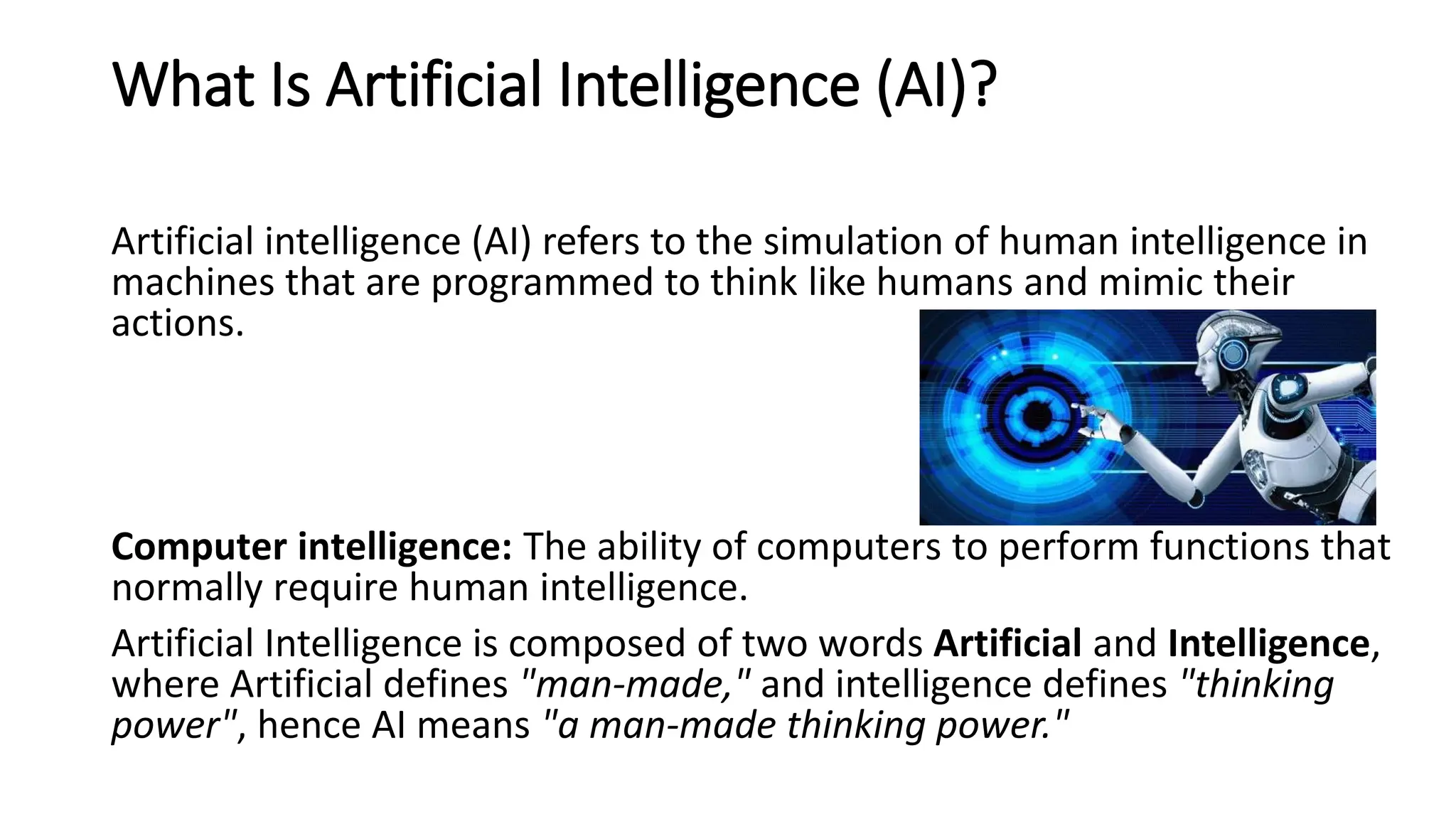
Artificial intelligence (AI) refers to the simulation of human intelligence in
machines that are programmed to think like humans and mimic their
actions.
Computer intelligence: The ability of computers to perform functions that
normally require human intelligence.
Artificial Intelligence is composed of two words Artificial and Intelligence,
where Artificial defines "man-made," and intelligence defines "thinking
power", hence AI means "a man-made thinking power."
History of Artificial Intelligence
• Year 1956: The word "Artificial Intelligence" first adopted by American
Computer scientist John McCarthy at the Dartmouth Conference. For the
first time, AI coined as an academic field.
• Year 1966: The researchers emphasized developing algorithms which can
solve mathematical problems. Joseph Weizenbaum created the first
chatbot in 1966, which was named as ELIZA.
• Year 1972: The first intelligent humanoid robot was built in Japan which
was named as WABOT-1.
• 1990’s Major advances in all areas of AI
• 2000 Interactive robot pets ( "smart toys") became commercially
available.
• Year 2012: Google has launched an Android app feature "Google now",
which was able to provide information to the user as a prediction.
Characteristics of intelligent behavior include the
ability to:
• Learn from experience and apply knowledge acquired from experience
• High Accuracy with less errors: AI machines or systems are prone to less errors
and high accuracy as it takes decisions as per pre-experience or information.
• High-Speed: AI systems can be of very high-speed and fast-decision making,
because of that AI systems can beat a chess champion in the Chess game.
• High reliability: AI machines are highly reliable and can perform the same action
multiple times with high accuracy.
• Useful for risky areas: AI machines can be helpful in situations such as defusing a
bomb, exploring the ocean floor, where to employ a human can be risky.
• Digital Assistant: AI can be very useful to provide digital assistant to the users
such as AI technology is currently used by various E-commerce websites to show
the products as per customer requirement.
• Useful as a public utility: AI can be very useful for public utilities such as a self-
driving car which can make our journey safer and hassle-free, facial recognition
for security purpose, Natural language processing to communicate with the
human in human-language, etc.
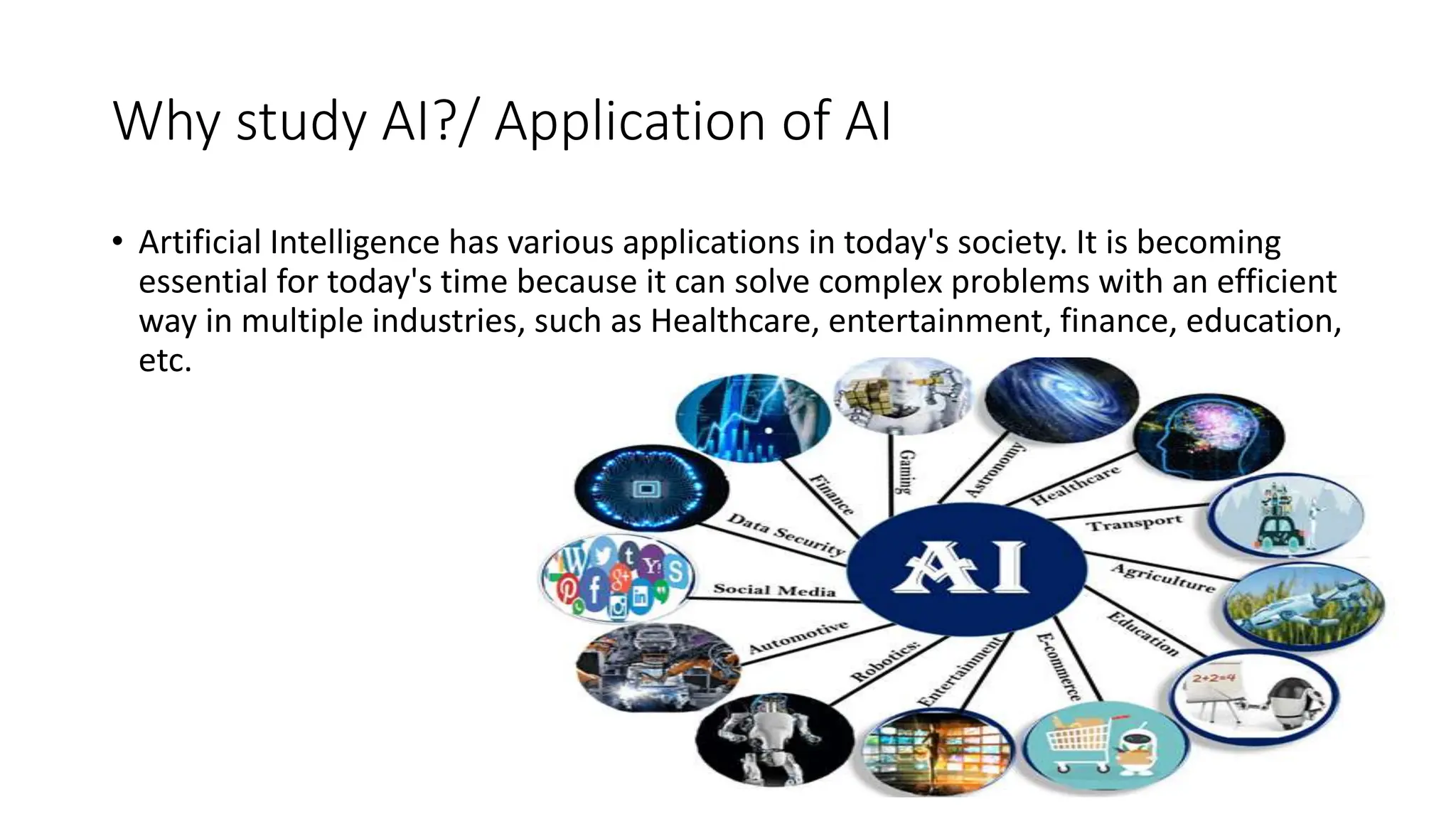
Why study AI?/ Application of AI
• Artificial Intelligence has various applications in today's society. It is becoming
essential for today's time because it can solve complex problems with an efficient
way in multiple industries, such as Healthcare, entertainment, finance, education,
etc.
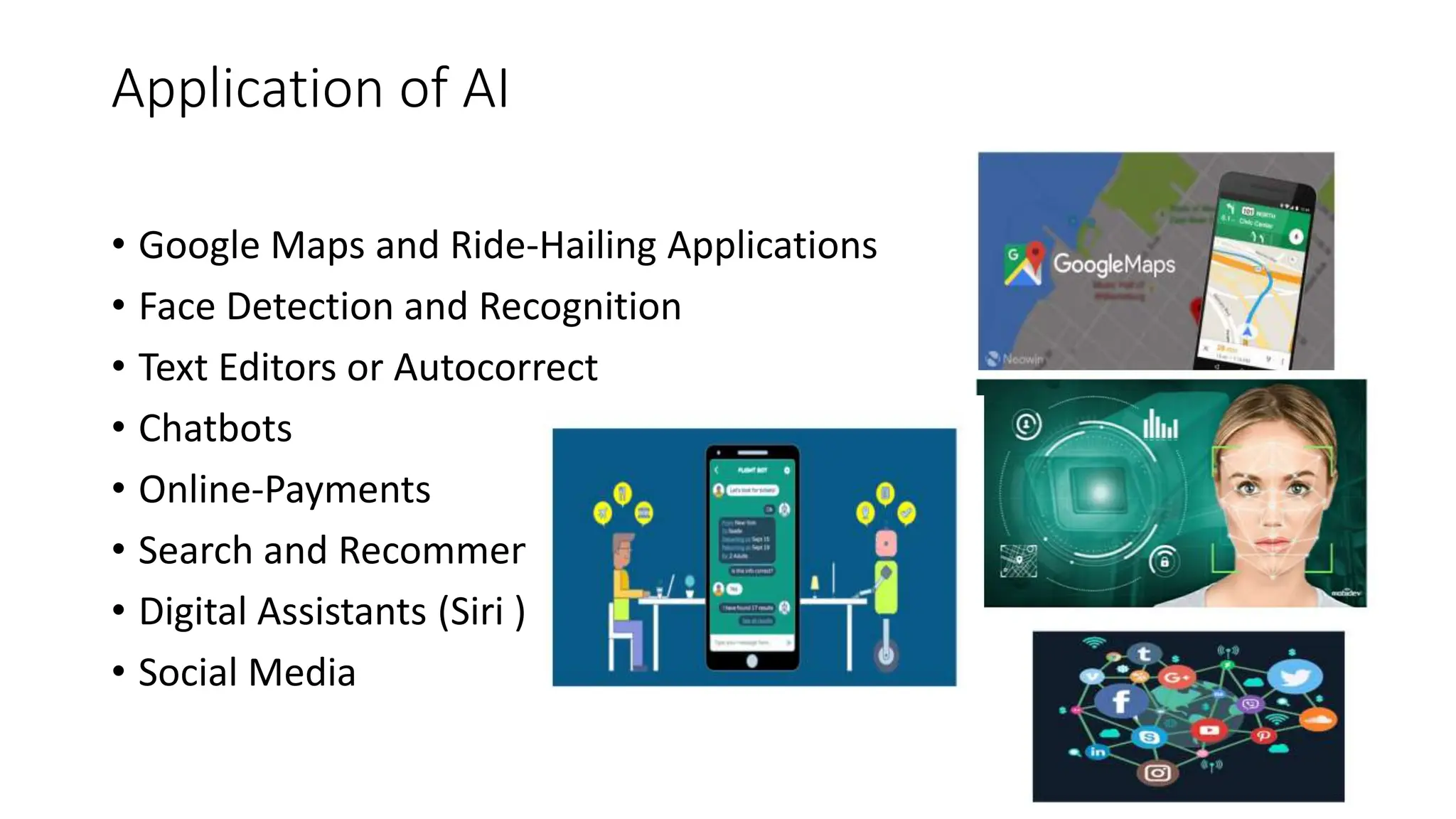
Application of AI
• Google Maps and Ride-Hailing Applications
• Face Detection and Recognition
• Text Editors or Autocorrect
• Chatbots
• Online-Payments
• Search and Recommendation Algorithms
• Digital Assistants (Siri )
• Social Media
Why study AI?/ Application of AI
• Neural Networks: -Can simulate the functioning of a human brain
-Can process many pieces of data at the same time and learn to
recognize patterns.
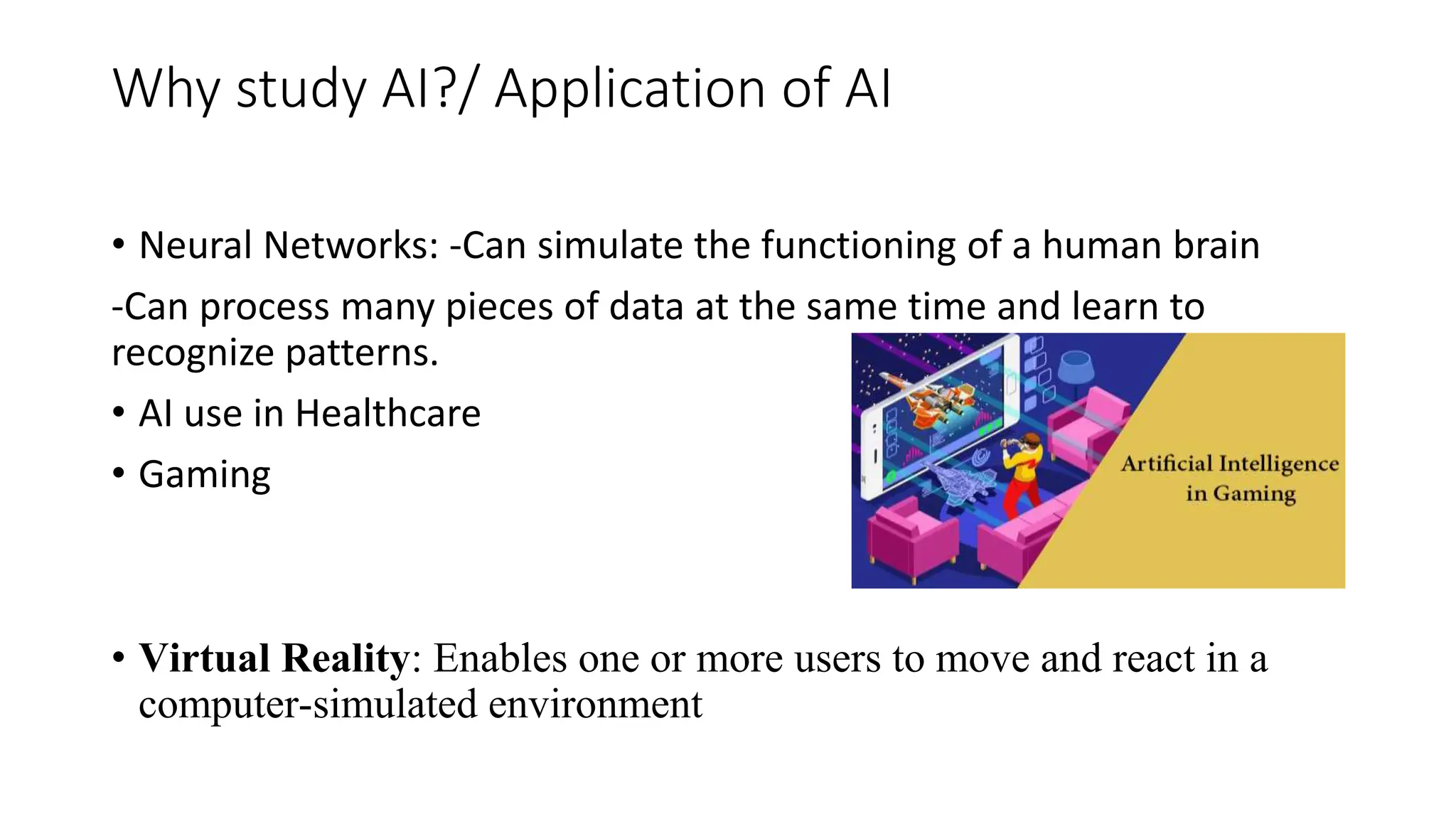
• AI use in Healthcare
• Gaming
• Virtual Reality: Enables one or more users to move and react in a
computer-simulated environment
Why study AI?/ Application of AI
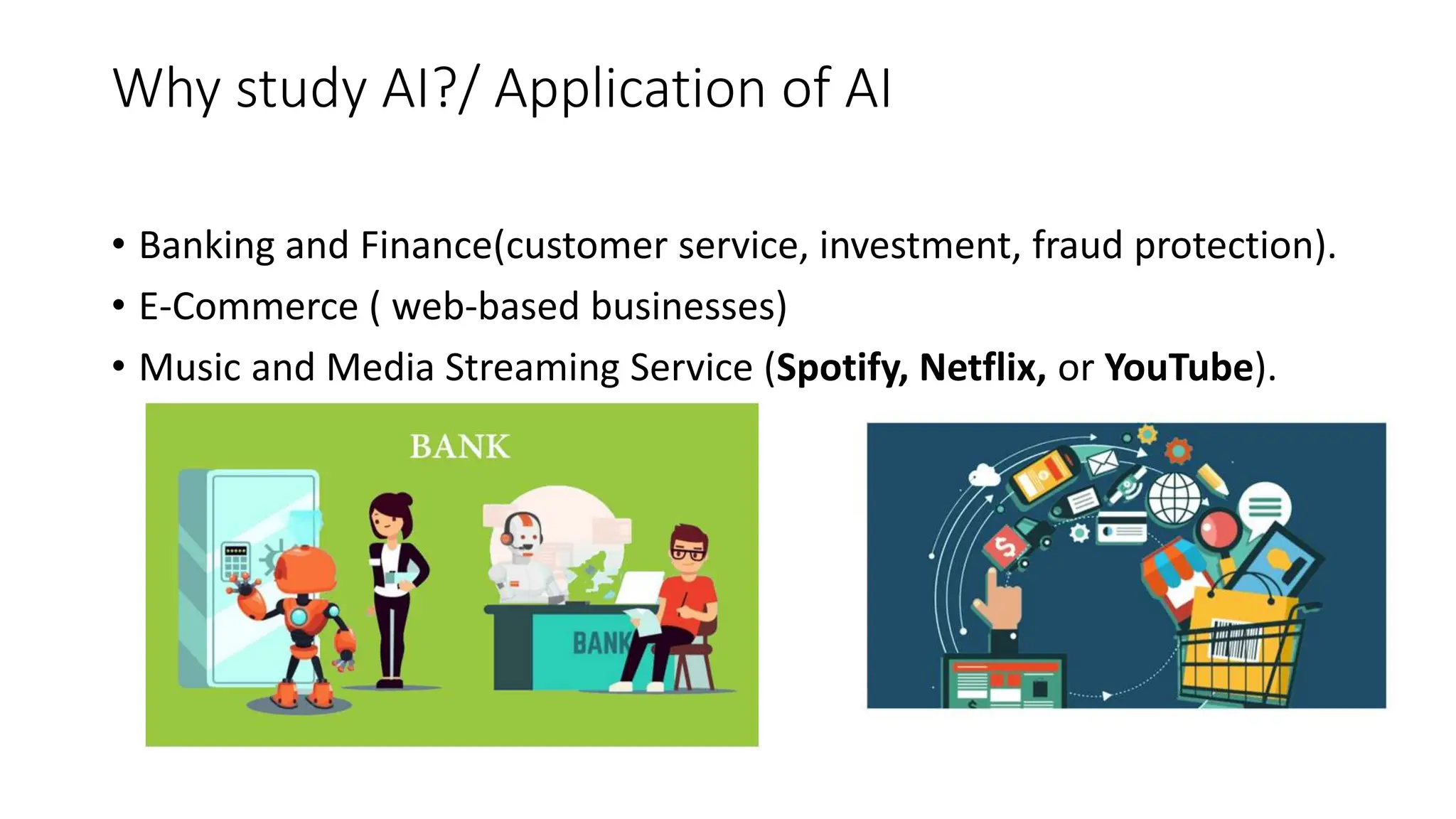
• Banking and Finance(customer service, investment, fraud protection).
• E-Commerce ( web-based businesses)
• Music and Media Streaming Service (Spotify, Netflix, or YouTube).
Robots: An Introduction
• A robot is a computer controlled machine with some degrees of
freedom typically has
• sensors to sense its environment, particularly to make sure it does
not hit any obstacles in its way
• goals (otherwise there is no need to have the robot)
• planning to determine how to accomplish those goals
• some robots are pre-programmed with the plan steps to carry out the
given goals so planning is not needed
• path planning to determine how to move about its environment using
the available degrees of freedom
Types of Robots
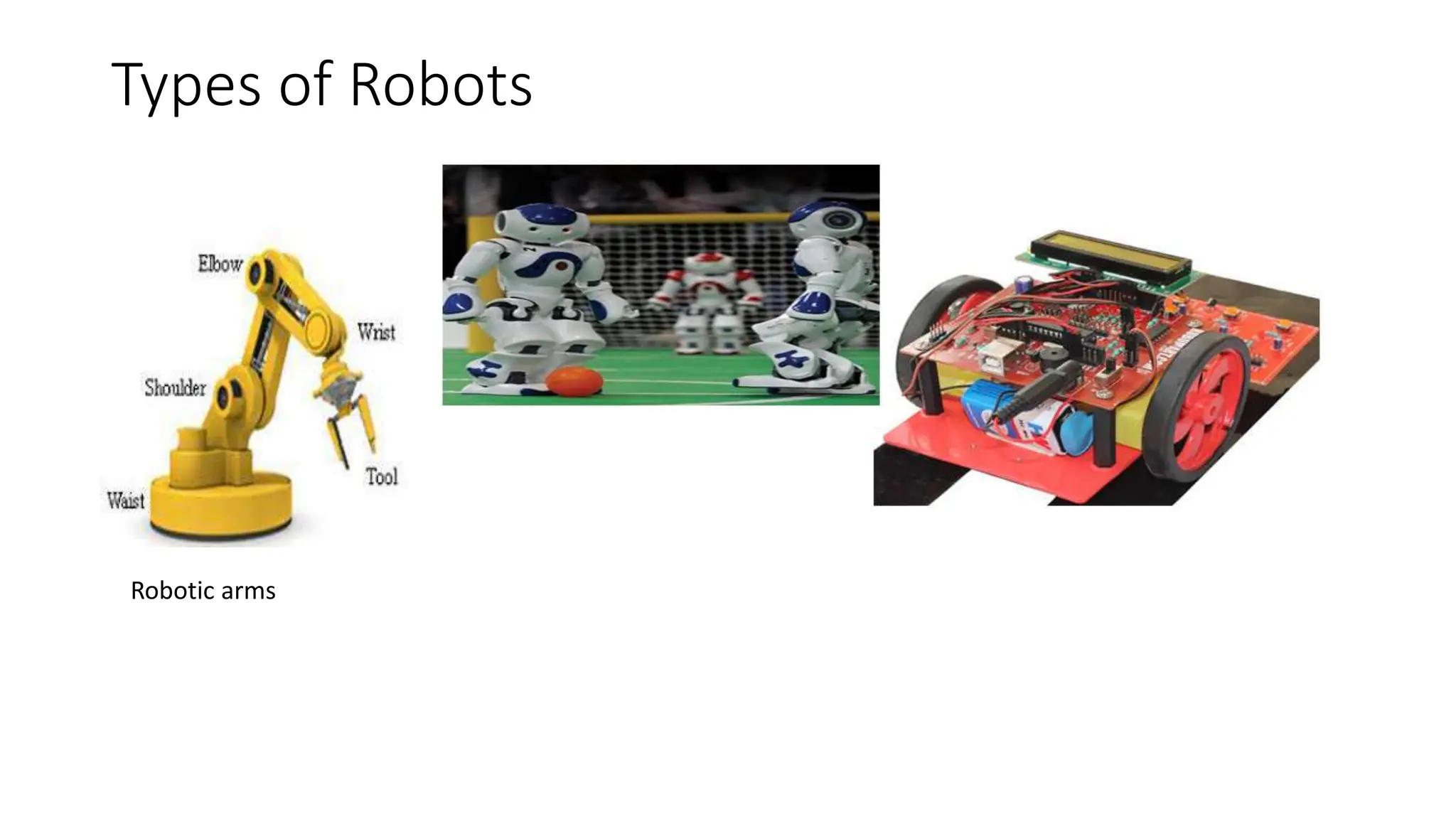
Mobile robots – robots that move freely in their environment.
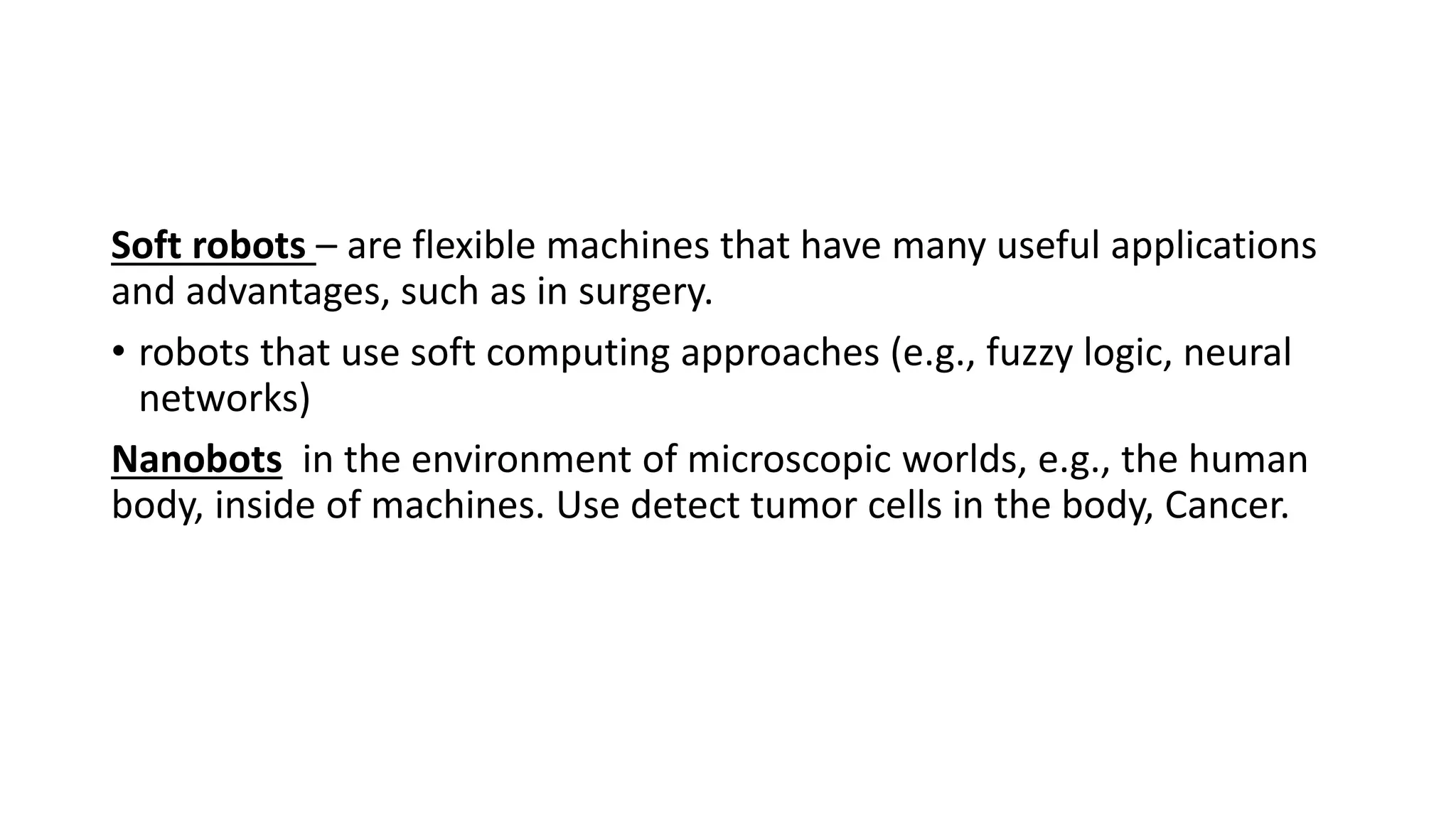
Humanoid robots, entertainment pets, drones, and underwater
robots are great examples of mobile robots. They are different from
other robots because of their ability to move autonomously. These
robots have the intelligence to decide based on algorithms it takes
input and gives the expected output.
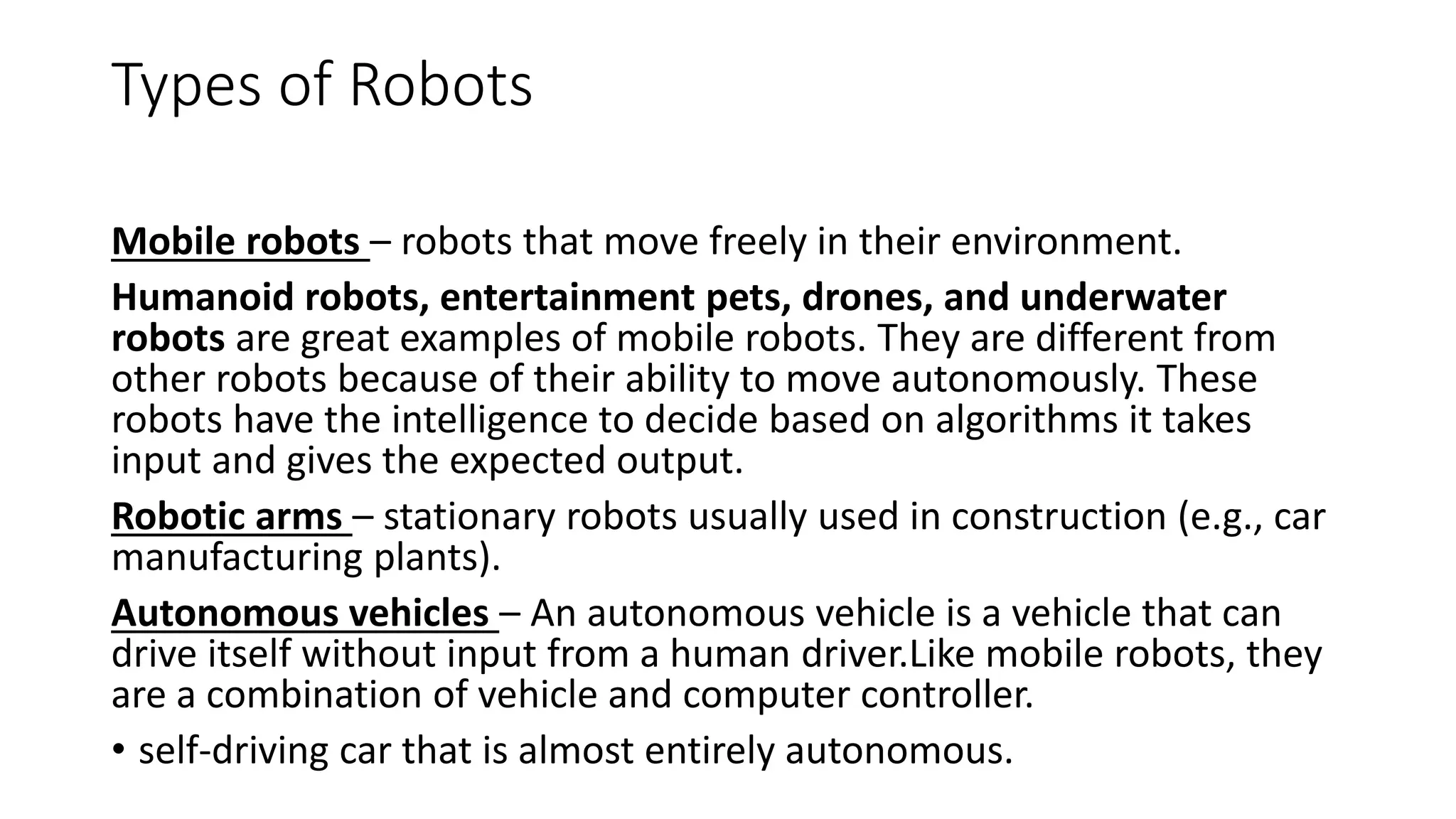
Robotic arms – stationary robots usually used in construction (e.g., car
manufacturing plants).
Autonomous vehicles – An autonomous vehicle is a vehicle that can
drive itself without input from a human driver.Like mobile robots, they
are a combination of vehicle and computer controller.
• self-driving car that is almost entirely autonomous.
Soft robots – are flexible machines that have many useful applications
and advantages, such as in surgery.
• robots that use soft computing approaches (e.g., fuzzy logic, neural
networks)
Nanobots in the environment of microscopic worlds, e.g., the human
body, inside of machines. Use detect tumor cells in the body, Cancer.
Types of Robots
Robotic arms
Factory robot uses:
Mechanical production, e.g., welding, painting
Packaging – often used in the production of packaged food, drinks,
medication
Electronics – placing chips on circuit boards
Bomb disabling
Exploration (volcanoes, underwater, other planets)

AI and Robotics(Lecture). All you know about AI and robotics.

  • 1.
  • 2.
    What Is ArtificialIntelligence (AI)? Artificial intelligence (AI) refers to the simulation of human intelligence in machines that are programmed to think like humans and mimic their actions. Computer intelligence: The ability of computers to perform functions that normally require human intelligence. Artificial Intelligence is composed of two words Artificial and Intelligence, where Artificial defines "man-made," and intelligence defines "thinking power", hence AI means "a man-made thinking power."
  • 3.
    History of ArtificialIntelligence • Year 1956: The word "Artificial Intelligence" first adopted by American Computer scientist John McCarthy at the Dartmouth Conference. For the first time, AI coined as an academic field. • Year 1966: The researchers emphasized developing algorithms which can solve mathematical problems. Joseph Weizenbaum created the first chatbot in 1966, which was named as ELIZA. • Year 1972: The first intelligent humanoid robot was built in Japan which was named as WABOT-1. • 1990’s Major advances in all areas of AI • 2000 Interactive robot pets ( "smart toys") became commercially available. • Year 2012: Google has launched an Android app feature "Google now", which was able to provide information to the user as a prediction.
  • 4.
    Characteristics of intelligentbehavior include the ability to: • Learn from experience and apply knowledge acquired from experience • High Accuracy with less errors: AI machines or systems are prone to less errors and high accuracy as it takes decisions as per pre-experience or information. • High-Speed: AI systems can be of very high-speed and fast-decision making, because of that AI systems can beat a chess champion in the Chess game. • High reliability: AI machines are highly reliable and can perform the same action multiple times with high accuracy. • Useful for risky areas: AI machines can be helpful in situations such as defusing a bomb, exploring the ocean floor, where to employ a human can be risky. • Digital Assistant: AI can be very useful to provide digital assistant to the users such as AI technology is currently used by various E-commerce websites to show the products as per customer requirement. • Useful as a public utility: AI can be very useful for public utilities such as a self- driving car which can make our journey safer and hassle-free, facial recognition for security purpose, Natural language processing to communicate with the human in human-language, etc.
  • 5.
    Why study AI?/Application of AI • Artificial Intelligence has various applications in today's society. It is becoming essential for today's time because it can solve complex problems with an efficient way in multiple industries, such as Healthcare, entertainment, finance, education, etc.
  • 6.
    Application of AI •Google Maps and Ride-Hailing Applications • Face Detection and Recognition • Text Editors or Autocorrect • Chatbots • Online-Payments • Search and Recommendation Algorithms • Digital Assistants (Siri ) • Social Media
  • 7.
    Why study AI?/Application of AI • Neural Networks: -Can simulate the functioning of a human brain -Can process many pieces of data at the same time and learn to recognize patterns. • AI use in Healthcare • Gaming • Virtual Reality: Enables one or more users to move and react in a computer-simulated environment
  • 8.
    Why study AI?/Application of AI • Banking and Finance(customer service, investment, fraud protection). • E-Commerce ( web-based businesses) • Music and Media Streaming Service (Spotify, Netflix, or YouTube).
  • 9.
    Robots: An Introduction •A robot is a computer controlled machine with some degrees of freedom typically has • sensors to sense its environment, particularly to make sure it does not hit any obstacles in its way • goals (otherwise there is no need to have the robot) • planning to determine how to accomplish those goals • some robots are pre-programmed with the plan steps to carry out the given goals so planning is not needed • path planning to determine how to move about its environment using the available degrees of freedom
  • 10.
    Types of Robots Mobilerobots – robots that move freely in their environment. Humanoid robots, entertainment pets, drones, and underwater robots are great examples of mobile robots. They are different from other robots because of their ability to move autonomously. These robots have the intelligence to decide based on algorithms it takes input and gives the expected output. Robotic arms – stationary robots usually used in construction (e.g., car manufacturing plants). Autonomous vehicles – An autonomous vehicle is a vehicle that can drive itself without input from a human driver.Like mobile robots, they are a combination of vehicle and computer controller. • self-driving car that is almost entirely autonomous.
  • 11.
    Soft robots –are flexible machines that have many useful applications and advantages, such as in surgery. • robots that use soft computing approaches (e.g., fuzzy logic, neural networks) Nanobots in the environment of microscopic worlds, e.g., the human body, inside of machines. Use detect tumor cells in the body, Cancer.
  • 12.
  • 13.
    Factory robot uses: Mechanicalproduction, e.g., welding, painting Packaging – often used in the production of packaged food, drinks, medication Electronics – placing chips on circuit boards Bomb disabling Exploration (volcanoes, underwater, other planets)