Artificial
Intelligence
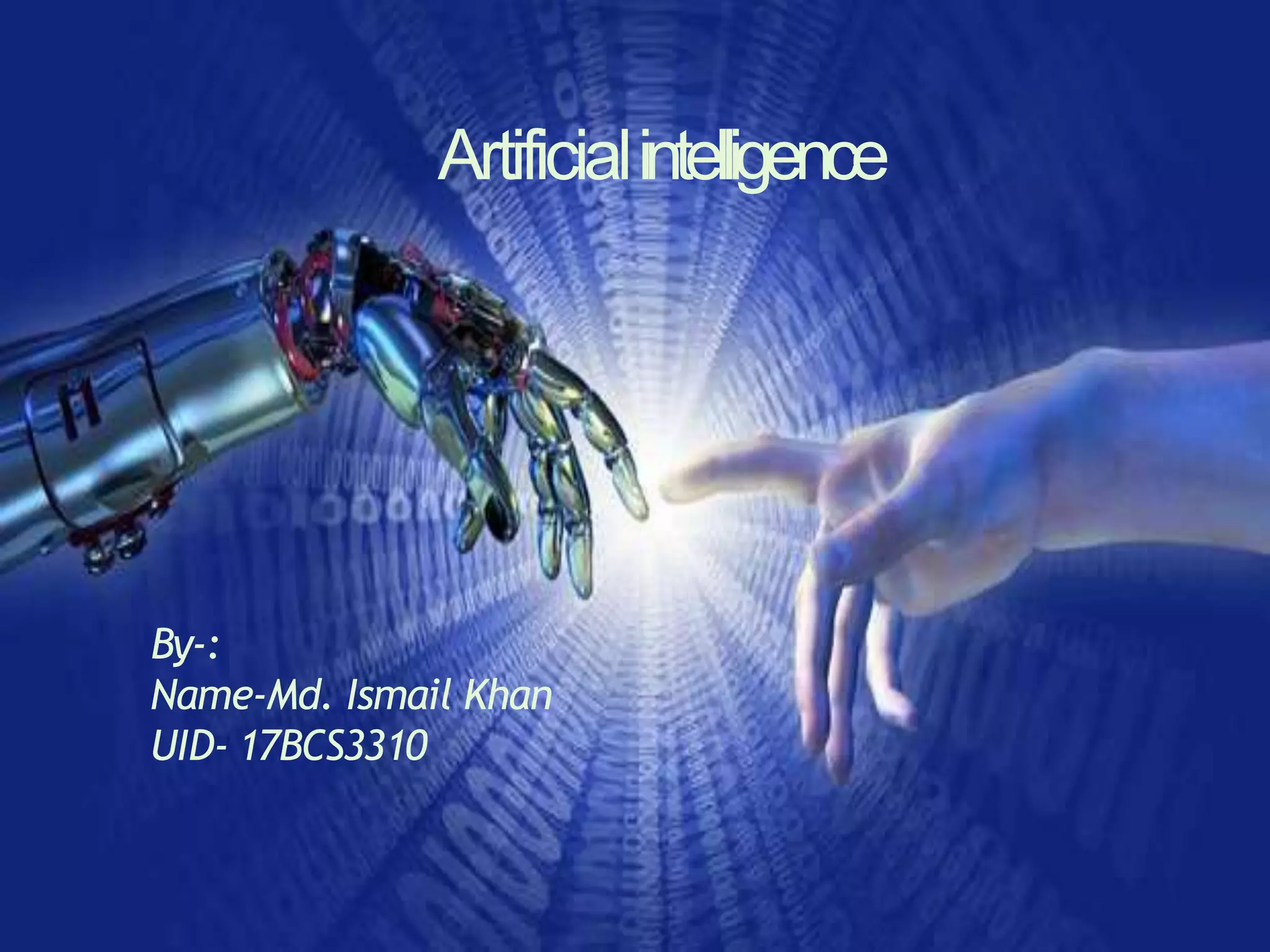
Artificialintelligence
By-:
Name-Md. Ismail Khan
UID- 17BCS3310
What is A r t i f i c i a l
Intelligence ?
 The theory and development of computer
systems able to perform tasks normally
requiring human intelligence, such asvisual
perception, speech recognition, decision-
making, and translation between languages.
 In simple words giving brain to the computer.
History of A r t i f i c i a l
intelligence
 The term artificial intelligence was first
coined by John McCarthy in 1956 when he
held the first academic conference on the
subject. But the journey to understand if
machines cantruly think began much before
that.
 JohnMcCarthy is known asfather ofArtificial
Intelligence.
Types of AI
 Sofar there are 3types ofAI
 1.Narrow artificial intelligence(ANI)
 2.General artificial intelligence(AGI)
 3.Super artificial intelligence(ASI)
More about types :
 ANI : The first stage, ANI, asthe name suggests,
is limited in scope with intelligence restricted to
only one functionalarea.
 AGI : The second stage(AGI)ofAI, is at an
advanced level: it coversmore than one field like
power of reasoning, problem solving and
abstract thinking, which is mostly on par with
matured human.
 ASI:The final stage(ASI)ofAI, is the final level ,
It will overcome entirely the human intelligence.
No one canable to challenge it.
Rise of A r t i f i c i a l Intelligence
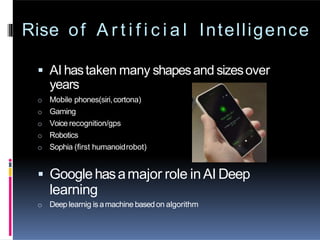
 AI hastaken many shapesand sizesover
years
o Mobile phones(siri,cortona)
o Gaming
o Voice recognition/gps
o Robotics
o Sophia (first humanoidrobot)
 Googlehasamajor role inAI Deep
learning
o Deep learnig is amachine basedon algorithm
Best Example on AI
 Siri,Google Now, and cortona are all intelligent
digital personal assistants on various platforms
(iOS,Android, and Windows Mobile). In short,
they help find useful information when you ask
for it using your voice; you cansay“Where’s the
nearest Chinese restaurant?”, “What’s on my
schedule today?”, “Remind me to callJerry at
eight o’clock,” and the assistant will respond by
finding information, relaying information from
your phone, or sending commands to other
apps.
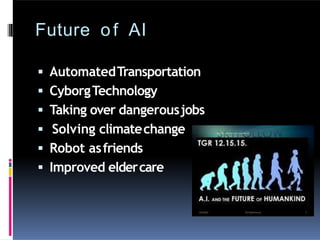
Future of AI
 AutomatedTransportation
 CyborgTechnology
 Taking over dangerousjobs
 Solving climatechange
 Robot asfriends
 Improved eldercare
Some famous sayings !
 “I visualize atime when we will be to robots
what dogsare to humans, and I’m rooting for
the machines.” —ClaudeShannon
 “What do you think about the machines that
think.”
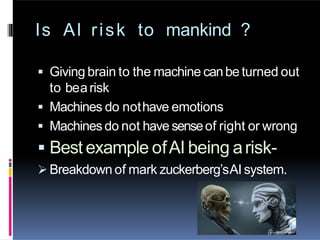
Is AI risk to mankind ?
 Giving brain to the machine canbe turned out
to bearisk
 Machines do nothave emotions
 Machinesdo not have senseof right or wrong
 Best example ofAI being arisk-
 Breakdown of mark zuckerberg’sAI system.
Pros and cons of AI
ConsPros
 Safety
 Better performancethan
humans
 It’s cheap
 It canpredict what your
customers will donext
 It canmake senseof all the
data and connection
around us
 Things can gowrong
 AI can be vulnerableto
attack
 Economicproblems
 Trust issues
 Abilities ofpeople will
diminish
 Moral andethical
implications
Conclusion
 Artificial Intelligence and the technology are one side
of the life that always interest and surprise uswith the
new ideas, topics, innovations, products …etc.AI is still
not implemented asthe films representing it(i.e.
intelligent robots), however there are many important
tries to reach the level and to compete in market, like
sometimes the robots that they show in TV.
Nevertheless, the hidden projects and the
development in industrialcompanies.
ThankYou!

Artificial Intelligence ppt

  • 1.
  • 2.
    What is Ar t i f i c i a l Intelligence ?  The theory and development of computer systems able to perform tasks normally requiring human intelligence, such asvisual perception, speech recognition, decision- making, and translation between languages.  In simple words giving brain to the computer.
  • 3.
    History of Ar t i f i c i a l intelligence  The term artificial intelligence was first coined by John McCarthy in 1956 when he held the first academic conference on the subject. But the journey to understand if machines cantruly think began much before that.  JohnMcCarthy is known asfather ofArtificial Intelligence.
  • 4.
    Types of AI Sofar there are 3types ofAI  1.Narrow artificial intelligence(ANI)  2.General artificial intelligence(AGI)  3.Super artificial intelligence(ASI)
  • 5.
    More about types:  ANI : The first stage, ANI, asthe name suggests, is limited in scope with intelligence restricted to only one functionalarea.  AGI : The second stage(AGI)ofAI, is at an advanced level: it coversmore than one field like power of reasoning, problem solving and abstract thinking, which is mostly on par with matured human.  ASI:The final stage(ASI)ofAI, is the final level , It will overcome entirely the human intelligence. No one canable to challenge it.
  • 6.
    Rise of Ar t i f i c i a l Intelligence  AI hastaken many shapesand sizesover years o Mobile phones(siri,cortona) o Gaming o Voice recognition/gps o Robotics o Sophia (first humanoidrobot)  Googlehasamajor role inAI Deep learning o Deep learnig is amachine basedon algorithm
  • 7.
    Best Example onAI  Siri,Google Now, and cortona are all intelligent digital personal assistants on various platforms (iOS,Android, and Windows Mobile). In short, they help find useful information when you ask for it using your voice; you cansay“Where’s the nearest Chinese restaurant?”, “What’s on my schedule today?”, “Remind me to callJerry at eight o’clock,” and the assistant will respond by finding information, relaying information from your phone, or sending commands to other apps.
  • 8.
    Future of AI AutomatedTransportation  CyborgTechnology  Taking over dangerousjobs  Solving climatechange  Robot asfriends  Improved eldercare
  • 9.
    Some famous sayings!  “I visualize atime when we will be to robots what dogsare to humans, and I’m rooting for the machines.” —ClaudeShannon  “What do you think about the machines that think.”
  • 10.
    Is AI riskto mankind ?  Giving brain to the machine canbe turned out to bearisk  Machines do nothave emotions  Machinesdo not have senseof right or wrong  Best example ofAI being arisk-  Breakdown of mark zuckerberg’sAI system.
  • 11.
    Pros and consof AI ConsPros  Safety  Better performancethan humans  It’s cheap  It canpredict what your customers will donext  It canmake senseof all the data and connection around us  Things can gowrong  AI can be vulnerableto attack  Economicproblems  Trust issues  Abilities ofpeople will diminish  Moral andethical implications
  • 12.
    Conclusion  Artificial Intelligenceand the technology are one side of the life that always interest and surprise uswith the new ideas, topics, innovations, products …etc.AI is still not implemented asthe films representing it(i.e. intelligent robots), however there are many important tries to reach the level and to compete in market, like sometimes the robots that they show in TV. Nevertheless, the hidden projects and the development in industrialcompanies.
  • 13.