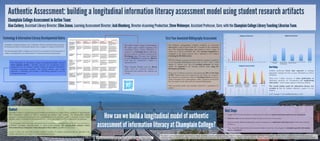
Authentic Assessment: building a longitudinal information literacy assessment model using student research artifacts
Champlain College Assessment in Action Team:
Alan Carbery, Assistant Library Director; Ellen Zeman, Learning Assessment Director; Josh Blumberg, Director eLearning Production; Steve Wehmeyer, Assistant Professor, Core; with the Champlain College Library Teaching Librarian Team.
The rubric contains 4 stages of development.
We might expect students beginning their
information literacy journey (freshmen) to
perform at an Emerging Level. Sophomore
& Juniors might be expected to perform at the
Developing stage. We expect our Graduates
to reach Proficiency by graduation. Mastery
level may be considered a higher or
aspirational level.
When assessing, librarians used the Absent
grade when we expected students to
demonstrate that criterion, but evidence was
missing.
The Technology & Information Literacy Developmental Rubric contains
seven separate criteria – Identifies questions for investigation; selects
appropriate tools & strategies; critically evaluates & appraises information;
synthesizes information; attributes work ethically; practices safe & legal
approach to technology, and develops a self-learning approach to new &
emerging technologies.
Champlain’s Teaching Librarian team (7 librarians) devised, developed and normed the
developmental rubric for information literacy over a number of months in 2014/2015.
The developmental rubric is designed to be used as an assessment tool for any piece of
student work appropriate for demonstration of information literacy performance.
Technology & Information Literacy Developmental Rubric First Year Annotated Bibliography Assessment
Iden%fies(Ques%ons(
for(Inves%ga%on(
Selects(Appropriate(
Strategies(&(Tools(to(
Access(Informa%on(
Cri%cally(evaluates(
and(appraises(
informa%on(
Synthesizes(
Informa%on(
A?ribu%on(
0( 7( 2( 7( 7( 2(
1( 26( 22( 32( 23( 26(
2( 22( 29( 14( 25( 21(
3( 2( 4( 4( 2( 8(
4( 0( 0( 0( 0( 0(
0(
5(
10(
15(
20(
25(
30(
35(
0(
1(
2(
3(
4(
Iden%fies(Ques%ons(for(
Inves%ga%on(
Selects(Appropriate(
Strategies(&(Tools(to(
Access(Informa%on(
Cri%cally(evaluates(and(
appraises(informa%on(
Synthesizes(Informa%on( A?ribu%on(
0(
2(
4(
6(
8(
10(
12(
0( 0.2( 0.4( 0.6( 0.8( 1( 1.2( 1.4( 1.6( 1.8( 2( 2.2( 2.4( 2.6( 2.8( 3( 3.2( 3.4( 3.6( 3.8( 4(
This%project%is%part%of%the%program%“Assessment%in%Ac4on:%Academic%Libraries%and%Student%Success”%which%is%undertaken%by%the%Associa4on%of%College%and%Research%Libraries%(ACRL)%in%partnership%with%the%Associa4on%for%
Ins4tu4onal%Research%and%the%Associa4on%of%Public%and%LandFgrant%Universi4es.%The%program,%a%cornerstone%of%ACRL's%Value%of%Academic%Libraries%ini4a4ve,%is%made%possible%by%the%Ins4tute%of%Museum%and%Library%Services.%(
Main Findings
Students performed better than expected in selecting
appropriate strategies & tools to access information as well as
attribution.
There were a higher instances of lower performance in
identifying questions for investigation and synthesizing
information – which students appear to find more difficult.
The overall median grade for information literacy was
recorded at 1.4. No students achieved a grade 4 in any
criterion.
n=57, Average = 1.44, standard deviation = 0.55
All freshmen undergraduate students complete an annotated
bibliography as part of their COR 120 – Concepts of the Community
class. This annotated bibliography asks students to find a range of
sources on a chosen community type. This common assignment is
completed in the Spring semester and is uploaded to the College’s
eLearning & ePortfolio system.
With the College’s Learning Assessment Director, the library sampled a
set of annotated bibliographies from Class of 2017. After a small
number of artifacts were used for norming processes, the larger
sample was assessed by the Teaching Librarian Team using the
Developmental Rubric.
There were 57 artifacts assessed in total representing 10% of the Class
of 2017. Student names were redacted and each artifact was assigned a
key code prior to assessment, to allow for tracking in future assessment
efforts throughout their undergraduate studies. Librarians assessed the
first five criteria on the rubric with the annotated bibliography
After assessment; grades were manually entered into a spreadsheet for
analysis.
Context
Frequency of overall scores Median Score by Criterion
Frequency of scores by criterion
How can we build a longitudinal model of authentic
assessment of information literacy at Champlain College?
Champlain College is a small, private, professionally-focused liberal arts college with an enrollment of approximately
2000 undergraduate students, as well as continuing and graduate online students. The undergraduate student
experience is enhanced through an innovative interdisciplinary Core curriculum, which sits alongside students’ major
discipline studies. Technology & Information literacy is one of the college’s 9 college competencies for graduates.
Since its inception over 8 years ago, information literacy instruction is embedded throughout the Core curriculum in
a blended, scaffolded, sequential model of inquiry-based pedagogy. All undergraduate students receive
information literacy instruction 7 times throughout their studies, regardless of their major.
As part of their Core curriculum, students complete a number of common assignments that are uploaded to the
College’s ePortfolio in our College’s Learning Management System.
Next Steps
•  Sample COR 310 Literature Review student research artifacts for Junior-level information literacy assessment
•  Norm & revise the developmental rubric for this second wave of assessment
•  Target & identify additional appropriate common assignments in sophomore and senior year for information literacy
assessment
•  Target & identify academic division assessment artifacts beyond the Core program for discipline-specific information
literacy assessment
Illustration & poster created by Alan Carbery, Champlain College library.

Authentic Assessment: building a longitudinal information literacy assessment model using student research artifacts

  • 1.
    Authentic Assessment: buildinga longitudinal information literacy assessment model using student research artifacts Champlain College Assessment in Action Team: Alan Carbery, Assistant Library Director; Ellen Zeman, Learning Assessment Director; Josh Blumberg, Director eLearning Production; Steve Wehmeyer, Assistant Professor, Core; with the Champlain College Library Teaching Librarian Team. The rubric contains 4 stages of development. We might expect students beginning their information literacy journey (freshmen) to perform at an Emerging Level. Sophomore & Juniors might be expected to perform at the Developing stage. We expect our Graduates to reach Proficiency by graduation. Mastery level may be considered a higher or aspirational level. When assessing, librarians used the Absent grade when we expected students to demonstrate that criterion, but evidence was missing. The Technology & Information Literacy Developmental Rubric contains seven separate criteria – Identifies questions for investigation; selects appropriate tools & strategies; critically evaluates & appraises information; synthesizes information; attributes work ethically; practices safe & legal approach to technology, and develops a self-learning approach to new & emerging technologies. Champlain’s Teaching Librarian team (7 librarians) devised, developed and normed the developmental rubric for information literacy over a number of months in 2014/2015. The developmental rubric is designed to be used as an assessment tool for any piece of student work appropriate for demonstration of information literacy performance. Technology & Information Literacy Developmental Rubric First Year Annotated Bibliography Assessment Iden%fies(Ques%ons( for(Inves%ga%on( Selects(Appropriate( Strategies(&(Tools(to( Access(Informa%on( Cri%cally(evaluates( and(appraises( informa%on( Synthesizes( Informa%on( A?ribu%on( 0( 7( 2( 7( 7( 2( 1( 26( 22( 32( 23( 26( 2( 22( 29( 14( 25( 21( 3( 2( 4( 4( 2( 8( 4( 0( 0( 0( 0( 0( 0( 5( 10( 15( 20( 25( 30( 35( 0( 1( 2( 3( 4( Iden%fies(Ques%ons(for( Inves%ga%on( Selects(Appropriate( Strategies(&(Tools(to( Access(Informa%on( Cri%cally(evaluates(and( appraises(informa%on( Synthesizes(Informa%on( A?ribu%on( 0( 2( 4( 6( 8( 10( 12( 0( 0.2( 0.4( 0.6( 0.8( 1( 1.2( 1.4( 1.6( 1.8( 2( 2.2( 2.4( 2.6( 2.8( 3( 3.2( 3.4( 3.6( 3.8( 4( This%project%is%part%of%the%program%“Assessment%in%Ac4on:%Academic%Libraries%and%Student%Success”%which%is%undertaken%by%the%Associa4on%of%College%and%Research%Libraries%(ACRL)%in%partnership%with%the%Associa4on%for% Ins4tu4onal%Research%and%the%Associa4on%of%Public%and%LandFgrant%Universi4es.%The%program,%a%cornerstone%of%ACRL's%Value%of%Academic%Libraries%ini4a4ve,%is%made%possible%by%the%Ins4tute%of%Museum%and%Library%Services.%( Main Findings Students performed better than expected in selecting appropriate strategies & tools to access information as well as attribution. There were a higher instances of lower performance in identifying questions for investigation and synthesizing information – which students appear to find more difficult. The overall median grade for information literacy was recorded at 1.4. No students achieved a grade 4 in any criterion. n=57, Average = 1.44, standard deviation = 0.55 All freshmen undergraduate students complete an annotated bibliography as part of their COR 120 – Concepts of the Community class. This annotated bibliography asks students to find a range of sources on a chosen community type. This common assignment is completed in the Spring semester and is uploaded to the College’s eLearning & ePortfolio system. With the College’s Learning Assessment Director, the library sampled a set of annotated bibliographies from Class of 2017. After a small number of artifacts were used for norming processes, the larger sample was assessed by the Teaching Librarian Team using the Developmental Rubric. There were 57 artifacts assessed in total representing 10% of the Class of 2017. Student names were redacted and each artifact was assigned a key code prior to assessment, to allow for tracking in future assessment efforts throughout their undergraduate studies. Librarians assessed the first five criteria on the rubric with the annotated bibliography After assessment; grades were manually entered into a spreadsheet for analysis. Context Frequency of overall scores Median Score by Criterion Frequency of scores by criterion How can we build a longitudinal model of authentic assessment of information literacy at Champlain College? Champlain College is a small, private, professionally-focused liberal arts college with an enrollment of approximately 2000 undergraduate students, as well as continuing and graduate online students. The undergraduate student experience is enhanced through an innovative interdisciplinary Core curriculum, which sits alongside students’ major discipline studies. Technology & Information literacy is one of the college’s 9 college competencies for graduates. Since its inception over 8 years ago, information literacy instruction is embedded throughout the Core curriculum in a blended, scaffolded, sequential model of inquiry-based pedagogy. All undergraduate students receive information literacy instruction 7 times throughout their studies, regardless of their major. As part of their Core curriculum, students complete a number of common assignments that are uploaded to the College’s ePortfolio in our College’s Learning Management System. Next Steps •  Sample COR 310 Literature Review student research artifacts for Junior-level information literacy assessment •  Norm & revise the developmental rubric for this second wave of assessment •  Target & identify additional appropriate common assignments in sophomore and senior year for information literacy assessment •  Target & identify academic division assessment artifacts beyond the Core program for discipline-specific information literacy assessment Illustration & poster created by Alan Carbery, Champlain College library.