Agrometeorology
2014 Agricultural Engineering Review
Prepared by: Edward R. Lapong, PhD
Agrometeorology
- study which deals with the relationship of the
physical environment and agricultural elements
 Physical environment: atmosphere, soil and water
 Agriculture elements: crops and animals
Objective: optimally utilize the existing microclimate
for agricultural purposes;
minimize agri-business losses due to
unfavorable weather conditions;
gather/record data for future studies
Agromet stations are usually found in universities
and research institutes/stations, to collect
meteorological and biological data
Major data collected:
- rainfall
- temperature (atmospheric and soil)
- atmospheric pressure
- relative humidity
- wind data
- solar radiation
Major data collected:
Phenology – the study of animal and plant life cycle as
affected by seasonal variations of climate
- evaporation
- phenological observations (crop growth and
production data, animal diseases outbreak,
insect population and infestation, etc.)
Recommended Time of Data Collection:
 2~3 times daily, from 8 AM~5 or 6 PM
(8am, 10am, 12am, 2am, 4pm, 6pm); (8am, 11am, 2pm, 5pm)
Parameter Standard Agromet Station AWS
Rainfall 24-hr 1-, 5-, 30-min; 1-hr
Solar Radiation 12-, 24-hr 1-hr
Temperature,
Pressure, Humidity
2-, 3-hr 1-hr or less
Wind Speed &
Direction
2-, 3-hr 1-hr or less
Cloud/Sky Condition 2-, 3-hr 1-hr
Standard Agromet Station (recommended by PCARRD)
Criteria for selection of Agromet Station site:
 Accessibilty for data monitoring, operation
and maintenance
 Should be in a location truly representative
of the natural conditions of the agricultural
region it suppose to serve
 Site has no problem on right of way,
ownership and security
 Site is fairly level and flood-free
 Site free from obstruction
 at least 4x the height of the nearest obstruction
(other reference: 8-10 times)
 no shadow casted greater part of the day
 Facing north
(east-west direction
should be identified)
Criteria for selection of Agromet Station site:
 Site has grass cover and no tall weeds
 Site is not concrete, asphalted, nor made
of crushed stone.
 Security should be provided (fence)
Agromet Station Instruments:
1. Rainfall-measuring instruments:
a. Standard Rain Gage
A = 20 cm (8”)
a
AREA
area
10
1







 H
D
h
d 2
2
4
10
1
4


The actual rainfall depth is magnified 10 times
in the collecting cylinder.
b. Tipping Bucket Rain Gage
c. Optical Rain Gage
d. Weighing-type Rain Gage
Consists of a storage bin atop a pen recording the changes of
weight on a rotating drum.
Unlike Tipping Bucket, it does not underestimate intense rain.
Contains a device to measure the quantity of chemicals
contained in the locations atmosphere. This is extremely helpful
to study the effects of greenhouse gases.
However, they are more expensive.
e. Acoustic-type Rain Gage
Ombrometer – rain gage
Disdrometer – measures drop size distribution and
velocity of precipitation
- distinguish rain, snow, hail, etc
Hydrometeors – precipitation
Why are rainfall measurements expressed
in terms of depth and not by volume?
Ans.
‘Depth’ (mm) is the amount of rainfall that would
accumulate on a flat, horizontal and impermeable
surface in a given time (min or hr)
a. It is not feasible to calculate rainfall volume
since areal coverage may be different
Why are rainfall measurements expressed
in terms of depth and not by volume?
b. To provide an international standard and uniform
measurement of rainfall. It is more simple,
effective and easier to measure, describe and
compare amount of rainfall in ‘depth’.
 For consistency, simplicity and standardization
Agromet Station Instruments:
2. Temperature-measuring instruments:
Maximum-Minimum
Thermometers
Ordinary
Thermometers
Maximum Thermometer
When temperature rises, the
expanding mercury is forced
past the constriction but when
the temperature falls the
column of mercury remains in
the tube, thus indicating the
maximum temperature
b. Aneroid Barometer
Agromet Station Instruments:
3. Pressure-measuring instruments:
a. Mercury Barometer
Aneroid Barometer
It is basically a manometer
with one end exposed to the
atmosphere
It is more sensitive than
aneroid barometer since it
has Vernier scale on it and
has already temperature,
elevation and altitude
corrections.
Other differences between aneroid barometer and
mercury barometer?
• Aneroid barometer is more stable
and compact, less fragile; thus, is
easy to transport and take readings.
• The mercury barometer can be
constructed easily, but the aneroid
barometer requires machinery.
Why is barometer installed inside rather
than outside the building?
Ans.
a. To prevent effect of wind and solar radiation
b. To prevent effect of outside temperature and
humidity
(However, if the room is not airtight, no significant
difference.)
(Vibration and shock may lead to fluctuation)
(Barometer does not give a true reading if affected
by gusty wind.)
Why is barometer installed inside rather
than outside the building?
Ans.
c. To prevent wear and tear.
Note: Barometer should not be placed in an air
conditioned room.
(It may create a pressure differential between the
inside and outside environment)
Instrument Shelter (Thermometer Screen)
It shields the instruments
against rain and direct solar
radiation while allowing air
to circulate freely around
them.
To provide a standardized
environment in which to put
or keep the temperature-
and humidity-measuring
instruments.
Why should instrument shelter be painted
white?
Ans. To reflect the solar radiation and avoid
absorption of radiation that may affect
the setting/calibration and accuracy of
the instruments placed inside.
Agromet Station Instruments:
4. Humidity-measuring instruments:
a. Hygrometer
b. Hygrothermograph
c. Psychrometer
Sling Psychrometer
Hand-held Digital
Psychrometer
Dry-Bulb
Thermometer
Wet-Bulb
Thermometer
Agromet Station Instruments:
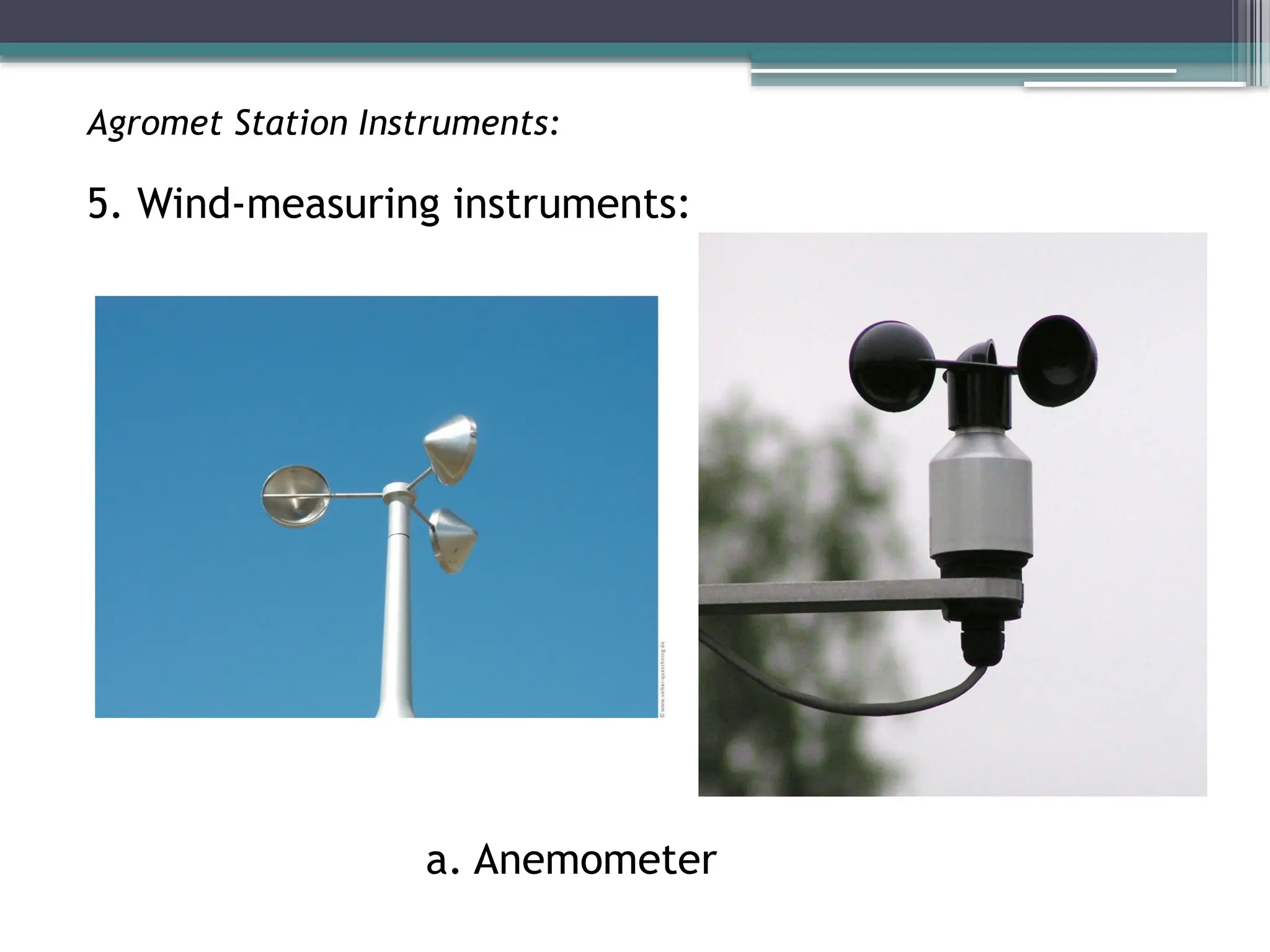
5. Wind-measuring instruments:
a. Anemometer
b. Wind Vane
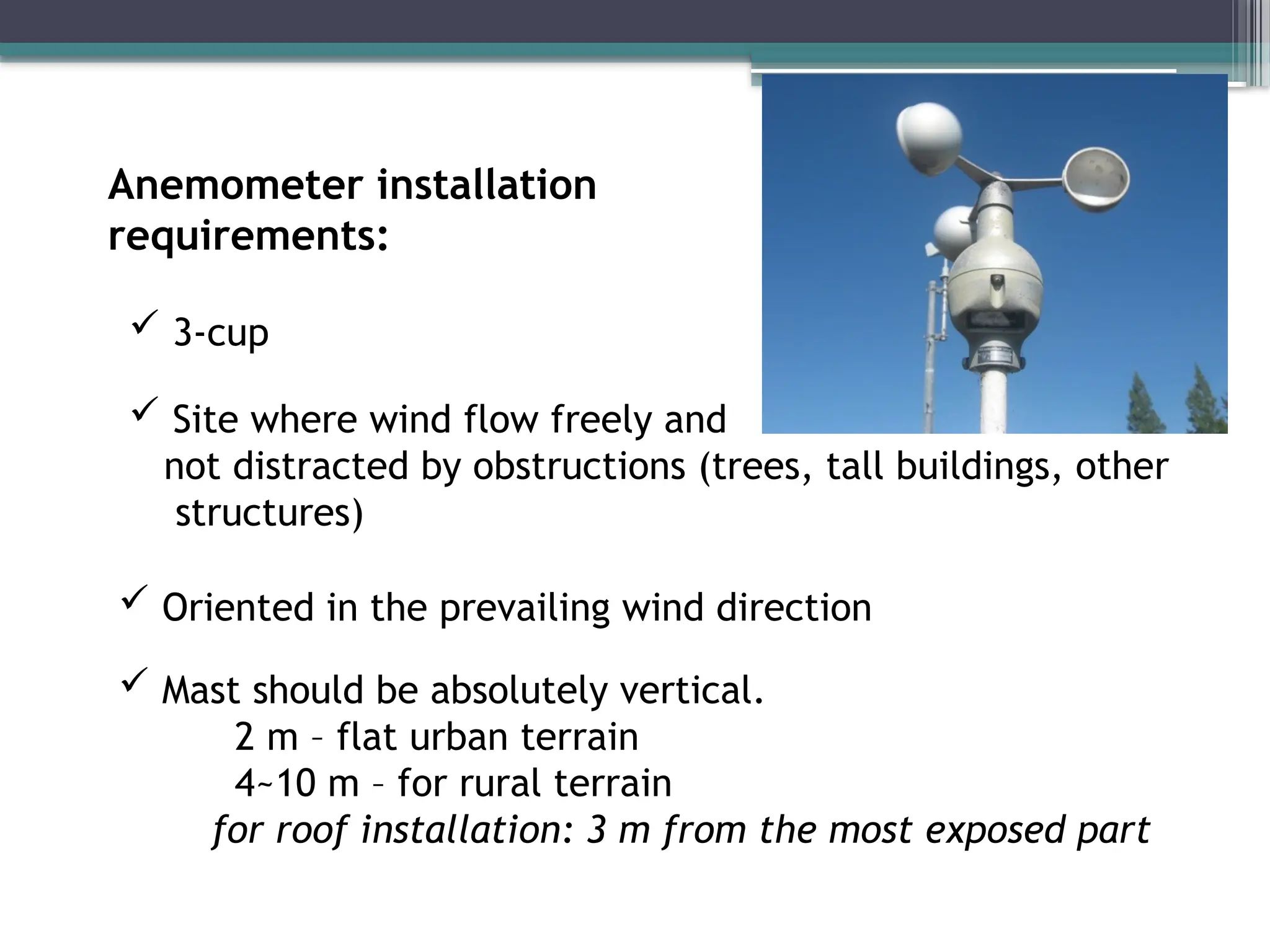
Anemometer installation
requirements:
 Site where wind flow freely and
not distracted by obstructions (trees, tall buildings, other
structures)
 Oriented in the prevailing wind direction
 Mast should be absolutely vertical.
2 m – flat urban terrain
4~10 m – for rural terrain
for roof installation: 3 m from the most exposed part
 3-cup
Wind vane installation requirements:
 Should be mounted towards true north
(use magnetic compass and corrected by the magnetic
delineation for specific area)
 Satisfactorily exposed and can rotate 3600
 Best mounted in an open terrain, at least 30 m from the
nearest obstruction
(wind can blow freely, no nearby obstruction)
 Mounted 6-10 m above the ground
Wind vane installation requirements:
 Could be as simple as
handcrafted wooden or light
metal; or as elaborate with
decorative ornament
 Lightning rod may be installed to
minimize risk of damage during
thunderstorm.
Agromet Station Instruments:
6. Evaporation-measuring instruments:
Evaporation Pan
Class A Evaporation Pan
120 cm (47.5’) 25 cm
(10’)
Stilling Well
 Class A Evaporation Pan measurement is highly correlated
with the potential evapotranspiration of the surrounding area.
Class A Evaporation Pan installation requirements:
 Galvanized iron Gage 20
 Operating water level depth: 175~200 mm
(water level kept at 50~75 mm from the rim)
 Installed 150-mm from the ground on wooden
stand/platform
 Measuring stick is 1.0 m and accuracy of 0.02 mm.
 Measurement should be done in still well as it
prevents the effect of waves and ripples which
affects accuracy.
Why should measurement be done in the
stilling well?
Agromet Station Instruments:
6. Solar Radiation-measuring instruments:
a. Sunshine Recorder
Campbell-Stokes
Sunshine Recorder:
A device that measures or
records the amount of
sunshine at a given location.
Campbell-Stokes
Sunshine Recorder
b. Actinometer – used to measure heating power of radiation
Solar radiation as transmitted directly by the sun,
scattered by the atmosphere, or reflected by the earth.
c. Pyranometer
A type of actinometer used to
measure broadband solar
irradiance (short wave radiation)
c. Pyrheliometer
Used to measure intensity of
direct solar radiation
Agromet Station Instruments:
7. Other instruments:
a. Ceilometer
A device which uses a laser
or other light source to
determine the height of
a cloud base.
b. Radiosonde
A group of instruments for
simultaneous
measurement and radio
transmission of
meteorological data:
temperature, pressure,
and humidity of the
atmosphere. The
instrument package is
usually carried into the
atmosphere by a balloon.
 A typical AWS comprises 8
sensors for measuring wind
speed, wind direction, air
temperature, RH, solar
radiation, soil temp., surface
wetness, and rainfall.
AWS (Automatic Weather Station)
 Battery- or solar-powered.
What are the differences between a typical
Agromet station and AWS?
 AWS is an automated version of the traditional Agromet
station, either to save human labor or to enable
measurements from remote areas.
 An AWS is equipped with data storage system, thus
data downloading can be done on a daily, weekly, or
monthly basis. The frequency of data collection can
also be programmed according to the needs and use of
such information.
 Moreover, a telemetry system could be connected to
the AWS so that data can be remotely accessed through
mobile SMS or other form of messages in real time.
Thus, data from the AWS can be transmitted in real
time to a central server which can be viewed from
a web-based system through the Internet.
 While, the data from the existing agromet station are
recorded daily in a prescribed form from PAGASA by an
assigned agromet observer and are submitted to BSWM
every month through mail.
Data Logger
Rain Gage
Anemometer
Solar
Radiation
Humidity
Solar Panel
End

Agromet-Station.pptxvbggggghhhhdxccvvbbvvvccc

  • 1.
    Agrometeorology 2014 Agricultural EngineeringReview Prepared by: Edward R. Lapong, PhD
  • 2.
    Agrometeorology - study whichdeals with the relationship of the physical environment and agricultural elements  Physical environment: atmosphere, soil and water  Agriculture elements: crops and animals Objective: optimally utilize the existing microclimate for agricultural purposes; minimize agri-business losses due to unfavorable weather conditions; gather/record data for future studies
  • 3.
    Agromet stations areusually found in universities and research institutes/stations, to collect meteorological and biological data Major data collected: - rainfall - temperature (atmospheric and soil) - atmospheric pressure - relative humidity - wind data - solar radiation
  • 4.
    Major data collected: Phenology– the study of animal and plant life cycle as affected by seasonal variations of climate - evaporation - phenological observations (crop growth and production data, animal diseases outbreak, insect population and infestation, etc.)
  • 5.
    Recommended Time ofData Collection:  2~3 times daily, from 8 AM~5 or 6 PM (8am, 10am, 12am, 2am, 4pm, 6pm); (8am, 11am, 2pm, 5pm) Parameter Standard Agromet Station AWS Rainfall 24-hr 1-, 5-, 30-min; 1-hr Solar Radiation 12-, 24-hr 1-hr Temperature, Pressure, Humidity 2-, 3-hr 1-hr or less Wind Speed & Direction 2-, 3-hr 1-hr or less Cloud/Sky Condition 2-, 3-hr 1-hr
  • 6.
    Standard Agromet Station(recommended by PCARRD)
  • 9.
    Criteria for selectionof Agromet Station site:  Accessibilty for data monitoring, operation and maintenance  Should be in a location truly representative of the natural conditions of the agricultural region it suppose to serve  Site has no problem on right of way, ownership and security  Site is fairly level and flood-free
  • 10.
     Site freefrom obstruction  at least 4x the height of the nearest obstruction (other reference: 8-10 times)  no shadow casted greater part of the day  Facing north (east-west direction should be identified) Criteria for selection of Agromet Station site:
  • 11.
    Criteria for selectionof Agromet Station site:  Site has grass cover and no tall weeds  Site is not concrete, asphalted, nor made of crushed stone.  Security should be provided (fence)
  • 12.
  • 13.
    Agromet Station Instruments: 1.Rainfall-measuring instruments: a. Standard Rain Gage
  • 14.
    A = 20cm (8”) a AREA area 10 1         H D h d 2 2 4 10 1 4   The actual rainfall depth is magnified 10 times in the collecting cylinder.
  • 16.
  • 17.
  • 20.
  • 21.
    d. Weighing-type RainGage Consists of a storage bin atop a pen recording the changes of weight on a rotating drum. Unlike Tipping Bucket, it does not underestimate intense rain. Contains a device to measure the quantity of chemicals contained in the locations atmosphere. This is extremely helpful to study the effects of greenhouse gases. However, they are more expensive. e. Acoustic-type Rain Gage
  • 22.
    Ombrometer – raingage Disdrometer – measures drop size distribution and velocity of precipitation - distinguish rain, snow, hail, etc Hydrometeors – precipitation
  • 23.
    Why are rainfallmeasurements expressed in terms of depth and not by volume? Ans. ‘Depth’ (mm) is the amount of rainfall that would accumulate on a flat, horizontal and impermeable surface in a given time (min or hr) a. It is not feasible to calculate rainfall volume since areal coverage may be different
  • 24.
    Why are rainfallmeasurements expressed in terms of depth and not by volume? b. To provide an international standard and uniform measurement of rainfall. It is more simple, effective and easier to measure, describe and compare amount of rainfall in ‘depth’.  For consistency, simplicity and standardization
  • 25.
    Agromet Station Instruments: 2.Temperature-measuring instruments: Maximum-Minimum Thermometers Ordinary Thermometers
  • 26.
    Maximum Thermometer When temperaturerises, the expanding mercury is forced past the constriction but when the temperature falls the column of mercury remains in the tube, thus indicating the maximum temperature
  • 27.
    b. Aneroid Barometer AgrometStation Instruments: 3. Pressure-measuring instruments: a. Mercury Barometer
  • 28.
    Aneroid Barometer It isbasically a manometer with one end exposed to the atmosphere It is more sensitive than aneroid barometer since it has Vernier scale on it and has already temperature, elevation and altitude corrections.
  • 29.
    Other differences betweenaneroid barometer and mercury barometer? • Aneroid barometer is more stable and compact, less fragile; thus, is easy to transport and take readings. • The mercury barometer can be constructed easily, but the aneroid barometer requires machinery.
  • 30.
    Why is barometerinstalled inside rather than outside the building? Ans. a. To prevent effect of wind and solar radiation b. To prevent effect of outside temperature and humidity (However, if the room is not airtight, no significant difference.) (Vibration and shock may lead to fluctuation) (Barometer does not give a true reading if affected by gusty wind.)
  • 31.
    Why is barometerinstalled inside rather than outside the building? Ans. c. To prevent wear and tear. Note: Barometer should not be placed in an air conditioned room. (It may create a pressure differential between the inside and outside environment)
  • 32.
    Instrument Shelter (ThermometerScreen) It shields the instruments against rain and direct solar radiation while allowing air to circulate freely around them. To provide a standardized environment in which to put or keep the temperature- and humidity-measuring instruments.
  • 33.
    Why should instrumentshelter be painted white? Ans. To reflect the solar radiation and avoid absorption of radiation that may affect the setting/calibration and accuracy of the instruments placed inside.
  • 34.
    Agromet Station Instruments: 4.Humidity-measuring instruments: a. Hygrometer
  • 35.
  • 36.
  • 37.
  • 38.
    Agromet Station Instruments: 5.Wind-measuring instruments: a. Anemometer
  • 39.
  • 40.
    Anemometer installation requirements:  Sitewhere wind flow freely and not distracted by obstructions (trees, tall buildings, other structures)  Oriented in the prevailing wind direction  Mast should be absolutely vertical. 2 m – flat urban terrain 4~10 m – for rural terrain for roof installation: 3 m from the most exposed part  3-cup
  • 41.
    Wind vane installationrequirements:  Should be mounted towards true north (use magnetic compass and corrected by the magnetic delineation for specific area)  Satisfactorily exposed and can rotate 3600  Best mounted in an open terrain, at least 30 m from the nearest obstruction (wind can blow freely, no nearby obstruction)  Mounted 6-10 m above the ground
  • 42.
    Wind vane installationrequirements:  Could be as simple as handcrafted wooden or light metal; or as elaborate with decorative ornament  Lightning rod may be installed to minimize risk of damage during thunderstorm.
  • 43.
    Agromet Station Instruments: 6.Evaporation-measuring instruments: Evaporation Pan
  • 44.
    Class A EvaporationPan 120 cm (47.5’) 25 cm (10’) Stilling Well  Class A Evaporation Pan measurement is highly correlated with the potential evapotranspiration of the surrounding area.
  • 45.
    Class A EvaporationPan installation requirements:  Galvanized iron Gage 20  Operating water level depth: 175~200 mm (water level kept at 50~75 mm from the rim)  Installed 150-mm from the ground on wooden stand/platform  Measuring stick is 1.0 m and accuracy of 0.02 mm.
  • 46.
     Measurement shouldbe done in still well as it prevents the effect of waves and ripples which affects accuracy. Why should measurement be done in the stilling well?
  • 47.
    Agromet Station Instruments: 6.Solar Radiation-measuring instruments: a. Sunshine Recorder
  • 48.
    Campbell-Stokes Sunshine Recorder: A devicethat measures or records the amount of sunshine at a given location. Campbell-Stokes Sunshine Recorder
  • 49.
    b. Actinometer –used to measure heating power of radiation Solar radiation as transmitted directly by the sun, scattered by the atmosphere, or reflected by the earth.
  • 50.
    c. Pyranometer A typeof actinometer used to measure broadband solar irradiance (short wave radiation)
  • 51.
    c. Pyrheliometer Used tomeasure intensity of direct solar radiation
  • 52.
    Agromet Station Instruments: 7.Other instruments: a. Ceilometer A device which uses a laser or other light source to determine the height of a cloud base.
  • 54.
    b. Radiosonde A groupof instruments for simultaneous measurement and radio transmission of meteorological data: temperature, pressure, and humidity of the atmosphere. The instrument package is usually carried into the atmosphere by a balloon.
  • 55.
     A typicalAWS comprises 8 sensors for measuring wind speed, wind direction, air temperature, RH, solar radiation, soil temp., surface wetness, and rainfall. AWS (Automatic Weather Station)  Battery- or solar-powered.
  • 56.
    What are thedifferences between a typical Agromet station and AWS?  AWS is an automated version of the traditional Agromet station, either to save human labor or to enable measurements from remote areas.  An AWS is equipped with data storage system, thus data downloading can be done on a daily, weekly, or monthly basis. The frequency of data collection can also be programmed according to the needs and use of such information.
  • 57.
     Moreover, atelemetry system could be connected to the AWS so that data can be remotely accessed through mobile SMS or other form of messages in real time. Thus, data from the AWS can be transmitted in real time to a central server which can be viewed from a web-based system through the Internet.  While, the data from the existing agromet station are recorded daily in a prescribed form from PAGASA by an assigned agromet observer and are submitted to BSWM every month through mail.
  • 59.
  • 60.