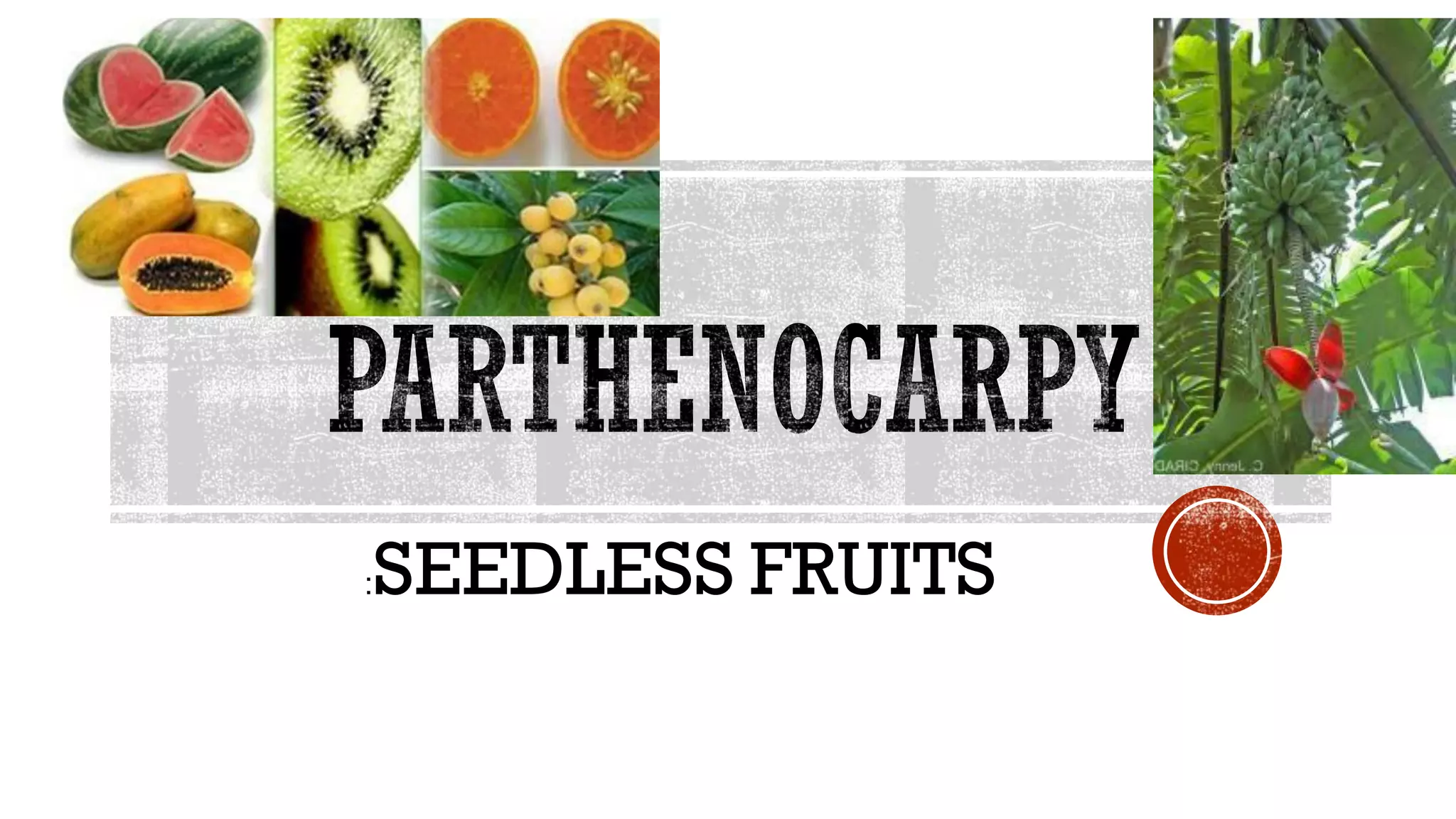
:SEEDLESS FRUITS
._definition by nitsch (1965)
: Formation of fruits without fertilisation.
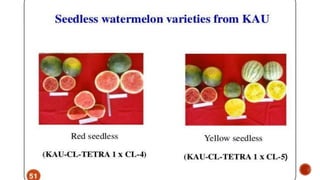
,Absence of seeds.
▪ 1:Natural parthenocarpy_ bananas which known to develop naturally..
▪ 2:Induced parthenocarpy_fruit formation is stimulated.
▪ Based on stimulating factors,;
▪ *Genetical parthenocarpy
▪ . *Environmental parthenocarpy
▪ . *Chemical parthenocarpy
▪ BASED ON POLLINATION
▪ Vegetative parthenocarpy/Autonomous:The fruit development without pollination.
▪ Eg...banana
▪ Stimulative/aitonomous parthenocarpy:The fruit development with pollination.
CONDITION FOR PLANT TO PRODUCE PARTHENOCARPICFRUIT
*Fruit develop after fertilisation.then sometimes the seed stop
development and result in seedless fruit.eg-grapes
*Pollination as usual and pollen tube grow to certain distance but fruit
develop without fertilisation.eg-nicotiana.
*Dead pollen or non viable pollen placed on stigma encourages fruit
formation.
*Fruits may be developed without pollination.eg-tomato,banana,fig.
THUS PARTHENOCARY IS AN NATURAL ACCIDENT OR IT CAN BE
INDUCED ARTIFICIALLY BY THE HELP OF HORMONE LIKE AUXIN AND
GIBBERELLINS.
GENETICAL PARTHENOCARPY
*Common in cultivated than in wild plants.
*Mutations,hybridization,incompatibility are the reasons.
*In incompatible plants ,pollen tube growth is extremely slow and flowers fall much before the tube
reaches the ovary.
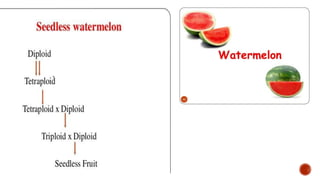
• In natural genitical parthenocarpy,is associated with high auxin content and are triploids.eg-grapes.
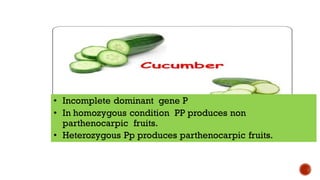
• Incomplete dominant gene P
• In homozygous condition PP produces non
parthenocarpic fruits.
• Heterozygous Pp produces parthenocarpic fruits.
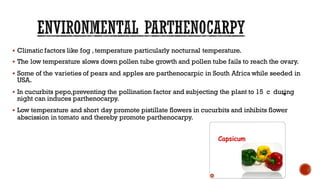
▪ Climatic factors like fog , temperature particularly nocturnal temperature.
▪ The low temperature slows down pollen tube growth and pollen tube fails to reach the ovary.
▪ Some of the varieties of pears and apples are parthenocarpic in South Africa while seeded in
USA.
▪ In cucurbits pepo,preventing the pollination factor and subjecting the plant to 15 c during
night can induces parthenocarpy.
▪ Low temperature and short day promote pistillate flowers in cucurbits and inhibits flower
abscission in tomato and thereby promote parthenocarpy.
▪ Gustafson (1939)made a comparative study of hormone in seeded and seedless fruits and
found that seedless varieties have bigger auxin ccontent.
▪ Application of auxin:
*prevent abscission layer and encourage the development of vascular system in the stalk.
*Auxin brings abortion of seeds.
*Auxin spray also reduces loss of water from fruits.
* Starch synthesis is increased.
*Effect enzymatic activity and increase oxygen uptake.
* Vegetative parthenocarpy can be induced in morus alba if pollination is prevented
through bagging.
Application of gibberellin
*GA3 if injected in ovary of zephyranthes would stimulate the
development of ovaries with seeds but without embryos.
* Low concentration of gibberellin (20ppm) can induce
parthenocarpy.
• Induces seedless fruits in tomatoes,figs,apples,pears.
• Both 2-NOA(2-naphthoxy acetic acid) and 24D can induce fruit
formation in tomato if the same fails to grow in low temperature.
PARTHENOGENESIS
*Kerner (1976) in Antennaria alpina,staminate flowers are present
fertile pollen are very few.
*In this plant, megaspore mother cell directly functions as
megaspore without meiosis and diploid megaspore directly
develops to embryo without fertilisation.
• This kind of development of embryo without fertilisation is termed
as parthenogenesis.
• Haploid parthenogenesis
• Diploid parparthenogenesis
• Facultative parthenogenesis
• Induced parthenogenesis
# In haploid parthenogenesis,the egg is formed after reduction division of
mega spore mother cell and develops to embyo.As it contain only a single set
of chromosomes it cannot establish it’s generation.
# Diploid embryos may be formed without fertilisation if megaspore mother
cell develops to megaspore directly.this is called diploid embryogenesis.
# Development of embryo is only a chance is included in facultative
embryogenesis.reported in orchis maculata.
#A number of physiological and chemical treatment for induced
parthenogenesis like,~exposing ovary to low /high temperature soon after
pollination,~exposing stigma to x-rayed pollen,~using pollen of unrelated
plants or delayed pollination,~chemical treatment.
Eg:Tritium monoccum.
METHODS FOR THE INDUCTION OF PARTHENOCARPY
*Interspecific and intergeneric crosses are responsible for the parthenogenesis in Brassicas.
*Delayed pollination will help to obtain haploid embryos
*Use of chemical Belvitan in petunia violaceae result in enlargement of micellar cells and
formation of pro embryos.
*When applying the growth regulator it must be penetrate the cuticle or tissues so esters are
effective.
*Fumigation with ester vapour possible only in green houses.
*In pears frost injury of ovary is beneficial
*treatment of grapes floral clusters,dipping in GA3 is useful in large scale production in Japan.
*In strawberry,2NAA at concentration of 50mg/l sprayed after two weeks of pollination.
* Artificial changes in temperature is also successful.
SIGNIFICANCE OF
PARTHENOCARPY/ECONOMICAL
IMPORTANTANCE
Parthenocarpic fruits are required by food
preservationist for making
jams,jellies,sauces,fruit drinks etc.because
the edible fleshy part of fruit may increased
by the absence of seeds.
😊Helps the growers to keep the insect and
pest away because there no need for
pollinating agent.So it improves the crop
yield without using pesticides.
,😀 Preferred by consumers.
😀 Plants need not to be pollinated.
▪WHY SOME FRUITS
DEVELOP
PARTHENOCARPICALY
IN NATUREWHILE
OTHERS DO NOT?

Parthenocarpy

  • 1.
  • 2.
    ._definition by nitsch(1965) : Formation of fruits without fertilisation. ,Absence of seeds.
  • 3.
    ▪ 1:Natural parthenocarpy_bananas which known to develop naturally.. ▪ 2:Induced parthenocarpy_fruit formation is stimulated. ▪ Based on stimulating factors,; ▪ *Genetical parthenocarpy ▪ . *Environmental parthenocarpy ▪ . *Chemical parthenocarpy ▪ BASED ON POLLINATION ▪ Vegetative parthenocarpy/Autonomous:The fruit development without pollination. ▪ Eg...banana ▪ Stimulative/aitonomous parthenocarpy:The fruit development with pollination.
  • 4.
    CONDITION FOR PLANTTO PRODUCE PARTHENOCARPICFRUIT *Fruit develop after fertilisation.then sometimes the seed stop development and result in seedless fruit.eg-grapes *Pollination as usual and pollen tube grow to certain distance but fruit develop without fertilisation.eg-nicotiana. *Dead pollen or non viable pollen placed on stigma encourages fruit formation. *Fruits may be developed without pollination.eg-tomato,banana,fig. THUS PARTHENOCARY IS AN NATURAL ACCIDENT OR IT CAN BE INDUCED ARTIFICIALLY BY THE HELP OF HORMONE LIKE AUXIN AND GIBBERELLINS.
  • 5.
    GENETICAL PARTHENOCARPY *Common incultivated than in wild plants. *Mutations,hybridization,incompatibility are the reasons. *In incompatible plants ,pollen tube growth is extremely slow and flowers fall much before the tube reaches the ovary. • In natural genitical parthenocarpy,is associated with high auxin content and are triploids.eg-grapes.
  • 6.
    • Incomplete dominantgene P • In homozygous condition PP produces non parthenocarpic fruits. • Heterozygous Pp produces parthenocarpic fruits.
  • 9.
    ▪ Climatic factorslike fog , temperature particularly nocturnal temperature. ▪ The low temperature slows down pollen tube growth and pollen tube fails to reach the ovary. ▪ Some of the varieties of pears and apples are parthenocarpic in South Africa while seeded in USA. ▪ In cucurbits pepo,preventing the pollination factor and subjecting the plant to 15 c during night can induces parthenocarpy. ▪ Low temperature and short day promote pistillate flowers in cucurbits and inhibits flower abscission in tomato and thereby promote parthenocarpy.
  • 10.
    ▪ Gustafson (1939)madea comparative study of hormone in seeded and seedless fruits and found that seedless varieties have bigger auxin ccontent. ▪ Application of auxin: *prevent abscission layer and encourage the development of vascular system in the stalk. *Auxin brings abortion of seeds. *Auxin spray also reduces loss of water from fruits. * Starch synthesis is increased. *Effect enzymatic activity and increase oxygen uptake. * Vegetative parthenocarpy can be induced in morus alba if pollination is prevented through bagging.
  • 11.
    Application of gibberellin *GA3if injected in ovary of zephyranthes would stimulate the development of ovaries with seeds but without embryos. * Low concentration of gibberellin (20ppm) can induce parthenocarpy. • Induces seedless fruits in tomatoes,figs,apples,pears. • Both 2-NOA(2-naphthoxy acetic acid) and 24D can induce fruit formation in tomato if the same fails to grow in low temperature.
  • 12.
    PARTHENOGENESIS *Kerner (1976) inAntennaria alpina,staminate flowers are present fertile pollen are very few. *In this plant, megaspore mother cell directly functions as megaspore without meiosis and diploid megaspore directly develops to embryo without fertilisation. • This kind of development of embryo without fertilisation is termed as parthenogenesis. • Haploid parthenogenesis • Diploid parparthenogenesis • Facultative parthenogenesis • Induced parthenogenesis
  • 13.
    # In haploidparthenogenesis,the egg is formed after reduction division of mega spore mother cell and develops to embyo.As it contain only a single set of chromosomes it cannot establish it’s generation. # Diploid embryos may be formed without fertilisation if megaspore mother cell develops to megaspore directly.this is called diploid embryogenesis. # Development of embryo is only a chance is included in facultative embryogenesis.reported in orchis maculata. #A number of physiological and chemical treatment for induced parthenogenesis like,~exposing ovary to low /high temperature soon after pollination,~exposing stigma to x-rayed pollen,~using pollen of unrelated plants or delayed pollination,~chemical treatment. Eg:Tritium monoccum.
  • 14.
    METHODS FOR THEINDUCTION OF PARTHENOCARPY *Interspecific and intergeneric crosses are responsible for the parthenogenesis in Brassicas. *Delayed pollination will help to obtain haploid embryos *Use of chemical Belvitan in petunia violaceae result in enlargement of micellar cells and formation of pro embryos. *When applying the growth regulator it must be penetrate the cuticle or tissues so esters are effective. *Fumigation with ester vapour possible only in green houses. *In pears frost injury of ovary is beneficial *treatment of grapes floral clusters,dipping in GA3 is useful in large scale production in Japan. *In strawberry,2NAA at concentration of 50mg/l sprayed after two weeks of pollination. * Artificial changes in temperature is also successful.
  • 15.
    SIGNIFICANCE OF PARTHENOCARPY/ECONOMICAL IMPORTANTANCE Parthenocarpic fruitsare required by food preservationist for making jams,jellies,sauces,fruit drinks etc.because the edible fleshy part of fruit may increased by the absence of seeds. 😊Helps the growers to keep the insect and pest away because there no need for pollinating agent.So it improves the crop yield without using pesticides. ,😀 Preferred by consumers. 😀 Plants need not to be pollinated.
  • 20.