Meteorological
Instruments And Their
Uses
Name : Neilkrishna
Kabara
STD: 9th A
Roll no. : A914
• Firstly, I would like to thank my subject
teacher” Sabita Mam” for giving me a
golden opportunity to study this topic and
getting much valuable information.
• Secondly, I would like to thank my parents to
guide me in this project.
• Thirdly, I would like to thank my friends for
guiding me and providing me with valuable
information and making this project
successful.
SR.NO TOPIC SLIDE NO.
1. Meteorology and Meteorological Instuments 5
2. Chart showing the Instruments 6
3. Six’s Maximum and minimum Thermometer 7
4. Uses 8
5. Mercury Barometer 9
6. Uses 10
7. Aneroid Barometer 11
8. Uses 12
9. Wind Vane 13
10. Anemometer 14
11. Images of Anemometer 15
12. Rain Gauge 16
13 Images of Rain Gauge 17
14. Hygrometer 18
15. Bibliography 19.
16. Thank You Slide 20
PREFACE
• This project will explain you the some of
the Meteorological Instruments, their
working, and even their uses.
• Many unknown facts will be showed in the
in the upcoming Slides.
SO LETS GO THE NEXT SLIDE
• Meteorology Definition:
The branch of science concerned with the
processes and phenomena of the atmosphere,
especially as a means of forecasting the weather, is
called Meteorology.
• Meteorological Instruments:
Meteorological instruments are
the equipment used to sample the state of the
atmosphere at a given time. Each science has its own
unique sets of laboratory equipment.
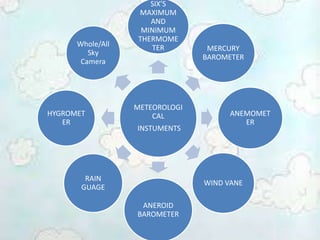
METEOROLOGI
CAL
INSTUMENTS
SIX’S
MAXIMUM
AND
MINIMUM
THERMOME
TER MERCURY
BAROMETER
ANEMOMET
ER
WIND VANE
ANEROID
BAROMETER
RAIN
GUAGE
HYGROMET
ER
Whole/All
Sky
Camera
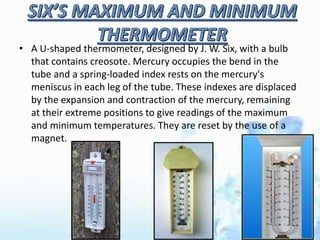
• A U-shaped thermometer, designed by J. W. Six, with a bulb
that contains creosote. Mercury occupies the bend in the
tube and a spring-loaded index rests on the mercury's
meniscus in each leg of the tube. These indexes are displaced
by the expansion and contraction of the mercury, remaining
at their extreme positions to give readings of the maximum
and minimum temperatures. They are reset by the use of a
magnet.
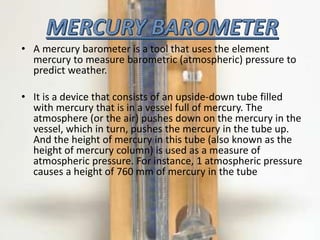
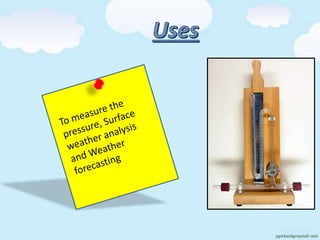
• A mercury barometer is a tool that uses the element
mercury to measure barometric (atmospheric) pressure to
predict weather.
• It is a device that consists of an upside-down tube filled
with mercury that is in a vessel full of mercury. The
atmosphere (or the air) pushes down on the mercury in the
vessel, which in turn, pushes the mercury in the tube up.
And the height of mercury in this tube (also known as the
height of mercury column) is used as a measure of
atmospheric pressure. For instance, 1 atmospheric pressure
causes a height of 760 mm of mercury in the tube
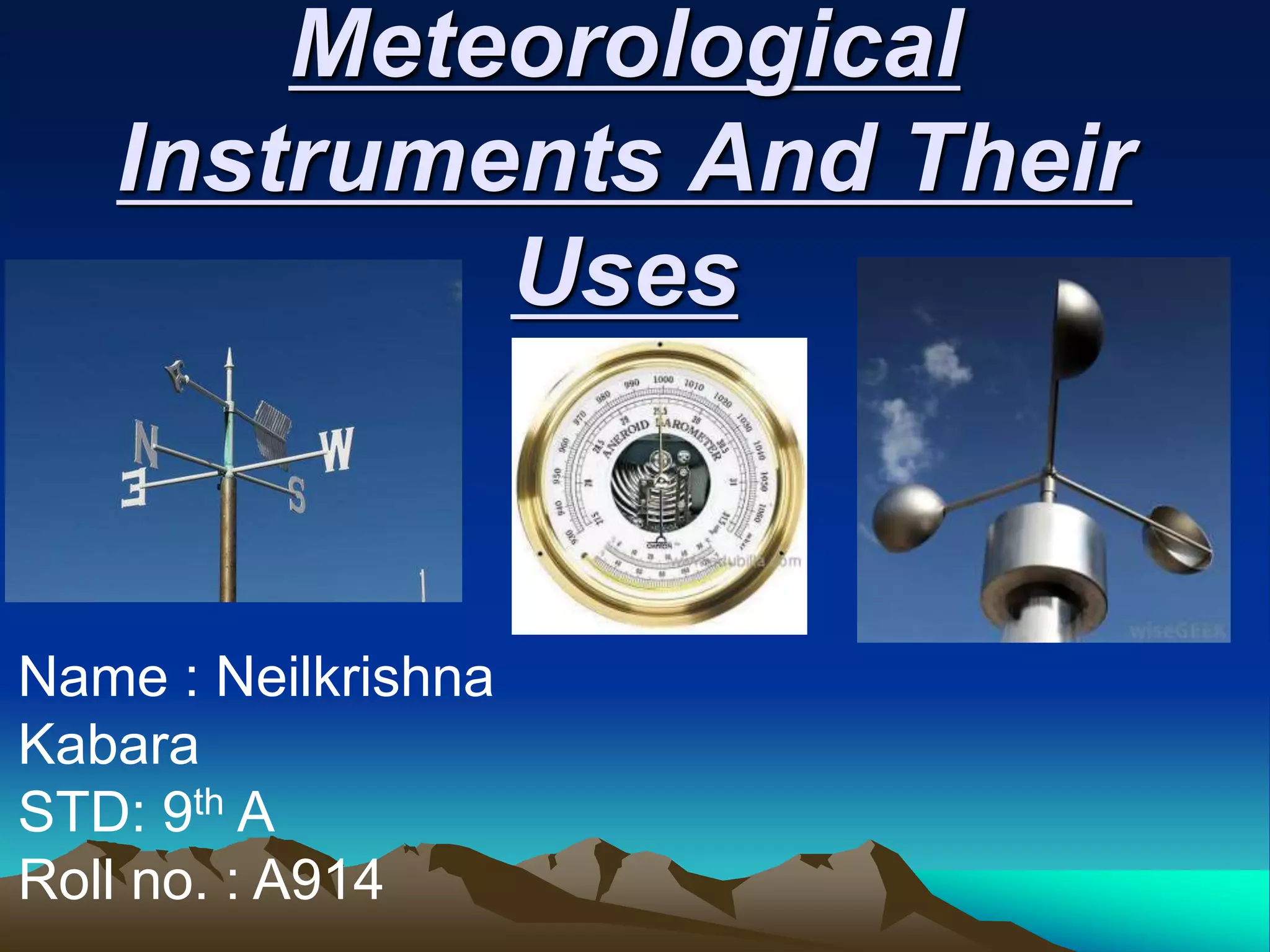
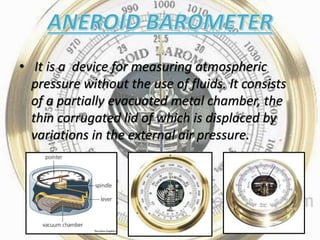
• It is a device for measuring atmospheric
pressure without the use of fluids. It consists
of a partially evacuated metal chamber, the
thin corrugated lid of which is displaced by
variations in the external air pressure.
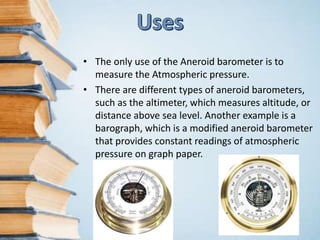
• The only use of the Aneroid barometer is to
measure the Atmospheric pressure.
• There are different types of aneroid barometers,
such as the altimeter, which measures altitude, or
distance above sea level. Another example is a
barograph, which is a modified aneroid barometer
that provides constant readings of atmospheric
pressure on graph paper.
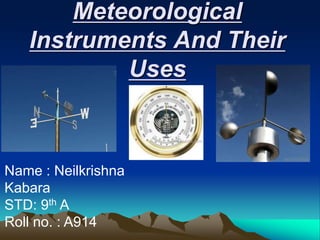
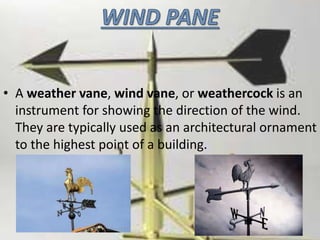
• A weather vane, wind vane, or weathercock is an
instrument for showing the direction of the wind.
They are typically used as an architectural ornament
to the highest point of a building.
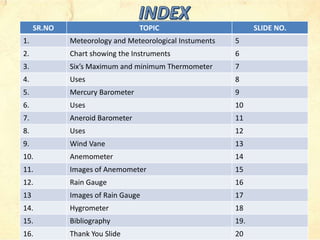
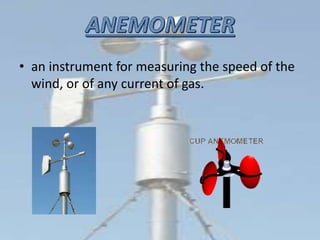
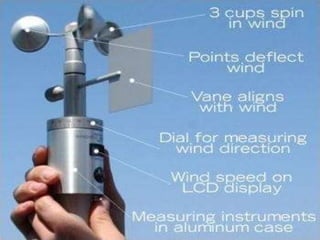
• an instrument for measuring the speed of the
wind, or of any current of gas.
• It is used at the airports to calcite accurate wind
data under all conditions.
In order for wind speeds to be comparable
from location to location, the effect of the terrain
needs to be considered, especially in regard to
height. Other considerations are the presence of
trees, and both natural canyons and artificial
canyons (urban buildings). The standard
anemometer height in open rural terrain is 10
meters.
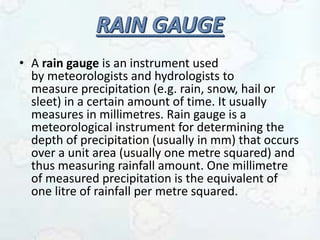
• A rain gauge is an instrument used
by meteorologists and hydrologists to
measure precipitation (e.g. rain, snow, hail or
sleet) in a certain amount of time. It usually
measures in millimetres. Rain gauge is a
meteorological instrument for determining the
depth of precipitation (usually in mm) that occurs
over a unit area (usually one metre squared) and
thus measuring rainfall amount. One millimetre
of measured precipitation is the equivalent of
one litre of rainfall per metre squared.
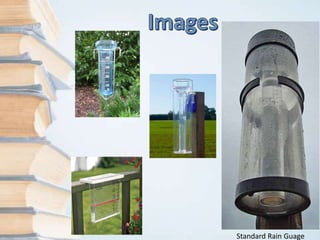
Standard Rain Guage
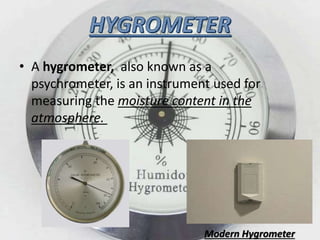
• A hygrometer, also known as a
psychrometer, is an instrument used for
measuring the moisture content in the
atmosphere.
Modern Hygrometer
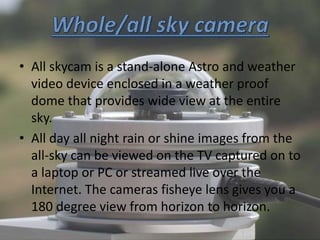
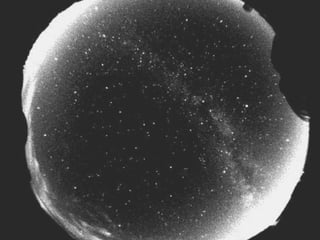
• All skycam is a stand-alone Astro and weather
video device enclosed in a weather proof
dome that provides wide view at the entire
sky.
• All day all night rain or shine images from the
all-sky can be viewed on the TV captured on to
a laptop or PC or streamed live over the
Internet. The cameras fisheye lens gives you a
180 degree view from horizon to horizon.
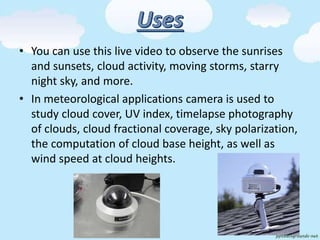
• You can use this live video to observe the sunrises
and sunsets, cloud activity, moving storms, starry
night sky, and more.
• In meteorological applications camera is used to
study cloud cover, UV index, timelapse photography
of clouds, cloud fractional coverage, sky polarization,
the computation of cloud base height, as well as
wind speed at cloud heights.
• https://www.google.co.in/search?q=Hygrometer
&espv=2&biw=1242&bih=557&source=lnms&sa=
X&ved=0ahUKEwj5itrrn8LSAhXHRI8KHW91C1UQ
_AUIBygA&dpr=1.1
• https://www.google.co.in/search?q=Hygrometer
&espv=2&biw=1242&bih=557&source=lnms&sa=
X&ved=0ahUKEwj5itrrn8LSAhXHRI8KHW91C1UQ
_AUIBygA&dpr=1.1#q=anemometer&*
• www.google.co.in
Metrological instuments.

Metrological instuments.

  • 1.
    Meteorological Instruments And Their Uses Name: Neilkrishna Kabara STD: 9th A Roll no. : A914
  • 2.
    • Firstly, Iwould like to thank my subject teacher” Sabita Mam” for giving me a golden opportunity to study this topic and getting much valuable information. • Secondly, I would like to thank my parents to guide me in this project. • Thirdly, I would like to thank my friends for guiding me and providing me with valuable information and making this project successful.
  • 3.
    SR.NO TOPIC SLIDENO. 1. Meteorology and Meteorological Instuments 5 2. Chart showing the Instruments 6 3. Six’s Maximum and minimum Thermometer 7 4. Uses 8 5. Mercury Barometer 9 6. Uses 10 7. Aneroid Barometer 11 8. Uses 12 9. Wind Vane 13 10. Anemometer 14 11. Images of Anemometer 15 12. Rain Gauge 16 13 Images of Rain Gauge 17 14. Hygrometer 18 15. Bibliography 19. 16. Thank You Slide 20
  • 4.
    PREFACE • This projectwill explain you the some of the Meteorological Instruments, their working, and even their uses. • Many unknown facts will be showed in the in the upcoming Slides. SO LETS GO THE NEXT SLIDE
  • 5.
    • Meteorology Definition: Thebranch of science concerned with the processes and phenomena of the atmosphere, especially as a means of forecasting the weather, is called Meteorology. • Meteorological Instruments: Meteorological instruments are the equipment used to sample the state of the atmosphere at a given time. Each science has its own unique sets of laboratory equipment.
  • 6.
  • 7.
    • A U-shapedthermometer, designed by J. W. Six, with a bulb that contains creosote. Mercury occupies the bend in the tube and a spring-loaded index rests on the mercury's meniscus in each leg of the tube. These indexes are displaced by the expansion and contraction of the mercury, remaining at their extreme positions to give readings of the maximum and minimum temperatures. They are reset by the use of a magnet.
  • 9.
    • A mercurybarometer is a tool that uses the element mercury to measure barometric (atmospheric) pressure to predict weather. • It is a device that consists of an upside-down tube filled with mercury that is in a vessel full of mercury. The atmosphere (or the air) pushes down on the mercury in the vessel, which in turn, pushes the mercury in the tube up. And the height of mercury in this tube (also known as the height of mercury column) is used as a measure of atmospheric pressure. For instance, 1 atmospheric pressure causes a height of 760 mm of mercury in the tube
  • 11.
    • It isa device for measuring atmospheric pressure without the use of fluids. It consists of a partially evacuated metal chamber, the thin corrugated lid of which is displaced by variations in the external air pressure.
  • 12.
    • The onlyuse of the Aneroid barometer is to measure the Atmospheric pressure. • There are different types of aneroid barometers, such as the altimeter, which measures altitude, or distance above sea level. Another example is a barograph, which is a modified aneroid barometer that provides constant readings of atmospheric pressure on graph paper.
  • 13.
    • A weathervane, wind vane, or weathercock is an instrument for showing the direction of the wind. They are typically used as an architectural ornament to the highest point of a building.
  • 14.
    • an instrumentfor measuring the speed of the wind, or of any current of gas.
  • 15.
    • It isused at the airports to calcite accurate wind data under all conditions. In order for wind speeds to be comparable from location to location, the effect of the terrain needs to be considered, especially in regard to height. Other considerations are the presence of trees, and both natural canyons and artificial canyons (urban buildings). The standard anemometer height in open rural terrain is 10 meters.
  • 17.
    • A raingauge is an instrument used by meteorologists and hydrologists to measure precipitation (e.g. rain, snow, hail or sleet) in a certain amount of time. It usually measures in millimetres. Rain gauge is a meteorological instrument for determining the depth of precipitation (usually in mm) that occurs over a unit area (usually one metre squared) and thus measuring rainfall amount. One millimetre of measured precipitation is the equivalent of one litre of rainfall per metre squared.
  • 18.
  • 19.
    • A hygrometer,also known as a psychrometer, is an instrument used for measuring the moisture content in the atmosphere. Modern Hygrometer
  • 20.
    • All skycamis a stand-alone Astro and weather video device enclosed in a weather proof dome that provides wide view at the entire sky. • All day all night rain or shine images from the all-sky can be viewed on the TV captured on to a laptop or PC or streamed live over the Internet. The cameras fisheye lens gives you a 180 degree view from horizon to horizon.
  • 22.
    • You canuse this live video to observe the sunrises and sunsets, cloud activity, moving storms, starry night sky, and more. • In meteorological applications camera is used to study cloud cover, UV index, timelapse photography of clouds, cloud fractional coverage, sky polarization, the computation of cloud base height, as well as wind speed at cloud heights.
  • 23.