
AGRI-BUSINESS MANAGEMENT
SYSTEMS
SUBMITTED TO,
Dr.K.C.PRAKASH
Assistant professor
IIPM
Bangalore
SUBMITTED BY,
U.A.SOMANNA
PGDM ABPM-86
IIPM Bangalore
1
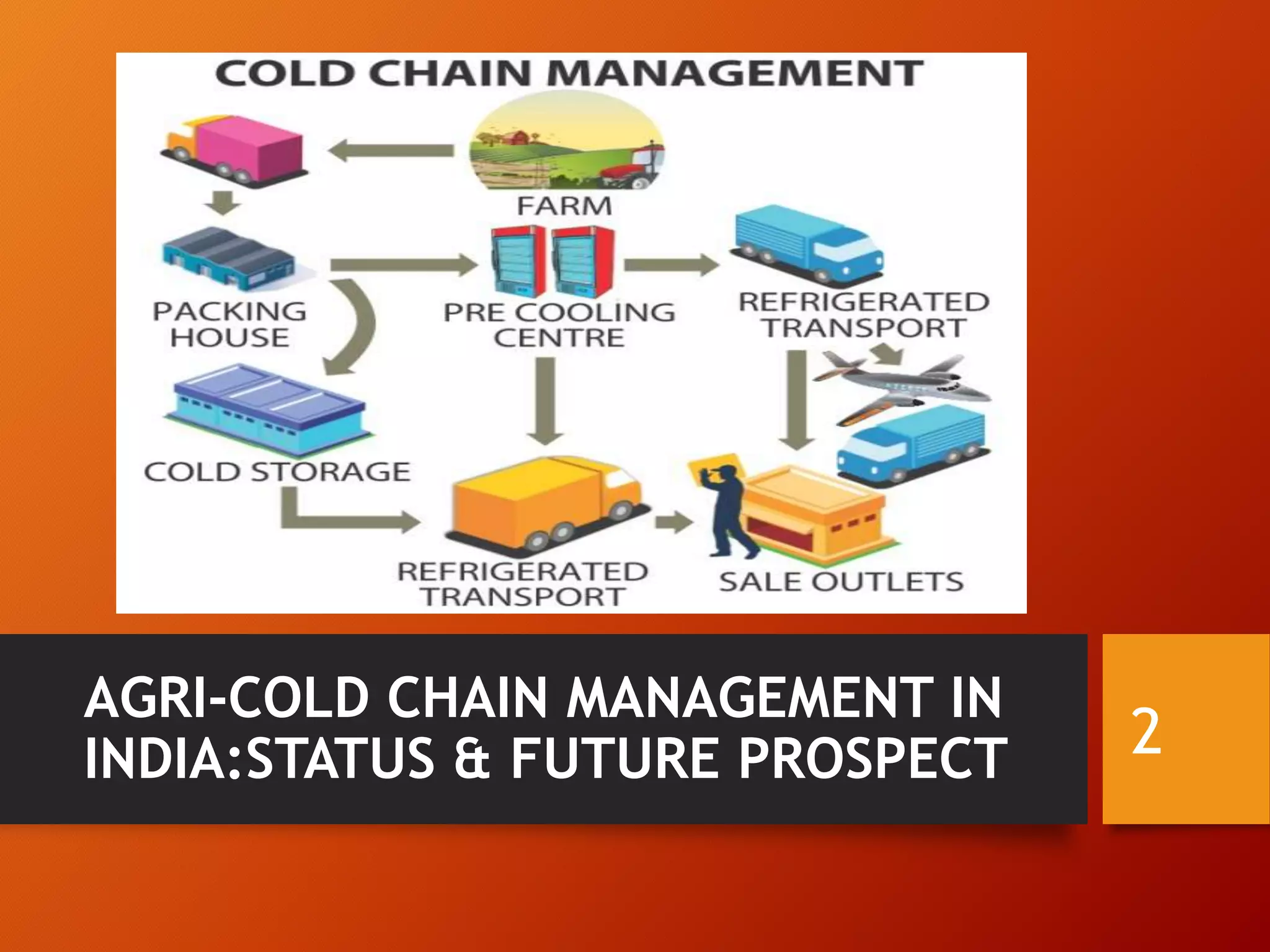
AGRI-COLD CHAIN MANAGEMENT IN
INDIA:STATUS & FUTURE PROSPECT 2
F & V in India
• India is worlds number one in milk, second in fruits
and third in fish production.
• Postharvest losses account for about 25% to 30% of
production.
• Quality of produce deteriorates by the time it reaches
the consumer.
• There is more wastage of fruits and vegetables in the
southern and western regions of India due to the
tropical and humid climate.
3
Perishable Agri-Horti Produce –
India vs. World
Produce India (MT) World (MT) India’s
percentage share
Fruits
89 654
13.6 (next to
China)
Vegetables
163 1,160
14 (second to
China)
Milk 136 770 17.7 (1st rank)
Fish 9.58 196 4.9 (3rd rank)
Meat (including
poultry)
6.2 310 2 (6th rank)
4
GROWTH OF SCM IN AGRICULTURE
• No concrete idea of of scientific supply chain.
• Just few players such as the farmer and the
trader.
• Emergence of regulated markets.
• Emergence of corporate into fruits and
vegetables sector.
• Contract farming with the farmers.
5
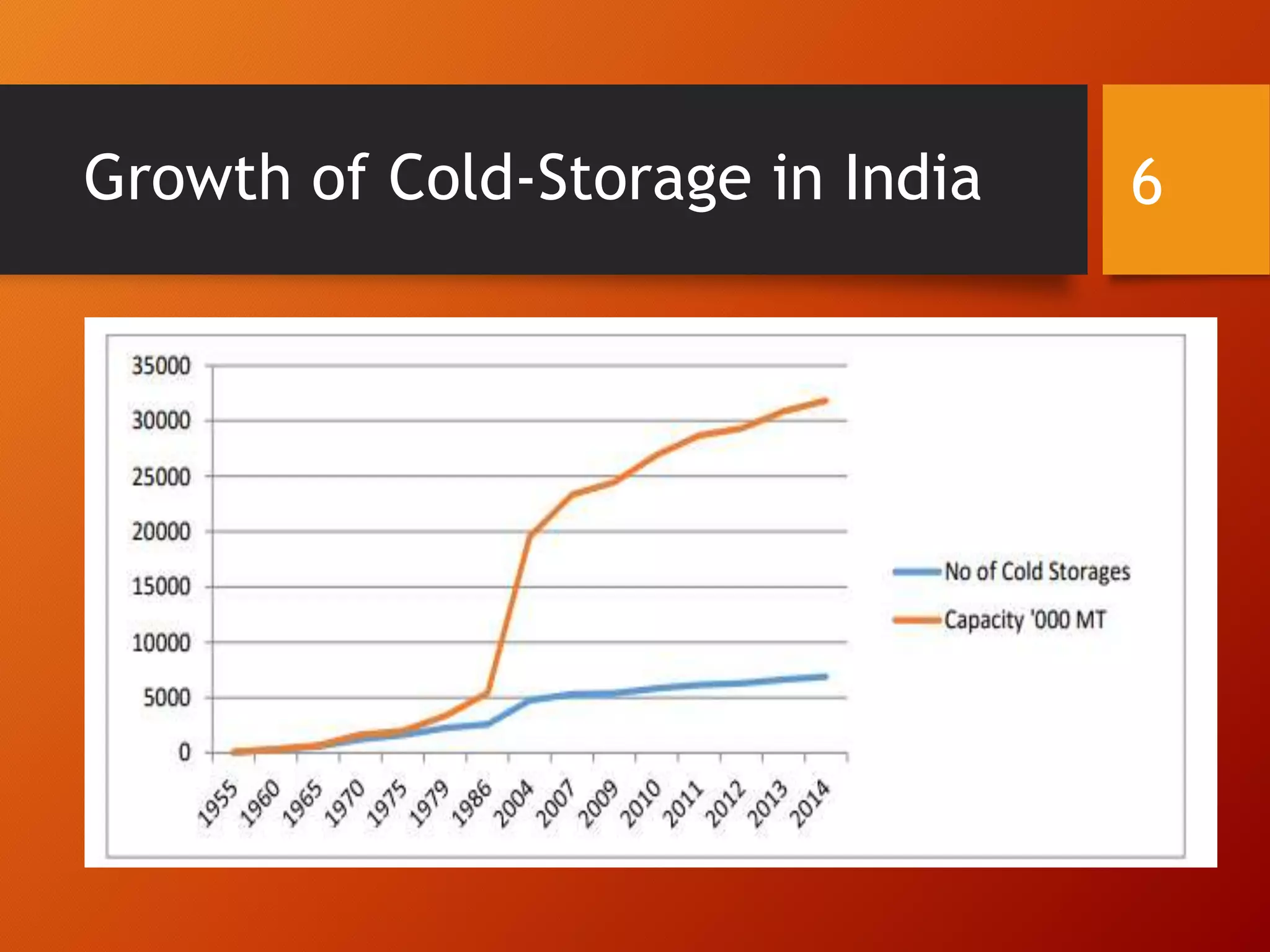
Growth of Cold-Storage in India 6
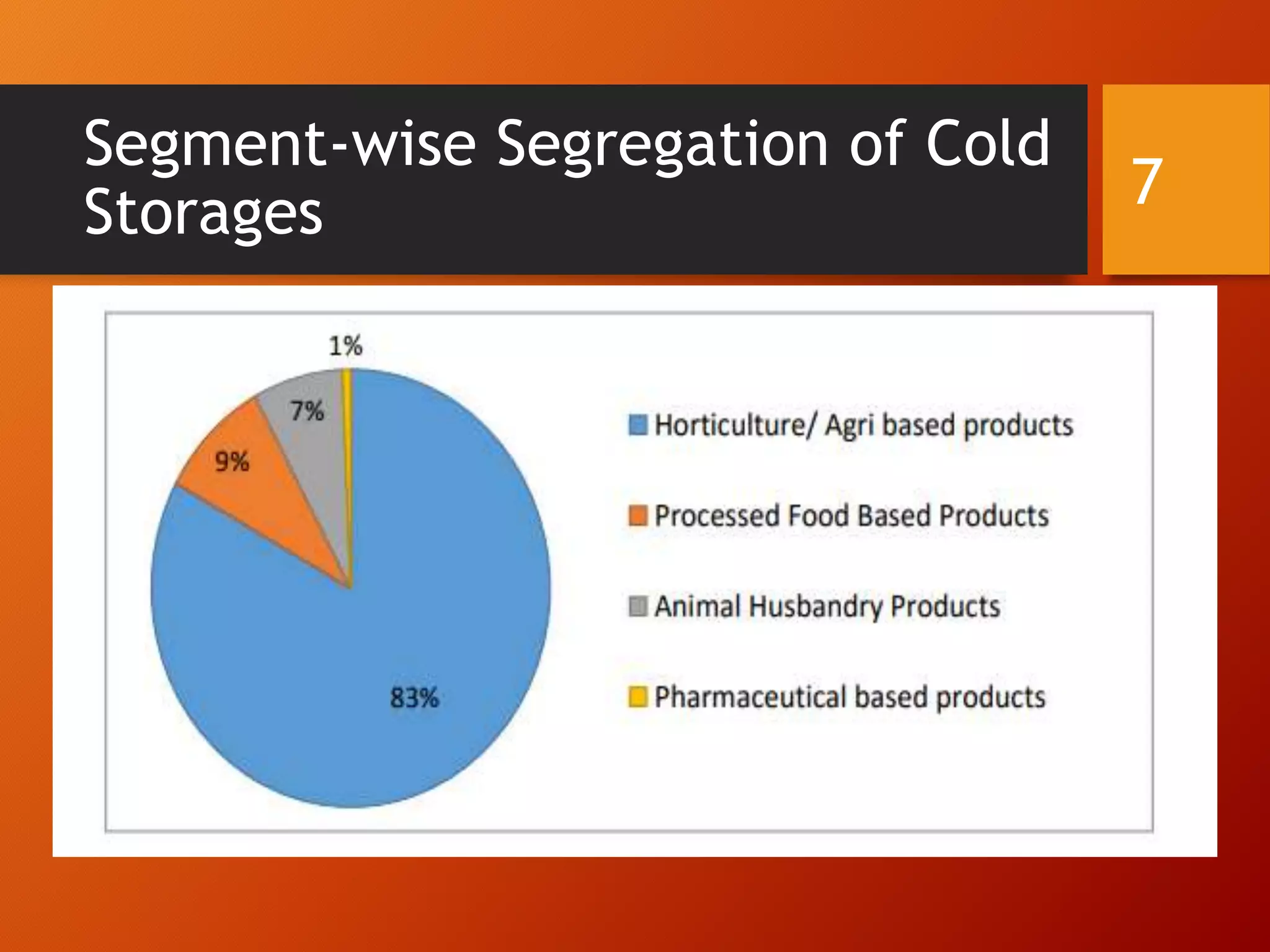
Segment-wise Segregation of Cold
Storages 7
8
STAGES IN COLD CHAIN
• F & V should be frozen quickly after harvesting
to maintain high quality.
• Transported to refrigerated warehouses, through
reefer vehicles where they are stored at – 20 to –
23°C, from few days to months.
• Later moves to markets through reefer vans.
9
• Kept in refrigerated display cases held in the
market at 3 to 5°C for unfrozen fruits and
vegetables.
• In the case of bananas, there is no storage
period. Instead, there is a period of ripening.
The best temperature for slow ripening is
14.5°C.
10
PRESENT SCENARIO OF COLD
CHAIN IN INDIA
• Short by 10 million tons of cold storage capacity.
• 6,300 cold storage facilities unevenly spread across
the country, with an installed capacity of 30.11 MT.
• Growth has averaged 3 to 4% over the past 10 years.
• Ownership is mainly in the private sector, with the
public and cooperative sectors only comprising 10% of
capacity.
• However, some 75-80 per cent of these refrigerated
warehouses are used only to store potatoes.
11
• 36% of these cold storages in India have capacity
below 1,000 MT.
• 65% of India’s cold chain storage capacity is
contributed by the states of Uttar Pradesh and
West Bengal
• At the current capacity only less than 11% of what
is produced can be stored.
12
EXISTING INFRASTRUCTURE 13
EXISTING GAP 14
KEY CHALLENGES
• Lack of quality cold warehousing infrastructure.
• Lack of standards and protocols in construction
and operation of facilities.
• Low awareness of labor in handling temperature-
sensitive products.
• High fuel cost and power cuts.
• Lack of low cost & environment friendly
technology.
15
GOVERNMENT INITIATIVES:
• 100% FDI
• 5% concession on import duty, service tax
exemption, excise duty exemption on several
items.
• Subsidy of over 25 to 33.3% on the cold storage
project cost
• Establishment of National Centre for Cold Chain
Development
• Over 50 to 70% capital grant on projects.
• Proposed financial outplay for cold chain
infrastructure of US $650 million.
16
GROWTH EXPECTED
• Setting up cold chains with PPP model.
• Then government is also promoting the food
safety and security bill that would further cold
chain facilities in order to reduce the amount of
food wastage.
• Cold chain industry is expected to grow at a
CAGR of 28% over the next three years and reach
a market size of $13 billion in 2017.
17
OTHER RETAIL OPERATORS 18

Agri cold chain

  • 1.
    AGRI-BUSINESS MANAGEMENT SYSTEMS SUBMITTED TO, Dr.K.C.PRAKASH Assistantprofessor IIPM Bangalore SUBMITTED BY, U.A.SOMANNA PGDM ABPM-86 IIPM Bangalore 1
  • 2.
    AGRI-COLD CHAIN MANAGEMENTIN INDIA:STATUS & FUTURE PROSPECT 2
  • 3.
    F & Vin India • India is worlds number one in milk, second in fruits and third in fish production. • Postharvest losses account for about 25% to 30% of production. • Quality of produce deteriorates by the time it reaches the consumer. • There is more wastage of fruits and vegetables in the southern and western regions of India due to the tropical and humid climate. 3
  • 4.
    Perishable Agri-Horti Produce– India vs. World Produce India (MT) World (MT) India’s percentage share Fruits 89 654 13.6 (next to China) Vegetables 163 1,160 14 (second to China) Milk 136 770 17.7 (1st rank) Fish 9.58 196 4.9 (3rd rank) Meat (including poultry) 6.2 310 2 (6th rank) 4
  • 5.
    GROWTH OF SCMIN AGRICULTURE • No concrete idea of of scientific supply chain. • Just few players such as the farmer and the trader. • Emergence of regulated markets. • Emergence of corporate into fruits and vegetables sector. • Contract farming with the farmers. 5
  • 6.
  • 7.
  • 8.
  • 9.
    STAGES IN COLDCHAIN • F & V should be frozen quickly after harvesting to maintain high quality. • Transported to refrigerated warehouses, through reefer vehicles where they are stored at – 20 to – 23°C, from few days to months. • Later moves to markets through reefer vans. 9
  • 10.
    • Kept inrefrigerated display cases held in the market at 3 to 5°C for unfrozen fruits and vegetables. • In the case of bananas, there is no storage period. Instead, there is a period of ripening. The best temperature for slow ripening is 14.5°C. 10
  • 11.
    PRESENT SCENARIO OFCOLD CHAIN IN INDIA • Short by 10 million tons of cold storage capacity. • 6,300 cold storage facilities unevenly spread across the country, with an installed capacity of 30.11 MT. • Growth has averaged 3 to 4% over the past 10 years. • Ownership is mainly in the private sector, with the public and cooperative sectors only comprising 10% of capacity. • However, some 75-80 per cent of these refrigerated warehouses are used only to store potatoes. 11
  • 12.
    • 36% ofthese cold storages in India have capacity below 1,000 MT. • 65% of India’s cold chain storage capacity is contributed by the states of Uttar Pradesh and West Bengal • At the current capacity only less than 11% of what is produced can be stored. 12
  • 13.
  • 14.
  • 15.
    KEY CHALLENGES • Lackof quality cold warehousing infrastructure. • Lack of standards and protocols in construction and operation of facilities. • Low awareness of labor in handling temperature- sensitive products. • High fuel cost and power cuts. • Lack of low cost & environment friendly technology. 15
  • 16.
    GOVERNMENT INITIATIVES: • 100%FDI • 5% concession on import duty, service tax exemption, excise duty exemption on several items. • Subsidy of over 25 to 33.3% on the cold storage project cost • Establishment of National Centre for Cold Chain Development • Over 50 to 70% capital grant on projects. • Proposed financial outplay for cold chain infrastructure of US $650 million. 16
  • 17.
    GROWTH EXPECTED • Settingup cold chains with PPP model. • Then government is also promoting the food safety and security bill that would further cold chain facilities in order to reduce the amount of food wastage. • Cold chain industry is expected to grow at a CAGR of 28% over the next three years and reach a market size of $13 billion in 2017. 17
  • 18.