I N D I A – R E P O R T 
2014 
IIAR - NASHVILLE 
PRESENTATION BY 
SAMIR SHAH – RVC – INDIA / SOUTH ASIA.
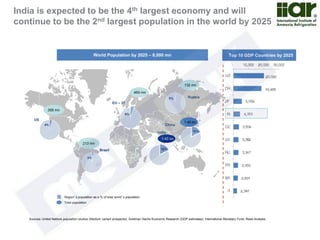
India is expected to be the 4th largest economy and will 
continue to be the 2nd largest population in the world by 2025 
World Population by 2025 – 8,000 mn 
China 
18% 
US 
Russia 
359 mn 
1.45 bn 
EU – 27 
India 
132 mn 
Brazil 
1.43 bn 
469 mn 
213 mn 
2% 
3% 
6% 
Region’s population as a % of total world’s population 
Total population 
4% 
18% 
Top 10 GDP Countries by 2025 
Sources: United Nations population studies (Medium variant prospects); Goldman Sachs Economic Research (GDP estimates); International Monetary Fund; Reed Analysis
GEN
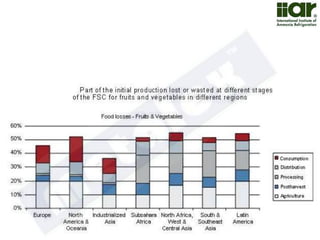
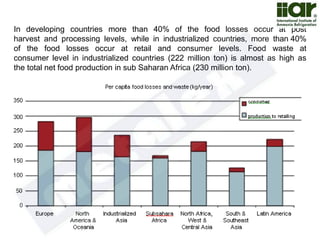
In developing countries more than 40% of the food losses occur at post 
harvest and processing levels, while in industrialized countries, more than 40% 
of the food losses occur at retail and consumer levels. Food waste at 
consumer level in industrialized countries (222 million ton) is almost as high as 
the total net food production in sub Saharan Africa (230 million ton).
INDIA STATISTICS
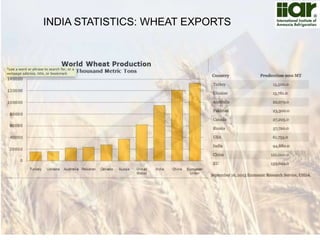
INDIA STATISTICS: WHEAT EXPORTS
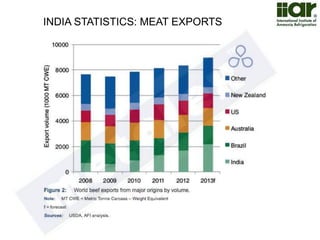
INDIA STATISTICS: MEAT EXPORTS
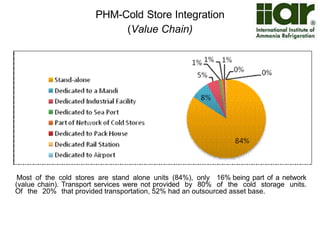
PHM-Cold Store Integration 
(Value Chain) 
Most of the cold stores are stand alone units (84%), only 16% being part of a network 
(value chain). Transport services were not provided by 80% of the cold storage units. 
Of the 20% that provided transportation, 52% had an outsourced asset base.
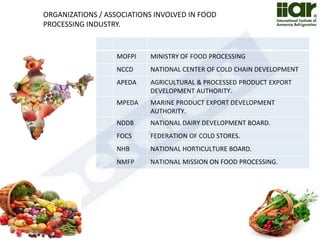
ORGANIZATIONS / ASSOCIATIONS INVOLVED IN FOOD 
PROCESSING INDUSTRY. 
MOFPI MINISTRY OF FOOD PROCESSING 
NCCD NATIONAL CENTER OF COLD CHAIN DEVELOPMENT 
APEDA AGRICULTURAL & PROCESSED PRODUCT EXPORT 
DEVELOPMENT AUTHORITY. 
MPEDA MARINE PRODUCT EXPORT DEVELOPMENT 
AUTHORITY. 
NDDB NATIONAL DAIRY DEVELOPMENT BOARD. 
FOCS FEDERATION OF COLD STORES. 
NHB NATIONAL HORTICULTURE BOARD. 
NMFP NATIONAL MISSION ON FOOD PROCESSING.
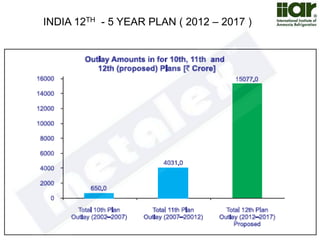
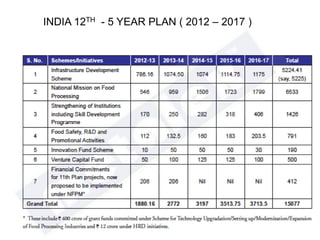
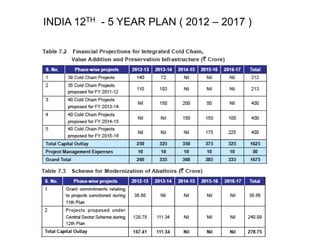
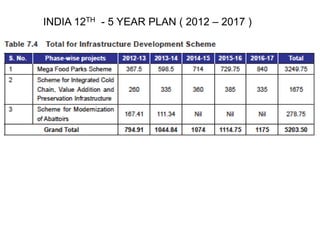
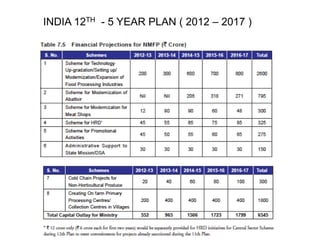
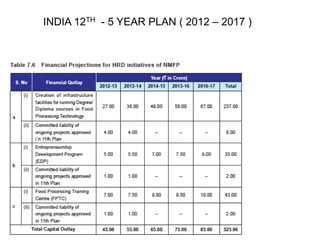
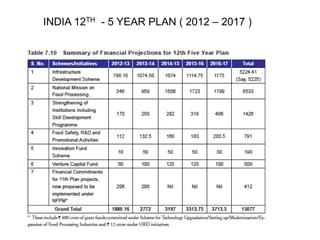
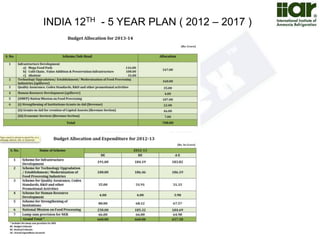
INDIA 12TH - 5 YEAR PLAN
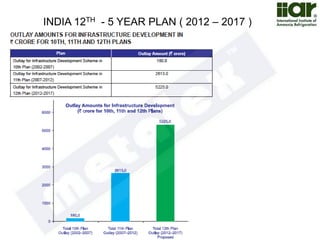
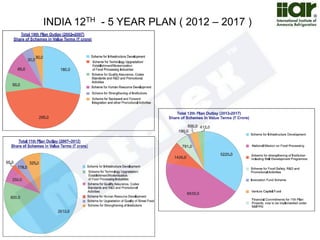
INDIA 12TH - 5 YEAR PLAN ( 2012 – 2017 )
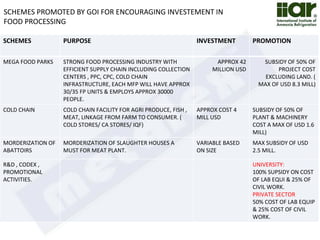
SCHEMES PURPOSE INVESTMENT PROMOTION 
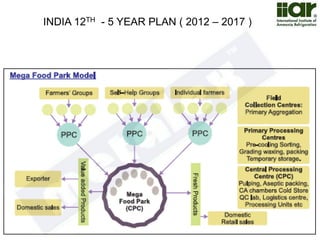
MEGA FOOD PARKS STRONG FOOD PROCESSING INDUSTRY WITH 
EFFICIENT SUPPLY CHAIN INCLUDING COLLECTION 
CENTERS , PPC, CPC, COLD CHAIN 
INFRASTRUCTURE, EACH MFP WILL HAVE APPROX 
30/35 FP UNITS & EMPLOYS APPROX 30000 
PEOPLE. 
APPROX 42 
MILLION USD 
SUBSIDY OF 50% OF 
PROJECT COST 
EXCLUDING LAND. ( 
MAX OF USD 8.3 MILL) 
COLD CHAIN COLD CHAIN FACILITY FOR AGRI PRODUCE, FISH , 
MEAT, LINKAGE FROM FARM TO CONSUMER. ( 
COLD STORES/ CA STORES/ IQF) 
APPROX COST 4 
MILL USD 
SUBSIDY OF 50% OF 
PLANT & MACHINERY 
COST A MAX OF USD 1.6 
MILL) 
MORDERIZATION OF 
ABATTOIRS 
MORDERIZATION OF SLAUGHTER HOUSES A 
MUST FOR MEAT PLANT. 
VARIABLE BASED 
ON SIZE 
MAX SUBSIDY OF USD 
2.5 MILL. 
R&D , CODEX , 
PROMOTIONAL 
ACTIVITIES. 
UNIVERSITY: 
100% SUPSIDY ON COST 
OF LAB EQUI & 25% OF 
CIVIL WORK. 
PRIVATE SECTOR 
50% COST OF LAB EQUIP 
& 25% COST OF CIVIL 
WORK. 
SCHEMES PROMOTED BY GOI FOR ENCOURAGING INVESTEMENT IN 
FOOD PROCESSING
INDIA 12TH - 5 YEAR PLAN ( 2012 – 2017 )
INDIA 12TH - 5 YEAR PLAN ( 2012 – 2017 ) 
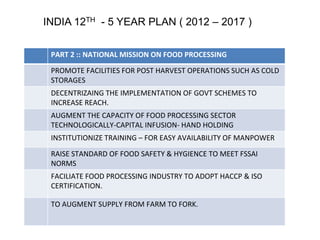
PART 2 :: NATIONAL MISSION ON FOOD PROCESSING 
PROMOTE FACILITIES FOR POST HARVEST OPERATIONS SUCH AS COLD 
STORAGES 
DECENTRIZAING THE IMPLEMENTATION OF GOVT SCHEMES TO 
INCREASE REACH. 
AUGMENT THE CAPACITY OF FOOD PROCESSING SECTOR 
TECHNOLOGICALLY-CAPITAL INFUSION- HAND HOLDING 
INSTITUTIONIZE TRAINING – FOR EASY AVAILABILITY OF MANPOWER 
RAISE STANDARD OF FOOD SAFETY & HYGIENCE TO MEET FSSAI 
NORMS 
FACILIATE FOOD PROCESSING INDUSTRY TO ADOPT HACCP & ISO 
CERTIFICATION. 
TO AUGMENT SUPPLY FROM FARM TO FORK.
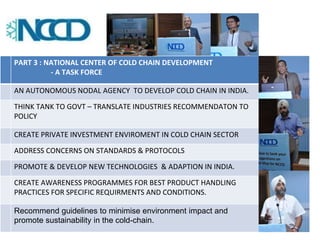
PART 3 : NATIONAL CENTER OF COLD CHAIN DEVELOPMENT 
- A TASK FORCE 
AN AUTONOMOUS NODAL AGENCY TO DEVELOP COLD CHAIN IN INDIA. 
THINK TANK TO GOVT – TRANSLATE INDUSTRIES RECOMMENDATON TO 
POLICY 
CREATE PRIVATE INVESTMENT ENVIROMENT IN COLD CHAIN SECTOR 
ADDRESS CONCERNS ON STANDARDS & PROTOCOLS 
PROMOTE & DEVELOP NEW TECHNOLOGIES & ADAPTION IN INDIA. 
CREATE AWARENESS PROGRAMMES FOR BEST PRODUCT HANDLING 
PRACTICES FOR SPECIFIC REQUIRMENTS AND CONDITIONS. 
Recommend guidelines to minimise environment impact and 
promote sustainability in the cold-chain.
INDIA 12TH - 5 YEAR PLAN ( 2012 – 2017 )
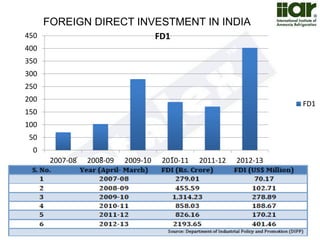
FOREIGN DIRECT INVESTMENT IN INDIA 
450 
400 
350 
300 
250 
200 
150 
100 
50 
0 
FD1 
2007-08 2008-09 2009-10 2010-11 2011-12 2012-13 
FD1
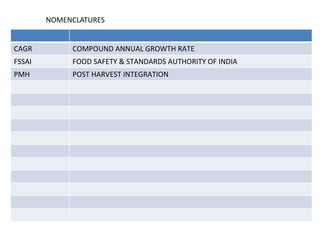
NOMENCLATURES 
CAGR COMPOUND ANNUAL GROWTH RATE 
FSSAI FOOD SAFETY & STANDARDS AUTHORITY OF INDIA 
PMH POST HARVEST INTEGRATION
REFRENCES 
www.fao.org 
www.12thplan.gov.in 
www.planningcommission.ni.in 
www.emerson.com/india 
Central Institute of Post Harvest Engg & Tech 
Post Harvest Intergration
Prospect for cold chain development in 
the next decade
Availability of Cold Storages 
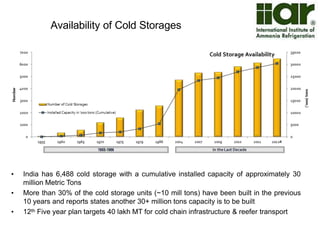
• India has 6,488 cold storage with a cumulative installed capacity of approximately 30 
million Metric Tons 
• More than 30% of the cold storage units (~10 mill tons) have been built in the previous 
10 years and reports states another 30+ million tons capacity is to be built 
• 12th Five year plan targets 40 lakh MT for cold chain infrastructure & reefer transport
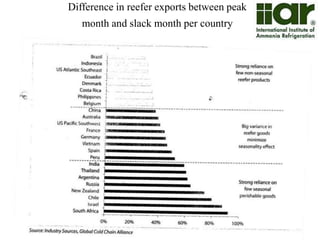
Difference in reefer exports between peak 
month and slack month per country
Role of Govt. in development process
CHALLENGES : 
High Operating Expenditure will see change 
• About 28% of the total expenses for cold storages in India is accounted for by 
energy expenses compared to only 10% in the West 
• About 30-35% of the losses can be reduced by transporting the freshly harvested 
fruits and vegetables in refrigerated containers or in suitable containers, crates 
etc. 
• Investment costs in the back-up systems of cold storages further makes the 
setting up of cold storage difficult, unviable and uneconomical 
• Alternate sources of non-conventional energy to be tapped.
CHALLENGES 
Govt. policy interventions to develop 
integrated Cold Chain 
• No Clear cut policy on cold chain development, presently. 
• Need for Adoption of modern Technology in Warehousing Business Model of Cold 
Chain Infrastructure. 
• Enforcement of Technical Standards for Specialized / Reefer Transport System as 
regulatory tools for claiming subsidies. 
• Generating minimum critical mass of Skilled Man-Power. 
• Creating synergy for Indian produce and institutions. 
• Specialized Purpose Vehicle (SPV) for Cold Chain Logistics Initiative. 
• National Centre for Cold Chain Development (NCCD) activation.
CHALLENGES 
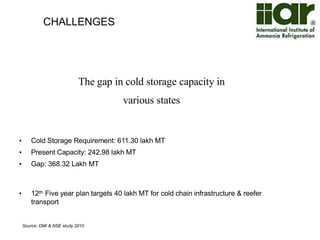
The gap in cold storage capacity in 
various states 
• Cold Storage Requirement: 611.30 lakh MT 
• Present Capacity: 242.98 lakh MT 
• Gap: 368.32 Lakh MT 
• 12th Five year plan targets 40 lakh MT for cold chain infrastructure & reefer 
transport 
Source: DMI & NSE study 2010
STRENGTH IN CHANGE : 
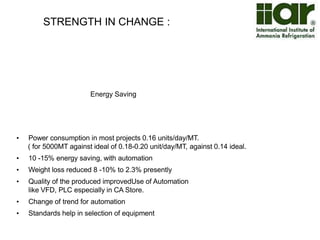
Energy Saving 
• Power consumption in most projects 0.16 units/day/MT. 
( for 5000MT against ideal of 0.18-0.20 unit/day/MT, against 0.14 ideal. 
• 10 -15% energy saving, with automation 
• Weight loss reduced 8 -10% to 2.3% presently 
• Quality of the produced improvedUse of Automation 
like VFD, PLC especially in CA Store. 
• Change of trend for automation 
• Standards help in selection of equipment
STRENGTH IN CHANGE: 
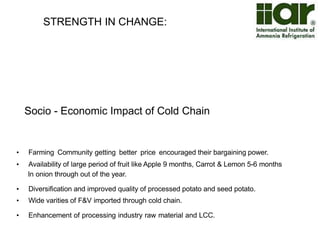
Socio - Economic Impact of Cold Chain 
• Farming Community getting better price encouraged their bargaining power. 
• Availability of large period of fruit like Apple 9 months, Carrot & Lemon 5-6 months 
In onion through out of the year. 
• Diversification and improved quality of processed potato and seed potato. 
• Wide varities of F&V imported through cold chain. 
• Enhancement of processing industry raw material and LCC.
OPPORTUNITIES : 
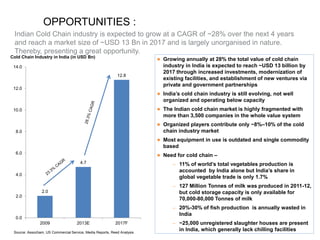
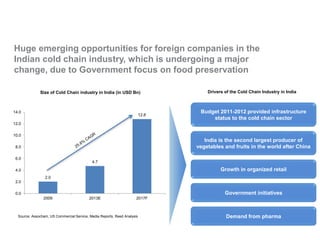
Indian Cold Chain industry is expected to grow at a CAGR of ~28% over the next 4 years 
and reach a market size of ~USD 13 Bn in 2017 and is largely unorganised in nature. 
Thereby, presenting a great opportunity. 
Cold Chain Industry in India (in USD Bn)  Growing annually at 28% the total value of cold chain 
2.0 
4.7 
12.8 
14.0 
12.0 
10.0 
8.0 
6.0 
4.0 
2.0 
0.0 
2009 2013E 2017F 
industry in India is expected to reach ~USD 13 billion by 
2017 through increased investments, modernization of 
existing facilities, and establishment of new ventures via 
private and government partnerships 
 India’s cold chain industry is still evolving, not well 
organized and operating below capacity 
 The Indian cold chain market is highly fragmented with 
more than 3,500 companies in the whole value system 
 Organized players contribute only ~8%–10% of the cold 
chain industry market 
 Most equipment in use is outdated and single commodity 
based 
 Need for cold chain – 
‒ 11% of world’s total vegetables production is 
accounted by India alone but India’s share in 
global vegetable trade is only 1.7% 
‒ 127 Million Tonnes of milk was produced in 2011-12, 
but cold storage capacity is only available for 
70,000-80,000 Tonnes of milk 
‒ 20%-30% of fish production is annually wasted in 
India 
‒ ~25,000 unregistered slaughter houses are present 
in India, which generally lack chilling facilities 
Source: Assocham, US Commercial Service, Media Reports, Reed Analysis
OPPORTUNITIES : 
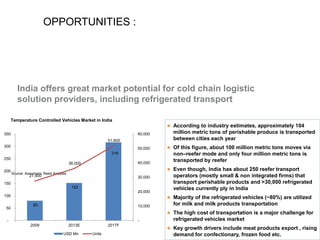
India offers great market potential for cold chain logistic 
solution providers, including refrigerated transport 
Temperature Controlled Vehicles Market in India 
 According to industry estimates, approximately 104 
million metric tons of perishable produce is transported 
between cities each year 
 Of this figure, about 100 million metric tons moves via 
non–reefer mode and only four million metric tons is 
transported by reefer 
 Even though, India has about 250 reefer transport 
operators (mostly small & non integrated firms) that 
transport perishable products and >30,000 refrigerated 
vehicles currently ply in India 
 Majority of the refrigerated vehicles (~80%) are utilized 
for milk and milk products transportation 
 The high cost of transportation is a major challenge for 
refrigerated vehicles market 
 Key growth drivers include meat products export , rising 
demand for confectionary, frozen food etc. 
Source: Assocham, Reed Analysis 
80 
152 
316 
27,400 
36,000 
51,800 
60,000 
50,000 
40,000 
30,000 
20,000 
10,000 
- 
350 
300 
250 
200 
150 
100 
50 
- 
2009 2013E 2017F 
USD Mn Units
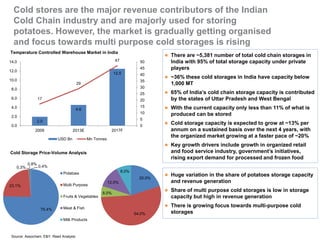
Cold stores are the major revenue contributors of the Indian 
Cold Chain industry and are majorly used for storing 
potatoes. However, the market is gradually getting organised 
and focus towards multi purpose cold storages is rising 
Temperature Controlled Warehouse Market in India  There are ~5,381 number of total cold chain storages in 
India with 95% of total storage capacity under private 
players 
 ~36% these cold storages in India have capacity below 
1,000 MT 
 65% of India’s cold chain storage capacity is contributed 
by the states of Uttar Pradesh and West Bengal 
 With the current capacity only less than 11% of what is 
produced can be stored 
 Cold storage capacity is expected to grow at ~13% per 
annum on a sustained basis over the next 4 years, with 
the organized market growing at a faster pace of ~20% 
 Key growth drivers include growth in organized retail 
and food service industry, government’s initiatives, 
rising export demand for processed and frozen food 
2.0 
14.0 
12.0 
10.0 
8.0 
6.0 
4.0 
2.0 
0.3% 
Source: Assocham, E&Y, Reed Analysis 
4.6 
12.5 
17 
29 
47 
50 
45 
40 
35 
30 
25 
20 
15 
10 
5 
0 
0.0 
2009 2013E 2017F 
USD Bn Mn Tonnes 
Cold Storage Price-Volume Analysis 
75.4% 
23.1% 
0.8% 
0.4% 
Potatoes 
Multi Purpose 
Fruits & Vegetables 
Meat & Fish 
Milk Products 
 Huge variation in the share of potatoes storage capacity 
and revenue generation 
 Share of multi purpose cold storages is low in storage 
capacity but high in revenue generation 
 There is growing focus towards multi-purpose cold 
storages 
20.0% 
54.0% 
12.0% 
6.0% 
8.0%
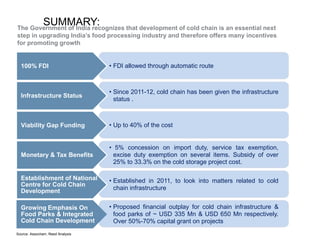
SUMMARY: 
The Government of India recognizes that development of cold chain is an essential next 
step in upgrading India’s food processing industry and therefore offers many incentives 
for promoting growth 
100% FDI • FDI allowed through automatic route 
• Since 2011-12, cold chain has been given the infrastructure 
status . 
Infrastructure Status 
Viability Gap Funding • Up to 40% of the cost 
• 5% concession on import duty, service tax exemption, 
excise duty exemption on several items. Subsidy of over 
25% to 33.3% on the cold storage project cost. 
Monetary & Tax Benefits 
• Established in 2011, to look into matters related to cold 
chain infrastructure 
Establishment of National 
Centre for Cold Chain 
Development 
• Proposed financial outplay for cold chain infrastructure & 
food parks of ~ USD 335 Mn & USD 650 Mn respectively. 
Over 50%-70% capital grant on projects 
Growing Emphasis On 
Food Parks & Integrated 
Cold Chain Development 
Source: Assocham, Reed Analysis
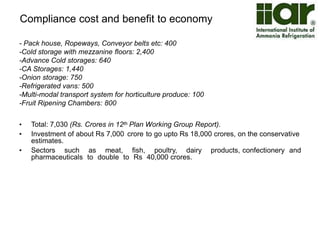
Compliance cost and benefit to economy 
- Pack house, Ropeways, Conveyor belts etc: 400 
-Cold storage with mezzanine floors: 2,400 
-Advance Cold storages: 640 
-CA Storages: 1,440 
-Onion storage: 750 
-Refrigerated vans: 500 
-Multi-modal transport system for horticulture produce: 100 
-Fruit Ripening Chambers: 800 
• Total: 7,030 (Rs. Crores in 12th Plan Working Group Report). 
• Investment of about Rs 7,000 crore to go upto Rs 18,000 crores, on the conservative 
estimates. 
• Sectors such as meat, fish, poultry, dairy products, confectionery and 
pharmaceuticals to double to Rs 40,000 crores.
Importance of standards for healthy 
development of cold chain projects
Cold Chain industry in India
The India Opportunity
Doing Business in India
India Statistics
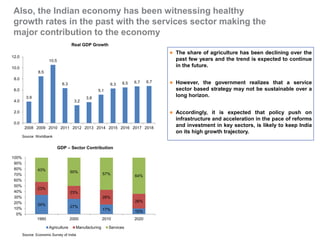
Also, the Indian economy has been witnessing healthy 
growth rates in the past with the services sector making the 
major contribution to the economy 
3.9 
8.5 
10.5 
6.3 
Real GDP Growth 
3.2 
3.8 
5.1 
6.3 6.5 6.7 6.7 
12.0 
10.0 
8.0 
6.0 
4.0 
2.0 
0.0 
2008 2009 2010 2011 2012 2013 2014 2015 2016 2017 2018 
Source: Worldbank 
 The share of agriculture has been declining over the 
past few years and the trend is expected to continue 
in the future. 
 However, the government realizes that a service 
sector based strategy may not be sustainable over a 
long horizon. 
 Accordingly, it is expected that policy push on 
infrastructure and acceleration in the pace of reforms 
and investment in key sectors, is likely to keep India 
on its high growth trajectory. 
34% 
GDP – Sector Contribution 
27% 
17% 
10% 
23% 
23% 
26% 
26% 
43% 
50% 
57% 
64% 
100% 
90% 
80% 
70% 
60% 
50% 
40% 
30% 
20% 
10% 
0% 
1990 2000 2010 2020 
Agriculture Manufacturing Services 
Source: Economic Survey of India
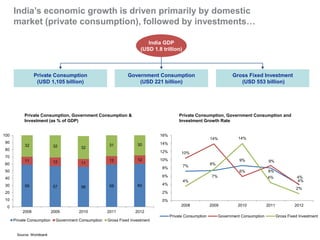
India’s economic growth is driven primarily by domestic 
market (private consumption), followed by investments… 
11 12 11 
59 57 56 59 60 
Source: Worldbank 
12 12 
32 32 32 
31 30 
100 
90 
80 
70 
60 
50 
40 
30 
20 
10 
0 
2008 2009 2010 2011 2012 
Private Consumption Government Consumption Gross Fixed Investment 
7% 
7% 
9% 
8% 
4% 
10% 
14% 
6% 
9% 
4% 
4% 
8% 
14% 
4% 
2% 
16% 
14% 
12% 
10% 
8% 
6% 
4% 
2% 
0% 
2008 2009 2010 2011 2012 
Private Consumption Government Consumption Gross Fixed Investment 
Private Consumption, Government Consumption & 
Investment (as % of GDP) 
Private Consumption, Government Consumption and 
Investment Growth Rate 
India GDP 
(USD 1.8 trillion) 
Private Consumption 
(USD 1,105 billion) 
Government Consumption 
(USD 221 billion) 
Gross Fixed Investment 
(USD 553 billion)
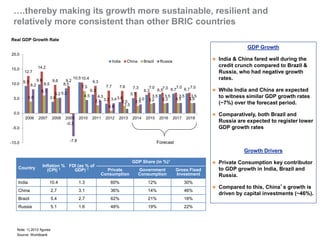
….thereby making its growth more sustainable, resilient and 
relatively more consistent than other BRIC countries 
Real GDP Growth Rate 
9.3 9.8 
3.9 
8.5 
10.5 
6.3 
India China Brazil Russia 
3.2 3.8 
5.1 
6.3 6.5 6.7 6.7 
12.7 
14.2 
9.6 9.2 
10.4 
9.3 
7.7 7.6 7.3 7.0 7.0 7.0 7.0 
4.0 
6.1 
5.2 
-0.3 
7.5 
2.7 
0.9 
2.5 2.5 
3.2 3.3 3.5 3.5 
8.2 8.5 
5.2 
-7.8 
4.5 4.3 
3.4 
1.5 
3.0 
3.5 3.5 3.5 3.5 
20.0 
15.0 
10.0 
5.0 
0.0 
-5.0 
-10.0 
2006 2007 2008 2009 2010 2011 2012 2013 2014 2015 2016 2017 2018 
Source: Worldbank 
GDP Growth 
 India & China fared well during the 
credit crunch compared to Brazil & 
Russia, who had negative growth 
rates. 
 While India and China are expected 
to witness similar GDP growth rates 
(~7%) over the forecast period. 
 Comparatively, both Brazil and 
Russia are expected to register lower 
GDP growth rates 
Growth Drivers 
 Private Consumption key contributor 
to GDP growth in India, Brazil and 
Russia. 
 Compared to this, China’s growth is 
driven by capital investments (~46%). 
Country 
Inflation % 
(CPI) 1 
FDI (as % of 
GDP) 1 
Forecast 
GDP Share (in %)1 
Private 
Consumption 
Government 
Consumption 
Gross Fixed 
Investment 
India 10.4 1.3 60% 12% 30% 
China 2.7 3.1 36% 14% 46% 
Brazil 5.4 2.7 62% 21% 18% 
Russia 5.1 1.6 48% 19% 22% 
Note: 1) 2012 figures
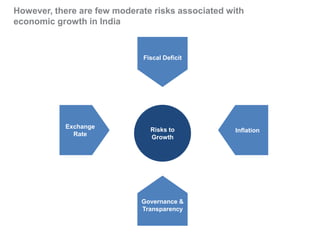
However, there are few moderate risks associated with 
economic growth in India 
Exchange 
Rate 
Inflation 
Fiscal Deficit 
Risks to 
Growth 
Governance & 
Transparency
Logistics in India
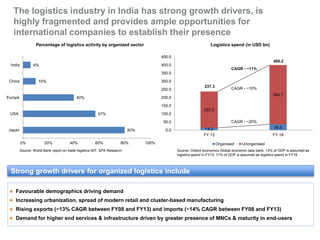
The logistics industry in India has strong growth drivers, is 
highly fragmented and provides ample opportunities for 
international companies to establish their presence 
223.2 
364.7 
CAGR - ~11% 
CAGR - ~10% 
14.2 35.5 
450.0 
400.0 
350.0 
300.0 
250.0 
200.0 
150.0 
100.0 
50.0 
0.0 
FY 13 FY 18 
Organised Unorganised 
80% 
57% 
40% 
6% 
10% 
0% 20% 40% 60% 80% 100% 
India 
China 
Europe 
USA 
Japan 
Percentage of logistics activity by organized sector Logistics spend (in USD bn) 
237.3 
400.2 
CAGR - ~20% 
Source: World Bank report on trade logistics 007, SPA Research Source: Oxford economics Global economic data bank; 13% of GDP is assumed as 
logistics spend in FY13; 11% of GDP is assumed as logistics spend in FY18 
Strong growth drivers for organized logistics include 
 Favourable demographics driving demand 
 Increasing urbanization, spread of modern retail and cluster-based manufacturing 
 Rising exports (~13% CAGR between FY08 and FY13) and imports (~14% CAGR between FY08 and FY13) 
 Demand for higher end services & infrastructure driven by greater presence of MNCs & maturity in end-users
Key growth opportunities in the 
logistics sector in India
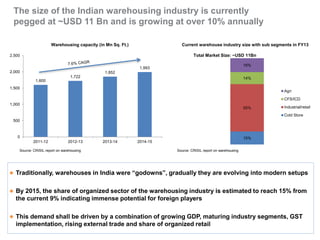
The size of the Indian warehousing industry is currently 
pegged at ~USD 11 Bn and is growing at over 10% annually 
1,600 
Warehousing capacity (in Mn Sq. Ft.) Current warehouse industry size with sub segments in FY13 
1,722 
1,852 
1,993 
2,500 
2,000 
1,500 
1,000 
500 
0 
2011-12 2012-13 2013-14 2014-15 
Source: CRISIL report on warehousing Source: CRISIL report on warehousing 
16% 
14% 
55% 
 Traditionally, warehouses in India were “godowns”, gradually they are evolving into modern setups 
 By 2015, the share of organized sector of the warehousing industry is estimated to reach 15% from 
the current 9% indicating immense potential for foreign players 
 This demand shall be driven by a combination of growing GDP, maturing industry segments, GST 
implementation, rising external trade and share of organized retail 
15% 
Agri 
CFS/ICD 
Industrial/retail 
Cold Store 
Total Market Size: ~USD 11Bn
Huge emerging opportunities for foreign companies in the 
Indian cold chain industry, which is undergoing a major 
change, due to Government focus on food preservation 
Size of Cold Chain industry in India (in USD Bn) 
2.0 
4.7 
12.8 
14.0 
12.0 
10.0 
8.0 
6.0 
4.0 
2.0 
0.0 
2009 2013E 2017F 
Drivers of the Cold Chain Industry in India 
Budget 2011-2012 provided infrastructure 
status to the cold chain sector 
India is the second largest producer of 
vegetables and fruits in the world after China 
Growth in organized retail 
Government initiatives 
Demand from pharma 
Source: Assocham, US Commercial Service, Media Reports, Reed Analysis
INDIA CHALLENGES:

Refrigeration Solutions By Metalex Cryogenics Limited, Pune
  • 1.
    I N DI A – R E P O R T 2014 IIAR - NASHVILLE PRESENTATION BY SAMIR SHAH – RVC – INDIA / SOUTH ASIA.
  • 2.
    India is expectedto be the 4th largest economy and will continue to be the 2nd largest population in the world by 2025 World Population by 2025 – 8,000 mn China 18% US Russia 359 mn 1.45 bn EU – 27 India 132 mn Brazil 1.43 bn 469 mn 213 mn 2% 3% 6% Region’s population as a % of total world’s population Total population 4% 18% Top 10 GDP Countries by 2025 Sources: United Nations population studies (Medium variant prospects); Goldman Sachs Economic Research (GDP estimates); International Monetary Fund; Reed Analysis
  • 3.
  • 5.
    In developing countriesmore than 40% of the food losses occur at post harvest and processing levels, while in industrialized countries, more than 40% of the food losses occur at retail and consumer levels. Food waste at consumer level in industrialized countries (222 million ton) is almost as high as the total net food production in sub Saharan Africa (230 million ton).
  • 6.
  • 7.
  • 8.
  • 10.
    PHM-Cold Store Integration (Value Chain) Most of the cold stores are stand alone units (84%), only 16% being part of a network (value chain). Transport services were not provided by 80% of the cold storage units. Of the 20% that provided transportation, 52% had an outsourced asset base.
  • 11.
    ORGANIZATIONS / ASSOCIATIONSINVOLVED IN FOOD PROCESSING INDUSTRY. MOFPI MINISTRY OF FOOD PROCESSING NCCD NATIONAL CENTER OF COLD CHAIN DEVELOPMENT APEDA AGRICULTURAL & PROCESSED PRODUCT EXPORT DEVELOPMENT AUTHORITY. MPEDA MARINE PRODUCT EXPORT DEVELOPMENT AUTHORITY. NDDB NATIONAL DAIRY DEVELOPMENT BOARD. FOCS FEDERATION OF COLD STORES. NHB NATIONAL HORTICULTURE BOARD. NMFP NATIONAL MISSION ON FOOD PROCESSING.
  • 12.
    INDIA 12TH -5 YEAR PLAN
  • 13.
    INDIA 12TH -5 YEAR PLAN ( 2012 – 2017 )
  • 14.
    SCHEMES PURPOSE INVESTMENTPROMOTION MEGA FOOD PARKS STRONG FOOD PROCESSING INDUSTRY WITH EFFICIENT SUPPLY CHAIN INCLUDING COLLECTION CENTERS , PPC, CPC, COLD CHAIN INFRASTRUCTURE, EACH MFP WILL HAVE APPROX 30/35 FP UNITS & EMPLOYS APPROX 30000 PEOPLE. APPROX 42 MILLION USD SUBSIDY OF 50% OF PROJECT COST EXCLUDING LAND. ( MAX OF USD 8.3 MILL) COLD CHAIN COLD CHAIN FACILITY FOR AGRI PRODUCE, FISH , MEAT, LINKAGE FROM FARM TO CONSUMER. ( COLD STORES/ CA STORES/ IQF) APPROX COST 4 MILL USD SUBSIDY OF 50% OF PLANT & MACHINERY COST A MAX OF USD 1.6 MILL) MORDERIZATION OF ABATTOIRS MORDERIZATION OF SLAUGHTER HOUSES A MUST FOR MEAT PLANT. VARIABLE BASED ON SIZE MAX SUBSIDY OF USD 2.5 MILL. R&D , CODEX , PROMOTIONAL ACTIVITIES. UNIVERSITY: 100% SUPSIDY ON COST OF LAB EQUI & 25% OF CIVIL WORK. PRIVATE SECTOR 50% COST OF LAB EQUIP & 25% COST OF CIVIL WORK. SCHEMES PROMOTED BY GOI FOR ENCOURAGING INVESTEMENT IN FOOD PROCESSING
  • 15.
    INDIA 12TH -5 YEAR PLAN ( 2012 – 2017 )
  • 16.
    INDIA 12TH -5 YEAR PLAN ( 2012 – 2017 )
  • 17.
    INDIA 12TH -5 YEAR PLAN ( 2012 – 2017 )
  • 18.
    INDIA 12TH -5 YEAR PLAN ( 2012 – 2017 )
  • 19.
    INDIA 12TH -5 YEAR PLAN ( 2012 – 2017 )
  • 20.
    INDIA 12TH -5 YEAR PLAN ( 2012 – 2017 )
  • 21.
    INDIA 12TH -5 YEAR PLAN ( 2012 – 2017 )
  • 22.
    INDIA 12TH -5 YEAR PLAN ( 2012 – 2017 )
  • 23.
    INDIA 12TH -5 YEAR PLAN ( 2012 – 2017 )
  • 24.
    INDIA 12TH -5 YEAR PLAN ( 2012 – 2017 ) PART 2 :: NATIONAL MISSION ON FOOD PROCESSING PROMOTE FACILITIES FOR POST HARVEST OPERATIONS SUCH AS COLD STORAGES DECENTRIZAING THE IMPLEMENTATION OF GOVT SCHEMES TO INCREASE REACH. AUGMENT THE CAPACITY OF FOOD PROCESSING SECTOR TECHNOLOGICALLY-CAPITAL INFUSION- HAND HOLDING INSTITUTIONIZE TRAINING – FOR EASY AVAILABILITY OF MANPOWER RAISE STANDARD OF FOOD SAFETY & HYGIENCE TO MEET FSSAI NORMS FACILIATE FOOD PROCESSING INDUSTRY TO ADOPT HACCP & ISO CERTIFICATION. TO AUGMENT SUPPLY FROM FARM TO FORK.
  • 25.
    PART 3 :NATIONAL CENTER OF COLD CHAIN DEVELOPMENT - A TASK FORCE AN AUTONOMOUS NODAL AGENCY TO DEVELOP COLD CHAIN IN INDIA. THINK TANK TO GOVT – TRANSLATE INDUSTRIES RECOMMENDATON TO POLICY CREATE PRIVATE INVESTMENT ENVIROMENT IN COLD CHAIN SECTOR ADDRESS CONCERNS ON STANDARDS & PROTOCOLS PROMOTE & DEVELOP NEW TECHNOLOGIES & ADAPTION IN INDIA. CREATE AWARENESS PROGRAMMES FOR BEST PRODUCT HANDLING PRACTICES FOR SPECIFIC REQUIRMENTS AND CONDITIONS. Recommend guidelines to minimise environment impact and promote sustainability in the cold-chain.
  • 26.
    INDIA 12TH -5 YEAR PLAN ( 2012 – 2017 )
  • 27.
    FOREIGN DIRECT INVESTMENTIN INDIA 450 400 350 300 250 200 150 100 50 0 FD1 2007-08 2008-09 2009-10 2010-11 2011-12 2012-13 FD1
  • 28.
    NOMENCLATURES CAGR COMPOUNDANNUAL GROWTH RATE FSSAI FOOD SAFETY & STANDARDS AUTHORITY OF INDIA PMH POST HARVEST INTEGRATION
  • 29.
    REFRENCES www.fao.org www.12thplan.gov.in www.planningcommission.ni.in www.emerson.com/india Central Institute of Post Harvest Engg & Tech Post Harvest Intergration
  • 30.
    Prospect for coldchain development in the next decade
  • 31.
    Availability of ColdStorages • India has 6,488 cold storage with a cumulative installed capacity of approximately 30 million Metric Tons • More than 30% of the cold storage units (~10 mill tons) have been built in the previous 10 years and reports states another 30+ million tons capacity is to be built • 12th Five year plan targets 40 lakh MT for cold chain infrastructure & reefer transport
  • 32.
    Difference in reeferexports between peak month and slack month per country
  • 33.
    Role of Govt.in development process
  • 34.
    CHALLENGES : HighOperating Expenditure will see change • About 28% of the total expenses for cold storages in India is accounted for by energy expenses compared to only 10% in the West • About 30-35% of the losses can be reduced by transporting the freshly harvested fruits and vegetables in refrigerated containers or in suitable containers, crates etc. • Investment costs in the back-up systems of cold storages further makes the setting up of cold storage difficult, unviable and uneconomical • Alternate sources of non-conventional energy to be tapped.
  • 35.
    CHALLENGES Govt. policyinterventions to develop integrated Cold Chain • No Clear cut policy on cold chain development, presently. • Need for Adoption of modern Technology in Warehousing Business Model of Cold Chain Infrastructure. • Enforcement of Technical Standards for Specialized / Reefer Transport System as regulatory tools for claiming subsidies. • Generating minimum critical mass of Skilled Man-Power. • Creating synergy for Indian produce and institutions. • Specialized Purpose Vehicle (SPV) for Cold Chain Logistics Initiative. • National Centre for Cold Chain Development (NCCD) activation.
  • 36.
    CHALLENGES The gapin cold storage capacity in various states • Cold Storage Requirement: 611.30 lakh MT • Present Capacity: 242.98 lakh MT • Gap: 368.32 Lakh MT • 12th Five year plan targets 40 lakh MT for cold chain infrastructure & reefer transport Source: DMI & NSE study 2010
  • 37.
    STRENGTH IN CHANGE: Energy Saving • Power consumption in most projects 0.16 units/day/MT. ( for 5000MT against ideal of 0.18-0.20 unit/day/MT, against 0.14 ideal. • 10 -15% energy saving, with automation • Weight loss reduced 8 -10% to 2.3% presently • Quality of the produced improvedUse of Automation like VFD, PLC especially in CA Store. • Change of trend for automation • Standards help in selection of equipment
  • 38.
    STRENGTH IN CHANGE: Socio - Economic Impact of Cold Chain • Farming Community getting better price encouraged their bargaining power. • Availability of large period of fruit like Apple 9 months, Carrot & Lemon 5-6 months In onion through out of the year. • Diversification and improved quality of processed potato and seed potato. • Wide varities of F&V imported through cold chain. • Enhancement of processing industry raw material and LCC.
  • 39.
    OPPORTUNITIES : IndianCold Chain industry is expected to grow at a CAGR of ~28% over the next 4 years and reach a market size of ~USD 13 Bn in 2017 and is largely unorganised in nature. Thereby, presenting a great opportunity. Cold Chain Industry in India (in USD Bn)  Growing annually at 28% the total value of cold chain 2.0 4.7 12.8 14.0 12.0 10.0 8.0 6.0 4.0 2.0 0.0 2009 2013E 2017F industry in India is expected to reach ~USD 13 billion by 2017 through increased investments, modernization of existing facilities, and establishment of new ventures via private and government partnerships  India’s cold chain industry is still evolving, not well organized and operating below capacity  The Indian cold chain market is highly fragmented with more than 3,500 companies in the whole value system  Organized players contribute only ~8%–10% of the cold chain industry market  Most equipment in use is outdated and single commodity based  Need for cold chain – ‒ 11% of world’s total vegetables production is accounted by India alone but India’s share in global vegetable trade is only 1.7% ‒ 127 Million Tonnes of milk was produced in 2011-12, but cold storage capacity is only available for 70,000-80,000 Tonnes of milk ‒ 20%-30% of fish production is annually wasted in India ‒ ~25,000 unregistered slaughter houses are present in India, which generally lack chilling facilities Source: Assocham, US Commercial Service, Media Reports, Reed Analysis
  • 40.
    OPPORTUNITIES : Indiaoffers great market potential for cold chain logistic solution providers, including refrigerated transport Temperature Controlled Vehicles Market in India  According to industry estimates, approximately 104 million metric tons of perishable produce is transported between cities each year  Of this figure, about 100 million metric tons moves via non–reefer mode and only four million metric tons is transported by reefer  Even though, India has about 250 reefer transport operators (mostly small & non integrated firms) that transport perishable products and >30,000 refrigerated vehicles currently ply in India  Majority of the refrigerated vehicles (~80%) are utilized for milk and milk products transportation  The high cost of transportation is a major challenge for refrigerated vehicles market  Key growth drivers include meat products export , rising demand for confectionary, frozen food etc. Source: Assocham, Reed Analysis 80 152 316 27,400 36,000 51,800 60,000 50,000 40,000 30,000 20,000 10,000 - 350 300 250 200 150 100 50 - 2009 2013E 2017F USD Mn Units
  • 41.
    Cold stores arethe major revenue contributors of the Indian Cold Chain industry and are majorly used for storing potatoes. However, the market is gradually getting organised and focus towards multi purpose cold storages is rising Temperature Controlled Warehouse Market in India  There are ~5,381 number of total cold chain storages in India with 95% of total storage capacity under private players  ~36% these cold storages in India have capacity below 1,000 MT  65% of India’s cold chain storage capacity is contributed by the states of Uttar Pradesh and West Bengal  With the current capacity only less than 11% of what is produced can be stored  Cold storage capacity is expected to grow at ~13% per annum on a sustained basis over the next 4 years, with the organized market growing at a faster pace of ~20%  Key growth drivers include growth in organized retail and food service industry, government’s initiatives, rising export demand for processed and frozen food 2.0 14.0 12.0 10.0 8.0 6.0 4.0 2.0 0.3% Source: Assocham, E&Y, Reed Analysis 4.6 12.5 17 29 47 50 45 40 35 30 25 20 15 10 5 0 0.0 2009 2013E 2017F USD Bn Mn Tonnes Cold Storage Price-Volume Analysis 75.4% 23.1% 0.8% 0.4% Potatoes Multi Purpose Fruits & Vegetables Meat & Fish Milk Products  Huge variation in the share of potatoes storage capacity and revenue generation  Share of multi purpose cold storages is low in storage capacity but high in revenue generation  There is growing focus towards multi-purpose cold storages 20.0% 54.0% 12.0% 6.0% 8.0%
  • 42.
    SUMMARY: The Governmentof India recognizes that development of cold chain is an essential next step in upgrading India’s food processing industry and therefore offers many incentives for promoting growth 100% FDI • FDI allowed through automatic route • Since 2011-12, cold chain has been given the infrastructure status . Infrastructure Status Viability Gap Funding • Up to 40% of the cost • 5% concession on import duty, service tax exemption, excise duty exemption on several items. Subsidy of over 25% to 33.3% on the cold storage project cost. Monetary & Tax Benefits • Established in 2011, to look into matters related to cold chain infrastructure Establishment of National Centre for Cold Chain Development • Proposed financial outplay for cold chain infrastructure & food parks of ~ USD 335 Mn & USD 650 Mn respectively. Over 50%-70% capital grant on projects Growing Emphasis On Food Parks & Integrated Cold Chain Development Source: Assocham, Reed Analysis
  • 43.
    Compliance cost andbenefit to economy - Pack house, Ropeways, Conveyor belts etc: 400 -Cold storage with mezzanine floors: 2,400 -Advance Cold storages: 640 -CA Storages: 1,440 -Onion storage: 750 -Refrigerated vans: 500 -Multi-modal transport system for horticulture produce: 100 -Fruit Ripening Chambers: 800 • Total: 7,030 (Rs. Crores in 12th Plan Working Group Report). • Investment of about Rs 7,000 crore to go upto Rs 18,000 crores, on the conservative estimates. • Sectors such as meat, fish, poultry, dairy products, confectionery and pharmaceuticals to double to Rs 40,000 crores.
  • 44.
    Importance of standardsfor healthy development of cold chain projects
  • 45.
  • 46.
  • 47.
  • 48.
  • 49.
    Also, the Indianeconomy has been witnessing healthy growth rates in the past with the services sector making the major contribution to the economy 3.9 8.5 10.5 6.3 Real GDP Growth 3.2 3.8 5.1 6.3 6.5 6.7 6.7 12.0 10.0 8.0 6.0 4.0 2.0 0.0 2008 2009 2010 2011 2012 2013 2014 2015 2016 2017 2018 Source: Worldbank  The share of agriculture has been declining over the past few years and the trend is expected to continue in the future.  However, the government realizes that a service sector based strategy may not be sustainable over a long horizon.  Accordingly, it is expected that policy push on infrastructure and acceleration in the pace of reforms and investment in key sectors, is likely to keep India on its high growth trajectory. 34% GDP – Sector Contribution 27% 17% 10% 23% 23% 26% 26% 43% 50% 57% 64% 100% 90% 80% 70% 60% 50% 40% 30% 20% 10% 0% 1990 2000 2010 2020 Agriculture Manufacturing Services Source: Economic Survey of India
  • 50.
    India’s economic growthis driven primarily by domestic market (private consumption), followed by investments… 11 12 11 59 57 56 59 60 Source: Worldbank 12 12 32 32 32 31 30 100 90 80 70 60 50 40 30 20 10 0 2008 2009 2010 2011 2012 Private Consumption Government Consumption Gross Fixed Investment 7% 7% 9% 8% 4% 10% 14% 6% 9% 4% 4% 8% 14% 4% 2% 16% 14% 12% 10% 8% 6% 4% 2% 0% 2008 2009 2010 2011 2012 Private Consumption Government Consumption Gross Fixed Investment Private Consumption, Government Consumption & Investment (as % of GDP) Private Consumption, Government Consumption and Investment Growth Rate India GDP (USD 1.8 trillion) Private Consumption (USD 1,105 billion) Government Consumption (USD 221 billion) Gross Fixed Investment (USD 553 billion)
  • 51.
    ….thereby making itsgrowth more sustainable, resilient and relatively more consistent than other BRIC countries Real GDP Growth Rate 9.3 9.8 3.9 8.5 10.5 6.3 India China Brazil Russia 3.2 3.8 5.1 6.3 6.5 6.7 6.7 12.7 14.2 9.6 9.2 10.4 9.3 7.7 7.6 7.3 7.0 7.0 7.0 7.0 4.0 6.1 5.2 -0.3 7.5 2.7 0.9 2.5 2.5 3.2 3.3 3.5 3.5 8.2 8.5 5.2 -7.8 4.5 4.3 3.4 1.5 3.0 3.5 3.5 3.5 3.5 20.0 15.0 10.0 5.0 0.0 -5.0 -10.0 2006 2007 2008 2009 2010 2011 2012 2013 2014 2015 2016 2017 2018 Source: Worldbank GDP Growth  India & China fared well during the credit crunch compared to Brazil & Russia, who had negative growth rates.  While India and China are expected to witness similar GDP growth rates (~7%) over the forecast period.  Comparatively, both Brazil and Russia are expected to register lower GDP growth rates Growth Drivers  Private Consumption key contributor to GDP growth in India, Brazil and Russia.  Compared to this, China’s growth is driven by capital investments (~46%). Country Inflation % (CPI) 1 FDI (as % of GDP) 1 Forecast GDP Share (in %)1 Private Consumption Government Consumption Gross Fixed Investment India 10.4 1.3 60% 12% 30% China 2.7 3.1 36% 14% 46% Brazil 5.4 2.7 62% 21% 18% Russia 5.1 1.6 48% 19% 22% Note: 1) 2012 figures
  • 52.
    However, there arefew moderate risks associated with economic growth in India Exchange Rate Inflation Fiscal Deficit Risks to Growth Governance & Transparency
  • 53.
  • 54.
    The logistics industryin India has strong growth drivers, is highly fragmented and provides ample opportunities for international companies to establish their presence 223.2 364.7 CAGR - ~11% CAGR - ~10% 14.2 35.5 450.0 400.0 350.0 300.0 250.0 200.0 150.0 100.0 50.0 0.0 FY 13 FY 18 Organised Unorganised 80% 57% 40% 6% 10% 0% 20% 40% 60% 80% 100% India China Europe USA Japan Percentage of logistics activity by organized sector Logistics spend (in USD bn) 237.3 400.2 CAGR - ~20% Source: World Bank report on trade logistics 007, SPA Research Source: Oxford economics Global economic data bank; 13% of GDP is assumed as logistics spend in FY13; 11% of GDP is assumed as logistics spend in FY18 Strong growth drivers for organized logistics include  Favourable demographics driving demand  Increasing urbanization, spread of modern retail and cluster-based manufacturing  Rising exports (~13% CAGR between FY08 and FY13) and imports (~14% CAGR between FY08 and FY13)  Demand for higher end services & infrastructure driven by greater presence of MNCs & maturity in end-users
  • 55.
    Key growth opportunitiesin the logistics sector in India
  • 56.
    The size ofthe Indian warehousing industry is currently pegged at ~USD 11 Bn and is growing at over 10% annually 1,600 Warehousing capacity (in Mn Sq. Ft.) Current warehouse industry size with sub segments in FY13 1,722 1,852 1,993 2,500 2,000 1,500 1,000 500 0 2011-12 2012-13 2013-14 2014-15 Source: CRISIL report on warehousing Source: CRISIL report on warehousing 16% 14% 55%  Traditionally, warehouses in India were “godowns”, gradually they are evolving into modern setups  By 2015, the share of organized sector of the warehousing industry is estimated to reach 15% from the current 9% indicating immense potential for foreign players  This demand shall be driven by a combination of growing GDP, maturing industry segments, GST implementation, rising external trade and share of organized retail 15% Agri CFS/ICD Industrial/retail Cold Store Total Market Size: ~USD 11Bn
  • 57.
    Huge emerging opportunitiesfor foreign companies in the Indian cold chain industry, which is undergoing a major change, due to Government focus on food preservation Size of Cold Chain industry in India (in USD Bn) 2.0 4.7 12.8 14.0 12.0 10.0 8.0 6.0 4.0 2.0 0.0 2009 2013E 2017F Drivers of the Cold Chain Industry in India Budget 2011-2012 provided infrastructure status to the cold chain sector India is the second largest producer of vegetables and fruits in the world after China Growth in organized retail Government initiatives Demand from pharma Source: Assocham, US Commercial Service, Media Reports, Reed Analysis
  • 58.

Editor's Notes

  • #3 By 2025, India will have the 2nd largest population in the world, just after China. India’s economy will be the world’s fourth largest by 2025, trailing only the US, China and Japan. The huge population growth and booming economic engine will generate enormous pressures to invest on the modernization and expansion of current infrastructure. As this investment cannot be covered by the GoI, international companies and investors are welcome.
  • #70 Key Trends for Commercial Vehicles Better infrastructure: Demand for commercial vehicles increased due to the development of roadways and greater market access. India has the second largest road network in the world, spanning a total of 4.7 million kilometres. This is used to transport over 60 per cent of all goods in the country and 85 per cent of total passenger traffic. Currently, the Government of India aims to develop a total of 66,117 kilometres of roads under various programmes Easy availability of credit: Greater access to credit eases the purchase of passenger and commercial vehicles. Auto finance penetration has increased at a CAGR of 16.6% to USD15.5 billion during FY07-11 Rapid Urbanisation : Urbanization in India is expected to increase from 33% in 2010 to over 40% by 2020. Consider the need to keep food cold: 30% of agricultural produce in India now perishes en route to the market due to refrigeration gaps in the supply chain; hence, there is a nationwide need for refrigerated trucks Policy support: Automotive Mission Plan’s vision to make India a preferred destination for designing and manufacturing of automobiles and achieve a market size of USD154 Bn by 2016. Proposal to allocate USD 2.7 Bn for JNNURM (Jawaharlal Nehru National Urban Renewal Mission) to bolster sales volumes of Medium and Heavy Commercial Vehicles Key Trends for Material Handling Equipment Growth in underlying sectors to drive demand: Construction sector in India is poised to grow from USD 83 Bn in FY 12 to USD 101 Bn in FY16 Market value of the steel sector in India stood at USD 57.8 Bn in 2011 and is expected to touch USD 95 Bn by 2016 The Ministry of Power has set a target for adding 76,000 MW of electricity capacity in the 12th Five Year Plan (2012-17) and 93,000 MW in the 13th Five Year Plan (2017-2022) Infrastructure Spend: Infrastructure spend of USD 1 Tn envisaged in the twelfth five year plan