ZATION OF COLD
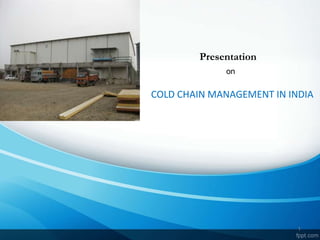
SCOLD CHAIN MANAGEMENT IN INDIA
TORAGES/STORAGES
HORTICULTURE PRODUCE
1
Presentation
on
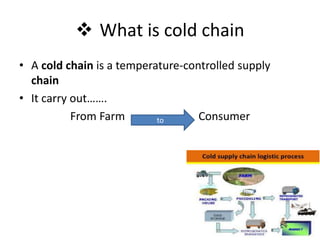
 What is cold chain
• A cold chain is a temperature-controlled supply
chain
• It carry out…….
From Farm Consumerto
2
Objectives of study
– Learn the development and current status of cold chain in
India
– Identify the major problems and opportunities in the
development of cold chain in India
– To assess the requirements predominantly for fruits and
vegetables and other products in the chill, mild-chill and
frozen categories of fruit and vegetables
– However, high value dairy products like ice-cream is
included under frozen category is also important
3
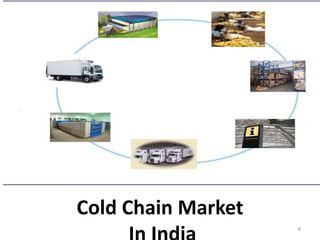
Cold Chain Market
4
Cold chain
• Not new to India – fairly well established for milk &
milk products
• To some extent for fish, meat and poultry products
• Still at infancy for fruits and vegetables
5
Different component f cold chain
1. Conventional cold storage
2. Pack houses, precooling & cold storage
3. C.A.Storage
4. Frozen foods plants
5. A.C / ventilated storage
6. Distribution centers
7. Super markets / retailers
8. Refrigerated transport
6
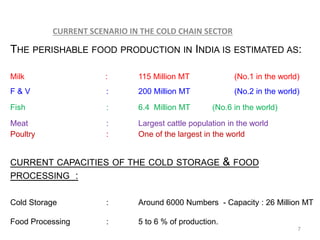
CURRENT SCENARIO IN THE COLD CHAIN SECTOR
THE PERISHABLE FOOD PRODUCTION IN INDIA IS ESTIMATED AS:
Milk : 115 Million MT (No.1 in the world)
F & V : 200 Million MT (No.2 in the world)
Fish : 6.4 Million MT (No.6 in the world)
Meat : Largest cattle population in the world
Poultry : One of the largest in the world
CURRENT CAPACITIES OF THE COLD STORAGE & FOOD
PROCESSING :
Cold Storage : Around 6000 Numbers - Capacity : 26 Million MT
Food Processing : 5 to 6 % of production.
7
• Growing annually at 28% the total value of cold chain
industry in India is expected to reach ~USD 13 billion by
2017
• through increased investments, modernization of existing
facilities, and establishment of new ventures via private
and government partnerships
• India’s cold chain industry is still evolving, not well
organized and operating below capacity
• The Indian cold chain market is highly fragmented with
more than 3,500 companies in the whole value system
• Organized players contribute only ~8%–10% of the cold
chain industry market
• Most equipment in use is out-dated and single commodity
based source: Assocham, US Commercial Service, Media Reports, Reed Analysis 8
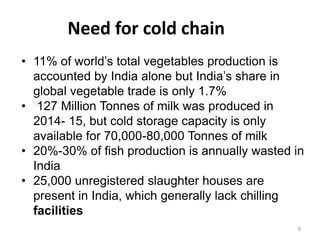
Need for cold chain
• 11% of world’s total vegetables production is
accounted by India alone but India’s share in
global vegetable trade is only 1.7%
• 127 Million Tonnes of milk was produced in
2014- 15, but cold storage capacity is only
available for 70,000-80,000 Tonnes of milk
• 20%-30% of fish production is annually wasted in
India
• 25,000 unregistered slaughter houses are
present in India, which generally lack chilling
facilities
9
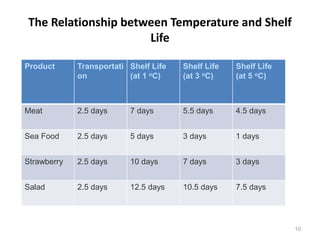
The Relationship between Temperature and Shelf
Life
Product Transportati
on
Shelf Life
(at 1 oC)
Shelf Life
(at 3 oC)
Shelf Life
(at 5 oC)
Meat 2.5 days 7 days 5.5 days 4.5 days
Sea Food 2.5 days 5 days 3 days 1 days
Strawberry 2.5 days 10 days 7 days 3 days
Salad 2.5 days 12.5 days 10.5 days 7.5 days
10
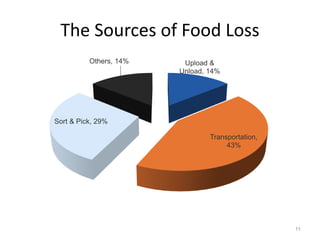
The Sources of Food Loss
Upload &
Unload, 14%
Transportation,
43%
Sort & Pick, 29%
Others, 14%
11
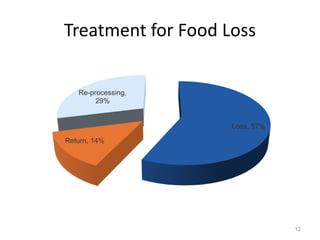
Treatment for Food Loss
Loss, 57%
Return, 14%
Re-processing,
29%
12
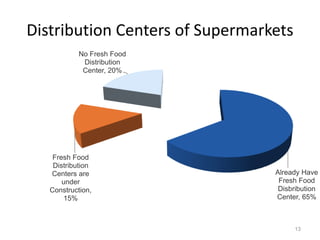
Distribution Centers of Supermarkets
Already Have
Fresh Food
Disbribution
Center, 65%
Fresh Food
Distribution
Centers are
under
Construction,
15%
No Fresh Food
Distribution
Center, 20%
13
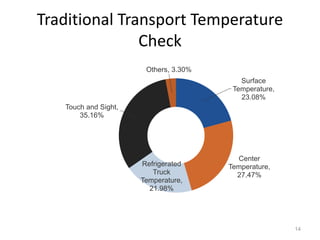
Traditional Transport Temperature
Check
Surface
Temperature,
23.08%
Center
Temperature,
27.47%
Refrigerated
Truck
Temperature,
21.98%
Touch and Sight,
35.16%
Others, 3.30%
14
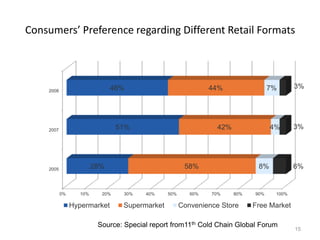
Consumers’ Preference regarding Different Retail Formats
0% 10% 20% 30% 40% 50% 60% 70% 80% 90% 100%
2005
2007
2008
28%
51%
46%
58%
42%
44%
8%
4%
7%
6%
3%
3%
Hypermarket Supermarket Convenience Store Free Market
15
Source: Special report from11th Cold Chain Global Forum
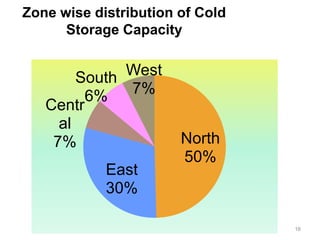
North
50%
East
30%
Centr
al
7%
South
6%
West
7%
Zone wise distribution of Cold
Storage Capacity
16
Challenges of Entering BRIC Markets
Top 10 Challenges:
• Initial Cost
• Culture
• Finding a Trusted Partner
• Infrastructure
• Lack of Control
17
• Lack of Expertise
• Market Knowledge
• Regulations/Customs
• Time
• Transportation Laws
Source: Special report from11th Cold Chain Global Forum18
Current update on cold chain
• With 3500+ players, the Indian cold chain market is highly
fragmented
• India currently has 6156 cold storage facilities across various
states with total capacity of 28.68 MMT which is insufficient.
• Due to lack of cold storage facilities, India has wastage of
more than 450MMT every year which leads to a huge amount
of loss, and leads to shortage in the overall generation
capability
Source: Special report from11th Cold Chain Global Forum19
OPPORTUNITY
• With the growing production there is a great potential for
development of Cold Chain in F&V sector
• Food processing recognized as a Priority sector by Govt.
• Incentives offered by the govt.
• Multi-products Cold Stores – more and more products such as
carrots, turmeric are being added in this category.
• Food Parks –designed for overall development of the food
handling, processing & storage facilities. Govt. promoting 30
Mega Food Parks
20
• Terminal markets managed both by APMCs & Private
players
• Pack Houses with Precooling facilities for relevant products
in different regions.
• India is the second largest producer of fruits and vegetables
in the world.
• Due to lack of adequate cold storage facilities, more than
INR 100 BN worth of fresh produce is wasted every year in
the country.
• In absence of improvements in the area of cold chain
infrastructure, food wastage problem is likely to grow
furthermore.
21
• More modern facilities along with planned establishment
between the point of production and market can help
India improve the situation, helping it lower wastage and
increase profitability.
• The demand for cold chain in fruit and vegetable industry
has been growing day-by-day," said the report.
22
According to the TechSci Research report;
“India Cold Chain Market Forecast & Opportunities, 2017”
• the cold chain market in India is anticipated to grow at a
CAGR (Constant Annual Growth Rate) of 28.7% during 2012-
2017
• which will make the market reach US$ 11.6 Billion by 2017
• According to Indian farmers quoted in an article in The
Hindu newspaper in the food sector, 30% of food wastage is
due to issues related to transportation, and this includes issues
related to cold storage
23
India needs investment of $ 2 billion for
low-cost cold chain tech
• India needs $ 2 billion investment to set up low- cost and
energy efficient cold chains in the country, said by
Agriculture Ministry
• Future cold chain market in India is to touch the whooping
figure of around INR 640 Billion (USD 11 Billion) by 2017.
24
Cold Chains can prevent Rs 13,600 crore worth
food loss
• Lack of cold and frozen supply chains leads to loss of fruits and
vegetables worth over Rs. 13,600 crore annually in the country,
according to report.
• The report 'A tank of cold: Cleantech Leapfrog to a more food secure
world' by UK- based Institution of Mechanical Engineers calls for
urgent action to encourage roll out of sustainable cold chains in India
to prevent unnecessary food loss, help alleviate hunger improve
global food security.
• As much as 50 % of perishable food items are lost every year in India
due to lack of cold storages, it said.
25
• India is the world's largest producer of milk, and second only to china
in fruit and vegetables.
• Yet agriculture, which makes up 53 % of the workforce, generates
just 15 % of GDP.
• As of 2015, India had about 6,300 cold storages with a capacity of
30.11 million MT. But about 60% of them are located in Uttar
Pradesh, Gujarat, west Bengal and Punjab.
• The Indian government as well as NGOs involved in development
initiatives and retailers need to priorities investment into affordable,
reliable and sustainable cold chain, said the report. 26
NABARD earmarks Rs. 1000 crore for
Promoting Cold Chain Infrastructure
• National Bank for Agriculture and Rural Development (NABARD)
earmarked Rs. 1000 crore for providing direct finance to cold chain
infrastructure projects in the country, out of the Rs. 5000 crore
Warehouse Infrastructure Fund announced in the Union Budget
2014-15.
• Cold Chain players in the public, private and cooperative sectors
besides Farmers' Producers Organizations (FPOs) can now avail this
direct credit window from NABARD at competitive interest rates.
27Source : NABARD site
POSSIBLE REASONS OF SCOPE
• Poor Infrastructure
• Insufficient Cold Storage Capacity
• Unavailability of Cold Stores near to Farms
• Transport Refrigeration
 This calls for investments as the primary need for Cold Storages and cold
chain to save perishable horticulture produce thus strengthening and
improving the food supply chain .
This can result in
• Reduce wastage
• Creation of small scale Industries and Employment
28
Govt. Support for cold storage
• Hon'ble Finance Minister in this budget speech for 2014-15,
announced the establishment of a dedicated fund with a corpus of
Rs. 5000 crore in NABARD, for projects related with agriculture
commodity storage infrastructure sector.
• This fund is known as the Warehouse Infrastructure Fund (WIF) 2014-
15. Under implementation - for eg. Nabard team has already started
visiting Agra area for assessment on need of such assistance.
• Excise duty is fully exempt for specified equipments for cold stores or
transport.
29Source : NABARD site
• Deduction of 150 % of capital expenditure incurred for setting up and
operating a cold chain facility(for computing taxable income)
• Service tax exempted for storage of agri cold storage and warehouse
• Service tax exempted for creation, installation, commissioning of cold
storage equipment's, transport, technical testing and analysis
• Investment Subsidy of 35% to 50% for cold chain projects available
• 100% FDI through automatic route open for cold chain
• Basic Custom duty @ 5% for imports specific for cold chain projects
• Basic Custom duty @ nil for import of reefer vans and containers
30
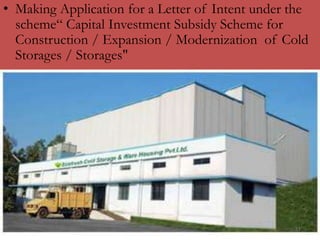
• Making Application for a Letter of Intent under the
scheme“ Capital Investment Subsidy Scheme for
Construction / Expansion / Modernization of Cold
Storages / Storages"
31
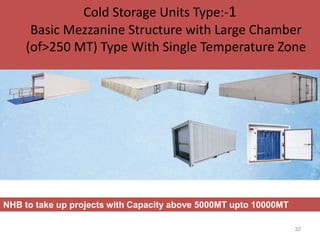
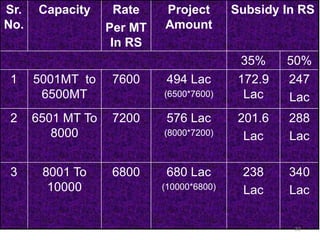
Cold Storage Units Type:-1
Basic Mezzanine Structure with Large Chamber
(of>250 MT) Type With Single Temperature Zone
NHB to take up projects with Capacity above 5000MT upto 10000MT
32
Sr.
No.
Capacity Rate
Per MT
In RS
Project
Amount
Subsidy In RS
35% 50%
1 5001MT to
6500MT
7600 494 Lac
(6500*7600)
172.9
Lac
247
Lac
2 6501 MT To
8000
7200 576 Lac
(8000*7200)
201.6
Lac
288
Lac
3 8001 To
10000
6800 680 Lac
(10000*6800)
238
Lac
340
Lac
33
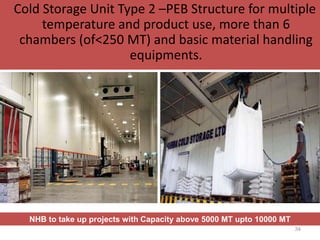
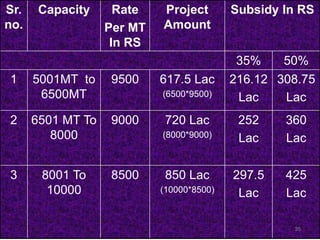
Cold Storage Unit Type 2 –PEB Structure for multiple
temperature and product use, more than 6
chambers (of<250 MT) and basic material handling
equipments.
NHB to take up projects with Capacity above 5000 MT upto 10000 MT
34
Sr.
no.
Capacity Rate
Per MT
In RS
Project
Amount
Subsidy In RS
35% 50%
1 5001MT to
6500MT
9500 617.5 Lac
(6500*9500)
216.12
Lac
308.75
Lac
2 6501 MT To
8000
9000 720 Lac
(8000*9000)
252
Lac
360
Lac
3 8001 To
10000
8500 850 Lac
(10000*8500)
297.5
Lac
425
Lac
35
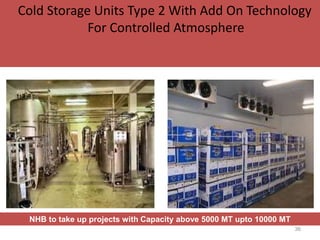
Cold Storage Units Type 2 With Add On Technology
For Controlled Atmosphere
NHB to take up projects with Capacity above 5000 MT upto 10000 MT
36
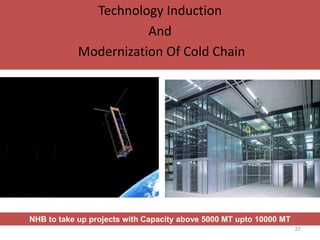
Technology Induction
And
Modernization Of Cold Chain
NHB to take up projects with Capacity above 5000 MT upto 10000 MT
37
Revised Operational Guidelines for release of subsidy in
respect of projects under NHB schemes
With a view to:-
1) promote horticulture and
2) creation of critical infrastructure for the sector and
3) to reduce the interest burden on the loan taken by the farming
communities/entrepreneurs
 On projects considered under the credit linked back ended subsidy
scheme of the Board
 Operational Guidelines have been revised for the release of
subsidy
38
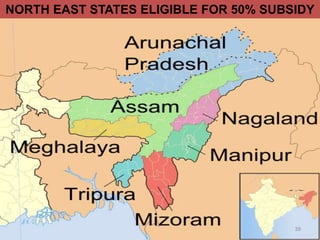
NORTH EAST STATES ELIGIBLE FOR 50% SUBSIDY
39
40
41
Thank you

Cold chain transportion in india

  • 1.
    ZATION OF COLD SCOLDCHAIN MANAGEMENT IN INDIA TORAGES/STORAGES HORTICULTURE PRODUCE 1 Presentation on
  • 2.
     What iscold chain • A cold chain is a temperature-controlled supply chain • It carry out……. From Farm Consumerto 2
  • 3.
    Objectives of study –Learn the development and current status of cold chain in India – Identify the major problems and opportunities in the development of cold chain in India – To assess the requirements predominantly for fruits and vegetables and other products in the chill, mild-chill and frozen categories of fruit and vegetables – However, high value dairy products like ice-cream is included under frozen category is also important 3
  • 4.
  • 5.
    Cold chain • Notnew to India – fairly well established for milk & milk products • To some extent for fish, meat and poultry products • Still at infancy for fruits and vegetables 5
  • 6.
    Different component fcold chain 1. Conventional cold storage 2. Pack houses, precooling & cold storage 3. C.A.Storage 4. Frozen foods plants 5. A.C / ventilated storage 6. Distribution centers 7. Super markets / retailers 8. Refrigerated transport 6
  • 7.
    CURRENT SCENARIO INTHE COLD CHAIN SECTOR THE PERISHABLE FOOD PRODUCTION IN INDIA IS ESTIMATED AS: Milk : 115 Million MT (No.1 in the world) F & V : 200 Million MT (No.2 in the world) Fish : 6.4 Million MT (No.6 in the world) Meat : Largest cattle population in the world Poultry : One of the largest in the world CURRENT CAPACITIES OF THE COLD STORAGE & FOOD PROCESSING : Cold Storage : Around 6000 Numbers - Capacity : 26 Million MT Food Processing : 5 to 6 % of production. 7
  • 8.
    • Growing annuallyat 28% the total value of cold chain industry in India is expected to reach ~USD 13 billion by 2017 • through increased investments, modernization of existing facilities, and establishment of new ventures via private and government partnerships • India’s cold chain industry is still evolving, not well organized and operating below capacity • The Indian cold chain market is highly fragmented with more than 3,500 companies in the whole value system • Organized players contribute only ~8%–10% of the cold chain industry market • Most equipment in use is out-dated and single commodity based source: Assocham, US Commercial Service, Media Reports, Reed Analysis 8
  • 9.
    Need for coldchain • 11% of world’s total vegetables production is accounted by India alone but India’s share in global vegetable trade is only 1.7% • 127 Million Tonnes of milk was produced in 2014- 15, but cold storage capacity is only available for 70,000-80,000 Tonnes of milk • 20%-30% of fish production is annually wasted in India • 25,000 unregistered slaughter houses are present in India, which generally lack chilling facilities 9
  • 10.
    The Relationship betweenTemperature and Shelf Life Product Transportati on Shelf Life (at 1 oC) Shelf Life (at 3 oC) Shelf Life (at 5 oC) Meat 2.5 days 7 days 5.5 days 4.5 days Sea Food 2.5 days 5 days 3 days 1 days Strawberry 2.5 days 10 days 7 days 3 days Salad 2.5 days 12.5 days 10.5 days 7.5 days 10
  • 11.
    The Sources ofFood Loss Upload & Unload, 14% Transportation, 43% Sort & Pick, 29% Others, 14% 11
  • 12.
    Treatment for FoodLoss Loss, 57% Return, 14% Re-processing, 29% 12
  • 13.
    Distribution Centers ofSupermarkets Already Have Fresh Food Disbribution Center, 65% Fresh Food Distribution Centers are under Construction, 15% No Fresh Food Distribution Center, 20% 13
  • 14.
  • 15.
    Consumers’ Preference regardingDifferent Retail Formats 0% 10% 20% 30% 40% 50% 60% 70% 80% 90% 100% 2005 2007 2008 28% 51% 46% 58% 42% 44% 8% 4% 7% 6% 3% 3% Hypermarket Supermarket Convenience Store Free Market 15 Source: Special report from11th Cold Chain Global Forum
  • 16.
  • 17.
    Challenges of EnteringBRIC Markets Top 10 Challenges: • Initial Cost • Culture • Finding a Trusted Partner • Infrastructure • Lack of Control 17
  • 18.
    • Lack ofExpertise • Market Knowledge • Regulations/Customs • Time • Transportation Laws Source: Special report from11th Cold Chain Global Forum18
  • 19.
    Current update oncold chain • With 3500+ players, the Indian cold chain market is highly fragmented • India currently has 6156 cold storage facilities across various states with total capacity of 28.68 MMT which is insufficient. • Due to lack of cold storage facilities, India has wastage of more than 450MMT every year which leads to a huge amount of loss, and leads to shortage in the overall generation capability Source: Special report from11th Cold Chain Global Forum19
  • 20.
    OPPORTUNITY • With thegrowing production there is a great potential for development of Cold Chain in F&V sector • Food processing recognized as a Priority sector by Govt. • Incentives offered by the govt. • Multi-products Cold Stores – more and more products such as carrots, turmeric are being added in this category. • Food Parks –designed for overall development of the food handling, processing & storage facilities. Govt. promoting 30 Mega Food Parks 20
  • 21.
    • Terminal marketsmanaged both by APMCs & Private players • Pack Houses with Precooling facilities for relevant products in different regions. • India is the second largest producer of fruits and vegetables in the world. • Due to lack of adequate cold storage facilities, more than INR 100 BN worth of fresh produce is wasted every year in the country. • In absence of improvements in the area of cold chain infrastructure, food wastage problem is likely to grow furthermore. 21
  • 22.
    • More modernfacilities along with planned establishment between the point of production and market can help India improve the situation, helping it lower wastage and increase profitability. • The demand for cold chain in fruit and vegetable industry has been growing day-by-day," said the report. 22
  • 23.
    According to theTechSci Research report; “India Cold Chain Market Forecast & Opportunities, 2017” • the cold chain market in India is anticipated to grow at a CAGR (Constant Annual Growth Rate) of 28.7% during 2012- 2017 • which will make the market reach US$ 11.6 Billion by 2017 • According to Indian farmers quoted in an article in The Hindu newspaper in the food sector, 30% of food wastage is due to issues related to transportation, and this includes issues related to cold storage 23
  • 24.
    India needs investmentof $ 2 billion for low-cost cold chain tech • India needs $ 2 billion investment to set up low- cost and energy efficient cold chains in the country, said by Agriculture Ministry • Future cold chain market in India is to touch the whooping figure of around INR 640 Billion (USD 11 Billion) by 2017. 24
  • 25.
    Cold Chains canprevent Rs 13,600 crore worth food loss • Lack of cold and frozen supply chains leads to loss of fruits and vegetables worth over Rs. 13,600 crore annually in the country, according to report. • The report 'A tank of cold: Cleantech Leapfrog to a more food secure world' by UK- based Institution of Mechanical Engineers calls for urgent action to encourage roll out of sustainable cold chains in India to prevent unnecessary food loss, help alleviate hunger improve global food security. • As much as 50 % of perishable food items are lost every year in India due to lack of cold storages, it said. 25
  • 26.
    • India isthe world's largest producer of milk, and second only to china in fruit and vegetables. • Yet agriculture, which makes up 53 % of the workforce, generates just 15 % of GDP. • As of 2015, India had about 6,300 cold storages with a capacity of 30.11 million MT. But about 60% of them are located in Uttar Pradesh, Gujarat, west Bengal and Punjab. • The Indian government as well as NGOs involved in development initiatives and retailers need to priorities investment into affordable, reliable and sustainable cold chain, said the report. 26
  • 27.
    NABARD earmarks Rs.1000 crore for Promoting Cold Chain Infrastructure • National Bank for Agriculture and Rural Development (NABARD) earmarked Rs. 1000 crore for providing direct finance to cold chain infrastructure projects in the country, out of the Rs. 5000 crore Warehouse Infrastructure Fund announced in the Union Budget 2014-15. • Cold Chain players in the public, private and cooperative sectors besides Farmers' Producers Organizations (FPOs) can now avail this direct credit window from NABARD at competitive interest rates. 27Source : NABARD site
  • 28.
    POSSIBLE REASONS OFSCOPE • Poor Infrastructure • Insufficient Cold Storage Capacity • Unavailability of Cold Stores near to Farms • Transport Refrigeration  This calls for investments as the primary need for Cold Storages and cold chain to save perishable horticulture produce thus strengthening and improving the food supply chain . This can result in • Reduce wastage • Creation of small scale Industries and Employment 28
  • 29.
    Govt. Support forcold storage • Hon'ble Finance Minister in this budget speech for 2014-15, announced the establishment of a dedicated fund with a corpus of Rs. 5000 crore in NABARD, for projects related with agriculture commodity storage infrastructure sector. • This fund is known as the Warehouse Infrastructure Fund (WIF) 2014- 15. Under implementation - for eg. Nabard team has already started visiting Agra area for assessment on need of such assistance. • Excise duty is fully exempt for specified equipments for cold stores or transport. 29Source : NABARD site
  • 30.
    • Deduction of150 % of capital expenditure incurred for setting up and operating a cold chain facility(for computing taxable income) • Service tax exempted for storage of agri cold storage and warehouse • Service tax exempted for creation, installation, commissioning of cold storage equipment's, transport, technical testing and analysis • Investment Subsidy of 35% to 50% for cold chain projects available • 100% FDI through automatic route open for cold chain • Basic Custom duty @ 5% for imports specific for cold chain projects • Basic Custom duty @ nil for import of reefer vans and containers 30
  • 31.
    • Making Applicationfor a Letter of Intent under the scheme“ Capital Investment Subsidy Scheme for Construction / Expansion / Modernization of Cold Storages / Storages" 31
  • 32.
    Cold Storage UnitsType:-1 Basic Mezzanine Structure with Large Chamber (of>250 MT) Type With Single Temperature Zone NHB to take up projects with Capacity above 5000MT upto 10000MT 32
  • 33.
    Sr. No. Capacity Rate Per MT InRS Project Amount Subsidy In RS 35% 50% 1 5001MT to 6500MT 7600 494 Lac (6500*7600) 172.9 Lac 247 Lac 2 6501 MT To 8000 7200 576 Lac (8000*7200) 201.6 Lac 288 Lac 3 8001 To 10000 6800 680 Lac (10000*6800) 238 Lac 340 Lac 33
  • 34.
    Cold Storage UnitType 2 –PEB Structure for multiple temperature and product use, more than 6 chambers (of<250 MT) and basic material handling equipments. NHB to take up projects with Capacity above 5000 MT upto 10000 MT 34
  • 35.
    Sr. no. Capacity Rate Per MT InRS Project Amount Subsidy In RS 35% 50% 1 5001MT to 6500MT 9500 617.5 Lac (6500*9500) 216.12 Lac 308.75 Lac 2 6501 MT To 8000 9000 720 Lac (8000*9000) 252 Lac 360 Lac 3 8001 To 10000 8500 850 Lac (10000*8500) 297.5 Lac 425 Lac 35
  • 36.
    Cold Storage UnitsType 2 With Add On Technology For Controlled Atmosphere NHB to take up projects with Capacity above 5000 MT upto 10000 MT 36
  • 37.
    Technology Induction And Modernization OfCold Chain NHB to take up projects with Capacity above 5000 MT upto 10000 MT 37
  • 38.
    Revised Operational Guidelinesfor release of subsidy in respect of projects under NHB schemes With a view to:- 1) promote horticulture and 2) creation of critical infrastructure for the sector and 3) to reduce the interest burden on the loan taken by the farming communities/entrepreneurs  On projects considered under the credit linked back ended subsidy scheme of the Board  Operational Guidelines have been revised for the release of subsidy 38
  • 39.
    NORTH EAST STATESELIGIBLE FOR 50% SUBSIDY 39
  • 40.
  • 41.