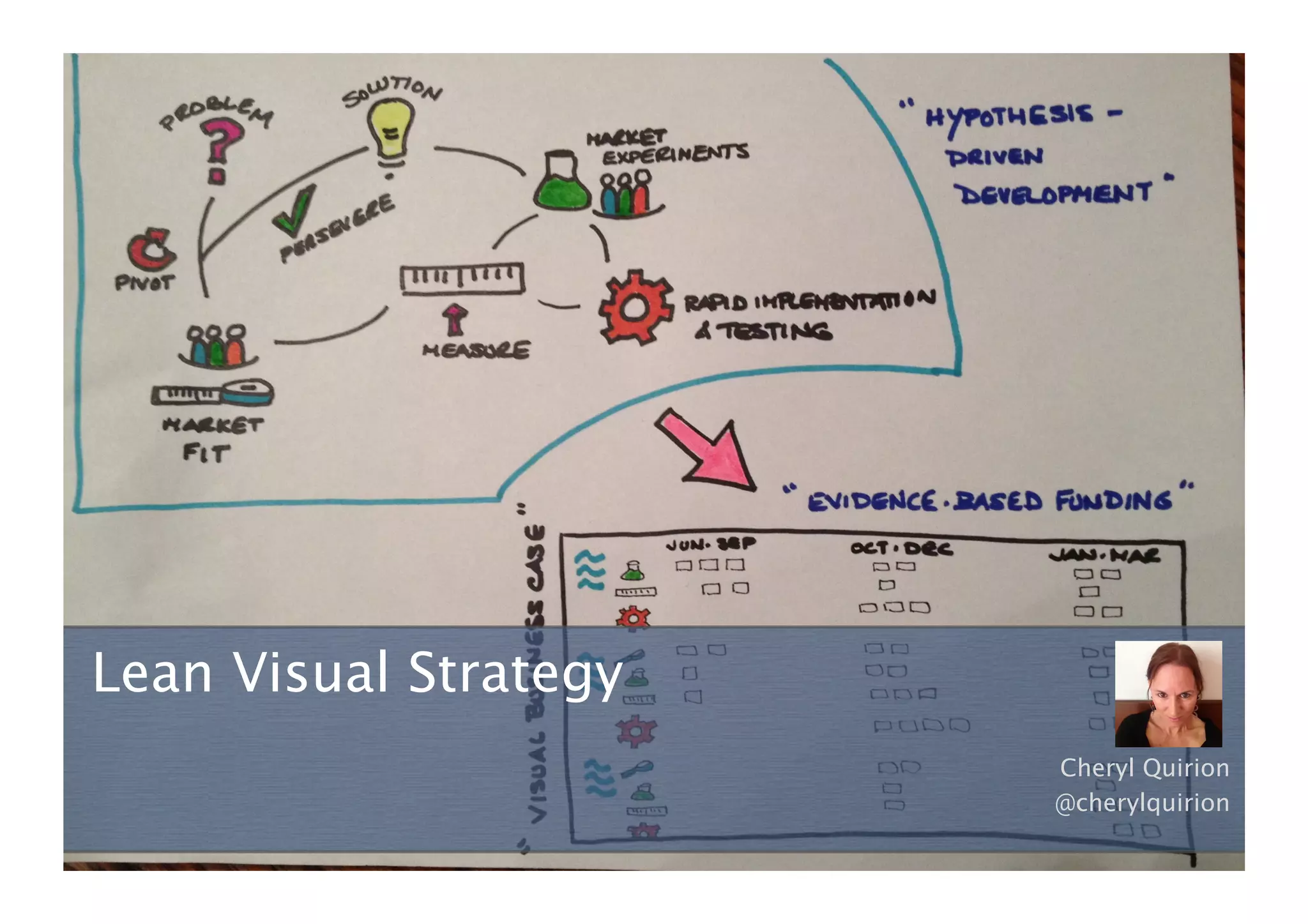
Lean Visual Strategy
Cheryl Quirion
@cherylquirion
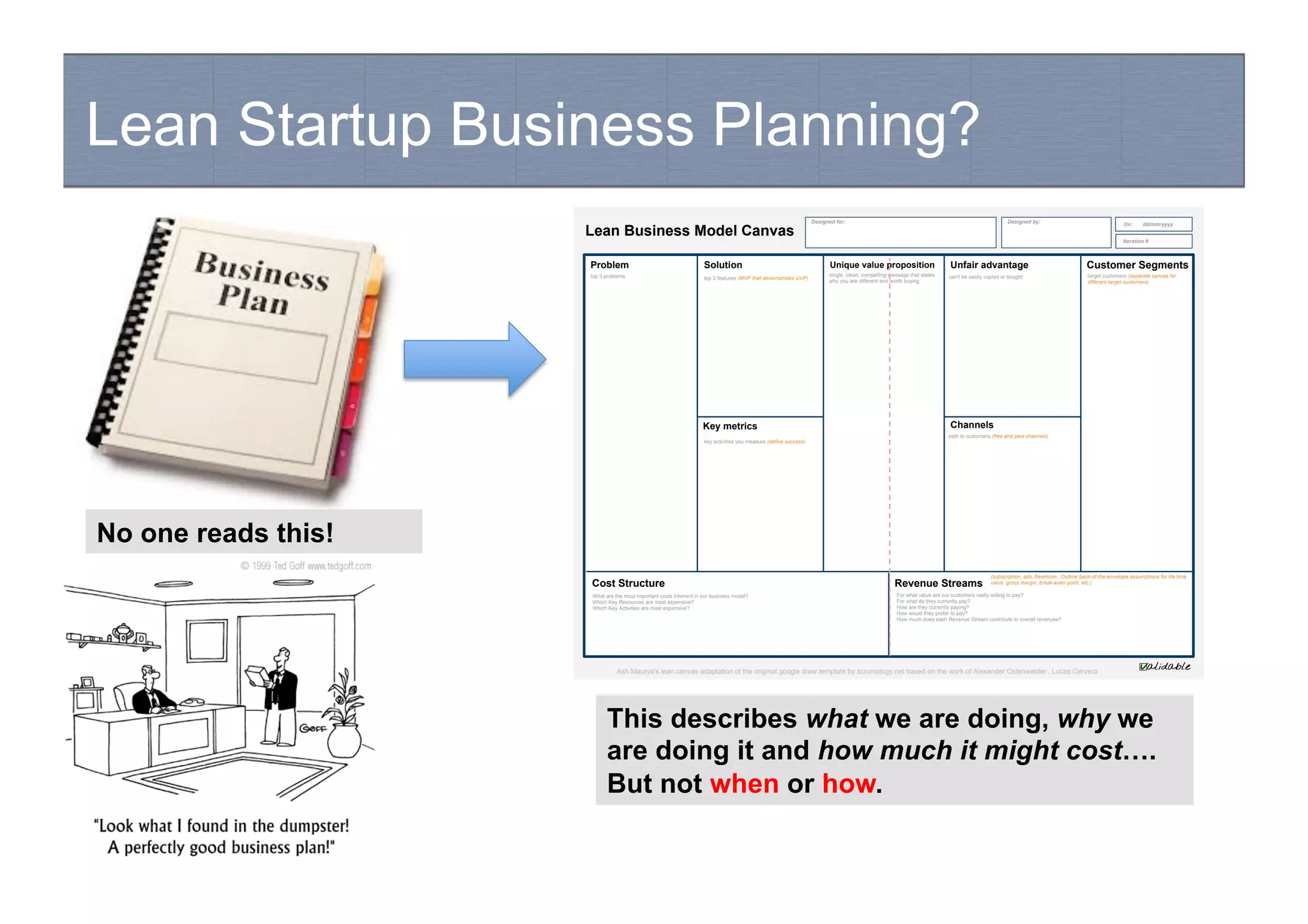
Lean Startup Business Planning?
No one reads this!
Problem Solution
Key metrics
Unique value proposition Unfair advantage Customer Segments
Channels
Cost Structure Revenue Streams
top 3 problems top 3 features (MVP that demonstrates UVP)
single, clean, compelling message that states
why you are different and worth buying
can't be easily copied or bought target customers (separate canvas for
different target customers)
key activities you measure (define success)
path to customers (free and paid channels)
What are the most important costs inherent in our business model?
Which Key Resources are most expensive?
Which Key Activities are most expensive?
For what value are our customers really willing to pay?
For what do they currently pay?
How are they currently paying?
How would they prefer to pay?
How much does each Revenue Stream contribute to overall revenues?
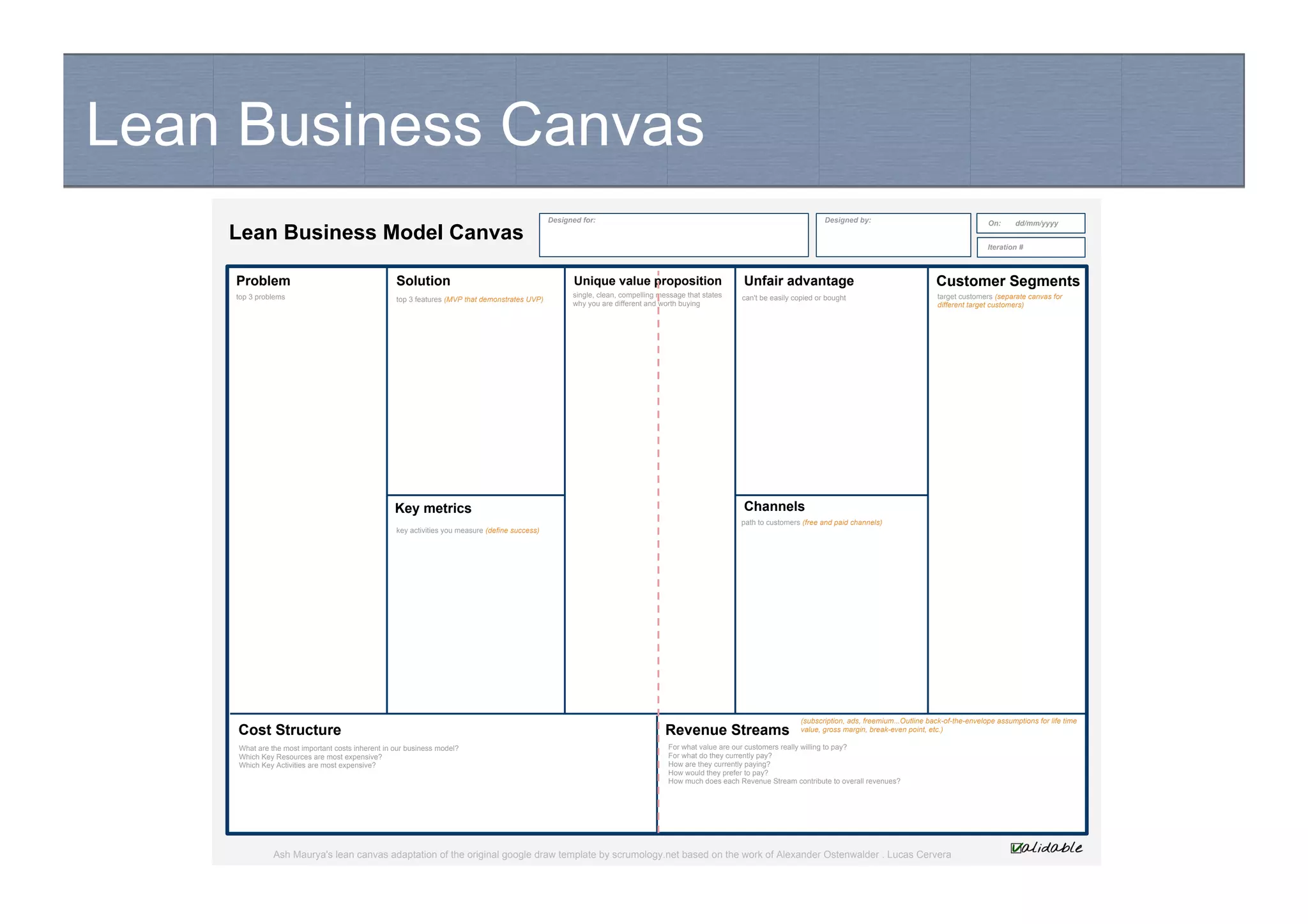
Lean Business Model Canvas
Designed for: Designed by: On: dd/mm/yyyy
Iteration #
Add
Text
Here
Add
Text
Here
Add
Text
Here
Add
Text
Here
Add
Text
Here
Add
Text
Here
copy the post-its
below and paste
them in the canvas
Ash Maurya's lean canvas adaptation of the original google draw template by scrumology.net based on the work of Alexander Ostenwalder . Lucas Cervera
to cre
canvas, go
share
(subscription, ads, freemium...Outline back-of-the-envelope assumptions for life time
value, gross margin, break-even point, etc.)
This describes what we are doing, why we
are doing it and how much it might cost….
But not when or how.
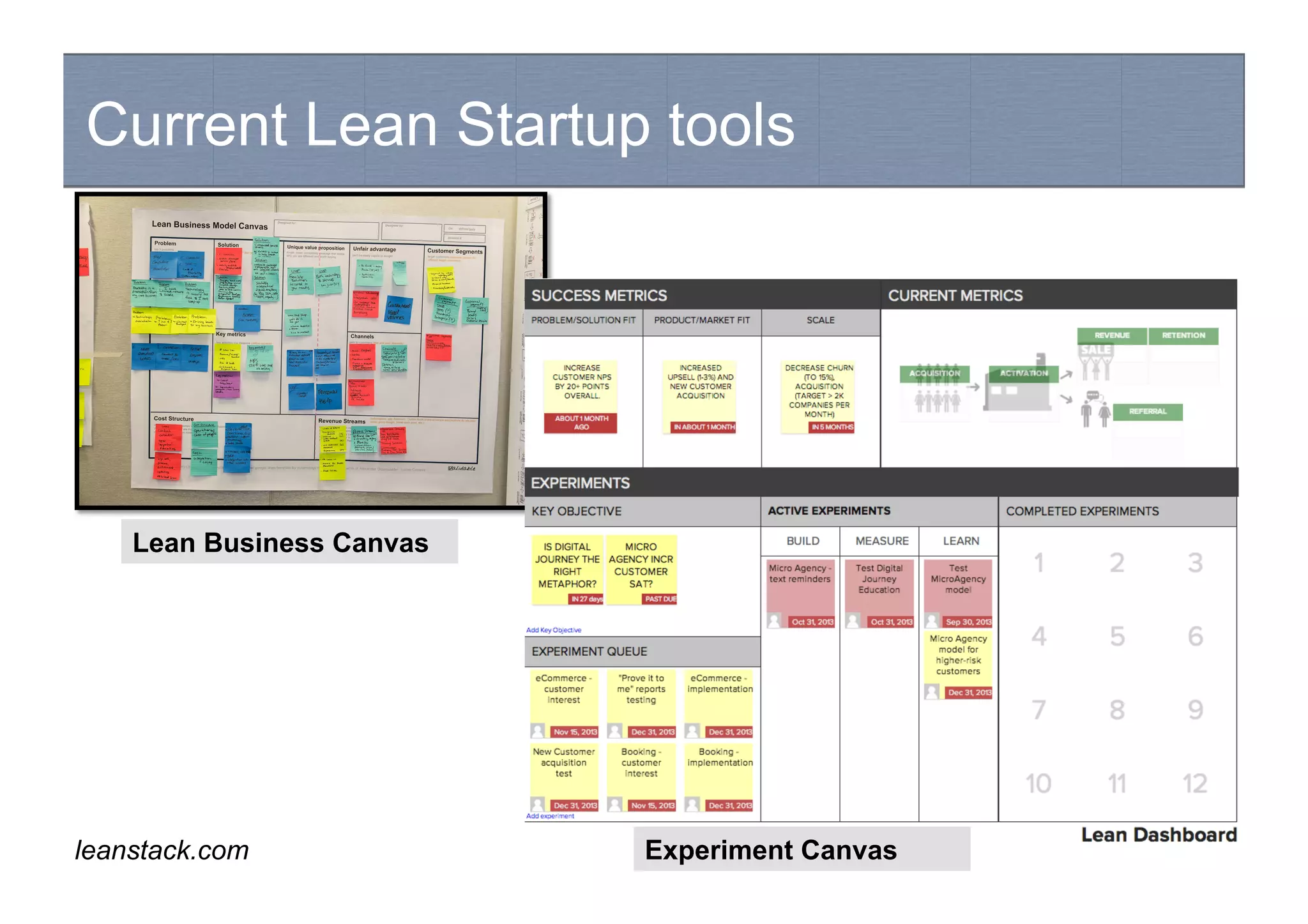
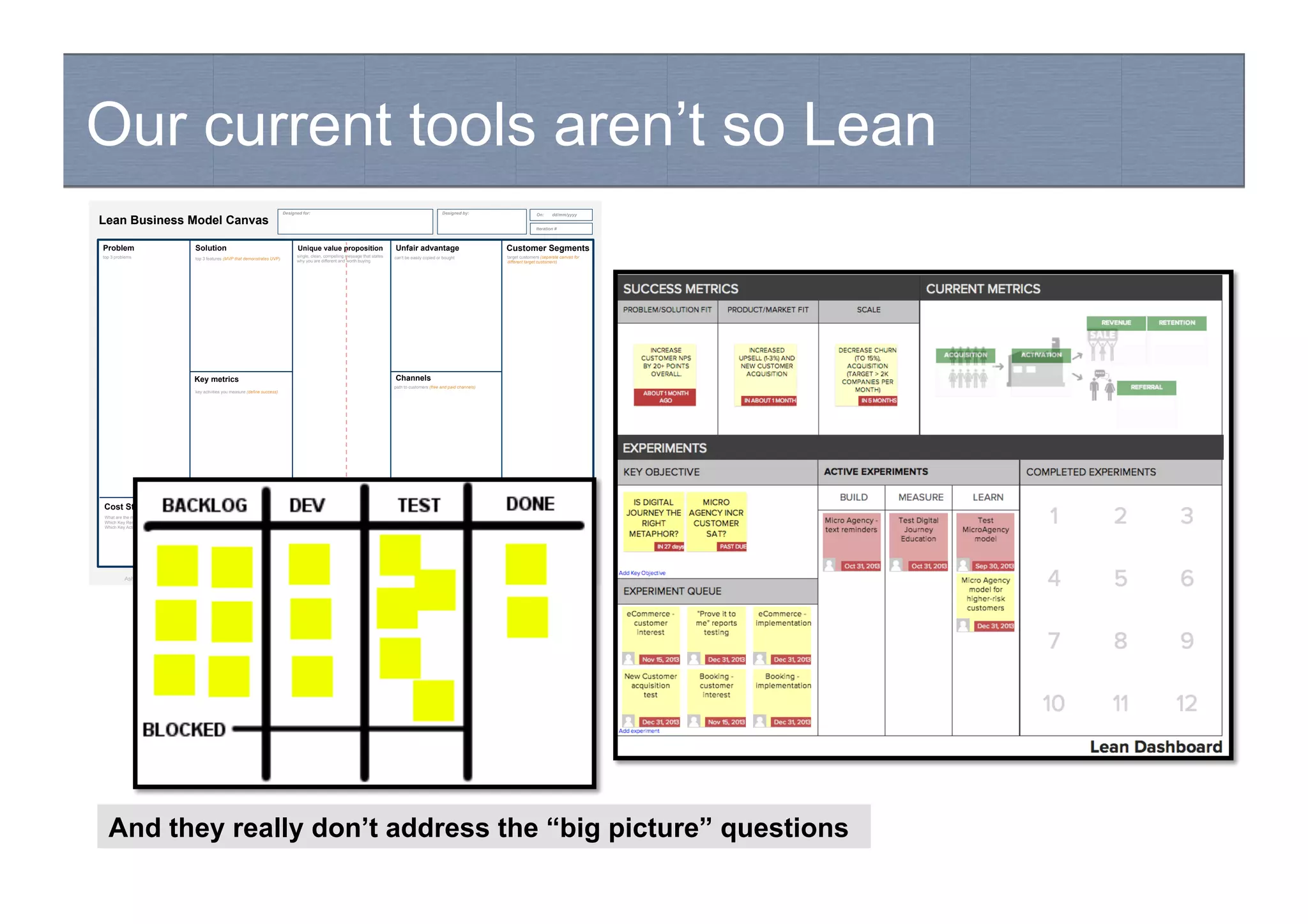
Current Lean Startup tools
Lean Business Canvas
Experiment Canvasleanstack.com
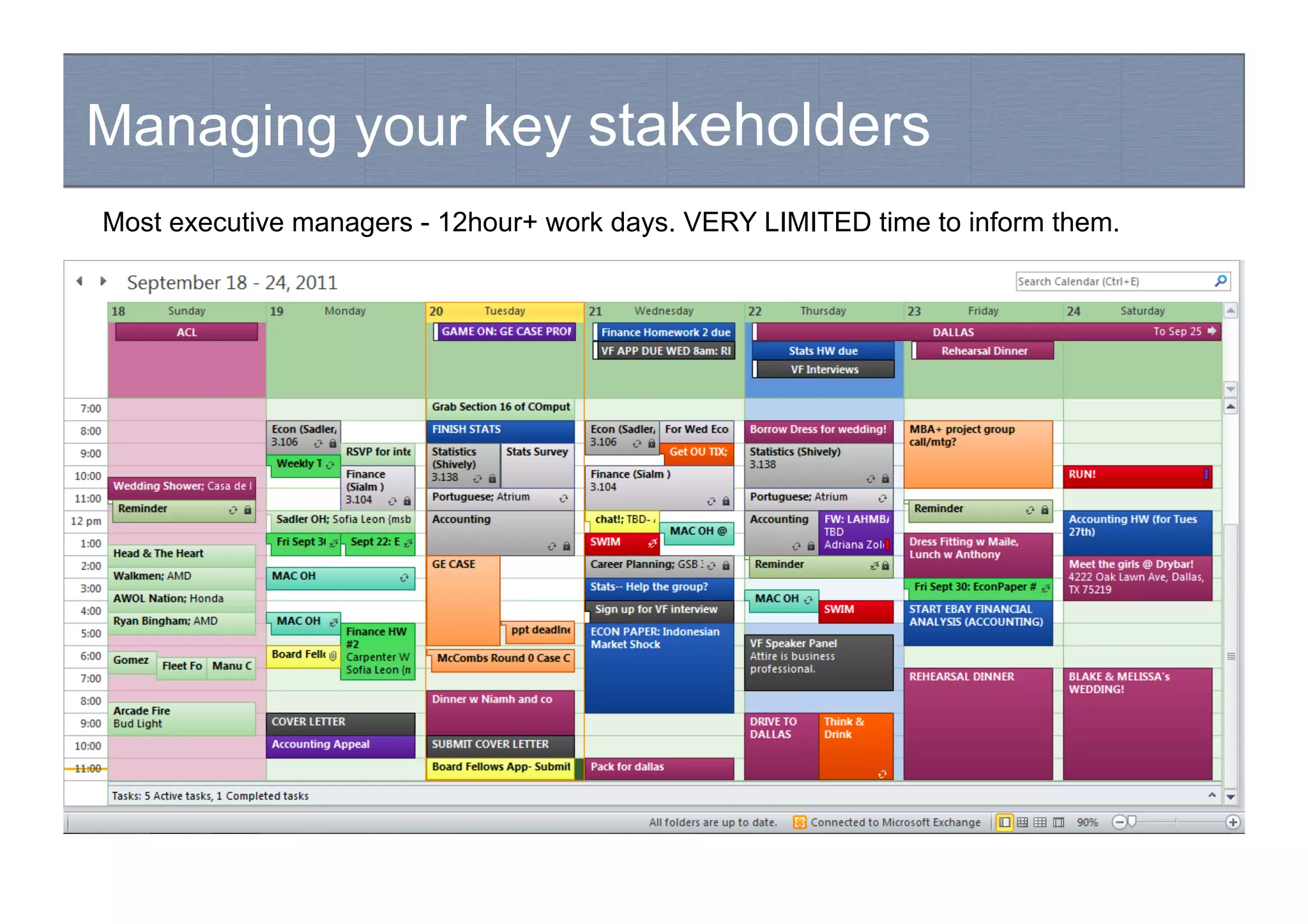
Managing your key stakeholders
Most executive managers - 12hour+ work days. VERY LIMITED time to inform them.
Stakeholders want to know
•  What is the customer problem?
•  How are you going to solve it?
•  How long do you think it will take?
•  When can you launch something to market?
•  What is it going to cost?
•  What are the expected revenues (and return on
investment)? ……
“BIG PICTURE” questions… to get support and funding.
How do we address these questions and still use Lean
Startup principles to “build the right thing”?
Our current tools aren’t so Lean
Problem Solution
Key metrics
Unique value proposition Unfair advantage Customer Segments
Channels
Cost Structure Revenue Streams
top 3 problems top 3 features (MVP that demonstrates UVP)
single, clean, compelling message that states
why you are different and worth buying
can't be easily copied or bought target customers (separate canvas for
different target customers)
key activities you measure (define success)
path to customers (free and paid channels)
What are the most important costs inherent in our business model?
Which Key Resources are most expensive?
Which Key Activities are most expensive?
For what value are our customers really willing to pay?
For what do they currently pay?
How are they currently paying?
How would they prefer to pay?
How much does each Revenue Stream contribute to overall revenues?
Lean Business Model Canvas
Designed for: Designed by: On: dd/mm/yyyy
Iteration #
Add
Text
Here
Add
Text
Here
Add
Text
Here
copy the post-its
below and paste
em in the canvas
Ash Maurya's lean canvas adaptation of the original google draw template by scrumology.net based on the work of Alexander Ostenwalder . Lucas Cervera
to create your own copy of this
canvas, go to File/Make a copy and
share it with whoever you want
(subscription, ads, freemium...Outline back-of-the-envelope assumptions for life time
value, gross margin, break-even point, etc.)
And they really don’t address the “big picture” questions
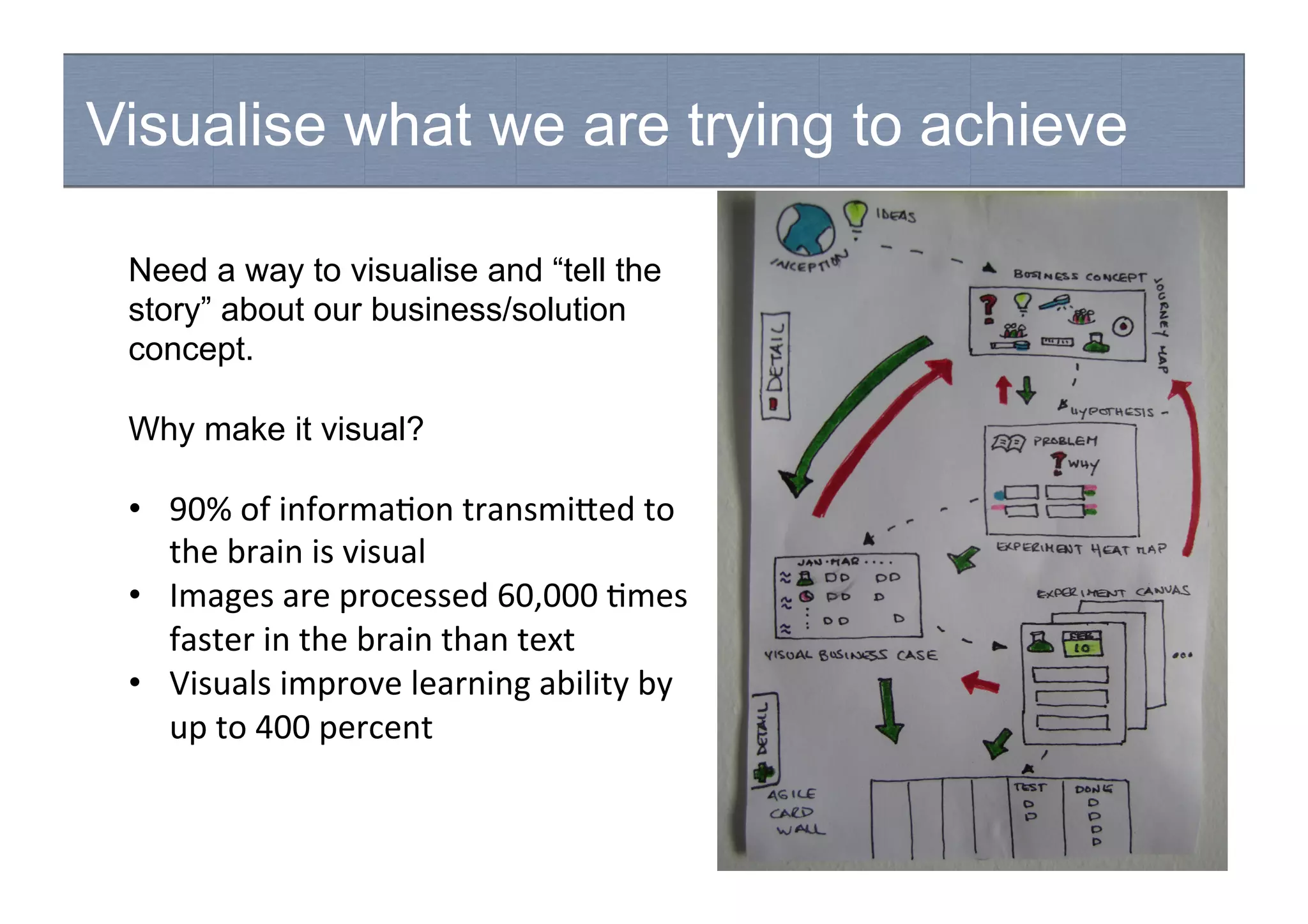
Visualise what we are trying to achieve
Need a way to visualise and “tell the
story” about our business/solution
concept.
Why make it visual?
	
  
•  90%	
  of	
  informa,on	
  transmi/ed	
  to	
  
the	
  brain	
  is	
  visual	
  
•  Images	
  are	
  processed	
  60,000	
  ,mes	
  
faster	
  in	
  the	
  brain	
  than	
  text	
  
•  Visuals	
  improve	
  learning	
  ability	
  by	
  
up	
  to	
  400	
  percent	
  
Lean Business Canvas
Hypothesis-driven development
Problem Solution
Key metrics
Unique value proposition Unfair advantage Customer Segments
Channels
Cost Structure Revenue Streams
top 3 problems top 3 features (MVP that demonstrates UVP)
single, clean, compelling message that states
why you are different and worth buying
can't be easily copied or bought target customers (separate canvas for
different target customers)
key activities you measure (define success)
path to customers (free and paid channels)
What are the most important costs inherent in our business model?
Which Key Resources are most expensive?
Which Key Activities are most expensive?
For what value are our customers really willing to pay?
For what do they currently pay?
How are they currently paying?
How would they prefer to pay?
How much does each Revenue Stream contribute to overall revenues?
Lean Business Model Canvas
Designed for: Designed by: On: dd/mm/yyyy
Iteration #
dd
ext
ere
dd
ext
ere
Add
Text
Here
dd
ext
ere
Add
Text
Here
Add
Text
Here
copy the post-its
below and paste
them in the canvas
Ash Maurya's lean canvas adaptation of the original google draw template by scrumology.net based on the work of Alexander Ostenwalder . Lucas Cervera
to create your
canvas, go to File/
share it with w
(subscription, ads, freemium...Outline back-of-the-envelope assumptions for life time
value, gross margin, break-even point, etc.)
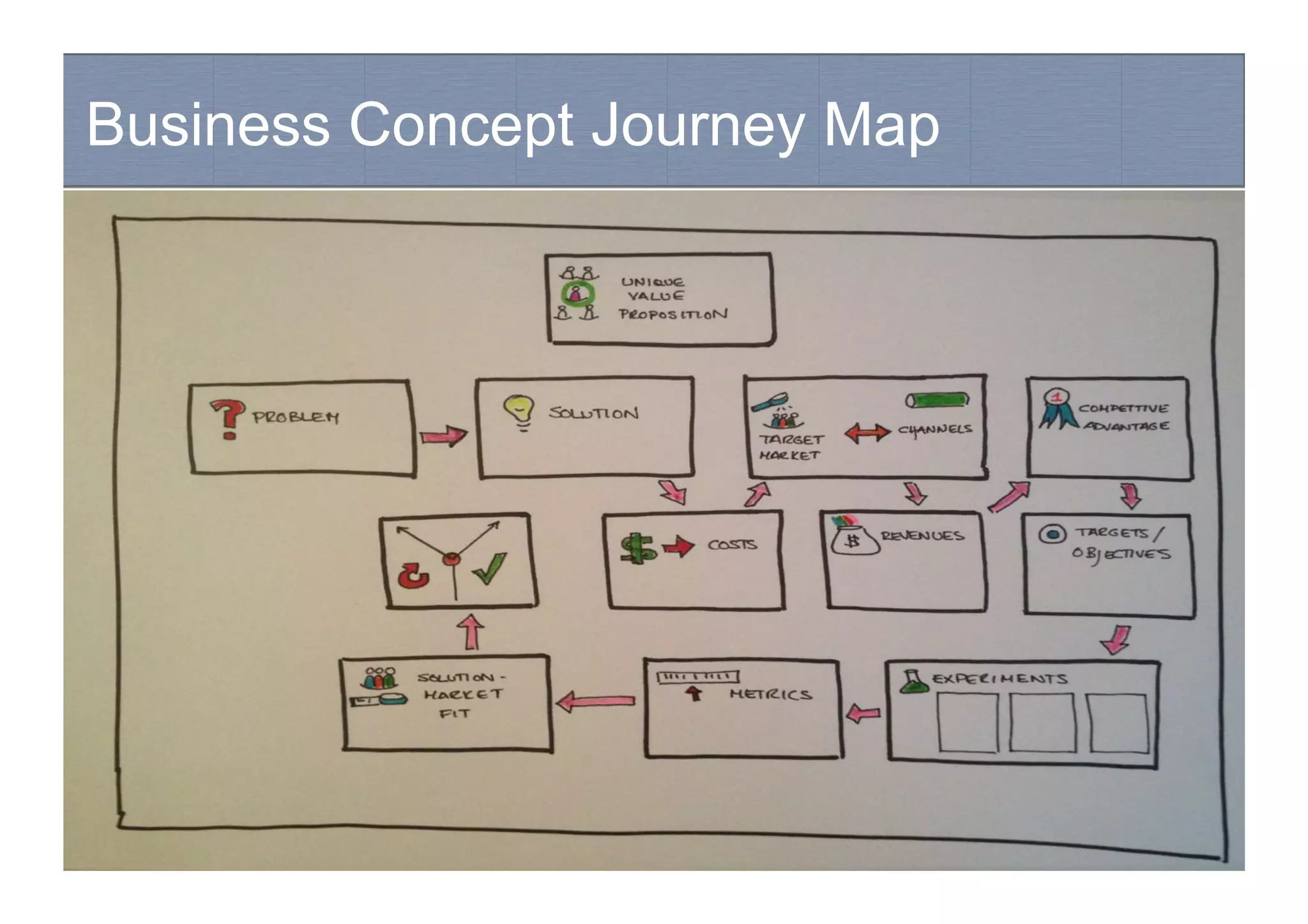
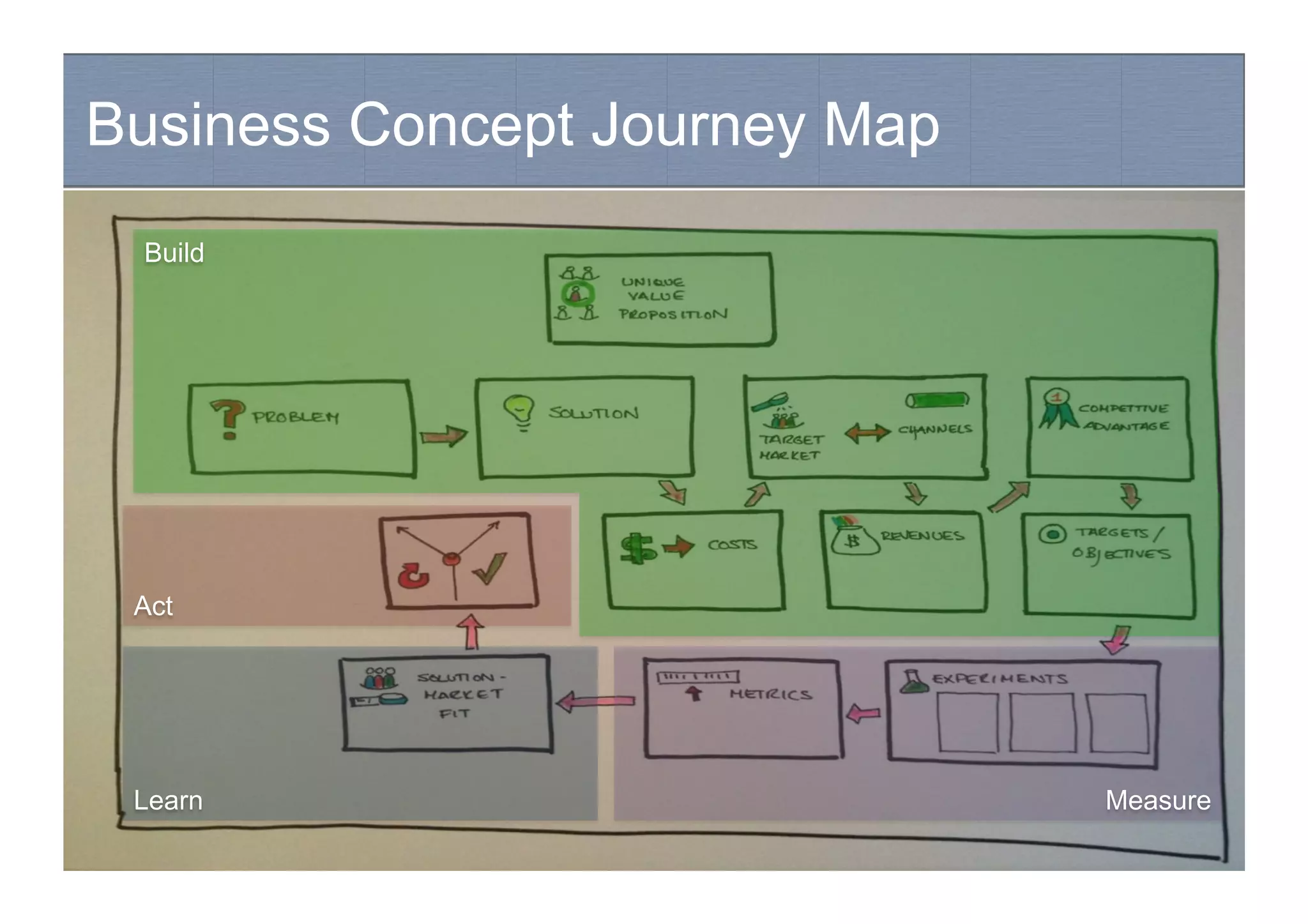
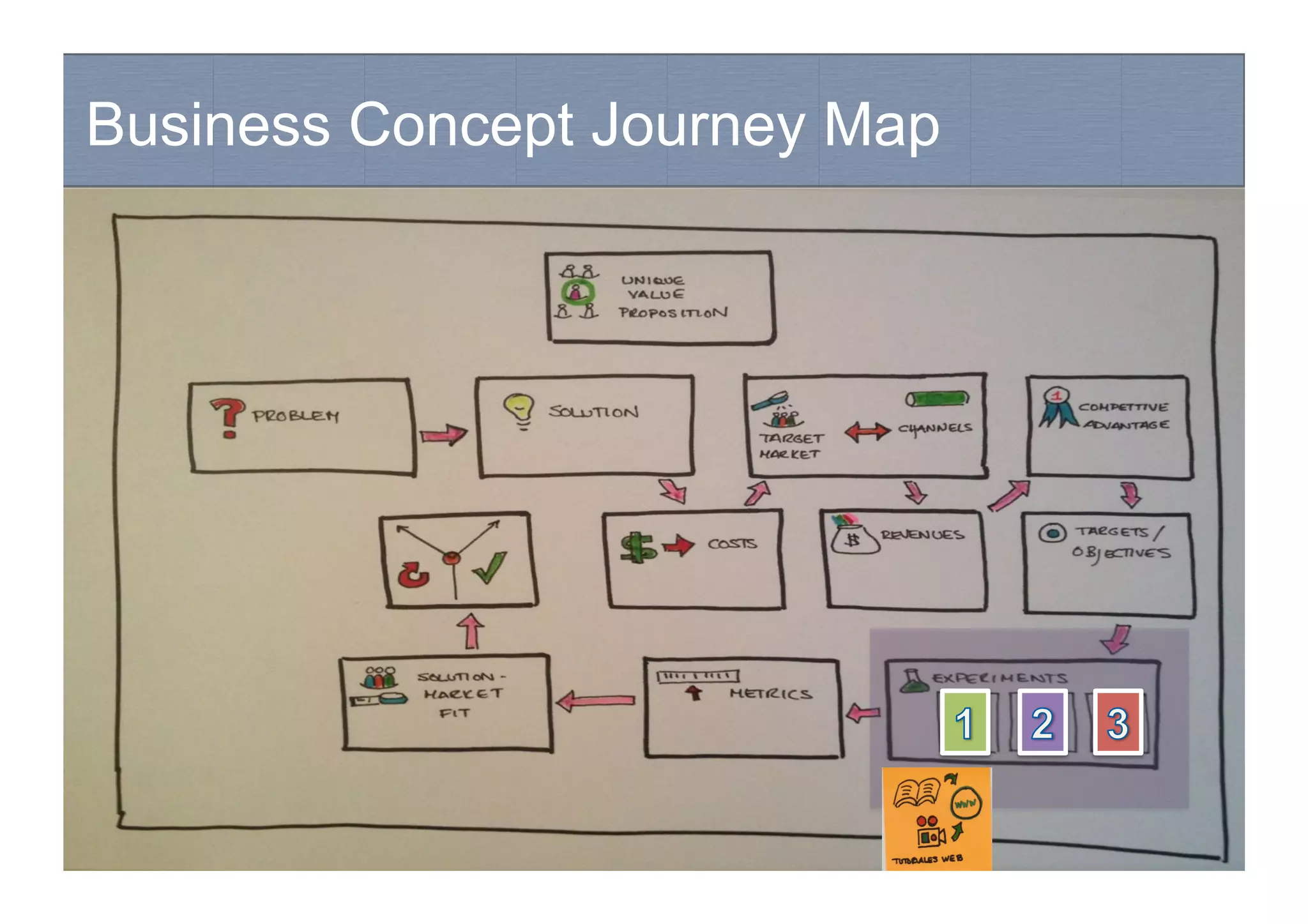
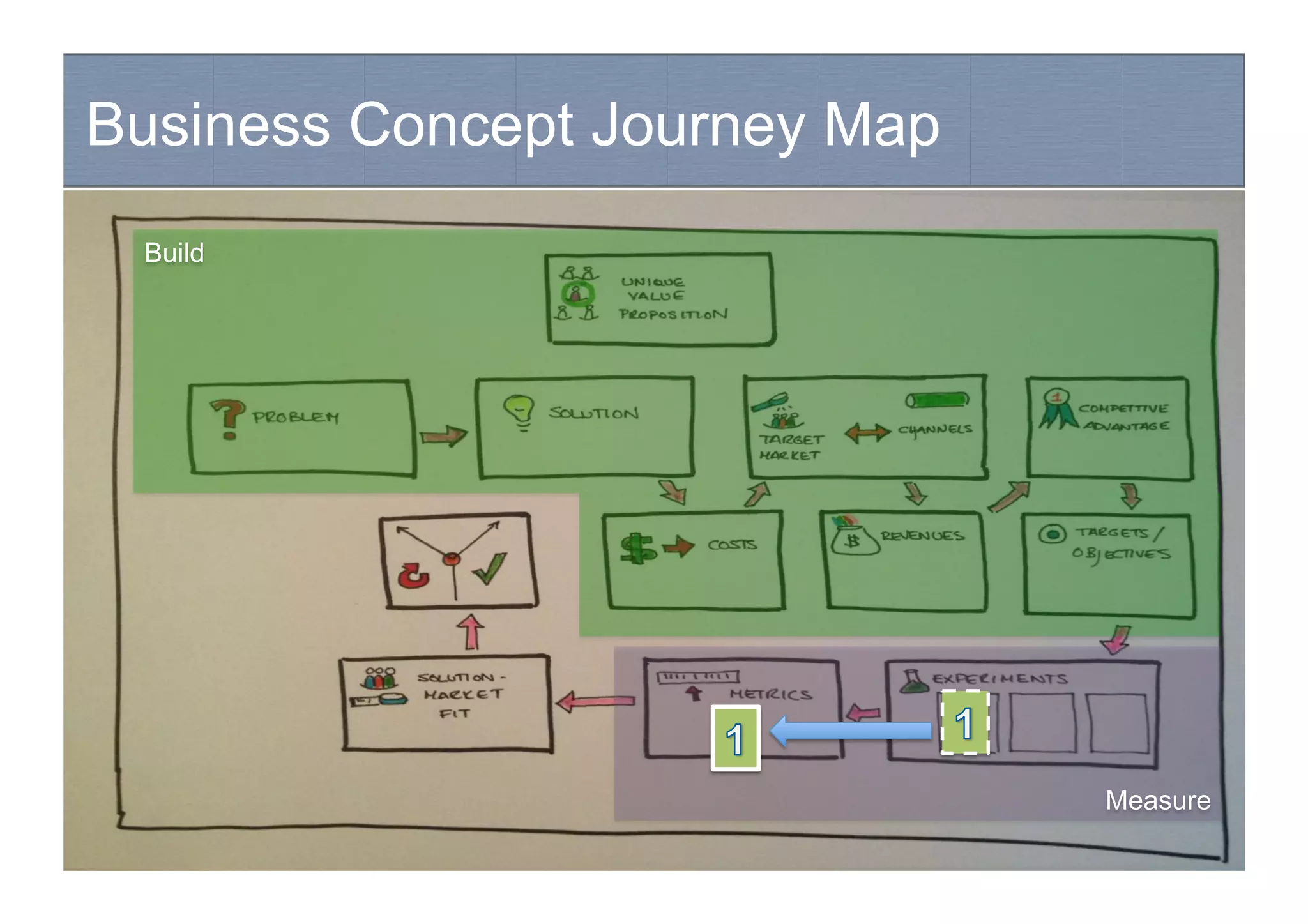
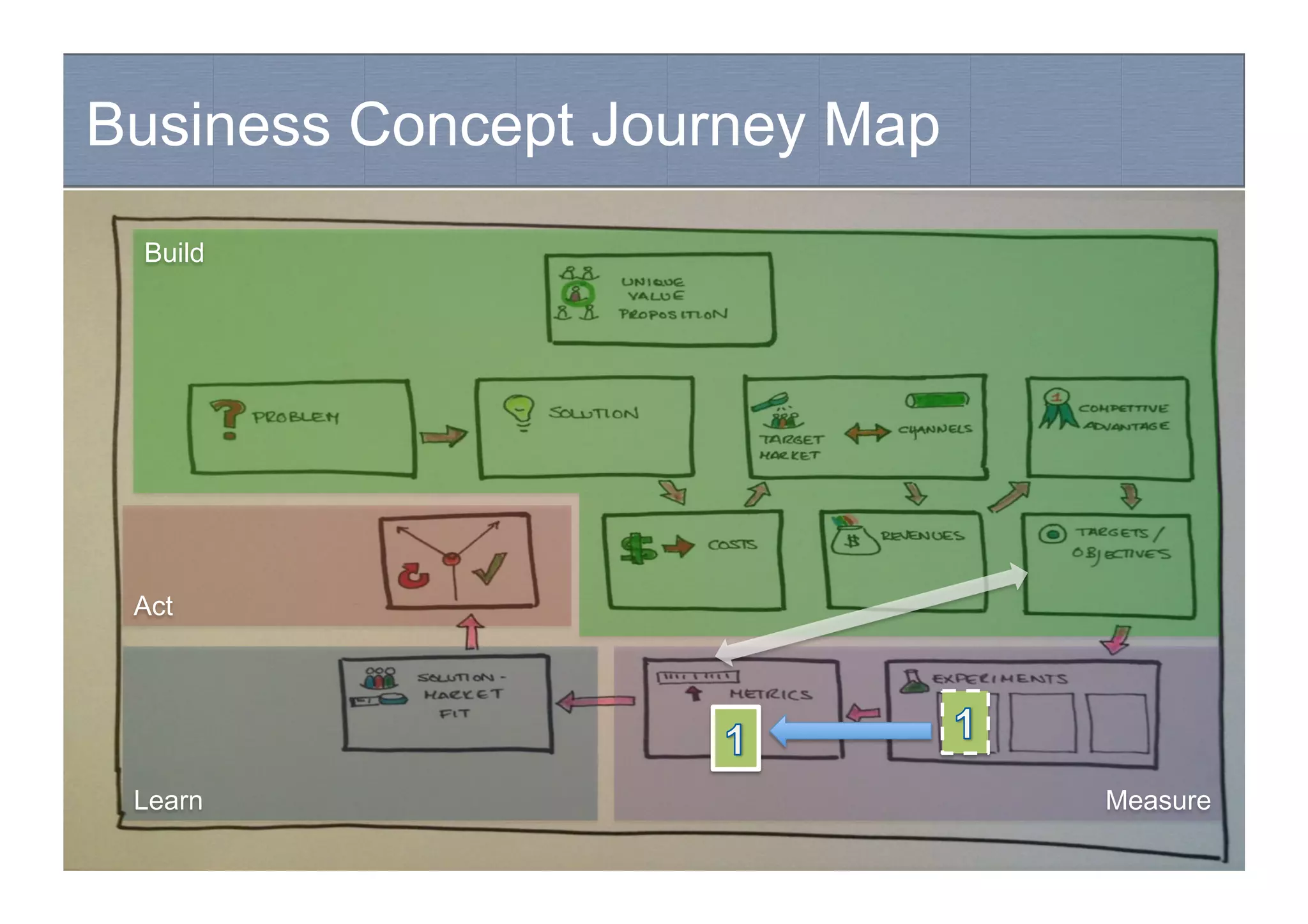
Business Concept Journey Map
Hypothesis-driven development
Business Concept Journey Map
Hypothesis-driven development
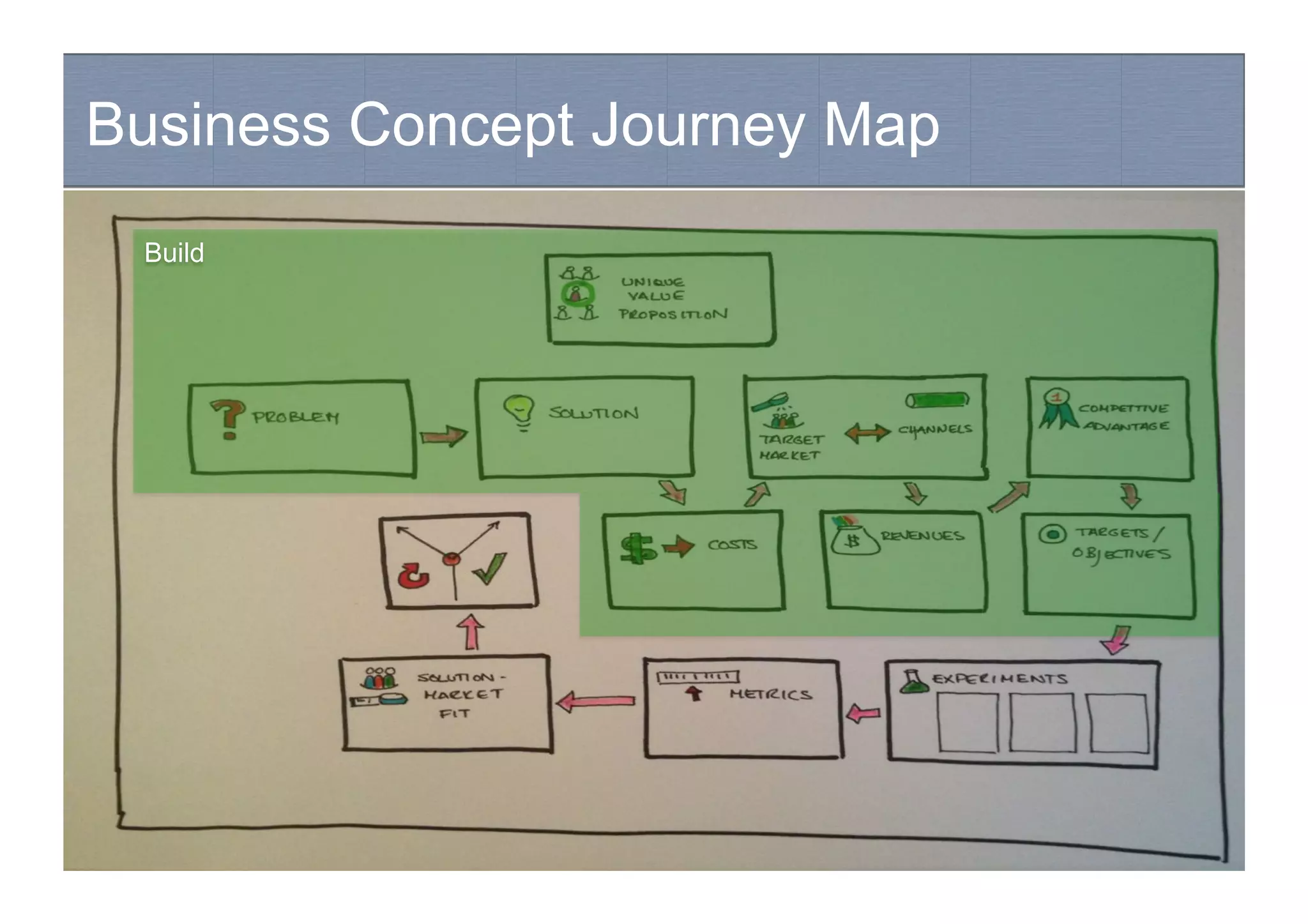
Build
Business Concept Journey Map
Hypothesis-driven development
Build
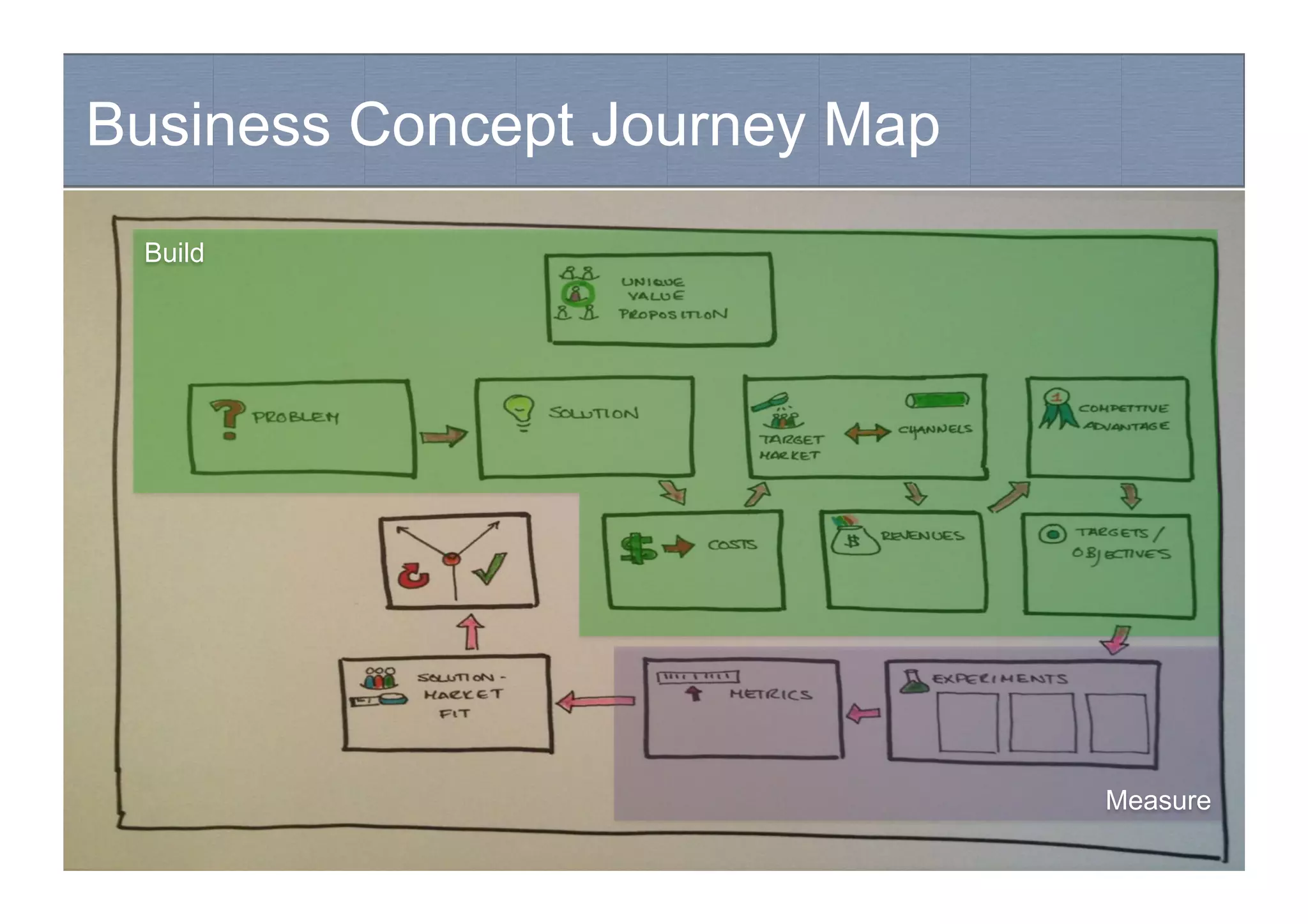
Measure
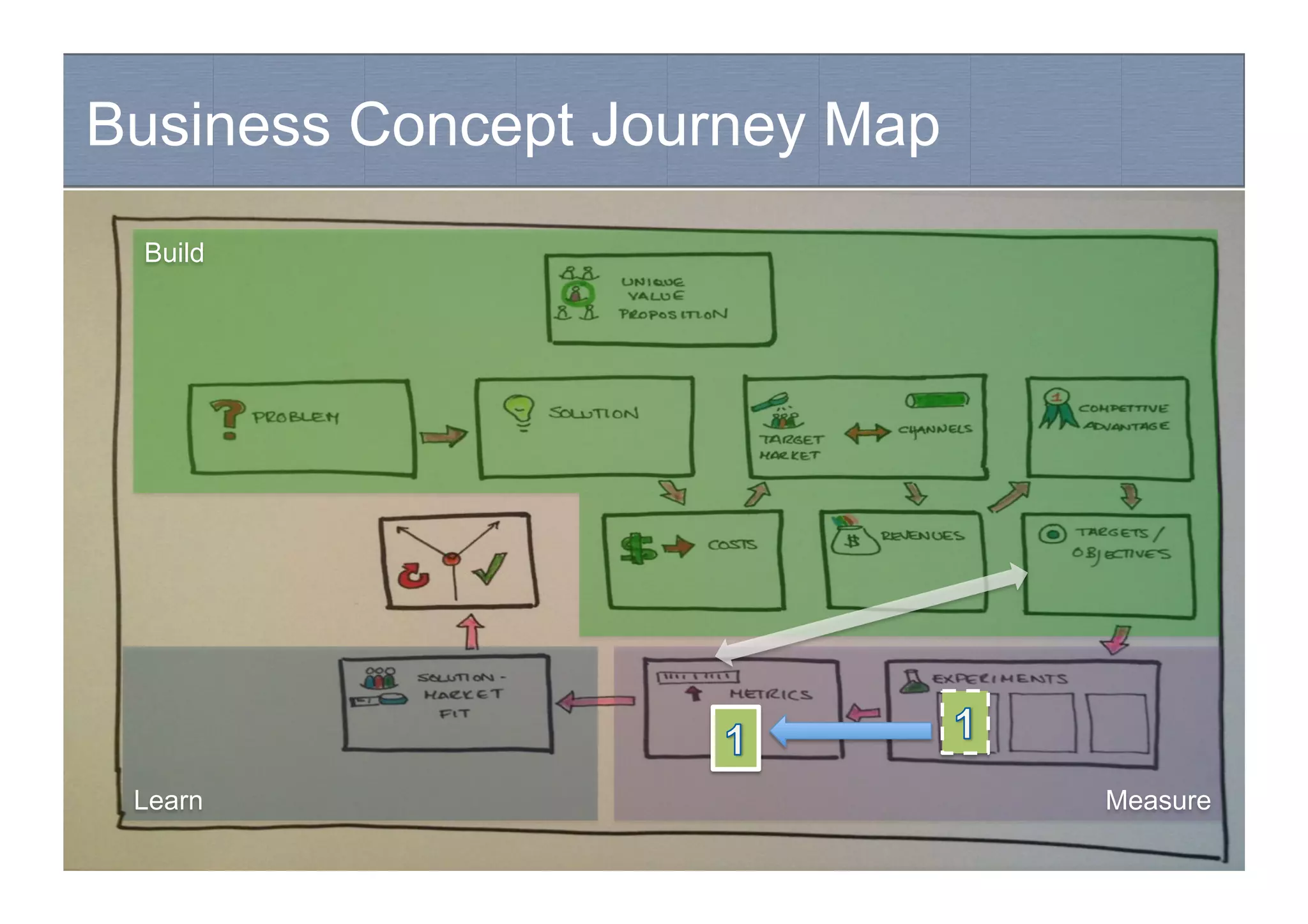
Business Concept Journey Map
Hypothesis-driven development
Build
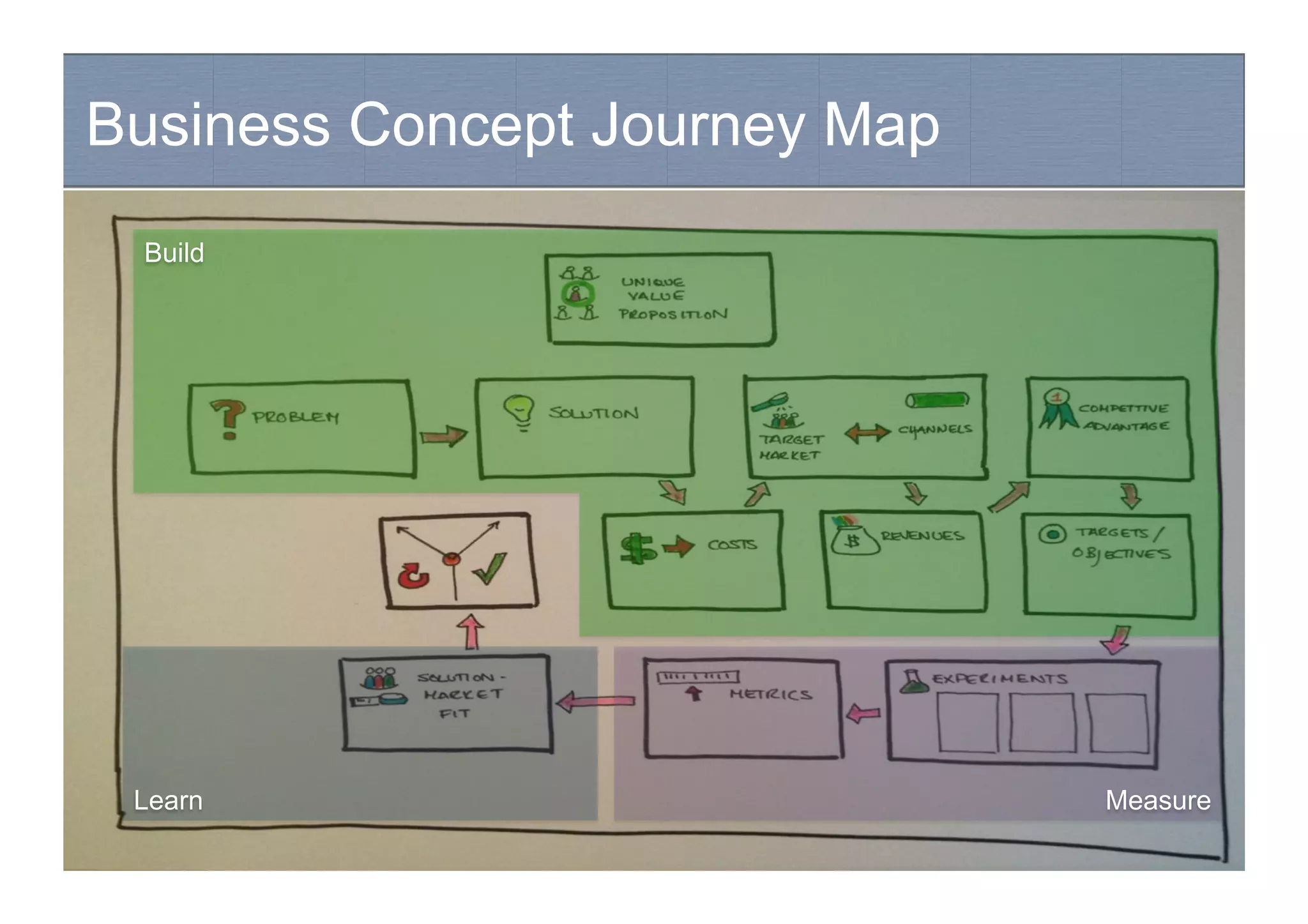
MeasureLearn
Business Concept Journey Map
Hypothesis-driven development
Build
MeasureLearn
Act
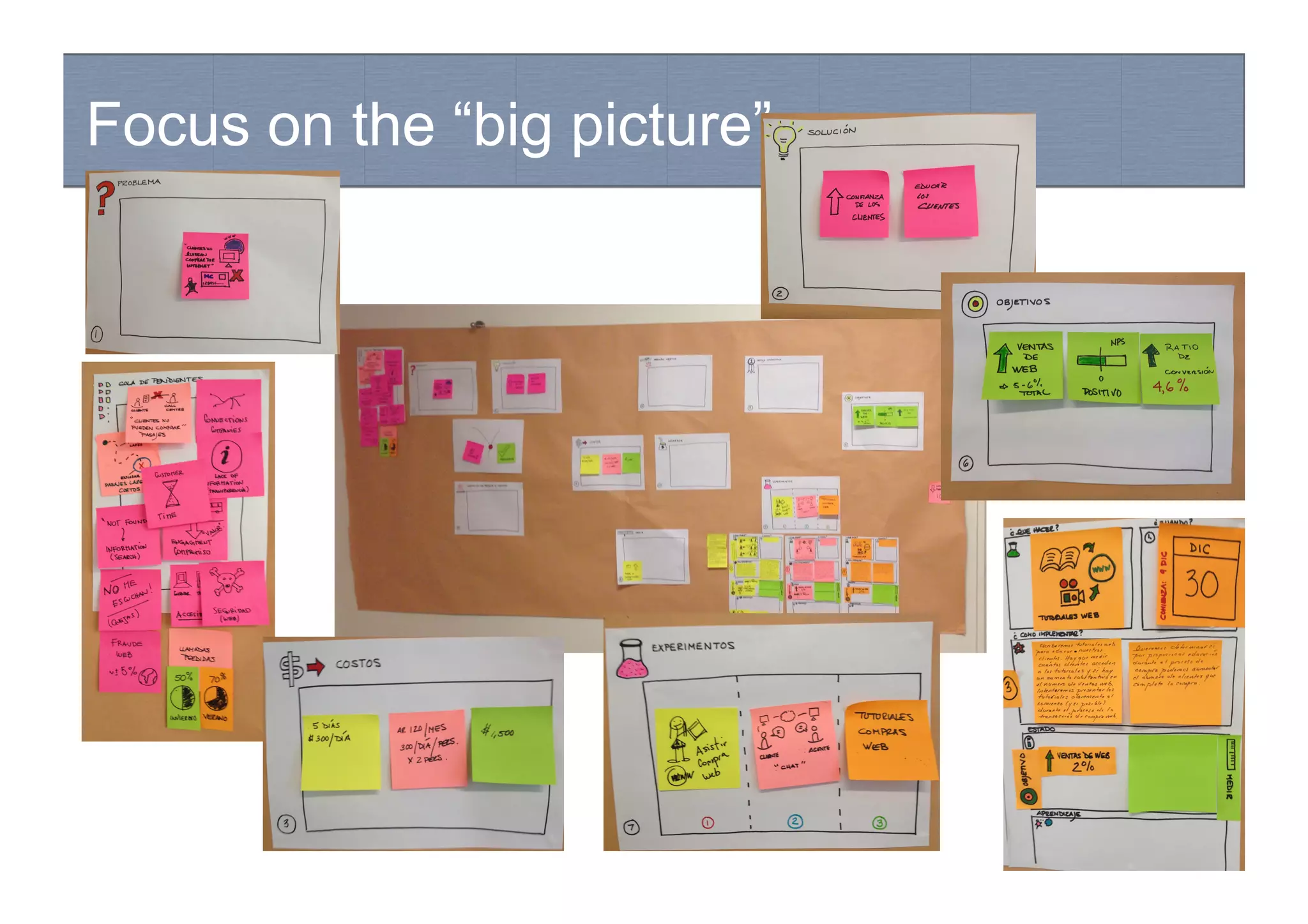
Focus on the “big picture”
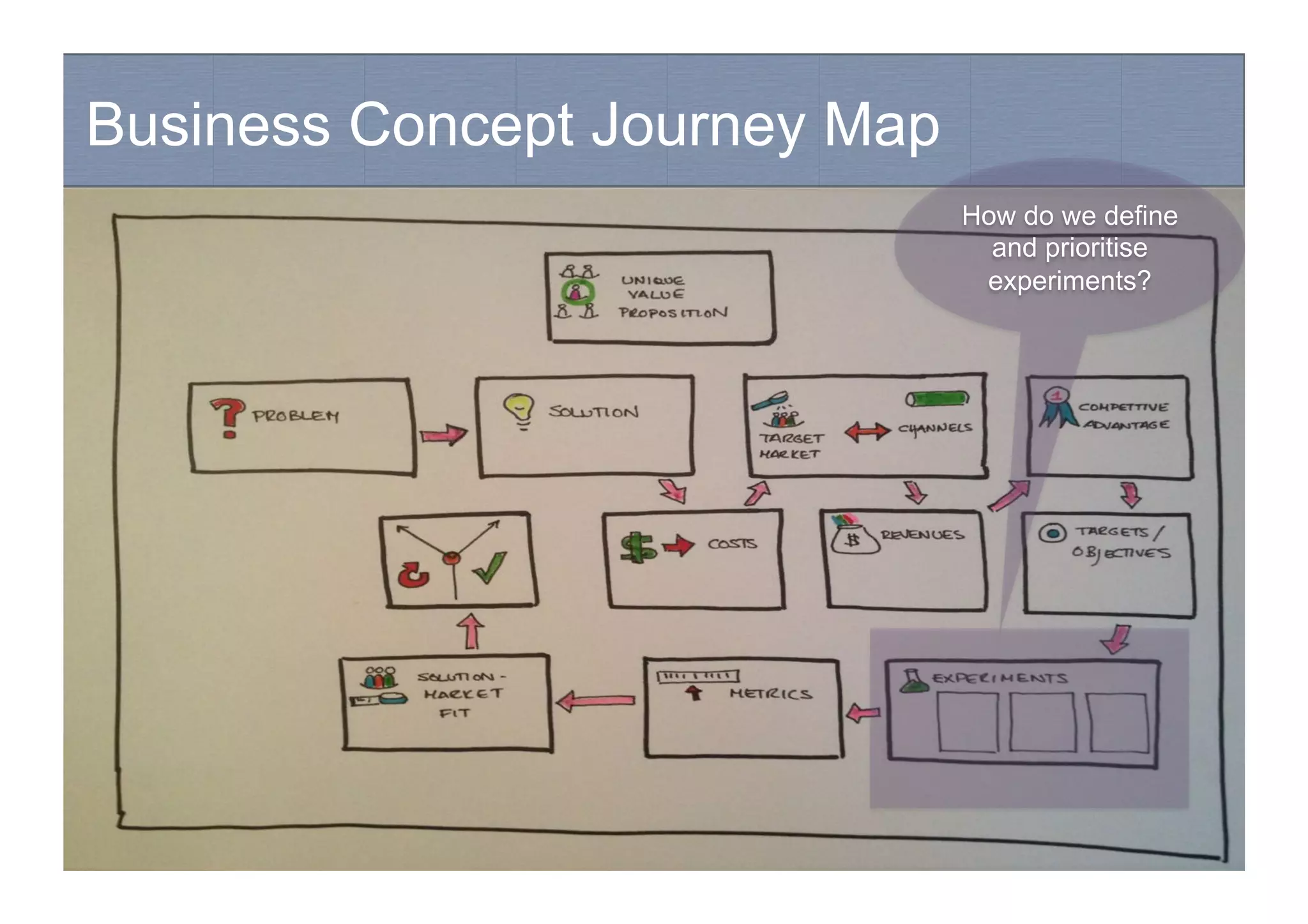
Business Concept Journey Map
Hypothesis-driven development
How do we define
and prioritise
experiments?
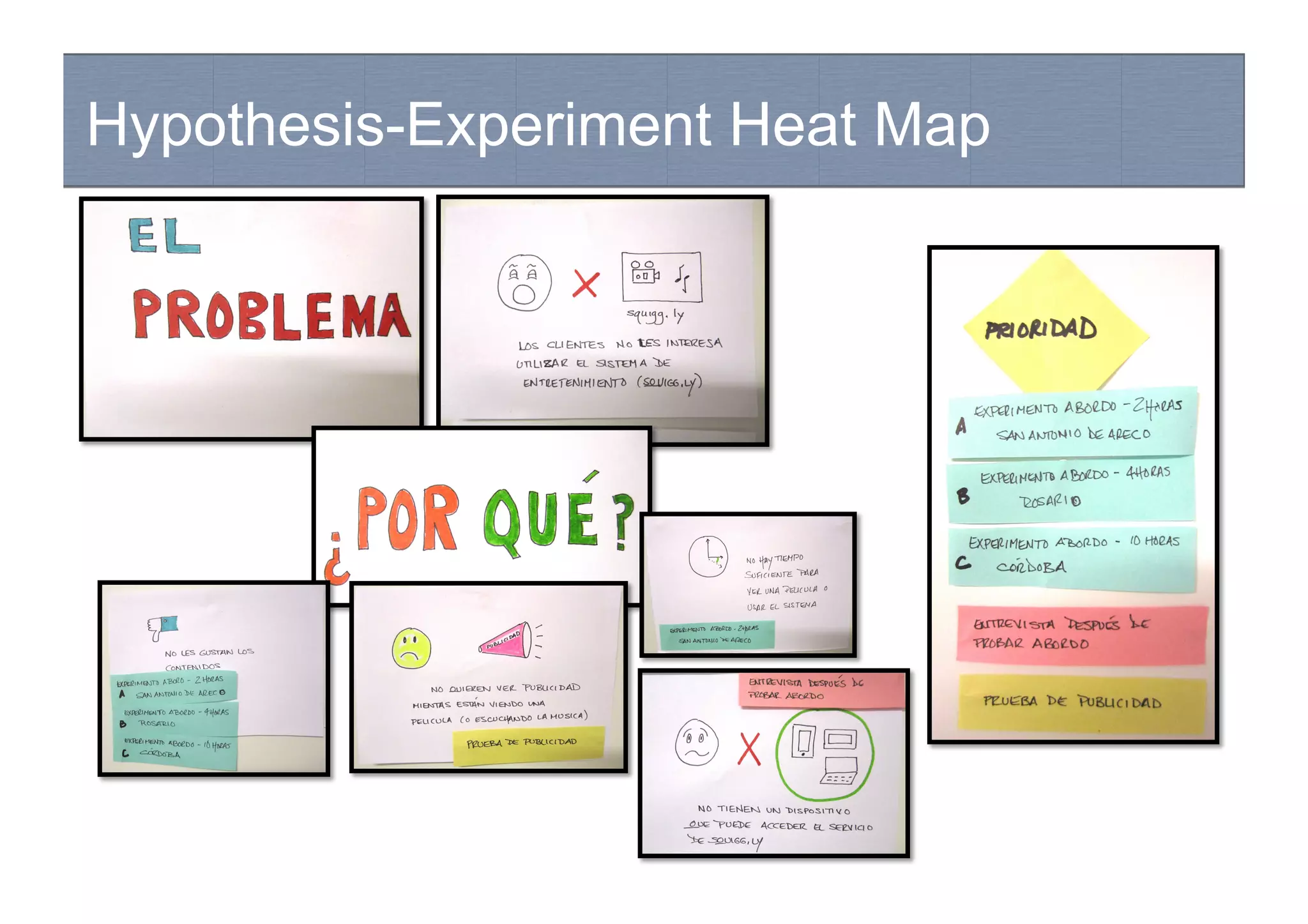
Hypothesis-Experiment Heat Map
Business Concept Journey Map
Hypothesis-driven development
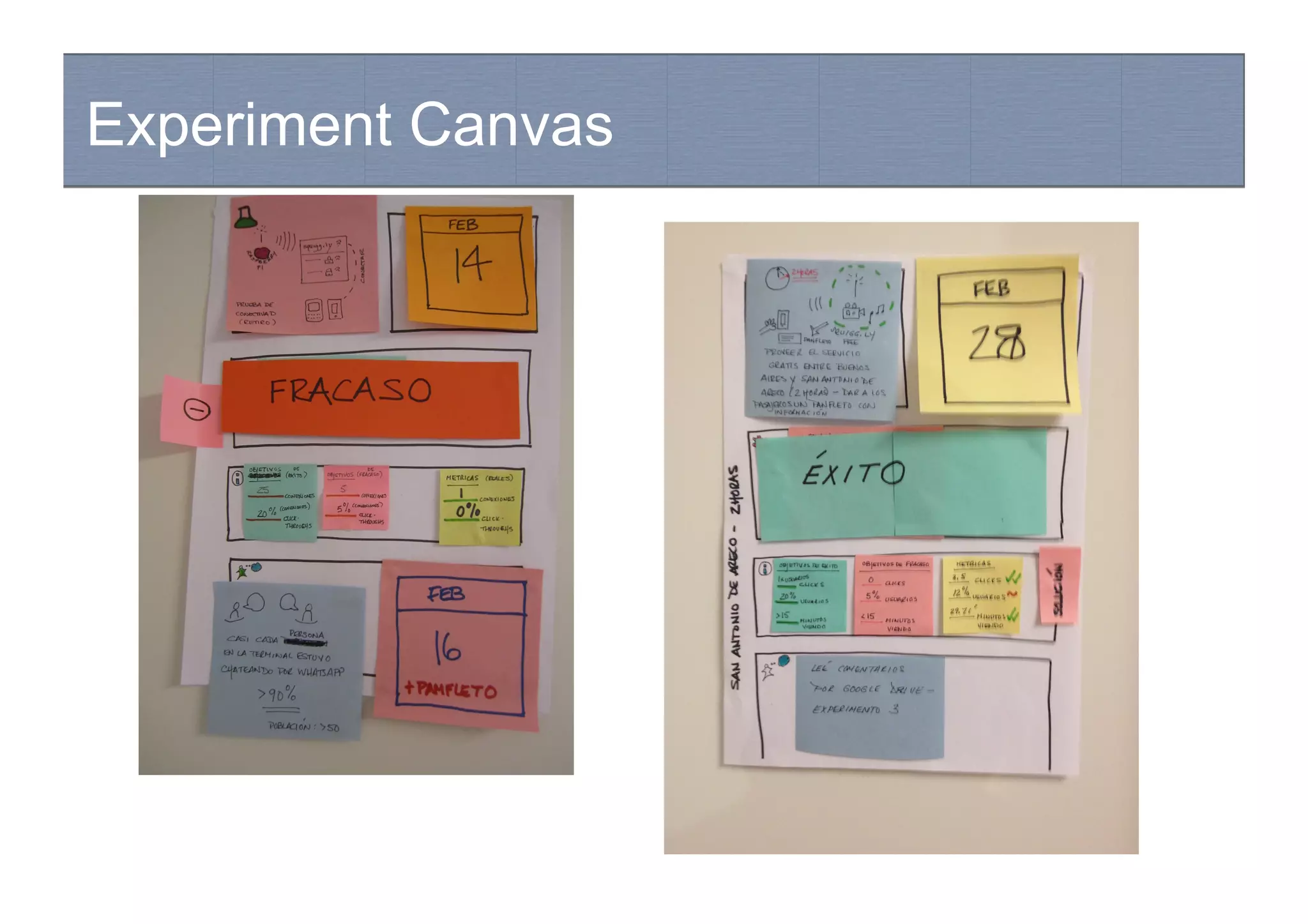
Experiment Canvas
Hypothesis-driven development
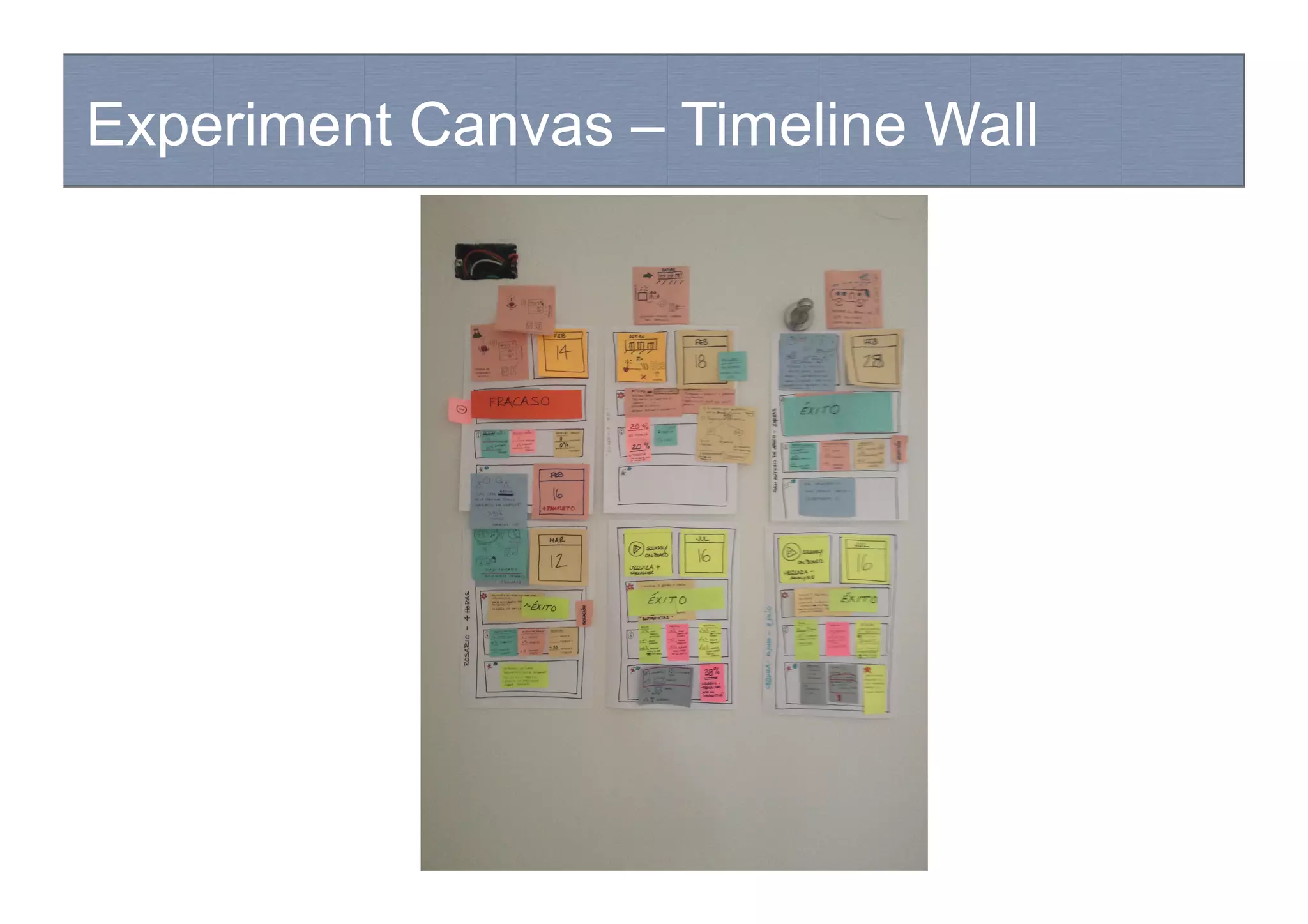
Experiment Canvas – Timeline Wall
Hypothesis-driven development
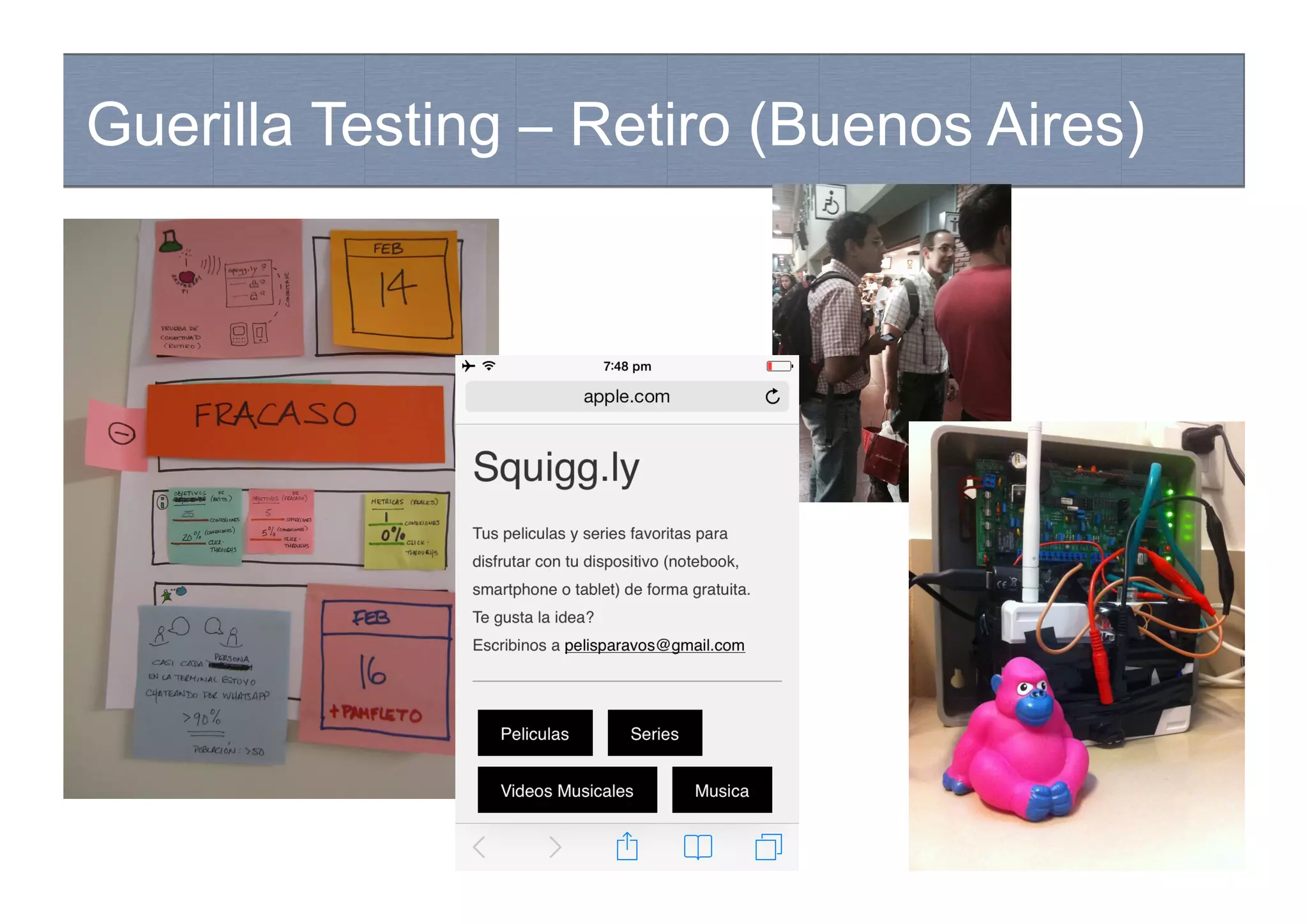
Guerilla Testing – Retiro (Buenos Aires)
Hypothesis-driven development
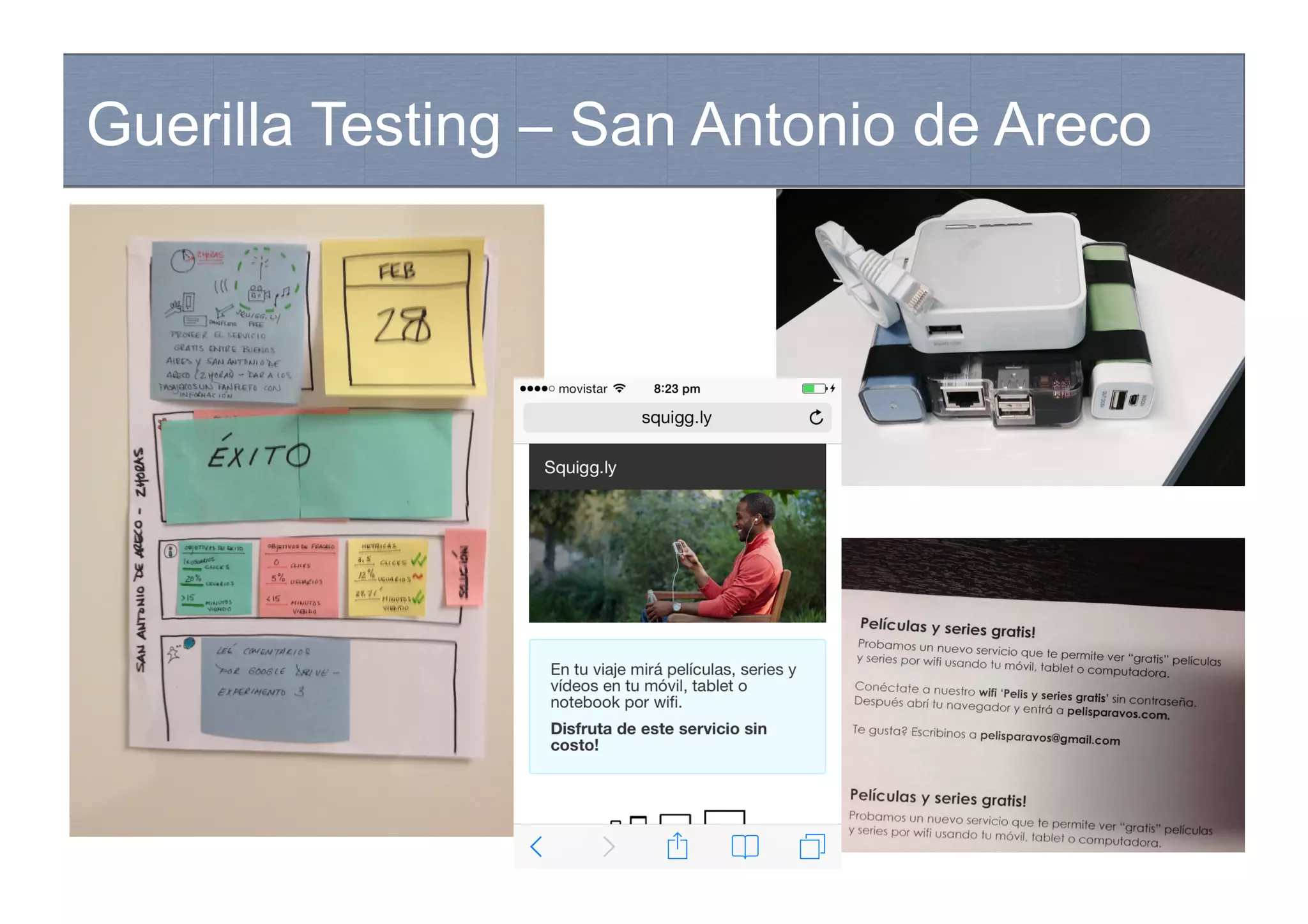
Guerilla Testing – San Antonio de Areco
Hypothesis-driven development
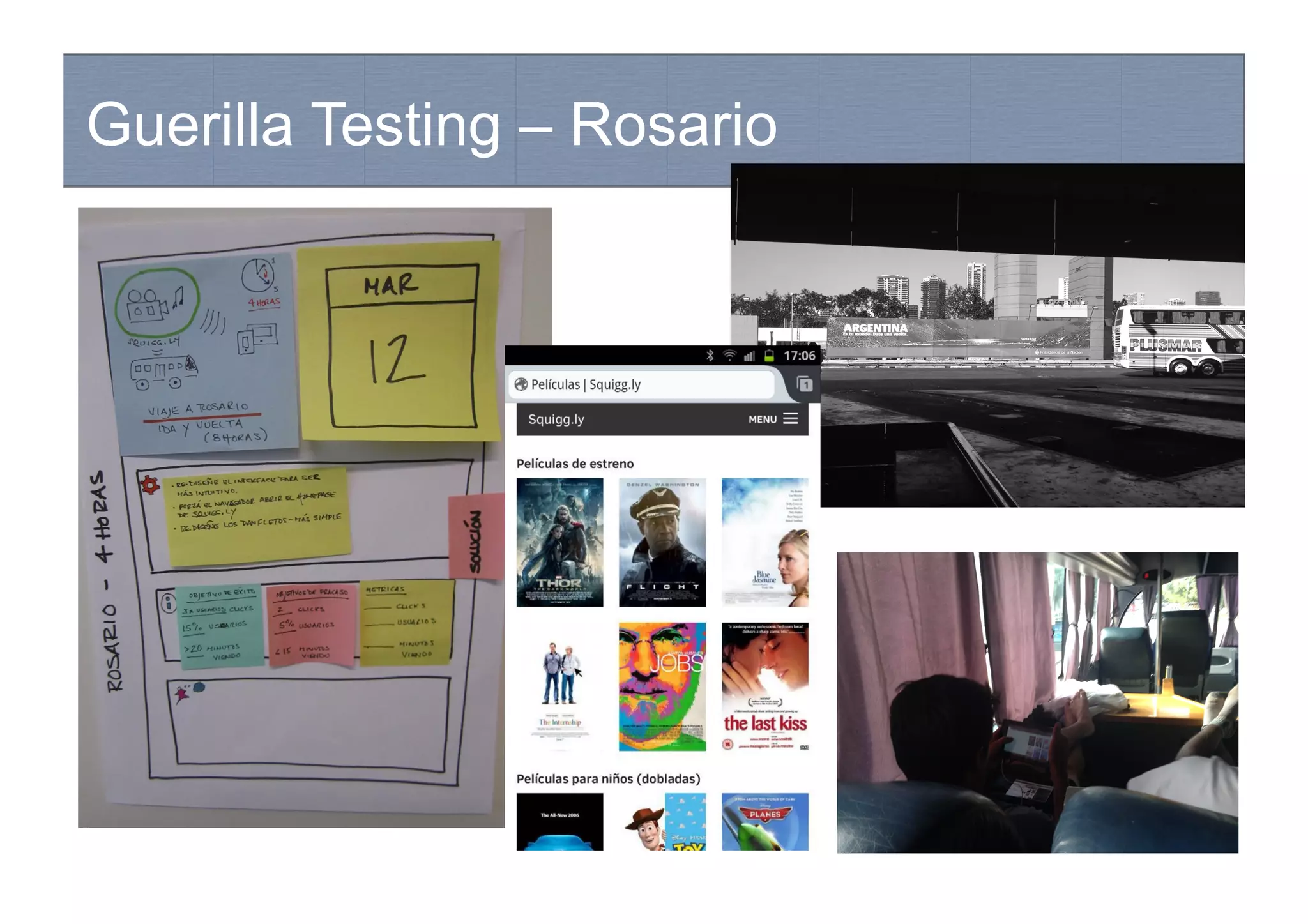
Guerilla Testing – Rosario
Hypothesis-driven development
Business Concept Journey Map
Hypothesis-driven development
Build
Measure
Business Concept Journey Map
Hypothesis-driven development
Build
MeasureLearn
Business Concept Journey Map
Hypothesis-driven development
Build
Measure
Act
Learn
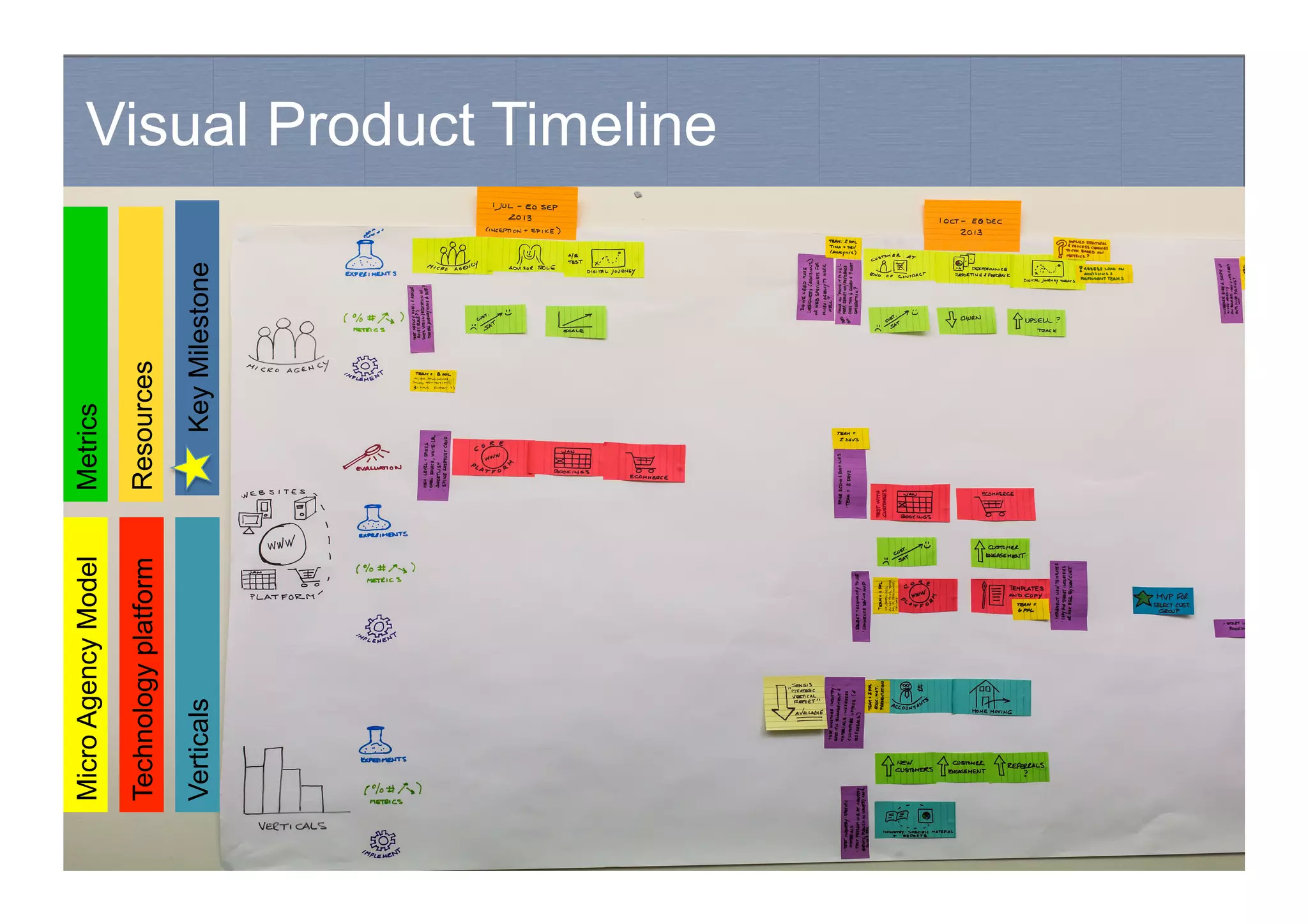
Visual Product Timeline
MicroAgencyModel
Technologyplatform
Verticals
Metrics
Resources
KeyMilestone
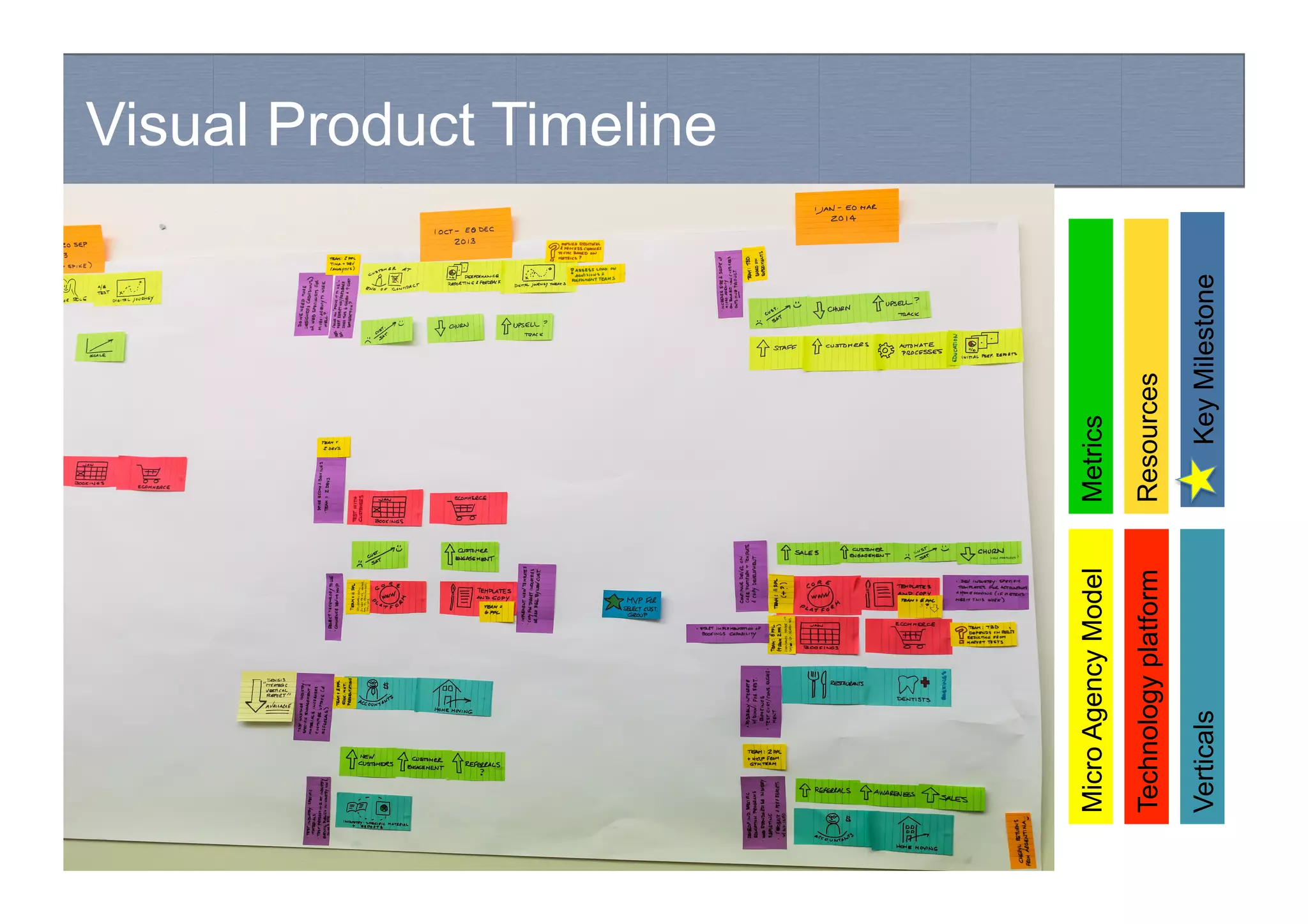
Visual Product Timeline
MicroAgencyModel
Technologyplatform
Verticals
Metrics
Resources
KeyMilestone
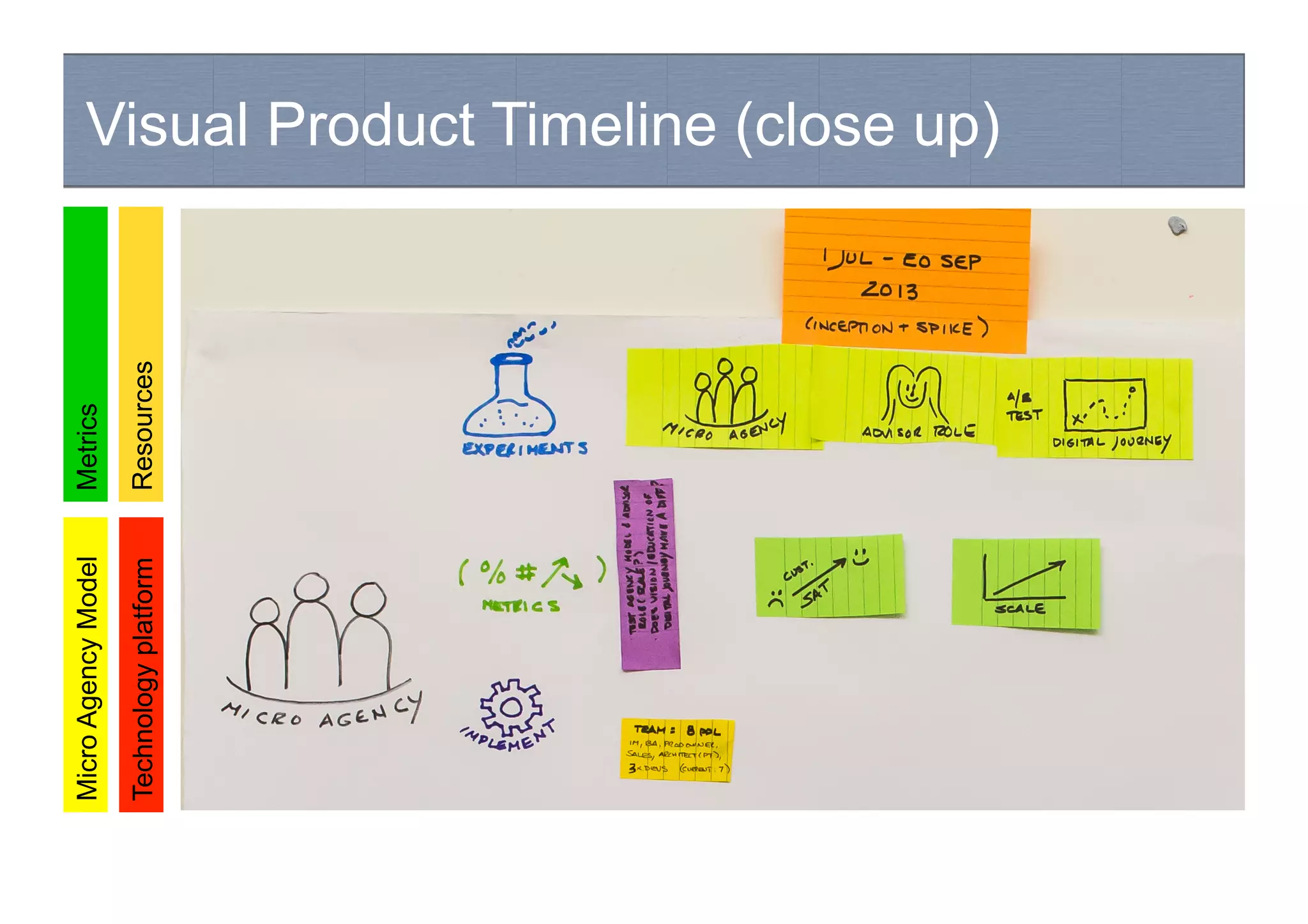
Visual Product Timeline (close up)
MicroAgencyModel
Technologyplatform
Metrics
Resources
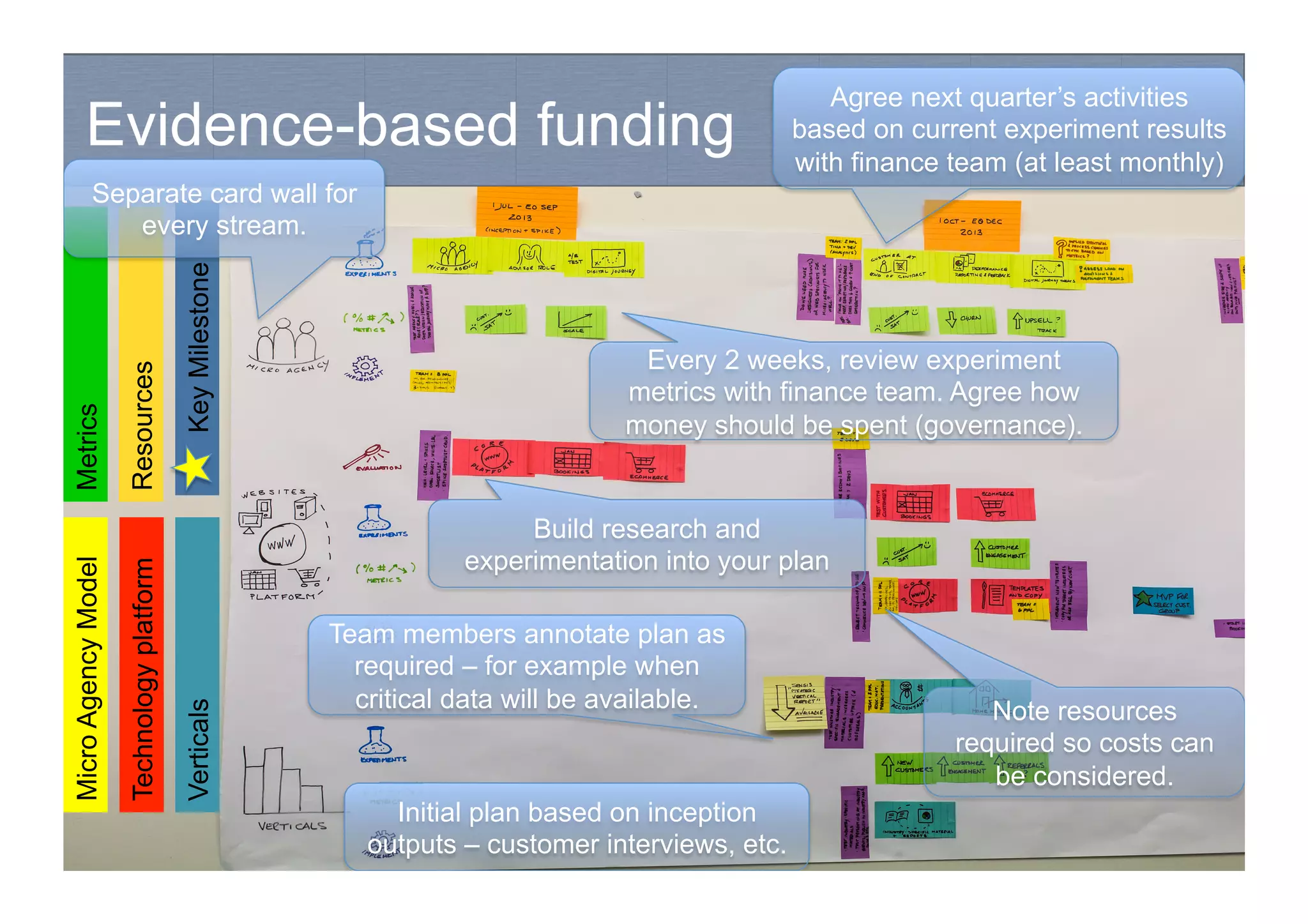
Evidence-based funding
MicroAgencyModel
Technologyplatform
Verticals
Metrics
Resources
KeyMilestone
Every 2 weeks, review experiment
metrics with finance team. Agree how
money should be spent (governance).
Agree next quarter’s activities
based on current experiment results
with finance team (at least monthly)
Initial plan based on inception
outputs – customer interviews, etc.
Team members annotate plan as
required – for example when
critical data will be available.
Separate card wall for
every stream.
Build research and
experimentation into your plan
Note resources
required so costs can
be considered.
Closing thoughts
Hypothesis-driven development
•  Put the “visual” back into strategic vision. Images are
processed by the brain 60,000 times faster than text.
•  Experiments that test the risk in your business plan are
vital. What customers say and what they do varies
greatly. Rely solely on “market research” at your peril.
•  Solution doesn’t necessarily mean software. Remember
the “human element” – user experience, sales, service,
education.
•  Create “information radiators” - share information visually
to facilitate conversations and better decision making
Questions?
Cheryl Quirion
CEO Squiggly / Lean & Agile Coach
@cherylquirion
Cheryl Quirion

Agiles 2015 - Lean Visual Strategy - 22Oct15

  • 1.
    Lean Visual Strategy CherylQuirion @cherylquirion
  • 2.
    Lean Startup BusinessPlanning? No one reads this! Problem Solution Key metrics Unique value proposition Unfair advantage Customer Segments Channels Cost Structure Revenue Streams top 3 problems top 3 features (MVP that demonstrates UVP) single, clean, compelling message that states why you are different and worth buying can't be easily copied or bought target customers (separate canvas for different target customers) key activities you measure (define success) path to customers (free and paid channels) What are the most important costs inherent in our business model? Which Key Resources are most expensive? Which Key Activities are most expensive? For what value are our customers really willing to pay? For what do they currently pay? How are they currently paying? How would they prefer to pay? How much does each Revenue Stream contribute to overall revenues? Lean Business Model Canvas Designed for: Designed by: On: dd/mm/yyyy Iteration # Add Text Here Add Text Here Add Text Here Add Text Here Add Text Here Add Text Here copy the post-its below and paste them in the canvas Ash Maurya's lean canvas adaptation of the original google draw template by scrumology.net based on the work of Alexander Ostenwalder . Lucas Cervera to cre canvas, go share (subscription, ads, freemium...Outline back-of-the-envelope assumptions for life time value, gross margin, break-even point, etc.) This describes what we are doing, why we are doing it and how much it might cost…. But not when or how.
  • 3.
    Current Lean Startuptools Lean Business Canvas Experiment Canvasleanstack.com
  • 4.
    Managing your keystakeholders Most executive managers - 12hour+ work days. VERY LIMITED time to inform them.
  • 5.
    Stakeholders want toknow •  What is the customer problem? •  How are you going to solve it? •  How long do you think it will take? •  When can you launch something to market? •  What is it going to cost? •  What are the expected revenues (and return on investment)? …… “BIG PICTURE” questions… to get support and funding. How do we address these questions and still use Lean Startup principles to “build the right thing”?
  • 6.
    Our current toolsaren’t so Lean Problem Solution Key metrics Unique value proposition Unfair advantage Customer Segments Channels Cost Structure Revenue Streams top 3 problems top 3 features (MVP that demonstrates UVP) single, clean, compelling message that states why you are different and worth buying can't be easily copied or bought target customers (separate canvas for different target customers) key activities you measure (define success) path to customers (free and paid channels) What are the most important costs inherent in our business model? Which Key Resources are most expensive? Which Key Activities are most expensive? For what value are our customers really willing to pay? For what do they currently pay? How are they currently paying? How would they prefer to pay? How much does each Revenue Stream contribute to overall revenues? Lean Business Model Canvas Designed for: Designed by: On: dd/mm/yyyy Iteration # Add Text Here Add Text Here Add Text Here copy the post-its below and paste em in the canvas Ash Maurya's lean canvas adaptation of the original google draw template by scrumology.net based on the work of Alexander Ostenwalder . Lucas Cervera to create your own copy of this canvas, go to File/Make a copy and share it with whoever you want (subscription, ads, freemium...Outline back-of-the-envelope assumptions for life time value, gross margin, break-even point, etc.) And they really don’t address the “big picture” questions
  • 7.
    Visualise what weare trying to achieve Need a way to visualise and “tell the story” about our business/solution concept. Why make it visual?   •  90%  of  informa,on  transmi/ed  to   the  brain  is  visual   •  Images  are  processed  60,000  ,mes   faster  in  the  brain  than  text   •  Visuals  improve  learning  ability  by   up  to  400  percent  
  • 8.
    Lean Business Canvas Hypothesis-drivendevelopment Problem Solution Key metrics Unique value proposition Unfair advantage Customer Segments Channels Cost Structure Revenue Streams top 3 problems top 3 features (MVP that demonstrates UVP) single, clean, compelling message that states why you are different and worth buying can't be easily copied or bought target customers (separate canvas for different target customers) key activities you measure (define success) path to customers (free and paid channels) What are the most important costs inherent in our business model? Which Key Resources are most expensive? Which Key Activities are most expensive? For what value are our customers really willing to pay? For what do they currently pay? How are they currently paying? How would they prefer to pay? How much does each Revenue Stream contribute to overall revenues? Lean Business Model Canvas Designed for: Designed by: On: dd/mm/yyyy Iteration # dd ext ere dd ext ere Add Text Here dd ext ere Add Text Here Add Text Here copy the post-its below and paste them in the canvas Ash Maurya's lean canvas adaptation of the original google draw template by scrumology.net based on the work of Alexander Ostenwalder . Lucas Cervera to create your canvas, go to File/ share it with w (subscription, ads, freemium...Outline back-of-the-envelope assumptions for life time value, gross margin, break-even point, etc.)
  • 9.
    Business Concept JourneyMap Hypothesis-driven development
  • 10.
    Business Concept JourneyMap Hypothesis-driven development Build
  • 11.
    Business Concept JourneyMap Hypothesis-driven development Build Measure
  • 12.
    Business Concept JourneyMap Hypothesis-driven development Build MeasureLearn
  • 13.
    Business Concept JourneyMap Hypothesis-driven development Build MeasureLearn Act
  • 14.
    Focus on the“big picture”
  • 15.
    Business Concept JourneyMap Hypothesis-driven development How do we define and prioritise experiments?
  • 16.
  • 17.
    Business Concept JourneyMap Hypothesis-driven development
  • 18.
  • 19.
    Experiment Canvas –Timeline Wall Hypothesis-driven development
  • 20.
    Guerilla Testing –Retiro (Buenos Aires) Hypothesis-driven development
  • 21.
    Guerilla Testing –San Antonio de Areco Hypothesis-driven development
  • 22.
    Guerilla Testing –Rosario Hypothesis-driven development
  • 23.
    Business Concept JourneyMap Hypothesis-driven development Build Measure
  • 24.
    Business Concept JourneyMap Hypothesis-driven development Build MeasureLearn
  • 25.
    Business Concept JourneyMap Hypothesis-driven development Build Measure Act Learn
  • 26.
  • 27.
  • 28.
    Visual Product Timeline(close up) MicroAgencyModel Technologyplatform Metrics Resources
  • 29.
    Evidence-based funding MicroAgencyModel Technologyplatform Verticals Metrics Resources KeyMilestone Every 2weeks, review experiment metrics with finance team. Agree how money should be spent (governance). Agree next quarter’s activities based on current experiment results with finance team (at least monthly) Initial plan based on inception outputs – customer interviews, etc. Team members annotate plan as required – for example when critical data will be available. Separate card wall for every stream. Build research and experimentation into your plan Note resources required so costs can be considered.
  • 30.
    Closing thoughts Hypothesis-driven development • Put the “visual” back into strategic vision. Images are processed by the brain 60,000 times faster than text. •  Experiments that test the risk in your business plan are vital. What customers say and what they do varies greatly. Rely solely on “market research” at your peril. •  Solution doesn’t necessarily mean software. Remember the “human element” – user experience, sales, service, education. •  Create “information radiators” - share information visually to facilitate conversations and better decision making
  • 31.
    Questions? Cheryl Quirion CEO Squiggly/ Lean & Agile Coach @cherylquirion Cheryl Quirion