RUNNING LEAN
A systematic process for iterating your web
application from Plan A to a plan that works
ASH MAURYA
@ashmaurya
http://www.ashmaurya.com
Thursday, November 4, 2010
The sad statistics of Plan A.
Thursday, November 4, 2010
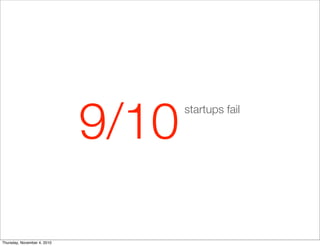
9/10
startups fail
Thursday, November 4, 2010
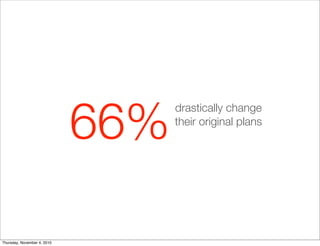
66%
drastically change
their original plans
Thursday, November 4, 2010
Not a better Plan A.
But a path to a plan that works.
Thursday, November 4, 2010
Running Lean is a systematic process for iterating
from Plan A to a plan that works.
Thursday, November 4, 2010
Agenda
1. What is Running Lean?
2. What does a Lean Startup look like?
3. How can you use Lean to define and measure progress?
Thursday, November 4, 2010
Agenda
1. What is Running Lean?
2. What does a Lean Startup look like?
3. How can you use Lean to define and measure progress?
Thursday, November 4, 2010
About Me
Thursday, November 4, 2010
Practice Trumps Theory
Thursday, November 4, 2010
What is Running Lean
Customer Development
+
Lean Startup
+
Bootstrapping
Thursday, November 4, 2010
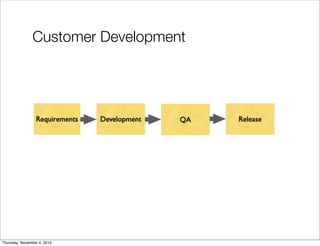
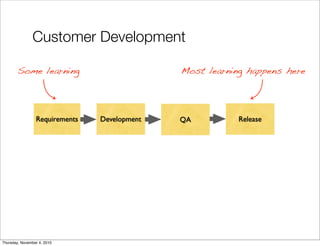
Requirements ReleaseDevelopment QA
Customer Development
Thursday, November 4, 2010
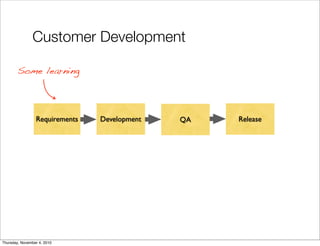
Requirements ReleaseDevelopment QA
Some learning
Customer Development
Thursday, November 4, 2010
Requirements ReleaseDevelopment QA
Some learning Most learning happens here
Customer Development
Thursday, November 4, 2010
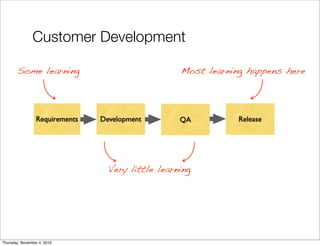
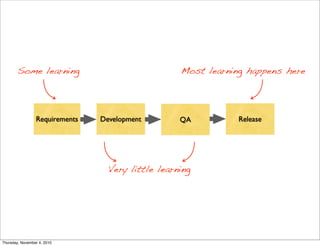
Requirements ReleaseDevelopment QA
Some learning
Very little learning
Most learning happens here
Customer Development
Thursday, November 4, 2010
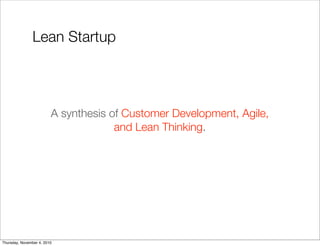
A synthesis of Customer Development, Agile,
and Lean Thinking.
Lean Startup
Thursday, November 4, 2010
Funding with customer revenue.
Bootstrapping
Thursday, November 4, 2010
Startups that succeed are those that manage to iterate
enough times before running out of resources.
- Eric Ries
Speed
Thursday, November 4, 2010
Get out of the building.
- Steve Blank
Learning
Thursday, November 4, 2010
Right Action, Right Time.
- Bijoy Goswami
Focus
Thursday, November 4, 2010
Speed, Learning, Focus.
Thursday, November 4, 2010
There are no silver bullets
Thursday, November 4, 2010
Agenda
1. What is Running Lean?
2. What does a Lean Startup look like?
3. How can you use Lean to define and measure progress?
Thursday, November 4, 2010
1. Document your Plan A
2. Systematically Test your Plan A
Thursday, November 4, 2010
There is an “I” in Vision
Smart people can rationalize anything.
Thursday, November 4, 2010
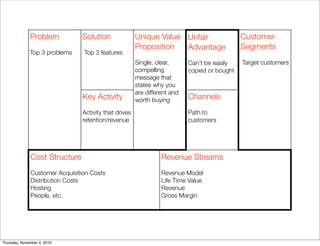
Business Model vs Business Plan
Thursday, November 4, 2010
Business Model vs Business Plan
A document investors make you write
that they don’t read
Thursday, November 4, 2010
Business Model vs Business Plan
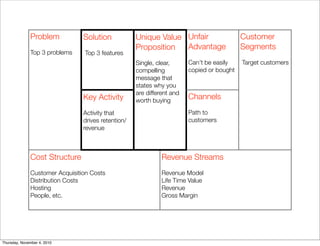
A single diagram of your business
Thursday, November 4, 2010
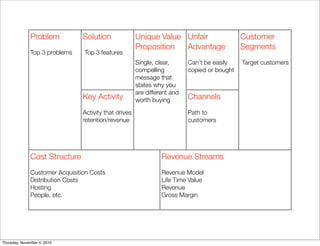
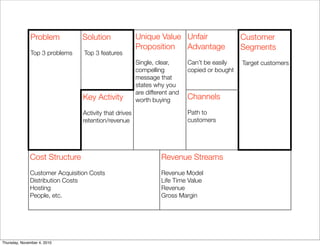
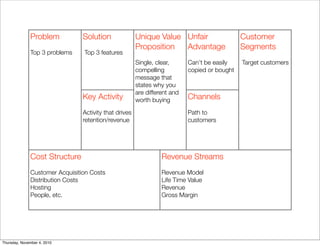
Problem
Top 3 problems
Solution
Top 3 features
Unique Value
Proposition
Single, clear,
compelling
message that
states why you
are different and
worth buying
Unique Value
Proposition
Single, clear,
compelling
message that
states why you
are different and
worth buying
Unfair
Advantage
Can’t be easily
copied or bought
Customer
Segments
Target customers
Problem
Top 3 problems
Key Activity
Activity that drives
retention/revenue
Unique Value
Proposition
Single, clear,
compelling
message that
states why you
are different and
worth buying
Unique Value
Proposition
Single, clear,
compelling
message that
states why you
are different and
worth buying Channels
Path to
customers
Customer
Segments
Target customers
Cost Structure
Customer Acquisition Costs
Distribution Costs
Hosting
People, etc.
Cost Structure
Customer Acquisition Costs
Distribution Costs
Hosting
People, etc.
Cost Structure
Customer Acquisition Costs
Distribution Costs
Hosting
People, etc.
Revenue Streams
Revenue Model
Life Time Value
Revenue
Gross Margin
Revenue Streams
Revenue Model
Life Time Value
Revenue
Gross Margin
Revenue Streams
Revenue Model
Life Time Value
Revenue
Gross Margin
Thursday, November 4, 2010
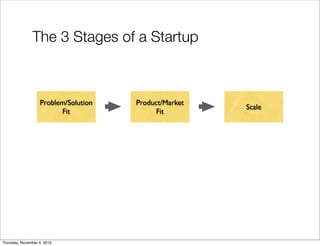
The 3 Stages of a Startup
Problem/Solution
Fit
Product/Market
Fit
Scale
Thursday, November 4, 2010
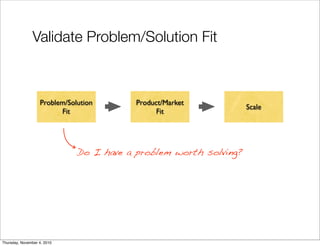
Validate Problem/Solution Fit
Problem/Solution
Fit
Product/Market
Fit
Scale
Do I have a problem worth solving?
Thursday, November 4, 2010
Problem
Top 3 problems
Solution
Top 3 features
Unique Value
Proposition
Single, clear,
compelling
message that
states why you
are different and
worth buying
Unique Value
Proposition
Single, clear,
compelling
message that
states why you
are different and
worth buying
Unfair
Advantage
Can’t be easily
copied or bought
Customer
Segments
Target customers
Problem
Top 3 problems
Key Activity
Activity that drives
retention/revenue
Unique Value
Proposition
Single, clear,
compelling
message that
states why you
are different and
worth buying
Unique Value
Proposition
Single, clear,
compelling
message that
states why you
are different and
worth buying Channels
Path to
customers
Customer
Segments
Target customers
Cost Structure
Customer Acquisition Costs
Distribution Costs
Hosting
People, etc.
Cost Structure
Customer Acquisition Costs
Distribution Costs
Hosting
People, etc.
Cost Structure
Customer Acquisition Costs
Distribution Costs
Hosting
People, etc.
Revenue Streams
Revenue Model
Life Time Value
Revenue
Gross Margin
Revenue Streams
Revenue Model
Life Time Value
Revenue
Gross Margin
Revenue Streams
Revenue Model
Life Time Value
Revenue
Gross Margin
Thursday, November 4, 2010
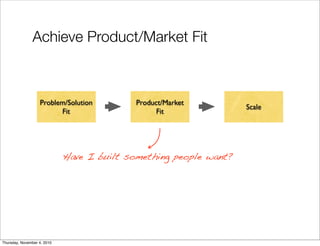
Achieve Product/Market Fit
Have I built something people want?
Problem/Solution
Fit
Product/Market
Fit
Scale
Thursday, November 4, 2010
Requirements ReleaseDevelopment QA
Some learning
Very little learning
Most learning happens here
Thursday, November 4, 2010
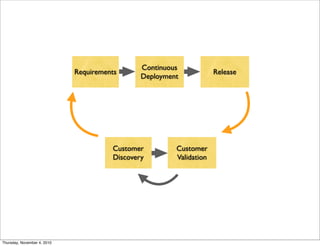
Requirements Release
Customer
Discovery
Customer
Validation
Continuous
Deployment
Thursday, November 4, 2010
Problem
Top 3 problems
Solution
Top 3 features
Unique Value
Proposition
Single, clear,
compelling
message that
states why you
are different and
worth buying
Unique Value
Proposition
Single, clear,
compelling
message that
states why you
are different and
worth buying
Unfair
Advantage
Can’t be easily
copied or bought
Customer
Segments
Target customers
Problem
Top 3 problems
Key Activity
Activity that
drives retention/
revenue
Unique Value
Proposition
Single, clear,
compelling
message that
states why you
are different and
worth buying
Unique Value
Proposition
Single, clear,
compelling
message that
states why you
are different and
worth buying
Channels
Path to
customers
Customer
Segments
Target customers
Cost Structure
Customer Acquisition Costs
Distribution Costs
Hosting
People, etc.
Cost Structure
Customer Acquisition Costs
Distribution Costs
Hosting
People, etc.
Cost Structure
Customer Acquisition Costs
Distribution Costs
Hosting
People, etc.
Revenue Streams
Revenue Model
Life Time Value
Revenue
Gross Margin
Revenue Streams
Revenue Model
Life Time Value
Revenue
Gross Margin
Revenue Streams
Revenue Model
Life Time Value
Revenue
Gross Margin
Thursday, November 4, 2010
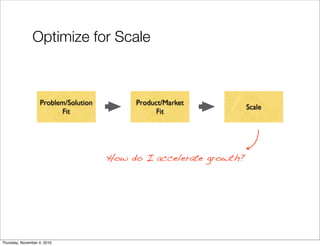
Optimize for Scale
How do I accelerate growth?
Problem/Solution
Fit
Product/Market
Fit
Scale
Thursday, November 4, 2010
Problem
Top 3 problems
Solution
Top 3 features
Unique Value
Proposition
Single, clear,
compelling
message that
states why you
are different and
worth buying
Unique Value
Proposition
Single, clear,
compelling
message that
states why you
are different and
worth buying
Unfair
Advantage
Can’t be easily
copied or bought
Customer
Segments
Target customers
Problem
Top 3 problems
Key Activity
Activity that drives
retention/revenue
Unique Value
Proposition
Single, clear,
compelling
message that
states why you
are different and
worth buying
Unique Value
Proposition
Single, clear,
compelling
message that
states why you
are different and
worth buying Channels
Path to
customers
Customer
Segments
Target customers
Cost Structure
Customer Acquisition Costs
Distribution Costs
Hosting
People, etc.
Cost Structure
Customer Acquisition Costs
Distribution Costs
Hosting
People, etc.
Cost Structure
Customer Acquisition Costs
Distribution Costs
Hosting
People, etc.
Revenue Streams
Revenue Model
Life Time Value
Revenue
Gross Margin
Revenue Streams
Revenue Model
Life Time Value
Revenue
Gross Margin
Revenue Streams
Revenue Model
Life Time Value
Revenue
Gross Margin
Thursday, November 4, 2010
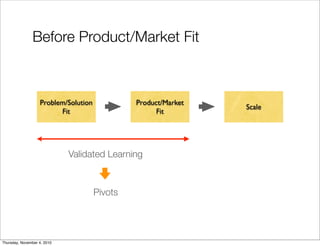
Before Product/Market Fit
Validated Learning
Pivots
Problem/Solution
Fit
Product/Market
Fit
Scale
Thursday, November 4, 2010
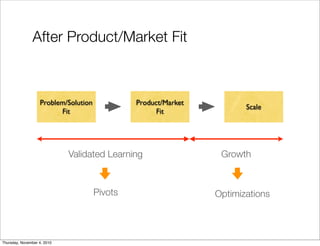
After Product/Market Fit
Growth
Optimizations
Validated Learning
Pivots
Problem/Solution
Fit
Product/Market
Fit
Scale
Thursday, November 4, 2010
Agenda
1. What is Running Lean?
2. What does a Lean Startup look like?
3. How can you use Lean to define and measure progress?
Thursday, November 4, 2010
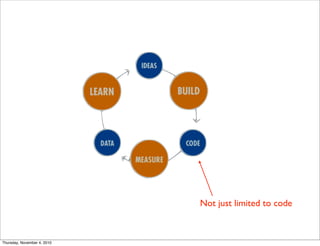
Not just limited to code
Thursday, November 4, 2010
Speed, Learning, Focus.
Thursday, November 4, 2010
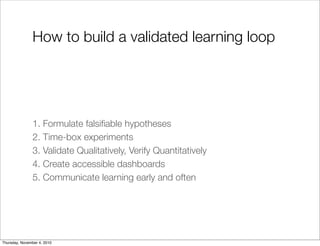
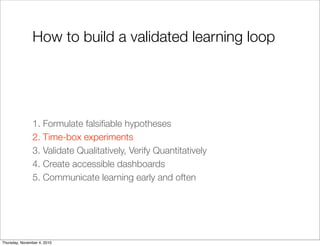
How to build a validated learning loop
1. Formulate falsifiable hypotheses
2. Time-box experiments
3. Validate Qualitatively, Verify Quantitatively
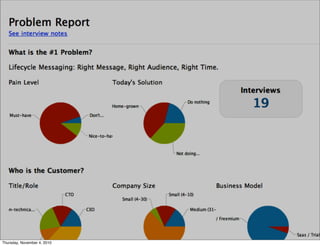
4. Create accessible dashboards
5. Communicate learning early and often
Thursday, November 4, 2010
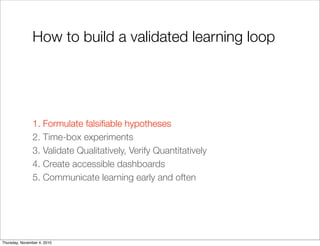
How to build a validated learning loop
1. Formulate falsifiable hypotheses
2. Time-box experiments
3. Validate Qualitatively, Verify Quantitatively
4. Create accessible dashboards
5. Communicate learning early and often
Thursday, November 4, 2010
Problem
Top 3 problems
Solution
Top 3 features
Unique Value
Proposition
Single, clear,
compelling
message that
states why you
are different and
worth buying
Unique Value
Proposition
Single, clear,
compelling
message that
states why you
are different and
worth buying
Unfair
Advantage
Can’t be easily
copied or bought
Customer
Segments
Target customers
Problem
Top 3 problems
Key Activity
Activity that drives
retention/revenue
Unique Value
Proposition
Single, clear,
compelling
message that
states why you
are different and
worth buying
Unique Value
Proposition
Single, clear,
compelling
message that
states why you
are different and
worth buying Channels
Path to
customers
Customer
Segments
Target customers
Cost Structure
Customer Acquisition Costs
Distribution Costs
Hosting
People, etc.
Cost Structure
Customer Acquisition Costs
Distribution Costs
Hosting
People, etc.
Cost Structure
Customer Acquisition Costs
Distribution Costs
Hosting
People, etc.
Revenue Streams
Revenue Model
Life Time Value
Revenue
Gross Margin
Revenue Streams
Revenue Model
Life Time Value
Revenue
Gross Margin
Revenue Streams
Revenue Model
Life Time Value
Revenue
Gross Margin
Thursday, November 4, 2010
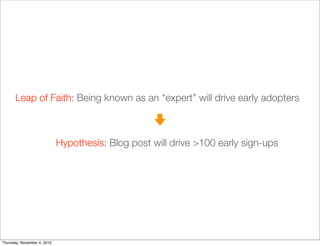
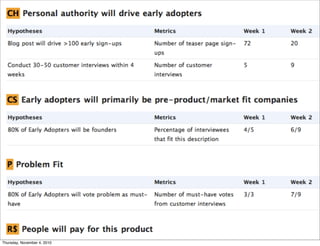
Leap of Faith: Being known as an “expert” will drive early adopters
Hypothesis: Blog post will drive >100 early sign-ups
Thursday, November 4, 2010
How to build a validated learning loop
1. Formulate falsifiable hypotheses
2. Time-box experiments
3. Validate Qualitatively, Verify Quantitatively
4. Create accessible dashboards
5. Communicate learning early and often
Thursday, November 4, 2010
Time is more valuable than money.
Thursday, November 4, 2010
How to build a validated learning loop
1. Formulate falsifiable hypotheses
2. Time-box experiments
3. Validate Qualitatively, Verify Quantitatively
4. Create accessible dashboards
5. Communicate learning early and often
Thursday, November 4, 2010
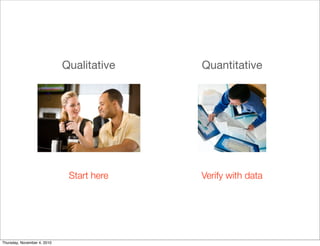
Qualitative Quantitative
Start here Verify with data
Thursday, November 4, 2010
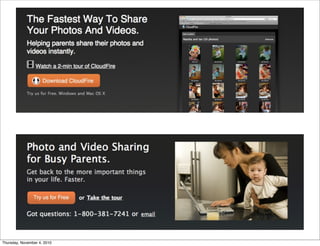
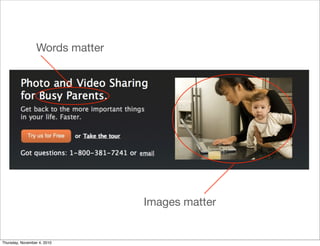
Words matter
Images matter
Thursday, November 4, 2010
How to build a validated learning loop
1. Formulate falsifiable hypotheses
2. Time-box experiments
3. Validate Qualitatively, Verify Quantitatively
4. Create accessible dashboards
5. Communicate learning early and often
Thursday, November 4, 2010
How to build a validated learning loop
1. Formulate falsifiable hypotheses
2. Time-box experiments
3. Validate Qualitatively, Verify Quantitatively
4. Create accessible dashboards
5. Communicate learning early and often
Thursday, November 4, 2010
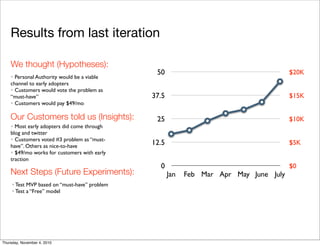
We thought (Hypotheses):
Our Customers told us (Insights):
Next Steps (Future Experiments):
0
12.5
25
37.5
50
Jan Feb Mar Apr May June July
$20K
$15K
$10K
$5K
$0
• Personal Authority would be a viable
channel to early adopters
• Customers would vote the problem as
“must-have”
• Customers would pay $49/mo
• Most early adopters did come through
blog and twitter
• Customers voted #3 problem as “must-
have”. Others as nice-to-have
• $49/mo works for customers with early
traction
•Test MVP based on “must-have” problem
•Test a “Free” model
Results from last iteration
Thursday, November 4, 2010
Not a better Plan A.
But a path to a plan that works.
Thursday, November 4, 2010
Thanks!
Ash Maurya
twitter: ashmaurya
blog: http://www.ashmaurya.com
Running Lean - the book
Systematically iterate your product
from plan A to a plan that works
http://www.RunningLeanHQ.com
Thursday, November 4, 2010

Running Lean - Dallas

  • 1.
    RUNNING LEAN A systematicprocess for iterating your web application from Plan A to a plan that works ASH MAURYA @ashmaurya http://www.ashmaurya.com Thursday, November 4, 2010
  • 2.
    The sad statisticsof Plan A. Thursday, November 4, 2010
  • 3.
  • 4.
    66% drastically change their originalplans Thursday, November 4, 2010
  • 5.
    Not a betterPlan A. But a path to a plan that works. Thursday, November 4, 2010
  • 6.
    Running Lean isa systematic process for iterating from Plan A to a plan that works. Thursday, November 4, 2010
  • 7.
    Agenda 1. What isRunning Lean? 2. What does a Lean Startup look like? 3. How can you use Lean to define and measure progress? Thursday, November 4, 2010
  • 8.
    Agenda 1. What isRunning Lean? 2. What does a Lean Startup look like? 3. How can you use Lean to define and measure progress? Thursday, November 4, 2010
  • 9.
  • 10.
  • 11.
    What is RunningLean Customer Development + Lean Startup + Bootstrapping Thursday, November 4, 2010
  • 12.
    Requirements ReleaseDevelopment QA CustomerDevelopment Thursday, November 4, 2010
  • 13.
    Requirements ReleaseDevelopment QA Somelearning Customer Development Thursday, November 4, 2010
  • 14.
    Requirements ReleaseDevelopment QA Somelearning Most learning happens here Customer Development Thursday, November 4, 2010
  • 15.
    Requirements ReleaseDevelopment QA Somelearning Very little learning Most learning happens here Customer Development Thursday, November 4, 2010
  • 16.
    A synthesis ofCustomer Development, Agile, and Lean Thinking. Lean Startup Thursday, November 4, 2010
  • 17.
    Funding with customerrevenue. Bootstrapping Thursday, November 4, 2010
  • 18.
    Startups that succeedare those that manage to iterate enough times before running out of resources. - Eric Ries Speed Thursday, November 4, 2010
  • 19.
    Get out ofthe building. - Steve Blank Learning Thursday, November 4, 2010
  • 20.
    Right Action, RightTime. - Bijoy Goswami Focus Thursday, November 4, 2010
  • 21.
  • 22.
    There are nosilver bullets Thursday, November 4, 2010
  • 23.
    Agenda 1. What isRunning Lean? 2. What does a Lean Startup look like? 3. How can you use Lean to define and measure progress? Thursday, November 4, 2010
  • 24.
    1. Document yourPlan A 2. Systematically Test your Plan A Thursday, November 4, 2010
  • 25.
    There is an“I” in Vision Smart people can rationalize anything. Thursday, November 4, 2010
  • 26.
    Business Model vsBusiness Plan Thursday, November 4, 2010
  • 27.
    Business Model vsBusiness Plan A document investors make you write that they don’t read Thursday, November 4, 2010
  • 28.
    Business Model vsBusiness Plan A single diagram of your business Thursday, November 4, 2010
  • 29.
    Problem Top 3 problems Solution Top3 features Unique Value Proposition Single, clear, compelling message that states why you are different and worth buying Unique Value Proposition Single, clear, compelling message that states why you are different and worth buying Unfair Advantage Can’t be easily copied or bought Customer Segments Target customers Problem Top 3 problems Key Activity Activity that drives retention/revenue Unique Value Proposition Single, clear, compelling message that states why you are different and worth buying Unique Value Proposition Single, clear, compelling message that states why you are different and worth buying Channels Path to customers Customer Segments Target customers Cost Structure Customer Acquisition Costs Distribution Costs Hosting People, etc. Cost Structure Customer Acquisition Costs Distribution Costs Hosting People, etc. Cost Structure Customer Acquisition Costs Distribution Costs Hosting People, etc. Revenue Streams Revenue Model Life Time Value Revenue Gross Margin Revenue Streams Revenue Model Life Time Value Revenue Gross Margin Revenue Streams Revenue Model Life Time Value Revenue Gross Margin Thursday, November 4, 2010
  • 30.
    The 3 Stagesof a Startup Problem/Solution Fit Product/Market Fit Scale Thursday, November 4, 2010
  • 31.
    Validate Problem/Solution Fit Problem/Solution Fit Product/Market Fit Scale DoI have a problem worth solving? Thursday, November 4, 2010
  • 32.
    Problem Top 3 problems Solution Top3 features Unique Value Proposition Single, clear, compelling message that states why you are different and worth buying Unique Value Proposition Single, clear, compelling message that states why you are different and worth buying Unfair Advantage Can’t be easily copied or bought Customer Segments Target customers Problem Top 3 problems Key Activity Activity that drives retention/revenue Unique Value Proposition Single, clear, compelling message that states why you are different and worth buying Unique Value Proposition Single, clear, compelling message that states why you are different and worth buying Channels Path to customers Customer Segments Target customers Cost Structure Customer Acquisition Costs Distribution Costs Hosting People, etc. Cost Structure Customer Acquisition Costs Distribution Costs Hosting People, etc. Cost Structure Customer Acquisition Costs Distribution Costs Hosting People, etc. Revenue Streams Revenue Model Life Time Value Revenue Gross Margin Revenue Streams Revenue Model Life Time Value Revenue Gross Margin Revenue Streams Revenue Model Life Time Value Revenue Gross Margin Thursday, November 4, 2010
  • 33.
    Achieve Product/Market Fit HaveI built something people want? Problem/Solution Fit Product/Market Fit Scale Thursday, November 4, 2010
  • 34.
    Requirements ReleaseDevelopment QA Somelearning Very little learning Most learning happens here Thursday, November 4, 2010
  • 35.
  • 36.
    Problem Top 3 problems Solution Top3 features Unique Value Proposition Single, clear, compelling message that states why you are different and worth buying Unique Value Proposition Single, clear, compelling message that states why you are different and worth buying Unfair Advantage Can’t be easily copied or bought Customer Segments Target customers Problem Top 3 problems Key Activity Activity that drives retention/ revenue Unique Value Proposition Single, clear, compelling message that states why you are different and worth buying Unique Value Proposition Single, clear, compelling message that states why you are different and worth buying Channels Path to customers Customer Segments Target customers Cost Structure Customer Acquisition Costs Distribution Costs Hosting People, etc. Cost Structure Customer Acquisition Costs Distribution Costs Hosting People, etc. Cost Structure Customer Acquisition Costs Distribution Costs Hosting People, etc. Revenue Streams Revenue Model Life Time Value Revenue Gross Margin Revenue Streams Revenue Model Life Time Value Revenue Gross Margin Revenue Streams Revenue Model Life Time Value Revenue Gross Margin Thursday, November 4, 2010
  • 37.
    Optimize for Scale Howdo I accelerate growth? Problem/Solution Fit Product/Market Fit Scale Thursday, November 4, 2010
  • 38.
    Problem Top 3 problems Solution Top3 features Unique Value Proposition Single, clear, compelling message that states why you are different and worth buying Unique Value Proposition Single, clear, compelling message that states why you are different and worth buying Unfair Advantage Can’t be easily copied or bought Customer Segments Target customers Problem Top 3 problems Key Activity Activity that drives retention/revenue Unique Value Proposition Single, clear, compelling message that states why you are different and worth buying Unique Value Proposition Single, clear, compelling message that states why you are different and worth buying Channels Path to customers Customer Segments Target customers Cost Structure Customer Acquisition Costs Distribution Costs Hosting People, etc. Cost Structure Customer Acquisition Costs Distribution Costs Hosting People, etc. Cost Structure Customer Acquisition Costs Distribution Costs Hosting People, etc. Revenue Streams Revenue Model Life Time Value Revenue Gross Margin Revenue Streams Revenue Model Life Time Value Revenue Gross Margin Revenue Streams Revenue Model Life Time Value Revenue Gross Margin Thursday, November 4, 2010
  • 39.
    Before Product/Market Fit ValidatedLearning Pivots Problem/Solution Fit Product/Market Fit Scale Thursday, November 4, 2010
  • 40.
    After Product/Market Fit Growth Optimizations ValidatedLearning Pivots Problem/Solution Fit Product/Market Fit Scale Thursday, November 4, 2010
  • 41.
    Agenda 1. What isRunning Lean? 2. What does a Lean Startup look like? 3. How can you use Lean to define and measure progress? Thursday, November 4, 2010
  • 42.
    Not just limitedto code Thursday, November 4, 2010
  • 43.
  • 44.
    How to builda validated learning loop 1. Formulate falsifiable hypotheses 2. Time-box experiments 3. Validate Qualitatively, Verify Quantitatively 4. Create accessible dashboards 5. Communicate learning early and often Thursday, November 4, 2010
  • 45.
    How to builda validated learning loop 1. Formulate falsifiable hypotheses 2. Time-box experiments 3. Validate Qualitatively, Verify Quantitatively 4. Create accessible dashboards 5. Communicate learning early and often Thursday, November 4, 2010
  • 46.
    Problem Top 3 problems Solution Top3 features Unique Value Proposition Single, clear, compelling message that states why you are different and worth buying Unique Value Proposition Single, clear, compelling message that states why you are different and worth buying Unfair Advantage Can’t be easily copied or bought Customer Segments Target customers Problem Top 3 problems Key Activity Activity that drives retention/revenue Unique Value Proposition Single, clear, compelling message that states why you are different and worth buying Unique Value Proposition Single, clear, compelling message that states why you are different and worth buying Channels Path to customers Customer Segments Target customers Cost Structure Customer Acquisition Costs Distribution Costs Hosting People, etc. Cost Structure Customer Acquisition Costs Distribution Costs Hosting People, etc. Cost Structure Customer Acquisition Costs Distribution Costs Hosting People, etc. Revenue Streams Revenue Model Life Time Value Revenue Gross Margin Revenue Streams Revenue Model Life Time Value Revenue Gross Margin Revenue Streams Revenue Model Life Time Value Revenue Gross Margin Thursday, November 4, 2010
  • 47.
    Leap of Faith:Being known as an “expert” will drive early adopters Hypothesis: Blog post will drive >100 early sign-ups Thursday, November 4, 2010
  • 48.
    How to builda validated learning loop 1. Formulate falsifiable hypotheses 2. Time-box experiments 3. Validate Qualitatively, Verify Quantitatively 4. Create accessible dashboards 5. Communicate learning early and often Thursday, November 4, 2010
  • 49.
    Time is morevaluable than money. Thursday, November 4, 2010
  • 50.
    How to builda validated learning loop 1. Formulate falsifiable hypotheses 2. Time-box experiments 3. Validate Qualitatively, Verify Quantitatively 4. Create accessible dashboards 5. Communicate learning early and often Thursday, November 4, 2010
  • 51.
    Qualitative Quantitative Start hereVerify with data Thursday, November 4, 2010
  • 52.
  • 53.
  • 54.
    How to builda validated learning loop 1. Formulate falsifiable hypotheses 2. Time-box experiments 3. Validate Qualitatively, Verify Quantitatively 4. Create accessible dashboards 5. Communicate learning early and often Thursday, November 4, 2010
  • 55.
  • 56.
  • 57.
    How to builda validated learning loop 1. Formulate falsifiable hypotheses 2. Time-box experiments 3. Validate Qualitatively, Verify Quantitatively 4. Create accessible dashboards 5. Communicate learning early and often Thursday, November 4, 2010
  • 58.
    We thought (Hypotheses): OurCustomers told us (Insights): Next Steps (Future Experiments): 0 12.5 25 37.5 50 Jan Feb Mar Apr May June July $20K $15K $10K $5K $0 • Personal Authority would be a viable channel to early adopters • Customers would vote the problem as “must-have” • Customers would pay $49/mo • Most early adopters did come through blog and twitter • Customers voted #3 problem as “must- have”. Others as nice-to-have • $49/mo works for customers with early traction •Test MVP based on “must-have” problem •Test a “Free” model Results from last iteration Thursday, November 4, 2010
  • 59.
    Not a betterPlan A. But a path to a plan that works. Thursday, November 4, 2010
  • 60.
    Thanks! Ash Maurya twitter: ashmaurya blog:http://www.ashmaurya.com Running Lean - the book Systematically iterate your product from plan A to a plan that works http://www.RunningLeanHQ.com Thursday, November 4, 2010