
Business Model Canvas
A step-by-step guide
Contents
1. Introduction
2. Filling out the canvas
3. Improving your business model
Introduction
● Fits on one page
● Broadly applicable
● Based on research
● Lean startup method
An overview of the
resources and
operations required to
make your business
successful.
What is the Business Model Canvas?
Why use it?
● Plan your strategy
● Share your vision
● Identify gaps
● Grow your business
Filling out the canvas
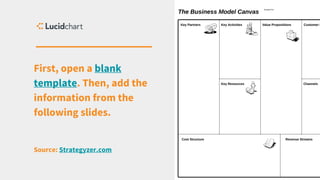
First, open a blank
template. Then, add the
information from the
following slides.
Source: Strategyzer.com
Products and services
you offer to meet
customers’ needs.
Value proposition
● Brand differentiation
● Quantity vs quality
● May vary by customer
People and
organizations for whom
you create value.
Customer segments
● Buyer personas
● Niche markets
● Multi-sided markets
The kinds of
relationships you want
to establish with your
customer segments.
Customer relationships
● Personal assistance
● Community
● Self service
The points at which you
interact with customers
to deliver value.
Channels
● Channels you own
● Partners’ channels
The resources you need
to sustain your business
and create value.
Key resources
● Human
● Financial
● Physical
● Intellectual
Activities that enable
you to fulfill your value
proposition.
Key activities
● Supply chains
● Processes
● Training
Other agents you rely
on to create and deliver
value.
Key partners
● Suppliers
● Distributors
● Joint ventures
A description of the
costs of operating your
business.
Cost structure
● Fixed costs
● Variable costs
● Changes in costs as
you scale
What customers pay
for, and how they pay.
Revenue streams
● Purchases
● Subscriptions
● Willingness to pay
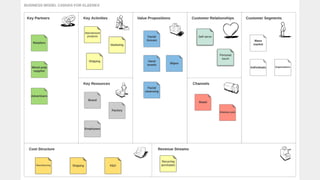
Example: Kleenex
Improving your business model
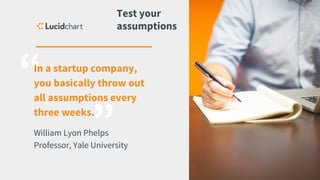
”
“In a startup company,
you basically throw out
all assumptions every
three weeks.
William Lyon Phelps
Professor, Yale University
Test your
assumptions
● Track key metrics
● Try A/B tests
● Frequent, limited
releases
Find simple, small-scale
ways to test each
aspect of your business
model.
Validate your business model
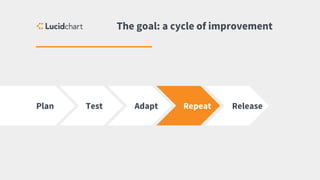
The goal: a cycle of improvement
Plan Test Adapt Repeat Release
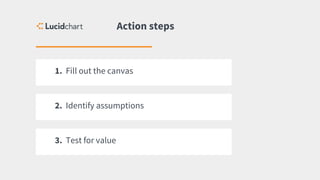
1. Fill out the canvas
Action steps
2. Identify assumptions
3. Test for value
● Flowcharts
● Mind maps
● UML diagrams
● Much more
Update your business
model today with
Lucidchart, the web’s
top diagramming app.
Thanks for reading!

Business Model Canvas: a step-by-step guide

  • 1.
    Business Model Canvas Astep-by-step guide
  • 2.
    Contents 1. Introduction 2. Fillingout the canvas 3. Improving your business model
  • 3.
  • 4.
    ● Fits onone page ● Broadly applicable ● Based on research ● Lean startup method An overview of the resources and operations required to make your business successful. What is the Business Model Canvas?
  • 5.
    Why use it? ●Plan your strategy ● Share your vision ● Identify gaps ● Grow your business
  • 6.
  • 7.
    First, open ablank template. Then, add the information from the following slides. Source: Strategyzer.com
  • 8.
    Products and services youoffer to meet customers’ needs. Value proposition ● Brand differentiation ● Quantity vs quality ● May vary by customer
  • 9.
    People and organizations forwhom you create value. Customer segments ● Buyer personas ● Niche markets ● Multi-sided markets
  • 10.
    The kinds of relationshipsyou want to establish with your customer segments. Customer relationships ● Personal assistance ● Community ● Self service
  • 11.
    The points atwhich you interact with customers to deliver value. Channels ● Channels you own ● Partners’ channels
  • 12.
    The resources youneed to sustain your business and create value. Key resources ● Human ● Financial ● Physical ● Intellectual
  • 13.
    Activities that enable youto fulfill your value proposition. Key activities ● Supply chains ● Processes ● Training
  • 14.
    Other agents yourely on to create and deliver value. Key partners ● Suppliers ● Distributors ● Joint ventures
  • 15.
    A description ofthe costs of operating your business. Cost structure ● Fixed costs ● Variable costs ● Changes in costs as you scale
  • 16.
    What customers pay for,and how they pay. Revenue streams ● Purchases ● Subscriptions ● Willingness to pay
  • 17.
  • 19.
  • 20.
    ” “In a startupcompany, you basically throw out all assumptions every three weeks. William Lyon Phelps Professor, Yale University Test your assumptions
  • 21.
    ● Track keymetrics ● Try A/B tests ● Frequent, limited releases Find simple, small-scale ways to test each aspect of your business model. Validate your business model
  • 22.
    The goal: acycle of improvement Plan Test Adapt Repeat Release
  • 23.
    1. Fill outthe canvas Action steps 2. Identify assumptions 3. Test for value
  • 24.
    ● Flowcharts ● Mindmaps ● UML diagrams ● Much more Update your business model today with Lucidchart, the web’s top diagramming app. Thanks for reading!