


By Samir Chitkara
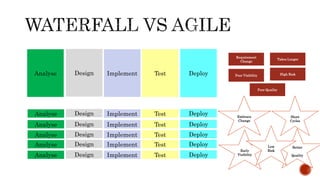
 Traditional Development – Waterfall Vs Agile
 Agile – Concepts
 Scrum - Theory
 Scrum - Roles
 Scrum – Events
 Scrum – Artifacts
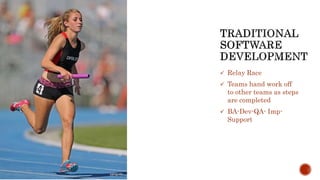
 Relay Race
 Teams hand work off
to other teams as steps
are completed
 BA-Dev-QA- Imp-
Support
Deploy
Requirement
Change
Takes Longer
Poor Visibility
Poor Quality
High RiskAnalyse Design Implement Test
DeployAnalyse Design Implement Test Short
Cycles
Early
Visibility
Better
Quality
Low
Risk
DeployAnalyse Design Implement Test
Embrace
Change
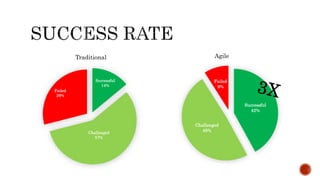
Successful
14%
Challenged
57%
Failed
29%
Successful
42%
Challenged
49%
Failed
9%
Traditional Agile
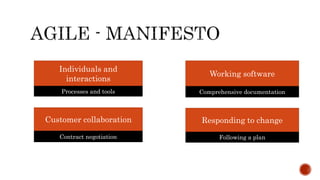
Individuals and
interactions
Contract negotiation
Processes and tools
Following a plan
Comprehensive documentation
Working software
Customer collaboration Responding to change
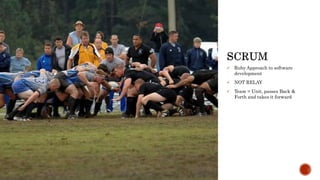
 Ruby Approach to software
development
 NOT RELAY
 Team = Unit, passes Back &
Forth and takes it forward
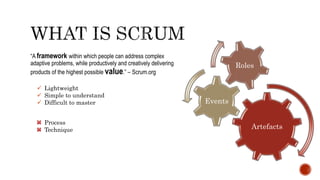
“A framework within which people can address complex
adaptive problems, while productively and creatively delivering
products of the highest possible value.” – Scrum.org
 Lightweight
 Simple to understand
 Difficult to master
Process
Technique Artefacts
Events
Roles
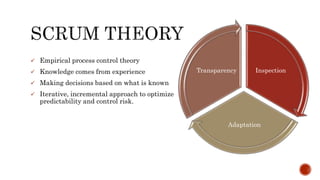
 Empirical process control theory
 Knowledge comes from experience
 Making decisions based on what is known
 Iterative, incremental approach to optimize
predictability and control risk.
Inspection
Adaptation
Transparency
 Key aspects of the process must
be visible to those responsible for
the outcome.
 Common Language
 Common Definition of Done
 Inspect Scrum Artefacts
 Check the Deviation from Goal
 Optimal Frequency
 By skilled inspector
 At Point of Work
 Peer Reviews
 Monitor Deviations.
 Adjust
 Sprint planning
 Daily Scrum
 Sprint Review
 Sprint Retrospective
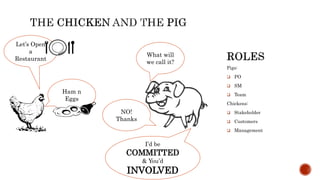
Pigs:
 PO
 SM
 Team
Chickens:
 Stakeholder
 Customers
 Management
What will
we call it?
Ham n
Eggs
NO!
Thanks
I’d be
COMMITTED
& You’d
INVOLVED
Let’s Open
a
Restaurant
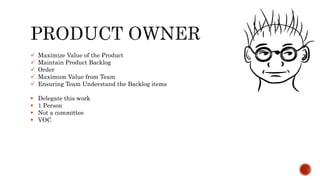
 Maximize Value of the Product
 Maintain Product Backlog
 Order
 Maximum Value from Team
 Ensuring Team Understand the Backlog items
 Delegate this work
 1 Person
 Not a committee
 VOC
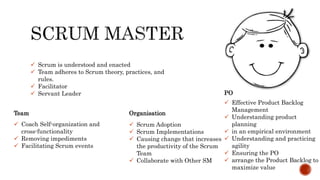
 Scrum is understood and enacted
 Team adheres to Scrum theory, practices, and
rules.
 Facilitator
 Servant Leader
 Coach Self-organization and
cross-functionality
 Removing impediments
 Facilitating Scrum events
Team
 Scrum Adoption
 Scrum Implementations
 Causing change that increases
the productivity of the Scrum
Team
 Collaborate with Other SM
Organisation
 Effective Product Backlog
Management
 Understanding product
planning
 in an empirical environment
 Understanding and practicing
agility
 Ensuring the PO
 arrange the Product Backlog to
maximize value
PO
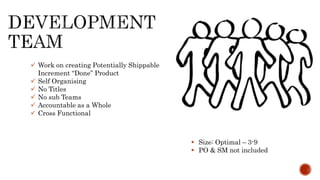
 Work on creating Potentially Shippable
Increment “Done” Product
 Self Organising
 No Titles
 No sub Teams
 Accountable as a Whole
 Cross Functional
 Size: Optimal – 3-9
 PO & SM not included
Create Regularity
Minimise need of meetings
All Event = TIME BOXED
Sprint duration = FIXED
All Other EVENT = END = when purpose is Achieved
Opportunity for INSPECTION & APATATION
Enable TRANPARENCY
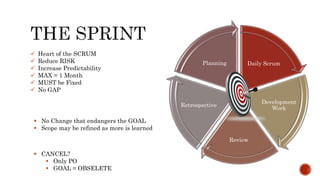
Daily Scrum
Development
Work
Review
Retrospective
Planning
 Heart of the SCRUM
 Reduce RISK
 Increase Predictability
 MAX = 1 Month
 MUST be Fixed
 No GAP
 No Change that endangers the GOAL
 Scope may be refined as more is learned
 CANCEL?
 Only PO
 GOAL = OBSELETE
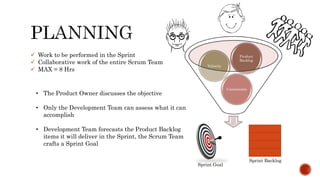
 Work to be performed in the Sprint
 Collaborative work of the entire Scrum Team
 MAX = 8 Hrs
Sprint Backlog
Sprint Goal
Constraints
Velocity
Product
Backlog
• The Product Owner discusses the objective
• Only the Development Team can assess what it can
accomplish
• Development Team forecasts the Product Backlog
items it will deliver in the Sprint, the Scrum Team
crafts a Sprint Goal
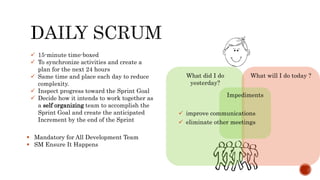
 15-minute time-boxed
 To synchronize activities and create a
plan for the next 24 hours
 Same time and place each day to reduce
complexity.
 Inspect progress toward the Sprint Goal
 Decide how it intends to work together as
a self organizing team to accomplish the
Sprint Goal and create the anticipated
Increment by the end of the Sprint
 Mandatory for All Development Team
 SM Ensure It Happens
What did I do
yesterday?
What will I do today ?
Impediments
 improve communications
 eliminate other meetings
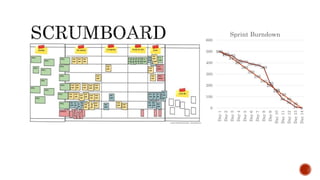
500
480
440
400
360
320
280
240
200
160
120
80
40
0
500
470465
420410
390380
360
220
150
80
50
10 00
100
200
300
400
500
600
Day1
Day2
Day3
Day4
Day5
Day6
Day7
Day8
Day9
Day10
Day11
Day12
Day13
Day14
Sprint Burndown
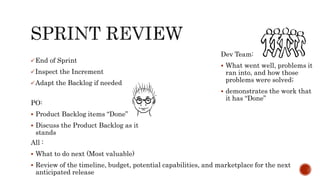
End of Sprint
Inspect the Increment
Adapt the Backlog if needed
PO:
 Product Backlog items “Done”
 Discuss the Product Backlog as it
stands
Dev Team:
 What went well, problems it
ran into, and how those
problems were solved;
 demonstrates the work that
it has “Done”
All :
 What to do next (Most valuable)
 Review of the timeline, budget, potential capabilities, and marketplace for the next
anticipated release
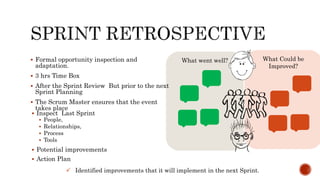
What went well? What Could be
Improved?
 Formal opportunity inspection and
adaptation.
 3 hrs Time Box
 After the Sprint Review But prior to the next
Sprint Planning
 The Scrum Master ensures that the event
takes place
 Identified improvements that it will implement in the next Sprint.
 Inspect Last Sprint
 People,
 Relationships,
 Process
 Tools
 Potential improvements
 Action Plan
 Scrum relies on transparency
 Scrum’s artifacts represent work or value to provide transparency and
opportunities for inspection and adaptation.
 Artifacts are not transparent, these decisions can be flawed,
 Value may diminish and risk may increase.
 The Scrum Master’s job is to work with the Scrum Team and the organization to
increase the transparency of the artifacts.
 Involves learning, convincing, and change.
 Transparency doesn’t occur overnight, but is a path.
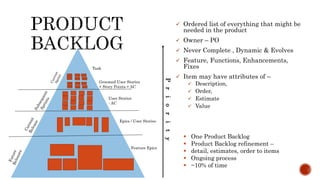
 Ordered list of everything that might be
needed in the product
 Owner – PO
 Never Complete , Dynamic & Evolves
 Feature, Functions, Enhancements,
Fixes
 Item may have attributes of –
 Description,
 Order,
 Estimate
 Value
 One Product Backlog
 Product Backlog refinement –
 detail, estimates, order to items
 Ongoing process
 ~10% of time
Task
Groomed User Stories
+ Story Points + AC
User Stories
- AC
Epics / User Stories
Feature Epics
Priority
 Set of Product Backlog items selected for the Sprint
+ Plan product Increment + Sprint Goal
 Enough detail that changes in progress can be understood in the Daily Scrum.
 Dev Team modifies the Sprint Backlog throughout the Sprint
 Emerges during the Sprint
 Highly visible, real-time picture of the work that the Development Team
 Assess when work is complete on the product Increment
 Everyone must understand what “Done” mean
 Vary significantly per Scrum Teams
 Guides the Development Team in knowing how many Product Backlog to Pick
 DoD will expand to include more stringent criteria for higher quality with
Maturity
 https://www.versionone.com/assets/img/files/CHAOSManifesto2013.pdf
 Photo credit: Foter.com

Agile - Scrum

  • 1.
  • 2.
     Traditional Development– Waterfall Vs Agile  Agile – Concepts  Scrum - Theory  Scrum - Roles  Scrum – Events  Scrum – Artifacts
  • 3.
     Relay Race Teams hand work off to other teams as steps are completed  BA-Dev-QA- Imp- Support
  • 4.
    Deploy Requirement Change Takes Longer Poor Visibility PoorQuality High RiskAnalyse Design Implement Test DeployAnalyse Design Implement Test Short Cycles Early Visibility Better Quality Low Risk DeployAnalyse Design Implement Test DeployAnalyse Design Implement Test DeployAnalyse Design Implement Test DeployAnalyse Design Implement Test Embrace Change
  • 5.
  • 6.
    Individuals and interactions Contract negotiation Processesand tools Following a plan Comprehensive documentation Working software Customer collaboration Responding to change
  • 8.
     Ruby Approachto software development  NOT RELAY  Team = Unit, passes Back & Forth and takes it forward
  • 9.
    “A framework withinwhich people can address complex adaptive problems, while productively and creatively delivering products of the highest possible value.” – Scrum.org  Lightweight  Simple to understand  Difficult to master Process Technique Artefacts Events Roles
  • 10.
     Empirical processcontrol theory  Knowledge comes from experience  Making decisions based on what is known  Iterative, incremental approach to optimize predictability and control risk. Inspection Adaptation Transparency
  • 11.
     Key aspectsof the process must be visible to those responsible for the outcome.  Common Language  Common Definition of Done
  • 12.
     Inspect ScrumArtefacts  Check the Deviation from Goal  Optimal Frequency  By skilled inspector  At Point of Work  Peer Reviews
  • 13.
     Monitor Deviations. Adjust  Sprint planning  Daily Scrum  Sprint Review  Sprint Retrospective
  • 14.
    Pigs:  PO  SM Team Chickens:  Stakeholder  Customers  Management What will we call it? Ham n Eggs NO! Thanks I’d be COMMITTED & You’d INVOLVED Let’s Open a Restaurant
  • 15.
     Maximize Valueof the Product  Maintain Product Backlog  Order  Maximum Value from Team  Ensuring Team Understand the Backlog items  Delegate this work  1 Person  Not a committee  VOC
  • 16.
     Scrum isunderstood and enacted  Team adheres to Scrum theory, practices, and rules.  Facilitator  Servant Leader  Coach Self-organization and cross-functionality  Removing impediments  Facilitating Scrum events Team  Scrum Adoption  Scrum Implementations  Causing change that increases the productivity of the Scrum Team  Collaborate with Other SM Organisation  Effective Product Backlog Management  Understanding product planning  in an empirical environment  Understanding and practicing agility  Ensuring the PO  arrange the Product Backlog to maximize value PO
  • 17.
     Work oncreating Potentially Shippable Increment “Done” Product  Self Organising  No Titles  No sub Teams  Accountable as a Whole  Cross Functional  Size: Optimal – 3-9  PO & SM not included
  • 18.
    Create Regularity Minimise needof meetings All Event = TIME BOXED Sprint duration = FIXED All Other EVENT = END = when purpose is Achieved Opportunity for INSPECTION & APATATION Enable TRANPARENCY
  • 19.
    Daily Scrum Development Work Review Retrospective Planning  Heartof the SCRUM  Reduce RISK  Increase Predictability  MAX = 1 Month  MUST be Fixed  No GAP  No Change that endangers the GOAL  Scope may be refined as more is learned  CANCEL?  Only PO  GOAL = OBSELETE
  • 20.
     Work tobe performed in the Sprint  Collaborative work of the entire Scrum Team  MAX = 8 Hrs Sprint Backlog Sprint Goal Constraints Velocity Product Backlog • The Product Owner discusses the objective • Only the Development Team can assess what it can accomplish • Development Team forecasts the Product Backlog items it will deliver in the Sprint, the Scrum Team crafts a Sprint Goal
  • 21.
     15-minute time-boxed To synchronize activities and create a plan for the next 24 hours  Same time and place each day to reduce complexity.  Inspect progress toward the Sprint Goal  Decide how it intends to work together as a self organizing team to accomplish the Sprint Goal and create the anticipated Increment by the end of the Sprint  Mandatory for All Development Team  SM Ensure It Happens What did I do yesterday? What will I do today ? Impediments  improve communications  eliminate other meetings
  • 22.
  • 23.
    End of Sprint Inspectthe Increment Adapt the Backlog if needed PO:  Product Backlog items “Done”  Discuss the Product Backlog as it stands Dev Team:  What went well, problems it ran into, and how those problems were solved;  demonstrates the work that it has “Done” All :  What to do next (Most valuable)  Review of the timeline, budget, potential capabilities, and marketplace for the next anticipated release
  • 24.
    What went well?What Could be Improved?  Formal opportunity inspection and adaptation.  3 hrs Time Box  After the Sprint Review But prior to the next Sprint Planning  The Scrum Master ensures that the event takes place  Identified improvements that it will implement in the next Sprint.  Inspect Last Sprint  People,  Relationships,  Process  Tools  Potential improvements  Action Plan
  • 25.
     Scrum relieson transparency  Scrum’s artifacts represent work or value to provide transparency and opportunities for inspection and adaptation.  Artifacts are not transparent, these decisions can be flawed,  Value may diminish and risk may increase.  The Scrum Master’s job is to work with the Scrum Team and the organization to increase the transparency of the artifacts.  Involves learning, convincing, and change.  Transparency doesn’t occur overnight, but is a path.
  • 26.
     Ordered listof everything that might be needed in the product  Owner – PO  Never Complete , Dynamic & Evolves  Feature, Functions, Enhancements, Fixes  Item may have attributes of –  Description,  Order,  Estimate  Value  One Product Backlog  Product Backlog refinement –  detail, estimates, order to items  Ongoing process  ~10% of time Task Groomed User Stories + Story Points + AC User Stories - AC Epics / User Stories Feature Epics Priority
  • 27.
     Set ofProduct Backlog items selected for the Sprint + Plan product Increment + Sprint Goal  Enough detail that changes in progress can be understood in the Daily Scrum.  Dev Team modifies the Sprint Backlog throughout the Sprint  Emerges during the Sprint  Highly visible, real-time picture of the work that the Development Team
  • 28.
     Assess whenwork is complete on the product Increment  Everyone must understand what “Done” mean  Vary significantly per Scrum Teams  Guides the Development Team in knowing how many Product Backlog to Pick  DoD will expand to include more stringent criteria for higher quality with Maturity
  • 29.