Introduction to SCRUM
By – AMJAD SHAIKH
What is “AGILE”?
Introduction “Scrum” Framework
Your journey is about to begin
Overview of Scrum Process
What Constitutes Scrum Process?
Understanding Scrum Roles
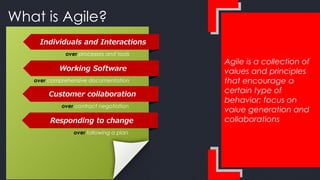
Agile is a collection of
values and principles
that encourage a
certain type of
behavior; focus on
value generation and
collaborations
What is Agile?
Individuals and Interactions
over processes and tools
Working Software
over comprehensive documentation
Customer collaboration
over contract negotiation
Responding to change
over following a plan
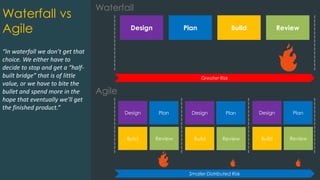
Smaller Distributed Risk
“In waterfall we don’t get that
choice. We either have to
decide to stop and get a “half-
built bridge” that is of little
value, or we have to bite the
bullet and spend more in the
hope that eventually we’ll get
the finished product.”
Greater Risk
Waterfall vs
Agile Design Plan Build Review
Waterfall
Design Plan
Build Review
Agile
Design Plan
Build Review
Design Plan
Build Review
Hey Buddy!!
Sorry to be an unplanned interruption – but
can you please first explain me “Why are we
talking about agile in first place?” Seriously if
this is not that important then I can go back to
my work.
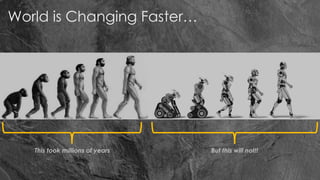
World is Changing Faster…
This took millions of years But this will not!!
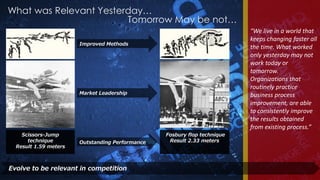
“We live in a world that
keeps changing faster all
the time. What worked
only yesterday may not
work today or
tomorrow.
Organizations that
routinely practice
business process
improvement, are able
to consistently improve
the results obtained
from existing process.”
Scissors-Jump
technique
Result 1.59 meters
Fosbury flop technique
Result 2.33 meters
Improved Methods
Market Leadership
Outstanding Performance
What was Relevant Yesterday…
Tomorrow May be not…
Evolve to be relevant in competition
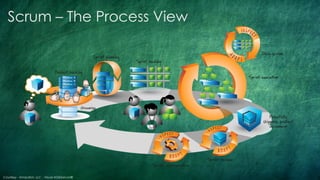
Scrum – The Process View
Courtesy - Innolution, LLC - Visual AGILExicon®
Inside Scrum
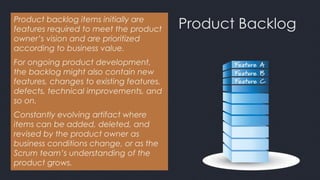
Product BacklogProduct backlog items initially are
features required to meet the product
owner’s vision and are prioritized
according to business value.
For ongoing product development,
the backlog might also contain new
features, changes to existing features,
defects, technical improvements, and
so on.
Constantly evolving artifact where
items can be added, deleted, and
revised by the product owner as
business conditions change, or as the
Scrum team’s understanding of the
product grows.
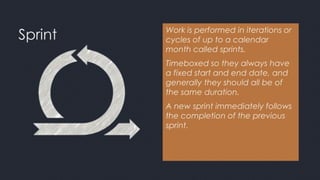
Sprint Work is performed in iterations or
cycles of up to a calendar
month called sprints.
Timeboxed so they always have
a fixed start and end date, and
generally they should all be of
the same duration.
A new sprint immediately follows
the completion of the previous
sprint.
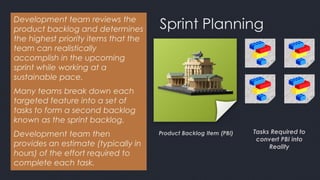
Sprint PlanningDevelopment team reviews the
product backlog and determines
the highest priority items that the
team can realistically
accomplish in the upcoming
sprint while working at a
sustainable pace.
Many teams break down each
targeted feature into a set of
tasks to form a second backlog
known as the sprint backlog.
Development team then
provides an estimate (typically in
hours) of the effort required to
complete each task.
Product Backlog Item (PBI) Tasks Required to
convert PBI into
Reality
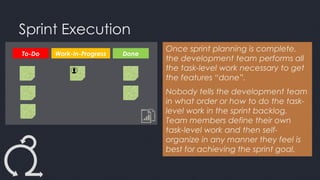
To-Do Work-In-Progress Done
Sprint Execution
Once sprint planning is complete,
the development team performs all
the task-level work necessary to get
the features “done”.
Nobody tells the development team
in what order or how to do the task-
level work in the sprint backlog.
Team members define their own
task-level work and then self-
organize in any manner they feel is
best for achieving the sprint goal.
Scrum Roles
Product Owner
The single authority on product and is the one
person responsible for a project's success. The
Product Owner leads the development effort by
conveying his or her vision to the team, outlining
work in the Product Backlog, and prioritizing it
based on business value.
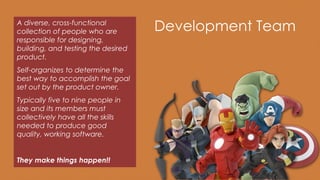
Development TeamA diverse, cross-functional
collection of people who are
responsible for designing,
building, and testing the desired
product.
Self-organizes to determine the
best way to accomplish the goal
set out by the product owner.
Typically five to nine people in
size and its members must
collectively have all the skills
needed to produce good
quality, working software.
They make things happen!!
Scrum Master
The Servant Leader.
Helps everyone involved understand and
embrace the Scrum values, principles, and
practices.
The Scrum Master does anything possible to
help the team perform at their highest level. This
involves removing any impediments to
progress.
The Scrum Master is also often viewed as a
protector of the team.
Lets Discuss
Thank You For Your
Patience !!!
More sessions to come!!!

Introduction to Scrum - An Agile Frameworks

  • 1.
    Introduction to SCRUM By– AMJAD SHAIKH
  • 2.
    What is “AGILE”? Introduction“Scrum” Framework Your journey is about to begin Overview of Scrum Process What Constitutes Scrum Process? Understanding Scrum Roles
  • 3.
    Agile is acollection of values and principles that encourage a certain type of behavior; focus on value generation and collaborations What is Agile? Individuals and Interactions over processes and tools Working Software over comprehensive documentation Customer collaboration over contract negotiation Responding to change over following a plan
  • 4.
    Smaller Distributed Risk “Inwaterfall we don’t get that choice. We either have to decide to stop and get a “half- built bridge” that is of little value, or we have to bite the bullet and spend more in the hope that eventually we’ll get the finished product.” Greater Risk Waterfall vs Agile Design Plan Build Review Waterfall Design Plan Build Review Agile Design Plan Build Review Design Plan Build Review
  • 5.
    Hey Buddy!! Sorry tobe an unplanned interruption – but can you please first explain me “Why are we talking about agile in first place?” Seriously if this is not that important then I can go back to my work.
  • 6.
    World is ChangingFaster… This took millions of years But this will not!!
  • 7.
    “We live ina world that keeps changing faster all the time. What worked only yesterday may not work today or tomorrow. Organizations that routinely practice business process improvement, are able to consistently improve the results obtained from existing process.” Scissors-Jump technique Result 1.59 meters Fosbury flop technique Result 2.33 meters Improved Methods Market Leadership Outstanding Performance What was Relevant Yesterday… Tomorrow May be not… Evolve to be relevant in competition
  • 8.
    Scrum – TheProcess View Courtesy - Innolution, LLC - Visual AGILExicon®
  • 9.
  • 10.
    Product BacklogProduct backlogitems initially are features required to meet the product owner’s vision and are prioritized according to business value. For ongoing product development, the backlog might also contain new features, changes to existing features, defects, technical improvements, and so on. Constantly evolving artifact where items can be added, deleted, and revised by the product owner as business conditions change, or as the Scrum team’s understanding of the product grows.
  • 11.
    Sprint Work isperformed in iterations or cycles of up to a calendar month called sprints. Timeboxed so they always have a fixed start and end date, and generally they should all be of the same duration. A new sprint immediately follows the completion of the previous sprint.
  • 12.
    Sprint PlanningDevelopment teamreviews the product backlog and determines the highest priority items that the team can realistically accomplish in the upcoming sprint while working at a sustainable pace. Many teams break down each targeted feature into a set of tasks to form a second backlog known as the sprint backlog. Development team then provides an estimate (typically in hours) of the effort required to complete each task. Product Backlog Item (PBI) Tasks Required to convert PBI into Reality
  • 13.
    To-Do Work-In-Progress Done SprintExecution Once sprint planning is complete, the development team performs all the task-level work necessary to get the features “done”. Nobody tells the development team in what order or how to do the task- level work in the sprint backlog. Team members define their own task-level work and then self- organize in any manner they feel is best for achieving the sprint goal.
  • 14.
  • 15.
    Product Owner The singleauthority on product and is the one person responsible for a project's success. The Product Owner leads the development effort by conveying his or her vision to the team, outlining work in the Product Backlog, and prioritizing it based on business value.
  • 16.
    Development TeamA diverse,cross-functional collection of people who are responsible for designing, building, and testing the desired product. Self-organizes to determine the best way to accomplish the goal set out by the product owner. Typically five to nine people in size and its members must collectively have all the skills needed to produce good quality, working software. They make things happen!!
  • 17.
    Scrum Master The ServantLeader. Helps everyone involved understand and embrace the Scrum values, principles, and practices. The Scrum Master does anything possible to help the team perform at their highest level. This involves removing any impediments to progress. The Scrum Master is also often viewed as a protector of the team.
  • 18.
  • 19.
    Thank You ForYour Patience !!! More sessions to come!!!