An 
Introduction to 
Agile SCRUM Methodology
AAggeennddaa 
 Introduction 
 What is Agile Methodology? 
 What is Scrum? 
 History of Scrum 
 Functionality of Scrum 
 Components of Scrum 
 Scrum Roles 
 The Process 
 Scrum Artifacts 
 Scaling Scrum 
 Q & A Session
IInnttrroodduuccttiioonn 
Classical methods of software development have 
many disadvantages: 
 huge effort during the planning phase 
 poor requirements conversion in a rapid changing 
environment 
 treatment of staff as a factor of production 
 New methods: 
Agile Software Development Methodology
WWhhaatt iiss AAggiillee ?? 
 Agile proponents believe 
 Current software development processes are too 
heavyweight or cumbersome 
 Too many things are done that are not directly related to 
software product being produced 
 Current software development is too rigid 
 Difficulty with incomplete or changing requirements 
 Short development cycles (Internet applications) 
 More active customer involvement needed 
 CMM focuses on process
CCoonnttdd…… 
 Agile methods are considered 
 Lightweight 
 People-based rather than Plan-based 
 Several agile methods 
 No single agile method 
 XP most popular 
 No single definition 
 Agile Manifesto closest to a definition 
 Set of principles 
 Developed by Agile Alliance
AAggiillee MMaanniiffeessttoo 
A Statement of Values 
 Individuals and interactions over processes and 
tools 
 Working software over comprehensive 
documentation 
 Customer collaboration over contract negotiation 
 Responding to change over following a plan 
 http://www.agilemanifesto.org
AAggiillee MMeetthhooddss 
 Agile methods: 
 Scrum 
 Extreme Programming 
 Adaptive Software Development (ASD) 
 Dynamic System Development Method (DSDM) 
 … 
 Agile Alliance (www.agilealliance.org) 
 A non-profit organization promotes agile 
development
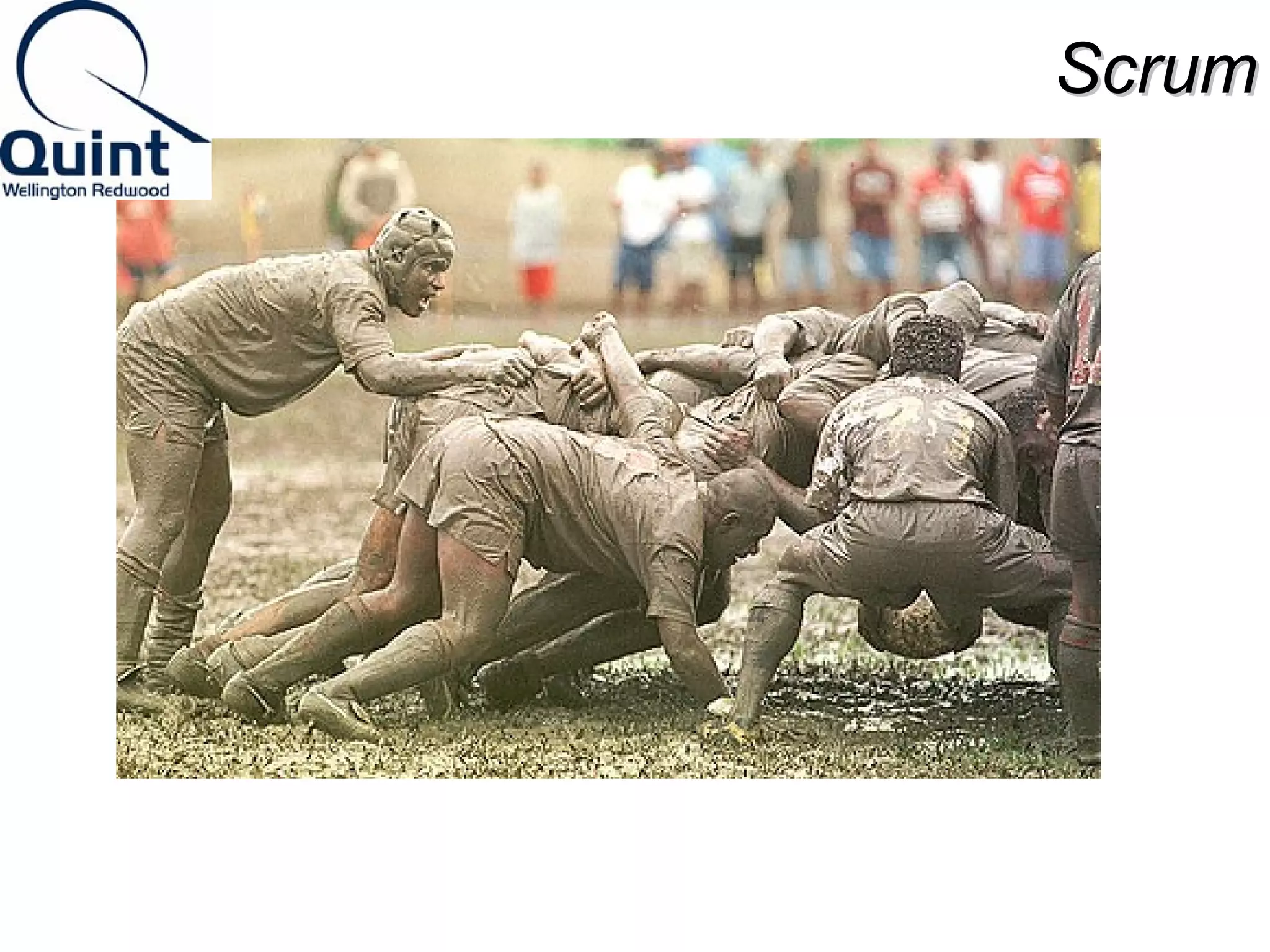
SSccrruumm
SSccrruumm iinn 110000 wwoorrddss 
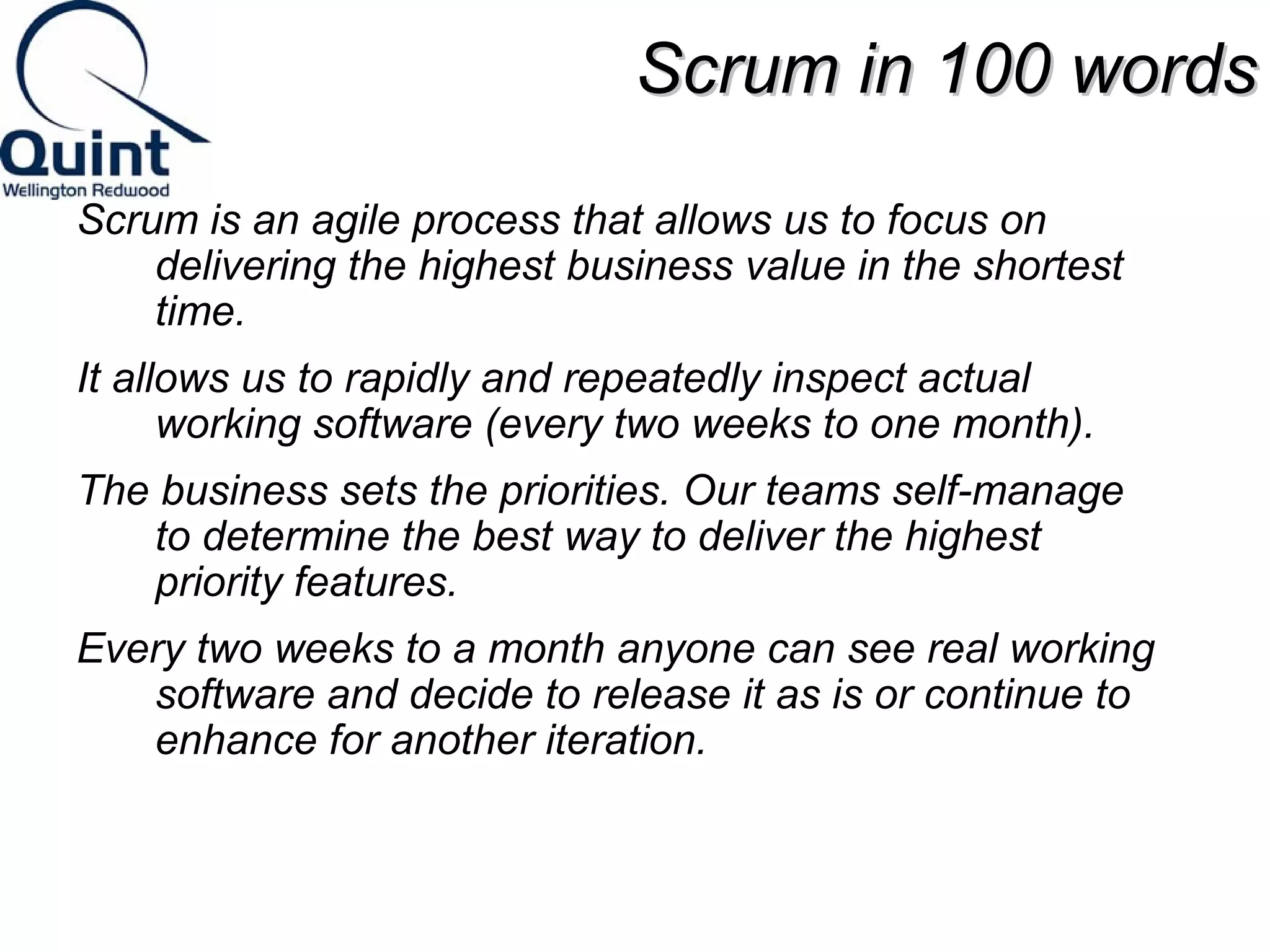
Scrum is an agile process that allows us to focus on 
delivering the highest business value in the shortest 
time. 
It allows us to rapidly and repeatedly inspect actual 
working software (every two weeks to one month). 
The business sets the priorities. Our teams self-manage 
to determine the best way to deliver the highest 
priority features. 
Every two weeks to a month anyone can see real working 
software and decide to release it as is or continue to 
enhance for another iteration.
HHiissttoorryy ooff SSccrruumm 
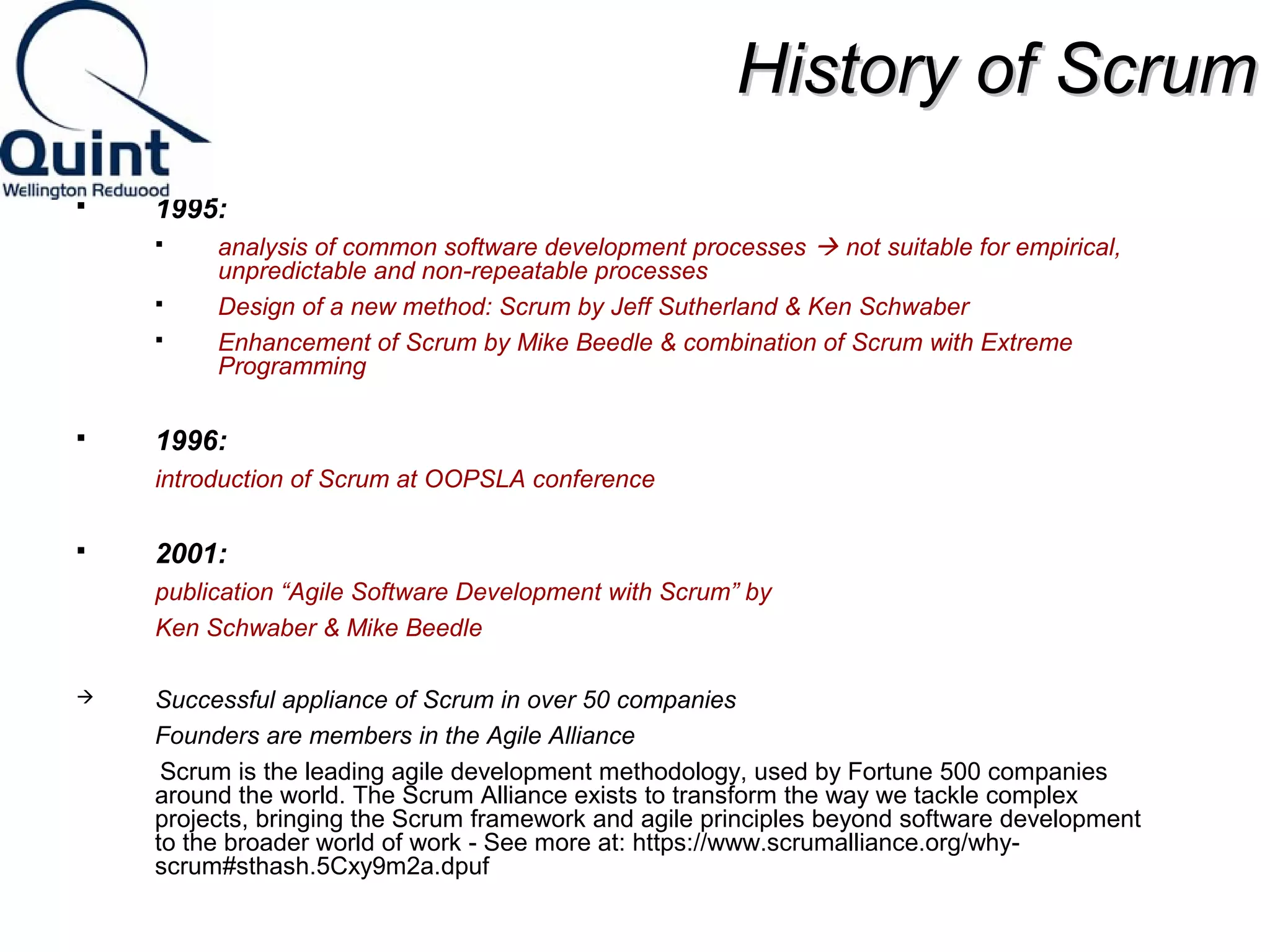
 1995: 
 analysis of common software development processes  not suitable for empirical, 
unpredictable and non-repeatable processes 
 Design of a new method: Scrum by Jeff Sutherland & Ken Schwaber 
 Enhancement of Scrum by Mike Beedle & combination of Scrum with Extreme 
Programming 
 1996: 
introduction of Scrum at OOPSLA conference 
 2001: 
publication “Agile Software Development with Scrum” by 
Ken Schwaber & Mike Beedle 
 Successful appliance of Scrum in over 50 companies 
Founders are members in the Agile Alliance 
Scrum is the leading agile development methodology, used by Fortune 500 companies 
around the world. The Scrum Alliance exists to transform the way we tackle complex 
projects, bringing the Scrum framework and agile principles beyond software development 
to the broader world of work - See more at: https://www.scrumalliance.org/why-scrum# 
sthash.5Cxy9m2a.dpuf
CChhaarraacctteerriissttiiccss 
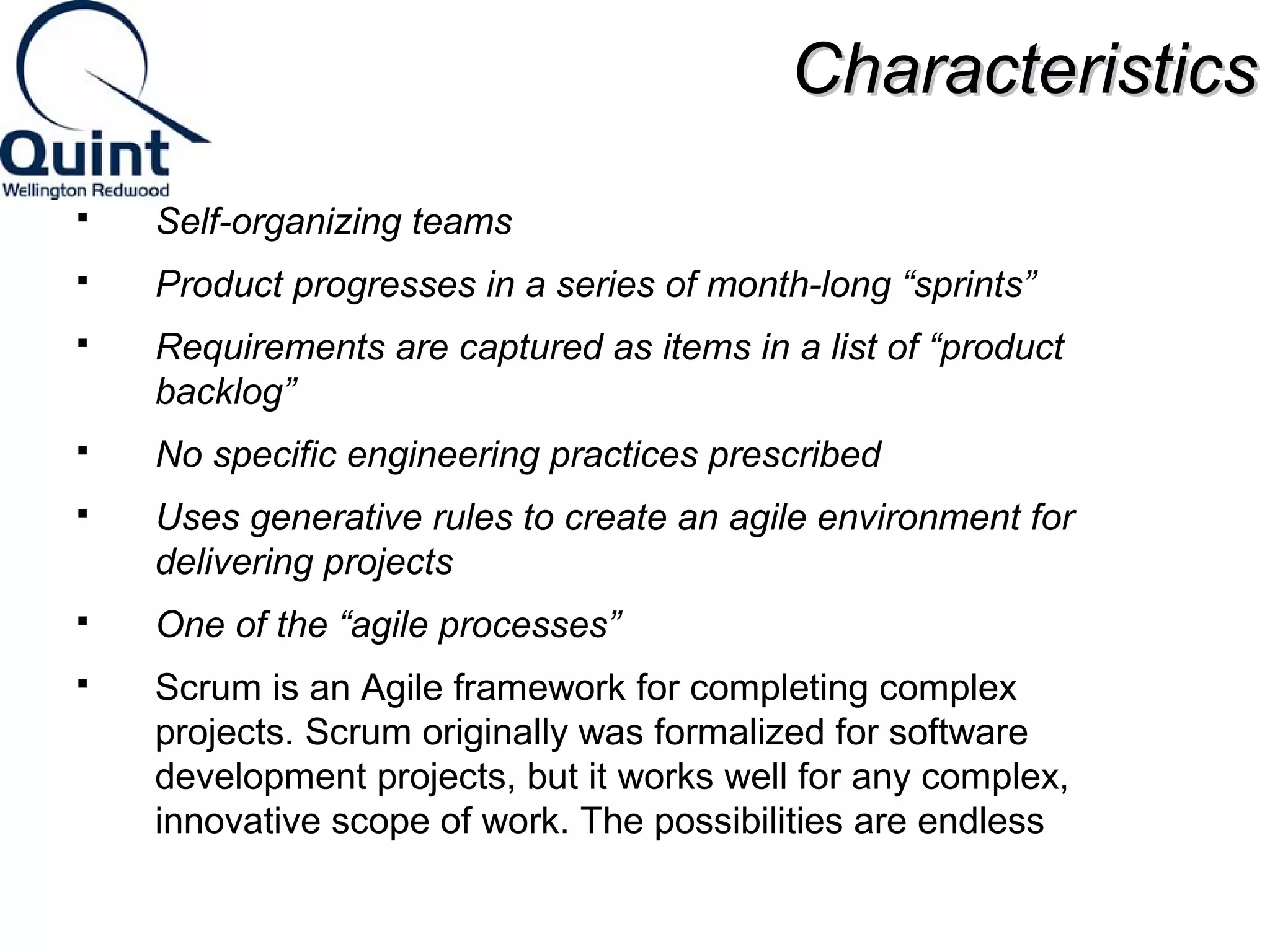
 Self-organizing teams 
 Product progresses in a series of month-long “sprints” 
 Requirements are captured as items in a list of “product 
backlog” 
 No specific engineering practices prescribed 
 Uses generative rules to create an agile environment for 
delivering projects 
 One of the “agile processes” 
 Scrum is an Agile framework for completing complex 
projects. Scrum originally was formalized for software 
development projects, but it works well for any complex, 
innovative scope of work. The possibilities are endless
HHooww SSccrruumm WWoorrkkss??
SSpprriinnttss 
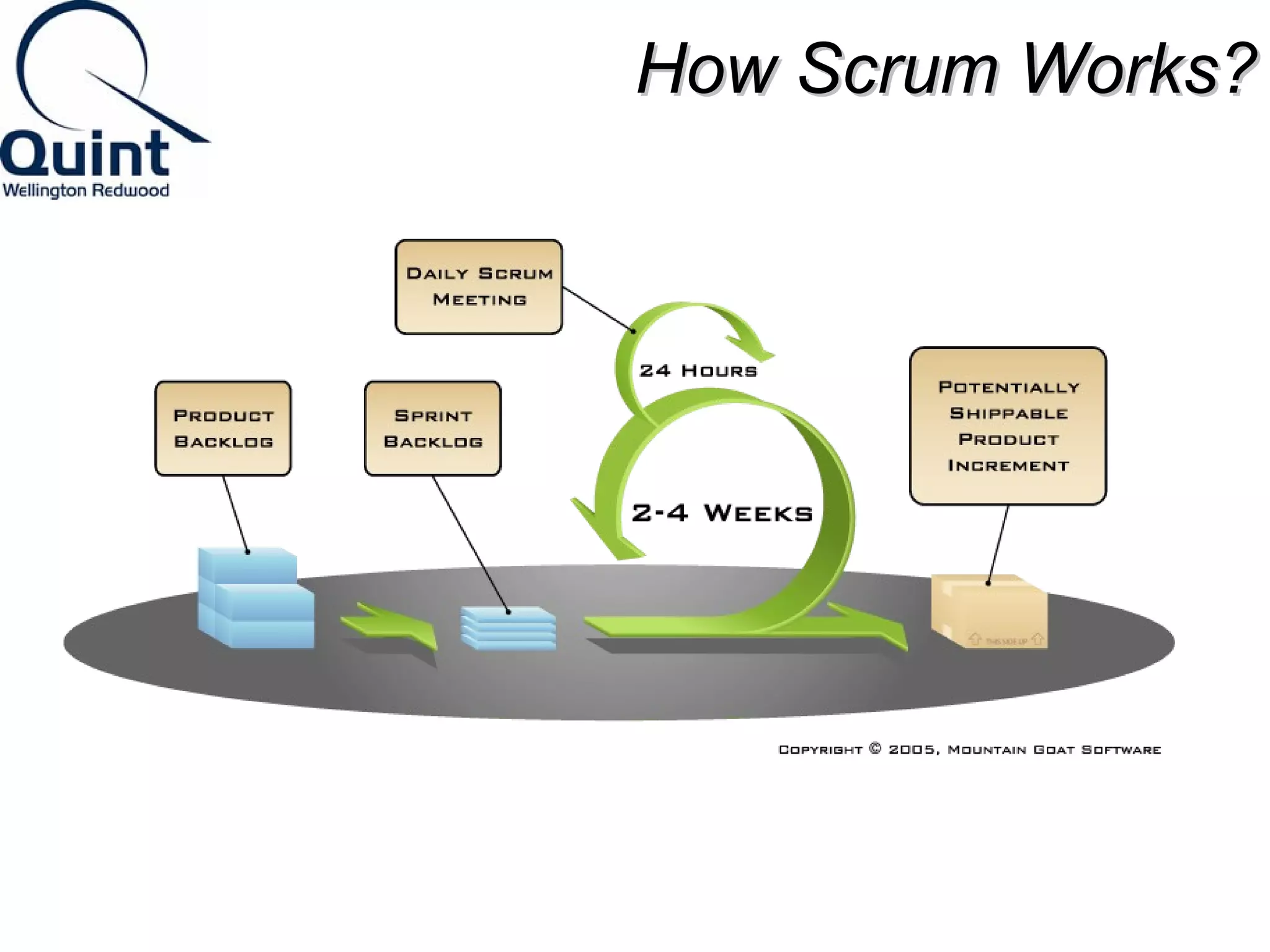
 Scrum projects make progress in a series of 
“sprints” 
 Analogous to XP iterations 
 Target duration is one month 
 +/- a week or two 
 But, a constant duration leads to a better 
rhythm 
 Product is designed, coded, and tested during 
the sprint
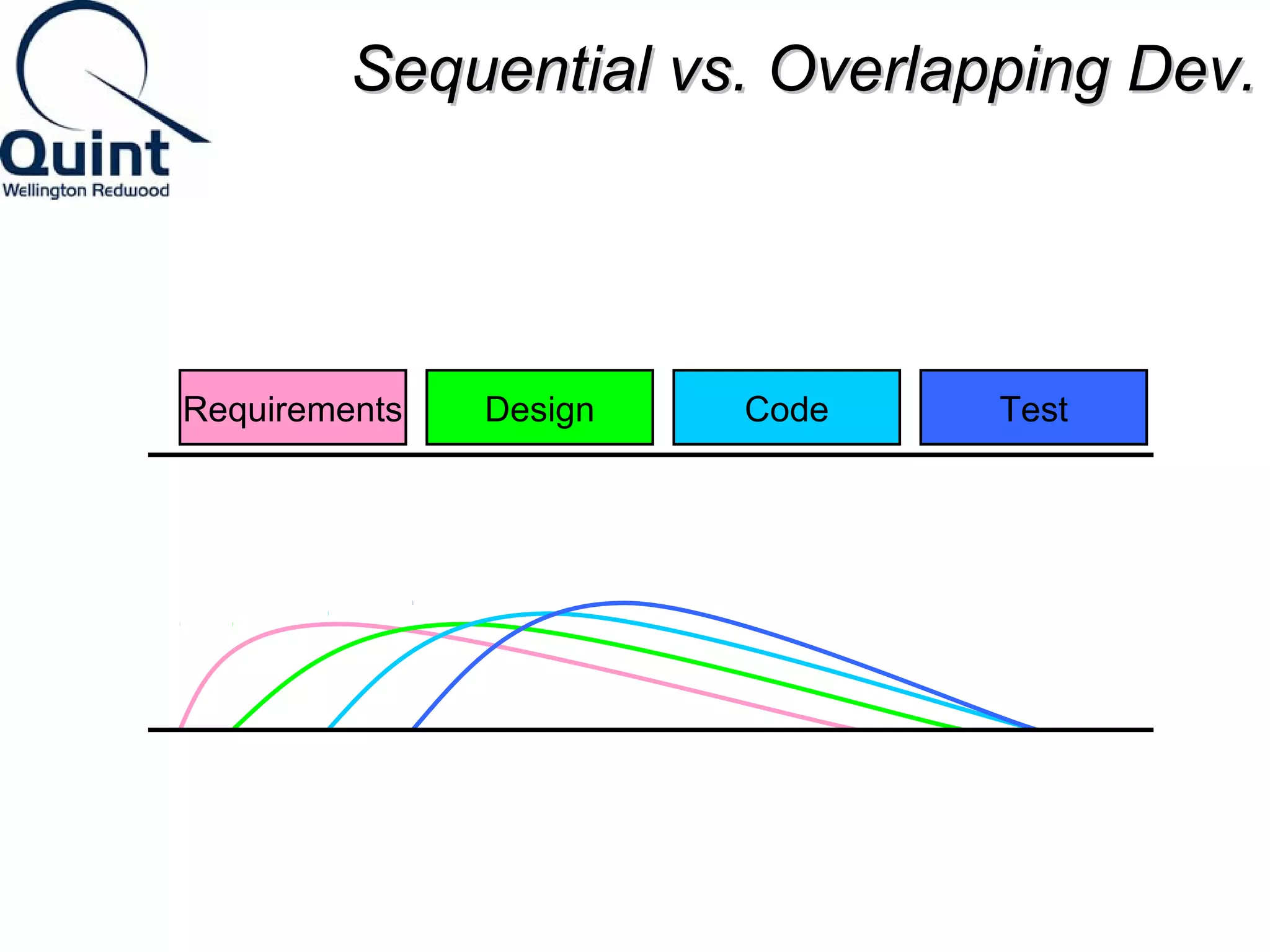
SSeeqquueennttiiaall vvss.. OOvveerrllaappppiinngg DDeevv.. 
Requirements Design Code Test
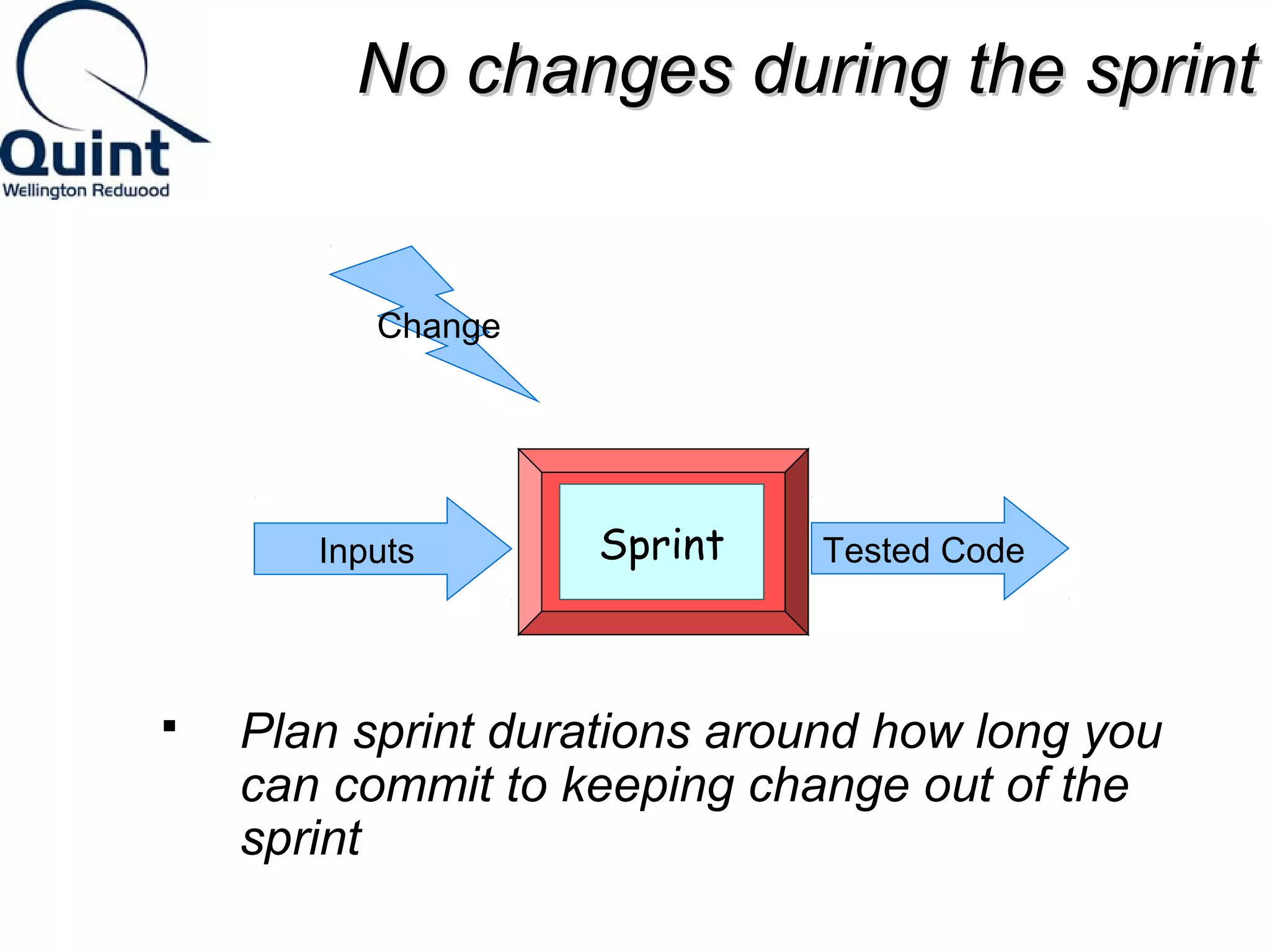
No changes dduurriinngg tthhee sspprriinntt 
Change 
Inputs Sprint Tested Code 
 Plan sprint durations around how long you 
can commit to keeping change out of the 
sprint
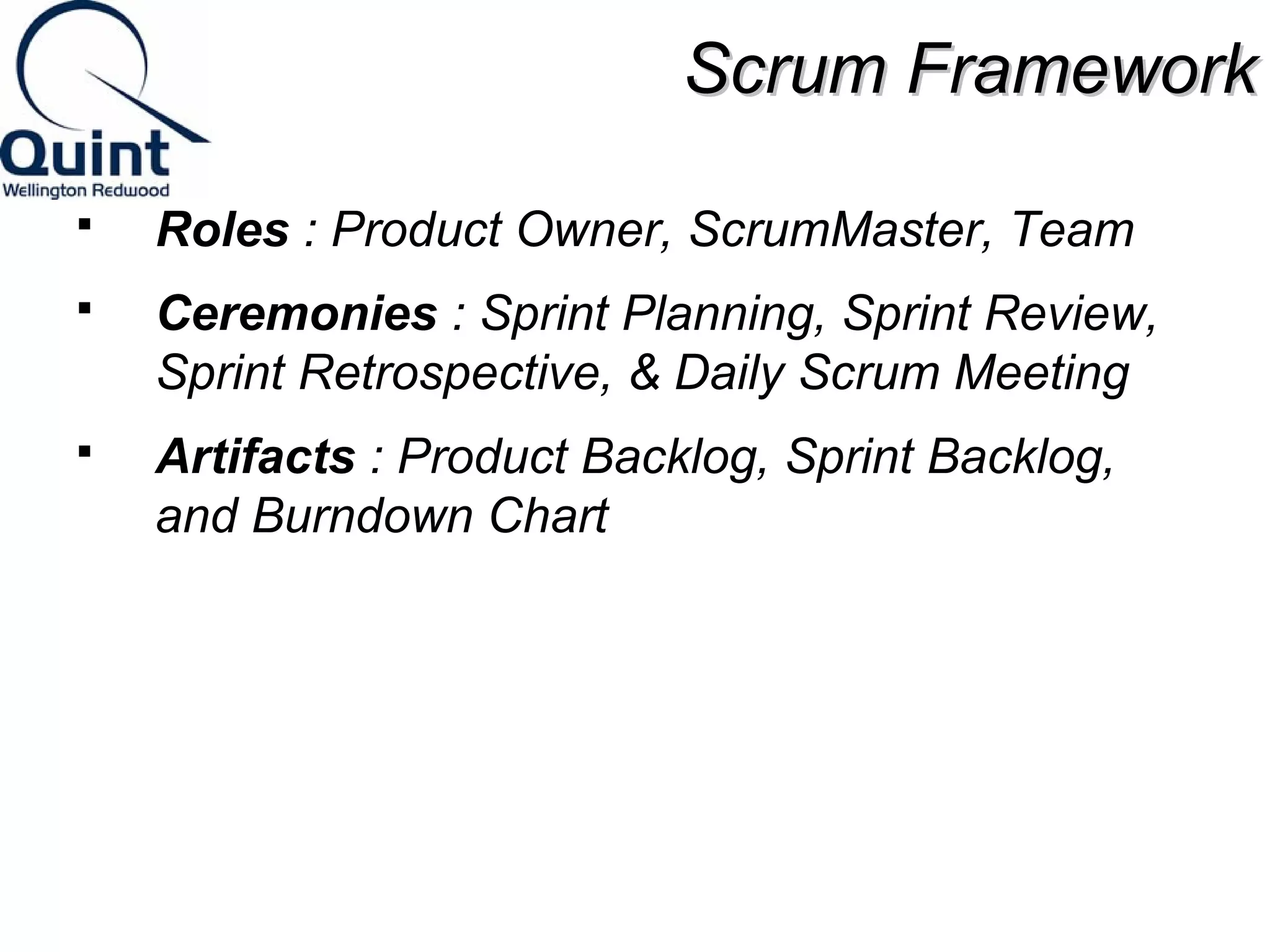
SSccrruumm FFrraammeewwoorrkk 
 Roles : Product Owner, ScrumMaster, Team 
 Ceremonies : Sprint Planning, Sprint Review, 
Sprint Retrospective, & Daily Scrum Meeting 
 Artifacts : Product Backlog, Sprint Backlog, 
and Burndown Chart
PPrroodduucctt OOwwnneerr 
 Define the features of the product 
 Decide on release date and content 
 Be responsible for the profitability of the 
product (ROI) 
 Prioritize features according to market value 
 Adjust features and priority every iteration, as 
needed 
 Accept or reject work results.
TThhee SSccrruumm MMaasstteerr 
 Represents management to the project 
 Responsible for enacting Scrum values and practices 
 Removes impediments 
 Ensure that the team is fully functional and productive 
 Enable close cooperation across all roles and 
functions 
 Shield the team from external interferences
SSccrruumm TTeeaamm 
 Typically 5-10 people 
 Cross-functional 
 QA, Programmers, UI Designers, etc. 
 Members should be full-time 
 May be exceptions (e.g., System Admin, etc.) 
 Teams are self-organizing 
 What to do if a team self-organizes someone off the team?? 
 Ideally, no titles but rarely a possibility 
 Membership can change only between sprints
CCeerreemmoonniieess 
 Sprint Planning Meeting 
 Sprint 
 Daily Scrum 
 Sprint Review Meeting
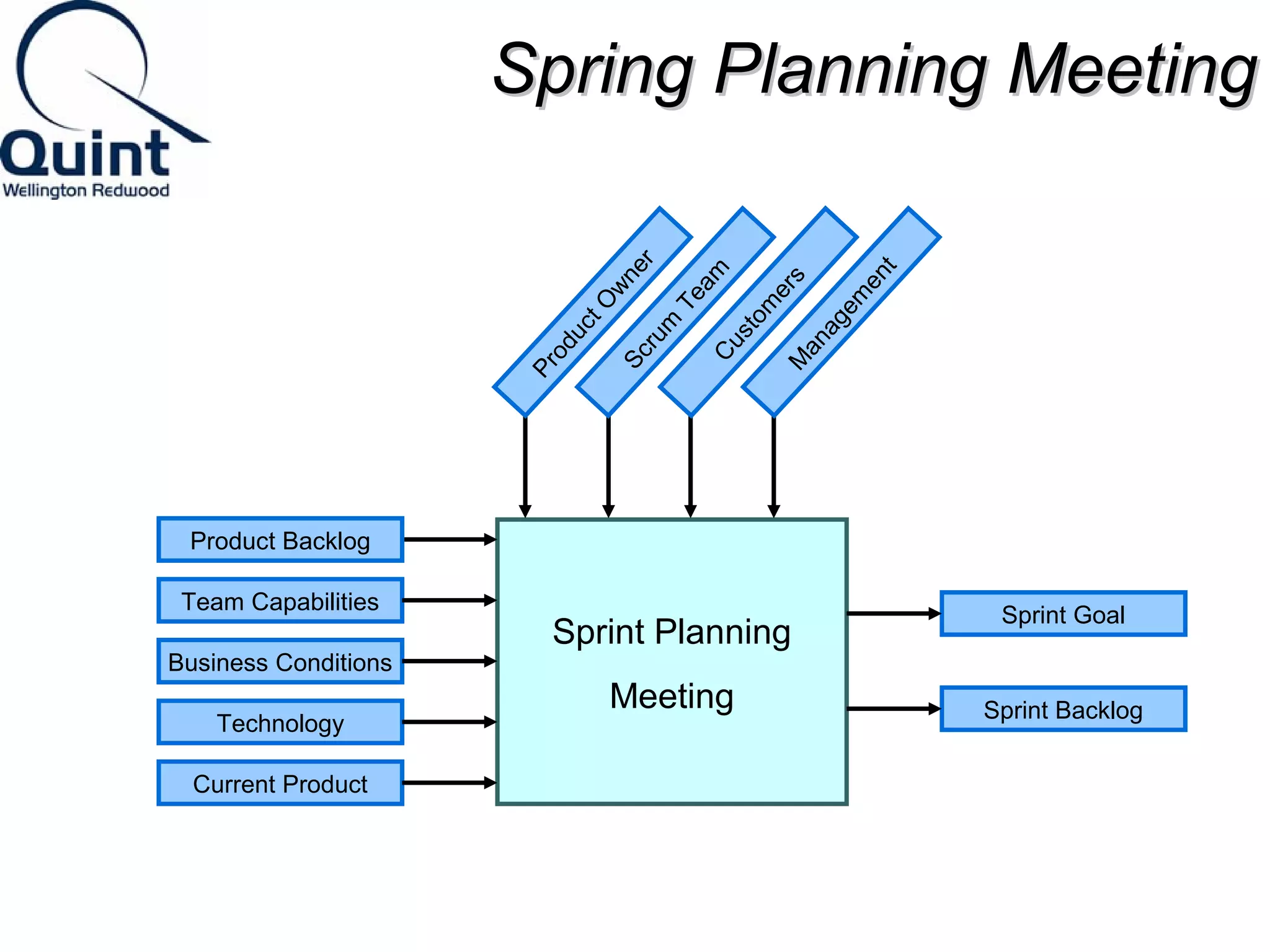
Spring PPllaannnniinngg MMeeeettiinngg 
Sprint Planning 
Meeting 
Product Backlog 
Team Capabilities 
Business Conditions 
Technology 
Current Product 
Sprint Backlog 
Product Owner 
Scrum Team 
Management 
Customers 
Sprint Goal
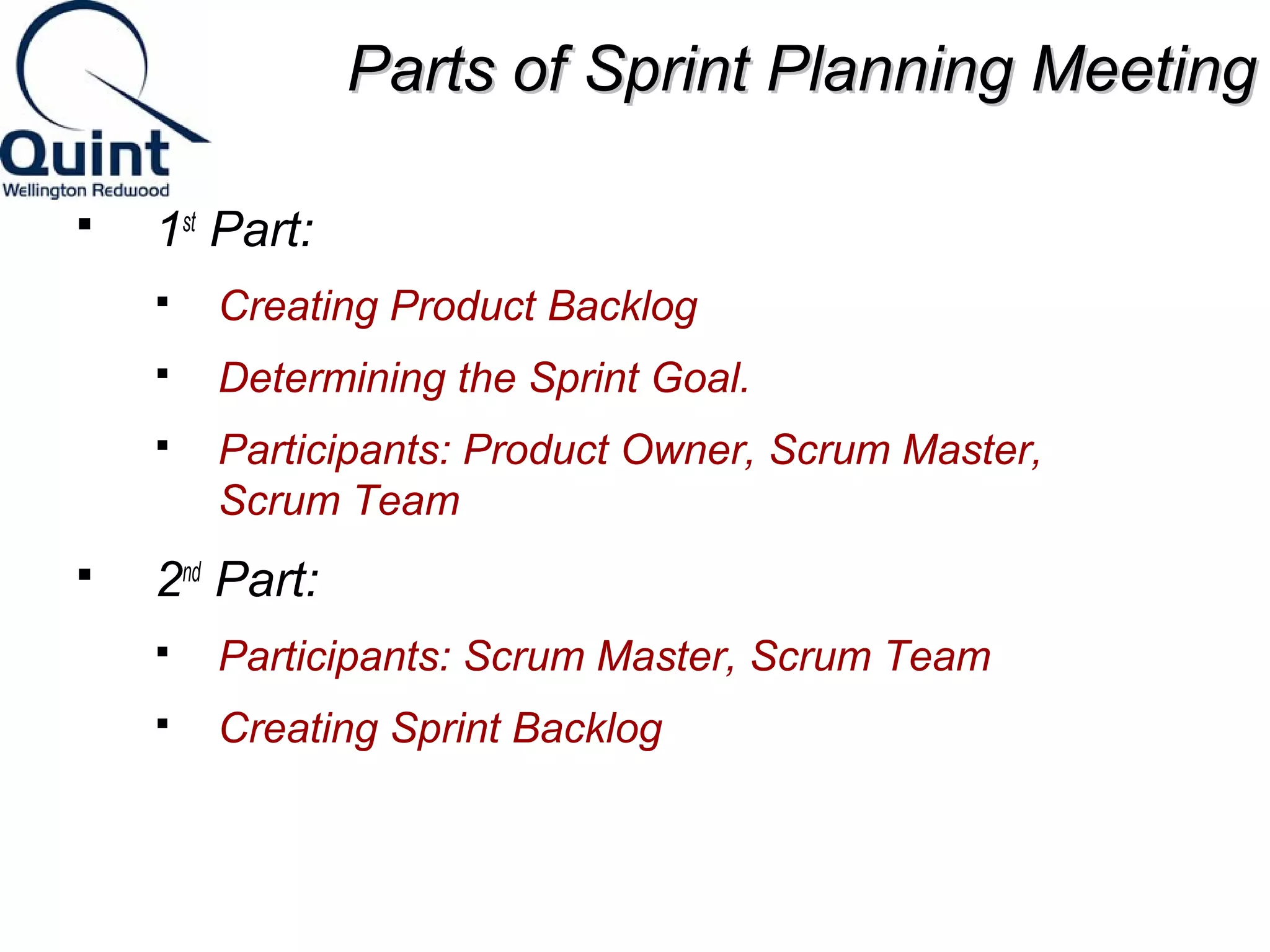
PPaarrttss ooff SSpprriinntt PPllaannnniinngg MMeeeettiinngg 
 1st Part: 
 Creating Product Backlog 
 Determining the Sprint Goal. 
 Participants: Product Owner, Scrum Master, 
Scrum Team 
 2nd Part: 
 Participants: Scrum Master, Scrum Team 
 Creating Sprint Backlog
PPrree--PPrroojjeecctt//KKiicckkooffff MMeeeettiinngg 
 A special form of Sprint Planning Meeting 
 Meeting before the begin of the Project
SSpprriinntt 
 A month-long iteration, during which is 
incremented a product functionality 
 NO outside influence can interfere with the 
Scrum team during the Sprint 
 Each Sprint begins with the Daily Scrum 
Meeting
DDaaiillyy SSccrruumm 
 Parameters 
 Daily 
 15-minutes 
 Stand-up 
 Not for problem solving 
 Three questions: 
1. What did you do yesterday 
2. What will you do today? 
3. What obstacles are in your way? 
 Chickens and pigs are invited 
 Help avoid other unnecessary meetings 
 Only pigs can talk
DDaaiillyy SSccrruumm 
 Is NOT a problem solving session 
 Is NOT a way to collect information about 
WHO is behind the schedule 
 Is a meeting in which team members make 
commitments to each other and to the Scrum 
Master 
 Is a good way for a Scrum Master to track the 
progress of the Team
SSccrruumm FFAAQQss 
 Why daily? 
 “How does a project get to be a year late?” 
 “One day at a time.” 
 Fred Brooks, The Mythical Man-Month. 
 Can Scrum meetings be replaced by emailed status 
reports? 
 No 
 Entire team sees the whole picture every day 
 Create peer pressure to do what you say you’ll do
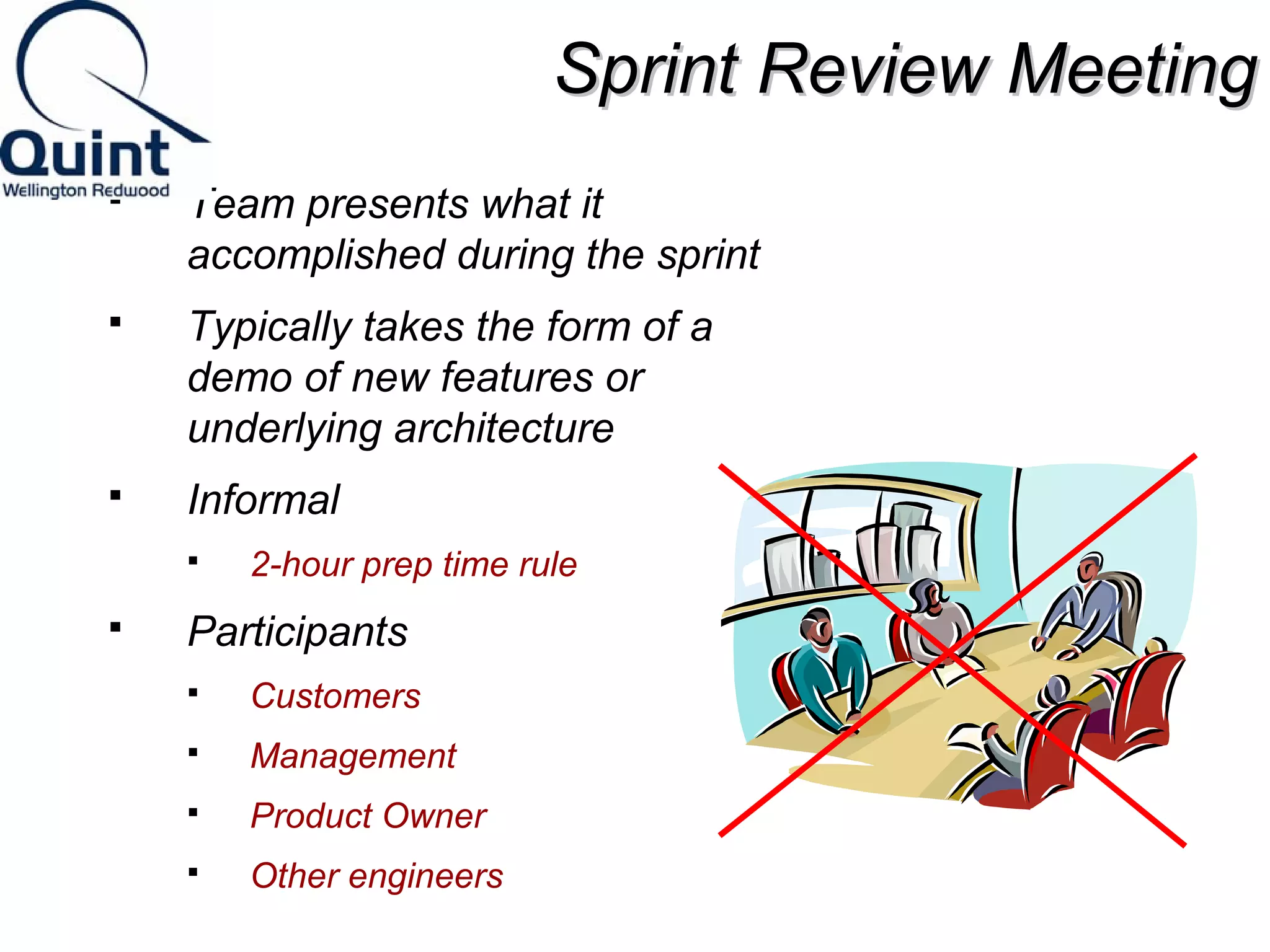
SSpprriinntt RReevviieeww MMeeeettiinngg 
 Team presents what it 
accomplished during the sprint 
 Typically takes the form of a 
demo of new features or 
underlying architecture 
 Informal 
 2-hour prep time rule 
 Participants 
 Customers 
 Management 
 Product Owner 
 Other engineers
SSpprriinntt RReettrroossppeeccttiivvee MMeeeettiinngg 
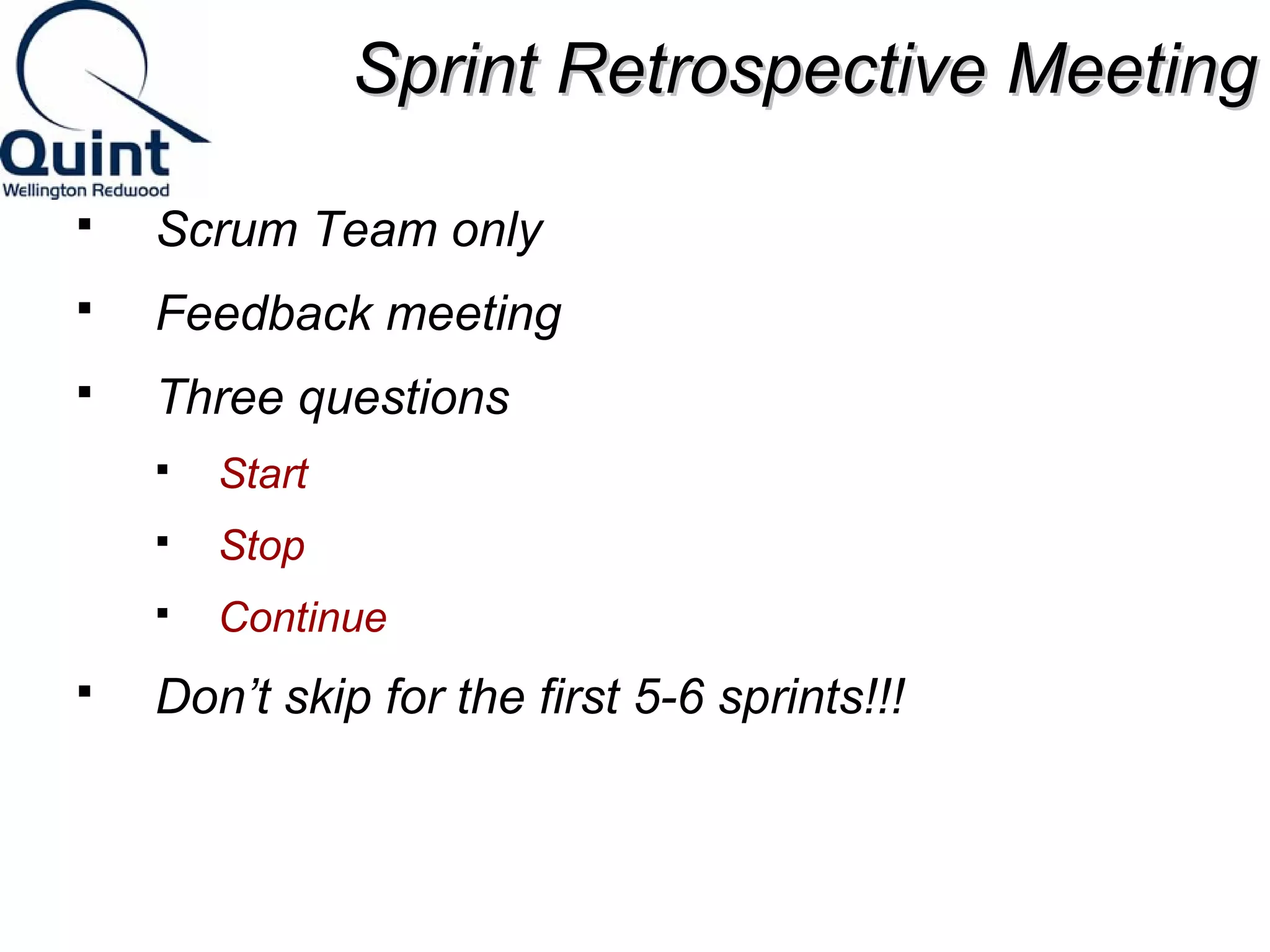
 Scrum Team only 
 Feedback meeting 
 Three questions 
 Start 
 Stop 
 Continue 
 Don’t skip for the first 5-6 sprints!!!
PPrroodduucctt BBaacckklloogg 
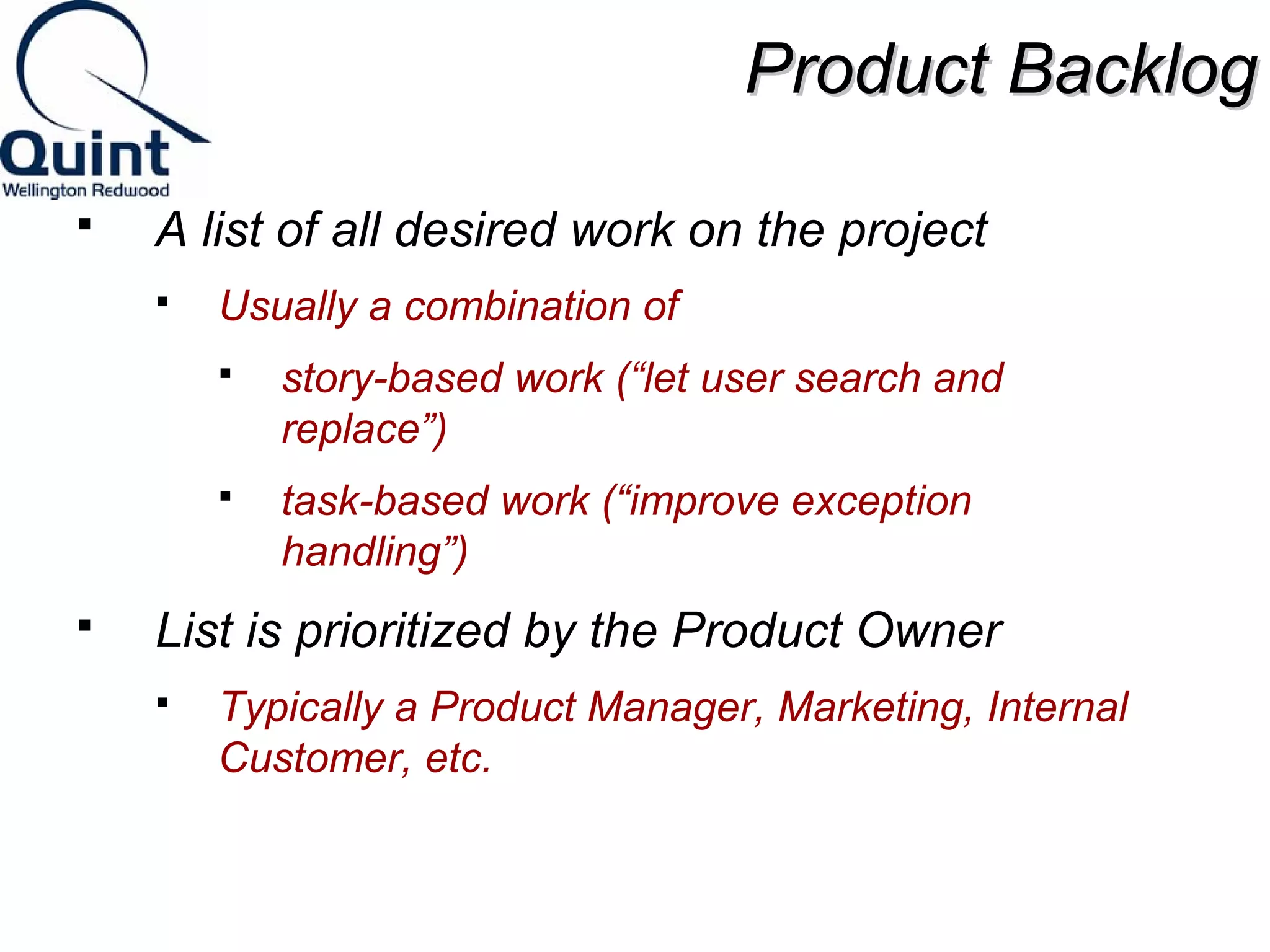
 A list of all desired work on the project 
 Usually a combination of 
 story-based work (“let user search and 
replace”) 
 task-based work (“improve exception 
handling”) 
 List is prioritized by the Product Owner 
 Typically a Product Manager, Marketing, Internal 
Customer, etc.
PPrroodduucctt BBaacckklloogg 
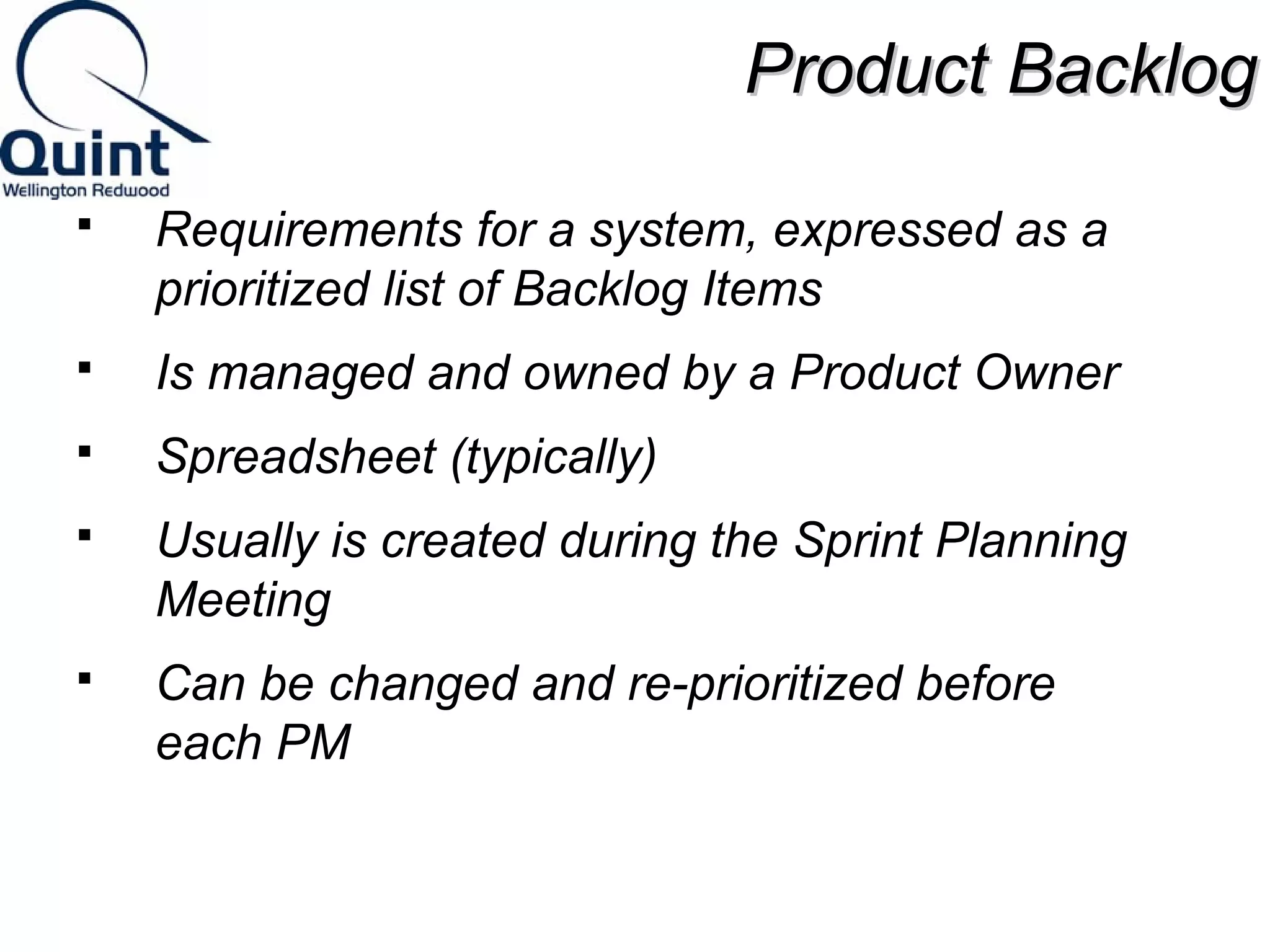
 Requirements for a system, expressed as a 
prioritized list of Backlog Items 
 Is managed and owned by a Product Owner 
 Spreadsheet (typically) 
 Usually is created during the Sprint Planning 
Meeting 
 Can be changed and re-prioritized before 
each PM
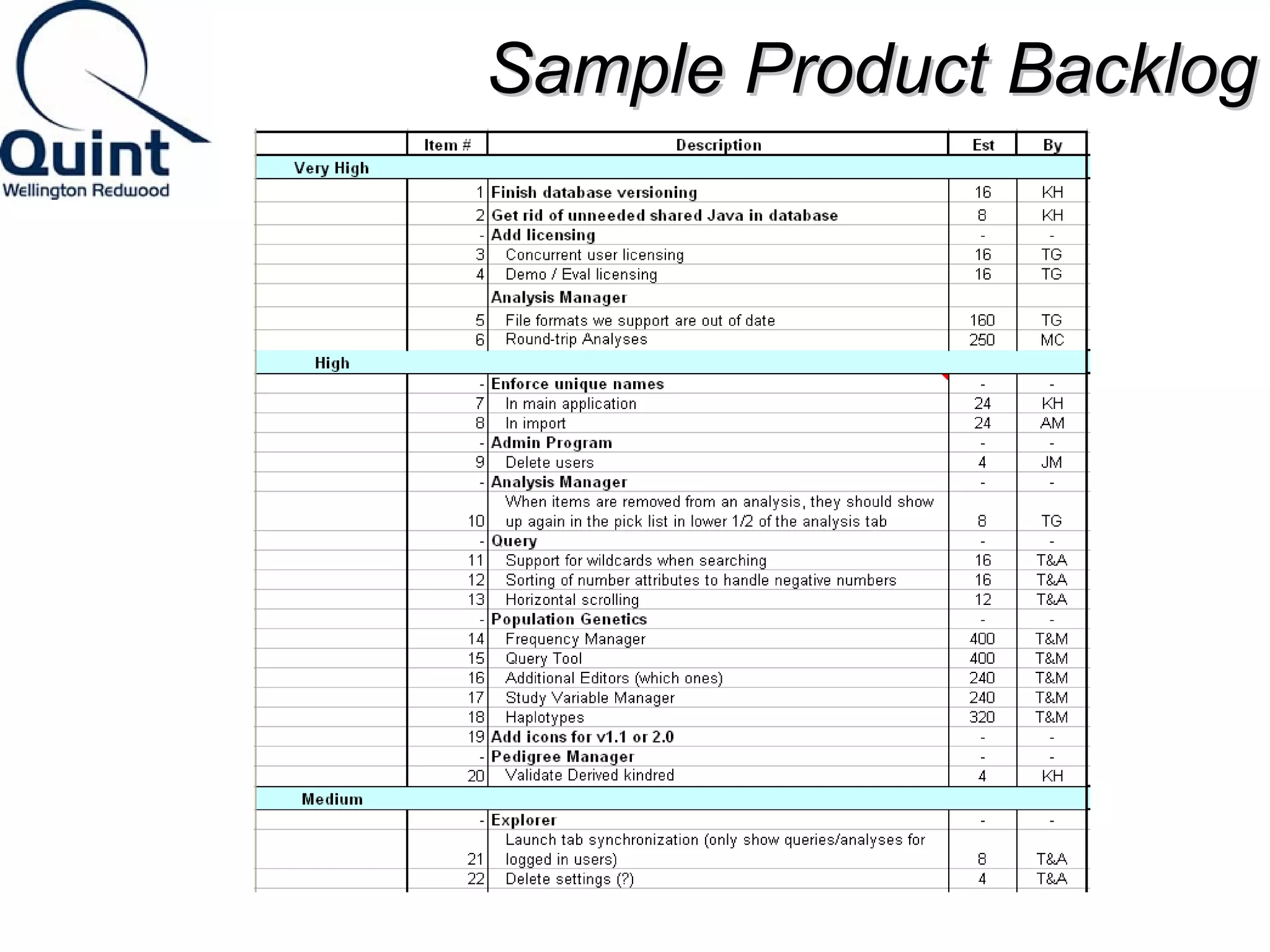
SSaammppllee PPrroodduucctt BBaacckklloogg
FFrroomm SSpprriinntt GGooaall ttoo SSpprriinntt BBaacckklloogg 
 Scrum team takes the Sprint Goal and 
decides what tasks are necessary 
 Team self-organizes around how they’ll meet 
the Sprint Goal 
 Manager doesn’t assign tasks to individuals 
 Managers don’t make decisions for the team 
 Sprint Backlog is created
SSpprriinntt BBaacckklloogg dduurriinngg tthhee SSpprriinntt 
 Changes 
 Team adds new tasks whenever they need to in 
order to meet the Sprint Goal 
 Team can remove unnecessary tasks 
 But: Sprint Backlog can only be updated by the 
team 
 Estimates are updated whenever there’s new 
information
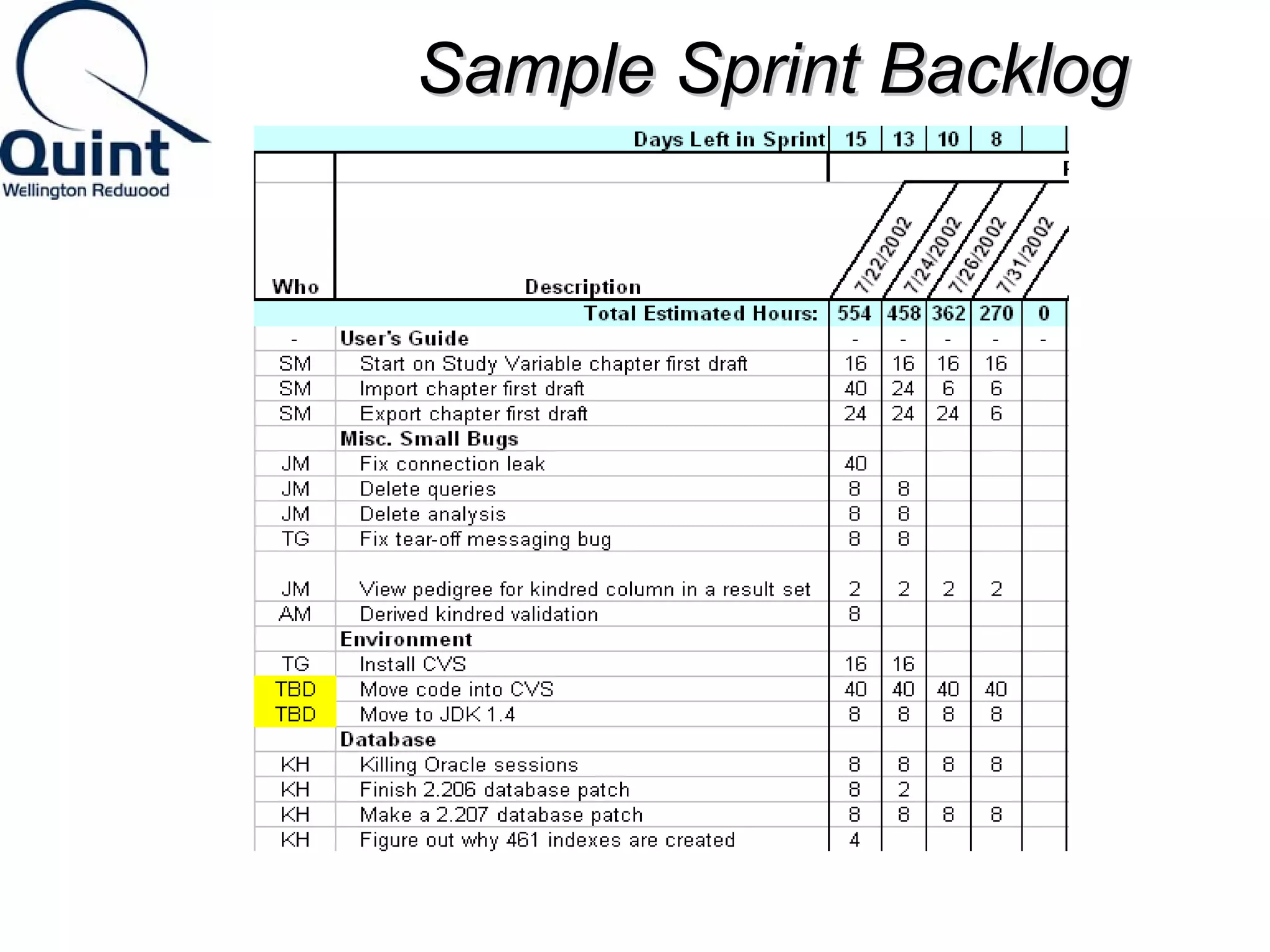
SSpprriinntt BBaacckklloogg 
 A subset of Product Backlog Items, which 
define the work for a Sprint 
 Is created ONLY by Team members 
 Each Item has it’s own status 
 Should be updated every day
SSpprriinntt BBaacckklloogg 
 No more than 300 tasks in the list 
 If a task requires more than 16 hours, it 
should be broken down 
 Team can add or subtract items from the list. 
Product Owner is not allowed to do it
SSaammppllee SSpprriinntt BBaacckklloogg
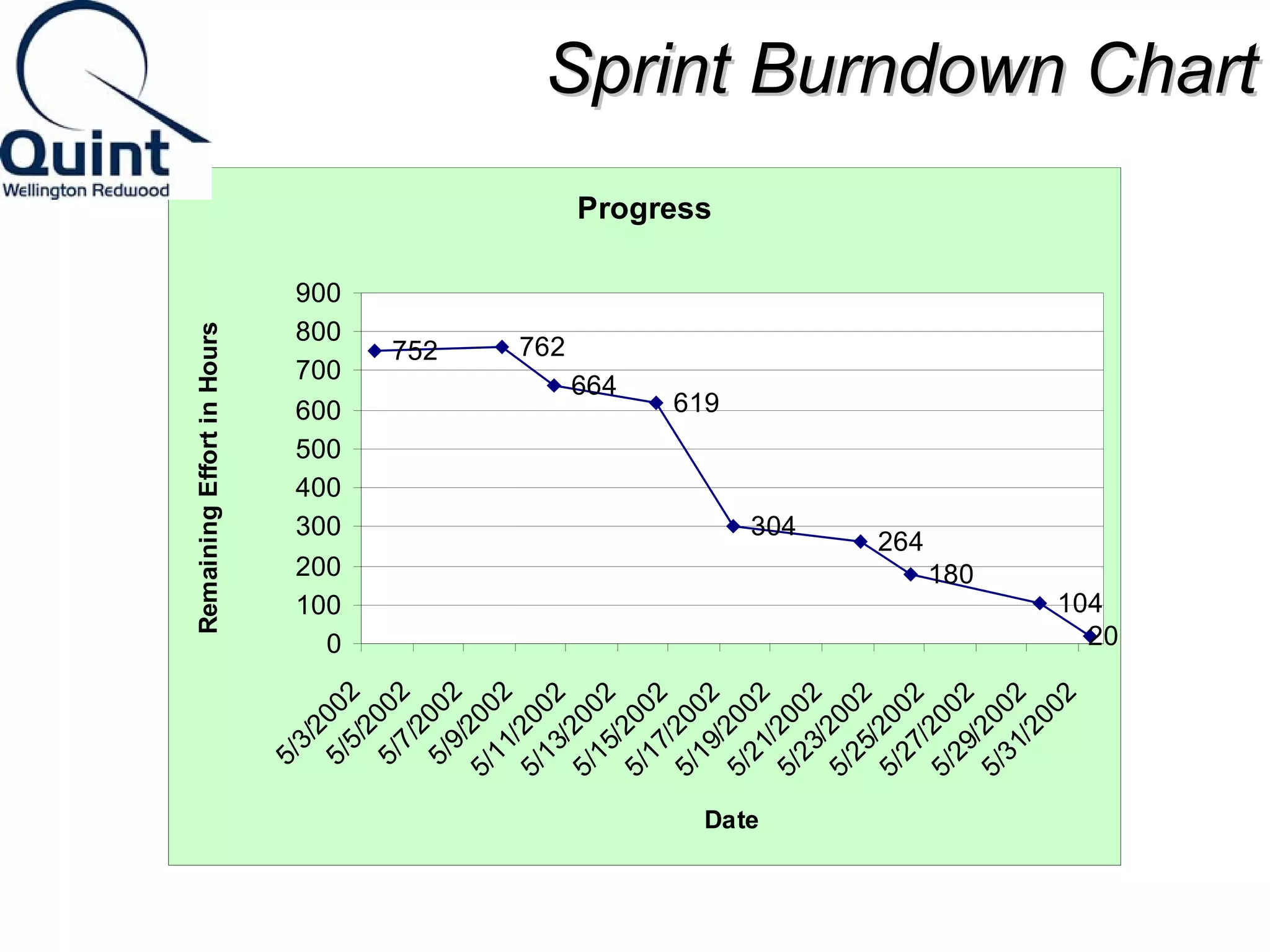
SSpprriinntt BBuurrnn ddoowwnn CChhaarrtt 
 Depicts the total Sprint Backlog hours 
remaining per day 
 Shows the estimated amount of time to 
release 
 Ideally should burn down to zero to the end of 
the Sprint 
 Actually is not a straight line 
 Can bump UP
IInnffoorrmmaattiioonn RRaaddiiaattoorr 
"Two characteristics are key to a good 
information radiator. The first is that the 
information changes over time. This makes it 
worth a person's while to look at the display... 
The other characteristic is that it takes very 
little energy to view the display."
SSpprriinntt BBuurrnnddoowwnn CChhaarrtt 
Progress 
752 762 
664 619 
304 264 
180 
104 
900 
800 
700 
600 
500 
400 
300 
200 
100 
0 20 
5/3/2002 
5/5/2002 
5/7/2002 
5/9/2002 
5/11/2002 
5/13/2002 
5/15/2002 
5/17/2002 
5/19/2002 
5/21/2002 
5/23/2002 
5/25/2002 
5/27/2002 
5/29/2002 
5/31/2002 
Date 
Remaining Effort in Hours
RReelleeaassee BBuurrnnddoowwnn CChhaarrtt 
 Will the release be done on right time? 
 X-axis: sprints 
 Y-axis: amount of hours remaining 
 The estimated work remaining can also burn 
up
PPrroodduucctt BBuurrnnddoowwnn CChhaarrtt 
 Is a “big picture” view of project’s progress (all 
the releases)
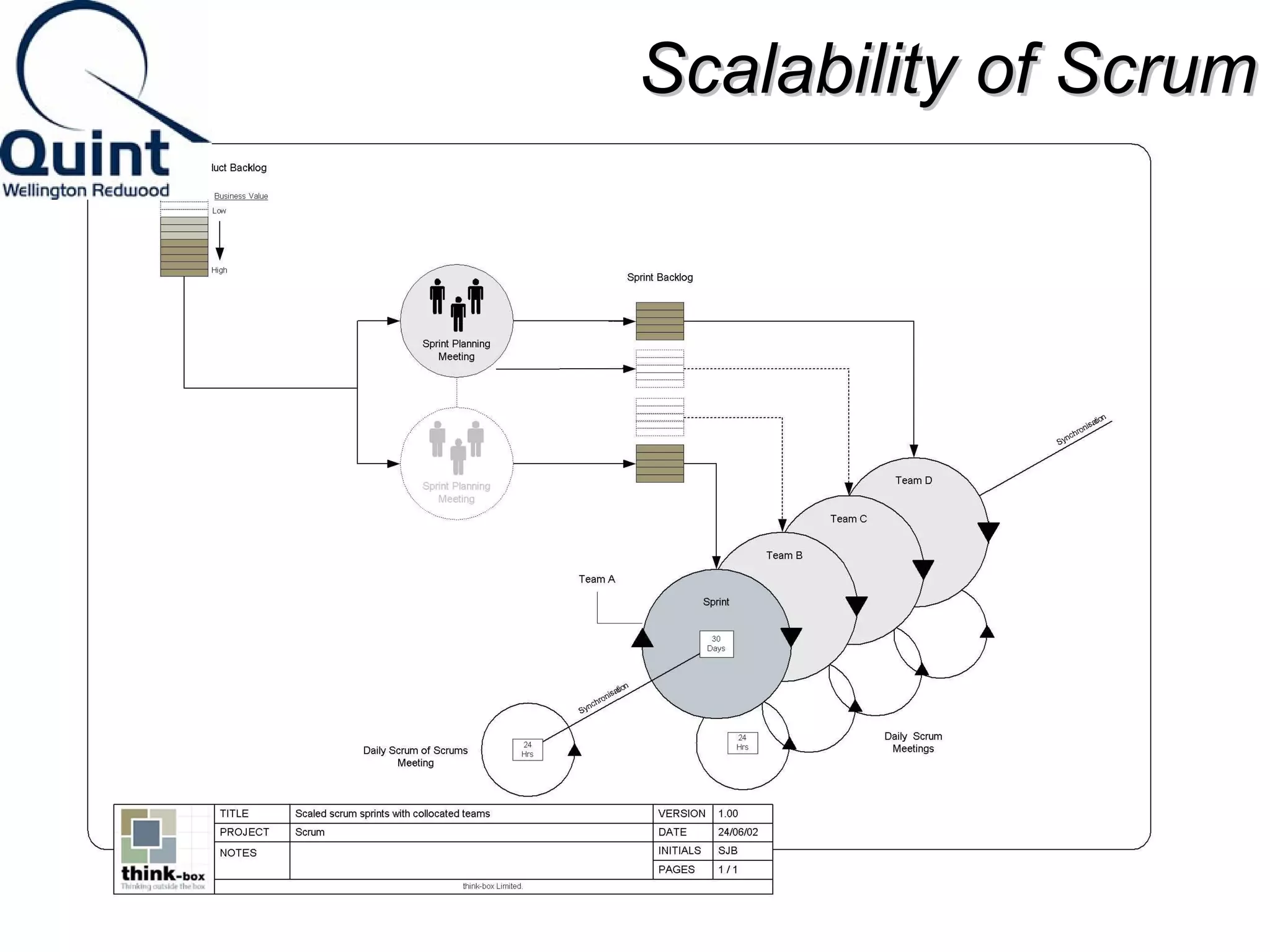
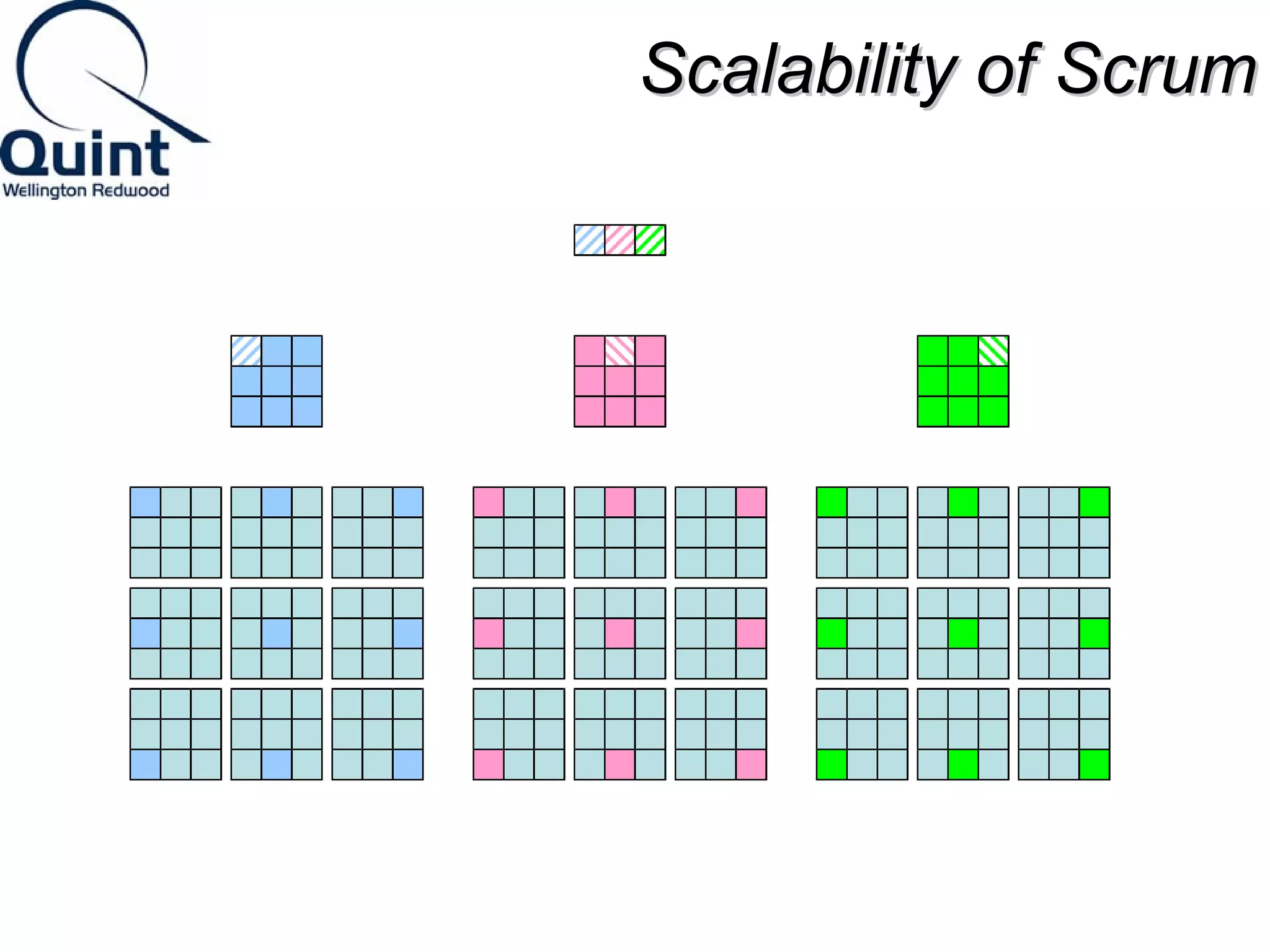
SSccaallaabbiilliittyy ooff SSccrruumm 
 A typical Scrum team is 6-10 people 
 Jeff Sutherland - up to over 800 people 
 "Scrum of Scrums" or what called "Meta- 
Scrum“ 
 Frequency of meetings is based on the 
degree of coupling between packets
SSccaallaabbiilliittyy ooff SSccrruumm
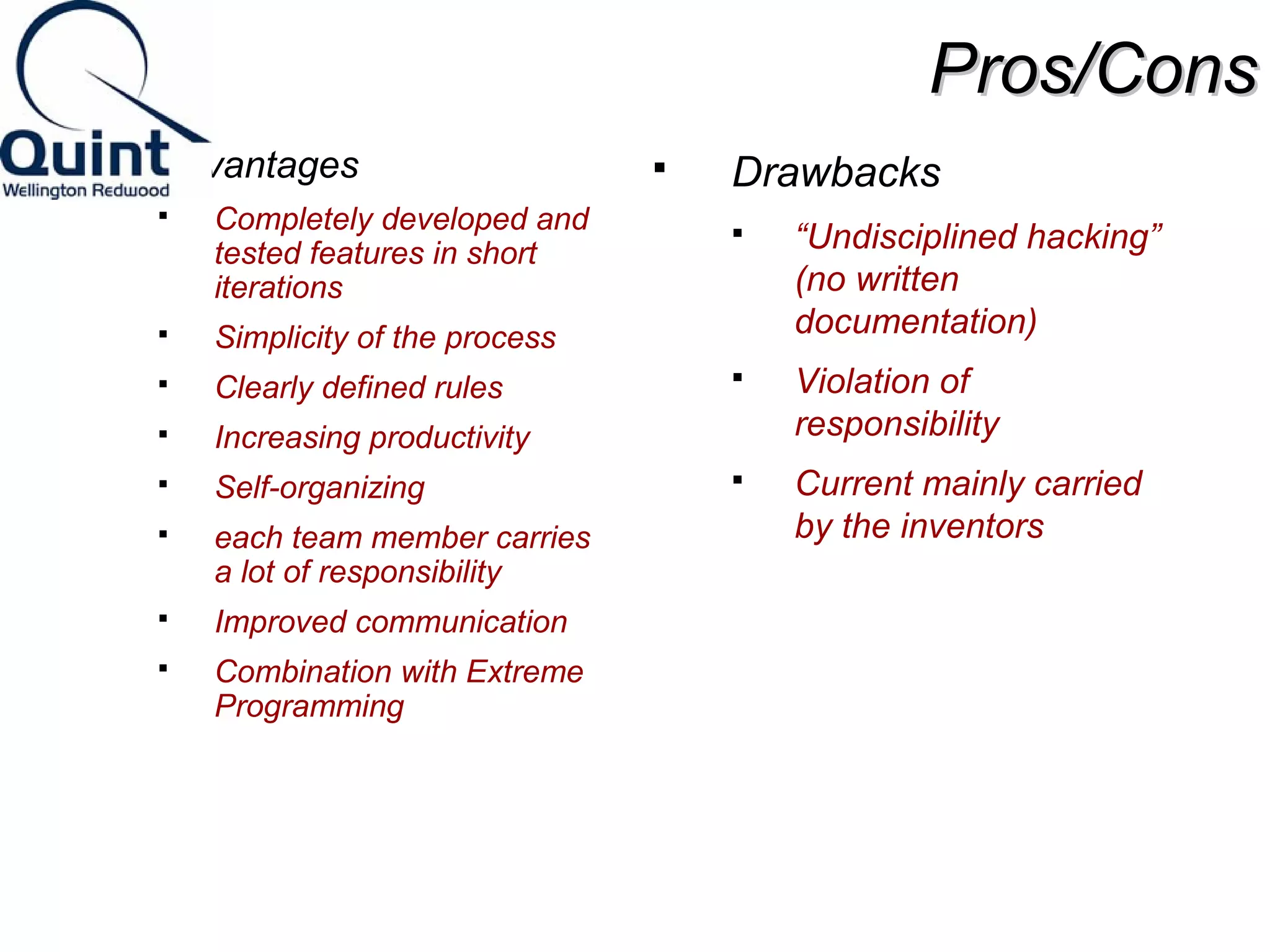
PPrrooss//CCoonnss 
 Advantages 
 Completely developed and 
tested features in short 
iterations 
 Simplicity of the process 
 Clearly defined rules 
 Increasing productivity 
 Self-organizing 
 each team member carries 
a lot of responsibility 
 Improved communication 
 Combination with Extreme 
Programming 
 Drawbacks 
 “Undisciplined hacking” 
(no written 
documentation) 
 Violation of 
responsibility 
 Current mainly carried 
by the inventors
Thank You !!!

Agile Scrum Presentation-Detailed

  • 1.
    An Introduction to Agile SCRUM Methodology
  • 2.
    AAggeennddaa  Introduction  What is Agile Methodology?  What is Scrum?  History of Scrum  Functionality of Scrum  Components of Scrum  Scrum Roles  The Process  Scrum Artifacts  Scaling Scrum  Q & A Session
  • 3.
    IInnttrroodduuccttiioonn Classical methodsof software development have many disadvantages:  huge effort during the planning phase  poor requirements conversion in a rapid changing environment  treatment of staff as a factor of production  New methods: Agile Software Development Methodology
  • 4.
    WWhhaatt iiss AAggiillee??  Agile proponents believe  Current software development processes are too heavyweight or cumbersome  Too many things are done that are not directly related to software product being produced  Current software development is too rigid  Difficulty with incomplete or changing requirements  Short development cycles (Internet applications)  More active customer involvement needed  CMM focuses on process
  • 5.
    CCoonnttdd……  Agilemethods are considered  Lightweight  People-based rather than Plan-based  Several agile methods  No single agile method  XP most popular  No single definition  Agile Manifesto closest to a definition  Set of principles  Developed by Agile Alliance
  • 6.
    AAggiillee MMaanniiffeessttoo AStatement of Values  Individuals and interactions over processes and tools  Working software over comprehensive documentation  Customer collaboration over contract negotiation  Responding to change over following a plan  http://www.agilemanifesto.org
  • 7.
    AAggiillee MMeetthhooddss Agile methods:  Scrum  Extreme Programming  Adaptive Software Development (ASD)  Dynamic System Development Method (DSDM)  …  Agile Alliance (www.agilealliance.org)  A non-profit organization promotes agile development
  • 8.
  • 9.
    SSccrruumm iinn 110000wwoorrddss Scrum is an agile process that allows us to focus on delivering the highest business value in the shortest time. It allows us to rapidly and repeatedly inspect actual working software (every two weeks to one month). The business sets the priorities. Our teams self-manage to determine the best way to deliver the highest priority features. Every two weeks to a month anyone can see real working software and decide to release it as is or continue to enhance for another iteration.
  • 10.
    HHiissttoorryy ooff SSccrruumm  1995:  analysis of common software development processes  not suitable for empirical, unpredictable and non-repeatable processes  Design of a new method: Scrum by Jeff Sutherland & Ken Schwaber  Enhancement of Scrum by Mike Beedle & combination of Scrum with Extreme Programming  1996: introduction of Scrum at OOPSLA conference  2001: publication “Agile Software Development with Scrum” by Ken Schwaber & Mike Beedle  Successful appliance of Scrum in over 50 companies Founders are members in the Agile Alliance Scrum is the leading agile development methodology, used by Fortune 500 companies around the world. The Scrum Alliance exists to transform the way we tackle complex projects, bringing the Scrum framework and agile principles beyond software development to the broader world of work - See more at: https://www.scrumalliance.org/why-scrum# sthash.5Cxy9m2a.dpuf
  • 11.
    CChhaarraacctteerriissttiiccss  Self-organizingteams  Product progresses in a series of month-long “sprints”  Requirements are captured as items in a list of “product backlog”  No specific engineering practices prescribed  Uses generative rules to create an agile environment for delivering projects  One of the “agile processes”  Scrum is an Agile framework for completing complex projects. Scrum originally was formalized for software development projects, but it works well for any complex, innovative scope of work. The possibilities are endless
  • 12.
  • 13.
    SSpprriinnttss  Scrumprojects make progress in a series of “sprints”  Analogous to XP iterations  Target duration is one month  +/- a week or two  But, a constant duration leads to a better rhythm  Product is designed, coded, and tested during the sprint
  • 14.
    SSeeqquueennttiiaall vvss.. OOvveerrllaappppiinnggDDeevv.. Requirements Design Code Test
  • 15.
    No changes dduurriinnggtthhee sspprriinntt Change Inputs Sprint Tested Code  Plan sprint durations around how long you can commit to keeping change out of the sprint
  • 16.
    SSccrruumm FFrraammeewwoorrkk Roles : Product Owner, ScrumMaster, Team  Ceremonies : Sprint Planning, Sprint Review, Sprint Retrospective, & Daily Scrum Meeting  Artifacts : Product Backlog, Sprint Backlog, and Burndown Chart
  • 17.
    PPrroodduucctt OOwwnneerr Define the features of the product  Decide on release date and content  Be responsible for the profitability of the product (ROI)  Prioritize features according to market value  Adjust features and priority every iteration, as needed  Accept or reject work results.
  • 18.
    TThhee SSccrruumm MMaasstteerr  Represents management to the project  Responsible for enacting Scrum values and practices  Removes impediments  Ensure that the team is fully functional and productive  Enable close cooperation across all roles and functions  Shield the team from external interferences
  • 19.
    SSccrruumm TTeeaamm Typically 5-10 people  Cross-functional  QA, Programmers, UI Designers, etc.  Members should be full-time  May be exceptions (e.g., System Admin, etc.)  Teams are self-organizing  What to do if a team self-organizes someone off the team??  Ideally, no titles but rarely a possibility  Membership can change only between sprints
  • 20.
    CCeerreemmoonniieess  SprintPlanning Meeting  Sprint  Daily Scrum  Sprint Review Meeting
  • 21.
    Spring PPllaannnniinngg MMeeeettiinngg Sprint Planning Meeting Product Backlog Team Capabilities Business Conditions Technology Current Product Sprint Backlog Product Owner Scrum Team Management Customers Sprint Goal
  • 22.
    PPaarrttss ooff SSpprriinnttPPllaannnniinngg MMeeeettiinngg  1st Part:  Creating Product Backlog  Determining the Sprint Goal.  Participants: Product Owner, Scrum Master, Scrum Team  2nd Part:  Participants: Scrum Master, Scrum Team  Creating Sprint Backlog
  • 23.
    PPrree--PPrroojjeecctt//KKiicckkooffff MMeeeettiinngg A special form of Sprint Planning Meeting  Meeting before the begin of the Project
  • 24.
    SSpprriinntt  Amonth-long iteration, during which is incremented a product functionality  NO outside influence can interfere with the Scrum team during the Sprint  Each Sprint begins with the Daily Scrum Meeting
  • 25.
    DDaaiillyy SSccrruumm Parameters  Daily  15-minutes  Stand-up  Not for problem solving  Three questions: 1. What did you do yesterday 2. What will you do today? 3. What obstacles are in your way?  Chickens and pigs are invited  Help avoid other unnecessary meetings  Only pigs can talk
  • 26.
    DDaaiillyy SSccrruumm Is NOT a problem solving session  Is NOT a way to collect information about WHO is behind the schedule  Is a meeting in which team members make commitments to each other and to the Scrum Master  Is a good way for a Scrum Master to track the progress of the Team
  • 27.
    SSccrruumm FFAAQQss Why daily?  “How does a project get to be a year late?”  “One day at a time.”  Fred Brooks, The Mythical Man-Month.  Can Scrum meetings be replaced by emailed status reports?  No  Entire team sees the whole picture every day  Create peer pressure to do what you say you’ll do
  • 28.
    SSpprriinntt RReevviieeww MMeeeettiinngg  Team presents what it accomplished during the sprint  Typically takes the form of a demo of new features or underlying architecture  Informal  2-hour prep time rule  Participants  Customers  Management  Product Owner  Other engineers
  • 29.
    SSpprriinntt RReettrroossppeeccttiivvee MMeeeettiinngg  Scrum Team only  Feedback meeting  Three questions  Start  Stop  Continue  Don’t skip for the first 5-6 sprints!!!
  • 30.
    PPrroodduucctt BBaacckklloogg A list of all desired work on the project  Usually a combination of  story-based work (“let user search and replace”)  task-based work (“improve exception handling”)  List is prioritized by the Product Owner  Typically a Product Manager, Marketing, Internal Customer, etc.
  • 31.
    PPrroodduucctt BBaacckklloogg Requirements for a system, expressed as a prioritized list of Backlog Items  Is managed and owned by a Product Owner  Spreadsheet (typically)  Usually is created during the Sprint Planning Meeting  Can be changed and re-prioritized before each PM
  • 32.
  • 33.
    FFrroomm SSpprriinntt GGooaallttoo SSpprriinntt BBaacckklloogg  Scrum team takes the Sprint Goal and decides what tasks are necessary  Team self-organizes around how they’ll meet the Sprint Goal  Manager doesn’t assign tasks to individuals  Managers don’t make decisions for the team  Sprint Backlog is created
  • 34.
    SSpprriinntt BBaacckklloogg dduurriinnggtthhee SSpprriinntt  Changes  Team adds new tasks whenever they need to in order to meet the Sprint Goal  Team can remove unnecessary tasks  But: Sprint Backlog can only be updated by the team  Estimates are updated whenever there’s new information
  • 35.
    SSpprriinntt BBaacckklloogg A subset of Product Backlog Items, which define the work for a Sprint  Is created ONLY by Team members  Each Item has it’s own status  Should be updated every day
  • 36.
    SSpprriinntt BBaacckklloogg No more than 300 tasks in the list  If a task requires more than 16 hours, it should be broken down  Team can add or subtract items from the list. Product Owner is not allowed to do it
  • 37.
  • 38.
    SSpprriinntt BBuurrnn ddoowwnnCChhaarrtt  Depicts the total Sprint Backlog hours remaining per day  Shows the estimated amount of time to release  Ideally should burn down to zero to the end of the Sprint  Actually is not a straight line  Can bump UP
  • 39.
    IInnffoorrmmaattiioonn RRaaddiiaattoorr "Twocharacteristics are key to a good information radiator. The first is that the information changes over time. This makes it worth a person's while to look at the display... The other characteristic is that it takes very little energy to view the display."
  • 40.
    SSpprriinntt BBuurrnnddoowwnn CChhaarrtt Progress 752 762 664 619 304 264 180 104 900 800 700 600 500 400 300 200 100 0 20 5/3/2002 5/5/2002 5/7/2002 5/9/2002 5/11/2002 5/13/2002 5/15/2002 5/17/2002 5/19/2002 5/21/2002 5/23/2002 5/25/2002 5/27/2002 5/29/2002 5/31/2002 Date Remaining Effort in Hours
  • 41.
    RReelleeaassee BBuurrnnddoowwnn CChhaarrtt  Will the release be done on right time?  X-axis: sprints  Y-axis: amount of hours remaining  The estimated work remaining can also burn up
  • 42.
    PPrroodduucctt BBuurrnnddoowwnn CChhaarrtt  Is a “big picture” view of project’s progress (all the releases)
  • 43.
    SSccaallaabbiilliittyy ooff SSccrruumm  A typical Scrum team is 6-10 people  Jeff Sutherland - up to over 800 people  "Scrum of Scrums" or what called "Meta- Scrum“  Frequency of meetings is based on the degree of coupling between packets
  • 44.
  • 45.
  • 46.
    PPrrooss//CCoonnss  Advantages  Completely developed and tested features in short iterations  Simplicity of the process  Clearly defined rules  Increasing productivity  Self-organizing  each team member carries a lot of responsibility  Improved communication  Combination with Extreme Programming  Drawbacks  “Undisciplined hacking” (no written documentation)  Violation of responsibility  Current mainly carried by the inventors
  • 47.