

Agile Philosophy
Zaheer Abbas, CSM®
An alternative to traditional Project Management(Waterfall) which is risky and
invites failure
It is hard to practice
Development is incremental
It requires courage and commitment
Iterative approach(Sprints)
1.What is Agile Development?
Individuals and interactions over processes and tools
Working software over comprehensive documentation
Customer collaboration over contract negotiation
Responding to change over following a plan
2. The Agile Manifesto
3. Scrum Methodology
Part of Agile movement
Inspired by empirical inspect and adapt feedback loops
Emphasizes decision making from real-world results rather than speculation
Demonstrated potentially shippable product increment
4. Why Scrum?
Suits ANY project type
Defined process
Increase in quality of deliverables
Handle changes effectively
More control of the project schedule
Project state clarity
5. The Scrum Process
The Empirical process control theory
1. Transparency
2. Inspection
3. Adaptation
6. The Scrum Team
The Scrum Master
The Product Owner
The Development Team
6.1 The Scrum Master
He has no Management authority
Does not have a Project Management role
Facilitator
Removes impediments
Ensures team productivity, shields from external interferences
Servant leader
6.2 The Product Owner
Responsible for the ROI
Assign work
Rejections & approvals
Interface between the development team and the stakeholder
6.3 The Development Team
Self organizing
Cross functional
Transparent
Takes ownership of the work
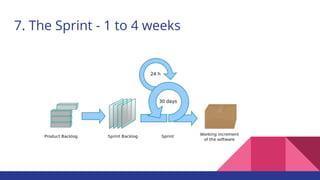
7. The Sprint - 1 to 4 weeks
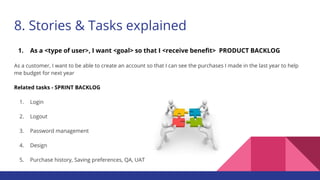
8. Stories & Tasks explained
1. As a <type of user>, I want <goal> so that I <receive benefit> PRODUCT BACKLOG
As a customer, I want to be able to create an account so that I can see the purchases I made in the last year to help
me budget for next year
Related tasks - SPRINT BACKLOG
1. Login
2. Logout
3. Password management
4. Design
5. Purchase history, Saving preferences, QA, UAT
8.1 Scrum Artifacts
1. Product backlog items(PBIs) OR Use case scenarios
- Comprehensive list of all the modules of a project which we want to deliver
- Responsibility of the Product owner
- Feature list is prioritized
- If a feature is not present in a Product backlog, it does not exist
2. Sprint backlog
- List of items committed to be delivered for this current Sprint(what)
- Has an end date
- List of Sprint tasks(how)
9. Scrum Events/Ceremonies
Sprint Planning
Daily Scrum
Sprint Review - Defines “Done” state
Sprint Retrospective
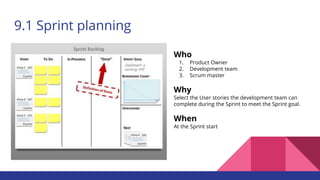
9.1 Sprint planning
Who
1. Product Owner
2. Development team
3. Scrum master
Why
Select the User stories the development team can
complete during the Sprint to meet the Sprint goal.
When
At the Sprint start
9.2 Daily Scrum meeting
The development team members discuss about -
➔ What I did yesterday?
➔ What I am doing today?
➔ What is blocking me?
Duration - 15 minutes max
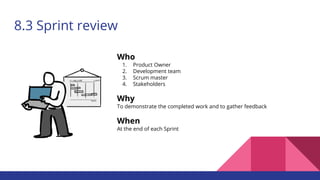
8.3 Sprint review
Who
1. Product Owner
2. Development team
3. Scrum master
4. Stakeholders
Why
To demonstrate the completed work and to gather feedback
When
At the end of each Sprint
8.4 Definition of ‘DONE’ - Importance
❏ Differs from Project to Project
❏ Client
❏ Product Owner
❏ Reviews & approvals
❏ T & M model
❏ Productivity
❏ Past experience
❏ Expert advice
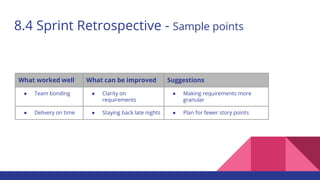
8.4 Sprint Retrospective - Sample points
What worked well What can be improved Suggestions
● Team bonding ● Clarity on
requirements
● Making requirements more
granular
● Delivery on time ● Staying back late nights ● Plan for fewer story points
9. Estimation in Scrum
As this is User Story based estimation, we use different types of estimation
techniques
- Planning Poker – planningpoker.com
- T-Shirt Sizes – Not so frequently used as there is no math number in it
- Relative Mass Valuation – For large list of Product backlog stories
10. Performance measurement
1. Actual stories completed Vs. Number of stories committed
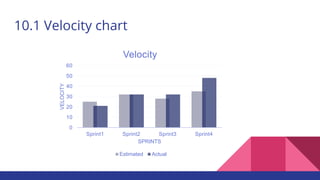
2. Velocity & consistency
3. Quality
4. Communication & collaboration
5. Retrospective Process improvement
6. Adherence to Scrum rules and practices
10.1 Velocity chart
0
10
20
30
40
50
60
Sprint1 Sprint2 Sprint3 Sprint4
VELOCITY
SPRINTS
Velocity
Estimated Actual
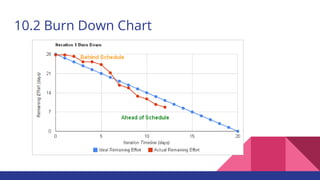
10.2 Burn Down Chart
9. The Agile transformation
CHANGE! The mindset
Communication importance - Communication & communication
Fully transparent
Culture modification
Training
Ownership
Willing to offer help
10. The Agile transformation(Contd.)
Friendly environment
Freedom to fail
Self organize
Learn
Enjoy
11. Agile - The start! Project NEW
❏ Start by forming Agile teams at the start of the project - Max 9 including ALL
❏ Identify ALL the resources - Dev, QA, designer, PM, SM
❏ Define one persona as the PO - Internally or from the Client side
❏ From the Project plan, identify the milestones
❏ Rename milestones as Sprints - 4 weeks max for each Sprint
❏ Take the initial 1-2 weeks as Sprint ‘0’ for planning the Project & Sprint ‘1’
❏ Consider delivering 1 Sprint at a time
❏ Perform all the Scrum events ethically
❏ Take less work initially for all domains - Dev, QA, design etc.,
❏ Make sure to deliver what was promised
Agile – Starting with basics
❏ Sprint 1 may/may not go well, trust yourself
❏ Deliver Sprint 1 with the highest quality
❏ Review it with all the stakeholders
❏ Get approvals
❏ Completed Sprint 1 - Retrospect yourself and note down the lessons learnt
❏ Ask for feedback
❏ Feel proud in it and move to the next Sprint
❏ Learn and apply
❏ Repeat
12. Points to consider
1. We are an Agile Team
2. Winning is everyone’s effort - Same with losing!
3. Always try to be cross functional, know what other’s responsibility as well
4. Help them out
5. Raise a flag immediately, do not wait till the 11th hour
6. Anyone from the same Agile team can be a Scrum Master, we don’t need a profile for it.
7. There is no blame game
8. Take ownership of what you do
9. Fail - Get up - Repeat!
Thank you!

Agile philosophy

  • 1.
  • 2.
    An alternative totraditional Project Management(Waterfall) which is risky and invites failure It is hard to practice Development is incremental It requires courage and commitment Iterative approach(Sprints) 1.What is Agile Development?
  • 3.
    Individuals and interactionsover processes and tools Working software over comprehensive documentation Customer collaboration over contract negotiation Responding to change over following a plan 2. The Agile Manifesto
  • 4.
    3. Scrum Methodology Partof Agile movement Inspired by empirical inspect and adapt feedback loops Emphasizes decision making from real-world results rather than speculation Demonstrated potentially shippable product increment
  • 5.
    4. Why Scrum? SuitsANY project type Defined process Increase in quality of deliverables Handle changes effectively More control of the project schedule Project state clarity
  • 6.
    5. The ScrumProcess The Empirical process control theory 1. Transparency 2. Inspection 3. Adaptation
  • 7.
    6. The ScrumTeam The Scrum Master The Product Owner The Development Team
  • 8.
    6.1 The ScrumMaster He has no Management authority Does not have a Project Management role Facilitator Removes impediments Ensures team productivity, shields from external interferences Servant leader
  • 9.
    6.2 The ProductOwner Responsible for the ROI Assign work Rejections & approvals Interface between the development team and the stakeholder
  • 10.
    6.3 The DevelopmentTeam Self organizing Cross functional Transparent Takes ownership of the work
  • 11.
    7. The Sprint- 1 to 4 weeks
  • 12.
    8. Stories &Tasks explained 1. As a <type of user>, I want <goal> so that I <receive benefit> PRODUCT BACKLOG As a customer, I want to be able to create an account so that I can see the purchases I made in the last year to help me budget for next year Related tasks - SPRINT BACKLOG 1. Login 2. Logout 3. Password management 4. Design 5. Purchase history, Saving preferences, QA, UAT
  • 13.
    8.1 Scrum Artifacts 1.Product backlog items(PBIs) OR Use case scenarios - Comprehensive list of all the modules of a project which we want to deliver - Responsibility of the Product owner - Feature list is prioritized - If a feature is not present in a Product backlog, it does not exist 2. Sprint backlog - List of items committed to be delivered for this current Sprint(what) - Has an end date - List of Sprint tasks(how)
  • 14.
    9. Scrum Events/Ceremonies SprintPlanning Daily Scrum Sprint Review - Defines “Done” state Sprint Retrospective
  • 15.
    9.1 Sprint planning Who 1.Product Owner 2. Development team 3. Scrum master Why Select the User stories the development team can complete during the Sprint to meet the Sprint goal. When At the Sprint start
  • 16.
    9.2 Daily Scrummeeting The development team members discuss about - ➔ What I did yesterday? ➔ What I am doing today? ➔ What is blocking me? Duration - 15 minutes max
  • 17.
    8.3 Sprint review Who 1.Product Owner 2. Development team 3. Scrum master 4. Stakeholders Why To demonstrate the completed work and to gather feedback When At the end of each Sprint
  • 18.
    8.4 Definition of‘DONE’ - Importance ❏ Differs from Project to Project ❏ Client ❏ Product Owner ❏ Reviews & approvals ❏ T & M model ❏ Productivity ❏ Past experience ❏ Expert advice
  • 19.
    8.4 Sprint Retrospective- Sample points What worked well What can be improved Suggestions ● Team bonding ● Clarity on requirements ● Making requirements more granular ● Delivery on time ● Staying back late nights ● Plan for fewer story points
  • 20.
    9. Estimation inScrum As this is User Story based estimation, we use different types of estimation techniques - Planning Poker – planningpoker.com - T-Shirt Sizes – Not so frequently used as there is no math number in it - Relative Mass Valuation – For large list of Product backlog stories
  • 21.
    10. Performance measurement 1.Actual stories completed Vs. Number of stories committed 2. Velocity & consistency 3. Quality 4. Communication & collaboration 5. Retrospective Process improvement 6. Adherence to Scrum rules and practices
  • 22.
    10.1 Velocity chart 0 10 20 30 40 50 60 Sprint1Sprint2 Sprint3 Sprint4 VELOCITY SPRINTS Velocity Estimated Actual
  • 23.
  • 24.
    9. The Agiletransformation CHANGE! The mindset Communication importance - Communication & communication Fully transparent Culture modification Training Ownership Willing to offer help
  • 25.
    10. The Agiletransformation(Contd.) Friendly environment Freedom to fail Self organize Learn Enjoy
  • 26.
    11. Agile -The start! Project NEW ❏ Start by forming Agile teams at the start of the project - Max 9 including ALL ❏ Identify ALL the resources - Dev, QA, designer, PM, SM ❏ Define one persona as the PO - Internally or from the Client side ❏ From the Project plan, identify the milestones ❏ Rename milestones as Sprints - 4 weeks max for each Sprint ❏ Take the initial 1-2 weeks as Sprint ‘0’ for planning the Project & Sprint ‘1’ ❏ Consider delivering 1 Sprint at a time ❏ Perform all the Scrum events ethically ❏ Take less work initially for all domains - Dev, QA, design etc., ❏ Make sure to deliver what was promised
  • 27.
    Agile – Startingwith basics ❏ Sprint 1 may/may not go well, trust yourself ❏ Deliver Sprint 1 with the highest quality ❏ Review it with all the stakeholders ❏ Get approvals ❏ Completed Sprint 1 - Retrospect yourself and note down the lessons learnt ❏ Ask for feedback ❏ Feel proud in it and move to the next Sprint ❏ Learn and apply ❏ Repeat
  • 28.
    12. Points toconsider 1. We are an Agile Team 2. Winning is everyone’s effort - Same with losing! 3. Always try to be cross functional, know what other’s responsibility as well 4. Help them out 5. Raise a flag immediately, do not wait till the 11th hour 6. Anyone from the same Agile team can be a Scrum Master, we don’t need a profile for it. 7. There is no blame game 8. Take ownership of what you do 9. Fail - Get up - Repeat!
  • 29.