Introduction to
Scrum
What, Why
and How
A goal is established, then the team moves toward that goal,
iteration by iteration. The plan is modified as needed based on
experience.
Scrum was created in response to issues with the traditional
“waterfall” project management approach
Scrum is a framework founded on empirical process control theory,
which asserts that knowledge comes from experience and making
decisions based on what is known. It employs an iterative,
incremental approach to optimize predictability and control risk.
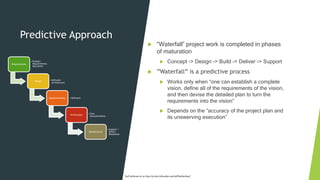
Predictive Approach
 ”Waterfall” project work is completed in phases
of maturation
 Concept -> Design -> Build -> Deliver -> Support
 ”Waterfall” is a predictive process
 Works only when “one can establish a complete
vision, define all of the requirements of the vision,
and then devise the detailed plan to turn the
requirements into the vision”
 Depends on the “accuracy of the project plan and
its unswerving execution”
Requirements
•Product
Requirements
Document
Design •Software
Architecture
Implementation •Software
Verification
•Test
Documentation
Maintenance
•Support /
Defect
Resolution
Ref:SoftwareIn30Days byKenSchwaberandJeffSutherland
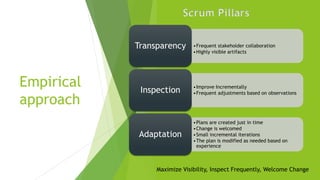
Empirical
approach
Ref: ScrumInc
•Frequent stakeholder collaboration
•Highly visible artifacts
Transparency
•Improve Incrementally
•Frequent adjustments based on observationsInspection
•Plans are created just in time
•Change is welcomed
•Small incremental iterations
•The plan is modified as needed based on
experience
Adaptation
Maximize Visibility, Inspect Frequently, Welcome Change
Scrum Pillars
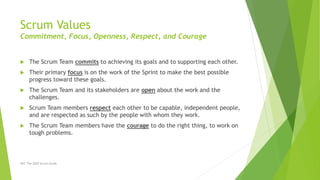
Scrum Values
Commitment, Focus, Openness, Respect, and Courage
 The Scrum Team commits to achieving its goals and to supporting each other.
 Their primary focus is on the work of the Sprint to make the best possible
progress toward these goals.
 The Scrum Team and its stakeholders are open about the work and the
challenges.
 Scrum Team members respect each other to be capable, independent people,
and are respected as such by the people with whom they work.
 The Scrum Team members have the courage to do the right thing, to work on
tough problems.
Ref: The 2020 Scrum Guide
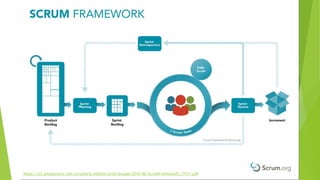
https://s3.amazonaws.com/scrumorg-website-prod/drupal/2016-06/ScrumFramework_17x11.pdf
Scrum Framework
Scrum is a simple, lightweight framework
 Roles
 Scrum Master, Product Owner, Developers
 The “Scrum Team” consists of members
with all three roles
 Artifacts
 Increment, Product Backlog and Sprint
Backlog
 Events
 Sprint, Sprint Planning, Daily Scrum,
Sprint Review and Retrospective
“Scrum is built upon by the collective intelligence of the people using it.”
The 2020 Scrum Guide
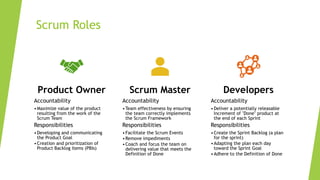
Scrum Roles
Product Owner
Accountability
•Maximize value of the product
resulting from the work of the
Scrum Team
Responsibilities
•Developing and communicating
the Product Goal
•Creation and prioritization of
Product Backlog Items (PBIs)
Scrum Master
Accountability
•Team effectiveness by ensuring
the team correctly implements
the Scrum Framework
Responsibilities
•Facilitate the Scrum Events
•Remove impediments
•Coach and focus the team on
delivering value that meets the
Definition of Done
Developers
Accountability
•Deliver a potentially releasable
Increment of "Done" product at
the end of each Sprint
Responsibilities
•Create the Sprint Backlog (a plan
for the sprint)
•Adapting the plan each day
toward the Sprint Goal
•Adhere to the Definition of Done
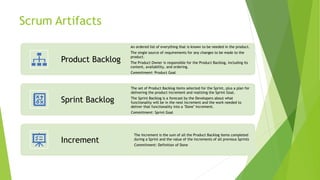
Scrum Artifacts
Product Backlog
An ordered list of everything that is known to be needed in the product.
The single source of requirements for any changes to be made to the
product.
The Product Owner is responsible for the Product Backlog, including its
content, availability, and ordering.
Commitment: Product Goal
Sprint Backlog
The set of Product Backlog items selected for the Sprint, plus a plan for
delivering the product Increment and realizing the Sprint Goal.
The Sprint Backlog is a forecast by the Developers about what
functionality will be in the next Increment and the work needed to
deliver that functionality into a "Done" Increment.
Commitment: Sprint Goal
Increment
The Increment is the sum of all the Product Backlog items completed
during a Sprint and the value of the increments of all previous Sprints
Commitment: Definition of Done
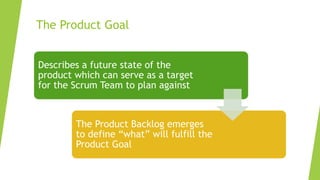
The Product Goal
Describes a future state of the
product which can serve as a target
for the Scrum Team to plan against
The Product Backlog emerges
to define “what” will fulfill the
Product Goal
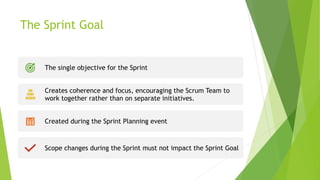
The Sprint Goal
The single objective for the Sprint
Creates coherence and focus, encouraging the Scrum Team to
work together rather than on separate initiatives.
Created during the Sprint Planning event
Scope changes during the Sprint must not impact the Sprint Goal
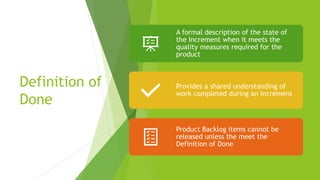
Definition of
Done
A formal description of the state of
the Increment when it meets the
quality measures required for the
product
Provides a shared understanding of
work completed during an Increment
Product Backlog items cannot be
released unless the meet the
Definition of Done
Definition of a Done Increment
 Transparency of the increment means that everyone equally has a shared
definition and understanding of a done increment
 “A done, completed increment is something you can use”
 The capability resulting from an increment should be immediately deployable for
use
 The Product Owner should not accept incomplete sprints
 Partially completed functionality that is accepted is built upon in subsequent
iterations
 Technical debt accumulates as work is done
 Technical debt is more expensive to fix when it is built upon by subsequent functionality
Ref: Software In 30 Days by Ken Schwaber and Jeff Sutherland
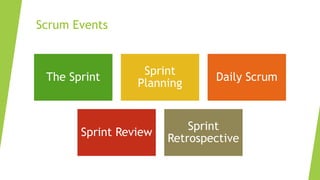
Scrum Events
The Sprint
Sprint
Planning
Daily Scrum
Sprint Review
Sprint
Retrospective
The Sprint
 Contains all other Scrum Events
 Sprint Planning, Daily Scrums, Sprint Review
and Sprint Retrospective
 Fixed length iteration
 A new Sprint starts immediately after the
conclusion of the previous Sprint
 Creates the product value committed to
during planning
 Scope can be clarified and renegotiated with
the Product Owner as more is learned
 No changes are made that would endanger the
Sprint Goal
Timebox: Fixed length, 1 month of less
Sprint Planning
 Initiates the sprint by planning out the work to be performed
 Results in a defined Sprint Goal and a Sprint Backlog
(the plan)
 Involves the entire Scrum Team
 Why is the Sprint valuable?
 Define the Sprint Goal
 What can be Done in the Sprint?
 Estimate work in detail and use capacity based on
past performance
 Work in priority order until capacity is met
 How will the chosen work get done?
 Break down work into detailed tasks required
complete work
Timebox: A maximum of eight hours for a one-month Sprint.
For shorter Sprints, the event is usually shorter.
The Daily Scrum
 Team meets daily to inspect progress
toward the Sprint Goal and adapt the
Sprint Backlog as needed
 Produces an actionable plan for the
next day of work
 The format of the meeting and
techniques utilized are determined by
the team
Timebox: 15 Minutes
Sprint Review
 At the end of the Sprint, the Scrum
Team and key stakeholders meet to
review what happened during the
sprint and the increment of
functionality that was produced
 What was done, how much was done,
how effectively it was done and the
usefulness of the work
 New requirements, opportunities and
challenges can arise during the Sprint
Review
Timebox: Maximum of 4 hours for a 1-month sprint. For
shorter Sprints, the vent is usually shorter.
Sprint Retrospective
 At the end of the Sprint, the Scrum Team meets to formulate
improvements based on what happed during the sprint
 Suggested topics:
 How well or poorly did the team members work
together and why
 Did the team achieve more or less than forecast and
why
 Whether the team has all the skills needed to do its job
 What the team thinks of using Scrum
 The team identifies the most helpful changes to improve its
effectiveness
 Address the most impactful changes as soon as possible
 Even as soon as the next Sprint
Timebox: Maximum of 3 hours for a 1-month Sprint. For
shorter Sprints, the event is usually shorter.
References
 The 2020 Scrum Guide (Scrum.org / Scruminc)
 Alternate Release Burdown Chart (Mountain Goat Software)
 Project Management Metrics (Attlassian)
 Software In 30 Days by Ken Schwaber and Jeff Sutherland
Charts by James Walmsley
CSM, PSM I, PSK I
 www.linkedin.com/in/jameswalmsleycsm

Introduction to Scrum

  • 1.
  • 2.
    What, Why and How Agoal is established, then the team moves toward that goal, iteration by iteration. The plan is modified as needed based on experience. Scrum was created in response to issues with the traditional “waterfall” project management approach Scrum is a framework founded on empirical process control theory, which asserts that knowledge comes from experience and making decisions based on what is known. It employs an iterative, incremental approach to optimize predictability and control risk.
  • 3.
    Predictive Approach  ”Waterfall”project work is completed in phases of maturation  Concept -> Design -> Build -> Deliver -> Support  ”Waterfall” is a predictive process  Works only when “one can establish a complete vision, define all of the requirements of the vision, and then devise the detailed plan to turn the requirements into the vision”  Depends on the “accuracy of the project plan and its unswerving execution” Requirements •Product Requirements Document Design •Software Architecture Implementation •Software Verification •Test Documentation Maintenance •Support / Defect Resolution Ref:SoftwareIn30Days byKenSchwaberandJeffSutherland
  • 4.
    Empirical approach Ref: ScrumInc •Frequent stakeholdercollaboration •Highly visible artifacts Transparency •Improve Incrementally •Frequent adjustments based on observationsInspection •Plans are created just in time •Change is welcomed •Small incremental iterations •The plan is modified as needed based on experience Adaptation Maximize Visibility, Inspect Frequently, Welcome Change Scrum Pillars
  • 5.
    Scrum Values Commitment, Focus,Openness, Respect, and Courage  The Scrum Team commits to achieving its goals and to supporting each other.  Their primary focus is on the work of the Sprint to make the best possible progress toward these goals.  The Scrum Team and its stakeholders are open about the work and the challenges.  Scrum Team members respect each other to be capable, independent people, and are respected as such by the people with whom they work.  The Scrum Team members have the courage to do the right thing, to work on tough problems. Ref: The 2020 Scrum Guide
  • 6.
  • 7.
    Scrum Framework Scrum isa simple, lightweight framework  Roles  Scrum Master, Product Owner, Developers  The “Scrum Team” consists of members with all three roles  Artifacts  Increment, Product Backlog and Sprint Backlog  Events  Sprint, Sprint Planning, Daily Scrum, Sprint Review and Retrospective “Scrum is built upon by the collective intelligence of the people using it.” The 2020 Scrum Guide
  • 8.
    Scrum Roles Product Owner Accountability •Maximizevalue of the product resulting from the work of the Scrum Team Responsibilities •Developing and communicating the Product Goal •Creation and prioritization of Product Backlog Items (PBIs) Scrum Master Accountability •Team effectiveness by ensuring the team correctly implements the Scrum Framework Responsibilities •Facilitate the Scrum Events •Remove impediments •Coach and focus the team on delivering value that meets the Definition of Done Developers Accountability •Deliver a potentially releasable Increment of "Done" product at the end of each Sprint Responsibilities •Create the Sprint Backlog (a plan for the sprint) •Adapting the plan each day toward the Sprint Goal •Adhere to the Definition of Done
  • 9.
    Scrum Artifacts Product Backlog Anordered list of everything that is known to be needed in the product. The single source of requirements for any changes to be made to the product. The Product Owner is responsible for the Product Backlog, including its content, availability, and ordering. Commitment: Product Goal Sprint Backlog The set of Product Backlog items selected for the Sprint, plus a plan for delivering the product Increment and realizing the Sprint Goal. The Sprint Backlog is a forecast by the Developers about what functionality will be in the next Increment and the work needed to deliver that functionality into a "Done" Increment. Commitment: Sprint Goal Increment The Increment is the sum of all the Product Backlog items completed during a Sprint and the value of the increments of all previous Sprints Commitment: Definition of Done
  • 10.
    The Product Goal Describesa future state of the product which can serve as a target for the Scrum Team to plan against The Product Backlog emerges to define “what” will fulfill the Product Goal
  • 11.
    The Sprint Goal Thesingle objective for the Sprint Creates coherence and focus, encouraging the Scrum Team to work together rather than on separate initiatives. Created during the Sprint Planning event Scope changes during the Sprint must not impact the Sprint Goal
  • 12.
    Definition of Done A formaldescription of the state of the Increment when it meets the quality measures required for the product Provides a shared understanding of work completed during an Increment Product Backlog items cannot be released unless the meet the Definition of Done
  • 13.
    Definition of aDone Increment  Transparency of the increment means that everyone equally has a shared definition and understanding of a done increment  “A done, completed increment is something you can use”  The capability resulting from an increment should be immediately deployable for use  The Product Owner should not accept incomplete sprints  Partially completed functionality that is accepted is built upon in subsequent iterations  Technical debt accumulates as work is done  Technical debt is more expensive to fix when it is built upon by subsequent functionality Ref: Software In 30 Days by Ken Schwaber and Jeff Sutherland
  • 14.
    Scrum Events The Sprint Sprint Planning DailyScrum Sprint Review Sprint Retrospective
  • 15.
    The Sprint  Containsall other Scrum Events  Sprint Planning, Daily Scrums, Sprint Review and Sprint Retrospective  Fixed length iteration  A new Sprint starts immediately after the conclusion of the previous Sprint  Creates the product value committed to during planning  Scope can be clarified and renegotiated with the Product Owner as more is learned  No changes are made that would endanger the Sprint Goal Timebox: Fixed length, 1 month of less
  • 16.
    Sprint Planning  Initiatesthe sprint by planning out the work to be performed  Results in a defined Sprint Goal and a Sprint Backlog (the plan)  Involves the entire Scrum Team  Why is the Sprint valuable?  Define the Sprint Goal  What can be Done in the Sprint?  Estimate work in detail and use capacity based on past performance  Work in priority order until capacity is met  How will the chosen work get done?  Break down work into detailed tasks required complete work Timebox: A maximum of eight hours for a one-month Sprint. For shorter Sprints, the event is usually shorter.
  • 17.
    The Daily Scrum Team meets daily to inspect progress toward the Sprint Goal and adapt the Sprint Backlog as needed  Produces an actionable plan for the next day of work  The format of the meeting and techniques utilized are determined by the team Timebox: 15 Minutes
  • 18.
    Sprint Review  Atthe end of the Sprint, the Scrum Team and key stakeholders meet to review what happened during the sprint and the increment of functionality that was produced  What was done, how much was done, how effectively it was done and the usefulness of the work  New requirements, opportunities and challenges can arise during the Sprint Review Timebox: Maximum of 4 hours for a 1-month sprint. For shorter Sprints, the vent is usually shorter.
  • 19.
    Sprint Retrospective  Atthe end of the Sprint, the Scrum Team meets to formulate improvements based on what happed during the sprint  Suggested topics:  How well or poorly did the team members work together and why  Did the team achieve more or less than forecast and why  Whether the team has all the skills needed to do its job  What the team thinks of using Scrum  The team identifies the most helpful changes to improve its effectiveness  Address the most impactful changes as soon as possible  Even as soon as the next Sprint Timebox: Maximum of 3 hours for a 1-month Sprint. For shorter Sprints, the event is usually shorter.
  • 20.
    References  The 2020Scrum Guide (Scrum.org / Scruminc)  Alternate Release Burdown Chart (Mountain Goat Software)  Project Management Metrics (Attlassian)  Software In 30 Days by Ken Schwaber and Jeff Sutherland Charts by James Walmsley CSM, PSM I, PSK I  www.linkedin.com/in/jameswalmsleycsm

Editor's Notes

  • #5 -Scrum is iterative and incremental approach -The plan is modified as needed based on experience -Scrum is based on 3 pillars: Transparency, Adaptation and Inspection
  • #8 Scrum is intentionally defined as a “framework”, rather than a process. The Scrum Guide states the following: “Scrum is simple. Try it as is and determine if its philosophy, theory, and structure help to achieve goals and create value. The Scrum framework is purposefully incomplete, only defining the parts required to implement Scrum theory. Scrum is built upon by the collective intelligence of the people using it. Rather than provide people with detailed instructions, the rules of Scrum guide their relationships and interactions.”
  • #9 -Teams are small, self organizing and cross-functional