
Agents vs Users: Visual
Recommendation of Research Talks
with Multiple Dimension of Relevance
Katrien Verbert – KU Leuven – @katrien_v
Denis Parra – PUC Chile - @denisparra
Peter Brusilovsky – University of Pittsburgh - @peterpaws
Presented at IUI 2017
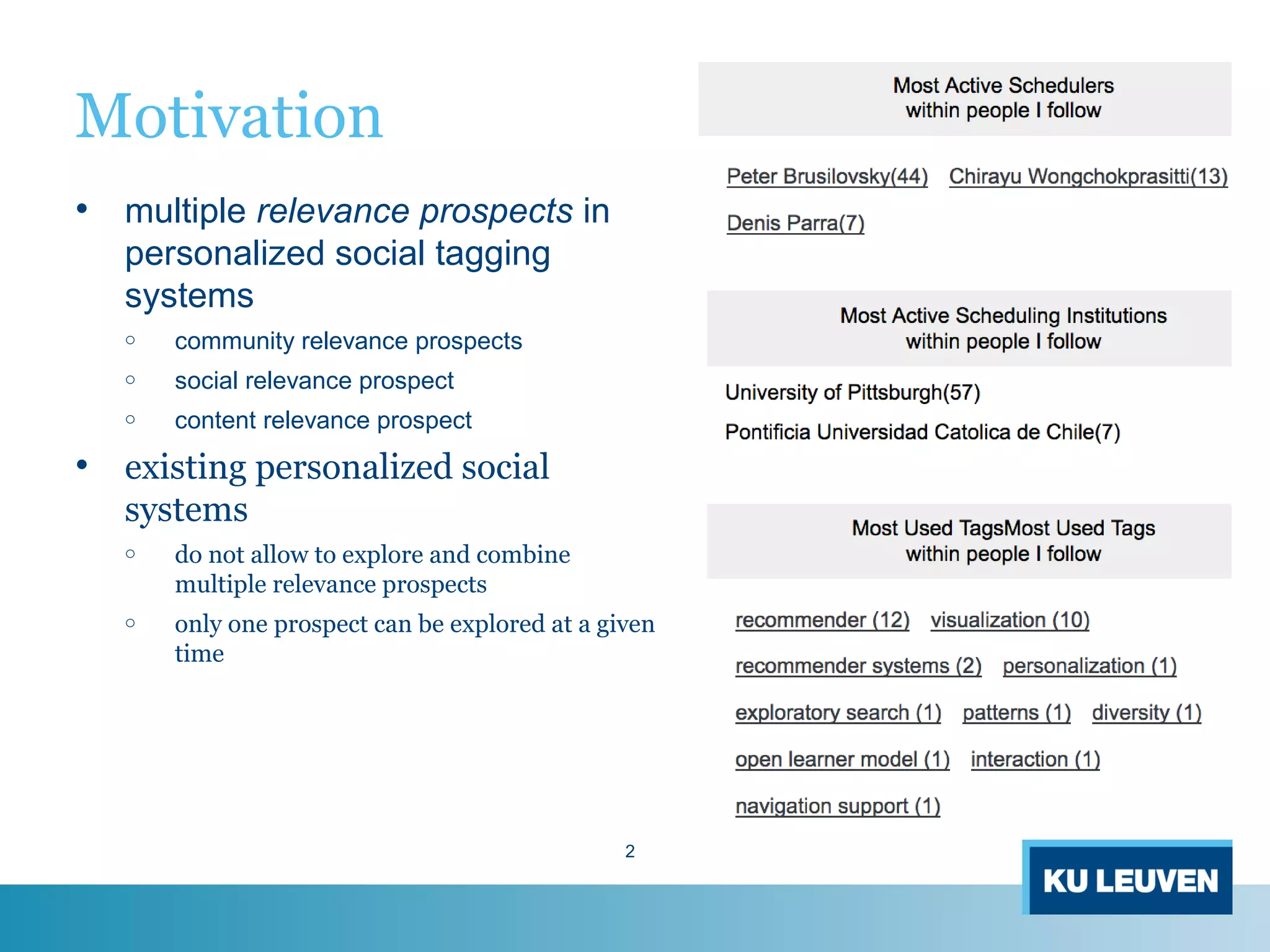
Motivation
• multiple relevance prospects in
personalized social tagging
systems
o community relevance prospects
o social relevance prospect
o content relevance prospect
• existing personalized social
systems
o do not allow to explore and combine
multiple relevance prospects
o only one prospect can be explored at a given
time
2
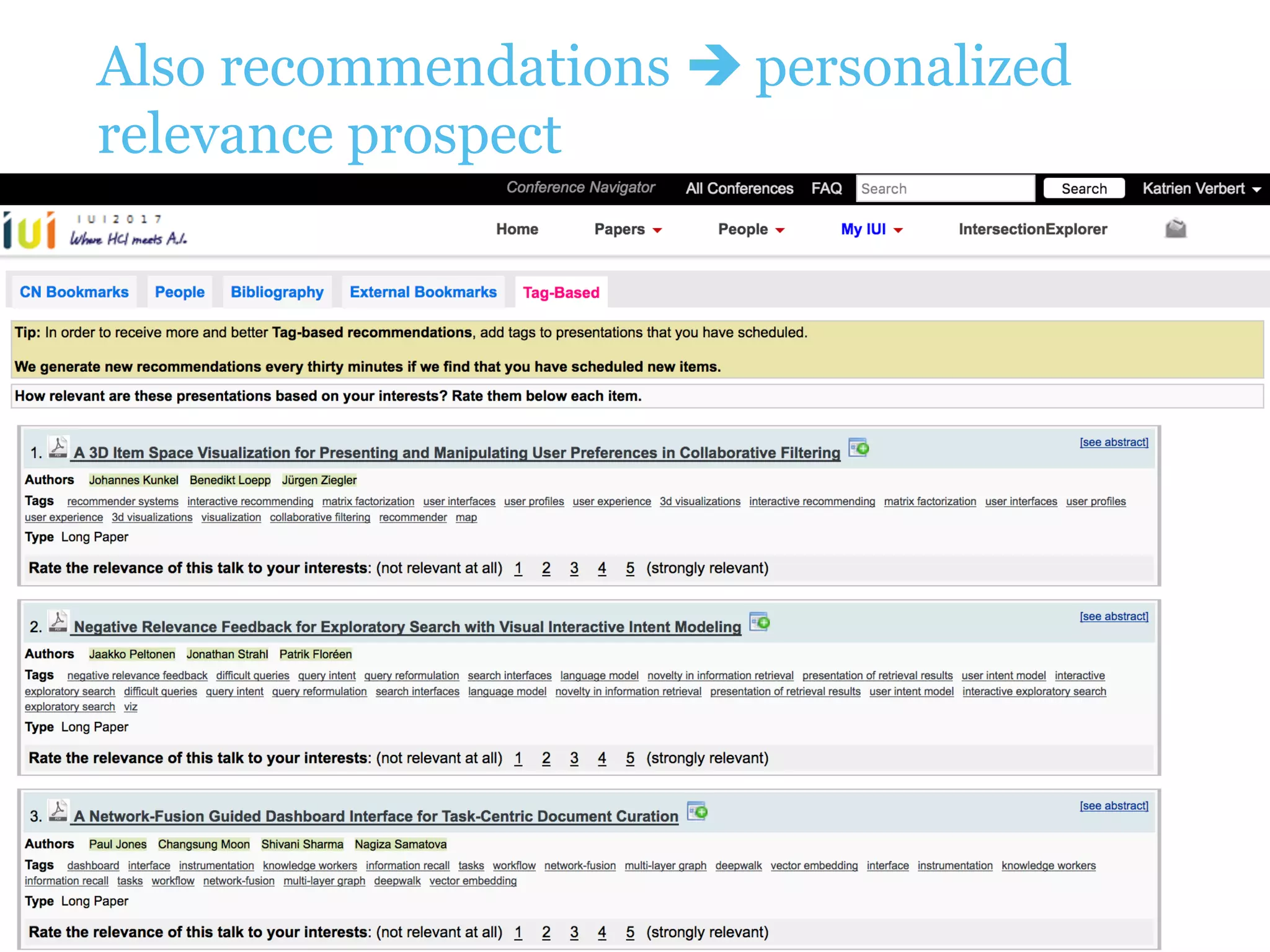
Also recommendations  personalized
relevance prospect
3
Shortcomings recommender systems
• cold-start issues
• difficult to explain the rationale behind recommendations
• user control has positive effect
o several ways to control elements
o which are most effective for the user experience?
4
5
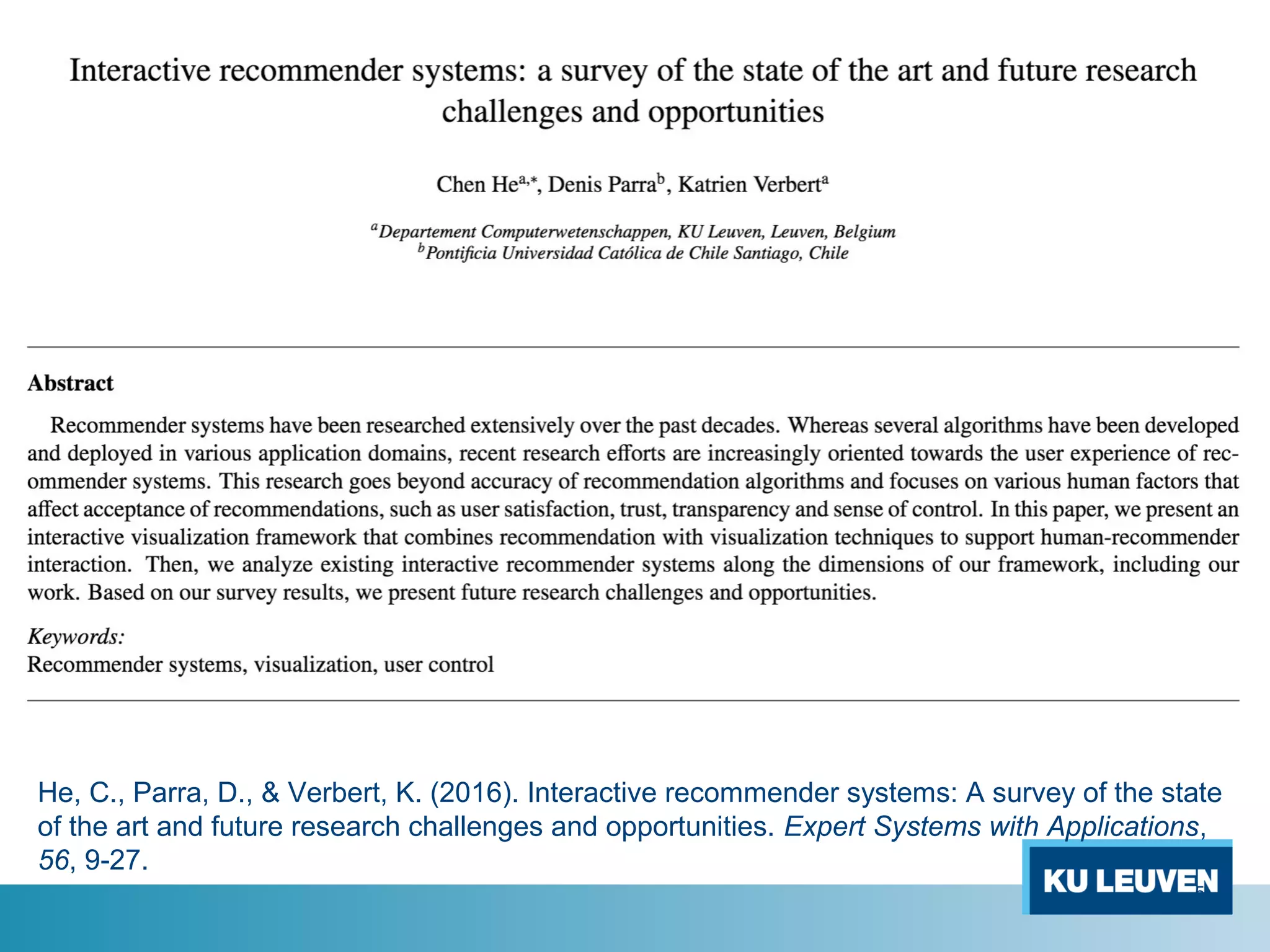
He, C., Parra, D., & Verbert, K. (2016). Interactive recommender systems: A survey of the state
of the art and future research challenges and opportunities. Expert Systems with Applications,
56, 9-27.
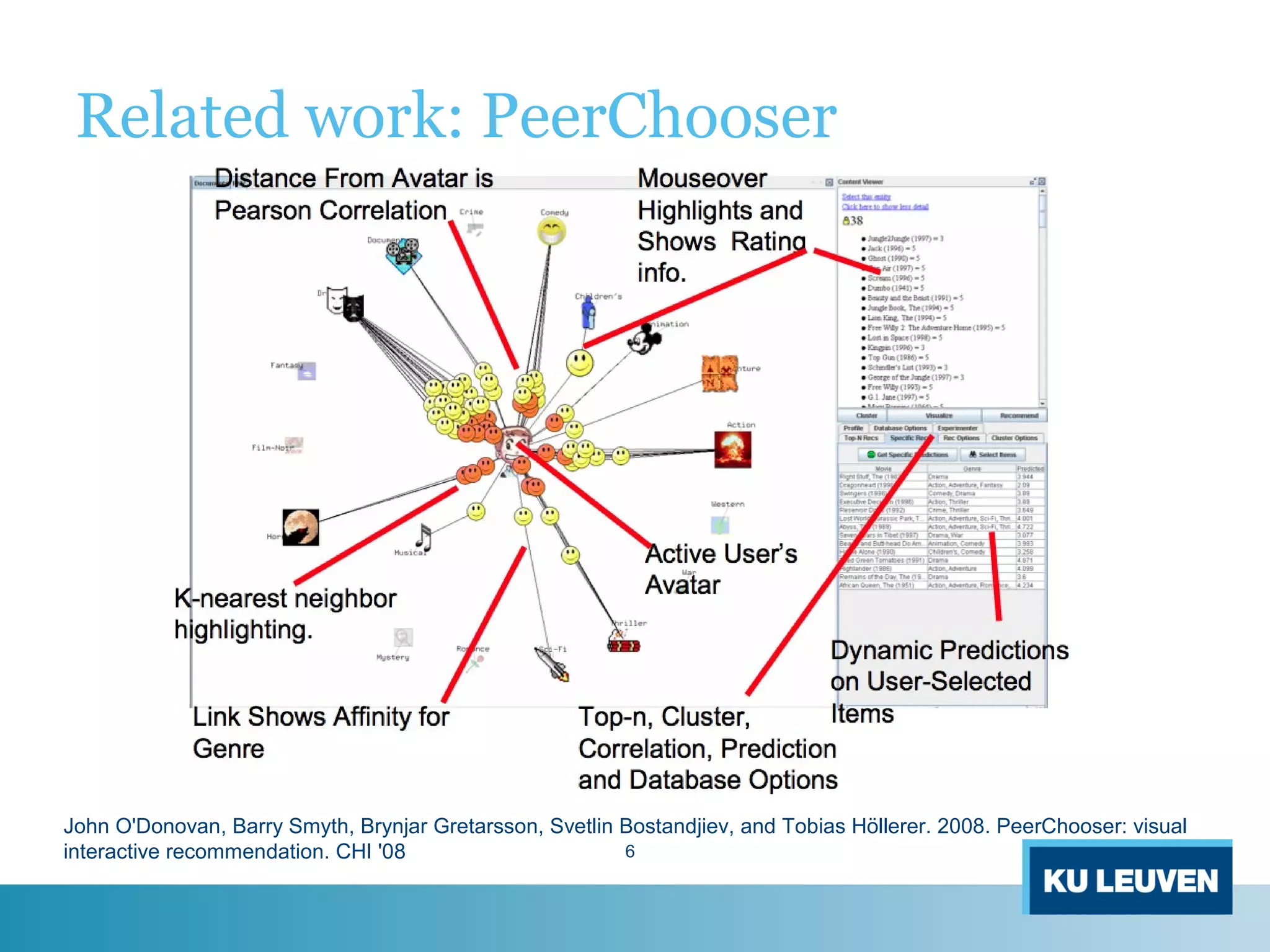
John O'Donovan, Barry Smyth, Brynjar Gretarsson, Svetlin Bostandjiev, and Tobias Höllerer. 2008. PeerChooser: visual
interactive recommendation. CHI '08
Related work: PeerChooser
6
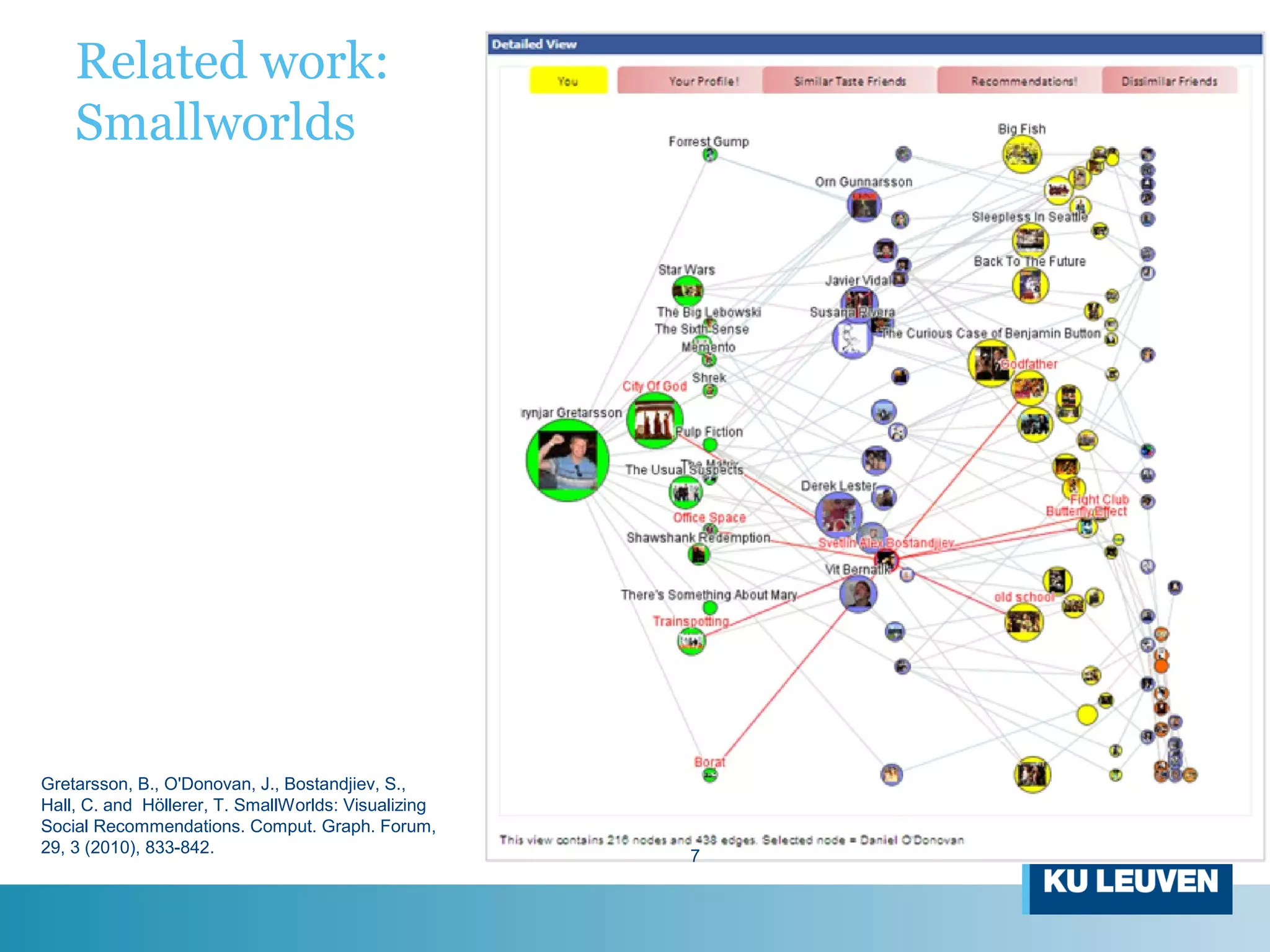
Related work:
Smallworlds
Gretarsson, B., O'Donovan, J., Bostandjiev, S.,
Hall, C. and Höllerer, T. SmallWorlds: Visualizing
Social Recommendations. Comput. Graph. Forum,
29, 3 (2010), 833-842. 7
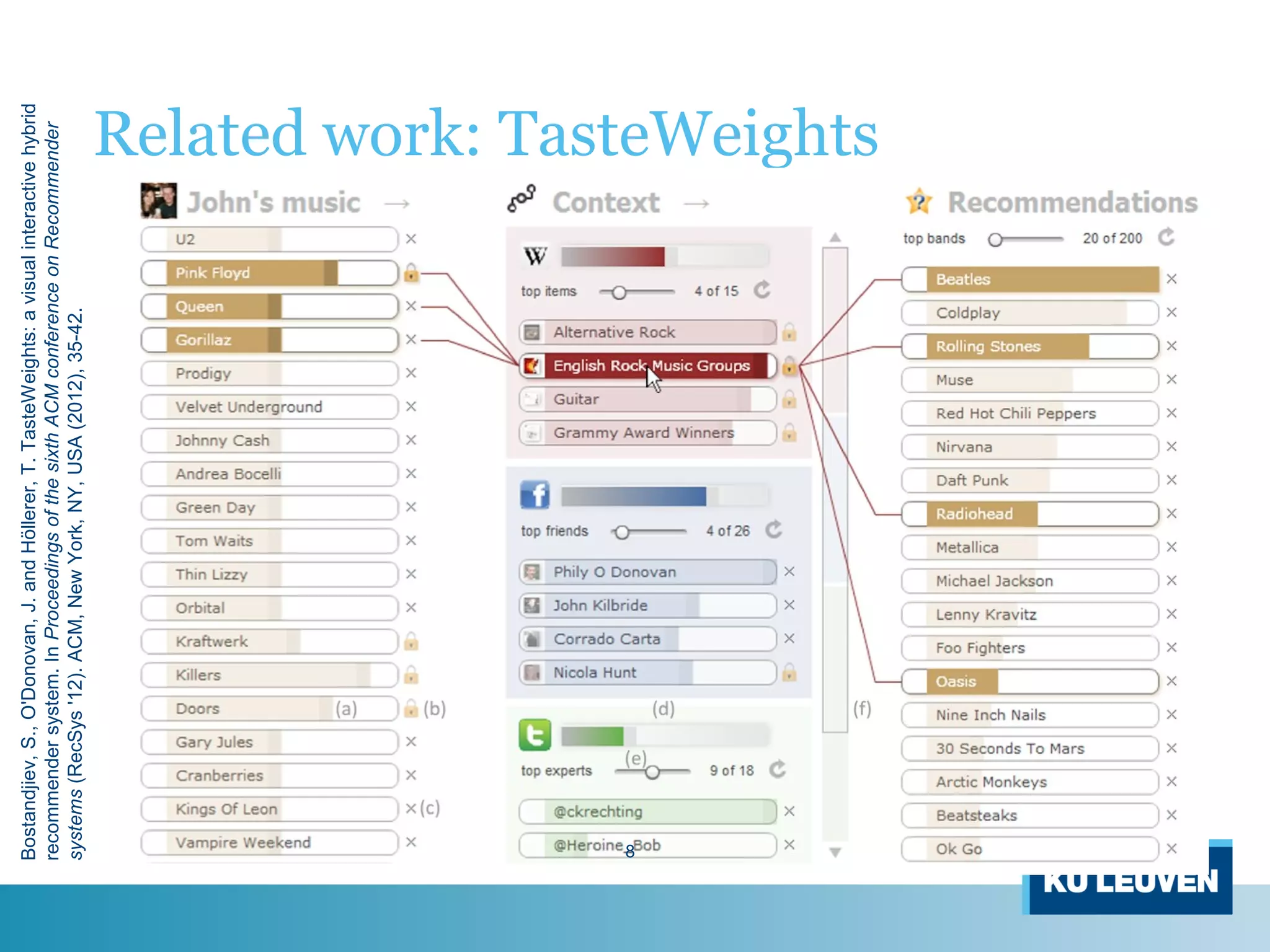
Related work: TasteWeights
Bostandjiev,S.,O'Donovan,J.andHöllerer,T.TasteWeights:avisualinteractivehybrid
recommendersystem.InProceedingsofthesixthACMconferenceonRecommender
systems(RecSys'12).ACM,NewYork,NY,USA(2012),35-42.
8
Contributions
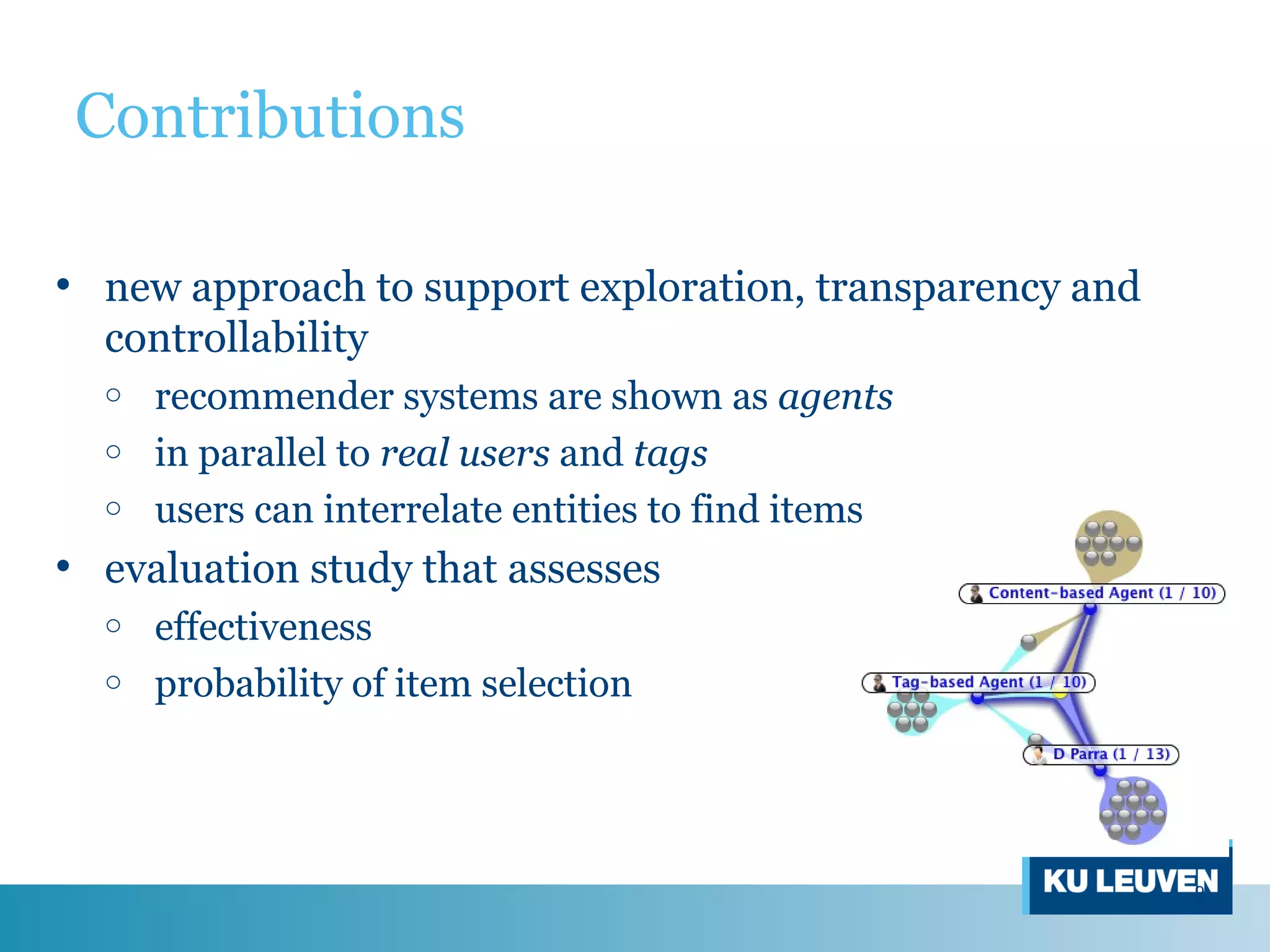
• new approach to support exploration, transparency and
controllability
o recommender systems are shown as agents
o in parallel to real users and tags
o users can interrelate entities to find items
• evaluation study that assesses
o effectiveness
o probability of item selection
9
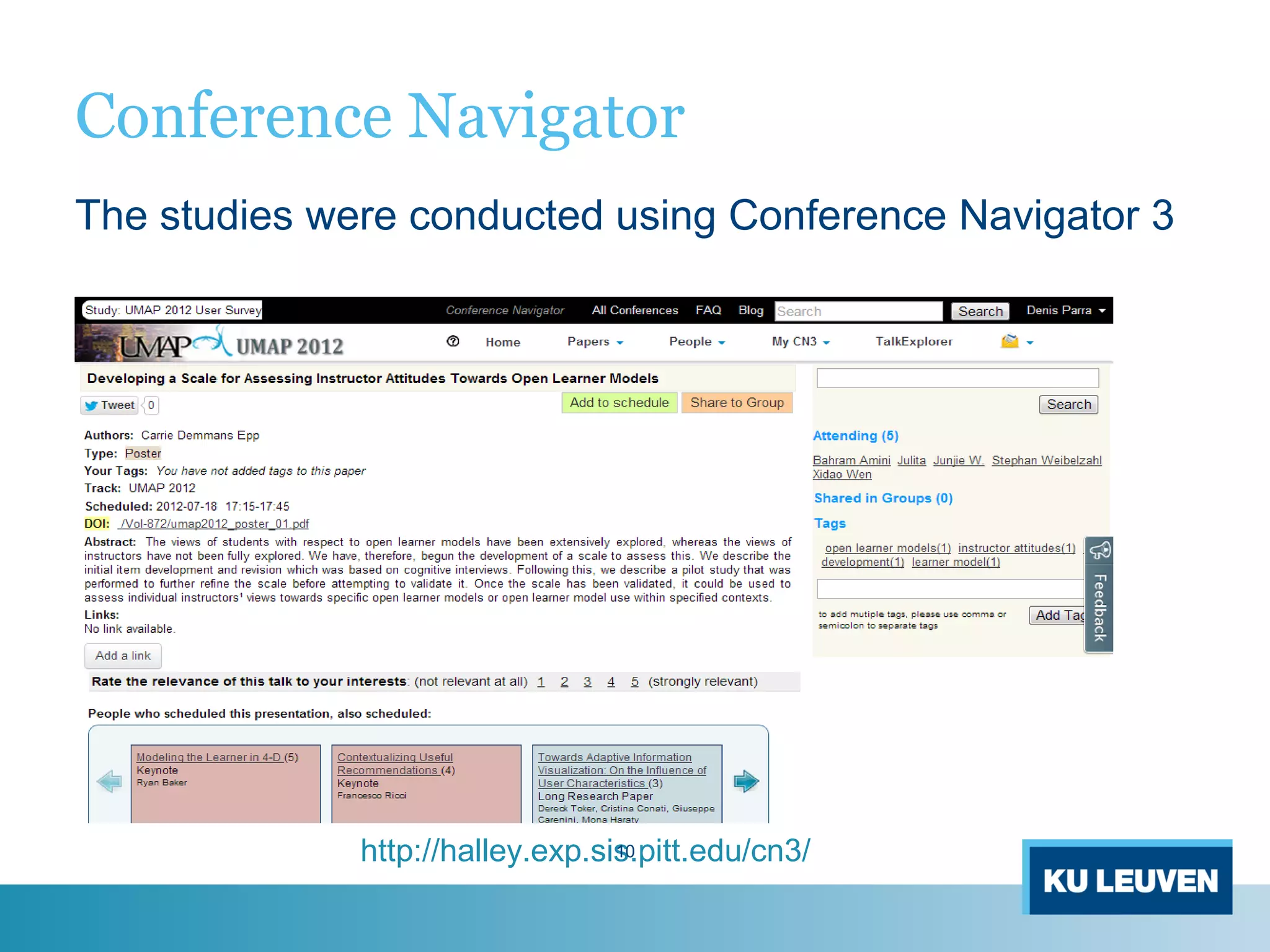
Conference Navigator
The studies were conducted using Conference Navigator 3
http://halley.exp.sis.pitt.edu/cn3/10
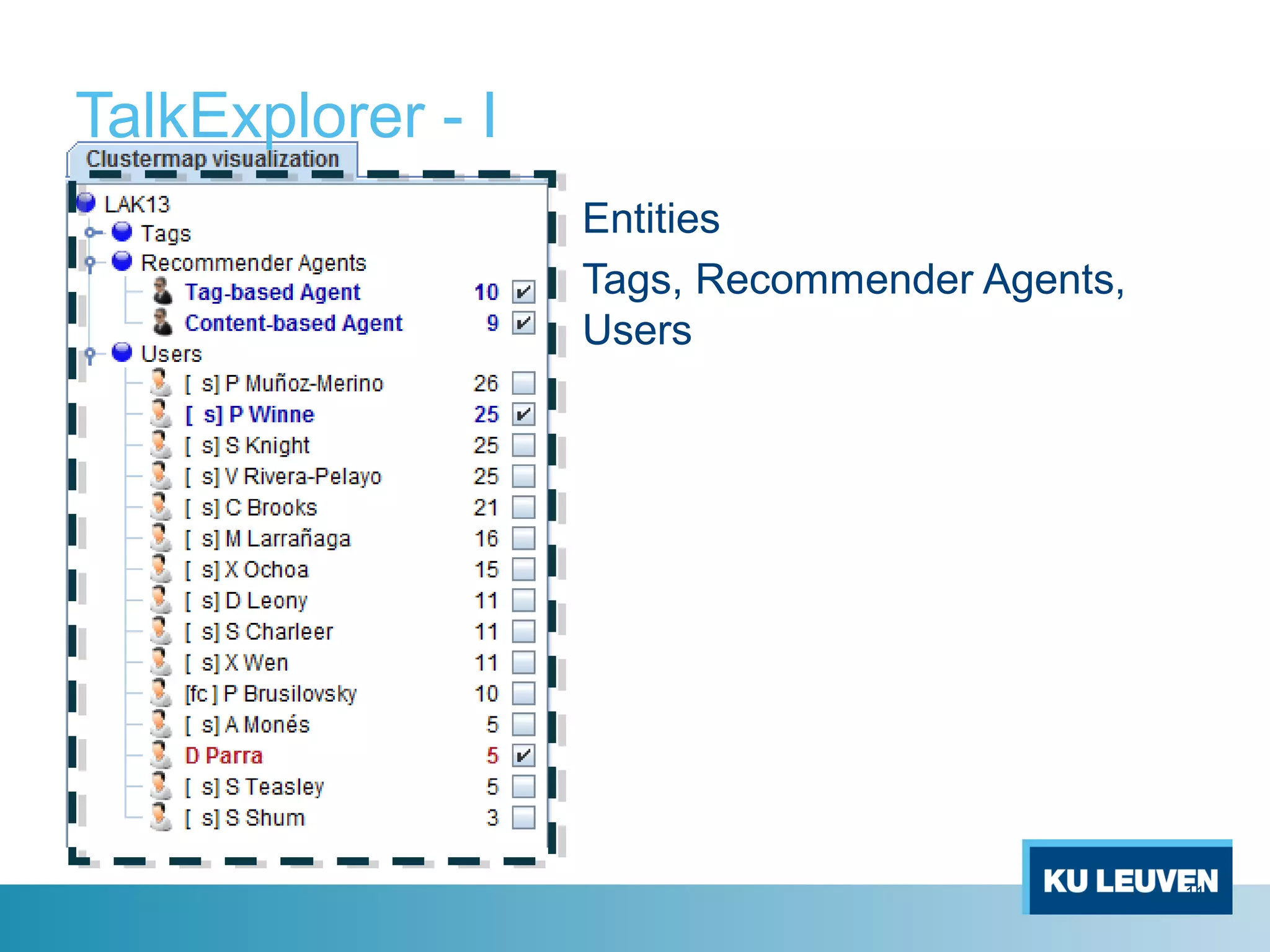
TalkExplorer - I
11
Entities
Tags, Recommender Agents,
Users
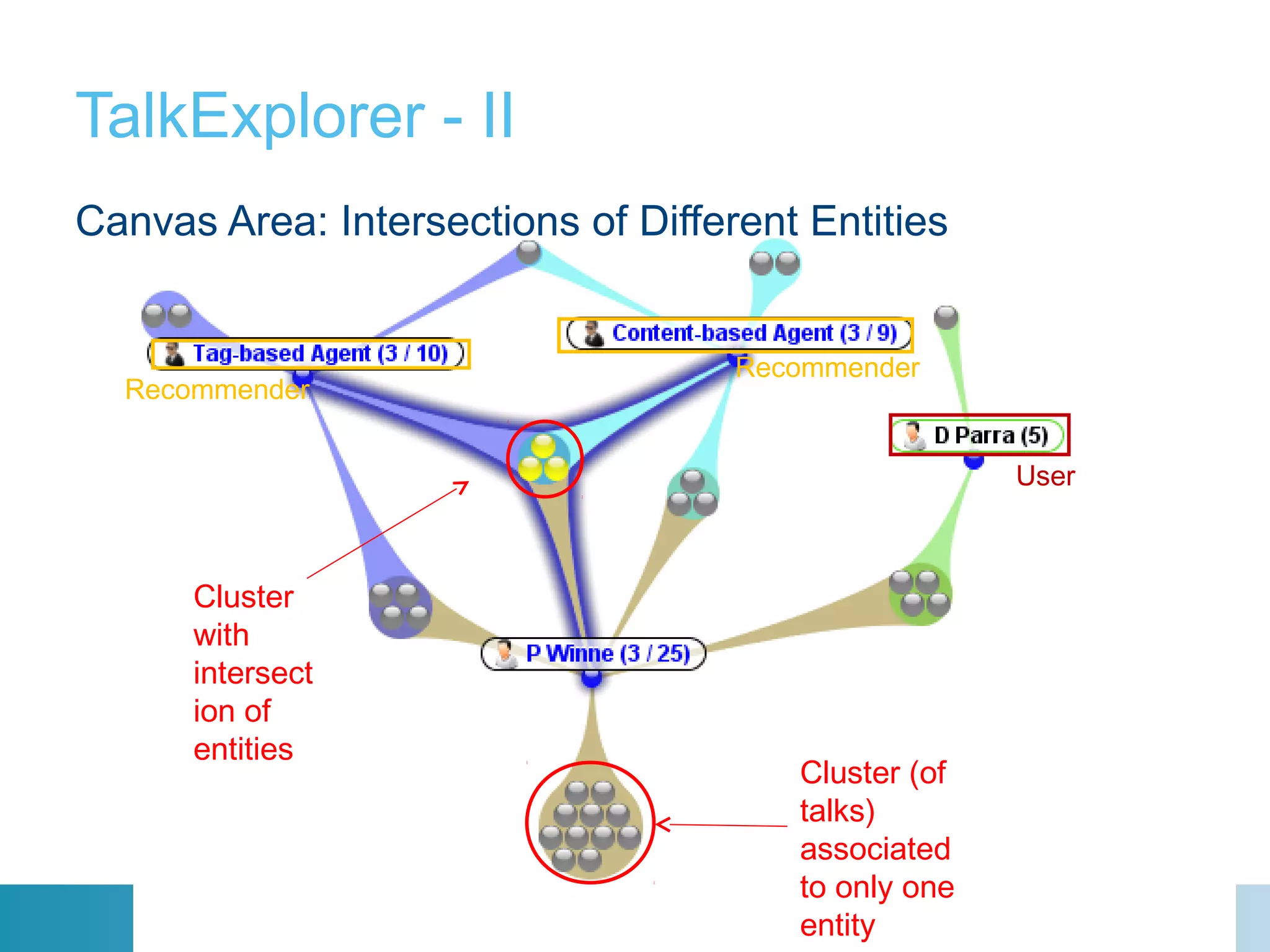
TalkExplorer - II
Recommender
Recommender
Cluster
with
intersect
ion of
entities
Cluster (of
talks)
associated
to only one
entity
Canvas Area: Intersections of Different Entities
User
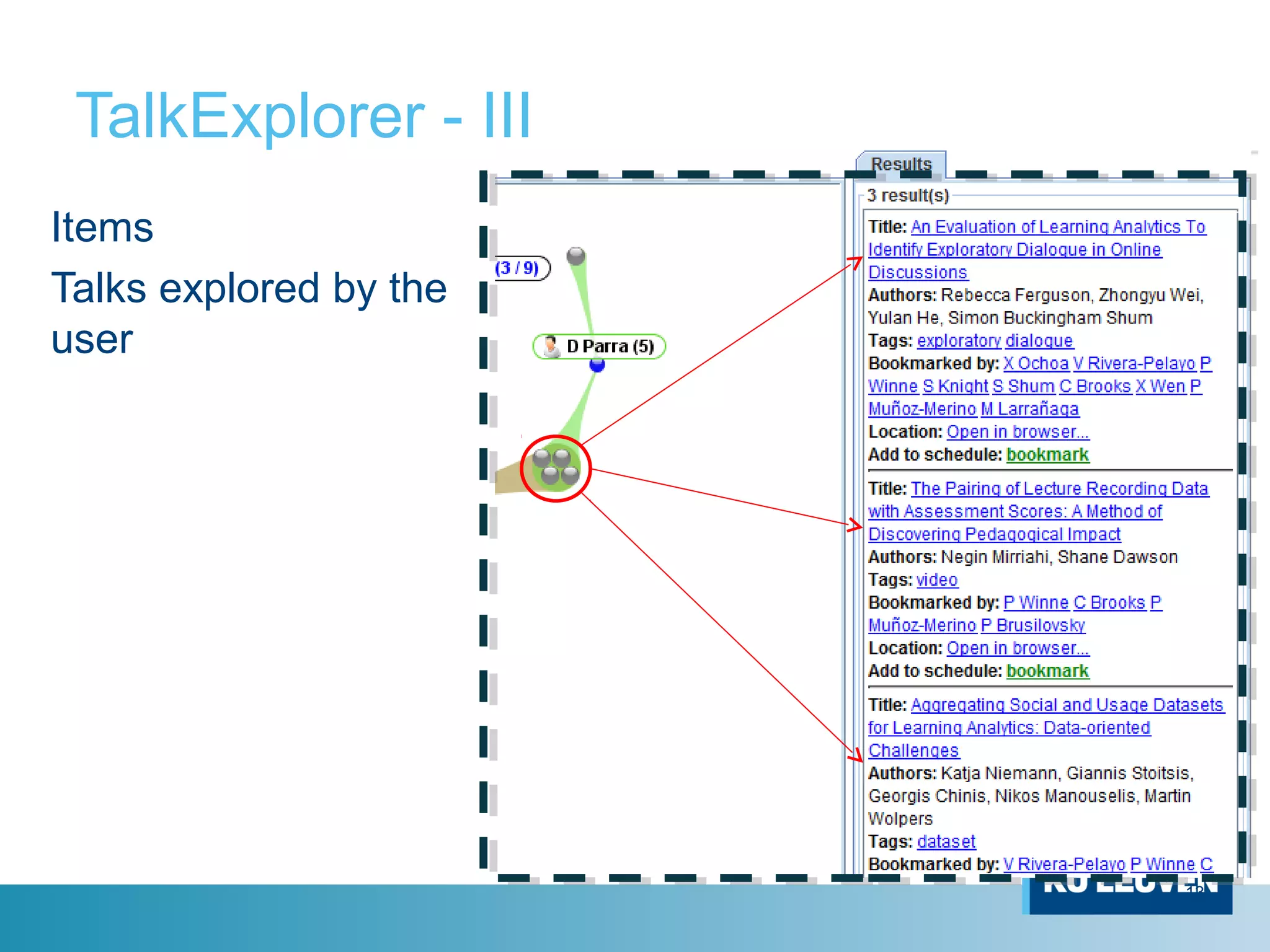
TalkExplorer - III
13
Items
Talks explored by the
user
Our Assumptions
• Items which are relevant in more that one aspect could be
more valuable to the users
• Displaying multiple aspects of relevance visually is
important for the users in the process of item’s exploration
14
User study 1
• Setup
o supervised user study
o 21 participants at UMAP 2012 and ACM Hypertext 2012 conferences
• Procedure
o Tasks
• interact with users and their bookmarks
• interact with agents
• interact with tags
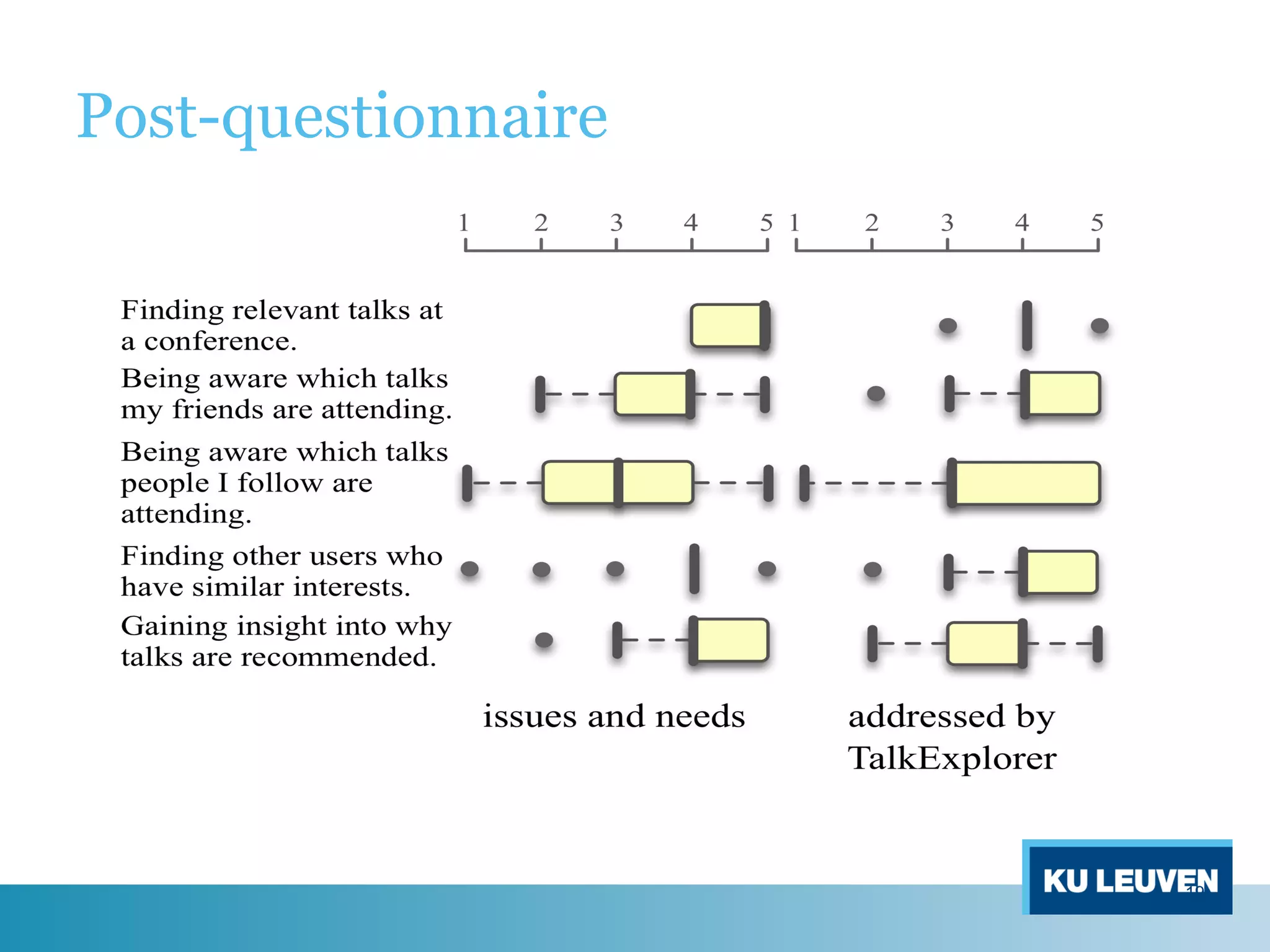
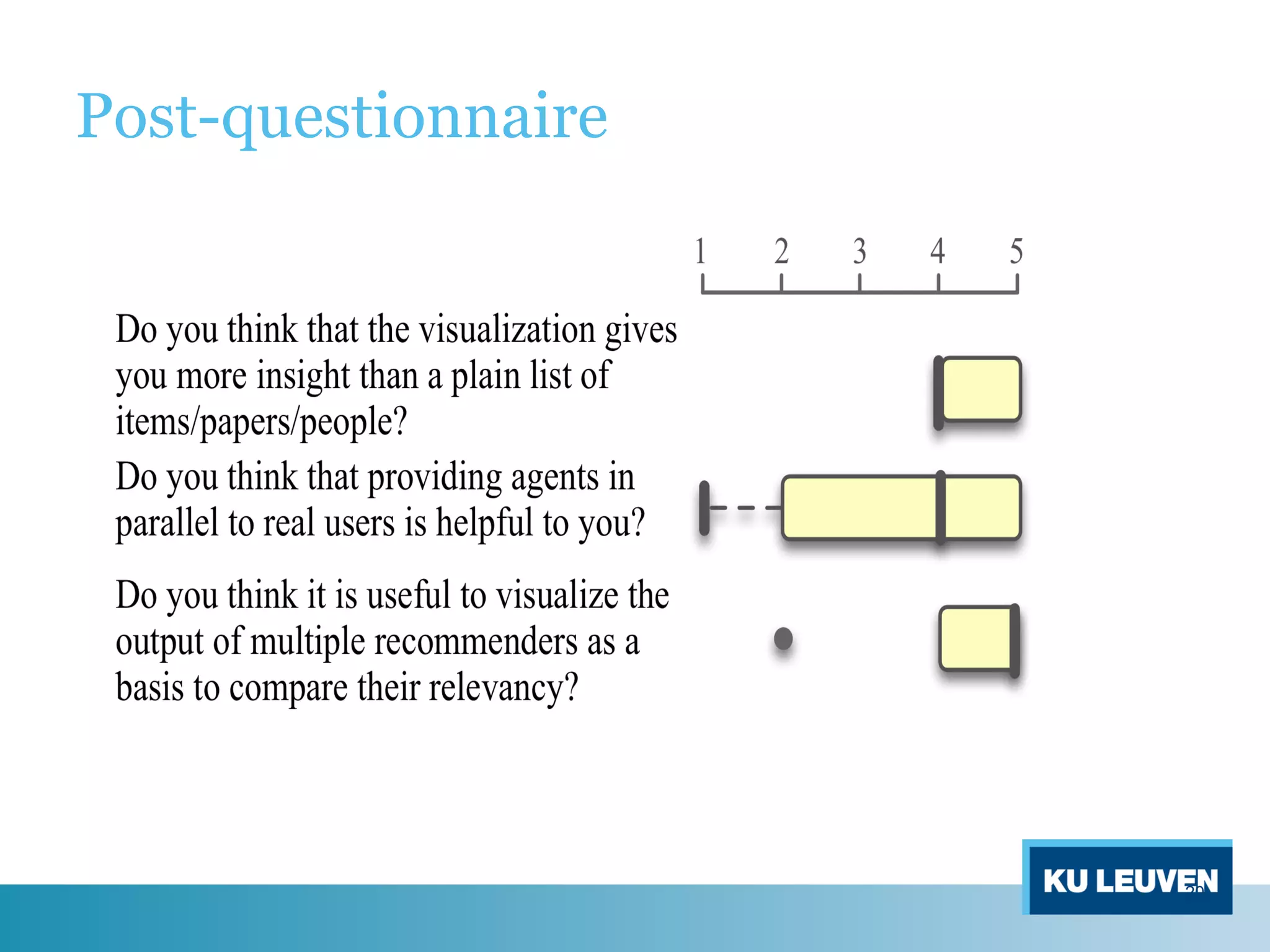
o Post-questionnaire
15
Evaluation
• Data collection
o recordings of voice and screen using camtasia studio
o system logs
• Measurements
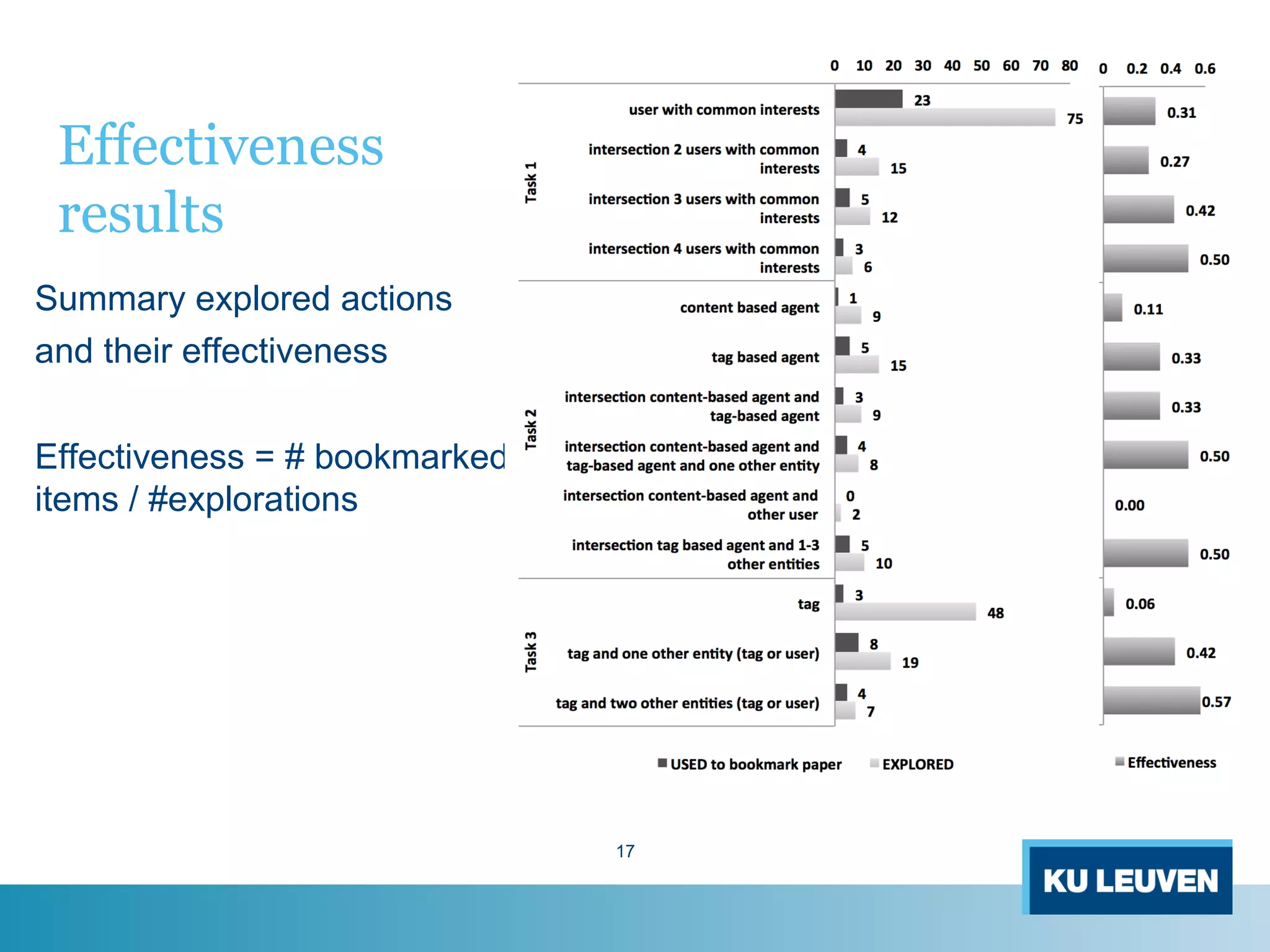
o effectiveness: # bookmarked items / #explorations
o yield: : # bookmarked items / sum of items in selection set
16
Effectiveness
results
Summary explored actions
and their effectiveness
Effectiveness = # bookmarked
items / #explorations
17
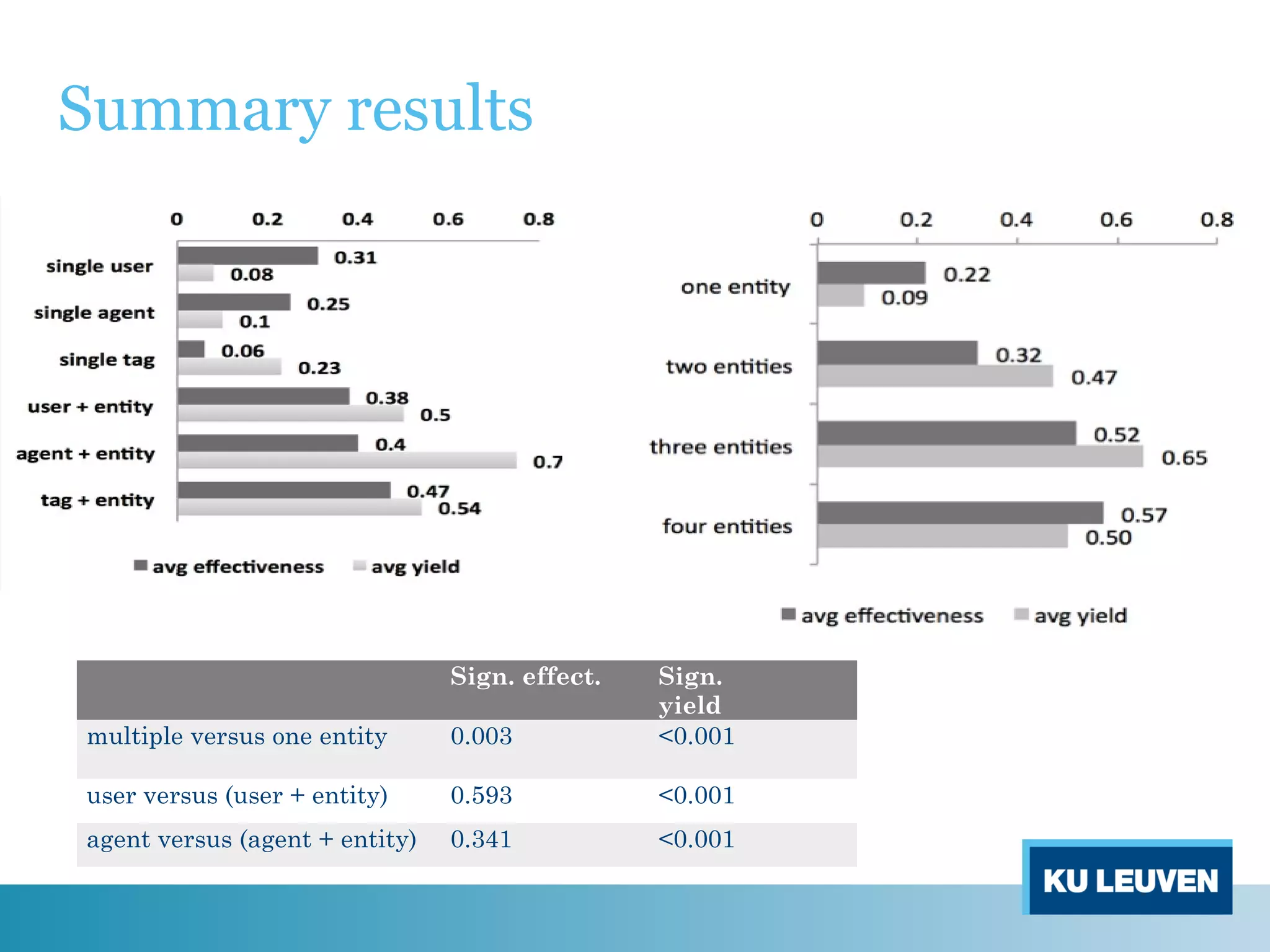
Summary results
  Sign. effect. Sign.
yield
multiple versus one entity 0.003 <0.001
user versus (user + entity) 0.593 <0.001
agent versus (agent + entity) 0.341 <0.001
Post-questionnaire
19
Post-questionnaire
20
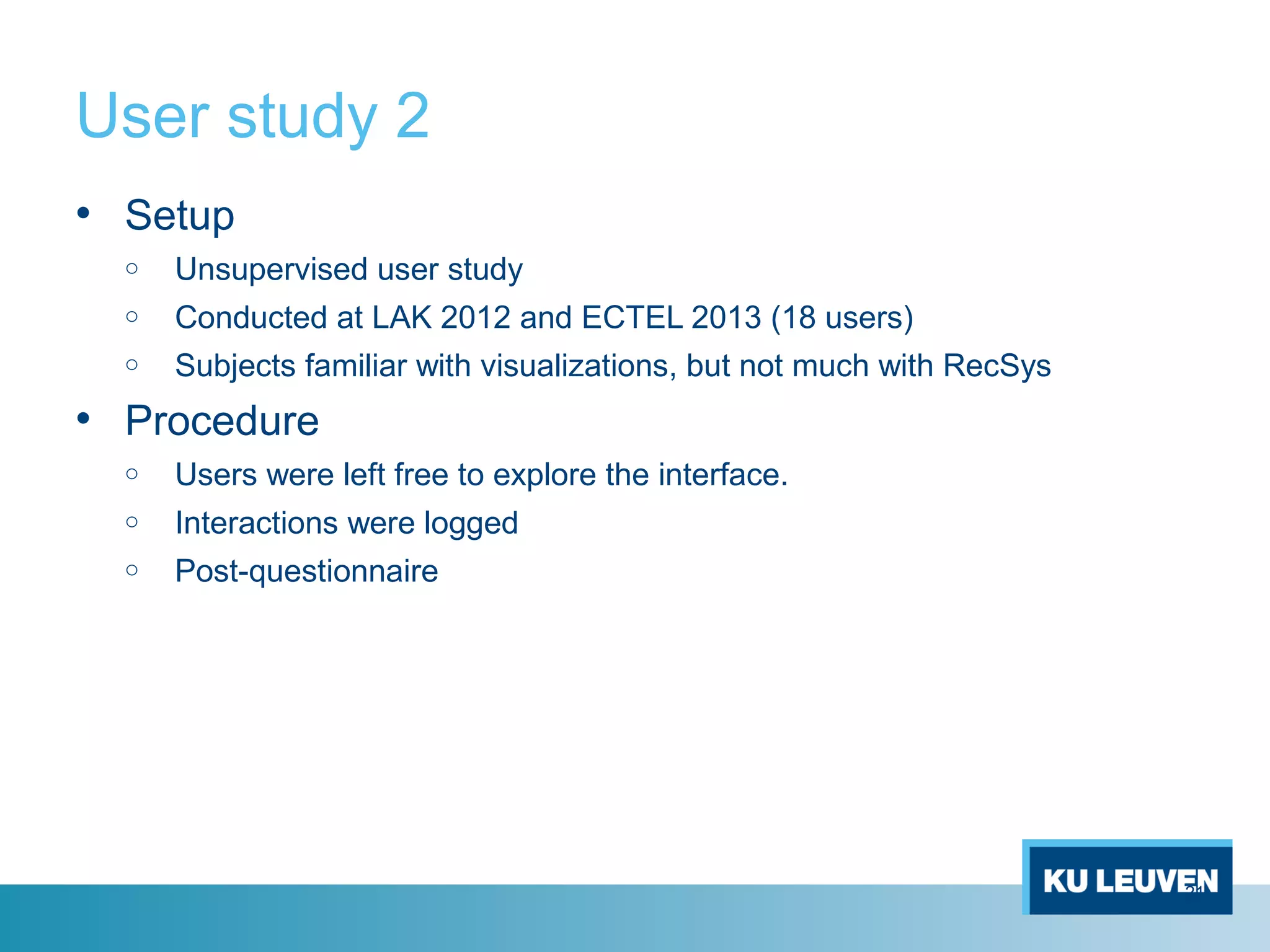
User study 2
• Setup
o Unsupervised user study
o Conducted at LAK 2012 and ECTEL 2013 (18 users)
o Subjects familiar with visualizations, but not much with RecSys
• Procedure
o Users were left free to explore the interface.
o Interactions were logged
o Post-questionnaire
21
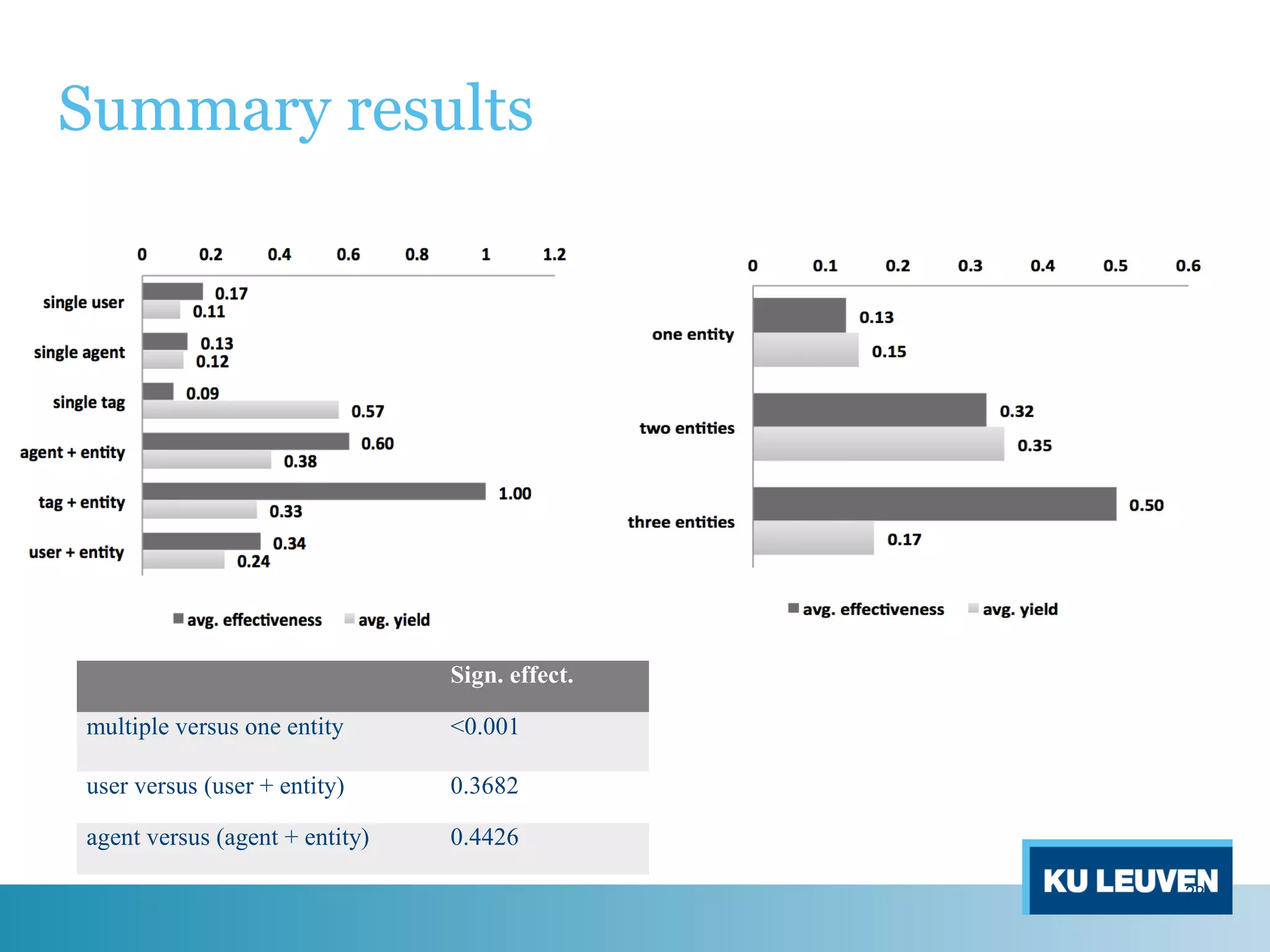
Summary results
22
  Sign. effect.
multiple versus one entity <0.001
user versus (user + entity) 0.3682
agent versus (agent + entity) 0.4426
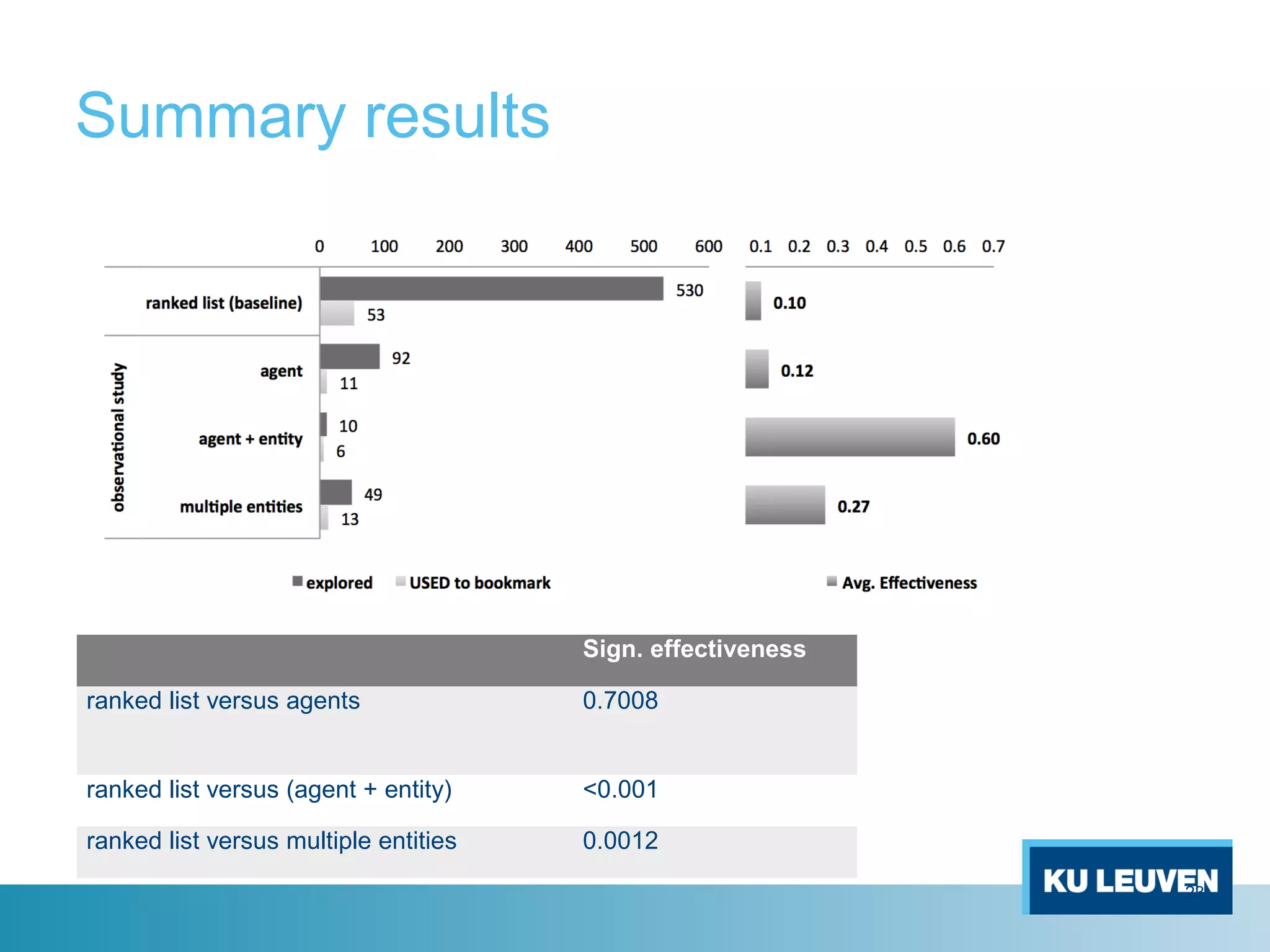
Summary results
  Sign. effectiveness
ranked list versus agents 0.7008
ranked list versus (agent + entity) <0.001
ranked list versus multiple entities 0.0012
23
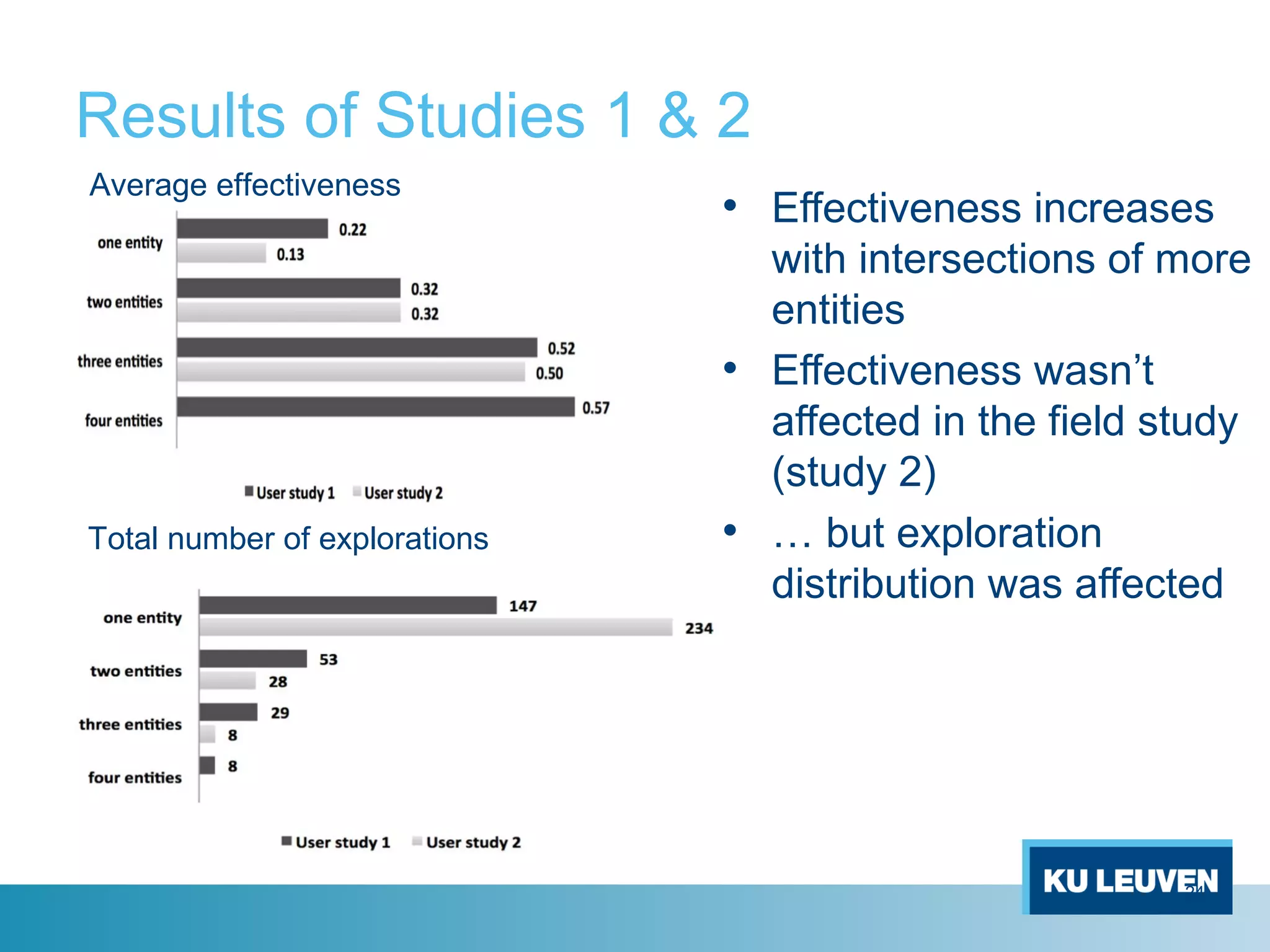
Results of Studies 1 & 2
• Effectiveness increases
with intersections of more
entities
• Effectiveness wasn’t
affected in the field study
(study 2)
• … but exploration
distribution was affected
Average effectiveness
Total number of explorations
24
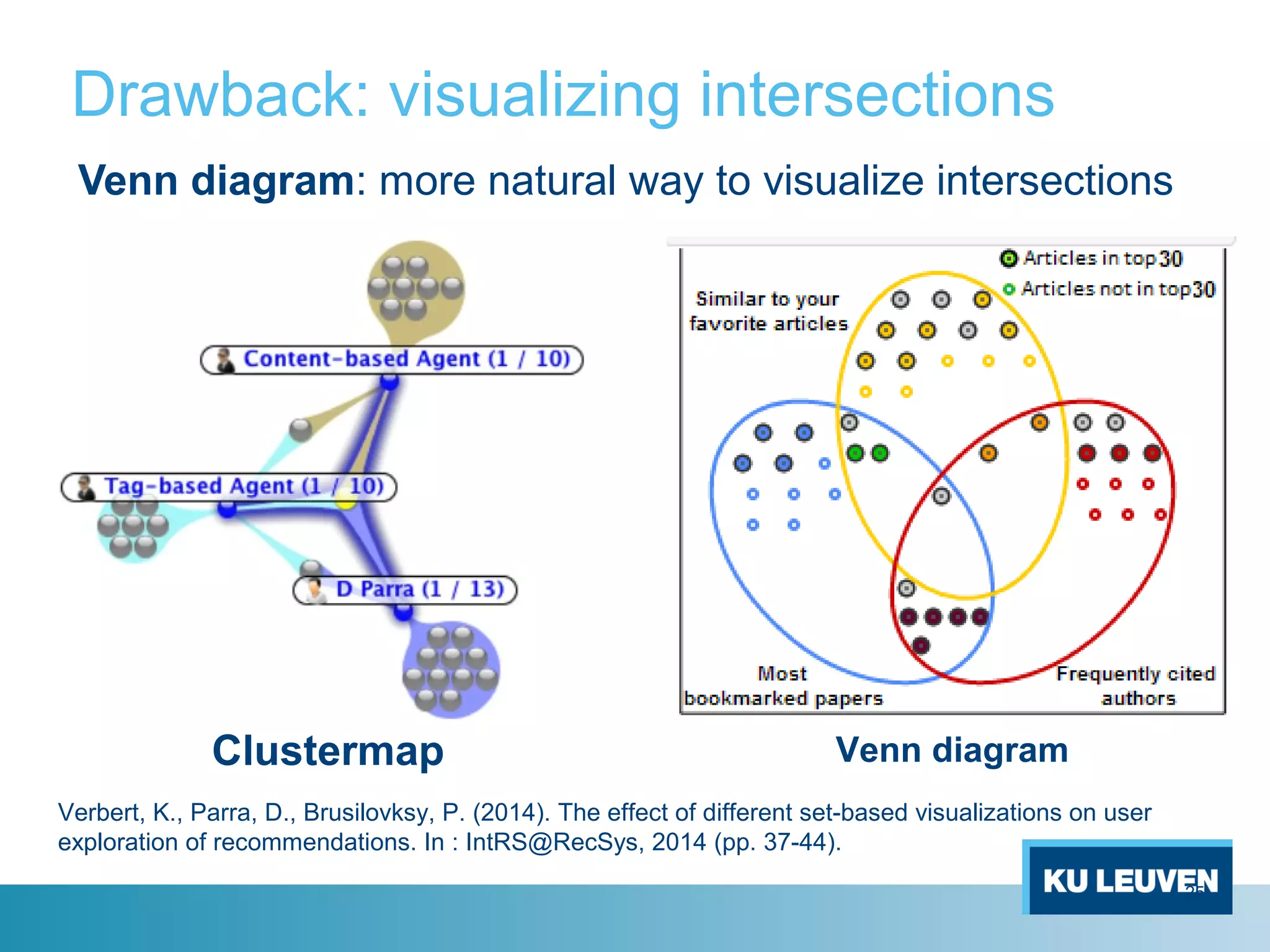
Drawback: visualizing intersections
Clustermap Venn diagram
Venn diagram: more natural way to visualize intersections
25
Verbert, K., Parra, D., Brusilovksy, P. (2014). The effect of different set-based visualizations on user
exploration of recommendations. In : IntRS@RecSys, 2014 (pp. 37-44).
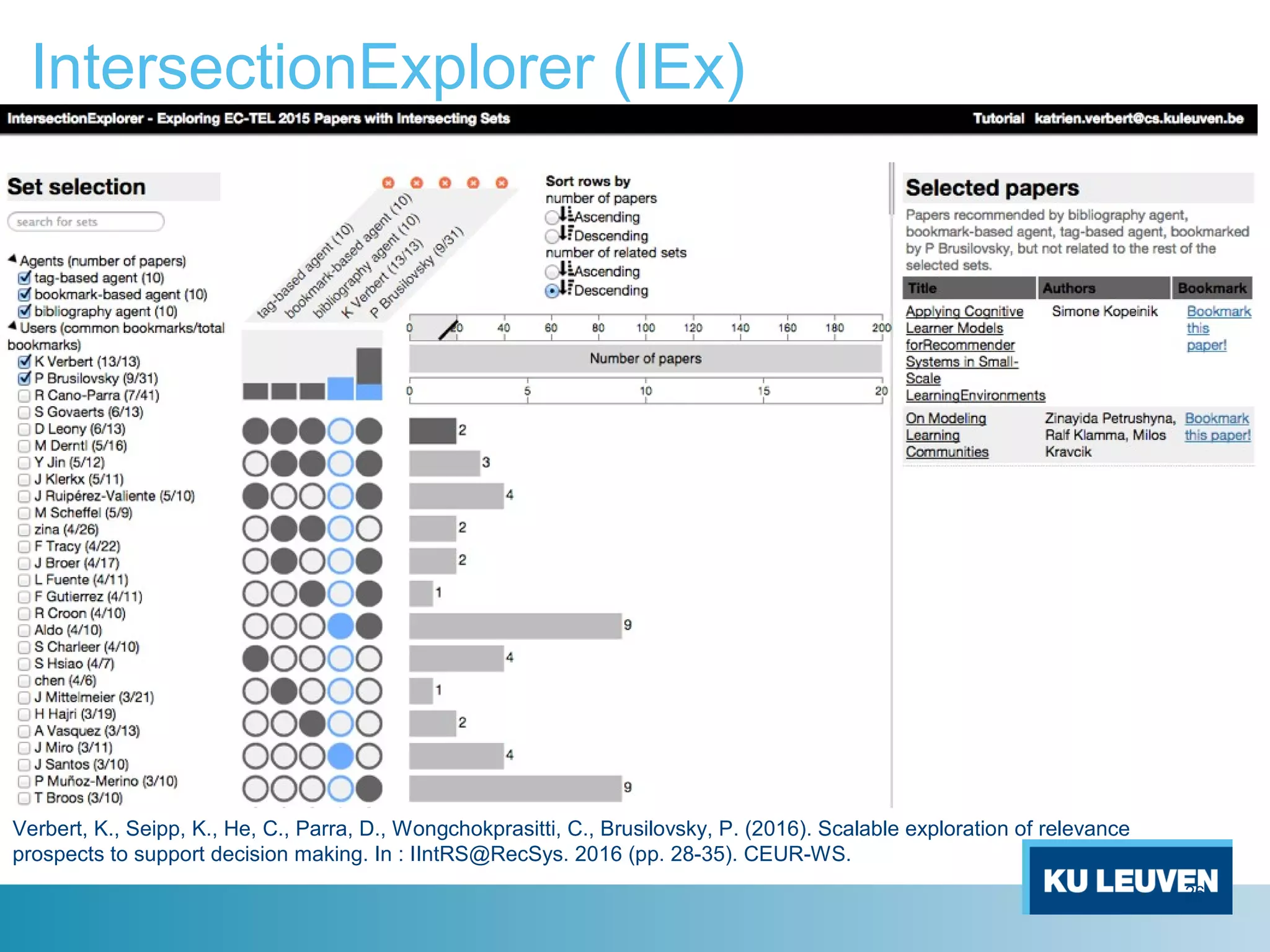
IntersectionExplorer (IEx)
26
Verbert, K., Seipp, K., He, C., Parra, D., Wongchokprasitti, C., Brusilovsky, P. (2016). Scalable exploration of relevance
prospects to support decision making. In : IIntRS@RecSys. 2016 (pp. 28-35). CEUR-WS.
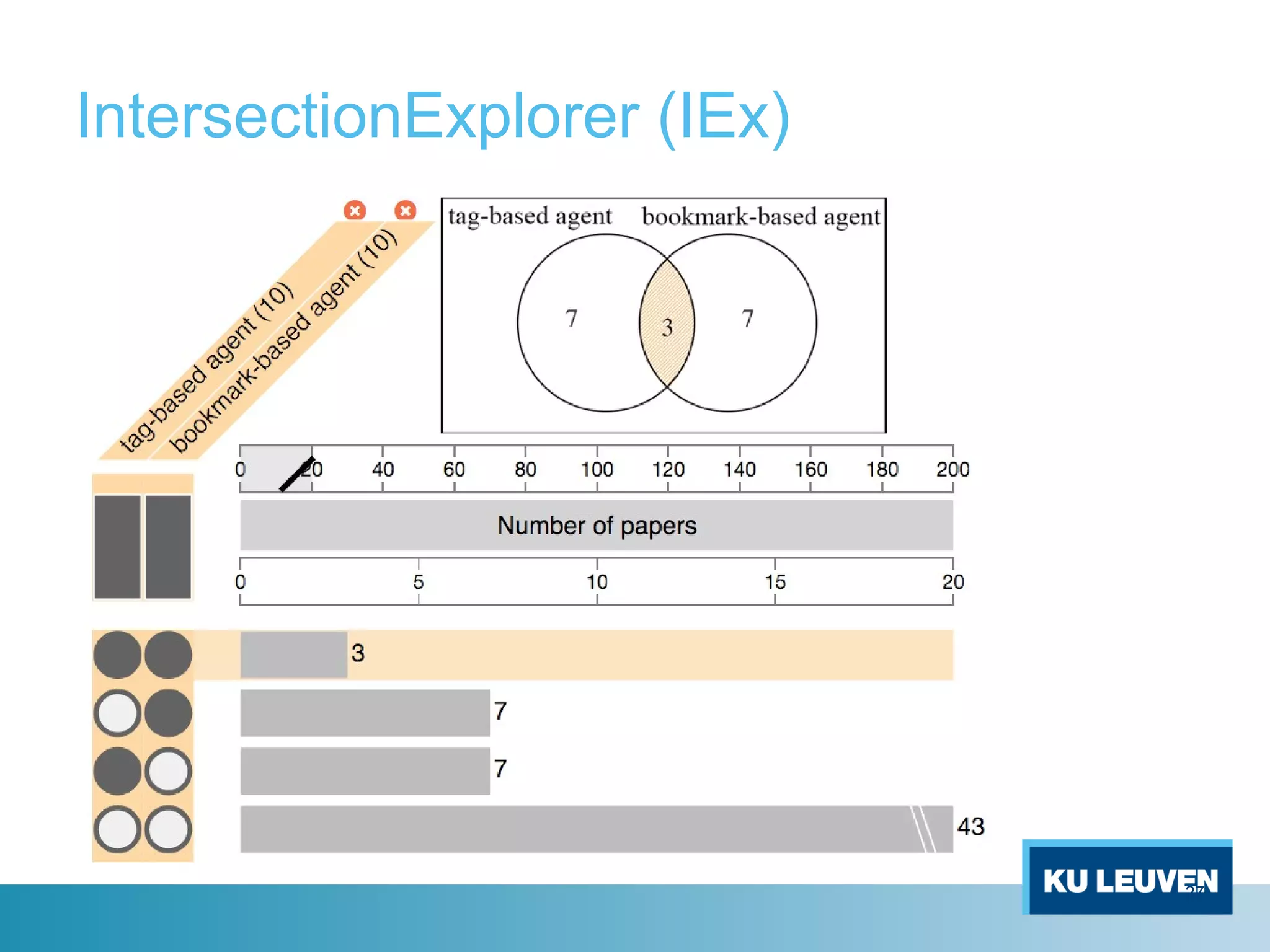
IntersectionExplorer (IEx)
27
Feedback very welcome!
Please participate in a short user study:
http://halley.exp.sis.pitt.edu/cn3/iestudy3.php?conferenceID=
148
28
Thank you!
Katrien.verbert@cs.kuleuven.be
peterb@pitt.edu
denisparra@gmail.com
29

Agents vs Users: Visual Recommendation of Research Talks with Multiple Dimension of Relevance

Editor's Notes

  • #3 Our work has been motivated by the presence of multiple relevance prospects in modern social tagging systems. An important feature pioneered by social tagging systems and later used in other kinds of social systems is the ability to explore different community relevance prospects by examining items bookmarked by a specific user or items associated by various users with a specific tag. Items bookmarked by a specific user offer a social relevance prospect: if this user is known and trustable or appears to be like-minded (bookmarked a number of items known as interesting) a collection of his or her bookmarks is perceived as an interesting and relevant set that is worth to explore for more useful items. Similarly, items marked by a specific tag offer a content relevance prospect. Items related to a tag of interest or a tag that was used to mark many known interesting items are also perceived as potentially relevant and worth to explore. In a social tagging system extended with a personalized recommender engine
  • #7 Related work: peerchooser John O&amp;apos;Donovan, Barry Smyth, Brynjar Gretarsson, Svetlin Bostandjiev, and Tobias Höllerer. 2008. PeerChooser: visual interactive recommendation. In Proceedings of the SIGCHI Conference on Human Factors in Computing Systems (CHI &amp;apos;08).
  • #25 - In field study, users explore mainly clusters connected to one entity Users don’t even get to explore interactions between 4 items enabling users to explore interrelationships between prospects increases probability of finding a relevant item interrelating tags with other entities increase their effectiveness significantly