
Human-Centered AI in AIED
Peter Brusilovsky
with Sergey Sosnovsky, Julio Guerra,
Jordan Barria-Pineda, Kamil
Akhuseyinoglu,
PAWS Lab
School of Computing and Information
University of Pittsburgh
• A problem with a long history in AI
– The experience of “expert systems”
• Modern issues
– Possible biases of AI-based decisions with
no ability to inspect
– Lack of trust to recommendations coming
from AI
– Limited ability to control or impact AI 2
AI vs Human?
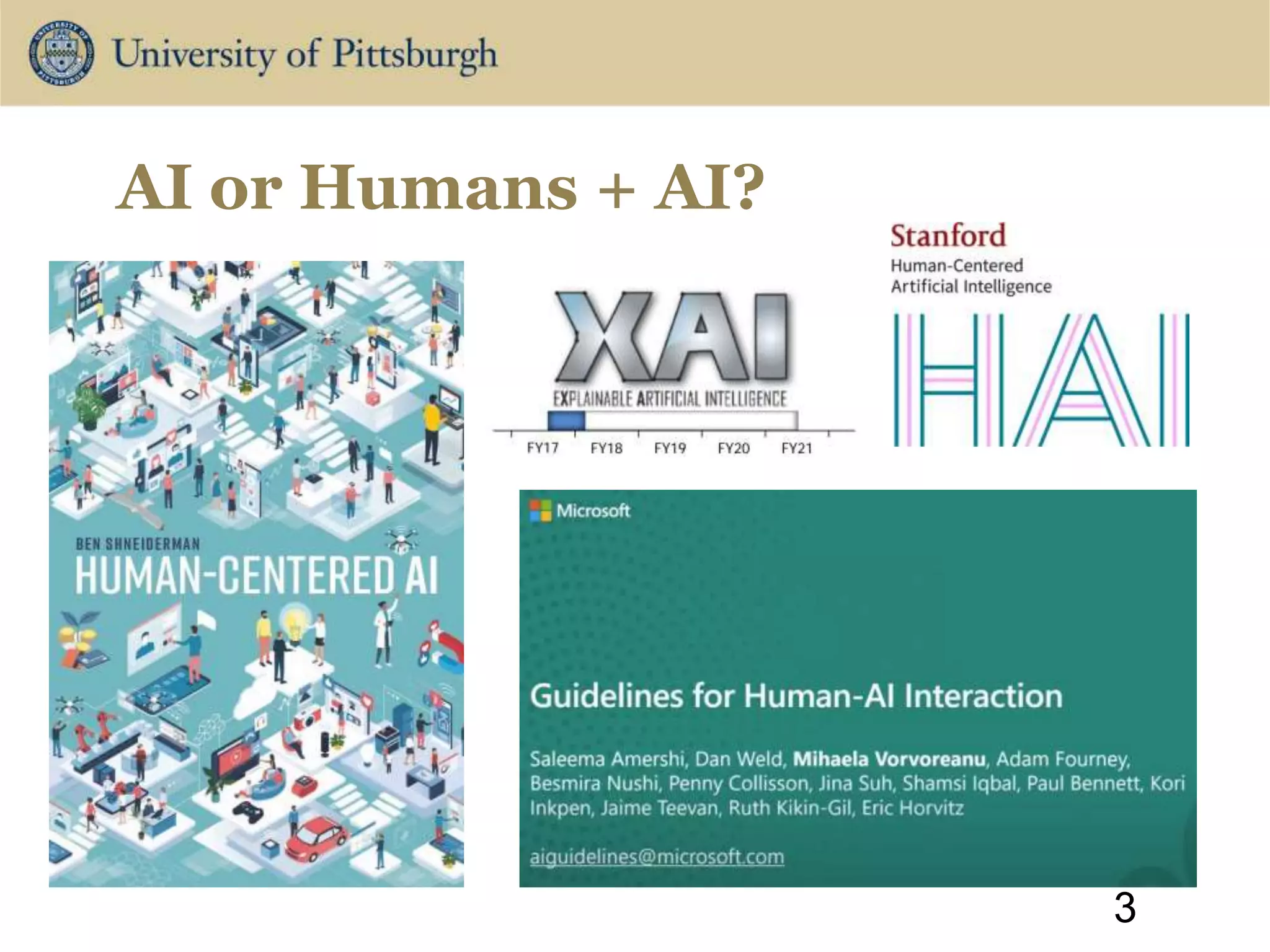
AI or Humans + AI?
3
• Transparent AI
• Explainable AI
• Human-in-the Loop AI/ML
• Human-Centered design of AI systems
• “Natural” communication with AI systems
• User interfaces for recommender systems
– Controlling and explaining recommendations
5
Growing stream of research
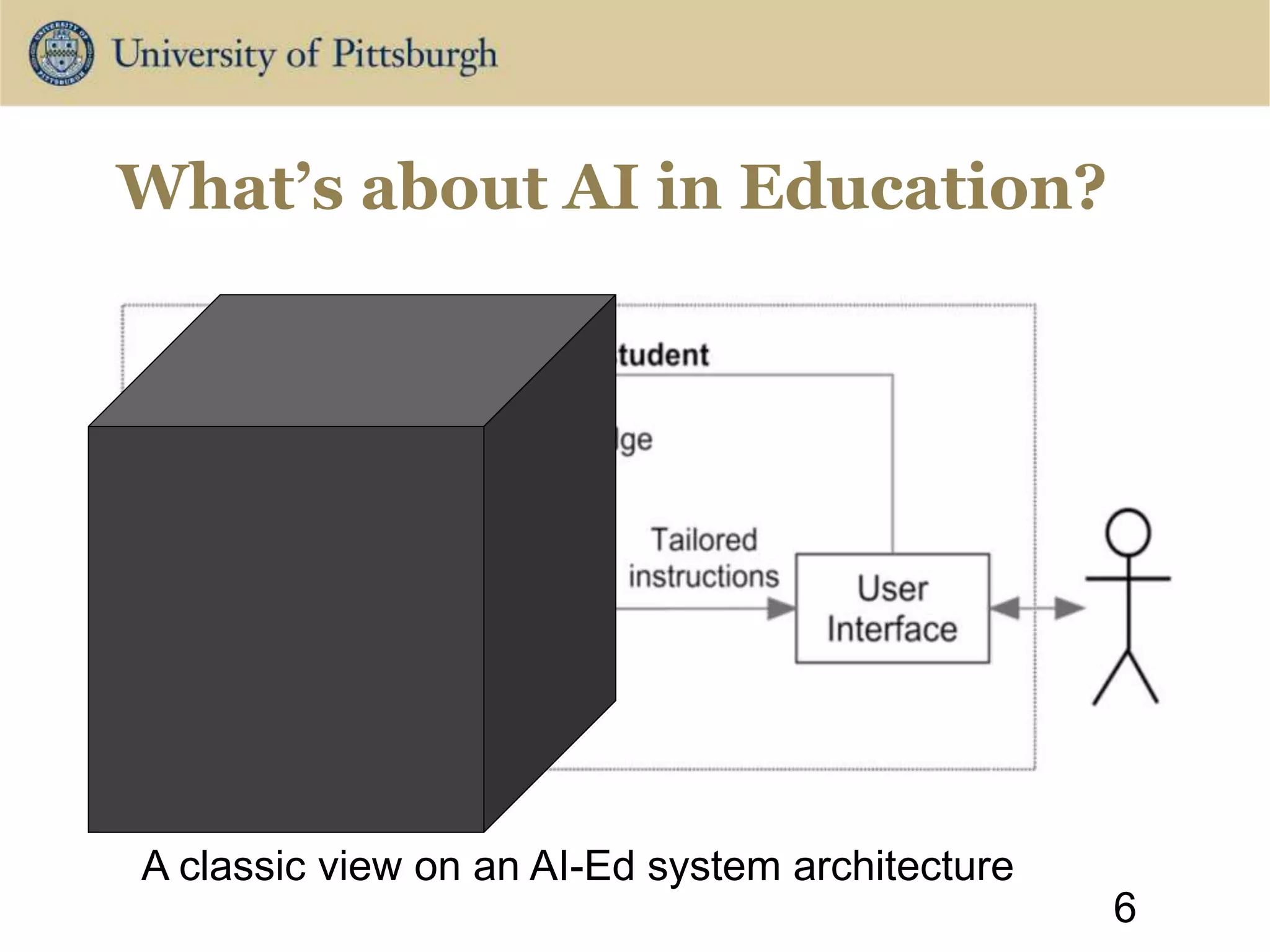
What’s about AI in Education?
6
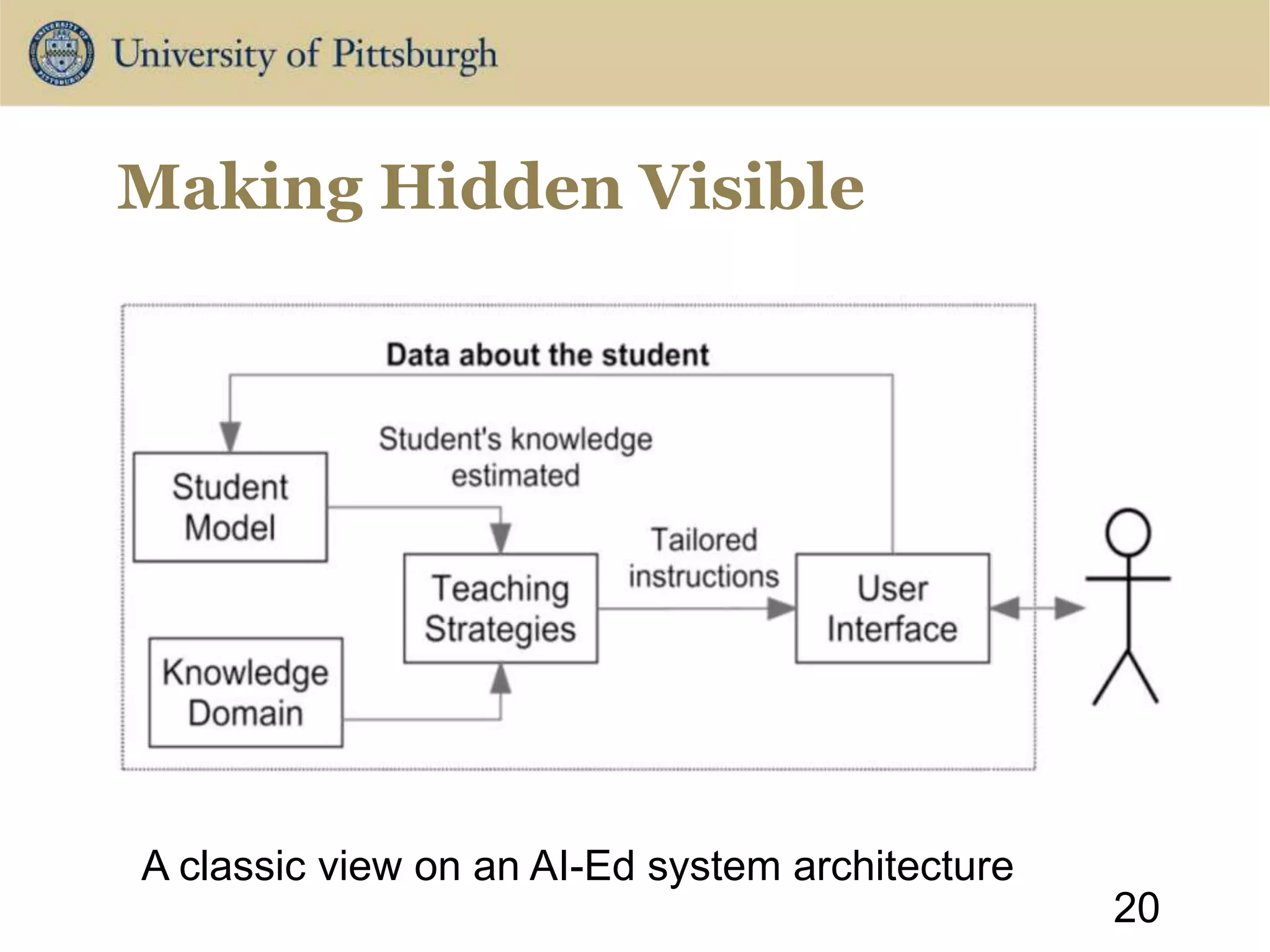
A classic view on an AI-Ed system architecture
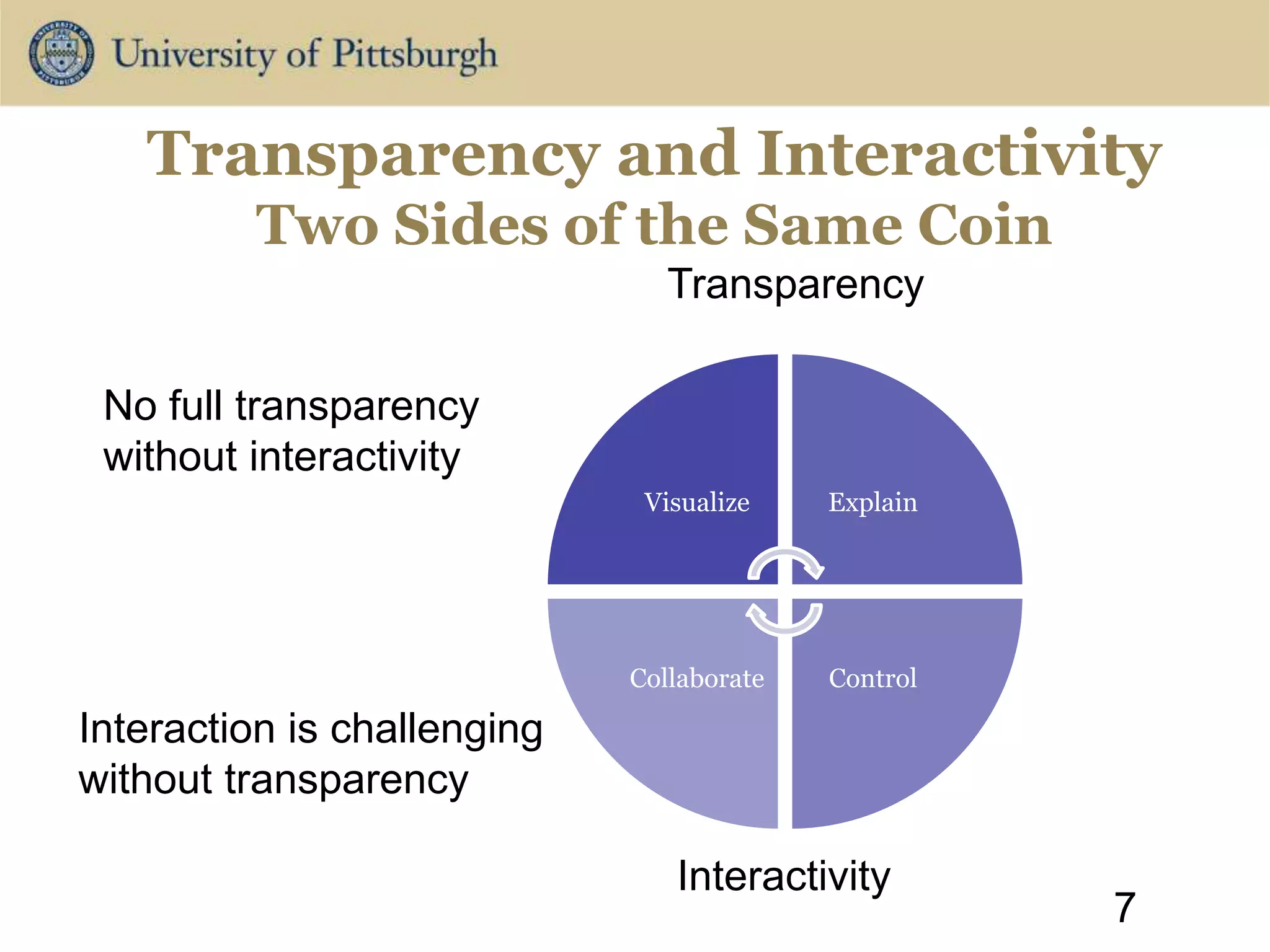
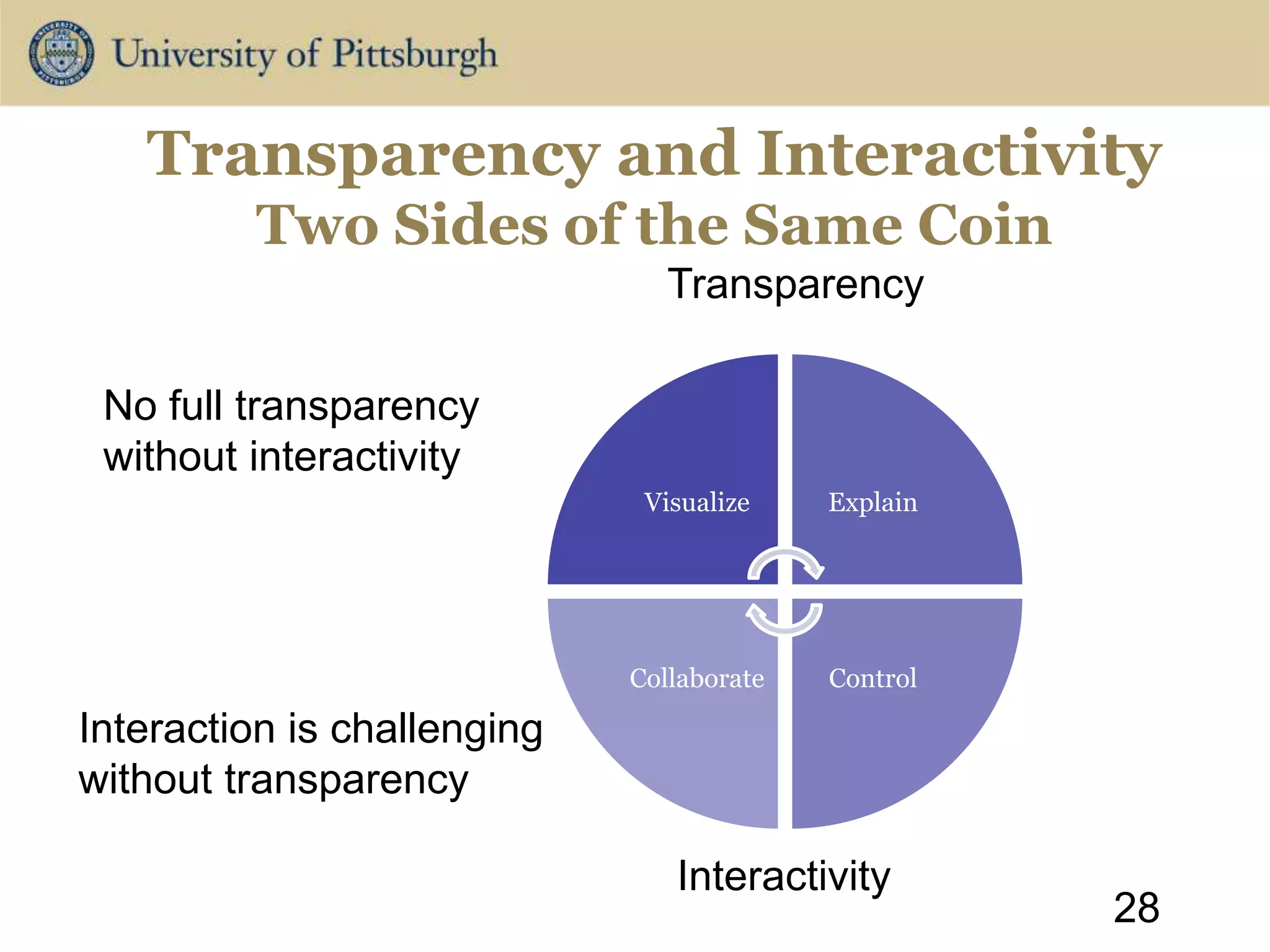
Transparency and Interactivity
Two Sides of the Same Coin
Visualize Explain
Control
Collaborate
7
Transparency
Interactivity
No full transparency
without interactivity
Interaction is challenging
without transparency
What are Possible Solutions?
• Collaborate
– Work together with AI to make best decisions
• Visualize
– What is the current state of the learner model that drives AIED
decisions?
– What is the content model of the current activity?
• Control
– Edit or negotiate your learner model
– Express your goals and preferences in the learning process
• Explain
– Why a specific learning activity item is good at the current point?
8
Collaborate!
Adaptive Hypermedia: Human-AI Collaboration
9
Human-AI Collaboration
10
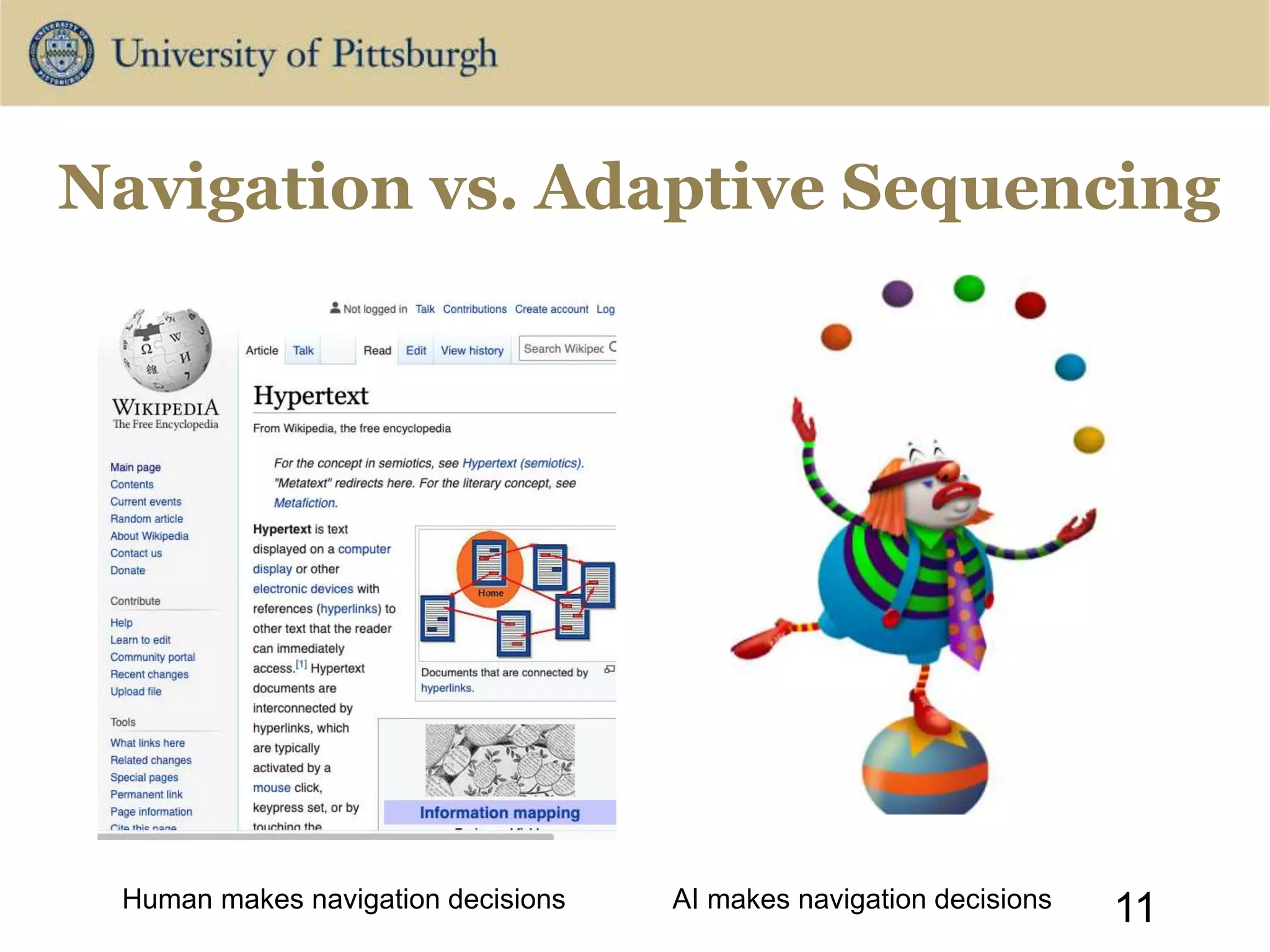
Navigation vs. Adaptive Sequencing
11
Human makes navigation decisions AI makes navigation decisions
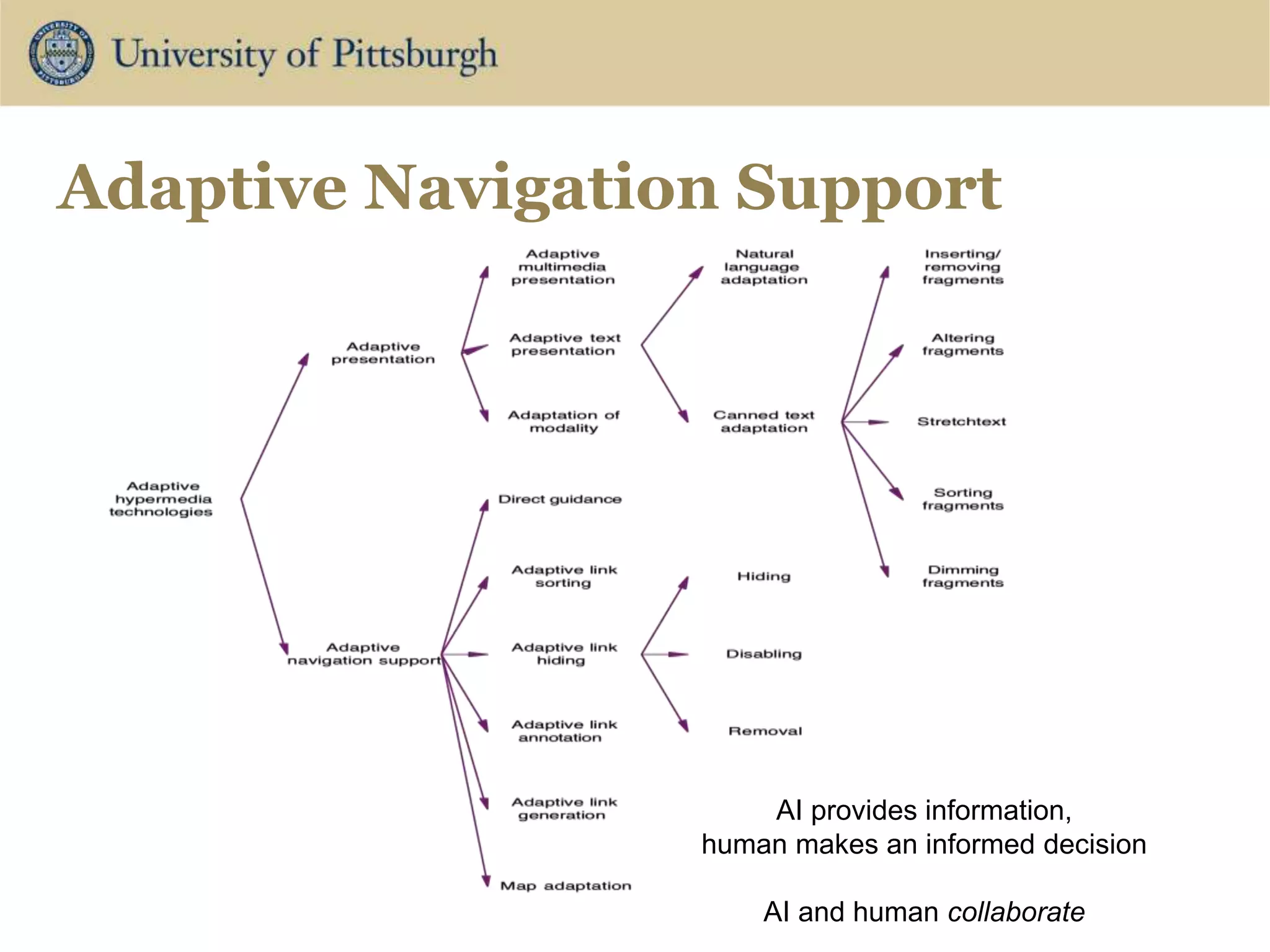
Adaptive Navigation Support
AI provides information,
human makes an informed decision
AI and human collaborate
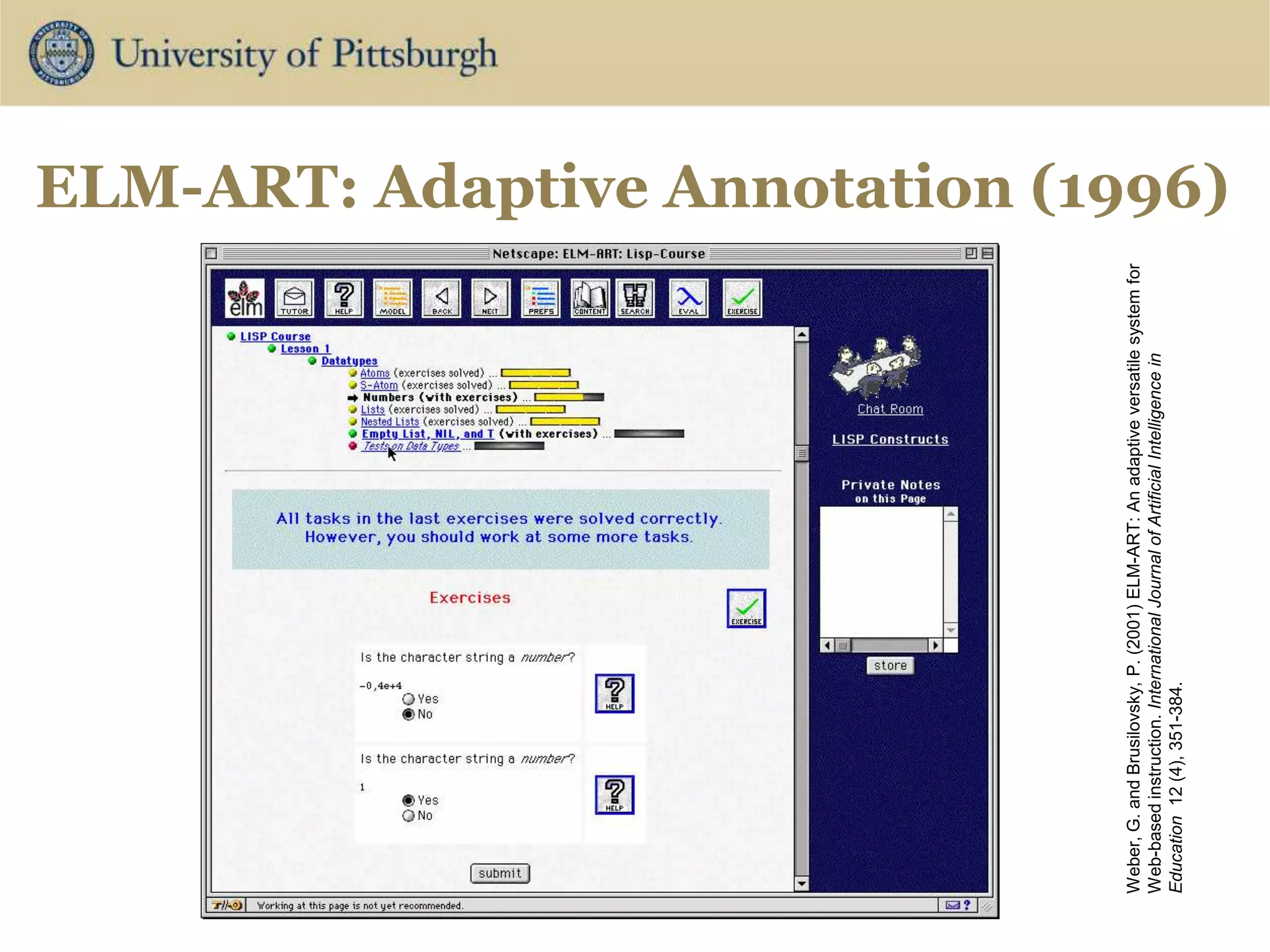
ELM-ART: Adaptive Annotation (1996)
Weber,
G.
and
Brusilovsky,
P.
(2001)
ELM-ART:
An
adaptive
versatile
system
for
Web-based
instruction.
International
Journal
of
Artificial
Intelligence
in
Education
12
(4),
351-384.
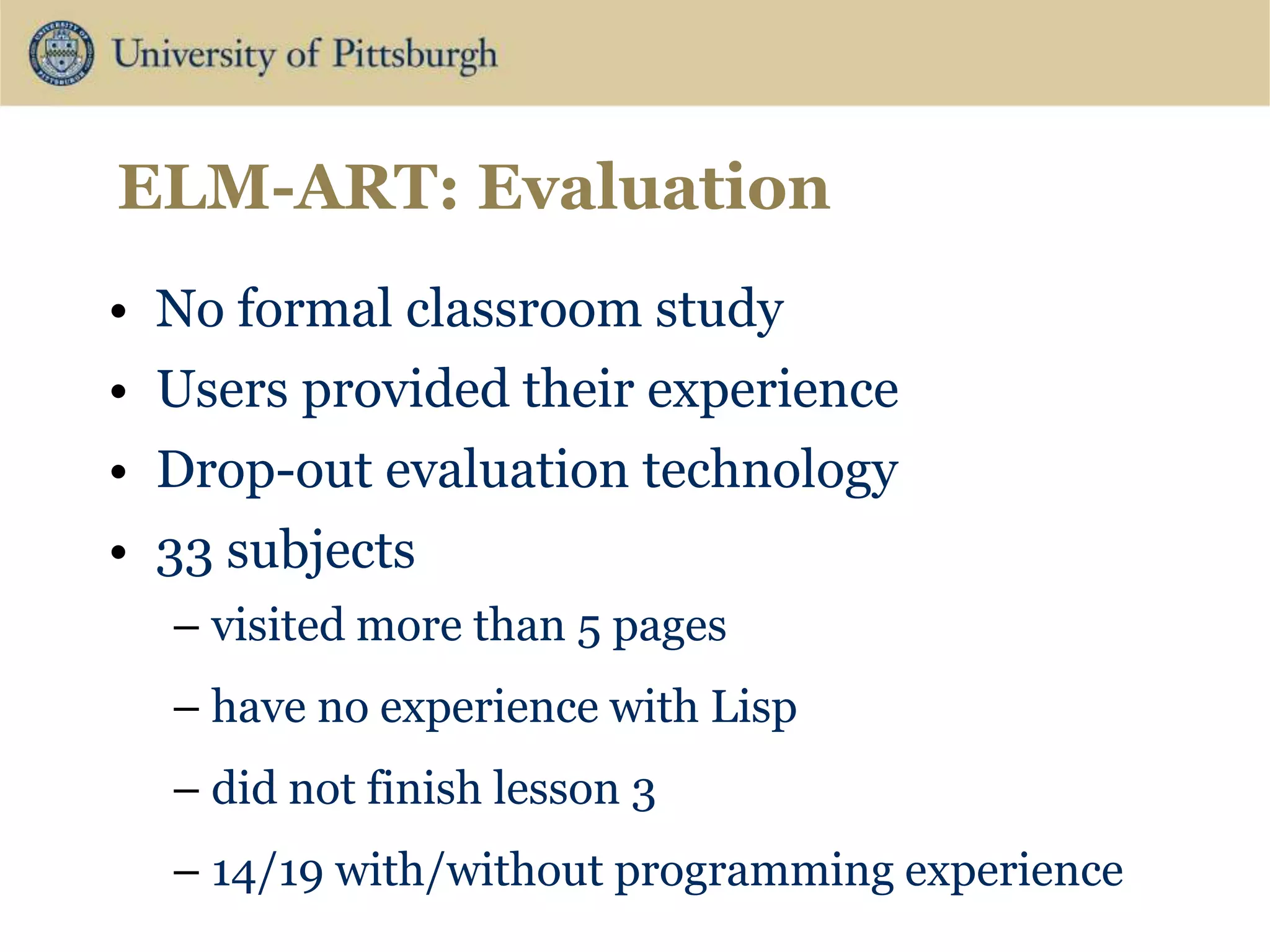
ELM-ART: Evaluation
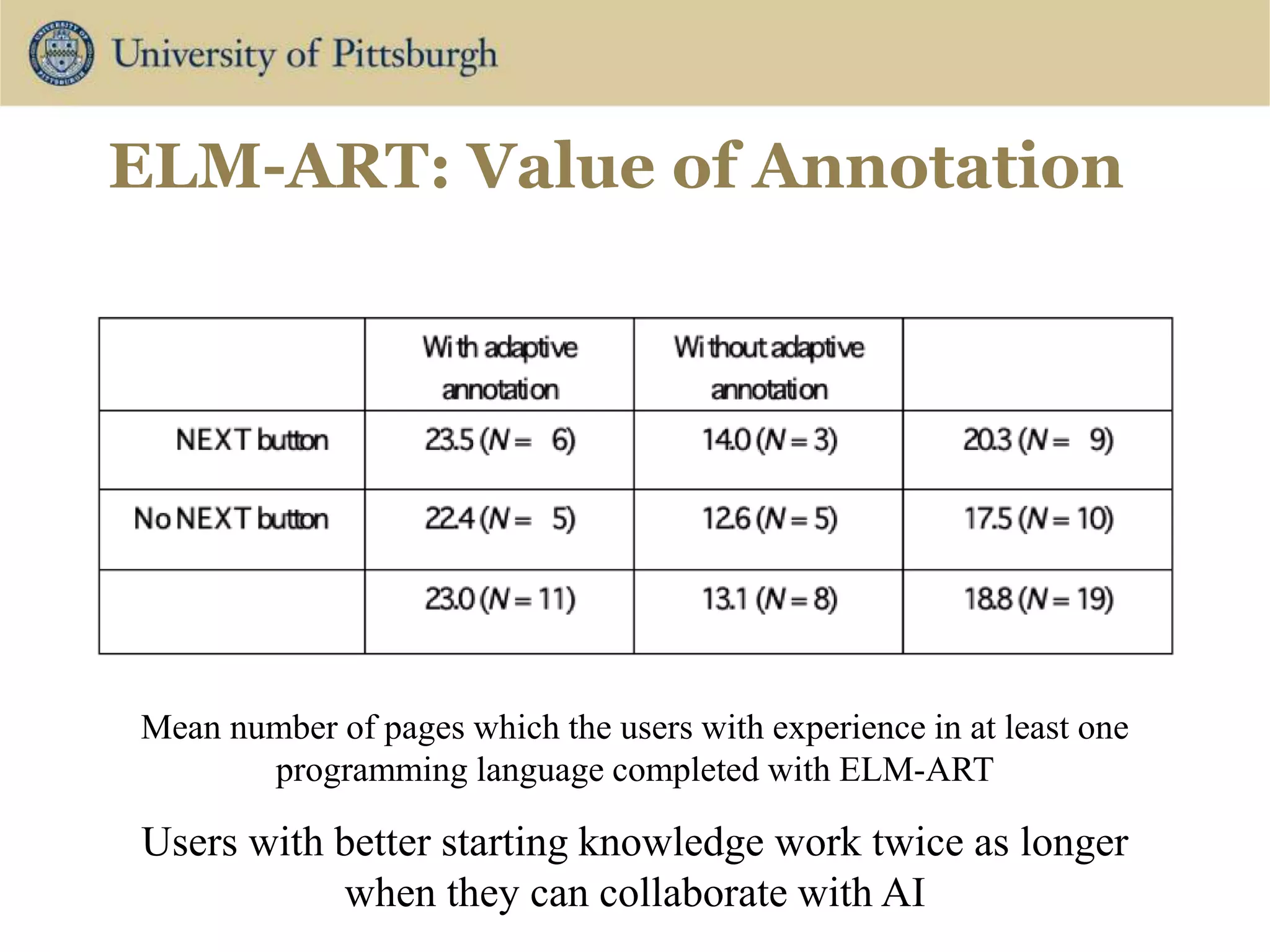
• No formal classroom study
• Users provided their experience
• Drop-out evaluation technology
• 33 subjects
– visited more than 5 pages
– have no experience with Lisp
– did not finish lesson 3
– 14/19 with/without programming experience
ELM-ART: Value of Annotation
Mean number of pages which the users with experience in at least one
programming language completed with ELM-ART
Users with better starting knowledge work twice as longer
when they can collaborate with AI
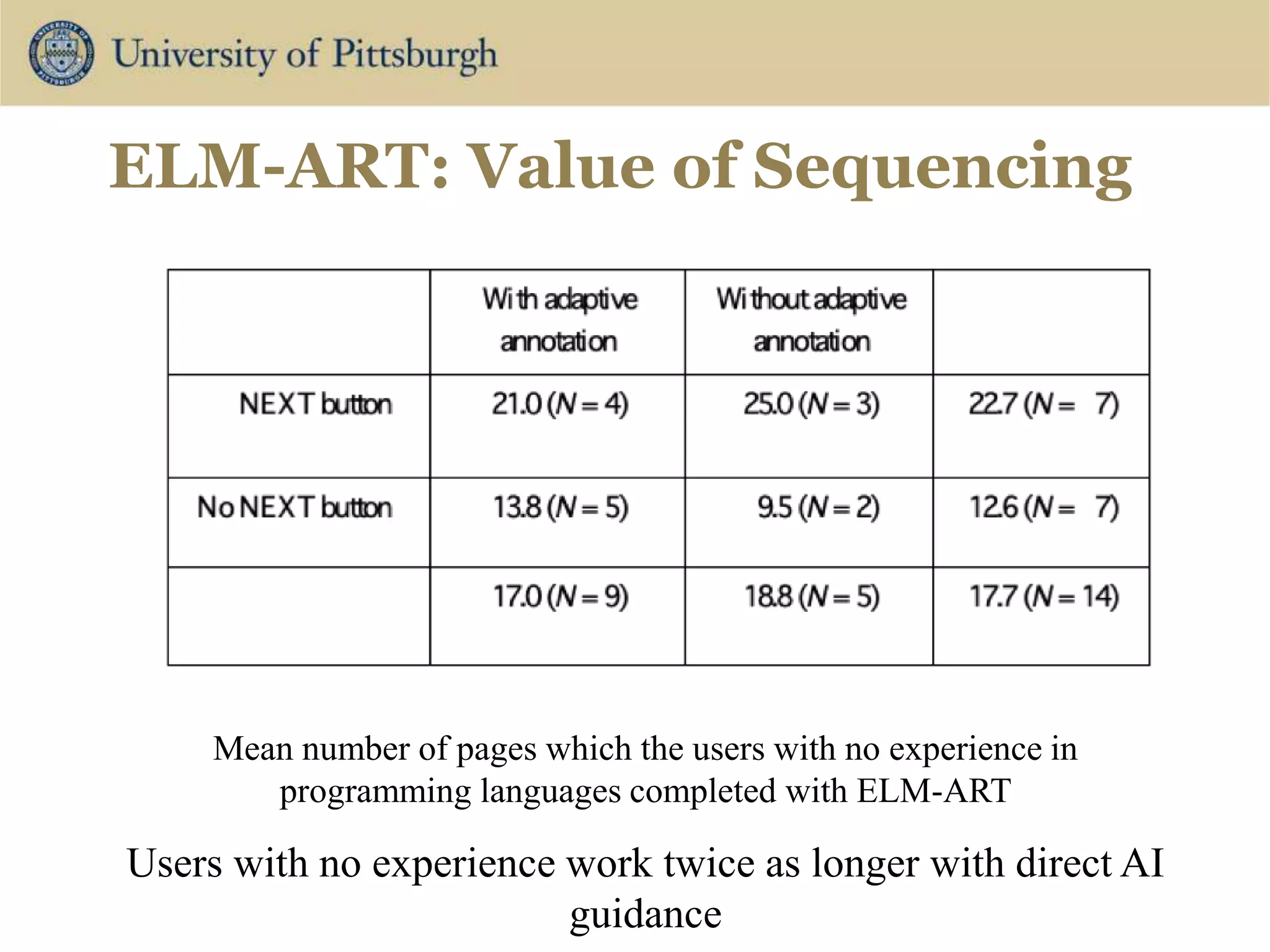
ELM-ART: Value of Sequencing
Mean number of pages which the users with no experience in
programming languages completed with ELM-ART
Users with no experience work twice as longer with direct AI
guidance
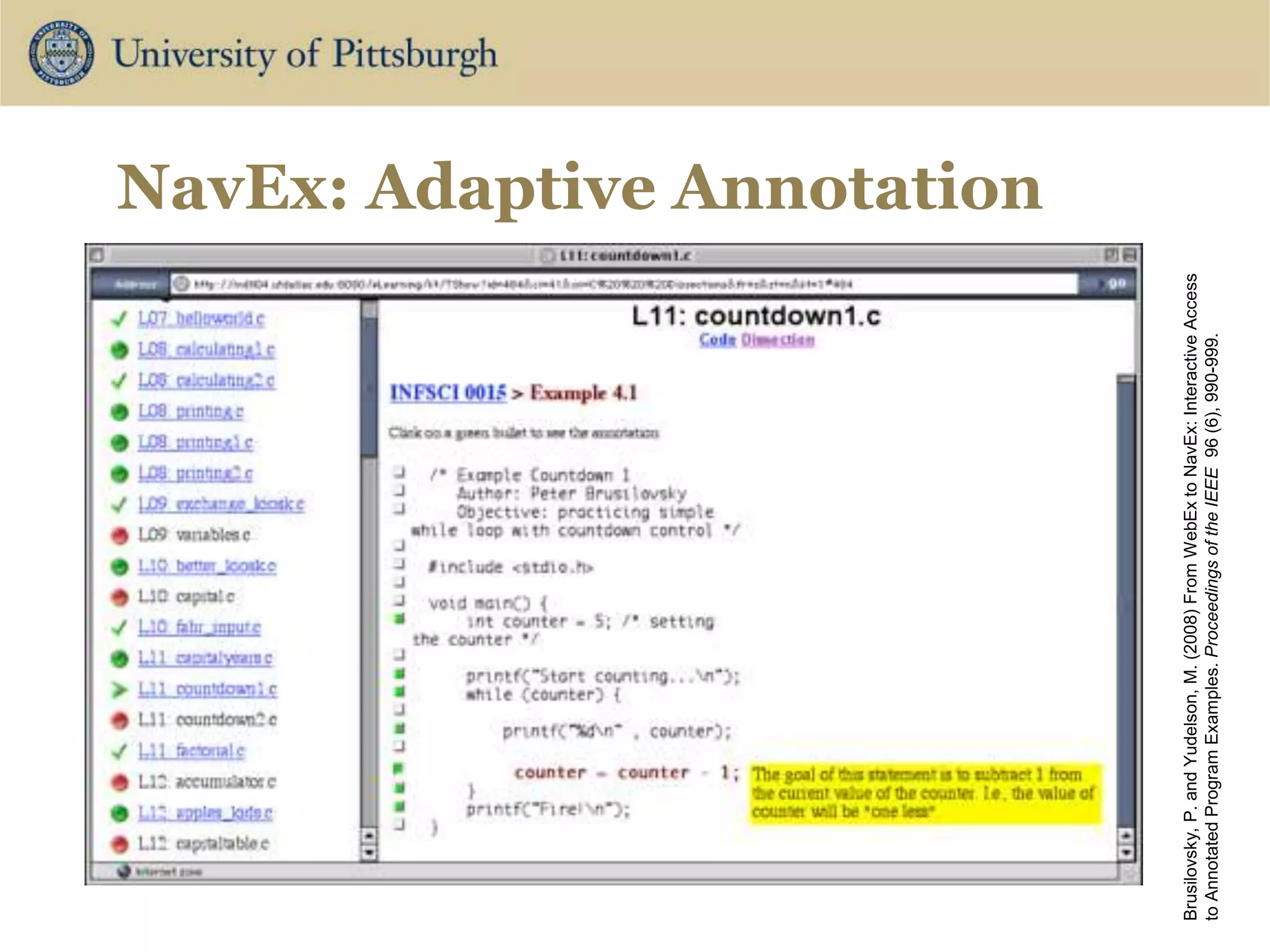
NavEx: Adaptive Annotation
Brusilovsky,
P.
and
Yudelson,
M.
(2008)
From
WebEx
to
NavEx:
Interactive
Access
to
Annotated
Program
Examples.
Proceedings
of
the
IEEE
96
(6),
990-999.
Adaptive Annotation Can:
• Reduce navigation efforts
• Reduce repetitive visits to learning content
pages
• Encourage non-sequential navigation
• Increase learning outcome
• For those who is ready to follow and advice
• Make system more attractive for students
• Students stay much longer without any reward
VISUALIZE!
Making learner and content models visible
19
Making Hidden Visible
20
A classic view on an AI-Ed system architecture
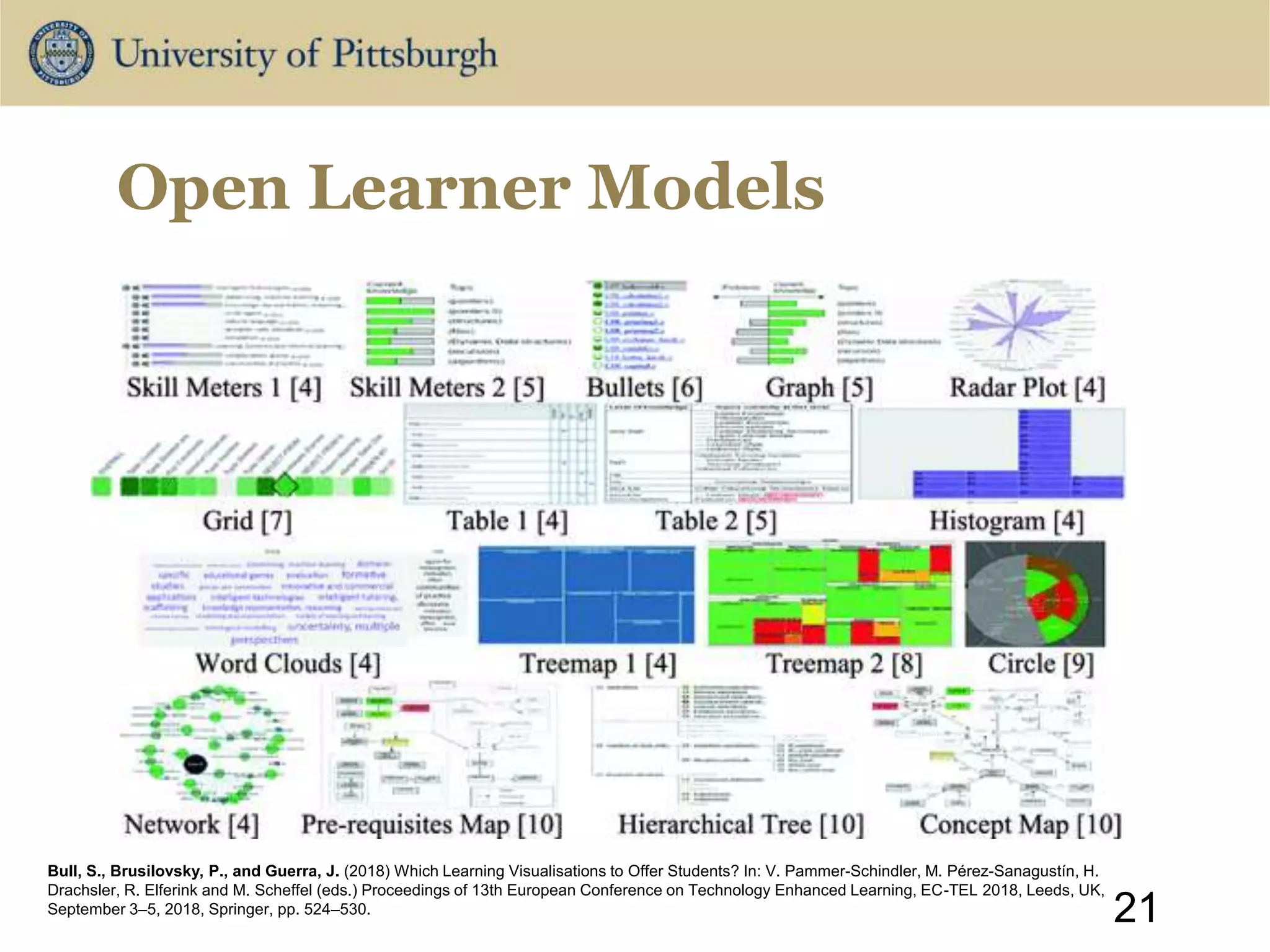
Open Learner Models
21
Bull, S., Brusilovsky, P., and Guerra, J. (2018) Which Learning Visualisations to Offer Students? In: V. Pammer-Schindler, M. Pérez-Sanagustín, H.
Drachsler, R. Elferink and M. Scheffel (eds.) Proceedings of 13th European Conference on Technology Enhanced Learning, EC-TEL 2018, Leeds, UK,
September 3–5, 2018, Springer, pp. 524–530.
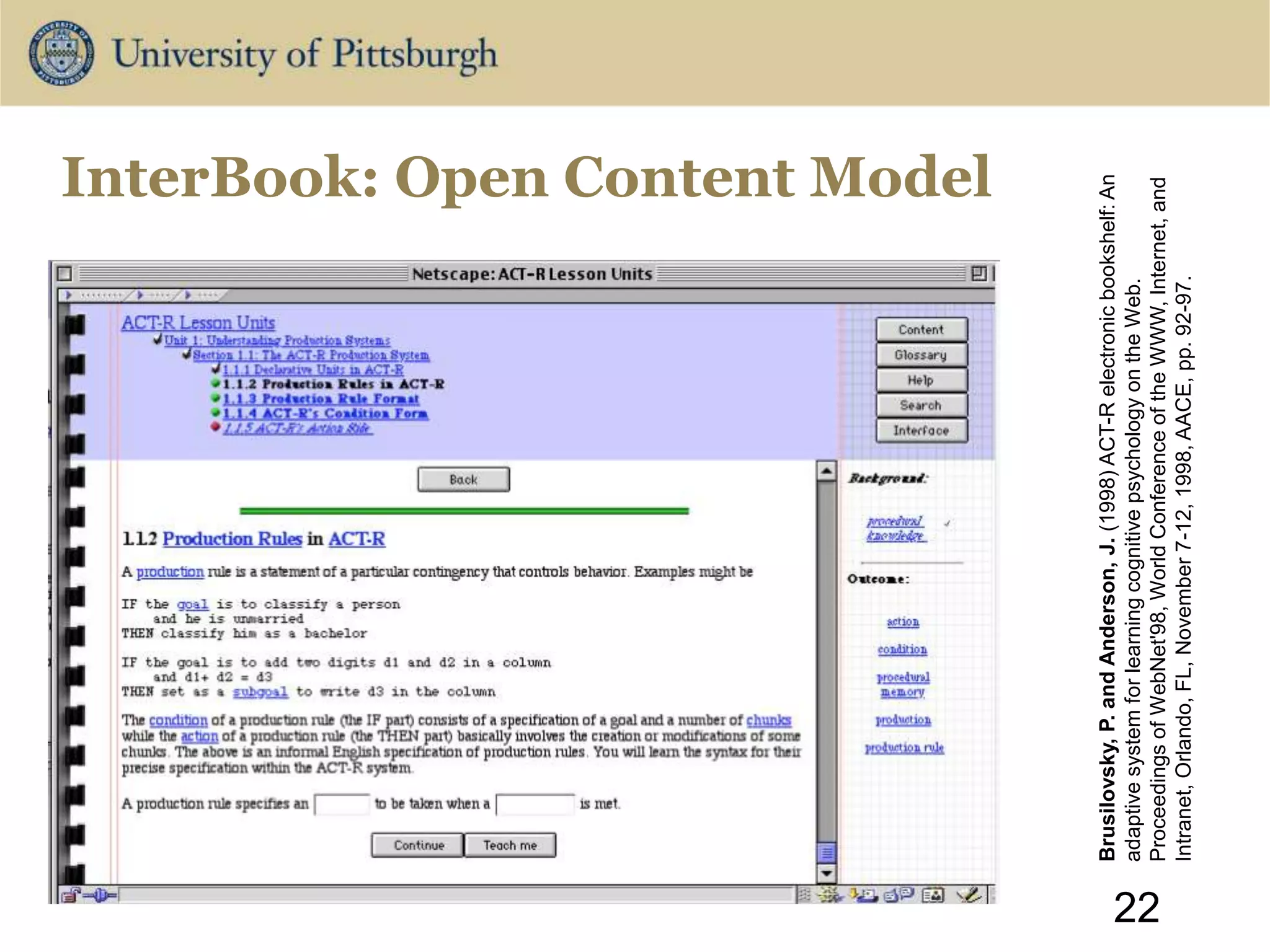
InterBook: Open Content Model
22
Brusilovsky,
P.
and
Anderson,
J.
(1998)
ACT-R
electronic
bookshelf:
An
adaptive
system
for
learning
cognitive
psychology
on
the
Web.
Proceedings
of
WebNet'98,
World
Conference
of
the
WWW,
Internet,
and
Intranet,
Orlando,
FL,
November
7-12,
1998,
AACE,
pp.
92-97.
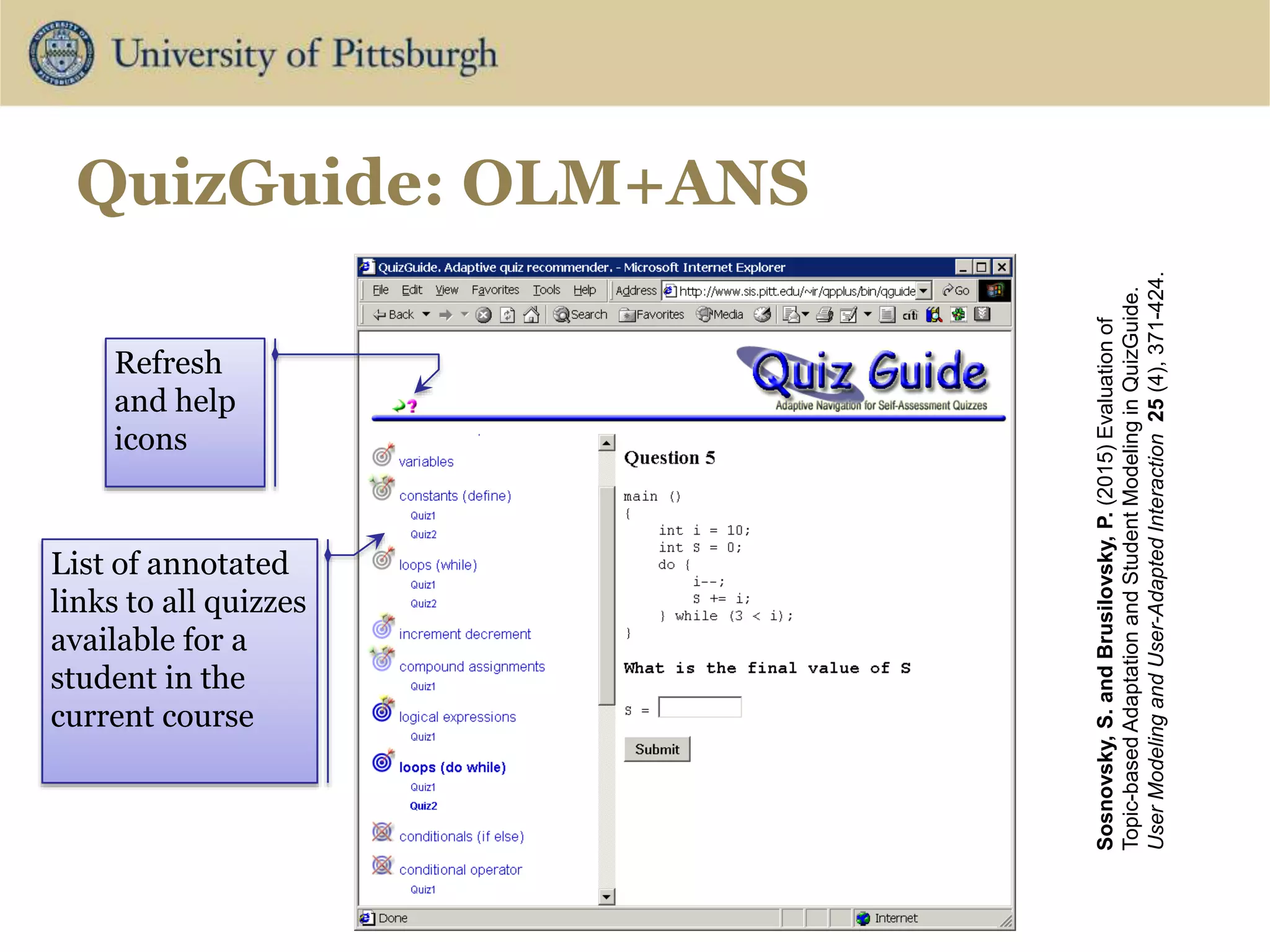
List of annotated
links to all quizzes
available for a
student in the
current course
Refresh
and help
icons
QuizGuide: OLM+ANS
Sosnovsky,
S.
and
Brusilovsky,
P.
(2015)
Evaluation
of
Topic-based
Adaptation
and
Student
Modeling
in
QuizGuide.
User
Modeling
and
User-Adapted
Interaction
25
(4),
371-424.
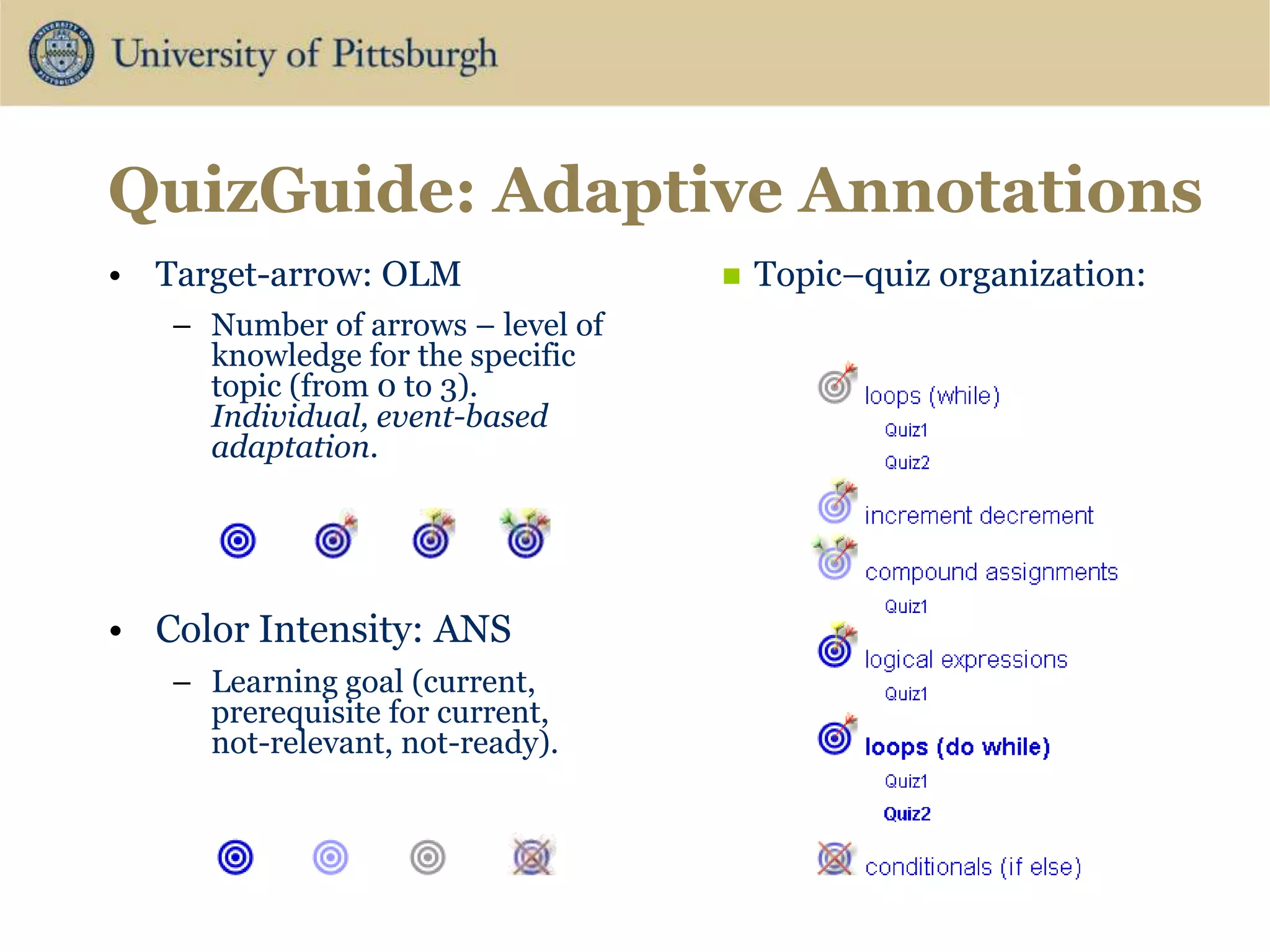
QuizGuide: Adaptive Annotations
• Target-arrow: OLM
– Number of arrows – level of
knowledge for the specific
topic (from 0 to 3).
Individual, event-based
adaptation.
• Color Intensity: ANS
– Learning goal (current,
prerequisite for current,
not-relevant, not-ready).
 Topic–quiz organization:
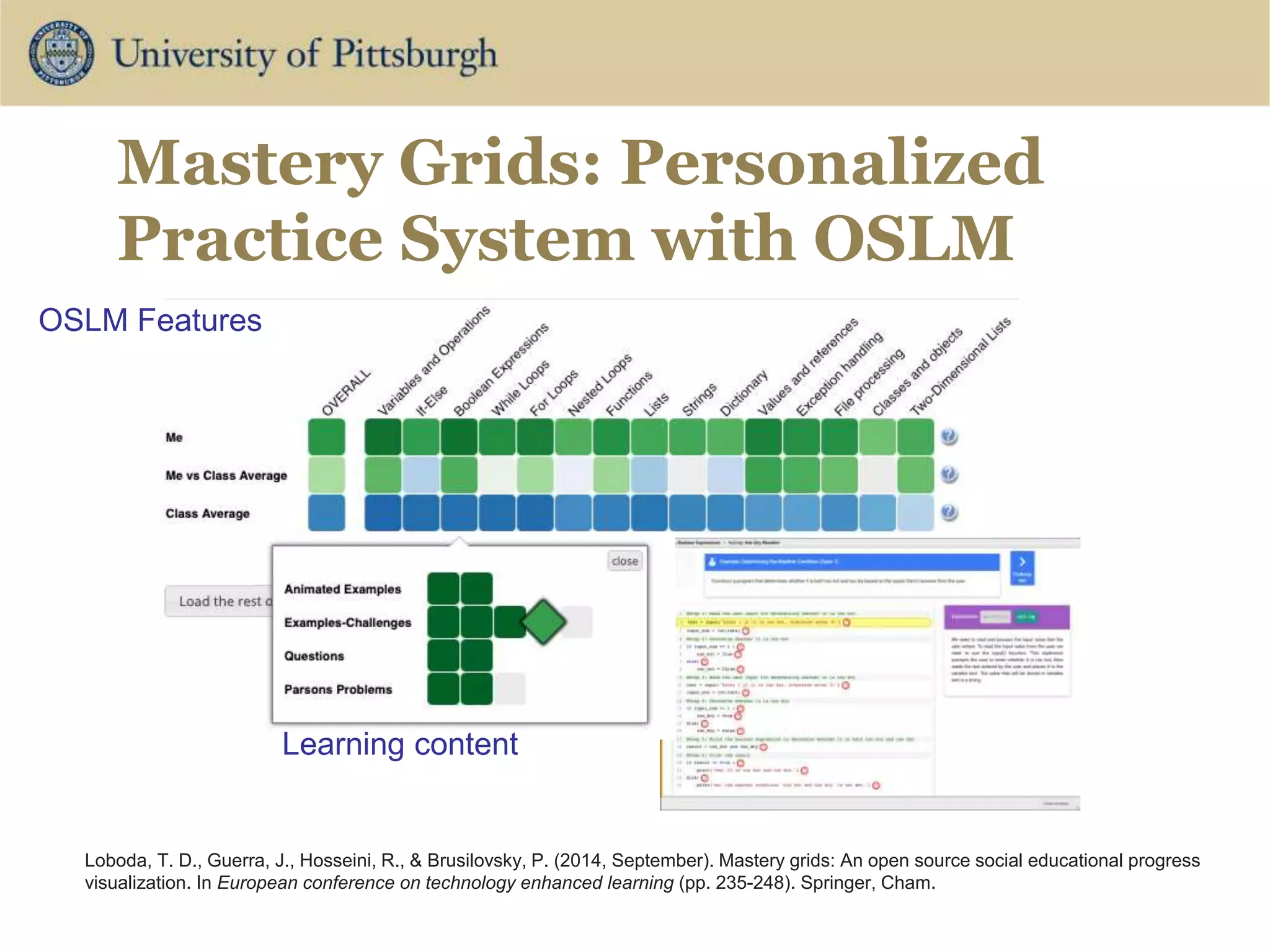
Mastery Grids: Personalized
Practice System with OSLM
Loboda, T. D., Guerra, J., Hosseini, R., & Brusilovsky, P. (2014, September). Mastery grids: An open source social educational progress
visualization. In European conference on technology enhanced learning (pp. 235-248). Springer, Cham.
Learning content
OSLM Features
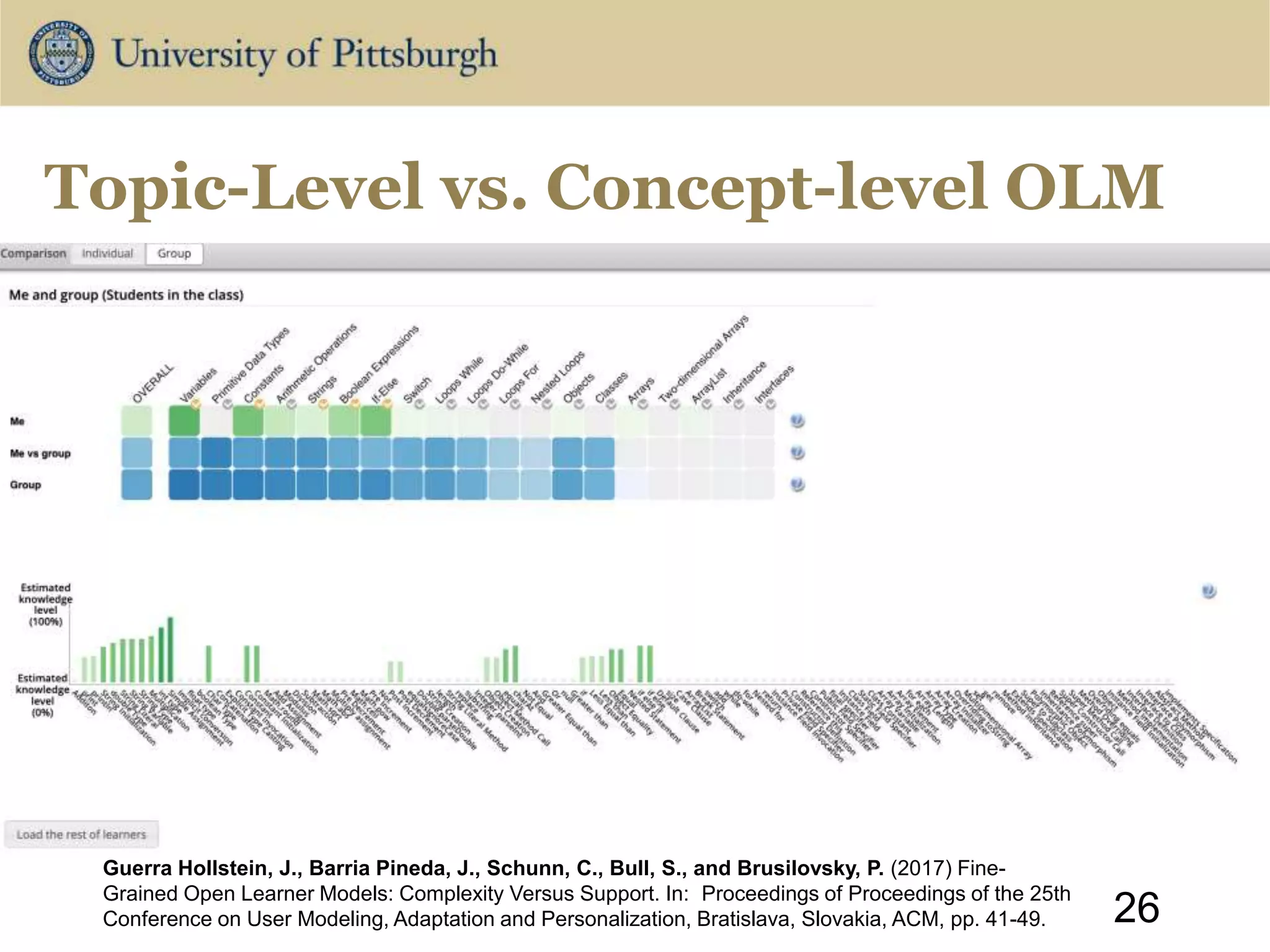
Topic-Level vs. Concept-level OLM
26
Guerra Hollstein, J., Barria Pineda, J., Schunn, C., Bull, S., and Brusilovsky, P. (2017) Fine-
Grained Open Learner Models: Complexity Versus Support. In: Proceedings of Proceedings of the 25th
Conference on User Modeling, Adaptation and Personalization, Bratislava, Slovakia, ACM, pp. 41-49.
Transparency and Interactivity
Two Sides of the Same Coin
Visualize Explain
Control
Collaborate
28
Transparency
Interactivity
No full transparency
without interactivity
Interaction is challenging
without transparency
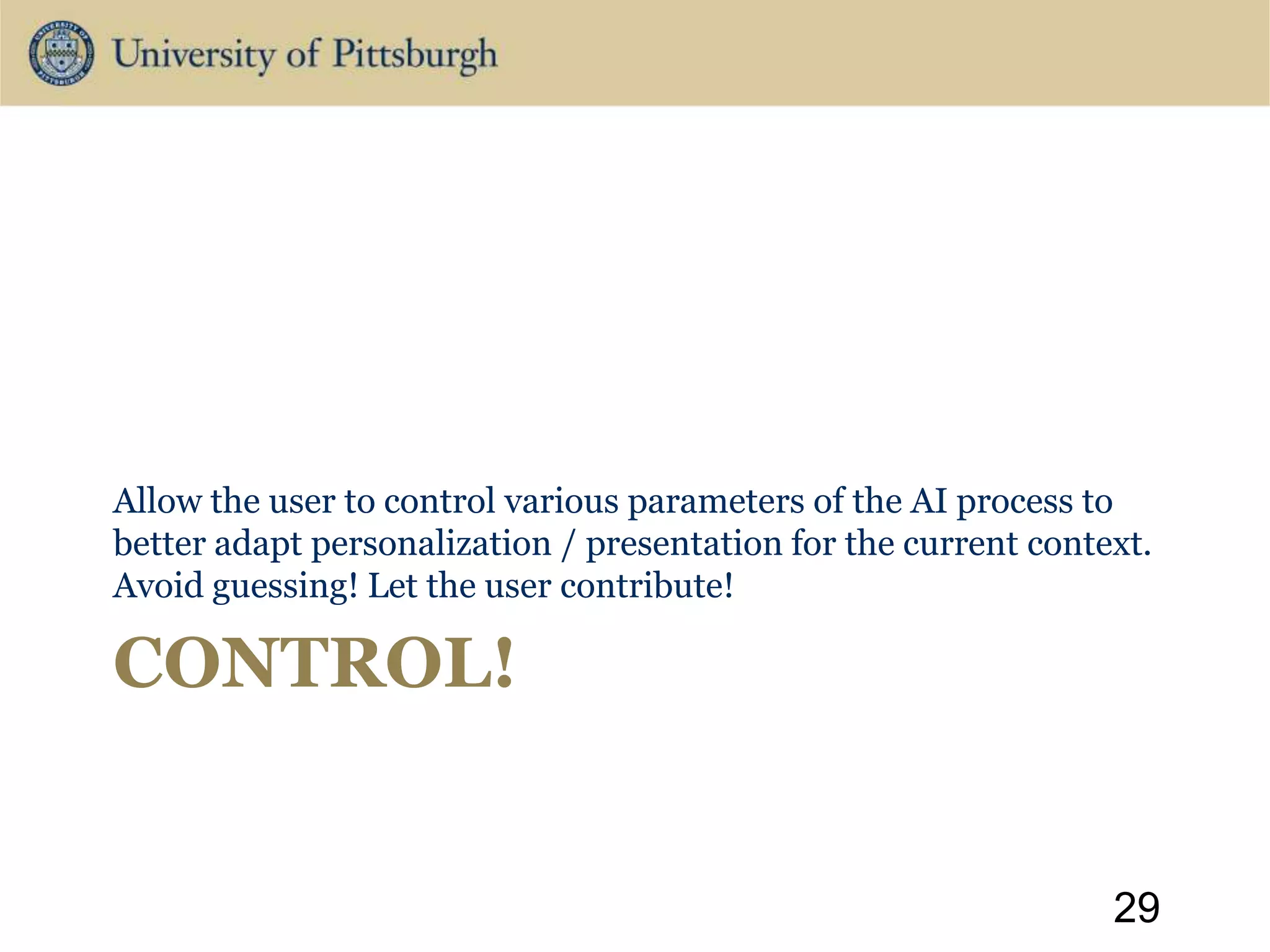
CONTROL!
Allow the user to control various parameters of the AI process to
better adapt personalization / presentation for the current context.
Avoid guessing! Let the user contribute!
29
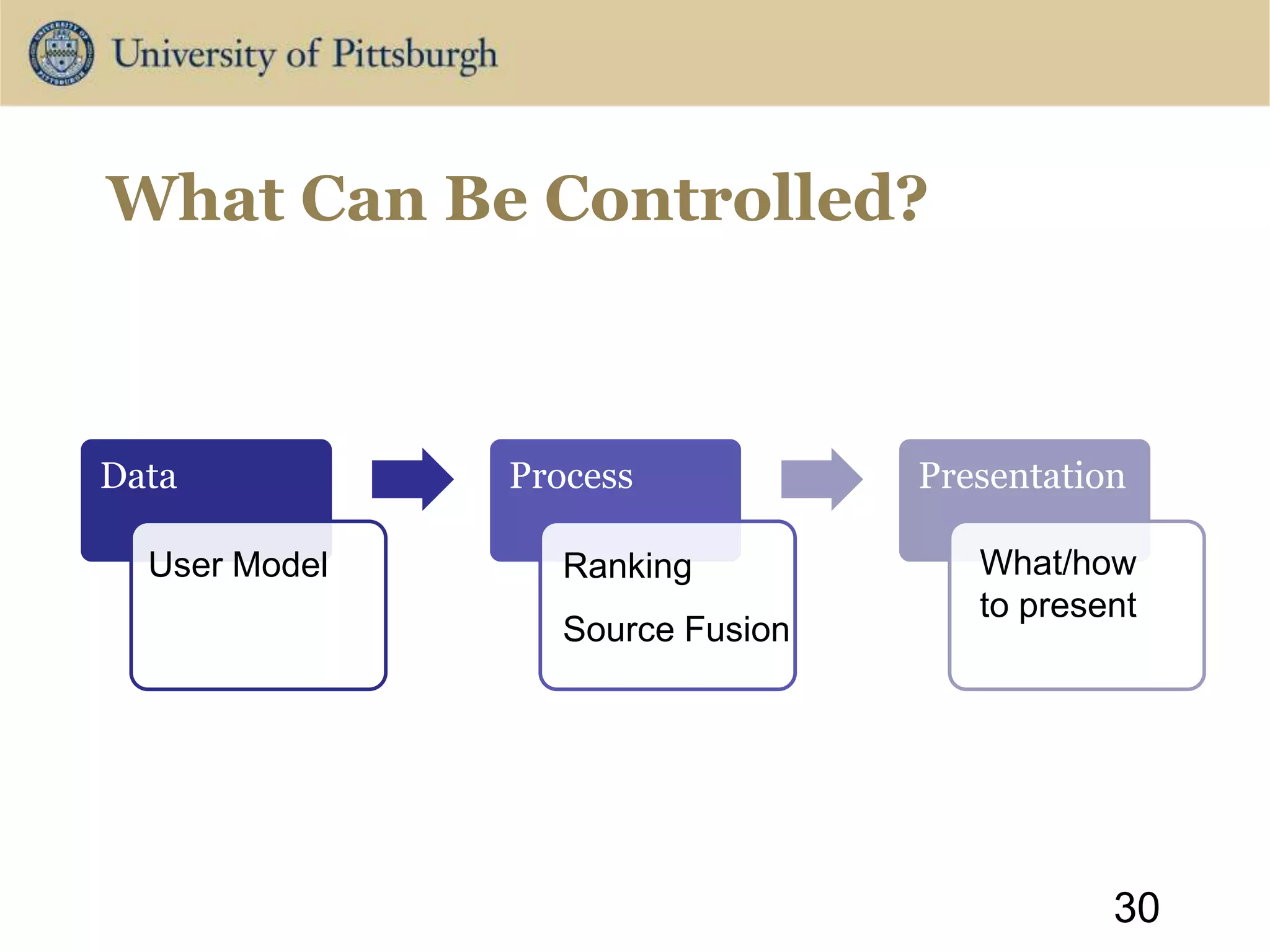
What Can Be Controlled?
30
Data Process Presentation
User Model Ranking
Source Fusion
What/how
to present
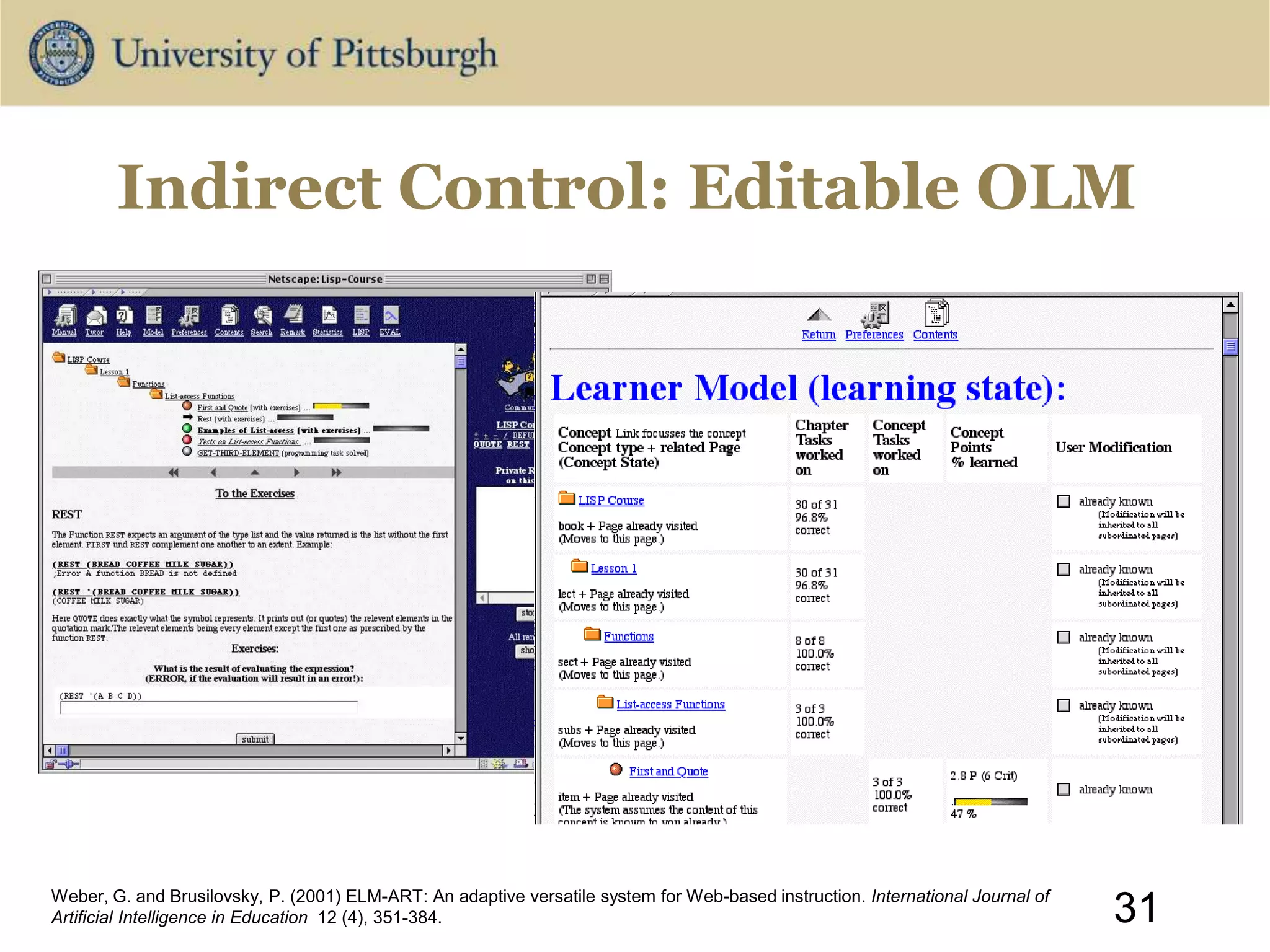
Indirect Control: Editable OLM
31
Weber, G. and Brusilovsky, P. (2001) ELM-ART: An adaptive versatile system for Web-based instruction. International Journal of
Artificial Intelligence in Education 12 (4), 351-384.
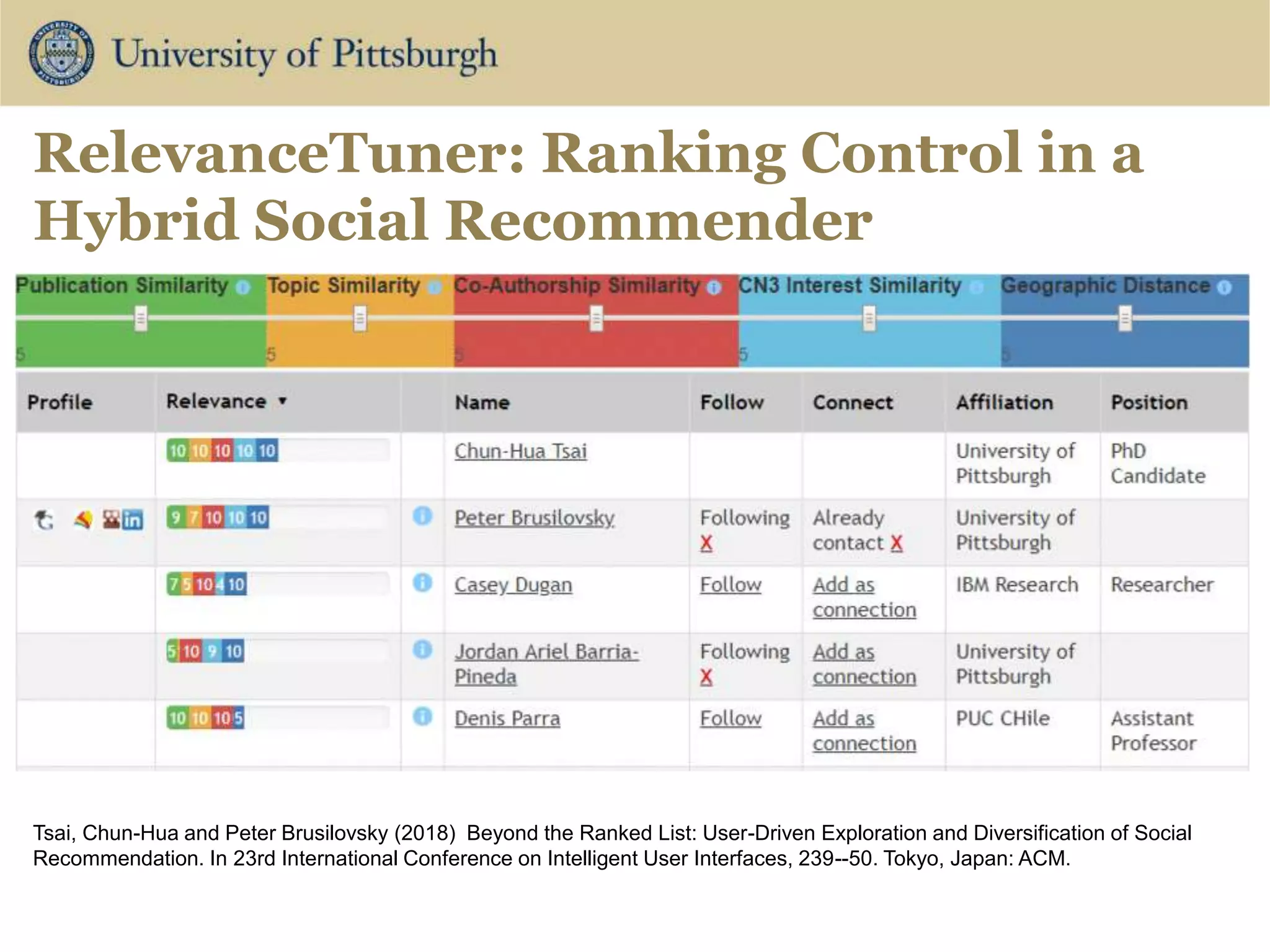
RelevanceTuner: Ranking Control in a
Hybrid Social Recommender
Tsai, Chun-Hua and Peter Brusilovsky (2018) Beyond the Ranked List: User-Driven Exploration and Diversification of Social
Recommendation. In 23rd International Conference on Intelligent User Interfaces, 239--50. Tokyo, Japan: ACM.
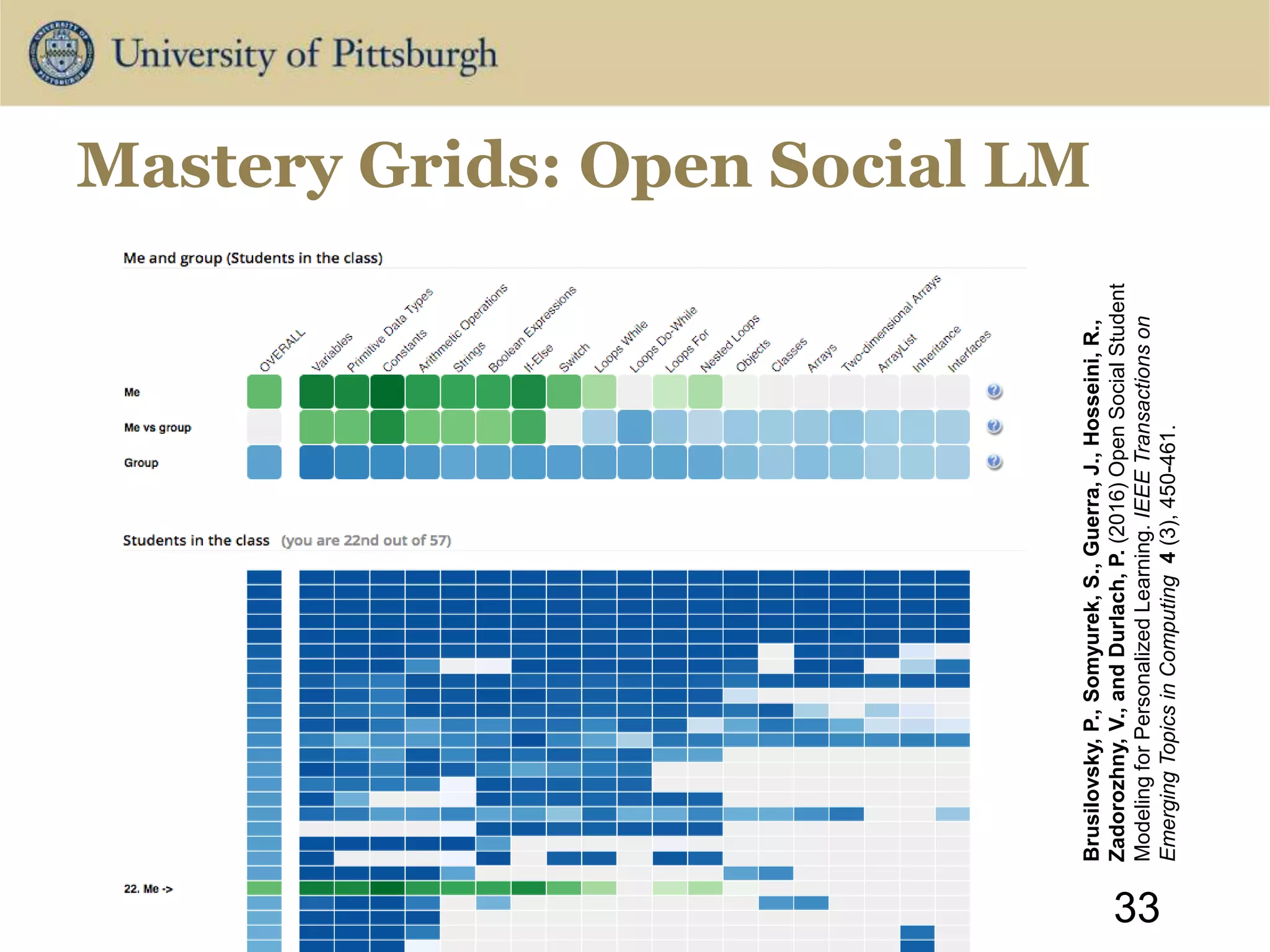
Mastery Grids: Open Social LM
33
Brusilovsky,
P.,
Somyurek,
S.,
Guerra,
J.,
Hosseini,
R.,
Zadorozhny,
V.,
and
Durlach,
P.
(2016)
Open
Social
Student
Modeling
for
Personalized
Learning.
IEEE
Transactions
on
Emerging
Topics
in
Computing
4
(3),
450-461.
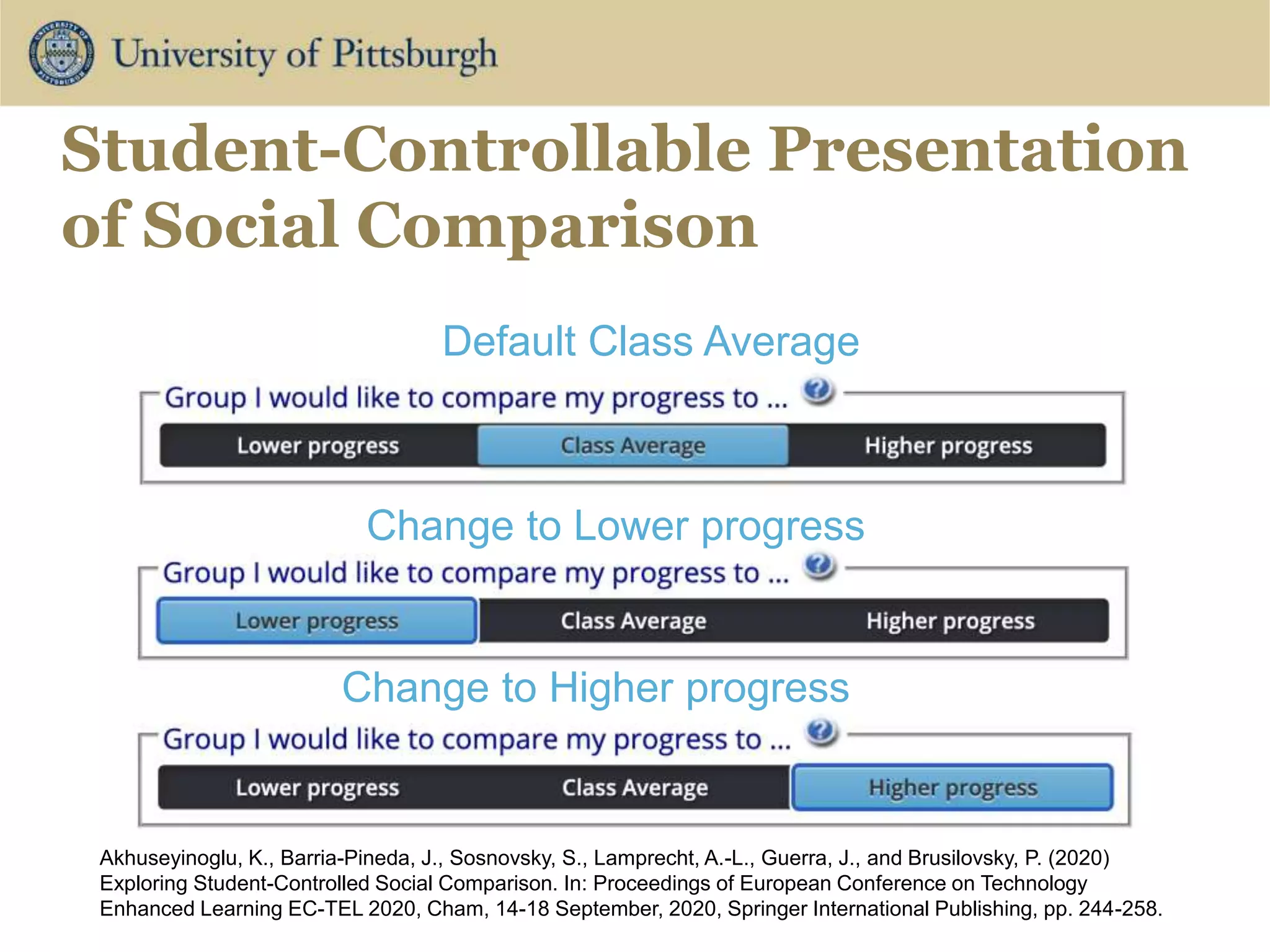
Student-Controllable Presentation
of Social Comparison
Default Class Average
Change to Lower progress
Change to Higher progress
Akhuseyinoglu, K., Barria-Pineda, J., Sosnovsky, S., Lamprecht, A.-L., Guerra, J., and Brusilovsky, P. (2020)
Exploring Student-Controlled Social Comparison. In: Proceedings of European Conference on Technology
Enhanced Learning EC-TEL 2020, Cham, 14-18 September, 2020, Springer International Publishing, pp. 244-258.
Student-controllable Social
Comparison: Average
35
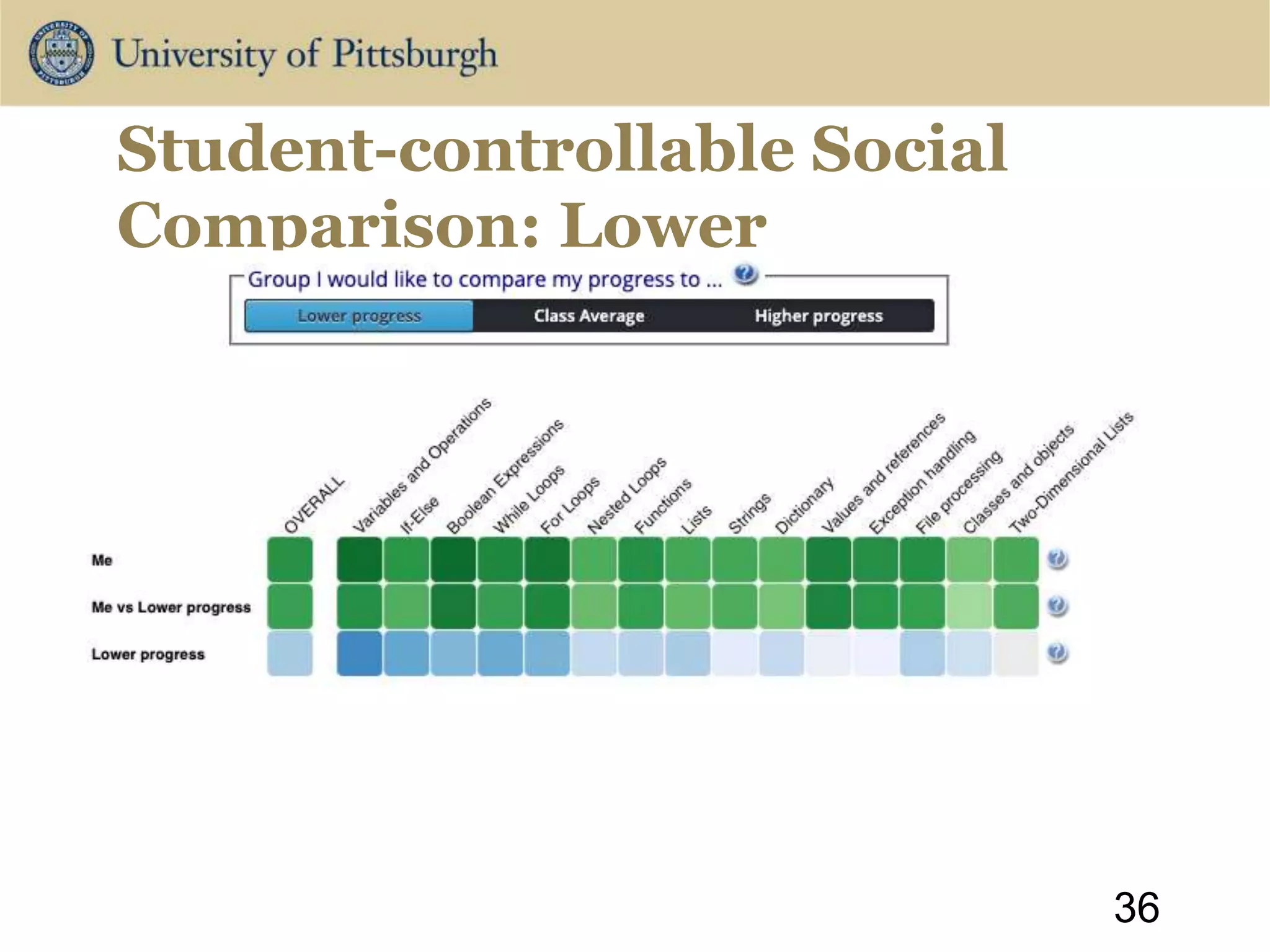
Student-controllable Social
Comparison: Lower
36
Study Details
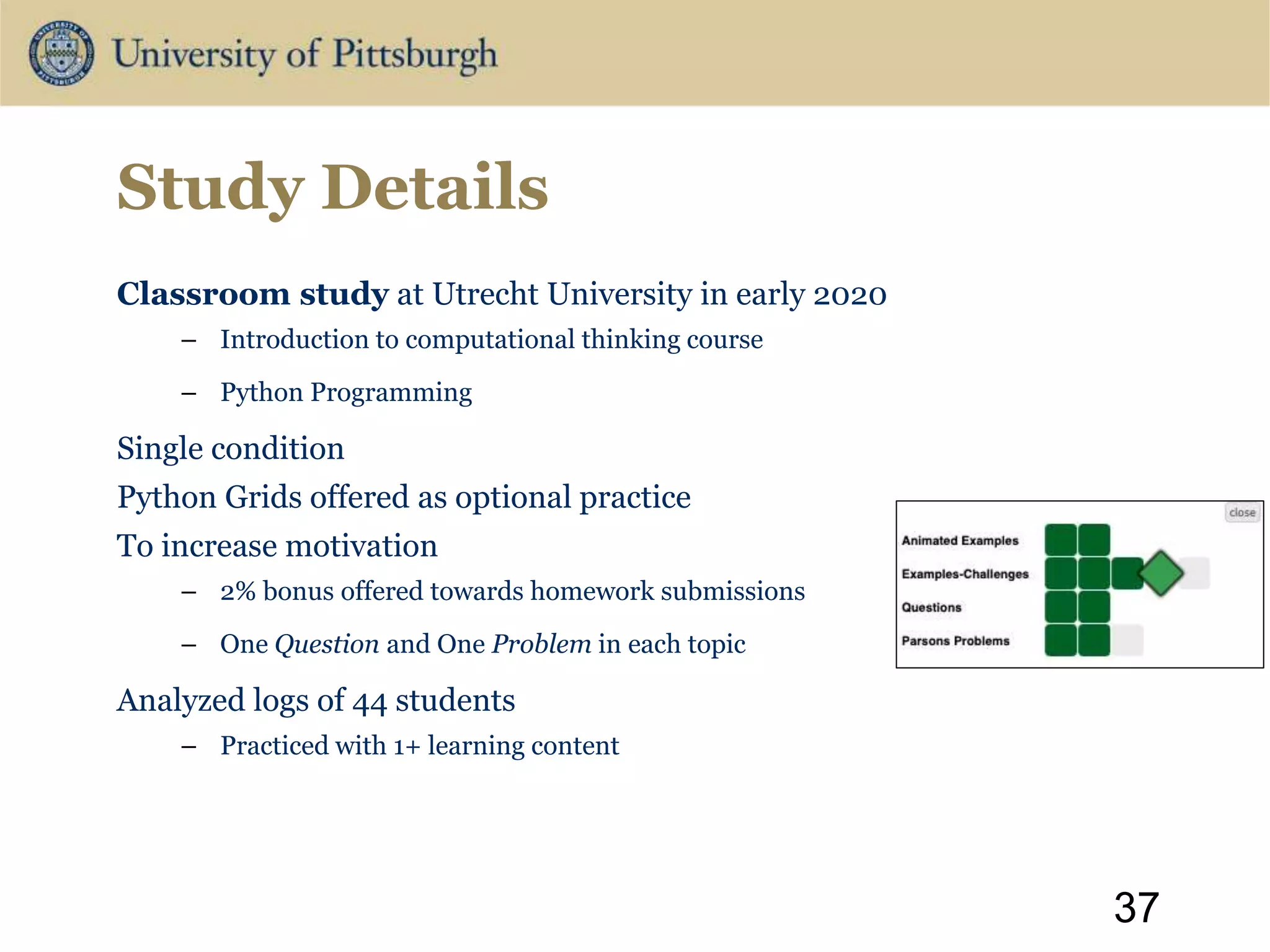
Classroom study at Utrecht University in early 2020
– Introduction to computational thinking course
– Python Programming
Single condition
Python Grids offered as optional practice
To increase motivation
– 2% bonus offered towards homework submissions
– One Question and One Problem in each topic
Analyzed logs of 44 students
– Practiced with 1+ learning content
37
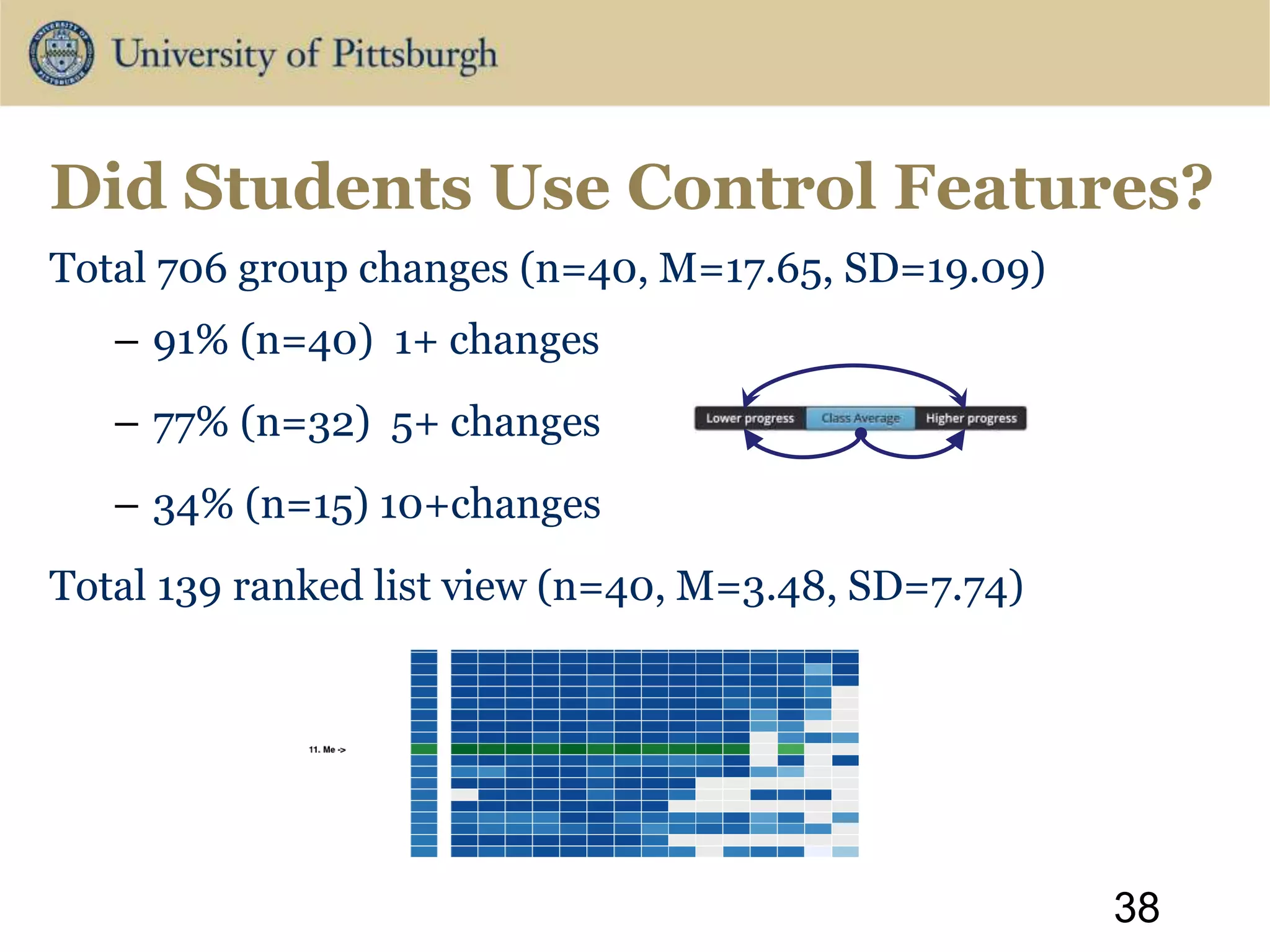
Total 706 group changes (n=40, M=17.65, SD=19.09)
– 91% (n=40) 1+ changes
– 77% (n=32) 5+ changes
– 34% (n=15) 10+changes
Total 139 ranked list view (n=40, M=3.48, SD=7.74)
38
Did Students Use Control Features?
Results
40
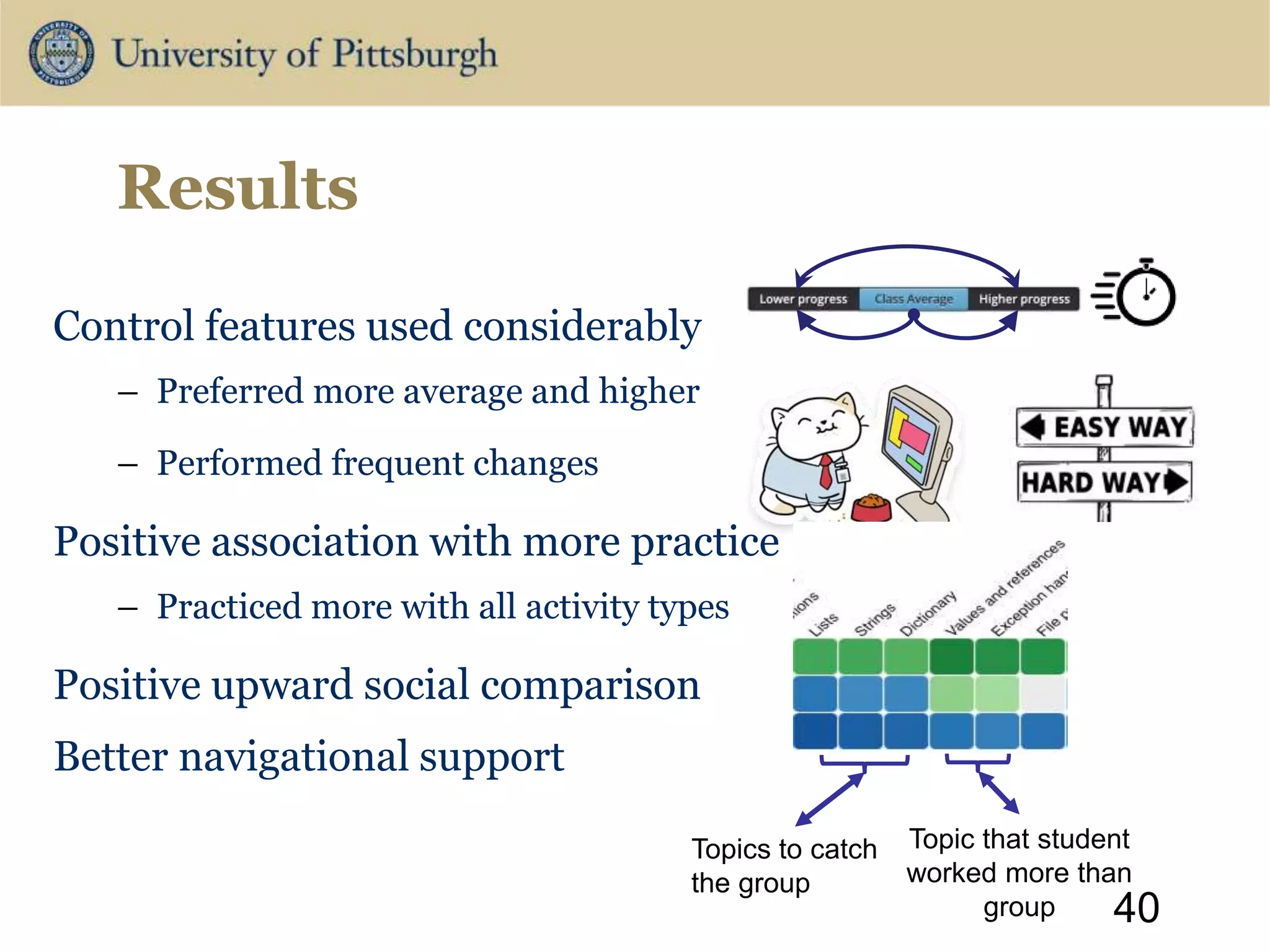
Control features used considerably
– Preferred more average and higher
– Performed frequent changes
Positive association with more practice
– Practiced more with all activity types
Positive upward social comparison
Better navigational support
Topics to catch
the group
Topic that student
worked more than
group
EXPLAIN!
Make it more clear for students why specific recommended
learning activities are recommended and how they relate to their
knowledge and learning goals
42
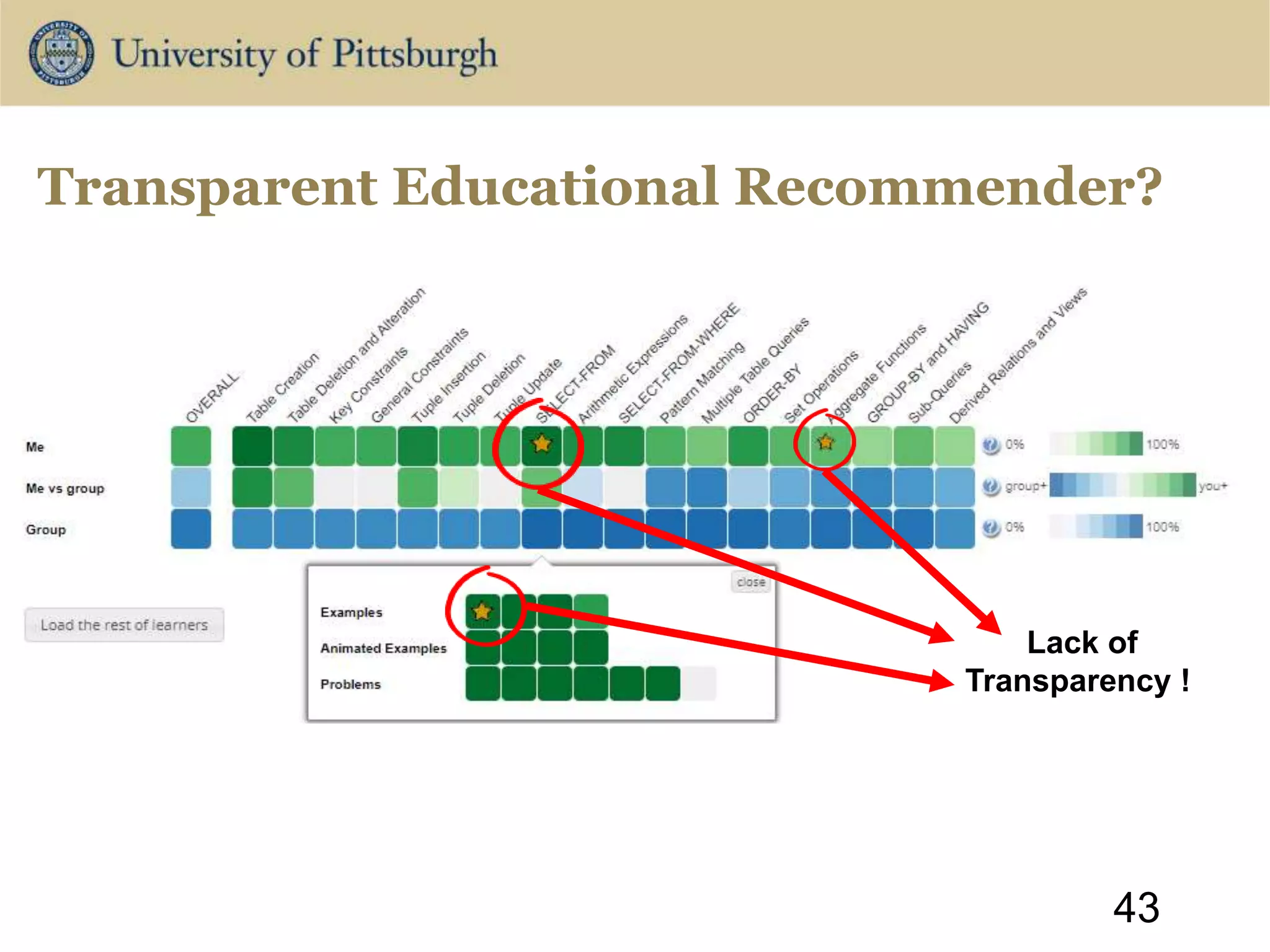
Transparent Educational Recommender?
43
Lack of
Transparency !
ATEC Worksho
2 0 1 9
Los Angeles
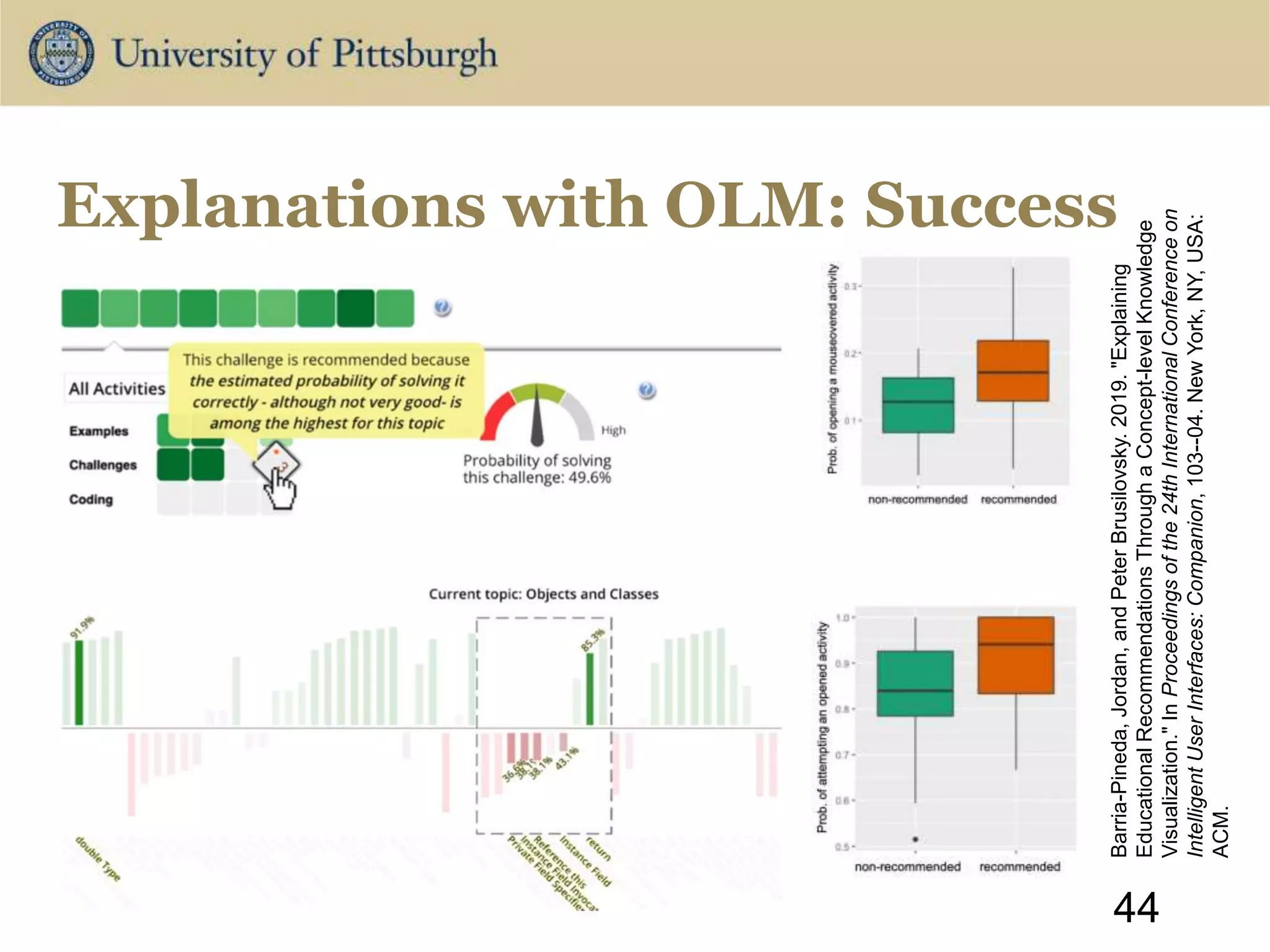
44
Explanations with OLM: Success
Barria-Pineda,
Jordan,
and
Peter
Brusilovsky.
2019.
"Explaining
Educational
Recommendations
Through
a
Concept-level
Knowledge
Visualization."
In
Proceedings
of
the
24th
International
Conference
on
Intelligent
User
Interfaces:
Companion,
103--04.
New
York,
NY,
USA:
ACM.
1
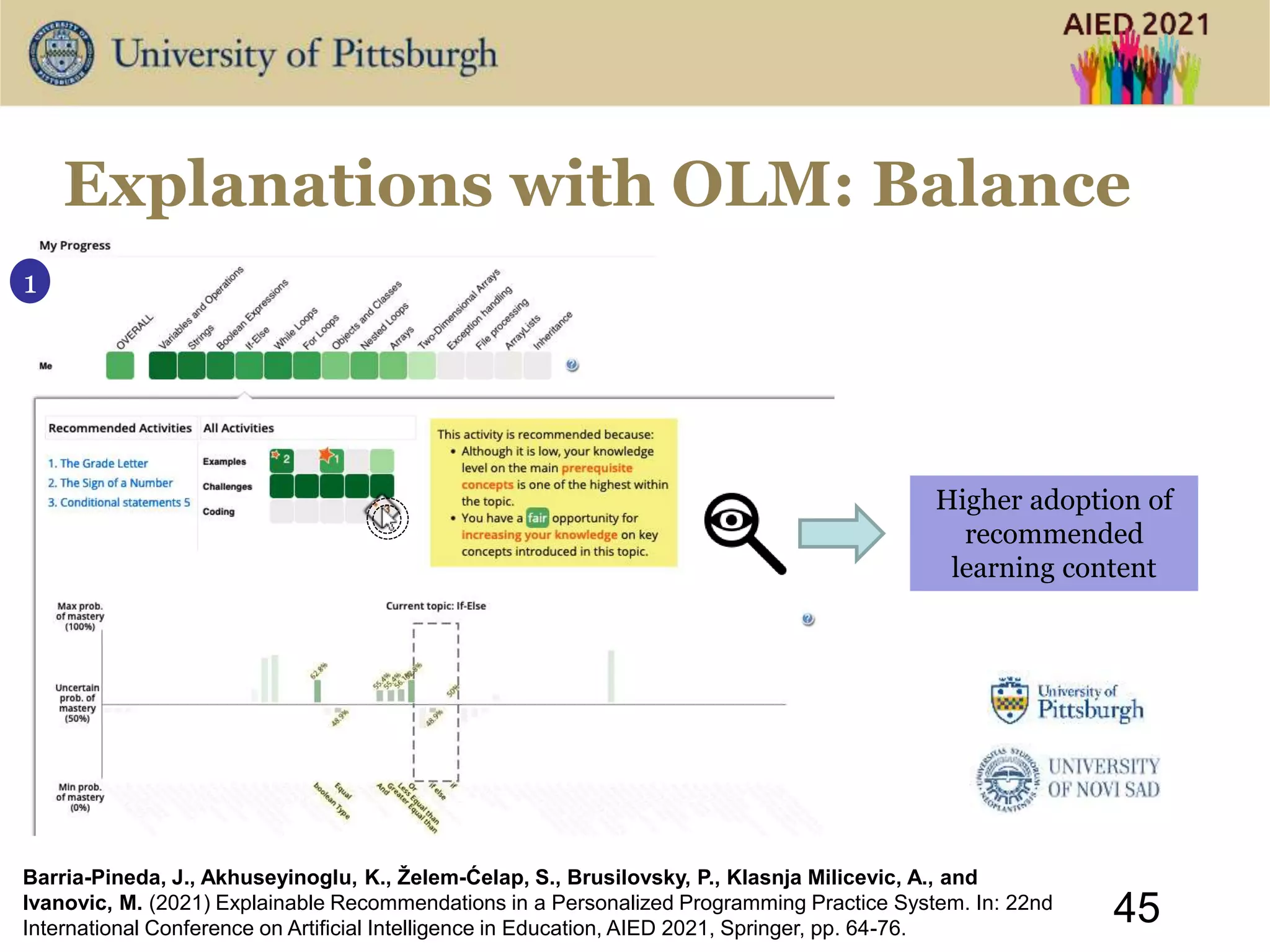
45
Explanations with OLM: Balance
Higher adoption of
recommended
learning content
Barria-Pineda, J., Akhuseyinoglu, K., Želem-Ćelap, S., Brusilovsky, P., Klasnja Milicevic, A., and
Ivanovic, M. (2021) Explainable Recommendations in a Personalized Programming Practice System. In: 22nd
International Conference on Artificial Intelligence in Education, AIED 2021, Springer, pp. 64-76.
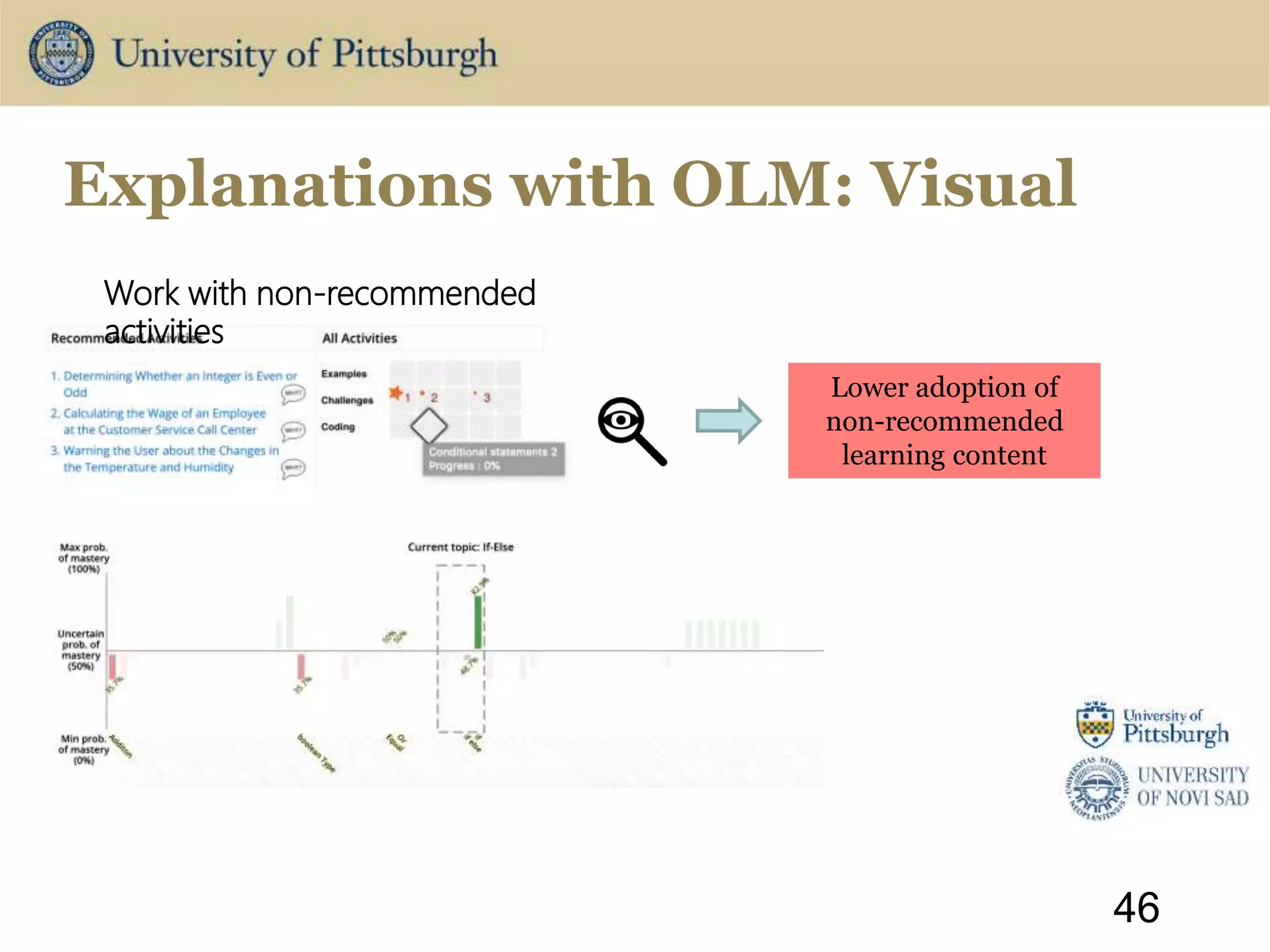
46
Work with non-recommended
activities
Lower adoption of
non-recommended
learning content
Explanations with OLM: Visual
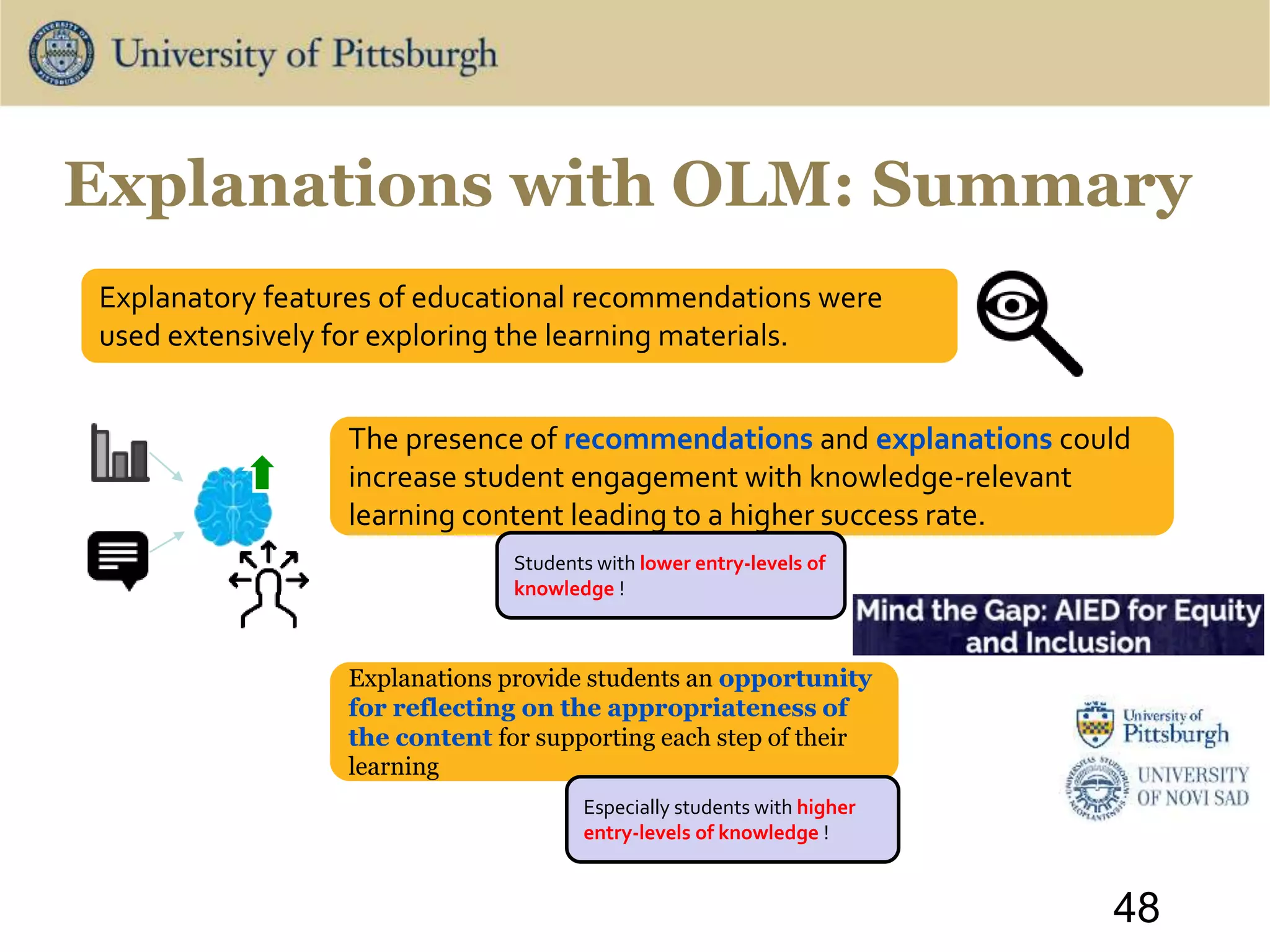
The presence of recommendations and explanations could
increase student engagement with knowledge-relevant
learning content leading to a higher success rate.
48
Explanatory features of educational recommendations were
used extensively for exploring the learning materials.
Students with lower entry-levels of
knowledge !
Explanations provide students an opportunity
for reflecting on the appropriateness of
the content for supporting each step of their
learning
Especially students with higher
entry-levels of knowledge !
Explanations with OLM: Summary
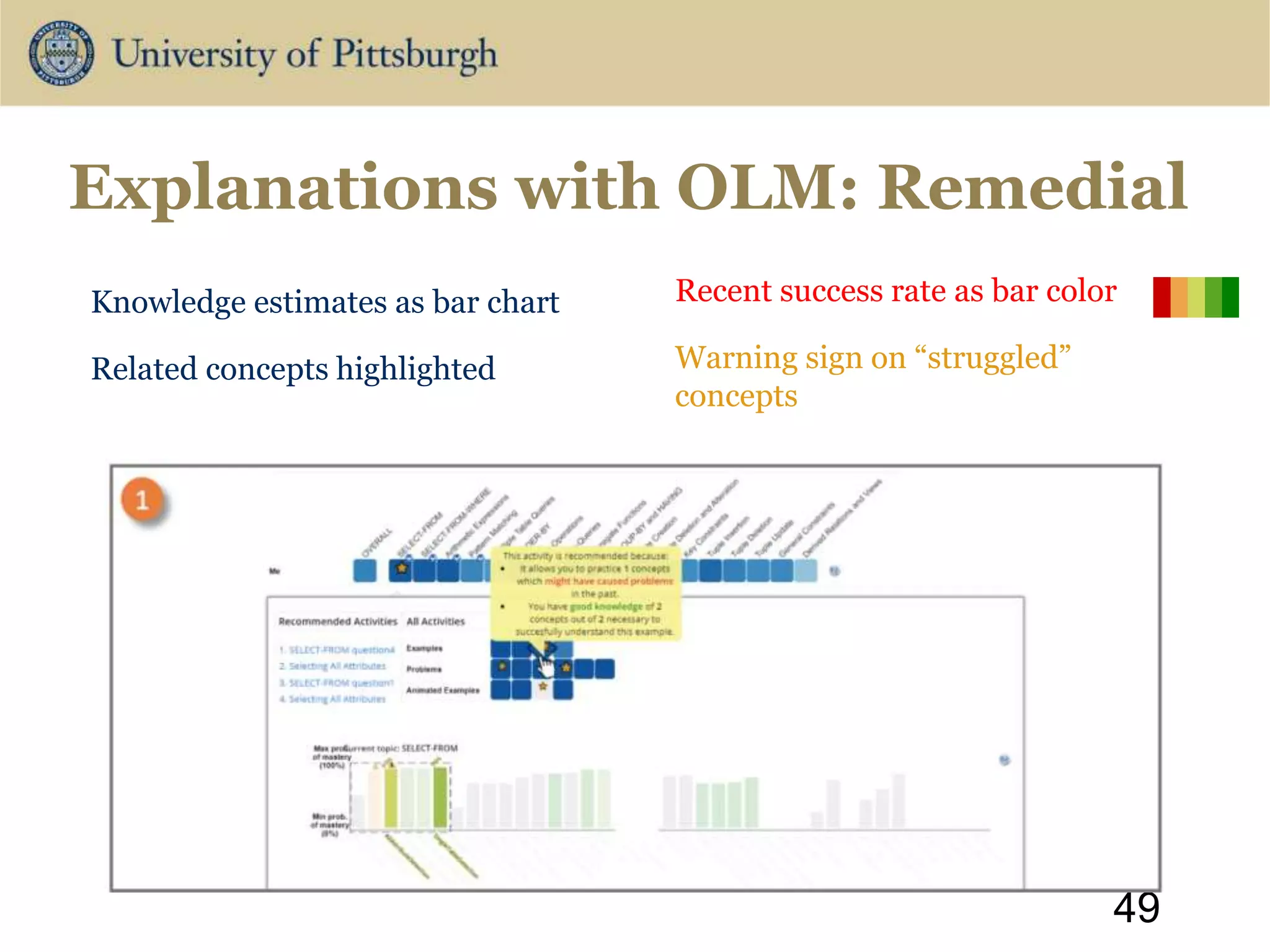
Explanations with OLM: Remedial
Knowledge estimates as bar chart
Related concepts highlighted
49
Recent success rate as bar color
Warning sign on “struggled”
concepts
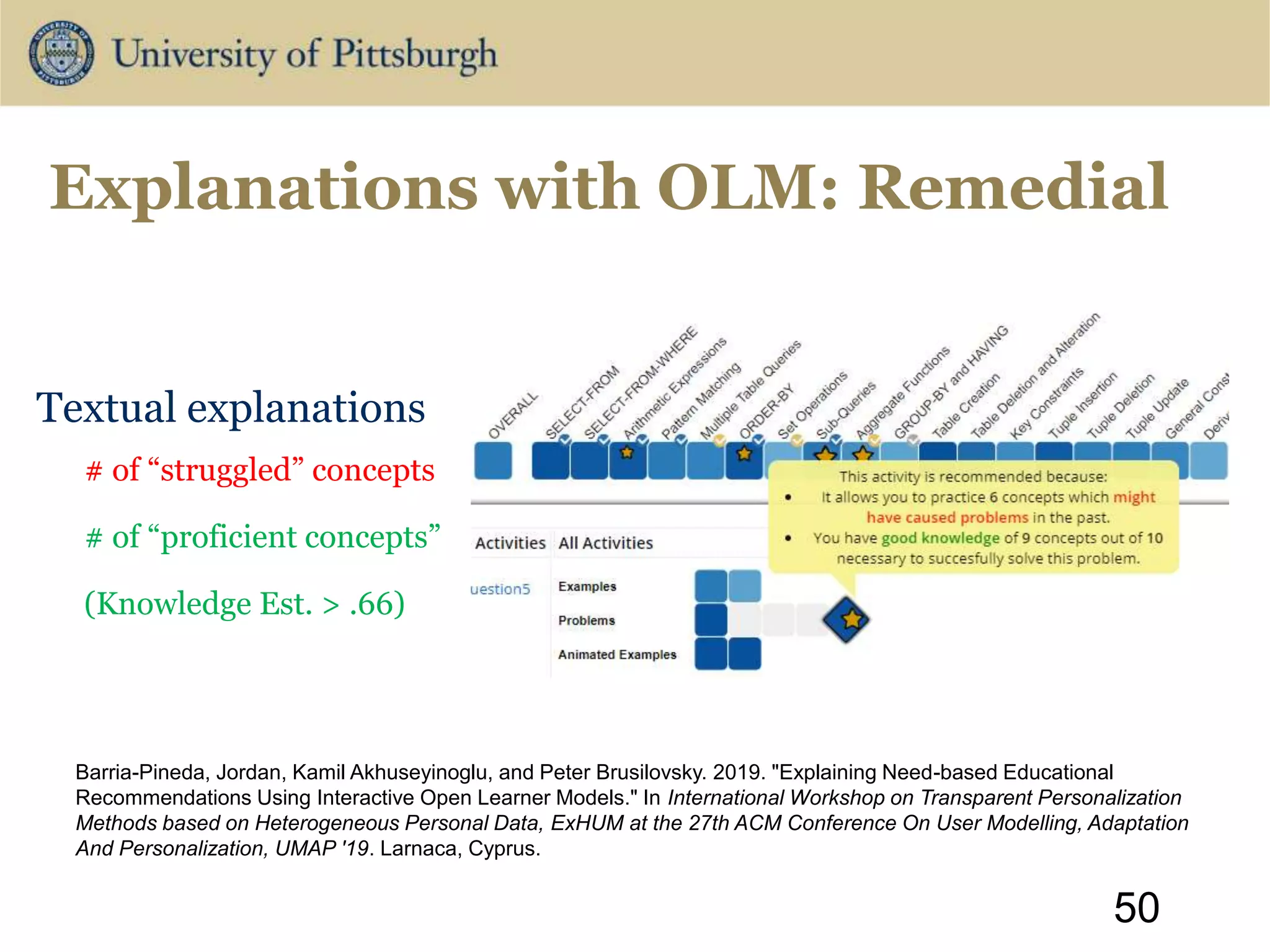
Explanations with OLM: Remedial
Textual explanations
# of “struggled” concepts
# of “proficient concepts”
(Knowledge Est. > .66)
50
Barria-Pineda, Jordan, Kamil Akhuseyinoglu, and Peter Brusilovsky. 2019. "Explaining Need-based Educational
Recommendations Using Interactive Open Learner Models." In International Workshop on Transparent Personalization
Methods based on Heterogeneous Personal Data, ExHUM at the 27th ACM Conference On User Modelling, Adaptation
And Personalization, UMAP '19. Larnaca, Cyprus.
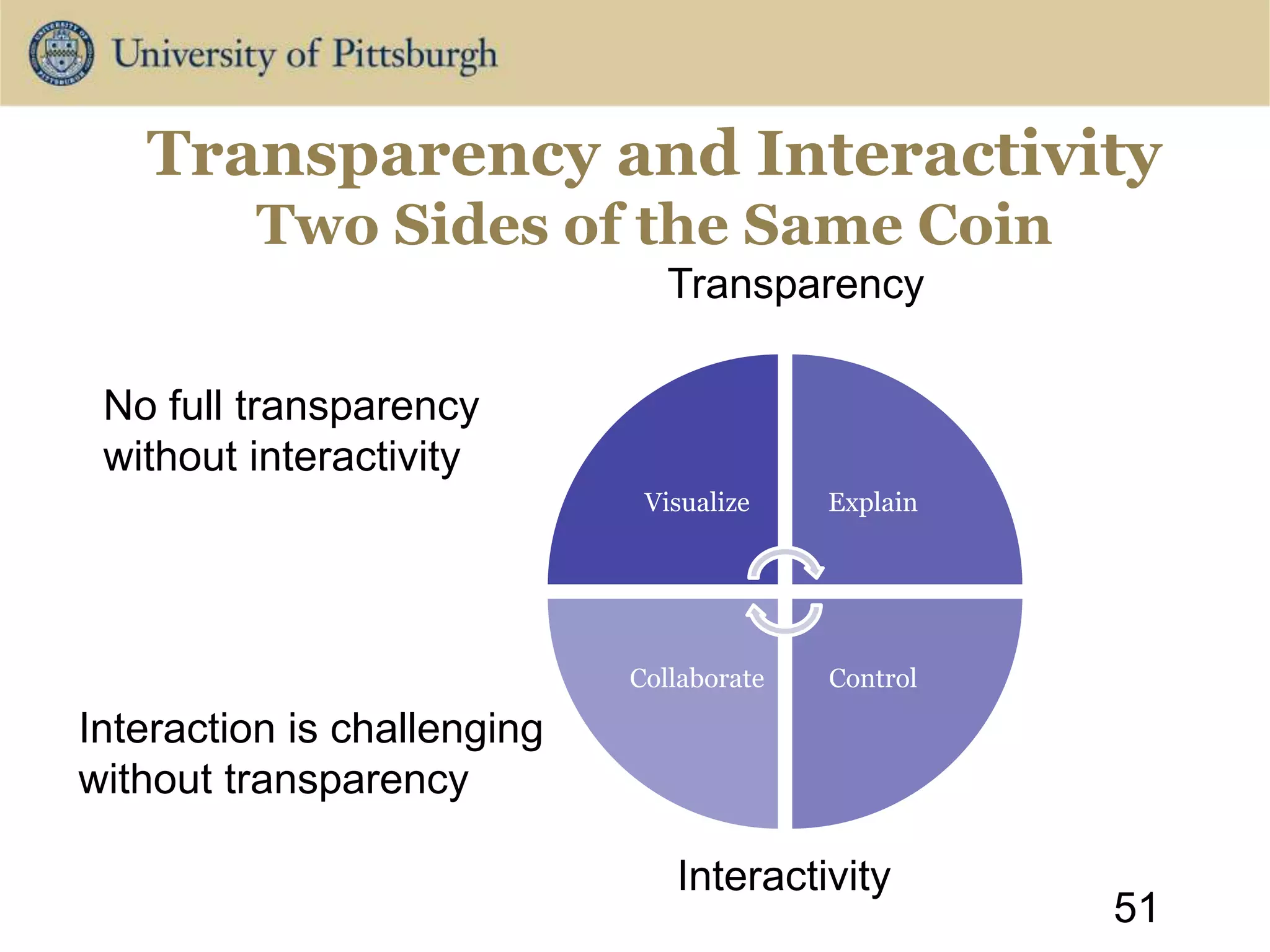
Transparency and Interactivity
Two Sides of the Same Coin
Visualize Explain
Control
Collaborate
51
Transparency
Interactivity
No full transparency
without interactivity
Interaction is challenging
without transparency
Questions?
52
Readings
• Brusilovsky, P. and Anderson, J. (1998) ACT-R electronic bookshelf: An adaptive system for learning cognitive psychology on the
Web. Proceedings of WebNet'98, World Conference of the WWW, Internet, and Intranet, Orlando, FL,, pp. 92-97.
• Weber, G. and Brusilovsky, P. (2001) ELM-ART: An adaptive versatile system for Web-based instruction. International Journal
of Artificial Intelligence in Education 12 (4), 351-384.
• Brusilovsky, P. and Yudelson, M. (2008) From WebEx to NavEx: Interactive Access to Annotated Program Examples.
Proceedings of the IEEE 96 (6), 990-999.
• Loboda, T. D., Guerra, J., Hosseini, R., & Brusilovsky, P. (2014). Mastery grids: An open source social educational progress
visualization. In European conference on technology enhanced learning (pp. 235-248). Springer, Cham.
• Sosnovsky, S. and Brusilovsky, P. (2015) Evaluation of Topic-based Adaptation and Student Modeling in QuizGuide. User
Modeling and User-Adapted Interaction 25 (4), 371-424.
• Brusilovsky, P., Somyurek, S., Guerra, J., Hosseini, R., Zadorozhny, V., and Durlach, P. (2016) Open Social Student
Modeling for Personalized Learning. IEEE Transactions on Emerging Topics in Computing 4 (3), 450-461.
• Guerra Hollstein, J., Barria Pineda, J., Schunn, C., Bull, S., and Brusilovsky, P. (2017) Fine-Grained Open Learner
Models: Complexity Versus Support. In: Proceedings of Proceedings of the 25th Conference on User Modeling, Adaptation and
Personalization, Bratislava, Slovakia, ACM, pp. 41-49.
• Tsai, Chun-Hua and Peter Brusilovsky (2018) Beyond the Ranked List: User-Driven Exploration and Diversification of Social
Recommendation. In 23rd International Conference on Intelligent User Interfaces, 239--50. Tokyo, Japan: ACM.
• Barria-Pineda, J., Akhuseyinoglu, K., and Brusilovsky, P. (2019) Explaining Need-based Educational Recommendations Using Interactive
Open Learner Models. In: Proceedings of International Workshop on Transparent Personalization Methods based on Heterogeneous Personal Data,
ExHUM at the 27th ACM Conference On User Modelling, Adaptation And Personalization, UMAP '19, Larnaca, Cyprus, June 09, 2019, pp. 273–277.
• Akhuseyinoglu, K., Barria-Pineda, J., Sosnovsky, S., Lamprecht, A.-L., Guerra, J., and Brusilovsky, P. (2020)
Exploring Student-Controlled Social Comparison. In: Proceedings of European Conference on Technology Enhanced Learning EC-TEL
2020, Cham, 14-18 September, 2020, Springer International Publishing, pp. 244-258.
• Barria-Pineda, J., Akhuseyinoglu, K., Želem-Ćelap, S., Brusilovsky, P., Klasnja Milicevic, A., and Ivanovic, M. (2021)
Explainable Recommendations in a Personalized Programming Practice System. In: I. Roll, D. McNamara, S. Sosnovsky, R. Luckin and
V. Dimitrova (eds.) Proceedings of 22nd International Conference on Artificial Intelligence in Education, AIED 2021, Utrecht, The
Netherlands, June 14-18, 2021, Springer, pp. 64-76. 53

Human-Centered AI in AI-ED - Keynote at AAAI 2022 AI for Education workshop

  • 1.
    Human-Centered AI inAIED Peter Brusilovsky with Sergey Sosnovsky, Julio Guerra, Jordan Barria-Pineda, Kamil Akhuseyinoglu, PAWS Lab School of Computing and Information University of Pittsburgh
  • 2.
    • A problemwith a long history in AI – The experience of “expert systems” • Modern issues – Possible biases of AI-based decisions with no ability to inspect – Lack of trust to recommendations coming from AI – Limited ability to control or impact AI 2 AI vs Human?
  • 3.
    AI or Humans+ AI? 3
  • 4.
    • Transparent AI •Explainable AI • Human-in-the Loop AI/ML • Human-Centered design of AI systems • “Natural” communication with AI systems • User interfaces for recommender systems – Controlling and explaining recommendations 5 Growing stream of research
  • 5.
    What’s about AIin Education? 6 A classic view on an AI-Ed system architecture
  • 6.
    Transparency and Interactivity TwoSides of the Same Coin Visualize Explain Control Collaborate 7 Transparency Interactivity No full transparency without interactivity Interaction is challenging without transparency
  • 7.
    What are PossibleSolutions? • Collaborate – Work together with AI to make best decisions • Visualize – What is the current state of the learner model that drives AIED decisions? – What is the content model of the current activity? • Control – Edit or negotiate your learner model – Express your goals and preferences in the learning process • Explain – Why a specific learning activity item is good at the current point? 8
  • 8.
  • 9.
  • 10.
    Navigation vs. AdaptiveSequencing 11 Human makes navigation decisions AI makes navigation decisions
  • 11.
    Adaptive Navigation Support AIprovides information, human makes an informed decision AI and human collaborate
  • 12.
    ELM-ART: Adaptive Annotation(1996) Weber, G. and Brusilovsky, P. (2001) ELM-ART: An adaptive versatile system for Web-based instruction. International Journal of Artificial Intelligence in Education 12 (4), 351-384.
  • 13.
    ELM-ART: Evaluation • Noformal classroom study • Users provided their experience • Drop-out evaluation technology • 33 subjects – visited more than 5 pages – have no experience with Lisp – did not finish lesson 3 – 14/19 with/without programming experience
  • 14.
    ELM-ART: Value ofAnnotation Mean number of pages which the users with experience in at least one programming language completed with ELM-ART Users with better starting knowledge work twice as longer when they can collaborate with AI
  • 15.
    ELM-ART: Value ofSequencing Mean number of pages which the users with no experience in programming languages completed with ELM-ART Users with no experience work twice as longer with direct AI guidance
  • 16.
  • 17.
    Adaptive Annotation Can: •Reduce navigation efforts • Reduce repetitive visits to learning content pages • Encourage non-sequential navigation • Increase learning outcome • For those who is ready to follow and advice • Make system more attractive for students • Students stay much longer without any reward
  • 18.
    VISUALIZE! Making learner andcontent models visible 19
  • 19.
    Making Hidden Visible 20 Aclassic view on an AI-Ed system architecture
  • 20.
    Open Learner Models 21 Bull,S., Brusilovsky, P., and Guerra, J. (2018) Which Learning Visualisations to Offer Students? In: V. Pammer-Schindler, M. Pérez-Sanagustín, H. Drachsler, R. Elferink and M. Scheffel (eds.) Proceedings of 13th European Conference on Technology Enhanced Learning, EC-TEL 2018, Leeds, UK, September 3–5, 2018, Springer, pp. 524–530.
  • 21.
    InterBook: Open ContentModel 22 Brusilovsky, P. and Anderson, J. (1998) ACT-R electronic bookshelf: An adaptive system for learning cognitive psychology on the Web. Proceedings of WebNet'98, World Conference of the WWW, Internet, and Intranet, Orlando, FL, November 7-12, 1998, AACE, pp. 92-97.
  • 22.
    List of annotated linksto all quizzes available for a student in the current course Refresh and help icons QuizGuide: OLM+ANS Sosnovsky, S. and Brusilovsky, P. (2015) Evaluation of Topic-based Adaptation and Student Modeling in QuizGuide. User Modeling and User-Adapted Interaction 25 (4), 371-424.
  • 23.
    QuizGuide: Adaptive Annotations •Target-arrow: OLM – Number of arrows – level of knowledge for the specific topic (from 0 to 3). Individual, event-based adaptation. • Color Intensity: ANS – Learning goal (current, prerequisite for current, not-relevant, not-ready).  Topic–quiz organization:
  • 24.
    Mastery Grids: Personalized PracticeSystem with OSLM Loboda, T. D., Guerra, J., Hosseini, R., & Brusilovsky, P. (2014, September). Mastery grids: An open source social educational progress visualization. In European conference on technology enhanced learning (pp. 235-248). Springer, Cham. Learning content OSLM Features
  • 25.
    Topic-Level vs. Concept-levelOLM 26 Guerra Hollstein, J., Barria Pineda, J., Schunn, C., Bull, S., and Brusilovsky, P. (2017) Fine- Grained Open Learner Models: Complexity Versus Support. In: Proceedings of Proceedings of the 25th Conference on User Modeling, Adaptation and Personalization, Bratislava, Slovakia, ACM, pp. 41-49.
  • 26.
    Transparency and Interactivity TwoSides of the Same Coin Visualize Explain Control Collaborate 28 Transparency Interactivity No full transparency without interactivity Interaction is challenging without transparency
  • 27.
    CONTROL! Allow the userto control various parameters of the AI process to better adapt personalization / presentation for the current context. Avoid guessing! Let the user contribute! 29
  • 28.
    What Can BeControlled? 30 Data Process Presentation User Model Ranking Source Fusion What/how to present
  • 29.
    Indirect Control: EditableOLM 31 Weber, G. and Brusilovsky, P. (2001) ELM-ART: An adaptive versatile system for Web-based instruction. International Journal of Artificial Intelligence in Education 12 (4), 351-384.
  • 30.
    RelevanceTuner: Ranking Controlin a Hybrid Social Recommender Tsai, Chun-Hua and Peter Brusilovsky (2018) Beyond the Ranked List: User-Driven Exploration and Diversification of Social Recommendation. In 23rd International Conference on Intelligent User Interfaces, 239--50. Tokyo, Japan: ACM.
  • 31.
    Mastery Grids: OpenSocial LM 33 Brusilovsky, P., Somyurek, S., Guerra, J., Hosseini, R., Zadorozhny, V., and Durlach, P. (2016) Open Social Student Modeling for Personalized Learning. IEEE Transactions on Emerging Topics in Computing 4 (3), 450-461.
  • 32.
    Student-Controllable Presentation of SocialComparison Default Class Average Change to Lower progress Change to Higher progress Akhuseyinoglu, K., Barria-Pineda, J., Sosnovsky, S., Lamprecht, A.-L., Guerra, J., and Brusilovsky, P. (2020) Exploring Student-Controlled Social Comparison. In: Proceedings of European Conference on Technology Enhanced Learning EC-TEL 2020, Cham, 14-18 September, 2020, Springer International Publishing, pp. 244-258.
  • 33.
  • 34.
  • 35.
    Study Details Classroom studyat Utrecht University in early 2020 – Introduction to computational thinking course – Python Programming Single condition Python Grids offered as optional practice To increase motivation – 2% bonus offered towards homework submissions – One Question and One Problem in each topic Analyzed logs of 44 students – Practiced with 1+ learning content 37
  • 36.
    Total 706 groupchanges (n=40, M=17.65, SD=19.09) – 91% (n=40) 1+ changes – 77% (n=32) 5+ changes – 34% (n=15) 10+changes Total 139 ranked list view (n=40, M=3.48, SD=7.74) 38 Did Students Use Control Features?
  • 37.
    Results 40 Control features usedconsiderably – Preferred more average and higher – Performed frequent changes Positive association with more practice – Practiced more with all activity types Positive upward social comparison Better navigational support Topics to catch the group Topic that student worked more than group
  • 38.
    EXPLAIN! Make it moreclear for students why specific recommended learning activities are recommended and how they relate to their knowledge and learning goals 42
  • 39.
  • 40.
    ATEC Worksho 2 01 9 Los Angeles 44 Explanations with OLM: Success Barria-Pineda, Jordan, and Peter Brusilovsky. 2019. "Explaining Educational Recommendations Through a Concept-level Knowledge Visualization." In Proceedings of the 24th International Conference on Intelligent User Interfaces: Companion, 103--04. New York, NY, USA: ACM.
  • 41.
    1 45 Explanations with OLM:Balance Higher adoption of recommended learning content Barria-Pineda, J., Akhuseyinoglu, K., Želem-Ćelap, S., Brusilovsky, P., Klasnja Milicevic, A., and Ivanovic, M. (2021) Explainable Recommendations in a Personalized Programming Practice System. In: 22nd International Conference on Artificial Intelligence in Education, AIED 2021, Springer, pp. 64-76.
  • 42.
    46 Work with non-recommended activities Loweradoption of non-recommended learning content Explanations with OLM: Visual
  • 43.
    The presence ofrecommendations and explanations could increase student engagement with knowledge-relevant learning content leading to a higher success rate. 48 Explanatory features of educational recommendations were used extensively for exploring the learning materials. Students with lower entry-levels of knowledge ! Explanations provide students an opportunity for reflecting on the appropriateness of the content for supporting each step of their learning Especially students with higher entry-levels of knowledge ! Explanations with OLM: Summary
  • 44.
    Explanations with OLM:Remedial Knowledge estimates as bar chart Related concepts highlighted 49 Recent success rate as bar color Warning sign on “struggled” concepts
  • 45.
    Explanations with OLM:Remedial Textual explanations # of “struggled” concepts # of “proficient concepts” (Knowledge Est. > .66) 50 Barria-Pineda, Jordan, Kamil Akhuseyinoglu, and Peter Brusilovsky. 2019. "Explaining Need-based Educational Recommendations Using Interactive Open Learner Models." In International Workshop on Transparent Personalization Methods based on Heterogeneous Personal Data, ExHUM at the 27th ACM Conference On User Modelling, Adaptation And Personalization, UMAP '19. Larnaca, Cyprus.
  • 46.
    Transparency and Interactivity TwoSides of the Same Coin Visualize Explain Control Collaborate 51 Transparency Interactivity No full transparency without interactivity Interaction is challenging without transparency
  • 47.
  • 48.
    Readings • Brusilovsky, P.and Anderson, J. (1998) ACT-R electronic bookshelf: An adaptive system for learning cognitive psychology on the Web. Proceedings of WebNet'98, World Conference of the WWW, Internet, and Intranet, Orlando, FL,, pp. 92-97. • Weber, G. and Brusilovsky, P. (2001) ELM-ART: An adaptive versatile system for Web-based instruction. International Journal of Artificial Intelligence in Education 12 (4), 351-384. • Brusilovsky, P. and Yudelson, M. (2008) From WebEx to NavEx: Interactive Access to Annotated Program Examples. Proceedings of the IEEE 96 (6), 990-999. • Loboda, T. D., Guerra, J., Hosseini, R., & Brusilovsky, P. (2014). Mastery grids: An open source social educational progress visualization. In European conference on technology enhanced learning (pp. 235-248). Springer, Cham. • Sosnovsky, S. and Brusilovsky, P. (2015) Evaluation of Topic-based Adaptation and Student Modeling in QuizGuide. User Modeling and User-Adapted Interaction 25 (4), 371-424. • Brusilovsky, P., Somyurek, S., Guerra, J., Hosseini, R., Zadorozhny, V., and Durlach, P. (2016) Open Social Student Modeling for Personalized Learning. IEEE Transactions on Emerging Topics in Computing 4 (3), 450-461. • Guerra Hollstein, J., Barria Pineda, J., Schunn, C., Bull, S., and Brusilovsky, P. (2017) Fine-Grained Open Learner Models: Complexity Versus Support. In: Proceedings of Proceedings of the 25th Conference on User Modeling, Adaptation and Personalization, Bratislava, Slovakia, ACM, pp. 41-49. • Tsai, Chun-Hua and Peter Brusilovsky (2018) Beyond the Ranked List: User-Driven Exploration and Diversification of Social Recommendation. In 23rd International Conference on Intelligent User Interfaces, 239--50. Tokyo, Japan: ACM. • Barria-Pineda, J., Akhuseyinoglu, K., and Brusilovsky, P. (2019) Explaining Need-based Educational Recommendations Using Interactive Open Learner Models. In: Proceedings of International Workshop on Transparent Personalization Methods based on Heterogeneous Personal Data, ExHUM at the 27th ACM Conference On User Modelling, Adaptation And Personalization, UMAP '19, Larnaca, Cyprus, June 09, 2019, pp. 273–277. • Akhuseyinoglu, K., Barria-Pineda, J., Sosnovsky, S., Lamprecht, A.-L., Guerra, J., and Brusilovsky, P. (2020) Exploring Student-Controlled Social Comparison. In: Proceedings of European Conference on Technology Enhanced Learning EC-TEL 2020, Cham, 14-18 September, 2020, Springer International Publishing, pp. 244-258. • Barria-Pineda, J., Akhuseyinoglu, K., Želem-Ćelap, S., Brusilovsky, P., Klasnja Milicevic, A., and Ivanovic, M. (2021) Explainable Recommendations in a Personalized Programming Practice System. In: I. Roll, D. McNamara, S. Sosnovsky, R. Luckin and V. Dimitrova (eds.) Proceedings of 22nd International Conference on Artificial Intelligence in Education, AIED 2021, Utrecht, The Netherlands, June 14-18, 2021, Springer, pp. 64-76. 53