TRAUMATIC BRAIN INJURY
TIERS OF THERAPY
Dra. Alia
BCH
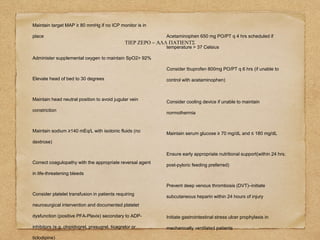
TIER ZERO - ALL PATIENTS
Maintain target MAP ≥ 80 mmHg if no ICP monitor is in
place
Administer supplemental oxygen to maintain SpO2> 92%
Elevate head of bed to 30 degrees
Maintain head neutral position to avoid jugular vein
constriction
Maintain sodium ≥140 mEq/L with isotonic fluids (no
dextrose)
Correct coagulopathy with the appropriate reversal agent
in life-threatening bleeds
Consider platelet transfusion in patients requiring
neurosurgical intervention and documented platelet
dysfunction (positive PFA-Plavix) secondary to ADP-
inhibitors (e.g. clopidogrel, prasugrel, ticagrelor or
ticlodipine)
Acetaminophen 650 mg PO/PT q 4 hrs scheduled if
temperature > 37 Celsius
Consider Ibuprofen 800mg PO/PT q 6 hrs (if unable to
control with acetaminophen)
Consider cooling device if unable to maintain
normothermia
Maintain serum glucose ≥ 70 mg/dL and ≤ 180 mg/dL
Ensure early appropriate nutritional support(within 24 hrs;
post-pyloric feeding preferred)
Prevent deep venous thrombosis (DVT)–initiate
subcutaneous heparin within 24 hours of injury
Initiate gastrointestinal stress ulcer prophylaxis in
mechanically ventilated patients
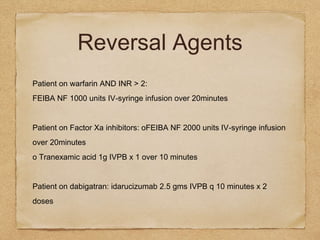
Reversal Agents
Patient on warfarin AND INR > 2:
FEIBA NF 1000 units IV-syringe infusion over 20minutes
Patient on Factor Xa inhibitors: oFEIBA NF 2000 units IV-syringe infusion
over 20minutes
o Tranexamic acid 1g IVPB x 1 over 10 minutes
Patient on dabigatran: idarucizumab 2.5 gms IVPB q 10 minutes x 2
doses
TIER ONE
The following interventions should be added in all patients with Glasgow Coma Score (GCS) ≤8:
Ensure all physiologic goals from Tier Zero are met
• Airway / Breathing
• Systemic Perfusion
• Cerebral Perfusion
• Osmolar Therapy
• Protect the Brain
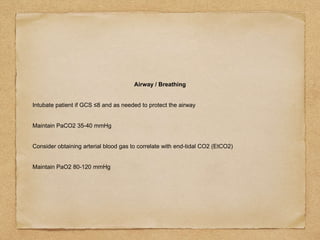
Airway / Breathing
Intubate patient if GCS ≤8 and as needed to protect the airway
Maintain PaCO2 35-40 mmHg
Consider obtaining arterial blood gas to correlate with end-tidal CO2 (EtCO2)
Maintain PaO2 80-120 mmHg
Systemic Perfusion
Insert an arterial line (leveled at the phlebostatic axis)
Maintain euvolemia (fluid balance positive by 500-1000 mL in first 24 hrs)
MaintainMAP≥ 80 mmHg if no ICP monitor is in place
Ensure adequate volume resuscitation
Ensure hemoglobin > 9 g/dL during the patient’s acute resuscitation phase
Consider advanced hemodynamic monitoring
Consider adding norepinephrine 0.05 mcg/kg/min –titrate to keep MAP ≥ 80 mmHg or CPP ≥ 60 mmHg
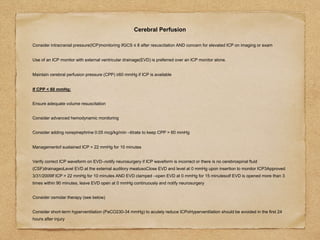
Cerebral Perfusion
Consider intracranial pressure(ICP)monitoring ifGCS ≤ 8 after resuscitation AND concern for elevated ICP on imaging or exam
Use of an ICP monitor with external ventricular drainage(EVD) is preferred over an ICP monitor alone.
Maintain cerebral perfusion pressure (CPP) ≥60 mmHg if ICP is available
If CPP < 60 mmHg:
Ensure adequate volume resuscitation
Consider advanced hemodynamic monitoring
Consider adding norepinephrine 0.05 mcg/kg/min –titrate to keep CPP > 60 mmHg
Managementof sustained ICP > 22 mmHg for 10 minutes
Verify correct ICP waveform on EVD–notify neurosurgery if ICP waveform is incorrect or there is no cerebrospinal fluid
(CSF)drainageoLevel EVD at the external auditory meatusoClose EVD and level at 0 mmHg upon insertion to monitor ICP3Approved
3/31/2009If ICP > 22 mmHg for 10 minutes AND EVD clamped –open EVD at 0 mmHg for 15 minutesoIf EVD is opened more than 3
times within 90 minutes, leave EVD open at 0 mmHg continuously and notify neurosurgery
Consider osmolar therapy (see below)
Consider short-term hyperventilation (PaCO230-34 mmHg) to acutely reduce ICPoHyperventilation should be avoided in the first 24
hours after injury
Osmolar Therapy
First line therapy for ICP >22 mmHg for ≥ 10 minutes:
7.5% Sodium Chloride 250mL IV bolus over 15min x 1 if serum sodium< 160 mmol/L
Alternate therapy:
Mannitol 0.25-1.0 gm/kg IV-push x 1 if serum sodium<160 and/or serum osmolality < 320 mOsm/L
Measure serum sodium every 4 hrs(and serum osmolality every 4 hrs if using mannitol)
Notify intensivist if serum sodium changes by > 2mEq/L/4 hours from previous measurement
Hold hypertonic saline therapy for serum sodium≥160 mEq/L
Hold mannitol therapy for serum sodium ≥160 mEq/L and/or serum osmolality ≥320 mOsm/L
Provide judicious analgesia and sedation to control pain and agitation -Analgosedation is preferred
Fentanyl 25-500mcg/hr IV infusion -Bolus with dose increases for elevated ICP -Preferentially increase fentanyl (and/or oral opioid
therapy) over propofol
Propofol 10-50 mcg/kg/minIV infusion
Rule-out seizure activity
Initiate continuous EEG monitoring to rule non-convulsive status epilepticus
Levetiracetam 500 mg IV/PO/PT every 12hrs x7 days (discontinue after 7 days if no seizure activity)
Levetiracetam500 mg IV/PO/PTevery 12hrsx7 days (discontinue after 7 days if no seizure activity)
Avoid:
Hypotension (SBP < 100mmHg)or CPP < 60 mmHg
Hypoxemia (SpO2< 92%)
Hypercarbia (PaCO2> 45 mmHg)
Hyponatremia (serum sodium< 140 mEq/L)
Hypoglycemia or Hyperglycemia (serum glucose <70 mg/dL or >180 mg/dL)
Hypovolemia
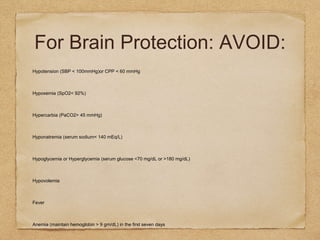
For Brain Protection: AVOID:
Hypotension (SBP < 100mmHg)or CPP < 60 mmHg
Hypoxemia (SpO2< 92%)
Hypercarbia (PaCO2> 45 mmHg)
Hyponatremia (serum sodium< 140 mEq/L)
Hypoglycemia or Hyperglycemia (serum glucose <70 mg/dL or >180 mg/dL)
Hypovolemia
Fever
Anemia (maintain hemoglobin > 9 gm/dL) in the first seven days
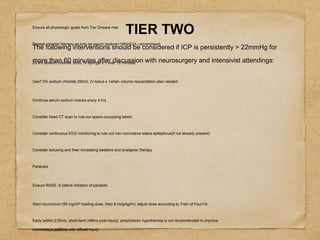
TIER TWO
The following interventions should be considered if ICP is persistently > 22mmHg for
more than 60 minutes after discussion with neurosurgery and intensivist attendings:
Ensure all physiologic goals from Tier Oneare met
Repeat osmolar therapy as long as serum sodium<160mEq/L–recommend:
23.4% sodium chloride 30mL IV-syringe x 1 over 15 minutes
Use7.5% sodium chloride 250mL IV-bolus x 1when volume resuscitation also needed
Continue serum sodium checks every 4 hrs
Consider head CT scan to rule out space-occupying lesion
Consider continuous EEG monitoring to rule out non-convulsive status epilepticus(if not already present)
Consider bolusing and then increasing sedative and analgesic therapy
Paralysis
Ensure RASS -5 before initiation of paralytic
Start rocuronium (50 mgIVP loading dose, then 8 mcg/kg/hr); adjust dose according to Train of Four1/4
Early (within 2.5hrs), short-term (48hrs post-injury), prophylactic hypothermia is not recommended to improve
outcomes in patients with diffuse injury.
TIER THREE
The following interventions should be considered if ICP remains > 22mmHg despite
all Tier Two goals being met
Ensure that medical therapy with hypertonic saline is maximized(e.g. serum sodium 155-160mEq/L)
Consider revised ICP threshold of 25 mmHg with strict adherence to CPP> 60 mmHg
Initiate continuous EEG (if not already present)
Surgical decompression
Craniectomy solely for management of ICP does not improve long-term neurological outcome
Consider decompressive craniectomy / craniotomy in patients with a surgical lesion.
Barbiturate Coma
If not a surgical candidate, and refractory to all above interventions, consider pentobarbital coma
Pentobarbital 10 mg/kg IV over 10 minutes, then 5 mg/kg/h x 3hours, then 1 mg/kg/hr IV infusion
Titrate pentobarbital to the minimal dose required to achieve EEG burst suppression–3-5 bursts / minute (= 1-2 bursts per screen)
Discontinue all other sedative agents and paralytics after pentobarbital loading doses complete (4 hours)
Consider invasive hemodynamic monitoring (such as pulmonary artery catheter) due to the negative inotropic effects of pentobarbital

Tbi

  • 1.
    TRAUMATIC BRAIN INJURY TIERSOF THERAPY Dra. Alia BCH
  • 2.
    TIER ZERO -ALL PATIENTS Maintain target MAP ≥ 80 mmHg if no ICP monitor is in place Administer supplemental oxygen to maintain SpO2> 92% Elevate head of bed to 30 degrees Maintain head neutral position to avoid jugular vein constriction Maintain sodium ≥140 mEq/L with isotonic fluids (no dextrose) Correct coagulopathy with the appropriate reversal agent in life-threatening bleeds Consider platelet transfusion in patients requiring neurosurgical intervention and documented platelet dysfunction (positive PFA-Plavix) secondary to ADP- inhibitors (e.g. clopidogrel, prasugrel, ticagrelor or ticlodipine) Acetaminophen 650 mg PO/PT q 4 hrs scheduled if temperature > 37 Celsius Consider Ibuprofen 800mg PO/PT q 6 hrs (if unable to control with acetaminophen) Consider cooling device if unable to maintain normothermia Maintain serum glucose ≥ 70 mg/dL and ≤ 180 mg/dL Ensure early appropriate nutritional support(within 24 hrs; post-pyloric feeding preferred) Prevent deep venous thrombosis (DVT)–initiate subcutaneous heparin within 24 hours of injury Initiate gastrointestinal stress ulcer prophylaxis in mechanically ventilated patients
  • 3.
    Reversal Agents Patient onwarfarin AND INR > 2: FEIBA NF 1000 units IV-syringe infusion over 20minutes Patient on Factor Xa inhibitors: oFEIBA NF 2000 units IV-syringe infusion over 20minutes o Tranexamic acid 1g IVPB x 1 over 10 minutes Patient on dabigatran: idarucizumab 2.5 gms IVPB q 10 minutes x 2 doses
  • 4.
    TIER ONE The followinginterventions should be added in all patients with Glasgow Coma Score (GCS) ≤8: Ensure all physiologic goals from Tier Zero are met • Airway / Breathing • Systemic Perfusion • Cerebral Perfusion • Osmolar Therapy • Protect the Brain
  • 5.
    Airway / Breathing Intubatepatient if GCS ≤8 and as needed to protect the airway Maintain PaCO2 35-40 mmHg Consider obtaining arterial blood gas to correlate with end-tidal CO2 (EtCO2) Maintain PaO2 80-120 mmHg
  • 6.
    Systemic Perfusion Insert anarterial line (leveled at the phlebostatic axis) Maintain euvolemia (fluid balance positive by 500-1000 mL in first 24 hrs) MaintainMAP≥ 80 mmHg if no ICP monitor is in place Ensure adequate volume resuscitation Ensure hemoglobin > 9 g/dL during the patient’s acute resuscitation phase Consider advanced hemodynamic monitoring Consider adding norepinephrine 0.05 mcg/kg/min –titrate to keep MAP ≥ 80 mmHg or CPP ≥ 60 mmHg
  • 7.
    Cerebral Perfusion Consider intracranialpressure(ICP)monitoring ifGCS ≤ 8 after resuscitation AND concern for elevated ICP on imaging or exam Use of an ICP monitor with external ventricular drainage(EVD) is preferred over an ICP monitor alone. Maintain cerebral perfusion pressure (CPP) ≥60 mmHg if ICP is available If CPP < 60 mmHg: Ensure adequate volume resuscitation Consider advanced hemodynamic monitoring Consider adding norepinephrine 0.05 mcg/kg/min –titrate to keep CPP > 60 mmHg Managementof sustained ICP > 22 mmHg for 10 minutes Verify correct ICP waveform on EVD–notify neurosurgery if ICP waveform is incorrect or there is no cerebrospinal fluid (CSF)drainageoLevel EVD at the external auditory meatusoClose EVD and level at 0 mmHg upon insertion to monitor ICP3Approved 3/31/2009If ICP > 22 mmHg for 10 minutes AND EVD clamped –open EVD at 0 mmHg for 15 minutesoIf EVD is opened more than 3 times within 90 minutes, leave EVD open at 0 mmHg continuously and notify neurosurgery Consider osmolar therapy (see below) Consider short-term hyperventilation (PaCO230-34 mmHg) to acutely reduce ICPoHyperventilation should be avoided in the first 24 hours after injury
  • 8.
    Osmolar Therapy First linetherapy for ICP >22 mmHg for ≥ 10 minutes: 7.5% Sodium Chloride 250mL IV bolus over 15min x 1 if serum sodium< 160 mmol/L Alternate therapy: Mannitol 0.25-1.0 gm/kg IV-push x 1 if serum sodium<160 and/or serum osmolality < 320 mOsm/L Measure serum sodium every 4 hrs(and serum osmolality every 4 hrs if using mannitol) Notify intensivist if serum sodium changes by > 2mEq/L/4 hours from previous measurement Hold hypertonic saline therapy for serum sodium≥160 mEq/L Hold mannitol therapy for serum sodium ≥160 mEq/L and/or serum osmolality ≥320 mOsm/L
  • 9.
    Provide judicious analgesiaand sedation to control pain and agitation -Analgosedation is preferred Fentanyl 25-500mcg/hr IV infusion -Bolus with dose increases for elevated ICP -Preferentially increase fentanyl (and/or oral opioid therapy) over propofol Propofol 10-50 mcg/kg/minIV infusion Rule-out seizure activity Initiate continuous EEG monitoring to rule non-convulsive status epilepticus Levetiracetam 500 mg IV/PO/PT every 12hrs x7 days (discontinue after 7 days if no seizure activity) Levetiracetam500 mg IV/PO/PTevery 12hrsx7 days (discontinue after 7 days if no seizure activity) Avoid: Hypotension (SBP < 100mmHg)or CPP < 60 mmHg Hypoxemia (SpO2< 92%) Hypercarbia (PaCO2> 45 mmHg) Hyponatremia (serum sodium< 140 mEq/L) Hypoglycemia or Hyperglycemia (serum glucose <70 mg/dL or >180 mg/dL) Hypovolemia
  • 10.
    For Brain Protection:AVOID: Hypotension (SBP < 100mmHg)or CPP < 60 mmHg Hypoxemia (SpO2< 92%) Hypercarbia (PaCO2> 45 mmHg) Hyponatremia (serum sodium< 140 mEq/L) Hypoglycemia or Hyperglycemia (serum glucose <70 mg/dL or >180 mg/dL) Hypovolemia Fever Anemia (maintain hemoglobin > 9 gm/dL) in the first seven days
  • 11.
    TIER TWO The followinginterventions should be considered if ICP is persistently > 22mmHg for more than 60 minutes after discussion with neurosurgery and intensivist attendings: Ensure all physiologic goals from Tier Oneare met Repeat osmolar therapy as long as serum sodium<160mEq/L–recommend: 23.4% sodium chloride 30mL IV-syringe x 1 over 15 minutes Use7.5% sodium chloride 250mL IV-bolus x 1when volume resuscitation also needed Continue serum sodium checks every 4 hrs Consider head CT scan to rule out space-occupying lesion Consider continuous EEG monitoring to rule out non-convulsive status epilepticus(if not already present) Consider bolusing and then increasing sedative and analgesic therapy Paralysis Ensure RASS -5 before initiation of paralytic Start rocuronium (50 mgIVP loading dose, then 8 mcg/kg/hr); adjust dose according to Train of Four1/4 Early (within 2.5hrs), short-term (48hrs post-injury), prophylactic hypothermia is not recommended to improve outcomes in patients with diffuse injury.
  • 12.
    TIER THREE The followinginterventions should be considered if ICP remains > 22mmHg despite all Tier Two goals being met Ensure that medical therapy with hypertonic saline is maximized(e.g. serum sodium 155-160mEq/L) Consider revised ICP threshold of 25 mmHg with strict adherence to CPP> 60 mmHg Initiate continuous EEG (if not already present) Surgical decompression Craniectomy solely for management of ICP does not improve long-term neurological outcome Consider decompressive craniectomy / craniotomy in patients with a surgical lesion. Barbiturate Coma If not a surgical candidate, and refractory to all above interventions, consider pentobarbital coma Pentobarbital 10 mg/kg IV over 10 minutes, then 5 mg/kg/h x 3hours, then 1 mg/kg/hr IV infusion Titrate pentobarbital to the minimal dose required to achieve EEG burst suppression–3-5 bursts / minute (= 1-2 bursts per screen) Discontinue all other sedative agents and paralytics after pentobarbital loading doses complete (4 hours) Consider invasive hemodynamic monitoring (such as pulmonary artery catheter) due to the negative inotropic effects of pentobarbital