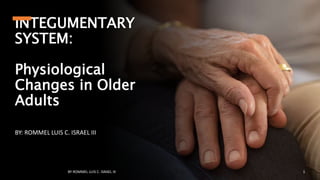

INTEGUMENTARY
SYSTEM:
Physiological
Changes in Older
Adults
BY: ROMMEL LUIS C. ISRAEL III
BY ROMMEL LUIS C. ISRAEL III 1
PHYSIOLOGICA
L CHANGES IN
AGING
AFFECTING
VARIOUS
SYSTEM
• Physiological changes of aging is
an integral part of aging process.
• We cannot say an individual ages without
the occurrence of these physiological
changes such as changes in physical
appearance, declined functionality and
chronic diseases.
• Even the psychological and social
changes can contribute to physiological
changes.
• Several of the normal age-
related changes are similar to those seen
in the
presence of pathological
conditions.
BY ROMMEL LUIS C. ISRAEL III 2
PHYSIOLOGIC
AL CHANGES
IN AGING
AFFECTING
VARIOUS
SYSTEM
BY
ROMMEL
LUIS
C.
ISRAEL
III
3
Examples of Normal Age Changes Potentially
Misinterpreted as Indicators of Pathology
Slight delay in reflex response
Loss of hair on lower extremities
Decreased spoken word recognition
Reduced pupillary response (bilateral)
Decreased color discrimination
Examples of Indicators of Pathology
Potentially Misinterpreted as Normal Age
Changes
Memory loss Incontinence Falling
Sudden confusion Constipation
BY ROMMEL LUIS C. ISRAEL III 4
CLASSIFICATION:
BY
ROMMEL
LUIS
C.
ISRAEL
III
5
CHRONOLOGICAL OR INTRINSIC AGING refers
to those changes considered to be due only
to the passage of time and is caused by
internal factors related to degeneration of
physiologic processes, such as diminished
collagen synthesis.
EXTRINSIC AGING is the result of chronic
exposure of the skin to external factors such
as smoking, poor nutrition and especially UV
lights, which induces photoaging
EXAMPLE OF
THE
CLASSIFICATION
BY
ROMMEL
LUIS
C.
ISRAEL
III
6
CHRONOLOGICALLY AGED SKIN is
characterized by thinness and reduction
in elasticity resulting to wrinkles
formation but are usually very fine and
thus appears relatively smooth.
EXTRINSIC AGING OR PHOTOAGED SKIN
is characterized as deep wrinkles, sagging
and a leathery appearance
CHANGES IN
VARIOUS BODY
SYSTEMS
BY ROMMEL LUIS C. ISRAEL III 7
INTEGUMENTARY
SYSTEM
BY
ROMMEL
LUIS
C.
ISRAEL
III
• The integument is the largest organ of the
body
• It provides clues to hereditary, dietary,
physical, and emotional conditions and
health.
• The skin serves as a
means of communication and enables us to
experience touch, warmth, cold, and pain.
• It protects the internal organs, helps
regulate body temperature, serves as an
efficient vehicle for the excretion of salts,
water, and organic wastes, and stores fat.
• It helps protect the person from the damage
of ultraviolet rays and produces vitamin D.
• Finally, the integument gives each
person his or her unique and changing
appearance.
• Consist of the skin and its accessory
structures including hair, nails, and the
sweat and sebaceous glands
• Changes in the skin structure and function
can be classified as either chronological 8
NORMAL
AGING
CHANGES OF
THE
INTEGUMENTA
RY SYSTEM
BY
ROMMEL
LUIS
C.
ISRAEL
III
9
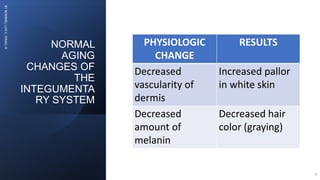
PHYSIOLOGIC
CHANGE
RESULTS
Decreased
vascularity of
dermis
Increased pallor
in white skin
Decreased
amount of
melanin
Decreased hair
color (graying)
NORMAL
AGING
CHANGES OF
THE
INTEGUMENTA
RY SYSTEM
BY
ROMMEL
LUIS
C.
ISRAEL
III
10
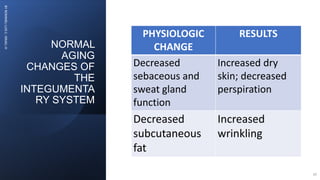
PHYSIOLOGIC
CHANGE
RESULTS
Decreased
sebaceous and
sweat gland
function
Increased dry
skin; decreased
perspiration
Decreased
subcutaneous
fat
Increased
wrinkling
NORMAL
AGING
CHANGES OF
THE
INTEGUMENTA
RY SYSTEM
BY
ROMMEL
LUIS
C.
ISRAEL
III
11
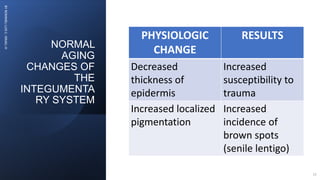
PHYSIOLOGIC
CHANGE
RESULTS
Decreased
thickness of
epidermis
Increased
susceptibility to
trauma
Increased localized
pigmentation
Increased
incidence of
brown spots
(senile lentigo)
NORMAL
AGING
CHANGES OF
THE
INTEGUMENTA
RY SYSTEM
BY
ROMMEL
LUIS
C.
ISRAEL
III
12
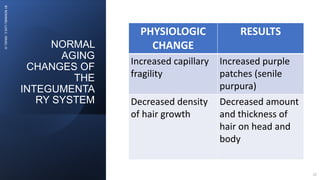
PHYSIOLOGIC
CHANGE
RESULTS
Increased capillary
fragility
Increased purple
patches (senile
purpura)
Decreased density
of hair growth
Decreased amount
and thickness of
hair on head and
body
NORMAL
AGING
CHANGES OF
THE
INTEGUMENTA
RY SYSTEM
BY
ROMMEL
LUIS
C.
ISRAEL
III
13
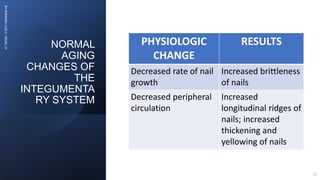
PHYSIOLOGIC
CHANGE
RESULTS
Decreased rate of nail
growth
Increased brittleness
of nails
Decreased peripheral
circulation
Increased
longitudinal ridges of
nails; increased
thickening and
yellowing of nails
NORMAL
AGING
CHANGES OF
THE
INTEGUMENTA
RY SYSTEM
BY
ROMMEL
LUIS
C.
ISRAEL
III
14
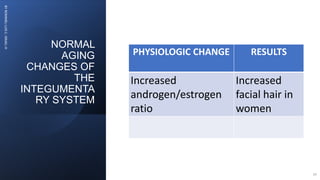
PHYSIOLOGIC CHANGE RESULTS
Increased
androgen/estrogen
ratio
Increased
facial hair in
women
Nursing
Assessments and
Care Strategies
Related to
Integumentary
Changes
BY ROMMEL LUIS C. ISRAEL III 15
BY
ROMMEL
LUIS
C.
ISRAEL
III
16
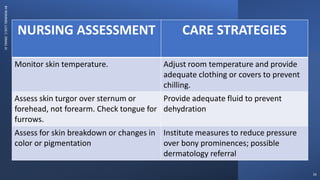
NURSING ASSESSMENT CARE STRATEGIES
Monitor skin temperature. Adjust room temperature and provide
adequate clothing or covers to prevent
chilling.
Assess skin turgor over sternum or
forehead, not forearm. Check tongue for
furrows.
Provide adequate fluid to prevent
dehydration
Assess for skin breakdown or changes in
color or pigmentation
Institute measures to reduce pressure
over bony prominences; possible
dermatology referral
BY
ROMMEL
LUIS
C.
ISRAEL
III
17
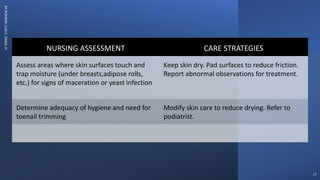
NURSING ASSESSMENT CARE STRATEGIES
Assess areas where skin surfaces touch and
trap moisture (under breasts,adipose rolls,
etc.) for signs of maceration or yeast infection
Keep skin dry. Pad surfaces to reduce friction.
Report abnormal observations for treatment.
Determine adequacy of hygiene and need for
toenail trimming
Modify skin care to reduce drying. Refer to
podiatrist.
COMMON DISORDERS
BASAL CELL CARCINOMA AND MELANOMA - Common to people who are
always exposed to the sun. It is an unusual appearance of moles
PRESSURE ULCERS - Breakdown of skin and tissues located over bony
prominences
INFLAMMATION AND INFECTION Rosacea and various from of dermatitis
HYPOTHERMIA
BY ROMMEL LUIS C. ISRAEL III 18
Promoting Healthy
Skin
• Avoid excessive exposure to ultraviolet light.
• Keep moisturized.
• Avoid soaps that dry the skin.
• Always use sunscreens.
• Keep well hydrated.
• Protect the skin from injury
BY ROMMEL LUIS C. ISRAEL III 19

INTEGUMENTARY SYSTEM Physiological Changes in Older Adults