PRESENTED BY
CHANDRA BAHADUR KHATRI
MPT FIRST YEAR
DEPARTMENT OF CARDIOPULMONARY PHYSIOTHERAPY
REVIEW OF LITERATURE
AGE RELATED
CARDIOPULMONARY CHANGES
CONTENTS
 Ageing and theories of ageing
 Cardiovascular changes related to age
 Pulmonary changes related to age
 Biomechanical changes
 Changes in Defense mechanism
 Evidence
 References
AGEING
 Ageing: showing the effects of time; a process of change,
usually gradual and spontaneous.
 Biological Aging: Aging includes several different kinds of
changes. Age associated changes that involve the physical
structures and functioning of the body and that affect a
person's ability to function or survive are referred to as
biological aging.
 Senescence: the loss of power of cell division and growth
and function with time, leading to death.
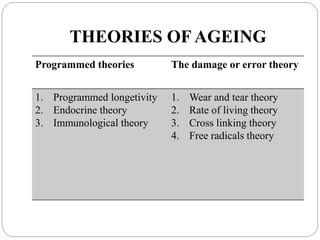
THEORIES OF AGEING
Programmed theories The damage or error theory
1. Programmed longetivity
2. Endocrine theory
3. Immunological theory
1. Wear and tear theory
2. Rate of living theory
3. Cross linking theory
4. Free radicals theory
CARDIOVASCULAR CHANGES
 Structural changes with aging involve myocardium, the
cardiac conduction system, and endocardium.
 There is progressive degeneration of cardiac structure with
ageing that includes loss of elasticity, fibrotic changes in
the valves of heart, and infiltration with myeloid.
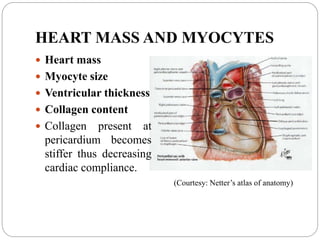
HEART MASS AND MYOCYTES
 Heart mass
 Myocyte size
 Ventricular thickness
 Collagen content
 Collagen present at
pericardium becomes
stiffer thus decreasing
cardiac compliance.
(Courtesy: Netter’s atlas of anatomy)
MYOCARDIAL SUB CELLULAR
CHANGES
 Nucleus becomes larger.
 Nucleoli increase in size and number.
 Chromatin shows clumping, shrinking, fragmentation or
dissolution.
 Mitochondria shows alteration in size shape, crystal
pattern and matrix density.
 Cytoplasm is marked by increased fatty infiltration.
Clinical significance
 Decreased cellular activities such as homeostasis, protein
synthesis, and degradation rates.
STIMULUS FOR VENTRICULAR
HYPERTROPHY
 May result due to altered systolic blood pressure
and aortic compliance.
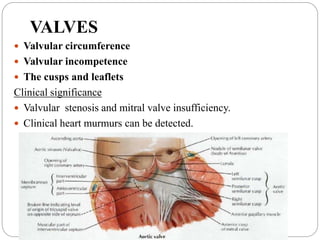
VALVES
 Valvular circumference
 Valvular incompetence
 The cusps and leaflets
Clinical significance
 Valvular stenosis and mitral valve insufficiency.
 Clinical heart murmurs can be detected.
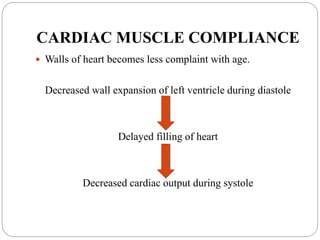
CARDIAC MUSCLE COMPLIANCE
 Walls of heart becomes less complaint with age.
Decreased wall expansion of left ventricle during diastole
Delayed filling of heart
Decreased cardiac output during systole
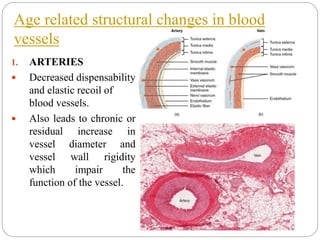
Age related structural changes in blood
vessels
1. ARTERIES
 Decreased dispensability
and elastic recoil of
blood vessels.
 Also leads to chronic or
residual increase in
vessel diameter and
vessel wall rigidity
which impair the
function of the vessel.
A. Aorta
 Wall of aorta becomes less flexible,..
 decrease in elastin fiber and increase in collagen
fiber.
 Volume elasticity is decreased.
B. Peripheral arteries
 Peripheral arteries become stiffer and increase in
diameter.
 Accommodation to larger blood volume is altered.
 Impedance of blood flow increases.
VEINS
 Walls becomes thicker due to deposition of
connective tissues and calcium.
 Valves of veins becomes stiff and incompetent.
CLINICAL SIGNIFICANCE
 Rise of systolic pressure and widening of pulse
pressure.
 increased ventricular systolic pressure and
decreased aortic diastolic pressure.
 Increase in after load.
 Limit the maximal perfusion of tissues.
BLOOD
 Blood appears rather resistant to ageing process.
 However the amount of red bone marrow
decreases with age so the capability of formation
of decreases.
Age related changes in the electrical
conduction system of the heart
 Decrease in number of pacemaker cells at sinoatrial
node with age.
 Accumulation of fat.
 Calcification of left side of cardiac skeleton.
 Changes in electrocardiogram with advancing age.
Physiological changes of Heart
1. Heart rate
 Supine heart rate is unaffected but sitting heart rate is
decreased.
2. Stroke volume
 It remains unaffected.
3. Cardiac output(CO=HR * SV)
 Unaffected at rest. However during exercise maximum
cardiac output and aerobic capacity is reduced.
4. Resting blood pressure
 Resting blood pressure is not affected by the advancing
age.
 It may increase if total peripheral resistance increases
which can be due to narrowing of arteries.
 Systolic and diastolic blood pressure tend to rise.
5. Changes in cellular calcium handling:
 Affected by increased production of reactive oxygen
species which depends upon the amount of
polyunsaturated fatty acids that decreases with age.
 Leads to arrhythmia.
6. Cardiac adrenergic responsiveness:
 With age there is diminishment of autonomic
modulation of heart.
 There is decrement of cardiovascular response to beta
adrenergic signaling.
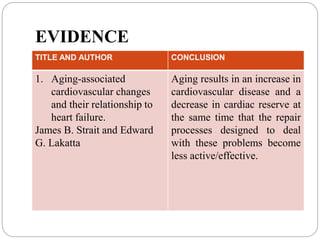
EVIDENCE
TITLE AND AUTHOR CONCLUSION
1. Aging-associated
cardiovascular changes
and their relationship to
heart failure.
James B. Strait and Edward
G. Lakatta
Aging results in an increase in
cardiovascular disease and a
decrease in cardiac reserve at
the same time that the repair
processes designed to deal
with these problems become
less active/effective.
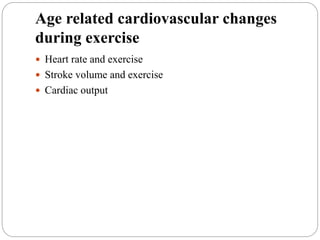
Age related cardiovascular changes
during exercise
 Heart rate and exercise
 Stroke volume and exercise
 Cardiac output
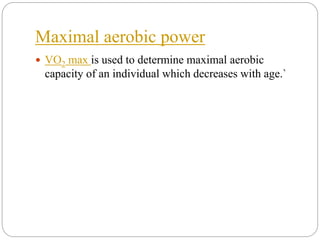
Maximal aerobic power
 VO2 max is used to determine maximal aerobic
capacity of an individual which decreases with age.`
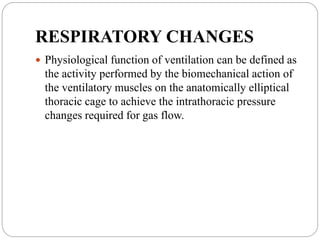
RESPIRATORY CHANGES
 Physiological function of ventilation can be defined as
the activity performed by the biomechanical action of
the ventilatory muscles on the anatomically elliptical
thoracic cage to achieve the intrathoracic pressure
changes required for gas flow.
Alterations in ventilatory muscles
 Both endurance and strength is decreased with age.
 Elastic recoil of ventilatory muscle is affected due to
age.
AIRWAY/LUNG ALTERATIONS
 Elastin fibers in alveoli.
 The ducts and Alveolar openings are dilated.
 Deposition of Granular black pigment.
 There is loss of elastic recoil of the lung.
 Proportional decline in vital capacity and residual volume
increases.
Thoracic pump alterations
 The anatomical changes in thoracic skeleton leads to
more rigid chest wall frame and reduction in mobility.
 Reduction of mobility can be first due to increase in
cross-linking of collagen fibers in both ribs and
connecting sternal cartilage and second due to change
in vertebral column.
 There is increased lung compliance but decreased
chest wall compliance.
Ventilatory Work of Breathing
 Although increased RV and FRC provides
mechanical advantage but it leads to altered
positioning of diaphragm(flattened diaphragm).
 The total VO2 consumption increases from 1% to
10% to perform work of breathing.
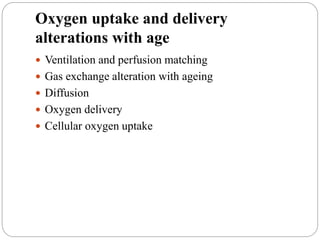
Oxygen uptake and delivery
alterations with age
 Ventilation and perfusion matching
 Gas exchange alteration with ageing
 Diffusion
 Oxygen delivery
 Cellular oxygen uptake
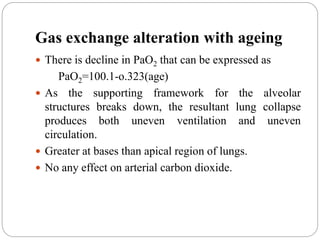
Gas exchange alteration with ageing
 There is decline in PaO2 that can be expressed as
PaO2=100.1-o.323(age)
 As the supporting framework for the alveolar
structures breaks down, the resultant lung collapse
produces both uneven ventilation and uneven
circulation.
 Greater at bases than apical region of lungs.
 No any effect on arterial carbon dioxide.
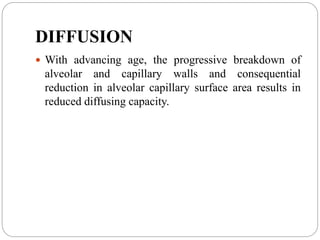
DIFFUSION
 With advancing age, the progressive breakdown of
alveolar and capillary walls and consequential
reduction in alveolar capillary surface area results in
reduced diffusing capacity.
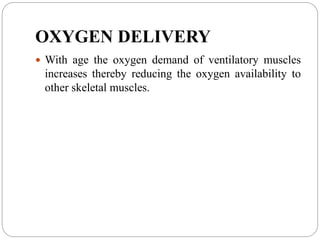
OXYGEN DELIVERY
 With age the oxygen demand of ventilatory muscles
increases thereby reducing the oxygen availability to
other skeletal muscles.
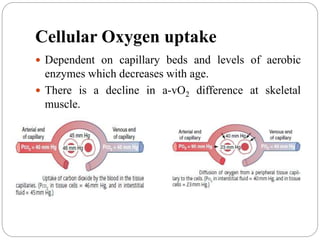
Cellular Oxygen uptake
 Dependent on capillary beds and levels of aerobic
enzymes which decreases with age.
 There is a decline in a-vO2 difference at skeletal
muscle.
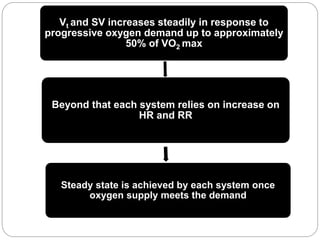
Integration of cardiovascular and
pulmonary response to increased
oxygen demand
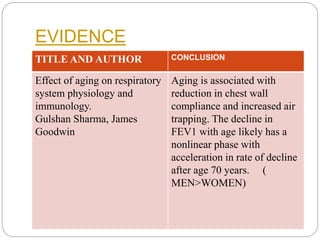
Vt and SV increases steadily in response to
progressive oxygen demand up to approximately
50% of VO2 max
Beyond that each system relies on increase on
HR and RR
Steady state is achieved by each system once
oxygen supply meets the demand
EVIDENCE
TITLE AND AUTHOR CONCLUSION
Effect of aging on respiratory
system physiology and
immunology.
Gulshan Sharma, James
Goodwin
Aging is associated with
reduction in chest wall
compliance and increased air
trapping. The decline in
FEV1 with age likely has a
nonlinear phase with
acceleration in rate of decline
after age 70 years. (
MEN>WOMEN)
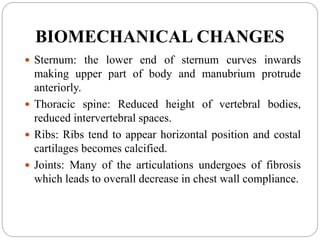
BIOMECHANICAL CHANGES
 Sternum: the lower end of sternum curves inwards
making upper part of body and manubrium protrude
anteriorly.
 Thoracic spine: Reduced height of vertebral bodies,
reduced intervertebral spaces.
 Ribs: Ribs tend to appear horizontal position and costal
cartilages becomes calcified.
 Joints: Many of the articulations undergoes of fibrosis
which leads to overall decrease in chest wall compliance.
EVIDENCE
TITLE AND AUTHOR CONCLUSION
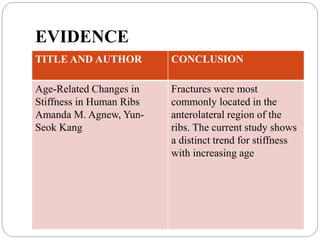
Age-Related Changes in
Stiffness in Human Ribs
Amanda M. Agnew, Yun-
Seok Kang
Fractures were most
commonly located in the
anterolateral region of the
ribs. The current study shows
a distinct trend for stiffness
with increasing age
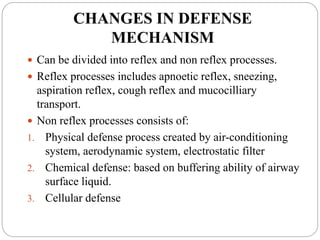
CHANGES IN DEFENSE
MECHANISM
 Can be divided into reflex and non reflex processes.
 Reflex processes includes apnoetic reflex, sneezing,
aspiration reflex, cough reflex and mucocilliary
transport.
 Non reflex processes consists of:
1. Physical defense process created by air-conditioning
system, aerodynamic system, electrostatic filter
2. Chemical defense: based on buffering ability of airway
surface liquid.
3. Cellular defense
EVIDENCE
TITLE AND AUTHOR CONCLUSION
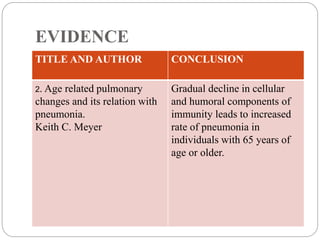
2. Age related pulmonary
changes and its relation with
pneumonia.
Keith C. Meyer
Gradual decline in cellular
and humoral components of
immunity leads to increased
rate of pneumonia in
individuals with 65 years of
age or older.
REFERENCES
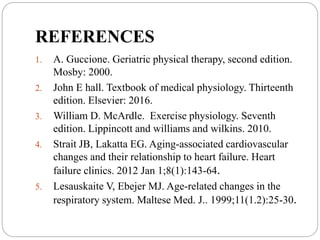
1. A. Guccione. Geriatric physical therapy, second edition.
Mosby: 2000.
2. John E hall. Textbook of medical physiology. Thirteenth
edition. Elsevier: 2016.
3. William D. McArdle. Exercise physiology. Seventh
edition. Lippincott and williams and wilkins. 2010.
4. Strait JB, Lakatta EG. Aging-associated cardiovascular
changes and their relationship to heart failure. Heart
failure clinics. 2012 Jan 1;8(1):143-64.
5. Lesauskaite V, Ebejer MJ. Age-related changes in the
respiratory system. Maltese Med. J.. 1999;11(1.2):25-30.
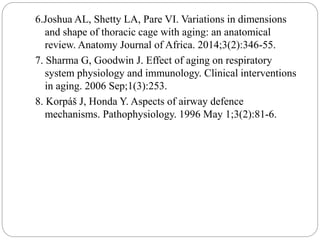
6.Joshua AL, Shetty LA, Pare VI. Variations in dimensions
and shape of thoracic cage with aging: an anatomical
review. Anatomy Journal of Africa. 2014;3(2):346-55.
7. Sharma G, Goodwin J. Effect of aging on respiratory
system physiology and immunology. Clinical interventions
in aging. 2006 Sep;1(3):253.
8. Korpáš J, Honda Y. Aspects of airway defence
mechanisms. Pathophysiology. 1996 May 1;3(2):81-6.
Thank you

'age related cardiopulmonary changes.pptx'.pptx

  • 1.
    PRESENTED BY CHANDRA BAHADURKHATRI MPT FIRST YEAR DEPARTMENT OF CARDIOPULMONARY PHYSIOTHERAPY REVIEW OF LITERATURE
  • 2.
  • 3.
    CONTENTS  Ageing andtheories of ageing  Cardiovascular changes related to age  Pulmonary changes related to age  Biomechanical changes  Changes in Defense mechanism  Evidence  References
  • 4.
    AGEING  Ageing: showingthe effects of time; a process of change, usually gradual and spontaneous.  Biological Aging: Aging includes several different kinds of changes. Age associated changes that involve the physical structures and functioning of the body and that affect a person's ability to function or survive are referred to as biological aging.  Senescence: the loss of power of cell division and growth and function with time, leading to death.
  • 5.
    THEORIES OF AGEING Programmedtheories The damage or error theory 1. Programmed longetivity 2. Endocrine theory 3. Immunological theory 1. Wear and tear theory 2. Rate of living theory 3. Cross linking theory 4. Free radicals theory
  • 6.
    CARDIOVASCULAR CHANGES  Structuralchanges with aging involve myocardium, the cardiac conduction system, and endocardium.  There is progressive degeneration of cardiac structure with ageing that includes loss of elasticity, fibrotic changes in the valves of heart, and infiltration with myeloid.
  • 7.
    HEART MASS ANDMYOCYTES  Heart mass  Myocyte size  Ventricular thickness  Collagen content  Collagen present at pericardium becomes stiffer thus decreasing cardiac compliance. (Courtesy: Netter’s atlas of anatomy)
  • 8.
    MYOCARDIAL SUB CELLULAR CHANGES Nucleus becomes larger.  Nucleoli increase in size and number.  Chromatin shows clumping, shrinking, fragmentation or dissolution.  Mitochondria shows alteration in size shape, crystal pattern and matrix density.  Cytoplasm is marked by increased fatty infiltration. Clinical significance  Decreased cellular activities such as homeostasis, protein synthesis, and degradation rates.
  • 9.
    STIMULUS FOR VENTRICULAR HYPERTROPHY May result due to altered systolic blood pressure and aortic compliance.
  • 10.
    VALVES  Valvular circumference Valvular incompetence  The cusps and leaflets Clinical significance  Valvular stenosis and mitral valve insufficiency.  Clinical heart murmurs can be detected.
  • 11.
    CARDIAC MUSCLE COMPLIANCE Walls of heart becomes less complaint with age. Decreased wall expansion of left ventricle during diastole Delayed filling of heart Decreased cardiac output during systole
  • 12.
    Age related structuralchanges in blood vessels 1. ARTERIES  Decreased dispensability and elastic recoil of blood vessels.  Also leads to chronic or residual increase in vessel diameter and vessel wall rigidity which impair the function of the vessel.
  • 13.
    A. Aorta  Wallof aorta becomes less flexible,..  decrease in elastin fiber and increase in collagen fiber.  Volume elasticity is decreased. B. Peripheral arteries  Peripheral arteries become stiffer and increase in diameter.  Accommodation to larger blood volume is altered.  Impedance of blood flow increases.
  • 14.
    VEINS  Walls becomesthicker due to deposition of connective tissues and calcium.  Valves of veins becomes stiff and incompetent.
  • 15.
    CLINICAL SIGNIFICANCE  Riseof systolic pressure and widening of pulse pressure.  increased ventricular systolic pressure and decreased aortic diastolic pressure.  Increase in after load.  Limit the maximal perfusion of tissues.
  • 16.
    BLOOD  Blood appearsrather resistant to ageing process.  However the amount of red bone marrow decreases with age so the capability of formation of decreases.
  • 17.
    Age related changesin the electrical conduction system of the heart  Decrease in number of pacemaker cells at sinoatrial node with age.  Accumulation of fat.  Calcification of left side of cardiac skeleton.  Changes in electrocardiogram with advancing age.
  • 18.
    Physiological changes ofHeart 1. Heart rate  Supine heart rate is unaffected but sitting heart rate is decreased. 2. Stroke volume  It remains unaffected. 3. Cardiac output(CO=HR * SV)  Unaffected at rest. However during exercise maximum cardiac output and aerobic capacity is reduced.
  • 19.
    4. Resting bloodpressure  Resting blood pressure is not affected by the advancing age.  It may increase if total peripheral resistance increases which can be due to narrowing of arteries.  Systolic and diastolic blood pressure tend to rise.
  • 20.
    5. Changes incellular calcium handling:  Affected by increased production of reactive oxygen species which depends upon the amount of polyunsaturated fatty acids that decreases with age.  Leads to arrhythmia. 6. Cardiac adrenergic responsiveness:  With age there is diminishment of autonomic modulation of heart.  There is decrement of cardiovascular response to beta adrenergic signaling.
  • 21.
    EVIDENCE TITLE AND AUTHORCONCLUSION 1. Aging-associated cardiovascular changes and their relationship to heart failure. James B. Strait and Edward G. Lakatta Aging results in an increase in cardiovascular disease and a decrease in cardiac reserve at the same time that the repair processes designed to deal with these problems become less active/effective.
  • 22.
    Age related cardiovascularchanges during exercise  Heart rate and exercise  Stroke volume and exercise  Cardiac output
  • 23.
    Maximal aerobic power VO2 max is used to determine maximal aerobic capacity of an individual which decreases with age.`
  • 24.
    RESPIRATORY CHANGES  Physiologicalfunction of ventilation can be defined as the activity performed by the biomechanical action of the ventilatory muscles on the anatomically elliptical thoracic cage to achieve the intrathoracic pressure changes required for gas flow.
  • 25.
    Alterations in ventilatorymuscles  Both endurance and strength is decreased with age.  Elastic recoil of ventilatory muscle is affected due to age.
  • 26.
    AIRWAY/LUNG ALTERATIONS  Elastinfibers in alveoli.  The ducts and Alveolar openings are dilated.  Deposition of Granular black pigment.  There is loss of elastic recoil of the lung.  Proportional decline in vital capacity and residual volume increases.
  • 27.
    Thoracic pump alterations The anatomical changes in thoracic skeleton leads to more rigid chest wall frame and reduction in mobility.  Reduction of mobility can be first due to increase in cross-linking of collagen fibers in both ribs and connecting sternal cartilage and second due to change in vertebral column.  There is increased lung compliance but decreased chest wall compliance.
  • 28.
    Ventilatory Work ofBreathing  Although increased RV and FRC provides mechanical advantage but it leads to altered positioning of diaphragm(flattened diaphragm).  The total VO2 consumption increases from 1% to 10% to perform work of breathing.
  • 29.
    Oxygen uptake anddelivery alterations with age  Ventilation and perfusion matching  Gas exchange alteration with ageing  Diffusion  Oxygen delivery  Cellular oxygen uptake
  • 30.
    Gas exchange alterationwith ageing  There is decline in PaO2 that can be expressed as PaO2=100.1-o.323(age)  As the supporting framework for the alveolar structures breaks down, the resultant lung collapse produces both uneven ventilation and uneven circulation.  Greater at bases than apical region of lungs.  No any effect on arterial carbon dioxide.
  • 31.
    DIFFUSION  With advancingage, the progressive breakdown of alveolar and capillary walls and consequential reduction in alveolar capillary surface area results in reduced diffusing capacity.
  • 32.
    OXYGEN DELIVERY  Withage the oxygen demand of ventilatory muscles increases thereby reducing the oxygen availability to other skeletal muscles.
  • 33.
    Cellular Oxygen uptake Dependent on capillary beds and levels of aerobic enzymes which decreases with age.  There is a decline in a-vO2 difference at skeletal muscle.
  • 34.
    Integration of cardiovascularand pulmonary response to increased oxygen demand
  • 35.
    Vt and SVincreases steadily in response to progressive oxygen demand up to approximately 50% of VO2 max Beyond that each system relies on increase on HR and RR Steady state is achieved by each system once oxygen supply meets the demand
  • 36.
    EVIDENCE TITLE AND AUTHORCONCLUSION Effect of aging on respiratory system physiology and immunology. Gulshan Sharma, James Goodwin Aging is associated with reduction in chest wall compliance and increased air trapping. The decline in FEV1 with age likely has a nonlinear phase with acceleration in rate of decline after age 70 years. ( MEN>WOMEN)
  • 37.
    BIOMECHANICAL CHANGES  Sternum:the lower end of sternum curves inwards making upper part of body and manubrium protrude anteriorly.  Thoracic spine: Reduced height of vertebral bodies, reduced intervertebral spaces.  Ribs: Ribs tend to appear horizontal position and costal cartilages becomes calcified.  Joints: Many of the articulations undergoes of fibrosis which leads to overall decrease in chest wall compliance.
  • 38.
    EVIDENCE TITLE AND AUTHORCONCLUSION Age-Related Changes in Stiffness in Human Ribs Amanda M. Agnew, Yun- Seok Kang Fractures were most commonly located in the anterolateral region of the ribs. The current study shows a distinct trend for stiffness with increasing age
  • 39.
    CHANGES IN DEFENSE MECHANISM Can be divided into reflex and non reflex processes.  Reflex processes includes apnoetic reflex, sneezing, aspiration reflex, cough reflex and mucocilliary transport.  Non reflex processes consists of: 1. Physical defense process created by air-conditioning system, aerodynamic system, electrostatic filter 2. Chemical defense: based on buffering ability of airway surface liquid. 3. Cellular defense
  • 40.
    EVIDENCE TITLE AND AUTHORCONCLUSION 2. Age related pulmonary changes and its relation with pneumonia. Keith C. Meyer Gradual decline in cellular and humoral components of immunity leads to increased rate of pneumonia in individuals with 65 years of age or older.
  • 41.
    REFERENCES 1. A. Guccione.Geriatric physical therapy, second edition. Mosby: 2000. 2. John E hall. Textbook of medical physiology. Thirteenth edition. Elsevier: 2016. 3. William D. McArdle. Exercise physiology. Seventh edition. Lippincott and williams and wilkins. 2010. 4. Strait JB, Lakatta EG. Aging-associated cardiovascular changes and their relationship to heart failure. Heart failure clinics. 2012 Jan 1;8(1):143-64. 5. Lesauskaite V, Ebejer MJ. Age-related changes in the respiratory system. Maltese Med. J.. 1999;11(1.2):25-30.
  • 42.
    6.Joshua AL, ShettyLA, Pare VI. Variations in dimensions and shape of thoracic cage with aging: an anatomical review. Anatomy Journal of Africa. 2014;3(2):346-55. 7. Sharma G, Goodwin J. Effect of aging on respiratory system physiology and immunology. Clinical interventions in aging. 2006 Sep;1(3):253. 8. Korpáš J, Honda Y. Aspects of airway defence mechanisms. Pathophysiology. 1996 May 1;3(2):81-6.
  • 43.