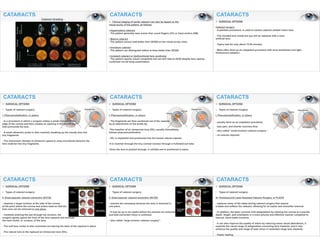
CRYSTALINE LENS
Ø An eyeball cut in half (Cross-section), showing the lens and the passage
of light through it from the object ahead to the focus on the retina.
- Also called the lens,
Ø Properties:
1. Biconvex
2. Relatively acellular
3. Optically transparent intraocular structure
4. Suspended behind the iris of the eye,
5. Serves to transmit light to the retina with minimal light scattering
CRYSTALINE LENS
Ø Composition:
• Collagen
• Mostly of proteins (60% of the lens mass)
- a concentration higher than almost any other tissue in the body
• Unusual elongated cells
Ø Blood supply: None
- have no blood supply but obtain nutrients
from the surrounding fluids mainly the aqueous humour.
Ø Aqueous humour
- give nutrients to the crystalline lens
- removes waste products
CRYSTALINE LENS
Ø Accommodation
- The relaxation and contraction of the ciliary
muscles surrounding it, thereby changing the focal distance to the
retina and bringing the image at widely varying distances into sharp
focus on the retina
• Zonular fiber (Suspensory ligaments)
- attaches the lens to the ciliary body, which holds the lens in position
and determines its degree of accommodation
• Note:
1. Accommodation gradually declines with age
(a condition called presbyopia), often requiring correction
2. The lens is flatter on its anterior side than on its posterior side
CRYSTALINE LENS
Ø Four structures make up the crystalline lens:
1. Capsule
2. Epithelium
3. Cortex
4. Nucleus
CRYSTALINE LENS
Ø Four structures make up the crystalline lens:
1. Capsule
2. Epithelium
3. Cortex
4. Nucleus
CRYSTALINE LENS
Ø Four structures make up the crystalline lens:
1. Capsule
2. Epithelium
3. Cortex
4. Nucleus
CRYSTALINE LENS
Ø Histological section of normal crystalline lens
- The sectioned iris is shown but the ciliary body is mostly out of the plane
of the section.
- Notice the lens is flatter anteriorly, facing the cornea (cornea).
CATARACTS
Ø A dense, cloudiness that forms in the normally crystal-clear ocular
lens which causes visual loss when it is located on the visual axis.
Ø Pathophysiology
- Cataracts develop because of changes in metabolism and movement of
nutrients in the lens.
- Proteins in the eye form clumps that prevent the lens from sending
clear images to the retina.
CATARACTS
Ø Causes of cataract
• Degenerative - common senile or age-related cataract
• Congenital
• Infection
• Radiation
• Drugs
• Trauma
• Diabetes mellitus
CATARACTS
Ø Clinical manifestation
- A patient with senile cataract often presents with a
history of gradual progressive visual deterioration and disturbance in
night and near vision.
CATARACTS
Ø Characteristic symptoms of senile cataract:
1. Decreased visual acuity
- the most common complaint of patients with senile cataract
- difficulty seeing in low light situations (including poor night vision)
2. Glare
- Disabling glare during the day to glare with oncoming headlights at night.
- Halos or streaks around lights, difficulty seeing in the presence of
bright lights
3. Poor contrast sensitivity
- Decrease in contrast sensitivity in brightly lit environments
4. Poor ability to discern colors
CATARACTS
Ø Characteristic symptoms of senile cataract:
5. Myopic shift
- The progression of cataracts frequently increases the anteroposterior (AP)
axis and therefore the dioptric power of the lens, resulting in a mild to
moderate degree of increased myopia or myopic shift
6. Monocular diplopia –
- At times, the nuclear changes are concentrated in the inner layers of the
lens, resulting in a refractile area in the center of the lens, the so called “lens
within a lens” phenomenon, which may lead to monocular diplopia that is
not correctable with spectacles, prisms, or contact lenses.
CATARACTS
Ø Several common misconceptions about cataract.
- It is NOT a film visible on the outside of the eye
- It is NOT caused from over-use of the eyes
- It generally does NOT cause irritation or pain
CATARACTS
v Degenerative (Senile) cataract
- is an age-related, vision-impairing condition characterized by gradual
progressive clouding and thickening of the lens of the eye.
- it is the world’s leading cause of treatable blindness.
- The most common type of cataract
Ø Divided into 3 types based on the anatomy of the human lens:
I. Nuclear Sclerotic
II. Cortical
III. Posterior Subcapsular Cataracts
Ø Note: Patients commonly develop opacity in more than one area of their lens
which can cause overlap in the classification of cataracts.
CATARACTS
I. Nuclear sclerotic cataract
- is the yellowing and hardening of the central portion of the crystalline lens
- it occurs slowly over years
- distance acuity is decreased therefore giving a good near vision
- Can also cause colors to be less vibrant although the change is
so gradual (often not noticed)
- Nucleus can become very opaque, yellow and brown (brunescent nuclear cataract)
- Brunescent cataracts are very advanced nuclear cataracts that
have become brown and opaque.
Ø Note:
- As the core of the lens hardens, it often causes the lens to increase the refractive
power and causes nearsightedness.
- This is why some patients who had previously relied on reading glasses for reading
may no longer need them once a nuclear sclerotic cataract starts to form
(referred as Temporary Second Sight)
CATARACTS
I. Nuclear sclerotic cataract
Ø Progression of Nuclear cataract
CATARACTS
II. Cortical cataract
- wedge-shaped opacity with clear areas of lens matter
- mostly present at the periphery (incipient cortical cataract)
- usually start in the lens periphery and encroach into the visual axis
- interfere with central vision in later stages
- occur when the portion of lens fibers surrounding the nucleus become
opacified.
- The impact on vision is related to how close the opacities are to the center
of the visual axis and their impact can vary greatly.
- Visual acuity long remains intact until late stages when cortical spokes
compromise visual axis.
CATARACTS
II. Cortical cataract
Ø Progression:
- is variable with some progressing over years and others in months.
Ø Common symptom:
- glare, especially from headlights while night driving
CATARACTS
II. Cortical cataract
v Cortical cataract with prominent cortical fluid clefts (black lines)
v Cortical cataract using:
(A) direct illumination
(B) retroillumination.
CATARACTS
II. Cortical cataract
v Wedge-shaped (cuneiform) or spoke-like (wheel) peripheral changes are seen
CATARACTS
III. Posterior Subcapsular Cataract (PSC)
- Are granular and plaque-like opacities located in the most posterior
cortical layer, directly under the lens capsule
- Found in the back outer layer of the lens
- This type of cataract tends to occur in younger patients than
cortical or nuclear sclerotic cataracts
- often occur in combination with nuclear or cortical cataracts
in the later stages
- they are easily noticed on retroillumination because they are
usually located centrally, and may interfere with funduscopy
CATARACTS
III. Posterior Subcapsular Cataract (PSC)
Ø Progression:
- variable but tends to occur more rapidly than in nuclear sclerosis.
Ø Symptoms: near vision is often more affected than distance
Ø Contributory factors:
1. Complication of other conditions such as intraocular inflammation
(ex: chronic uveitis),
2. Steroid administration,
3. Vitreoretinal surgery
4. External eye trauma
5. Systemic conditions such as diabetes mellitus
CATARACTS
III. Posterior Subcapsular Cataract (PSC)
v Central location, which gives rise to severe glare disability
v PSC with irregular opacities (similar to the surface of the moon)
CATARACTS
OTHER TYPES OF CATARACTS
❖ Anterior subcapsular cataracts (ASC)
- are the same as PSC but are located in the front center of the lens.
- they are less common than PSCs and it appears the greatest risk factor is trauma to
the eye.
- form after anterior lens epithelial cells become necrotic from a variety of causes
Including:
Iritis
Keratitis
Inflammation
Atopic dermatitis
Irradiation
Electrical burns
Ocular trauma
CATARACTS
OTHER TYPES OF CATARACTS
v Anterior polar cataract (APC)
- is a small opacity in the anterior capsule of the lens
- APC generally do not grow during childhood and are
typically not visually significant.
- Often managed without surgery
Retro-illumination view of Anterior polar cataract
CATARACTS
OTHER TYPES OF CATARACTS
v Posterior Polar cataract (PPC)
- Presents as an area of degenerative and malformed lens fibers that form
a well demarcated white opacity in the central posterior subcapsular area of the lens.
- The opacities project forward as cylinders penetrating into the posterior
lens cortex.
Ø Complicated surgical removal
- Because the opacity is adherent to the lens capsule
Retro-illumination view of a posterior polar cataract
The clinical appearance of posterior polar cataract
CATARACTS
Differential Diagnosis
CATARACTS
Differential Diagnosis
CATARACTS
❖ Mixed cataract
- more than one of the above-described varieties of cataract will occur together in a
lens
- In general, a cataract will start as a pure type but eventually become mixed as the other lens
regions become involved in the degenerative process
CATARACTS
❖ Mixed cataract
Ø Cortical and nuclear sclerotic cataract.
- Note the opacification of central oval shaped nucleus and
surrounding cortex are visible separately by oblique slit beam
CATARACTS
❖ Mixed cataract
CATARACTS
❖ Mixed cataract
CATARACTS
❖ Traumatic cataract
- The clouding of the lens that may occur secondary to blunt or penetrating ocular
trauma that disrupts and damages the lens fibers.
- Infrared energy (glass-blower's cataract), electric shock, and ionizing radiation are other rare
causes of traumatic cataracts.
- Most of the traumatic cataracts lead to eye lens swelling, but the type and clinical course
depends on trauma and the integrity of the capsular bag.
CATARACTS
❖ Traumatic cataract
Ø Etiology:
o Blunt trauma
- classically form stellate- or rosette-shaped posterior axial opacities that
may be stable or progressive
o Penetrating trauma with disruption of the lens capsule
- forms cortical changes that may remain focal if small or may progress
rapidly to total cortical opacification.
CATARACTS
❖ Traumatic cataract
CATARACTS
❖ Traumatic cataract
CATARACTS
❖ Congenital cataract
- is a painless opacification of the lens that is present at birth or shortly after birth.
Ø May be caused by:
o inherited (multiple genetic or chromosomal disorders)
o disorders of metabolism (galactosemia)
o infections contracted while in the womb (rubella)
o another disease of the mother during pregnancy
Ø Location:
o nuclear - (center of the lens)
o subcapsular or cortical - may involve the lens material underneath the
anterior or posterior lens.
CATARACTS
❖ Congenital cataract
Ø Unilateral
- usually, isolated incidents and can be associated with ocular
abnormalities:
▪ posterior lenticonus
▪ anterior segment dysgenesis
▪ posterior pole tumors
▪ trauma
▪ intrauterine infection, particularly rubella
CATARACTS
❖ Congenital cataract
Ø Bilateral
- Usually, inherited and associated with other diseases:
▪ Hypoglycemia
▪ trisomy ( Down, Edward, and Patau syndromes)
▪ myotonic dystrophy, infectious diseases (toxoplasmosis, rubella,
cytomegalovirus, and herpes simplex
▪ prematurity
CATARACTS
❖ Congenital cataract
Ø Note:
- May not be noticed unless the red reflex is checked or unless ophthalmoscopy is done at
birth.
CATARACTS
❖ Diabetic snowflake cataract
- appear as grey-white subcapsular opacities and often progress rapidly turning the entire
lens white.
- this rapid onset form of cataract is quite uncommon
- May be found in some patients with: Diabetes mellitus (uncontrolled, very elevated blood sugars)
CATARACTS
❖ Diabetic snowflake cataract
Ø Risk factors for cataract development
• Diabetes or elevated blood sugar
• Steroid use (oral, IV, or inhaled)
• Ultraviolet exposure
• Smoking
• Ocular diseases: Retinitis Pigmentosa, Uveitis
• Ocular Trauma
• Prior ocular surgery
• Genetic predisposition
• Nutritional deficiency:
-low levels of antioxidants (Vit C, Vit E, carotenoids)
CATARACTS
v Staging:
- Clinical staging of senile cataract is traditionally based on the appearance of the lens on slit-lamp
examination, as follows:
Ø Hypermature cataract
- This is a dense white opacity that obscures the red reflex and
contains milky fluid within the capsule, a result of degenerated lens cortex.
- The capsule if often tense or wrinkled
- A “Morgagnian Cataract” is a type of hypermature cataract in which the nucleus sinks
within the fluid cortex.
CATARACTS
v Staging:
- Clinical staging of senile cataract is traditionally based on the appearance of the lens on slit-lamp
examination, as follows:
Ø Mature cataract
- This is a cataract that is opaque, totally obscuring the red reflex.
- It is either white or brunescent.
Ø Immature cataract
- This is a cataract characterized by a variable amount of opacification,
present in certain areas of the lens.
- These may include both high- and low-density areas, with some clear
lens fibers.
CATARACTS
v Staging:
- Clinical staging of senile cataract is traditionally based on the appearance of the lens on slit-lamp
examination, as follows:
Ø Incipient cataract
- This is a cataract that is seen on slit-lamp examination but is of little
clinical significance.
- Minor opacities
CATARACTS
Cataract Grading
CATARACTS
Ø Clinical staging of senile cataract can also be based on the
visual acuity of the patient, as follows:
• Hypermature cataract
- The patient generally sees worse than count fingers (CF) or hand motion (HM).
• Mature cataract
- The patient cannot read better than 20/200 on the visual acuity chart.
• Immature cataract
- The patient can distinguish letters at lines better than 20/200.
• Incipient cataract or dysfunctional lens syndrome
- The patient reports visual complaints but can still read at 20/20 despite lens opacity
confirmed via slit lamp-examination.
CATARACTS
Ø SURGICAL OPTIONS
Cataract surgery
- A painless procedure, is used to restore cataract-related vision loss.
- The clouded lens inside the eye will be replaced with a clear
artificial lens.
- Typica last for only about 15-30 minutes
- Most often done as an outpatient procedure with local anesthesia and light
intravenous sedation.
CATARACTS
Ø SURGICAL OPTIONS
• Types of cataract surgery:
I. Phacoemulsification, or phaco
- Is a procedure in which a surgeon makes a small incision at the
edge of the cornea and then creates an opening in the membrane
that surrounds the lens.
- A small ultrasonic probe is then inserted, breaking up the cloudy lens into
tiny fragments.
- The instrument vibrates at ultrasonic speed to chop and almost dissolve the
lens material into tiny fragments.
CATARACTS
Ø SURGICAL OPTIONS
• Types of cataract surgery:
I. Phacoemulsification, or phaco
- The fragments are then suctioned out of the capsule
by an attachment on the probe tip.
-The insertion of an intraocular lens (IOL) usually immediately
follows phacoemulsification.
- IOL is implanted and positioned into the lenses natural capsule.
-It is inserted through the tiny corneal incision through a hollowed-out tube.
-Once the lens is pushed through, it unfolds and is positioned in place.
CATARACTS
Ø SURGICAL OPTIONS
• Types of cataract surgery:
I. Phacoemulsification, or phaco
- usually done as an outpatient procedure.
- less pain, and shorter recovery time
- also called “small-incision cataract surgery.”
- no sutures required
CATARACTS
Ø SURGICAL OPTIONS
• Types of cataract surgery:
II. Extarcapsular cataract extraction (ECCE)
- requires a larger incision at the side of the cornea
at the point where the cornea and sclera meet so that the
lens core can be removed in one piece.
- Carefully entering the eye through the incision, the
surgeon gently opens the front of the lens capsule and removes
the hard center, or nucleus, of the lens.
- The soft lens cortex is then suctioned out leaving the back of the capsule in place.
- The natural lens is the replaced an intraocular lens (IOL).
CATARACTS
Ø SURGICAL OPTIONS
• Types of cataract surgery:
II. Extarcapsular cataract extraction (ECCE)
- sutures are necessary because the lens is removed in
one piece.
- It may be up to six weeks before the sutures are removed
and best-corrected vision is achieved.
- also called “large-incision cataract surgery”.
CATARACTS
Ø SURGICAL OPTIONS
• Types of cataract surgery:
III. Femtosecond Laser-Assisted Cataract Surgery, or FLACS
- replaces many of the steps during cataract surgery that require
a blade and softens the cataract, allowing for an easier and smoother removal.
- In addition, the laser corrects mild astigmatism by relaxing the cornea at a precise
depth, length, and orientation in a more precise and effective manner compared to
manual, hand-made incisions.
- It can also improve the quality of vision by reducing some visual aberrations, it
expands the visual range of astigmatism-correcting lens implants, and it may
enhance the quality and range of near vision in extended range lens implants.
- Faster healing.
CATARACTS
Ø SURGICAL OPTIONS
• Types of cataract surgery:
III. Femtosecond Laser-Assisted Cataract Surgery, or FLACS
CATARACTS
Ø SURGICAL OPTIONS
III. Femtosecond Laser-Assisted Cataract Surgery, or FLACS
a.) Scheduling of capsulotomy, lens fragmentation
and corneal incision positioning in the imaging
system.
b.) Completion of capsulotomy, lens fragmentation
and corneal incision positioning via femtosecond
laser.
c.) External eye appearance prior to cataract surgery
and removal of the phakic intraocular lens.
CATARACTS
Ø SURGICAL OPTIONS
III. Femtosecond Laser-Assisted Cataract Surgery, or FLACS
d.) Phacoemulsification and aspiration under the
phakic intraocular lens.
e.) Implantation of a new multifocal intraocular lens.
f.) Extraction of the phakic intraocular lens after
widening of the corneal incision
CATARACTS
Ø SURGICAL OPTIONS
Ø Indication for surgical intervention:
▪ maximally corrected vision ≤ 20/50 (6/15)
▪ subjective visual impairment that prevents activities (driving, reading, occupational
activities).
▪ disabling glare (most common with posterior subcapsular cataracts).
▪ lens-induced diseases (PHACOLYTIC GLAUCOMA, PHACOANTIGENIC UVEITIS).
▪ need to visualize fundus for management of diseases (DIABETIC RETINOPATHY,
GLAUCOMA)
CATARACTS
Ø Types of intraocular lens (IOL)
I. Multifocal (or accommodative) IOLs
- IOL design that provides correction for both near
and distance vision, and both near and far objects
can be in focus at the same time.
- The brain must learn to select the visual information
it needs to form an image of either near or distant objects,
so multifocal IOLs may require some adjustment.
- A person may adjust better to multifocal IOLs if they are placed in both eyes.
- This type of lens is not an option for some people.
CATARACTS
Ø Types of intraocular lens (IOL)
II. Monofocal IOLs (standard)
- IOL designed for either near or distance vision.
- Prescription eyeglasses may still be required.
It is common for the IOLs to be chosen to provide
better distance vision than near vision.
- Then glasses are used for sharp near vision.
CATARACTS
Ø Types of intraocular lens (IOL)
III. Toric IOLs
- a type of monofocal IOL that helps correct astigmatism
- considered a premium lens
CATARACTS
v Posterior capsular opacification (PCO)
- also called secondary or after cataract,
- most common complication after a cataract surgery
- occur when natural cells remain and proteins grow at the
back of the lens capsule (the “capsular bag”) that contains
the intraocular lens or IOL.
CATARACTS
v Posterior capsular opacification (PCO)
- a type of cataract can be:
• In the form of pearl, fibrous or a combination of both
• May multiply around the capsule,
• Move to other areas or differentiate from the lens
epithelial cells
CATARACTS
v Posterior capsular opacification (PCO)
- The capsule that bags the IOL is transparent,
but it is also still natural human tissue.
- It means it still can change over time.
- Because of that, it isn’t uncommon for the capsule holding
this new, perfectly clear lens to lose a little bit of its
transparency
CATARACTS
v Posterior capsular opacification (PCO)
- The capsule that bags the IOL is transparent,
but it is also still natural human tissue.
- It means it still can change over time.
- Because of that, it isn’t uncommon for the capsule holding
this new, perfectly clear lens to lose a little bit of its
transparency
- The capsular bag effectively 'shrink-wraps' the new lens and holds it in place.
- However, a few natural lens cells always remain after surgery.
CATARACTS
v Posterior capsular opacification (PCO)
- In time the eye's wound-healing response leads the cells to
spread across the underside of the artificial lens.
- This interferes with vision, causing what's known as
'posterior capsule opacification' or “secondary cataract”.
- PCO may develop months or even years after cataract surgery
or it may it stays transparent.
CATARACTS
v Posterior capsular opacification (PCO)
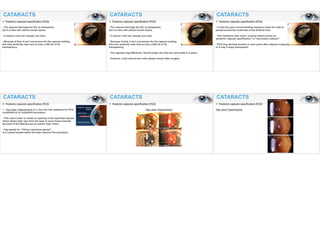
Ø Yag Laser Capsulotomy is a very low-risk treatment for PCO,
completed as an outpatient procedure.
- This uses a laser to create an opening in the opacified capsule
which allows light rays from the laser to move freely towards
the back of the affected eye to restore clear vision.
- Yag stands for “Yttrium aluminum garnet”,
is a crystal located within the laser used for the procedure.
CATARACTS
v Posterior capsular opacification (PCO)
Yag Laser Capsulotomy
CATARACTS
v Posterior capsular opacification (PCO)
Yag Laser Capsulotomy

Cataract Cataract Cataract Cataract Cataract

  • 1.
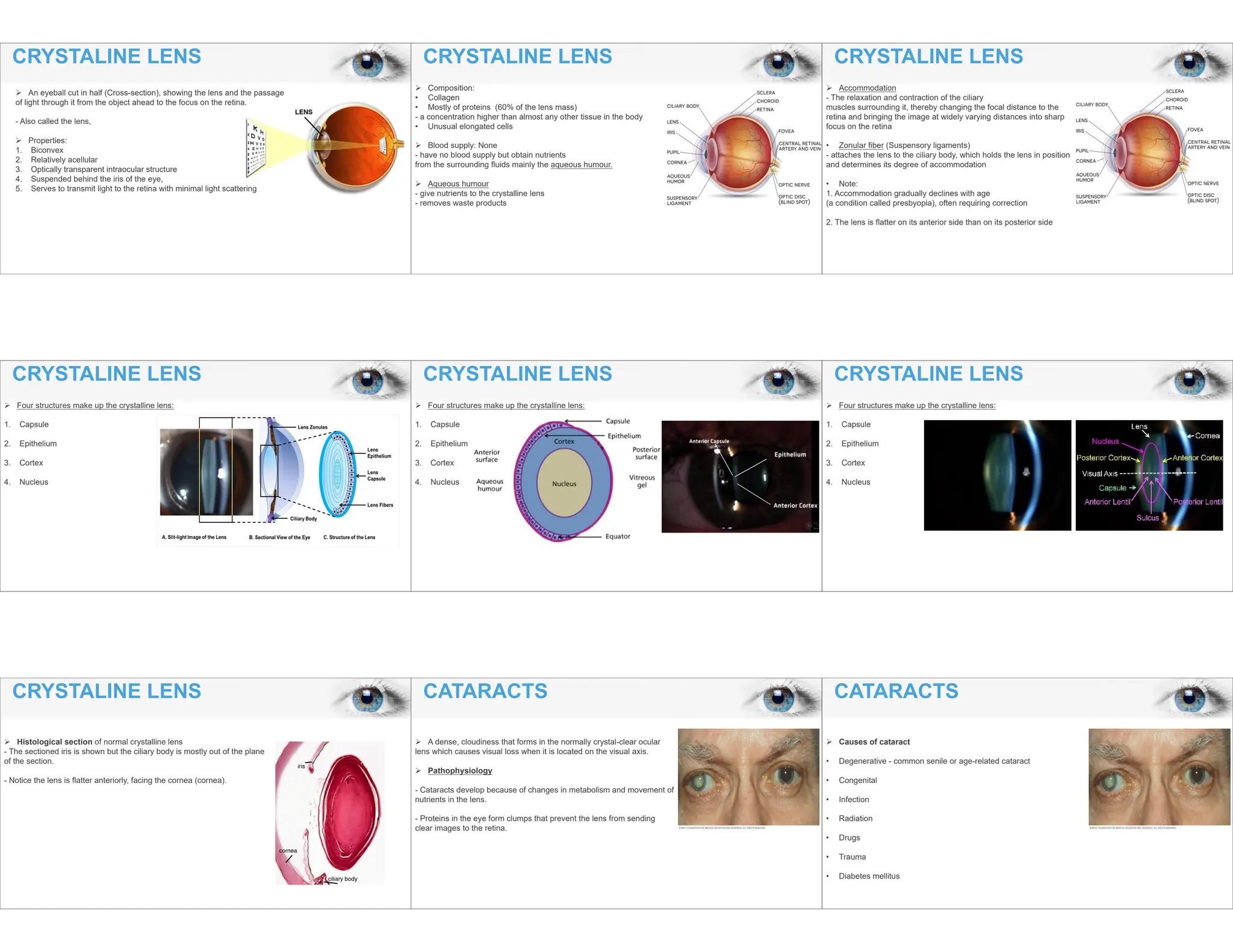
    CRYSTALINE LENS Ø Aneyeball cut in half (Cross-section), showing the lens and the passage of light through it from the object ahead to the focus on the retina. - Also called the lens, Ø Properties: 1. Biconvex 2. Relatively acellular 3. Optically transparent intraocular structure 4. Suspended behind the iris of the eye, 5. Serves to transmit light to the retina with minimal light scattering CRYSTALINE LENS Ø Composition: • Collagen • Mostly of proteins (60% of the lens mass) - a concentration higher than almost any other tissue in the body • Unusual elongated cells Ø Blood supply: None - have no blood supply but obtain nutrients from the surrounding fluids mainly the aqueous humour. Ø Aqueous humour - give nutrients to the crystalline lens - removes waste products CRYSTALINE LENS Ø Accommodation - The relaxation and contraction of the ciliary muscles surrounding it, thereby changing the focal distance to the retina and bringing the image at widely varying distances into sharp focus on the retina • Zonular fiber (Suspensory ligaments) - attaches the lens to the ciliary body, which holds the lens in position and determines its degree of accommodation • Note: 1. Accommodation gradually declines with age (a condition called presbyopia), often requiring correction 2. The lens is flatter on its anterior side than on its posterior side CRYSTALINE LENS Ø Four structures make up the crystalline lens: 1. Capsule 2. Epithelium 3. Cortex 4. Nucleus CRYSTALINE LENS Ø Four structures make up the crystalline lens: 1. Capsule 2. Epithelium 3. Cortex 4. Nucleus CRYSTALINE LENS Ø Four structures make up the crystalline lens: 1. Capsule 2. Epithelium 3. Cortex 4. Nucleus CRYSTALINE LENS Ø Histological section of normal crystalline lens - The sectioned iris is shown but the ciliary body is mostly out of the plane of the section. - Notice the lens is flatter anteriorly, facing the cornea (cornea). CATARACTS Ø A dense, cloudiness that forms in the normally crystal-clear ocular lens which causes visual loss when it is located on the visual axis. Ø Pathophysiology - Cataracts develop because of changes in metabolism and movement of nutrients in the lens. - Proteins in the eye form clumps that prevent the lens from sending clear images to the retina. CATARACTS Ø Causes of cataract • Degenerative - common senile or age-related cataract • Congenital • Infection • Radiation • Drugs • Trauma • Diabetes mellitus
  • 2.
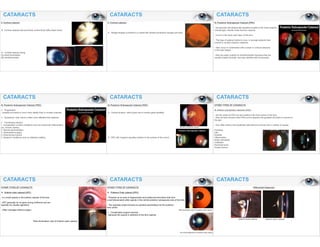
    CATARACTS Ø Clinical manifestation -A patient with senile cataract often presents with a history of gradual progressive visual deterioration and disturbance in night and near vision. CATARACTS Ø Characteristic symptoms of senile cataract: 1. Decreased visual acuity - the most common complaint of patients with senile cataract - difficulty seeing in low light situations (including poor night vision) 2. Glare - Disabling glare during the day to glare with oncoming headlights at night. - Halos or streaks around lights, difficulty seeing in the presence of bright lights 3. Poor contrast sensitivity - Decrease in contrast sensitivity in brightly lit environments 4. Poor ability to discern colors CATARACTS Ø Characteristic symptoms of senile cataract: 5. Myopic shift - The progression of cataracts frequently increases the anteroposterior (AP) axis and therefore the dioptric power of the lens, resulting in a mild to moderate degree of increased myopia or myopic shift 6. Monocular diplopia – - At times, the nuclear changes are concentrated in the inner layers of the lens, resulting in a refractile area in the center of the lens, the so called “lens within a lens” phenomenon, which may lead to monocular diplopia that is not correctable with spectacles, prisms, or contact lenses. CATARACTS Ø Several common misconceptions about cataract. - It is NOT a film visible on the outside of the eye - It is NOT caused from over-use of the eyes - It generally does NOT cause irritation or pain CATARACTS v Degenerative (Senile) cataract - is an age-related, vision-impairing condition characterized by gradual progressive clouding and thickening of the lens of the eye. - it is the world’s leading cause of treatable blindness. - The most common type of cataract Ø Divided into 3 types based on the anatomy of the human lens: I. Nuclear Sclerotic II. Cortical III. Posterior Subcapsular Cataracts Ø Note: Patients commonly develop opacity in more than one area of their lens which can cause overlap in the classification of cataracts. CATARACTS I. Nuclear sclerotic cataract - is the yellowing and hardening of the central portion of the crystalline lens - it occurs slowly over years - distance acuity is decreased therefore giving a good near vision - Can also cause colors to be less vibrant although the change is so gradual (often not noticed) - Nucleus can become very opaque, yellow and brown (brunescent nuclear cataract) - Brunescent cataracts are very advanced nuclear cataracts that have become brown and opaque. Ø Note: - As the core of the lens hardens, it often causes the lens to increase the refractive power and causes nearsightedness. - This is why some patients who had previously relied on reading glasses for reading may no longer need them once a nuclear sclerotic cataract starts to form (referred as Temporary Second Sight) CATARACTS I. Nuclear sclerotic cataract Ø Progression of Nuclear cataract CATARACTS II. Cortical cataract - wedge-shaped opacity with clear areas of lens matter - mostly present at the periphery (incipient cortical cataract) - usually start in the lens periphery and encroach into the visual axis - interfere with central vision in later stages - occur when the portion of lens fibers surrounding the nucleus become opacified. - The impact on vision is related to how close the opacities are to the center of the visual axis and their impact can vary greatly. - Visual acuity long remains intact until late stages when cortical spokes compromise visual axis. CATARACTS II. Cortical cataract Ø Progression: - is variable with some progressing over years and others in months. Ø Common symptom: - glare, especially from headlights while night driving
  • 3.
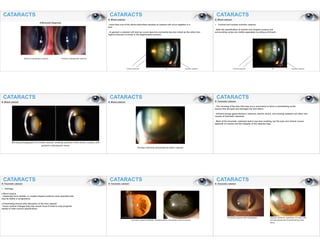
    CATARACTS II. Cortical cataract vCortical cataract with prominent cortical fluid clefts (black lines) v Cortical cataract using: (A) direct illumination (B) retroillumination. CATARACTS II. Cortical cataract v Wedge-shaped (cuneiform) or spoke-like (wheel) peripheral changes are seen CATARACTS III. Posterior Subcapsular Cataract (PSC) - Are granular and plaque-like opacities located in the most posterior cortical layer, directly under the lens capsule - Found in the back outer layer of the lens - This type of cataract tends to occur in younger patients than cortical or nuclear sclerotic cataracts - often occur in combination with nuclear or cortical cataracts in the later stages - they are easily noticed on retroillumination because they are usually located centrally, and may interfere with funduscopy CATARACTS III. Posterior Subcapsular Cataract (PSC) Ø Progression: - variable but tends to occur more rapidly than in nuclear sclerosis. Ø Symptoms: near vision is often more affected than distance Ø Contributory factors: 1. Complication of other conditions such as intraocular inflammation (ex: chronic uveitis), 2. Steroid administration, 3. Vitreoretinal surgery 4. External eye trauma 5. Systemic conditions such as diabetes mellitus CATARACTS III. Posterior Subcapsular Cataract (PSC) v Central location, which gives rise to severe glare disability v PSC with irregular opacities (similar to the surface of the moon) CATARACTS OTHER TYPES OF CATARACTS ❖ Anterior subcapsular cataracts (ASC) - are the same as PSC but are located in the front center of the lens. - they are less common than PSCs and it appears the greatest risk factor is trauma to the eye. - form after anterior lens epithelial cells become necrotic from a variety of causes Including: Iritis Keratitis Inflammation Atopic dermatitis Irradiation Electrical burns Ocular trauma CATARACTS OTHER TYPES OF CATARACTS v Anterior polar cataract (APC) - is a small opacity in the anterior capsule of the lens - APC generally do not grow during childhood and are typically not visually significant. - Often managed without surgery Retro-illumination view of Anterior polar cataract CATARACTS OTHER TYPES OF CATARACTS v Posterior Polar cataract (PPC) - Presents as an area of degenerative and malformed lens fibers that form a well demarcated white opacity in the central posterior subcapsular area of the lens. - The opacities project forward as cylinders penetrating into the posterior lens cortex. Ø Complicated surgical removal - Because the opacity is adherent to the lens capsule Retro-illumination view of a posterior polar cataract The clinical appearance of posterior polar cataract CATARACTS Differential Diagnosis
  • 4.
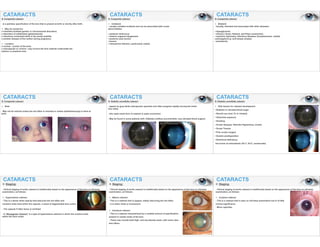
    CATARACTS Differential Diagnosis CATARACTS ❖ Mixedcataract - more than one of the above-described varieties of cataract will occur together in a lens - In general, a cataract will start as a pure type but eventually become mixed as the other lens regions become involved in the degenerative process CATARACTS ❖ Mixed cataract Ø Cortical and nuclear sclerotic cataract. - Note the opacification of central oval shaped nucleus and surrounding cortex are visible separately by oblique slit beam CATARACTS ❖ Mixed cataract CATARACTS ❖ Mixed cataract CATARACTS ❖ Traumatic cataract - The clouding of the lens that may occur secondary to blunt or penetrating ocular trauma that disrupts and damages the lens fibers. - Infrared energy (glass-blower's cataract), electric shock, and ionizing radiation are other rare causes of traumatic cataracts. - Most of the traumatic cataracts lead to eye lens swelling, but the type and clinical course depends on trauma and the integrity of the capsular bag. CATARACTS ❖ Traumatic cataract Ø Etiology: o Blunt trauma - classically form stellate- or rosette-shaped posterior axial opacities that may be stable or progressive o Penetrating trauma with disruption of the lens capsule - forms cortical changes that may remain focal if small or may progress rapidly to total cortical opacification. CATARACTS ❖ Traumatic cataract CATARACTS ❖ Traumatic cataract
  • 5.
    CATARACTS ❖ Congenital cataract -is a painless opacification of the lens that is present at birth or shortly after birth. Ø May be caused by: o inherited (multiple genetic or chromosomal disorders) o disorders of metabolism (galactosemia) o infections contracted while in the womb (rubella) o another disease of the mother during pregnancy Ø Location: o nuclear - (center of the lens) o subcapsular or cortical - may involve the lens material underneath the anterior or posterior lens. CATARACTS ❖ Congenital cataract Ø Unilateral - usually, isolated incidents and can be associated with ocular abnormalities: ▪ posterior lenticonus ▪ anterior segment dysgenesis ▪ posterior pole tumors ▪ trauma ▪ intrauterine infection, particularly rubella CATARACTS ❖ Congenital cataract Ø Bilateral - Usually, inherited and associated with other diseases: ▪ Hypoglycemia ▪ trisomy ( Down, Edward, and Patau syndromes) ▪ myotonic dystrophy, infectious diseases (toxoplasmosis, rubella, cytomegalovirus, and herpes simplex ▪ prematurity CATARACTS ❖ Congenital cataract Ø Note: - May not be noticed unless the red reflex is checked or unless ophthalmoscopy is done at birth. CATARACTS ❖ Diabetic snowflake cataract - appear as grey-white subcapsular opacities and often progress rapidly turning the entire lens white. - this rapid onset form of cataract is quite uncommon - May be found in some patients with: Diabetes mellitus (uncontrolled, very elevated blood sugars) CATARACTS ❖ Diabetic snowflake cataract Ø Risk factors for cataract development • Diabetes or elevated blood sugar • Steroid use (oral, IV, or inhaled) • Ultraviolet exposure • Smoking • Ocular diseases: Retinitis Pigmentosa, Uveitis • Ocular Trauma • Prior ocular surgery • Genetic predisposition • Nutritional deficiency: -low levels of antioxidants (Vit C, Vit E, carotenoids) CATARACTS v Staging: - Clinical staging of senile cataract is traditionally based on the appearance of the lens on slit-lamp examination, as follows: Ø Hypermature cataract - This is a dense white opacity that obscures the red reflex and contains milky fluid within the capsule, a result of degenerated lens cortex. - The capsule if often tense or wrinkled - A “Morgagnian Cataract” is a type of hypermature cataract in which the nucleus sinks within the fluid cortex. CATARACTS v Staging: - Clinical staging of senile cataract is traditionally based on the appearance of the lens on slit-lamp examination, as follows: Ø Mature cataract - This is a cataract that is opaque, totally obscuring the red reflex. - It is either white or brunescent. Ø Immature cataract - This is a cataract characterized by a variable amount of opacification, present in certain areas of the lens. - These may include both high- and low-density areas, with some clear lens fibers. CATARACTS v Staging: - Clinical staging of senile cataract is traditionally based on the appearance of the lens on slit-lamp examination, as follows: Ø Incipient cataract - This is a cataract that is seen on slit-lamp examination but is of little clinical significance. - Minor opacities
  • 6.
    CATARACTS Cataract Grading CATARACTS Ø Clinicalstaging of senile cataract can also be based on the visual acuity of the patient, as follows: • Hypermature cataract - The patient generally sees worse than count fingers (CF) or hand motion (HM). • Mature cataract - The patient cannot read better than 20/200 on the visual acuity chart. • Immature cataract - The patient can distinguish letters at lines better than 20/200. • Incipient cataract or dysfunctional lens syndrome - The patient reports visual complaints but can still read at 20/20 despite lens opacity confirmed via slit lamp-examination. CATARACTS Ø SURGICAL OPTIONS Cataract surgery - A painless procedure, is used to restore cataract-related vision loss. - The clouded lens inside the eye will be replaced with a clear artificial lens. - Typica last for only about 15-30 minutes - Most often done as an outpatient procedure with local anesthesia and light intravenous sedation. CATARACTS Ø SURGICAL OPTIONS • Types of cataract surgery: I. Phacoemulsification, or phaco - Is a procedure in which a surgeon makes a small incision at the edge of the cornea and then creates an opening in the membrane that surrounds the lens. - A small ultrasonic probe is then inserted, breaking up the cloudy lens into tiny fragments. - The instrument vibrates at ultrasonic speed to chop and almost dissolve the lens material into tiny fragments. CATARACTS Ø SURGICAL OPTIONS • Types of cataract surgery: I. Phacoemulsification, or phaco - The fragments are then suctioned out of the capsule by an attachment on the probe tip. -The insertion of an intraocular lens (IOL) usually immediately follows phacoemulsification. - IOL is implanted and positioned into the lenses natural capsule. -It is inserted through the tiny corneal incision through a hollowed-out tube. -Once the lens is pushed through, it unfolds and is positioned in place. CATARACTS Ø SURGICAL OPTIONS • Types of cataract surgery: I. Phacoemulsification, or phaco - usually done as an outpatient procedure. - less pain, and shorter recovery time - also called “small-incision cataract surgery.” - no sutures required CATARACTS Ø SURGICAL OPTIONS • Types of cataract surgery: II. Extarcapsular cataract extraction (ECCE) - requires a larger incision at the side of the cornea at the point where the cornea and sclera meet so that the lens core can be removed in one piece. - Carefully entering the eye through the incision, the surgeon gently opens the front of the lens capsule and removes the hard center, or nucleus, of the lens. - The soft lens cortex is then suctioned out leaving the back of the capsule in place. - The natural lens is the replaced an intraocular lens (IOL). CATARACTS Ø SURGICAL OPTIONS • Types of cataract surgery: II. Extarcapsular cataract extraction (ECCE) - sutures are necessary because the lens is removed in one piece. - It may be up to six weeks before the sutures are removed and best-corrected vision is achieved. - also called “large-incision cataract surgery”. CATARACTS Ø SURGICAL OPTIONS • Types of cataract surgery: III. Femtosecond Laser-Assisted Cataract Surgery, or FLACS - replaces many of the steps during cataract surgery that require a blade and softens the cataract, allowing for an easier and smoother removal. - In addition, the laser corrects mild astigmatism by relaxing the cornea at a precise depth, length, and orientation in a more precise and effective manner compared to manual, hand-made incisions. - It can also improve the quality of vision by reducing some visual aberrations, it expands the visual range of astigmatism-correcting lens implants, and it may enhance the quality and range of near vision in extended range lens implants. - Faster healing.
  • 7.
    CATARACTS Ø SURGICAL OPTIONS •Types of cataract surgery: III. Femtosecond Laser-Assisted Cataract Surgery, or FLACS CATARACTS Ø SURGICAL OPTIONS III. Femtosecond Laser-Assisted Cataract Surgery, or FLACS a.) Scheduling of capsulotomy, lens fragmentation and corneal incision positioning in the imaging system. b.) Completion of capsulotomy, lens fragmentation and corneal incision positioning via femtosecond laser. c.) External eye appearance prior to cataract surgery and removal of the phakic intraocular lens. CATARACTS Ø SURGICAL OPTIONS III. Femtosecond Laser-Assisted Cataract Surgery, or FLACS d.) Phacoemulsification and aspiration under the phakic intraocular lens. e.) Implantation of a new multifocal intraocular lens. f.) Extraction of the phakic intraocular lens after widening of the corneal incision CATARACTS Ø SURGICAL OPTIONS Ø Indication for surgical intervention: ▪ maximally corrected vision ≤ 20/50 (6/15) ▪ subjective visual impairment that prevents activities (driving, reading, occupational activities). ▪ disabling glare (most common with posterior subcapsular cataracts). ▪ lens-induced diseases (PHACOLYTIC GLAUCOMA, PHACOANTIGENIC UVEITIS). ▪ need to visualize fundus for management of diseases (DIABETIC RETINOPATHY, GLAUCOMA) CATARACTS Ø Types of intraocular lens (IOL) I. Multifocal (or accommodative) IOLs - IOL design that provides correction for both near and distance vision, and both near and far objects can be in focus at the same time. - The brain must learn to select the visual information it needs to form an image of either near or distant objects, so multifocal IOLs may require some adjustment. - A person may adjust better to multifocal IOLs if they are placed in both eyes. - This type of lens is not an option for some people. CATARACTS Ø Types of intraocular lens (IOL) II. Monofocal IOLs (standard) - IOL designed for either near or distance vision. - Prescription eyeglasses may still be required. It is common for the IOLs to be chosen to provide better distance vision than near vision. - Then glasses are used for sharp near vision. CATARACTS Ø Types of intraocular lens (IOL) III. Toric IOLs - a type of monofocal IOL that helps correct astigmatism - considered a premium lens CATARACTS v Posterior capsular opacification (PCO) - also called secondary or after cataract, - most common complication after a cataract surgery - occur when natural cells remain and proteins grow at the back of the lens capsule (the “capsular bag”) that contains the intraocular lens or IOL. CATARACTS v Posterior capsular opacification (PCO) - a type of cataract can be: • In the form of pearl, fibrous or a combination of both • May multiply around the capsule, • Move to other areas or differentiate from the lens epithelial cells
  • 8.
    CATARACTS v Posterior capsularopacification (PCO) - The capsule that bags the IOL is transparent, but it is also still natural human tissue. - It means it still can change over time. - Because of that, it isn’t uncommon for the capsule holding this new, perfectly clear lens to lose a little bit of its transparency CATARACTS v Posterior capsular opacification (PCO) - The capsule that bags the IOL is transparent, but it is also still natural human tissue. - It means it still can change over time. - Because of that, it isn’t uncommon for the capsule holding this new, perfectly clear lens to lose a little bit of its transparency - The capsular bag effectively 'shrink-wraps' the new lens and holds it in place. - However, a few natural lens cells always remain after surgery. CATARACTS v Posterior capsular opacification (PCO) - In time the eye's wound-healing response leads the cells to spread across the underside of the artificial lens. - This interferes with vision, causing what's known as 'posterior capsule opacification' or “secondary cataract”. - PCO may develop months or even years after cataract surgery or it may it stays transparent. CATARACTS v Posterior capsular opacification (PCO) Ø Yag Laser Capsulotomy is a very low-risk treatment for PCO, completed as an outpatient procedure. - This uses a laser to create an opening in the opacified capsule which allows light rays from the laser to move freely towards the back of the affected eye to restore clear vision. - Yag stands for “Yttrium aluminum garnet”, is a crystal located within the laser used for the procedure. CATARACTS v Posterior capsular opacification (PCO) Yag Laser Capsulotomy CATARACTS v Posterior capsular opacification (PCO) Yag Laser Capsulotomy