We take for grated what we
think we know best
Affective &
Effective Learning
We take for grated what we
think we know best
Why should I care?!
• Transactional or transformational goals?!
• What does it change?!
• Theory AND/OR practice?!
A philosophical starting point
pros

cons

• It is a universal principal
in business,
communication – all
spheres of life

• Not enough time

• Quick-fixes don’t work
long term
• It’s all about how you feel.

• Results are not quickly
• Results may not always
visible
Affective Teaching – the center
It all starts in your center – your beliefs, ideas,
attitude and deep rooted models of perceiving
students and their learning
“I know it” is the best sign you don’t
Affective Teaching – the center
The role of the teacher – facilitator,
mediator and coach
“This is more than a technique it requires personal
improvement and change”
Affective Teaching – what do you
do?
After a class that didn’t work well what do you do?
•Weep
•Blame students
•Get some wine
•Complain to a friend
Affective Teaching – what CAN
you do?
After a class that didn’t work well what do you do?
• Not take it personally
•Reflect
•Constructive talk to colleague
•Involve others
•Try something new
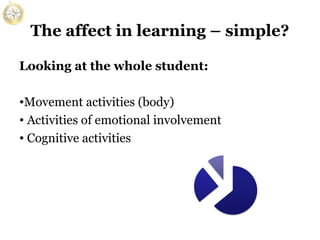
The affect in learning – simple?
Looking at the whole student:
•Movement activities (body)
• Activities of emotional involvement
• Cognitive activities
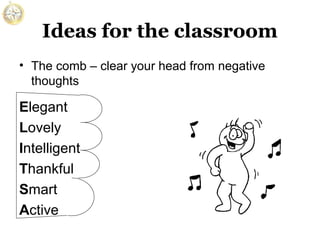
Ideas for the classroom
• The comb – clear your head from negative
thoughts

Elegant
Lovely
Intelligent
Thankful
Smart
Active
The affect in learning - Motivation
• Whole course goals
“What is in there for me?”
“Why do we..”/ “What are the benefits of”
Asking these questions as a habit
• Your passion
Activities/ Projects
• The “Why and Why not study FL project”
• Bring different points of view on the table
• The findings board
The affect in learning - Motivation
• Explicit about activity
• Vary activities - The 20/15 rule – change activity each
20/15 min.
• Challenge – time/ completion/a thematic frame for the
activity
Activities
Beginning: We do this to learn/ practice to….
Middle: How are you doing about……
End: What did we learn/ how can we learn better?
• Signs about how students feel about the activity
“I’m ok”
“It is too easy”
“I need help”
• The challenge box
The affect in learning - beliefs
• Beliefs about self
• Beliefs about learning
• Beliefs about the subject
Activities:
• Draw yourself as a language learner
• Include beliefs about the self in questionnaires
• Work with/ through stories
• Make students create a comic about overcoming
challenges
The affect in learning - mistakes
• Beliefs and attitude - mistakes – family/cultural
• How to correct mistakes in class
• Learn to make mistakes
• Learn to learn from mistakes
Ideas for the classroom
• Ask explicit questions as a reflection – portfolio/
questionnaires
• Make mistakes and feel ok about it
• Students writing stories about making mistakes
• Share successful mistake stories
The affect in learning – standards?!
The CEFR stresses on the affective part of
Language Learning!
Example: beliefs and attitudes towards learning

Affective.effective

  • 1.
    We take forgrated what we think we know best
  • 2.
    Affective & Effective Learning Wetake for grated what we think we know best
  • 3.
    Why should Icare?! • Transactional or transformational goals?! • What does it change?! • Theory AND/OR practice?!
  • 4.
    A philosophical startingpoint pros cons • It is a universal principal in business, communication – all spheres of life • Not enough time • Quick-fixes don’t work long term • It’s all about how you feel. • Results are not quickly • Results may not always visible
  • 5.
    Affective Teaching –the center It all starts in your center – your beliefs, ideas, attitude and deep rooted models of perceiving students and their learning “I know it” is the best sign you don’t
  • 6.
    Affective Teaching –the center The role of the teacher – facilitator, mediator and coach “This is more than a technique it requires personal improvement and change”
  • 7.
    Affective Teaching –what do you do? After a class that didn’t work well what do you do? •Weep •Blame students •Get some wine •Complain to a friend
  • 8.
    Affective Teaching –what CAN you do? After a class that didn’t work well what do you do? • Not take it personally •Reflect •Constructive talk to colleague •Involve others •Try something new
  • 9.
    The affect inlearning – simple? Looking at the whole student: •Movement activities (body) • Activities of emotional involvement • Cognitive activities
  • 10.
    Ideas for theclassroom • The comb – clear your head from negative thoughts Elegant Lovely Intelligent Thankful Smart Active
  • 11.
    The affect inlearning - Motivation • Whole course goals “What is in there for me?” “Why do we..”/ “What are the benefits of” Asking these questions as a habit • Your passion
  • 12.
    Activities/ Projects • The“Why and Why not study FL project” • Bring different points of view on the table • The findings board
  • 13.
    The affect inlearning - Motivation • Explicit about activity • Vary activities - The 20/15 rule – change activity each 20/15 min. • Challenge – time/ completion/a thematic frame for the activity
  • 14.
    Activities Beginning: We dothis to learn/ practice to…. Middle: How are you doing about…… End: What did we learn/ how can we learn better? • Signs about how students feel about the activity “I’m ok” “It is too easy” “I need help” • The challenge box
  • 15.
    The affect inlearning - beliefs • Beliefs about self • Beliefs about learning • Beliefs about the subject
  • 16.
    Activities: • Draw yourselfas a language learner • Include beliefs about the self in questionnaires • Work with/ through stories • Make students create a comic about overcoming challenges
  • 17.
    The affect inlearning - mistakes • Beliefs and attitude - mistakes – family/cultural • How to correct mistakes in class • Learn to make mistakes • Learn to learn from mistakes
  • 18.
    Ideas for theclassroom • Ask explicit questions as a reflection – portfolio/ questionnaires • Make mistakes and feel ok about it • Students writing stories about making mistakes • Share successful mistake stories
  • 19.
    The affect inlearning – standards?! The CEFR stresses on the affective part of Language Learning! Example: beliefs and attitudes towards learning