MOOD & AFFECT
DR ABHISHEK R CHAUDHARY
JR-1 , DEPARTMENT OF PSYCHIATRY ,
DR MK SHAH MEDICAL COLLEGE AND
RESEARCH CENTRE,
AHMEDABAD
2023-24 DR ABHISHEK CHAUDHARY
MOOD & AFFECT ARE THE
COMPONENT OF MENTAL STATE
EXAMINATION (MSE)
WHAT IS MENTAL STATUS EXAMINATION (
MSE ) ?
• MSE is an organised, systemic approach to
assessment of an individual’s current psychiatric
conditions
• It is the part of clinical assessment that describes the
sum total of the examiner’s observation and
impressions of a psychiatric patient at the time of the
interview.
• MSE includes observing the patient’s behavior and
describing it in an objective, non-judgmental manner.
2023-24 DR ABHISHEK CHAUDHARY
COMPONENTS OF MSE :
1. General Appearance
2. Attitude towards Examiner
3. Rapport
4. Motor Behaviour
5. Speech
6. Cognitive functions
7. Mood and Affect
8. Thought
9. Perception
10.Attention and Concentration
11.Intelligence
12.Insight and Judgement
MOOD
• Mood is defined as a pervasive and sustained
feeling tone that is experienced internally and in
the extreme, can markedly influence all aspects
of a person’s behavior & perception to the
external world. ( SYNOPSIS)
• Mood is an emotional state which usually last for
sometime and which colors the total experience
of the subject ( FISH)
HOW DO WE ASSESS THE MOOD ?
How are you feeling lately ?
OR
How are you feeling right now ?
OR
How is your mood during whole day since past few days ?
2023-24 DR ABHISHEK CHAUDHARY
HOW CAN WE DESCRIBE MOOD ?
MOOD CAN BE ASSESSED UNDER FOLLOWING
COMPONENTS :
1. Quality
2. Reactivity
3. Labiality
4. Diurnal Variation
What are Quality of MOOD ?
2023-24 DR ABHISHEK CHAUDHARY
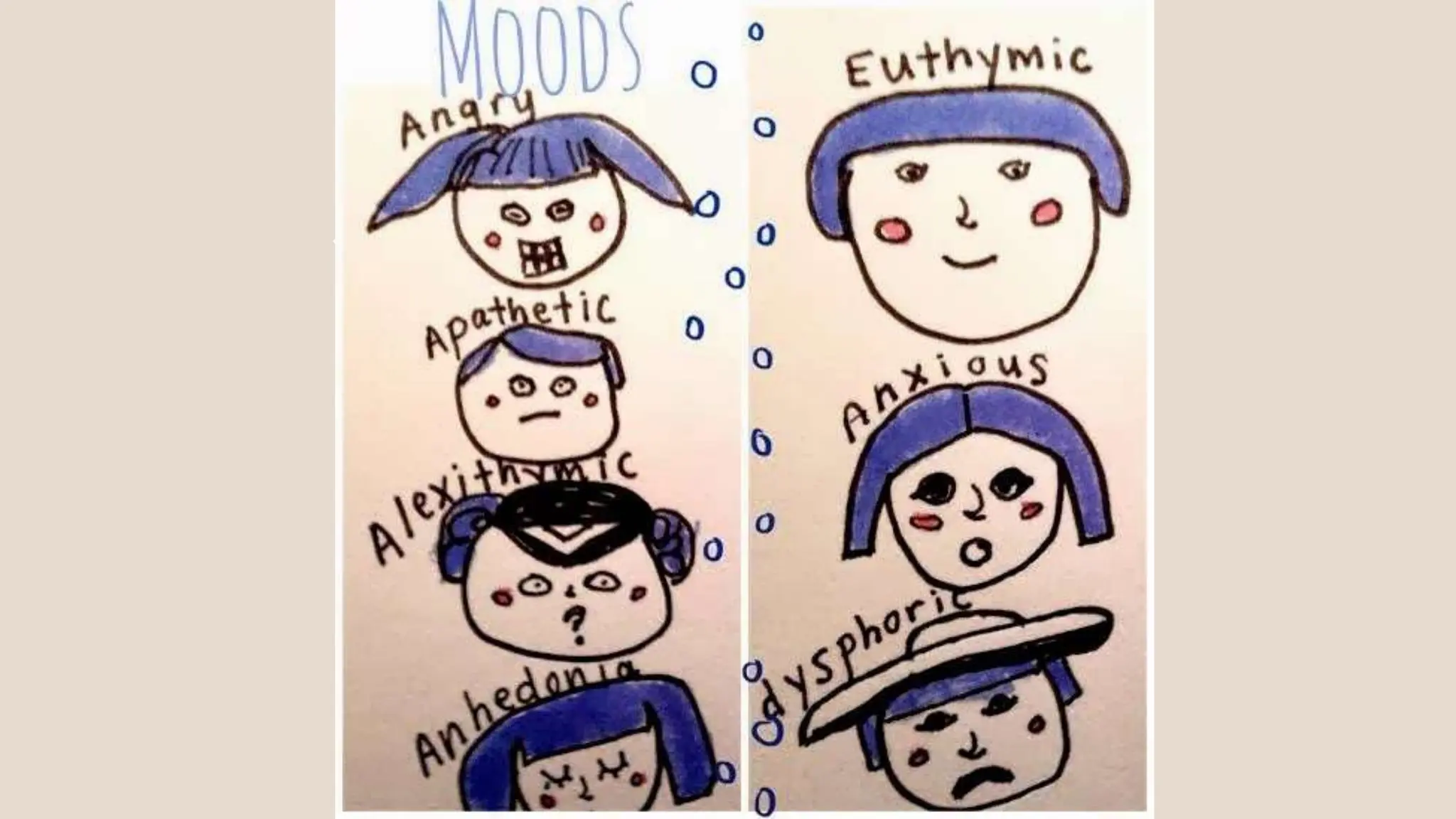
EUTHYMIC :
• Its an normal range of mood.
• Patient remains calm, consistent in emotional expression,
comfortable, appropriately friendly and reasonably cooperative.
• It is unsually health sign.
• Terms used to describe euthymic mood – pleasant , friendly,
calm.
DYSPHORIA :
#It is described as feeling down, blue, sad, worthless, upset,
hopeless and frustrated.
#Mood of dysphoric range is a hallmark of major depressive
disorder , but also occur in context to variety of other disorders
including mixed bipolar , schizophrenia , anxiety , drug/alcohol
abuse, medical disorders( particularly neurologic, oncologic and
endocrinal, post surgery, and chronic illness states.
2023-24 DR ABHISHEK CHAUDHARY
EUPHORIA :
• Euphoria and Happiness are normal moods when the situation
warrants, but can also accompany certain pathological
conditions.
• When elevated mood is present , condition manic should come
in the context, but it can also be associated with drug
intoxications ( Marijuana, ethanol , Amphetamines, etc)
ANGER :
• It is an common psychiatric presentation, especially in
emergency room setting.
• It is usually seen in manics ( with minimal provocation –
irritability ) , drug / alcohol intoxication , epilepsy ( complex
partial) , head trauma , stroke, dementia, neurologic
disorders specially when pre-frontal cortex or amygdala is
affected.
2023-24 DR ABHISHEK CHAUHDARY
ANXIOUS :
• It includes fearful, tense and apprehensive feelings and is
common experience in threatening situations.
• It might also associated with autonomic arousals ( flight-fight-
fright response)
• In psychiatric illness, it is typically seen in panic disorder and
phobic states.
• It may also be seen in atypical depression , personality
disorders or organic states like hyperthyroidism, drug
intoxication ( amphetamines) , respiratory compromise, sleep
disturbances ( nightmares ) .
• Anxious range includes tense , nervous, worried , fearful ,
overwhelmed, etc.
APATHY :
2023-24 DR ABHISHEK CHAUDHARY
• Apathy word used where there is no evident mood.
• Mood in this category is described as apathetic , bland , dull
or flat.
• Seen in alexithymic patients , where individuals have
persistent & consistent impairment in the capacity for
emotional expression & impaired capacity to recognise any
of their mood shifts that do occurs.
REACTIVITY :
• It is the extent to which
affect changes in
response to
environmental stimuli.
2023-24 DR ABHISHEK CHAUDHARY
DIURNAL VARIATION :
The changes occurring with passage of the day.
• Worse in morning- Seen in Endogenous Depression,
Headache.
• Worse in the evening- Seen in Anxiety, Delirium (sun
downing).
•
• Worse at night -Seen in Uremia.
AFFECT
2023-24 DR ABHISHEK CHAUDHARY
• Affect is defined as the subjective and immediate experience
of emotion attached to ideas OR mental representations of the
objects ( SYNOPSIS)
• A Wave of emotions in which there is sudden exacerbation of
emotion usually as a response to some event (FISH)
• Patient’s present emotional responsiveness, inferred from
patients facial expressions (SOP)
How Affect can be assessed ?
2023-24 DR ABHISHEK CHAUDHARY
1.Quality
2.Intensity
3.Range
4.Mobility
5.Communicability
6.Appropriateness
REACTIVITY :
• It is the extent to which
affect changes in
response to
environmental stimuli.
2023-24 DR ABHISHEK CHAUDHARY
INTENSITY :
It is the strength of emotional expression.
1.Shallow affect – Lack of depth in emotions
2.Blunt affect – diminished emotional expressions or
expressionless face
3.Flat affect – no expression of the affect
RANGE :
• Full Range – appropriately expressed many emotions
depending on the context.
• Restricted Range : Shows only a fixed emotion or Limited
Range.
(SEEN in Schizophrenia or Depression)
2023-24 DR ABHISHEK CHAUDHARY
QUALITY :
It is assessed on two criteria :
1.Subjective evaluation – how do you feel ?
2.Objective evaluation – Based on the
observation of interviewer
2023-24 DR ABHISHEK CHAUDHARY
Quality of Affect can be :
1.Dysphoric – feeling of unpleasantness or discomfort.
2.Anxious – feeling of apprehension caused by anticipation of
danger which may be internal or external.
3.Irritable – a state of poor control over aggressive impulses
directed towards others; most frequently to those nearest and
dearest. May manifest in outburst in which a person is easily
annoyed & provoked.
4.Depressed – emotional mood tending towards sorrow.
2023-24 DR ABHISHEK CHAUDHARY
5. Elevated – An Exaggerated feeling of well-being out of keeping
with life situation.
6. Euphoric – increased sense if well-being with cheerful thoughts
and lack of response to depressing influence so that everything is
seen in best possible light.
7. Elated – feeling of well-being and euphoria leading to faulty
judgement and increased psychomotor activity.
8. Exalted – feeling of intense elation and grandeur ; seen in
mania.
2023-24 DR ABHISHEK CHAUDHARY
9. Ecstatic – Intense sense of blissfulness ; seen in delirium,
stuporous mania.
10. Euthymic – mood in normal range implying absence if
depressed or elated mood.
MOBILITY :
It is the ease and speed with which one moves from one type to
another type of emotion.
1.Constricted affect- Reduced mobility is also referred as
constricted affect. ( seen in depression )
2.Fixed affect- When affect is extremely constricted to one
emotion it is called fixed or immobile.
3.Labile affect- Pathologically increased mobility of affect, marked
by a rapid shift from one type to another emotion without
persistence of any affect. ( seen in organic brain disease, drug
intoxication, early in schizophrenia)
COMMUNICABILITY :
• The ability of the expression of affect to communicate to
another one’s emotional response to events, interaction,
behaviour, and situation.
• The capacity to connect with the interviewer.
• Usually present in Mania , absent in Schizophrenia.
APPROPRIATENESS :
It is congruence or fit between the expressed quality of emotion
and the content of speech, thought, expected degree of intensity
and the overall situation.
1.Paramimia- Lack of unity between various modes of
expression of emotion.
2.Parathymia- Expression of an emotion that is exactly opposite
of what is expected under the circumstances, for example,
laughing at a tragic news.
2023-24 DR ABHISHEK CHAUDHARY
DIURNAL VARIATION :
The change in affect occuring with passage of the day.
• Worse in morning- Seen in Endogenous Depression,
Headache.
• Worse in the evening- Seen in Anxiety, Delirium (sun
downing).
•
• Worse at night -Seen in Uremia.
References
20XX presentation title 30
2023-24 DR ABHISHEK CHAUDHARY
SO , HOW WAS YOUR MOOD / AFFECT
DURING ENTIRE PRESENTATION ?
Thank You
DR ABHISHEK R CHAUDHARY

MOOD AND AFFECT PPT.pptx FROM SYNOPSIS .

  • 1.
    MOOD & AFFECT DRABHISHEK R CHAUDHARY JR-1 , DEPARTMENT OF PSYCHIATRY , DR MK SHAH MEDICAL COLLEGE AND RESEARCH CENTRE, AHMEDABAD
  • 2.
    2023-24 DR ABHISHEKCHAUDHARY MOOD & AFFECT ARE THE COMPONENT OF MENTAL STATE EXAMINATION (MSE)
  • 3.
    WHAT IS MENTALSTATUS EXAMINATION ( MSE ) ? • MSE is an organised, systemic approach to assessment of an individual’s current psychiatric conditions • It is the part of clinical assessment that describes the sum total of the examiner’s observation and impressions of a psychiatric patient at the time of the interview. • MSE includes observing the patient’s behavior and describing it in an objective, non-judgmental manner. 2023-24 DR ABHISHEK CHAUDHARY
  • 4.
    2023-24 DR ABHISHEKCHAUDHARY COMPONENTS OF MSE : 1. General Appearance 2. Attitude towards Examiner 3. Rapport 4. Motor Behaviour 5. Speech 6. Cognitive functions 7. Mood and Affect 8. Thought 9. Perception 10.Attention and Concentration 11.Intelligence 12.Insight and Judgement
  • 5.
    MOOD • Mood isdefined as a pervasive and sustained feeling tone that is experienced internally and in the extreme, can markedly influence all aspects of a person’s behavior & perception to the external world. ( SYNOPSIS) • Mood is an emotional state which usually last for sometime and which colors the total experience of the subject ( FISH)
  • 6.
    HOW DO WEASSESS THE MOOD ? How are you feeling lately ? OR How are you feeling right now ? OR How is your mood during whole day since past few days ? 2023-24 DR ABHISHEK CHAUDHARY
  • 7.
    HOW CAN WEDESCRIBE MOOD ? MOOD CAN BE ASSESSED UNDER FOLLOWING COMPONENTS : 1. Quality 2. Reactivity 3. Labiality 4. Diurnal Variation
  • 8.
    What are Qualityof MOOD ? 2023-24 DR ABHISHEK CHAUDHARY EUTHYMIC : • Its an normal range of mood. • Patient remains calm, consistent in emotional expression, comfortable, appropriately friendly and reasonably cooperative. • It is unsually health sign. • Terms used to describe euthymic mood – pleasant , friendly, calm.
  • 9.
    DYSPHORIA : #It isdescribed as feeling down, blue, sad, worthless, upset, hopeless and frustrated. #Mood of dysphoric range is a hallmark of major depressive disorder , but also occur in context to variety of other disorders including mixed bipolar , schizophrenia , anxiety , drug/alcohol abuse, medical disorders( particularly neurologic, oncologic and endocrinal, post surgery, and chronic illness states. 2023-24 DR ABHISHEK CHAUDHARY
  • 10.
    EUPHORIA : • Euphoriaand Happiness are normal moods when the situation warrants, but can also accompany certain pathological conditions. • When elevated mood is present , condition manic should come in the context, but it can also be associated with drug intoxications ( Marijuana, ethanol , Amphetamines, etc)
  • 11.
    ANGER : • Itis an common psychiatric presentation, especially in emergency room setting. • It is usually seen in manics ( with minimal provocation – irritability ) , drug / alcohol intoxication , epilepsy ( complex partial) , head trauma , stroke, dementia, neurologic disorders specially when pre-frontal cortex or amygdala is affected.
  • 12.
    2023-24 DR ABHISHEKCHAUHDARY ANXIOUS : • It includes fearful, tense and apprehensive feelings and is common experience in threatening situations. • It might also associated with autonomic arousals ( flight-fight- fright response) • In psychiatric illness, it is typically seen in panic disorder and phobic states. • It may also be seen in atypical depression , personality disorders or organic states like hyperthyroidism, drug intoxication ( amphetamines) , respiratory compromise, sleep disturbances ( nightmares ) . • Anxious range includes tense , nervous, worried , fearful , overwhelmed, etc.
  • 13.
    APATHY : 2023-24 DRABHISHEK CHAUDHARY • Apathy word used where there is no evident mood. • Mood in this category is described as apathetic , bland , dull or flat. • Seen in alexithymic patients , where individuals have persistent & consistent impairment in the capacity for emotional expression & impaired capacity to recognise any of their mood shifts that do occurs.
  • 14.
    REACTIVITY : • Itis the extent to which affect changes in response to environmental stimuli. 2023-24 DR ABHISHEK CHAUDHARY
  • 15.
    2023-24 DR ABHISHEKCHAUDHARY DIURNAL VARIATION : The changes occurring with passage of the day. • Worse in morning- Seen in Endogenous Depression, Headache. • Worse in the evening- Seen in Anxiety, Delirium (sun downing). • • Worse at night -Seen in Uremia.
  • 17.
    AFFECT 2023-24 DR ABHISHEKCHAUDHARY • Affect is defined as the subjective and immediate experience of emotion attached to ideas OR mental representations of the objects ( SYNOPSIS) • A Wave of emotions in which there is sudden exacerbation of emotion usually as a response to some event (FISH) • Patient’s present emotional responsiveness, inferred from patients facial expressions (SOP)
  • 18.
    How Affect canbe assessed ? 2023-24 DR ABHISHEK CHAUDHARY 1.Quality 2.Intensity 3.Range 4.Mobility 5.Communicability 6.Appropriateness
  • 19.
    REACTIVITY : • Itis the extent to which affect changes in response to environmental stimuli. 2023-24 DR ABHISHEK CHAUDHARY
  • 20.
    2023-24 DR ABHISHEKCHAUDHARY INTENSITY : It is the strength of emotional expression. 1.Shallow affect – Lack of depth in emotions 2.Blunt affect – diminished emotional expressions or expressionless face 3.Flat affect – no expression of the affect
  • 21.
    RANGE : • FullRange – appropriately expressed many emotions depending on the context. • Restricted Range : Shows only a fixed emotion or Limited Range. (SEEN in Schizophrenia or Depression)
  • 22.
    2023-24 DR ABHISHEKCHAUDHARY QUALITY : It is assessed on two criteria : 1.Subjective evaluation – how do you feel ? 2.Objective evaluation – Based on the observation of interviewer
  • 23.
    2023-24 DR ABHISHEKCHAUDHARY Quality of Affect can be : 1.Dysphoric – feeling of unpleasantness or discomfort. 2.Anxious – feeling of apprehension caused by anticipation of danger which may be internal or external. 3.Irritable – a state of poor control over aggressive impulses directed towards others; most frequently to those nearest and dearest. May manifest in outburst in which a person is easily annoyed & provoked. 4.Depressed – emotional mood tending towards sorrow.
  • 24.
    2023-24 DR ABHISHEKCHAUDHARY 5. Elevated – An Exaggerated feeling of well-being out of keeping with life situation. 6. Euphoric – increased sense if well-being with cheerful thoughts and lack of response to depressing influence so that everything is seen in best possible light. 7. Elated – feeling of well-being and euphoria leading to faulty judgement and increased psychomotor activity. 8. Exalted – feeling of intense elation and grandeur ; seen in mania.
  • 25.
    2023-24 DR ABHISHEKCHAUDHARY 9. Ecstatic – Intense sense of blissfulness ; seen in delirium, stuporous mania. 10. Euthymic – mood in normal range implying absence if depressed or elated mood.
  • 26.
    MOBILITY : It isthe ease and speed with which one moves from one type to another type of emotion. 1.Constricted affect- Reduced mobility is also referred as constricted affect. ( seen in depression ) 2.Fixed affect- When affect is extremely constricted to one emotion it is called fixed or immobile. 3.Labile affect- Pathologically increased mobility of affect, marked by a rapid shift from one type to another emotion without persistence of any affect. ( seen in organic brain disease, drug intoxication, early in schizophrenia)
  • 27.
    COMMUNICABILITY : • Theability of the expression of affect to communicate to another one’s emotional response to events, interaction, behaviour, and situation. • The capacity to connect with the interviewer. • Usually present in Mania , absent in Schizophrenia.
  • 28.
    APPROPRIATENESS : It iscongruence or fit between the expressed quality of emotion and the content of speech, thought, expected degree of intensity and the overall situation. 1.Paramimia- Lack of unity between various modes of expression of emotion. 2.Parathymia- Expression of an emotion that is exactly opposite of what is expected under the circumstances, for example, laughing at a tragic news.
  • 29.
    2023-24 DR ABHISHEKCHAUDHARY DIURNAL VARIATION : The change in affect occuring with passage of the day. • Worse in morning- Seen in Endogenous Depression, Headache. • Worse in the evening- Seen in Anxiety, Delirium (sun downing). • • Worse at night -Seen in Uremia.
  • 30.
  • 31.
    2023-24 DR ABHISHEKCHAUDHARY SO , HOW WAS YOUR MOOD / AFFECT DURING ENTIRE PRESENTATION ?
  • 32.