Aeschylus By Dr. Arlene S. Opina
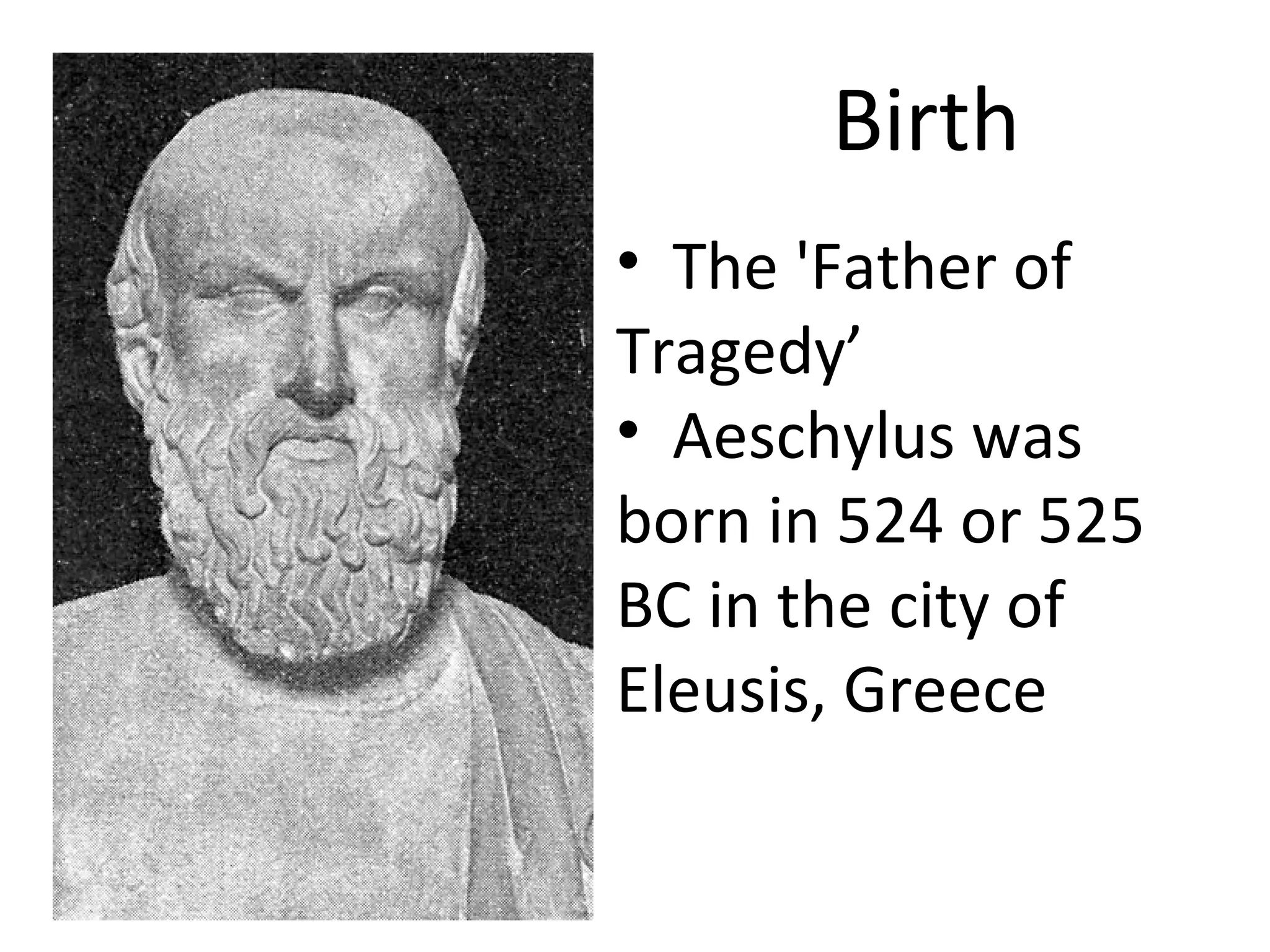
Birth The 'Father of Tragedy’ Aeschylus was born in 524 or 525 BC in the city of Eleusis, Greece
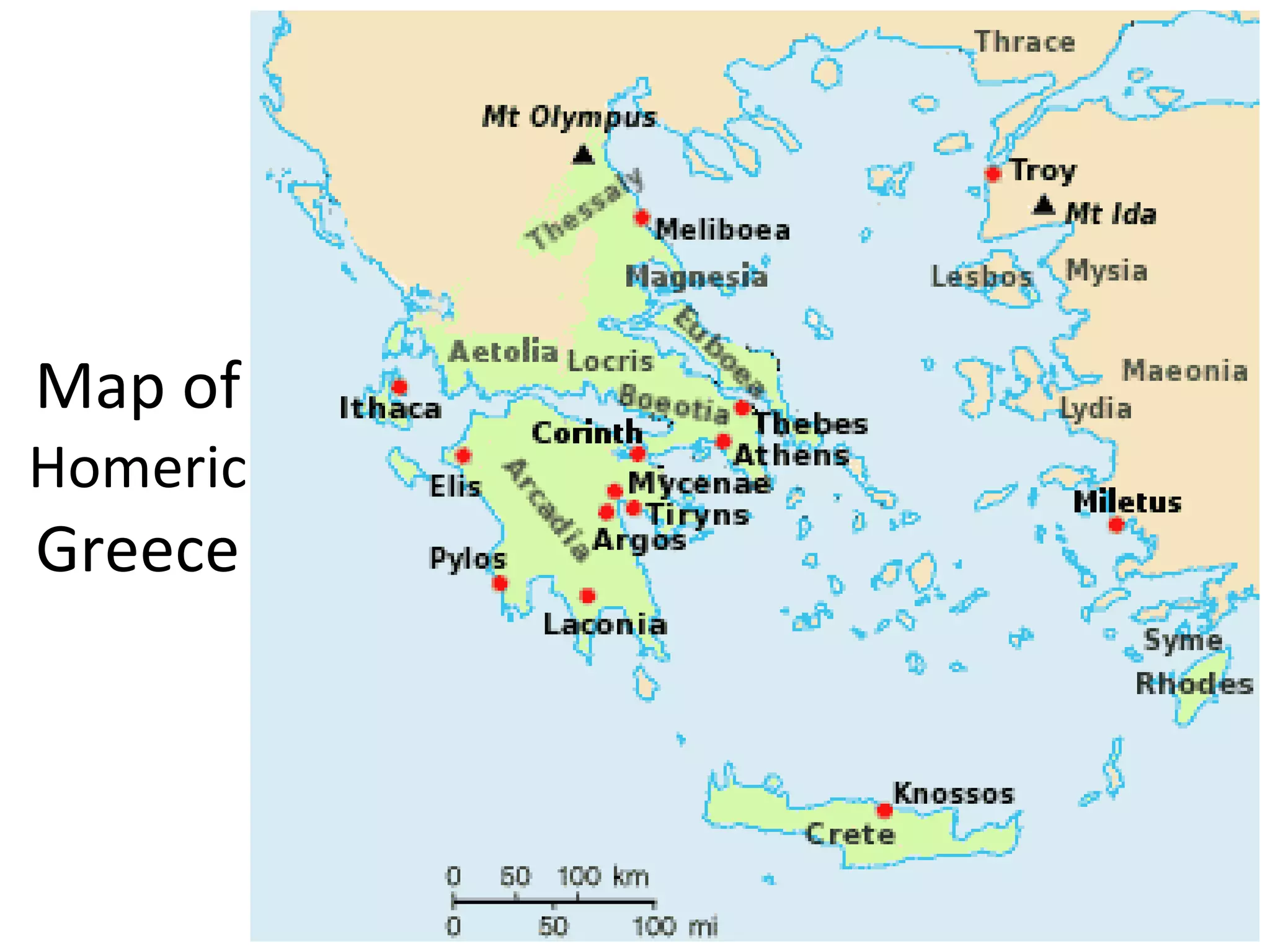
Map of  Homeric  Greece
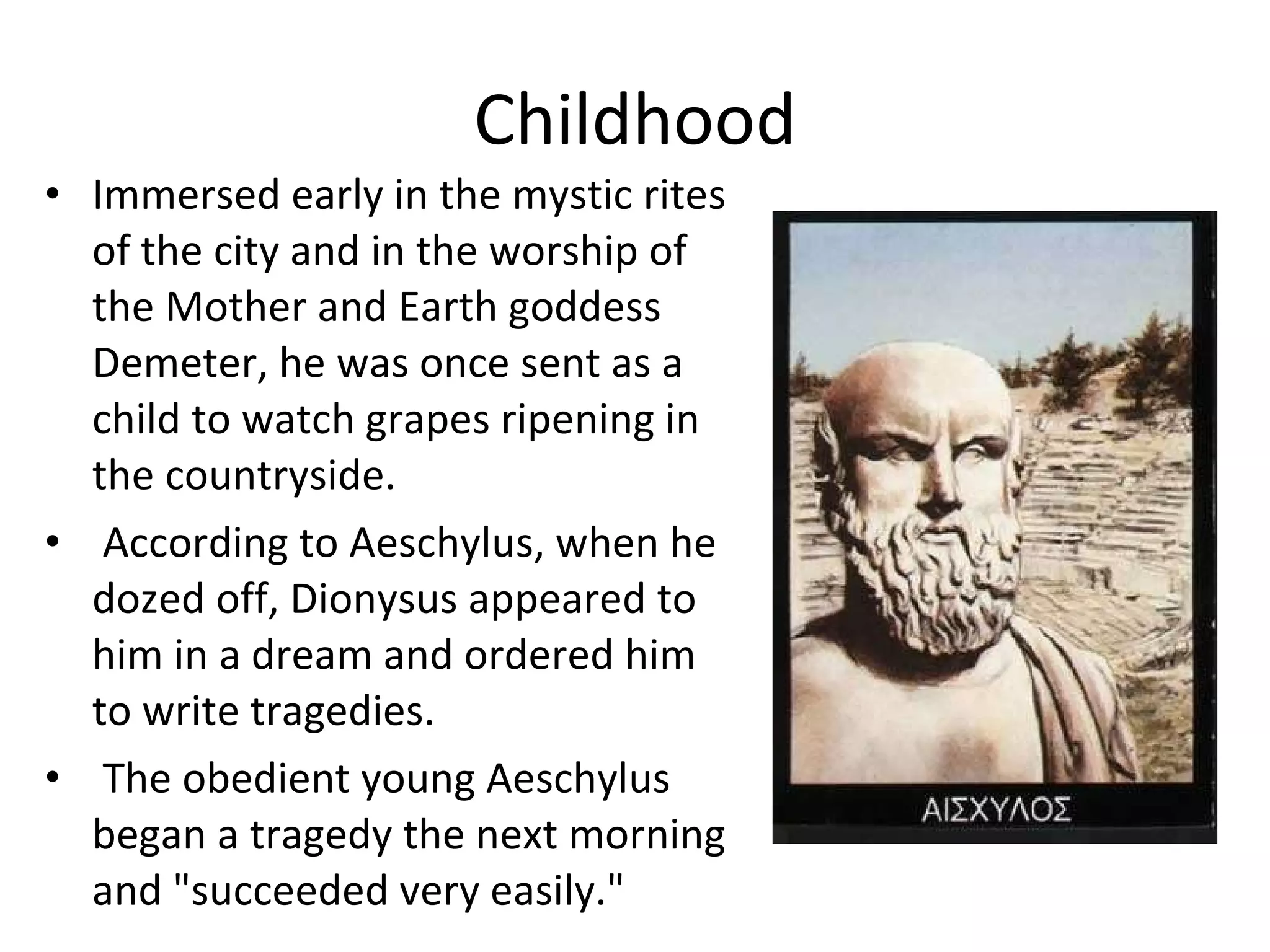
Childhood Immersed early in the mystic rites of the city and in the worship of the Mother and Earth goddess Demeter, he was once sent as a child to watch grapes ripening in the countryside. According to Aeschylus, when he dozed off, Dionysus appeared to him in a dream and ordered him to write tragedies. The obedient young Aeschylus began a tragedy the next morning and "succeeded very easily."
Family His father, Euphorion, headed a wealthy, aristocratic family.  His brother, Cynegirus, died at Marathon, though Aeschylus fought on. Many scholars believe the playwright also participated in the battle at Salamis (480 B.C.), among other engagements. Aeschylus had two sons, Euaion and Euphorion.  Euphorion, claimed first prize at the City Dionysia, defeating both Sophocles and Euripides in 431 BC.
Aeschylus's education Aeschylus's education included the writings of Homer . It was Homer who proved most inspiring to Aeschylus when he began to write as a teen.  He entered his tragedies into the annual competition in Athens and won his first award as a young adult in 484 B.C.E.  Aeschylus' writings were strongly Athenian and rich with moral authority.  He carried home the first place award from the Athens competition thirteen times!
Aeschylus as soldier Aeschylus lived through many exciting events in the history of Athens.  Politically the city underwent many constitutional reforms resulting in a democracy.  Aeschylus became a soldier and took part in turning back a Persian invasion at the Battle of Marathon (490 B.C.E. ).
Athens Following Greek resistance of the Persian Empire, Athens established its independence as a democracy of the elite and intellectual.  Athens became the headquarters of the Dalian League of Greek city-states. This brought prosperity to the city and made Athens the center of the Greek cultural world.  Nevertheless, Aeschylus's plays left a bigger mark in Greek history than any of his battle accomplishments.
Greek Plays in his time When Aeschylus first began writing, the theatre had only just begun to evolve.  Plays were little more than animated oratorios or choral poetry supplemented with expressive dance.
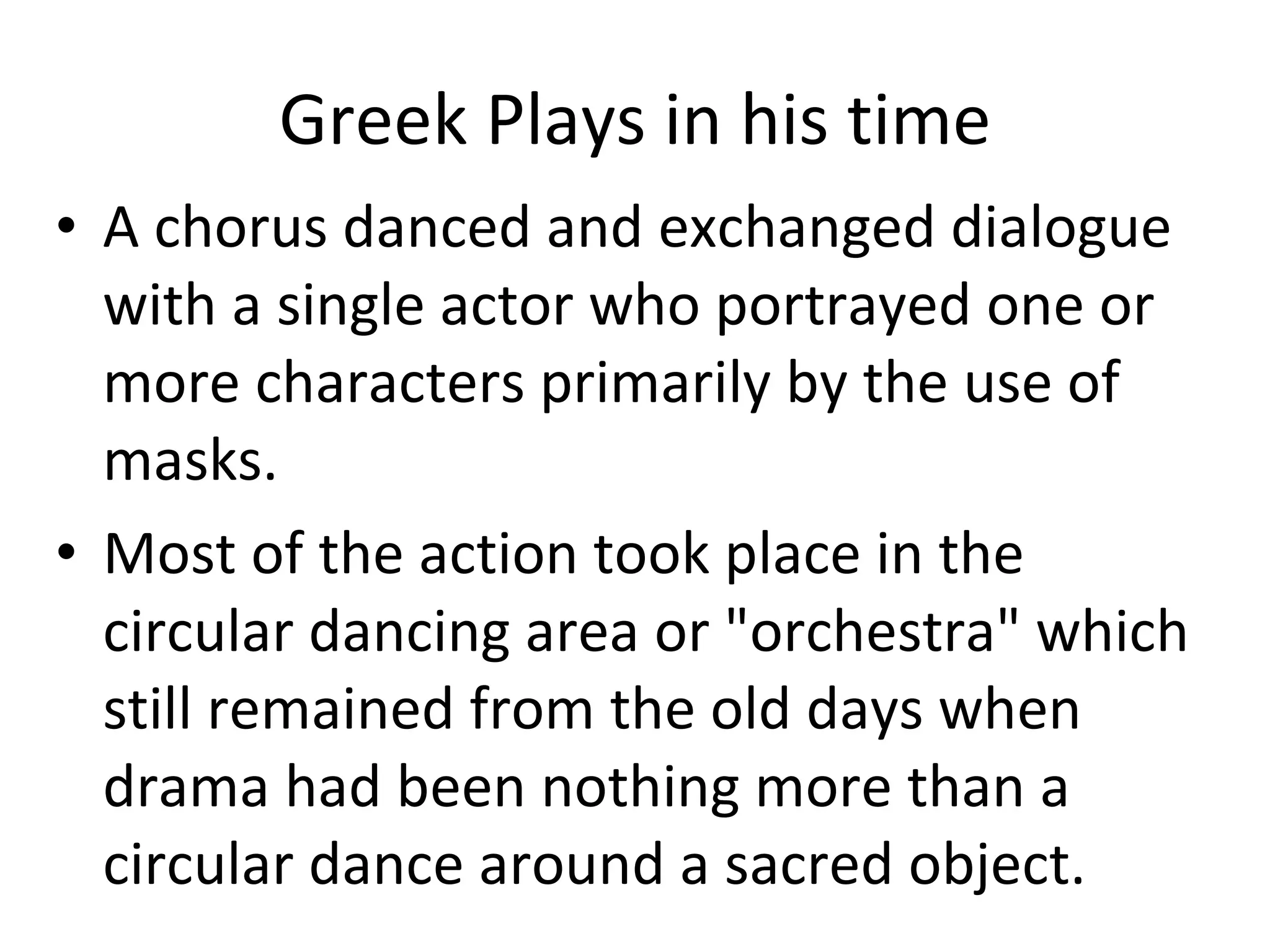
Greek Plays in his time A chorus danced and exchanged dialogue with a single actor who portrayed one or more characters primarily by the use of masks.  Most of the action took place in the circular dancing area or "orchestra" which still remained from the old days when drama had been nothing more than a circular dance around a sacred object.
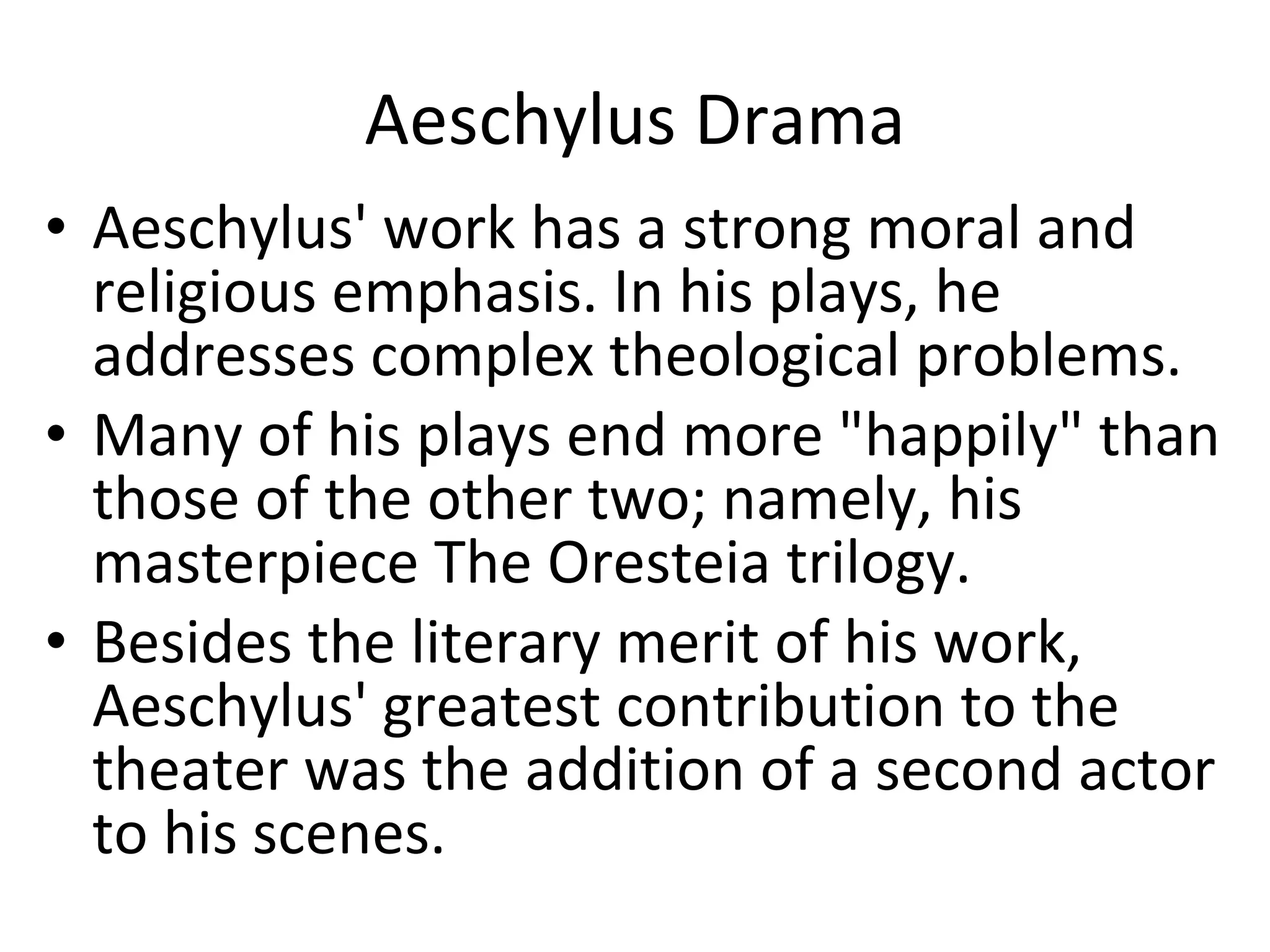
Aeschylus Drama Aeschylus' work has a strong moral and religious emphasis. In his plays, he addresses complex theological problems. Many of his plays end more "happily" than those of the other two; namely, his masterpiece The Oresteia trilogy.  Besides the literary merit of his work, Aeschylus' greatest contribution to the theater was the addition of a second actor to his scenes.
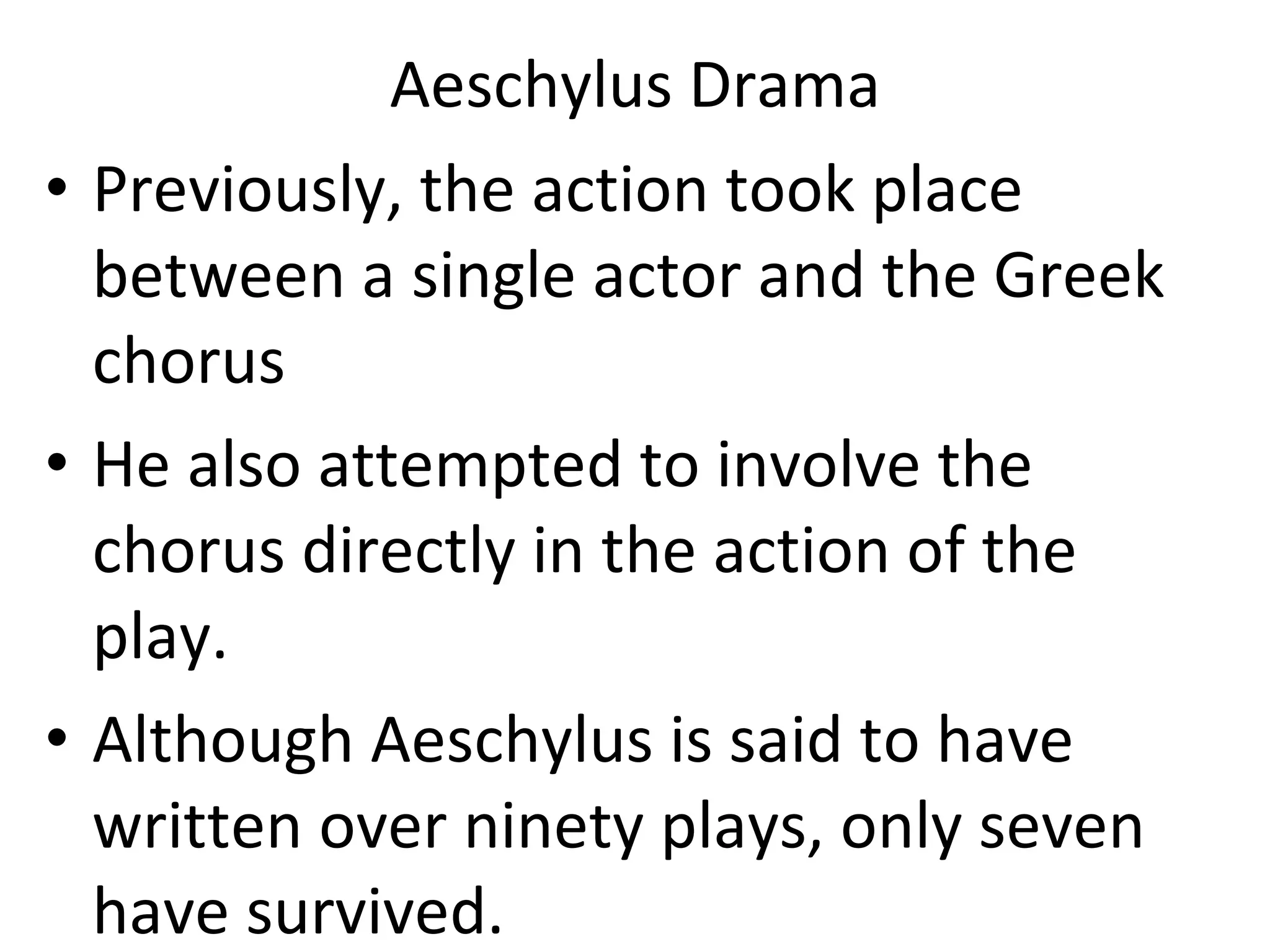
Aeschylus Drama Previously, the action took place between a single actor and the Greek chorus He also attempted to involve the chorus directly in the action of the play.  Although Aeschylus is said to have written over ninety plays, only seven have survived.
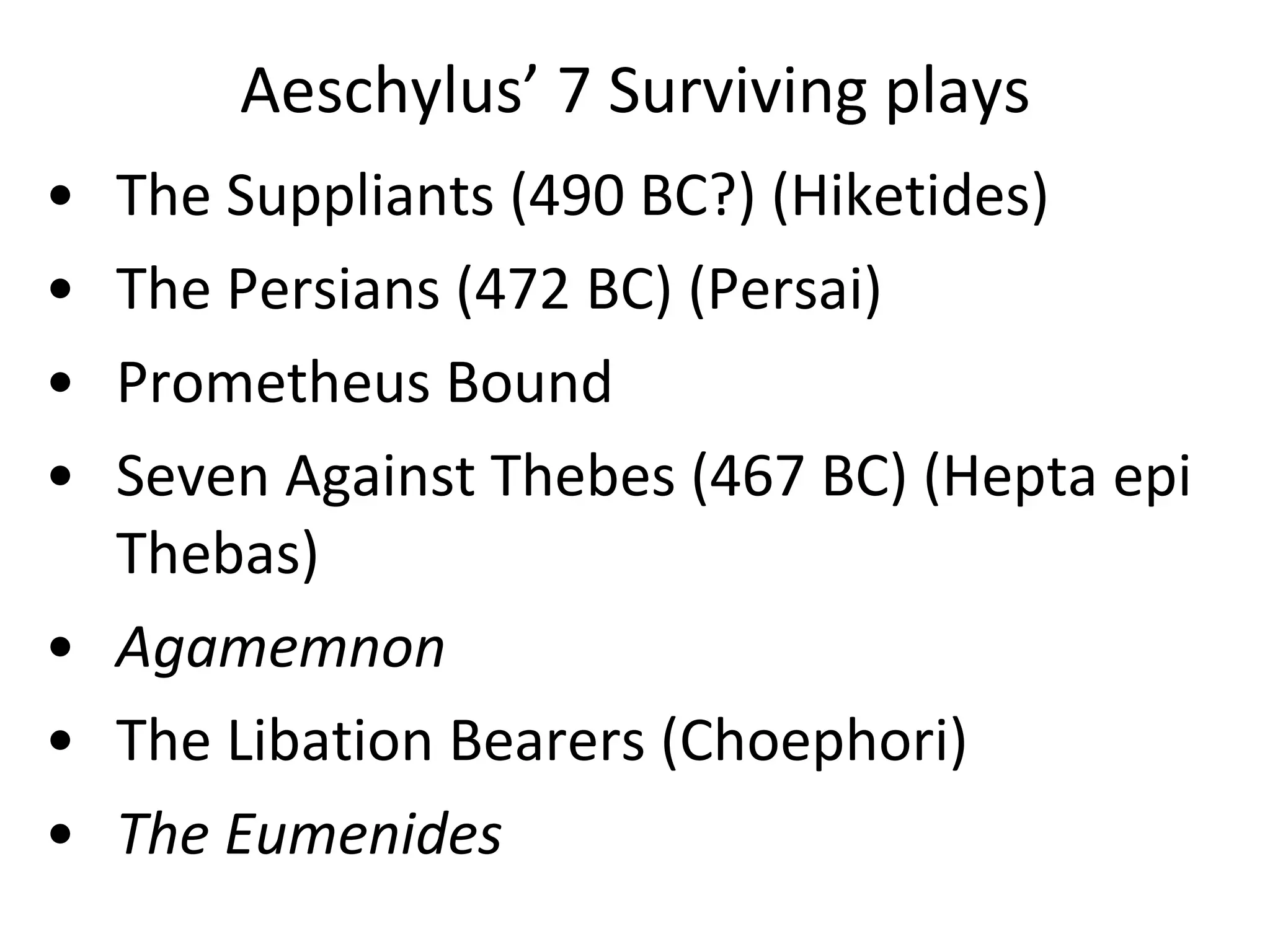
Aeschylus’ 7 Surviving plays The Suppliants (490 BC?) (Hiketides)  The Persians (472 BC) (Persai)  Prometheus Bound Seven Against Thebes (467 BC) (Hepta epi Thebas)  Agamemnon  The Libation Bearers (Choephori)  The Eumenides
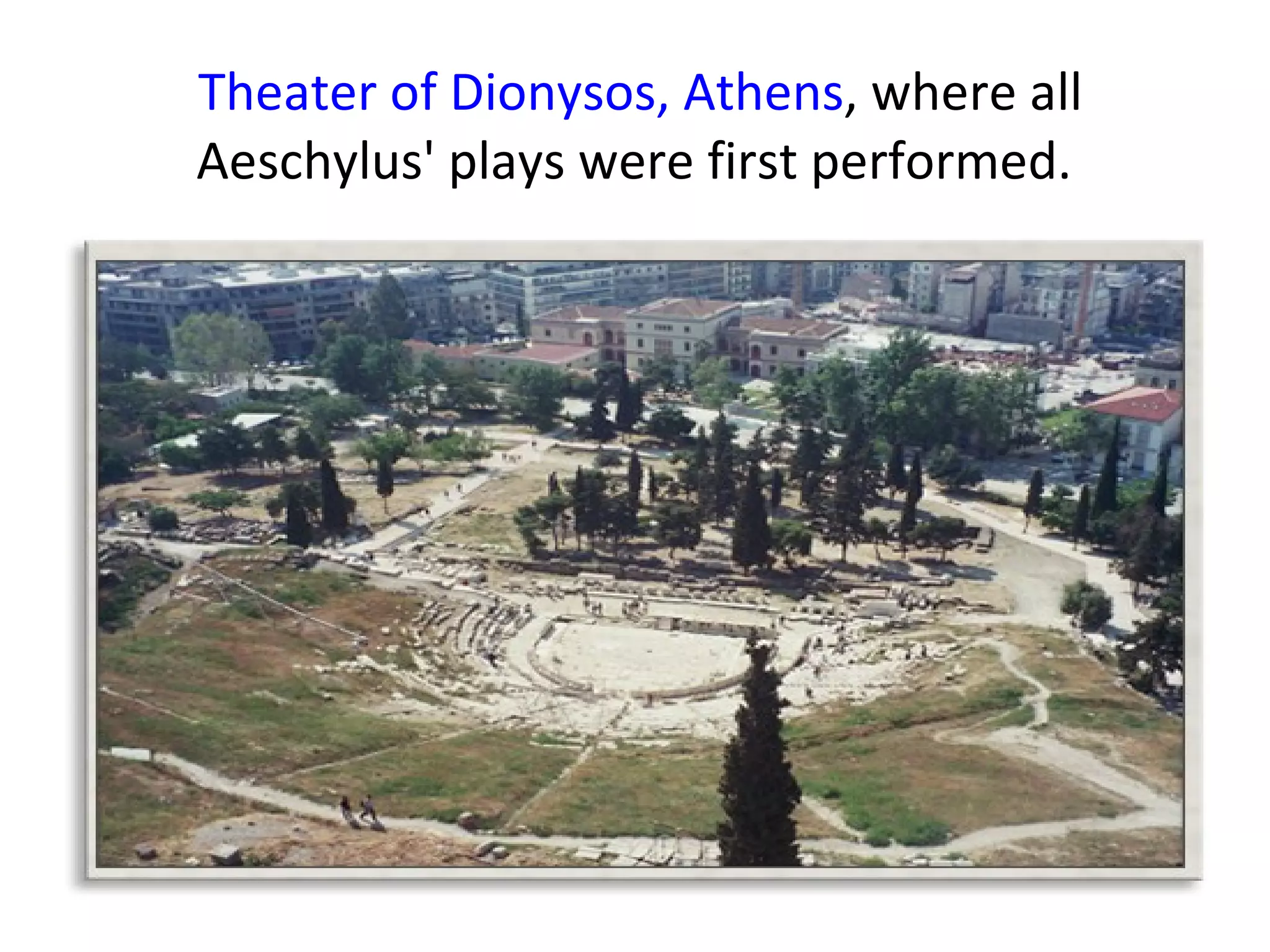
Theater of Dionysos, Athens , where all Aeschylus' plays were first performed.
Newly found play In 2003 another Aeschylus play was discovered in the wrappings of a mummy in Egypt.  The play,  Achilles , was part of a trilogy about the Trojan War.  It was known to exist due to mentions in ancient sources, but had been lost for over 2000 years.
Death Aeschylus frequently travelled to Sicily, where the tyrant of Gela was a patron.  In 458 he travelled there for the last time; according to traditional legend, Aeschylus was killed in 456 when an eagle (or more likely a Lammergeier), mistaking the playwright's bald crown for a stone, dropped a tortoise on his head.  He dies in Gela (c. 456 BC) in one of his trips to Sicily and a monument is build there in his memory.

Aeschylus

  • 1.
    Aeschylus By Dr.Arlene S. Opina
  • 2.
    Birth The 'Fatherof Tragedy’ Aeschylus was born in 524 or 525 BC in the city of Eleusis, Greece
  • 3.
    Map of Homeric Greece
  • 4.
    Childhood Immersed earlyin the mystic rites of the city and in the worship of the Mother and Earth goddess Demeter, he was once sent as a child to watch grapes ripening in the countryside. According to Aeschylus, when he dozed off, Dionysus appeared to him in a dream and ordered him to write tragedies. The obedient young Aeschylus began a tragedy the next morning and "succeeded very easily."
  • 5.
    Family His father,Euphorion, headed a wealthy, aristocratic family. His brother, Cynegirus, died at Marathon, though Aeschylus fought on. Many scholars believe the playwright also participated in the battle at Salamis (480 B.C.), among other engagements. Aeschylus had two sons, Euaion and Euphorion. Euphorion, claimed first prize at the City Dionysia, defeating both Sophocles and Euripides in 431 BC.
  • 6.
    Aeschylus's education Aeschylus'seducation included the writings of Homer . It was Homer who proved most inspiring to Aeschylus when he began to write as a teen. He entered his tragedies into the annual competition in Athens and won his first award as a young adult in 484 B.C.E. Aeschylus' writings were strongly Athenian and rich with moral authority. He carried home the first place award from the Athens competition thirteen times!
  • 7.
    Aeschylus as soldierAeschylus lived through many exciting events in the history of Athens. Politically the city underwent many constitutional reforms resulting in a democracy. Aeschylus became a soldier and took part in turning back a Persian invasion at the Battle of Marathon (490 B.C.E. ).
  • 8.
    Athens Following Greekresistance of the Persian Empire, Athens established its independence as a democracy of the elite and intellectual. Athens became the headquarters of the Dalian League of Greek city-states. This brought prosperity to the city and made Athens the center of the Greek cultural world. Nevertheless, Aeschylus's plays left a bigger mark in Greek history than any of his battle accomplishments.
  • 9.
    Greek Plays inhis time When Aeschylus first began writing, the theatre had only just begun to evolve. Plays were little more than animated oratorios or choral poetry supplemented with expressive dance.
  • 10.
    Greek Plays inhis time A chorus danced and exchanged dialogue with a single actor who portrayed one or more characters primarily by the use of masks. Most of the action took place in the circular dancing area or "orchestra" which still remained from the old days when drama had been nothing more than a circular dance around a sacred object.
  • 11.
    Aeschylus Drama Aeschylus'work has a strong moral and religious emphasis. In his plays, he addresses complex theological problems. Many of his plays end more "happily" than those of the other two; namely, his masterpiece The Oresteia trilogy. Besides the literary merit of his work, Aeschylus' greatest contribution to the theater was the addition of a second actor to his scenes.
  • 12.
    Aeschylus Drama Previously,the action took place between a single actor and the Greek chorus He also attempted to involve the chorus directly in the action of the play. Although Aeschylus is said to have written over ninety plays, only seven have survived.
  • 13.
    Aeschylus’ 7 Survivingplays The Suppliants (490 BC?) (Hiketides) The Persians (472 BC) (Persai) Prometheus Bound Seven Against Thebes (467 BC) (Hepta epi Thebas) Agamemnon The Libation Bearers (Choephori) The Eumenides
  • 14.
    Theater of Dionysos,Athens , where all Aeschylus' plays were first performed.
  • 15.
    Newly found playIn 2003 another Aeschylus play was discovered in the wrappings of a mummy in Egypt. The play, Achilles , was part of a trilogy about the Trojan War. It was known to exist due to mentions in ancient sources, but had been lost for over 2000 years.
  • 16.
    Death Aeschylus frequentlytravelled to Sicily, where the tyrant of Gela was a patron. In 458 he travelled there for the last time; according to traditional legend, Aeschylus was killed in 456 when an eagle (or more likely a Lammergeier), mistaking the playwright's bald crown for a stone, dropped a tortoise on his head. He dies in Gela (c. 456 BC) in one of his trips to Sicily and a monument is build there in his memory.