What’s New in the KBRR Invasive Monitoring Program? A new tunicate invader found in Sitka Alaska A new approach to the KBBR Monitoring and Research program Legislative support for invasive species response: some opportunities
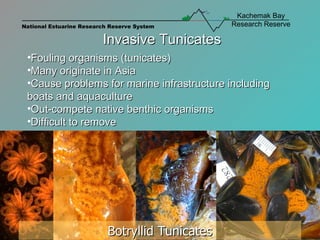
Botryllid Tunicates Invasive Tunicates  Fouling organisms (tunicates)  Many originate in Asia Cause problems for marine infrastructure including boats and aquaculture Out-compete native benthic organisms Difficult to remove
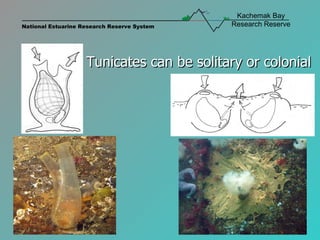
Tunicates can be solitary or colonial
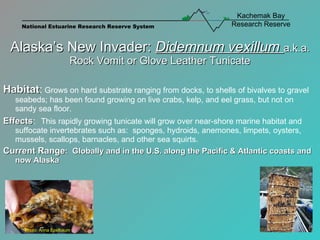
Alaska’s New Invader:  Didemnum vexillum  a.k.a. Rock Vomit or Glove Leather Tunicate Habitat :  Grows on hard substrate ranging from docks, to shells of bivalves to gravel seabeds; has been found growing on live crabs, kelp, and eel grass, but not on sandy sea floor.  Effects :   This rapidly growing tunicate will grow over near-shore marine habitat and suffocate invertebrates such as:  sponges, hydroids, anemones, limpets, oysters, mussels, scallops, barnacles, and other sea squirts.  Current Range :  Globally and in the U.S. along the Pacific & Atlantic coasts and now Alaska Photo: Anna Epelbaum
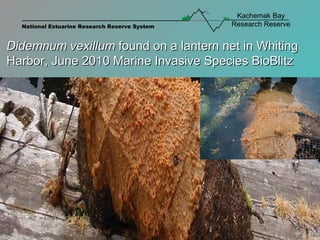
Didemnum vexillum  found on a lantern net in Whiting Harbor, June 2010 Marine Invasive Species BioBlitz
Asexual budding expands  the colony rapidly Photo: J. Nichols
What is Being Done to Address the Invasion? Reducing marine traffic in the affected area: ADF&G coordinated an area closure Conducting broad-scale dive surveys to determine distribution Communication to local residences, mariculture programs, and Alaska Marine Invasive Species Working Group Evaluation of quarantine and removal strategies Implementation of a rapid response plan fall/winter 2010/2011
Vectors: How invasive species are moved to Alaska Fouled vessel hulls, especially slow-moving vessels Ballast water Relocating fouled docks from infested waters Contaminated aquaculture gear and products Contaminated imported shellfish stock
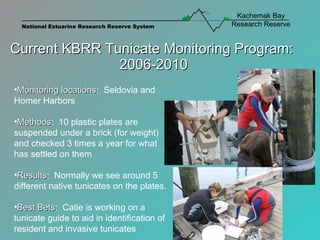
Current KBRR Tunicate Monitoring Program:  2006-2010 Monitoring locations :  Seldovia and Homer Harbors Methods :  10 plastic plates are suspended under a brick (for weight) and checked 3 times a year for what has settled on them Results :  Normally we see around 5 different native tunicates on the plates. Best Bets :  Catie is working on a tunicate guide to aid in identification of resident and invasive tunicates
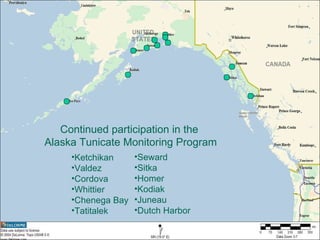
Continued participation in the  Alaska Tunicate Monitoring Program Ketchikan Valdez Cordova Whittier Chenega Bay Tatitalek Seward Sitka Homer Kodiak Juneau Dutch Harbor
On the KBRR Horizon for Tunicate Monitoring & Research Expand the invasive monitoring program to include a research plan for potential invasives to Kachemak Bay Making full use of data already collected (HABs, Tunicates, Green Crab) Ensuring good baseline data prior to an invasive outbreak Identification of data gaps and opportunities for additional monitoring Development of KBRR research and monitoring plans for future years Response Planning Collaboration with UAF:  the marine research dive classes will be adding tunicate monitoring to their course work Will be developing a program collaboratively with Brenda Konar Students will monitor Little Jackolof Bay annually
A Community Council Opportunity… Advocate for support of invasive species monitoring and a funding plan for the removal of species when they are 1 st  identified! Issues:  programs have limited funds to monitor for invasives eradication programs are most effective when the foot print of the invader is small (i.e. prior to it being an economic stressor) currently, there is not a funding source for the removal of small out breaks of invasives

Kachemak Bay NERR, Alaska Invasive Tunicate

  • 1.
    What’s New inthe KBRR Invasive Monitoring Program? A new tunicate invader found in Sitka Alaska A new approach to the KBBR Monitoring and Research program Legislative support for invasive species response: some opportunities
  • 2.
    Botryllid Tunicates InvasiveTunicates Fouling organisms (tunicates) Many originate in Asia Cause problems for marine infrastructure including boats and aquaculture Out-compete native benthic organisms Difficult to remove
  • 3.
    Tunicates can besolitary or colonial
  • 4.
    Alaska’s New Invader: Didemnum vexillum a.k.a. Rock Vomit or Glove Leather Tunicate Habitat : Grows on hard substrate ranging from docks, to shells of bivalves to gravel seabeds; has been found growing on live crabs, kelp, and eel grass, but not on sandy sea floor. Effects : This rapidly growing tunicate will grow over near-shore marine habitat and suffocate invertebrates such as: sponges, hydroids, anemones, limpets, oysters, mussels, scallops, barnacles, and other sea squirts. Current Range : Globally and in the U.S. along the Pacific & Atlantic coasts and now Alaska Photo: Anna Epelbaum
  • 5.
    Didemnum vexillum found on a lantern net in Whiting Harbor, June 2010 Marine Invasive Species BioBlitz
  • 6.
    Asexual budding expands the colony rapidly Photo: J. Nichols
  • 7.
    What is BeingDone to Address the Invasion? Reducing marine traffic in the affected area: ADF&G coordinated an area closure Conducting broad-scale dive surveys to determine distribution Communication to local residences, mariculture programs, and Alaska Marine Invasive Species Working Group Evaluation of quarantine and removal strategies Implementation of a rapid response plan fall/winter 2010/2011
  • 8.
    Vectors: How invasivespecies are moved to Alaska Fouled vessel hulls, especially slow-moving vessels Ballast water Relocating fouled docks from infested waters Contaminated aquaculture gear and products Contaminated imported shellfish stock
  • 9.
    Current KBRR TunicateMonitoring Program: 2006-2010 Monitoring locations : Seldovia and Homer Harbors Methods : 10 plastic plates are suspended under a brick (for weight) and checked 3 times a year for what has settled on them Results : Normally we see around 5 different native tunicates on the plates. Best Bets : Catie is working on a tunicate guide to aid in identification of resident and invasive tunicates
  • 10.
    Continued participation inthe Alaska Tunicate Monitoring Program Ketchikan Valdez Cordova Whittier Chenega Bay Tatitalek Seward Sitka Homer Kodiak Juneau Dutch Harbor
  • 11.
    On the KBRRHorizon for Tunicate Monitoring & Research Expand the invasive monitoring program to include a research plan for potential invasives to Kachemak Bay Making full use of data already collected (HABs, Tunicates, Green Crab) Ensuring good baseline data prior to an invasive outbreak Identification of data gaps and opportunities for additional monitoring Development of KBRR research and monitoring plans for future years Response Planning Collaboration with UAF: the marine research dive classes will be adding tunicate monitoring to their course work Will be developing a program collaboratively with Brenda Konar Students will monitor Little Jackolof Bay annually
  • 12.
    A Community CouncilOpportunity… Advocate for support of invasive species monitoring and a funding plan for the removal of species when they are 1 st identified! Issues: programs have limited funds to monitor for invasives eradication programs are most effective when the foot print of the invader is small (i.e. prior to it being an economic stressor) currently, there is not a funding source for the removal of small out breaks of invasives

Editor's Notes

  • #7 Point out the tendril that will drop off and float in the current, looking for a new home.
  • #11 Actual Monitoring: Valdez Cordova Whittier Kodiak Juneau Dutch Harbor Tatitlek Homer Trained, but not sites established? Ketchikan Sitka Slated for training this year: Chenega Bay Seward