BY DR. ARLENE SALVE OPINA Miguel de Cervantes Saavedra  1547 - 1616
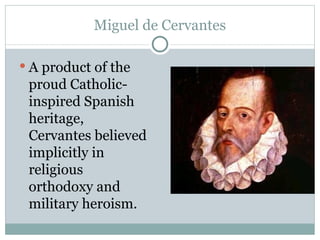
Miguel de Cervantes A product of the proud Catholic-inspired Spanish heritage, Cervantes believed implicitly in religious orthodoxy and military heroism.
Birth born in Alcalá de Henares in 1547 the fourth son in a family of seven children.  Little is known of Cervantes' early life, but it is doubtful if he received much formal education. scanty biographical date available about Cervantes.
Parents His father, Rodrigo, was a surgeon, one of the salaried employees of the university of Alcala de Henares, but he earned very little to feed his family.  Cervantes's mother seems to have been a descendant of Jewish converts to Christianity.
Military Hero At 20, together with his brother Rodrigo, Miguel participated in the battle of Lepanto against the Turks.  Received two shots in his chest and a wound on his left hand rendered him useless the rest of his life.
Military Hero rejoined the army in the famous battle of La Goleta (mentioned in the Captive's story).  their ship was captured by pirates and both brothers were sold as slaves in Algiers but were ransomed later.
Financial woes In 1580, Cervantes returned to Spain, maimed, without any means of livelihood. Out of desperation, he began to write for the theater, but of the 30 or 40 plays only a few have survived.  During this period, Cervantes had an affair with a Portuguese girl who eventually deserted him, leaving their daughter Isabel de Saavedra for him to raise.
Wife At 40 , married to Catalina de Salazar, the daughter of a well-to-do farmer. Little is known of his wife, but the marriage was not a successful one.
Commissary He applied for many civil service posts and eventually was granted a job as commissary collecting foodstuffs for the Invincible Armada.  It is during this period that Cervantes learned to know the Spanish peasant, and his stored-up knowledge was to result in the creation of Sancho Panza.
Still poor Became a Book keeper and was twice imprisoned for owing money to the treasury from a shortage in his accounts.  Started  writing Don Quixote in Prison and finally completed in 1604.
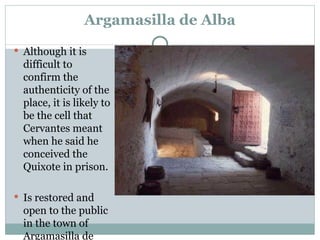
Argamasilla de Alba Although it is difficult to confirm the authenticity of the place, it is likely to be the cell that Cervantes meant when he said he conceived the Quixote in prison.  Is restored and open to the public in the town of Argamasilla de Alba.
the  Quixote  was an immediate bestseller. Running into six editions a year after that, Cervantes derived no further profit from the book, other than the money originally paid him by his publisher.  The success of his work, however, interested the Count of Lemos and the Cardinal Archbishop of Toledo, who became his patrons, although they did not do much to improve Cervantes' miserable circumstances.
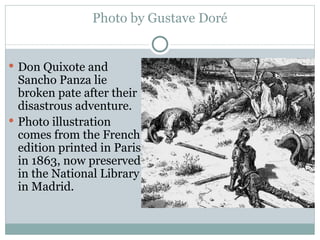
Photo by Gustave Doré Don Quixote and Sancho Panza lie broken pate after their disastrous adventure.  Photo illustration comes from the French edition printed in Paris in 1863, now preserved in the National Library in Madrid.
Best Seller Sixty-seven years old, still dogged by poverty and with his health failing, Cervantes began the sequel to  Don Quixote  only to find that a pirate edition of his idea had become popular. Although  Don Quixote  is one of the most read novels in the world, as well as one of the longest, and continues to be a bestseller, the life of Spain's greatest author is less known than the lives of lesser literary figures.
Don Quixote – his own experience Like Don Quixote, Cervantes traveled through life with a strong sense of purpose.  Meeting with misfortune and disillusion like his hero, Cervantes contributed to civilization, possibly as a result of his own life's experiences, the people and the values of  Don Quixote.
Literary works During the last nine years of his life, Cervantes solidified his reputation as a writer.  Published his  Exemplary Novels,  twelve stories of Spain which survive as perceptive accounts of the local life of that time.  Published some plays,  Eight Interludes and Eight Comedies,  which manifest a dramatic talent that his earlier pieces never quite achieved.
Literary Works Novelas ejemplares  in 1613,  Viaje del Parnaso  in 1614, and in 1615,  Ocho comedias y ocho entremeses  and the second part of  Don Quixote , a year after the mysterious Avellaneda had published his apocryphal sequel to the novel.  Los trabajos de Persiles y Sigismunda , which he completed three days before his death, and which appeared posthumously in January 1617. 
Death His last work,  The Troubles of Persiles and Sigismunda,  is notable mainly for its prologue dedicated to the ungrateful Count of Lemos.  Cervantes, writing from his deathbed, began the prologue: "With one foot already in the stirrup and with the agony of death upon me, great lord, I write to you.“  Cervantes died on April 22, 1616, the same month that marks the death of William Shakespeare. wrapped in his Franciscan habit, his face uncovered, was buried in the convent of the Discalced Trinitarian , in the then Cantarranas Street.

Miguel de cervantes

  • 1.
    BY DR. ARLENESALVE OPINA Miguel de Cervantes Saavedra 1547 - 1616
  • 2.
    Miguel de CervantesA product of the proud Catholic-inspired Spanish heritage, Cervantes believed implicitly in religious orthodoxy and military heroism.
  • 3.
    Birth born inAlcalá de Henares in 1547 the fourth son in a family of seven children. Little is known of Cervantes' early life, but it is doubtful if he received much formal education. scanty biographical date available about Cervantes.
  • 4.
    Parents His father,Rodrigo, was a surgeon, one of the salaried employees of the university of Alcala de Henares, but he earned very little to feed his family. Cervantes's mother seems to have been a descendant of Jewish converts to Christianity.
  • 5.
    Military Hero At20, together with his brother Rodrigo, Miguel participated in the battle of Lepanto against the Turks. Received two shots in his chest and a wound on his left hand rendered him useless the rest of his life.
  • 6.
    Military Hero rejoinedthe army in the famous battle of La Goleta (mentioned in the Captive's story). their ship was captured by pirates and both brothers were sold as slaves in Algiers but were ransomed later.
  • 7.
    Financial woes In1580, Cervantes returned to Spain, maimed, without any means of livelihood. Out of desperation, he began to write for the theater, but of the 30 or 40 plays only a few have survived. During this period, Cervantes had an affair with a Portuguese girl who eventually deserted him, leaving their daughter Isabel de Saavedra for him to raise.
  • 8.
    Wife At 40, married to Catalina de Salazar, the daughter of a well-to-do farmer. Little is known of his wife, but the marriage was not a successful one.
  • 9.
    Commissary He appliedfor many civil service posts and eventually was granted a job as commissary collecting foodstuffs for the Invincible Armada. It is during this period that Cervantes learned to know the Spanish peasant, and his stored-up knowledge was to result in the creation of Sancho Panza.
  • 10.
    Still poor Becamea Book keeper and was twice imprisoned for owing money to the treasury from a shortage in his accounts. Started writing Don Quixote in Prison and finally completed in 1604.
  • 11.
    Argamasilla de AlbaAlthough it is difficult to confirm the authenticity of the place, it is likely to be the cell that Cervantes meant when he said he conceived the Quixote in prison. Is restored and open to the public in the town of Argamasilla de Alba.
  • 12.
    the  Quixote  wasan immediate bestseller. Running into six editions a year after that, Cervantes derived no further profit from the book, other than the money originally paid him by his publisher. The success of his work, however, interested the Count of Lemos and the Cardinal Archbishop of Toledo, who became his patrons, although they did not do much to improve Cervantes' miserable circumstances.
  • 13.
    Photo by GustaveDoré Don Quixote and Sancho Panza lie broken pate after their disastrous adventure. Photo illustration comes from the French edition printed in Paris in 1863, now preserved in the National Library in Madrid.
  • 14.
    Best Seller Sixty-sevenyears old, still dogged by poverty and with his health failing, Cervantes began the sequel to Don Quixote  only to find that a pirate edition of his idea had become popular. Although  Don Quixote  is one of the most read novels in the world, as well as one of the longest, and continues to be a bestseller, the life of Spain's greatest author is less known than the lives of lesser literary figures.
  • 15.
    Don Quixote –his own experience Like Don Quixote, Cervantes traveled through life with a strong sense of purpose. Meeting with misfortune and disillusion like his hero, Cervantes contributed to civilization, possibly as a result of his own life's experiences, the people and the values of  Don Quixote.
  • 16.
    Literary works Duringthe last nine years of his life, Cervantes solidified his reputation as a writer. Published his  Exemplary Novels,  twelve stories of Spain which survive as perceptive accounts of the local life of that time. Published some plays,  Eight Interludes and Eight Comedies,  which manifest a dramatic talent that his earlier pieces never quite achieved.
  • 17.
    Literary Works Novelasejemplares  in 1613, Viaje del Parnaso  in 1614, and in 1615, Ocho comedias y ocho entremeses  and the second part of  Don Quixote , a year after the mysterious Avellaneda had published his apocryphal sequel to the novel. Los trabajos de Persiles y Sigismunda , which he completed three days before his death, and which appeared posthumously in January 1617. 
  • 18.
    Death His lastwork,  The Troubles of Persiles and Sigismunda,  is notable mainly for its prologue dedicated to the ungrateful Count of Lemos. Cervantes, writing from his deathbed, began the prologue: "With one foot already in the stirrup and with the agony of death upon me, great lord, I write to you.“ Cervantes died on April 22, 1616, the same month that marks the death of William Shakespeare. wrapped in his Franciscan habit, his face uncovered, was buried in the convent of the Discalced Trinitarian , in the then Cantarranas Street.