EURIPIDES
A SHORT BIOGRAPHY
EURIPIDES’ LIFE
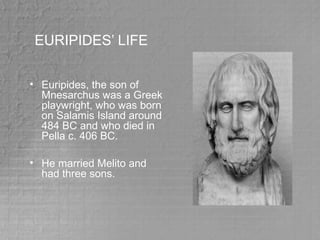
• Euripides, the son of
Mnesarchus was a Greek
playwright, who was born
on Salamis Island around
484 BC and who died in
Pella c. 406 BC.
• He married Melito and
had three sons.
EURIPIDES’ LIFE
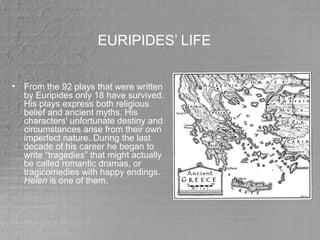
• From the 92 plays that were written
by Euripides only 18 have survived.
His plays express both religious
belief and ancient myths. His
characters' unfortunate destiny and
circumstances arise from their own
imperfect nature. During the last
decade of his career he began to
write “tragedies” that might actually
be called romantic dramas, or
tragicomedies with happy endings.
Helen is one of them.
EURIPIDES’ LIFE
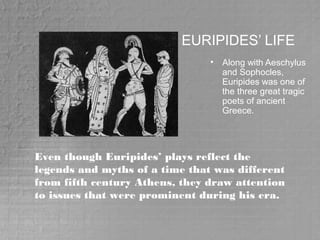
• Along with Aeschylus
and Sophocles,
Euripides was one of
the three great tragic
poets of ancient
Greece.
Even though Euripides’ plays reflect the
legends and myths of a time that was different
from fifth century Athens, they draw attention
to issues that were prominent during his era.
EURIPIDES’ IDEAS
• Euripides’ central ideas deal with
problems of knowledge, language,
appearance, reality, and personal
existence.
• Euripides was also troubled by the
Peloponnesian war with Sparta which
broke out in 431BC and outlived him.
EURIPIDES’
CONTEMPORARIES
• Euripides lived in the time
of Aeschylus and
Sophocles, both writers
and poets.
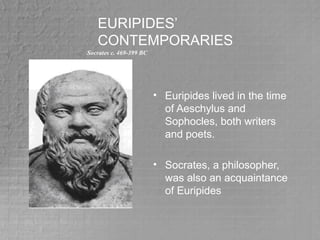
• Socrates, a philosopher,
was also an acquaintance
of Euripides
Socrates c. 469-399 BC
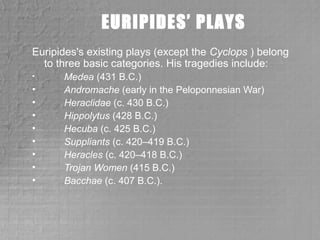
Euripides's existing plays (except the Cyclops ) belong
to three basic categories. His tragedies include:
• Medea (431 B.C.)
• Andromache (early in the Peloponnesian War)
• Heraclidae (c. 430 B.C.)
• Hippolytus (428 B.C.)
• Hecuba (c. 425 B.C.)
• Suppliants (c. 420–419 B.C.)
• Heracles (c. 420–418 B.C.)
• Trojan Women (415 B.C.)
• Bacchae (c. 407 B.C.).
EURIPIDES’ PLAYS
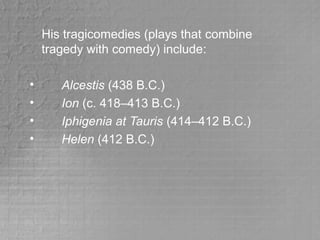
His tragicomedies (plays that combine
tragedy with comedy) include:
• Alcestis (438 B.C.)
• Ion (c. 418–413 B.C.)
• Iphigenia at Tauris (414–412 B.C.)
• Helen (412 B.C.)
The melodramas (sentimental dramas that
often have a happy outcome) include:
• Electra (c. 415 B.C.)
• Phoenician Women (c. 409 B.C.)
• Orestes (408 B.C.)
• Iphigenia at Aulis (c. 407 B.C.)
EURIPIDES’ HELEN
• Euripides’ romantic tragicomedies
were unusual in that they had
happy endings.
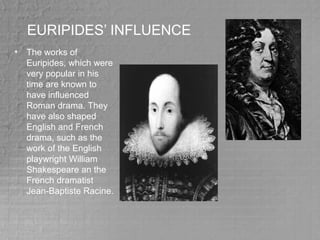
• Among them was ‘Helen’. In this
particular tragicomedy Euripides
presents Helen of Troy as a
woman of virtue. The play is set in
Egypt, where the innocent Helen
was transported by the gods when
her double (eidolon) went to Troy.
Helen tries to preserve her virtue
and her husband’s life. She gladly
degrades her own beauty in order
to return happily to Greece with
her long-lost husband, Menelaus,
who presents himself as the hero
of the Trojan War and the truly
suitable husband for her. Yet
Euripides questions the reality of
this romantic fantasy.
Abduction of Helen by Theseus
EURIPIDES’ INFLUENCE
• The works of
Euripides, which were
very popular in his
time are known to
have influenced
Roman drama. They
have also shaped
English and French
drama, such as the
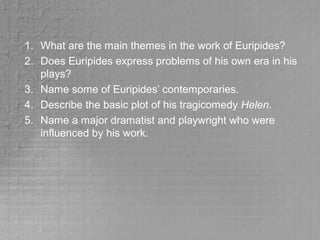
work of the English
playwright William
Shakespeare an the
French dramatist
Jean-Baptiste Racine.
1. What are the main themes in the work of Euripides?
2. Does Euripides express problems of his own era in his
plays?
3. Name some of Euripides’ contemporaries.
4. Describe the basic plot of his tragicomedy Helen.
5. Name a major dramatist and playwright who were
influenced by his work.
Webography
• http://www.didaskalia.net/studyarea/greekstagecraft.http://www.didaskalia.net/studyarea/greekstagecraft.
html (accessed October 2013)html (accessed October 2013)
• http://www.notablebiographies.com/Du-http://www.notablebiographies.com/Du-
Fi/Euripides.htmlFi/Euripides.html (accessed October 2013)(accessed October 2013)
• http://www.poetry-http://www.poetry-
archive.com/e/euripides_bibliography.htmlarchive.com/e/euripides_bibliography.html (accessed(accessed
October 2013)October 2013)
• http://newspapers.bc.edu/cgi-bin/bostonsh?http://newspapers.bc.edu/cgi-bin/bostonsh?
a=d&d=bcheights19250421.2.18a=d&d=bcheights19250421.2.18 (accessed October(accessed October
2013)2013)

4. euripides2

  • 1.
  • 2.
    EURIPIDES’ LIFE • Euripides,the son of Mnesarchus was a Greek playwright, who was born on Salamis Island around 484 BC and who died in Pella c. 406 BC. • He married Melito and had three sons.
  • 3.
    EURIPIDES’ LIFE • Fromthe 92 plays that were written by Euripides only 18 have survived. His plays express both religious belief and ancient myths. His characters' unfortunate destiny and circumstances arise from their own imperfect nature. During the last decade of his career he began to write “tragedies” that might actually be called romantic dramas, or tragicomedies with happy endings. Helen is one of them.
  • 4.
    EURIPIDES’ LIFE • Alongwith Aeschylus and Sophocles, Euripides was one of the three great tragic poets of ancient Greece. Even though Euripides’ plays reflect the legends and myths of a time that was different from fifth century Athens, they draw attention to issues that were prominent during his era.
  • 5.
    EURIPIDES’ IDEAS • Euripides’central ideas deal with problems of knowledge, language, appearance, reality, and personal existence. • Euripides was also troubled by the Peloponnesian war with Sparta which broke out in 431BC and outlived him.
  • 6.
    EURIPIDES’ CONTEMPORARIES • Euripides livedin the time of Aeschylus and Sophocles, both writers and poets. • Socrates, a philosopher, was also an acquaintance of Euripides Socrates c. 469-399 BC
  • 7.
    Euripides's existing plays(except the Cyclops ) belong to three basic categories. His tragedies include: • Medea (431 B.C.) • Andromache (early in the Peloponnesian War) • Heraclidae (c. 430 B.C.) • Hippolytus (428 B.C.) • Hecuba (c. 425 B.C.) • Suppliants (c. 420–419 B.C.) • Heracles (c. 420–418 B.C.) • Trojan Women (415 B.C.) • Bacchae (c. 407 B.C.). EURIPIDES’ PLAYS
  • 8.
    His tragicomedies (playsthat combine tragedy with comedy) include: • Alcestis (438 B.C.) • Ion (c. 418–413 B.C.) • Iphigenia at Tauris (414–412 B.C.) • Helen (412 B.C.)
  • 9.
    The melodramas (sentimentaldramas that often have a happy outcome) include: • Electra (c. 415 B.C.) • Phoenician Women (c. 409 B.C.) • Orestes (408 B.C.) • Iphigenia at Aulis (c. 407 B.C.)
  • 10.
    EURIPIDES’ HELEN • Euripides’romantic tragicomedies were unusual in that they had happy endings. • Among them was ‘Helen’. In this particular tragicomedy Euripides presents Helen of Troy as a woman of virtue. The play is set in Egypt, where the innocent Helen was transported by the gods when her double (eidolon) went to Troy. Helen tries to preserve her virtue and her husband’s life. She gladly degrades her own beauty in order to return happily to Greece with her long-lost husband, Menelaus, who presents himself as the hero of the Trojan War and the truly suitable husband for her. Yet Euripides questions the reality of this romantic fantasy. Abduction of Helen by Theseus
  • 11.
    EURIPIDES’ INFLUENCE • Theworks of Euripides, which were very popular in his time are known to have influenced Roman drama. They have also shaped English and French drama, such as the work of the English playwright William Shakespeare an the French dramatist Jean-Baptiste Racine.
  • 12.
    1. What arethe main themes in the work of Euripides? 2. Does Euripides express problems of his own era in his plays? 3. Name some of Euripides’ contemporaries. 4. Describe the basic plot of his tragicomedy Helen. 5. Name a major dramatist and playwright who were influenced by his work.
  • 13.
    Webography • http://www.didaskalia.net/studyarea/greekstagecraft.http://www.didaskalia.net/studyarea/greekstagecraft. html (accessedOctober 2013)html (accessed October 2013) • http://www.notablebiographies.com/Du-http://www.notablebiographies.com/Du- Fi/Euripides.htmlFi/Euripides.html (accessed October 2013)(accessed October 2013) • http://www.poetry-http://www.poetry- archive.com/e/euripides_bibliography.htmlarchive.com/e/euripides_bibliography.html (accessed(accessed October 2013)October 2013) • http://newspapers.bc.edu/cgi-bin/bostonsh?http://newspapers.bc.edu/cgi-bin/bostonsh? a=d&d=bcheights19250421.2.18a=d&d=bcheights19250421.2.18 (accessed October(accessed October 2013)2013)