1
AEROSPACE TRENDS
AND NEW TECHNOLOGY DEVELOPMENTS
2
TABLE OF CONTENTS
Introduction . . . . . . . . . . . . . . . . . . . . . . . . . . . . . . . . . . . . . . . . . . . . . . . . . . . . . . . . . . . . . . . . . . . . . . . . . . . . . 3	
Increasing Production Rates.. . . . . . . . . . . . . . . . . . . . . . . . . . . . . . . . . . . . . . . . . . . . . . . . . . . . . . . . 4	
Trends and Developments . . . . . . . . . . . . . . . . . . . . . . . . . . . . . . . . . . . . . . . . . . . . . . . . . . . . . . . . . . . 5	
Automation . . . . . . . . . . . . . . . . . . . . . . . . . . . . . . . . . . . . . . . . . . . . . . . . . . . . . . . . . . . . . . . . . . . . . . . . . . . . . . 6	
Lightweighting. . . . . . . . . . . . . . . . . . . . . . . . . . . . . . . . . . . . . . . . . . . . . . . . . . . . . . . . . . . . . . . . . . . . . . . . . . . 7	
New, Advanced Materials . . . . . . . . . . . . . . . . . . . . . . . . . . . . . . . . . . . . . . . . . . . . . . . . . . . . . . . . . . . . 8	
Additive Manufacturing . . . . . . . . . . . . . . . . . . . . . . . . . . . . . . . . . . . . . . . . . . . . . . . . . . . . . . . . . . . . . . . 9	
Streamlining Assembly Processes . . . . . . . . . . . . . . . . . . . . . . . . . . . . . . . . . . . . . . . . . . . . . . . 10	
Nondestructive Evaluation . . . . . . . . . . . . . . . . . . . . . . . . . . . . . . . . . . . . . . . . . . . . . . . . . . . . . . . . . 11	
Next-Generation Repair Technologies.. . . . . . . . . . . . . . . . . . . . . . . . . . . . . . . . . . . . . . . . . . . 12	
Experienced Skilled Labor . . . . . . . . . . . . . . . . . . . . . . . . . . . . . . . . . . . . . . . . . . . . . . . . . . . . . . . . . 13	
New Technology Developments . . . . . . . . . . . . . . . . . . . . . . . . . . . . . . . . . . . . . . . . . . . . . . . . . . 14	
Laser Coating Removal for Aircraft, Parts, and Dies . . . . . . . . . . . . . . . . . . . . . . . . . 15	
Low-Cost Honeycomb Panels . . . . . . . . . . . . . . . . . . . . . . . . . . . . . . . . . . . . . . . . . . . . . . . . . . . . 16	
High Power Ultrasonics .. . . . . . . . . . . . . . . . . . . . . . . . . . . . . . . . . . . . . . . . . . . . . . . . . . . . . . . . . . . . 15	
Conclusion . . . . . . . . . . . . . . . . . . . . . . . . . . . . . . . . . . . . . . . . . . . . . . . . . . . . . . . . . . . . . . . . . . . . . . . . . . . . 18	
About EWI.. . . . . . . . . . . . . . . . . . . . . . . . . . . . . . . . . . . . . . . . . . . . . . . . . . . . . . . . . . . . . . . . . . . . . . . . . . . . . 19
3
Following years of decreased defense revenues, the aerospace
industry is poised for positive growth. Due to rising passenger
traffic, accelerated equipment replacement cycles, decreasing
crude oil prices, and an increase in defense spending, aerospace
manufacturers are on pace for record production levels of next-
generation aircraft.
3.0%
In 2016, an estimated
1,420 large
commercial aircraft
will be produced—
40.5% more than five
years ago.3
The 2016 FAA
forecast predicts
that U.S. carrier
passenger growth
will average 2.1% per
year for the next 20
years.2
Global aerospace
and defense industry
revenues are
expected to grow at
3.0% in 2016.1
40.5%2.1%
INTRODUCTION
By Brian Bishop
4
Intense competition drives the pace of technological
innovation. This is especially true in the current aerospace
manufacturing landscape. To increase production rates to
meet high demand from OEMs and remain competitive,
manufacturers will need to improve their operational
and manufacturing performance. Building aircraft,
subassemblies, and components efficiently, sustainably,
and cost effectively will require not only technological
innovation, but improved performance throughout all levels
of the supply chain.
INCREASING
PRODUCTION
RATES
5
Trends:
n	Automation
n	Lightweighting
n	New, Advanced Materials
n	Additive Manufacturing
n	Streamlining Assembly
Processes
n	Nondestructive Evaluation
n	Next-generation Repair
Technologies
n	Experienced Skilled Labor
New Technology
Developments:
n	Laser Coating Removal for
Aircraft, Parts, and Dies
n	Low-cost
	 Honeycomb Panels
n	High Power Ultrasonics
This overview will examine some of the major trends and drivers
currently shaping the aerospace industry. It will also spotlight
three new technological developments that can enable aerospace
manufacturers to increase productivity, efficiency, and quality while
meeting heavy demand.
TRENDS AND
DEVELOPMENTS
6
In comparison to the automotive industry, in which automated
processes are ubiquitous, the aerospace industry has much lower
production volumes, higher tolerances, and larger subassemblies.
Additionally, certain materials used in aircraft manufacturing can
make automation more challenging. Challenges aside, automation
presents the promise of addressing constraints in capacity and
greatly increasing productivity. Aerospace manufacturers are
investing accordingly.
AUTOMATION
n	 Boeing plans to invest more
than $1 billion in automation
over the next few years
to boost production at its
assembly plants.4
7
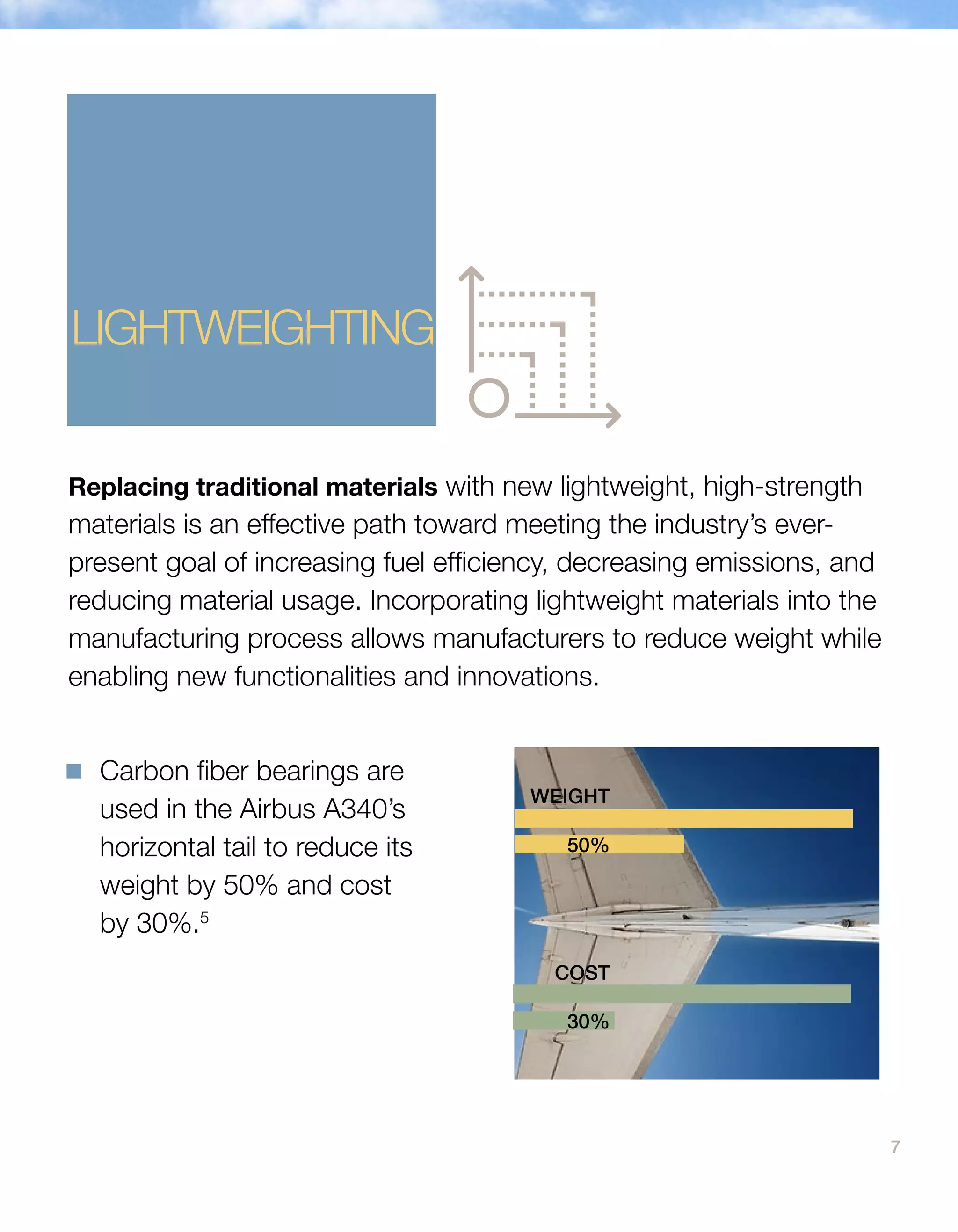
n	Carbon fiber bearings are
used in the Airbus A340’s
horizontal tail to reduce its
weight by 50% and cost
by 30%.5
LIGHTWEIGHTING
Replacing traditional materials with new lightweight, high-strength
materials is an effective path toward meeting the industry’s ever-
present goal of increasing fuel efficiency, decreasing emissions, and
reducing material usage. Incorporating lightweight materials into the
manufacturing process allows manufacturers to reduce weight while
enabling new functionalities and innovations.
WEIGHT
50%
COST
30%
8
Whether the goal is to achieve lower weight, increase fatigue life,
or enable higher heat resistance, materials advancements are
critical to increasing aircraft performance. The aerospace industry
has traditionally been quick to incorporate advanced material
solutions into design including advanced Al alloys, titanium, and
engineered panels. However, new materials come with a wealth
of new challenges. In order for aircraft manufacturers to be able to
successfully machine a greater range of materials and incorporate
them into new aircraft designs, fabrication technologies must
continue to develop.
n	Superalloys in the global
aerospace market are forecast
to grow at a CAGR of 2.6% from
2015-2020.6
NEW,
ADVANCED
MATERIALS
9
ADVANCING ADDITIVE
MANUFACTURING IN
AEROSPACE
AM-AERO14
The aerospace industry has been an early adopter of additive
manufacturing. Aerospace companies are investing in additive
technology in order to achieve weight savings, structural and
space optimization, and reduce part count and joining. More than
just a technique for rapid prototyping, 3D-printed components are
now being produced for end use in aircraft manufacturing.
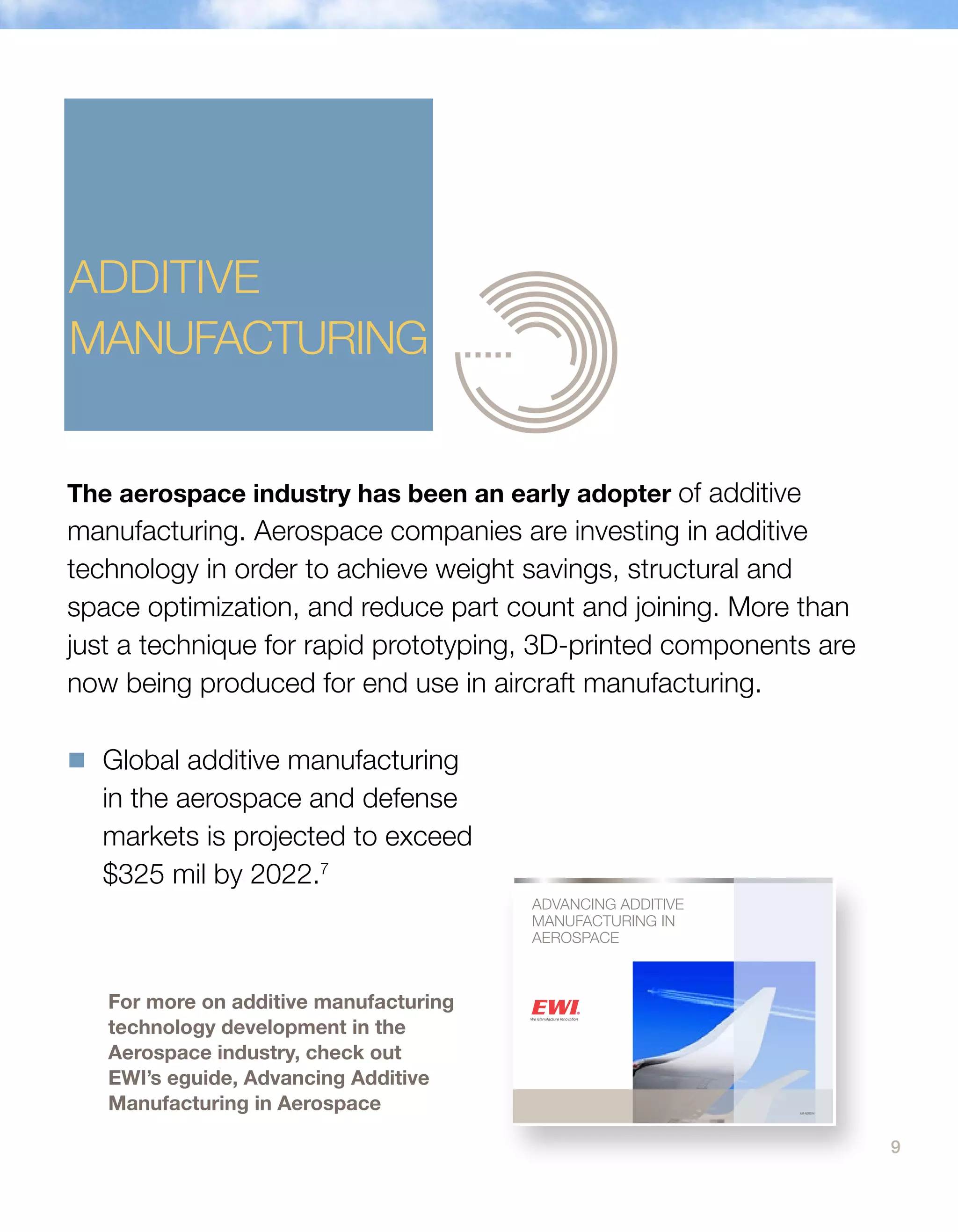
For more on additive manufacturing
technology development in the
Aerospace industry, check out
EWI’s eguide, Advancing Additive
Manufacturing in Aerospace
ADDITIVE
MANUFACTURING
n	Global additive manufacturing
in the aerospace and defense
markets is projected to exceed
$325 mil by 2022.7
10
Consolidating processes where possible allows
manufacturers to reduce costs and greatly enhance
productivity. Many avenues, including automation and additive
manufacturing, are being explored and employed to eliminate
steps in the aircraft manufacturing process.
REDUCING
WASTE
n	 Streamlining the
assembly process for
the A350 XWB allowed
Airbus to reduce the
time from start of final
assembly to aircraft
delivery by 30%.8
11
Because aerospace components are high-cost and low-volume,
destructive testing methods are not a viable solution. As such,
the industry makes extensive use of nondestructive evaluation
(NDE) and inspection techniques. NDE is a cost-effective way to
measure the quality of components and inspect welds.
EWI continually develops new NDE techniques and capabilities
to ensure the highest standards of quality. One such innovation
is EWI’s use of ultrasonic matrix phased array-technology to
assess welds made on aerospace-grade metals. In addition,
automated advanced NDE capabilities and inspection
techniques are currently in development.
NONDESTRUCTIVE
EVALUATION
Read the article here.
12
A new generation of aircraft means a dramatic change
in maintenance and repair technologies. Aircraft built with
advanced materials require a different approach than those built
with traditional materials. Even more challenging is the need to
develop repair techniques for materials and parts that have not
yet reached market, but are on the near horizon.
NEXT-
GENERATION
REPAIR
TECHNOLOGIES
n	 Survey of airlines predicts
that by 2020, 15-20% of
the projected $83.2 billion
MRO aftermarket spend for
that year could be affected
by new technology.9
15%
to
20%
13
As a greater number of aerospace workers reach
retirement age, the industry finds itself facing a shortage of
skilled workers. As demand continues to rise, this situation
will only be exacerbated. Recruiting, training, and retaining
young qualified individuals has proven challenging, and
some companies are partnering with external organizations
to expand their capabilities in the face of this shortage.
n	 The average age of
	 aerospace workers
	 is 47.10
EXPERIENCED
SKILLED
LABOR
14
EWI has developed and demonstrated an array of new and
enhanced technological capabilities that are particularly relevant to
aerospace manufacturers in their pursuit of quality, performance,
and innovation.
THE NEXT THREE PAGES SPOTLIGHT THESE TECHNOLOGIES:
Laser Coating Removal for Aircraft, Parts, and Dies
EWI’s innovative laser paint stripping technology
Low-cost Honeycomb Panels
EWI’s fabrication technology for low-cost acreage thermal
protection panels made from bimetallic honeycomb
High-power Ultrasonics
EWI-developed ultrasonic machining technology for increasing
throughput and quality
NEW
TECHNOLOGY
DEVELOPMENTS
15
Laser Coating Removal
for Aircraft, Parts, and Dies
Current methods of removing coatings or contaminants include
hazardous processes such as chemical stripping and plastic
media blast, or time consuming processes like sanding. EWI’s
innovative laser paint stripping technology:
n	 Reduces hazardous waste products
n	 Reduces de-paint time
n	 Reduces costs
n	 Has the precision to stop at primer or 			
completely strip to the substrate
NEW
TECHNOLOGY
DEVELOPMENTS
16
Low-Cost
Honeycomb Panels
Sandwich panels are critical components in aircraft interiors due
to their lightweight nature and the high mechanical performance
they provide. The aerospace industry commonly uses honeycomb
sandwich panels; however, producing these structures is costly.
EWI has developed preliminary fabrication technology for low-
cost acreage thermal protection panels made from bimetallic
honeycomb. The structure consists of a bimetallic core with
thin face sheets, protected by oxidation-resistant coatings. The
developed product has passed NASA burner rig testing. This
method of manufacturing and choice of materials is expected
to significantly reduce costs and simplify construction for
hypersonic vehicles.
NEW
TECHNOLOGY
DEVELOPMENTS
17
High-Power
Ultrasonics
Ultrasonic assisted machining applies intense vibrations
to conventional metalworking tools for altering the frictional
characteristics of the cutter and material being removed.
Aerospace manufacturers have found this technology to offer
significant reductions in heat generated by the cutting process,
greatly enhancing the machinability of advanced aerospace
materials. Aerospace components prone to work hardening
or undergoing microstructure transformations during the
manufacturing process can be produced faster with higher quality.
EWI developed an innovative system that is now being taken to
market by Acoustech Systems for installation on new or existing
machines. The reductions in heat and cutting forces offered by
ultrasonic assisted machining provides significant benefits to
manufacturers in the form of:
n	 Higher production rates (2-10x)
n	 Increased tool life (2-10x)
n	 Superior surface finishes
n	 Improved dimensional stability
NEW
TECHNOLOGY
DEVELOPMENTS
18
The road ahead for the aerospace industry is one of continued
growth and innovation. With the number of passengers increasing
and fuel prices decreasing in the near term, the competition
will be intense. Additional factors like unmanned aerial vehicles
and space travel add an additional layer of complexity and
competitiveness. Being first to market with next-generation
aircraft will require aerospace companies to partner with
engineering experts to apply emerging technologies, incorporate
advanced materials, and implement both.
CONCLUSION
1
2016 Global aerospace and defense sector outlook. (2016, January). Retrieved from http://www2.deloitte.com/global/en/pages/manufacturing/articles/global-a-
and-d-outlook.html
2
FAA Aerospace Forecast Fiscal Years 2016-2036. (2016). Retrieved from https://www.faa.gov/data_research/aviation/aerospace_forecasts/media/FY2016-
36_FAA_Aerospace_Forecast.pdf
3
Brothers, E. (2016, February 15). 2016 Aerospace Forecast. In Aerospace Manufacturing and Design. Retrieved from http://www.
aerospacemanufacturinganddesign.com/article/2016-aerospace-forecast/
4
Weber, A. (2015, April 2). Assembly Automation Takes Off in Aerospace Industry. In Assembly. Retrieved from http://www.assemblymag.com/articles/92790-
assembly-automation-takes-off-in-aerospace-industry
5
Lightweight, Heavy Impact (n.d.). In McKinsey & Company. Retrieved from http://www.mckinsey.com/~/media/mckinsey/dotcom/client_service/Automotive%20
and%20Assembly/PDFs/Lightweight_heavy_impact.ashx.
6
Growth Opportunities for Superalloys in the Global Aerospace Industry 2015-2020: Trends, Forecast, and Opportunity Analysis (2016, May 11). Retrieved from
http://www.prnewswire.com/news-releases/growth-opportunities-for-superalloys-in-the-global-aerospace-industry-2015-2020-trends-forecast-and-opportunity-
analysis-300267337.html
7
Global Additive Manufacturing in Space & Defense Aerospace Markets Report 2015 - Analysis, Prospects & Technologies - Key Vendors: Honeywell Aerospace,
Rocket Lab, Sigma Labs (2016, March 14). Retrieved from http://www.prnewswire.com/news-releases/global-additive-manufacturing-in-space--defense-
aerospace-markets-report-2015---analysis-prospects--technologies---key-vendors-honeywell-aerospace-rocket-lab-si
8
Final Assembly and Tests (n.d.). In Airbus. Retrieved from http://www.airbus.com/company/aircraft-manufacture/how-is-an-aircraft-built/final-assembly-and-tests/
9
Seidenman, P., & Spanovich, D. J. (2015, November 30). Next-Gen Jets Driving New Repair Technology Trends. Retrieved from http://aviationweek.com/
advanced-machines-aerospace-manufacturing/next-gen-jets-driving-new-repair-technology-trends
10
Aviation Week 2015 Workforce Study: A Reality Check as Competition for Talent Increases (2015, July). Retrieved from http://www.aerospace.georgiainnovation.
org/images/public/reports/Aviation_Week_WorkForce2015.pdf
19
ABOUT EWI
EWI helps aerospace manufacturers reduce the risks associated
with innovation by applying advanced technologies to improve
the performance, quality, and manufacturability of aircraft
components while reducing life-cycle costs. Our extensive work
with advanced welding and materials joining technologies,
additive manufacturing, advanced non-destructive evaluation
(NDE), computational modeling and simulation, and aerospace
technologies gives our customers a definitive advantage.
To learn more about EWI’s experience helping aerospace
manufacturers and suppliers use technology innovation to
become more competitive, contact Brian Bishop, Aerospace
Business Development Director, at bbishop@ewi.org or
614.270.7052.

Aerospace Trends and New Technology Developments

  • 1.
    1 AEROSPACE TRENDS AND NEWTECHNOLOGY DEVELOPMENTS
  • 2.
    2 TABLE OF CONTENTS Introduction. . . . . . . . . . . . . . . . . . . . . . . . . . . . . . . . . . . . . . . . . . . . . . . . . . . . . . . . . . . . . . . . . . . . . . . . . . . . . 3 Increasing Production Rates.. . . . . . . . . . . . . . . . . . . . . . . . . . . . . . . . . . . . . . . . . . . . . . . . . . . . . . . . 4 Trends and Developments . . . . . . . . . . . . . . . . . . . . . . . . . . . . . . . . . . . . . . . . . . . . . . . . . . . . . . . . . . . 5 Automation . . . . . . . . . . . . . . . . . . . . . . . . . . . . . . . . . . . . . . . . . . . . . . . . . . . . . . . . . . . . . . . . . . . . . . . . . . . . . . 6 Lightweighting. . . . . . . . . . . . . . . . . . . . . . . . . . . . . . . . . . . . . . . . . . . . . . . . . . . . . . . . . . . . . . . . . . . . . . . . . . . 7 New, Advanced Materials . . . . . . . . . . . . . . . . . . . . . . . . . . . . . . . . . . . . . . . . . . . . . . . . . . . . . . . . . . . . 8 Additive Manufacturing . . . . . . . . . . . . . . . . . . . . . . . . . . . . . . . . . . . . . . . . . . . . . . . . . . . . . . . . . . . . . . . 9 Streamlining Assembly Processes . . . . . . . . . . . . . . . . . . . . . . . . . . . . . . . . . . . . . . . . . . . . . . . 10 Nondestructive Evaluation . . . . . . . . . . . . . . . . . . . . . . . . . . . . . . . . . . . . . . . . . . . . . . . . . . . . . . . . . 11 Next-Generation Repair Technologies.. . . . . . . . . . . . . . . . . . . . . . . . . . . . . . . . . . . . . . . . . . . 12 Experienced Skilled Labor . . . . . . . . . . . . . . . . . . . . . . . . . . . . . . . . . . . . . . . . . . . . . . . . . . . . . . . . . 13 New Technology Developments . . . . . . . . . . . . . . . . . . . . . . . . . . . . . . . . . . . . . . . . . . . . . . . . . . 14 Laser Coating Removal for Aircraft, Parts, and Dies . . . . . . . . . . . . . . . . . . . . . . . . . 15 Low-Cost Honeycomb Panels . . . . . . . . . . . . . . . . . . . . . . . . . . . . . . . . . . . . . . . . . . . . . . . . . . . . 16 High Power Ultrasonics .. . . . . . . . . . . . . . . . . . . . . . . . . . . . . . . . . . . . . . . . . . . . . . . . . . . . . . . . . . . . 15 Conclusion . . . . . . . . . . . . . . . . . . . . . . . . . . . . . . . . . . . . . . . . . . . . . . . . . . . . . . . . . . . . . . . . . . . . . . . . . . . . 18 About EWI.. . . . . . . . . . . . . . . . . . . . . . . . . . . . . . . . . . . . . . . . . . . . . . . . . . . . . . . . . . . . . . . . . . . . . . . . . . . . . 19
  • 3.
    3 Following years ofdecreased defense revenues, the aerospace industry is poised for positive growth. Due to rising passenger traffic, accelerated equipment replacement cycles, decreasing crude oil prices, and an increase in defense spending, aerospace manufacturers are on pace for record production levels of next- generation aircraft. 3.0% In 2016, an estimated 1,420 large commercial aircraft will be produced— 40.5% more than five years ago.3 The 2016 FAA forecast predicts that U.S. carrier passenger growth will average 2.1% per year for the next 20 years.2 Global aerospace and defense industry revenues are expected to grow at 3.0% in 2016.1 40.5%2.1% INTRODUCTION By Brian Bishop
  • 4.
    4 Intense competition drivesthe pace of technological innovation. This is especially true in the current aerospace manufacturing landscape. To increase production rates to meet high demand from OEMs and remain competitive, manufacturers will need to improve their operational and manufacturing performance. Building aircraft, subassemblies, and components efficiently, sustainably, and cost effectively will require not only technological innovation, but improved performance throughout all levels of the supply chain. INCREASING PRODUCTION RATES
  • 5.
    5 Trends: n Automation n Lightweighting n New, Advanced Materials n AdditiveManufacturing n Streamlining Assembly Processes n Nondestructive Evaluation n Next-generation Repair Technologies n Experienced Skilled Labor New Technology Developments: n Laser Coating Removal for Aircraft, Parts, and Dies n Low-cost Honeycomb Panels n High Power Ultrasonics This overview will examine some of the major trends and drivers currently shaping the aerospace industry. It will also spotlight three new technological developments that can enable aerospace manufacturers to increase productivity, efficiency, and quality while meeting heavy demand. TRENDS AND DEVELOPMENTS
  • 6.
    6 In comparison tothe automotive industry, in which automated processes are ubiquitous, the aerospace industry has much lower production volumes, higher tolerances, and larger subassemblies. Additionally, certain materials used in aircraft manufacturing can make automation more challenging. Challenges aside, automation presents the promise of addressing constraints in capacity and greatly increasing productivity. Aerospace manufacturers are investing accordingly. AUTOMATION n Boeing plans to invest more than $1 billion in automation over the next few years to boost production at its assembly plants.4
  • 7.
    7 n Carbon fiber bearingsare used in the Airbus A340’s horizontal tail to reduce its weight by 50% and cost by 30%.5 LIGHTWEIGHTING Replacing traditional materials with new lightweight, high-strength materials is an effective path toward meeting the industry’s ever- present goal of increasing fuel efficiency, decreasing emissions, and reducing material usage. Incorporating lightweight materials into the manufacturing process allows manufacturers to reduce weight while enabling new functionalities and innovations. WEIGHT 50% COST 30%
  • 8.
    8 Whether the goalis to achieve lower weight, increase fatigue life, or enable higher heat resistance, materials advancements are critical to increasing aircraft performance. The aerospace industry has traditionally been quick to incorporate advanced material solutions into design including advanced Al alloys, titanium, and engineered panels. However, new materials come with a wealth of new challenges. In order for aircraft manufacturers to be able to successfully machine a greater range of materials and incorporate them into new aircraft designs, fabrication technologies must continue to develop. n Superalloys in the global aerospace market are forecast to grow at a CAGR of 2.6% from 2015-2020.6 NEW, ADVANCED MATERIALS
  • 9.
    9 ADVANCING ADDITIVE MANUFACTURING IN AEROSPACE AM-AERO14 Theaerospace industry has been an early adopter of additive manufacturing. Aerospace companies are investing in additive technology in order to achieve weight savings, structural and space optimization, and reduce part count and joining. More than just a technique for rapid prototyping, 3D-printed components are now being produced for end use in aircraft manufacturing. For more on additive manufacturing technology development in the Aerospace industry, check out EWI’s eguide, Advancing Additive Manufacturing in Aerospace ADDITIVE MANUFACTURING n Global additive manufacturing in the aerospace and defense markets is projected to exceed $325 mil by 2022.7
  • 10.
    10 Consolidating processes wherepossible allows manufacturers to reduce costs and greatly enhance productivity. Many avenues, including automation and additive manufacturing, are being explored and employed to eliminate steps in the aircraft manufacturing process. REDUCING WASTE n Streamlining the assembly process for the A350 XWB allowed Airbus to reduce the time from start of final assembly to aircraft delivery by 30%.8
  • 11.
    11 Because aerospace componentsare high-cost and low-volume, destructive testing methods are not a viable solution. As such, the industry makes extensive use of nondestructive evaluation (NDE) and inspection techniques. NDE is a cost-effective way to measure the quality of components and inspect welds. EWI continually develops new NDE techniques and capabilities to ensure the highest standards of quality. One such innovation is EWI’s use of ultrasonic matrix phased array-technology to assess welds made on aerospace-grade metals. In addition, automated advanced NDE capabilities and inspection techniques are currently in development. NONDESTRUCTIVE EVALUATION Read the article here.
  • 12.
    12 A new generationof aircraft means a dramatic change in maintenance and repair technologies. Aircraft built with advanced materials require a different approach than those built with traditional materials. Even more challenging is the need to develop repair techniques for materials and parts that have not yet reached market, but are on the near horizon. NEXT- GENERATION REPAIR TECHNOLOGIES n Survey of airlines predicts that by 2020, 15-20% of the projected $83.2 billion MRO aftermarket spend for that year could be affected by new technology.9 15% to 20%
  • 13.
    13 As a greaternumber of aerospace workers reach retirement age, the industry finds itself facing a shortage of skilled workers. As demand continues to rise, this situation will only be exacerbated. Recruiting, training, and retaining young qualified individuals has proven challenging, and some companies are partnering with external organizations to expand their capabilities in the face of this shortage. n The average age of aerospace workers is 47.10 EXPERIENCED SKILLED LABOR
  • 14.
    14 EWI has developedand demonstrated an array of new and enhanced technological capabilities that are particularly relevant to aerospace manufacturers in their pursuit of quality, performance, and innovation. THE NEXT THREE PAGES SPOTLIGHT THESE TECHNOLOGIES: Laser Coating Removal for Aircraft, Parts, and Dies EWI’s innovative laser paint stripping technology Low-cost Honeycomb Panels EWI’s fabrication technology for low-cost acreage thermal protection panels made from bimetallic honeycomb High-power Ultrasonics EWI-developed ultrasonic machining technology for increasing throughput and quality NEW TECHNOLOGY DEVELOPMENTS
  • 15.
    15 Laser Coating Removal forAircraft, Parts, and Dies Current methods of removing coatings or contaminants include hazardous processes such as chemical stripping and plastic media blast, or time consuming processes like sanding. EWI’s innovative laser paint stripping technology: n Reduces hazardous waste products n Reduces de-paint time n Reduces costs n Has the precision to stop at primer or completely strip to the substrate NEW TECHNOLOGY DEVELOPMENTS
  • 16.
    16 Low-Cost Honeycomb Panels Sandwich panelsare critical components in aircraft interiors due to their lightweight nature and the high mechanical performance they provide. The aerospace industry commonly uses honeycomb sandwich panels; however, producing these structures is costly. EWI has developed preliminary fabrication technology for low- cost acreage thermal protection panels made from bimetallic honeycomb. The structure consists of a bimetallic core with thin face sheets, protected by oxidation-resistant coatings. The developed product has passed NASA burner rig testing. This method of manufacturing and choice of materials is expected to significantly reduce costs and simplify construction for hypersonic vehicles. NEW TECHNOLOGY DEVELOPMENTS
  • 17.
    17 High-Power Ultrasonics Ultrasonic assisted machiningapplies intense vibrations to conventional metalworking tools for altering the frictional characteristics of the cutter and material being removed. Aerospace manufacturers have found this technology to offer significant reductions in heat generated by the cutting process, greatly enhancing the machinability of advanced aerospace materials. Aerospace components prone to work hardening or undergoing microstructure transformations during the manufacturing process can be produced faster with higher quality. EWI developed an innovative system that is now being taken to market by Acoustech Systems for installation on new or existing machines. The reductions in heat and cutting forces offered by ultrasonic assisted machining provides significant benefits to manufacturers in the form of: n Higher production rates (2-10x) n Increased tool life (2-10x) n Superior surface finishes n Improved dimensional stability NEW TECHNOLOGY DEVELOPMENTS
  • 18.
    18 The road aheadfor the aerospace industry is one of continued growth and innovation. With the number of passengers increasing and fuel prices decreasing in the near term, the competition will be intense. Additional factors like unmanned aerial vehicles and space travel add an additional layer of complexity and competitiveness. Being first to market with next-generation aircraft will require aerospace companies to partner with engineering experts to apply emerging technologies, incorporate advanced materials, and implement both. CONCLUSION 1 2016 Global aerospace and defense sector outlook. (2016, January). Retrieved from http://www2.deloitte.com/global/en/pages/manufacturing/articles/global-a- and-d-outlook.html 2 FAA Aerospace Forecast Fiscal Years 2016-2036. (2016). Retrieved from https://www.faa.gov/data_research/aviation/aerospace_forecasts/media/FY2016- 36_FAA_Aerospace_Forecast.pdf 3 Brothers, E. (2016, February 15). 2016 Aerospace Forecast. In Aerospace Manufacturing and Design. Retrieved from http://www. aerospacemanufacturinganddesign.com/article/2016-aerospace-forecast/ 4 Weber, A. (2015, April 2). Assembly Automation Takes Off in Aerospace Industry. In Assembly. Retrieved from http://www.assemblymag.com/articles/92790- assembly-automation-takes-off-in-aerospace-industry 5 Lightweight, Heavy Impact (n.d.). In McKinsey & Company. Retrieved from http://www.mckinsey.com/~/media/mckinsey/dotcom/client_service/Automotive%20 and%20Assembly/PDFs/Lightweight_heavy_impact.ashx. 6 Growth Opportunities for Superalloys in the Global Aerospace Industry 2015-2020: Trends, Forecast, and Opportunity Analysis (2016, May 11). Retrieved from http://www.prnewswire.com/news-releases/growth-opportunities-for-superalloys-in-the-global-aerospace-industry-2015-2020-trends-forecast-and-opportunity- analysis-300267337.html 7 Global Additive Manufacturing in Space & Defense Aerospace Markets Report 2015 - Analysis, Prospects & Technologies - Key Vendors: Honeywell Aerospace, Rocket Lab, Sigma Labs (2016, March 14). Retrieved from http://www.prnewswire.com/news-releases/global-additive-manufacturing-in-space--defense- aerospace-markets-report-2015---analysis-prospects--technologies---key-vendors-honeywell-aerospace-rocket-lab-si 8 Final Assembly and Tests (n.d.). In Airbus. Retrieved from http://www.airbus.com/company/aircraft-manufacture/how-is-an-aircraft-built/final-assembly-and-tests/ 9 Seidenman, P., & Spanovich, D. J. (2015, November 30). Next-Gen Jets Driving New Repair Technology Trends. Retrieved from http://aviationweek.com/ advanced-machines-aerospace-manufacturing/next-gen-jets-driving-new-repair-technology-trends 10 Aviation Week 2015 Workforce Study: A Reality Check as Competition for Talent Increases (2015, July). Retrieved from http://www.aerospace.georgiainnovation. org/images/public/reports/Aviation_Week_WorkForce2015.pdf
  • 19.
    19 ABOUT EWI EWI helpsaerospace manufacturers reduce the risks associated with innovation by applying advanced technologies to improve the performance, quality, and manufacturability of aircraft components while reducing life-cycle costs. Our extensive work with advanced welding and materials joining technologies, additive manufacturing, advanced non-destructive evaluation (NDE), computational modeling and simulation, and aerospace technologies gives our customers a definitive advantage. To learn more about EWI’s experience helping aerospace manufacturers and suppliers use technology innovation to become more competitive, contact Brian Bishop, Aerospace Business Development Director, at bbishop@ewi.org or 614.270.7052.