1
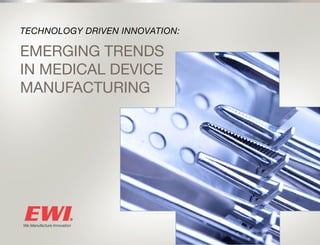
EMERGING TRENDS
IN MEDICAL DEVICE
MANUFACTURING
TECHNOLOGY DRIVEN INNOVATION:
21
To continue a
trajectory of
steady growth,
the global medical
device industry
must adapt to the
dynamic changes
disrupting the
healthcare landscape. An aging population,
a push for more personalized treatment,
and the increasing availability of healthcare
are some of the factors driving new markets
and an expanding consumer base. In
addition, regulatory scrutiny and federal
initiatives like the medical device excise tax
have levied extra pressure on R&D budgets.
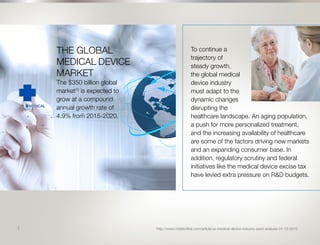
THE GLOBAL
MEDICAL DEVICE
MARKET
The $350 billion global
market(1)
is expected to
grow at a compound
annual growth rate of
4.9% from 2015-2020.
1
http://www.mddionline.com/article/us-medical-device-industry-swot-analysis-01-12-2015
3
Rapid changes in the industry require manufacturers to
accelerate the design and production of innovative devices.
To deliver reliable devices that provide the diagnostic,
monitoring, and therapeutic capabilities that the market
demands, companies must use new materials and
advanced manufacturing technologies.
Doing so enables companies to capitalize on current trends
and secure a return on their R&D investments.
2
4
7 TRENDS IMPACTING
MEDICAL DEVICE
MANUFACTURERS:
n	 Wearable health monitoring devices
n	 Technology fusion
n	 Miniaturization of implantable devices
n	 Improved quality inspection
n	 Aging global population
n	 Growth of emerging markets
n	 Slow regulatory approval processes
3
5
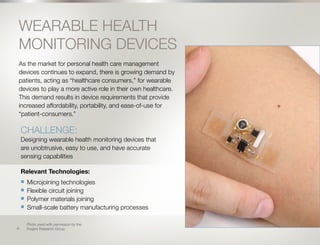
WEARABLE HEALTH
MONITORING DEVICES
As the market for personal health care management
devices continues to expand, there is growing demand by
patients, acting as “healthcare consumers,” for wearable
devices to play a more active role in their own healthcare.
This demand results in device requirements that provide
increased affordability, portability, and ease-of-use for
“patient-consumers.”
Relevant Technologies:
n	 Microjoining technologies
n	 Flexible circuit joining
n	 Polymer materials joining
n	 Small-scale battery manufacturing processes
CHALLENGE:
Designing wearable health monitoring devices that
are unobtrusive, easy to use, and have accurate
sensing capabilities
Photo used with permission by the
Rogers Research Group.4
6
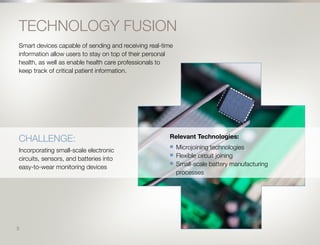
TECHNOLOGY FUSION
Smart devices capable of sending and receiving real-time
information allow users to stay on top of their personal
health, as well as enable health care professionals to
keep track of critical patient information.
Relevant Technologies:
n	 Microjoining technologies
n	 Flexible circuit joining
n	 Small-scale battery manufacturing
processes
CHALLENGE:
Incorporating small-scale electronic
circuits, sensors, and batteries into
easy-to-wear monitoring devices
5
7
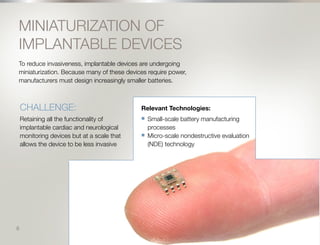
MINIATURIZATION OF
IMPLANTABLE DEVICES
To reduce invasiveness, implantable devices are undergoing
miniaturization. Because many of these devices require power,
manufacturers must design increasingly smaller batteries.
CHALLENGE:
Retaining all the functionality of
implantable cardiac and neurological
monitoring devices but at a scale that
allows the device to be less invasive
Relevant Technologies:
n	 Small-scale battery manufacturing
processes
n	 Micro-scale nondestructive evaluation
(NDE) technology
6
8
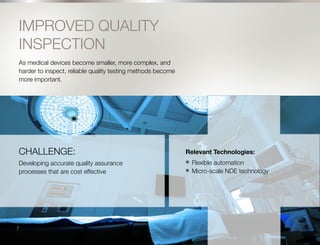
IMPROVED QUALITY
INSPECTION
As medical devices become smaller, more complex, and
harder to inspect, reliable quality testing methods become
more important.
CHALLENGE:
Developing accurate quality assurance
processes that are cost effective
Relevant Technologies:
n	 Flexible automation
n	 Micro-scale NDE technology
7
9
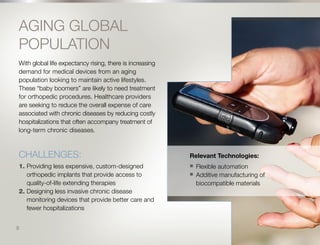
AGING GLOBAL
POPULATION
With global life expectancy rising, there is increasing
demand for medical devices from an aging
population looking to maintain active lifestyles.
These “baby boomers” are likely to need treatment
for orthopedic procedures. Healthcare providers
are seeking to reduce the overall expense of care
associated with chronic diseases by reducing costly
hospitalizations that often accompany treatment of
long-term chronic diseases.
CHALLENGES:
1.	Providing less expensive, custom-designed
orthopedic implants that provide access to
quality-of-life extending therapies
2.	Designing less invasive chronic disease
monitoring devices that provide better care and
fewer hospitalizations
Relevant Technologies:
n	 Flexible automation
n	 Additive manufacturing of
biocompatible materials
8
10
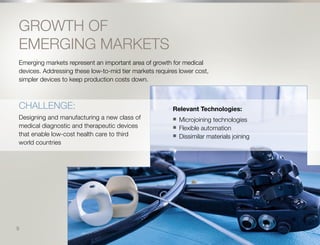
GROWTH OF
EMERGING MARKETS
Emerging markets represent an important area of growth for medical
devices. Addressing these low-to-mid tier markets requires lower cost,
simpler devices to keep production costs down.
CHALLENGE:
Designing and manufacturing a new class of
medical diagnostic and therapeutic devices
that enable low-cost health care to third
world countries
Relevant Technologies:
n	 Microjoining technologies
n	 Flexible automation
n	 Dissimilar materials joining
9
11
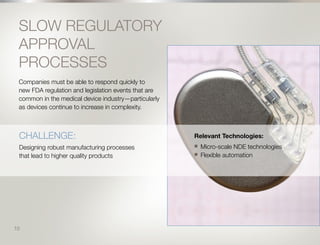
SLOW REGULATORY
APPROVAL
PROCESSES
Companies must be able to respond quickly to
new FDA regulation and legislation events that are
common in the medical device industry—particularly
as devices continue to increase in complexity.
CHALLENGE:
Designing robust manufacturing processes
that lead to higher quality products
Relevant Technologies:
n	 Micro-scale NDE technologies
n	 Flexible automation
10
12
CASE STUDY:
Installing Micro-Sensors for an Implantable Device
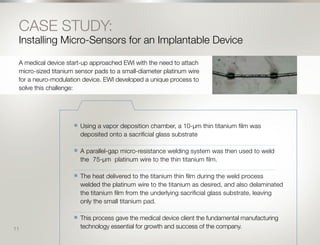
A medical device start-up approached EWI with the need to attach
micro-sized titanium sensor pads to a small-diameter platinum wire
for a neuro-modulation device. EWI developed a unique process to
solve this challenge:
n	 Using a vapor deposition chamber, a 10-μm thin titanium film was
deposited onto a sacrificial glass substrate
______________________________________________________________________________________________________________________________
n	 A parallel-gap micro-resistance welding system was then used to weld
the 	75-μm platinum wire to the thin titanium film.
______________________________________________________________________________________________________________________________
n	 The heat delivered to the titanium thin film during the weld process
welded the platinum wire to the titanium as desired, and also delaminated
the titanium film from the underlying sacrificial glass substrate, leaving
only the small titanium pad.
_______________________________________________________________________________________________________________________________
n	 This process gave the medical device client the fundamental manufacturing
technology essential for growth and success of the company.11
13
ABOUT EWI
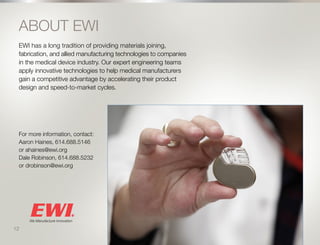
EWI has a long tradition of providing materials joining,
fabrication, and allied manufacturing technologies to companies
in the medical device industry. Our expert engineering teams
apply innovative technologies to help medical manufacturers
gain a competitive advantage by accelerating their product
design and speed-to-market cycles.
For more information, contact:
Aaron Haines, 614.688.5146
or ahaines@ewi.org
Dale Robinson, 614.688.5232
or drobinson@ewi.org
12

Emerging Trends In Medical Device Manufacturing

  • 1.
    1 EMERGING TRENDS IN MEDICALDEVICE MANUFACTURING TECHNOLOGY DRIVEN INNOVATION:
  • 2.
    21 To continue a trajectoryof steady growth, the global medical device industry must adapt to the dynamic changes disrupting the healthcare landscape. An aging population, a push for more personalized treatment, and the increasing availability of healthcare are some of the factors driving new markets and an expanding consumer base. In addition, regulatory scrutiny and federal initiatives like the medical device excise tax have levied extra pressure on R&D budgets. THE GLOBAL MEDICAL DEVICE MARKET The $350 billion global market(1) is expected to grow at a compound annual growth rate of 4.9% from 2015-2020. 1 http://www.mddionline.com/article/us-medical-device-industry-swot-analysis-01-12-2015
  • 3.
    3 Rapid changes inthe industry require manufacturers to accelerate the design and production of innovative devices. To deliver reliable devices that provide the diagnostic, monitoring, and therapeutic capabilities that the market demands, companies must use new materials and advanced manufacturing technologies. Doing so enables companies to capitalize on current trends and secure a return on their R&D investments. 2
  • 4.
    4 7 TRENDS IMPACTING MEDICALDEVICE MANUFACTURERS: n Wearable health monitoring devices n Technology fusion n Miniaturization of implantable devices n Improved quality inspection n Aging global population n Growth of emerging markets n Slow regulatory approval processes 3
  • 5.
    5 WEARABLE HEALTH MONITORING DEVICES Asthe market for personal health care management devices continues to expand, there is growing demand by patients, acting as “healthcare consumers,” for wearable devices to play a more active role in their own healthcare. This demand results in device requirements that provide increased affordability, portability, and ease-of-use for “patient-consumers.” Relevant Technologies: n Microjoining technologies n Flexible circuit joining n Polymer materials joining n Small-scale battery manufacturing processes CHALLENGE: Designing wearable health monitoring devices that are unobtrusive, easy to use, and have accurate sensing capabilities Photo used with permission by the Rogers Research Group.4
  • 6.
    6 TECHNOLOGY FUSION Smart devicescapable of sending and receiving real-time information allow users to stay on top of their personal health, as well as enable health care professionals to keep track of critical patient information. Relevant Technologies: n Microjoining technologies n Flexible circuit joining n Small-scale battery manufacturing processes CHALLENGE: Incorporating small-scale electronic circuits, sensors, and batteries into easy-to-wear monitoring devices 5
  • 7.
    7 MINIATURIZATION OF IMPLANTABLE DEVICES Toreduce invasiveness, implantable devices are undergoing miniaturization. Because many of these devices require power, manufacturers must design increasingly smaller batteries. CHALLENGE: Retaining all the functionality of implantable cardiac and neurological monitoring devices but at a scale that allows the device to be less invasive Relevant Technologies: n Small-scale battery manufacturing processes n Micro-scale nondestructive evaluation (NDE) technology 6
  • 8.
    8 IMPROVED QUALITY INSPECTION As medicaldevices become smaller, more complex, and harder to inspect, reliable quality testing methods become more important. CHALLENGE: Developing accurate quality assurance processes that are cost effective Relevant Technologies: n Flexible automation n Micro-scale NDE technology 7
  • 9.
    9 AGING GLOBAL POPULATION With globallife expectancy rising, there is increasing demand for medical devices from an aging population looking to maintain active lifestyles. These “baby boomers” are likely to need treatment for orthopedic procedures. Healthcare providers are seeking to reduce the overall expense of care associated with chronic diseases by reducing costly hospitalizations that often accompany treatment of long-term chronic diseases. CHALLENGES: 1. Providing less expensive, custom-designed orthopedic implants that provide access to quality-of-life extending therapies 2. Designing less invasive chronic disease monitoring devices that provide better care and fewer hospitalizations Relevant Technologies: n Flexible automation n Additive manufacturing of biocompatible materials 8
  • 10.
    10 GROWTH OF EMERGING MARKETS Emergingmarkets represent an important area of growth for medical devices. Addressing these low-to-mid tier markets requires lower cost, simpler devices to keep production costs down. CHALLENGE: Designing and manufacturing a new class of medical diagnostic and therapeutic devices that enable low-cost health care to third world countries Relevant Technologies: n Microjoining technologies n Flexible automation n Dissimilar materials joining 9
  • 11.
    11 SLOW REGULATORY APPROVAL PROCESSES Companies mustbe able to respond quickly to new FDA regulation and legislation events that are common in the medical device industry—particularly as devices continue to increase in complexity. CHALLENGE: Designing robust manufacturing processes that lead to higher quality products Relevant Technologies: n Micro-scale NDE technologies n Flexible automation 10
  • 12.
    12 CASE STUDY: Installing Micro-Sensorsfor an Implantable Device A medical device start-up approached EWI with the need to attach micro-sized titanium sensor pads to a small-diameter platinum wire for a neuro-modulation device. EWI developed a unique process to solve this challenge: n Using a vapor deposition chamber, a 10-μm thin titanium film was deposited onto a sacrificial glass substrate ______________________________________________________________________________________________________________________________ n A parallel-gap micro-resistance welding system was then used to weld the 75-μm platinum wire to the thin titanium film. ______________________________________________________________________________________________________________________________ n The heat delivered to the titanium thin film during the weld process welded the platinum wire to the titanium as desired, and also delaminated the titanium film from the underlying sacrificial glass substrate, leaving only the small titanium pad. _______________________________________________________________________________________________________________________________ n This process gave the medical device client the fundamental manufacturing technology essential for growth and success of the company.11
  • 13.
    13 ABOUT EWI EWI hasa long tradition of providing materials joining, fabrication, and allied manufacturing technologies to companies in the medical device industry. Our expert engineering teams apply innovative technologies to help medical manufacturers gain a competitive advantage by accelerating their product design and speed-to-market cycles. For more information, contact: Aaron Haines, 614.688.5146 or ahaines@ewi.org Dale Robinson, 614.688.5232 or drobinson@ewi.org 12