CONTROL SURFACE
ATTACHMENT & CONSTRUCTION
CONTROL SURFACE ATTACHMENT
• Similar to wing-aileron attachment, rudder,
elevators are also attached to stabilizer
structure.
• They are attached at rear spar.
• On most a/c, this will be hinges or fittings that
allow the back & forth movement of surface.
• A rear or false spar may be built into TE of
flight control area when trim tab is fitted.
CONTROL SURFACE CONSTRUCTION
• These resemble wing construction of a/c.
• They use spar, ribs, skin all.
• Commonly they use epoxy reinforced
composite construction & honeycomb core
construction covered with aluminium skin.
• Epoxy is thermosetting polymer which
possesses unique mechanical & resistance
properties.
CONTD...
• Honeycomb core is manufactured from
composite materials like fibre class, reinforced
plastic or from a metal such as aluminium.
• Control surfaces are built, keeping in mind
that they should be light in weight.
• They have minimal structure aft of the front
spar in honeycomb core.
MASS & AERODYNAMIC BALANCING
• Both the balancing is important to avoid
FLUTTER.
• FLUTTER is an severe oscillation in control
surfaces as they are mounted on flexible
structure like wings.
• This can be cured by bringing the CG of the
control surface to the hinge line.
• This can be accomplished by adding mass balance
weights to LE of control which is mass balancing.
CONTD...
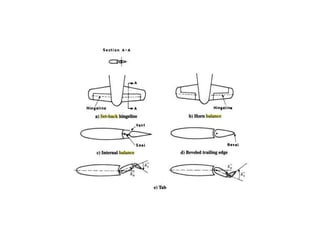
• Aerodynamic balancing means of reducing
hinge movement & thereby the physical effort
needed to control an a/c.
• Eg. In elevator if a portion of control surface
would extend in front of hinge line at
outboard end of surface, the portion ahead of
hinge line will tend to reduce force needed by
pilot to operate the same.
CONTD...
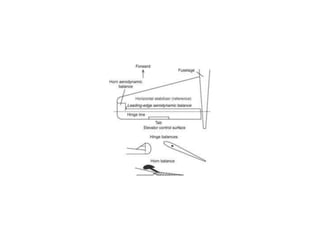
• So there must be a setting to set the hinge
into the control surface so that when
deflected from neutral, the part of the surface
forward of hinge line projects into air stream.
• This is aerodynamic balancing.
• They may be inset hinges, horn balance,
internal balance & tab balance.
Mass, Aerodynamic balancing &control surface construction in aircraft

Mass, Aerodynamic balancing &control surface construction in aircraft

  • 1.
  • 2.
    CONTROL SURFACE ATTACHMENT •Similar to wing-aileron attachment, rudder, elevators are also attached to stabilizer structure. • They are attached at rear spar. • On most a/c, this will be hinges or fittings that allow the back & forth movement of surface. • A rear or false spar may be built into TE of flight control area when trim tab is fitted.
  • 3.
    CONTROL SURFACE CONSTRUCTION •These resemble wing construction of a/c. • They use spar, ribs, skin all. • Commonly they use epoxy reinforced composite construction & honeycomb core construction covered with aluminium skin. • Epoxy is thermosetting polymer which possesses unique mechanical & resistance properties.
  • 4.
    CONTD... • Honeycomb coreis manufactured from composite materials like fibre class, reinforced plastic or from a metal such as aluminium. • Control surfaces are built, keeping in mind that they should be light in weight. • They have minimal structure aft of the front spar in honeycomb core.
  • 5.
    MASS & AERODYNAMICBALANCING • Both the balancing is important to avoid FLUTTER. • FLUTTER is an severe oscillation in control surfaces as they are mounted on flexible structure like wings. • This can be cured by bringing the CG of the control surface to the hinge line. • This can be accomplished by adding mass balance weights to LE of control which is mass balancing.
  • 6.
    CONTD... • Aerodynamic balancingmeans of reducing hinge movement & thereby the physical effort needed to control an a/c. • Eg. In elevator if a portion of control surface would extend in front of hinge line at outboard end of surface, the portion ahead of hinge line will tend to reduce force needed by pilot to operate the same.
  • 7.
    CONTD... • So theremust be a setting to set the hinge into the control surface so that when deflected from neutral, the part of the surface forward of hinge line projects into air stream. • This is aerodynamic balancing. • They may be inset hinges, horn balance, internal balance & tab balance.