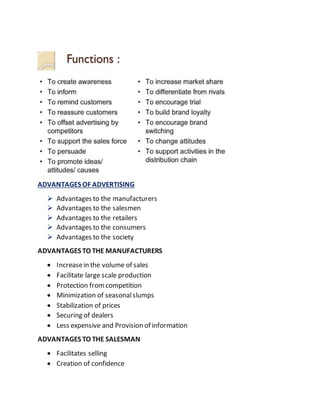
ADVERTISING
INTRODUCTION
 Advertising is a popular device employed in the modern marketing system used by
companies to promote or sell products and services.
 Effective advertisements has become more indispensable. The primary goal of
advertising is to influence the buying behavior by promoting a product, service or
company.
 All kinds of institutions find advertising as suitable means of publicity.
 The word advertising is derived from two Latin Words „Ad‟ and „Verto‟.
Ad – towards
Verto – I turn
 Literally it means to turn the people’s attention to a specific thing.
EVOLUTION
o Inscriptions were found on earthen bricks prepared by Babylonians about 3000BC.
o The bricks carry the name of the officials when the structure was erected.
o The earliest forms were signboards and writing on the walls of prominent buildings.
o Pamphlets and posters also used.
o Hand press was invented at the end of 15th century.
o The invention of printing machines further aided for the development of advertising
techniques through handbills, magazines, newspapers, and handbooks.
o The evolution of printing machinery brought revolutionary changes in the art of
advertising and such changes were closely followed by structural changes in the
marketing methods.
o After the occurrence of Industrial Revolution, mass production has become a reality.
o This mass scale productions brought various changes in the techniques of marketing.
o Mass advertising came into being in the latter half of the 19th century, Which was
further stimulated by increased literacy.
DEFINITION
 Advertising is any form of paid non-personal presentation of ideas, goods, or
services for the purpose of inducing people to buy.
 The process of delivering a message about ideas, goods and services, through
the media, paid by an individual sponsor.
 To turn the peoples attention to a specific thing.
 Advertising is just a single concept of marketing.
 “If you think advertising is the same thing as marketing, you have just limited
yourself to only using the most expensive way to market your business.”
 Advertising is any paid form of non-personal presentation and promotion of
ideas, goods, or services by an identified sponsor.
It involves the use of such media as magazine, newspaper, space, radio, motion pictures,
outdoor media, cards, catalogues, direct mail, directories and references, store signs, programs,
and menus, novelties, and circulars.
 Advertising is any paid form of non-personal presentation and promotion of ideas,
goods, or services by an identified sponsor.
[American Marketing Association]
 Advertising consists of all the activities involved in presenting to a group of non-
personal, oral or visual, openly sponsored message regarding a product, service or idea.
This message called an advertisement disseminated through one or more media and is
paid for by the identified sponsor.
[WilliamJ Stanton]
 Advertising is any form of paid non-personal presentation of ideas, goods or services for
the purpose of inducing people to buy.
[ Weeler ]
 Advertising is any paid form of non personal presentation and promotion of goods,
services, or ideas by an identified sponsor.
[ Kotler ]
MAJOR ADVERTISING MEDIA
 News papers
 Television
 Direct mail
 Radio
 Magazines
 Brochures
 Telephone
 Internet
OBJECTIVES
1 To inform / INFORMATIVE ADVERTISING
◦ New Product,
New Service, New Features, Re-Launch
 Advertisements are used to increase brand awareness and brand exposure in the target
market. Informing potential customers about the brand and its products is the first step
towards attaining business goals.
 Building A Brand And Company Image
 Telling The Market About A New Product
 Explaining How The Product Works
 Suggesting New Usage Of A Product
 Informing The Market Of A Price Change
 Describing Available Services And Support
 Correcting False Impression
2 To persuade / PERSUASIVE ADVERTISING
◦ Comparative Ads
 Persuading customers to perform a particular task is a prominent objective of
advertising. The task may involve buying or trying the products and services offered, to
form brand image, develop a favorable attitude towards the brand
 Building Brand Preference
 Encouraging Switching To Your Brand
 Persuading Customers To Purchase New
 Convincing Customers To Tell Others About The Brand
3 To Remind / REMINDER ADVERTISING
◦ Continuous Ads
Ex: Coca Cola
 To reinforce the brand message and to reassure the existing and potential customers
about the brand vision.
 Maintaining Customer Relationship
 Reminding Consumers That The Product May Be Needed In The Near Future
 Reminding Consumers Where To Buy The Product
Other objectives
o Brand Building
o Increasing Sales
o Creating Demand
o Engagement
o Expanding Customer Base
o Changing Customers Attitude
o Assure ready acceptance of new products
o Sets a standard for organisations performance
o Aids to maintain both wholesale and retail prices
o Encourage maintenance
o Improve the quality
o Develop new markets and attract a new group of customers
o Retain the users interest
o Creates mass demand
o Gains goodwill
o Reduces selling and distribution expenses
Characteristics
1.tool for market promotion
There are various tools used for market communication-such as advertising, sales promotion,
personal selling, and publicity. It is a powerful, expensive and popular element of promotion
mix.
2 non personal
Advertising is a type of non personal or mass communication with the target audience. A large
number of people are addressed at a time. It is called as non personal salesmanship.
3 paid form
Advertising is not free of costs. Advertiser called as sponsor, has to spend money for preparing
message, buying media, and monitoring advertising efforts. It is the costliest option of market
promotion. Company has to prepare its advertising budget to appropriate advertising costs.
4 wide applicability
Advertising is a widely used means for communicating with the target market. It is not only
used for business and profession, but is widely used by museums, charitable trusts, government
agencies, educational institutions, and others to inform and attract various target publics.
5 varied objectives
Advertising aimed at achieving varied objectives. It is targeted to increase sales, create and
improve brand image, face competition, build relation with publics, or to educate people.
6 forms of advertising
Advertising messages can be expressed in oral, written, audible or visual forms, mostly
expressed in joint forms-oral-visual, audio-visual
7 use of media
Advertiser can use any of the several advertising media to convey the message. Widely used
media are:
 Print media-news paper, magazines ,letters, booklets
 Outdoor media-sign boards, wall printing, banners
 Audio visual media- television, film, internet
8 advertising as an art
9 personal or non-personal
Advertising can be non personal as in the case of T V ,News paper, radio or highly personal as in
the case of social media and other cookie based advertisements.
TYPES OF ADVERTISING
1 . PRODUCT ADVERTISING
2. INSTITUTIONAL ADVERTISING
3. OTHER TYPES
1. Product advertising : attempts to inform and stimulate the market about the advertisers
products or services.
USERS: Business, government organizations and private non-business organizations
Purpose : To promote the uses, features, images and benefits of products or services
a) Direct actionand indirect actionadvertising
Direct action productadvertising : It stimulates the buyer to buy the product immediately.
It expects the quick response from the buyer.
Indirectaction advertising : It seeks to stimulate demand over a long period. It increases
the demand for commodities and increases sales volume. It creates a favourable attitude
towards the product.
b) Pioneer demand and selectivedemandadvertising
Pioneer advertising: When new kinds of goods are produced for the first time, the
manufactures has to explain the features of product. He should make the buyers aware of the
product, how it can be used and where it is available.
Selective advertising: Having created mass demand for a product of a particular class the
manufacturer has to popularize his brand among buyers.
2 Institutional advertising
It creates a favourable image of the company which markets the products or service. Service
organisations –LIC, SBI
a) Patronage institutional advertising : appeals to the patronage motives of buyers. It
aims at building at long term relationship with customers.it explains about the manufacturer,
his policies and his personnel.
b)Public relationinstitutional advertising : appeals to the stakeholders of the company.
It creates a favourable image of the organization among employees, shareholders, or general
public.
c)Public service institutional advertising aims at garnering public support. e.g.
conservation of natural resources, savings, security.
Institutional advertising is undertaken by the government.
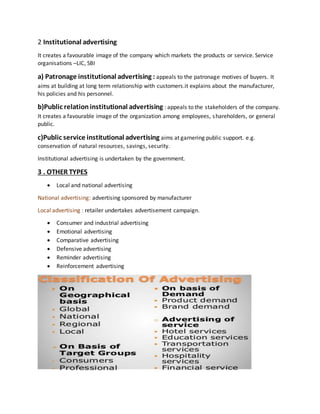
3 . OTHER TYPES
 Local and national advertising
National advertising: advertising sponsored by manufacturer
Local advertising : retailer undertakes advertisement campaign.
 Consumer and industrial advertising
 Emotional advertising
 Comparative advertising
 Defensive advertising
 Reminder advertising
 Reinforcement advertising
TYPES OF ADVERTISING
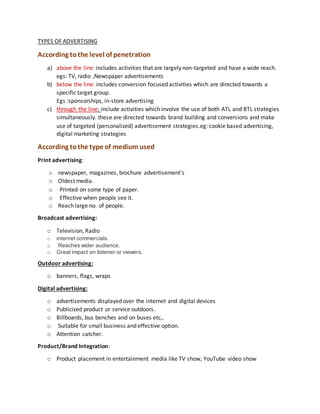
According tothe level of penetration
a) above the line: includes activities that are largely non-targeted and have a wide reach.
egs: TV, radio ,Newspaper advertisements
b) below the line: includes conversion focused activities which are directed towards a
specific target group.
Egs :sponsorships, in-store advertising
c) through the line: include activities which involve the use of both ATL and BTL strategies
simultaneously. these are directed towards brand building and conversions and make
use of targeted (personalized) advertisement strategies.eg: cookie based advertising,
digital marketing strategies
According tothe type of medium used
Print advertising:
o newspaper, magazines, brochure advertisement's
o Oldest media.
o Printed on some type of paper.
o Effective when people see it.
o Reach large no. of people.
Broadcast advertising:
o Television, Radio
o internet commercials.
o Reaches wider audience.
o Great impact on listener or viewers.
Outdoor advertising:
o banners, flags, wraps
Digital advertising:
o advertisements displayed over the internet and digital devices
o Publicized product or service outdoors.
o Billboards, bus benches and on buses etc,.
o Suitable for small business and effective option.
o Attention catcher.
Product/Brand Integration:
o Product placement in entertainment media like TV show, YouTube video show
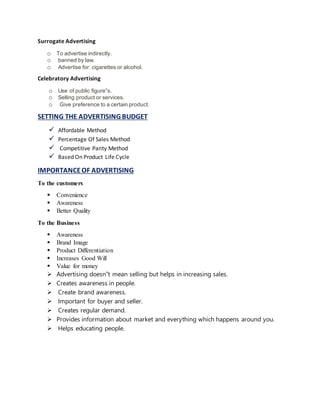
Surrogate Advertising
o To advertise indirectly.
o banned by law.
o Advertise for: cigarettes or alcohol.
Celebratory Advertising
o Use of public figure‟s.
o Selling product or services.
o Give preference to a certain product.
SETTING THE ADVERTISING BUDGET
 Affordable Method
 Percentage Of Sales Method
 Competitive Parity Method
 Based On Product Life Cycle
IMPORTANCEOF ADVERTISING
To the customers
 Convenience
 Awareness
 Better Quality
To the Business
 Awareness
 Brand Image
 Product Differentiation
 Increases Good Will
 Value for money
 Advertising doesn‟t mean selling but helps in increasing sales.
 Creates awareness in people.
 Create brand awareness.
 Important for buyer and seller.
 Creates regular demand.
 Provides information about market and everything which happens around you.
 Helps educating people.
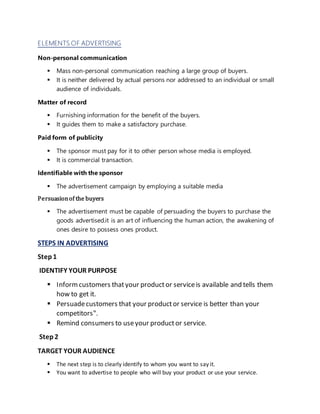
ELEMENTS OF ADVERTISING
Non-personal communication
 Mass non-personal communication reaching a large group of buyers.
 It is neither delivered by actual persons nor addressed to an individual or small
audience of individuals.
Matter of record
 Furnishing information for the benefit of the buyers.
 It guides them to make a satisfactory purchase.
Paid form of publicity
 The sponsor must pay for it to other person whose media is employed.
 It is commercial transaction.
Identifiable with the sponsor
 The advertisement campaign by employing a suitable media
Persuasionof the buyers
 The advertisement must be capable of persuading the buyers to purchase the
goods advertised.it is an art of influencing the human action, the awakening of
ones desire to possess ones product.
STEPS IN ADVERTISING
Step1
IDENTIFY YOUR PURPOSE
 Informcustomers thatyour productor serviceis available and tells them
how to get it.
 Persuadecustomers that your productor service is better than your
competitors‟.
 Remind consumers to useyour productor service.
Step2
TARGET YOUR AUDIENCE
 The next step is to clearly identify to whom you want to say it.
 You want to advertise to people who will buy your product or use your service.
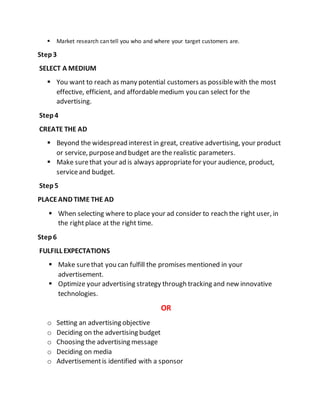
 Market research can tell you who and where your target customers are.
Step3
SELECT A MEDIUM
 You want to reach as many potential customers as possiblewith the most
effective, efficient, and affordablemedium you can select for the
advertising.
Step4
CREATE THE AD
 Beyond the widespread interest in great, creative advertising, your product
or service, purposeand budget are the realistic parameters.
 Make surethat your ad is always appropriatefor your audience, product,
serviceand budget.
Step5
PLACEAND TIME THE AD
 When selecting where to place your ad consider to reach the right user, in
the rightplace at the right time.
Step6
FULFILL EXPECTATIONS
 Make surethat you can fulfill the promises mentioned in your
advertisement.
 Optimize your advertising strategy through tracking and new innovative
technologies.
OR
o Setting an advertising objective
o Deciding on the advertising budget
o Choosing the advertising message
o Deciding on media
o Advertisementis identified with a sponsor
ADVANTAGES OF ADVERTISING
 Advantages to the manufacturers
 Advantages to the salesmen
 Advantages to the retailers
 Advantages to the consumers
 Advantages to the society
ADVANTAGES TO THE MANUFACTURERS
 Increasein the volume of sales
 Facilitate large scale production
 Protection fromcompetition
 Minimization of seasonalslumps
 Stabilization of prices
 Securing of dealers
 Less expensive and Provision of information
ADVANTAGES TO THE SALESMAN
 Facilitates selling
 Creation of confidence
 Lesser efforts
ADVANTAGES TO THE RETAILERS
 Increases theturnover
 Publicity
 Minimum efforts
 Risk of price wars
 Sales forecasting
 Strengthening of goodwill
ADVANTAGES TO THE CONSUMERS
 Quality of the product
 Selection of products
 Information service
 Fair prices and Mail order business
ADVANTAGES TO THE SOCIETY
 Educative value
 Stimulation of investment
 Employment opportunities
ADVANTAGES OF ADVERTISING
 Reduce per unit cost
 Helps in brand building
 Helps in launching new products
 Boosts up existing customers confidencein the brand
 Helps in reducing customer turn over
 Attracts new customers
 Educates the customers
DISADVANTAGES
 Increases thecost
 Confuses the buyer
 Only for big businesses
 Encourages the sale of inferior products
Advertising

Advertising

  • 1.
    ADVERTISING INTRODUCTION  Advertising isa popular device employed in the modern marketing system used by companies to promote or sell products and services.  Effective advertisements has become more indispensable. The primary goal of advertising is to influence the buying behavior by promoting a product, service or company.  All kinds of institutions find advertising as suitable means of publicity.  The word advertising is derived from two Latin Words „Ad‟ and „Verto‟. Ad – towards Verto – I turn  Literally it means to turn the people’s attention to a specific thing. EVOLUTION o Inscriptions were found on earthen bricks prepared by Babylonians about 3000BC. o The bricks carry the name of the officials when the structure was erected. o The earliest forms were signboards and writing on the walls of prominent buildings. o Pamphlets and posters also used. o Hand press was invented at the end of 15th century. o The invention of printing machines further aided for the development of advertising techniques through handbills, magazines, newspapers, and handbooks. o The evolution of printing machinery brought revolutionary changes in the art of advertising and such changes were closely followed by structural changes in the marketing methods. o After the occurrence of Industrial Revolution, mass production has become a reality. o This mass scale productions brought various changes in the techniques of marketing. o Mass advertising came into being in the latter half of the 19th century, Which was further stimulated by increased literacy. DEFINITION  Advertising is any form of paid non-personal presentation of ideas, goods, or services for the purpose of inducing people to buy.  The process of delivering a message about ideas, goods and services, through the media, paid by an individual sponsor.  To turn the peoples attention to a specific thing.  Advertising is just a single concept of marketing.  “If you think advertising is the same thing as marketing, you have just limited yourself to only using the most expensive way to market your business.”
  • 2.
     Advertising isany paid form of non-personal presentation and promotion of ideas, goods, or services by an identified sponsor. It involves the use of such media as magazine, newspaper, space, radio, motion pictures, outdoor media, cards, catalogues, direct mail, directories and references, store signs, programs, and menus, novelties, and circulars.  Advertising is any paid form of non-personal presentation and promotion of ideas, goods, or services by an identified sponsor. [American Marketing Association]  Advertising consists of all the activities involved in presenting to a group of non- personal, oral or visual, openly sponsored message regarding a product, service or idea. This message called an advertisement disseminated through one or more media and is paid for by the identified sponsor. [WilliamJ Stanton]  Advertising is any form of paid non-personal presentation of ideas, goods or services for the purpose of inducing people to buy. [ Weeler ]  Advertising is any paid form of non personal presentation and promotion of goods, services, or ideas by an identified sponsor. [ Kotler ] MAJOR ADVERTISING MEDIA  News papers  Television  Direct mail  Radio  Magazines  Brochures  Telephone  Internet OBJECTIVES 1 To inform / INFORMATIVE ADVERTISING ◦ New Product, New Service, New Features, Re-Launch
  • 3.
     Advertisements areused to increase brand awareness and brand exposure in the target market. Informing potential customers about the brand and its products is the first step towards attaining business goals.  Building A Brand And Company Image  Telling The Market About A New Product  Explaining How The Product Works  Suggesting New Usage Of A Product  Informing The Market Of A Price Change  Describing Available Services And Support  Correcting False Impression 2 To persuade / PERSUASIVE ADVERTISING ◦ Comparative Ads  Persuading customers to perform a particular task is a prominent objective of advertising. The task may involve buying or trying the products and services offered, to form brand image, develop a favorable attitude towards the brand  Building Brand Preference  Encouraging Switching To Your Brand  Persuading Customers To Purchase New  Convincing Customers To Tell Others About The Brand 3 To Remind / REMINDER ADVERTISING ◦ Continuous Ads Ex: Coca Cola  To reinforce the brand message and to reassure the existing and potential customers about the brand vision.  Maintaining Customer Relationship  Reminding Consumers That The Product May Be Needed In The Near Future  Reminding Consumers Where To Buy The Product Other objectives o Brand Building o Increasing Sales o Creating Demand o Engagement o Expanding Customer Base o Changing Customers Attitude
  • 4.
    o Assure readyacceptance of new products o Sets a standard for organisations performance o Aids to maintain both wholesale and retail prices o Encourage maintenance o Improve the quality o Develop new markets and attract a new group of customers o Retain the users interest o Creates mass demand o Gains goodwill o Reduces selling and distribution expenses Characteristics 1.tool for market promotion There are various tools used for market communication-such as advertising, sales promotion, personal selling, and publicity. It is a powerful, expensive and popular element of promotion mix. 2 non personal Advertising is a type of non personal or mass communication with the target audience. A large number of people are addressed at a time. It is called as non personal salesmanship. 3 paid form Advertising is not free of costs. Advertiser called as sponsor, has to spend money for preparing message, buying media, and monitoring advertising efforts. It is the costliest option of market promotion. Company has to prepare its advertising budget to appropriate advertising costs. 4 wide applicability Advertising is a widely used means for communicating with the target market. It is not only used for business and profession, but is widely used by museums, charitable trusts, government agencies, educational institutions, and others to inform and attract various target publics. 5 varied objectives Advertising aimed at achieving varied objectives. It is targeted to increase sales, create and improve brand image, face competition, build relation with publics, or to educate people. 6 forms of advertising Advertising messages can be expressed in oral, written, audible or visual forms, mostly expressed in joint forms-oral-visual, audio-visual
  • 5.
    7 use ofmedia Advertiser can use any of the several advertising media to convey the message. Widely used media are:  Print media-news paper, magazines ,letters, booklets  Outdoor media-sign boards, wall printing, banners  Audio visual media- television, film, internet 8 advertising as an art 9 personal or non-personal Advertising can be non personal as in the case of T V ,News paper, radio or highly personal as in the case of social media and other cookie based advertisements. TYPES OF ADVERTISING 1 . PRODUCT ADVERTISING 2. INSTITUTIONAL ADVERTISING 3. OTHER TYPES 1. Product advertising : attempts to inform and stimulate the market about the advertisers products or services. USERS: Business, government organizations and private non-business organizations Purpose : To promote the uses, features, images and benefits of products or services a) Direct actionand indirect actionadvertising Direct action productadvertising : It stimulates the buyer to buy the product immediately. It expects the quick response from the buyer. Indirectaction advertising : It seeks to stimulate demand over a long period. It increases the demand for commodities and increases sales volume. It creates a favourable attitude towards the product. b) Pioneer demand and selectivedemandadvertising Pioneer advertising: When new kinds of goods are produced for the first time, the manufactures has to explain the features of product. He should make the buyers aware of the product, how it can be used and where it is available. Selective advertising: Having created mass demand for a product of a particular class the manufacturer has to popularize his brand among buyers.
  • 6.
    2 Institutional advertising Itcreates a favourable image of the company which markets the products or service. Service organisations –LIC, SBI a) Patronage institutional advertising : appeals to the patronage motives of buyers. It aims at building at long term relationship with customers.it explains about the manufacturer, his policies and his personnel. b)Public relationinstitutional advertising : appeals to the stakeholders of the company. It creates a favourable image of the organization among employees, shareholders, or general public. c)Public service institutional advertising aims at garnering public support. e.g. conservation of natural resources, savings, security. Institutional advertising is undertaken by the government. 3 . OTHER TYPES  Local and national advertising National advertising: advertising sponsored by manufacturer Local advertising : retailer undertakes advertisement campaign.  Consumer and industrial advertising  Emotional advertising  Comparative advertising  Defensive advertising  Reminder advertising  Reinforcement advertising
  • 7.
    TYPES OF ADVERTISING Accordingtothe level of penetration a) above the line: includes activities that are largely non-targeted and have a wide reach. egs: TV, radio ,Newspaper advertisements b) below the line: includes conversion focused activities which are directed towards a specific target group. Egs :sponsorships, in-store advertising c) through the line: include activities which involve the use of both ATL and BTL strategies simultaneously. these are directed towards brand building and conversions and make use of targeted (personalized) advertisement strategies.eg: cookie based advertising, digital marketing strategies According tothe type of medium used Print advertising: o newspaper, magazines, brochure advertisement's o Oldest media. o Printed on some type of paper. o Effective when people see it. o Reach large no. of people. Broadcast advertising: o Television, Radio o internet commercials. o Reaches wider audience. o Great impact on listener or viewers. Outdoor advertising: o banners, flags, wraps Digital advertising: o advertisements displayed over the internet and digital devices o Publicized product or service outdoors. o Billboards, bus benches and on buses etc,. o Suitable for small business and effective option. o Attention catcher. Product/Brand Integration: o Product placement in entertainment media like TV show, YouTube video show
  • 8.
    Surrogate Advertising o Toadvertise indirectly. o banned by law. o Advertise for: cigarettes or alcohol. Celebratory Advertising o Use of public figure‟s. o Selling product or services. o Give preference to a certain product. SETTING THE ADVERTISING BUDGET  Affordable Method  Percentage Of Sales Method  Competitive Parity Method  Based On Product Life Cycle IMPORTANCEOF ADVERTISING To the customers  Convenience  Awareness  Better Quality To the Business  Awareness  Brand Image  Product Differentiation  Increases Good Will  Value for money  Advertising doesn‟t mean selling but helps in increasing sales.  Creates awareness in people.  Create brand awareness.  Important for buyer and seller.  Creates regular demand.  Provides information about market and everything which happens around you.  Helps educating people.
  • 9.
    ELEMENTS OF ADVERTISING Non-personalcommunication  Mass non-personal communication reaching a large group of buyers.  It is neither delivered by actual persons nor addressed to an individual or small audience of individuals. Matter of record  Furnishing information for the benefit of the buyers.  It guides them to make a satisfactory purchase. Paid form of publicity  The sponsor must pay for it to other person whose media is employed.  It is commercial transaction. Identifiable with the sponsor  The advertisement campaign by employing a suitable media Persuasionof the buyers  The advertisement must be capable of persuading the buyers to purchase the goods advertised.it is an art of influencing the human action, the awakening of ones desire to possess ones product. STEPS IN ADVERTISING Step1 IDENTIFY YOUR PURPOSE  Informcustomers thatyour productor serviceis available and tells them how to get it.  Persuadecustomers that your productor service is better than your competitors‟.  Remind consumers to useyour productor service. Step2 TARGET YOUR AUDIENCE  The next step is to clearly identify to whom you want to say it.  You want to advertise to people who will buy your product or use your service.
  • 10.
     Market researchcan tell you who and where your target customers are. Step3 SELECT A MEDIUM  You want to reach as many potential customers as possiblewith the most effective, efficient, and affordablemedium you can select for the advertising. Step4 CREATE THE AD  Beyond the widespread interest in great, creative advertising, your product or service, purposeand budget are the realistic parameters.  Make surethat your ad is always appropriatefor your audience, product, serviceand budget. Step5 PLACEAND TIME THE AD  When selecting where to place your ad consider to reach the right user, in the rightplace at the right time. Step6 FULFILL EXPECTATIONS  Make surethat you can fulfill the promises mentioned in your advertisement.  Optimize your advertising strategy through tracking and new innovative technologies. OR o Setting an advertising objective o Deciding on the advertising budget o Choosing the advertising message o Deciding on media o Advertisementis identified with a sponsor
  • 11.
    ADVANTAGES OF ADVERTISING Advantages to the manufacturers  Advantages to the salesmen  Advantages to the retailers  Advantages to the consumers  Advantages to the society ADVANTAGES TO THE MANUFACTURERS  Increasein the volume of sales  Facilitate large scale production  Protection fromcompetition  Minimization of seasonalslumps  Stabilization of prices  Securing of dealers  Less expensive and Provision of information ADVANTAGES TO THE SALESMAN  Facilitates selling  Creation of confidence
  • 12.
     Lesser efforts ADVANTAGESTO THE RETAILERS  Increases theturnover  Publicity  Minimum efforts  Risk of price wars  Sales forecasting  Strengthening of goodwill ADVANTAGES TO THE CONSUMERS  Quality of the product  Selection of products  Information service  Fair prices and Mail order business ADVANTAGES TO THE SOCIETY  Educative value  Stimulation of investment  Employment opportunities ADVANTAGES OF ADVERTISING  Reduce per unit cost  Helps in brand building  Helps in launching new products  Boosts up existing customers confidencein the brand  Helps in reducing customer turn over  Attracts new customers  Educates the customers DISADVANTAGES  Increases thecost  Confuses the buyer  Only for big businesses  Encourages the sale of inferior products