SYSTEMIC STEROIDS

  JONATHAN OLESU
ANATOMY AND PHYSIOLOGY
• The adrenal glands are located on the superior
  aspect of each kidney and
• consist of two defined portions
• The outer portion of the gland, the adrenal
  cortex, produces three groups of steroid
  hormones:
  – glucocorticoids,
  – mineralocorticoids,
  – androgens.
• They are derived from cholesterol and share a
  common core structure.
• The adrenal cortex has three zones.
• The outermost zona glomerulosa produces
  mineralocorticoids, primarily aldosterone
• The zona fasciculata and the innermost
• zona reticularis secrete glucocorticoid,cortisol, and
  androgens.

• The inner portion of the gland, adrenal
  medulla,produces catecholamines,
   – epinephrine (adrenaline), and
   – norepinephrine (noradrenaline).
• aldosterone,
  – for sodium and potassium balance and
    extracellular fluid volume.
• Cortisol
  – essential for metabolism,
  – anti-inflammatory properties, and
  – maintenance of homeostasis during periods of
    physical or emotional stress.
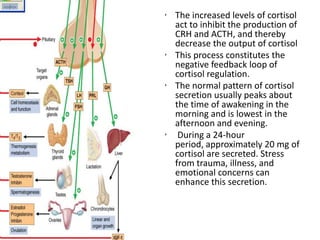
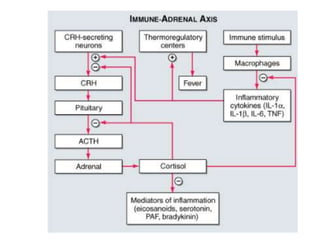
• Cortisol secretion is regulated by the hypothalamic-
  pituitary-adrenal axis. The circadian rhythm, mediated
  by the CNS, and responses to stress stimulate the
  hypothalamus to release corticotropin-releasing
  hormone (CRH), which stimulates the production and
  secretion of adrenocorticotropic hormone (ACTH) by
  the anterior pituitary.
• The adrenal cortex is stimulated by ACTH to produce
  and secrete cortisol. Circulating plasma cortisol levels
  are elevated within minutes after stimulation in a
  normally functioning gland.
• The increased levels of cortisol
  act to inhibit the production of
  CRH and ACTH, and thereby
  decrease the output of cortisol
• This process constitutes the
  negative feedback loop of
  cortisol regulation.
• The normal pattern of cortisol
  secretion usually peaks about
  the time of awakening in the
  morning and is lowest in the
  afternoon and evening.
• During a 24-hour
  period, approximately 20 mg of
  cortisol are secreted. Stress
  from trauma, illness, and
  emotional concerns can
  enhance this secretion.
• Aldosterone secretion is regulated by
  – renin-angiotensin system,
  – ACTH, sodium, and
  – potassium levels .
• When renal blood pressure decreases,
  – renin is released, which
  – stimulates release of angiotensin and
  – activates the secretion of aldosterone
• via a negative feedback loop.
Examples of systemic steroids
• Short-Acting
   –   Cortisol (hydrocortisone)
   –   Cortisone
   –   Prednisone
   –   Prednisolone
   –   Methylprednisolone
• Intermediate-Acting
   – triamcinolone
• Long-Acting
   – Betamethasone
   – Dexamethasone
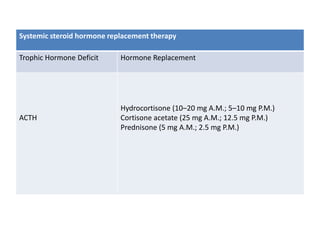
Systemic steroid hormone replacement therapy

Trophic Hormone Deficit     Hormone Replacement


                            Hydrocortisone (10–20 mg A.M.; 5–10 mg P.M.)
ACTH                        Cortisone acetate (25 mg A.M.; 12.5 mg P.M.)
                            Prednisone (5 mg A.M.; 2.5 mg P.M.)
Uses and problems of therapeutic
              steroid therapy
•   Apart from their use as therapeutic replacement for endocrine deficiency
    states, synthetic glucocorticoid s are widely used for many non-endocrine
    conditions

•    Short-term use (e.g. for acute asthma) carries only small risks of significant side-
    effects except for the simultaneous suppression of immune responses. The danger
    lies in their continuance, often through medical oversight or patient default. In
    general, therapy for 3 weeks or less, or a dose of prednisolone less than 1 0 mg
    per day, will not result in significant long-term suppression of the normal adrenal
    axis.

•   Long-term therapy with synthetic or natural steroids will, in most respects, mimic
    endogenous Cushing's syndrome. Exceptions are the relative absence of
    hirsutism, ac ne, hypertension and severe sodium retention, a s the common
    synthetic steroids have low androgenic and mineralocorticoid activity.

•   Excessive doses of steroids may also be absorbed from skin when strong
    dermatological preparations are used, but inhaled steroids rarely cause Cushing's
    syndrome,
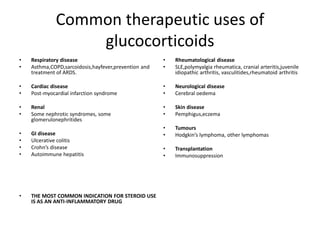
Common therapeutic uses of
                  glucocorticoids
•   Respiratory disease                               •   Rheumatological disease
•   Asthma,COPD,sarcoidosis,hayfever,prevention and   •   SLE,polymyalgia rheumatica, cranial arteritis,juvenile
    treatment of ARDS.                                    idiopathic arthritis, vasculitides,rheumatoid arthritis

•   Cardiac disease                                   •   Neurological disease
•   Post-myocardial infarction syndrome               •   Cerebral oedema

•   Renal                                             •   Skin disease
•   Some nephrotic syndromes, some                    •   Pemphigus,eczema
    glomerulonephritides
                                                      •   Tumours
•   GI disease                                        •   Hodgkin’s lymphoma, other lymphomas
•   Ulcerative colitis
•   Crohn’s disease                                   •   Transplantation
•   Autoimmune hepatitis                              •   Immunosuppression


•   THE MOST COMMON INDICATION FOR STEROID USE
    IS AS AN ANTI-INFLAMMATORY DRUG
INDICATION OF SYSTEMIC STEROIDS IN
         DENTAL SURGERY
•   Lichen planus
•   Aphthous ulcers
•   Benign mucous membrane pemphigoid
•   Pemphigus vulgaris
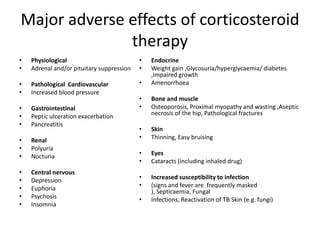
Major adverse effects of corticosteroid
              therapy
•   Physiological                          •   Endocrine
•   Adrenal and/or pituitary suppression   •   Weight gain ,Glycosuria/hyperglycaemia/ diabetes
                                               ,Impaired growth
•   Pathological Cardiovascular            •   Amenorrhoea
•   Increased blood pressure
                                           •   Bone and muscle
•   Gastrointestinal                       •   Osteoporosis, Proximal myopathy and wasting ,Aseptic
•   Peptic ulceration exacerbation             necrosis of the hip, Pathological fractures
•   Pancreatitis
                                           •   Skin
•   Renal                                  •   Thinning, Easy bruising
•   Polyuria
•   Nocturia                               •   Eyes
                                           •   Cataracts (including inhaled drug)
•   Central nervous
•   Depression                             •   Increased susceptibility to infection
•   Euphoria                               •   (signs and fever are frequently masked
                                               ), Septicaemia, Fungal
•   Psychosis                              •   Infections, Reactivation of TB Skin (e.g. fungi)
•   Insomnia
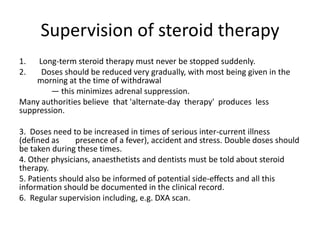
Supervision of steroid therapy
1.   Long-term steroid therapy must never be stopped suddenly.
2.    Doses should be reduced very gradually, with most being given in the
    morning at the time of withdrawal
        — this minimizes adrenal suppression.
Many authorities believe that 'alternate-day therapy' produces less
suppression.

3. Doses need to be increased in times of serious inter-current illness
(defined as     presence of a fever), accident and stress. Double doses should
be taken during these times.
4. Other physicians, anaesthetists and dentists must be told about steroid
therapy.
5. Patients should also be informed of potential side-effects and all this
information should be documented in the clinical record.
6. Regular supervision including, e.g. DXA scan.
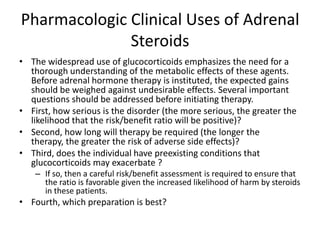
Pharmacologic Clinical Uses of Adrenal
              Steroids
• The widespread use of glucocorticoids emphasizes the need for a
  thorough understanding of the metabolic effects of these agents.
  Before adrenal hormone therapy is instituted, the expected gains
  should be weighed against undesirable effects. Several important
  questions should be addressed before initiating therapy.
• First, how serious is the disorder (the more serious, the greater the
  likelihood that the risk/benefit ratio will be positive)?
• Second, how long will therapy be required (the longer the
  therapy, the greater the risk of adverse side effects)?
• Third, does the individual have preexisting conditions that
  glucocorticoids may exacerbate ?
    – If so, then a careful risk/benefit assessment is required to ensure that
      the ratio is favorable given the increased likelihood of harm by steroids
      in these patients.
• Fourth, which preparation is best?
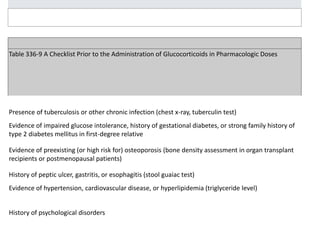
Table 336-9 A Checklist Prior to the Administration of Glucocorticoids in Pharmacologic Doses


Presence of tuberculosis or other chronic infection (chest x-ray, tuberculin test)
Evidence of impaired glucose intolerance, history of gestational diabetes, or strong family history of
type 2 diabetes mellitus in first-degree relative

Evidence of preexisting (or high risk for) osteoporosis (bone density assessment in organ transplant
recipients or postmenopausal patients)

History of peptic ulcer, gastritis, or esophagitis (stool guaiac test)
Evidence of hypertension, cardiovascular disease, or hyperlipidemia (triglyceride level)


History of psychological disorders
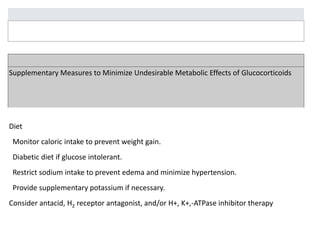
Supplementary Measures to Minimize Undesirable Metabolic Effects of Glucocorticoids


Diet
 Monitor caloric intake to prevent weight gain.
 Diabetic diet if glucose intolerant.
 Restrict sodium intake to prevent edema and minimize hypertension.
 Provide supplementary potassium if necessary.
Consider antacid, H2 receptor antagonist, and/or H+, K+,-ATPase inhibitor therapy
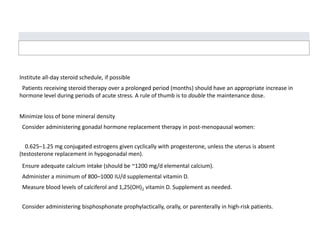
Institute all-day steroid schedule, if possible
 Patients receiving steroid therapy over a prolonged period (months) should have an appropriate increase in
hormone level during periods of acute stress. A rule of thumb is to double the maintenance dose.


Minimize loss of bone mineral density
 Consider administering gonadal hormone replacement therapy in post-menopausal women:


   0.625–1.25 mg conjugated estrogens given cyclically with progesterone, unless the uterus is absent
(testosterone replacement in hypogonadal men).
 Ensure adequate calcium intake (should be ~1200 mg/d elemental calcium).
 Administer a minimum of 800–1000 IU/d supplemental vitamin D.
 Measure blood levels of calciferol and 1,25(OH)2 vitamin D. Supplement as needed.


 Consider administering bisphosphonate prophylactically, orally, or parenterally in high-risk patients.
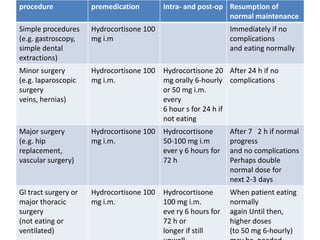
procedure             premedication        Intra- and post-op Resumption of
 Steroid cover for 100
Simple procedures Hydrocortisone
                                 operative procedures
                                             Immediately if no
                                                              normal maintenance

(e.g. gastroscopy,    mg i.m                                    complications
simple dental                                                   and eating normally
extractions)
Minor surgery         Hydrocortisone 100   Hydrocortisone 20 After 24 h if no
(e.g. laparoscopic    mg i.m.              mg orally 6-hourly complications
surgery                                    or 50 mg i.m.
veins, hernias)                            every
                                           6 hour s for 24 h if
                                           not eating
Major surgery         Hydrocortisone 100   Hydrocortisone       After 7 2 h if normal
(e.g. hip             mg i.m.              50-100 mg i.m        progress
replacement,                               ever y 6 hours for   and no complications
vascular surgery)                          72 h                 Perhaps double
                                                                normal dose for
                                                                next 2-3 days
Gl tract surgery or   Hydrocortisone 100   Hydrocortisone       When patient eating
major thoracic        mg i.m.              100 mg i.m.          normally
surgery                                    eve ry 6 hours for   again Until then,
(not eating or                             72 h or              higher doses
ventilated)                                longer if still      (to 50 mg 6-hourly)
THANKS

Systemic steroids

  • 1.
    SYSTEMIC STEROIDS JONATHAN OLESU
  • 2.
    ANATOMY AND PHYSIOLOGY •The adrenal glands are located on the superior aspect of each kidney and • consist of two defined portions • The outer portion of the gland, the adrenal cortex, produces three groups of steroid hormones: – glucocorticoids, – mineralocorticoids, – androgens. • They are derived from cholesterol and share a common core structure.
  • 3.
    • The adrenalcortex has three zones. • The outermost zona glomerulosa produces mineralocorticoids, primarily aldosterone • The zona fasciculata and the innermost • zona reticularis secrete glucocorticoid,cortisol, and androgens. • The inner portion of the gland, adrenal medulla,produces catecholamines, – epinephrine (adrenaline), and – norepinephrine (noradrenaline).
  • 4.
    • aldosterone, – for sodium and potassium balance and extracellular fluid volume. • Cortisol – essential for metabolism, – anti-inflammatory properties, and – maintenance of homeostasis during periods of physical or emotional stress.
  • 5.
    • Cortisol secretionis regulated by the hypothalamic- pituitary-adrenal axis. The circadian rhythm, mediated by the CNS, and responses to stress stimulate the hypothalamus to release corticotropin-releasing hormone (CRH), which stimulates the production and secretion of adrenocorticotropic hormone (ACTH) by the anterior pituitary. • The adrenal cortex is stimulated by ACTH to produce and secrete cortisol. Circulating plasma cortisol levels are elevated within minutes after stimulation in a normally functioning gland.
  • 6.
    • The increasedlevels of cortisol act to inhibit the production of CRH and ACTH, and thereby decrease the output of cortisol • This process constitutes the negative feedback loop of cortisol regulation. • The normal pattern of cortisol secretion usually peaks about the time of awakening in the morning and is lowest in the afternoon and evening. • During a 24-hour period, approximately 20 mg of cortisol are secreted. Stress from trauma, illness, and emotional concerns can enhance this secretion.
  • 8.
    • Aldosterone secretionis regulated by – renin-angiotensin system, – ACTH, sodium, and – potassium levels . • When renal blood pressure decreases, – renin is released, which – stimulates release of angiotensin and – activates the secretion of aldosterone • via a negative feedback loop.
  • 9.
    Examples of systemicsteroids • Short-Acting – Cortisol (hydrocortisone) – Cortisone – Prednisone – Prednisolone – Methylprednisolone • Intermediate-Acting – triamcinolone • Long-Acting – Betamethasone – Dexamethasone
  • 10.
    Systemic steroid hormonereplacement therapy Trophic Hormone Deficit Hormone Replacement Hydrocortisone (10–20 mg A.M.; 5–10 mg P.M.) ACTH Cortisone acetate (25 mg A.M.; 12.5 mg P.M.) Prednisone (5 mg A.M.; 2.5 mg P.M.)
  • 11.
    Uses and problemsof therapeutic steroid therapy • Apart from their use as therapeutic replacement for endocrine deficiency states, synthetic glucocorticoid s are widely used for many non-endocrine conditions • Short-term use (e.g. for acute asthma) carries only small risks of significant side- effects except for the simultaneous suppression of immune responses. The danger lies in their continuance, often through medical oversight or patient default. In general, therapy for 3 weeks or less, or a dose of prednisolone less than 1 0 mg per day, will not result in significant long-term suppression of the normal adrenal axis. • Long-term therapy with synthetic or natural steroids will, in most respects, mimic endogenous Cushing's syndrome. Exceptions are the relative absence of hirsutism, ac ne, hypertension and severe sodium retention, a s the common synthetic steroids have low androgenic and mineralocorticoid activity. • Excessive doses of steroids may also be absorbed from skin when strong dermatological preparations are used, but inhaled steroids rarely cause Cushing's syndrome,
  • 12.
    Common therapeutic usesof glucocorticoids • Respiratory disease • Rheumatological disease • Asthma,COPD,sarcoidosis,hayfever,prevention and • SLE,polymyalgia rheumatica, cranial arteritis,juvenile treatment of ARDS. idiopathic arthritis, vasculitides,rheumatoid arthritis • Cardiac disease • Neurological disease • Post-myocardial infarction syndrome • Cerebral oedema • Renal • Skin disease • Some nephrotic syndromes, some • Pemphigus,eczema glomerulonephritides • Tumours • GI disease • Hodgkin’s lymphoma, other lymphomas • Ulcerative colitis • Crohn’s disease • Transplantation • Autoimmune hepatitis • Immunosuppression • THE MOST COMMON INDICATION FOR STEROID USE IS AS AN ANTI-INFLAMMATORY DRUG
  • 13.
    INDICATION OF SYSTEMICSTEROIDS IN DENTAL SURGERY • Lichen planus • Aphthous ulcers • Benign mucous membrane pemphigoid • Pemphigus vulgaris
  • 14.
    Major adverse effectsof corticosteroid therapy • Physiological • Endocrine • Adrenal and/or pituitary suppression • Weight gain ,Glycosuria/hyperglycaemia/ diabetes ,Impaired growth • Pathological Cardiovascular • Amenorrhoea • Increased blood pressure • Bone and muscle • Gastrointestinal • Osteoporosis, Proximal myopathy and wasting ,Aseptic • Peptic ulceration exacerbation necrosis of the hip, Pathological fractures • Pancreatitis • Skin • Renal • Thinning, Easy bruising • Polyuria • Nocturia • Eyes • Cataracts (including inhaled drug) • Central nervous • Depression • Increased susceptibility to infection • Euphoria • (signs and fever are frequently masked ), Septicaemia, Fungal • Psychosis • Infections, Reactivation of TB Skin (e.g. fungi) • Insomnia
  • 15.
    Supervision of steroidtherapy 1. Long-term steroid therapy must never be stopped suddenly. 2. Doses should be reduced very gradually, with most being given in the morning at the time of withdrawal — this minimizes adrenal suppression. Many authorities believe that 'alternate-day therapy' produces less suppression. 3. Doses need to be increased in times of serious inter-current illness (defined as presence of a fever), accident and stress. Double doses should be taken during these times. 4. Other physicians, anaesthetists and dentists must be told about steroid therapy. 5. Patients should also be informed of potential side-effects and all this information should be documented in the clinical record. 6. Regular supervision including, e.g. DXA scan.
  • 16.
    Pharmacologic Clinical Usesof Adrenal Steroids • The widespread use of glucocorticoids emphasizes the need for a thorough understanding of the metabolic effects of these agents. Before adrenal hormone therapy is instituted, the expected gains should be weighed against undesirable effects. Several important questions should be addressed before initiating therapy. • First, how serious is the disorder (the more serious, the greater the likelihood that the risk/benefit ratio will be positive)? • Second, how long will therapy be required (the longer the therapy, the greater the risk of adverse side effects)? • Third, does the individual have preexisting conditions that glucocorticoids may exacerbate ? – If so, then a careful risk/benefit assessment is required to ensure that the ratio is favorable given the increased likelihood of harm by steroids in these patients. • Fourth, which preparation is best?
  • 17.
    Table 336-9 AChecklist Prior to the Administration of Glucocorticoids in Pharmacologic Doses Presence of tuberculosis or other chronic infection (chest x-ray, tuberculin test) Evidence of impaired glucose intolerance, history of gestational diabetes, or strong family history of type 2 diabetes mellitus in first-degree relative Evidence of preexisting (or high risk for) osteoporosis (bone density assessment in organ transplant recipients or postmenopausal patients) History of peptic ulcer, gastritis, or esophagitis (stool guaiac test) Evidence of hypertension, cardiovascular disease, or hyperlipidemia (triglyceride level) History of psychological disorders
  • 18.
    Supplementary Measures toMinimize Undesirable Metabolic Effects of Glucocorticoids Diet Monitor caloric intake to prevent weight gain. Diabetic diet if glucose intolerant. Restrict sodium intake to prevent edema and minimize hypertension. Provide supplementary potassium if necessary. Consider antacid, H2 receptor antagonist, and/or H+, K+,-ATPase inhibitor therapy
  • 19.
    Institute all-day steroidschedule, if possible Patients receiving steroid therapy over a prolonged period (months) should have an appropriate increase in hormone level during periods of acute stress. A rule of thumb is to double the maintenance dose. Minimize loss of bone mineral density Consider administering gonadal hormone replacement therapy in post-menopausal women: 0.625–1.25 mg conjugated estrogens given cyclically with progesterone, unless the uterus is absent (testosterone replacement in hypogonadal men). Ensure adequate calcium intake (should be ~1200 mg/d elemental calcium). Administer a minimum of 800–1000 IU/d supplemental vitamin D. Measure blood levels of calciferol and 1,25(OH)2 vitamin D. Supplement as needed. Consider administering bisphosphonate prophylactically, orally, or parenterally in high-risk patients.
  • 20.
    procedure premedication Intra- and post-op Resumption of Steroid cover for 100 Simple procedures Hydrocortisone operative procedures Immediately if no normal maintenance (e.g. gastroscopy, mg i.m complications simple dental and eating normally extractions) Minor surgery Hydrocortisone 100 Hydrocortisone 20 After 24 h if no (e.g. laparoscopic mg i.m. mg orally 6-hourly complications surgery or 50 mg i.m. veins, hernias) every 6 hour s for 24 h if not eating Major surgery Hydrocortisone 100 Hydrocortisone After 7 2 h if normal (e.g. hip mg i.m. 50-100 mg i.m progress replacement, ever y 6 hours for and no complications vascular surgery) 72 h Perhaps double normal dose for next 2-3 days Gl tract surgery or Hydrocortisone 100 Hydrocortisone When patient eating major thoracic mg i.m. 100 mg i.m. normally surgery eve ry 6 hours for again Until then, (not eating or 72 h or higher doses ventilated) longer if still (to 50 mg 6-hourly)
  • 21.