PEER-TO-PEER NETWORK &
CLIENT-SERVER NETWORK
Advantages & Disadvantages of
Presented By:
Cornelio, Ma. Patricia Kayle A.
Enriquez, Sheriah V.
WHAT IS PEER-TO-PEER
NETWORK?
it is a distributed application architecture that partitions tasks or
workloads between peers. It is a group of computers, each of which
acts as a node for sharing files within the group.
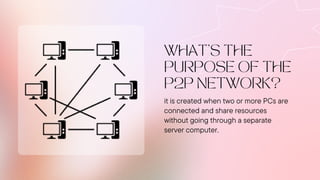
it is created when two or more PCs are
connected and share resources
without going through a separate
server computer.
WHAT'S THE
PURPOSE OF THE
P2P NETWORK?
The failure of one computer won’t disrupt
the rest of the system.
Peer to peer networks don’t require a
network operating system.
You get to avoid the expense of having and
maintaining a server.
This system doesn’t require advanced
knowledge to be useful.
It reduces the need to have technical staff
available.
5 ADVANTAGES
OF P2P
NETWORK
1
2
3
4
5
5
DISADVANTAGES
OF P2P
NETWORK
The files or resources are not centrally
organized with a P2P network.
P2P networks often have very little security.
Virus introduction risks rise with a peer to
peer network.
There is no way to back up files or folders
centrally.
P2P networks often suffer from
performance issues.
1
2
3
4
5
WHAT IS CLIENT-
SERVER NETWORK?
it is a communications model in which multiple client programs share
the services of a common server program. A form of internet network
that consists of a single central computer functioning as a server and
directing several other computers, referred to as clients.
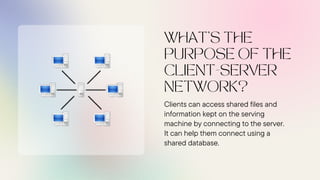
Clients can access shared files and
information kept on the serving
machine by connecting to the server.
It can help them connect using a
shared database.
WHAT'S THE
PURPOSE OF THE
CLIENT-SERVER
NETWORK?
5 ADVANTAGES
OF CLIENT-
SERVER
NETWORK
Centralization: All the necessary
information are placed in a single location.
Security: The data is well protected due to
its centralized architecture
A client-server network may be expanded
by adding network segments, servers, and
PCs with little downtime.
The client-server system's nodes are all
self-contained, requesting data only from
the server, allowing for simple upgrades,
replacements, and relocation.
It is really simple to handle files because
they are all kept on the same server.
1
2
3
4
5
5
DISADVANTAGES
OF CLIENT-
SERVER
NETWORK
Traffic Congestion: If too many clients make
request from the same server, it will result in
crashes or slowing down of the connection.
The cost of setting up and maintaining the
server is typically higher than the cost of
running the network.
Robustness: The whole network will be
interrupted, if the primary server experiences
failure or interference.
Maintenance: When the servers are
implemented, it is going to work non-stop.
Not all the resources that is present on the
server is acquirable.
1
2
3
4
5
THANK YOU FOR
LISTENING!

Advantages-and-Disadvantages-of-P2P-Network-Client-Server-Network.pdf

  • 1.
    PEER-TO-PEER NETWORK & CLIENT-SERVERNETWORK Advantages & Disadvantages of Presented By: Cornelio, Ma. Patricia Kayle A. Enriquez, Sheriah V.
  • 2.
    WHAT IS PEER-TO-PEER NETWORK? itis a distributed application architecture that partitions tasks or workloads between peers. It is a group of computers, each of which acts as a node for sharing files within the group.
  • 3.
    it is createdwhen two or more PCs are connected and share resources without going through a separate server computer. WHAT'S THE PURPOSE OF THE P2P NETWORK?
  • 4.
    The failure ofone computer won’t disrupt the rest of the system. Peer to peer networks don’t require a network operating system. You get to avoid the expense of having and maintaining a server. This system doesn’t require advanced knowledge to be useful. It reduces the need to have technical staff available. 5 ADVANTAGES OF P2P NETWORK 1 2 3 4 5
  • 5.
    5 DISADVANTAGES OF P2P NETWORK The filesor resources are not centrally organized with a P2P network. P2P networks often have very little security. Virus introduction risks rise with a peer to peer network. There is no way to back up files or folders centrally. P2P networks often suffer from performance issues. 1 2 3 4 5
  • 6.
    WHAT IS CLIENT- SERVERNETWORK? it is a communications model in which multiple client programs share the services of a common server program. A form of internet network that consists of a single central computer functioning as a server and directing several other computers, referred to as clients.
  • 7.
    Clients can accessshared files and information kept on the serving machine by connecting to the server. It can help them connect using a shared database. WHAT'S THE PURPOSE OF THE CLIENT-SERVER NETWORK?
  • 8.
    5 ADVANTAGES OF CLIENT- SERVER NETWORK Centralization:All the necessary information are placed in a single location. Security: The data is well protected due to its centralized architecture A client-server network may be expanded by adding network segments, servers, and PCs with little downtime. The client-server system's nodes are all self-contained, requesting data only from the server, allowing for simple upgrades, replacements, and relocation. It is really simple to handle files because they are all kept on the same server. 1 2 3 4 5
  • 9.
    5 DISADVANTAGES OF CLIENT- SERVER NETWORK Traffic Congestion:If too many clients make request from the same server, it will result in crashes or slowing down of the connection. The cost of setting up and maintaining the server is typically higher than the cost of running the network. Robustness: The whole network will be interrupted, if the primary server experiences failure or interference. Maintenance: When the servers are implemented, it is going to work non-stop. Not all the resources that is present on the server is acquirable. 1 2 3 4 5
  • 10.