Lesson Exemplar
for TLE
Lesson
1
7
Quarter 1
Lesson Exemplar for TLE Grade 7
Quarter 1: Lesson 1 (Week 1)
SY 2024-2025
This material is intended exclusively for the use of teachers participating in the implementation of the MATATAG K to 10 Curriculum during the School
Year 2024-2025. It aims to assist in delivering the curriculum content, standards, and lesson competencies. Any unauthorized reproduction, distribution,
modification, or utilization of this material beyond the designated scope is strictly prohibited and may result in appropriate legal actions and disciplinary measures.
Borrowed content included in this material are owned by their respective copyright holders. Every effort has been made to locate and obtain permission
to use these materials from their respective copyright owners. The publisher and development team do not represent nor claim ownership over them.
Every care has been taken to ensure the accuracy of the information provided in this material. For inquiries or feedback, please write or call the Office
of the Director of the Bureau of Learning Resources via telephone numbers (02) 8634-1072 and 8631-6922 or by email at blr.od@deped.gov.ph.
Development Team
Writer:
• Janet C. Rivera, PhD (Mariano Marcos State University)
Validators:
• Emilio Aguinaldo, MTE (Philippine Normal University — Manila)
• Regie Boy B. Fabro, PhD (Mariano Marcos State University)
Management Team
Philippine Normal University
Research Institute for Teacher Quality
SiMERR National Research Centre
1
TLE /QUARTER 1/ GRADE 7
I. CURRICULUM CONTENT, STANDARDS, AND LESSON COMPETENCIES
A. Content
Standards
The learners demonstrate an understanding of ICT sectors, as well as the potential career and business opportunities
these sectors offer in relation to their chosen career in the future.
The learners demonstrate an understanding of current trends and emerging issues in ICT
B. Performance
Standards
The learners convert number systems in practical scenarios.
C. Learning
Competencies
and Objectives
Learning Competencies
1. The learners analyze the various sectors of ICT and evaluate the potential career and business prospects relevant
to their future career choices.
2. Discuss the emerging trends and issues in ICT.
Learning Objectives
At the end of the lesson, the learners are expected to:
1. Identify various ICT sectors and potential career and business opportunities;
2. Identify the various trends in ICT that may contribute to developments in the ICT industry and Entrepreneurial
activities;
3. Create graphic organizers on the different ICT Sectors’ career and business opportunities;
4. Examine skills and competencies related to ICT career and business opportunities;
5. Identify the issues that may hamper any progress in the ICT industry;
6. Value the significance of ICT Sectors to future career or business opportunities;
7. Appreciate the significant relevance of the ICT sectors in their future career or business opportunities; and
8. Reflect on the significance of trends and issues in ICT.
D. Content Sectors of ICT and Its Career and Business Opportunities
• Computer programming - Programmer/Web and Game Developer
• Visual arts – animator/ illustrator/ graphic designer
• Computer system servicing – computer/ network
• technician
• Telecommunication – call center agents/ outbound
• and inbound agents/ contact center services
Trends and Issues in ICT
2
E. Integration SDG 4: Quality Education
SGD 9: Industry, Innovation and Infrastructure
II. LEARNING RESOURCES
Khan, U. (2023). Choosing your career path: Job vs business. LinkedIn. https://www.linkedin.com/pulse/choosing-your-career-path-job-vs-
business-uzair-khan/
Phillips, A. (2023). ICT and career paths. Unpublished manuscript.
III. TEACHING AND LEARNING PROCEDURE NOTES TO TEACHERS
A. Activating Prior
Knowledge
DAY 1 AND 2
1. Short Review
Use search engines to look for sectors of ICT and career business
opportunities. Provide an image and make a summary for each career.Prepare
and facilitate a class discussion based on the following question:
1.What are the ICT sector and career opportunities you were able to find?
2. Are you familiar with those sectors?
3. What aspects are they common with?
4. Among these ICT career opportunities, what career do you want to pursue?
Note and assess the learners’ responses.
2. Feedback (Optional)
Divide the class into small groups
of 5 students. After a few
minutes, have each group share
their findings with the class and
facilitate a discussion by asking
questions.
3
B. Establishing
Lesson Purpose
1. Lesson Purpose
Present a “Word Cloud Art” that contains keywords and terms. Asks students a
thought-provoking question or presenting a real-life scenario that highlights the
importance of knowing sectors of ICT and career business opportunities.
Ask the students, "Why is it important to understand the different sectors of ICT
and the career opportunities they offer?".
2. Unlocking Content Area Vocabulary
• Animation A series of pictures or frames created to simulate movement.
• ICT sectors combine manufacturing and services industries whose
products primarily fulfil or enable the function of information processing
and communication by electronic means, including transmission and
display.
• Graphic designers create visual concepts, using computer software or by
hand, to communicate ideas that inspire, inform, and captivate
consumers.
• Computer security, cybersecurity, digital security, or information
technology security is the protection of computer systems and networks
from attacks by malicious actors that may result in unauthorized access.
• Computer Systems Servicing refers to the process of providing
maintenance and support for computer systems. It involves tasks such as
installing, configuring, troubleshooting, and maintaining computer
systems and networks.
Start with questions that will
pique the interest and help the
students understand the
practical applications of the
concepts you're about to
introduce.
Inform learners about what they
will achieve by the end of the
lesson.
By the end of the lesson, you will
have a deeper understanding of
the various sectors of ICT and
the career and business
opportunities they offer, as well
as the recent trends and issues
in ICT.
C. Developing and
Deepening
Understanding
SUB-TOPIC 1: Sectors of ICT and Its Career and Business Opportunities
1. Explicitation
ICT plays a significant role nowadays. ICT or Information and Communications
Technology stresses the role of unified communications and the integration of
telecommunications (telephone lines and wireless signals) and computers, as
well as necessary enterprise software, middleware, storage, and audiovisual,
that enable users to access, store, transmit, understand, and manipulate
information. The creation, production, commercialization, and widespread use
of new technology are the major operations carried out by the manufacturing
and service sectors that comprise the ICT sector. ICT skills are becoming more
in demand, and organizations might benefit from combining these with
Start the class with an engaging
activity by showing career
pictures to the students and
allow them to identify the
sectors.
4
communication abilities in Public Relations, advertising, and media
communications. Here are the different preferences when it comes to choosing
career paths. It covers career opportunities in ICT sectors such as Programming,
Visual Arts, Computer System Servicing, and Telecommunications.
Computer Programming- Programming skills are essential for many
technology disciplines but are in especially high demand for software and web
development roles.
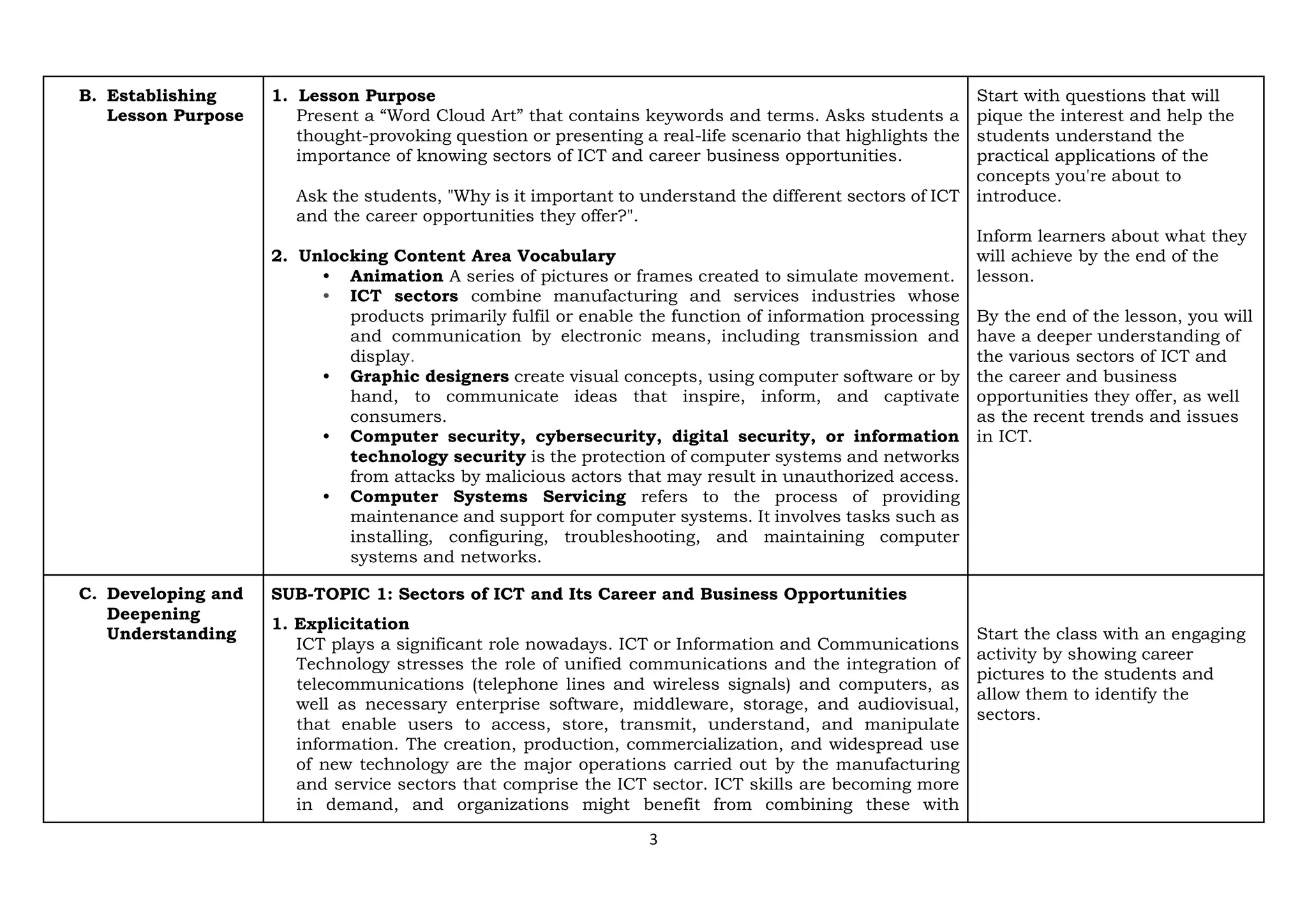
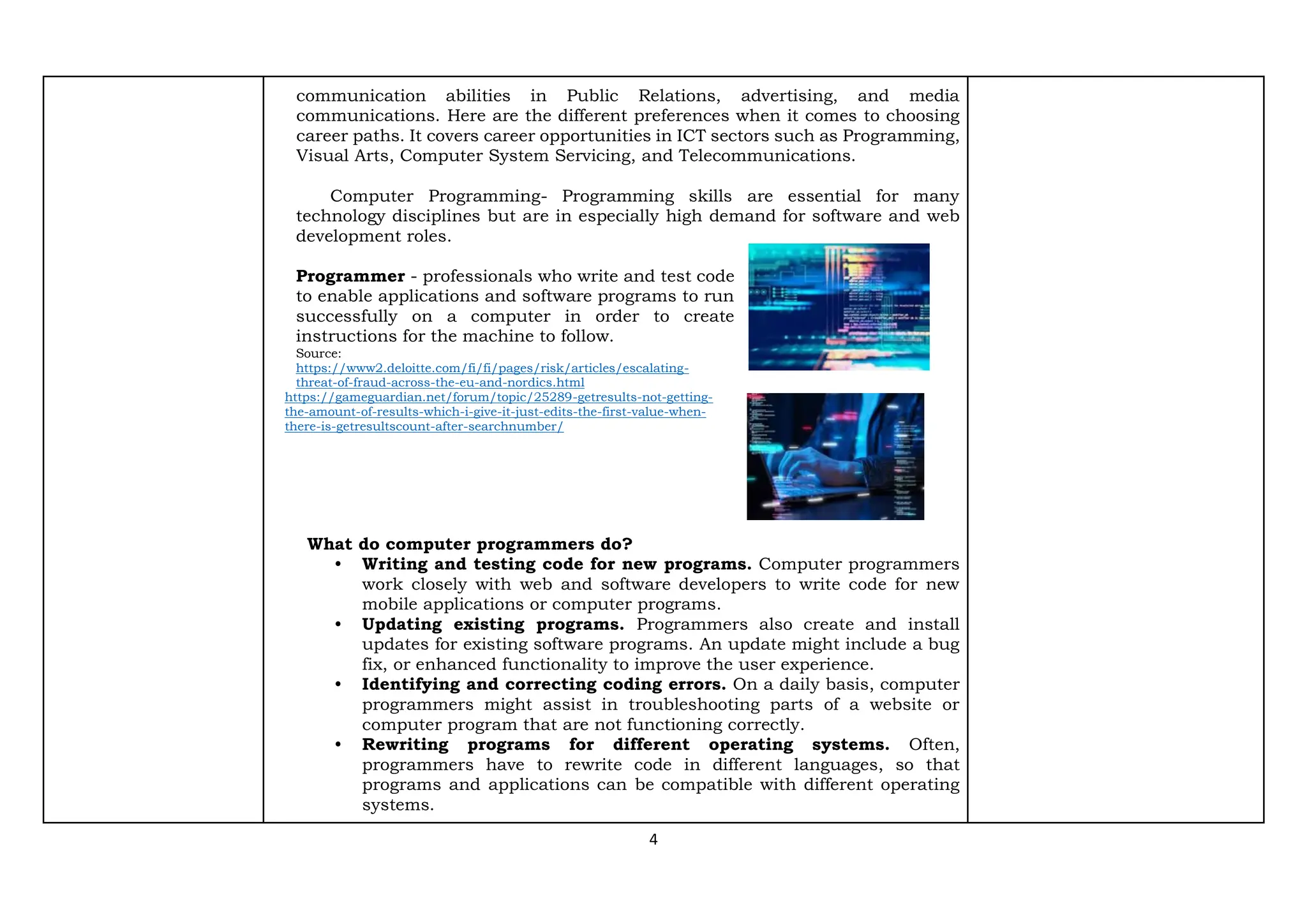
Programmer - professionals who write and test code
to enable applications and software programs to run
successfully on a computer in order to create
instructions for the machine to follow.
Source:
https://www2.deloitte.com/fi/fi/pages/risk/articles/escalating-
threat-of-fraud-across-the-eu-and-nordics.html
https://gameguardian.net/forum/topic/25289-getresults-not-getting-
the-amount-of-results-which-i-give-it-just-edits-the-first-value-when-
there-is-getresultscount-after-searchnumber/
What do computer programmers do?
• Writing and testing code for new programs. Computer programmers
work closely with web and software developers to write code for new
mobile applications or computer programs.
• Updating existing programs. Programmers also create and install
updates for existing software programs. An update might include a bug
fix, or enhanced functionality to improve the user experience.
• Identifying and correcting coding errors. On a daily basis, computer
programmers might assist in troubleshooting parts of a website or
computer program that are not functioning correctly.
• Rewriting programs for different operating systems. Often,
programmers have to rewrite code in different languages, so that
programs and applications can be compatible with different operating
systems.
5
• Secure programs against cybersecurity threats. Many computer
programmers work in the cybersecurity field, helping to identify
malicious software and fix software that could be vulnerable to potential
hacks.
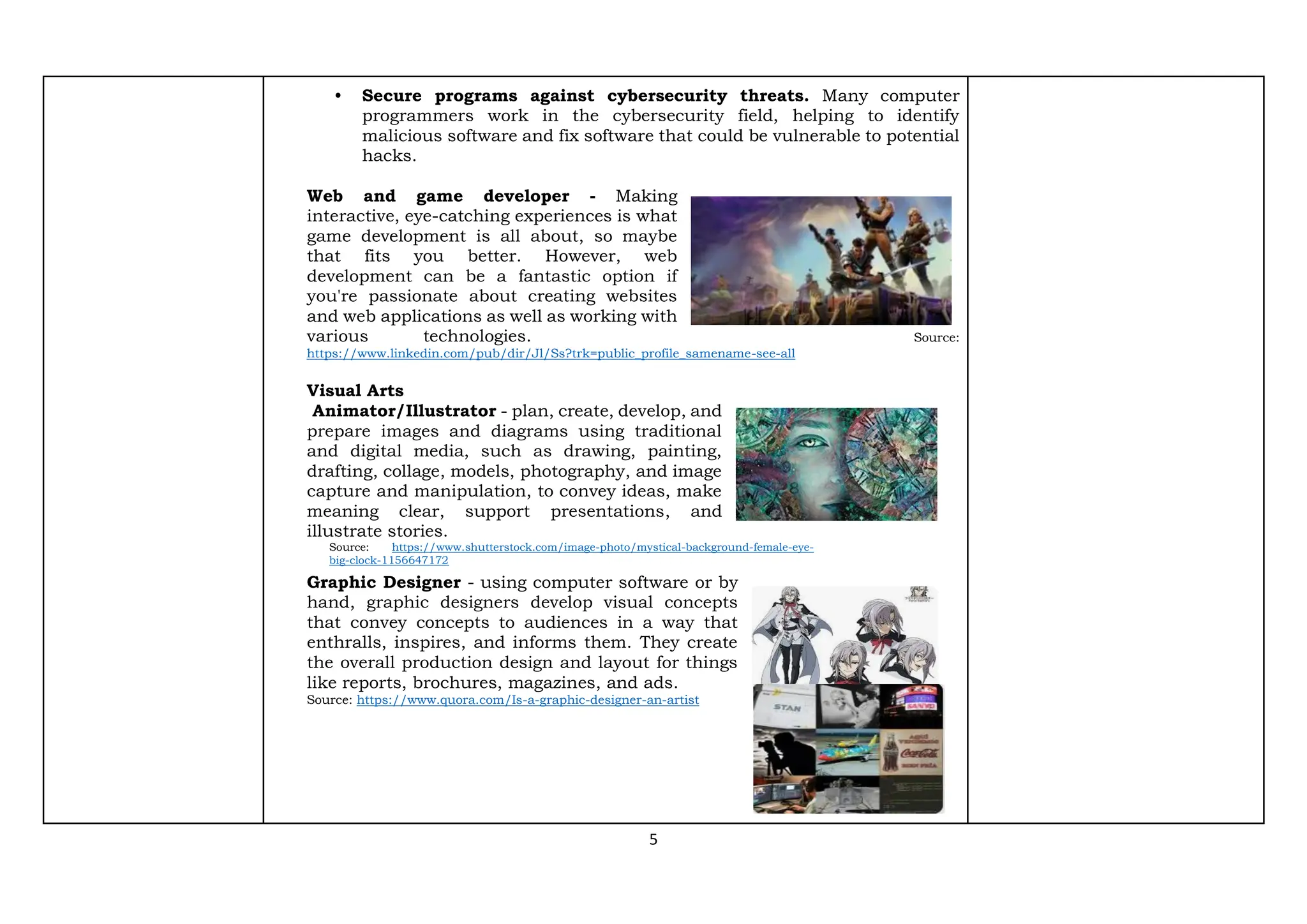
Web and game developer - Making
interactive, eye-catching experiences is what
game development is all about, so maybe
that fits you better. However, web
development can be a fantastic option if
you're passionate about creating websites
and web applications as well as working with
various technologies. Source:
https://www.linkedin.com/pub/dir/Jl/Ss?trk=public_profile_samename-see-all
Visual Arts
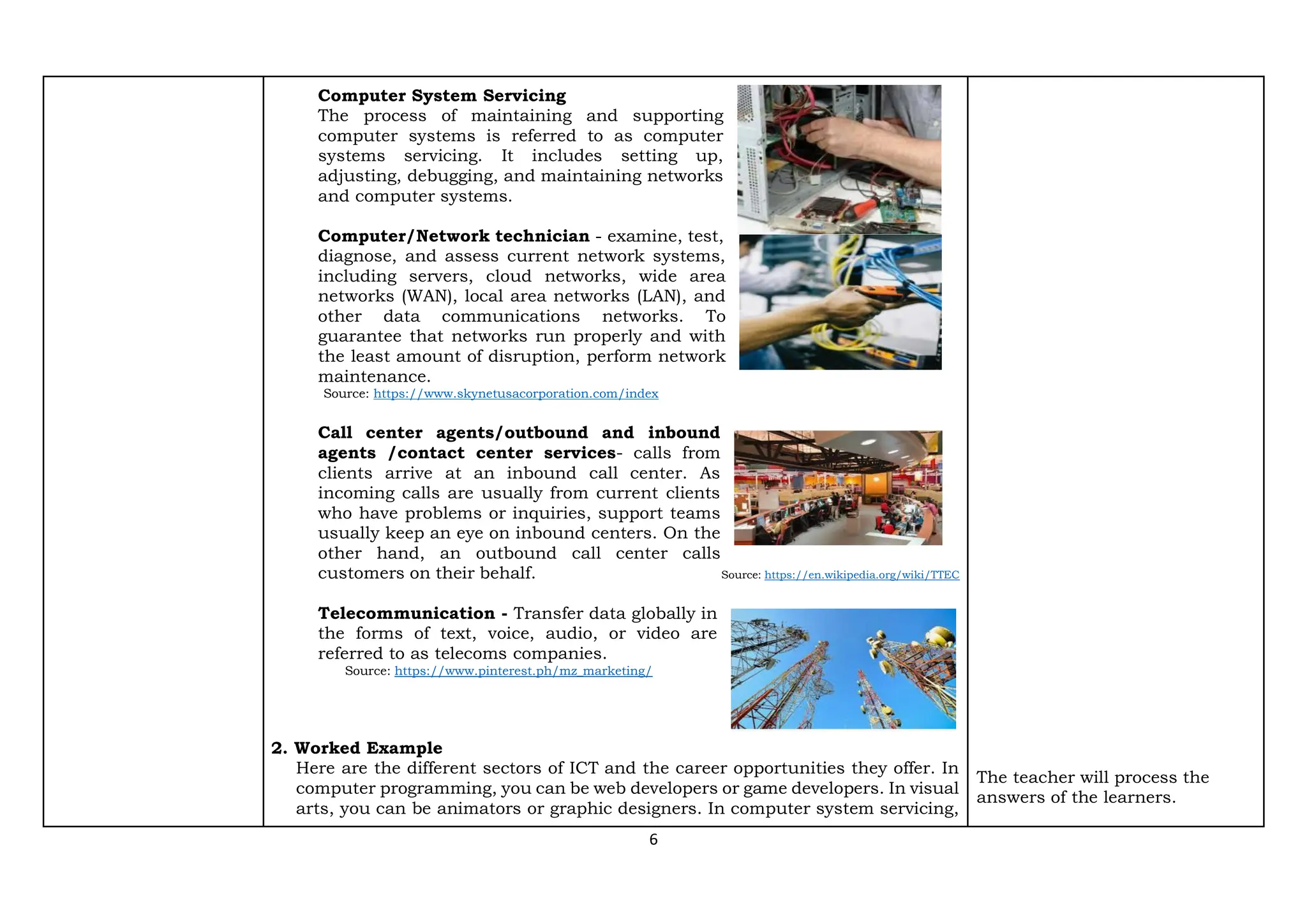
Animator/Illustrator - plan, create, develop, and
prepare images and diagrams using traditional
and digital media, such as drawing, painting,
drafting, collage, models, photography, and image
capture and manipulation, to convey ideas, make
meaning clear, support presentations, and
illustrate stories.
Source: https://www.shutterstock.com/image-photo/mystical-background-female-eye-
big-clock-1156647172
Graphic Designer - using computer software or by
hand, graphic designers develop visual concepts
that convey concepts to audiences in a way that
enthralls, inspires, and informs them. They create
the overall production design and layout for things
like reports, brochures, magazines, and ads.
Source: https://www.quora.com/Is-a-graphic-designer-an-artist
6
Computer System Servicing
The process of maintaining and supporting
computer systems is referred to as computer
systems servicing. It includes setting up,
adjusting, debugging, and maintaining networks
and computer systems.
Computer/Network technician - examine, test,
diagnose, and assess current network systems,
including servers, cloud networks, wide area
networks (WAN), local area networks (LAN), and
other data communications networks. To
guarantee that networks run properly and with
the least amount of disruption, perform network
maintenance.
Source: https://www.skynetusacorporation.com/index
Call center agents/outbound and inbound
agents /contact center services- calls from
clients arrive at an inbound call center. As
incoming calls are usually from current clients
who have problems or inquiries, support teams
usually keep an eye on inbound centers. On the
other hand, an outbound call center calls
customers on their behalf. Source: https://en.wikipedia.org/wiki/TTEC
Telecommunication - Transfer data globally in
the forms of text, voice, audio, or video are
referred to as telecoms companies.
Source: https://www.pinterest.ph/mz_marketing/
2. Worked Example
Here are the different sectors of ICT and the career opportunities they offer. In
computer programming, you can be web developers or game developers. In visual
arts, you can be animators or graphic designers. In computer system servicing,
The teacher will process the
answers of the learners.
7
you can be computer or network technicians. In telecommunication, you can be
call-center agents or contact center services representatives.
Ask learners to identify which sector interests them the most and why.
"Think about the ICT sector that interests you the most. Why do you like this
sector? What career opportunities do you want to pursue?"
3. Lesson Activity
See Worksheet Week 1 No. 1 and 2
DAY 3
SUB-TOPIC 2: Trends and Issues in ICT
1. Explicitation
Every year, current trends emerge in the ICT business. In the modern world,
one needs to be conversant with all the different trends they encompass.
Knowledge of the Current patterns will be beneficial for whatever one's vocation.
You or anybody else recognizes the possibilities of enhancements as well as the
advancement of this kind of business.
The technology sector is presently going through unparalleled expansion.
Increasingly more Companies are trying to grow within this sector due to its
excellent potential. ICT has become recognized as an important and appreciated
element within the present Organizational structure.
What are the available ICT trends? Should we be attempting to locate it on
theinternet, there's a huge volume of knowledge on the patterns, but for our
lesson, we'll just accentuate the following patterns.
• Superapps, the ICT supertrend
Asia, particularly China, is the origin of this idea. These are applications
that combine a lot of services so users can have access to a single
application that does everything. The services include a dedicated
messaging area and a bank transfer area. As they boost their
competitiveness and foster customer loyalty, they are becoming more and
more well-known among businesses.
• Explosion of the metaverse in the business world
With the creation of virtual spaces that can blur physical barriers, the
virtual world hopes to realize its great potential and excel in important
fields like the potential to change the way people live, work, and shop.
• Digital twins
The teacher will ask the learners
for some questions, clarification,
or muddy parts in the lesson,
and explain it with further
examples if necessary.
V. Synthesis/Extended
Practice/Differentiation
Ask the learner to research other
ICT sectors/ industries in the
community and have it
presented the next day.
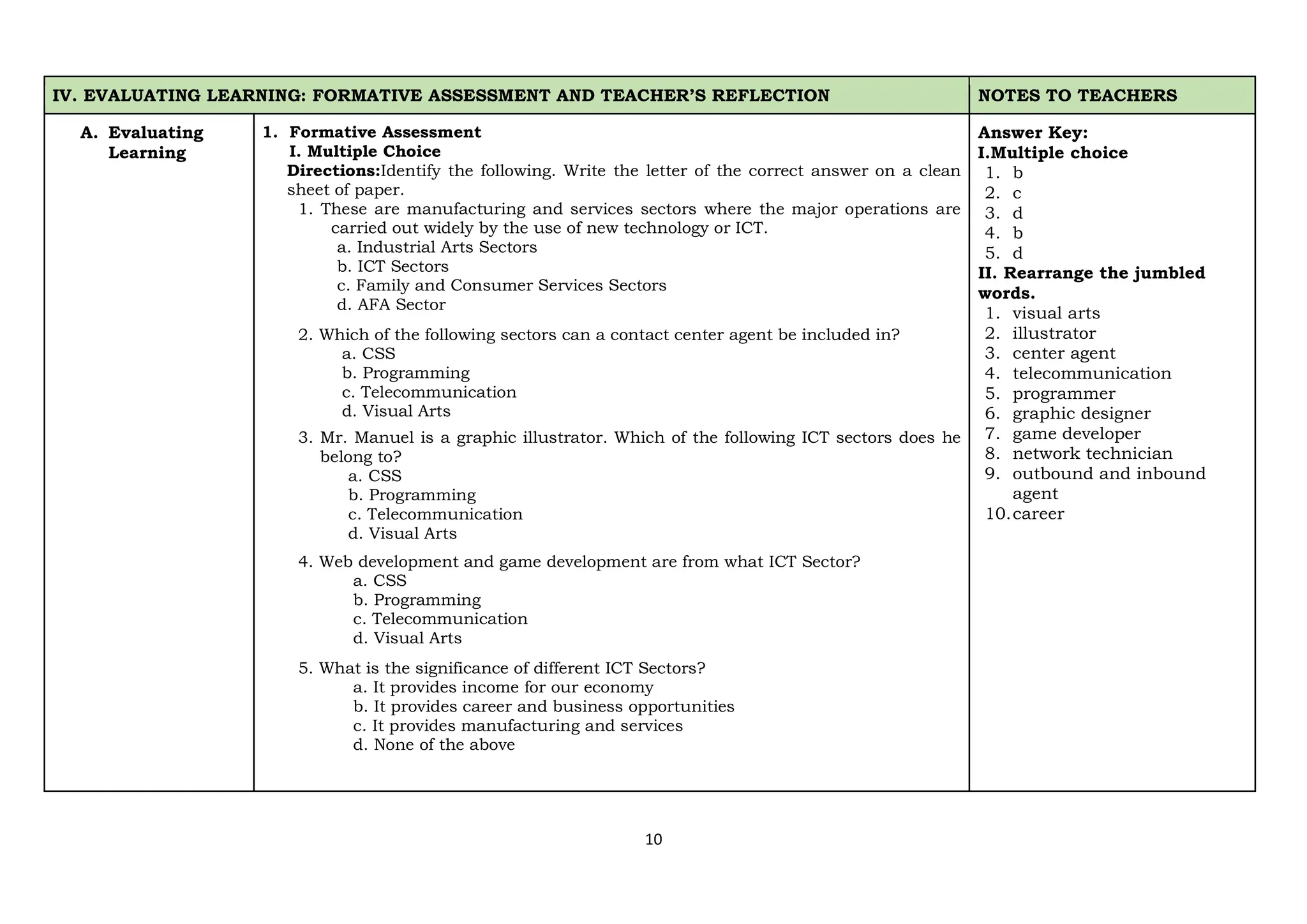
Start the class by engaging them
in an inquiry activity. Showing
the students a picture or collage
that depicts the current trends in
the ICT Industry.
8
Not only can this technology create sets of digital duplicates of spaces,
elements, and systems to manage errors, save costs, and produce more
accurate products.
• MedTech, the revolution in medicine
The convergence of IoT and MedTech represents a significant chance to
leverage digital technologies like virtual care, RPA, AI, and others to
overcome obstacles and settle disputes in the modern healthcare
industry.
• Artificial Intelligence and Cybersecurity
The primary goal of this technology is to increase data security on smart
networks; therefore, businesses should prioritize optimizing smart device
security capabilities.
• Blockchain, one of the most secure ICT trends
guarantees that the integrity of data is maintained while doing away with
single control over information and party middlemen. To enable the
automation of transactions and communications, the data are thus stored
in a highly secure and encrypted manner, thereby providing an
unquestionable boost to digital identity.
Issues in Information and Communications Technology (ICT)
• Cybersecurity threats: With the increasing reliance on digital systems
and the internet, cybersecurity threats such as hacking, malware,
phishing, and cyber attacks have become a significant concern for
individuals, businesses, and governments. Protecting sensitive data and
critical infrastructure from cyber threats is a top priority.
• Data privacy and regulation: The collection, storage, and use of personal
data by companies and organizations have raised concerns about data
privacy.
• Artificial Intelligence (AI) and automation: The rapid development of AI
and automation technologies has raised concerns about job displacement,
algorithmic bias, and ethical implications.
• Slow Internet Connections: Causes like network congestion, distance
from server, outdated hardware or software
• Viruses: Different types like trojans, worms, ransomware that can corrupt
data, steal info. How they spread through downloads, emails, networks.
Source:sprintzeal.com
1. What does the picture
depict?
2. How can you relate it to
our previous lesson in the career
opportunities in ICT?
9
Other potential issus:
• E-waste and environmental impact of hardware/devices
• IT personnel shortages and skills gaps
• Digital divide and access inequalities
• Ethical issues around AI, autonomous systems
• Regulation and governance of emerging technologies
2. Worked Example
Here are examples of recent trends and issues in ICT such as artificial
intelligence, cloud computing, and cybersecurity. Notice how these affect our
daily lives and businesses. Learners discuss the impact of these trends and
issues on society and industry. Discuss in your group the impact of these trends
and issues on our society and industry. How can we solve these issues?
DAY 4
3. Lesson Activity
See Worksheet Week 1 No. 3
The teacher will process the
learners’ responses.
Explain to the learners that the
lesson will focus on the concept of
trends and possible issues in the
ICT Industry.
Divide the class into small groups
of 5 students. After a few
minutes, have each group share
their work and facilitate a
discussion by asking questions
D. Making
Generalizations
1. Learners’ Takeaways
The teacher will ask the learners:
1. What is the significant impact of these ICT Sectors in the career and business
opportunities that they may undertake in the future?
2. Why does the issue always arise whenever there is a trend?
3. In your opinion, discuss possible trends five years fromnow?
4. How do ICT trends change as time goes by?
2. Reflection on Learning
The teacher will ask the learners to explain the concept of ICT Sectors and the
career and business opportunities related to it. The teacher will call selected
learners to share their answers. How does this lesson help you to better
understand the concept of Trends and Issues in ICT?
The teacher will ask the learners
the following questions.
The teacher will re-emphasize
the highlights on the important
concepts/notes about the topics.
10
IV. EVALUATING LEARNING: FORMATIVE ASSESSMENT AND TEACHER’S REFLECTION NOTES TO TEACHERS
A. Evaluating
Learning
1. Formative Assessment
I. Multiple Choice
Directions:Identify the following. Write the letter of the correct answer on a clean
sheet of paper.
1. These are manufacturing and services sectors where the major operations are
carried out widely by the use of new technology or ICT.
a. Industrial Arts Sectors
b. ICT Sectors
c. Family and Consumer Services Sectors
d. AFA Sector
2. Which of the following sectors can a contact center agent be included in?
a. CSS
b. Programming
c. Telecommunication
d. Visual Arts
3. Mr. Manuel is a graphic illustrator. Which of the following ICT sectors does he
belong to?
a. CSS
b. Programming
c. Telecommunication
d. Visual Arts
4. Web development and game development are from what ICT Sector?
a. CSS
b. Programming
c. Telecommunication
d. Visual Arts
5. What is the significance of different ICT Sectors?
a. It provides income for our economy
b. It provides career and business opportunities
c. It provides manufacturing and services
d. None of the above
Answer Key:
I.Multiple choice
1. b
2. c
3. d
4. b
5. d
II. Rearrange the jumbled
words.
1. visual arts
2. illustrator
3. center agent
4. telecommunication
5. programmer
6. graphic designer
7. game developer
8. network technician
9. outbound and inbound
agent
10.career
11
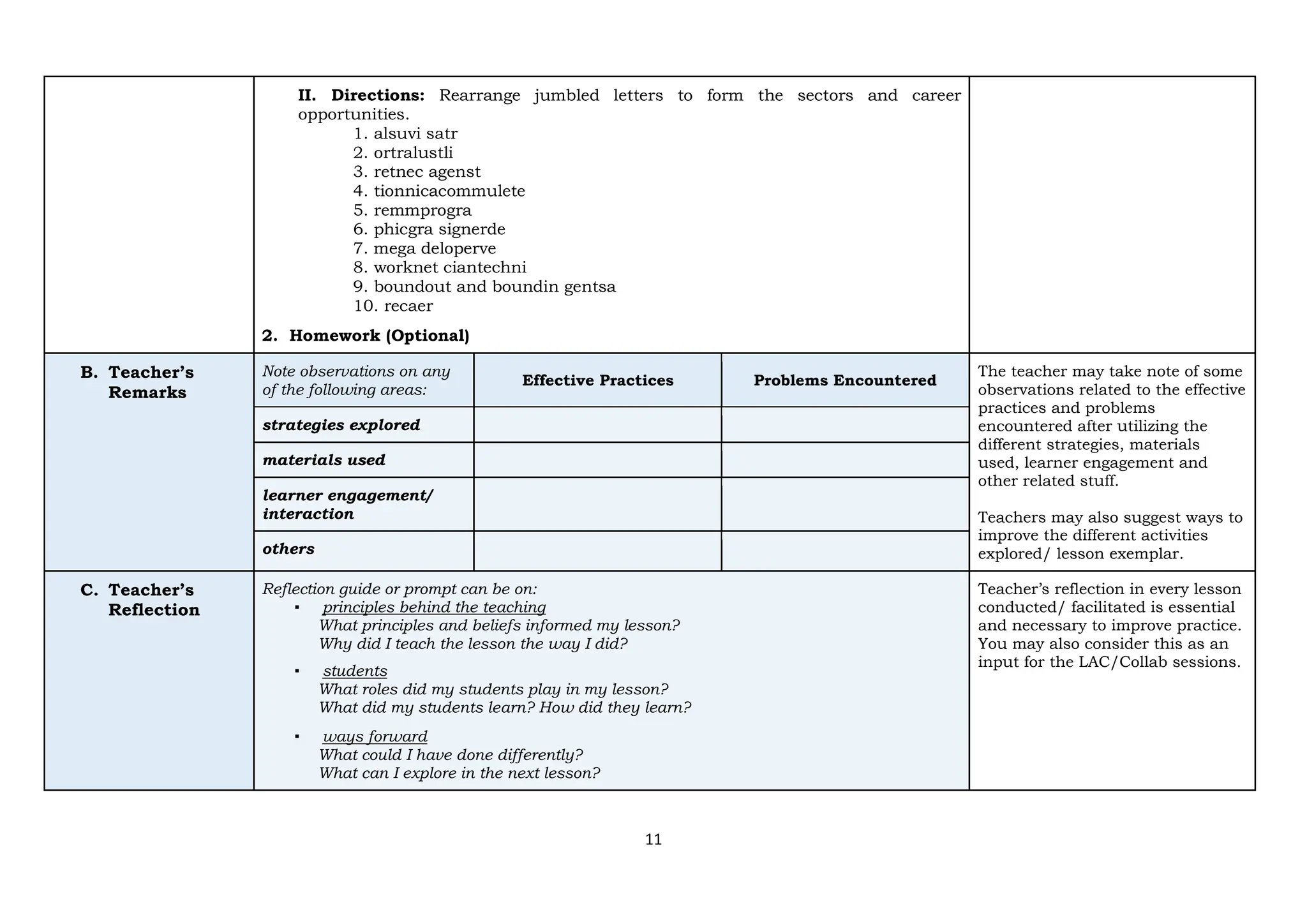
II. Directions: Rearrange jumbled letters to form the sectors and career
opportunities.
1. alsuvi satr
2. ortralustli
3. retnec agenst
4. tionnicacommulete
5. remmprogra
6. phicgra signerde
7. mega deloperve
8. worknet ciantechni
9. boundout and boundin gentsa
10. recaer
2. Homework (Optional)
B. Teacher’s
Remarks
Note observations on any
of the following areas:
Effective Practices Problems Encountered
The teacher may take note of some
observations related to the effective
practices and problems
encountered after utilizing the
different strategies, materials
used, learner engagement and
other related stuff.
Teachers may also suggest ways to
improve the different activities
explored/ lesson exemplar.
strategies explored
materials used
learner engagement/
interaction
others
C. Teacher’s
Reflection
Reflection guide or prompt can be on:
▪ principles behind the teaching
What principles and beliefs informed my lesson?
Why did I teach the lesson the way I did?
▪ students
What roles did my students play in my lesson?
What did my students learn? How did they learn?
▪ ways forward
What could I have done differently?
What can I explore in the next lesson?
Teacher’s reflection in every lesson
conducted/ facilitated is essential
and necessary to improve practice.
You may also consider this as an
input for the LAC/Collab sessions.

MATATAG CURR_Q1_LE_TLE 7_Lesson 1_Week 1.pdf

  • 1.
  • 2.
    Lesson Exemplar forTLE Grade 7 Quarter 1: Lesson 1 (Week 1) SY 2024-2025 This material is intended exclusively for the use of teachers participating in the implementation of the MATATAG K to 10 Curriculum during the School Year 2024-2025. It aims to assist in delivering the curriculum content, standards, and lesson competencies. Any unauthorized reproduction, distribution, modification, or utilization of this material beyond the designated scope is strictly prohibited and may result in appropriate legal actions and disciplinary measures. Borrowed content included in this material are owned by their respective copyright holders. Every effort has been made to locate and obtain permission to use these materials from their respective copyright owners. The publisher and development team do not represent nor claim ownership over them. Every care has been taken to ensure the accuracy of the information provided in this material. For inquiries or feedback, please write or call the Office of the Director of the Bureau of Learning Resources via telephone numbers (02) 8634-1072 and 8631-6922 or by email at blr.od@deped.gov.ph. Development Team Writer: • Janet C. Rivera, PhD (Mariano Marcos State University) Validators: • Emilio Aguinaldo, MTE (Philippine Normal University — Manila) • Regie Boy B. Fabro, PhD (Mariano Marcos State University) Management Team Philippine Normal University Research Institute for Teacher Quality SiMERR National Research Centre
  • 3.
    1 TLE /QUARTER 1/GRADE 7 I. CURRICULUM CONTENT, STANDARDS, AND LESSON COMPETENCIES A. Content Standards The learners demonstrate an understanding of ICT sectors, as well as the potential career and business opportunities these sectors offer in relation to their chosen career in the future. The learners demonstrate an understanding of current trends and emerging issues in ICT B. Performance Standards The learners convert number systems in practical scenarios. C. Learning Competencies and Objectives Learning Competencies 1. The learners analyze the various sectors of ICT and evaluate the potential career and business prospects relevant to their future career choices. 2. Discuss the emerging trends and issues in ICT. Learning Objectives At the end of the lesson, the learners are expected to: 1. Identify various ICT sectors and potential career and business opportunities; 2. Identify the various trends in ICT that may contribute to developments in the ICT industry and Entrepreneurial activities; 3. Create graphic organizers on the different ICT Sectors’ career and business opportunities; 4. Examine skills and competencies related to ICT career and business opportunities; 5. Identify the issues that may hamper any progress in the ICT industry; 6. Value the significance of ICT Sectors to future career or business opportunities; 7. Appreciate the significant relevance of the ICT sectors in their future career or business opportunities; and 8. Reflect on the significance of trends and issues in ICT. D. Content Sectors of ICT and Its Career and Business Opportunities • Computer programming - Programmer/Web and Game Developer • Visual arts – animator/ illustrator/ graphic designer • Computer system servicing – computer/ network • technician • Telecommunication – call center agents/ outbound • and inbound agents/ contact center services Trends and Issues in ICT
  • 4.
    2 E. Integration SDG4: Quality Education SGD 9: Industry, Innovation and Infrastructure II. LEARNING RESOURCES Khan, U. (2023). Choosing your career path: Job vs business. LinkedIn. https://www.linkedin.com/pulse/choosing-your-career-path-job-vs- business-uzair-khan/ Phillips, A. (2023). ICT and career paths. Unpublished manuscript. III. TEACHING AND LEARNING PROCEDURE NOTES TO TEACHERS A. Activating Prior Knowledge DAY 1 AND 2 1. Short Review Use search engines to look for sectors of ICT and career business opportunities. Provide an image and make a summary for each career.Prepare and facilitate a class discussion based on the following question: 1.What are the ICT sector and career opportunities you were able to find? 2. Are you familiar with those sectors? 3. What aspects are they common with? 4. Among these ICT career opportunities, what career do you want to pursue? Note and assess the learners’ responses. 2. Feedback (Optional) Divide the class into small groups of 5 students. After a few minutes, have each group share their findings with the class and facilitate a discussion by asking questions.
  • 5.
    3 B. Establishing Lesson Purpose 1.Lesson Purpose Present a “Word Cloud Art” that contains keywords and terms. Asks students a thought-provoking question or presenting a real-life scenario that highlights the importance of knowing sectors of ICT and career business opportunities. Ask the students, "Why is it important to understand the different sectors of ICT and the career opportunities they offer?". 2. Unlocking Content Area Vocabulary • Animation A series of pictures or frames created to simulate movement. • ICT sectors combine manufacturing and services industries whose products primarily fulfil or enable the function of information processing and communication by electronic means, including transmission and display. • Graphic designers create visual concepts, using computer software or by hand, to communicate ideas that inspire, inform, and captivate consumers. • Computer security, cybersecurity, digital security, or information technology security is the protection of computer systems and networks from attacks by malicious actors that may result in unauthorized access. • Computer Systems Servicing refers to the process of providing maintenance and support for computer systems. It involves tasks such as installing, configuring, troubleshooting, and maintaining computer systems and networks. Start with questions that will pique the interest and help the students understand the practical applications of the concepts you're about to introduce. Inform learners about what they will achieve by the end of the lesson. By the end of the lesson, you will have a deeper understanding of the various sectors of ICT and the career and business opportunities they offer, as well as the recent trends and issues in ICT. C. Developing and Deepening Understanding SUB-TOPIC 1: Sectors of ICT and Its Career and Business Opportunities 1. Explicitation ICT plays a significant role nowadays. ICT or Information and Communications Technology stresses the role of unified communications and the integration of telecommunications (telephone lines and wireless signals) and computers, as well as necessary enterprise software, middleware, storage, and audiovisual, that enable users to access, store, transmit, understand, and manipulate information. The creation, production, commercialization, and widespread use of new technology are the major operations carried out by the manufacturing and service sectors that comprise the ICT sector. ICT skills are becoming more in demand, and organizations might benefit from combining these with Start the class with an engaging activity by showing career pictures to the students and allow them to identify the sectors.
  • 6.
    4 communication abilities inPublic Relations, advertising, and media communications. Here are the different preferences when it comes to choosing career paths. It covers career opportunities in ICT sectors such as Programming, Visual Arts, Computer System Servicing, and Telecommunications. Computer Programming- Programming skills are essential for many technology disciplines but are in especially high demand for software and web development roles. Programmer - professionals who write and test code to enable applications and software programs to run successfully on a computer in order to create instructions for the machine to follow. Source: https://www2.deloitte.com/fi/fi/pages/risk/articles/escalating- threat-of-fraud-across-the-eu-and-nordics.html https://gameguardian.net/forum/topic/25289-getresults-not-getting- the-amount-of-results-which-i-give-it-just-edits-the-first-value-when- there-is-getresultscount-after-searchnumber/ What do computer programmers do? • Writing and testing code for new programs. Computer programmers work closely with web and software developers to write code for new mobile applications or computer programs. • Updating existing programs. Programmers also create and install updates for existing software programs. An update might include a bug fix, or enhanced functionality to improve the user experience. • Identifying and correcting coding errors. On a daily basis, computer programmers might assist in troubleshooting parts of a website or computer program that are not functioning correctly. • Rewriting programs for different operating systems. Often, programmers have to rewrite code in different languages, so that programs and applications can be compatible with different operating systems.
  • 7.
    5 • Secure programsagainst cybersecurity threats. Many computer programmers work in the cybersecurity field, helping to identify malicious software and fix software that could be vulnerable to potential hacks. Web and game developer - Making interactive, eye-catching experiences is what game development is all about, so maybe that fits you better. However, web development can be a fantastic option if you're passionate about creating websites and web applications as well as working with various technologies. Source: https://www.linkedin.com/pub/dir/Jl/Ss?trk=public_profile_samename-see-all Visual Arts Animator/Illustrator - plan, create, develop, and prepare images and diagrams using traditional and digital media, such as drawing, painting, drafting, collage, models, photography, and image capture and manipulation, to convey ideas, make meaning clear, support presentations, and illustrate stories. Source: https://www.shutterstock.com/image-photo/mystical-background-female-eye- big-clock-1156647172 Graphic Designer - using computer software or by hand, graphic designers develop visual concepts that convey concepts to audiences in a way that enthralls, inspires, and informs them. They create the overall production design and layout for things like reports, brochures, magazines, and ads. Source: https://www.quora.com/Is-a-graphic-designer-an-artist
  • 8.
    6 Computer System Servicing Theprocess of maintaining and supporting computer systems is referred to as computer systems servicing. It includes setting up, adjusting, debugging, and maintaining networks and computer systems. Computer/Network technician - examine, test, diagnose, and assess current network systems, including servers, cloud networks, wide area networks (WAN), local area networks (LAN), and other data communications networks. To guarantee that networks run properly and with the least amount of disruption, perform network maintenance. Source: https://www.skynetusacorporation.com/index Call center agents/outbound and inbound agents /contact center services- calls from clients arrive at an inbound call center. As incoming calls are usually from current clients who have problems or inquiries, support teams usually keep an eye on inbound centers. On the other hand, an outbound call center calls customers on their behalf. Source: https://en.wikipedia.org/wiki/TTEC Telecommunication - Transfer data globally in the forms of text, voice, audio, or video are referred to as telecoms companies. Source: https://www.pinterest.ph/mz_marketing/ 2. Worked Example Here are the different sectors of ICT and the career opportunities they offer. In computer programming, you can be web developers or game developers. In visual arts, you can be animators or graphic designers. In computer system servicing, The teacher will process the answers of the learners.
  • 9.
    7 you can becomputer or network technicians. In telecommunication, you can be call-center agents or contact center services representatives. Ask learners to identify which sector interests them the most and why. "Think about the ICT sector that interests you the most. Why do you like this sector? What career opportunities do you want to pursue?" 3. Lesson Activity See Worksheet Week 1 No. 1 and 2 DAY 3 SUB-TOPIC 2: Trends and Issues in ICT 1. Explicitation Every year, current trends emerge in the ICT business. In the modern world, one needs to be conversant with all the different trends they encompass. Knowledge of the Current patterns will be beneficial for whatever one's vocation. You or anybody else recognizes the possibilities of enhancements as well as the advancement of this kind of business. The technology sector is presently going through unparalleled expansion. Increasingly more Companies are trying to grow within this sector due to its excellent potential. ICT has become recognized as an important and appreciated element within the present Organizational structure. What are the available ICT trends? Should we be attempting to locate it on theinternet, there's a huge volume of knowledge on the patterns, but for our lesson, we'll just accentuate the following patterns. • Superapps, the ICT supertrend Asia, particularly China, is the origin of this idea. These are applications that combine a lot of services so users can have access to a single application that does everything. The services include a dedicated messaging area and a bank transfer area. As they boost their competitiveness and foster customer loyalty, they are becoming more and more well-known among businesses. • Explosion of the metaverse in the business world With the creation of virtual spaces that can blur physical barriers, the virtual world hopes to realize its great potential and excel in important fields like the potential to change the way people live, work, and shop. • Digital twins The teacher will ask the learners for some questions, clarification, or muddy parts in the lesson, and explain it with further examples if necessary. V. Synthesis/Extended Practice/Differentiation Ask the learner to research other ICT sectors/ industries in the community and have it presented the next day. Start the class by engaging them in an inquiry activity. Showing the students a picture or collage that depicts the current trends in the ICT Industry.
  • 10.
    8 Not only canthis technology create sets of digital duplicates of spaces, elements, and systems to manage errors, save costs, and produce more accurate products. • MedTech, the revolution in medicine The convergence of IoT and MedTech represents a significant chance to leverage digital technologies like virtual care, RPA, AI, and others to overcome obstacles and settle disputes in the modern healthcare industry. • Artificial Intelligence and Cybersecurity The primary goal of this technology is to increase data security on smart networks; therefore, businesses should prioritize optimizing smart device security capabilities. • Blockchain, one of the most secure ICT trends guarantees that the integrity of data is maintained while doing away with single control over information and party middlemen. To enable the automation of transactions and communications, the data are thus stored in a highly secure and encrypted manner, thereby providing an unquestionable boost to digital identity. Issues in Information and Communications Technology (ICT) • Cybersecurity threats: With the increasing reliance on digital systems and the internet, cybersecurity threats such as hacking, malware, phishing, and cyber attacks have become a significant concern for individuals, businesses, and governments. Protecting sensitive data and critical infrastructure from cyber threats is a top priority. • Data privacy and regulation: The collection, storage, and use of personal data by companies and organizations have raised concerns about data privacy. • Artificial Intelligence (AI) and automation: The rapid development of AI and automation technologies has raised concerns about job displacement, algorithmic bias, and ethical implications. • Slow Internet Connections: Causes like network congestion, distance from server, outdated hardware or software • Viruses: Different types like trojans, worms, ransomware that can corrupt data, steal info. How they spread through downloads, emails, networks. Source:sprintzeal.com 1. What does the picture depict? 2. How can you relate it to our previous lesson in the career opportunities in ICT?
  • 11.
    9 Other potential issus: •E-waste and environmental impact of hardware/devices • IT personnel shortages and skills gaps • Digital divide and access inequalities • Ethical issues around AI, autonomous systems • Regulation and governance of emerging technologies 2. Worked Example Here are examples of recent trends and issues in ICT such as artificial intelligence, cloud computing, and cybersecurity. Notice how these affect our daily lives and businesses. Learners discuss the impact of these trends and issues on society and industry. Discuss in your group the impact of these trends and issues on our society and industry. How can we solve these issues? DAY 4 3. Lesson Activity See Worksheet Week 1 No. 3 The teacher will process the learners’ responses. Explain to the learners that the lesson will focus on the concept of trends and possible issues in the ICT Industry. Divide the class into small groups of 5 students. After a few minutes, have each group share their work and facilitate a discussion by asking questions D. Making Generalizations 1. Learners’ Takeaways The teacher will ask the learners: 1. What is the significant impact of these ICT Sectors in the career and business opportunities that they may undertake in the future? 2. Why does the issue always arise whenever there is a trend? 3. In your opinion, discuss possible trends five years fromnow? 4. How do ICT trends change as time goes by? 2. Reflection on Learning The teacher will ask the learners to explain the concept of ICT Sectors and the career and business opportunities related to it. The teacher will call selected learners to share their answers. How does this lesson help you to better understand the concept of Trends and Issues in ICT? The teacher will ask the learners the following questions. The teacher will re-emphasize the highlights on the important concepts/notes about the topics.
  • 12.
    10 IV. EVALUATING LEARNING:FORMATIVE ASSESSMENT AND TEACHER’S REFLECTION NOTES TO TEACHERS A. Evaluating Learning 1. Formative Assessment I. Multiple Choice Directions:Identify the following. Write the letter of the correct answer on a clean sheet of paper. 1. These are manufacturing and services sectors where the major operations are carried out widely by the use of new technology or ICT. a. Industrial Arts Sectors b. ICT Sectors c. Family and Consumer Services Sectors d. AFA Sector 2. Which of the following sectors can a contact center agent be included in? a. CSS b. Programming c. Telecommunication d. Visual Arts 3. Mr. Manuel is a graphic illustrator. Which of the following ICT sectors does he belong to? a. CSS b. Programming c. Telecommunication d. Visual Arts 4. Web development and game development are from what ICT Sector? a. CSS b. Programming c. Telecommunication d. Visual Arts 5. What is the significance of different ICT Sectors? a. It provides income for our economy b. It provides career and business opportunities c. It provides manufacturing and services d. None of the above Answer Key: I.Multiple choice 1. b 2. c 3. d 4. b 5. d II. Rearrange the jumbled words. 1. visual arts 2. illustrator 3. center agent 4. telecommunication 5. programmer 6. graphic designer 7. game developer 8. network technician 9. outbound and inbound agent 10.career
  • 13.
    11 II. Directions: Rearrangejumbled letters to form the sectors and career opportunities. 1. alsuvi satr 2. ortralustli 3. retnec agenst 4. tionnicacommulete 5. remmprogra 6. phicgra signerde 7. mega deloperve 8. worknet ciantechni 9. boundout and boundin gentsa 10. recaer 2. Homework (Optional) B. Teacher’s Remarks Note observations on any of the following areas: Effective Practices Problems Encountered The teacher may take note of some observations related to the effective practices and problems encountered after utilizing the different strategies, materials used, learner engagement and other related stuff. Teachers may also suggest ways to improve the different activities explored/ lesson exemplar. strategies explored materials used learner engagement/ interaction others C. Teacher’s Reflection Reflection guide or prompt can be on: ▪ principles behind the teaching What principles and beliefs informed my lesson? Why did I teach the lesson the way I did? ▪ students What roles did my students play in my lesson? What did my students learn? How did they learn? ▪ ways forward What could I have done differently? What can I explore in the next lesson? Teacher’s reflection in every lesson conducted/ facilitated is essential and necessary to improve practice. You may also consider this as an input for the LAC/Collab sessions.