
Network Devices and Wireless
Technologies
BY
SHUBHAM BATHE (FYMCA02)
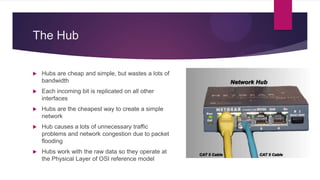
The Hub
 Hubs are cheap and simple, but wastes a lots of
bandwidth
 Each incoming bit is replicated on all other
interfaces
 Hubs are the cheapest way to create a simple
network
 Hub causes a lots of unnecessary traffic
problems and network congestion due to packet
flooding
 Hubs work with the raw data so they operate at
the Physical Layer of OSI reference model
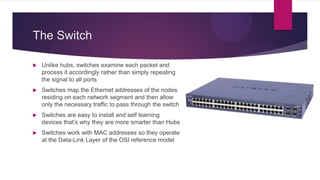
The Switch
 Unlike hubs, switches examine each packet and
process it accordingly rather than simply repeating
the signal to all ports
 Switches map the Ethernet addresses of the nodes
residing on each network segment and then allow
only the necessary traffic to pass through the switch
 Switches are easy to install and self learning
devices that’s why they are more smarter than Hubs
 Switches work with MAC addresses so they operate
at the Data-Link Layer of the OSI reference model
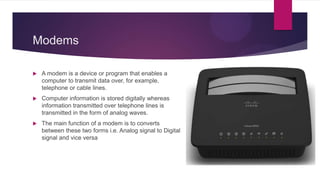
Modems
 A modem is a device or program that enables a
computer to transmit data over, for example,
telephone or cable lines.
 Computer information is stored digitally whereas
information transmitted over telephone lines is
transmitted in the form of analog waves.
 The main function of a modem is to converts
between these two forms i.e. Analog signal to Digital
signal and vice versa
Bridges
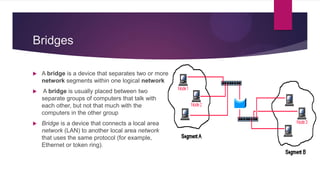
 A bridge is a device that separates two or more
network segments within one logical network
 A bridge is usually placed between two
separate groups of computers that talk with
each other, but not that much with the
computers in the other group
 Bridge is a device that connects a local area
network (LAN) to another local area network
that uses the same protocol (for example,
Ethernet or token ring).
Routers : The device that ties networks
together
 Hubs and Switches are devices that can be used to
create networks , but what if we want to establish a
connection between two or more networks ??
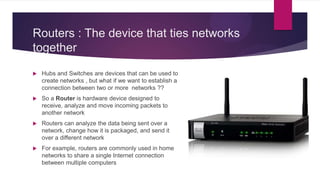
 So a Router is hardware device designed to
receive, analyze and move incoming packets to
another network
 Routers can analyze the data being sent over a
network, change how it is packaged, and send it
over a different network
 For example, routers are commonly used in home
networks to share a single Internet connection
between multiple computers
Routers
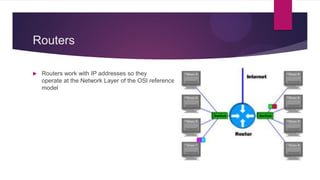
 Routers work with IP addresses so they
operate at the Network Layer of the OSI reference
model
Functions of Router
 Routing the packets from source to the destination
 Performing Network Address Translation
 Assigning IP addresses to Host
 Broadcasting a WiFi signal
Top Wireless Technologies
 Wi-Fi Direct : Portable Wi-Fi that goes with
you anywhere
 Wi-Fi CERTIFIED Wi-Fi Direct® is a certification
mark for devices supporting a technology that
enables Wi-Fi devices to connect directly enabling
them to do things like printing, sharing, syncing
 Mobile phones, cameras, printers, PCs, and
gaming devices connect to each other directly to
transfer content and share applications quickly and
easily
 Devices can make a one-to-one connection, or a
group of several devices can connect
simultaneously
Top Wireless Technologies
 Wi-Fi HaLow : Low power, long range Wi-Fi
 With industry momentum mounting around a low
power Wi-Fi® solution, Wi-Fi Alliance® has
introduced Wi-Fi HaLow™ as the designation for
products incorporating IEEE 802.11ah technology
 Wi-Fi HaLow operates in frequency bands below
one gigahertz, offering longer range, lower power
connectivity to Wi-Fi CERTIFIED™ products
 Wi-Fi HaLow’s range is nearly twice that of today’s
Wi-Fi
 Wifi Halow will be powering Smart Home,
connected car, and digital healthcare
Top Wireless Technologies
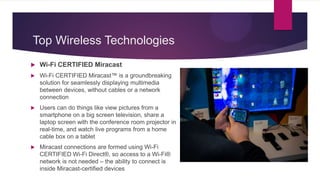
 Wi-Fi CERTIFIED Miracast
 Wi-Fi CERTIFIED Miracast™ is a groundbreaking
solution for seamlessly displaying multimedia
between devices, without cables or a network
connection
 Users can do things like view pictures from a
smartphone on a big screen television, share a
laptop screen with the conference room projector in
real-time, and watch live programs from a home
cable box on a tablet
 Miracast connections are formed using Wi-Fi
CERTIFIED Wi-Fi Direct®, so access to a Wi-Fi®
network is not needed – the ability to connect is
inside Miracast-certified devices
Top Wireless Technologies
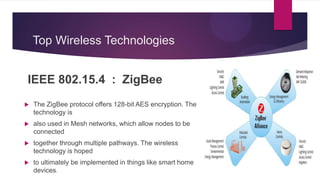
IEEE 802.15.4 : ZigBee
 The ZigBee protocol offers 128-bit AES encryption. The
technology is
 also used in Mesh networks, which allow nodes to be
connected
 together through multiple pathways. The wireless
technology is hoped
 to ultimately be implemented in things like smart home
devices.
Top Wireless Technologies
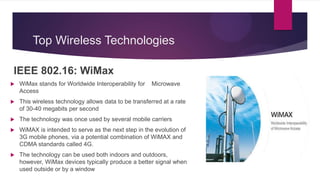
IEEE 802.16: WiMax
 WiMax stands for Worldwide Interoperability for Microwave
Access
 This wireless technology allows data to be transferred at a rate
of 30-40 megabits per second
 The technology was once used by several mobile carriers
 WiMAX is intended to serve as the next step in the evolution of
3G mobile phones, via a potential combination of WiMAX and
CDMA standards called 4G.
 The technology can be used both indoors and outdoors,
however, WiMax devices typically produce a better signal when
used outside or by a window
Types of Networking Devices

Types of Networking Devices

  • 1.
    Network Devices andWireless Technologies BY SHUBHAM BATHE (FYMCA02)
  • 2.
    The Hub  Hubsare cheap and simple, but wastes a lots of bandwidth  Each incoming bit is replicated on all other interfaces  Hubs are the cheapest way to create a simple network  Hub causes a lots of unnecessary traffic problems and network congestion due to packet flooding  Hubs work with the raw data so they operate at the Physical Layer of OSI reference model
  • 3.
    The Switch  Unlikehubs, switches examine each packet and process it accordingly rather than simply repeating the signal to all ports  Switches map the Ethernet addresses of the nodes residing on each network segment and then allow only the necessary traffic to pass through the switch  Switches are easy to install and self learning devices that’s why they are more smarter than Hubs  Switches work with MAC addresses so they operate at the Data-Link Layer of the OSI reference model
  • 4.
    Modems  A modemis a device or program that enables a computer to transmit data over, for example, telephone or cable lines.  Computer information is stored digitally whereas information transmitted over telephone lines is transmitted in the form of analog waves.  The main function of a modem is to converts between these two forms i.e. Analog signal to Digital signal and vice versa
  • 5.
    Bridges  A bridgeis a device that separates two or more network segments within one logical network  A bridge is usually placed between two separate groups of computers that talk with each other, but not that much with the computers in the other group  Bridge is a device that connects a local area network (LAN) to another local area network that uses the same protocol (for example, Ethernet or token ring).
  • 6.
    Routers : Thedevice that ties networks together  Hubs and Switches are devices that can be used to create networks , but what if we want to establish a connection between two or more networks ??  So a Router is hardware device designed to receive, analyze and move incoming packets to another network  Routers can analyze the data being sent over a network, change how it is packaged, and send it over a different network  For example, routers are commonly used in home networks to share a single Internet connection between multiple computers
  • 7.
    Routers  Routers workwith IP addresses so they operate at the Network Layer of the OSI reference model
  • 8.
    Functions of Router Routing the packets from source to the destination  Performing Network Address Translation  Assigning IP addresses to Host  Broadcasting a WiFi signal
  • 9.
    Top Wireless Technologies Wi-Fi Direct : Portable Wi-Fi that goes with you anywhere  Wi-Fi CERTIFIED Wi-Fi Direct® is a certification mark for devices supporting a technology that enables Wi-Fi devices to connect directly enabling them to do things like printing, sharing, syncing  Mobile phones, cameras, printers, PCs, and gaming devices connect to each other directly to transfer content and share applications quickly and easily  Devices can make a one-to-one connection, or a group of several devices can connect simultaneously
  • 10.
    Top Wireless Technologies Wi-Fi HaLow : Low power, long range Wi-Fi  With industry momentum mounting around a low power Wi-Fi® solution, Wi-Fi Alliance® has introduced Wi-Fi HaLow™ as the designation for products incorporating IEEE 802.11ah technology  Wi-Fi HaLow operates in frequency bands below one gigahertz, offering longer range, lower power connectivity to Wi-Fi CERTIFIED™ products  Wi-Fi HaLow’s range is nearly twice that of today’s Wi-Fi  Wifi Halow will be powering Smart Home, connected car, and digital healthcare
  • 11.
    Top Wireless Technologies Wi-Fi CERTIFIED Miracast  Wi-Fi CERTIFIED Miracast™ is a groundbreaking solution for seamlessly displaying multimedia between devices, without cables or a network connection  Users can do things like view pictures from a smartphone on a big screen television, share a laptop screen with the conference room projector in real-time, and watch live programs from a home cable box on a tablet  Miracast connections are formed using Wi-Fi CERTIFIED Wi-Fi Direct®, so access to a Wi-Fi® network is not needed – the ability to connect is inside Miracast-certified devices
  • 12.
    Top Wireless Technologies IEEE802.15.4 : ZigBee  The ZigBee protocol offers 128-bit AES encryption. The technology is  also used in Mesh networks, which allow nodes to be connected  together through multiple pathways. The wireless technology is hoped  to ultimately be implemented in things like smart home devices.
  • 13.
    Top Wireless Technologies IEEE802.16: WiMax  WiMax stands for Worldwide Interoperability for Microwave Access  This wireless technology allows data to be transferred at a rate of 30-40 megabits per second  The technology was once used by several mobile carriers  WiMAX is intended to serve as the next step in the evolution of 3G mobile phones, via a potential combination of WiMAX and CDMA standards called 4G.  The technology can be used both indoors and outdoors, however, WiMax devices typically produce a better signal when used outside or by a window