ADVANCED
PRODUCT QUALITY PLANNING (APQP)
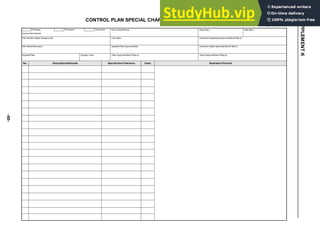
AND CONTROL PLAN
Reference Manual
Issued June 1994, Second Printing February 1995 (new cover only)
Copyright©
1994, ©
1995
Chrysler Corporation, Ford Motor Company, and General Motors Corporation
FOREWORD
This Reference Manual and Reporting Format were developed by the Advanced Product
Quality Planning (APQP) and the Control Plan teams that were sanctioned by Chrysler, Ford,
General Motors Supplier Quality Requirements Task Force.
The Task Force charter is to standardize the reference manuals, procedures, reporting formats,
and technical nomenclature used by Chrysler, Ford, and General Motors in their respective
supplier quality systems. Accordingly, this manual and format, approved and endorsed by
Chrysler, Ford and General Motors, should be used by suppliers implementing APQP
techniques into their design/manufacturing processes.
In the past, Chrysler, Ford, and General Motors each had their own guidelines and formats for
ensuring supplier APQP compliance. Differences between these guidelines and formats
resulted in additional demands on supplier resources. To improve upon this situation,
Chrysler, Ford and General Motors agreed to develop and distribute this Manual. The work
group responsible for this Manual was led by Mike Mazur of Ford Motor Company.
This manual provides general guidelines for preparing plans and checklists for ensuring that
Advanced Product Quality Planning is in actuality carried out at the supplier. It does not give
specific instructions on how to arrive at each APQP or Control Plan entry, a task best left to
each component review team.
While these guidelines are intended to cover all situations normally occurring either in the
early planning, design phase, or process analysis, there will be questions that arise. These
questions should be directed to your customer’s Supplier Quality activity. If you are uncertain
as to how to contact the appropriate activity, contact your buyer in your customer’s Purchasing
office.
The Task Force gratefully acknowledges: the leadership and commitment of Vice Presidents
Thomas T. Stallkamp at Chrysler, Norman F. Ehlers at Ford, and G. Richard Wagoner, Jr. of
General Motors; the assistance of the AIAG in the development, production, and distribution
of this manual; and the guidance of Task Force Principals Russell Jacobs (Chrysler), Radley
Smith (Ford), and Dan Reid (General Motors).
This procedure is copyrighted by Chrysler, Ford and General Motors, all rights reserved, 1994.
Additional copies can be ordered from AIAG 810-358-3003. Suppliers of the Automotive
Industry have permission to copy any forms and/or checklists.
June 1994
i
ii
ACKNOWLEDGEMENT
This document, which includes a reference manual and reporting format, represents the consensus
of the members of the Advanced Product Quality Planning and Control Plan teams sanctioned by
the Chrysler, Ford, General Motors Supplier Quality Requirements Task Force. Team members,
whose names appear below, wish to acknowledge the many contributions made by individuals
from within their respective organizations, individuals without whose support and assistance this
document would not have been possible.
Advanced Product Quality Planning Team Members
Chrysler Ford General Motors
Robert Roush Michael A. Mazur R. Dan Reid
Andy Kucharski Roderick A. Munro David L. Kraush
Suppliers
Paul Anglin ITT Automotive
Brenda Dusek Harvard Industries
Charles R. Dykstra Inverness Casting
Donald Geis Federal Mogul Corporation
Al Walton United Technologies
Control Plan Team Members
Frederick N. Baz Ford
Brenda Dusek Harvard Industries
Rebecca French General Motors
Gary Hoyt Chrysler
Mary Ann Raymond Robert Bosch Corporation
Additional Assistance
Bea Anderson Chrysler
iii
Table of Contents
Introduction 1
Product Quality Planning Responsibility Matrix 2
Fundamentals of Product Quality Planning 3
Product Quality Planning Timing Chart 5
1.0 Plan and Define Program 6
1.1 Voice of the Customer 7
1.1.1 Market Research 8
1.1.2 Historical Warranty and Quality Information 8
1.1.3 Team Experience 8
1.2 Business Plan/Marketing Strategy 9
1.3 Product/Process Benchmark Data 9
1.4 Product/Process Assumptions 9
1.5 Product Reliability Studies 9
1.6 Customer Inputs 9
1.7 Design Goals 10
1.8 Reliability And Quality Goals 10
1.9 Preliminary Bill of Material 10
1.10 Preliminary Process Flow Chart 10
1.11 Preliminary Listing of Special Product and Process Characteristics 10
1.12 Product Assurance Plan 11
1.13 Management Support 11
2.0 Product Design and Development 12
2.1 Design Failure Mode and Effects Analysis (DFMEA) 14
2.2 Design for Manufacturability and Assembly 14
2.3 Design Verification 15
2.4 Design Reviews 15
2.5 Prototype Build – Control Plan 15
2.6 Engineering Drawings (Including Math Data) 16
2.7 Engineering Specifications 16
2.8 Material Specifications 16
2.9 Drawing and Specification Changes 16
2.10 New Equipment, Tooling and Facilities Requirements 17
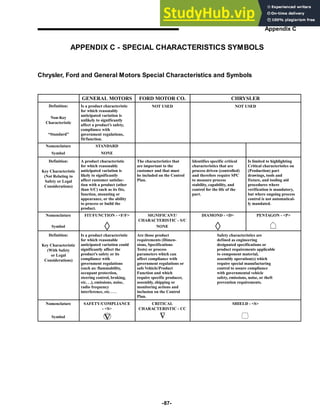
2.11 Special Product and Process Characteristics 17
2.12 Gages/Testing Equipment Requirements 17
2.13 Team Feasibility Commitment and Management Support 17
3.0 Process Design and Development 18
3.1 Packaging Standards 20
3.2 Product/Process Quality System Review 20
3.3 Process Flow Chart 20
3.4 Floor Plan Layout 20
TABLE OF CONTENTS
Page No.
Page No.
iv
3.5 Characteristics Matrix 20
3.6 Process Failure Mode and Effects Analysis (PFMEA) 21
3.7 Pre-Launch Control Plan 21
3.8 Process Instructions 21
3.9 Measurement Systems Analysis Plan 22
3.10 Preliminary Process Capability Study Plan 22
3.11 Packaging Specifications 22
3.12 Management Support 22
4.0 Product and Process Validation 24
4.1 Production Trial Run 25
4.2 Measurement Systems Evaluation 26
4.3 Preliminary Process Capability Study 26
4.4 Production Part Approval 26
4.5 Production Validation Testing 26
4.6 Packaging Evaluation 27
4.7 Production Control Plan 27
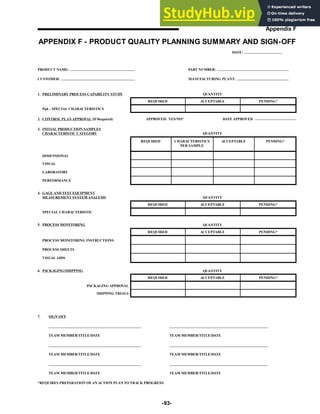
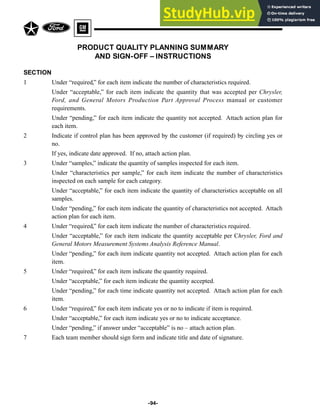
4.8 Quality Planning Sign-Off and Management Support 27
5.0 Feedback,Assessment and Corrective Action 28
5.1 Reduced Variation 29
5.2 Customer Satisfaction 30
5.3 Delivery and Service 30
6.0 Control Plan Methodology 31
6.1 Table of Contents 32
6.2 Overview 33
6.3 Control Plan Column Descriptions 37
6.4 Process Analysis 46
6.5 Supplements 47
v
Table of Contents
Page No.
Appendix A – Product Quality Planning Checklists 63
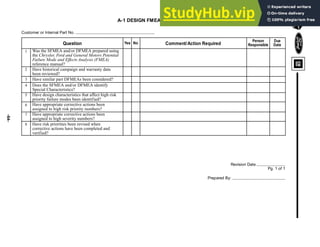
A-1 Design FMEA Checklist 64
A-2 Design Information Checklist 65
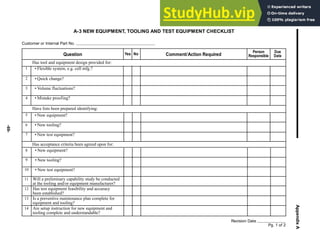
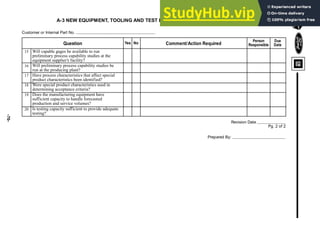
A-3 New Equipment, Tooling and Test Equipment Checklist 69
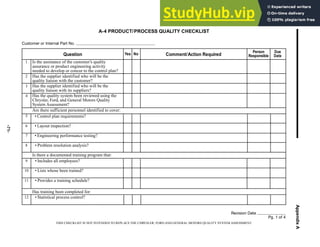
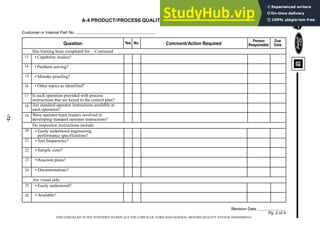
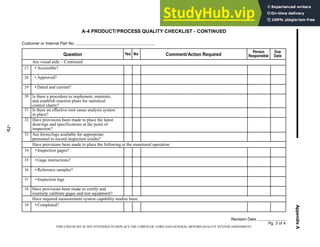
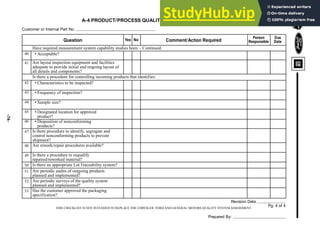
A-4 Product/Process Quality Checklist 71
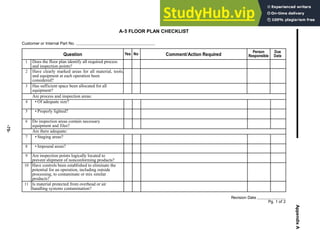
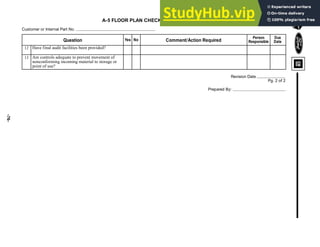
A-5 Floor Plan Checklist 75
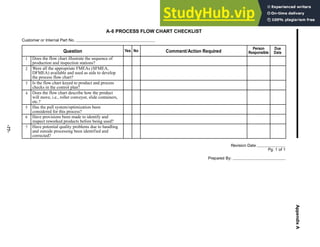
A-6 Process Flow Chart Checklist 77
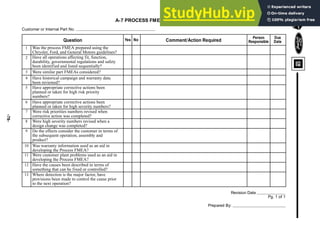
A-7 Process FMEA Checklist 78
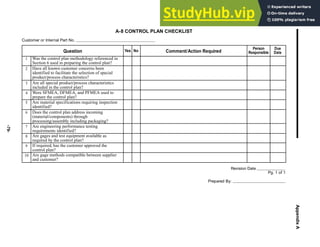
A-8 Control Plan Checklist 79
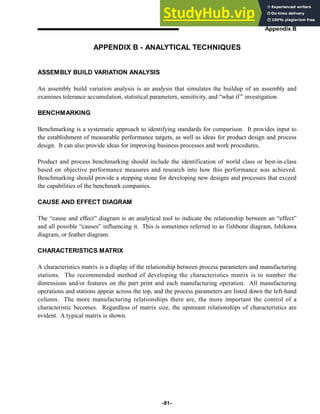
Appendix B – Analytical Techniques 81
Assembly Build Variation Analysis 81
Benchmarking 81
Cause and Effect Diagram 81
Characteristics Matrix 81
Critical Path Method 82
Design of Experiments (DOE) 82
Design for Manufacturability and Assembly 82
Design Verification Plan and Report (DVP&R) 83
Dimensional Control Plan (DCP) 83
Dynamic Control Plan (DCP) 83
Mistake Proofing (Poka-Yoke) 84
Process Flow Charting 84
Quality Function Deployment (QFD) 84
System Failure Mode and Effects Analysis (SFMEA) 85
Appendix C –Special Characteristics Symbols 87
Appendix D –Reference Material 89
Appendix E – Team Feasibility Commitment 91
Appendix F – Product Quality Planning Summary and Sign-off 93
Appendix G –Ford’s Powertrain Dynamic Control Planning 95
Appendix H –Glossary 103
Appendix I – Acronyms 107
Appendix J – Bibliography 109
Appendix K –Alphabetic Index 111
Appendix L – Forms 113
vi
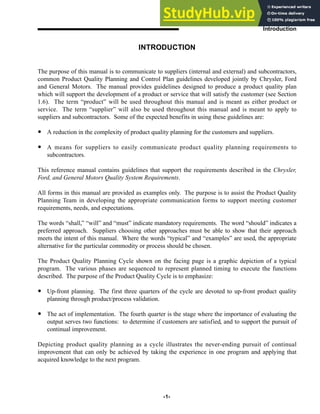
PRODUCT QUALITY PLANNING CYCLE
-1-
Introduction
INTRODUCTION
The purpose of this manual is to communicate to suppliers (internal and external) and subcontractors,
common Product Quality Planning and Control Plan guidelines developed jointly by Chrysler, Ford
and General Motors. The manual provides guidelines designed to produce a product quality plan
which will support the development of a product or service that will satisfy the customer (see Section
1.6). The term “product” will be used throughout this manual and is meant as either product or
service. The term “supplier” will also be used throughout this manual and is meant to apply to
suppliers and subcontractors. Some of the expected benefits in using these guidelines are:
• A reduction in the complexity of product quality planning for the customers and suppliers.
• A means for suppliers to easily communicate product quality planning requirements to
subcontractors.
This reference manual contains guidelines that support the requirements described in the Chrysler,
Ford, and General Motors Quality System Requirements.
All forms in this manual are provided as examples only. The purpose is to assist the Product Quality
Planning Team in developing the appropriate communication forms to support meeting customer
requirements, needs, and expectations.
The words “shall,” “will” and “must” indicate mandatory requirements. The word “should” indicates a
preferred approach. Suppliers choosing other approaches must be able to show that their approach
meets the intent of this manual. Where the words “typical” and “examples” are used, the appropriate
alternative for the particular commodity or process should be chosen.
The Product Quality Planning Cycle shown on the facing page is a graphic depiction of a typical
program. The various phases are sequenced to represent planned timing to execute the functions
described. The purpose of the Product Quality Cycle is to emphasize:
• Up-front planning. The first three quarters of the cycle are devoted to up-front product quality
planning through product/process validation.
• The act of implementation. The fourth quarter is the stage where the importance of evaluating the
output serves two functions: to determine if customers are satisfied, and to support the pursuit of
continual improvement.
Depicting product quality planning as a cycle illustrates the never-ending pursuit of continual
improvement that can only be achieved by taking the experience in one program and applying that
acquired knowledge to the next program.
-2-
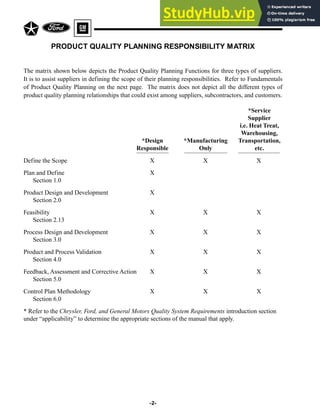
PRODUCT QUALITY PLANNING RESPONSIBILITY MATRIX
The matrix shown below depicts the Product Quality Planning Functions for three types of suppliers.
It is to assist suppliers in defining the scope of their planning responsibilities. Refer to Fundamentals
of Product Quality Planning on the next page. The matrix does not depict all the different types of
product quality planning relationships that could exist among suppliers, subcontractors, and customers.
*Service
Supplier
i.e. Heat Treat,
Warehousing,
Transportation,
etc.
*Design
Responsible
*Manufacturing
Only
Define the Scope X X X
Plan and Define X
Section 1.0
Product Design and Development X
Section 2.0
Feasibility X X X
Section 2.13
Process Design and Development X X X
Section 3.0
Product and Process Validation X X X
Section 4.0
Feedback, Assessment and Corrective Action X X X
Section 5.0
Control Plan Methodology X X X
Section 6.0
* Refer to the Chrysler, Ford, and General Motors Quality System Requirements introduction section
under “applicability” to determine the appropriate sections of the manual that apply.
FUNDAMENTALS OF PRODUCT QUALITY PLANNING
Product Quality Planning is a structured method of defining and establishing the steps necessary to
assure that a product satisfies the customer. The goal of product quality planning is to facilitate
communication with everyone involved to assure that all required steps are completed on time.
Effective product quality planning depends on a company’s top management commitment to the effort
required in achieving customer satisfaction. Some of the benefits of Product Quality Planning are:
• To direct resources to satisfy the customer.
• To promote early identification of required changes.
• To avoid late changes.
• To provide a quality product on time at the lowest cost.
The work practices, tools, and analytical techniques described in this manual are listed in a logical
sequence to make it easy to follow. Each Product Quality Plan is unique. The actual timing and
sequence of execution is dependent on customer needs and expectations and/or other practical matters.
The earlier a work practice, tool, and/or analytical technique can be implemented in the Product
Quality Planning Cycle, the better.
ORGANIZE THE TEAM
The supplier’s first step in Product Quality Planning is to assign responsibility to a cross functional
team. Effective product quality planning requires the involvement of more than just the quality
department. The initial team should include representatives from engineering, manufacturing, material
control, purchasing, quality, sales, field service, subcontractors, and customers, as appropriate.
DEFINE THE SCOPE
It is important for the Product Quality Planning Team in the earliest stage of the product program to
identify customer needs, expectations, and requirements. At a minimum, the team must meet to:
• Select a project team leader responsible for overseeing the planning process. (In some cases it may
be advantageous to rotate the team leader during the planning cycle.)
• Define the roles and responsibilities of each area represented.
• Identify the customers - internal and external.
• Define customer requirements. (Use QFD if applicable, as referenced in Appendix B.)
• Select the disciplines, individuals, and/or subcontractors that must be added to the team, and those
not required.
• Understand customer expectations, i.e., design, number of tests.
• Assess the feasibility of the proposed design, performance requirements and manufacturing process.
-3-
Introduction
• Identify costs, timing, and constraints that must be considered.
• Determine assistance required from the customer.
• Identify documentation process or method.
TEAM-TO-TEAM
The Product Quality Planning Team must establish lines of communication with other customer and
supplier teams. This may include regular meetings with other teams. The extent of team-to-team
contact is dependent upon the number of issues requiring resolution.
TRAINING
The success of a Product Quality Plan is dependent upon an effective training program that
communicates all the requirements and development skills to fulfill customer needs and expectations.
CUSTOMER AND SUPPLIER INVOLVEMENT
The primary customer may initiate the quality planning process with a supplier. However, the supplier
has an obligation to establish a cross functional team to manage the Product Quality Planning process.
Suppliers must expect the same performance from their subcontractors.
SIMULTANEOUS ENGINEERING
Simultaneous Engineering is a process where cross functional teams strive for a common goal. It
replaces the sequential series of phases where results are transmitted to the next area for execution.
The purpose is to expedite the introduction of quality products sooner. The Product Quality Planning
Team assures that other areas/teams plan and execute activities that support the common goal or goals.
CONTROL PLANS
Control Plans are written descriptions of the systems for controlling parts and processes. Separate
Control Plans cover three distinct phases:
• Prototype - A description of the dimensional measurements and material and performance tests
that will occur during Prototype build.
• Pre-launch - A description of the dimensional measurements and material and performance tests
that will occur after Prototype and before full Production.
• Production - A comprehensive documentation of product/process characteristics, process controls,
tests, and measurement systems that will occur during mass production.
CONCERN RESOLUTION
During the planning process, the team will encounter product design and/or processing concerns.
These concerns should be documented on a matrix with assigned responsibility and timing.
Disciplined problem-solving methods are recommended in difficult situations. Analytical techniques
described in Appendix B should be used as appropriate.
-4-
PRODUCT QUALITY TIMING PLAN
The Product Quality Planning Team’s first order of business following organizational activities should
be the development of a Timing Plan. The type of product, complexity and customer expectations
should be considered in selecting the timing elements that must be planned and charted. All team
members should agree with each event, action, and timing. A well-organized timing chart should list
tasks, assignments, and/or other events. (The Critical Path Method may be appropriate; reference
Appendix B.) Also, the chart provides the planning team with a consistent format for tracking
progress and setting meeting agendas. To facilitate status reporting, each event must have a “start” and
a “completion” date with the actual point of progress recorded. Effective status reporting supports
program monitoring with a focus on identifying items that require special attention.
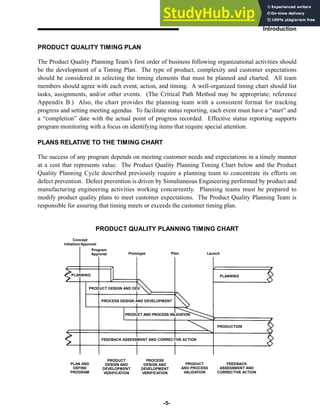
PLANS RELATIVE TO THE TIMING CHART
The success of any program depends on meeting customer needs and expectations in a timely manner
at a cost that represents value. The Product Quality Planning Timing Chart below and the Product
Quality Planning Cycle described previously require a planning team to concentrate its efforts on
defect prevention. Defect prevention is driven by Simultaneous Engineering performed by product and
manufacturing engineering activities working concurrently. Planning teams must be prepared to
modify product quality plans to meet customer expectations. The Product Quality Planning Team is
responsible for assuring that timing meets or exceeds the customer timing plan.
-5-
Introduction
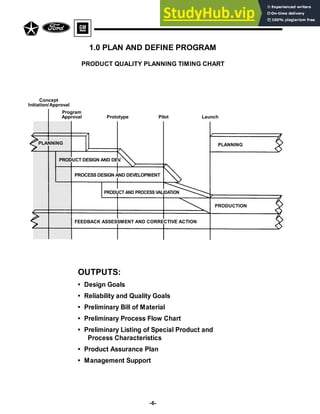
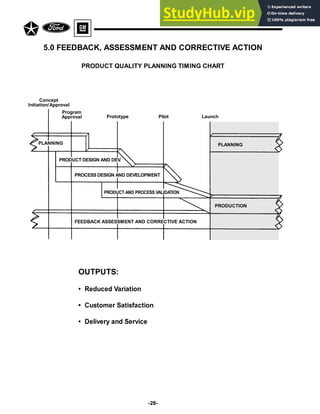
PRODUCT QUALITY PLANNING TIMING CHART
Concept
Initiation/Approval
Program
Approval Prototype Pilot Launch
PLANNING
PLANNING
PRODUCT DESIGN AND DEV.
PROCESS DESIGN AND DEVELOPMENT
PRODUCT AND PROCESS VALIDATION
PRODUCTION
FEEDBACK ASSESSMENT AND CORRECTIVE ACTION
PLAN AND
DEFINE
PROGRAM
PRODUCT
DESIGN AND
DEVELOPMENT
VERIFICATION
PROCESS
DESIGN AND
DEVELOPMENT
VERIFICATION
PRODUCT
AND PROCESS
VALIDATION
FEEDBACK
ASSESSMENT AND
CORRECTIVE ACTION
PRODUCT QUALITY PLANNING TIMING CHART
1.0 PLAN AND DEFINE PROGRAM
-6-
Concept
Initiation/Approval
Program
Approval Prototype Pilot Launch
PLANNING
PLANNING
PRODUCT DESIGN AND DEV
.
PROCESS DESIGN AND DEVELOPMENT
PRODUCT AND PROCESS VALIDATION
PRODUCTION
FEEDBACK ASSESSMENT AND CORRECTIVE ACTION
OUTPUTS:
• Design Goals
• Reliability and Quality Goals
• Preliminary Bill of Material
• Preliminary Process Flow Chart
• Preliminary Listing of Special Product and
Process Characteristics
• Product Assurance Plan
• Management Support
INTRODUCTION
This section describes how to determine customer needs and expectations in order to plan and define a
quality program. All work must be done with the customer in mind, providing better products and
services than the competition. The early stage of the product quality planning process is designed to
assure that customer needs and expectations are clearly understood.
The inputs and outputs applicable to the process may vary according to the product process and
customer needs and expectations. Some recommendations discussed in this section are as follows:
INPUTS
• Voice of the Customer
- Market Research
- Historical Warranty and Quality Information
- Team Experience
• Business Plan/Marketing Strategy
• Product/Process Benchmark Data
• Product/Process Assumptions
• Product Reliability Studies
• Customer Inputs
OUTPUTS (Become inputs for Section 2.0.)
• Design Goals
• Reliability and Quality Goals
• Preliminary Bill of Material
• Preliminary Process Flow Chart
• Preliminary Listing of Special Product and Process Characteristics
• Product Assurance Plan
• Management Support
1.1 VOICE OF THE CUSTOMER
The “Voice of the Customer” encompasses complaints, recommendations, data and information
obtained from internal and/or external customers. Some methods for gathering this information appear
in the following paragraphs.
-7-
Plan and Define Program
-8-
1.1.1 MARKET RESEARCH
The Product Quality Planning Team may need to obtain market research data and information
reflecting the Voice of the Customer. The following sources can assist in identifying customer
concerns/wants and translating those concerns into product and process characteristics:
• Customer interviews
• Customer questionnaires and surveys
• Market test and positioning reports
• New product quality and reliability studies
• Competitive product quality studies
• Things Gone Right (TGR) reports
1.1.2 HISTORICAL WARRANTY AND QUALITY INFORMATION
A list of historical customer concerns/wants should be prepared to assess the potential for recurrence
during the design, manufacture, installation and use of the product. These should be considered as an
extension of the other design requirements and included in the analysis of customer needs.
Many of the following items can assist the team in identifying customer concerns/wants and
prioritizing appropriate resolutions.
• Things Gone Wrong (TGW) reports
• Warranty reports
• Capability indicators
• Supplier plant internal quality reports
• Problem resolution reports
• Customer plant returns and rejections
• Field return product analysis
1.1.3 TEAM EXPERIENCE
The team may use any source of any information as appropriate, including the following:
• Input from higher system level or past Quality Function Deployment (QFD) projects
• Media commentary and analysis: magazine and newspaper reports, etc.
• Customer letters and suggestions
• TGR/TGW reports
-9-
Plan and Define Program
• Dealer comments
• Fleet Operator’s comments
• Field service reports
• Internal evaluations using surrogate customers
• Road trips
• Management comments or direction
• Problems and issues reported from internal customers
• Government requirements and regulations
• Contract review
1.2 BUSINESS PLAN/MARKETING STRATEGY
The customer business plan and marketing strategy will set the framework for the product quality plan.
The business plan may place constraints (e.g., timing, cost, investment, product positioning, research
and development (R&D) resources) on the team that affect the direction taken. The marketing strategy
will define the target customer, the key sales points, and key competitors.
1.3 PRODUCT/PROCESS BENCHMARK DATA
The use of Benchmarking (referenced in Appendix B) will provide input to establishing product/
process performance targets. Research and development may also provide benchmarks and concept
ideas. One method to successful benchmarking is:
• Identify the appropriate benchmarks.
• Understand the reason for the gap between your current status and the benchmark.
• Develop a plan to either close the gap, match the benchmark, or exceed the benchmark.
1.4 PRODUCT/PROCESS ASSUMPTIONS
There will be assumptions that the product has certain features, design, or process concepts. These
include technical innovations, advanced materials, reliability assessments, and new technology. All
should be utilized as inputs.
1.5 PRODUCT RELIABILITY STUDIES
This type of data considers frequency of repair or replacement of components within designated
periods of time and the results of long-term reliability/durability tests.
1.6 CUSTOMER INPUTS
The next users of the product can provide valuable information relating to their needs and
expectations. In addition, the next product users may have already conducted some or all of the
aforementioned reviews and studies. These inputs should be used by the customer and/or supplier to
develop agreed upon measures of customer satisfaction.
1.7 DESIGN GOALS
Design goals are a translation of the Voice of the Customer into tentative and measurable design
objectives. The proper selection of Design Goals assures that the Voice of the Customer is not lost in
subsequent design activity.
1.8 RELIABILITY AND QUALITY GOALS
Reliability goals are established based on customer wants and expectations, program objectives, and
reliability benchmarks. Examples of customer wants and expectations could be no safety failures or
serviceability. Some reliability benchmarks could be competitor product reliability, consumer reports,
or frequency of repair over a set time period. Overall reliability goals should be expressed in terms of
probability and confidence limits. Quality goals are targets based on continual improvement. Some
examples are parts per million, defect levels, or scrap reduction.
1.9 PRELIMINARY BILL OF MATERIAL
The team should establish a preliminary bill of material based on product/process assumptions and
include an early subcontractor list. In order to identify the preliminary special product/process
characteristics it is necessary to have selected the appropriate design and manufacturing process.
1.10 PRELIMINARY PROCESS FLOW CHART
The anticipated manufacturing process should be described using a process flow chart developed from
the preliminary bill of material and product/process assumptions.
1.11 PRELIMINARY LISTING OF SPECIAL PRODUCT AND PROCESS
CHARACTERISTICS
Special product and process characteristics are identified by the customer in addition to those selected
by the supplier through knowledge of the product and process. At this stage, the team should assure
that a preliminary list of special product and process characteristics resulting from the analysis of the
inputs pertaining to customer needs and expectations is developed. This listing could be developed
from but is not limited to the following:
• Product assumptions based on the analysis of customer needs and expectations.
• Identification of reliability goals/requirements.
• Identification of special process characteristics from the anticipated manufacturing process.
• Similar part FMEAs.
-10-
1.12 PRODUCT ASSURANCE PLAN
The Product Assurance Plan translates design goals into design requirements. The amount of effort
devoted to the Product Assurance Plan by the Product Quality Planning Team depends on the customer
needs, expectations, and requirements. This manual does not prescribe a method for preparing a
Product Assurance Plan. The Product Assurance Plan can be developed in any understandable format
and should include, but is not limited to the following actions:
• Outlining of program requirements.
• Identification of reliability, durability, and apportionment/allocation goals and/or requirements.
• Assessment of new technology, complexity, materials, application, environment, packaging,
service, and manufacturing requirements, or any other factor that may place the program at risk.
• Development of Failure Mode Analysis (FMA) (referenced in Appendix H).
• Development of preliminary engineering standards requirements.
The Product Assurance Plan is an important part of the Product Quality Plan.
1.13 MANAGEMENT SUPPORT
One of the keys to the Product Quality Planning Team’s success is the interest, commitment and
support of upper management. The team should update management at the conclusion of every
product quality planning phase to maintain their interest, plus reinforce their commitment and support.
Updates and/or requests for assistance can occur more frequently as the team requires. The updates
should be formal with the opportunity for questions and answers. A functional goal of the Product
Quality Planning Team is to maintain management support by demonstrating that all planning
requirements have been met and/or concerns documented and scheduled for resolution. Participation
by management in product quality planning meetings is vital to ensuring the success of the program.
-11-
Plan and Define Program
PRODUCT QUALITY PLANNING TIMING CHART
2.0 PRODUCT DESIGN AND DEVELOPMENT
-12-
Concept
Initiation/Approval
Program
Approval Prototype Pilot Launch
PLANNING
PLANNING
PRODUCT DESIGN AND DEV
.
PROCESS DESIGN AND DEVELOPMENT
PRODUCT AND PROCESS VALIDATION
PRODUCTION
FEEDBACK ASSESSMENT AND CORRECTIVE ACTION
OUTPUTS BY DESIGN
RESPONSIBLE ACTIVITY
• Design Failure Mode and Effects
Analysis (DFMEA)
• Design For Manufacturability
and Assembly
• Design Verification
• Design Reviews
• Prototype Build
• Engineering Drawings
(Including Math Data)
• Engineering Specifications
• Material Specifications
• Drawing and Specification Changes
OUTPUTS BY ADVANCED PRODUCT
QUALITY PLANNING TEAM
• New Equipment, Tooling and
Facilities Requirements
• Special Product
and Process Characteristics
• Prototype Control Plan
• Gages/Testing Equipment Requirements
• Team Feasibility Commitment &
Management Support
-13-
Product Design and Development
INTRODUCTION
This section discusses the elements of the planning process during which design features and
characteristics are developed into a near final form. The Product Quality Planning Team should
consider all design factors in the planning process even if the design is owned by the customer or
shared. The steps include prototype build to verify that the product or service meets the objectives of
the Voice of the Customer. A feasible design must permit meeting production volumes and schedules,
and be consistent with the ability to meet engineering requirements, along with quality, reliability,
investment cost, weight, unit cost and timing objectives. Although feasibility studies and control plans
are primarily based on engineering drawings and specification requirements, valuable information can
be derived from the analytical tools described in this section to further define and prioritize the
characteristics that may need special product and process controls.
In this section, the Product Quality Planning Process is designed to assure a comprehensive and critical
review of engineering requirements and other related technical information. At this stage of the
process, a preliminary feasibility analysis will be made to assess the potential problems that could
occur during manufacturing.
The inputs and outputs applicable to this section are as follows:
INPUTS (Derived from the outputs of Section 1.0)
• Design Goals
• Reliability and Quality Goals
• Preliminary Bill of Material
• Preliminary Process Flow Chart
• Preliminary Listing of Special Product and Process Characteristics
• Product Assurance Plan
• Management Support
OUTPUTS BY DESIGN RESPONSIBLE ACTIVITY (Become inputs for Section 3.0)
• Design Failure Mode and Effects Analysis (DFMEA)
• Design for Manufacturability and Assembly
• Design Verification
• Design Reviews
• Prototype Build - Control Plan
• Engineering Drawings (Including Math Data)
• Engineering Specifications
-14-
• Material Specifications
• Drawing and Specification Changes
OUTPUTS BY PRODUCT QUALITY PLANNING TEAM (Becomes Inputs for Section 3.0)
• New Equipment, Tooling and Facilities Requirements
• Special Product and Process Characteristics
• Gages/Testing Equipment Requirements
• Team Feasibility Commitment and Management Support
2.1 DESIGN FAILURE MODE AND EFFECTS ANALYSIS (DFMEA)
The DFMEA is a disciplined analytical technique that assesses the probability of failure as well as the
effect of such failure. A form of DFMEA is a Systems Failure Mode and Effects Analysis (SFMEA).
A DFMEA is a living document continually updated as customer needs and expectations require.
Preparing the DFMEA provides the team an opportunity to review the previously selected product and
process characteristics and make necessary additions, changes, and deletions. The Chrysler, Ford and
General Motors Potential Failure Mode and Effects Analysis reference manual should be used for the
acceptable method of preparing a DFMEA. The Design FMEA Checklist in Appendix A-1 should also
be reviewed to assure that the appropriate design characteristics have been considered.
2.2 DESIGN FOR MANUFACTURABILITY AND ASSEMBLY
Design for Manufacturability and Assembly is a Simultaneous Engineering process designed to
optimize the relationship between design function, manufacturability, and ease of assembly. The scope
of customer needs and expectations defined in Section 1.0 will determine the extent of the supplier’s
Product Quality Planning Team involvement in this activity. This manual does not include or refer to a
formal method of preparing a Design for Manufacturability and Assembly Plan. At a minimum, the
items listed here should be considered by the Product Quality Planning Team:
• Design, concept, function, and sensitivity to manufacturing variation
• Manufacturing and/or assembly process
• Dimensional tolerances
• Performance requirements
• Number of components
• Process adjustments
• Material Handling
The Product Quality Planning Team’s knowledge, experience, the product/process, government
regulations, and service requirements may require other factors to be considered.
-15-
Product Design and Development
2.3 DESIGN VERIFICATION
Design Verification verifies that the product design meets the customer requirements derived from the
activities described in Section 1.0.
2.4 DESIGN REVIEWS
Design Reviews are regularly scheduled meetings led by the supplier’s design engineering activity and
must include other affected areas. The Design Review is an effective method to prevent problems and
misunderstandings; it also provides a mechanism to monitor progress and report to management.
Design Reviews are a series of verification activities that are more than an engineering inspection. At
a minimum Design Reviews should include evaluation of:
• Design/Functional requirement(s) considerations
• Formal reliability and confidence goals
• Component/subsystem/system duty cycles
• Computer simulation and bench test results
• DFMEA(s)
• Review of the Design For Manufacturability and Assembly effort
• Design Of Experiments (DOE) and assembly build variation results (Refer to Appendix B.)
• Test failures
• Design Verification progress
A major function of Design Reviews is the tracking of design verification progress. The supplier
should track design verification progress through the use of a plan and report format, referred to as
Design Verification Plan and Report (DVP&R) by Chrysler and Ford. The plan and report is a formal
method to assure:
• Design verification
• Product and process validation of components and assemblies through the application of a
comprehensive test plan and report.
The Product Quality Planning Team is not limited to the items listed. The team should consider and
use as appropriate, the analytical techniques listed in Appendix B.
2.5 PROTOTYPE BUILD - CONTROL PLAN
Prototype Control Plans are a description of the dimensional measurements and material and
functional tests that will occur during prototype build. The Product Quality Planning Team should
ensure that a prototype control plan is prepared. Control plan methodology is described in Section 6.
A Control Plan Checklist is provided in both Appendix A-8 and Section 6 to assist in the preparation of
the prototype control plan.
The manufacture of prototype parts provides an excellent opportunity for the team and the customer to
evaluate how well the product or service meets Voice of the Customer objectives. All prototypes that
are the Product Quality Planning Team’s responsibility should be reviewed to:
• Assure that the product or service meets specification and report data as required.
• Ensure that particular attention has been given to special product and process characteristics.
• Use data and experience to establish preliminary process parameters and packaging requirements.
• Communicate any concerns, deviations, and/or cost impact to the customer.
2.6 ENGINEERING DRAWINGS (Including Math Data)
Customer designs do not preclude the planning team’s responsibility to review engineering drawings in
the following manner. Engineering drawings may include special (governmental regulatory and safety)
characteristics that must be shown on the control plan. When customer engineering drawings are
nonexistent, the controlling drawings should be reviewed by the planning team to determine which
characteristics affect fit, function, durability and/or governmental regulatory safety requirements.
Drawings should be reviewed to determine if there is sufficient information for a dimensional layout of
the individual parts. Control or datum surfaces/locators should be clearly identified so that appropriate
functional gages and equipment can be designed for ongoing controls. Dimensions should be
evaluated to assure feasibility and compatibility with industry manufacturing and measuring standards.
If appropriate, the team should assure that math data is compatible with the customer’s system for
effective two-way communications.
2.7 ENGINEERING SPECIFICATIONS
A detailed review and understanding of the controlling specifications will help the Product Quality
Planning Team to identify the functional, durability and appearance requirements of the subject
component or assembly. Sample size, frequency, and acceptance criteria of these parameters are
generally defined in the in-process test section of the Engineering Specification. Otherwise, the
sample size and frequency are to be determined by the supplier and listed in the control plan. In either
case, the supplier should determine which characteristics affect or control the results that fulfill
meeting functional, durability, and appearance requirements.
2.8 MATERIAL SPECIFICATIONS
In addition to drawings and performance specifications, material specifications should be reviewed for
Special Characteristics relating to physical properties, performance, environmental, handling, and
storage requirements. These characteristics should also be included in the control plan.
2.9 DRAWING AND SPECIFICATION CHANGES
Where drawing and specification changes are required, the team must ensure that the changes are
promptly communicated and properly documented to all affected areas.
-16-
2.10 NEW EQUIPMENT, TOOLING AND FACILITIES REQUIREMENTS
The DFMEA, Product Assurance Plan and/or Design Reviews may identify new equipment and
facilities requirements. The Product Quality Planning Team should address these requirements by
adding the items to the Timing Chart. The team should ensure that the new equipment and tooling is
capable and delivered on time. Facilities progress should be monitored to assure completion to surpass
planned production tryout. Refer to the New Equipment, Tooling and Test Equipment Checklist in
Appendix A-3.
2.11 SPECIAL PRODUCT AND PROCESS CHARACTERISTICS
In the stage of quality planning described in Section 1.0, the team identified preliminary special
product and process characteristics resulting from understanding the Voice of the Customer. The
Product Quality Planning Team should build on this listing and reach consensus during the review and
development of design features through the evaluation of the technical information. Appendix C
contains a table describing the symbols Chrysler, Ford and General Motors use to denote Special
Characteristics. The consensus is to be documented on the appropriate Control Plan. The Control Plan
Special Characteristics and Data Point Coordinates forms referenced in Section 6, Supplements K and
L, are recommended methods to document and update Special Characteristics, as required, to support
the Prototype, Pre-Launch, and Production Control Plans. The supplier can use any form that
accomplishes the same documentation requirement. Customers may have unique approval
requirements. Refer to Chrysler, Ford, and General Motors Quality System Requirements, Section III
for details.
2.12 GAGES/TESTING EQUIPMENT REQUIREMENTS
Gages/testing equipment requirements may also be identified at this time. The Product Quality
Planning Team should add these requirements to the Timing Chart. Progress will then be monitored to
assure that required timing is met.
2.13 TEAM FEASIBILITY COMMITMENT AND MANAGEMENT SUPPORT
The Product Quality Planning Team must assess the feasibility of the proposed design at this time.
Customer design ownership does not preclude the supplier’s obligation to assess design feasibility. The
team must be satisfied that the proposed design can be manufactured, assembled, tested, packaged, and
delivered in sufficient quantity, at an acceptable cost to the customer on schedule. The Design
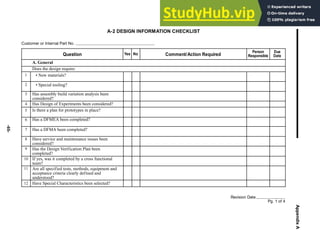
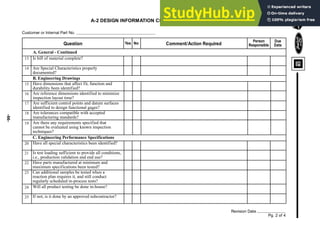
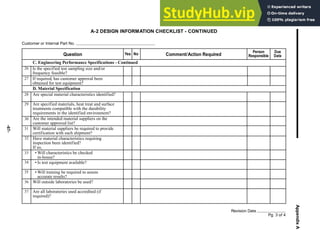
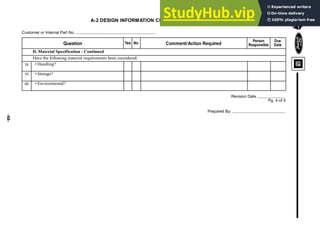
Information Checklist in Appendix A-2 allows the team to review its efforts in this section and make
an evaluation of its effectiveness. This checklist will also serve as a basis for the open issues discussed
in the Team Feasibility Commitment, Appendix E. The team consensus that the proposed design is
feasible should be documented along with all open issues that require resolution and presented to
management for their support. The Team Feasibility Commitment form shown in Appendix E is an
example of the type of written record recommended.
-17-
Product Design and Development
-18-
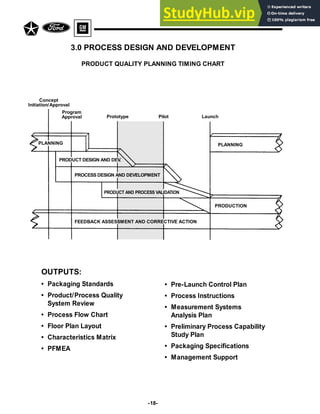
PRODUCT QUALITY PLANNING TIMING CHART
3.0 PROCESS DESIGN AND DEVELOPMENT
Concept
Initiation/Approval
Program
Approval Prototype Pilot Launch
PLANNING
PLANNING
PRODUCT DESIGN AND DEV
.
PROCESS DESIGN AND DEVELOPMENT
PRODUCT AND PROCESS VALIDATION
PRODUCTION
FEEDBACK ASSESSMENT AND CORRECTIVE ACTION
OUTPUTS:
• Packaging Standards
• Product/Process Quality
System Review
• Process Flow Chart
• Floor Plan Layout
• Characteristics Matrix
• PFMEA
• Pre-Launch Control Plan
• Process Instructions
• Measurement Systems
Analysis Plan
• Preliminary Process Capability
Study Plan
• Packaging Specifications
• Management Support
-19-
Process Design and Development
INTRODUCTION
This section discusses the major features of developing a manufacturing system and its related control
plans to achieve quality products. The tasks to be accomplished at this step of the product quality
planning process depend upon the successful completion of the prior stages contained in the first two
sections. This next step is designed to ensure the comprehensive development of an effective
manufacturing system. The manufacturing system must assure that customer requirements, needs and
expectations are met.
The inputs and outputs applicable to the process step in this section are as follows:
INPUTS (Derived from the outputs of Section 2.0.)
• Design Failure Mode and Effects Analysis (DFMEA)
• Design for Manufacturability and Assembly
• Design Verification
• Design Reviews
• Prototype Build - Control Plan
• Engineering Drawings (Including Math Data)
• Engineering Specifications
• Material Specifications
• Drawing and Specification Changes
• New Equipment, Tooling and Facilities Requirements
• Special Product and Process Characteristics
• Gages/Testing Equipment Requirements
• Team Feasibility Commitment and Management Support
OUTPUTS (Become inputs for Section 4.0.)
• Packaging Standards
• Product/Process Quality System Review
• Process Flow Chart
• Floor Plan Layout
• Characteristics Matrix
• Process Failure Mode and Effects Analysis (PFMEA)
• Pre-Launch Control Plan
• Process Instructions
• Measurement Systems Analysis Plan
• Preliminary Process Capability Study Plan
• Packaging Specifications
• Management Support
3.1 PACKAGING STANDARDS
The customer will usually have packaging standards that should be incorporated into any packaging
specifications for the product. If none are provided, the packaging design should ensure product
integrity at point of use.
3.2 PRODUCT/PROCESS QUALITY SYSTEM REVIEW
The Product Quality Planning Team should review the manufacturing location’s Quality System
Manual. Any additional controls and/or procedural changes required to produce the product should be
updated in the Quality System Manual and should also be included in the manufacturing control plan.
This is an opportunity for the Product Quality Planning Team to improve the existing quality system
based on customer input, team expertise, and previous experience. The Product/Process Quality
Checklist provided in Appendix A-4 can be used by the Product Quality Planning Team to assist in its
evaluation.
3.3 PROCESS FLOW CHART
The process flow chart is a schematic representation of the current or proposed process flow. It can be used
to analyze sources of variations of machines, materials, methods, and manpower from the beginning to end
of a manufacturing or assembly process. It is used to emphasize the impact of sources of variation on the
process. The flow chart helps to analyze the total process rather than individual steps in the process. The
flow chart assists the Product Quality Planning Team to focus on the process when conducting the PFMEA
and designing the Control Plan. The Process Flow Chart Checklist in Appendix A-6 can be used by the
Product Quality Planning Team to assist in its evaluation.
3.4 FLOOR PLAN LAYOUT
The floor plan should be developed and reviewed to determine the acceptability of inspection points,
control chart location, applicability of visual aids, interim repair stations, and storage areas to contain
defective material. All material flow should be keyed to the process flow chart and control plan. The
Floor Plan Checklist in Appendix A-5 can be used by the Product Quality Planning Team to assist in its
evaluation.
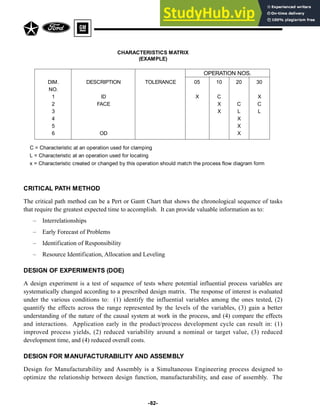
3.5 CHARACTERISTICS MATRIX
A characteristics matrix is a recommended analytical technique for displaying the relationship between
process parameters and manufacturing stations. See Analytical Techniques in Appendix B for further
detail.
-20-
3.6 PROCESS FAILURE MODE AND EFFECTS ANALYSIS
A PFMEA should be conducted during product quality planning and before beginning production. It
is a disciplined review and analysis of a new/revised process and is conducted to anticipate, resolve, or
monitor potential process problems for a new/revised product program. A PFMEA is a living
document and needs to be reviewed and updated as new failure modes are discovered.
For further information on the creation and maintenance of PFMEAs refer to Chrysler, Ford and
General Motors Potential Failure Mode and Effects Analysis (FMEA) reference manual. The Process
FMEA Checklist in Appendix A-7 can be used by the Product Quality Planning Team to assist in its
evaluation.
3.7 PRE-LAUNCH CONTROL PLAN
Pre-launch Control Plans are a description of the dimensional measurements and material and
functional tests that will occur after prototype and before full production. The pre-launch control plan
should include additional product/process controls to be implemented until the production process is
validated. The purpose of the pre-launch control plan is to contain potential nonconformances during
or prior to initial production runs. Examples are:
• More frequent inspection
• More in-process and final check points
• Statistical evaluations
• Increased audits
For further information on the creation and maintenance of control plans refer to Section 6. The
Control Plan Checklist in Appendix A-8 can be used by the Product Quality Planning Team to assist in
its evaluation.
3.8 PROCESS INSTRUCTIONS
The Product Quality Planning Team should ensure that understandable process instructions provide
sufficient detail for all operating personnel who have direct responsibility for the operation of the
processes. These instructions should be developed from the following sources:
• FMEAs
• Control plan(s)
• Engineering drawings, performance specifications, material specifications, visual standards and
industry standards
• Process flow chart
• Floor plan layout
• Characteristics matrix
-21-
Process Design and Development
• Packaging Standards
• Process parameters
• Producer expertise and knowledge of the processes and products
• Handling requirements
• Operators of the Process
The process instructions for standard operating procedures should be posted and should include set-up
parameters such as: machine speeds, feeds, cycle times, etc., and should be accessible to the operators
and supervisors. Additional information for process instruction preparation can be found in the
Chrysler, Ford, and General Motors Quality System Requirements.
3.9 MEASUREMENT SYSTEMS ANALYSIS PLAN
The Product Quality Planning Team should ensure that a plan to accomplish the required measurement
systems analysis is developed. This plan should include, at a minimum, the responsibility to ensure
gage linearity, accuracy, repeatability, reproducibility, and correlation for duplicate gages. Refer to the
Chrysler, Ford, and General Motors Measurement Systems Analysis Reference Manual.
3.10 PRELIMINARY PROCESS CAPABILITY STUDY PLAN
The Product Quality Planning Team should ensure the development of a preliminary process capability
plan. The characteristics identified in the control plan will serve as the basis for the preliminary
process capability study plan. Reference the Chrysler, Ford, and General Motors Production Part
Approval Process manual and Chrysler, Ford, and General Motors Fundamental Statistical Process
Control Reference Manual for further definition.
3.11 PACKAGING SPECIFICATIONS
The Product Quality Planning Team should ensure that individual product packaging (including
interior partitions) is designed and developed. Customer packaging standards or generic packaging
requirements should be used when appropriate. In all cases the packaging design must assure that the
product performance and characteristics will remain unchanged during packing, transit, and
unpacking. The packaging should have compatibility with all material handling equipment including
robots.
3.12 MANAGEMENT SUPPORT
The Product Quality Planning Team is required to schedule the formal review designed to reinforce
management commitment at the conclusion of the process design and development phase. The
purpose of this review is to inform upper management of program status and gain their commitment to
assist in resolution of any open issues.
-22-
-23-
Process Design and Development
-24-
PRODUCT QUALITY PLANNING TIMING CHART
4.0 PRODUCT AND PROCESS VALIDATION
Concept
Initiation/Approval
Program
Approval Prototype Pilot Launch
PLANNING
PLANNING
PRODUCT DESIGN AND DEV
.
PROCESS DESIGN AND DEVELOPMENT
PRODUCT AND PROCESS VALIDATION
PRODUCTION
FEEDBACK ASSESSMENT AND CORRECTIVE ACTION
OUTPUTS:
• Production Trial Run
• Measurement Systems Evaluation
• Preliminary Process Capability Study
• Production Part Approval
• Production Validation Testing
• Packaging Evaluation
• Production Control Plan
• Quality Planning Sign-Off and Management Support
INTRODUCTION
This section discusses the major features of validating the manufacturing process through an
evaluation of a production trial run. During a production trial run, the Product Quality Planning Team
should validate that the control plan and process flow chart are being followed and the products meet
customer requirements. Additional concerns should be identified for investigation and resolution prior
to regular production runs.
The inputs and outputs applicable to the process steps in this section are as follows:
INPUTS (Derived from the outputs of Section 3.0.)
• Packaging Standards
• Product/Process Quality System Review
• Process Flow Chart
• Floor Plan Layout
• Characteristics Matrix
• Process Failure Mode and Effects Analysis (PFMEA)
• Pre-Launch Control Plan
• Process Instructions
• Measurement Systems Analysis Plan
• Preliminary Process Capability Study Plan
• Packaging Specifications
• Management Support
OUTPUTS (Become inputs for Section 5.0)
• Production Trial Run
• Measurement Systems Evaluation
• Preliminary Process Capability Study
• Production Part Approval
• Production Validation Testing
• Packaging Evaluation
• Production Control Plan
• Quality Planning Sign-Off and Management Support
4.1 PRODUCTION TRIAL RUN
The production trial run must be conducted using production tooling, equipment, environment
(including production operators), facility, and cycle time. The validation of the effectiveness of the
-25-
Product and Process Validation
manufacturing process begins with the production trial run. The minimum quantity for a production
trial run is usually set by the customer but can be exceeded by the Product Quality Planning Team.
Output of the production trial run (product) is used for:
• Preliminary process capability study
• Measurement systems evaluation
• Final feasibility
• Process review
• Production validation testing
• Production part approval
• Packaging evaluation
• First time capability (FTC)
• Quality planning sign-off
4.2 MEASUREMENT SYSTEMS EVALUATION
The specified measurement devices and methods should be used to check the control plan identified
characteristics to engineering specification and be subjected to measurement system evaluation during
or prior to the production trial run. Refer to the Chrysler, Ford, and General Motors Measurement
Systems Analysis Reference Manual.
4.3 PRELIMINARY PROCESS CAPABILITY STUDY
The preliminary process capability study should be performed on characteristics identified in the
control plan. The study provides an assessment of the readiness of the process for production. Refer
to the Chrysler, Ford, and General Motors Production Part Approval Process reference manual and
Chrysler, Ford, and General Motors Fundamental Statistical Process Control Reference Manual for
details concerning the preliminary process capability study.
4.4 PRODUCTION PART APPROVAL
The intent of production part approval is to validate that products made from production tools and
processes meet engineering requirements. Refer to the Chrysler, Ford, and General Motors Production
Part Approval Process reference manual.
4.5 PRODUCTION VALIDATION TESTING
Production validation testing refers to engineering tests that validate that products made from
production tools and processes meet engineering standards. Refer to the Chrysler, Ford, and General
Motors Quality System Requirements for specific requirements.
-26-
4.6 PACKAGING EVALUATION
All test shipments (where feasible) and test methods must assess the protection of the product from
normal transportation damage and adverse environmental factors. Customer-specified packaging does
not preclude the Product Quality Planning Team involvement in evaluating the packaging method.
4.7 PRODUCTION CONTROL PLAN
The production control plan is a written description of the systems for controlling parts and processes.
The production control plan is a living document and should be updated to reflect the addition/deletion
of controls based on experience gained by producing parts. (Approval of the procuring organization(s)
may be required.) The production control plan is a logical extension of the pre-launch control plan.
Mass production provides the producer the opportunity to evaluate output, review the control plan and
make appropriate changes. Section 6 and Appendix A-8 present Control Plan Methodology and a
checklist to assist the producer in this review. There can be other types of control plans. An example
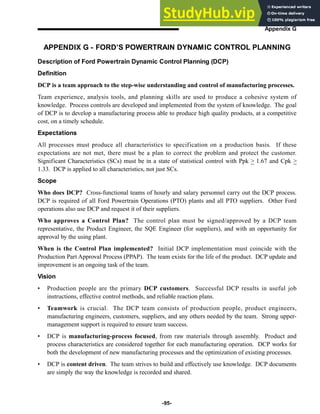
is the Ford Dynamic Control Plan (DCP) described in Appendix B and detailed in Appendix G.
4.8 QUALITY PLANNING SIGN-OFF AND MANAGEMENT SUPPORT
The Product Quality Planning Team should ensure that all control plans and process flow charts are
being followed. It is suggested that the Product Quality Planning Team performs its review at the
manufacturing location(s) and coordinates a formal sign-off. A review of the following items prior to
first production shipment is required:
• Control Plans. Control plans should exist and be available at all times for all affected operations.
• Process Instructions. Verify that these documents contain all the Special Characteristics specified
in the control plan and that all PFMEA recommendations have been addressed. Compare the
process instructions and process flow chart to the control plan.
• Gage and Test Equipment. Where special gages, fixtures, or test equipment are required per the
control plan, verify gage repeatability and reproducibility (GR&R) and proper usage. (Refer to
Appendix D for Measurement Systems Analysis reference manual information.)
Management support is necessary prior to the quality planning sign-off. The team should be able to
show that all planning requirements are met or concerns documented and schedule a management
review. The purpose of this review is to inform upper management of program status and gain their
commitment to assist in any open issues. The Product Quality Planning Summary and Sign-Off report
shown in Appendix F is an example of the documentation required to support an effective quality
planning sign-off.
-27-
Product and Process Validation
-28-
PRODUCT QUALITY PLANNING TIMING CHART
5.0 FEEDBACK, ASSESSMENT AND CORRECTIVE ACTION
Concept
Initiation/Approval
Program
Approval Prototype Pilot Launch
PLANNING
PLANNING
PRODUCT DESIGN AND DEV
.
PROCESS DESIGN AND DEVELOPMENT
PRODUCT AND PROCESS VALIDATION
PRODUCTION
FEEDBACK ASSESSMENT AND CORRECTIVE ACTION
OUTPUTS:
• Reduced Variation
• Customer Satisfaction
• Delivery and Service
INTRODUCTION
Quality planning does not end with process validation and installation. It is the component
manufacturing stage where output can be evaluated when all special and common causes of variation
are present. This is also the time to evaluate the effectiveness of the product quality planning effort.
The production control plan is the basis for evaluating product or service at this stage. Variable and
attribute data must be evaluated. Appropriate actions as described in the Chrysler, Ford, and General
Motors Fundamental Statistical Process Control Reference Manual must be taken. It is the obligation
of all suppliers to meet customer requirements on all characteristics. Special Characteristics must
meet the indices specified by the customer.
The inputs and outputs applicable to the process step in this section are as follows:
INPUTS (Derived from the outputs of Section 4.0.)
• Production Trial Run
• Measurement Systems Evaluation
• Preliminary Process Capability Study
• Production Part Approval
• Production Validation Testing
• Packaging Evaluation
• Production Control Plan
• Quality Planning Sign-Off and Management Support
OUTPUTS
• Reduced Variation
• Customer Satisfaction
• Delivery and Service
5.1 REDUCED VARIATION
Control charts and other statistical techniques should be used as tools to identify process variation.
Analysis and corrective actions should be used to reduce variation. Continual improvement requires
attention not only to the special causes of variation but understanding common causes and seeking
ways to reduce these sources of variation. Proposals should be developed including costs, timing, and
anticipated improvement for customer review. Often the reduction or elimination of a common cause
results in lower costs. Suppliers should not be reluctant to prepare proposals based on value analysis,
reduction of variation, etc. The decision to implement, negotiate, or progress to the next product
-29-
Feedback, Assessment and Corrective Action
design level is the customer’s prerogative. Refer to the Chrysler, Ford, and General Motors
Fundamental Statistical Process Control Reference Manual for details on long-term capability, special
and common causes of variation.
5.2 CUSTOMER SATISFACTION
Detailed planning activities and demonstrated process capability of a product or service do not always
guarantee customer satisfaction. The product or service must perform in the customer environment.
The product usage stage requires supplier participation. It is in this stage where the most can be
learned by both the supplier and customer. The effectiveness of the Product Quality Planning efforts
can be evaluated in this stage. The supplier and customer must be partners in making the changes
necessary to correct deficiencies to achieve customer satisfaction.
5.3 DELIVERY AND SERVICE
The delivery and service stage of quality planning continues the supplier/customer partnership in
solving problems and continual improvement. The customer’s replacement parts and service
operations always merit the same consideration in quality, cost, and delivery. Failure to correct a
problem the first time always damages the supplier’s reputation and customer partnership. It is
important that both supplier and customer listen to the Voice of the Customer.
The experience gained in this stage provides the customer and supplier with the necessary knowledge
to recommend price reductions achieved by reducing process, inventory, and quality costs and to
provide the right component or system for the next product.
-30-
-31-
Control Plan Methodology
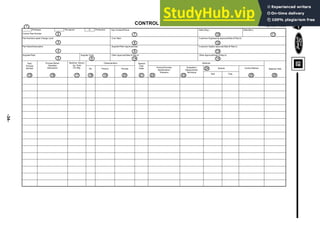
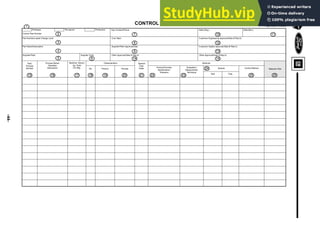
6.0 CONTROL PLAN METHODOLOGY
Control Plan Number
Prototype Production
Pre-launch
Part Number/Latest Change Level
Part Name/Description
Supplier/Plant Supplier Code
Core Team
Supplier/Plant Approval/Date
Other Approval/Date (If Req’d)
Key Contact/Phone
Customer Engineering Approval/Date (If Req’d)
Customer Quality Approval/Date (If Req’d)
Other Approval/Date (If Req’d)
Date (Orig.) Date (Rev.)
Part/
Process
Number
Machine,
Device,
Jig, Tools
For Mfg.
Process Name/
Operation
Description
Characteristics Methods
No. Product Process
Special
Char.
Class.
Product/Process
Specification/
Tolerance
Evaluation/
Measurement
Technique
Sample
Size Freq.
Control Method Reaction Plan
Page of
CONTROL PLAN
6.2 Overview 33
6.3 Control Plan Column Descriptions 37
1) Prototype, Pre-Launch, Production 37
2) Control Plan Number 37
3) Part Number/Latest Change Level 37
4) Part Name/Description 37
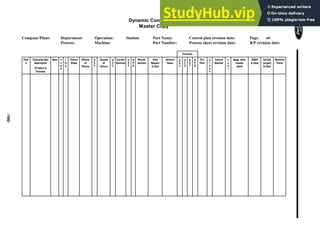
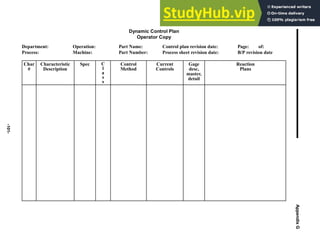
5) Supplier/Plant 37
6) Supplier Code 37
7) Key Contact/Phone 37
8) Core Team 37
9) Supplier/Plant Approval/Date 37
10) Date (Orig.) 39
11) Date (Rev.) 39
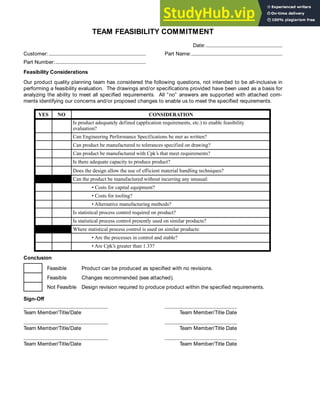
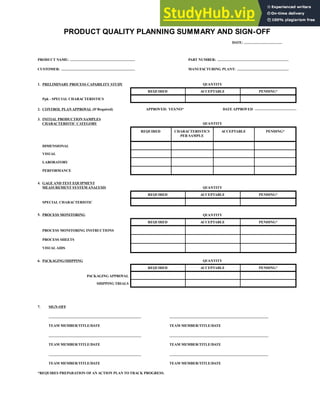
12) Customer Engineering Approval/Date 39
13) Customer Quality Approval/Date 39
14) Other Approval/Date 39
15) Part/Process Number 39
16) Process Name/Operation Description 39
17) Machine, Device, Jig, Tools for Manufacturing 39
Characteristics 39
18) Number 39
19) Product 41
20) Process 41
21) Special Characteristic Classification 41
Methods 43
22) Product/Process Specification/Tolerance 43
23) Evaluation/Measurement Technique 43
24) Sample Size/Frequency 43
25) Control Method 43
26) Reaction Plan 45
6.4 Process Analysis 46
6.5 Supplements 47
A) Equipment: Set-Up Dominant Process Control Plan Example 47
B) Equipment: Machine Dominant Process Control Plan Example 48
C) Equipment: Fixture/Pallet Dominant Process Control Plan Example 49
D) Equipment: Tooling Dominant Process Control Plan Example 50
E) People: Operator Dominant Process Control Plan Example 52
F) Material: Material or Component Dominant Process Control Plan Example 53
G) Methods: Preventative Maintenance Dominant Process Control Plan Example 54
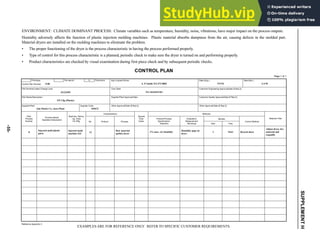
H) Environment: Climate Dominant Process Control Plan Example 55
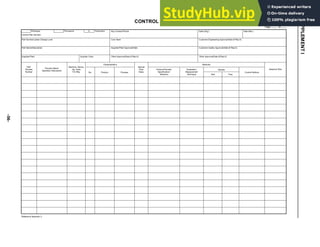
I) Control Plan Form 56
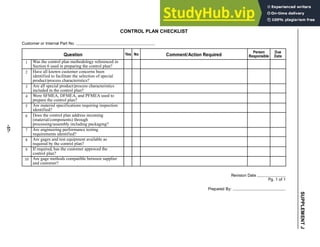
J) Control Plan Checklist 57
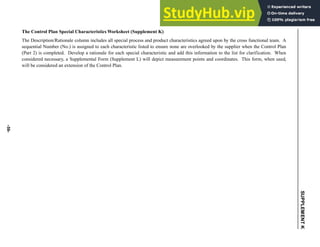
K) Control Plan Special Characteristics Worksheet 59
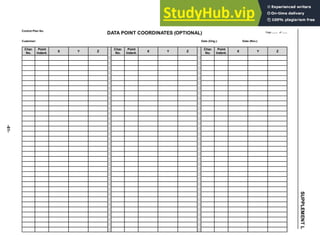
L) Data Point Coordinates 61
Page No.
6.1 TABLE OF CONTENTS
-32-
6.2 OVERVIEW
The purpose of this Control Plan methodology is to aid in the manufacture of quality products
according to customer requirements. It does this by providing a structured approach for the design,
selection and implementation of value-added control methods for the total system. Control Plans
provide a written summary description of the systems used in minimizing process and product
variation. The intent of the Control Plan form displayed in this section is to provide an example of
how this information can be documented. An alternate format may be used as long as it contains the
same information, as a minimum. The Control Plan does not replace the information contained in
detailed operator instructions. This methodology is applicable to a wide range of manufacturing
processes and technologies. The Control Plan is an integral part of an overall quality process and is to
be utilized as a living document. Therefore this section should be used in conjunction with other
related documents.
An important phase of the process for quality planning is the development of a Control Plan. A
Control Plan is a written description of the system for controlling parts and processes. A single
Control Plan may apply to a group or family of products that are produced by the same process at the
same source. Sketches, as necessary, may be attached to the Control Plan for illustration purposes. In
support of a Control Plan, process monitoring instructions should be defined and used continually.
In effect, the Control Plan describes the actions that are required at each phase of the process including
receiving, in-process, out-going, and periodic requirements to assure that all process outputs will be in
a state of control. During regular production runs, the Control Plan provides the process monitoring
and control methods that will be used to control characteristics. Since processes are expected to be
continually updated and improved, the Control Plan reflects a strategy that is responsive to these
changing process conditions.
The Control Plan is maintained and used throughout the product life cycle. Early in the product life
cycle its primary purpose is to document and communicate the initial plan for process control.
Subsequently, it guides manufacturing in how to control the process and ensure product quality.
Ultimately, the Control Plan remains a living document, reflecting the current methods of control, and
measurement systems used. The Control Plan is updated as measurement systems and control methods
are evaluated and improved.
-33-
Control Plan Methodology
-34-
Control Plan Number
Prototype Production
Pre-launch X
Part Number/Latest Change Level
Part Name/Description
Supplier/Plant Supplier Code
Core Team
Supplier/Plant Approval/Date
Other Approval/Date (If Req’d)
Key Contact/Phone
Customer Engineering Approval/Date (If Req’d)
Customer Quality Approval/Date (If Req’d)
Other Approval/Date (If Req’d)
Date (Orig.) Date (Rev.)
Part/
Process
Number
Machine, Device,
Jig, Tools
For Mfg.
Process Name/
Operation
Description
Characteristics Methods
No. Product Process
Special
Char.
Class. Product/Process
Specification/
Tolerance
Evaluation/
Measurement
Technique
Sample
Size Freq.
Control Method Reaction Plan
Page of
CONTROL PLAN
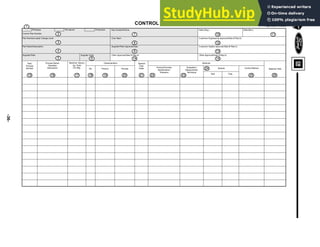
1
2
3
4
5
7
8
9
14
6
10
12
13
14
11
15 16 17 18 19 20 21 22 23
24
25 26
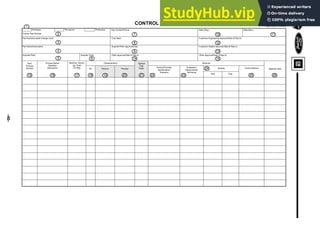
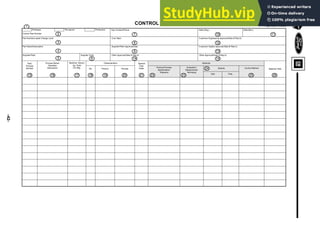
For process control and improvement to be effective, a basic understanding of the process must be
obtained. A multi-disciplined team is established to develop the Control Plan by utilizing all the
available information to gain a better understanding of the process, such as:
• Process Flow Diagram
• System/Design/Process Failure Mode and Effects Analysis
• Special Characteristics
• Lessons Learned from Similar Parts
• Team’s Knowledge of the Process
• Design Reviews
• Optimization Methods (e.g., QFD, DOE, etc.)
The benefits of developing and implementing a Control Plan include:
Quality: The Control Plan methodology reduces waste and improves the quality
of products during design, manufacturing, and assembly. This structured
discipline provides a thorough evaluation of the product and process.
Control Plans identify process characteristics and help to identify their
sources of variation (input variables), which cause variation in product
characteristics (output variables).
Customer Satisfaction: Control Plans focus resources on processes and products related to
characteristics that are important to the customer. The proper allocation
of resources on these major items helps to reduce costs without
sacrificing quality.
Communication: As a living document the Control Plan identifies and communicates
changes in the product/process characteristics, control method, and
characteristic measurement.
-35-
Control Plan Methodology
-36-
Control Plan Number
Prototype Production
Pre-launch
Part Number/Latest Change Level
Part Name/Description
Supplier/Plant Supplier Code
Core Team
Supplier/Plant Approval/Date
Other Approval/Date (If Req’d)
Key Contact/Phone
Customer Engineering Approval/Date (If Req’d)
Customer Quality Approval/Date (If Req’d)
Other Approval/Date (If Req’d)
Date (Orig.) Date (Rev.)
Part/
Process
Number
Machine, Device,
Jig, Tools
For Mfg.
Process Name/
Operation
Description
Characteristics Methods
No. Product Process
Special
Char.
Class. Product/Process
Specification/
Tolerance
Evaluation/
Measurement
Technique
Sample
Size Freq.
Control Method Reaction Plan
Page of
CONTROL PLAN
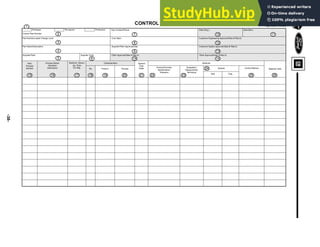
1
2
3
4
5
7
8
9
14
6
10
12
13
14
11
15 16 17 18 19 20 21 22 23
24
25 26
-37-
Control Plan Methodology
Indicate the appropriate category.
• Prototype - A description of the dimensional
measurements material and performance tests
occurring during Prototype build.
• Pre-Launch - A description of the dimensional
measurements, material and performance tests
that will occur after Prototype and before normal
Production.
• Production - A comprehensive documentation of
product/process characteristics, process controls,
tests, and measurement systems occurring
during normal production.
Enter the control plan document number used
for tracking, if applicable. For multiple control
pages, enter page number (page___of___).
Enter the number of the system, subsystem or component
being controlled. When applicable, enter the latest engineering
change level and/or issue date from the drawing specification.
Enter the name and description of the product/process
being controlled.
Enter the name of the company and the appropriate
division/plant/department preparing the control plan.
Enter the identification number (Duns, Z-Code, GSDB...)
as requested by the procuring organization.
Enter the name and telephone number of the primary contact
responsible for the control plan.
Enter the name(s) and telephone number(s) of the
individual(s) responsible for preparing the Control
Plan to the latest revision. It is recommended
that all of the team members’ names, phone numbers,
and locations be included on an attached distribution list.
Obtain the responsible manufacturing plant approval (if required).
6.3 CONTROL PLAN COLUMN DESCRIPTIONS
1) PROTOTYPE,
PRE-LAUNCH,
PRODUCTION
2) CONTROL PLAN
NUMBER
3) PART NUMBER
LATEST CHANGE
LEVEL
4) PART NAME/
DESCRIPTION
5) SUPPLIER/PLANT
6) SUPPLIER CODE
7) KEY CONTACT/
PHONE
8) CORE TEAM
9) SUPPLIER/PLANT
APPROVAL/DATE
-38-
Control Plan Number
Prototype Production
Pre-launch
Part Number/Latest Change Level
Part Name/Description
Supplier/Plant Supplier Code
Core Team
Supplier/Plant Approval/Date
Other Approval/Date (If Req’d)
Key Contact/Phone
Customer Engineering Approval/Date (If Req’d)
Customer Quality Approval/Date (If Req’d)
Other Approval/Date (If Req’d)
Date (Orig.) Date (Rev.)
Part/
Process
Number
Machine, Device,
Jig, Tools
For Mfg.
Process Name/
Operation
Description
Characteristics Methods
No. Product Process
Special
Char.
Class. Product/Process
Specification/
Tolerance
Evaluation/
Measurement
Technique
Sample
Size Freq.
Control Method Reaction Plan
Page of
CONTROL PLAN
1
2
3
4
5
7
8
9
14
6
10
12
13
14
11
15 16 17 18 19 21 22 23
24
25 26
20
-39-
Control Plan Methodology
Enter the date that the original control plan was compiled.
Enter the date of the latest Control Plan updates.
Obtain the responsible engineering approval (if required).
Obtain the responsible supplier quality representative
approval (if required).
Obtain any other agreed upon approval (if required).
This item number is usually referenced from
the Process Flow Chart. If multiple part numbers
exist (assembly), list the individual part numbers
and their processes accordingly.
All steps in the manufacturing of a system,
subsystem, or component are described in a
process flow diagram. Identify the process/operation
name from the flow diagram that best describes
the activity being addressed.
For each operation that is described, identify the
processing equipment, e.g., machine, device, jig,
or other tools for manufacturing, as appropriate.
10) DATE (ORIG.)
11) DATE (REV.)
12) CUSTOMER
ENGINEERING
APPROVAL/DATE
13) CUSTOMER
QUALITY
APPROVAL/DATE
14) OTHER
APPROVAL/DATE
15) PART/PROCESS
NUMBER
16) PROCESS NAME/
OPERATION
DESCRIPTION
17) MACHINE, DEVICE,
JIG, TOOLS FOR
MANUFACTURING
CHARACTERISTICS A distinguishing feature, dimension or property of a process or its
output (product) on which variable or attribute data can be collected. Use visual aids where applicable.
Enter a cross reference number from all applicable documents
such as, but not limited to, process flow diagram, numbered
blue print, FMEAs, and sketches (computer generated or
otherwise), if required.
Optional example work sheets and explanation of these
work sheets are located in Supplements K and L of this section.
18) NUMBER
-40-
Control Plan Number
Prototype Production
Pre-launch
Part Number/Latest Change Level
Part Name/Description
Supplier/Plant Supplier Code
Core Team
Supplier/Plant Approval/Date
Other Approval/Date (If Req’d)
Key Contact/Phone
Customer Engineering Approval/Date (If Req’d)
Customer Quality Approval/Date (If Req’d)
Other Approval/Date (If Req’d)
Date (Orig.) Date (Rev.)
Part/
Process
Number
Machine, Device,
Jig, Tools
For Mfg.
Process Name/
Operation
Description
Characteristics Methods
No. Product Process
Special
Char.
Class. Product/Process
Specification/
Tolerance
Evaluation/
Measurement
Technique
Sample
Size Freq.
Control Method Reaction Plan
Page of
CONTROL PLAN
1
2
3
4
5
7
8
9
14
6
10
12
13
14
11
15 16 17 18 19 20 21 22 23
24
25 26
-41-
Control Plan Methodology
Product Characteristics are the features or
properties of a part, component or assembly that
are described on drawings or other primary engineering
information. The Core Team should identify
the Special Product Characteristics that
are a compilation of important Product Characteristics
from all sources. All Special Characteristics must
be listed on the Control Plan. In addition, the
manufacturer may list other Product Characteristics
for which process controls are routinely tracked
during normal operations.
Process Characteristics are the process
variables (input variables) that have a cause
and effect relationship with the identified
Product Characteristic. A Process Characteristic
can only be measured at the time it occurs.
The Core Team should identify Process
Characteristics for which variation must
be controlled to minimize product variation.
There could be one or more Process Characteristics
listed for each Product Characteristic. In some
processes one Process Characteristic may affect
several Product Characteristics.
Use the appropriate classification as required by the
OEM, to designate the type of special characteristic or this
field can be left blank for other undesignated characteristics.
Customers may use unique symbols to identify important
characteristics, such as those that affect customer
safety, compliance with regulations, function, fit,
or appearance. These characteristics are variously
termed, “Critical,” “Key,” “Safety,” or “Significant.”
Appendix C provides a cross reference to these symbols
and descriptive terms.
19) PRODUCT
20) PROCESS
21) SPECIAL
CHARACTERISTIC
CLASSIFICATION
-42-
Control Plan Number
Prototype Production
Pre-launch
Part Number/Latest Change Level
Part Name/Description
Supplier/Plant Supplier Code
Core Team
Supplier/Plant Approval/Date
Other Approval/Date (If Req’d)
Key Contact/Phone
Customer Engineering Approval/Date (If Req’d)
Customer Quality Approval/Date (If Req’d)
Other Approval/Date (If Req’d)
Date (Orig.) Date (Rev.)
Part/
Process
Number
Machine, Device,
Jig, Tools
For Mfg.
Process Name/
Operation
Description
Characteristics Methods
No. Product Process
Special
Char.
Class. Product/Process
Specification/
Tolerance
Evaluation/
Measurement
Technique
Sample
Size Freq.
Control Method Reaction Plan
Page of
CONTROL PLAN
1
2
3
4
5
7
8
9
14
6
10
12
13
14
11
15 16 17 18 19 20 21 22 23
24
25 26
-43-
Control Plan Methodology
A systematic plan using procedures and other tools to control a process.
Specifications/tolerance may be obtained from various
engineering documents, such as, but not limited to,
drawings, design reviews, material standard, computer-
aided design data, manufacturing, and/or assembly
requirements.
This column identifies the measurement system being used.
This could include gages, fixtures, tools, and/or test
equipment required to measure the part/process/manufacturing
equipment. An analysis of the linearity, reproducibility, repeatability,
stability and accuracy of the measurement system
should be done prior to relying on a
measurement system and improvements
made accordingly.
When sampling is required list the corresponding
sample size and frequency.
This column contains a brief description of how the
operation will be controlled, including procedure
numbers where applicable. The control method
utilized should be based on effective analysis of the
process. The control method is determined by the type of
process that exists. Operations may be controlled by,
but are not limited to, Statistical Process Control,
inspection, attribute data, mistake-proofing,
(automated/non-automated), and sampling plans.
Refer to the examples for how typical processes
are controlled. The Control Plan descriptions should
reflect the planning and strategy being implemented
in the manufacturing process. If elaborate control
procedures are used, the plan will typically reference
the procedure document by a specific identification name
and/or number.
The method of control should be continually evaluated
for effectiveness of process control. For example, significant
changes in the process or process capability should lead to an
evaluation of the control method.
METHODS
22) PRODUCT/PROCESS
SPECIFICATION/
TOLERANCE
23) EVALUATION/
MEASUREMENT
TECHNIQUE
24) SAMPLE SIZE/
FREQUENCY
25) CONTROL
METHOD
-44-
Control Plan Number
Prototype Production
Pre-launch
Part Number/Latest Change Level
Part Name/Description
Supplier/Plant Supplier Code
Core Team
Supplier/Plant Approval/Date
Other Approval/Date (If Req’d)
Key Contact/Phone
Customer Engineering Approval/Date (If Req’d)
Customer Quality Approval/Date (If Req’d)
Other Approval/Date (If Req’d)
Date (Orig.) Date (Rev.)
Part/
Process
Number
Machine, Device,
Jig, Tools
For Mfg.
Process Name/
Operation
Description
Characteristics Methods
No. Product Process
Special
Char.
Class. Product/Process
Specification/
Tolerance
Evaluation/
Measurement
Technique
Sample
Size Freq.
Control Method Reaction Plan
Page of
CONTROL PLAN
1
2
3
4
5
7
8
9
14
6
10
12
13
14
11
15 16 17 18 19 20 21 22 23
24
25 26
-45-
Control Plan Methodology
The reaction plan specifies the corrective actions
necessary to avoid producing nonconforming products
or operating out of control. The actions should normally be
the responsibility of the people closest to the process, the
operator, jobsetter, or supervisor, and be clearly
designated in the plan. Provisions should be made
for documenting.
In all cases, suspect and nonconforming products
must be clearly identified and quarantined, and
disposition made by the responsible person designated
in the reaction plan. This column may also refer to a
specific reaction plan number and identify the
person responsible for the reaction plan.
26) REACTION PLAN
-46-
6.4 PROCESS ANALYSIS
Different types of processes present challenges and opportunities for control and reduction of variation.
The process types can be related to their most common sources of variation or the dominant factors in
determining the quality of the product. There are many effective methods of performing process
analysis. It is up to the supplier to determine the best method to analyze the process. Examples are:
• Fault Tree Analysis
• Design of Experiments
• Cause and Effect (see Figure 1)
Figure 1
Figure 1 organizes the types of processes into the cause and effect model, where the primary groupings
are: People, Materials, Equipment, Methods and Systems, and Environment. Examples describe
manufacturing and assembly situations with a corresponding Control Plan to show a typical document
as depicted in the following pages. The key to successful development of cost effective processes is
identification of the sources of variation and appropriate control methods.
Materials Equipment
Customer
Requirements
Customer
Satisfaction
Environment Methods &
Systems
Continual Improvement Loop
People
Teamwork • Continual Improvement
Teamwork
Communications
Training/Knowledge
Operation Variation
Humidity
Lighting
Ambient
Temperature
Cleanliness
Set-up
Instructions
Measurement
Systems
Ergonomics
Preventive
Maintenance
Metallurgy
Chemistry
Dimensions
Machine
Material Holding
Fixture
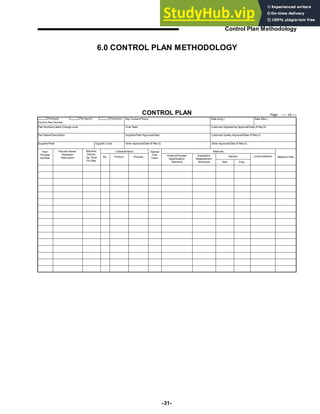
Tooling
-47-
SUPPLEMENT
A
6.5 SUPPLEMENTS
EQUIPMENT: SET-UP DOMINANT PROCESS: The process is highly capable and stable, therefore set-up is major variable impacting product variation.
Automobile grills are produced on plastic injection molding machines. After set-up of the mold, the machine must be adjusted to produce a dimensionally-correct part.
Parts must also be free of blemishes, flow lines and sink marks on the surface. The molding machine is highly repeatable because all parameters are computer controlled.
A set-up card provides specifications for setting all controls on the machine. After setting the machine to the specifications a sample part is produced. This part is
checked for the key control dimensions for mounting holes and perimeter fit, and visually inspected.
• The set-up is the critical variable in this type of process. Capability studies on the product characteristics show that when properly set up, the operation is highly
capable and stable. The set-up specifications become the process characteristics that affect the product characteristic.
• Types of controls for the process characteristic include first piece check procedures, and verification that machine settings are correct to authorized set-up cards.
• Product characteristics are measured to insure the set-up is correct and that no unusual special cause has occurred. In some cases lot control may be appropriate
between checks.
Control Plan Number
Prototype Production
Pre-launch X
Part Number/Latest Change Level
Part Name/Description
Supplier/Plant Supplier Code
Core Team
Supplier/Plant Approval/Date
Other Approval/Date (If Req’d)
Key Contact/Phone
Customer Engineering Approval/Date (If Req’d)
Customer Quality Approval/Date (If Req’d)
Other Approval/Date (If Req’d)
Date (Orig.) Date (Rev.)
Part/
Process
Number
Machine, Device,
Jig, Tools
For Mfg.
Process Name/
Operation Description
Characteristics Methods
No. Product Process
Special
Char.
Class.
Product/Process
Specification/
Tolerance
Evaluation/
Measurement
Technique
Sample
Size Freq.
Control Method
Reaction Plan
Page 4 of 23
CONTROL PLAN
*Reference Appendix C
EXAMPLES ARE FOR REFERENCE ONLY. REFER TO SPECIFIC CUSTOMER REQUIREMENTS.
3
Plastic Injection
Molding
Machine
No. 1-5
Machine
No. 1-5
Machine
No. 1-5
Machine
No. 1-5
Fixture #10
18
19
20
21
22
Set-up of mold
machine
Perimeter fit
Dimension
Mounting hole
loc.
No blemishes
Appearance *
*
*
*
flowlines
Free of blemishes
Hole “X” location
sink marks
25 ± 1mm
Gap 3 ± .5mm
Gap 3 ± .5mm
See attached set-up card
1st piece buy-off
Visual inspection
Fixture #10
1st piece buy-off
Fixture #10
Check gap to fixture
4 locations
Review of set-up
card and machine
settings
100%
1st piece
1st piece
5 pcs
5 pcs
Continuous
buy-off
per run
hr
buy-off
per run
hr
Each set-up
Adjust/re-check
Notify supervisor
Adjust/re-check
Adjust/re-check
Adjust and
recheck
Quarantine and
adjust
Adjust and reset
machine
Quarantine and
adjust
Inspector verifies
settings
1st Piece buy-off
x
_
-R chart
Check sheet
x
_
-R chart
Check sheet
Check sheet
Check sheet
100% inspection
001 J. Davis/313-555-5555
Product Development Team (E01) - See List
1-26-92 2-2-92
22521211/G 11-2-92
Plastic Injection Molded Grill
4-B Grill Co. Plant #3 0123
EQUIPMENT: MACHINE DOMINANT PROCESS: Machine parameters are the variables affecting the process output.
A supplier manufactures a circuit board with electronic components soldered on the board. Properly soldered connections are the major product characteristics. Two
major process characteristics for the wave solder machine, are solder level and flux concentration. An automated feeder controls the solder level by sensing the level of
solder and feeding in additional solder as the level is reduced. The flux must be sampled and tested for the concentration level. The Special Product Characteristic is
measured 100% by checking electrically for continuity.
• Machine settings are the variables that have the major effect on the output for this type of process. These process characteristics are the variables that need to be
controlled and measured to ensure that all products meet the customer’s requirements.
• Types of controls include self-adjusting devices on the parameters and statistical measurements taken on the process parameters and recorded on control charts (i.e. x
_
-
bar R charts).
• Product characteristics are measured using error proofing methods or statistical sampling to insure that all products meet the customer’s requirements.
-48-
SUPPLEMENT
B
Control Plan Number
Prototype Production
Pre-launch X
Part Number/Latest Change Level
Part Name/Description
Supplier/Plant Supplier Code
Core Team
Supplier/Plant Approval/Date
Other Approval/Date (If Req’d)
Key Contact/Phone
Customer Engineering Approval/Date (If Req’d)
Customer Quality Approval/Date (If Req’d)
Other Approval/Date (If Req’d)
Date (Orig.) Date (Rev.)
Part/
Process
Number
Machine, Device,
Jig, Tools
For Mfg.
Process Name/
Operation Description
Characteristics Methods
No. Product Process
Special
Char.
Class.
Product/Process
Specification/
Tolerance
Evaluation/
Measurement
Technique
Sample
Size Freq.
Control Method
Reaction Plan
Page 2 of 4
CONTROL PLAN
*Reference Appendix C
EXAMPLES ARE FOR REFERENCE ONLY. REFER TO SPECIFIC CUSTOMER REQUIREMENTS.
2 Soldering connections
Wave solder
machine
Flux
concentration
*
Standard #302B
2.0 ± 0.25mc
Test sampling lab
environment
Sensor continuity
check
100%
4 hours
Segregate and
reset
x-MR chart
002 T. Smith/313-555-5555
See attached
1-1-93 2-20-92
Circuit 10/8
Electronic Circuit Board
ACR Control 439412
Continuous
1 pc
Automated
inspection (error
proofing)
Adjust and retest
Wave solder
height
EQUIPMENT: FIXTURE/PALLET DOMINANT PROCESS: Fixture-to-fixture variation causes product variation.
Metal castings are loaded on a seven-stage rotary machine with several fixtures which rotary machine rotates under a cutting head. Each part has a machined surface on
which perpendicularity and depth of cut are critical. The depth of cut and perpendicularity are major product characteristics. Besides the cutting tool, the removal of
debris and proper adjustment of the fixtures can significantly affect the special product characteristic.
• The process characteristic includes variation between fixtures or pallets. The dimensional differences between fixtures or pallets and part location contribute to
product variation. In addition, debris accumulated on the fixture can cause fixture-to-fixture variation of part location.
• Types of controls for fixture/pallet process characteristics are driven by loading procedures, fixture/pallet adjustments and maintenance (i.e. cleaning).
• Process characteristics are often difficult to measure in fixture/pallet dominant processes. Therefore, frequent statistical product sampling may be required for
Special Product Characteristics.
-49-
SUPPLEMENT
C
Control Plan Number
Prototype Production
Pre-launch X
Part Number/Latest Change Level
Part Name/Description
Supplier/Plant Supplier Code
Core Team
Supplier/Plant Approval/Date
Other Approval/Date (If Req’d)
Key Contact/Phone
Customer Engineering Approval/Date (If Req’d)
Customer Quality Approval/Date (If Req’d)
Other Approval/Date (If Req’d)
Date (Orig.) Date (Rev.)
Part/
Process
Number
Machine, Device,
Jig, Tools
For Mfg.
Process Name/
Operation Description
Characteristics Methods
No. Product Process
Special
Char.
Class.
Product/Process
Specification/
Tolerance
Evaluation/
Measurement
Technique
Sample
Size Freq.
Control Method
Reaction Plan
Page 1 of 10
CONTROL PLAN
*Reference Appendix C
EXAMPLES ARE FOR REFERENCE ONLY. REFER TO SPECIFIC CUSTOMER REQUIREMENTS.
3 Machine surface “A”
Rotary
machine
Holding fixture
#10
51
53
Hold casting in
fixture for
proper
orientation
Perpendicular
cut
Depth of cut *
* 90º ± 1º
2 ± 0.25”
Fixture free from debris
Gage 050
Depth gage 5
1 pc
every 4 hrs
After each
cycle
Quarantine
adjust and reset
Readjust air
blow-off
Air blow-off
x-MR chart
12345M A. B. Casting 813-123-4567
See attached
9-9-92 2-20-93
54321231/D
Engine Block
ABC Company/Plant #2 12345M
52
Holding fixture
#10
Visual inspection
per hr per
fixture
1 pc
x
_
-R chart
Quarantine
adjust and reset
EQUIPMENT: TOOLING DOMINANT PROCESS: Tool life and design characteristics are the variables affecting the process output.
A sheet metal stamping die is used to form a steel bracket that has several angles and a pierced hole. The pierced hole diameter will not vary significantly; therefore it is
not marked as a Special Characteristic. The presence of the hole is critical to the part. The angles on the part are critical and two angles are marked as Special
Characteristics. Historically, broken hole punches are a problem with this type of tooling. Further, moving parts in the tool can vary when forming the angles in the
bracket.
• The process characteristic is the tooling. Tools can have details that break or moving parts that intermittently/permanently fail to move. Tools can also wear or be
repaired incorrectly. The product characteristics are affected by these tooling problems.
• Types of controls for tooling dominant processes are mainly seen in the product. First piece check can verify that a tool has been properly repaired. When in
operation a tool failure may go unnoticed except in the part, therefore lot control is appropriate. Error proofing techniques that check for holes or a dimension are also
needed.
• Product characteristics are a very important measure of proper tool life performance.
-50-
SUPPLEMENT
D
Control Plan Number
Prototype Production
Pre-launch X
Part Number/Latest Change Level
Part Name/Description
Supplier/Plant Supplier Code
Core Team
Supplier/Plant Approval/Date
Other Approval/Date (If Req’d)
Key Contact/Phone
Customer Engineering Approval/Date (If Req’d)
Customer Quality Approval/Date (If Req’d)
Other Approval/Date (If Req’d)
Date (Orig.) Date (Rev.)
Part/
Process
Number
Machine, Device,
Jig, Tools
For Mfg.
Process Name/
Operation Description
Characteristics Methods
No. Product Process
Special
Char.
Class.
Product/Process
Specification/
Tolerance
Evaluation/
Measurement
Technique
Sample
Size Freq.
Control Method
Reaction Plan
Page 3 of 8
CONTROL PLAN
*Reference Appendix C
EXAMPLES ARE FOR REFERENCE ONLY. REFER TO SPECIFIC CUSTOMER REQUIREMENTS.
4 Form metal bracket
Stamping die
(13-19)
Hole Presence of hole
Light beam/light
sensor
100%
004 A. C Brown/206-555-1234
See attached list
9-9-92 2-4-93
4321234/E
Seat Bracket
Ace Stamping 23456N
ongoing
Automated
inspection (error
proofing)
6
Segregate and
replace hole
punch
-51-
SUPPLEMENT
D
EQUIPMENT: TOOLING DOMINANT PROCESS: Tool life and design characteristics are the variables affecting the process output.
A broach is used to form the internal spline teeth on a steel propshaft yoke. The pitch diameter of internal spline teeth is the Special Product Characteristic.

• The sharpened tool is checked on a visual comparator for correct pitch diameter and relief angle prior to being approved for production.
• First piece of a production run is checked for sharpness of cut and correct pitch diameter.
Control Plan Number
Prototype Production
Pre-launch X
Part Number/Latest Change Level
Part Name/Description
Supplier/Plant Supplier Code
Core Team
Supplier/Plant Approval/Date
Other Approval/Date (If Req’d)
Key Contact/Phone

Customer Engineering Approval/Date (If Req’d)
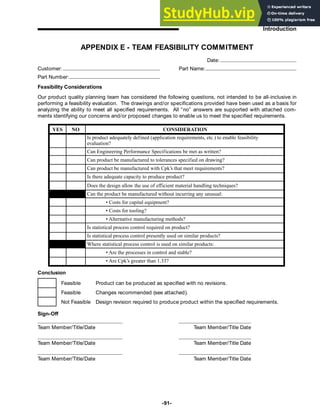
Customer Quality Approval/Date (If Req’d)
Other Approval/Date (If Req’d)
Date (Orig.) Date (Rev.)
Part/
Process
Number
Machine, Device,
Jig, Tools
For Mfg.
Process Name/
Operation Description
Characteristics Methods
No. Product Process
Special
Char.
Class.
Product/Process
Specification/
Tolerance
Evaluation/
Measurement
Technique
Sample
Size Freq.
Control Method
Reaction Plan
Page 1 of 1
CONTROL PLAN
*Reference Appendix C
EXAMPLES ARE FOR REFERENCE ONLY. REFER TO SPECIFIC CUSTOMER REQUIREMENTS.
30 Broach internal spline
Acme Broach
B-752
Yoke Pitch dia. .7510 .7525 Visual comparator 1st pc
002 T.Thomas 313-555-1234
See attached list
3-7-93
9873245/A
Yoke Propshaft
Key Machine 17532B
buy-off
per run
Repair tool and
recheck
Set-up sheet
Tool control check
sheet
Contain parts,
replace tool and
recheck
2 pcs each shift
Special dial
indicator T-0375
-52-
SUPPLEMENT
E
PEOPLE: OPERATOR DOMINANT PROCESS: The system is sensitive/dependent upon operator knowledge and control.
Headlamp aim is one of the final operations during car and truck assembly. An aiming device, which contains two bubble levels, attaches to the headlamp. The operator
adjusts the headlamps by turning aiming screws until the bubbles center in the level. Proper headlamp aim is an FMVSS requirement and therefore a Special Product
Characteristic. The Special Process Characteristic is operator knowledge and control, ensuring the two bubble levels center during aiming. The Special Product
Characteristic is measured by shining the headlamps on a headlamp aim board that measures beam pattern.
Control Plan Number
Prototype Production
Pre-launch X
Part Number/Latest Change Level
Part Name/Description
Supplier/Plant Supplier Code
Core Team
Supplier/Plant Approval/Date
Other Approval/Date (If Req’d)
Key Contact/Phone
Customer Engineering Approval/Date (If Req’d)
Customer Quality Approval/Date (If Req’d)
Other Approval/Date (If Req’d)
Date (Orig.) Date (Rev.)
Part/
Process
Number
Machine, Device,
Jig, Tools
For Mfg.
Process Name/
Operation Description
Characteristics Methods
No. Product Process
Special
Char.
Class.
Product/Process
Specification/
Tolerance
Evaluation/
Measurement
Technique
Sample
Size Freq.
Control Method
Reaction Plan
Page 2 of 3
CONTROL PLAN
*Reference Appendix C
EXAMPLES ARE FOR REFERENCE ONLY. REFER TO SPECIFIC CUSTOMER REQUIREMENTS.
5 Aiming headlights Aiming device Adjusted lamp Lighting inspection code
SPE J599 May ‘81
100%
005 B. J.Aim
Ben Aim, Ken Light, Nancy Drew
7-8-92
54321234/B
Headlight Aim
Final Line Dept 31
ongoing Adjust and retest
p-chart
Check sheet Contain and
requalify
5
Audit to check
aim per 1000
vehicles
Bubble position on
the level to be
centered
2-10-93
Aiming device Adjusted lamp *
*
Lighting inspection code
SPE J599 May ‘81
Bubble position on
the level to be
centered
-53-
SUPPLEMENT
F
MATERIAL: MATERIAL OR COMPONENT DOMINANT PROCESS: Characteristics or materials/components are the variables affecting the process output.
An automobile hood is made of SMC. SMC is a molding compound that is temperature sensitive, has a specific shelf life, and for which mixing is critical. The parts
produced from this material can become brittle when the material is improperly mixed, handled, or rotated. A force specification on one end of the bracket is a Special
Product Characteristic. The Special Process Characteristics are the proper formulation, storage, and use of material date control. The customer requires a laboratory
report on each lot of compound and the lots of material are dated for proper rotation.
• The materials or components are the process characteristics for this process. The variation found in the materials or components will affect the output of the process.
• Types of controls for the process characteristics include the various ways of testing and controlling the specification on the material or component being used (i.e.
control charts, lab reports, error proofing).
Control Plan Number
Prototype Production
Pre-launch X
Part Number/Latest Change Level
Part Name/Description
Supplier/Plant Supplier Code
Core Team
Supplier/Plant Approval/Date
Other Approval/Date (If Req’d)
Key Contact/Phone
Customer Engineering Approval/Date (If Req’d)
Customer Quality Approval/Date (If Req’d)
Other Approval/Date (If Req’d)
Date (Orig.) Date (Rev.)
Part/
Process
Number
Machine, Device,
Jig, Tools
For Mfg.
Process Name/
Operation Description
Characteristics Methods
No. Product Process
Special
Char.
Class.
Product/Process
Specification/
Tolerance
Evaluation/
Measurement
Technique
Sample
Size Freq.
Control Method
Reaction Plan
Page 1 of 1
CONTROL PLAN
*Reference Appendix C
EXAMPLES ARE FOR REFERENCE ONLY. REFER TO SPECIFIC CUSTOMER REQUIREMENTS.
1 Mold part
Mach. #20 Tool
IS-IB
Force Must withstand 10N
vertical force
1st 5
S. Specs 555-8888
J. Smith 555-2404 K. Jones 555-3050
F. Petull 555-1234 C. Miller 555-4114
11-20-92
54312345 C 10/31/92
Automobile Hood
Q.C./Suppco 4000-1
per hour
Segregate,
analyze___
material
Failure reliability
chart test to 11N
Lab report #G 9441
Return to
supplier
1 pc
Incoming inspection
1-25-93
*
Material
content
Izod impact test
lot
Material receiving
2
Mixing operation
3
Mixer Group
#23
Mix ratio 3:1:2
Lab equip #11
Lab equip #22
Lab report #G 9442
Segregate and
adjust ratio
1 pc lot
Store material
4 Storage Shelf life
1st piece visual lot
control
Document “last use”
of each mix
Dispose and/or
return to supplier
1 pc lot
Temperature 65-72º F Temperature sensor
Error proof by
using an
auto-adjust
back-up alarm for
temp. limits
Recalibrate
100% Continuous
-54-
SUPPLEMENT
G
METHODS: PREVENTIVE MAINTENANCE DOMINANT PROCESS: Equipment maintenance is the main variable that affects the process output.
A painting operation for decorative parts requires clean equipment and a dirt-free work area. Dirt-free paint is a Special Product Characteristic. Periodic cleaning of the
paint equipment and paint room prevents the problem of dirt in the paint. The process characteristic is a scheduled routine cleaning, repair, and replacement.
• Periodic maintenance is the process characteristic. Where input variables exist, replacing worn our parts, cleaning, calibration, tool adjustments, and other
maintenance activities have an effect on the product characteristics, and must be controlled.
• Types of controls for these process characteristics include scheduled maintenance programs and warning devices for monitoring.
• Product characteristics are checked after each maintenance to verify the process is properly performed.
Control Plan Number
Prototype Production
Pre-launch X
Part Number/Latest Change Level
Part Name/Description
Supplier/Plant Supplier Code
Core Team
Supplier/Plant Approval/Date
Other Approval/Date (If Req’d)
Key Contact/Phone
Customer Engineering Approval/Date (If Req’d)
Customer Quality Approval/Date (If Req’d)
Other Approval/Date (If Req’d)
Date (Orig.) Date (Rev.)
Part/
Process
Number
Machine, Device,
Jig, Tools
For Mfg.
Process Name/
Operation Description
Characteristics Methods
No. Product Process
Special
Char.
Class.
Product/Process
Specification/
Tolerance
Evaluation/
Measurement
Technique
Sample
Size Freq.
Control Method
Reaction Plan
Page 2 of 5
CONTROL PLAN
*Reference Appendix C
EXAMPLES ARE FOR REFERENCE ONLY. REFER TO SPECIFIC CUSTOMER REQUIREMENTS.
1 Spray paint
Electrostatic
Bell #110
Per J2154
Less than 6 particles per
square inch
Fluid meter and
controller
Visual 100%
Continuous
Recalibrate and
adjust
Automatic fluid
meter prevents film
build
007 F. Mercury 123-456-7891
Erin Hope, Alan Burt
6-3-93 8-4-93
1234/B
Grille
Lynch Inc. 0010
Inspection Check sheet
Clean guns and
recheck
Spray painting
Fluid control
Fluid
controller
-55-
SUPPLEMENT
H
ENVIRONMENT: CLIMATE DOMINANT PROCESS: Climate variables such as temperature, humidity, noise, vibrations, have major impact on the process outputs.
Humidity adversely affects the function of plastic injection molding machines. Plastic material absorbs dampness from the air, causing defects in the molded part.
Material dryers are installed on the molding machines to eliminate the problem.
• The proper functioning of the dryer is the process characteristic in having the process performed properly.
• Type of control for this process characteristic is a planned, periodic check to make sure the dryer is turned on and performing properly.
• Product characteristics are checked by visual examination during first piece check and by subsequent periodic checks.
Control Plan Number
Prototype Production
Pre-launch X
Part Number/Latest Change Level
Part Name/Description
Supplier/Plant Supplier Code
Core Team
Supplier/Plant Approval/Date
Other Approval/Date (If Req’d)
Key Contact/Phone
Customer Engineering Approval/Date (If Req’d)
Customer Quality Approval/Date (If Req’d)
Other Approval/Date (If Req’d)
Date (Orig.) Date (Rev.)
Part/
Process
Number
Machine, Device,
Jig, Tools
For Mfg.
Process Name/
Operation Description
Characteristics Methods
No. Product Process
Special
Char.
Class.
Product/Process
Specification/
Tolerance
Evaluation/
Measurement
Technique
Sample
Size Freq.
Control Method
Reaction Plan
Page 1 of 1
CONTROL PLAN
*Reference Appendix C
EXAMPLES ARE FOR REFERENCE ONLY. REFER TO SPECIFIC CUSTOMER REQUIREMENTS.
8
Injected mold plastic
parts
Injected mold
machine #22
.1% max. rel. humidity 1
1240 A. P. Smith 313-472-0001
See attached list
9-9-92 2-4-93
3212345F
I/P Clip (Plastic)
Aim Plastic Co., Iowa Plant 34567J
hour Record sheet
Adjust dryer, dry
material and
requalify
12
Raw material
(pellet) dryer
Humidity gage on
dryer
-56-
SUPPLEMENT
I
Control Plan Number
Prototype Production
Pre-launch X
Part Number/Latest Change Level
Part Name/Description
Supplier/Plant Supplier Code
Core Team
Supplier/Plant Approval/Date
Other Approval/Date (If Req’d)
Key Contact/Phone
Customer Engineering Approval/Date (If Req’d)
Customer Quality Approval/Date (If Req’d)
Other Approval/Date (If Req’d)
Date (Orig.) Date (Rev.)
Part/
Process
Number
Machine, Device,
Jig, Tools
For Mfg.
Process Name/
Operation Description
Characteristics Methods
No. Product Process
Special
Char.
Class.
Product/Process
Specification/
Tolerance
Evaluation/
Measurement
Technique
Sample
Size Freq.
Control Method
Reaction Plan
Page of
CONTROL PLAN
*Reference Appendix C
-57-
SUPPLEMENT
J
CONTROL PLAN CHECKLIST
Customer or Internal Part No.
1 Was the control plan methodology referenced in
Section 6 used in preparing the control plan?
2 Have all known customer concerns been
identified to facilitate the selection of special
product/process characteristics?
3 Are all special product/process characteristics
included in the control plan?
4 Were SFMEA, DFMEA, and PFMEA used to
prepare the control plan?
5 Are material specifications requiring inspection
identified?
6 Does the control plan address incoming
(material/components) through
processing/assembly including packaging?
7 Are engineering performance testing
requirements identified?
8 Are gages and test equipment available as
required by the control plan?
9 If required, has the customer approved the
control plan?
10 Are gage methods compatible between supplier
and customer?
Revision Date
Pg. 1 of 1
Prepared By:
Question Yes No Comment/Action Required
Person
Responsible
Due
Date
-58-
SUPPLEMENT J
-59-
SUPPLEMENT
K
The Control Plan Special Characteristics Worksheet (Supplement K)
The Description/Rationale column includes all special process and product characteristics agreed upon by the cross functional team. A
sequential Number (No.) is assigned to each characteristic listed to ensure none are overlooked by the supplier when the Control Plan
(Part 2) is completed. Develop a rationale for each special characteristic and add this information to the list for clarification. When
considered necessary, a Supplemental Form (Supplement L) will depict measurement points and coordinates. This form, when used,
will be considered an extension of the Control Plan.
-60-
SUPPLEMENT
K
Control Plan Number
Prototype Production
Pre-launch
Part Number/Latest Change Level
Part Name/Description
Supplier/Plant Supplier Code
Core Team
Supplier/Plant Approval/Date
Other Approval/Date (If Req’d)
Key Contact/Phone
Customer Engineering Approval/Date (If Req’d)
Customer Quality Approval/Date (If Req’d)
Other Approval/Date (If Req’d)
Date (Orig.) Date (Rev.)
Page of
CONTROL PLAN SPECIAL CHARACTERISTICS (OPTIONAL)
No. Description/Rationale Specification/Tolerance Class. Illustration/Pictorial
-61-
SUPPLEMENT
L
Page of
DATA POINT COORDINATES (OPTIONAL)
Control Plan No.
Customer: Date (Orig.): Date (Rev.):
Char.
No.
Point
Indent. X Y Z
Char.
No.
Point
Indent. X Y Z
Char.
No.
Point
Indent. X Y Z
-62-
SUPPLEMENT L
-63-
Appendix A
APPENDIX A - PRODUCT QUALITY PLANNING CHECKLISTS
A-1 Design FMEA Checklist
A-2 Design Information Checklist
A-3 New Equipment, Tooling and Test Equipment Checklist
A-4 Product/Process Quality Checklist
A-5 Floor Plan Checklist
A-6 Process Flow Chart Checklist
A-7 Process FMEA Checklist
A-8 Control Plan Checklist
-64-
A-1 DESIGN FMEA CHECKLIST
Customer or Internal Part No.
1 Was the SFMEA and/or DFMEA prepared using
the Chrysler, Ford and General Motors Potential
Failure Mode and Effects Analysis (FMEA)
reference manual?
2
3
4
5
6
7
8
Revision Date
Pg. 1 of 1
Prepared By:
Question Yes No Comment/Action Required
Person
Responsible
Due
Date
Have historical campaign and warranty data
been reviewed?
Have similar part DFMEAs been considered?
Does the SFMEA and/or DFMEA identify
Special Characteristics?
Have design characteristics that affect high risk
priority failure modes been identified?
Have appropriate corrective actions been
assigned to high risk priority numbers?
Have appropriate corrective actions been
assigned to high severity numbers?
Have risk priorities been revised when
corrective actions have been completed and
verified?
-65-
Appendix
A
A-2 DESIGN INFORMATION CHECKLIST
Customer or Internal Part No.
1 • New materials?
3
4
5
6
7
8
9
Revision Date
Pg. 1 of 4
Question Yes No Comment/Action Required
Person
Responsible
Due
Date
Has assembly build variation analysis been
considered?
Has Design of Experiments been considered?
Is there a plan for prototypes in place?
Has a DFMEA been completed?
Has a DFMA been completed?
Have service and maintenance issues been
considered?
Has the Design Verification Plan been
completed?
2 • Special tooling?
10
11
If yes, was it completed by a cross functional
team?
Are all specified tests, methods, equipment and
acceptance criteria clearly defined and
understood?
12 Have Special Characteristics been selected?
A. General
Does the design require:
-66-
A-2 DESIGN INFORMATION CHECKLIST - CONTINUED
Customer or Internal Part No.
A. General - Continued
Revision Date
Pg. 2 of 4
Question Yes No Comment/Action Required
Person
Responsible
Due
Date
Is bill of material complete?
Are Special Characteristics properly
documented?
Have dimensions that affect fit, function and
durability been identified?
Are reference dimensions identified to minimize
inspection layout time?
Are sufficient control points and datum surfaces
identified to design functional gages?
Are there any requirements specified that
cannot be evaluated using known inspection
techniques?
B. Engineering Drawings
Are tolerances compatible with accepted
manufacturing standards?
C. Engineering Performance Specifications
Have all special characteristics been identified?
Is test loading sufficient to provide all conditions,
i.e., production validation and end use?
Have parts manufactured at minimum and
maximum specifications been tested?
Will all product testing be done in-house?
Can additional samples be tested when a
reaction plan requires it, and still conduct
regularly scheduled in-process tests?
If not, is it done by an approved subcontractor?
13
14
15
16
17
18
19
20
21
22
23
24
25
-67-
Appendix
A
A-2 DESIGN INFORMATION CHECKLIST - CONTINUED
Customer or Internal Part No.
26 Is the specified test sampling size and/or
frequency feasible?
28
29
30
31
32
Revision Date
Pg. 3 of 4
Question Yes No Comment/Action Required
Person
Responsible
Are special material characteristics identified?
Are specified materials, heat treat and surface
treatments compatible with the durability
requirements in the identified environment?
Are the intended material suppliers on the
customer approved list?
Will material suppliers be required to provide
certification with each shipment?
Have material characteristics requiring
inspection been identified?
If so,
27 If required, has customer approval been
obtained for test equipment?
33
34
• Will characteristics be checked
in-house?
36 Will outside laboratories be used?
C. Engineering Performance Specifications - Continued
D. Material Specification
• Is test equipment available?
35 • Will training be required to assure
accurate results?
Due
Date
37 Are all laboratories used accredited (if
required)?
-68-
A-2 DESIGN INFORMATION CHECKLIST - CONTINUED
Customer or Internal Part No.
Revision Date
Pg. 4 of 4
Question Yes No Comment/Action Required
Person
Responsible
D. Material Specification - Continued
• Handling?
Due
Date
Have the following material requirements been considered:
• Storage?
38
39
• Environmental?
40
Prepared By:
-69-
Appendix
A
A-3 NEW EQUIPMENT, TOOLING AND TEST EQUIPMENT CHECKLIST
Customer or Internal Part No.
1 • Flexible system, e.g. cell mfg.?
3
4
Revision Date
Pg. 1 of 2
Question Yes No Comment/Action Required
Person
Responsible
• Volume fluctuations?
• Mistake proofing?
2 • Quick change?
8
9
• New equipment?
11 Will a preliminary capability study be conducted
at the tooling and/or equipment manufacturer?
Has tool and equipment design provided for:
• New tooling?
10 • New test equipment?
Due
Date
12 Has test equipment feasibility and accuracy
been established?
Have lists been prepared identifying:
6
7
• New tooling?
• New test equipment?
5 • New equipment?
Has acceptance criteria been agreed upon for:
13 Is a preventive maintenance plan complete for
equipment and tooling?
14 Are setup instruction for new equipment and
tooling complete and understandable?
-70-
A-3 NEW EQUIPMENT, TOOLING AND TEST EQUIPMENT CHECKLIST - CONTINUED
Customer or Internal Part No.
Revision Date
Pg. 2 of 2
Question Yes No Comment/Action Required
Person
Responsible
Will capable gages be available to run
preliminary process capability studies at the
equipment supplier’s facility?
Due
Date
Will preliminary process capability studies be
run at the producing plant?
Have process characteristics that affect special
product characteristics been identified?
Prepared By:
Were special product characteristics used in
determining acceptance criteria?
Does the manufacturing equipment have
sufficient capacity to handle forecasted
production and service volumes?
15
16
17
18
19
Is testing capacity sufficient to provide adequate
testing?
20
-71-
Appendix
A
A-4 PRODUCT/PROCESS QUALITY CHECKLIST
Customer or Internal Part No.
1
3
4
Revision Date
Pg. 1 of 4
Question Yes No Comment/Action Required
Person
Responsible
2
8 • Problem resolution analysis?
Due
Date
Are there sufficient personnel identified to cover:
6
7
• Layout inspection?
• Engineering performance testing?
5 • Control plan requirements?
Is there a documented training program that:
Is the assistance of the customer’s quality
assurance or product engineering activity
needed to develop or concur to the control plan?
Has the supplier identified who will be the
quality liaison with the customer?
Has the supplier identified who will be the
quality liaison with its suppliers?
Has the quality system been reviewed using the
Chrysler, Ford, and General Motors Quality
System Assessment?
9 • Includes all employees?
10 • Lists whose been trained?
11 • Provides a training schedule?
12 • Statistical process control?
Has training been completed for:
THIS CHECKLIST IS NOT INTENDED TO REPLACE THE CHRYSLER, FORD AND GENERAL MOTORS QUALITY SYSTEM ASSESSMENT.
-72-
THIS CHECKLIST IS NOT INTENDED TO REPLACE THE CHRYSLER, FORD AND GENERAL MOTORS QUALITY SYSTEM ASSESSMENT.
A-4 PRODUCT/PROCESS QUALITY CHECKLIST - CONTINUED
Customer or Internal Part No.
Revision Date
Pg. 2 of 4
Question Yes No Comment/Action Required
Person
Responsible
Due
Date
Has training been completed for: - Continued
• Problem solving?
• Mistake proofing?
• Capability studies?
Do inspection instructions include:
Are visual aids:
Is each operation provided with process
instructions that are keyed to the control plan?
Are standard operator instructions available at
each operation?
Were operator/team leaders involved in
developing standard operator instructions?
• Other topics as identified?
• Easily understood engineering
performance specifications?
• Test frequencies?
• Sample sizes?
• Reaction plans?
• Documentations?
• Easily understood?
• Available?
13
15
16
14
18
19
17
21
22
20
23
24
25
26
-73-
Appendix
A
A-4 PRODUCT/PROCESS QUALITY CHECKLIST - CONTINUED
Customer or Internal Part No.
Revision Date
Pg. 3 of 4
Question Yes No Comment/Action Required
Person
Responsible
Have provisions been made to place the following at the monitored operation:
Is there a procedure to implement, maintain,
and establish reaction plans for statistical
control charts?
34 • Inspection gages?
35 • Gage instructions?
Have required measurement system capability studies been:
THIS CHECKLIST IS NOT INTENDED TO REPLACE THE CHRYSLER, FORD AND GENERAL MOTORS QUALITY SYSTEM ASSESSMENT.
Are visual aids: - Continued
28
29
• Approved?
• Dated and current?
27 • Accessible?
30
Have provisions been made to place the latest
drawings and specifications at the point of
inspection?
32
Is there an effective root cause analysis system
in place?
31
Are forms/logs available for appropriate
personnel to record inspection results?
33
36 • Reference samples?
37 • Inspection logs
38 Have provisions been made to certify and
routinely calibrate gages and test equipment?
Due
Date
39 • Completed?
-74-
THIS CHECKLIST IS NOT INTENDED TO REPLACE THE CHRYSLER, FORD AND GENERAL MOTORS QUALITY SYSTEM ASSESSMENT.
A-4 PRODUCT/PROCESS QUALITY CHECKLIST - CONTINUED
Customer or Internal Part No.
Revision Date
Pg. 4 of 4
Question Yes No Comment/Action Required
Person
Responsible
Due
Date
Have required measurement system capability studies been: - Continued:
• Acceptable?
Are layout inspection equipment and facilities
adequate to provide initial and ongoing layout of
all details and components?
Is there a procedure for controlling incoming products that identifies:
• Characteristics to be inspected?
• Frequency of inspection?
• Sample size?
• Designated location for approved
product?
• Disposition of nonconforming
products?
Is there procedure to identify, segregate and
control nonconforming products to prevent
shipment?
Are rework/repair procedures available?
Is there a procedure to requalify
repaired/reworked material?
Is there an appropriate Lot Traceability system?
Are periodic audits of outgoing products
planned and implemented?
Are periodic surveys of the quality system
planned and implemented?
Has the customer approved the packaging
specification?
40
41
42
43
44
45
46
47
48
49
50
51
52
53
Prepared By:
-75-
Appendix
A
A-5 FLOOR PLAN CHECKLIST
Customer or Internal Part No.
Revision Date
Pg. 1 of 2
Question Yes No Comment/Action Required
Person
Responsible
Are process and inspection areas:
4 • Of adequate size?
9 Are inspection points logically located to
prevent shipment of nonconforming products?
Have clearly marked areas for all material, tools,
and equipment at each operation been
considered?
2
Does the floor plan identify all required process
and inspection points?
1
Has sufficient space been allocated for all
equipment?
3
5 • Properly lighted?
Do inspection areas contain necessary
equipment and files?
6
Are there adequate:
7 • Staging areas?
8 • Impound areas?
10 Have controls been established to eliminate the
potential for an operation, including outside
processing, to contaminate or mix similar
products?
11 Is material protected from overhead or air
handling systems contamination?
Due
Date
-76-
A-5 FLOOR PLAN CHECKLIST - CONTINUED
Customer or Internal Part No.
Revision Date
Pg. 2 of 2
Question Yes No Comment/Action Required
Person
Responsible
Due
Date
Are controls adequate to prevent movement of
nonconforming incoming material to storage or
point of use?
Prepared By:
13
Have final audit facilities been provided?
12
-77-
Appendix
A
Prepared By:
A-6 PROCESS FLOW CHART CHECKLIST
Customer or Internal Part No.
Revision Date
Pg. 1 of 1
Question Yes No Comment/Action Required
Person
Responsible
Due
Date
Were all the appropriate FMEAs (SFMEA,
DFMEA) available and used as aids to develop
the process flow chart?
2
Does the flow chart illustrate the sequence of
production and inspection stations?
1
Does the flow chart describe how the product
will move, i.e., roller conveyor, slide containers,
etc.?
4
Is the flow chart keyed to product and process
checks in the control plan?
3
Has the pull system/optimization been
considered for this process?
5
Have potential quality problems due to handling
and outside processing been identified and
corrected?
7
Have provisions been made to identify and
inspect reworked products before being used?
6
-78-
A-7 PROCESS FMEA CHECKLIST
Customer or Internal Part No.
Revision Date
Pg. 1 of 1
Question Yes No Comment/Action Required
Person
Responsible
Due
Date
Have all operations affecting fit, function,
durability, governmental regulations and safety
been identified and listed sequentially?
Prepared By:
Was the process FMEA prepared using the
Chrysler, Ford, and General Motors guidelines?
Were similar part FMEAs considered?
Have historical campaign and warranty data
been reviewed?
Have appropriate corrective actions been
planned or taken for high risk priority
numbers?
Have appropriate corrective actions been
planned or taken for high severity numbers?
Were risk priorities numbers revised when
corrective action was completed?
Were high severity numbers revised when a
design change was completed?
Do the effects consider the customer in terms of
the subsequent operation, assembly and
product?
2
1
3
4
5
6
7
8
9
Was warranty information used as an aid in
developing the Process FMEA?
Were customer plant problems used as an aid in
developing the Process FMEA?
Have the causes been described in terms of
something that can be fixed or controlled?
10
11
12
Where detection is the major factor, have
provisions been made to control the cause prior
to the next operation?
13
-79-
Appendix
A
Prepared By:
A-8 CONTROL PLAN CHECKLIST
Customer or Internal Part No.
Revision Date
Pg. 1 of 1
Question Yes No Comment/Action Required
Person
Responsible
Due
Date
Have all known customer concerns been
identified to facilitate the selection of special
product/process characteristics?
2
Was the control plan methodology referenced in
Section 6 used in preparing the control plan?
1
Were SFMEA, DFMEA, and PFMEA used to
prepare the control plan?
4
Are all special product/process characteristics
included in the control plan?
3
Are material specifications requiring inspection
identified?
5
Are engineering performance testing
requirements identified?
7
Does the control plan address incoming
(material/components) through
processing/assembly including packaging?
6
Are gages and test equipment available as
required by the control plan?
8
If required, has the customer approved the
control plan?
9
Are gage methods compatible between supplier
and customer?
10
-80-
-81-
Appendix B
APPENDIX B - ANALYTICAL TECHNIQUES
ASSEMBLY BUILD VARIATION ANALYSIS
An assembly build variation analysis is an analysis that simulates the buildup of an assembly and
examines tolerance accumulation, statistical parameters, sensitivity, and “what if ” investigation.
BENCHMARKING
Benchmarking is a systematic approach to identifying standards for comparison. It provides input to
the establishment of measurable performance targets, as well as ideas for product design and process
design. It can also provide ideas for improving business processes and work procedures.
Product and process benchmarking should include the identification of world class or best-in-class
based on objective performance measures and research into how this performance was achieved.
Benchmarking should provide a stepping stone for developing new designs and processes that exceed
the capabilities of the benchmark companies.
CAUSE AND EFFECT DIAGRAM
The “cause and effect” diagram is an analytical tool to indicate the relationship between an “effect”
and all possible “causes” influencing it. This is sometimes referred to as fishbone diagram, Ishikawa
diagram, or feather diagram.
CHARACTERISTICS MATRIX
A characteristics matrix is a display of the relationship between process parameters and manufacturing
stations. The recommended method of developing the characteristics matrix is to number the
dimensions and/or features on the part print and each manufacturing operation. All manufacturing
operations and stations appear across the top, and the process parameters are listed down the left-hand
column. The more manufacturing relationships there are, the more important the control of a
characteristic becomes. Regardless of matrix size, the upstream relationships of characteristics are
evident. A typical matrix is shown.
-82-
CRITICAL PATH METHOD
The critical path method can be a Pert or Gantt Chart that shows the chronological sequence of tasks
that require the greatest expected time to accomplish. It can provide valuable information as to:
– Interrelationships
– Early Forecast of Problems
– Identification of Responsibility
– Resource Identification, Allocation and Leveling
DESIGN OF EXPERIMENTS (DOE)
A design experiment is a test of sequence of tests where potential influential process variables are
systematically changed according to a prescribed design matrix. The response of interest is evaluated
under the various conditions to: (1) identify the influential variables among the ones tested, (2)
quantify the effects across the range represented by the levels of the variables, (3) gain a better
understanding of the nature of the causal system at work in the process, and (4) compare the effects
and interactions. Application early in the product/process development cycle can result in: (1)
improved process yields, (2) reduced variability around a nominal or target value, (3) reduced
development time, and (4) reduced overall costs.
DESIGN FOR MANUFACTURABILITY AND ASSEMBLY
Design for Manufacturability and Assembly is a Simultaneous Engineering process designed to
optimize the relationship between design function, manufacturability, and ease of assembly. The
CHARACTERISTICS MATRIX
(EXAMPLE)
DIM. DESCRIPTION TOLERANCE 05 10 20 30
NO.
1 ID X C X
2 FACE X C C
3 X L L
4 X
5 X
6 OD X
OPERATION NOS.
C = Characteristic at an operation used for clamping
L = Characteristic at an operation used for locating
x = Characteristic created or changed by this operation should match the process flow diagram form
-83-
Appendix B
enhancement of designs for assembly and manufacturing is an important step. Plant representatives
should be consulted early in the design process to review components or systems and provide input on
specific assembly and manufacturing requirements. Specific dimensional tolerances should be
determined based on the like process. This will assist in identifying the equipment required and any
process changes necessary.
DESIGN VERIFICATION PLAN AND REPORT (DVP&R)
The Design Verification Plan and Report (DVP&R) is a method to plan and document testing activity
through each phase of product/process development from inception to ongoing refinement. This
method is used by Chrysler and Ford.
An effective DVP&R provides a concise working document that aids engineering personnel in the
following areas:
• Facilitates the development of a logical testing sequence by requiring the responsible areas to
thoroughly plan the tests needed to assure that the component or system meets all engineering
requirements.
• Assures product reliability meets customer-driven objectives.
• Highlights situations where customer timing requires an accelerated test plan.
• Serves as a working tool for responsible area(s) by:
– Summarizing functional, durability, and reliability testing requirements and results in one
document for ease of reference.
– Providing the ability to easily prepare test status and progress reports for Design Reviews.
Detailed instructions can be obtained from the appropriate Chrysler and Ford Quality or Engineering
areas.
DIMENSIONAL CONTROL PLAN (DCP)
See Dynamic Control Plan.
DYNAMIC CONTROL PLAN (DCP)
Ford Motor Company is currently using a DCP (Dynamic Control Plan) process in some operations.
The basis for this process is the Characteristics Matrix described previously in this Appendix. It is a
structured methodology that integrates the control plan, FMEA and the Gage R&R information to
ensure that customer expectations in the form of product design requirements are understood,
deployed, and controlled in the manufacturing and assembly process. DCP is a systematic,
comprehensive methodology for implementing total production process planning. Refer to Appendix
G for an explanation of the Dynamic Control Planning Process.
-84-
MISTAKE PROOFING (POKA-YOKE)
Mistake proofing (Poka-Yoke) is a technique to eliminate errors often referred to as “fail-safeing.”
Mistake proofing should be used as a preventive technique to control repetitive tasks or actions. This
technique is designed to reduce customer concerns.
PROCESS FLOW CHARTING
Process flow charting is a visual approach to describing and developing sequential or related work
activities. It provides both a means of communication and analysis for planning, development
activities, and manufacturing processes.
Since one goal of quality assurance is to eliminate defects and improve the efficiency of
manufacturing and assembly processes, advance product quality plans should include illustrations of
the controls and resources involved. These process flow charts should be used to identify
improvements and to locate significant or critical product and process characteristics that will be
addressed in control plans to be developed later.
QUALITY FUNCTION DEPLOYMENT (QFD)
QFD is a systematic procedure for translating the Voice of the Customer into technical requirements
and operational terms, displaying and documenting the translated information in matrix form. QFD
focuses on the most important items and provides the mechanism to target selected areas to enhance
competitive advantages.
Depending upon the specific product, the technique of QFD may be used as a structure for the quality
planning process. In particular, QFD Phase I - Product Planning translates customer requirements, i.e.,
Voice of the Customer, into counterpart control characteristics or design requirements. QFD provides
a means of converting general customer requirements into specified final product and process control
characteristics.
A. ASPECTS OF QFD
The two dimensions of QFD are:
• Quality Deployment: Translation of Customer Requirements into Product Design Requirements.
• Function Deployment: Translation of Design Requirements into appropriate Part, Process and
Production Requirements.
B. BENEFITS OF QFD
Several benefits of QFD are that it:
• Increases the assurance of meeting the Voice of the Customer.
-85-
Appendix B
• Reduces number of changes due to engineering knowledge.
• Identifies conflicting design requirements.
• Focuses various company activities on customer-oriented objectives.
• Reduces product development cycle time.
• Reduces costs of engineering, manufacturing, and service.
• Improves quality or product and services.
SYSTEM FAILURE MODE AND EFFECTS ANALYSIS (SFMEA)
An SFMEA is an analytical technique that is used to identify potential weaknesses in an overall system
design. It is a “top-down” functional analysis. It is used to analyze system weaknesses in the early
concept stage before hardware has been defined. The SFMEA focuses on potential failures associated
with the functions performed at the system, subsystem, and lower functional levels. The SFMEA also
focuses on the interaction between systems, between subsystems, and the interface between system
elements.
-86-
-87-
Appendix C
APPENDIX C - SPECIAL CHARACTERISTICS SYMBOLS
Chrysler, Ford and General Motors Special Characteristics and Symbols
GENERAL MOTORS FORD MOTOR CO. CHRYSLER
Definition:
Non-Key
Characteristic
“Standard”
Is a product characteristic
for which reasonably
anticipated variation is
unlikely to significantly
affect a product’s safety,
compliance with
government regulations,
fit/function.
Definition:
Key Characteristic
(Not Relating to
Safety or Legal
Considerations)
A product characteristic
for which reasonably
anticipated variation is
likely to significantly
affect customer satisfac-
tion with a product (other
than S/C) such as its fits,
function, mounting or
appearance, or the ability
to process or build the
product.
Definition:
Key Characteristic
(With Safety
or Legal
Considerations)
Is a product characteristic
for which reasonable
anticipated variation could
significantly affect the
product’s safety or its
compliance with
government regulations
(such as: flammability,
occupant protection,
steering control, braking,
etc. . .), emissions, noise,
radio frequency
interference, etc. . . .
Nomenclature
Symbol
Nomenclature
Symbol
Nomenclature
Symbol
STANDARD
NONE
NOT USED NOT USED
The characteristics that
are important to the
customer and that must
be included on the Control
Plan.
Identifies specific critical
characteristics that are
process driven (controlled)
and therefore require SPC
to measure process
stability, capability, and
control for the life of the
part.
Is limited to highlighting
Critical characteristics on
(Production) part
drawings, tools and
fixture, and tooling aid
procedures where
verification is mandatory,
but where ongoing process
control is not automatical-
ly mandated.
FIT/FUNCTION - <F/F> SIGNIFICANT/
CHARACTERISTIC - S/C
NONE
DIAMOND - <D> PENTAGON - <P>
Are those product
requirements (Dimen-
sions, Specifications
Tests) or process
parameters which can
affect compliance with
government regulations or
safe Vehicle/Product
Function and which
require specific producer,
assembly, shipping or
monitoring actions and
inclusion on the Control
Plan.
Safety characteristics are
defined as engineering
designated specifications or
product requirements applicable
to component material,
assembly operation(s) which
require special manufacturing
control to assure compliance
with governmental vehicle
safety, emissions, noise, or theft
prevention requirements.
SAFETY/COMPLIANCE
- <S>
CRITICAL
CHARACTERISTIC - CC
SHIELD - <S>
∆
∆

◊ ◊
-88-
-89-
Introduction
APPENDIX D - REFERENCE MATERIAL
CHRYSLER, FORD, AND GENERAL MOTORS FUNDAMENTAL STATISTICAL PROCESS
CONTROL REFERENCE MANUAL
This is a reference manual prepared by quality and supplier assessment personnel from Chrysler, Ford,
and General Motors. The manual presents a unified reference for statistical process control. Copies of
this manual can be obtained from the Automotive Industry Action Group (AIAG) at (810) 358-3570.
CHRYSLER, FORD, AND GENERAL MOTORS MEASUREMENT SYSTEMS ANALYSIS
REFERENCE MANUAL
A reference manual developed by Chrysler, Ford, and General Motors that describes common methods
of evaluating measurement system variation. Copies of this manual can be obtained from AIAG at
(810) 358-3570.
CHRYSLER, FORD, AND GENERAL MOTORS POTENTIAL FAILURE MODE AND
EFFECTS ANALYSIS (FMEA)
This manual introduces the topic of potential Failure Mode and Effects Analysis (FMEA) and gives
general guidance in the application of techniques. The joint consensus on the contents of this
reference manual was effected through task team members from Chrysler, Ford, General Motors,
Bosch, Goodyear, and Kelsey-Hayes. Copies of this manual can be obtained from AIAG at (810) 358-
3570.
CHRYSLER, FORD, AND GENERAL MOTORS PRODUCTION PART APPROVAL
PROCESS
This procedure was developed by the Quality and Part Approval staffs at Chrysler, Ford, and General
Motors. The procedure covers generic requirements for production part approval for all production
and service commodities. Customer specific instructions are also included. Copies of this manual can
be obtained from AIAG at (810) 358-3570.
CHRYSLER, FORD, AND GENERAL MOTORS QUALITY SYSTEM REQUIREMENTS
This quality system requirement defines the expectations of Chrysler, Ford, and General Motors for
internal and external suppliers. These three companies recognize ISO 9001 as the foundation for this
standard. Copies of this manual can be obtained from AIAG at (810) 358-3570.
ZERO QUALITY CONTROL: SOURCE INSPECTION AND THE POKA-YOKE SYSTEM,
SHIGEO SHINGO, CAMBRIDGE, MA: PRODUCTIVITY PRESS, 1986
This book describes the techniques of mistake proofing developed by Shigeo Shingo.
-90-
-91-
Introduction
APPENDIX E - TEAM FEASIBILITY COMMITMENT
Date:
Customer: Part Name:
Part Number:
Feasibility Considerations
Our product quality planning team has considered the following questions, not intended to be all-inclusive in
performing a feasibility evaluation. The drawings and/or specifications provided have been used as a basis for
analyzing the ability to meet all specified requirements. All “no” answers are supported with attached com-
ments identifying our concerns and/or proposed changes to enable us to meet the specified requirements.
YES NO CONSIDERATION
Is product adequately defined (application requirements, etc.) to enable feasibility
evaluation?
Can Engineering Performance Specifications be met as written?
Can product be manufactured to tolerances specified on drawing?
Can product be manufactured with Cpk’s that meet requirements?
Is there adequate capacity to produce product?
Does the design allow the use of efficient material handling techniques?
Can the product be manufactured without incurring any unusual:
• Costs for capital equipment?
• Costs for tooling?
• Alternative manufacturing methods?
Is statistical process control required on product?
Is statistical process control presently used on similar products?
Where statistical process control is used on similar products:
• Are the processes in control and stable?
• Are Cpk’s greater than 1.33?
Conclusion
Feasible Product can be produced as specified with no revisions.
Feasible Changes recommended (see attached).
Not Feasible Design revision required to produce product within the specified requirements.
Sign-Off
Team Member/Title/Date
Team Member/Title Date
-92-
-93-
Appendix F
APPENDIX F - PRODUCT QUALITY PLANNING SUMMARY AND SIGN-OFF
PRODUCT NAME:
CUSTOMER:
PART NUMBER:
MANUFACTURING PLANT:
DATE:
REQUIRED ACCEPTABLE PENDING*
QUANTITY
REQUIRED ACCEPTABLE PENDING*
QUANTITY
CHARACTERISTICS
PER SAMPLE
APPROVED: YES/NO* DATE APPROVED
REQUIRED ACCEPTABLE PENDING*
QUANTITY
REQUIRED ACCEPTABLE PENDING*
QUANTITY
REQUIRED ACCEPTABLE PENDING*
PACKAGING APPROVAL
SHIPPING TRIALS
6. PACKAGING/SHIPPING
5. PROCESS MONITORING
PROCESS MONITORING INSTRUCTIONS
PROCESS SHEETS
VISUAL AIDS
4. GAGE AND TEST EQUIPMENT
MEASUREMENT SYSTEM ANALYSIS
SPECIAL CHARACTERISTIC
1. PRELIMINARY PROCESS CAPABILITY STUDY
Ppk - SPECIAL CHARACTERISTICS
2. CONTROL PLAN APPROVAL (If Required)
3. INITIAL PRODUCTION SAMPLES
CHARACTERISTIC CATEGORY
DIMENSIONAL
VISUAL
LABORATORY
PERFORMANCE
7. SIGN-OFF
TEAM MEMBER/TITLE/DATE
*REQUIRES PREPARATION OF AN ACTION PLAN TO TRACK PROGRESS.
TEAM MEMBER/TITLE/DATE
QUANTITY
-94-
PRODUCT QUALITY PLANNING SUMMARY
AND SIGN-OFF – INSTRUCTIONS
SECTION
1 Under “required,” for each item indicate the number of characteristics required.
Under “acceptable,” for each item indicate the quantity that was accepted per Chrysler,
Ford, and General Motors Production Part Approval Process manual or customer
requirements.
Under “pending,” for each item indicate the quantity not accepted. Attach action plan for
each item.
2 Indicate if control plan has been approved by the customer (if required) by circling yes or
no.
If yes, indicate date approved. If no, attach action plan.
3 Under “samples,” indicate the quantity of samples inspected for each item.
Under “characteristics per sample,” for each item indicate the number of characteristics
inspected on each sample for each category.
Under “acceptable,” for each item indicate the quantity of characteristics acceptable on all
samples.
Under “pending,” for each item indicate the quantity of characteristics not accepted. Attach
action plan for each item.
4 Under “required,” for each item indicate the number of characteristics required.
Under “acceptable,” for each item indicate the quantity acceptable per Chrysler, Ford and
General Motors Measurement Systems Analysis Reference Manual.
Under “pending,” for each item indicate quantity not accepted. Attach action plan for each
item.
5 Under “required,” for each item indicate the quantity required.
Under “acceptable,” for each item indicate the quantity accepted.
Under “pending,” for each time indicate quantity not accepted. Attach action plan for each
item.
6 Under “required,” for each item indicate yes or no to indicate if item is required.
Under “acceptable,” for each item indicate yes or no to indicate acceptance.
Under “pending,” if answer under “acceptable” is no – attach action plan.
7 Each team member should sign form and indicate title and date of signature.
-95-
Appendix G
APPENDIX G - FORD’S POWERTRAIN DYNAMIC CONTROL PLANNING
Description of Ford Powertrain Dynamic Control Planning (DCP)
Definition
DCP is a team approach to the step-wise understanding and control of manufacturing processes.
Team experience, analysis tools, and planning skills are used to produce a cohesive system of
knowledge. Process controls are developed and implemented from the system of knowledge. The goal
of DCP is to develop a manufacturing process able to produce high quality products, at a competitive
cost, on a timely schedule.
Expectations
All processes must produce all characteristics to specification on a production basis. If these
expectations are not met, there must be a plan to correct the problem and protect the customer.
Significant Characteristics (SCs) must be in a state of statistical control with Ppk 
_ 1.67 and Cpk 
_
1.33. DCP is applied to all characteristics, not just SCs.
Scope
Who does DCP? Cross-functional teams of hourly and salary personnel carry out the DCP process.
DCP is required of all Ford Powertrain Operations (PTO) plants and all PTO suppliers. Other Ford
operations also use DCP and request it of their suppliers.
Who approves a Control Plan? The control plan must be signed/approved by a DCP team
representative, the Product Engineer, the SQE Engineer (for suppliers), and with an opportunity for
approval by the using plant.
When is the Control Plan implemented? Initial DCP implementation must coincide with the
Production Part Approval Process (PPAP). The team exists for the life of the product. DCP update and
improvement is an ongoing task of the team.
Vision
• Production people are the primary DCP customers. Successful DCP results in useful job
instructions, effective control methods, and reliable reaction plans.
• Teamwork is crucial. The DCP team consists of production people, product engineers,
manufacturing engineers, customers, suppliers, and any others needed by the team. Strong upper-
management support is required to ensure team success.
• DCP is manufacturing-process focused, from raw materials through assembly. Product and
process characteristics are considered together for each manufacturing operation. DCP works for
both the development of new manufacturing processes and the optimization of existing processes.
• DCP is content driven. The team strives to build and effectively use knowledge. DCP documents
are simply the way the knowledge is recorded and shared.
-96-
The DCP Journey
A Four-Stage Process Supported by the DCP Elements
The Elements of DCP
• DCP Team
• Question Log
• Support Information
• Process Flow Diagram
• Measurement Systems
• Process Capability
• Characteristic Matrix
• Characteristic Type
• Operational Importance
• Process FMEA
• Control Factors
• Control Classifications
• Control Methods
• Illustrations and Instructions
-97-
Appendix G
Stage I. Understand the Manufacturing Process. (Steps 1 through 8)
The most important task a DCP team undertakes is
gaining and documenting a deep understanding of their
manufacturing process.
All other DCP tasks depend upon the success of this
activity.
The team must:
• Establish a Question Log.
• Gather important reference documents such as the
Design Failure Mode and Effects Analysis (FMEA)
and System FMEA.
• Define how process and product characteristics flow
together.
• Establish measurement systems to support
knowledge-gap investigation.
• Establish targets and tolerances.
• Identify variation sources.
It is important that the team considers variation paths
and works to fill knowledge gaps.
Stage II. Establish Capability. (Steps 9 through 15)
True process understanding demands capable
measuring systems and processes.
The team must:
• Establish measurement capability.
• Use the measurement system to check process
output.
• Assess whether each step will perform to the target
and within the tolerance the team has specified.
• Make corrections to process capability problems or
establish countermeasures.
• Assure that when a single production process
produces a family of parts that the process is
capable over the entire range of parts in the family.
The complete flow
is on page 99.
1.
Form Team
2.
Question Log
3.
Support
Information
4.
Flow
Diagram
Symbols
5.
Characteristics
6.
Knowledge
Gaps?
7.
Sources
of
Variation
8.
Knowledge
Gaps?
6.1
Measurements
OK?
6.3
Fill
Knowledge
Gaps
6.4
Change Flow?
Go to
Step
4
6.2
Fill
Measurement
Gap
No
No
No
Yes
Yes
Yes
No
Yes
9.
Measurement
Inventory
10.
Inventory
Complete?
11.
Measurement
Capability
12.
Measurement
Capability OK?
Go to
Step
4
14.1
Corrections or
Counter-
measures
12.1
Measurement
Capability
Corrections
13.
Process
Capability
14.
Process
Capability OK
15.
Change Flow?
No
Yes
Yes
Yes
No
No
No
Yes
-98-
Stage III. Develop Process Controls. (Steps 16 through 27)
Effective process controls are based on:
• Relationships between characteristics and process
steps.
• Measurement and process capability.
• Characteristic effects from conditions both within
and outside of specification.
• Control Methods that address variation/target
movement within specification and/or causes of
failure.
• Current Controls that prevent and/or detect failure
modes.
• Illustrations, instructions, and Reaction Plans that
really work.
Stage IV. Implement and Improve. (Steps 28 through 31)
The DCP vision is to provide value-added, user-friendly
information to all levels of the plant.
To successfully provide this information, the DCP team
must:
• Carefully plan and execute implementation of
controls, illustrations, and instructions.
• Monitor and respond to product changes, process
changes and innovations.
DCP is an important tool for managing change. The
team must continue to meet regularly to respond to
change.
16.
Characteristic
Matrix
18.
Characteristic
Type
19.
Operational
Importance
20.
PFMEA
21.
Change Flow?
No
17.
Change Flow?
22.
Control
Factors
Go to
Step
4
Go to
Step
4
Yes
No
Yes
27.
Do they work?
26.
Illustrations

Instructions
25.
Control
Methods
24.
Change Flow?
23.
Control
Classification
Go to
Step
4
Yes
No
27.1
Change
Illustrations 
Instructions
No
Yes
31.
Make
Changes
30.
Revisions or
Improvements?
No
29.
Maintain 
Periodically
Review
Yes
28.
Implement
-99-
Appendix G
The DCP Journey
A Focus
on the
Manufacturing Process
1.
Form Team
2.
Question Log
3.
Support
Information
4.
Flow
Diagram
Symbols
5.
Characteristics
6.
Knowledge
Gaps?
7.
Sources
of
Variation
8.
Knowledge
Gaps?
9.
Measurement
Inventory
10.
Inventory
Complete?
Yes
No
Yes
No
Yes
No
No
6.1
Measurements
OK?
6.2
Fill
Measurement
Gap
11.
Measurement
Capability
6.4
Change Flow?
6.3
Fill
Knowledge
Gaps
Go to
Step
4
12.
Measurement
Capability OK?
13.
Process
Capability
12.1
Measurement
Capability
Corrections
14.1
Corrections or
Counter-
measures
Go to
Step
4
14.
Process
Capability OK?
15.
Change Flow?
16.
Characteristic
Matrix
Go to
Step
4
Go to
Step
4
17.
Change Flow?
21.
Change Flow?
18.
Characteristic
Type
19.
Operational
Importance
20.
PFMEA
22.
Control
Factors
23.
Control
Classification
24.
Change Flow?
Go to
Step
4
Yes
No
Yes
No
Yes
No
25.
Control
Methods
26.
Illustrations

Instructions
27.
Do they work?
27.1
Change
Illustrations 
Instructions
28.
Implement
29.
Maintain 
Periodically
Review
31.
Make
Changes
30.
Revisions or
Improvements?
Yes
No
Yes
No
= Action
= Decision
Yes
Yes
No
No
No
Yes
Yes
No Yes
-100-
Dynamic Control Plan
Master Copy
Company/Plant: Department: Operation: Station: Part Name: Control plan revision date: Page: of:
Process: Machine: Part Number: Process sheet revision date: B/P revision date:
Char
#
Characteristic
Description
(Product 
Process)
Spec T
y
p
e
I
m
p
Failure
Mode
Effects
of
Failure
Causes
of
Failure
Current
Controls
O
C
C
S
E
V
D
E
T
R
P
N
Recom.
Actions
Area
Respon.
 Date
Actions
Taken
S
E
V
R
P
N
D
E
T
O
C
C
Previous
Ctrl.
Fact.
Control
Method
Gage, desc,
master,
detail
GRR
 Date
Cp/Cpk
(target)
 Date
Reaction
Plans
T
o
o
l
C
l
a
s
s
-101-
Appendix
G
Dynamic Control Plan
Operator Copy
Department: Operation: Part Name: Control plan revision date: Page: of:
Process: Machine: Part Number: Process sheet revision date: B/P revision date
Char
#
Characteristic
Description
Spec C
l
a
s
s
Control
Method
Current
Controls
Gage
desc,
master,
detail
Reaction
Plans
-102-
-103-
Appendix H
APPENDIX H - GLOSSARY
Apportionment: Referred to in this manual as a part of Reliability Engineering. Synonymous with
the term Reliability Apportionment, which is the assignment of reliability goals from system to sub-
system in such a way that the whole system will have the required reliability.
Benchmark Data: The results of an investigation to determine how competitors and/or best-in-class
companies achieved their level of performance.
Bill of Material: Total list of all components/materials required to manufacture the product.
Characteristics Matrix: An analytical technique for displaying the relationship between process
parameters and manufacturing stations.
Design Failure Mode and Effects Analysis (DFMEA): An analytical technique used by a design
responsible engineer/team as a means to assure, to the extent possible, that potential failure modes and
their associated causes/mechanisms have been considered and addressed.
Design for Manufacturability and Assembly: A simultaneous engineering process designed to
optimize the relationship between design function, manufacturability, and ease of assembly.
Design Information Checklist: A mistake proofing checklist designed to assure that all important
items were considered in establishing design requirements.
Design Reviews: A proactive process to prevent problems and misunderstandings.
Design Validation: Testing to ensure that product conforms to defined user needs and/or require-
ments. Design validation follows successful design verification and is normally performed on the
final product under defined operating conditions. Multiple validations may be performed if there are
different intended uses.
Design Verification: Testing to ensure that all design outputs meet design input requirements. Design
verification may include activities such as:
• Design Review
• Performing Alternate Calculations
• Understanding Tests and Demonstrations
• Review of Design Stage Documents Before Release
Durability: The probability that an item will continue to function at customer expectation levels, at
the useful life without requiring overhaul or rebuild due to wearout.
Failure Modes Analysis (FMA): A formal, structured procedure used to analyze failure mode data
from both current and prior processes to prevent occurrence of those failure modes in the future.
-104-
Feasibility: A determination that a process, design, procedure, or plan can be successfully
accomplished in the required time frame.
Finite Element Analysis: A technique for modeling a complex structure. When the mathematical
model is subjected to known loads, the displacement of the structure may be determined.
Kaizen: Taken from the Japanese words kai and zen where kai means change and zen means good.
The popular meaning is continual improvement of all areas of a company not just quality.
Maintainability: The probability that a failed system can be made operable in a specified interval or
downtime.
Packaging: A unit that provides protection and containment of items plus ease of handling by manual
or mechanical means.
Preliminary Bill of Material: An initial Bill of Material completed prior to design and print release.
Preliminary Process Flow Chart: An early depiction of the anticipated manufacturing process for a
product.
Process Failure Mode and Effects Analysis (PFMEA): An analytical technique used by a
manufacturing responsible engineer/team as a means to assure that, to the extent possible, potential
failure modes and their associated causes/mechanisms have been considered and addressed.
Product Assurance Plan: A part of the Product Quality Plan. It is a prevention-oriented management
tool that addresses product design, process design, and when applicable software design.
Production Trial Run: Product made using all production tools, processes, equipment, environment,
facility, and cycle time.
Quality Planning Sign-Off: A review and commitment by the Product Quality Planning Team that all
planned controls and processes are being followed.
Reliability: The probability that an item will continue to function at customer expectation levels at a
measurement point, under specified environmental and duty cycle conditions.
Reliability Apportionment: See Apportionment.
Simulation: The practice of mimicking some or all of the behavior of one system with a different,
dissimilar system.
Simultaneous Engineering: A way of simultaneously designing products, and the processes for
manufacturing those products, through the use of cross functional teams to assure manufacturability
and to reduce cycle time.
Special Characteristics: Product and process characteristics designated by the customer, including
governmental regulatory and safety, and/or selected by the supplier through knowledge of the product
and process.
-105-
Appendix H
Subsystem: A major part of a system which itself has the characteristics of a system, usually
consisting of several components.
System: A combination of several components or pieces of equipment integrated to perform a
specific function.
Team Feasibility Commitment: A commitment by the Product Quality Planning Team that the
design can be manufactured, assembled, tested, packaged, and shipped in sufficient quantity at an
acceptable cost, and on schedule.
Timing Plan: A plan that lists tasks, assignments, events, and timing required to provide a product
that meets customer needs and expectations.
Value Engineering/Value Analysis: A planned, clean sheet approach to problem solving, focusing on
specific product design and process characteristics. Where value analysis is employed to improve
value after production has begun, value engineering is employed to maximize value prior to
expenditures of facilities and tooling money.
Voice of the Customer: Customer feedback both positive and negative including likes, dislikes,
problems and suggestions.
Voice of the Process: Statistical data that is feedback to the people in the process to make decisions
about the process stability and/or capability as a tool for continual improvement.
-106-
-107-
Appendix I
APPENDIX I - ACRONYMS
AIAG Automotive Industry Action Group
CFT Cross Functional Team
DCP Dynamic Control Plan (Dimensional Control Plan)
DFMEA Design Failure Mode and Effects Analysis
DOE Design of Experiments
DVPR Design Verification Plan and Report
FMA Failure Mode Analysis
FMEA Failure Mode and Effects Analysis
FTC First Time Capability
GRR Gage Repeatability and Reproducibility
PFMEA Process Failure Mode and Effects Analysis
PQP Product Quality Planning
PQPT Product Quality Planning Team
QFD Quality Function Deployment
QSR Quality System Requirements
SFMEA System Failure Mode and Effects Analysis
TGR Things Gone Right
TGW Things Gone Wrong
VE/VA Value Engineering/Value Analysis
-108-
-109-
Appendix J
APPENDIX J - BIBLIOGRAPHY
Duncan, A. J. (1974). Quality Control and Industrial Statistics (4th Ed.). Homewood, IL: Richard D.
Irwin, Inc.
Feigenbaum, A. V. (1991). Total Quality Control (3rd Ed. Revised). New York: McGraw – Hill.
Grant, E. L.  Leavenworth, R. S. (1980). Statistical Quality Control, New York: McGraw – Hill.
Ishikawa, K. (1971). Guide to Quality Control, White Plains, NY: Asian Productivity Organization.
Juran, J. M. (1988). Juran’s Quality Control Handbook, New York: McGraw – Hill.
Kane, V. E. (1989). Defect Prevention: Use of Simple Statistical Tools, New York: Marcel Dekker, Inc.
Shewhart, W. A. (1931). Economic Control of Quality of Manufactured Product, New York: D. Van
Nostrand Company.
Western Electric Company (1956). Statistical Quality Control Handbook. Indianapolis: Author.
The Chrysler, Ford and GM documents published by
AIAG currently available are:
• Measurement Systems Analysis
• Fundamental Statistical Process Control
• The Production Part Approval Process
• Failure Mode and Effects Analysis
Planned for publication during the life of this
document:
• Quality System Requirements
Ordering information is available from the
Automotive Industry Action Group by calling
810-358-3003.
AIAG Publications
-110-
-111-
Appendix K
APPENDIX K - INDEX
A
Assembly Build Variation, 15, 65, 81
B
Benchmarking, 9, 81
Bill of Material, 10, 66, 103, 104
Business Plan/Marketing Strategy, 7, 9
C
Cause and Effect Diagram, 81
Characteristics Matrix, 19, 20, 21, 25, 81, 82, 103
Concern Resolution, 4
Control Plan, 1, 2, 4, 13, 15, 16, 17, 19, 20, 21, 22, 25,
26, 27, 29, 31, 32, 33, 35, 37, 39, 41, 43, 46, 47, 48,
49, 50, 51, 52, 53, 54, 55, 56, 57, 59, 60, 61, 71, 72,
77, 79, 83, 84, 87, 93, 94
Critical Path Method, 5, 82
Customer and Supplier Involvement, 4
Customer Inputs, 7, 9
Customer Satisfaction, 3, 10, 29, 30, 35, 87
Customers, 1, 2, 3, 7, 9, 17, 41
D
Define the Scope, 2, 3
Delivery, 30
Delivery and Service, 29, 30
Design Failure Mode and Effects Analysis (DFMEA),
13, 14, 15, 17, 19, 103, 107
Design for Manufacturability and Assembly, 13, 14, 15,
19, 82, 103
Design Goals, 7, 10, 11, 13
Design Information Checklist, 65, 66, 67, 68, 103
Design of Experiments, 15, 46, 82, 107
Design Responsible, 2, 13, 103
Design Reviews, 13, 15, 17, 19, 35, 43, 83, 103
Design Verification, 13, 15, 19, 103
Design Verification Plan and Report, 83, 107
Dimensional Control Plan, 83, 107
Drawing and Specification Changes, 14, 16, 19
Durability, 9, 11, 16, 66, 67, 78, 83, 103
Dynamic Control Plan, 27, 83, 95, 107
E
Engineering Drawings, 13, 16, 19, 21, 66
Engineering Specifications, 13, 16, 19
F
Facilities Requirements, 14, 17, 19
Failure Mode and Effects Analysis (FMEA), 10, 21, 39,
64, 77, 78, 83, 89, 107
Feasibility, 2, 3, 13, 16, 26, 69, 91, 104
Floor Plan, 19, 20, 21, 25, 75, 76
G
Gages/Testing Equipment Requirements, 14, 17, 19
H
Historical Warranty and Quality Information, 7, 8
M
Maintainability, 96
Management Support, 7, 11, 13, 14, 17, 19, 20, 22, 25,
27, 29
Manufacturing Only, 2
Market Research, 7, 8
Marketing Strategy, 9
Material Specifications, 14, 16, 19, 21, 57, 67, 79
Measurement Systems Analysis Plan, 20, 22, 25
Measurement Systems Evaluation, 25, 26, 29
Mistake Proofing, 69, 72, 84, 89, 103
N
New Equipment, Tooling and Facilities Requirements,
14, 17, 19
O
Organize the Team, 3
P
Packaging Evaluation, 25, 26, 27, 29
Packaging Specifications, 20, 22, 25, 74
Packaging Standards, 19, 20, 25
Plans Relative To The Timing Chard, 5
Pre-Launch Control Plan, 19, 21, 25, 27
Preliminary Bill of Material, 7, 10, 13, 104
Preliminary Listing of Special Product and Process
Characteristics, 7, 10, 13
Preliminary Process Capability Plan, 22
Preliminary Process Capability Study, 25, 26, 29, 70, 93
Preliminary Process Flow Chard, 7, 10, 13, 104
Prevention, 5, 87, 104
Process Capability, 30, 43
Process Failure Mode and Effects Analysis (PFMEA),
19, 21, 25, 27, 35, 79, 104, 107
Process Flow Chart, 10, 19, 20, 21, 25, 27, 39, 84
Process Instructions, 19, 21, 25, 27
Product Assurance Plan, 11, 13, 17, 104
Product Quality Planning Cycle, 1, 3, 5
Product Quality Timing Plan, 5
Product Reliability Studies, 7, 9
Product/Process Assumptions, 7, 10
Product/Process Benchmark Data, 7, 9
Product/Process Quality System Review, 19, 20, 25
Production Part Approval, 25, 26, 29, 89
Production Trial Run, 25, 26, 29, 104
Production Validation Testing, 25, 26, 29
Prototype Build – Control Plan, 13, 15, 19
Q
Quality Function Deployment, 8, 84, 107
Quality Planning Sign-Off, 25, 26, 27, 29, 104
-112-
R
Reduced Variation, 29
Reliability Goals, 10, 103
S
Service, 1, 3, 7, 9, 11, 13, 14, 16, 29, 30, 85, 89
Service Supplier, 2
Similar Part FMEA, 10, 78
Simulation 15, 104
Simultaneous Engineering, 4, 5, 14, 82, 103, 104
Special Product and Process Characteristics, 7, 10, 13,
14, 16, 17, 19
System Failure Mode and Effects Analysis (SFMEA),
14, 85, 107
T
Team Experience, 7, 8
Team Feasibility Commitment, 14, 17, 19, 91, 105
Team-To-Team, 4
Testing Equipment Requirements, 14, 17, 19
Timing Chart, 5, 6, 12, 17, 18, 24, 28
Training, 4, 67, 71, 72
V
Validation, 1, 2, 15, 24, 25, 66, 103
Variation, 15, 20, 29, 33, 35, 41, 46, 47, 49, 53, 65, 81,
87, 89
Voice of the Customer, 7, 8, 10, 13, 16, 17, 30, 84, 105
W
Warranty Quality Information (See Historical
Warranty and Quality Information)
-113-
Appendix L
APPENDIX L - FORMS
-114-
Control Plan Number
Prototype Production
Pre-launch X
Part Number/Latest Change Level
Part Name/Description
Supplier/Plant Supplier Code
Core Team
Supplier/Plant Approval/Date
Other Approval/Date (If Req’d)
Key Contact/Phone
Customer Engineering Approval/Date (If Req’d)
Customer Quality Approval/Date (If Req’d)
Other Approval/Date (If Req’d)
Date (Orig.) Date (Rev.)
Part/
Process
Number
Machine, Device,
Jig, Tools
For Mfg.
Process Name/
Operation Description
Characteristics Methods
No. Product Process
Special
Char.
Class.
Product/Process
Specification/
Tolerance
Evaluation/
Measurement
Technique
Sample
Size Freq.
Control Method
Reaction Plan
Page of
CONTROL PLAN
Control Plan Number
Prototype Production
Pre-launch
Part Number/Latest Change Level
Part Name/Description
Supplier/Plant Supplier Code
Core Team
Supplier/Plant Approval/Date
Other Approval/Date (If Req’d)
Key Contact/Phone
Customer Engineering Approval/Date (If Req’d)
Customer Quality Approval/Date (If Req’d)
Other Approval/Date (If Req’d)
Date (Orig.) Date (Rev.)
Page of
CONTROL PLAN SPECIAL CHARACTERISTICS (OPTIONAL)
No. Description/Rationale Specification/Tolerance Class. Illustration/Pictorial
Page of
DATA POINT COORDINATES (OPTIONAL)
Control Plan No.
Customer: Date (Orig.): Date (Rev.):
Char.
No.
Point
Indent. X Y Z
Char.
No.
Point
Indent. X Y Z
Char.
No.
Point
Indent. X Y Z
TEAM FEASIBILITY COMMITMENT
Date:
Customer: Part Name:
Part Number:
Feasibility Considerations
Our product quality planning team has considered the following questions, not intended to be all-inclusive in
performing a feasibility evaluation. The drawings and/or specifications provided have been used as a basis for
analyzing the ability to meet all specified requirements. All “no” answers are supported with attached com-
ments identifying our concerns and/or proposed changes to enable us to meet the specified requirements.
YES NO CONSIDERATION
Is product adequately defined (application requirements, etc.) to enable feasibility
evaluation?
Can Engineering Performance Specifications be met as written?
Can product be manufactured to tolerances specified on drawing?
Can product be manufactured with Cpk’s that meet requirements?
Is there adequate capacity to produce product?
Does the design allow the use of efficient material handling techniques?
Can the product be manufactured without incurring any unusual:
• Costs for capital equipment?
• Costs for tooling?
• Alternative manufacturing methods?
Is statistical process control required on product?
Is statistical process control presently used on similar products?
Where statistical process control is used on similar products:
• Are the processes in control and stable?
• Are Cpk’s greater than 1.33?
Conclusion
Feasible Product can be produced as specified with no revisions.
Feasible Changes recommended (see attached).
Not Feasible Design revision required to produce product within the specified requirements.
Sign-Off
Team Member/Title/Date
Team Member/Title Date
PRODUCT QUALITY PLANNING SUMMARY AND SIGN-OFF
PRODUCT NAME:
CUSTOMER:
PART NUMBER:
MANUFACTURING PLANT:
DATE:
REQUIRED ACCEPTABLE PENDING*
QUANTITY
REQUIRED ACCEPTABLE PENDING*
QUANTITY
CHARACTERISTICS
PER SAMPLE
APPROVED: YES/NO* DATE APPROVED
REQUIRED ACCEPTABLE PENDING*
QUANTITY
REQUIRED ACCEPTABLE PENDING*
QUANTITY
REQUIRED ACCEPTABLE PENDING*
PACKAGING APPROVAL
SHIPPING TRIALS
6. PACKAGING/SHIPPING
5. PROCESS MONITORING
PROCESS MONITORING INSTRUCTIONS
PROCESS SHEETS
VISUAL AIDS
4. GAGE AND TEST EQUIPMENT
MEASUREMENT SYSTEM ANALYSIS
SPECIAL CHARACTERISTIC
1. PRELIMINARY PROCESS CAPABILITY STUDY
Ppk - SPECIAL CHARACTERISTICS
2. CONTROL PLAN APPROVAL (If Required)
3. INITIAL PRODUCTION SAMPLES
CHARACTERISTIC CATEGORY
DIMENSIONAL
VISUAL
LABORATORY
PERFORMANCE
7. SIGN-OFF
TEAM MEMBER/TITLE/DATE
*REQUIRES PREPARATION OF AN ACTION PLAN TO TRACK PROGRESS.
TEAM MEMBER/TITLE/DATE
QUANTITY
ADVANCED PRODUCT QUALITY PLANNING AND CONTROL PLAN Reference Manual

ADVANCED PRODUCT QUALITY PLANNING AND CONTROL PLAN Reference Manual

  • 1.
    ADVANCED PRODUCT QUALITY PLANNING(APQP) AND CONTROL PLAN Reference Manual Issued June 1994, Second Printing February 1995 (new cover only) Copyright© 1994, © 1995 Chrysler Corporation, Ford Motor Company, and General Motors Corporation
  • 3.
    FOREWORD This Reference Manualand Reporting Format were developed by the Advanced Product Quality Planning (APQP) and the Control Plan teams that were sanctioned by Chrysler, Ford, General Motors Supplier Quality Requirements Task Force. The Task Force charter is to standardize the reference manuals, procedures, reporting formats, and technical nomenclature used by Chrysler, Ford, and General Motors in their respective supplier quality systems. Accordingly, this manual and format, approved and endorsed by Chrysler, Ford and General Motors, should be used by suppliers implementing APQP techniques into their design/manufacturing processes. In the past, Chrysler, Ford, and General Motors each had their own guidelines and formats for ensuring supplier APQP compliance. Differences between these guidelines and formats resulted in additional demands on supplier resources. To improve upon this situation, Chrysler, Ford and General Motors agreed to develop and distribute this Manual. The work group responsible for this Manual was led by Mike Mazur of Ford Motor Company. This manual provides general guidelines for preparing plans and checklists for ensuring that Advanced Product Quality Planning is in actuality carried out at the supplier. It does not give specific instructions on how to arrive at each APQP or Control Plan entry, a task best left to each component review team. While these guidelines are intended to cover all situations normally occurring either in the early planning, design phase, or process analysis, there will be questions that arise. These questions should be directed to your customer’s Supplier Quality activity. If you are uncertain as to how to contact the appropriate activity, contact your buyer in your customer’s Purchasing office. The Task Force gratefully acknowledges: the leadership and commitment of Vice Presidents Thomas T. Stallkamp at Chrysler, Norman F. Ehlers at Ford, and G. Richard Wagoner, Jr. of General Motors; the assistance of the AIAG in the development, production, and distribution of this manual; and the guidance of Task Force Principals Russell Jacobs (Chrysler), Radley Smith (Ford), and Dan Reid (General Motors). This procedure is copyrighted by Chrysler, Ford and General Motors, all rights reserved, 1994. Additional copies can be ordered from AIAG 810-358-3003. Suppliers of the Automotive Industry have permission to copy any forms and/or checklists. June 1994 i
  • 4.
    ii ACKNOWLEDGEMENT This document, whichincludes a reference manual and reporting format, represents the consensus of the members of the Advanced Product Quality Planning and Control Plan teams sanctioned by the Chrysler, Ford, General Motors Supplier Quality Requirements Task Force. Team members, whose names appear below, wish to acknowledge the many contributions made by individuals from within their respective organizations, individuals without whose support and assistance this document would not have been possible. Advanced Product Quality Planning Team Members Chrysler Ford General Motors Robert Roush Michael A. Mazur R. Dan Reid Andy Kucharski Roderick A. Munro David L. Kraush Suppliers Paul Anglin ITT Automotive Brenda Dusek Harvard Industries Charles R. Dykstra Inverness Casting Donald Geis Federal Mogul Corporation Al Walton United Technologies Control Plan Team Members Frederick N. Baz Ford Brenda Dusek Harvard Industries Rebecca French General Motors Gary Hoyt Chrysler Mary Ann Raymond Robert Bosch Corporation Additional Assistance Bea Anderson Chrysler
  • 5.
    iii Table of Contents Introduction1 Product Quality Planning Responsibility Matrix 2 Fundamentals of Product Quality Planning 3 Product Quality Planning Timing Chart 5 1.0 Plan and Define Program 6 1.1 Voice of the Customer 7 1.1.1 Market Research 8 1.1.2 Historical Warranty and Quality Information 8 1.1.3 Team Experience 8 1.2 Business Plan/Marketing Strategy 9 1.3 Product/Process Benchmark Data 9 1.4 Product/Process Assumptions 9 1.5 Product Reliability Studies 9 1.6 Customer Inputs 9 1.7 Design Goals 10 1.8 Reliability And Quality Goals 10 1.9 Preliminary Bill of Material 10 1.10 Preliminary Process Flow Chart 10 1.11 Preliminary Listing of Special Product and Process Characteristics 10 1.12 Product Assurance Plan 11 1.13 Management Support 11 2.0 Product Design and Development 12 2.1 Design Failure Mode and Effects Analysis (DFMEA) 14 2.2 Design for Manufacturability and Assembly 14 2.3 Design Verification 15 2.4 Design Reviews 15 2.5 Prototype Build – Control Plan 15 2.6 Engineering Drawings (Including Math Data) 16 2.7 Engineering Specifications 16 2.8 Material Specifications 16 2.9 Drawing and Specification Changes 16 2.10 New Equipment, Tooling and Facilities Requirements 17 2.11 Special Product and Process Characteristics 17 2.12 Gages/Testing Equipment Requirements 17 2.13 Team Feasibility Commitment and Management Support 17 3.0 Process Design and Development 18 3.1 Packaging Standards 20 3.2 Product/Process Quality System Review 20 3.3 Process Flow Chart 20 3.4 Floor Plan Layout 20 TABLE OF CONTENTS Page No.
  • 6.
    Page No. iv 3.5 CharacteristicsMatrix 20 3.6 Process Failure Mode and Effects Analysis (PFMEA) 21 3.7 Pre-Launch Control Plan 21 3.8 Process Instructions 21 3.9 Measurement Systems Analysis Plan 22 3.10 Preliminary Process Capability Study Plan 22 3.11 Packaging Specifications 22 3.12 Management Support 22 4.0 Product and Process Validation 24 4.1 Production Trial Run 25 4.2 Measurement Systems Evaluation 26 4.3 Preliminary Process Capability Study 26 4.4 Production Part Approval 26 4.5 Production Validation Testing 26 4.6 Packaging Evaluation 27 4.7 Production Control Plan 27 4.8 Quality Planning Sign-Off and Management Support 27 5.0 Feedback,Assessment and Corrective Action 28 5.1 Reduced Variation 29 5.2 Customer Satisfaction 30 5.3 Delivery and Service 30 6.0 Control Plan Methodology 31 6.1 Table of Contents 32 6.2 Overview 33 6.3 Control Plan Column Descriptions 37 6.4 Process Analysis 46 6.5 Supplements 47
  • 7.
    v Table of Contents PageNo. Appendix A – Product Quality Planning Checklists 63 A-1 Design FMEA Checklist 64 A-2 Design Information Checklist 65 A-3 New Equipment, Tooling and Test Equipment Checklist 69 A-4 Product/Process Quality Checklist 71 A-5 Floor Plan Checklist 75 A-6 Process Flow Chart Checklist 77 A-7 Process FMEA Checklist 78 A-8 Control Plan Checklist 79 Appendix B – Analytical Techniques 81 Assembly Build Variation Analysis 81 Benchmarking 81 Cause and Effect Diagram 81 Characteristics Matrix 81 Critical Path Method 82 Design of Experiments (DOE) 82 Design for Manufacturability and Assembly 82 Design Verification Plan and Report (DVP&R) 83 Dimensional Control Plan (DCP) 83 Dynamic Control Plan (DCP) 83 Mistake Proofing (Poka-Yoke) 84 Process Flow Charting 84 Quality Function Deployment (QFD) 84 System Failure Mode and Effects Analysis (SFMEA) 85 Appendix C –Special Characteristics Symbols 87 Appendix D –Reference Material 89 Appendix E – Team Feasibility Commitment 91 Appendix F – Product Quality Planning Summary and Sign-off 93 Appendix G –Ford’s Powertrain Dynamic Control Planning 95 Appendix H –Glossary 103 Appendix I – Acronyms 107 Appendix J – Bibliography 109 Appendix K –Alphabetic Index 111 Appendix L – Forms 113
  • 8.
  • 9.
    -1- Introduction INTRODUCTION The purpose ofthis manual is to communicate to suppliers (internal and external) and subcontractors, common Product Quality Planning and Control Plan guidelines developed jointly by Chrysler, Ford and General Motors. The manual provides guidelines designed to produce a product quality plan which will support the development of a product or service that will satisfy the customer (see Section 1.6). The term “product” will be used throughout this manual and is meant as either product or service. The term “supplier” will also be used throughout this manual and is meant to apply to suppliers and subcontractors. Some of the expected benefits in using these guidelines are: • A reduction in the complexity of product quality planning for the customers and suppliers. • A means for suppliers to easily communicate product quality planning requirements to subcontractors. This reference manual contains guidelines that support the requirements described in the Chrysler, Ford, and General Motors Quality System Requirements. All forms in this manual are provided as examples only. The purpose is to assist the Product Quality Planning Team in developing the appropriate communication forms to support meeting customer requirements, needs, and expectations. The words “shall,” “will” and “must” indicate mandatory requirements. The word “should” indicates a preferred approach. Suppliers choosing other approaches must be able to show that their approach meets the intent of this manual. Where the words “typical” and “examples” are used, the appropriate alternative for the particular commodity or process should be chosen. The Product Quality Planning Cycle shown on the facing page is a graphic depiction of a typical program. The various phases are sequenced to represent planned timing to execute the functions described. The purpose of the Product Quality Cycle is to emphasize: • Up-front planning. The first three quarters of the cycle are devoted to up-front product quality planning through product/process validation. • The act of implementation. The fourth quarter is the stage where the importance of evaluating the output serves two functions: to determine if customers are satisfied, and to support the pursuit of continual improvement. Depicting product quality planning as a cycle illustrates the never-ending pursuit of continual improvement that can only be achieved by taking the experience in one program and applying that acquired knowledge to the next program.
  • 10.
    -2- PRODUCT QUALITY PLANNINGRESPONSIBILITY MATRIX The matrix shown below depicts the Product Quality Planning Functions for three types of suppliers. It is to assist suppliers in defining the scope of their planning responsibilities. Refer to Fundamentals of Product Quality Planning on the next page. The matrix does not depict all the different types of product quality planning relationships that could exist among suppliers, subcontractors, and customers. *Service Supplier i.e. Heat Treat, Warehousing, Transportation, etc. *Design Responsible *Manufacturing Only Define the Scope X X X Plan and Define X Section 1.0 Product Design and Development X Section 2.0 Feasibility X X X Section 2.13 Process Design and Development X X X Section 3.0 Product and Process Validation X X X Section 4.0 Feedback, Assessment and Corrective Action X X X Section 5.0 Control Plan Methodology X X X Section 6.0 * Refer to the Chrysler, Ford, and General Motors Quality System Requirements introduction section under “applicability” to determine the appropriate sections of the manual that apply.
  • 11.
    FUNDAMENTALS OF PRODUCTQUALITY PLANNING Product Quality Planning is a structured method of defining and establishing the steps necessary to assure that a product satisfies the customer. The goal of product quality planning is to facilitate communication with everyone involved to assure that all required steps are completed on time. Effective product quality planning depends on a company’s top management commitment to the effort required in achieving customer satisfaction. Some of the benefits of Product Quality Planning are: • To direct resources to satisfy the customer. • To promote early identification of required changes. • To avoid late changes. • To provide a quality product on time at the lowest cost. The work practices, tools, and analytical techniques described in this manual are listed in a logical sequence to make it easy to follow. Each Product Quality Plan is unique. The actual timing and sequence of execution is dependent on customer needs and expectations and/or other practical matters. The earlier a work practice, tool, and/or analytical technique can be implemented in the Product Quality Planning Cycle, the better. ORGANIZE THE TEAM The supplier’s first step in Product Quality Planning is to assign responsibility to a cross functional team. Effective product quality planning requires the involvement of more than just the quality department. The initial team should include representatives from engineering, manufacturing, material control, purchasing, quality, sales, field service, subcontractors, and customers, as appropriate. DEFINE THE SCOPE It is important for the Product Quality Planning Team in the earliest stage of the product program to identify customer needs, expectations, and requirements. At a minimum, the team must meet to: • Select a project team leader responsible for overseeing the planning process. (In some cases it may be advantageous to rotate the team leader during the planning cycle.) • Define the roles and responsibilities of each area represented. • Identify the customers - internal and external. • Define customer requirements. (Use QFD if applicable, as referenced in Appendix B.) • Select the disciplines, individuals, and/or subcontractors that must be added to the team, and those not required. • Understand customer expectations, i.e., design, number of tests. • Assess the feasibility of the proposed design, performance requirements and manufacturing process. -3- Introduction
  • 12.
    • Identify costs,timing, and constraints that must be considered. • Determine assistance required from the customer. • Identify documentation process or method. TEAM-TO-TEAM The Product Quality Planning Team must establish lines of communication with other customer and supplier teams. This may include regular meetings with other teams. The extent of team-to-team contact is dependent upon the number of issues requiring resolution. TRAINING The success of a Product Quality Plan is dependent upon an effective training program that communicates all the requirements and development skills to fulfill customer needs and expectations. CUSTOMER AND SUPPLIER INVOLVEMENT The primary customer may initiate the quality planning process with a supplier. However, the supplier has an obligation to establish a cross functional team to manage the Product Quality Planning process. Suppliers must expect the same performance from their subcontractors. SIMULTANEOUS ENGINEERING Simultaneous Engineering is a process where cross functional teams strive for a common goal. It replaces the sequential series of phases where results are transmitted to the next area for execution. The purpose is to expedite the introduction of quality products sooner. The Product Quality Planning Team assures that other areas/teams plan and execute activities that support the common goal or goals. CONTROL PLANS Control Plans are written descriptions of the systems for controlling parts and processes. Separate Control Plans cover three distinct phases: • Prototype - A description of the dimensional measurements and material and performance tests that will occur during Prototype build. • Pre-launch - A description of the dimensional measurements and material and performance tests that will occur after Prototype and before full Production. • Production - A comprehensive documentation of product/process characteristics, process controls, tests, and measurement systems that will occur during mass production. CONCERN RESOLUTION During the planning process, the team will encounter product design and/or processing concerns. These concerns should be documented on a matrix with assigned responsibility and timing. Disciplined problem-solving methods are recommended in difficult situations. Analytical techniques described in Appendix B should be used as appropriate. -4-
  • 13.
    PRODUCT QUALITY TIMINGPLAN The Product Quality Planning Team’s first order of business following organizational activities should be the development of a Timing Plan. The type of product, complexity and customer expectations should be considered in selecting the timing elements that must be planned and charted. All team members should agree with each event, action, and timing. A well-organized timing chart should list tasks, assignments, and/or other events. (The Critical Path Method may be appropriate; reference Appendix B.) Also, the chart provides the planning team with a consistent format for tracking progress and setting meeting agendas. To facilitate status reporting, each event must have a “start” and a “completion” date with the actual point of progress recorded. Effective status reporting supports program monitoring with a focus on identifying items that require special attention. PLANS RELATIVE TO THE TIMING CHART The success of any program depends on meeting customer needs and expectations in a timely manner at a cost that represents value. The Product Quality Planning Timing Chart below and the Product Quality Planning Cycle described previously require a planning team to concentrate its efforts on defect prevention. Defect prevention is driven by Simultaneous Engineering performed by product and manufacturing engineering activities working concurrently. Planning teams must be prepared to modify product quality plans to meet customer expectations. The Product Quality Planning Team is responsible for assuring that timing meets or exceeds the customer timing plan. -5- Introduction PRODUCT QUALITY PLANNING TIMING CHART Concept Initiation/Approval Program Approval Prototype Pilot Launch PLANNING PLANNING PRODUCT DESIGN AND DEV. PROCESS DESIGN AND DEVELOPMENT PRODUCT AND PROCESS VALIDATION PRODUCTION FEEDBACK ASSESSMENT AND CORRECTIVE ACTION PLAN AND DEFINE PROGRAM PRODUCT DESIGN AND DEVELOPMENT VERIFICATION PROCESS DESIGN AND DEVELOPMENT VERIFICATION PRODUCT AND PROCESS VALIDATION FEEDBACK ASSESSMENT AND CORRECTIVE ACTION
  • 14.
    PRODUCT QUALITY PLANNINGTIMING CHART 1.0 PLAN AND DEFINE PROGRAM -6- Concept Initiation/Approval Program Approval Prototype Pilot Launch PLANNING PLANNING PRODUCT DESIGN AND DEV . PROCESS DESIGN AND DEVELOPMENT PRODUCT AND PROCESS VALIDATION PRODUCTION FEEDBACK ASSESSMENT AND CORRECTIVE ACTION OUTPUTS: • Design Goals • Reliability and Quality Goals • Preliminary Bill of Material • Preliminary Process Flow Chart • Preliminary Listing of Special Product and Process Characteristics • Product Assurance Plan • Management Support
  • 15.
    INTRODUCTION This section describeshow to determine customer needs and expectations in order to plan and define a quality program. All work must be done with the customer in mind, providing better products and services than the competition. The early stage of the product quality planning process is designed to assure that customer needs and expectations are clearly understood. The inputs and outputs applicable to the process may vary according to the product process and customer needs and expectations. Some recommendations discussed in this section are as follows: INPUTS • Voice of the Customer - Market Research - Historical Warranty and Quality Information - Team Experience • Business Plan/Marketing Strategy • Product/Process Benchmark Data • Product/Process Assumptions • Product Reliability Studies • Customer Inputs OUTPUTS (Become inputs for Section 2.0.) • Design Goals • Reliability and Quality Goals • Preliminary Bill of Material • Preliminary Process Flow Chart • Preliminary Listing of Special Product and Process Characteristics • Product Assurance Plan • Management Support 1.1 VOICE OF THE CUSTOMER The “Voice of the Customer” encompasses complaints, recommendations, data and information obtained from internal and/or external customers. Some methods for gathering this information appear in the following paragraphs. -7- Plan and Define Program
  • 16.
    -8- 1.1.1 MARKET RESEARCH TheProduct Quality Planning Team may need to obtain market research data and information reflecting the Voice of the Customer. The following sources can assist in identifying customer concerns/wants and translating those concerns into product and process characteristics: • Customer interviews • Customer questionnaires and surveys • Market test and positioning reports • New product quality and reliability studies • Competitive product quality studies • Things Gone Right (TGR) reports 1.1.2 HISTORICAL WARRANTY AND QUALITY INFORMATION A list of historical customer concerns/wants should be prepared to assess the potential for recurrence during the design, manufacture, installation and use of the product. These should be considered as an extension of the other design requirements and included in the analysis of customer needs. Many of the following items can assist the team in identifying customer concerns/wants and prioritizing appropriate resolutions. • Things Gone Wrong (TGW) reports • Warranty reports • Capability indicators • Supplier plant internal quality reports • Problem resolution reports • Customer plant returns and rejections • Field return product analysis 1.1.3 TEAM EXPERIENCE The team may use any source of any information as appropriate, including the following: • Input from higher system level or past Quality Function Deployment (QFD) projects • Media commentary and analysis: magazine and newspaper reports, etc. • Customer letters and suggestions • TGR/TGW reports
  • 17.
    -9- Plan and DefineProgram • Dealer comments • Fleet Operator’s comments • Field service reports • Internal evaluations using surrogate customers • Road trips • Management comments or direction • Problems and issues reported from internal customers • Government requirements and regulations • Contract review 1.2 BUSINESS PLAN/MARKETING STRATEGY The customer business plan and marketing strategy will set the framework for the product quality plan. The business plan may place constraints (e.g., timing, cost, investment, product positioning, research and development (R&D) resources) on the team that affect the direction taken. The marketing strategy will define the target customer, the key sales points, and key competitors. 1.3 PRODUCT/PROCESS BENCHMARK DATA The use of Benchmarking (referenced in Appendix B) will provide input to establishing product/ process performance targets. Research and development may also provide benchmarks and concept ideas. One method to successful benchmarking is: • Identify the appropriate benchmarks. • Understand the reason for the gap between your current status and the benchmark. • Develop a plan to either close the gap, match the benchmark, or exceed the benchmark. 1.4 PRODUCT/PROCESS ASSUMPTIONS There will be assumptions that the product has certain features, design, or process concepts. These include technical innovations, advanced materials, reliability assessments, and new technology. All should be utilized as inputs. 1.5 PRODUCT RELIABILITY STUDIES This type of data considers frequency of repair or replacement of components within designated periods of time and the results of long-term reliability/durability tests. 1.6 CUSTOMER INPUTS The next users of the product can provide valuable information relating to their needs and expectations. In addition, the next product users may have already conducted some or all of the
  • 18.
    aforementioned reviews andstudies. These inputs should be used by the customer and/or supplier to develop agreed upon measures of customer satisfaction. 1.7 DESIGN GOALS Design goals are a translation of the Voice of the Customer into tentative and measurable design objectives. The proper selection of Design Goals assures that the Voice of the Customer is not lost in subsequent design activity. 1.8 RELIABILITY AND QUALITY GOALS Reliability goals are established based on customer wants and expectations, program objectives, and reliability benchmarks. Examples of customer wants and expectations could be no safety failures or serviceability. Some reliability benchmarks could be competitor product reliability, consumer reports, or frequency of repair over a set time period. Overall reliability goals should be expressed in terms of probability and confidence limits. Quality goals are targets based on continual improvement. Some examples are parts per million, defect levels, or scrap reduction. 1.9 PRELIMINARY BILL OF MATERIAL The team should establish a preliminary bill of material based on product/process assumptions and include an early subcontractor list. In order to identify the preliminary special product/process characteristics it is necessary to have selected the appropriate design and manufacturing process. 1.10 PRELIMINARY PROCESS FLOW CHART The anticipated manufacturing process should be described using a process flow chart developed from the preliminary bill of material and product/process assumptions. 1.11 PRELIMINARY LISTING OF SPECIAL PRODUCT AND PROCESS CHARACTERISTICS Special product and process characteristics are identified by the customer in addition to those selected by the supplier through knowledge of the product and process. At this stage, the team should assure that a preliminary list of special product and process characteristics resulting from the analysis of the inputs pertaining to customer needs and expectations is developed. This listing could be developed from but is not limited to the following: • Product assumptions based on the analysis of customer needs and expectations. • Identification of reliability goals/requirements. • Identification of special process characteristics from the anticipated manufacturing process. • Similar part FMEAs. -10-
  • 19.
    1.12 PRODUCT ASSURANCEPLAN The Product Assurance Plan translates design goals into design requirements. The amount of effort devoted to the Product Assurance Plan by the Product Quality Planning Team depends on the customer needs, expectations, and requirements. This manual does not prescribe a method for preparing a Product Assurance Plan. The Product Assurance Plan can be developed in any understandable format and should include, but is not limited to the following actions: • Outlining of program requirements. • Identification of reliability, durability, and apportionment/allocation goals and/or requirements. • Assessment of new technology, complexity, materials, application, environment, packaging, service, and manufacturing requirements, or any other factor that may place the program at risk. • Development of Failure Mode Analysis (FMA) (referenced in Appendix H). • Development of preliminary engineering standards requirements. The Product Assurance Plan is an important part of the Product Quality Plan. 1.13 MANAGEMENT SUPPORT One of the keys to the Product Quality Planning Team’s success is the interest, commitment and support of upper management. The team should update management at the conclusion of every product quality planning phase to maintain their interest, plus reinforce their commitment and support. Updates and/or requests for assistance can occur more frequently as the team requires. The updates should be formal with the opportunity for questions and answers. A functional goal of the Product Quality Planning Team is to maintain management support by demonstrating that all planning requirements have been met and/or concerns documented and scheduled for resolution. Participation by management in product quality planning meetings is vital to ensuring the success of the program. -11- Plan and Define Program
  • 20.
    PRODUCT QUALITY PLANNINGTIMING CHART 2.0 PRODUCT DESIGN AND DEVELOPMENT -12- Concept Initiation/Approval Program Approval Prototype Pilot Launch PLANNING PLANNING PRODUCT DESIGN AND DEV . PROCESS DESIGN AND DEVELOPMENT PRODUCT AND PROCESS VALIDATION PRODUCTION FEEDBACK ASSESSMENT AND CORRECTIVE ACTION OUTPUTS BY DESIGN RESPONSIBLE ACTIVITY • Design Failure Mode and Effects Analysis (DFMEA) • Design For Manufacturability and Assembly • Design Verification • Design Reviews • Prototype Build • Engineering Drawings (Including Math Data) • Engineering Specifications • Material Specifications • Drawing and Specification Changes OUTPUTS BY ADVANCED PRODUCT QUALITY PLANNING TEAM • New Equipment, Tooling and Facilities Requirements • Special Product and Process Characteristics • Prototype Control Plan • Gages/Testing Equipment Requirements • Team Feasibility Commitment & Management Support
  • 21.
    -13- Product Design andDevelopment INTRODUCTION This section discusses the elements of the planning process during which design features and characteristics are developed into a near final form. The Product Quality Planning Team should consider all design factors in the planning process even if the design is owned by the customer or shared. The steps include prototype build to verify that the product or service meets the objectives of the Voice of the Customer. A feasible design must permit meeting production volumes and schedules, and be consistent with the ability to meet engineering requirements, along with quality, reliability, investment cost, weight, unit cost and timing objectives. Although feasibility studies and control plans are primarily based on engineering drawings and specification requirements, valuable information can be derived from the analytical tools described in this section to further define and prioritize the characteristics that may need special product and process controls. In this section, the Product Quality Planning Process is designed to assure a comprehensive and critical review of engineering requirements and other related technical information. At this stage of the process, a preliminary feasibility analysis will be made to assess the potential problems that could occur during manufacturing. The inputs and outputs applicable to this section are as follows: INPUTS (Derived from the outputs of Section 1.0) • Design Goals • Reliability and Quality Goals • Preliminary Bill of Material • Preliminary Process Flow Chart • Preliminary Listing of Special Product and Process Characteristics • Product Assurance Plan • Management Support OUTPUTS BY DESIGN RESPONSIBLE ACTIVITY (Become inputs for Section 3.0) • Design Failure Mode and Effects Analysis (DFMEA) • Design for Manufacturability and Assembly • Design Verification • Design Reviews • Prototype Build - Control Plan • Engineering Drawings (Including Math Data) • Engineering Specifications
  • 22.
    -14- • Material Specifications •Drawing and Specification Changes OUTPUTS BY PRODUCT QUALITY PLANNING TEAM (Becomes Inputs for Section 3.0) • New Equipment, Tooling and Facilities Requirements • Special Product and Process Characteristics • Gages/Testing Equipment Requirements • Team Feasibility Commitment and Management Support 2.1 DESIGN FAILURE MODE AND EFFECTS ANALYSIS (DFMEA) The DFMEA is a disciplined analytical technique that assesses the probability of failure as well as the effect of such failure. A form of DFMEA is a Systems Failure Mode and Effects Analysis (SFMEA). A DFMEA is a living document continually updated as customer needs and expectations require. Preparing the DFMEA provides the team an opportunity to review the previously selected product and process characteristics and make necessary additions, changes, and deletions. The Chrysler, Ford and General Motors Potential Failure Mode and Effects Analysis reference manual should be used for the acceptable method of preparing a DFMEA. The Design FMEA Checklist in Appendix A-1 should also be reviewed to assure that the appropriate design characteristics have been considered. 2.2 DESIGN FOR MANUFACTURABILITY AND ASSEMBLY Design for Manufacturability and Assembly is a Simultaneous Engineering process designed to optimize the relationship between design function, manufacturability, and ease of assembly. The scope of customer needs and expectations defined in Section 1.0 will determine the extent of the supplier’s Product Quality Planning Team involvement in this activity. This manual does not include or refer to a formal method of preparing a Design for Manufacturability and Assembly Plan. At a minimum, the items listed here should be considered by the Product Quality Planning Team: • Design, concept, function, and sensitivity to manufacturing variation • Manufacturing and/or assembly process • Dimensional tolerances • Performance requirements • Number of components • Process adjustments • Material Handling The Product Quality Planning Team’s knowledge, experience, the product/process, government regulations, and service requirements may require other factors to be considered.
  • 23.
    -15- Product Design andDevelopment 2.3 DESIGN VERIFICATION Design Verification verifies that the product design meets the customer requirements derived from the activities described in Section 1.0. 2.4 DESIGN REVIEWS Design Reviews are regularly scheduled meetings led by the supplier’s design engineering activity and must include other affected areas. The Design Review is an effective method to prevent problems and misunderstandings; it also provides a mechanism to monitor progress and report to management. Design Reviews are a series of verification activities that are more than an engineering inspection. At a minimum Design Reviews should include evaluation of: • Design/Functional requirement(s) considerations • Formal reliability and confidence goals • Component/subsystem/system duty cycles • Computer simulation and bench test results • DFMEA(s) • Review of the Design For Manufacturability and Assembly effort • Design Of Experiments (DOE) and assembly build variation results (Refer to Appendix B.) • Test failures • Design Verification progress A major function of Design Reviews is the tracking of design verification progress. The supplier should track design verification progress through the use of a plan and report format, referred to as Design Verification Plan and Report (DVP&R) by Chrysler and Ford. The plan and report is a formal method to assure: • Design verification • Product and process validation of components and assemblies through the application of a comprehensive test plan and report. The Product Quality Planning Team is not limited to the items listed. The team should consider and use as appropriate, the analytical techniques listed in Appendix B. 2.5 PROTOTYPE BUILD - CONTROL PLAN Prototype Control Plans are a description of the dimensional measurements and material and functional tests that will occur during prototype build. The Product Quality Planning Team should ensure that a prototype control plan is prepared. Control plan methodology is described in Section 6. A Control Plan Checklist is provided in both Appendix A-8 and Section 6 to assist in the preparation of the prototype control plan.
  • 24.
    The manufacture ofprototype parts provides an excellent opportunity for the team and the customer to evaluate how well the product or service meets Voice of the Customer objectives. All prototypes that are the Product Quality Planning Team’s responsibility should be reviewed to: • Assure that the product or service meets specification and report data as required. • Ensure that particular attention has been given to special product and process characteristics. • Use data and experience to establish preliminary process parameters and packaging requirements. • Communicate any concerns, deviations, and/or cost impact to the customer. 2.6 ENGINEERING DRAWINGS (Including Math Data) Customer designs do not preclude the planning team’s responsibility to review engineering drawings in the following manner. Engineering drawings may include special (governmental regulatory and safety) characteristics that must be shown on the control plan. When customer engineering drawings are nonexistent, the controlling drawings should be reviewed by the planning team to determine which characteristics affect fit, function, durability and/or governmental regulatory safety requirements. Drawings should be reviewed to determine if there is sufficient information for a dimensional layout of the individual parts. Control or datum surfaces/locators should be clearly identified so that appropriate functional gages and equipment can be designed for ongoing controls. Dimensions should be evaluated to assure feasibility and compatibility with industry manufacturing and measuring standards. If appropriate, the team should assure that math data is compatible with the customer’s system for effective two-way communications. 2.7 ENGINEERING SPECIFICATIONS A detailed review and understanding of the controlling specifications will help the Product Quality Planning Team to identify the functional, durability and appearance requirements of the subject component or assembly. Sample size, frequency, and acceptance criteria of these parameters are generally defined in the in-process test section of the Engineering Specification. Otherwise, the sample size and frequency are to be determined by the supplier and listed in the control plan. In either case, the supplier should determine which characteristics affect or control the results that fulfill meeting functional, durability, and appearance requirements. 2.8 MATERIAL SPECIFICATIONS In addition to drawings and performance specifications, material specifications should be reviewed for Special Characteristics relating to physical properties, performance, environmental, handling, and storage requirements. These characteristics should also be included in the control plan. 2.9 DRAWING AND SPECIFICATION CHANGES Where drawing and specification changes are required, the team must ensure that the changes are promptly communicated and properly documented to all affected areas. -16-
  • 25.
    2.10 NEW EQUIPMENT,TOOLING AND FACILITIES REQUIREMENTS The DFMEA, Product Assurance Plan and/or Design Reviews may identify new equipment and facilities requirements. The Product Quality Planning Team should address these requirements by adding the items to the Timing Chart. The team should ensure that the new equipment and tooling is capable and delivered on time. Facilities progress should be monitored to assure completion to surpass planned production tryout. Refer to the New Equipment, Tooling and Test Equipment Checklist in Appendix A-3. 2.11 SPECIAL PRODUCT AND PROCESS CHARACTERISTICS In the stage of quality planning described in Section 1.0, the team identified preliminary special product and process characteristics resulting from understanding the Voice of the Customer. The Product Quality Planning Team should build on this listing and reach consensus during the review and development of design features through the evaluation of the technical information. Appendix C contains a table describing the symbols Chrysler, Ford and General Motors use to denote Special Characteristics. The consensus is to be documented on the appropriate Control Plan. The Control Plan Special Characteristics and Data Point Coordinates forms referenced in Section 6, Supplements K and L, are recommended methods to document and update Special Characteristics, as required, to support the Prototype, Pre-Launch, and Production Control Plans. The supplier can use any form that accomplishes the same documentation requirement. Customers may have unique approval requirements. Refer to Chrysler, Ford, and General Motors Quality System Requirements, Section III for details. 2.12 GAGES/TESTING EQUIPMENT REQUIREMENTS Gages/testing equipment requirements may also be identified at this time. The Product Quality Planning Team should add these requirements to the Timing Chart. Progress will then be monitored to assure that required timing is met. 2.13 TEAM FEASIBILITY COMMITMENT AND MANAGEMENT SUPPORT The Product Quality Planning Team must assess the feasibility of the proposed design at this time. Customer design ownership does not preclude the supplier’s obligation to assess design feasibility. The team must be satisfied that the proposed design can be manufactured, assembled, tested, packaged, and delivered in sufficient quantity, at an acceptable cost to the customer on schedule. The Design Information Checklist in Appendix A-2 allows the team to review its efforts in this section and make an evaluation of its effectiveness. This checklist will also serve as a basis for the open issues discussed in the Team Feasibility Commitment, Appendix E. The team consensus that the proposed design is feasible should be documented along with all open issues that require resolution and presented to management for their support. The Team Feasibility Commitment form shown in Appendix E is an example of the type of written record recommended. -17- Product Design and Development
  • 26.
    -18- PRODUCT QUALITY PLANNINGTIMING CHART 3.0 PROCESS DESIGN AND DEVELOPMENT Concept Initiation/Approval Program Approval Prototype Pilot Launch PLANNING PLANNING PRODUCT DESIGN AND DEV . PROCESS DESIGN AND DEVELOPMENT PRODUCT AND PROCESS VALIDATION PRODUCTION FEEDBACK ASSESSMENT AND CORRECTIVE ACTION OUTPUTS: • Packaging Standards • Product/Process Quality System Review • Process Flow Chart • Floor Plan Layout • Characteristics Matrix • PFMEA • Pre-Launch Control Plan • Process Instructions • Measurement Systems Analysis Plan • Preliminary Process Capability Study Plan • Packaging Specifications • Management Support
  • 27.
    -19- Process Design andDevelopment INTRODUCTION This section discusses the major features of developing a manufacturing system and its related control plans to achieve quality products. The tasks to be accomplished at this step of the product quality planning process depend upon the successful completion of the prior stages contained in the first two sections. This next step is designed to ensure the comprehensive development of an effective manufacturing system. The manufacturing system must assure that customer requirements, needs and expectations are met. The inputs and outputs applicable to the process step in this section are as follows: INPUTS (Derived from the outputs of Section 2.0.) • Design Failure Mode and Effects Analysis (DFMEA) • Design for Manufacturability and Assembly • Design Verification • Design Reviews • Prototype Build - Control Plan • Engineering Drawings (Including Math Data) • Engineering Specifications • Material Specifications • Drawing and Specification Changes • New Equipment, Tooling and Facilities Requirements • Special Product and Process Characteristics • Gages/Testing Equipment Requirements • Team Feasibility Commitment and Management Support OUTPUTS (Become inputs for Section 4.0.) • Packaging Standards • Product/Process Quality System Review • Process Flow Chart • Floor Plan Layout • Characteristics Matrix • Process Failure Mode and Effects Analysis (PFMEA) • Pre-Launch Control Plan • Process Instructions
  • 28.
    • Measurement SystemsAnalysis Plan • Preliminary Process Capability Study Plan • Packaging Specifications • Management Support 3.1 PACKAGING STANDARDS The customer will usually have packaging standards that should be incorporated into any packaging specifications for the product. If none are provided, the packaging design should ensure product integrity at point of use. 3.2 PRODUCT/PROCESS QUALITY SYSTEM REVIEW The Product Quality Planning Team should review the manufacturing location’s Quality System Manual. Any additional controls and/or procedural changes required to produce the product should be updated in the Quality System Manual and should also be included in the manufacturing control plan. This is an opportunity for the Product Quality Planning Team to improve the existing quality system based on customer input, team expertise, and previous experience. The Product/Process Quality Checklist provided in Appendix A-4 can be used by the Product Quality Planning Team to assist in its evaluation. 3.3 PROCESS FLOW CHART The process flow chart is a schematic representation of the current or proposed process flow. It can be used to analyze sources of variations of machines, materials, methods, and manpower from the beginning to end of a manufacturing or assembly process. It is used to emphasize the impact of sources of variation on the process. The flow chart helps to analyze the total process rather than individual steps in the process. The flow chart assists the Product Quality Planning Team to focus on the process when conducting the PFMEA and designing the Control Plan. The Process Flow Chart Checklist in Appendix A-6 can be used by the Product Quality Planning Team to assist in its evaluation. 3.4 FLOOR PLAN LAYOUT The floor plan should be developed and reviewed to determine the acceptability of inspection points, control chart location, applicability of visual aids, interim repair stations, and storage areas to contain defective material. All material flow should be keyed to the process flow chart and control plan. The Floor Plan Checklist in Appendix A-5 can be used by the Product Quality Planning Team to assist in its evaluation. 3.5 CHARACTERISTICS MATRIX A characteristics matrix is a recommended analytical technique for displaying the relationship between process parameters and manufacturing stations. See Analytical Techniques in Appendix B for further detail. -20-
  • 29.
    3.6 PROCESS FAILUREMODE AND EFFECTS ANALYSIS A PFMEA should be conducted during product quality planning and before beginning production. It is a disciplined review and analysis of a new/revised process and is conducted to anticipate, resolve, or monitor potential process problems for a new/revised product program. A PFMEA is a living document and needs to be reviewed and updated as new failure modes are discovered. For further information on the creation and maintenance of PFMEAs refer to Chrysler, Ford and General Motors Potential Failure Mode and Effects Analysis (FMEA) reference manual. The Process FMEA Checklist in Appendix A-7 can be used by the Product Quality Planning Team to assist in its evaluation. 3.7 PRE-LAUNCH CONTROL PLAN Pre-launch Control Plans are a description of the dimensional measurements and material and functional tests that will occur after prototype and before full production. The pre-launch control plan should include additional product/process controls to be implemented until the production process is validated. The purpose of the pre-launch control plan is to contain potential nonconformances during or prior to initial production runs. Examples are: • More frequent inspection • More in-process and final check points • Statistical evaluations • Increased audits For further information on the creation and maintenance of control plans refer to Section 6. The Control Plan Checklist in Appendix A-8 can be used by the Product Quality Planning Team to assist in its evaluation. 3.8 PROCESS INSTRUCTIONS The Product Quality Planning Team should ensure that understandable process instructions provide sufficient detail for all operating personnel who have direct responsibility for the operation of the processes. These instructions should be developed from the following sources: • FMEAs • Control plan(s) • Engineering drawings, performance specifications, material specifications, visual standards and industry standards • Process flow chart • Floor plan layout • Characteristics matrix -21- Process Design and Development
  • 30.
    • Packaging Standards •Process parameters • Producer expertise and knowledge of the processes and products • Handling requirements • Operators of the Process The process instructions for standard operating procedures should be posted and should include set-up parameters such as: machine speeds, feeds, cycle times, etc., and should be accessible to the operators and supervisors. Additional information for process instruction preparation can be found in the Chrysler, Ford, and General Motors Quality System Requirements. 3.9 MEASUREMENT SYSTEMS ANALYSIS PLAN The Product Quality Planning Team should ensure that a plan to accomplish the required measurement systems analysis is developed. This plan should include, at a minimum, the responsibility to ensure gage linearity, accuracy, repeatability, reproducibility, and correlation for duplicate gages. Refer to the Chrysler, Ford, and General Motors Measurement Systems Analysis Reference Manual. 3.10 PRELIMINARY PROCESS CAPABILITY STUDY PLAN The Product Quality Planning Team should ensure the development of a preliminary process capability plan. The characteristics identified in the control plan will serve as the basis for the preliminary process capability study plan. Reference the Chrysler, Ford, and General Motors Production Part Approval Process manual and Chrysler, Ford, and General Motors Fundamental Statistical Process Control Reference Manual for further definition. 3.11 PACKAGING SPECIFICATIONS The Product Quality Planning Team should ensure that individual product packaging (including interior partitions) is designed and developed. Customer packaging standards or generic packaging requirements should be used when appropriate. In all cases the packaging design must assure that the product performance and characteristics will remain unchanged during packing, transit, and unpacking. The packaging should have compatibility with all material handling equipment including robots. 3.12 MANAGEMENT SUPPORT The Product Quality Planning Team is required to schedule the formal review designed to reinforce management commitment at the conclusion of the process design and development phase. The purpose of this review is to inform upper management of program status and gain their commitment to assist in resolution of any open issues. -22-
  • 31.
  • 32.
    -24- PRODUCT QUALITY PLANNINGTIMING CHART 4.0 PRODUCT AND PROCESS VALIDATION Concept Initiation/Approval Program Approval Prototype Pilot Launch PLANNING PLANNING PRODUCT DESIGN AND DEV . PROCESS DESIGN AND DEVELOPMENT PRODUCT AND PROCESS VALIDATION PRODUCTION FEEDBACK ASSESSMENT AND CORRECTIVE ACTION OUTPUTS: • Production Trial Run • Measurement Systems Evaluation • Preliminary Process Capability Study • Production Part Approval • Production Validation Testing • Packaging Evaluation • Production Control Plan • Quality Planning Sign-Off and Management Support
  • 33.
    INTRODUCTION This section discussesthe major features of validating the manufacturing process through an evaluation of a production trial run. During a production trial run, the Product Quality Planning Team should validate that the control plan and process flow chart are being followed and the products meet customer requirements. Additional concerns should be identified for investigation and resolution prior to regular production runs. The inputs and outputs applicable to the process steps in this section are as follows: INPUTS (Derived from the outputs of Section 3.0.) • Packaging Standards • Product/Process Quality System Review • Process Flow Chart • Floor Plan Layout • Characteristics Matrix • Process Failure Mode and Effects Analysis (PFMEA) • Pre-Launch Control Plan • Process Instructions • Measurement Systems Analysis Plan • Preliminary Process Capability Study Plan • Packaging Specifications • Management Support OUTPUTS (Become inputs for Section 5.0) • Production Trial Run • Measurement Systems Evaluation • Preliminary Process Capability Study • Production Part Approval • Production Validation Testing • Packaging Evaluation • Production Control Plan • Quality Planning Sign-Off and Management Support 4.1 PRODUCTION TRIAL RUN The production trial run must be conducted using production tooling, equipment, environment (including production operators), facility, and cycle time. The validation of the effectiveness of the -25- Product and Process Validation
  • 34.
    manufacturing process beginswith the production trial run. The minimum quantity for a production trial run is usually set by the customer but can be exceeded by the Product Quality Planning Team. Output of the production trial run (product) is used for: • Preliminary process capability study • Measurement systems evaluation • Final feasibility • Process review • Production validation testing • Production part approval • Packaging evaluation • First time capability (FTC) • Quality planning sign-off 4.2 MEASUREMENT SYSTEMS EVALUATION The specified measurement devices and methods should be used to check the control plan identified characteristics to engineering specification and be subjected to measurement system evaluation during or prior to the production trial run. Refer to the Chrysler, Ford, and General Motors Measurement Systems Analysis Reference Manual. 4.3 PRELIMINARY PROCESS CAPABILITY STUDY The preliminary process capability study should be performed on characteristics identified in the control plan. The study provides an assessment of the readiness of the process for production. Refer to the Chrysler, Ford, and General Motors Production Part Approval Process reference manual and Chrysler, Ford, and General Motors Fundamental Statistical Process Control Reference Manual for details concerning the preliminary process capability study. 4.4 PRODUCTION PART APPROVAL The intent of production part approval is to validate that products made from production tools and processes meet engineering requirements. Refer to the Chrysler, Ford, and General Motors Production Part Approval Process reference manual. 4.5 PRODUCTION VALIDATION TESTING Production validation testing refers to engineering tests that validate that products made from production tools and processes meet engineering standards. Refer to the Chrysler, Ford, and General Motors Quality System Requirements for specific requirements. -26-
  • 35.
    4.6 PACKAGING EVALUATION Alltest shipments (where feasible) and test methods must assess the protection of the product from normal transportation damage and adverse environmental factors. Customer-specified packaging does not preclude the Product Quality Planning Team involvement in evaluating the packaging method. 4.7 PRODUCTION CONTROL PLAN The production control plan is a written description of the systems for controlling parts and processes. The production control plan is a living document and should be updated to reflect the addition/deletion of controls based on experience gained by producing parts. (Approval of the procuring organization(s) may be required.) The production control plan is a logical extension of the pre-launch control plan. Mass production provides the producer the opportunity to evaluate output, review the control plan and make appropriate changes. Section 6 and Appendix A-8 present Control Plan Methodology and a checklist to assist the producer in this review. There can be other types of control plans. An example is the Ford Dynamic Control Plan (DCP) described in Appendix B and detailed in Appendix G. 4.8 QUALITY PLANNING SIGN-OFF AND MANAGEMENT SUPPORT The Product Quality Planning Team should ensure that all control plans and process flow charts are being followed. It is suggested that the Product Quality Planning Team performs its review at the manufacturing location(s) and coordinates a formal sign-off. A review of the following items prior to first production shipment is required: • Control Plans. Control plans should exist and be available at all times for all affected operations. • Process Instructions. Verify that these documents contain all the Special Characteristics specified in the control plan and that all PFMEA recommendations have been addressed. Compare the process instructions and process flow chart to the control plan. • Gage and Test Equipment. Where special gages, fixtures, or test equipment are required per the control plan, verify gage repeatability and reproducibility (GR&R) and proper usage. (Refer to Appendix D for Measurement Systems Analysis reference manual information.) Management support is necessary prior to the quality planning sign-off. The team should be able to show that all planning requirements are met or concerns documented and schedule a management review. The purpose of this review is to inform upper management of program status and gain their commitment to assist in any open issues. The Product Quality Planning Summary and Sign-Off report shown in Appendix F is an example of the documentation required to support an effective quality planning sign-off. -27- Product and Process Validation
  • 36.
    -28- PRODUCT QUALITY PLANNINGTIMING CHART 5.0 FEEDBACK, ASSESSMENT AND CORRECTIVE ACTION Concept Initiation/Approval Program Approval Prototype Pilot Launch PLANNING PLANNING PRODUCT DESIGN AND DEV . PROCESS DESIGN AND DEVELOPMENT PRODUCT AND PROCESS VALIDATION PRODUCTION FEEDBACK ASSESSMENT AND CORRECTIVE ACTION OUTPUTS: • Reduced Variation • Customer Satisfaction • Delivery and Service
  • 37.
    INTRODUCTION Quality planning doesnot end with process validation and installation. It is the component manufacturing stage where output can be evaluated when all special and common causes of variation are present. This is also the time to evaluate the effectiveness of the product quality planning effort. The production control plan is the basis for evaluating product or service at this stage. Variable and attribute data must be evaluated. Appropriate actions as described in the Chrysler, Ford, and General Motors Fundamental Statistical Process Control Reference Manual must be taken. It is the obligation of all suppliers to meet customer requirements on all characteristics. Special Characteristics must meet the indices specified by the customer. The inputs and outputs applicable to the process step in this section are as follows: INPUTS (Derived from the outputs of Section 4.0.) • Production Trial Run • Measurement Systems Evaluation • Preliminary Process Capability Study • Production Part Approval • Production Validation Testing • Packaging Evaluation • Production Control Plan • Quality Planning Sign-Off and Management Support OUTPUTS • Reduced Variation • Customer Satisfaction • Delivery and Service 5.1 REDUCED VARIATION Control charts and other statistical techniques should be used as tools to identify process variation. Analysis and corrective actions should be used to reduce variation. Continual improvement requires attention not only to the special causes of variation but understanding common causes and seeking ways to reduce these sources of variation. Proposals should be developed including costs, timing, and anticipated improvement for customer review. Often the reduction or elimination of a common cause results in lower costs. Suppliers should not be reluctant to prepare proposals based on value analysis, reduction of variation, etc. The decision to implement, negotiate, or progress to the next product -29- Feedback, Assessment and Corrective Action
  • 38.
    design level isthe customer’s prerogative. Refer to the Chrysler, Ford, and General Motors Fundamental Statistical Process Control Reference Manual for details on long-term capability, special and common causes of variation. 5.2 CUSTOMER SATISFACTION Detailed planning activities and demonstrated process capability of a product or service do not always guarantee customer satisfaction. The product or service must perform in the customer environment. The product usage stage requires supplier participation. It is in this stage where the most can be learned by both the supplier and customer. The effectiveness of the Product Quality Planning efforts can be evaluated in this stage. The supplier and customer must be partners in making the changes necessary to correct deficiencies to achieve customer satisfaction. 5.3 DELIVERY AND SERVICE The delivery and service stage of quality planning continues the supplier/customer partnership in solving problems and continual improvement. The customer’s replacement parts and service operations always merit the same consideration in quality, cost, and delivery. Failure to correct a problem the first time always damages the supplier’s reputation and customer partnership. It is important that both supplier and customer listen to the Voice of the Customer. The experience gained in this stage provides the customer and supplier with the necessary knowledge to recommend price reductions achieved by reducing process, inventory, and quality costs and to provide the right component or system for the next product. -30-
  • 39.
    -31- Control Plan Methodology 6.0CONTROL PLAN METHODOLOGY Control Plan Number Prototype Production Pre-launch Part Number/Latest Change Level Part Name/Description Supplier/Plant Supplier Code Core Team Supplier/Plant Approval/Date Other Approval/Date (If Req’d) Key Contact/Phone Customer Engineering Approval/Date (If Req’d) Customer Quality Approval/Date (If Req’d) Other Approval/Date (If Req’d) Date (Orig.) Date (Rev.) Part/ Process Number Machine, Device, Jig, Tools For Mfg. Process Name/ Operation Description Characteristics Methods No. Product Process Special Char. Class. Product/Process Specification/ Tolerance Evaluation/ Measurement Technique Sample Size Freq. Control Method Reaction Plan Page of CONTROL PLAN
  • 40.
    6.2 Overview 33 6.3Control Plan Column Descriptions 37 1) Prototype, Pre-Launch, Production 37 2) Control Plan Number 37 3) Part Number/Latest Change Level 37 4) Part Name/Description 37 5) Supplier/Plant 37 6) Supplier Code 37 7) Key Contact/Phone 37 8) Core Team 37 9) Supplier/Plant Approval/Date 37 10) Date (Orig.) 39 11) Date (Rev.) 39 12) Customer Engineering Approval/Date 39 13) Customer Quality Approval/Date 39 14) Other Approval/Date 39 15) Part/Process Number 39 16) Process Name/Operation Description 39 17) Machine, Device, Jig, Tools for Manufacturing 39 Characteristics 39 18) Number 39 19) Product 41 20) Process 41 21) Special Characteristic Classification 41 Methods 43 22) Product/Process Specification/Tolerance 43 23) Evaluation/Measurement Technique 43 24) Sample Size/Frequency 43 25) Control Method 43 26) Reaction Plan 45 6.4 Process Analysis 46 6.5 Supplements 47 A) Equipment: Set-Up Dominant Process Control Plan Example 47 B) Equipment: Machine Dominant Process Control Plan Example 48 C) Equipment: Fixture/Pallet Dominant Process Control Plan Example 49 D) Equipment: Tooling Dominant Process Control Plan Example 50 E) People: Operator Dominant Process Control Plan Example 52 F) Material: Material or Component Dominant Process Control Plan Example 53 G) Methods: Preventative Maintenance Dominant Process Control Plan Example 54 H) Environment: Climate Dominant Process Control Plan Example 55 I) Control Plan Form 56 J) Control Plan Checklist 57 K) Control Plan Special Characteristics Worksheet 59 L) Data Point Coordinates 61 Page No. 6.1 TABLE OF CONTENTS -32-
  • 41.
    6.2 OVERVIEW The purposeof this Control Plan methodology is to aid in the manufacture of quality products according to customer requirements. It does this by providing a structured approach for the design, selection and implementation of value-added control methods for the total system. Control Plans provide a written summary description of the systems used in minimizing process and product variation. The intent of the Control Plan form displayed in this section is to provide an example of how this information can be documented. An alternate format may be used as long as it contains the same information, as a minimum. The Control Plan does not replace the information contained in detailed operator instructions. This methodology is applicable to a wide range of manufacturing processes and technologies. The Control Plan is an integral part of an overall quality process and is to be utilized as a living document. Therefore this section should be used in conjunction with other related documents. An important phase of the process for quality planning is the development of a Control Plan. A Control Plan is a written description of the system for controlling parts and processes. A single Control Plan may apply to a group or family of products that are produced by the same process at the same source. Sketches, as necessary, may be attached to the Control Plan for illustration purposes. In support of a Control Plan, process monitoring instructions should be defined and used continually. In effect, the Control Plan describes the actions that are required at each phase of the process including receiving, in-process, out-going, and periodic requirements to assure that all process outputs will be in a state of control. During regular production runs, the Control Plan provides the process monitoring and control methods that will be used to control characteristics. Since processes are expected to be continually updated and improved, the Control Plan reflects a strategy that is responsive to these changing process conditions. The Control Plan is maintained and used throughout the product life cycle. Early in the product life cycle its primary purpose is to document and communicate the initial plan for process control. Subsequently, it guides manufacturing in how to control the process and ensure product quality. Ultimately, the Control Plan remains a living document, reflecting the current methods of control, and measurement systems used. The Control Plan is updated as measurement systems and control methods are evaluated and improved. -33- Control Plan Methodology
  • 42.
    -34- Control Plan Number PrototypeProduction Pre-launch X Part Number/Latest Change Level Part Name/Description Supplier/Plant Supplier Code Core Team Supplier/Plant Approval/Date Other Approval/Date (If Req’d) Key Contact/Phone Customer Engineering Approval/Date (If Req’d) Customer Quality Approval/Date (If Req’d) Other Approval/Date (If Req’d) Date (Orig.) Date (Rev.) Part/ Process Number Machine, Device, Jig, Tools For Mfg. Process Name/ Operation Description Characteristics Methods No. Product Process Special Char. Class. Product/Process Specification/ Tolerance Evaluation/ Measurement Technique Sample Size Freq. Control Method Reaction Plan Page of CONTROL PLAN 1 2 3 4 5 7 8 9 14 6 10 12 13 14 11 15 16 17 18 19 20 21 22 23 24 25 26
  • 43.
    For process controland improvement to be effective, a basic understanding of the process must be obtained. A multi-disciplined team is established to develop the Control Plan by utilizing all the available information to gain a better understanding of the process, such as: • Process Flow Diagram • System/Design/Process Failure Mode and Effects Analysis • Special Characteristics • Lessons Learned from Similar Parts • Team’s Knowledge of the Process • Design Reviews • Optimization Methods (e.g., QFD, DOE, etc.) The benefits of developing and implementing a Control Plan include: Quality: The Control Plan methodology reduces waste and improves the quality of products during design, manufacturing, and assembly. This structured discipline provides a thorough evaluation of the product and process. Control Plans identify process characteristics and help to identify their sources of variation (input variables), which cause variation in product characteristics (output variables). Customer Satisfaction: Control Plans focus resources on processes and products related to characteristics that are important to the customer. The proper allocation of resources on these major items helps to reduce costs without sacrificing quality. Communication: As a living document the Control Plan identifies and communicates changes in the product/process characteristics, control method, and characteristic measurement. -35- Control Plan Methodology
  • 44.
    -36- Control Plan Number PrototypeProduction Pre-launch Part Number/Latest Change Level Part Name/Description Supplier/Plant Supplier Code Core Team Supplier/Plant Approval/Date Other Approval/Date (If Req’d) Key Contact/Phone Customer Engineering Approval/Date (If Req’d) Customer Quality Approval/Date (If Req’d) Other Approval/Date (If Req’d) Date (Orig.) Date (Rev.) Part/ Process Number Machine, Device, Jig, Tools For Mfg. Process Name/ Operation Description Characteristics Methods No. Product Process Special Char. Class. Product/Process Specification/ Tolerance Evaluation/ Measurement Technique Sample Size Freq. Control Method Reaction Plan Page of CONTROL PLAN 1 2 3 4 5 7 8 9 14 6 10 12 13 14 11 15 16 17 18 19 20 21 22 23 24 25 26
  • 45.
    -37- Control Plan Methodology Indicatethe appropriate category. • Prototype - A description of the dimensional measurements material and performance tests occurring during Prototype build. • Pre-Launch - A description of the dimensional measurements, material and performance tests that will occur after Prototype and before normal Production. • Production - A comprehensive documentation of product/process characteristics, process controls, tests, and measurement systems occurring during normal production. Enter the control plan document number used for tracking, if applicable. For multiple control pages, enter page number (page___of___). Enter the number of the system, subsystem or component being controlled. When applicable, enter the latest engineering change level and/or issue date from the drawing specification. Enter the name and description of the product/process being controlled. Enter the name of the company and the appropriate division/plant/department preparing the control plan. Enter the identification number (Duns, Z-Code, GSDB...) as requested by the procuring organization. Enter the name and telephone number of the primary contact responsible for the control plan. Enter the name(s) and telephone number(s) of the individual(s) responsible for preparing the Control Plan to the latest revision. It is recommended that all of the team members’ names, phone numbers, and locations be included on an attached distribution list. Obtain the responsible manufacturing plant approval (if required). 6.3 CONTROL PLAN COLUMN DESCRIPTIONS 1) PROTOTYPE, PRE-LAUNCH, PRODUCTION 2) CONTROL PLAN NUMBER 3) PART NUMBER LATEST CHANGE LEVEL 4) PART NAME/ DESCRIPTION 5) SUPPLIER/PLANT 6) SUPPLIER CODE 7) KEY CONTACT/ PHONE 8) CORE TEAM 9) SUPPLIER/PLANT APPROVAL/DATE
  • 46.
    -38- Control Plan Number PrototypeProduction Pre-launch Part Number/Latest Change Level Part Name/Description Supplier/Plant Supplier Code Core Team Supplier/Plant Approval/Date Other Approval/Date (If Req’d) Key Contact/Phone Customer Engineering Approval/Date (If Req’d) Customer Quality Approval/Date (If Req’d) Other Approval/Date (If Req’d) Date (Orig.) Date (Rev.) Part/ Process Number Machine, Device, Jig, Tools For Mfg. Process Name/ Operation Description Characteristics Methods No. Product Process Special Char. Class. Product/Process Specification/ Tolerance Evaluation/ Measurement Technique Sample Size Freq. Control Method Reaction Plan Page of CONTROL PLAN 1 2 3 4 5 7 8 9 14 6 10 12 13 14 11 15 16 17 18 19 21 22 23 24 25 26 20
  • 47.
    -39- Control Plan Methodology Enterthe date that the original control plan was compiled. Enter the date of the latest Control Plan updates. Obtain the responsible engineering approval (if required). Obtain the responsible supplier quality representative approval (if required). Obtain any other agreed upon approval (if required). This item number is usually referenced from the Process Flow Chart. If multiple part numbers exist (assembly), list the individual part numbers and their processes accordingly. All steps in the manufacturing of a system, subsystem, or component are described in a process flow diagram. Identify the process/operation name from the flow diagram that best describes the activity being addressed. For each operation that is described, identify the processing equipment, e.g., machine, device, jig, or other tools for manufacturing, as appropriate. 10) DATE (ORIG.) 11) DATE (REV.) 12) CUSTOMER ENGINEERING APPROVAL/DATE 13) CUSTOMER QUALITY APPROVAL/DATE 14) OTHER APPROVAL/DATE 15) PART/PROCESS NUMBER 16) PROCESS NAME/ OPERATION DESCRIPTION 17) MACHINE, DEVICE, JIG, TOOLS FOR MANUFACTURING CHARACTERISTICS A distinguishing feature, dimension or property of a process or its output (product) on which variable or attribute data can be collected. Use visual aids where applicable. Enter a cross reference number from all applicable documents such as, but not limited to, process flow diagram, numbered blue print, FMEAs, and sketches (computer generated or otherwise), if required. Optional example work sheets and explanation of these work sheets are located in Supplements K and L of this section. 18) NUMBER
  • 48.
    -40- Control Plan Number PrototypeProduction Pre-launch Part Number/Latest Change Level Part Name/Description Supplier/Plant Supplier Code Core Team Supplier/Plant Approval/Date Other Approval/Date (If Req’d) Key Contact/Phone Customer Engineering Approval/Date (If Req’d) Customer Quality Approval/Date (If Req’d) Other Approval/Date (If Req’d) Date (Orig.) Date (Rev.) Part/ Process Number Machine, Device, Jig, Tools For Mfg. Process Name/ Operation Description Characteristics Methods No. Product Process Special Char. Class. Product/Process Specification/ Tolerance Evaluation/ Measurement Technique Sample Size Freq. Control Method Reaction Plan Page of CONTROL PLAN 1 2 3 4 5 7 8 9 14 6 10 12 13 14 11 15 16 17 18 19 20 21 22 23 24 25 26
  • 49.
    -41- Control Plan Methodology ProductCharacteristics are the features or properties of a part, component or assembly that are described on drawings or other primary engineering information. The Core Team should identify the Special Product Characteristics that are a compilation of important Product Characteristics from all sources. All Special Characteristics must be listed on the Control Plan. In addition, the manufacturer may list other Product Characteristics for which process controls are routinely tracked during normal operations. Process Characteristics are the process variables (input variables) that have a cause and effect relationship with the identified Product Characteristic. A Process Characteristic can only be measured at the time it occurs. The Core Team should identify Process Characteristics for which variation must be controlled to minimize product variation. There could be one or more Process Characteristics listed for each Product Characteristic. In some processes one Process Characteristic may affect several Product Characteristics. Use the appropriate classification as required by the OEM, to designate the type of special characteristic or this field can be left blank for other undesignated characteristics. Customers may use unique symbols to identify important characteristics, such as those that affect customer safety, compliance with regulations, function, fit, or appearance. These characteristics are variously termed, “Critical,” “Key,” “Safety,” or “Significant.” Appendix C provides a cross reference to these symbols and descriptive terms. 19) PRODUCT 20) PROCESS 21) SPECIAL CHARACTERISTIC CLASSIFICATION
  • 50.
    -42- Control Plan Number PrototypeProduction Pre-launch Part Number/Latest Change Level Part Name/Description Supplier/Plant Supplier Code Core Team Supplier/Plant Approval/Date Other Approval/Date (If Req’d) Key Contact/Phone Customer Engineering Approval/Date (If Req’d) Customer Quality Approval/Date (If Req’d) Other Approval/Date (If Req’d) Date (Orig.) Date (Rev.) Part/ Process Number Machine, Device, Jig, Tools For Mfg. Process Name/ Operation Description Characteristics Methods No. Product Process Special Char. Class. Product/Process Specification/ Tolerance Evaluation/ Measurement Technique Sample Size Freq. Control Method Reaction Plan Page of CONTROL PLAN 1 2 3 4 5 7 8 9 14 6 10 12 13 14 11 15 16 17 18 19 20 21 22 23 24 25 26
  • 51.
    -43- Control Plan Methodology Asystematic plan using procedures and other tools to control a process. Specifications/tolerance may be obtained from various engineering documents, such as, but not limited to, drawings, design reviews, material standard, computer- aided design data, manufacturing, and/or assembly requirements. This column identifies the measurement system being used. This could include gages, fixtures, tools, and/or test equipment required to measure the part/process/manufacturing equipment. An analysis of the linearity, reproducibility, repeatability, stability and accuracy of the measurement system should be done prior to relying on a measurement system and improvements made accordingly. When sampling is required list the corresponding sample size and frequency. This column contains a brief description of how the operation will be controlled, including procedure numbers where applicable. The control method utilized should be based on effective analysis of the process. The control method is determined by the type of process that exists. Operations may be controlled by, but are not limited to, Statistical Process Control, inspection, attribute data, mistake-proofing, (automated/non-automated), and sampling plans. Refer to the examples for how typical processes are controlled. The Control Plan descriptions should reflect the planning and strategy being implemented in the manufacturing process. If elaborate control procedures are used, the plan will typically reference the procedure document by a specific identification name and/or number. The method of control should be continually evaluated for effectiveness of process control. For example, significant changes in the process or process capability should lead to an evaluation of the control method. METHODS 22) PRODUCT/PROCESS SPECIFICATION/ TOLERANCE 23) EVALUATION/ MEASUREMENT TECHNIQUE 24) SAMPLE SIZE/ FREQUENCY 25) CONTROL METHOD
  • 52.
    -44- Control Plan Number PrototypeProduction Pre-launch Part Number/Latest Change Level Part Name/Description Supplier/Plant Supplier Code Core Team Supplier/Plant Approval/Date Other Approval/Date (If Req’d) Key Contact/Phone Customer Engineering Approval/Date (If Req’d) Customer Quality Approval/Date (If Req’d) Other Approval/Date (If Req’d) Date (Orig.) Date (Rev.) Part/ Process Number Machine, Device, Jig, Tools For Mfg. Process Name/ Operation Description Characteristics Methods No. Product Process Special Char. Class. Product/Process Specification/ Tolerance Evaluation/ Measurement Technique Sample Size Freq. Control Method Reaction Plan Page of CONTROL PLAN 1 2 3 4 5 7 8 9 14 6 10 12 13 14 11 15 16 17 18 19 20 21 22 23 24 25 26
  • 53.
    -45- Control Plan Methodology Thereaction plan specifies the corrective actions necessary to avoid producing nonconforming products or operating out of control. The actions should normally be the responsibility of the people closest to the process, the operator, jobsetter, or supervisor, and be clearly designated in the plan. Provisions should be made for documenting. In all cases, suspect and nonconforming products must be clearly identified and quarantined, and disposition made by the responsible person designated in the reaction plan. This column may also refer to a specific reaction plan number and identify the person responsible for the reaction plan. 26) REACTION PLAN
  • 54.
    -46- 6.4 PROCESS ANALYSIS Differenttypes of processes present challenges and opportunities for control and reduction of variation. The process types can be related to their most common sources of variation or the dominant factors in determining the quality of the product. There are many effective methods of performing process analysis. It is up to the supplier to determine the best method to analyze the process. Examples are: • Fault Tree Analysis • Design of Experiments • Cause and Effect (see Figure 1) Figure 1 Figure 1 organizes the types of processes into the cause and effect model, where the primary groupings are: People, Materials, Equipment, Methods and Systems, and Environment. Examples describe manufacturing and assembly situations with a corresponding Control Plan to show a typical document as depicted in the following pages. The key to successful development of cost effective processes is identification of the sources of variation and appropriate control methods. Materials Equipment Customer Requirements Customer Satisfaction Environment Methods & Systems Continual Improvement Loop People Teamwork • Continual Improvement Teamwork Communications Training/Knowledge Operation Variation Humidity Lighting Ambient Temperature Cleanliness Set-up Instructions Measurement Systems Ergonomics Preventive Maintenance Metallurgy Chemistry Dimensions Machine Material Holding Fixture Tooling
  • 55.
    -47- SUPPLEMENT A 6.5 SUPPLEMENTS EQUIPMENT: SET-UPDOMINANT PROCESS: The process is highly capable and stable, therefore set-up is major variable impacting product variation. Automobile grills are produced on plastic injection molding machines. After set-up of the mold, the machine must be adjusted to produce a dimensionally-correct part. Parts must also be free of blemishes, flow lines and sink marks on the surface. The molding machine is highly repeatable because all parameters are computer controlled. A set-up card provides specifications for setting all controls on the machine. After setting the machine to the specifications a sample part is produced. This part is checked for the key control dimensions for mounting holes and perimeter fit, and visually inspected. • The set-up is the critical variable in this type of process. Capability studies on the product characteristics show that when properly set up, the operation is highly capable and stable. The set-up specifications become the process characteristics that affect the product characteristic. • Types of controls for the process characteristic include first piece check procedures, and verification that machine settings are correct to authorized set-up cards. • Product characteristics are measured to insure the set-up is correct and that no unusual special cause has occurred. In some cases lot control may be appropriate between checks. Control Plan Number Prototype Production Pre-launch X Part Number/Latest Change Level Part Name/Description Supplier/Plant Supplier Code Core Team Supplier/Plant Approval/Date Other Approval/Date (If Req’d) Key Contact/Phone Customer Engineering Approval/Date (If Req’d) Customer Quality Approval/Date (If Req’d) Other Approval/Date (If Req’d) Date (Orig.) Date (Rev.) Part/ Process Number Machine, Device, Jig, Tools For Mfg. Process Name/ Operation Description Characteristics Methods No. Product Process Special Char. Class. Product/Process Specification/ Tolerance Evaluation/ Measurement Technique Sample Size Freq. Control Method Reaction Plan Page 4 of 23 CONTROL PLAN *Reference Appendix C EXAMPLES ARE FOR REFERENCE ONLY. REFER TO SPECIFIC CUSTOMER REQUIREMENTS. 3 Plastic Injection Molding Machine No. 1-5 Machine No. 1-5 Machine No. 1-5 Machine No. 1-5 Fixture #10 18 19 20 21 22 Set-up of mold machine Perimeter fit Dimension Mounting hole loc. No blemishes Appearance * * * * flowlines Free of blemishes Hole “X” location sink marks 25 ± 1mm Gap 3 ± .5mm Gap 3 ± .5mm See attached set-up card 1st piece buy-off Visual inspection Fixture #10 1st piece buy-off Fixture #10 Check gap to fixture 4 locations Review of set-up card and machine settings 100% 1st piece 1st piece 5 pcs 5 pcs Continuous buy-off per run hr buy-off per run hr Each set-up Adjust/re-check Notify supervisor Adjust/re-check Adjust/re-check Adjust and recheck Quarantine and adjust Adjust and reset machine Quarantine and adjust Inspector verifies settings 1st Piece buy-off x _ -R chart Check sheet x _ -R chart Check sheet Check sheet Check sheet 100% inspection 001 J. Davis/313-555-5555 Product Development Team (E01) - See List 1-26-92 2-2-92 22521211/G 11-2-92 Plastic Injection Molded Grill 4-B Grill Co. Plant #3 0123
  • 56.
    EQUIPMENT: MACHINE DOMINANTPROCESS: Machine parameters are the variables affecting the process output. A supplier manufactures a circuit board with electronic components soldered on the board. Properly soldered connections are the major product characteristics. Two major process characteristics for the wave solder machine, are solder level and flux concentration. An automated feeder controls the solder level by sensing the level of solder and feeding in additional solder as the level is reduced. The flux must be sampled and tested for the concentration level. The Special Product Characteristic is measured 100% by checking electrically for continuity. • Machine settings are the variables that have the major effect on the output for this type of process. These process characteristics are the variables that need to be controlled and measured to ensure that all products meet the customer’s requirements. • Types of controls include self-adjusting devices on the parameters and statistical measurements taken on the process parameters and recorded on control charts (i.e. x _ - bar R charts). • Product characteristics are measured using error proofing methods or statistical sampling to insure that all products meet the customer’s requirements. -48- SUPPLEMENT B Control Plan Number Prototype Production Pre-launch X Part Number/Latest Change Level Part Name/Description Supplier/Plant Supplier Code Core Team Supplier/Plant Approval/Date Other Approval/Date (If Req’d) Key Contact/Phone Customer Engineering Approval/Date (If Req’d) Customer Quality Approval/Date (If Req’d) Other Approval/Date (If Req’d) Date (Orig.) Date (Rev.) Part/ Process Number Machine, Device, Jig, Tools For Mfg. Process Name/ Operation Description Characteristics Methods No. Product Process Special Char. Class. Product/Process Specification/ Tolerance Evaluation/ Measurement Technique Sample Size Freq. Control Method Reaction Plan Page 2 of 4 CONTROL PLAN *Reference Appendix C EXAMPLES ARE FOR REFERENCE ONLY. REFER TO SPECIFIC CUSTOMER REQUIREMENTS. 2 Soldering connections Wave solder machine Flux concentration * Standard #302B 2.0 ± 0.25mc Test sampling lab environment Sensor continuity check 100% 4 hours Segregate and reset x-MR chart 002 T. Smith/313-555-5555 See attached 1-1-93 2-20-92 Circuit 10/8 Electronic Circuit Board ACR Control 439412 Continuous 1 pc Automated inspection (error proofing) Adjust and retest Wave solder height
  • 57.
    EQUIPMENT: FIXTURE/PALLET DOMINANTPROCESS: Fixture-to-fixture variation causes product variation. Metal castings are loaded on a seven-stage rotary machine with several fixtures which rotary machine rotates under a cutting head. Each part has a machined surface on which perpendicularity and depth of cut are critical. The depth of cut and perpendicularity are major product characteristics. Besides the cutting tool, the removal of debris and proper adjustment of the fixtures can significantly affect the special product characteristic. • The process characteristic includes variation between fixtures or pallets. The dimensional differences between fixtures or pallets and part location contribute to product variation. In addition, debris accumulated on the fixture can cause fixture-to-fixture variation of part location. • Types of controls for fixture/pallet process characteristics are driven by loading procedures, fixture/pallet adjustments and maintenance (i.e. cleaning). • Process characteristics are often difficult to measure in fixture/pallet dominant processes. Therefore, frequent statistical product sampling may be required for Special Product Characteristics. -49- SUPPLEMENT C Control Plan Number Prototype Production Pre-launch X Part Number/Latest Change Level Part Name/Description Supplier/Plant Supplier Code Core Team Supplier/Plant Approval/Date Other Approval/Date (If Req’d) Key Contact/Phone Customer Engineering Approval/Date (If Req’d) Customer Quality Approval/Date (If Req’d) Other Approval/Date (If Req’d) Date (Orig.) Date (Rev.) Part/ Process Number Machine, Device, Jig, Tools For Mfg. Process Name/ Operation Description Characteristics Methods No. Product Process Special Char. Class. Product/Process Specification/ Tolerance Evaluation/ Measurement Technique Sample Size Freq. Control Method Reaction Plan Page 1 of 10 CONTROL PLAN *Reference Appendix C EXAMPLES ARE FOR REFERENCE ONLY. REFER TO SPECIFIC CUSTOMER REQUIREMENTS. 3 Machine surface “A” Rotary machine Holding fixture #10 51 53 Hold casting in fixture for proper orientation Perpendicular cut Depth of cut * * 90º ± 1º 2 ± 0.25” Fixture free from debris Gage 050 Depth gage 5 1 pc every 4 hrs After each cycle Quarantine adjust and reset Readjust air blow-off Air blow-off x-MR chart 12345M A. B. Casting 813-123-4567 See attached 9-9-92 2-20-93 54321231/D Engine Block ABC Company/Plant #2 12345M 52 Holding fixture #10 Visual inspection per hr per fixture 1 pc x _ -R chart Quarantine adjust and reset
  • 58.
    EQUIPMENT: TOOLING DOMINANTPROCESS: Tool life and design characteristics are the variables affecting the process output. A sheet metal stamping die is used to form a steel bracket that has several angles and a pierced hole. The pierced hole diameter will not vary significantly; therefore it is not marked as a Special Characteristic. The presence of the hole is critical to the part. The angles on the part are critical and two angles are marked as Special Characteristics. Historically, broken hole punches are a problem with this type of tooling. Further, moving parts in the tool can vary when forming the angles in the bracket. • The process characteristic is the tooling. Tools can have details that break or moving parts that intermittently/permanently fail to move. Tools can also wear or be repaired incorrectly. The product characteristics are affected by these tooling problems. • Types of controls for tooling dominant processes are mainly seen in the product. First piece check can verify that a tool has been properly repaired. When in operation a tool failure may go unnoticed except in the part, therefore lot control is appropriate. Error proofing techniques that check for holes or a dimension are also needed. • Product characteristics are a very important measure of proper tool life performance. -50- SUPPLEMENT D Control Plan Number Prototype Production Pre-launch X Part Number/Latest Change Level Part Name/Description Supplier/Plant Supplier Code Core Team Supplier/Plant Approval/Date Other Approval/Date (If Req’d) Key Contact/Phone Customer Engineering Approval/Date (If Req’d) Customer Quality Approval/Date (If Req’d) Other Approval/Date (If Req’d) Date (Orig.) Date (Rev.) Part/ Process Number Machine, Device, Jig, Tools For Mfg. Process Name/ Operation Description Characteristics Methods No. Product Process Special Char. Class. Product/Process Specification/ Tolerance Evaluation/ Measurement Technique Sample Size Freq. Control Method Reaction Plan Page 3 of 8 CONTROL PLAN *Reference Appendix C EXAMPLES ARE FOR REFERENCE ONLY. REFER TO SPECIFIC CUSTOMER REQUIREMENTS. 4 Form metal bracket Stamping die (13-19) Hole Presence of hole Light beam/light sensor 100% 004 A. C Brown/206-555-1234 See attached list 9-9-92 2-4-93 4321234/E Seat Bracket Ace Stamping 23456N ongoing Automated inspection (error proofing) 6 Segregate and replace hole punch
  • 59.
    -51- SUPPLEMENT D EQUIPMENT: TOOLING DOMINANTPROCESS: Tool life and design characteristics are the variables affecting the process output. A broach is used to form the internal spline teeth on a steel propshaft yoke. The pitch diameter of internal spline teeth is the Special Product Characteristic. • The sharpened tool is checked on a visual comparator for correct pitch diameter and relief angle prior to being approved for production. • First piece of a production run is checked for sharpness of cut and correct pitch diameter. Control Plan Number Prototype Production Pre-launch X Part Number/Latest Change Level Part Name/Description Supplier/Plant Supplier Code Core Team Supplier/Plant Approval/Date Other Approval/Date (If Req’d) Key Contact/Phone Customer Engineering Approval/Date (If Req’d) Customer Quality Approval/Date (If Req’d) Other Approval/Date (If Req’d) Date (Orig.) Date (Rev.) Part/ Process Number Machine, Device, Jig, Tools For Mfg. Process Name/ Operation Description Characteristics Methods No. Product Process Special Char. Class. Product/Process Specification/ Tolerance Evaluation/ Measurement Technique Sample Size Freq. Control Method Reaction Plan Page 1 of 1 CONTROL PLAN *Reference Appendix C EXAMPLES ARE FOR REFERENCE ONLY. REFER TO SPECIFIC CUSTOMER REQUIREMENTS. 30 Broach internal spline Acme Broach B-752 Yoke Pitch dia. .7510 .7525 Visual comparator 1st pc 002 T.Thomas 313-555-1234 See attached list 3-7-93 9873245/A Yoke Propshaft Key Machine 17532B buy-off per run Repair tool and recheck Set-up sheet Tool control check sheet Contain parts, replace tool and recheck 2 pcs each shift Special dial indicator T-0375
  • 60.
    -52- SUPPLEMENT E PEOPLE: OPERATOR DOMINANTPROCESS: The system is sensitive/dependent upon operator knowledge and control. Headlamp aim is one of the final operations during car and truck assembly. An aiming device, which contains two bubble levels, attaches to the headlamp. The operator adjusts the headlamps by turning aiming screws until the bubbles center in the level. Proper headlamp aim is an FMVSS requirement and therefore a Special Product Characteristic. The Special Process Characteristic is operator knowledge and control, ensuring the two bubble levels center during aiming. The Special Product Characteristic is measured by shining the headlamps on a headlamp aim board that measures beam pattern. Control Plan Number Prototype Production Pre-launch X Part Number/Latest Change Level Part Name/Description Supplier/Plant Supplier Code Core Team Supplier/Plant Approval/Date Other Approval/Date (If Req’d) Key Contact/Phone Customer Engineering Approval/Date (If Req’d) Customer Quality Approval/Date (If Req’d) Other Approval/Date (If Req’d) Date (Orig.) Date (Rev.) Part/ Process Number Machine, Device, Jig, Tools For Mfg. Process Name/ Operation Description Characteristics Methods No. Product Process Special Char. Class. Product/Process Specification/ Tolerance Evaluation/ Measurement Technique Sample Size Freq. Control Method Reaction Plan Page 2 of 3 CONTROL PLAN *Reference Appendix C EXAMPLES ARE FOR REFERENCE ONLY. REFER TO SPECIFIC CUSTOMER REQUIREMENTS. 5 Aiming headlights Aiming device Adjusted lamp Lighting inspection code SPE J599 May ‘81 100% 005 B. J.Aim Ben Aim, Ken Light, Nancy Drew 7-8-92 54321234/B Headlight Aim Final Line Dept 31 ongoing Adjust and retest p-chart Check sheet Contain and requalify 5 Audit to check aim per 1000 vehicles Bubble position on the level to be centered 2-10-93 Aiming device Adjusted lamp * * Lighting inspection code SPE J599 May ‘81 Bubble position on the level to be centered
  • 61.
    -53- SUPPLEMENT F MATERIAL: MATERIAL ORCOMPONENT DOMINANT PROCESS: Characteristics or materials/components are the variables affecting the process output. An automobile hood is made of SMC. SMC is a molding compound that is temperature sensitive, has a specific shelf life, and for which mixing is critical. The parts produced from this material can become brittle when the material is improperly mixed, handled, or rotated. A force specification on one end of the bracket is a Special Product Characteristic. The Special Process Characteristics are the proper formulation, storage, and use of material date control. The customer requires a laboratory report on each lot of compound and the lots of material are dated for proper rotation. • The materials or components are the process characteristics for this process. The variation found in the materials or components will affect the output of the process. • Types of controls for the process characteristics include the various ways of testing and controlling the specification on the material or component being used (i.e. control charts, lab reports, error proofing). Control Plan Number Prototype Production Pre-launch X Part Number/Latest Change Level Part Name/Description Supplier/Plant Supplier Code Core Team Supplier/Plant Approval/Date Other Approval/Date (If Req’d) Key Contact/Phone Customer Engineering Approval/Date (If Req’d) Customer Quality Approval/Date (If Req’d) Other Approval/Date (If Req’d) Date (Orig.) Date (Rev.) Part/ Process Number Machine, Device, Jig, Tools For Mfg. Process Name/ Operation Description Characteristics Methods No. Product Process Special Char. Class. Product/Process Specification/ Tolerance Evaluation/ Measurement Technique Sample Size Freq. Control Method Reaction Plan Page 1 of 1 CONTROL PLAN *Reference Appendix C EXAMPLES ARE FOR REFERENCE ONLY. REFER TO SPECIFIC CUSTOMER REQUIREMENTS. 1 Mold part Mach. #20 Tool IS-IB Force Must withstand 10N vertical force 1st 5 S. Specs 555-8888 J. Smith 555-2404 K. Jones 555-3050 F. Petull 555-1234 C. Miller 555-4114 11-20-92 54312345 C 10/31/92 Automobile Hood Q.C./Suppco 4000-1 per hour Segregate, analyze___ material Failure reliability chart test to 11N Lab report #G 9441 Return to supplier 1 pc Incoming inspection 1-25-93 * Material content Izod impact test lot Material receiving 2 Mixing operation 3 Mixer Group #23 Mix ratio 3:1:2 Lab equip #11 Lab equip #22 Lab report #G 9442 Segregate and adjust ratio 1 pc lot Store material 4 Storage Shelf life 1st piece visual lot control Document “last use” of each mix Dispose and/or return to supplier 1 pc lot Temperature 65-72º F Temperature sensor Error proof by using an auto-adjust back-up alarm for temp. limits Recalibrate 100% Continuous
  • 62.
    -54- SUPPLEMENT G METHODS: PREVENTIVE MAINTENANCEDOMINANT PROCESS: Equipment maintenance is the main variable that affects the process output. A painting operation for decorative parts requires clean equipment and a dirt-free work area. Dirt-free paint is a Special Product Characteristic. Periodic cleaning of the paint equipment and paint room prevents the problem of dirt in the paint. The process characteristic is a scheduled routine cleaning, repair, and replacement. • Periodic maintenance is the process characteristic. Where input variables exist, replacing worn our parts, cleaning, calibration, tool adjustments, and other maintenance activities have an effect on the product characteristics, and must be controlled. • Types of controls for these process characteristics include scheduled maintenance programs and warning devices for monitoring. • Product characteristics are checked after each maintenance to verify the process is properly performed. Control Plan Number Prototype Production Pre-launch X Part Number/Latest Change Level Part Name/Description Supplier/Plant Supplier Code Core Team Supplier/Plant Approval/Date Other Approval/Date (If Req’d) Key Contact/Phone Customer Engineering Approval/Date (If Req’d) Customer Quality Approval/Date (If Req’d) Other Approval/Date (If Req’d) Date (Orig.) Date (Rev.) Part/ Process Number Machine, Device, Jig, Tools For Mfg. Process Name/ Operation Description Characteristics Methods No. Product Process Special Char. Class. Product/Process Specification/ Tolerance Evaluation/ Measurement Technique Sample Size Freq. Control Method Reaction Plan Page 2 of 5 CONTROL PLAN *Reference Appendix C EXAMPLES ARE FOR REFERENCE ONLY. REFER TO SPECIFIC CUSTOMER REQUIREMENTS. 1 Spray paint Electrostatic Bell #110 Per J2154 Less than 6 particles per square inch Fluid meter and controller Visual 100% Continuous Recalibrate and adjust Automatic fluid meter prevents film build 007 F. Mercury 123-456-7891 Erin Hope, Alan Burt 6-3-93 8-4-93 1234/B Grille Lynch Inc. 0010 Inspection Check sheet Clean guns and recheck Spray painting Fluid control Fluid controller
  • 63.
    -55- SUPPLEMENT H ENVIRONMENT: CLIMATE DOMINANTPROCESS: Climate variables such as temperature, humidity, noise, vibrations, have major impact on the process outputs. Humidity adversely affects the function of plastic injection molding machines. Plastic material absorbs dampness from the air, causing defects in the molded part. Material dryers are installed on the molding machines to eliminate the problem. • The proper functioning of the dryer is the process characteristic in having the process performed properly. • Type of control for this process characteristic is a planned, periodic check to make sure the dryer is turned on and performing properly. • Product characteristics are checked by visual examination during first piece check and by subsequent periodic checks. Control Plan Number Prototype Production Pre-launch X Part Number/Latest Change Level Part Name/Description Supplier/Plant Supplier Code Core Team Supplier/Plant Approval/Date Other Approval/Date (If Req’d) Key Contact/Phone Customer Engineering Approval/Date (If Req’d) Customer Quality Approval/Date (If Req’d) Other Approval/Date (If Req’d) Date (Orig.) Date (Rev.) Part/ Process Number Machine, Device, Jig, Tools For Mfg. Process Name/ Operation Description Characteristics Methods No. Product Process Special Char. Class. Product/Process Specification/ Tolerance Evaluation/ Measurement Technique Sample Size Freq. Control Method Reaction Plan Page 1 of 1 CONTROL PLAN *Reference Appendix C EXAMPLES ARE FOR REFERENCE ONLY. REFER TO SPECIFIC CUSTOMER REQUIREMENTS. 8 Injected mold plastic parts Injected mold machine #22 .1% max. rel. humidity 1 1240 A. P. Smith 313-472-0001 See attached list 9-9-92 2-4-93 3212345F I/P Clip (Plastic) Aim Plastic Co., Iowa Plant 34567J hour Record sheet Adjust dryer, dry material and requalify 12 Raw material (pellet) dryer Humidity gage on dryer
  • 64.
    -56- SUPPLEMENT I Control Plan Number PrototypeProduction Pre-launch X Part Number/Latest Change Level Part Name/Description Supplier/Plant Supplier Code Core Team Supplier/Plant Approval/Date Other Approval/Date (If Req’d) Key Contact/Phone Customer Engineering Approval/Date (If Req’d) Customer Quality Approval/Date (If Req’d) Other Approval/Date (If Req’d) Date (Orig.) Date (Rev.) Part/ Process Number Machine, Device, Jig, Tools For Mfg. Process Name/ Operation Description Characteristics Methods No. Product Process Special Char. Class. Product/Process Specification/ Tolerance Evaluation/ Measurement Technique Sample Size Freq. Control Method Reaction Plan Page of CONTROL PLAN *Reference Appendix C
  • 65.
    -57- SUPPLEMENT J CONTROL PLAN CHECKLIST Customeror Internal Part No. 1 Was the control plan methodology referenced in Section 6 used in preparing the control plan? 2 Have all known customer concerns been identified to facilitate the selection of special product/process characteristics? 3 Are all special product/process characteristics included in the control plan? 4 Were SFMEA, DFMEA, and PFMEA used to prepare the control plan? 5 Are material specifications requiring inspection identified? 6 Does the control plan address incoming (material/components) through processing/assembly including packaging? 7 Are engineering performance testing requirements identified? 8 Are gages and test equipment available as required by the control plan? 9 If required, has the customer approved the control plan? 10 Are gage methods compatible between supplier and customer? Revision Date Pg. 1 of 1 Prepared By: Question Yes No Comment/Action Required Person Responsible Due Date
  • 66.
  • 67.
    -59- SUPPLEMENT K The Control PlanSpecial Characteristics Worksheet (Supplement K) The Description/Rationale column includes all special process and product characteristics agreed upon by the cross functional team. A sequential Number (No.) is assigned to each characteristic listed to ensure none are overlooked by the supplier when the Control Plan (Part 2) is completed. Develop a rationale for each special characteristic and add this information to the list for clarification. When considered necessary, a Supplemental Form (Supplement L) will depict measurement points and coordinates. This form, when used, will be considered an extension of the Control Plan.
  • 68.
    -60- SUPPLEMENT K Control Plan Number PrototypeProduction Pre-launch Part Number/Latest Change Level Part Name/Description Supplier/Plant Supplier Code Core Team Supplier/Plant Approval/Date Other Approval/Date (If Req’d) Key Contact/Phone Customer Engineering Approval/Date (If Req’d) Customer Quality Approval/Date (If Req’d) Other Approval/Date (If Req’d) Date (Orig.) Date (Rev.) Page of CONTROL PLAN SPECIAL CHARACTERISTICS (OPTIONAL) No. Description/Rationale Specification/Tolerance Class. Illustration/Pictorial
  • 69.
    -61- SUPPLEMENT L Page of DATA POINTCOORDINATES (OPTIONAL) Control Plan No. Customer: Date (Orig.): Date (Rev.): Char. No. Point Indent. X Y Z Char. No. Point Indent. X Y Z Char. No. Point Indent. X Y Z
  • 70.
  • 71.
    -63- Appendix A APPENDIX A- PRODUCT QUALITY PLANNING CHECKLISTS A-1 Design FMEA Checklist A-2 Design Information Checklist A-3 New Equipment, Tooling and Test Equipment Checklist A-4 Product/Process Quality Checklist A-5 Floor Plan Checklist A-6 Process Flow Chart Checklist A-7 Process FMEA Checklist A-8 Control Plan Checklist
  • 72.
    -64- A-1 DESIGN FMEACHECKLIST Customer or Internal Part No. 1 Was the SFMEA and/or DFMEA prepared using the Chrysler, Ford and General Motors Potential Failure Mode and Effects Analysis (FMEA) reference manual? 2 3 4 5 6 7 8 Revision Date Pg. 1 of 1 Prepared By: Question Yes No Comment/Action Required Person Responsible Due Date Have historical campaign and warranty data been reviewed? Have similar part DFMEAs been considered? Does the SFMEA and/or DFMEA identify Special Characteristics? Have design characteristics that affect high risk priority failure modes been identified? Have appropriate corrective actions been assigned to high risk priority numbers? Have appropriate corrective actions been assigned to high severity numbers? Have risk priorities been revised when corrective actions have been completed and verified?
  • 73.
    -65- Appendix A A-2 DESIGN INFORMATIONCHECKLIST Customer or Internal Part No. 1 • New materials? 3 4 5 6 7 8 9 Revision Date Pg. 1 of 4 Question Yes No Comment/Action Required Person Responsible Due Date Has assembly build variation analysis been considered? Has Design of Experiments been considered? Is there a plan for prototypes in place? Has a DFMEA been completed? Has a DFMA been completed? Have service and maintenance issues been considered? Has the Design Verification Plan been completed? 2 • Special tooling? 10 11 If yes, was it completed by a cross functional team? Are all specified tests, methods, equipment and acceptance criteria clearly defined and understood? 12 Have Special Characteristics been selected? A. General Does the design require:
  • 74.
    -66- A-2 DESIGN INFORMATIONCHECKLIST - CONTINUED Customer or Internal Part No. A. General - Continued Revision Date Pg. 2 of 4 Question Yes No Comment/Action Required Person Responsible Due Date Is bill of material complete? Are Special Characteristics properly documented? Have dimensions that affect fit, function and durability been identified? Are reference dimensions identified to minimize inspection layout time? Are sufficient control points and datum surfaces identified to design functional gages? Are there any requirements specified that cannot be evaluated using known inspection techniques? B. Engineering Drawings Are tolerances compatible with accepted manufacturing standards? C. Engineering Performance Specifications Have all special characteristics been identified? Is test loading sufficient to provide all conditions, i.e., production validation and end use? Have parts manufactured at minimum and maximum specifications been tested? Will all product testing be done in-house? Can additional samples be tested when a reaction plan requires it, and still conduct regularly scheduled in-process tests? If not, is it done by an approved subcontractor? 13 14 15 16 17 18 19 20 21 22 23 24 25
  • 75.
    -67- Appendix A A-2 DESIGN INFORMATIONCHECKLIST - CONTINUED Customer or Internal Part No. 26 Is the specified test sampling size and/or frequency feasible? 28 29 30 31 32 Revision Date Pg. 3 of 4 Question Yes No Comment/Action Required Person Responsible Are special material characteristics identified? Are specified materials, heat treat and surface treatments compatible with the durability requirements in the identified environment? Are the intended material suppliers on the customer approved list? Will material suppliers be required to provide certification with each shipment? Have material characteristics requiring inspection been identified? If so, 27 If required, has customer approval been obtained for test equipment? 33 34 • Will characteristics be checked in-house? 36 Will outside laboratories be used? C. Engineering Performance Specifications - Continued D. Material Specification • Is test equipment available? 35 • Will training be required to assure accurate results? Due Date 37 Are all laboratories used accredited (if required)?
  • 76.
    -68- A-2 DESIGN INFORMATIONCHECKLIST - CONTINUED Customer or Internal Part No. Revision Date Pg. 4 of 4 Question Yes No Comment/Action Required Person Responsible D. Material Specification - Continued • Handling? Due Date Have the following material requirements been considered: • Storage? 38 39 • Environmental? 40 Prepared By:
  • 77.
    -69- Appendix A A-3 NEW EQUIPMENT,TOOLING AND TEST EQUIPMENT CHECKLIST Customer or Internal Part No. 1 • Flexible system, e.g. cell mfg.? 3 4 Revision Date Pg. 1 of 2 Question Yes No Comment/Action Required Person Responsible • Volume fluctuations? • Mistake proofing? 2 • Quick change? 8 9 • New equipment? 11 Will a preliminary capability study be conducted at the tooling and/or equipment manufacturer? Has tool and equipment design provided for: • New tooling? 10 • New test equipment? Due Date 12 Has test equipment feasibility and accuracy been established? Have lists been prepared identifying: 6 7 • New tooling? • New test equipment? 5 • New equipment? Has acceptance criteria been agreed upon for: 13 Is a preventive maintenance plan complete for equipment and tooling? 14 Are setup instruction for new equipment and tooling complete and understandable?
  • 78.
    -70- A-3 NEW EQUIPMENT,TOOLING AND TEST EQUIPMENT CHECKLIST - CONTINUED Customer or Internal Part No. Revision Date Pg. 2 of 2 Question Yes No Comment/Action Required Person Responsible Will capable gages be available to run preliminary process capability studies at the equipment supplier’s facility? Due Date Will preliminary process capability studies be run at the producing plant? Have process characteristics that affect special product characteristics been identified? Prepared By: Were special product characteristics used in determining acceptance criteria? Does the manufacturing equipment have sufficient capacity to handle forecasted production and service volumes? 15 16 17 18 19 Is testing capacity sufficient to provide adequate testing? 20
  • 79.
    -71- Appendix A A-4 PRODUCT/PROCESS QUALITYCHECKLIST Customer or Internal Part No. 1 3 4 Revision Date Pg. 1 of 4 Question Yes No Comment/Action Required Person Responsible 2 8 • Problem resolution analysis? Due Date Are there sufficient personnel identified to cover: 6 7 • Layout inspection? • Engineering performance testing? 5 • Control plan requirements? Is there a documented training program that: Is the assistance of the customer’s quality assurance or product engineering activity needed to develop or concur to the control plan? Has the supplier identified who will be the quality liaison with the customer? Has the supplier identified who will be the quality liaison with its suppliers? Has the quality system been reviewed using the Chrysler, Ford, and General Motors Quality System Assessment? 9 • Includes all employees? 10 • Lists whose been trained? 11 • Provides a training schedule? 12 • Statistical process control? Has training been completed for: THIS CHECKLIST IS NOT INTENDED TO REPLACE THE CHRYSLER, FORD AND GENERAL MOTORS QUALITY SYSTEM ASSESSMENT.
  • 80.
    -72- THIS CHECKLIST ISNOT INTENDED TO REPLACE THE CHRYSLER, FORD AND GENERAL MOTORS QUALITY SYSTEM ASSESSMENT. A-4 PRODUCT/PROCESS QUALITY CHECKLIST - CONTINUED Customer or Internal Part No. Revision Date Pg. 2 of 4 Question Yes No Comment/Action Required Person Responsible Due Date Has training been completed for: - Continued • Problem solving? • Mistake proofing? • Capability studies? Do inspection instructions include: Are visual aids: Is each operation provided with process instructions that are keyed to the control plan? Are standard operator instructions available at each operation? Were operator/team leaders involved in developing standard operator instructions? • Other topics as identified? • Easily understood engineering performance specifications? • Test frequencies? • Sample sizes? • Reaction plans? • Documentations? • Easily understood? • Available? 13 15 16 14 18 19 17 21 22 20 23 24 25 26
  • 81.
    -73- Appendix A A-4 PRODUCT/PROCESS QUALITYCHECKLIST - CONTINUED Customer or Internal Part No. Revision Date Pg. 3 of 4 Question Yes No Comment/Action Required Person Responsible Have provisions been made to place the following at the monitored operation: Is there a procedure to implement, maintain, and establish reaction plans for statistical control charts? 34 • Inspection gages? 35 • Gage instructions? Have required measurement system capability studies been: THIS CHECKLIST IS NOT INTENDED TO REPLACE THE CHRYSLER, FORD AND GENERAL MOTORS QUALITY SYSTEM ASSESSMENT. Are visual aids: - Continued 28 29 • Approved? • Dated and current? 27 • Accessible? 30 Have provisions been made to place the latest drawings and specifications at the point of inspection? 32 Is there an effective root cause analysis system in place? 31 Are forms/logs available for appropriate personnel to record inspection results? 33 36 • Reference samples? 37 • Inspection logs 38 Have provisions been made to certify and routinely calibrate gages and test equipment? Due Date 39 • Completed?
  • 82.
    -74- THIS CHECKLIST ISNOT INTENDED TO REPLACE THE CHRYSLER, FORD AND GENERAL MOTORS QUALITY SYSTEM ASSESSMENT. A-4 PRODUCT/PROCESS QUALITY CHECKLIST - CONTINUED Customer or Internal Part No. Revision Date Pg. 4 of 4 Question Yes No Comment/Action Required Person Responsible Due Date Have required measurement system capability studies been: - Continued: • Acceptable? Are layout inspection equipment and facilities adequate to provide initial and ongoing layout of all details and components? Is there a procedure for controlling incoming products that identifies: • Characteristics to be inspected? • Frequency of inspection? • Sample size? • Designated location for approved product? • Disposition of nonconforming products? Is there procedure to identify, segregate and control nonconforming products to prevent shipment? Are rework/repair procedures available? Is there a procedure to requalify repaired/reworked material? Is there an appropriate Lot Traceability system? Are periodic audits of outgoing products planned and implemented? Are periodic surveys of the quality system planned and implemented? Has the customer approved the packaging specification? 40 41 42 43 44 45 46 47 48 49 50 51 52 53 Prepared By:
  • 83.
    -75- Appendix A A-5 FLOOR PLANCHECKLIST Customer or Internal Part No. Revision Date Pg. 1 of 2 Question Yes No Comment/Action Required Person Responsible Are process and inspection areas: 4 • Of adequate size? 9 Are inspection points logically located to prevent shipment of nonconforming products? Have clearly marked areas for all material, tools, and equipment at each operation been considered? 2 Does the floor plan identify all required process and inspection points? 1 Has sufficient space been allocated for all equipment? 3 5 • Properly lighted? Do inspection areas contain necessary equipment and files? 6 Are there adequate: 7 • Staging areas? 8 • Impound areas? 10 Have controls been established to eliminate the potential for an operation, including outside processing, to contaminate or mix similar products? 11 Is material protected from overhead or air handling systems contamination? Due Date
  • 84.
    -76- A-5 FLOOR PLANCHECKLIST - CONTINUED Customer or Internal Part No. Revision Date Pg. 2 of 2 Question Yes No Comment/Action Required Person Responsible Due Date Are controls adequate to prevent movement of nonconforming incoming material to storage or point of use? Prepared By: 13 Have final audit facilities been provided? 12
  • 85.
    -77- Appendix A Prepared By: A-6 PROCESSFLOW CHART CHECKLIST Customer or Internal Part No. Revision Date Pg. 1 of 1 Question Yes No Comment/Action Required Person Responsible Due Date Were all the appropriate FMEAs (SFMEA, DFMEA) available and used as aids to develop the process flow chart? 2 Does the flow chart illustrate the sequence of production and inspection stations? 1 Does the flow chart describe how the product will move, i.e., roller conveyor, slide containers, etc.? 4 Is the flow chart keyed to product and process checks in the control plan? 3 Has the pull system/optimization been considered for this process? 5 Have potential quality problems due to handling and outside processing been identified and corrected? 7 Have provisions been made to identify and inspect reworked products before being used? 6
  • 86.
    -78- A-7 PROCESS FMEACHECKLIST Customer or Internal Part No. Revision Date Pg. 1 of 1 Question Yes No Comment/Action Required Person Responsible Due Date Have all operations affecting fit, function, durability, governmental regulations and safety been identified and listed sequentially? Prepared By: Was the process FMEA prepared using the Chrysler, Ford, and General Motors guidelines? Were similar part FMEAs considered? Have historical campaign and warranty data been reviewed? Have appropriate corrective actions been planned or taken for high risk priority numbers? Have appropriate corrective actions been planned or taken for high severity numbers? Were risk priorities numbers revised when corrective action was completed? Were high severity numbers revised when a design change was completed? Do the effects consider the customer in terms of the subsequent operation, assembly and product? 2 1 3 4 5 6 7 8 9 Was warranty information used as an aid in developing the Process FMEA? Were customer plant problems used as an aid in developing the Process FMEA? Have the causes been described in terms of something that can be fixed or controlled? 10 11 12 Where detection is the major factor, have provisions been made to control the cause prior to the next operation? 13
  • 87.
    -79- Appendix A Prepared By: A-8 CONTROLPLAN CHECKLIST Customer or Internal Part No. Revision Date Pg. 1 of 1 Question Yes No Comment/Action Required Person Responsible Due Date Have all known customer concerns been identified to facilitate the selection of special product/process characteristics? 2 Was the control plan methodology referenced in Section 6 used in preparing the control plan? 1 Were SFMEA, DFMEA, and PFMEA used to prepare the control plan? 4 Are all special product/process characteristics included in the control plan? 3 Are material specifications requiring inspection identified? 5 Are engineering performance testing requirements identified? 7 Does the control plan address incoming (material/components) through processing/assembly including packaging? 6 Are gages and test equipment available as required by the control plan? 8 If required, has the customer approved the control plan? 9 Are gage methods compatible between supplier and customer? 10
  • 88.
  • 89.
    -81- Appendix B APPENDIX B- ANALYTICAL TECHNIQUES ASSEMBLY BUILD VARIATION ANALYSIS An assembly build variation analysis is an analysis that simulates the buildup of an assembly and examines tolerance accumulation, statistical parameters, sensitivity, and “what if ” investigation. BENCHMARKING Benchmarking is a systematic approach to identifying standards for comparison. It provides input to the establishment of measurable performance targets, as well as ideas for product design and process design. It can also provide ideas for improving business processes and work procedures. Product and process benchmarking should include the identification of world class or best-in-class based on objective performance measures and research into how this performance was achieved. Benchmarking should provide a stepping stone for developing new designs and processes that exceed the capabilities of the benchmark companies. CAUSE AND EFFECT DIAGRAM The “cause and effect” diagram is an analytical tool to indicate the relationship between an “effect” and all possible “causes” influencing it. This is sometimes referred to as fishbone diagram, Ishikawa diagram, or feather diagram. CHARACTERISTICS MATRIX A characteristics matrix is a display of the relationship between process parameters and manufacturing stations. The recommended method of developing the characteristics matrix is to number the dimensions and/or features on the part print and each manufacturing operation. All manufacturing operations and stations appear across the top, and the process parameters are listed down the left-hand column. The more manufacturing relationships there are, the more important the control of a characteristic becomes. Regardless of matrix size, the upstream relationships of characteristics are evident. A typical matrix is shown.
  • 90.
    -82- CRITICAL PATH METHOD Thecritical path method can be a Pert or Gantt Chart that shows the chronological sequence of tasks that require the greatest expected time to accomplish. It can provide valuable information as to: – Interrelationships – Early Forecast of Problems – Identification of Responsibility – Resource Identification, Allocation and Leveling DESIGN OF EXPERIMENTS (DOE) A design experiment is a test of sequence of tests where potential influential process variables are systematically changed according to a prescribed design matrix. The response of interest is evaluated under the various conditions to: (1) identify the influential variables among the ones tested, (2) quantify the effects across the range represented by the levels of the variables, (3) gain a better understanding of the nature of the causal system at work in the process, and (4) compare the effects and interactions. Application early in the product/process development cycle can result in: (1) improved process yields, (2) reduced variability around a nominal or target value, (3) reduced development time, and (4) reduced overall costs. DESIGN FOR MANUFACTURABILITY AND ASSEMBLY Design for Manufacturability and Assembly is a Simultaneous Engineering process designed to optimize the relationship between design function, manufacturability, and ease of assembly. The CHARACTERISTICS MATRIX (EXAMPLE) DIM. DESCRIPTION TOLERANCE 05 10 20 30 NO. 1 ID X C X 2 FACE X C C 3 X L L 4 X 5 X 6 OD X OPERATION NOS. C = Characteristic at an operation used for clamping L = Characteristic at an operation used for locating x = Characteristic created or changed by this operation should match the process flow diagram form
  • 91.
    -83- Appendix B enhancement ofdesigns for assembly and manufacturing is an important step. Plant representatives should be consulted early in the design process to review components or systems and provide input on specific assembly and manufacturing requirements. Specific dimensional tolerances should be determined based on the like process. This will assist in identifying the equipment required and any process changes necessary. DESIGN VERIFICATION PLAN AND REPORT (DVP&R) The Design Verification Plan and Report (DVP&R) is a method to plan and document testing activity through each phase of product/process development from inception to ongoing refinement. This method is used by Chrysler and Ford. An effective DVP&R provides a concise working document that aids engineering personnel in the following areas: • Facilitates the development of a logical testing sequence by requiring the responsible areas to thoroughly plan the tests needed to assure that the component or system meets all engineering requirements. • Assures product reliability meets customer-driven objectives. • Highlights situations where customer timing requires an accelerated test plan. • Serves as a working tool for responsible area(s) by: – Summarizing functional, durability, and reliability testing requirements and results in one document for ease of reference. – Providing the ability to easily prepare test status and progress reports for Design Reviews. Detailed instructions can be obtained from the appropriate Chrysler and Ford Quality or Engineering areas. DIMENSIONAL CONTROL PLAN (DCP) See Dynamic Control Plan. DYNAMIC CONTROL PLAN (DCP) Ford Motor Company is currently using a DCP (Dynamic Control Plan) process in some operations. The basis for this process is the Characteristics Matrix described previously in this Appendix. It is a structured methodology that integrates the control plan, FMEA and the Gage R&R information to ensure that customer expectations in the form of product design requirements are understood, deployed, and controlled in the manufacturing and assembly process. DCP is a systematic, comprehensive methodology for implementing total production process planning. Refer to Appendix G for an explanation of the Dynamic Control Planning Process.
  • 92.
    -84- MISTAKE PROOFING (POKA-YOKE) Mistakeproofing (Poka-Yoke) is a technique to eliminate errors often referred to as “fail-safeing.” Mistake proofing should be used as a preventive technique to control repetitive tasks or actions. This technique is designed to reduce customer concerns. PROCESS FLOW CHARTING Process flow charting is a visual approach to describing and developing sequential or related work activities. It provides both a means of communication and analysis for planning, development activities, and manufacturing processes. Since one goal of quality assurance is to eliminate defects and improve the efficiency of manufacturing and assembly processes, advance product quality plans should include illustrations of the controls and resources involved. These process flow charts should be used to identify improvements and to locate significant or critical product and process characteristics that will be addressed in control plans to be developed later. QUALITY FUNCTION DEPLOYMENT (QFD) QFD is a systematic procedure for translating the Voice of the Customer into technical requirements and operational terms, displaying and documenting the translated information in matrix form. QFD focuses on the most important items and provides the mechanism to target selected areas to enhance competitive advantages. Depending upon the specific product, the technique of QFD may be used as a structure for the quality planning process. In particular, QFD Phase I - Product Planning translates customer requirements, i.e., Voice of the Customer, into counterpart control characteristics or design requirements. QFD provides a means of converting general customer requirements into specified final product and process control characteristics. A. ASPECTS OF QFD The two dimensions of QFD are: • Quality Deployment: Translation of Customer Requirements into Product Design Requirements. • Function Deployment: Translation of Design Requirements into appropriate Part, Process and Production Requirements. B. BENEFITS OF QFD Several benefits of QFD are that it: • Increases the assurance of meeting the Voice of the Customer.
  • 93.
    -85- Appendix B • Reducesnumber of changes due to engineering knowledge. • Identifies conflicting design requirements. • Focuses various company activities on customer-oriented objectives. • Reduces product development cycle time. • Reduces costs of engineering, manufacturing, and service. • Improves quality or product and services. SYSTEM FAILURE MODE AND EFFECTS ANALYSIS (SFMEA) An SFMEA is an analytical technique that is used to identify potential weaknesses in an overall system design. It is a “top-down” functional analysis. It is used to analyze system weaknesses in the early concept stage before hardware has been defined. The SFMEA focuses on potential failures associated with the functions performed at the system, subsystem, and lower functional levels. The SFMEA also focuses on the interaction between systems, between subsystems, and the interface between system elements.
  • 94.
  • 95.
    -87- Appendix C APPENDIX C- SPECIAL CHARACTERISTICS SYMBOLS Chrysler, Ford and General Motors Special Characteristics and Symbols GENERAL MOTORS FORD MOTOR CO. CHRYSLER Definition: Non-Key Characteristic “Standard” Is a product characteristic for which reasonably anticipated variation is unlikely to significantly affect a product’s safety, compliance with government regulations, fit/function. Definition: Key Characteristic (Not Relating to Safety or Legal Considerations) A product characteristic for which reasonably anticipated variation is likely to significantly affect customer satisfac- tion with a product (other than S/C) such as its fits, function, mounting or appearance, or the ability to process or build the product. Definition: Key Characteristic (With Safety or Legal Considerations) Is a product characteristic for which reasonable anticipated variation could significantly affect the product’s safety or its compliance with government regulations (such as: flammability, occupant protection, steering control, braking, etc. . .), emissions, noise, radio frequency interference, etc. . . . Nomenclature Symbol Nomenclature Symbol Nomenclature Symbol STANDARD NONE NOT USED NOT USED The characteristics that are important to the customer and that must be included on the Control Plan. Identifies specific critical characteristics that are process driven (controlled) and therefore require SPC to measure process stability, capability, and control for the life of the part. Is limited to highlighting Critical characteristics on (Production) part drawings, tools and fixture, and tooling aid procedures where verification is mandatory, but where ongoing process control is not automatical- ly mandated. FIT/FUNCTION - <F/F> SIGNIFICANT/ CHARACTERISTIC - S/C NONE DIAMOND - <D> PENTAGON - <P> Are those product requirements (Dimen- sions, Specifications Tests) or process parameters which can affect compliance with government regulations or safe Vehicle/Product Function and which require specific producer, assembly, shipping or monitoring actions and inclusion on the Control Plan. Safety characteristics are defined as engineering designated specifications or product requirements applicable to component material, assembly operation(s) which require special manufacturing control to assure compliance with governmental vehicle safety, emissions, noise, or theft prevention requirements. SAFETY/COMPLIANCE - <S> CRITICAL CHARACTERISTIC - CC SHIELD - <S> ∆ ∆ ◊ ◊
  • 96.
  • 97.
    -89- Introduction APPENDIX D -REFERENCE MATERIAL CHRYSLER, FORD, AND GENERAL MOTORS FUNDAMENTAL STATISTICAL PROCESS CONTROL REFERENCE MANUAL This is a reference manual prepared by quality and supplier assessment personnel from Chrysler, Ford, and General Motors. The manual presents a unified reference for statistical process control. Copies of this manual can be obtained from the Automotive Industry Action Group (AIAG) at (810) 358-3570. CHRYSLER, FORD, AND GENERAL MOTORS MEASUREMENT SYSTEMS ANALYSIS REFERENCE MANUAL A reference manual developed by Chrysler, Ford, and General Motors that describes common methods of evaluating measurement system variation. Copies of this manual can be obtained from AIAG at (810) 358-3570. CHRYSLER, FORD, AND GENERAL MOTORS POTENTIAL FAILURE MODE AND EFFECTS ANALYSIS (FMEA) This manual introduces the topic of potential Failure Mode and Effects Analysis (FMEA) and gives general guidance in the application of techniques. The joint consensus on the contents of this reference manual was effected through task team members from Chrysler, Ford, General Motors, Bosch, Goodyear, and Kelsey-Hayes. Copies of this manual can be obtained from AIAG at (810) 358- 3570. CHRYSLER, FORD, AND GENERAL MOTORS PRODUCTION PART APPROVAL PROCESS This procedure was developed by the Quality and Part Approval staffs at Chrysler, Ford, and General Motors. The procedure covers generic requirements for production part approval for all production and service commodities. Customer specific instructions are also included. Copies of this manual can be obtained from AIAG at (810) 358-3570. CHRYSLER, FORD, AND GENERAL MOTORS QUALITY SYSTEM REQUIREMENTS This quality system requirement defines the expectations of Chrysler, Ford, and General Motors for internal and external suppliers. These three companies recognize ISO 9001 as the foundation for this standard. Copies of this manual can be obtained from AIAG at (810) 358-3570. ZERO QUALITY CONTROL: SOURCE INSPECTION AND THE POKA-YOKE SYSTEM, SHIGEO SHINGO, CAMBRIDGE, MA: PRODUCTIVITY PRESS, 1986 This book describes the techniques of mistake proofing developed by Shigeo Shingo.
  • 98.
  • 99.
    -91- Introduction APPENDIX E -TEAM FEASIBILITY COMMITMENT Date: Customer: Part Name: Part Number: Feasibility Considerations Our product quality planning team has considered the following questions, not intended to be all-inclusive in performing a feasibility evaluation. The drawings and/or specifications provided have been used as a basis for analyzing the ability to meet all specified requirements. All “no” answers are supported with attached com- ments identifying our concerns and/or proposed changes to enable us to meet the specified requirements. YES NO CONSIDERATION Is product adequately defined (application requirements, etc.) to enable feasibility evaluation? Can Engineering Performance Specifications be met as written? Can product be manufactured to tolerances specified on drawing? Can product be manufactured with Cpk’s that meet requirements? Is there adequate capacity to produce product? Does the design allow the use of efficient material handling techniques? Can the product be manufactured without incurring any unusual: • Costs for capital equipment? • Costs for tooling? • Alternative manufacturing methods? Is statistical process control required on product? Is statistical process control presently used on similar products? Where statistical process control is used on similar products: • Are the processes in control and stable? • Are Cpk’s greater than 1.33? Conclusion Feasible Product can be produced as specified with no revisions. Feasible Changes recommended (see attached). Not Feasible Design revision required to produce product within the specified requirements. Sign-Off Team Member/Title/Date Team Member/Title/Date Team Member/Title/Date Team Member/Title Date Team Member/Title Date Team Member/Title Date
  • 100.
  • 101.
    -93- Appendix F APPENDIX F- PRODUCT QUALITY PLANNING SUMMARY AND SIGN-OFF PRODUCT NAME: CUSTOMER: PART NUMBER: MANUFACTURING PLANT: DATE: REQUIRED ACCEPTABLE PENDING* QUANTITY REQUIRED ACCEPTABLE PENDING* QUANTITY CHARACTERISTICS PER SAMPLE APPROVED: YES/NO* DATE APPROVED REQUIRED ACCEPTABLE PENDING* QUANTITY REQUIRED ACCEPTABLE PENDING* QUANTITY REQUIRED ACCEPTABLE PENDING* PACKAGING APPROVAL SHIPPING TRIALS 6. PACKAGING/SHIPPING 5. PROCESS MONITORING PROCESS MONITORING INSTRUCTIONS PROCESS SHEETS VISUAL AIDS 4. GAGE AND TEST EQUIPMENT MEASUREMENT SYSTEM ANALYSIS SPECIAL CHARACTERISTIC 1. PRELIMINARY PROCESS CAPABILITY STUDY Ppk - SPECIAL CHARACTERISTICS 2. CONTROL PLAN APPROVAL (If Required) 3. INITIAL PRODUCTION SAMPLES CHARACTERISTIC CATEGORY DIMENSIONAL VISUAL LABORATORY PERFORMANCE 7. SIGN-OFF TEAM MEMBER/TITLE/DATE TEAM MEMBER/TITLE/DATE TEAM MEMBER/TITLE/DATE *REQUIRES PREPARATION OF AN ACTION PLAN TO TRACK PROGRESS. TEAM MEMBER/TITLE/DATE TEAM MEMBER/TITLE/DATE TEAM MEMBER/TITLE/DATE QUANTITY
  • 102.
    -94- PRODUCT QUALITY PLANNINGSUMMARY AND SIGN-OFF – INSTRUCTIONS SECTION 1 Under “required,” for each item indicate the number of characteristics required. Under “acceptable,” for each item indicate the quantity that was accepted per Chrysler, Ford, and General Motors Production Part Approval Process manual or customer requirements. Under “pending,” for each item indicate the quantity not accepted. Attach action plan for each item. 2 Indicate if control plan has been approved by the customer (if required) by circling yes or no. If yes, indicate date approved. If no, attach action plan. 3 Under “samples,” indicate the quantity of samples inspected for each item. Under “characteristics per sample,” for each item indicate the number of characteristics inspected on each sample for each category. Under “acceptable,” for each item indicate the quantity of characteristics acceptable on all samples. Under “pending,” for each item indicate the quantity of characteristics not accepted. Attach action plan for each item. 4 Under “required,” for each item indicate the number of characteristics required. Under “acceptable,” for each item indicate the quantity acceptable per Chrysler, Ford and General Motors Measurement Systems Analysis Reference Manual. Under “pending,” for each item indicate quantity not accepted. Attach action plan for each item. 5 Under “required,” for each item indicate the quantity required. Under “acceptable,” for each item indicate the quantity accepted. Under “pending,” for each time indicate quantity not accepted. Attach action plan for each item. 6 Under “required,” for each item indicate yes or no to indicate if item is required. Under “acceptable,” for each item indicate yes or no to indicate acceptance. Under “pending,” if answer under “acceptable” is no – attach action plan. 7 Each team member should sign form and indicate title and date of signature.
  • 103.
    -95- Appendix G APPENDIX G- FORD’S POWERTRAIN DYNAMIC CONTROL PLANNING Description of Ford Powertrain Dynamic Control Planning (DCP) Definition DCP is a team approach to the step-wise understanding and control of manufacturing processes. Team experience, analysis tools, and planning skills are used to produce a cohesive system of knowledge. Process controls are developed and implemented from the system of knowledge. The goal of DCP is to develop a manufacturing process able to produce high quality products, at a competitive cost, on a timely schedule. Expectations All processes must produce all characteristics to specification on a production basis. If these expectations are not met, there must be a plan to correct the problem and protect the customer. Significant Characteristics (SCs) must be in a state of statistical control with Ppk _ 1.67 and Cpk _ 1.33. DCP is applied to all characteristics, not just SCs. Scope Who does DCP? Cross-functional teams of hourly and salary personnel carry out the DCP process. DCP is required of all Ford Powertrain Operations (PTO) plants and all PTO suppliers. Other Ford operations also use DCP and request it of their suppliers. Who approves a Control Plan? The control plan must be signed/approved by a DCP team representative, the Product Engineer, the SQE Engineer (for suppliers), and with an opportunity for approval by the using plant. When is the Control Plan implemented? Initial DCP implementation must coincide with the Production Part Approval Process (PPAP). The team exists for the life of the product. DCP update and improvement is an ongoing task of the team. Vision • Production people are the primary DCP customers. Successful DCP results in useful job instructions, effective control methods, and reliable reaction plans. • Teamwork is crucial. The DCP team consists of production people, product engineers, manufacturing engineers, customers, suppliers, and any others needed by the team. Strong upper- management support is required to ensure team success. • DCP is manufacturing-process focused, from raw materials through assembly. Product and process characteristics are considered together for each manufacturing operation. DCP works for both the development of new manufacturing processes and the optimization of existing processes. • DCP is content driven. The team strives to build and effectively use knowledge. DCP documents are simply the way the knowledge is recorded and shared.
  • 104.
    -96- The DCP Journey AFour-Stage Process Supported by the DCP Elements The Elements of DCP • DCP Team • Question Log • Support Information • Process Flow Diagram • Measurement Systems • Process Capability • Characteristic Matrix • Characteristic Type • Operational Importance • Process FMEA • Control Factors • Control Classifications • Control Methods • Illustrations and Instructions
  • 105.
    -97- Appendix G Stage I.Understand the Manufacturing Process. (Steps 1 through 8) The most important task a DCP team undertakes is gaining and documenting a deep understanding of their manufacturing process. All other DCP tasks depend upon the success of this activity. The team must: • Establish a Question Log. • Gather important reference documents such as the Design Failure Mode and Effects Analysis (FMEA) and System FMEA. • Define how process and product characteristics flow together. • Establish measurement systems to support knowledge-gap investigation. • Establish targets and tolerances. • Identify variation sources. It is important that the team considers variation paths and works to fill knowledge gaps. Stage II. Establish Capability. (Steps 9 through 15) True process understanding demands capable measuring systems and processes. The team must: • Establish measurement capability. • Use the measurement system to check process output. • Assess whether each step will perform to the target and within the tolerance the team has specified. • Make corrections to process capability problems or establish countermeasures. • Assure that when a single production process produces a family of parts that the process is capable over the entire range of parts in the family. The complete flow is on page 99. 1. Form Team 2. Question Log 3. Support Information 4. Flow Diagram Symbols 5. Characteristics 6. Knowledge Gaps? 7. Sources of Variation 8. Knowledge Gaps? 6.1 Measurements OK? 6.3 Fill Knowledge Gaps 6.4 Change Flow? Go to Step 4 6.2 Fill Measurement Gap No No No Yes Yes Yes No Yes 9. Measurement Inventory 10. Inventory Complete? 11. Measurement Capability 12. Measurement Capability OK? Go to Step 4 14.1 Corrections or Counter- measures 12.1 Measurement Capability Corrections 13. Process Capability 14. Process Capability OK 15. Change Flow? No Yes Yes Yes No No No Yes
  • 106.
    -98- Stage III. DevelopProcess Controls. (Steps 16 through 27) Effective process controls are based on: • Relationships between characteristics and process steps. • Measurement and process capability. • Characteristic effects from conditions both within and outside of specification. • Control Methods that address variation/target movement within specification and/or causes of failure. • Current Controls that prevent and/or detect failure modes. • Illustrations, instructions, and Reaction Plans that really work. Stage IV. Implement and Improve. (Steps 28 through 31) The DCP vision is to provide value-added, user-friendly information to all levels of the plant. To successfully provide this information, the DCP team must: • Carefully plan and execute implementation of controls, illustrations, and instructions. • Monitor and respond to product changes, process changes and innovations. DCP is an important tool for managing change. The team must continue to meet regularly to respond to change. 16. Characteristic Matrix 18. Characteristic Type 19. Operational Importance 20. PFMEA 21. Change Flow? No 17. Change Flow? 22. Control Factors Go to Step 4 Go to Step 4 Yes No Yes 27. Do they work? 26. Illustrations Instructions 25. Control Methods 24. Change Flow? 23. Control Classification Go to Step 4 Yes No 27.1 Change Illustrations Instructions No Yes 31. Make Changes 30. Revisions or Improvements? No 29. Maintain Periodically Review Yes 28. Implement
  • 107.
    -99- Appendix G The DCPJourney A Focus on the Manufacturing Process 1. Form Team 2. Question Log 3. Support Information 4. Flow Diagram Symbols 5. Characteristics 6. Knowledge Gaps? 7. Sources of Variation 8. Knowledge Gaps? 9. Measurement Inventory 10. Inventory Complete? Yes No Yes No Yes No No 6.1 Measurements OK? 6.2 Fill Measurement Gap 11. Measurement Capability 6.4 Change Flow? 6.3 Fill Knowledge Gaps Go to Step 4 12. Measurement Capability OK? 13. Process Capability 12.1 Measurement Capability Corrections 14.1 Corrections or Counter- measures Go to Step 4 14. Process Capability OK? 15. Change Flow? 16. Characteristic Matrix Go to Step 4 Go to Step 4 17. Change Flow? 21. Change Flow? 18. Characteristic Type 19. Operational Importance 20. PFMEA 22. Control Factors 23. Control Classification 24. Change Flow? Go to Step 4 Yes No Yes No Yes No 25. Control Methods 26. Illustrations Instructions 27. Do they work? 27.1 Change Illustrations Instructions 28. Implement 29. Maintain Periodically Review 31. Make Changes 30. Revisions or Improvements? Yes No Yes No = Action = Decision Yes Yes No No No Yes Yes No Yes
  • 108.
    -100- Dynamic Control Plan MasterCopy Company/Plant: Department: Operation: Station: Part Name: Control plan revision date: Page: of: Process: Machine: Part Number: Process sheet revision date: B/P revision date: Char # Characteristic Description (Product Process) Spec T y p e I m p Failure Mode Effects of Failure Causes of Failure Current Controls O C C S E V D E T R P N Recom. Actions Area Respon. Date Actions Taken S E V R P N D E T O C C Previous Ctrl. Fact. Control Method Gage, desc, master, detail GRR Date Cp/Cpk (target) Date Reaction Plans T o o l C l a s s
  • 109.
    -101- Appendix G Dynamic Control Plan OperatorCopy Department: Operation: Part Name: Control plan revision date: Page: of: Process: Machine: Part Number: Process sheet revision date: B/P revision date Char # Characteristic Description Spec C l a s s Control Method Current Controls Gage desc, master, detail Reaction Plans
  • 110.
  • 111.
    -103- Appendix H APPENDIX H- GLOSSARY Apportionment: Referred to in this manual as a part of Reliability Engineering. Synonymous with the term Reliability Apportionment, which is the assignment of reliability goals from system to sub- system in such a way that the whole system will have the required reliability. Benchmark Data: The results of an investigation to determine how competitors and/or best-in-class companies achieved their level of performance. Bill of Material: Total list of all components/materials required to manufacture the product. Characteristics Matrix: An analytical technique for displaying the relationship between process parameters and manufacturing stations. Design Failure Mode and Effects Analysis (DFMEA): An analytical technique used by a design responsible engineer/team as a means to assure, to the extent possible, that potential failure modes and their associated causes/mechanisms have been considered and addressed. Design for Manufacturability and Assembly: A simultaneous engineering process designed to optimize the relationship between design function, manufacturability, and ease of assembly. Design Information Checklist: A mistake proofing checklist designed to assure that all important items were considered in establishing design requirements. Design Reviews: A proactive process to prevent problems and misunderstandings. Design Validation: Testing to ensure that product conforms to defined user needs and/or require- ments. Design validation follows successful design verification and is normally performed on the final product under defined operating conditions. Multiple validations may be performed if there are different intended uses. Design Verification: Testing to ensure that all design outputs meet design input requirements. Design verification may include activities such as: • Design Review • Performing Alternate Calculations • Understanding Tests and Demonstrations • Review of Design Stage Documents Before Release Durability: The probability that an item will continue to function at customer expectation levels, at the useful life without requiring overhaul or rebuild due to wearout. Failure Modes Analysis (FMA): A formal, structured procedure used to analyze failure mode data from both current and prior processes to prevent occurrence of those failure modes in the future.
  • 112.
    -104- Feasibility: A determinationthat a process, design, procedure, or plan can be successfully accomplished in the required time frame. Finite Element Analysis: A technique for modeling a complex structure. When the mathematical model is subjected to known loads, the displacement of the structure may be determined. Kaizen: Taken from the Japanese words kai and zen where kai means change and zen means good. The popular meaning is continual improvement of all areas of a company not just quality. Maintainability: The probability that a failed system can be made operable in a specified interval or downtime. Packaging: A unit that provides protection and containment of items plus ease of handling by manual or mechanical means. Preliminary Bill of Material: An initial Bill of Material completed prior to design and print release. Preliminary Process Flow Chart: An early depiction of the anticipated manufacturing process for a product. Process Failure Mode and Effects Analysis (PFMEA): An analytical technique used by a manufacturing responsible engineer/team as a means to assure that, to the extent possible, potential failure modes and their associated causes/mechanisms have been considered and addressed. Product Assurance Plan: A part of the Product Quality Plan. It is a prevention-oriented management tool that addresses product design, process design, and when applicable software design. Production Trial Run: Product made using all production tools, processes, equipment, environment, facility, and cycle time. Quality Planning Sign-Off: A review and commitment by the Product Quality Planning Team that all planned controls and processes are being followed. Reliability: The probability that an item will continue to function at customer expectation levels at a measurement point, under specified environmental and duty cycle conditions. Reliability Apportionment: See Apportionment. Simulation: The practice of mimicking some or all of the behavior of one system with a different, dissimilar system. Simultaneous Engineering: A way of simultaneously designing products, and the processes for manufacturing those products, through the use of cross functional teams to assure manufacturability and to reduce cycle time. Special Characteristics: Product and process characteristics designated by the customer, including governmental regulatory and safety, and/or selected by the supplier through knowledge of the product and process.
  • 113.
    -105- Appendix H Subsystem: Amajor part of a system which itself has the characteristics of a system, usually consisting of several components. System: A combination of several components or pieces of equipment integrated to perform a specific function. Team Feasibility Commitment: A commitment by the Product Quality Planning Team that the design can be manufactured, assembled, tested, packaged, and shipped in sufficient quantity at an acceptable cost, and on schedule. Timing Plan: A plan that lists tasks, assignments, events, and timing required to provide a product that meets customer needs and expectations. Value Engineering/Value Analysis: A planned, clean sheet approach to problem solving, focusing on specific product design and process characteristics. Where value analysis is employed to improve value after production has begun, value engineering is employed to maximize value prior to expenditures of facilities and tooling money. Voice of the Customer: Customer feedback both positive and negative including likes, dislikes, problems and suggestions. Voice of the Process: Statistical data that is feedback to the people in the process to make decisions about the process stability and/or capability as a tool for continual improvement.
  • 114.
  • 115.
    -107- Appendix I APPENDIX I- ACRONYMS AIAG Automotive Industry Action Group CFT Cross Functional Team DCP Dynamic Control Plan (Dimensional Control Plan) DFMEA Design Failure Mode and Effects Analysis DOE Design of Experiments DVPR Design Verification Plan and Report FMA Failure Mode Analysis FMEA Failure Mode and Effects Analysis FTC First Time Capability GRR Gage Repeatability and Reproducibility PFMEA Process Failure Mode and Effects Analysis PQP Product Quality Planning PQPT Product Quality Planning Team QFD Quality Function Deployment QSR Quality System Requirements SFMEA System Failure Mode and Effects Analysis TGR Things Gone Right TGW Things Gone Wrong VE/VA Value Engineering/Value Analysis
  • 116.
  • 117.
    -109- Appendix J APPENDIX J- BIBLIOGRAPHY Duncan, A. J. (1974). Quality Control and Industrial Statistics (4th Ed.). Homewood, IL: Richard D. Irwin, Inc. Feigenbaum, A. V. (1991). Total Quality Control (3rd Ed. Revised). New York: McGraw – Hill. Grant, E. L. Leavenworth, R. S. (1980). Statistical Quality Control, New York: McGraw – Hill. Ishikawa, K. (1971). Guide to Quality Control, White Plains, NY: Asian Productivity Organization. Juran, J. M. (1988). Juran’s Quality Control Handbook, New York: McGraw – Hill. Kane, V. E. (1989). Defect Prevention: Use of Simple Statistical Tools, New York: Marcel Dekker, Inc. Shewhart, W. A. (1931). Economic Control of Quality of Manufactured Product, New York: D. Van Nostrand Company. Western Electric Company (1956). Statistical Quality Control Handbook. Indianapolis: Author. The Chrysler, Ford and GM documents published by AIAG currently available are: • Measurement Systems Analysis • Fundamental Statistical Process Control • The Production Part Approval Process • Failure Mode and Effects Analysis Planned for publication during the life of this document: • Quality System Requirements Ordering information is available from the Automotive Industry Action Group by calling 810-358-3003. AIAG Publications
  • 118.
  • 119.
    -111- Appendix K APPENDIX K- INDEX A Assembly Build Variation, 15, 65, 81 B Benchmarking, 9, 81 Bill of Material, 10, 66, 103, 104 Business Plan/Marketing Strategy, 7, 9 C Cause and Effect Diagram, 81 Characteristics Matrix, 19, 20, 21, 25, 81, 82, 103 Concern Resolution, 4 Control Plan, 1, 2, 4, 13, 15, 16, 17, 19, 20, 21, 22, 25, 26, 27, 29, 31, 32, 33, 35, 37, 39, 41, 43, 46, 47, 48, 49, 50, 51, 52, 53, 54, 55, 56, 57, 59, 60, 61, 71, 72, 77, 79, 83, 84, 87, 93, 94 Critical Path Method, 5, 82 Customer and Supplier Involvement, 4 Customer Inputs, 7, 9 Customer Satisfaction, 3, 10, 29, 30, 35, 87 Customers, 1, 2, 3, 7, 9, 17, 41 D Define the Scope, 2, 3 Delivery, 30 Delivery and Service, 29, 30 Design Failure Mode and Effects Analysis (DFMEA), 13, 14, 15, 17, 19, 103, 107 Design for Manufacturability and Assembly, 13, 14, 15, 19, 82, 103 Design Goals, 7, 10, 11, 13 Design Information Checklist, 65, 66, 67, 68, 103 Design of Experiments, 15, 46, 82, 107 Design Responsible, 2, 13, 103 Design Reviews, 13, 15, 17, 19, 35, 43, 83, 103 Design Verification, 13, 15, 19, 103 Design Verification Plan and Report, 83, 107 Dimensional Control Plan, 83, 107 Drawing and Specification Changes, 14, 16, 19 Durability, 9, 11, 16, 66, 67, 78, 83, 103 Dynamic Control Plan, 27, 83, 95, 107 E Engineering Drawings, 13, 16, 19, 21, 66 Engineering Specifications, 13, 16, 19 F Facilities Requirements, 14, 17, 19 Failure Mode and Effects Analysis (FMEA), 10, 21, 39, 64, 77, 78, 83, 89, 107 Feasibility, 2, 3, 13, 16, 26, 69, 91, 104 Floor Plan, 19, 20, 21, 25, 75, 76 G Gages/Testing Equipment Requirements, 14, 17, 19 H Historical Warranty and Quality Information, 7, 8 M Maintainability, 96 Management Support, 7, 11, 13, 14, 17, 19, 20, 22, 25, 27, 29 Manufacturing Only, 2 Market Research, 7, 8 Marketing Strategy, 9 Material Specifications, 14, 16, 19, 21, 57, 67, 79 Measurement Systems Analysis Plan, 20, 22, 25 Measurement Systems Evaluation, 25, 26, 29 Mistake Proofing, 69, 72, 84, 89, 103 N New Equipment, Tooling and Facilities Requirements, 14, 17, 19
  • 120.
    O Organize the Team,3 P Packaging Evaluation, 25, 26, 27, 29 Packaging Specifications, 20, 22, 25, 74 Packaging Standards, 19, 20, 25 Plans Relative To The Timing Chard, 5 Pre-Launch Control Plan, 19, 21, 25, 27 Preliminary Bill of Material, 7, 10, 13, 104 Preliminary Listing of Special Product and Process Characteristics, 7, 10, 13 Preliminary Process Capability Plan, 22 Preliminary Process Capability Study, 25, 26, 29, 70, 93 Preliminary Process Flow Chard, 7, 10, 13, 104 Prevention, 5, 87, 104 Process Capability, 30, 43 Process Failure Mode and Effects Analysis (PFMEA), 19, 21, 25, 27, 35, 79, 104, 107 Process Flow Chart, 10, 19, 20, 21, 25, 27, 39, 84 Process Instructions, 19, 21, 25, 27 Product Assurance Plan, 11, 13, 17, 104 Product Quality Planning Cycle, 1, 3, 5 Product Quality Timing Plan, 5 Product Reliability Studies, 7, 9 Product/Process Assumptions, 7, 10 Product/Process Benchmark Data, 7, 9 Product/Process Quality System Review, 19, 20, 25 Production Part Approval, 25, 26, 29, 89 Production Trial Run, 25, 26, 29, 104 Production Validation Testing, 25, 26, 29 Prototype Build – Control Plan, 13, 15, 19 Q Quality Function Deployment, 8, 84, 107 Quality Planning Sign-Off, 25, 26, 27, 29, 104 -112- R Reduced Variation, 29 Reliability Goals, 10, 103 S Service, 1, 3, 7, 9, 11, 13, 14, 16, 29, 30, 85, 89 Service Supplier, 2 Similar Part FMEA, 10, 78 Simulation 15, 104 Simultaneous Engineering, 4, 5, 14, 82, 103, 104 Special Product and Process Characteristics, 7, 10, 13, 14, 16, 17, 19 System Failure Mode and Effects Analysis (SFMEA), 14, 85, 107 T Team Experience, 7, 8 Team Feasibility Commitment, 14, 17, 19, 91, 105 Team-To-Team, 4 Testing Equipment Requirements, 14, 17, 19 Timing Chart, 5, 6, 12, 17, 18, 24, 28 Training, 4, 67, 71, 72 V Validation, 1, 2, 15, 24, 25, 66, 103 Variation, 15, 20, 29, 33, 35, 41, 46, 47, 49, 53, 65, 81, 87, 89 Voice of the Customer, 7, 8, 10, 13, 16, 17, 30, 84, 105 W Warranty Quality Information (See Historical Warranty and Quality Information)
  • 121.
  • 122.
  • 123.
    Control Plan Number PrototypeProduction Pre-launch X Part Number/Latest Change Level Part Name/Description Supplier/Plant Supplier Code Core Team Supplier/Plant Approval/Date Other Approval/Date (If Req’d) Key Contact/Phone Customer Engineering Approval/Date (If Req’d) Customer Quality Approval/Date (If Req’d) Other Approval/Date (If Req’d) Date (Orig.) Date (Rev.) Part/ Process Number Machine, Device, Jig, Tools For Mfg. Process Name/ Operation Description Characteristics Methods No. Product Process Special Char. Class. Product/Process Specification/ Tolerance Evaluation/ Measurement Technique Sample Size Freq. Control Method Reaction Plan Page of CONTROL PLAN
  • 124.
    Control Plan Number PrototypeProduction Pre-launch Part Number/Latest Change Level Part Name/Description Supplier/Plant Supplier Code Core Team Supplier/Plant Approval/Date Other Approval/Date (If Req’d) Key Contact/Phone Customer Engineering Approval/Date (If Req’d) Customer Quality Approval/Date (If Req’d) Other Approval/Date (If Req’d) Date (Orig.) Date (Rev.) Page of CONTROL PLAN SPECIAL CHARACTERISTICS (OPTIONAL) No. Description/Rationale Specification/Tolerance Class. Illustration/Pictorial
  • 125.
    Page of DATA POINTCOORDINATES (OPTIONAL) Control Plan No. Customer: Date (Orig.): Date (Rev.): Char. No. Point Indent. X Y Z Char. No. Point Indent. X Y Z Char. No. Point Indent. X Y Z
  • 126.
    TEAM FEASIBILITY COMMITMENT Date: Customer:Part Name: Part Number: Feasibility Considerations Our product quality planning team has considered the following questions, not intended to be all-inclusive in performing a feasibility evaluation. The drawings and/or specifications provided have been used as a basis for analyzing the ability to meet all specified requirements. All “no” answers are supported with attached com- ments identifying our concerns and/or proposed changes to enable us to meet the specified requirements. YES NO CONSIDERATION Is product adequately defined (application requirements, etc.) to enable feasibility evaluation? Can Engineering Performance Specifications be met as written? Can product be manufactured to tolerances specified on drawing? Can product be manufactured with Cpk’s that meet requirements? Is there adequate capacity to produce product? Does the design allow the use of efficient material handling techniques? Can the product be manufactured without incurring any unusual: • Costs for capital equipment? • Costs for tooling? • Alternative manufacturing methods? Is statistical process control required on product? Is statistical process control presently used on similar products? Where statistical process control is used on similar products: • Are the processes in control and stable? • Are Cpk’s greater than 1.33? Conclusion Feasible Product can be produced as specified with no revisions. Feasible Changes recommended (see attached). Not Feasible Design revision required to produce product within the specified requirements. Sign-Off Team Member/Title/Date Team Member/Title/Date Team Member/Title/Date Team Member/Title Date Team Member/Title Date Team Member/Title Date
  • 127.
    PRODUCT QUALITY PLANNINGSUMMARY AND SIGN-OFF PRODUCT NAME: CUSTOMER: PART NUMBER: MANUFACTURING PLANT: DATE: REQUIRED ACCEPTABLE PENDING* QUANTITY REQUIRED ACCEPTABLE PENDING* QUANTITY CHARACTERISTICS PER SAMPLE APPROVED: YES/NO* DATE APPROVED REQUIRED ACCEPTABLE PENDING* QUANTITY REQUIRED ACCEPTABLE PENDING* QUANTITY REQUIRED ACCEPTABLE PENDING* PACKAGING APPROVAL SHIPPING TRIALS 6. PACKAGING/SHIPPING 5. PROCESS MONITORING PROCESS MONITORING INSTRUCTIONS PROCESS SHEETS VISUAL AIDS 4. GAGE AND TEST EQUIPMENT MEASUREMENT SYSTEM ANALYSIS SPECIAL CHARACTERISTIC 1. PRELIMINARY PROCESS CAPABILITY STUDY Ppk - SPECIAL CHARACTERISTICS 2. CONTROL PLAN APPROVAL (If Required) 3. INITIAL PRODUCTION SAMPLES CHARACTERISTIC CATEGORY DIMENSIONAL VISUAL LABORATORY PERFORMANCE 7. SIGN-OFF TEAM MEMBER/TITLE/DATE TEAM MEMBER/TITLE/DATE TEAM MEMBER/TITLE/DATE *REQUIRES PREPARATION OF AN ACTION PLAN TO TRACK PROGRESS. TEAM MEMBER/TITLE/DATE TEAM MEMBER/TITLE/DATE TEAM MEMBER/TITLE/DATE QUANTITY