Presentation Skills
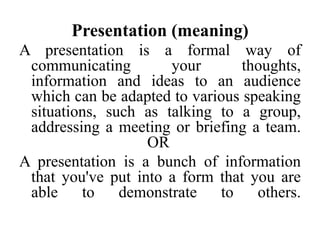
Presentation (meaning)
A presentation is a formal way of
communicating
your
thoughts,
information and ideas to an audience
which can be adapted to various speaking
situations, such as talking to a group,
addressing a meeting or briefing a team.
OR
A presentation is a bunch of information
that you've put into a form that you are
able
to
demonstrate
to
others.
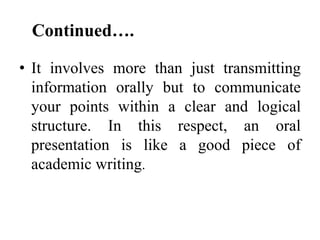
Continued….
• It involves more than just transmitting
information orally but to communicate
your points within a clear and logical
structure. In this respect, an oral
presentation is like a good piece of
academic writing.
Continued…..
Good oral presentation skills involve;
• not only what you say,
• but also how you say it
• and what you are doing when you say it.
Identifying
techniques

Activity
good
presentation

• What do you think are the skills that good
presenters share (based on your personal
experience as a listener).
• Think of a good lecture or talk that you
have attended and consider how the
presentation was given. What techniques
did the speaker use to convey his or her
ideas effectively?
Some common practices
• Clear slides with key words and figures in
large, readable print.
• The presenter didn't speak too fast or too
slow, and used varied expression.

• The speaker communicated with the
audience in a friendly way.
Continued…..
• They were enthusiastic about the topic
and wanted to communicate it to us.
• It was planned but delivered naturally,
and not read.
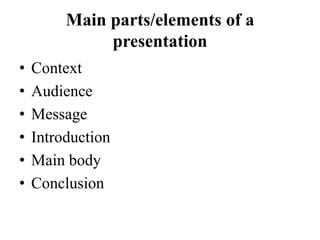
Main parts/elements of a
presentation
•
•
•
•
•
•

Context
Audience
Message
Introduction
Main body
Conclusion
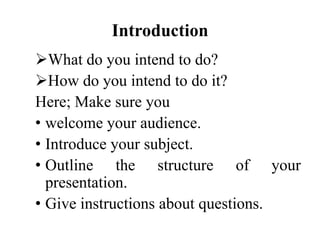
Introduction
What do you intend to do?
How do you intend to do it?
Here; Make sure you
• welcome your audience.
• Introduce your subject.
• Outline the structure of your
presentation.
• Give instructions about questions.
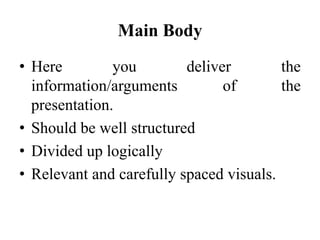
Main Body
• Here
you
deliver
the
information/arguments
of
the
presentation.
• Should be well structured
• Divided up logically
• Relevant and carefully spaced visuals.
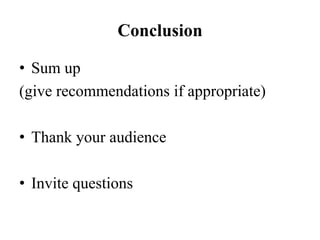
Conclusion
• Sum up
(give recommendations if appropriate)

• Thank your audience
• Invite questions
Presentation of a presentation
“A survey of more than 2,500 Americans
revealed that people feared public speaking
before a group more than death. Amazing
as it may seem, many Americans appear to
consider public speaking a fate worse than
death.” - Stephen E. Lucas, The Art of
Public Speaking
Activity
• Mention the challenges and fear that you
might have experienced during any
presentation that you have delivered.
• How have
challenges?

you

coped

with

those
Few challenges
• I've planned my oral presentation for next
week but I don't know to remember it
all…
• I just want to finish it as quickly as
possible…
• I always feel awkward when I give a
speech.
• I can't sit still and I tend to fidget a lot…
Continued….
• It makes me nervous being the centre of
attention - I never know where to look…
• How do I make sure I that talk for the
right length of time?
Presentation Techniques
These include, for example;
use of notes (not a complete written
text), use of voice, body language and
eye contact to convey your message,
and visual aids (these help reinforce
and illustrate the points you want to
make).
Continued…..
• Remember your audience and make it
easy for them to follow your talk
• Make sure you slow down for key pieces
of information so that your audience has
time to understand what you are saying.
• Format notes with bullet points and
important words highlighted (so they’re
easy to reference as you speak).
Continued…..
• Check the pronunciation of words you
use.
• Use visuals (pictures, graphs, tables,
props) whenever you can.
• Explain the meaning of difficult or
technical words.
Continued…..
• Pause and give the audience time to
understand complex information.
• Before you do anything, make sure you
understand it!
• One point per slide
• Use signposting language
Signposting (meaning)
• A word or phrase used in speech or
writing to highlight part of the text for the
reader or audience; e.g. to introduce the
different stages of a talk or lecture e.g.- to
sum up, let's now consider; to clarify the
writer's argument in writing - with regard
to..., in conclusion.
Functions of signposting
• To introduce the main topic of the talk;
• lead into the next point that the presenter
will address;
• introduce a detail which is interesting but
not essential to the main topic;
• return to the main topic,
• and conclude or sum up the presentation.
Activity

• Identify the signposting language in the
given extracts
Dealing with Questions
•Listen

and be sure you understand the
question
•Include all the audience when answering
•Answer briefly, making sure questionner is
satisfied with response
•Difficult questions
–Stay calm!
–If you don’t know the answer say you
will find out
DOs (summary)
•
•
•
•
•
•
•

Appear confident and knowledgeable
Speak slowly and clearly
Maintain good eye contact
Stand up straight
Use natural hand motions for emphasis
Be prepared for Q&A
Relax and smile
Don’ts (summary)
• Let your nervousness distract the
audience
• Speak too quickly
• Read directly from a script
• Slouch, tap your hands or feet, twirl your
hair, or adjust your clothes
• Chew gum, eat, or drink
• Repeat stalling words like: um, er, uh,
basically, you know, and like
• Forget to proof read your visuals
Effective Delivery
• Voice

e.g. Too fast, too slow
Tone: e.g. is it frightening, scary, friendly
too bossy etc.
Volume: Loudness of the sound. One
should be heard without shouting.
• Body language
People not only listen to you, they also
watch you.
Continued….
Posture; e.g. Straight, slouching, odd.
Eye contact; convey concern, confidence,
interest.
Facial expressions; e.g. smiling shows
happiness, friendliness.
Gestures; Lack of appropriate gestures
may convey yourself as boring and stiff.
Effective power point presentation
• Big (not small but big enough to be seen
by the person sitting at the far end)
• Simple (avoid too many colours, fonts
and styles)
• Clear (All capital letters vs upper and
lower case, Italics vs normal or bold
fonts, light on dark vs dark on light.
• Be consistent (e.g. slide transition)
Planning, Preparation and
Organization
• How much time do you have? (length of pre..)
• What is the purpose of the presentation?
• What is the target audience? How much are they
likely to know?
• What does the audience already know about the
subject?
• Are you expected to invite or take questions
from the audience?
• Anticipate types of questions
• What equipment will be available?
Continued….
• Make sure you research and know your
content thoroughly.
• Use the relevant amount of data for your
presentation but don’t overload with facts
and figures.
• Devise an outline plan for the
presentation.
Practice
• Do a test run in front of a mirror
• Demonstrate your presentation in front of
a friend
• Videotape it
• Don’t forget to:
–Use your notecards!
–Time it!
Factors influencing effective
presentation
For example;
• Background noise or other distractions,
• an overly warm or cool room,
• or the time of day
• and state of audience alertness
Outline plan for presentation
For example;
• 15 minute presentation: Why should we
give you the job?
• Tell them what you are going to tell them:
Introduction (1 minute)
• Tell them: Demonstrate that you
understand the company, their business
and the current market (4 minutes)
Continued….
• Show that you know what the company is
looking for (2 minutes)
• Demonstrate how you meet their criteria
(7 minutes)
• Tell them you have told them: Summarise
your main points (1 minute)
Top tips
• Planning and preparation are key
• Ensure you know your topic thoroughly
• Engage your audience with good eye
contact and body language
• Speak clearly and at a pace that can be
followed easily
• Practice with friends and family
beforehand
Continued….
• Ensure you stick to the time limit
• Don’t let your visual aids (e.g.
PowerPoint) dominate or detract from
what you are saying!
• Do not hurry
• Be enthusiastic
• Allow time for visuals to be effective
Continued…
•
•
•
•
•
•

Modulate your voice
Keep to your structure
Use your notes
Signpost throughout
Look friendly
Be neat and well-dressed
Presentation checklist
• Ideas are ordered logically and clearly
• Signposts are used appropriately
• It is not significantly over or under the
time limit
• I have made key word and phrase notes to
prompt myself
• I have written my notes on cue cards (1
card per main point)
Continued…..
• I talk at an appropriate speed (not too fast
and not too slowly)
• I have tried to vary my intonation (it is
not too flat)
• I use my voice to stress key words and
ideas
• I pause between the different stages of
my talk
• I stand up straight and face my listeners
Continued…..
• I use appropriate body language to
express my ideas
• I maintain eye contact with my listeners
• I have listened to my recording or asked
for someone else's feedback on my talk
• I have rehearsed my talk sufficiently
Continued….
• I have identified the topic clearly at the
beginning
• The main points of the article were
clearly explained
• I explained the meaning of any difficult
or technical words
• It could have been improved further
Some occasions of Presentation
• An organization presents the need for a
capital fund-raising campaign to benefit
the victims of a recent tragedy;
• A school district superintendent presents
a program to parents about the
introduction
of
foreign-language
instruction in the elementary schools;
Continued…..
• An artist demonstrates decorative
painting techniques to a group of interior
designers;
• A horticulturist shows garden club
members or homeowners how they might
use native plants in the suburban land.
• A police officer addresses a neighborhood
association about initiating a safety
program.
Presentation Task

Each student will deliver a presentation to
a specified audience within a specified
timeframe – anything within 10 minutes

Presentation skills

  • 1.
  • 2.
    Presentation (meaning) A presentationis a formal way of communicating your thoughts, information and ideas to an audience which can be adapted to various speaking situations, such as talking to a group, addressing a meeting or briefing a team. OR A presentation is a bunch of information that you've put into a form that you are able to demonstrate to others.
  • 3.
    Continued…. • It involvesmore than just transmitting information orally but to communicate your points within a clear and logical structure. In this respect, an oral presentation is like a good piece of academic writing.
  • 4.
    Continued….. Good oral presentationskills involve; • not only what you say, • but also how you say it • and what you are doing when you say it.
  • 5.
    Identifying techniques Activity good presentation • What doyou think are the skills that good presenters share (based on your personal experience as a listener). • Think of a good lecture or talk that you have attended and consider how the presentation was given. What techniques did the speaker use to convey his or her ideas effectively?
  • 6.
    Some common practices •Clear slides with key words and figures in large, readable print. • The presenter didn't speak too fast or too slow, and used varied expression. • The speaker communicated with the audience in a friendly way.
  • 7.
    Continued….. • They wereenthusiastic about the topic and wanted to communicate it to us. • It was planned but delivered naturally, and not read.
  • 8.
    Main parts/elements ofa presentation • • • • • • Context Audience Message Introduction Main body Conclusion
  • 9.
    Introduction What do youintend to do? How do you intend to do it? Here; Make sure you • welcome your audience. • Introduce your subject. • Outline the structure of your presentation. • Give instructions about questions.
  • 10.
    Main Body • Here you deliver the information/arguments of the presentation. •Should be well structured • Divided up logically • Relevant and carefully spaced visuals.
  • 11.
    Conclusion • Sum up (giverecommendations if appropriate) • Thank your audience • Invite questions
  • 12.
    Presentation of apresentation “A survey of more than 2,500 Americans revealed that people feared public speaking before a group more than death. Amazing as it may seem, many Americans appear to consider public speaking a fate worse than death.” - Stephen E. Lucas, The Art of Public Speaking
  • 13.
    Activity • Mention thechallenges and fear that you might have experienced during any presentation that you have delivered. • How have challenges? you coped with those
  • 14.
    Few challenges • I'veplanned my oral presentation for next week but I don't know to remember it all… • I just want to finish it as quickly as possible… • I always feel awkward when I give a speech. • I can't sit still and I tend to fidget a lot…
  • 15.
    Continued…. • It makesme nervous being the centre of attention - I never know where to look… • How do I make sure I that talk for the right length of time?
  • 16.
    Presentation Techniques These include,for example; use of notes (not a complete written text), use of voice, body language and eye contact to convey your message, and visual aids (these help reinforce and illustrate the points you want to make).
  • 17.
    Continued….. • Remember youraudience and make it easy for them to follow your talk • Make sure you slow down for key pieces of information so that your audience has time to understand what you are saying. • Format notes with bullet points and important words highlighted (so they’re easy to reference as you speak).
  • 18.
    Continued….. • Check thepronunciation of words you use. • Use visuals (pictures, graphs, tables, props) whenever you can. • Explain the meaning of difficult or technical words.
  • 19.
    Continued….. • Pause andgive the audience time to understand complex information. • Before you do anything, make sure you understand it! • One point per slide • Use signposting language
  • 20.
    Signposting (meaning) • Aword or phrase used in speech or writing to highlight part of the text for the reader or audience; e.g. to introduce the different stages of a talk or lecture e.g.- to sum up, let's now consider; to clarify the writer's argument in writing - with regard to..., in conclusion.
  • 21.
    Functions of signposting •To introduce the main topic of the talk; • lead into the next point that the presenter will address; • introduce a detail which is interesting but not essential to the main topic; • return to the main topic, • and conclude or sum up the presentation.
  • 22.
    Activity • Identify thesignposting language in the given extracts
  • 23.
    Dealing with Questions •Listen andbe sure you understand the question •Include all the audience when answering •Answer briefly, making sure questionner is satisfied with response •Difficult questions –Stay calm! –If you don’t know the answer say you will find out
  • 24.
    DOs (summary) • • • • • • • Appear confidentand knowledgeable Speak slowly and clearly Maintain good eye contact Stand up straight Use natural hand motions for emphasis Be prepared for Q&A Relax and smile
  • 25.
    Don’ts (summary) • Letyour nervousness distract the audience • Speak too quickly • Read directly from a script • Slouch, tap your hands or feet, twirl your hair, or adjust your clothes • Chew gum, eat, or drink • Repeat stalling words like: um, er, uh, basically, you know, and like • Forget to proof read your visuals
  • 26.
    Effective Delivery • Voice e.g.Too fast, too slow Tone: e.g. is it frightening, scary, friendly too bossy etc. Volume: Loudness of the sound. One should be heard without shouting. • Body language People not only listen to you, they also watch you.
  • 27.
    Continued…. Posture; e.g. Straight,slouching, odd. Eye contact; convey concern, confidence, interest. Facial expressions; e.g. smiling shows happiness, friendliness. Gestures; Lack of appropriate gestures may convey yourself as boring and stiff.
  • 28.
    Effective power pointpresentation • Big (not small but big enough to be seen by the person sitting at the far end) • Simple (avoid too many colours, fonts and styles) • Clear (All capital letters vs upper and lower case, Italics vs normal or bold fonts, light on dark vs dark on light. • Be consistent (e.g. slide transition)
  • 29.
    Planning, Preparation and Organization •How much time do you have? (length of pre..) • What is the purpose of the presentation? • What is the target audience? How much are they likely to know? • What does the audience already know about the subject? • Are you expected to invite or take questions from the audience? • Anticipate types of questions • What equipment will be available?
  • 30.
    Continued…. • Make sureyou research and know your content thoroughly. • Use the relevant amount of data for your presentation but don’t overload with facts and figures. • Devise an outline plan for the presentation.
  • 31.
    Practice • Do atest run in front of a mirror • Demonstrate your presentation in front of a friend • Videotape it • Don’t forget to: –Use your notecards! –Time it!
  • 32.
    Factors influencing effective presentation Forexample; • Background noise or other distractions, • an overly warm or cool room, • or the time of day • and state of audience alertness
  • 33.
    Outline plan forpresentation For example; • 15 minute presentation: Why should we give you the job? • Tell them what you are going to tell them: Introduction (1 minute) • Tell them: Demonstrate that you understand the company, their business and the current market (4 minutes)
  • 34.
    Continued…. • Show thatyou know what the company is looking for (2 minutes) • Demonstrate how you meet their criteria (7 minutes) • Tell them you have told them: Summarise your main points (1 minute)
  • 35.
    Top tips • Planningand preparation are key • Ensure you know your topic thoroughly • Engage your audience with good eye contact and body language • Speak clearly and at a pace that can be followed easily • Practice with friends and family beforehand
  • 36.
    Continued…. • Ensure youstick to the time limit • Don’t let your visual aids (e.g. PowerPoint) dominate or detract from what you are saying! • Do not hurry • Be enthusiastic • Allow time for visuals to be effective
  • 37.
    Continued… • • • • • • Modulate your voice Keepto your structure Use your notes Signpost throughout Look friendly Be neat and well-dressed
  • 38.
    Presentation checklist • Ideasare ordered logically and clearly • Signposts are used appropriately • It is not significantly over or under the time limit • I have made key word and phrase notes to prompt myself • I have written my notes on cue cards (1 card per main point)
  • 39.
    Continued….. • I talkat an appropriate speed (not too fast and not too slowly) • I have tried to vary my intonation (it is not too flat) • I use my voice to stress key words and ideas • I pause between the different stages of my talk • I stand up straight and face my listeners
  • 40.
    Continued….. • I useappropriate body language to express my ideas • I maintain eye contact with my listeners • I have listened to my recording or asked for someone else's feedback on my talk • I have rehearsed my talk sufficiently
  • 41.
    Continued…. • I haveidentified the topic clearly at the beginning • The main points of the article were clearly explained • I explained the meaning of any difficult or technical words • It could have been improved further
  • 42.
    Some occasions ofPresentation • An organization presents the need for a capital fund-raising campaign to benefit the victims of a recent tragedy; • A school district superintendent presents a program to parents about the introduction of foreign-language instruction in the elementary schools;
  • 43.
    Continued….. • An artistdemonstrates decorative painting techniques to a group of interior designers; • A horticulturist shows garden club members or homeowners how they might use native plants in the suburban land. • A police officer addresses a neighborhood association about initiating a safety program.
  • 44.
    Presentation Task Each studentwill deliver a presentation to a specified audience within a specified timeframe – anything within 10 minutes