• Introduction
• Mechanism
• Stereochemistry
• Reactivity
• Orientation
• Conclusion
• References
CONTENTS
Definition
An elimination reaction is a type of organic reaction in
which 2 substituents are removed (as a small molecule
such as HCl or H2O or Cl2) from a molecule by either a
one or two step mechanism in presence of a base.
C C
X Y
C C + X Y


base
INTRODUCTION
TYPES OF ELIMINATION REACTION
•  Elimination : Both the groups are lost from the same
carbon atom.eg: Dichlorocarbene formation
HCCl3 Base [:CCl2]
•  Elimination : Halogen is lost from  carbon and
Hydrogen is lost from  carbon.
eg: dehydrohalogenation of alkyl halides
•  Elimination- Departing groups located at 1,3or more
remote sites, cyclic products are formed.
H-O-CH2CH2CH2CH2-Cl
O
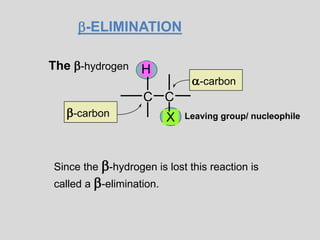
Leaving group/ nucleophile
-carbon
-carbon
The -hydrogen
Since the -hydrogen is lost this reaction is
called a -elimination.
C C
X
H
-ELIMINATION
TYPES OF  ELIMINATION
proton
first
halogen
second
carbocation
E2
C C
H
X
B:
C C
E1cb
carbanion
C C
H
X
C C
X
C C
B:
E1
halogen
first
proton
second
C C
H
X
C C
H
+
C C
B:
+ X
WWU -- Chemistry
Structure of the Carbocation
Intermediate
C CH3
CH3
CH3
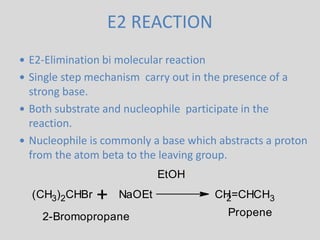
E2 REACTION
 E2-Elimination bi molecular reaction
 Single step mechanism carry out in the presence of a
strong base.
 Both substrate and nucleophile participate in the
reaction.
 Nucleophile is commonly a base which abstracts a proton
from the atom beta to the leaving group.
(CH3)2CHBr NaOEt CH
2=CHCH3
+
EtOH
2-Bromopropane Propene
•Typical of secondary or tertiary substituted
alkyl halides.
•Reaction rate is 2nd order.
•E2 mechanism results in formation of a Pi
bond, the two leaving groups need to be
coplanar.
•Hybridization - sp3 to sp2 - pi bond.
•Deuterium isotope effect is larger than 1.
C C
Cl
H
B:
THE BASE TAKES THE -HYDROGEN
C C
Cl
H
B
: :
..
: :
..
..
MECHANISM
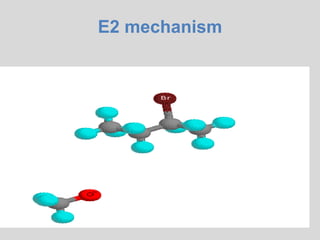
E2 mechanism
Elimination unimolecular,E1
 Two-step process – ionization (carbocation)
and deprotonation.
 Take place in the presence of only weak base.
 Accompanied by carbocation rearrangement
 Rate is 1st order
 Compete with SN1 [common carbocationic
intermediate]
 No deuterium isotope effect.
E1 mechanism
1)
+
+ Br
_
slow
+
2)
..
:
+
fast
O
.. +
O
C C
Br
C C
H
C C
H
C C
H
H H
H
H
H
rate determining
step
3o > 2o > 1o
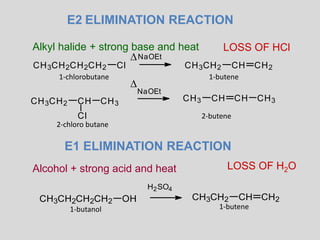
E2 ELIMINATION REACTION
Alkyl halide + strong base and heat LOSS OF HCl
D
D
CH3CH2CH2CH2 Cl CH3CH2 CH CH2
NaOEt
CH3CH2 CH CH3
Cl
CH3 CH CH CH3
NaOEt
1-chlorobutane 1-butene
2-chloro butane
2-butene
CH3CH2CH2CH2 OH CH3CH2 CH CH2
H2SO4
Alcohol + strong acid and heat LOSS OF H2O
E1 ELIMINATION REACTION
1-butene
1-butanol
[RX] constant, [B] increasing
Rate
rate = k1 [RX]
E1
rate = k2 [RX] [B] E2
BEHAVIOUR OF THE RATE WITH
INCREASING BASE CONCENTRATION
second order
first order
E1 dominates
at low base
concentration E2 dominates
at higher base
concentration
E2 REACTION
E1 REACTION
 Alkyl halide+strong base
 Second order kinetics
 Anti coplanar –
requirement
 Stereospecific
 Alkyl halide +weak base
 First order kinetics
 Good carbocation
formation
 Not stereospecific
ELIMINATION
STEREOCHEMICAL PREFERENCES
 Most E2 reactions are stereospecific and proceed with
greater facility when the departing groups are trans than
when they are cis.
 An elimination reaction produces p orbitals from the
bonds to the leaving group and the hydrogen to be
eliminated.
 In order to achieve max overlap of p orbitals in the
transition state they should be coplanar.
 For minimum energy of the transition state the groups to
be eliminated must be antiparallel to each other across
the central bond which becomes the π bond.
C=C
C
H3
Br
CH3
H
Fast
CH3 C C CH3
C=C
C
H3
CH3
Br
H
Trans
cis
Trans isomer is converted by a base to 2-butyne at a
faster rate than its cis isomer.
slow
example
STEREOCHEMISTRY
TWO EXTREME POSSIBILITIES FOR THE
ELIMINATION PROCESS
• Anti elimination:Departure of the groups from
the opposite sides of the reactant molecule.
• Syn elimination: departure of the molecule
from the
same side.
C C
H X
syn elimination
C C
H
X
anti elimination
not common
observed
most often
H
H
X
X anti-coplanar
cis
trans
syn peri planar
ANTI ELIMINATION
• Example
C6H5CHCHC 6H5
Cl
CH3
NaOEt/EtOH
C=C C=C
+
C6H5
C6H5
C6H5 C6H5
H
CH3
H
CH3
Z-a-Methylstilbene (cis)
1-Chloro- 1,2-diphenylpropane E-a- Methylstilbene (trans)
Threo-1-Chloro-1,2-diphenylpropane NaoEt/EtOH E-a-Methylstilbene
100% (trans)
Erythro-1-Chloro-1,2-diphenylpropane NaoEt/EtOH Z-a-Methylstilbene
98% (cis)
axial
4
2
H
fast
3-menthene
With Small amount of 2-menthene
Example
Chlorine is equitorial
slow
axial
2-menthene
100%
Deuterated norbornyl bromide [X-Br]
D
H
H
X
H
H
exo
endo
Rigid molecule
SYN - ELIMINATION
SYN ELIMINATION OCCURS BECAUSE
THERE ARE NO ANTI-COPLANAR -H
Orientation in elimination reaction
The elimination reactions of unsymmetrical
substrates usually yield mixtures of all
possible products.Two empirical rules
governing the orientation in these reaction.
• Hofmann Rule : Reactions give least
substituted alkenes.
• Saytzeff rule : Reactions give more
substituted alkene generally corresponds with
the formation of the more stable alkene
WWU -- Chemistry
Orientation of elimination:
Zaitsev’s Rule
• In reactions of removal of hydrogen halides from
alkyl halides or the removal of water from alcohols,
the hydrogen which is lost will come from the more
highly-branched -carbon.
A. N. Zaitsev -- 1875
   
C C C C
H
H
H H
X
H
H
H
H
CH3
Less branched
More branched
WWU -- Chemistry
Product formed from previous slide
C
C C
C
H
H
H
H
H
CH3
H
H
WWU -- Chemistry
Orientation of elimination:
regiochemistry/ Hofmann’s Rule
• In bimolecular elimination reactions in the presence
of either a bulky leaving group or a bulky base, the
hydrogen that is lost will come from the LEAST
highly-branched -carbon.
   
C C C C
H
H
H H
X
H
H
H
H
CH3
Less branched
More branched
WWU -- Chemistry
Product from previous slide
C
C
C
H
H
H
H
CH3
H
H
C
H
WWU -- Chemistry
bulky leaving groups -- Hofmann
Elimination
+
OH
_
heat
+
6%
94%
 

CH3 CH2 CH2 CH CH3
N
CH3
CH3
CH3
CH3 CH2 CH CH CH3
CH3 CH2 CH2 CH CH2
This give the anti-Zaitsev product (least
substituted product is formed)!
HOFMANN ELIMINATION
Hofmann found that when the leaving group was -N(CH3)3
+
E2 elimination reactions gave the least-substituted alkene.
CH3 CH2 CH
N
CH3
CH3
CH3
H3C
CH3CH2 CH CH2
CH3 CH CH CH3
+
KOH
EtOH
D
+
+
D EtOH
KOH
CH3 CH CH CH3
CH3CH2 CH CH2
CH3 CH2 CH
Br
CH3
95%
5%
31%
69%
Hofmann
Saytzeff
SAYTZEFF RULE
The reaction gives the most highly-substituted
(lowest energy) alkene as the major product.
CH3 CH CH CH3
CH3CH2 CH CH3
Br
+
CH3CH2 CH CH2
major product
81 %
Minor product
19%
REACTIVITY
Effect Of Substrate
30>20>10 RX- E1 &E2
Effect Of Base
Strong -E2
Weak –E1
Effect Of Leaving Group
Halogens – E2
OH2+ - E1
Effect Of Medium
increased polarity – increase E1 &E1cb
Effect Of Temperature
Elimination Is Favoured Over Substitution
•
CONCLUSION
There is a certain level of competition between elimination
reaction and nucleophilic substitution. Substitution generally
predominates and elimination occurs only during precise
circumstances. Generally, elimination is favored over
substitution when
•Steric hindrance increases
•Basicity increases
•Temperature increases
• The steric bulk of the base increases for example
Potassium tert-butoxide
• The nucleophile is poor
REFERENCES
 March,J.; ‘Advanced Organic Chemistry:Reactions, Mechanisms, and
Structure’;4th edition Wiley india publishers (2006 reprint).
 Finar,I.L.; Organic Chemistry Volume 2, 5th edition,
ELBS Publishers (1991 reprint).
 Pine,H.S.et al; Organic Chemistry 4th edition,
Mcgraw-Hill International Book Company(1981).
 Fuson,C.R; Reactions of Organic Compounds:
A textbook for the advanced student, John Wiley & sons (1962).
 www. wikipedia.com.
 Alkyl halide reactivity.htm
 www.u.chem
ELIMINATION SHEEJA.pptx

ELIMINATION SHEEJA.pptx

  • 3.
    • Introduction • Mechanism •Stereochemistry • Reactivity • Orientation • Conclusion • References CONTENTS
  • 4.
    Definition An elimination reactionis a type of organic reaction in which 2 substituents are removed (as a small molecule such as HCl or H2O or Cl2) from a molecule by either a one or two step mechanism in presence of a base. C C X Y C C + X Y   base INTRODUCTION
  • 5.
    TYPES OF ELIMINATIONREACTION •  Elimination : Both the groups are lost from the same carbon atom.eg: Dichlorocarbene formation HCCl3 Base [:CCl2] •  Elimination : Halogen is lost from  carbon and Hydrogen is lost from  carbon. eg: dehydrohalogenation of alkyl halides •  Elimination- Departing groups located at 1,3or more remote sites, cyclic products are formed. H-O-CH2CH2CH2CH2-Cl O
  • 6.
    Leaving group/ nucleophile -carbon -carbon The-hydrogen Since the -hydrogen is lost this reaction is called a -elimination. C C X H -ELIMINATION
  • 7.
    TYPES OF ELIMINATION proton first halogen second carbocation E2 C C H X B: C C E1cb carbanion C C H X C C X C C B: E1 halogen first proton second C C H X C C H + C C B: + X
  • 8.
    WWU -- Chemistry Structureof the Carbocation Intermediate C CH3 CH3 CH3
  • 9.
    E2 REACTION  E2-Eliminationbi molecular reaction  Single step mechanism carry out in the presence of a strong base.  Both substrate and nucleophile participate in the reaction.  Nucleophile is commonly a base which abstracts a proton from the atom beta to the leaving group. (CH3)2CHBr NaOEt CH 2=CHCH3 + EtOH 2-Bromopropane Propene
  • 10.
    •Typical of secondaryor tertiary substituted alkyl halides. •Reaction rate is 2nd order. •E2 mechanism results in formation of a Pi bond, the two leaving groups need to be coplanar. •Hybridization - sp3 to sp2 - pi bond. •Deuterium isotope effect is larger than 1.
  • 11.
    C C Cl H B: THE BASETAKES THE -HYDROGEN C C Cl H B : : .. : : .. .. MECHANISM
  • 12.
  • 13.
    Elimination unimolecular,E1  Two-stepprocess – ionization (carbocation) and deprotonation.  Take place in the presence of only weak base.  Accompanied by carbocation rearrangement  Rate is 1st order  Compete with SN1 [common carbocationic intermediate]  No deuterium isotope effect.
  • 14.
    E1 mechanism 1) + + Br _ slow + 2) .. : + fast O ..+ O C C Br C C H C C H C C H H H H H H rate determining step 3o > 2o > 1o
  • 15.
    E2 ELIMINATION REACTION Alkylhalide + strong base and heat LOSS OF HCl D D CH3CH2CH2CH2 Cl CH3CH2 CH CH2 NaOEt CH3CH2 CH CH3 Cl CH3 CH CH CH3 NaOEt 1-chlorobutane 1-butene 2-chloro butane 2-butene CH3CH2CH2CH2 OH CH3CH2 CH CH2 H2SO4 Alcohol + strong acid and heat LOSS OF H2O E1 ELIMINATION REACTION 1-butene 1-butanol
  • 16.
    [RX] constant, [B]increasing Rate rate = k1 [RX] E1 rate = k2 [RX] [B] E2 BEHAVIOUR OF THE RATE WITH INCREASING BASE CONCENTRATION second order first order E1 dominates at low base concentration E2 dominates at higher base concentration
  • 17.
    E2 REACTION E1 REACTION Alkyl halide+strong base  Second order kinetics  Anti coplanar – requirement  Stereospecific  Alkyl halide +weak base  First order kinetics  Good carbocation formation  Not stereospecific ELIMINATION
  • 18.
    STEREOCHEMICAL PREFERENCES  MostE2 reactions are stereospecific and proceed with greater facility when the departing groups are trans than when they are cis.  An elimination reaction produces p orbitals from the bonds to the leaving group and the hydrogen to be eliminated.  In order to achieve max overlap of p orbitals in the transition state they should be coplanar.  For minimum energy of the transition state the groups to be eliminated must be antiparallel to each other across the central bond which becomes the π bond.
  • 19.
    C=C C H3 Br CH3 H Fast CH3 C CCH3 C=C C H3 CH3 Br H Trans cis Trans isomer is converted by a base to 2-butyne at a faster rate than its cis isomer. slow example
  • 20.
    STEREOCHEMISTRY TWO EXTREME POSSIBILITIESFOR THE ELIMINATION PROCESS • Anti elimination:Departure of the groups from the opposite sides of the reactant molecule. • Syn elimination: departure of the molecule from the same side.
  • 21.
    C C H X synelimination C C H X anti elimination not common observed most often H H X X anti-coplanar cis trans syn peri planar
  • 22.
    ANTI ELIMINATION • Example C6H5CHCHC6H5 Cl CH3 NaOEt/EtOH C=C C=C + C6H5 C6H5 C6H5 C6H5 H CH3 H CH3 Z-a-Methylstilbene (cis) 1-Chloro- 1,2-diphenylpropane E-a- Methylstilbene (trans) Threo-1-Chloro-1,2-diphenylpropane NaoEt/EtOH E-a-Methylstilbene 100% (trans) Erythro-1-Chloro-1,2-diphenylpropane NaoEt/EtOH Z-a-Methylstilbene 98% (cis)
  • 23.
  • 24.
  • 25.
    Deuterated norbornyl bromide[X-Br] D H H X H H exo endo Rigid molecule SYN - ELIMINATION SYN ELIMINATION OCCURS BECAUSE THERE ARE NO ANTI-COPLANAR -H
  • 26.
    Orientation in eliminationreaction The elimination reactions of unsymmetrical substrates usually yield mixtures of all possible products.Two empirical rules governing the orientation in these reaction. • Hofmann Rule : Reactions give least substituted alkenes. • Saytzeff rule : Reactions give more substituted alkene generally corresponds with the formation of the more stable alkene
  • 27.
    WWU -- Chemistry Orientationof elimination: Zaitsev’s Rule • In reactions of removal of hydrogen halides from alkyl halides or the removal of water from alcohols, the hydrogen which is lost will come from the more highly-branched -carbon. A. N. Zaitsev -- 1875     C C C C H H H H X H H H H CH3 Less branched More branched
  • 28.
    WWU -- Chemistry Productformed from previous slide C C C C H H H H H CH3 H H
  • 29.
    WWU -- Chemistry Orientationof elimination: regiochemistry/ Hofmann’s Rule • In bimolecular elimination reactions in the presence of either a bulky leaving group or a bulky base, the hydrogen that is lost will come from the LEAST highly-branched -carbon.     C C C C H H H H X H H H H CH3 Less branched More branched
  • 30.
    WWU -- Chemistry Productfrom previous slide C C C H H H H CH3 H H C H
  • 31.
    WWU -- Chemistry bulkyleaving groups -- Hofmann Elimination + OH _ heat + 6% 94%    CH3 CH2 CH2 CH CH3 N CH3 CH3 CH3 CH3 CH2 CH CH CH3 CH3 CH2 CH2 CH CH2 This give the anti-Zaitsev product (least substituted product is formed)!
  • 32.
    HOFMANN ELIMINATION Hofmann foundthat when the leaving group was -N(CH3)3 + E2 elimination reactions gave the least-substituted alkene. CH3 CH2 CH N CH3 CH3 CH3 H3C CH3CH2 CH CH2 CH3 CH CH CH3 + KOH EtOH D + + D EtOH KOH CH3 CH CH CH3 CH3CH2 CH CH2 CH3 CH2 CH Br CH3 95% 5% 31% 69% Hofmann Saytzeff
  • 33.
    SAYTZEFF RULE The reactiongives the most highly-substituted (lowest energy) alkene as the major product. CH3 CH CH CH3 CH3CH2 CH CH3 Br + CH3CH2 CH CH2 major product 81 % Minor product 19%
  • 34.
    REACTIVITY Effect Of Substrate 30>20>10RX- E1 &E2 Effect Of Base Strong -E2 Weak –E1 Effect Of Leaving Group Halogens – E2 OH2+ - E1 Effect Of Medium increased polarity – increase E1 &E1cb Effect Of Temperature Elimination Is Favoured Over Substitution •
  • 35.
  • 36.
    There is acertain level of competition between elimination reaction and nucleophilic substitution. Substitution generally predominates and elimination occurs only during precise circumstances. Generally, elimination is favored over substitution when •Steric hindrance increases •Basicity increases •Temperature increases • The steric bulk of the base increases for example Potassium tert-butoxide • The nucleophile is poor
  • 37.
    REFERENCES  March,J.; ‘AdvancedOrganic Chemistry:Reactions, Mechanisms, and Structure’;4th edition Wiley india publishers (2006 reprint).  Finar,I.L.; Organic Chemistry Volume 2, 5th edition, ELBS Publishers (1991 reprint).  Pine,H.S.et al; Organic Chemistry 4th edition, Mcgraw-Hill International Book Company(1981).  Fuson,C.R; Reactions of Organic Compounds: A textbook for the advanced student, John Wiley & sons (1962).  www. wikipedia.com.  Alkyl halide reactivity.htm  www.u.chem