1
ADVANCED OPTICAL COMMUNICATIONS
Professor Vittorio Curri
This report is provided by :
Makan Mohammadi Ostadkalayeh
S201977
2
First one it is better to map our solution. in this case we want to check behavior of EDFA in linear and
saturation regions. As you can see the system is a multi-channel transmission link working at 32 ๐บ๐‘๐‘Ž๐‘ข๐‘‘.
The link must operate at 13๐‘‘๐ต ๐‘‚๐‘†๐‘๐‘… for 10โˆ’3
๐ต๐ธ๐‘… target with 2 dB margin. The experiment is to find
the number of spans satisfying the desired ๐‘‚๐‘†๐‘๐‘… requirements with the system operating in
linear/saturation regimes with transparency conditions.
linear regime
In linear and transparency condition ๐‘‚๐‘†๐‘๐‘… achieves by this formula :
๐‘‚๐‘†๐‘๐‘… =
1
๐บ โˆ’ 1
๐‘ƒ ๐‘‡
๐‘€. 2โ„Ž๐‘“๐‘… ๐‘  ๐‘› ๐‘ 
This formula is desired OSNR requirement and the minimum number of spans that satisfy the OSNR
requirement.
Also we know in linear condition, this is sharp that the operation in this regime is dominated by noise
that is mainly due to Amplified Stimulated Emission (ASE) but we can imagine the signal power at the
amplifier output is proportional to the power at the amplifier input so the output signal power increases
linearly with the input signal power. We must find the optimal span number at:
๐‘‚๐‘†๐‘๐‘… = ๐‘‚๐‘†๐‘๐‘… ๐‘‡ + ๐œ‡ = 13 + 2 = 15
The best choice for number of span is ๐‘€ = 62 and also ๐‘‚๐‘†๐‘๐‘… is increasing as the number of spans is
increasing, which shows the effect of the multi spans system in improving the performance for long
3
haul transmission system.
4
If we use " ๐‘€ = 62 " each span will be ๐ฟ ๐‘†๐‘๐‘Ž๐‘› = 3000/62 = 48.38๐พ๐‘š .
And
๐บ = |๐ด| = ๐‘Ž๐‘ก๐‘ก๐‘’๐‘›๐‘ข๐‘Ž๐‘ก๐‘œ๐‘Ÿ + ๐›ผ ๐‘‘๐ต. ๐ฟ ๐‘ ๐‘๐‘Ž๐‘› = 3 + (0.22 ร— 48.38) = 13.46 ๐‘‘๐ต
๐‘‚๐‘†๐‘๐‘… ๐‘‘๐ต = ๐‘ƒ ๐‘‡ ๐‘‘๐ต โˆ’ ๐‘ƒ ๐‘ ๐‘‘๐ต:
๐‘ค๐‘’ ๐‘๐‘Ž๐‘› ๐‘ ๐‘’๐‘’ ๐‘๐‘’๐‘™๐‘œ๐‘ค ๐‘กโ„Ž๐‘’ ๐‘‚๐‘†๐‘๐‘… ๐‘ฃ๐‘ . ๐‘€ ๐‘๐‘™๐‘œ๐‘ก(๐‘‚๐‘†๐‘๐‘… ๐‘–๐‘  ๐‘Ž๐‘ก ๐‘กโ„Ž๐‘’ ๐‘œ๐‘ข๐‘ก๐‘๐‘ข๐‘ก ๐‘œ๐‘“ ๐‘Ž๐‘š๐‘๐‘™๐‘–๐‘“๐‘–๐‘’๐‘Ÿ ):
5
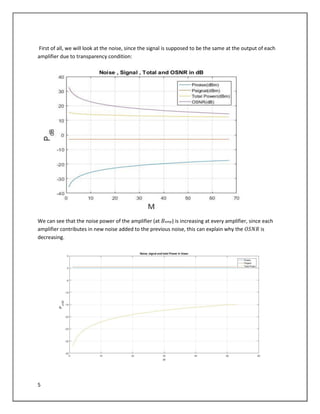
First of all, we will look at the noise, since the signal is supposed to be the same at the output of each
amplifier due to transparency condition:
We can see that the noise power of the amplifier (at ๐ต ๐‘Ž๐‘š๐‘) is increasing at every amplifier, since each
amplifier contributes in new noise added to the previous noise, this can explain why the ๐‘‚๐‘†๐‘๐‘… is
decreasing.
6
saturated regime:
Now, we will study the performance of the system in the Saturated Regime, trying to see the difference
between saturated and Linear Regime Using the same model. With the same parameters, and assuming
that the saturation power is the transmitted power
a.plotting the OSNR VS. M and finding the best
Following figure show us for ๐‘‚๐‘†๐‘๐‘… = 15 number of span will be ๐‘€ = 19.
We can suppose that ๐บ0 = 27๐‘‘๐ต for ๐‘€ = 19, now we must compute d ๐‘ƒ0โˆ’3๐‘‘๐ต :
๐‘ƒ0โˆ’3๐‘‘๐ต = ๐‘ƒ๐‘ก ร— ๐‘๐‘โ„Ž โˆ— (1 โˆ’ ๐ด ๐‘ ) โˆ— log10(e) /(1.44 โˆ— ๐‘™๐‘œ๐‘”(๐ด ๐‘  โˆ— ๐บ0)) = โˆ’0.2802
๐ด ๐‘‘๐ต = (โˆ’1) ร— (3 + ๐ด๐‘ก๐‘ก๐‘’๐‘›) ; ๐ด๐‘ก๐‘ก๐‘’๐‘›๐‘ข๐‘Ž๐‘ก๐‘–๐‘œ๐‘› ๐‘–๐‘› ๐‘‘๐ต
๐ด ๐‘  = 10(0.1โˆ—๐ด ๐‘‘๐ต)
๐ด๐‘ก๐‘ก๐‘’๐‘›๐‘ข๐‘Ž๐‘ก๐‘–๐‘œ๐‘› ๐‘–๐‘› ๐ฟ๐‘–๐‘›๐‘’๐‘Ž๐‘Ÿ ๐‘†๐‘๐‘Ž๐‘™๐‘’
๐‘ = 19 ;
๐ด๐‘ก๐‘ก๐‘’๐‘› = (๐›ผ โˆ— ๐ฟ ๐‘ก๐‘œ๐‘ก)/๐‘
Now we chose ๐‘€ = 19
So Attenuation and amplification are constant, letโ€™s see the ๐‘‚๐‘†๐‘๐‘… in this case:
As you can see in the figure ๐‘‚๐‘†๐‘๐‘… is decreasing, same as linear regime
7
And also this figure show us the variation of the ๐‘ ๐‘–๐‘”๐‘›๐‘Ž๐‘™ ๐‘๐‘œ๐‘ค๐‘’๐‘Ÿ and the ๐‘›๐‘œ๐‘–๐‘ ๐‘’ ๐‘๐‘œ๐‘ค๐‘’๐‘Ÿ and the
๐‘ก๐‘œ๐‘ก๐‘Ž๐‘™ ๐‘๐‘œ๐‘ค๐‘’๐‘Ÿ to understand how is it decreasing.
The total output power of the amplifier is constant and also the signal is decreasing and the noise power
is normal increasing, and we can see that the increase in the power of the noise is exactly the decrease
in the signal power which says:
This is why it is called saturation region, since the output power is not increasing anymore, not like in
the โ€œLinear Regimeโ€ were output power is increase at every amplifier.
This also can explain why the ๐‘‚๐‘†๐‘๐‘… is decreasing since the noise increasing and the signal power is
decreasing, which leads to the normal situation of fraction.
8
saturated regime with changing P0-3dB
In the Third Part of the report, it was required to redo all what is done above, but with different 3-dB
power output, which changes the saturation power, and so the transmitted power will change also.
๐บ0 = 27๐‘‘๐ต, ๐‘ƒ๐‘œ๐‘ข๐‘ก,3๐‘‘๐ต = 1๐‘‘๐ต๐‘š โ†’ ๐‘ƒ๐‘œ๐‘ข๐‘ก,3๐‘‘๐ต = 1.25๐‘š๐‘Š
@MATLAB
Po_3dB = Pt*Nch*(1-As)*log10(exp(1))/(1.44*log(As*G0)) ;
We have amount of Po_3dB and also As, G0, Nch than โ†’ ๐‘ƒ ๐‘‡ = 0.501 ๐‘‘๐ต๐‘š
so we repeat all of things that we did above at first we get the number of spans:
we can see that at desired ๐‘‚๐‘†๐‘๐‘… we have ๐‘€ = 43. Decreasing the saturation power, will lead to
decrease in the gain of the amplifier, so more spans will be needed and this is clear above.
Now for ๐‘€ = 43 โˆถ
9
10
Looking at the above graphs qualitatively they have the same response like in the previous part.
The output power is constant, as we are starting from saturation, while the signal power is decreasing
and the noise power is increasing in the same manner.
11
(II)
Question:
OptSim simulator parameters
VBS simulation center frequency: f0= 193 THz
VBS simulation bandwidth corresponding to 24 samples per symbol
Number of simulated bits: 211
for eye-diagrams and spectra and 217
for error counting
For all modulation formats use PRBS generators without precoder also for PSBT and DPSK
Optical Field Representation: โ€œDual Polarizationโ€
Rb=10.7 and 42.65 Gbit/s
Target BER=10-3
BER evaluation through error counting
Transmitter parameters
Laser: ideal CW Lorenzian laser emitting 0 dBm, leave default parameters
Data source (logical sources-> data source): sequence: random; pseudo random sequence mode: manual;
degree: 11, polynomial type: deterministic; polynomial number: 1
Modulation formats
IMDD-NRZ: electrical rectangular pulses, shaped using a 5 poles Bessel filter having -3 dB bandwidth
equal to to 0.75 Rb
IMDD-RZ: electrical RZ rectangular pulses with 50% duty-cycle, shaped using a 5 poles Bessel filter having
-3 dB bandwidth equal to 1.3ยทRb
PSBT: electrical NRZ rectangular pulses, shaped using a 5 poles Bessel filter having -3 dB bandwidth equal
to 0.25 Rb
DPSK: electrical NRZ rectangular pulses, shaped using a 5 poles Bessel filter having -3 dB bandwidth equal
to Rb
External modulation, use a realistic MZ modulator (sin2
model in the OptSim library of components) with
extinction ratio 20 dB and without filtering effect. Leave the insertion loss to the default value
12
In order to ideally define the transmitted power PTx = 0 dBm, use a fixed output power EDFA (turn noise
off) at the output of the modulator
Receiver parameters
Rx Optical filter: SuperGaussian 2nd
order with Bo=0.33 nm
Detection
IMDD and PSBT: Photodiode: PIN with 0.60 A/W
DPSK: ideal balanced DPSK receiver including the AMZI and the balanced photodetectors
(In the Optsim tree of components you can find it under โ€œreceiversโ€ and it is labelled โ€œIdeal balanced
2DPSK receiverโ€)
TIA: ideal (transimpedance: 15kฮฉ, noise set to 0 pA/sqrt(Hz)
Electrical filter: low-pass Bessel 5 poles with -3 dB bandwidth Be=0.75ยทRb
Channel
Noisy channel.
In this case we consider only the introduction of some ASE noise due to the chain of amplifiers and set
the OSNR at the receiver. It is suggested to use the following simulative approach
ASE noise generator added to the Tx signal with a combiner. In order to have the required OSNR [dB], set
the ASE noise generator to PTx โ€“OSNR-10*log10(Rb) [dB(mW/THz)], where Rb [Tbit/s] is the bit-rate.
Dispersive and noisy channel
In this case, besides the ASE noise introduction, you are request to test also the presence of some
chromatic dispersion. In order to speed-up the analysis it is suggested to emulate the dispersive channel
using an ideal fiber grating (under โ€œoptical componentsโ€ in the optsim library tree)
For the noise, use the ASE noise generator set as described in previous step. For the emulation of the
chromatic dispersion use an ideal fiber grating set to introduce Dacc [ps/nm].
Required analyses
Qualitative analyses (to this purpose, simulate only 211
bits, otherwise eye-diagram data files are too
large)
Verify the eye-diagrams and spectra for every modulation format
13
Quantitative analyses (to this purpose, simulate 217
bits)
In this case use the โ€œBER counterโ€ component you can find in the โ€œmeasurement components. Be careful
to specify the number of samples per symbol and the PRBS degree and polynomial number (11 and 1)
you are using at the transmitter side because in order to count the error, the component needs the
knowledge of the transmitted sequence. Please, use as autput data only the p(e) that is the evaluated
BER. To derive the corresponding Q factor, please, extract BER data and apply the inverse of the
relationship BER=1/2ยทerfc(Q/sqrt(2)), remembering that Q_dB=20ยทlog10(Q)
Using the noisy channel, for each modulation format, derive through error counting the BER vs. OSNR
behavior. Evaluate the target OSNR for the target BER (parametric run varying OSNR).
Using the noisy and dispersive channel, for each modulation format, with the OSNR set to the previously
calculated value, derive the BER (and Q) vs. Dacc curve (parametric run with OSNR fixed to the target
value previously established and Dacc varying in the ideal fiber grating). To define the Dacc range to
explore, use the heuristic law Dacc,max=1/10/Rb
2
and do some test on few values up to 2ยท Dacc,max. Then,
refine the analysis on a smaller range.
Using the noisy and dispersive channel, for the Dacc value giving 2 dB Qpenalty, evaluate the
corresponding OSNR penalty. For the PSBT, redo this analysis considering the bandwidth of the Tx filter
equal to 0.24ยทRb and 0.26ยทRb .
Parametric run with Dacc fixed to the 2-dB Q penalty value and OSNR varying, starting from the OSNR
target up to OSNR target + 3 dB, step 0.5 dB.
The diagram of our system is below :
Qualitative and quantitative analysis of NRZ, RZ, PSBT and DPSK Modulation schemes are shown above
at 10.7 Gbps and 42.65 Gbps. The system was composed of a transmitter, which includes Data Source,
Pulse Shaping filter, 5 poles Bessel Electronic filter, a Mach Zehnder to apply the modulation on the
optical signal and an optical amplifier, the channel with Noise source with a combiner and fibre grating
to add chromatic dispersion and the receiver consisting Gaussian Optical Filter, Photodiode (or DPSK
balanced receiver for DPSK) trans-impedance amplifier and a Bessel Electronic Filter. By varying the
parameters of pulse Shaping and Bessel TX Filter.
14
NRZ
Intensity Modulation Direct Detection: Non-Return to Zero - IMDD NRZ is an Amplitude Modulation
Scheme and transmission is only done at high level i.e. 1.The spectra and eye diagrams for this
modulation scheme were evaluated at bit rate, Rb equal to 10.7 and 42.65 Gbps bit rates.
NRZ modulation was used with the Bessel Filterโ€™s bandwidth equal to 0.75 Rb.
Qualitative Analysis of NRZ Modulation (spectra and eye diagrams)
The carrier peak at 193 THz characterizes the spectrum. The bandwidth is twice the bit rate as it can be
seen: the band is from 193.40 THz to 193.42 THz then about 0.2 THz is 20Gbits/s wide. For the noisy
channel, it can be seen that the peaks at the side lobes vanish.
Without noise, the eye diagram is opened and thus there is no interference. However, for the noisy
channel, the eye diagram has very less opening as can be seen in Figure below
The figure above shows NRZ Spectrum without noise at Rb = 10.7 Gbps
15
The figure above shows NRZ Eye-Diagram with no noise at Rb = 10.7 Gbps
The figure above shows NRZ Spectrum with Noise at Rb = 10.7 Gbps
16
The figure above shows the NRZ Eye-Diagram with Noise at Rb = 10.7 Gbps
The following diagrams show spectra and eye diagrams evaluated at 42.65 Gbps. Both the NRZ spectra
in case of ideal and noisy channel are quite identical as can be seen from the following figures. However,
eye diagrams show the change of behaviour in both the cases.
The figure above shows NRZ Spectrum with no Noise Rb = 42.65 Gbps
17
The figure above shows NRZ Eye Diagram with no Noise at Rb = 42.65 Gbps
the figure above shows NRZ Spectrum with Noise at Rb = 42.65 Gbps
18
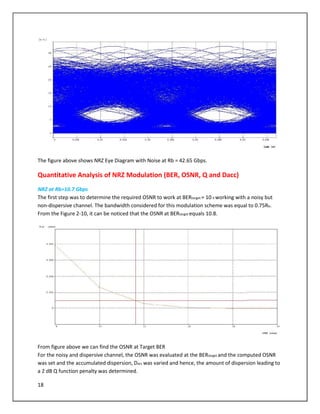
The figure above shows NRZ Eye Diagram with Noise at Rb = 42.65 Gbps.
Quantitative Analysis of NRZ Modulation (BER, OSNR, Q and Dacc)
NRZ at Rb=10.7 Gbps
The first step was to determine the required OSNR to work at BERtarget = 10-3 working with a noisy but
non-dispersive channel. The bandwidth considered for this modulation scheme was equal to 0.75Rb.
From the Figure 2-10, it can be noticed that the OSNR at BERtarget equals 10.8.
From figure above we can find the OSNR at Target BER
For the noisy and dispersive channel, the OSNR was evaluated at the BERtarget and the computed OSNR
was set and the accumulated dispersion, Dacc was varied and hence, the amount of dispersion leading to
a 2 dB Q function penalty was determined.
19
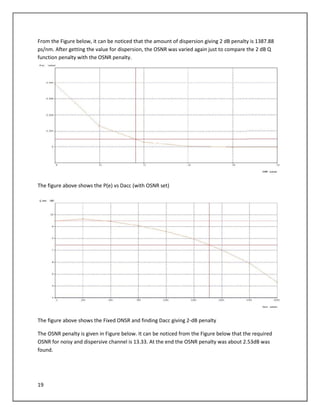
From the Figure below, it can be noticed that the amount of dispersion giving 2 dB penalty is 1387.88
ps/nm. After getting the value for dispersion, the OSNR was varied again just to compare the 2 dB Q
function penalty with the OSNR penalty.
The figure above shows the P(e) vs Dacc (with OSNR set)
The figure above shows the Fixed ONSR and finding Dacc giving 2-dB penalty
The OSNR penalty is given in Figure below. It can be noticed from the Figure below that the required
OSNR for noisy and dispersive channel is 13.33. At the end the OSNR penalty was about 2.53dB was
found.
20
The figure above shows the Fixed Dacc and finding OSNR at target BER.
NRZ at Rb=42.65 Gbps
The same procedure was repeated but with bit rate equal to 42.65 Gbps.
The figure above shows the Finding OSNR at Target BER.
At BERtarget=10-3
found OSNR = 9.
21
The figure above shows P(e) vs Dacc (with OSNR set)
22
The figure above shows the Fixed ONSR and finding Dacc giving 2-dB penalty
At, OSNR=9 and Dacc varying, found the Dacc = 82.1 giving 2-dB Penalty.
The figure above shows Fixed Dacc and finding OSNR at target BER
With Dacc = 82.1, at BERtarget the OSNR is 11.25.
It can be seen that with increase in bit rate we get small values of OSNR.
23
RZ
The IMDD RZ is very similar to IMDD NRZ except the shape of pulse. When the bit is โ€˜1โ€™ the pulse is at
the high level for only half the bit duration and at the low level for the other half. This accounts for the
extra spectrum components. This modulation scheme requires a larger band.
Qualitative Analysis of RZ Modulation (spectra and eye diagrams)
The following figures show the RZ spectra and eye diagram evaluated at 10.7 and 42.65 Gbps. From the
Eye Diagram, we can notice that there is no level off at the high level because of the RZ shaping.
The figure above shows RZ Spectrum with no noise.
24
The figure above shows RZ Eye Spectrum with no noise.
25
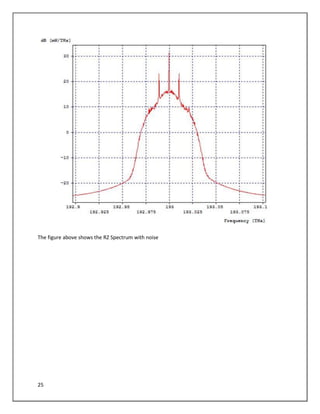
The figure above shows the RZ Spectrum with noise
26
The figure above shows the RZ Eye Spectrum with noise
The figure above shows the RZ Spectrum with no noise at Rb=42.65 Gbps
27
The figure above shows RZ Eye Diagram with no noise at Rb=42.65 Gbps
The figure above shows RZ Spectrum wih noise at Rb=42.65 Gbps
28
The figure above shows RZ Eye Diagram with noise at Rb=42.65 Gbps
Qualitative Analysis of RZ Modulation (OSNR, BER, Q and Dacc)
RZ at Rb=10.7 Gbps
The bandwidth considered for this modulation scheme was equal to 1.3Rb. At the BERtarget, the OSNR was
found to be 9.1 dB. The corresponding OSNR plot is shown in the following figure.
29
The figure above shows the Finding OSNR at Target BER
30
The figure above shows the P(e) vs Dacc (with OSNR set)
31
The figure above shows the Fixed ONSR and finding Dacc giving 2-dB penalty
At, OSNR=9 .1 and Dacc varying, found the Dacc = 558 giving 2-dB Penalty.
The figure above shows Fixed Dacc and finding OSNR at target BER
With Dacc = 558, at BERtarget the OSNR is 10.9.
32
RZ at Rb=42.65 Gbps
At the BERtarget, the OSNR was found to be 10.2 dB. The corresponding OSNR plot is shown in the figure
below
The figure above shows Finding OSNR at Target BER
The figure above shows the P(e) vs Dacc (with OSNR set)
33
The figure above shows the Fixed ONSR and finding Dacc giving 2-dB penalty
At, OSNR=10.02 and Dacc varying, found the Dacc = 105.05 giving 2-dB Penalty.
The figure above shows the Fixed Dacc and finding OSNR at target BER
With Dacc =105.05 , at BERtarget the OSNR is 12.94
34
PSBT
The Phase Shaped Binary Transmission modulation is derived from Duo binary modulation. Three signal
levels are used +A, 0 and โ€“A. The value of the current bit depends upon the previous bit sent before it.
This modulation format requires a narrower spectral occupancy with respect to IMDD NRZ. Regarding
the waveforms, we can see the three different signal levels.
Qualitative Analysis of PSBT Modulation (spectra and eye diagrams)
The figure above shows the PSBT Spectrum with no noise at Rb=10.7
35
The figure above shows PSBT Eye Diagram with no noise at Rb=10.7
The figure above shows the PSBT Spectrum with noise at Rb=10.7
36
The figure above PSBT Eye Diagram with noise at Rb=10.7
The figure above shows PSBT Spectrum with no noise at Rb=42.65
37
The figure above shows the PSBT Eye Diagram with no noise at Rb=42.65
the figure above shows the PSBT Spectrum with noise at Rb=42.65
38
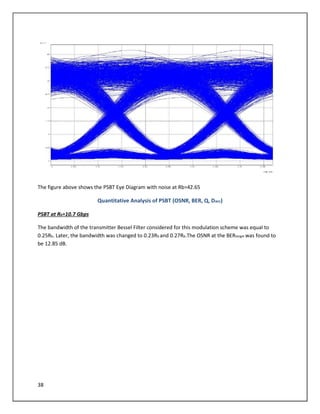
The figure above shows the PSBT Eye Diagram with noise at Rb=42.65
Quantitative Analysis of PSBT (OSNR, BER, Q, Dacc)
PSBT at Rb=10.7 Gbps
The bandwidth of the transmitter Bessel Filter considered for this modulation scheme was equal to
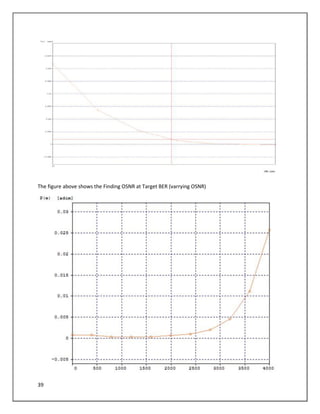
0.25Rb. Later, the bandwidth was changed to 0.23Rb and 0.27Rb.The OSNR at the BERtarget was found to
be 12.85 dB.
39
The figure above shows the Finding OSNR at Target BER (varrying OSNR)
40
The figure above shows the P(e) vs Dacc (with OSNR set)
The figure above shows the Fixed ONSR and finding Dacc giving 2-dB penalty
At, OSNR=12.85 and Dacc varying, found the Dacc = 3475.46 giving 2-dB Penalty.
Using this value of Dacc, the OSNR was found for different bandwidth namely 0.23Rb, 0.25Rb and 0.27Rb.
41
The figure above shows Fixed Dacc and Bw=0.25Rb, finding OSNR at target BER
Using the Dacc but with bandwidth of transmitter filter = 0.25Rb. The final OSNR value is 16.34
The figure above shows the Fixed Dacc and Bw=0.23Rb, finding OSNR at target BER
Using the same Dacc but with bandwidth of transmitter filter = 0.23Rb. The final OSNR value is 16.34.
The figure above shows the Fixed Dacc and Bw=0.27Rb, finding OSNR at target BER
Using the same Dacc but with bandwidth of transmitter filter = 0.27Rb. The final OSNR value is 15.90.
PSBT at Rb=42.65 Gbps
42
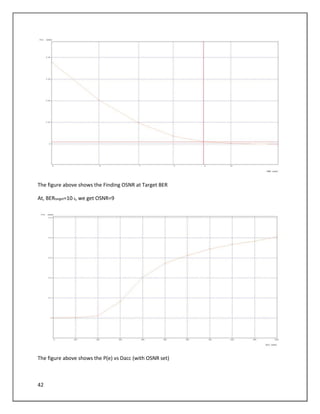
The figure above shows the Finding OSNR at Target BER
At, BERtarget=10-3, we get OSNR=9
The figure above shows the P(e) vs Dacc (with OSNR set)
43
The figure above shows the Fixed ONSR and finding Dacc giving 2-dB penalty
At, OSNR= 9 and Dacc varying, found the Dacc = 199.39 giving 2-dB Penalty.
The figure above shows the Fixed Dacc and finding OSNR at target BER
With Dacc = 199.39, at BERtarget the OSNR is 12.45.
44
The figure above shows Fixed Dacc and Bw=0.23Rb, finding OSNR at target BER
Using the same Dacc but with bandwidth of transmitter filter = 0.23Rb. The final OSNR value is 12.96.
The figure above shows the Fixed Dacc and Bw=0.27Rb, finding OSNR at target BER
Using the same Dacc but with bandwidth of transmitter filter = 0.27Rb. The final OSNR value is 12.36.To
conclude, with the increase in transmitterโ€™s filter bandwidth, the OSNR decreases due to the increase of
the noise power.
45
DPSK
he Differential Phase Shift Keying โ€“ DPSK is a phase modulation where the information is coded in the
difference in phase of the two signals.
Qualitative Analysis of DPSK (spectra and eye diagrams)
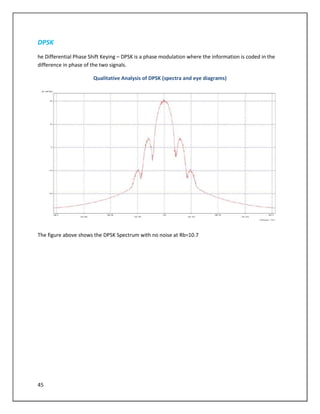
The figure above shows the DPSK Spectrum with no noise at Rb=10.7
46
The figure above shows the DPSK Eye Diagram with no noise at Rb=10.7
The figure above shows the DPSK Spectrum with noise at Rb=10.7
47
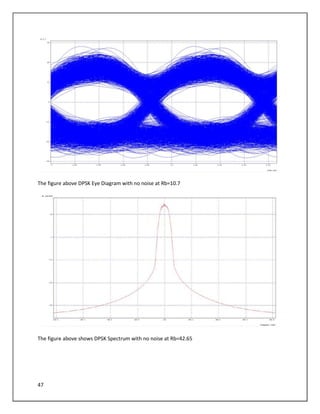
The figure above DPSK Eye Diagram with no noise at Rb=10.7
The figure above shows DPSK Spectrum with no noise at Rb=42.65
48
The figure above shows the DPSK Eye Diagram with no noise at Rb=42.65
The figure above shows the DPSK Spectrum with noise at Rb=42.65
49
The figure above shows the DPSK Eye Diagram with noise at Rb=42.65
Quantitative Analysis of DPSK (OSNR, BER, Q, Dacc)
DPSK at Rb=10.7 Gbps
The figure above shows the Finding OSNR at Target BER
50
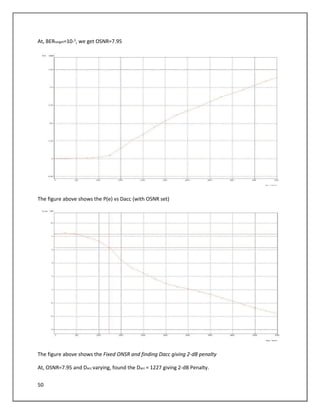
At, BERtarget=10-3
, we get OSNR=7.95
The figure above shows the P(e) vs Dacc (with OSNR set)
The figure above shows the Fixed ONSR and finding Dacc giving 2-dB penalty
At, OSNR=7.95 and Dacc varying, found the Dacc = 1227 giving 2-dB Penalty.
51
The figure above shows the Fixed Dacc and finding OSNR at target BER
With Dacc=1227 , at BERtarget the OSNR is 9.9.
DPSK at Rb=42.65 Gbps
The figure above shows the Finding OSNR at Target BER (varying OSNR)
52
At, BERtarget=10-3, we get OSNR=6.44
The figure above shows the P(e) vs Dacc (with OSNR set)
The figure above shows the Fixed ONSR and finding Dacc giving 2-dB penalty
53
At, OSNR=6.44 and Dacc varying, found the Dacc=64.8, giving 2-dB Penalty.
The figurer above shows the Fixed Dacc and finding OSNR at target BER
With Dacc=64.8, at BERtarget the OSNR is 7.78.
From the experiments it can be concluded that DPSK is more robust and gives less OSNR penalty

Advanc optical Telecommunication

  • 1.
    1 ADVANCED OPTICAL COMMUNICATIONS ProfessorVittorio Curri This report is provided by : Makan Mohammadi Ostadkalayeh S201977
  • 2.
    2 First one itis better to map our solution. in this case we want to check behavior of EDFA in linear and saturation regions. As you can see the system is a multi-channel transmission link working at 32 ๐บ๐‘๐‘Ž๐‘ข๐‘‘. The link must operate at 13๐‘‘๐ต ๐‘‚๐‘†๐‘๐‘… for 10โˆ’3 ๐ต๐ธ๐‘… target with 2 dB margin. The experiment is to find the number of spans satisfying the desired ๐‘‚๐‘†๐‘๐‘… requirements with the system operating in linear/saturation regimes with transparency conditions. linear regime In linear and transparency condition ๐‘‚๐‘†๐‘๐‘… achieves by this formula : ๐‘‚๐‘†๐‘๐‘… = 1 ๐บ โˆ’ 1 ๐‘ƒ ๐‘‡ ๐‘€. 2โ„Ž๐‘“๐‘… ๐‘  ๐‘› ๐‘  This formula is desired OSNR requirement and the minimum number of spans that satisfy the OSNR requirement. Also we know in linear condition, this is sharp that the operation in this regime is dominated by noise that is mainly due to Amplified Stimulated Emission (ASE) but we can imagine the signal power at the amplifier output is proportional to the power at the amplifier input so the output signal power increases linearly with the input signal power. We must find the optimal span number at: ๐‘‚๐‘†๐‘๐‘… = ๐‘‚๐‘†๐‘๐‘… ๐‘‡ + ๐œ‡ = 13 + 2 = 15 The best choice for number of span is ๐‘€ = 62 and also ๐‘‚๐‘†๐‘๐‘… is increasing as the number of spans is increasing, which shows the effect of the multi spans system in improving the performance for long
  • 3.
  • 4.
    4 If we use" ๐‘€ = 62 " each span will be ๐ฟ ๐‘†๐‘๐‘Ž๐‘› = 3000/62 = 48.38๐พ๐‘š . And ๐บ = |๐ด| = ๐‘Ž๐‘ก๐‘ก๐‘’๐‘›๐‘ข๐‘Ž๐‘ก๐‘œ๐‘Ÿ + ๐›ผ ๐‘‘๐ต. ๐ฟ ๐‘ ๐‘๐‘Ž๐‘› = 3 + (0.22 ร— 48.38) = 13.46 ๐‘‘๐ต ๐‘‚๐‘†๐‘๐‘… ๐‘‘๐ต = ๐‘ƒ ๐‘‡ ๐‘‘๐ต โˆ’ ๐‘ƒ ๐‘ ๐‘‘๐ต: ๐‘ค๐‘’ ๐‘๐‘Ž๐‘› ๐‘ ๐‘’๐‘’ ๐‘๐‘’๐‘™๐‘œ๐‘ค ๐‘กโ„Ž๐‘’ ๐‘‚๐‘†๐‘๐‘… ๐‘ฃ๐‘ . ๐‘€ ๐‘๐‘™๐‘œ๐‘ก(๐‘‚๐‘†๐‘๐‘… ๐‘–๐‘  ๐‘Ž๐‘ก ๐‘กโ„Ž๐‘’ ๐‘œ๐‘ข๐‘ก๐‘๐‘ข๐‘ก ๐‘œ๐‘“ ๐‘Ž๐‘š๐‘๐‘™๐‘–๐‘“๐‘–๐‘’๐‘Ÿ ):
  • 5.
    5 First of all,we will look at the noise, since the signal is supposed to be the same at the output of each amplifier due to transparency condition: We can see that the noise power of the amplifier (at ๐ต ๐‘Ž๐‘š๐‘) is increasing at every amplifier, since each amplifier contributes in new noise added to the previous noise, this can explain why the ๐‘‚๐‘†๐‘๐‘… is decreasing.
  • 6.
    6 saturated regime: Now, wewill study the performance of the system in the Saturated Regime, trying to see the difference between saturated and Linear Regime Using the same model. With the same parameters, and assuming that the saturation power is the transmitted power a.plotting the OSNR VS. M and finding the best Following figure show us for ๐‘‚๐‘†๐‘๐‘… = 15 number of span will be ๐‘€ = 19. We can suppose that ๐บ0 = 27๐‘‘๐ต for ๐‘€ = 19, now we must compute d ๐‘ƒ0โˆ’3๐‘‘๐ต : ๐‘ƒ0โˆ’3๐‘‘๐ต = ๐‘ƒ๐‘ก ร— ๐‘๐‘โ„Ž โˆ— (1 โˆ’ ๐ด ๐‘ ) โˆ— log10(e) /(1.44 โˆ— ๐‘™๐‘œ๐‘”(๐ด ๐‘  โˆ— ๐บ0)) = โˆ’0.2802 ๐ด ๐‘‘๐ต = (โˆ’1) ร— (3 + ๐ด๐‘ก๐‘ก๐‘’๐‘›) ; ๐ด๐‘ก๐‘ก๐‘’๐‘›๐‘ข๐‘Ž๐‘ก๐‘–๐‘œ๐‘› ๐‘–๐‘› ๐‘‘๐ต ๐ด ๐‘  = 10(0.1โˆ—๐ด ๐‘‘๐ต) ๐ด๐‘ก๐‘ก๐‘’๐‘›๐‘ข๐‘Ž๐‘ก๐‘–๐‘œ๐‘› ๐‘–๐‘› ๐ฟ๐‘–๐‘›๐‘’๐‘Ž๐‘Ÿ ๐‘†๐‘๐‘Ž๐‘™๐‘’ ๐‘ = 19 ; ๐ด๐‘ก๐‘ก๐‘’๐‘› = (๐›ผ โˆ— ๐ฟ ๐‘ก๐‘œ๐‘ก)/๐‘ Now we chose ๐‘€ = 19 So Attenuation and amplification are constant, letโ€™s see the ๐‘‚๐‘†๐‘๐‘… in this case: As you can see in the figure ๐‘‚๐‘†๐‘๐‘… is decreasing, same as linear regime
  • 7.
    7 And also thisfigure show us the variation of the ๐‘ ๐‘–๐‘”๐‘›๐‘Ž๐‘™ ๐‘๐‘œ๐‘ค๐‘’๐‘Ÿ and the ๐‘›๐‘œ๐‘–๐‘ ๐‘’ ๐‘๐‘œ๐‘ค๐‘’๐‘Ÿ and the ๐‘ก๐‘œ๐‘ก๐‘Ž๐‘™ ๐‘๐‘œ๐‘ค๐‘’๐‘Ÿ to understand how is it decreasing. The total output power of the amplifier is constant and also the signal is decreasing and the noise power is normal increasing, and we can see that the increase in the power of the noise is exactly the decrease in the signal power which says: This is why it is called saturation region, since the output power is not increasing anymore, not like in the โ€œLinear Regimeโ€ were output power is increase at every amplifier. This also can explain why the ๐‘‚๐‘†๐‘๐‘… is decreasing since the noise increasing and the signal power is decreasing, which leads to the normal situation of fraction.
  • 8.
    8 saturated regime withchanging P0-3dB In the Third Part of the report, it was required to redo all what is done above, but with different 3-dB power output, which changes the saturation power, and so the transmitted power will change also. ๐บ0 = 27๐‘‘๐ต, ๐‘ƒ๐‘œ๐‘ข๐‘ก,3๐‘‘๐ต = 1๐‘‘๐ต๐‘š โ†’ ๐‘ƒ๐‘œ๐‘ข๐‘ก,3๐‘‘๐ต = 1.25๐‘š๐‘Š @MATLAB Po_3dB = Pt*Nch*(1-As)*log10(exp(1))/(1.44*log(As*G0)) ; We have amount of Po_3dB and also As, G0, Nch than โ†’ ๐‘ƒ ๐‘‡ = 0.501 ๐‘‘๐ต๐‘š so we repeat all of things that we did above at first we get the number of spans: we can see that at desired ๐‘‚๐‘†๐‘๐‘… we have ๐‘€ = 43. Decreasing the saturation power, will lead to decrease in the gain of the amplifier, so more spans will be needed and this is clear above. Now for ๐‘€ = 43 โˆถ
  • 9.
  • 10.
    10 Looking at theabove graphs qualitatively they have the same response like in the previous part. The output power is constant, as we are starting from saturation, while the signal power is decreasing and the noise power is increasing in the same manner.
  • 11.
    11 (II) Question: OptSim simulator parameters VBSsimulation center frequency: f0= 193 THz VBS simulation bandwidth corresponding to 24 samples per symbol Number of simulated bits: 211 for eye-diagrams and spectra and 217 for error counting For all modulation formats use PRBS generators without precoder also for PSBT and DPSK Optical Field Representation: โ€œDual Polarizationโ€ Rb=10.7 and 42.65 Gbit/s Target BER=10-3 BER evaluation through error counting Transmitter parameters Laser: ideal CW Lorenzian laser emitting 0 dBm, leave default parameters Data source (logical sources-> data source): sequence: random; pseudo random sequence mode: manual; degree: 11, polynomial type: deterministic; polynomial number: 1 Modulation formats IMDD-NRZ: electrical rectangular pulses, shaped using a 5 poles Bessel filter having -3 dB bandwidth equal to to 0.75 Rb IMDD-RZ: electrical RZ rectangular pulses with 50% duty-cycle, shaped using a 5 poles Bessel filter having -3 dB bandwidth equal to 1.3ยทRb PSBT: electrical NRZ rectangular pulses, shaped using a 5 poles Bessel filter having -3 dB bandwidth equal to 0.25 Rb DPSK: electrical NRZ rectangular pulses, shaped using a 5 poles Bessel filter having -3 dB bandwidth equal to Rb External modulation, use a realistic MZ modulator (sin2 model in the OptSim library of components) with extinction ratio 20 dB and without filtering effect. Leave the insertion loss to the default value
  • 12.
    12 In order toideally define the transmitted power PTx = 0 dBm, use a fixed output power EDFA (turn noise off) at the output of the modulator Receiver parameters Rx Optical filter: SuperGaussian 2nd order with Bo=0.33 nm Detection IMDD and PSBT: Photodiode: PIN with 0.60 A/W DPSK: ideal balanced DPSK receiver including the AMZI and the balanced photodetectors (In the Optsim tree of components you can find it under โ€œreceiversโ€ and it is labelled โ€œIdeal balanced 2DPSK receiverโ€) TIA: ideal (transimpedance: 15kฮฉ, noise set to 0 pA/sqrt(Hz) Electrical filter: low-pass Bessel 5 poles with -3 dB bandwidth Be=0.75ยทRb Channel Noisy channel. In this case we consider only the introduction of some ASE noise due to the chain of amplifiers and set the OSNR at the receiver. It is suggested to use the following simulative approach ASE noise generator added to the Tx signal with a combiner. In order to have the required OSNR [dB], set the ASE noise generator to PTx โ€“OSNR-10*log10(Rb) [dB(mW/THz)], where Rb [Tbit/s] is the bit-rate. Dispersive and noisy channel In this case, besides the ASE noise introduction, you are request to test also the presence of some chromatic dispersion. In order to speed-up the analysis it is suggested to emulate the dispersive channel using an ideal fiber grating (under โ€œoptical componentsโ€ in the optsim library tree) For the noise, use the ASE noise generator set as described in previous step. For the emulation of the chromatic dispersion use an ideal fiber grating set to introduce Dacc [ps/nm]. Required analyses Qualitative analyses (to this purpose, simulate only 211 bits, otherwise eye-diagram data files are too large) Verify the eye-diagrams and spectra for every modulation format
  • 13.
    13 Quantitative analyses (tothis purpose, simulate 217 bits) In this case use the โ€œBER counterโ€ component you can find in the โ€œmeasurement components. Be careful to specify the number of samples per symbol and the PRBS degree and polynomial number (11 and 1) you are using at the transmitter side because in order to count the error, the component needs the knowledge of the transmitted sequence. Please, use as autput data only the p(e) that is the evaluated BER. To derive the corresponding Q factor, please, extract BER data and apply the inverse of the relationship BER=1/2ยทerfc(Q/sqrt(2)), remembering that Q_dB=20ยทlog10(Q) Using the noisy channel, for each modulation format, derive through error counting the BER vs. OSNR behavior. Evaluate the target OSNR for the target BER (parametric run varying OSNR). Using the noisy and dispersive channel, for each modulation format, with the OSNR set to the previously calculated value, derive the BER (and Q) vs. Dacc curve (parametric run with OSNR fixed to the target value previously established and Dacc varying in the ideal fiber grating). To define the Dacc range to explore, use the heuristic law Dacc,max=1/10/Rb 2 and do some test on few values up to 2ยท Dacc,max. Then, refine the analysis on a smaller range. Using the noisy and dispersive channel, for the Dacc value giving 2 dB Qpenalty, evaluate the corresponding OSNR penalty. For the PSBT, redo this analysis considering the bandwidth of the Tx filter equal to 0.24ยทRb and 0.26ยทRb . Parametric run with Dacc fixed to the 2-dB Q penalty value and OSNR varying, starting from the OSNR target up to OSNR target + 3 dB, step 0.5 dB. The diagram of our system is below : Qualitative and quantitative analysis of NRZ, RZ, PSBT and DPSK Modulation schemes are shown above at 10.7 Gbps and 42.65 Gbps. The system was composed of a transmitter, which includes Data Source, Pulse Shaping filter, 5 poles Bessel Electronic filter, a Mach Zehnder to apply the modulation on the optical signal and an optical amplifier, the channel with Noise source with a combiner and fibre grating to add chromatic dispersion and the receiver consisting Gaussian Optical Filter, Photodiode (or DPSK balanced receiver for DPSK) trans-impedance amplifier and a Bessel Electronic Filter. By varying the parameters of pulse Shaping and Bessel TX Filter.
  • 14.
    14 NRZ Intensity Modulation DirectDetection: Non-Return to Zero - IMDD NRZ is an Amplitude Modulation Scheme and transmission is only done at high level i.e. 1.The spectra and eye diagrams for this modulation scheme were evaluated at bit rate, Rb equal to 10.7 and 42.65 Gbps bit rates. NRZ modulation was used with the Bessel Filterโ€™s bandwidth equal to 0.75 Rb. Qualitative Analysis of NRZ Modulation (spectra and eye diagrams) The carrier peak at 193 THz characterizes the spectrum. The bandwidth is twice the bit rate as it can be seen: the band is from 193.40 THz to 193.42 THz then about 0.2 THz is 20Gbits/s wide. For the noisy channel, it can be seen that the peaks at the side lobes vanish. Without noise, the eye diagram is opened and thus there is no interference. However, for the noisy channel, the eye diagram has very less opening as can be seen in Figure below The figure above shows NRZ Spectrum without noise at Rb = 10.7 Gbps
  • 15.
    15 The figure aboveshows NRZ Eye-Diagram with no noise at Rb = 10.7 Gbps The figure above shows NRZ Spectrum with Noise at Rb = 10.7 Gbps
  • 16.
    16 The figure aboveshows the NRZ Eye-Diagram with Noise at Rb = 10.7 Gbps The following diagrams show spectra and eye diagrams evaluated at 42.65 Gbps. Both the NRZ spectra in case of ideal and noisy channel are quite identical as can be seen from the following figures. However, eye diagrams show the change of behaviour in both the cases. The figure above shows NRZ Spectrum with no Noise Rb = 42.65 Gbps
  • 17.
    17 The figure aboveshows NRZ Eye Diagram with no Noise at Rb = 42.65 Gbps the figure above shows NRZ Spectrum with Noise at Rb = 42.65 Gbps
  • 18.
    18 The figure aboveshows NRZ Eye Diagram with Noise at Rb = 42.65 Gbps. Quantitative Analysis of NRZ Modulation (BER, OSNR, Q and Dacc) NRZ at Rb=10.7 Gbps The first step was to determine the required OSNR to work at BERtarget = 10-3 working with a noisy but non-dispersive channel. The bandwidth considered for this modulation scheme was equal to 0.75Rb. From the Figure 2-10, it can be noticed that the OSNR at BERtarget equals 10.8. From figure above we can find the OSNR at Target BER For the noisy and dispersive channel, the OSNR was evaluated at the BERtarget and the computed OSNR was set and the accumulated dispersion, Dacc was varied and hence, the amount of dispersion leading to a 2 dB Q function penalty was determined.
  • 19.
    19 From the Figurebelow, it can be noticed that the amount of dispersion giving 2 dB penalty is 1387.88 ps/nm. After getting the value for dispersion, the OSNR was varied again just to compare the 2 dB Q function penalty with the OSNR penalty. The figure above shows the P(e) vs Dacc (with OSNR set) The figure above shows the Fixed ONSR and finding Dacc giving 2-dB penalty The OSNR penalty is given in Figure below. It can be noticed from the Figure below that the required OSNR for noisy and dispersive channel is 13.33. At the end the OSNR penalty was about 2.53dB was found.
  • 20.
    20 The figure aboveshows the Fixed Dacc and finding OSNR at target BER. NRZ at Rb=42.65 Gbps The same procedure was repeated but with bit rate equal to 42.65 Gbps. The figure above shows the Finding OSNR at Target BER. At BERtarget=10-3 found OSNR = 9.
  • 21.
    21 The figure aboveshows P(e) vs Dacc (with OSNR set)
  • 22.
    22 The figure aboveshows the Fixed ONSR and finding Dacc giving 2-dB penalty At, OSNR=9 and Dacc varying, found the Dacc = 82.1 giving 2-dB Penalty. The figure above shows Fixed Dacc and finding OSNR at target BER With Dacc = 82.1, at BERtarget the OSNR is 11.25. It can be seen that with increase in bit rate we get small values of OSNR.
  • 23.
    23 RZ The IMDD RZis very similar to IMDD NRZ except the shape of pulse. When the bit is โ€˜1โ€™ the pulse is at the high level for only half the bit duration and at the low level for the other half. This accounts for the extra spectrum components. This modulation scheme requires a larger band. Qualitative Analysis of RZ Modulation (spectra and eye diagrams) The following figures show the RZ spectra and eye diagram evaluated at 10.7 and 42.65 Gbps. From the Eye Diagram, we can notice that there is no level off at the high level because of the RZ shaping. The figure above shows RZ Spectrum with no noise.
  • 24.
    24 The figure aboveshows RZ Eye Spectrum with no noise.
  • 25.
    25 The figure aboveshows the RZ Spectrum with noise
  • 26.
    26 The figure aboveshows the RZ Eye Spectrum with noise The figure above shows the RZ Spectrum with no noise at Rb=42.65 Gbps
  • 27.
    27 The figure aboveshows RZ Eye Diagram with no noise at Rb=42.65 Gbps The figure above shows RZ Spectrum wih noise at Rb=42.65 Gbps
  • 28.
    28 The figure aboveshows RZ Eye Diagram with noise at Rb=42.65 Gbps Qualitative Analysis of RZ Modulation (OSNR, BER, Q and Dacc) RZ at Rb=10.7 Gbps The bandwidth considered for this modulation scheme was equal to 1.3Rb. At the BERtarget, the OSNR was found to be 9.1 dB. The corresponding OSNR plot is shown in the following figure.
  • 29.
    29 The figure aboveshows the Finding OSNR at Target BER
  • 30.
    30 The figure aboveshows the P(e) vs Dacc (with OSNR set)
  • 31.
    31 The figure aboveshows the Fixed ONSR and finding Dacc giving 2-dB penalty At, OSNR=9 .1 and Dacc varying, found the Dacc = 558 giving 2-dB Penalty. The figure above shows Fixed Dacc and finding OSNR at target BER With Dacc = 558, at BERtarget the OSNR is 10.9.
  • 32.
    32 RZ at Rb=42.65Gbps At the BERtarget, the OSNR was found to be 10.2 dB. The corresponding OSNR plot is shown in the figure below The figure above shows Finding OSNR at Target BER The figure above shows the P(e) vs Dacc (with OSNR set)
  • 33.
    33 The figure aboveshows the Fixed ONSR and finding Dacc giving 2-dB penalty At, OSNR=10.02 and Dacc varying, found the Dacc = 105.05 giving 2-dB Penalty. The figure above shows the Fixed Dacc and finding OSNR at target BER With Dacc =105.05 , at BERtarget the OSNR is 12.94
  • 34.
    34 PSBT The Phase ShapedBinary Transmission modulation is derived from Duo binary modulation. Three signal levels are used +A, 0 and โ€“A. The value of the current bit depends upon the previous bit sent before it. This modulation format requires a narrower spectral occupancy with respect to IMDD NRZ. Regarding the waveforms, we can see the three different signal levels. Qualitative Analysis of PSBT Modulation (spectra and eye diagrams) The figure above shows the PSBT Spectrum with no noise at Rb=10.7
  • 35.
    35 The figure aboveshows PSBT Eye Diagram with no noise at Rb=10.7 The figure above shows the PSBT Spectrum with noise at Rb=10.7
  • 36.
    36 The figure abovePSBT Eye Diagram with noise at Rb=10.7 The figure above shows PSBT Spectrum with no noise at Rb=42.65
  • 37.
    37 The figure aboveshows the PSBT Eye Diagram with no noise at Rb=42.65 the figure above shows the PSBT Spectrum with noise at Rb=42.65
  • 38.
    38 The figure aboveshows the PSBT Eye Diagram with noise at Rb=42.65 Quantitative Analysis of PSBT (OSNR, BER, Q, Dacc) PSBT at Rb=10.7 Gbps The bandwidth of the transmitter Bessel Filter considered for this modulation scheme was equal to 0.25Rb. Later, the bandwidth was changed to 0.23Rb and 0.27Rb.The OSNR at the BERtarget was found to be 12.85 dB.
  • 39.
    39 The figure aboveshows the Finding OSNR at Target BER (varrying OSNR)
  • 40.
    40 The figure aboveshows the P(e) vs Dacc (with OSNR set) The figure above shows the Fixed ONSR and finding Dacc giving 2-dB penalty At, OSNR=12.85 and Dacc varying, found the Dacc = 3475.46 giving 2-dB Penalty. Using this value of Dacc, the OSNR was found for different bandwidth namely 0.23Rb, 0.25Rb and 0.27Rb.
  • 41.
    41 The figure aboveshows Fixed Dacc and Bw=0.25Rb, finding OSNR at target BER Using the Dacc but with bandwidth of transmitter filter = 0.25Rb. The final OSNR value is 16.34 The figure above shows the Fixed Dacc and Bw=0.23Rb, finding OSNR at target BER Using the same Dacc but with bandwidth of transmitter filter = 0.23Rb. The final OSNR value is 16.34. The figure above shows the Fixed Dacc and Bw=0.27Rb, finding OSNR at target BER Using the same Dacc but with bandwidth of transmitter filter = 0.27Rb. The final OSNR value is 15.90. PSBT at Rb=42.65 Gbps
  • 42.
    42 The figure aboveshows the Finding OSNR at Target BER At, BERtarget=10-3, we get OSNR=9 The figure above shows the P(e) vs Dacc (with OSNR set)
  • 43.
    43 The figure aboveshows the Fixed ONSR and finding Dacc giving 2-dB penalty At, OSNR= 9 and Dacc varying, found the Dacc = 199.39 giving 2-dB Penalty. The figure above shows the Fixed Dacc and finding OSNR at target BER With Dacc = 199.39, at BERtarget the OSNR is 12.45.
  • 44.
    44 The figure aboveshows Fixed Dacc and Bw=0.23Rb, finding OSNR at target BER Using the same Dacc but with bandwidth of transmitter filter = 0.23Rb. The final OSNR value is 12.96. The figure above shows the Fixed Dacc and Bw=0.27Rb, finding OSNR at target BER Using the same Dacc but with bandwidth of transmitter filter = 0.27Rb. The final OSNR value is 12.36.To conclude, with the increase in transmitterโ€™s filter bandwidth, the OSNR decreases due to the increase of the noise power.
  • 45.
    45 DPSK he Differential PhaseShift Keying โ€“ DPSK is a phase modulation where the information is coded in the difference in phase of the two signals. Qualitative Analysis of DPSK (spectra and eye diagrams) The figure above shows the DPSK Spectrum with no noise at Rb=10.7
  • 46.
    46 The figure aboveshows the DPSK Eye Diagram with no noise at Rb=10.7 The figure above shows the DPSK Spectrum with noise at Rb=10.7
  • 47.
    47 The figure aboveDPSK Eye Diagram with no noise at Rb=10.7 The figure above shows DPSK Spectrum with no noise at Rb=42.65
  • 48.
    48 The figure aboveshows the DPSK Eye Diagram with no noise at Rb=42.65 The figure above shows the DPSK Spectrum with noise at Rb=42.65
  • 49.
    49 The figure aboveshows the DPSK Eye Diagram with noise at Rb=42.65 Quantitative Analysis of DPSK (OSNR, BER, Q, Dacc) DPSK at Rb=10.7 Gbps The figure above shows the Finding OSNR at Target BER
  • 50.
    50 At, BERtarget=10-3 , weget OSNR=7.95 The figure above shows the P(e) vs Dacc (with OSNR set) The figure above shows the Fixed ONSR and finding Dacc giving 2-dB penalty At, OSNR=7.95 and Dacc varying, found the Dacc = 1227 giving 2-dB Penalty.
  • 51.
    51 The figure aboveshows the Fixed Dacc and finding OSNR at target BER With Dacc=1227 , at BERtarget the OSNR is 9.9. DPSK at Rb=42.65 Gbps The figure above shows the Finding OSNR at Target BER (varying OSNR)
  • 52.
    52 At, BERtarget=10-3, weget OSNR=6.44 The figure above shows the P(e) vs Dacc (with OSNR set) The figure above shows the Fixed ONSR and finding Dacc giving 2-dB penalty
  • 53.
    53 At, OSNR=6.44 andDacc varying, found the Dacc=64.8, giving 2-dB Penalty. The figurer above shows the Fixed Dacc and finding OSNR at target BER With Dacc=64.8, at BERtarget the OSNR is 7.78. From the experiments it can be concluded that DPSK is more robust and gives less OSNR penalty