ADRENERGIC DRUGS
For BSN 1stYear
Dr. Pravin Prasad
2ndYear Resident, MD Clinical Pharmacology
Maharajgunj Medical Campus
14th March, 2017 (Chaitra 1, 2073),Tuesday
We will be discussing….
■ Overview of AdrenergicTransmission
■ Adrenergic receptors
■ Adrenergic Drugs
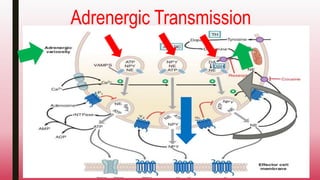
Adrenergic Transmission
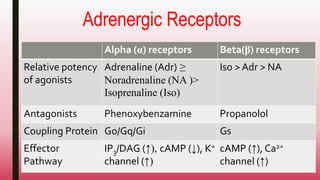
Adrenergic Receptors
Alpha (α) receptors Beta(β) receptors
Relative potency
of agonists
Adrenaline (Adr) ≥
Noradrenaline (NA )>
Isoprenaline (Iso)
Iso > Adr > NA
Antagonists Phenoxybenzamine Propanolol
Coupling Protein Go/Gq/Gi Gs
Effector
Pathway
IP3/DAG (↑), cAMP (↓), K+
channel (↑)
cAMP (↑), Ca2+
channel (↑)
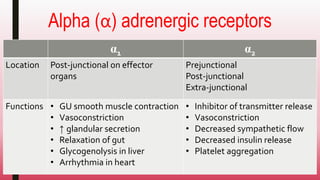
Alpha (α) adrenergic receptors
α1 α2
Location Post-junctional on effector
organs
Prejunctional
Post-junctional
Extra-junctional
Functions • GU smooth muscle contraction
• Vasoconstriction
• ↑ glandular secretion
• Relaxation of gut
• Glycogenolysis in liver
• Arrhythmia in heart
• Inhibitor of transmitter release
• Vasoconstriction
• Decreased sympathetic flow
• Decreased insulin release
• Platelet aggregation
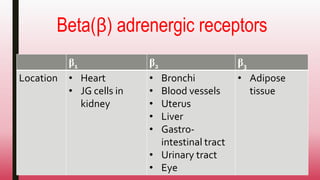
Beta(β) adrenergic receptors
β1 β2 β3
Location • Heart
• JG cells in
kidney
• Bronchi
• Blood vessels
• Uterus
• Liver
• Gastro-
intestinal tract
• Urinary tract
• Eye
• Adipose
tissue
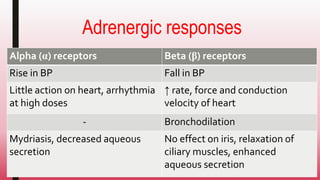
Adrenergic responses
Alpha (α) receptors Beta (β) receptors
Rise in BP Fall in BP
Little action on heart, arrhythmia
at high doses
↑ rate, force and conduction
velocity of heart
- Bronchodilation
Mydriasis, decreased aqueous
secretion
No effect on iris, relaxation of
ciliary muscles, enhanced
aqueous secretion
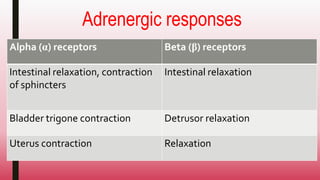
Adrenergic responses
Alpha (α) receptors Beta (β) receptors
Intestinal relaxation, contraction
of sphincters
Intestinal relaxation
Bladder trigone contraction Detrusor relaxation
Uterus contraction Relaxation
Adrenergic responses
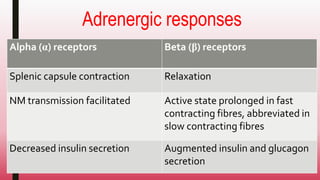
Alpha (α) receptors Beta (β) receptors
Splenic capsule contraction Relaxation
NM transmission facilitated Active state prolonged in fast
contracting fibres, abbreviated in
slow contracting fibres
Decreased insulin secretion Augmented insulin and glucagon
secretion
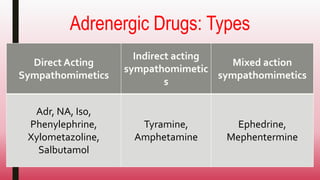
Adrenergic Drugs: Types
Direct Acting
Sympathomimetics
Indirect acting
sympathomimetic
s
Mixed action
sympathomimetics
Adr, NA, Iso,
Phenylephrine,
Xylometazoline,
Salbutamol
Tyramine,
Amphetamine
Ephedrine,
Mephentermine
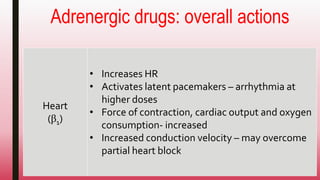
Adrenergic drugs: overall actions
Heart
(β1)
• Increases HR
• Activates latent pacemakers – arrhythmia at
higher doses
• Force of contraction, cardiac output and oxygen
consumption- increased
• Increased conduction velocity – may overcome
partial heart block
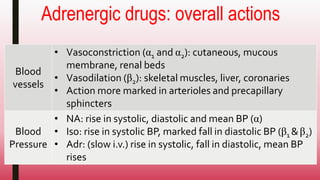
Adrenergic drugs: overall actions
Blood
vessels
• Vasoconstriction (α1 and α2): cutaneous, mucous
membrane, renal beds
• Vasodilation (β2): skeletal muscles, liver, coronaries
• Action more marked in arterioles and precapillary
sphincters
Blood
Pressure
• NA: rise in systolic, diastolic and mean BP (α)
• Iso: rise in systolic BP, marked fall in diastolic BP (β1 &β2)
• Adr: (slow i.v.) rise in systolic, fall in diastolic, mean BP
rises
Adrenergic drugs: overall actions
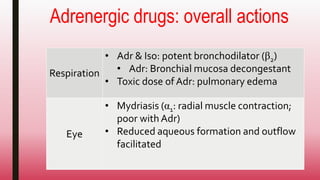
Respiration
• Adr & Iso: potent bronchodilator (β2)
• Adr: Bronchial mucosa decongestant
• Toxic dose of Adr: pulmonary edema
Eye
• Mydriasis (α1: radial muscle contraction;
poor with Adr)
• Reduced aqueous formation and outflow
facilitated
Adrenergic drugs: overall actions
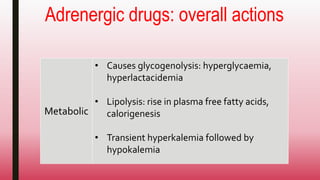
Metabolic
• Causes glycogenolysis: hyperglycaemia,
hyperlactacidemia
• Lipolysis: rise in plasma free fatty acids,
calorigenesis
• Transient hyperkalemia followed by
hypokalemia
Adrenaline: Adverse Effects
■ s.c./i.m. injection:
– Transient restlessness, headache, palpitation,
anxiety, tremor and pallor
■ Marked rise in BP leading to CVA,VT/VF, angina
– Large doses or inadvertent i.v. injection of Adr
myocardial infarction
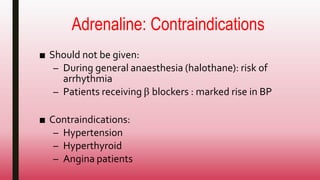
Adrenaline: Contraindications
■ Should not be given:
– During general anaesthesia (halothane): risk of
arrhythmia
– Patients receiving β blockers : marked rise in BP
■ Contraindications:
– Hypertension
– Hyperthyroid
– Angina patients
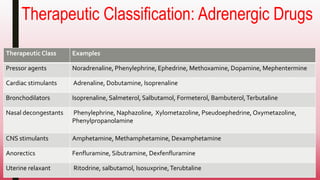
Therapeutic Classification: Adrenergic Drugs
Therapeutic Class Examples
Pressor agents Noradrenaline, Phenylephrine, Ephedrine, Methoxamine, Dopamine, Mephentermine
Cardiac stimulants Adrenaline, Dobutamine, Isoprenaline
Bronchodilators Isoprenaline, Salmeterol, Salbutamol, Formeterol, Bambuterol,Terbutaline
Nasal decongestants Phenylephrine, Naphazoline, Xylometazoline, Pseudoephedrine, Oxymetazoline,
Phenylpropanolamine
CNS stimulants Amphetamine, Methamphetamine, Dexamphetamine
Anorectics Fenfluramine, Sibutramine, Dexfenfluramine
Uterine relaxant Ritodrine, salbutamol, Isosuxprine,Terubtaline
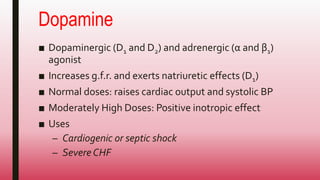
Dopamine
■ Dopaminergic (D1 and D2) and adrenergic (α and β1)
agonist
■ Increases g.f.r. and exerts natriuretic effects (D1)
■ Normal doses: raises cardiac output and systolic BP
■ Moderately High Doses: Positive inotropic effect
■ Uses
– Cardiogenic or septic shock
– Severe CHF
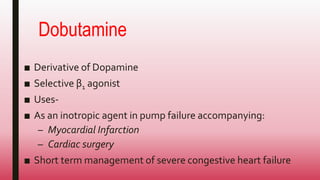
Dobutamine
■ Derivative of Dopamine
■ Selective β1 agonist
■ Uses-
■ As an inotropic agent in pump failure accompanying:
– Myocardial Infarction
– Cardiac surgery
■ Short term management of severe congestive heart failure
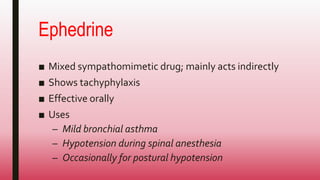
Ephedrine
■ Mixed sympathomimetic drug; mainly acts indirectly
■ Shows tachyphylaxis
■ Effective orally
■ Uses
– Mild bronchial asthma
– Hypotension during spinal anesthesia
– Occasionally for postural hypotension
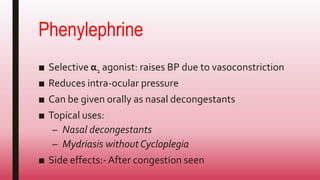
Phenylephrine
■ Selective α1 agonist: raises BP due to vasoconstriction
■ Reduces intra-ocular pressure
■ Can be given orally as nasal decongestants
■ Topical uses:
– Nasal decongestants
– Mydriasis without Cycloplegia
■ Side effects:-After congestion seen
Nasal Decongestants
■ α agonist- topically produces local vasoconstriction
■ Selective α2 agonists (naphazoline, xylometazoline,
oxymetazoline): longer duration of action
■ Lesser after congestion
■ Side Effects:
– Initial stinging,
– Impairs mucosal ciliary function on prolonged use: atrophic
rhinitis and anosmia;
– Systemic side effects: CNS depression, fall in BP
Indications: Vascular Uses
■ Hypotensive states (shock, spinal anaesthesia, hypotensive
drugs)
■ Along with local anaesthetics
■ Control of local bleeding
■ Nasal Decongestants
Indications: Cardiac Use
■ Cardiac arrest (drowning, electrocution, etc.)
– In combination with external cardiac massage
■ Partial or complete A-V block
– Isoprenaline as temporary measure
■ Congestive Heart Failure
Indications
■ Bronchial asthma
■ Allergic disorders (histamine mediated)
■ Mydriatic
– Fundus examination
– Wide angle glaucoma
Indications
■ Insulin Hypoglycaemia
■ Nocturnal enuresis in children and urinary incontinence
– Amphetamine
■ Uterine relaxant
– Ritoridine: to postpone labour
– Isosuxprine: threatened abortion and dysmenorrhoea
Indications: Central Uses
■ Attention Deficit
Hyperkinetic Disorders
– Amphetamine
■ Narcolepsy
– Amphetamine, Modafinil
– Imipramine like drugs
■ Epilepsy
– Amphetamines
■ Parkinsonism
– Amphetamine
■ Obesity
– Considered in severe
obesity
Any queries??
■ Next Topic:
– Overview of Anti-adrenergic drugs
– Drugs used in Glaucoma
■Thank you!!

Adrenergic drugs 2017

  • 1.
    ADRENERGIC DRUGS For BSN1stYear Dr. Pravin Prasad 2ndYear Resident, MD Clinical Pharmacology Maharajgunj Medical Campus 14th March, 2017 (Chaitra 1, 2073),Tuesday
  • 2.
    We will bediscussing…. ■ Overview of AdrenergicTransmission ■ Adrenergic receptors ■ Adrenergic Drugs
  • 3.
  • 4.
    Adrenergic Receptors Alpha (α)receptors Beta(β) receptors Relative potency of agonists Adrenaline (Adr) ≥ Noradrenaline (NA )> Isoprenaline (Iso) Iso > Adr > NA Antagonists Phenoxybenzamine Propanolol Coupling Protein Go/Gq/Gi Gs Effector Pathway IP3/DAG (↑), cAMP (↓), K+ channel (↑) cAMP (↑), Ca2+ channel (↑)
  • 5.
    Alpha (α) adrenergicreceptors α1 α2 Location Post-junctional on effector organs Prejunctional Post-junctional Extra-junctional Functions • GU smooth muscle contraction • Vasoconstriction • ↑ glandular secretion • Relaxation of gut • Glycogenolysis in liver • Arrhythmia in heart • Inhibitor of transmitter release • Vasoconstriction • Decreased sympathetic flow • Decreased insulin release • Platelet aggregation
  • 6.
    Beta(β) adrenergic receptors β1β2 β3 Location • Heart • JG cells in kidney • Bronchi • Blood vessels • Uterus • Liver • Gastro- intestinal tract • Urinary tract • Eye • Adipose tissue
  • 7.
    Adrenergic responses Alpha (α)receptors Beta (β) receptors Rise in BP Fall in BP Little action on heart, arrhythmia at high doses ↑ rate, force and conduction velocity of heart - Bronchodilation Mydriasis, decreased aqueous secretion No effect on iris, relaxation of ciliary muscles, enhanced aqueous secretion
  • 8.
    Adrenergic responses Alpha (α)receptors Beta (β) receptors Intestinal relaxation, contraction of sphincters Intestinal relaxation Bladder trigone contraction Detrusor relaxation Uterus contraction Relaxation
  • 9.
    Adrenergic responses Alpha (α)receptors Beta (β) receptors Splenic capsule contraction Relaxation NM transmission facilitated Active state prolonged in fast contracting fibres, abbreviated in slow contracting fibres Decreased insulin secretion Augmented insulin and glucagon secretion
  • 10.
    Adrenergic Drugs: Types DirectActing Sympathomimetics Indirect acting sympathomimetic s Mixed action sympathomimetics Adr, NA, Iso, Phenylephrine, Xylometazoline, Salbutamol Tyramine, Amphetamine Ephedrine, Mephentermine
  • 11.
    Adrenergic drugs: overallactions Heart (β1) • Increases HR • Activates latent pacemakers – arrhythmia at higher doses • Force of contraction, cardiac output and oxygen consumption- increased • Increased conduction velocity – may overcome partial heart block
  • 12.
    Adrenergic drugs: overallactions Blood vessels • Vasoconstriction (α1 and α2): cutaneous, mucous membrane, renal beds • Vasodilation (β2): skeletal muscles, liver, coronaries • Action more marked in arterioles and precapillary sphincters Blood Pressure • NA: rise in systolic, diastolic and mean BP (α) • Iso: rise in systolic BP, marked fall in diastolic BP (β1 &β2) • Adr: (slow i.v.) rise in systolic, fall in diastolic, mean BP rises
  • 13.
    Adrenergic drugs: overallactions Respiration • Adr & Iso: potent bronchodilator (β2) • Adr: Bronchial mucosa decongestant • Toxic dose of Adr: pulmonary edema Eye • Mydriasis (α1: radial muscle contraction; poor with Adr) • Reduced aqueous formation and outflow facilitated
  • 14.
    Adrenergic drugs: overallactions Metabolic • Causes glycogenolysis: hyperglycaemia, hyperlactacidemia • Lipolysis: rise in plasma free fatty acids, calorigenesis • Transient hyperkalemia followed by hypokalemia
  • 15.
    Adrenaline: Adverse Effects ■s.c./i.m. injection: – Transient restlessness, headache, palpitation, anxiety, tremor and pallor ■ Marked rise in BP leading to CVA,VT/VF, angina – Large doses or inadvertent i.v. injection of Adr myocardial infarction
  • 16.
    Adrenaline: Contraindications ■ Shouldnot be given: – During general anaesthesia (halothane): risk of arrhythmia – Patients receiving β blockers : marked rise in BP ■ Contraindications: – Hypertension – Hyperthyroid – Angina patients
  • 17.
    Therapeutic Classification: AdrenergicDrugs Therapeutic Class Examples Pressor agents Noradrenaline, Phenylephrine, Ephedrine, Methoxamine, Dopamine, Mephentermine Cardiac stimulants Adrenaline, Dobutamine, Isoprenaline Bronchodilators Isoprenaline, Salmeterol, Salbutamol, Formeterol, Bambuterol,Terbutaline Nasal decongestants Phenylephrine, Naphazoline, Xylometazoline, Pseudoephedrine, Oxymetazoline, Phenylpropanolamine CNS stimulants Amphetamine, Methamphetamine, Dexamphetamine Anorectics Fenfluramine, Sibutramine, Dexfenfluramine Uterine relaxant Ritodrine, salbutamol, Isosuxprine,Terubtaline
  • 18.
    Dopamine ■ Dopaminergic (D1and D2) and adrenergic (α and β1) agonist ■ Increases g.f.r. and exerts natriuretic effects (D1) ■ Normal doses: raises cardiac output and systolic BP ■ Moderately High Doses: Positive inotropic effect ■ Uses – Cardiogenic or septic shock – Severe CHF
  • 19.
    Dobutamine ■ Derivative ofDopamine ■ Selective β1 agonist ■ Uses- ■ As an inotropic agent in pump failure accompanying: – Myocardial Infarction – Cardiac surgery ■ Short term management of severe congestive heart failure
  • 20.
    Ephedrine ■ Mixed sympathomimeticdrug; mainly acts indirectly ■ Shows tachyphylaxis ■ Effective orally ■ Uses – Mild bronchial asthma – Hypotension during spinal anesthesia – Occasionally for postural hypotension
  • 21.
    Phenylephrine ■ Selective α1agonist: raises BP due to vasoconstriction ■ Reduces intra-ocular pressure ■ Can be given orally as nasal decongestants ■ Topical uses: – Nasal decongestants – Mydriasis without Cycloplegia ■ Side effects:-After congestion seen
  • 22.
    Nasal Decongestants ■ αagonist- topically produces local vasoconstriction ■ Selective α2 agonists (naphazoline, xylometazoline, oxymetazoline): longer duration of action ■ Lesser after congestion ■ Side Effects: – Initial stinging, – Impairs mucosal ciliary function on prolonged use: atrophic rhinitis and anosmia; – Systemic side effects: CNS depression, fall in BP
  • 23.
    Indications: Vascular Uses ■Hypotensive states (shock, spinal anaesthesia, hypotensive drugs) ■ Along with local anaesthetics ■ Control of local bleeding ■ Nasal Decongestants
  • 24.
    Indications: Cardiac Use ■Cardiac arrest (drowning, electrocution, etc.) – In combination with external cardiac massage ■ Partial or complete A-V block – Isoprenaline as temporary measure ■ Congestive Heart Failure
  • 25.
    Indications ■ Bronchial asthma ■Allergic disorders (histamine mediated) ■ Mydriatic – Fundus examination – Wide angle glaucoma
  • 26.
    Indications ■ Insulin Hypoglycaemia ■Nocturnal enuresis in children and urinary incontinence – Amphetamine ■ Uterine relaxant – Ritoridine: to postpone labour – Isosuxprine: threatened abortion and dysmenorrhoea
  • 27.
    Indications: Central Uses ■Attention Deficit Hyperkinetic Disorders – Amphetamine ■ Narcolepsy – Amphetamine, Modafinil – Imipramine like drugs ■ Epilepsy – Amphetamines ■ Parkinsonism – Amphetamine ■ Obesity – Considered in severe obesity
  • 28.
    Any queries?? ■ NextTopic: – Overview of Anti-adrenergic drugs – Drugs used in Glaucoma ■Thank you!!

Editor's Notes

  • #6 Prejunctional on nerve ending; post-junctional in brain, pancreatic β cells; extra-junctional in some vessels, platelets
  • #19 Normal doses: raises cardiac output and systolic BP Moderately High Doses: Positive inotropic effect (direct β1 and D1 action + that due to NA release)
  • #20 Selective β1 agonist: increased force of cardiac contraction and output
  • #24 Hypotensive states (shock, spinal anaesthesia, hypotensive drugs) Along with volume replacement (neurogenic and haemorrhagic shock) To maintain cerebral perfusion Not to be used in shock with marked vasoconstriction Cardiogenic shock: dopamine/dobutamine preferred Anaphylactic shock: Adrenaline 0.5 mg i.m. stat (benefits bronchospasm and laryngospasm as well) Autonomic neuropathy: oral ephedrine Along with local anaesthetics Infiltration, nerve block, spinal anaesthesia Prolonged duration of anaesthesia, systemic toxicity of local anaesthetics and local bleeding minimised Control of local bleeding Epistaxis, gastric erosions, stress ulcers Nasal Decongestants Common colds, rhinitis, blocked nose Blocked Eustachian tube Cautious use in infants and young children; hypertensive and elderly males
  • #28 Narcolepsy Amphetamine: possibility of development of tolerance, abuse, behavioural abnormalities Modafinil: less dependent potential Imipramine like drugs can be used