Lecture 11: Farm Management
Decisions
1
Farm Management:
• What is ‘farm’?
• A piece of land with a fixed boundary wherein crops
are raised or animals are reared for economic returns.
• What is ‘management’?
• Co-ordination of all the activities in farming from land
preparation to harvesting for realizing sustainable
profits.
• Farm management: It can be defined as a science
dealing with judicious decisions on the use of scarce
farm resources, having alternative uses to obtain the
maximum profit on sustainable basis.
• Or, organization and operation of farms with a view to
make continuous profits.
2
Farmers and decision making:
• Decision-making is central to farm management.
• Each decision has an impact on the farm and on the
farm household.
• Even deciding to do nothing is a decision and has an
impact.
• The more a farmer is aware of the decision-making
processes that affect farm and household, the more
sustainable the enterprise will be and the more
likely it will be profitable and sustainable.
3
Farm Management Decisions
• Farm management seeks to help the farmer in deciding
problems like what to produce, how much to produce, how
to produce & when to buy and sell and in organization and
managerial problems relating to these decisions.
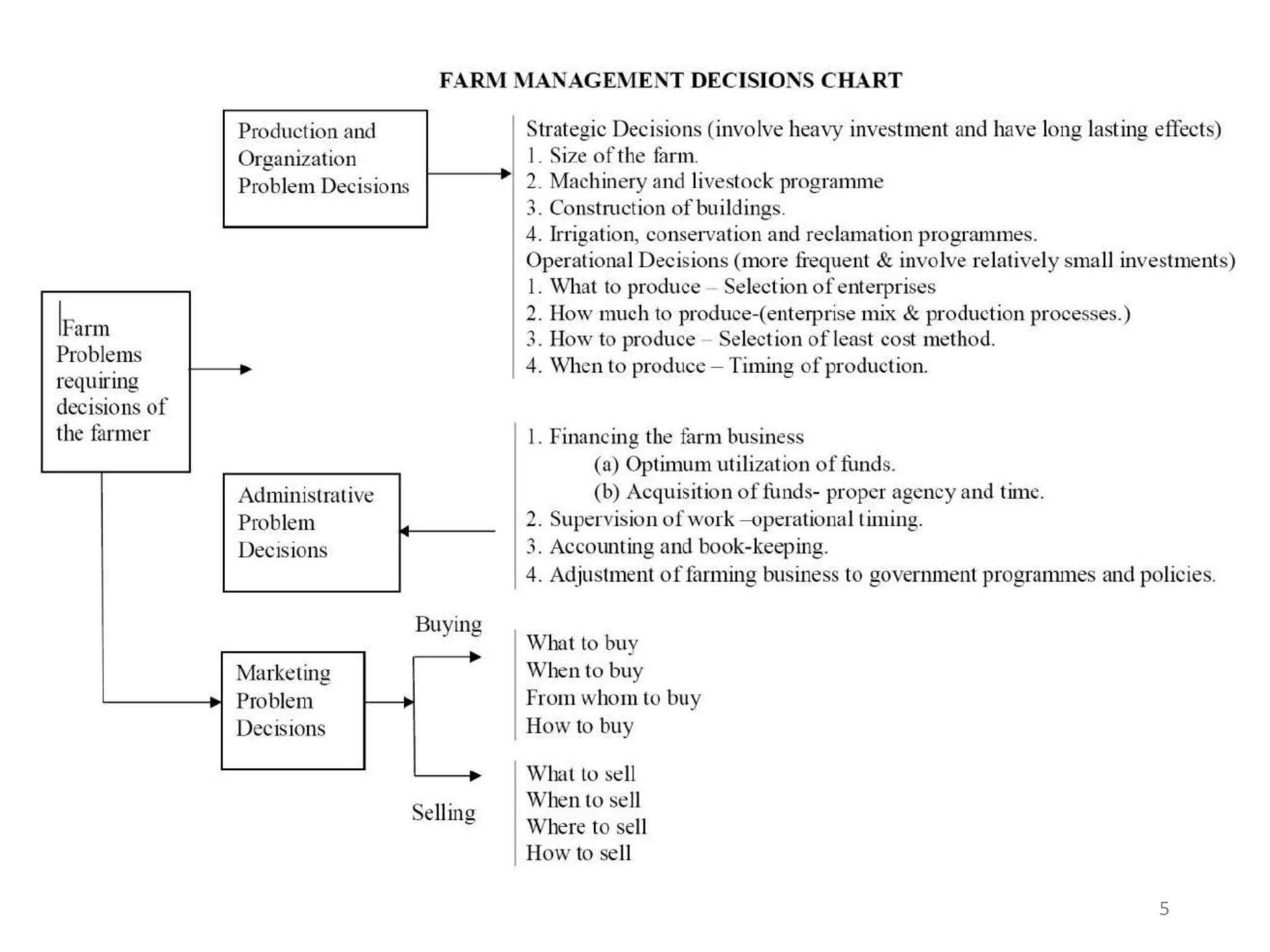
• Farm management decisions can be classified into:
1) organizational management decisions,
2) administrative management decisions and
3) marketing management decisions
4
5
Organizational Management Decisions:
1. Organizational Management Decisions:
1A. Operational management decisions
 involve less investment, made more frequently
 effect is short lived, reversed with less cost
 what, how and how much to produce?
 a.k.a tactical decisions
1B. Strategic management decisions
 involve heavy investment, made less frequently
 effect is long lasting, cannot be reversed
 size of farm, machinery, farm building construction, etc.
 a.k.a basic decisions
6
1A. Operational management decisions
- What to produce?
 to be decided before the season in tune with available resources
 whether to produce crop or to rear livestock or try both
 should aim at profit maximization
- How to produce?
 manner in which the resource combinations are to be made
 should aim at cost minimization
- How much to produce?
 level of inputs to be used
 finding our optimal use of input and output
 MVP = MIC (optimal input level) and MR = MC (optimal output level)
7
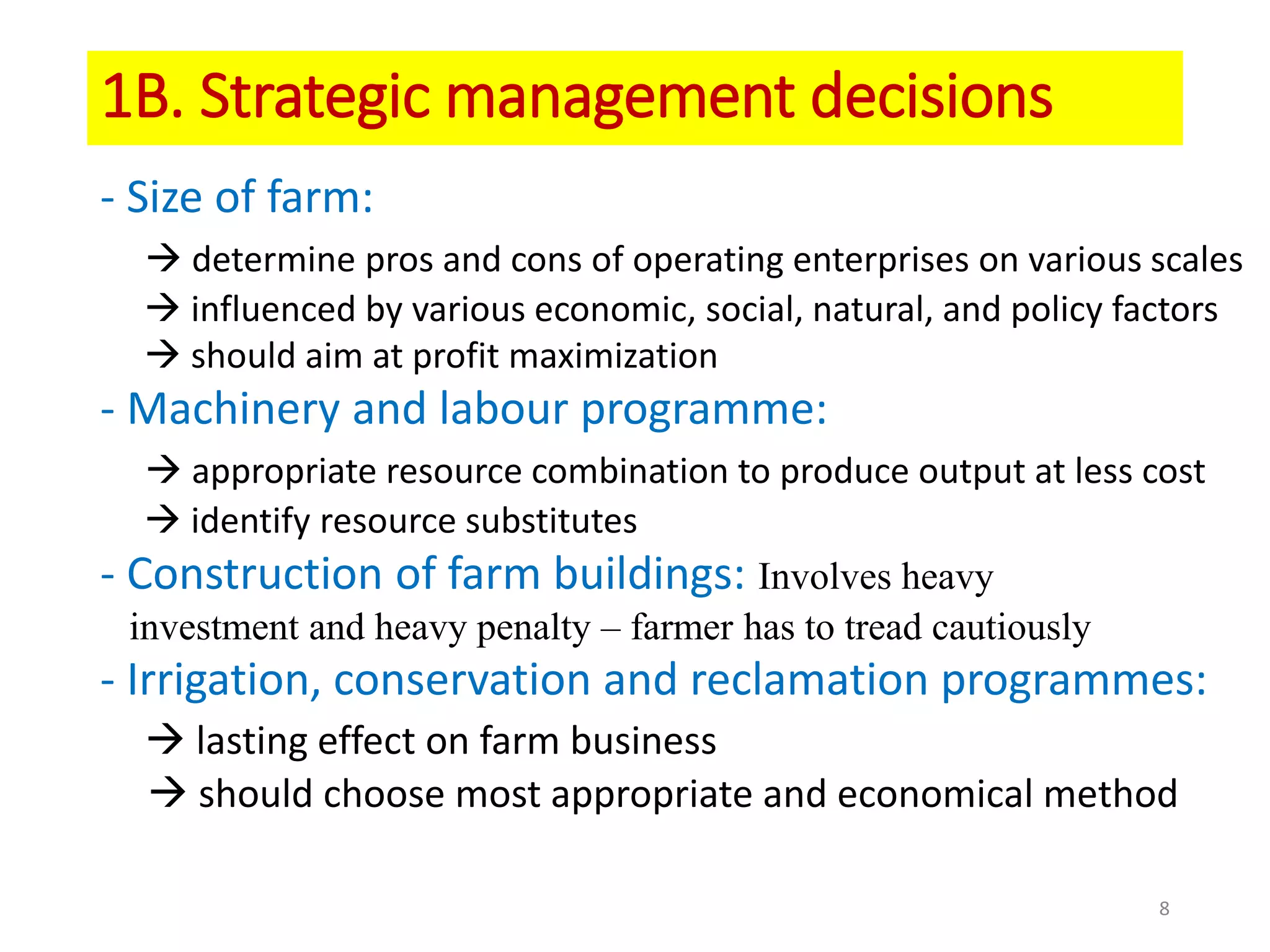
1B. Strategic management decisions
- Size of farm:
 determine pros and cons of operating enterprises on various scales
 influenced by various economic, social, natural, and policy factors
 should aim at profit maximization
- Machinery and labour programme:
 appropriate resource combination to produce output at less cost
 identify resource substitutes
- Construction of farm buildings: Involves heavy
investment and heavy penalty – farmer has to tread cautiously
- Irrigation, conservation and reclamation programmes:
 lasting effect on farm business
 should choose most appropriate and economical method
8
2. Administrative management decisions
- Financing the farm business:
 whom to borrow, when and how??????
- Supervision:
 keep a close watch for getting desired results
- Accounting:
 farm records provide control over the farm business
- Adjusting the farm production programme:
 allocation of farm resources should be consistent
with the government policies.
9
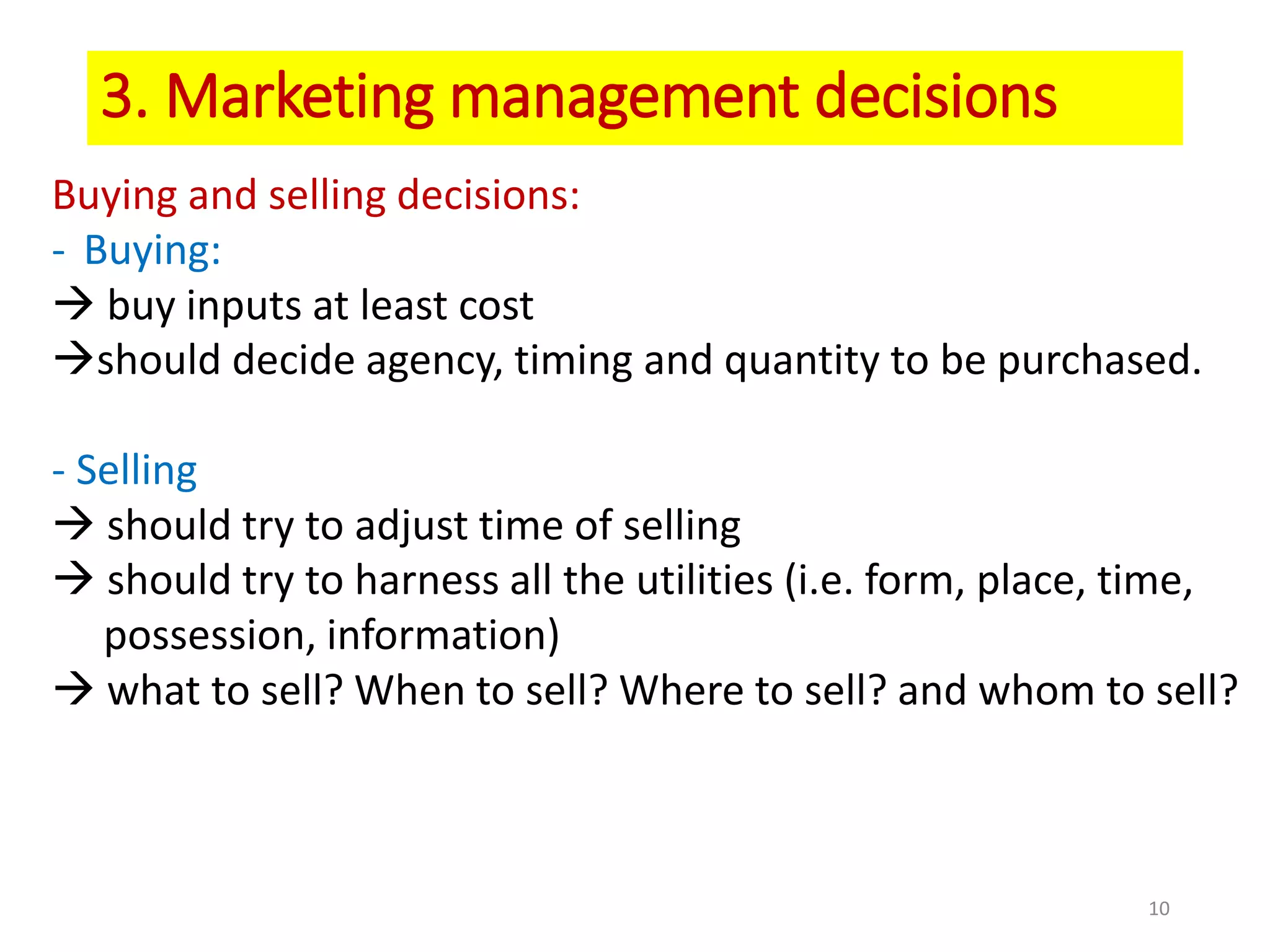
3. Marketing management decisions
Buying and selling decisions:
- Buying:
 buy inputs at least cost
should decide agency, timing and quantity to be purchased.
- Selling
 should try to adjust time of selling
 should try to harness all the utilities (i.e. form, place, time,
possession, information)
 what to sell? When to sell? Where to sell? and whom to sell?
10

Lecture 11 Farm Management Decisions

  • 1.
    Lecture 11: FarmManagement Decisions 1
  • 2.
    Farm Management: • Whatis ‘farm’? • A piece of land with a fixed boundary wherein crops are raised or animals are reared for economic returns. • What is ‘management’? • Co-ordination of all the activities in farming from land preparation to harvesting for realizing sustainable profits. • Farm management: It can be defined as a science dealing with judicious decisions on the use of scarce farm resources, having alternative uses to obtain the maximum profit on sustainable basis. • Or, organization and operation of farms with a view to make continuous profits. 2
  • 3.
    Farmers and decisionmaking: • Decision-making is central to farm management. • Each decision has an impact on the farm and on the farm household. • Even deciding to do nothing is a decision and has an impact. • The more a farmer is aware of the decision-making processes that affect farm and household, the more sustainable the enterprise will be and the more likely it will be profitable and sustainable. 3
  • 4.
    Farm Management Decisions •Farm management seeks to help the farmer in deciding problems like what to produce, how much to produce, how to produce & when to buy and sell and in organization and managerial problems relating to these decisions. • Farm management decisions can be classified into: 1) organizational management decisions, 2) administrative management decisions and 3) marketing management decisions 4
  • 5.
  • 6.
    Organizational Management Decisions: 1.Organizational Management Decisions: 1A. Operational management decisions  involve less investment, made more frequently  effect is short lived, reversed with less cost  what, how and how much to produce?  a.k.a tactical decisions 1B. Strategic management decisions  involve heavy investment, made less frequently  effect is long lasting, cannot be reversed  size of farm, machinery, farm building construction, etc.  a.k.a basic decisions 6
  • 7.
    1A. Operational managementdecisions - What to produce?  to be decided before the season in tune with available resources  whether to produce crop or to rear livestock or try both  should aim at profit maximization - How to produce?  manner in which the resource combinations are to be made  should aim at cost minimization - How much to produce?  level of inputs to be used  finding our optimal use of input and output  MVP = MIC (optimal input level) and MR = MC (optimal output level) 7
  • 8.
    1B. Strategic managementdecisions - Size of farm:  determine pros and cons of operating enterprises on various scales  influenced by various economic, social, natural, and policy factors  should aim at profit maximization - Machinery and labour programme:  appropriate resource combination to produce output at less cost  identify resource substitutes - Construction of farm buildings: Involves heavy investment and heavy penalty – farmer has to tread cautiously - Irrigation, conservation and reclamation programmes:  lasting effect on farm business  should choose most appropriate and economical method 8
  • 9.
    2. Administrative managementdecisions - Financing the farm business:  whom to borrow, when and how?????? - Supervision:  keep a close watch for getting desired results - Accounting:  farm records provide control over the farm business - Adjusting the farm production programme:  allocation of farm resources should be consistent with the government policies. 9
  • 10.
    3. Marketing managementdecisions Buying and selling decisions: - Buying:  buy inputs at least cost should decide agency, timing and quantity to be purchased. - Selling  should try to adjust time of selling  should try to harness all the utilities (i.e. form, place, time, possession, information)  what to sell? When to sell? Where to sell? and whom to sell? 10