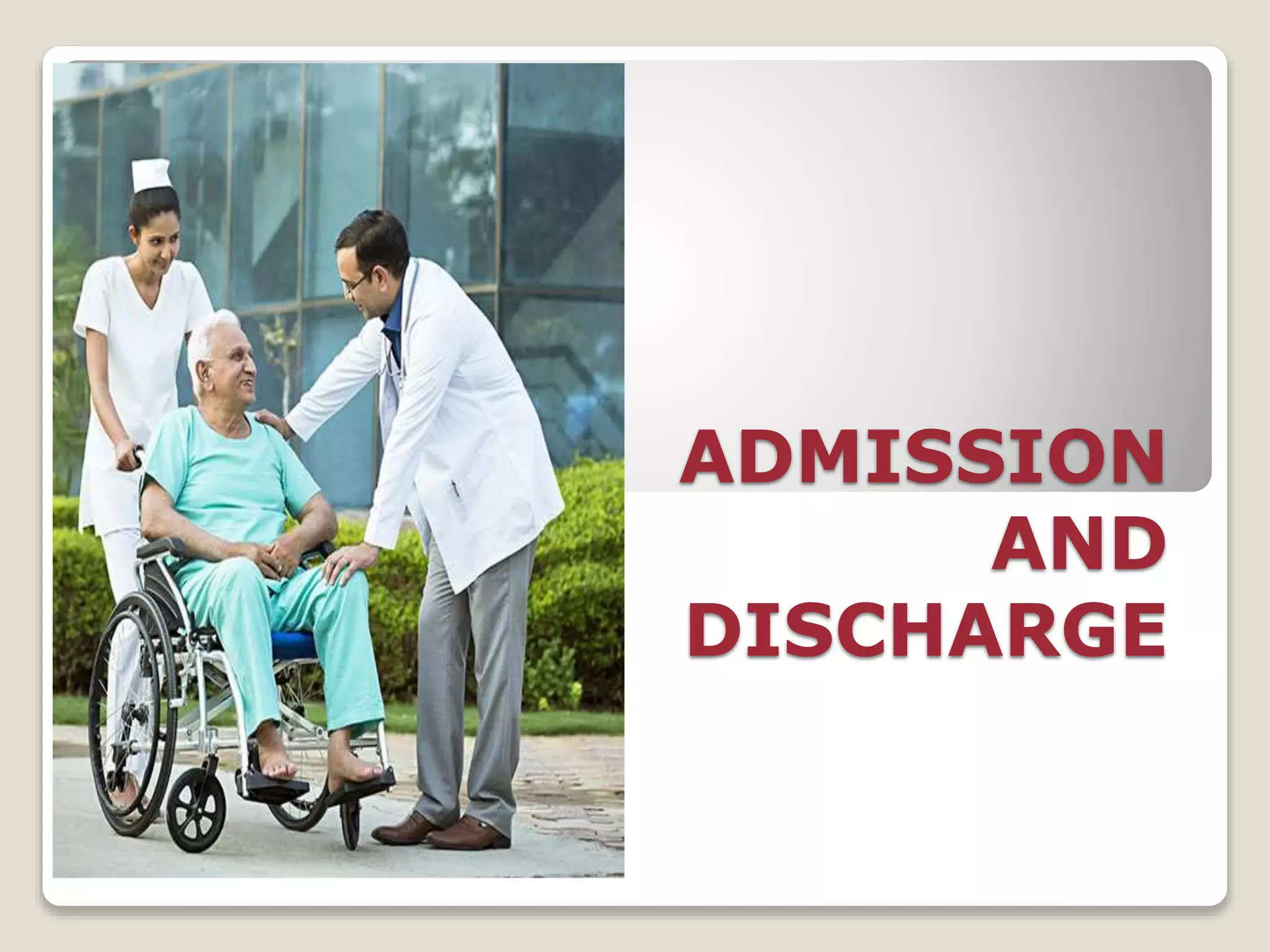
ADMISSION
AND
DISCHARGE
ADMISSION
 Admission is defined as allowing a patient
to stay in hospital for observation,
investigation, treatment and care.
 Admission is the entry of a patient into a
hospital /ward for therapeutic /diagnostic
purposes.
Purposes of admission
 To undergo evaluation & treatment.
 To know what is really happening in
his/her body right oft it to be fixed.
 To provide emotional security to the
newly admitted patient and his
family.
Types of admission
1. Emergency admission
2. Routine admission
 Emergency admission: In this, patients are
admitted in acute conditions requiring immediate
treatment. Examples. Patient with RTA,
Poisoning, burns and cardiac or respiratory
emergency.
 Routine admission: In this, patients are
admitted for investigation, diagnostic and
medical or surgical treatment. Treatment is given
according to patients problem. E.g. Patient with
hypertension, diabetes mellitus etc.
Unit and it’s preparation
 It is a place where the patient is kept
during hospital stay. The admitting
department notifies the unit prior to the
patients arrival so that room /bed can be
prepared.
 Prepare the treatment table.
 Ensure all the equipment are completed.
 Check ventilation.
 Ensure patient privacy
Special consideration
 Admission cause undue stress (emotional
factors as well as financial capability must
given utmost importance)
 Be observant consider the individual
patient needs.
 Provide an individual admission procedure
 Show may efficiency and concerns.
Admission procedure
 Receive the patient.
 Verify the patient data, by checking the
record sheet, chart.
 Introduce immediate personal.
 Assist patient to the treatment area.
 Ask the patient to change clothes into
hospital gown if necessary.
 Perform examination and evaluation
procedure
 Perform examination and evaluation
procedure establish base line values like
vital signs, do history taking, physical
examination etc.
 Coordinate with the physician and carry
out initial orders.
 Give the treatment and instructions as
need.
 Orientation to the patient and relatives.
 The equipment /instruments.
 Use of call system and telephone.
 Treatment schedule.
 Visitors timings.
 Other health care team members.
 Policy and rules and regulations.
 Care of patients valuable etc.
Record & Report
 Admission Book
 Preparation of Paper
 Drug Book
 Diet Book
 HMIS Entry
 Cost List
Medico – Legal issues
 Medico-legal cases (MLC) are an integral
part of medical practice that is frequently
encountered by Medical Officers.
 Proper handling and accurate
documentation of these cases is of prime
importance to avoid legal complications
and to ensure that the Next of Kin (NOK)
receive the entitled benefits.
Definition
MLC is defined as “any case of injury or
ailment where, the attending doctor after
history taking and clinical examination,
considers that investigations by law
enforcement agencies (and also superior
military authorities) are warranted to
ascertain circumstances and fix
responsibility regarding the said injury or
ailment according to the law”.
Examples of MLCs
 Accidents like Road Traffic Accidents
 Cases of trauma with suspicion of foul
play (d) Electrical injuries
 Poisoning, Alcohol Intoxication
 Burns and Scalds
 Sexual Offences
 Attempted suicide
Role and Responsibilities of Nurse
in admission procedure
 Nurse should deal every effort to be friendly
and courteous with the patient and family
members.
 Make proper observation of patients condition
 Orient patient and relatives regarding
hospital polices.
 Deal with patient carefully who is suffering
from communicable disease or illness. Isolate
if necessary.
 Patients valuables and clothes should be
handed over to relatives with proper
recording.
DISCHARGE
Discharge Procedure
 The patient, the family, medical staff,
nursing staff, social worker, dietician all
work together to coordinate the
discharge.
 The doctor plans the discharge with the
patient and leaves a written order on the
patient’s chart.
Introduction
 The patient may have concerns regarding
managing own care at home.
 Provisions such as home health care may
be needed, as ordered.
 Assessment needs to be done as to what
help the patient will need at home.
 Discharge planning involves the entire
healthcare team.
Definition
“Discharge of patient from the hospital
means, reliving a person from hospital
setting, who admitted as an inpatient in
that hospital”.
Types of Discharge
1. PLANNED DISCHARGE: Patient
completes the initial, actual
management in the hospital and now he
or she need not to be under direct
supervision of that hospital.
2. DAMA/LAMA: Discharge/Leave Against
Medical Advice.
3. TRANSFER: Transfer to other unit or
hospital.
4. ABSCOND: Abscond from Hospital
5. REFFERAL : Referred for further
management
Consent for DAMA
I am leaving the hospital ward against medical
advice. Doctor explained me about my disease
condition and ill effects of discharge against
medical advice. Doctors and Nursing staffs will
not be responsible for any ill effects happening
after my departure”.
Name of the patient / relative
Relation
Signature
Date
Time
Discharge planning
1. Nurses play an important role in
discharge planning in the hospital.
2. Continuity of care is important.
3. To achieve continuity of care, nurses use
critical thinking skills and apply the
nursing process.
4. Discharge planning is a centralized,
coordinated, interdisciplinary process
ESSENTIALS OF PLANNED
DISCHARGE
1. Written order by doctor.
2. Discharge card.
3. Informing other departments.
4. Check payment of the bills.
5. Hospital glossaries taken back.
6. Returning of the personal belongings.
7. Arrangement for transport.
8. Documentation.
Steps involved in the Discharge
Planning
1. Evaluation of the patient by qualified
personnel.
2. Discussion with the patient or his relatives.
3. Planning for homecoming or transfer to
other place.
4. Determining if caregiver training or for
other support.
5. Referrals to home care agency or
appropriate support.
6. Arranging for follow-up appointments or
tests.
Nurses Responsibility in Discharge
PREPARATION FOR DISCHARGE
 Planning in the beginning.
 Plan for rehabilitation and follow-up
need.
 Teach nursing procedures to be
continued at home, get it’s practice
done.
 Arrangement for transport.
Nurses Responsibility in Discharge
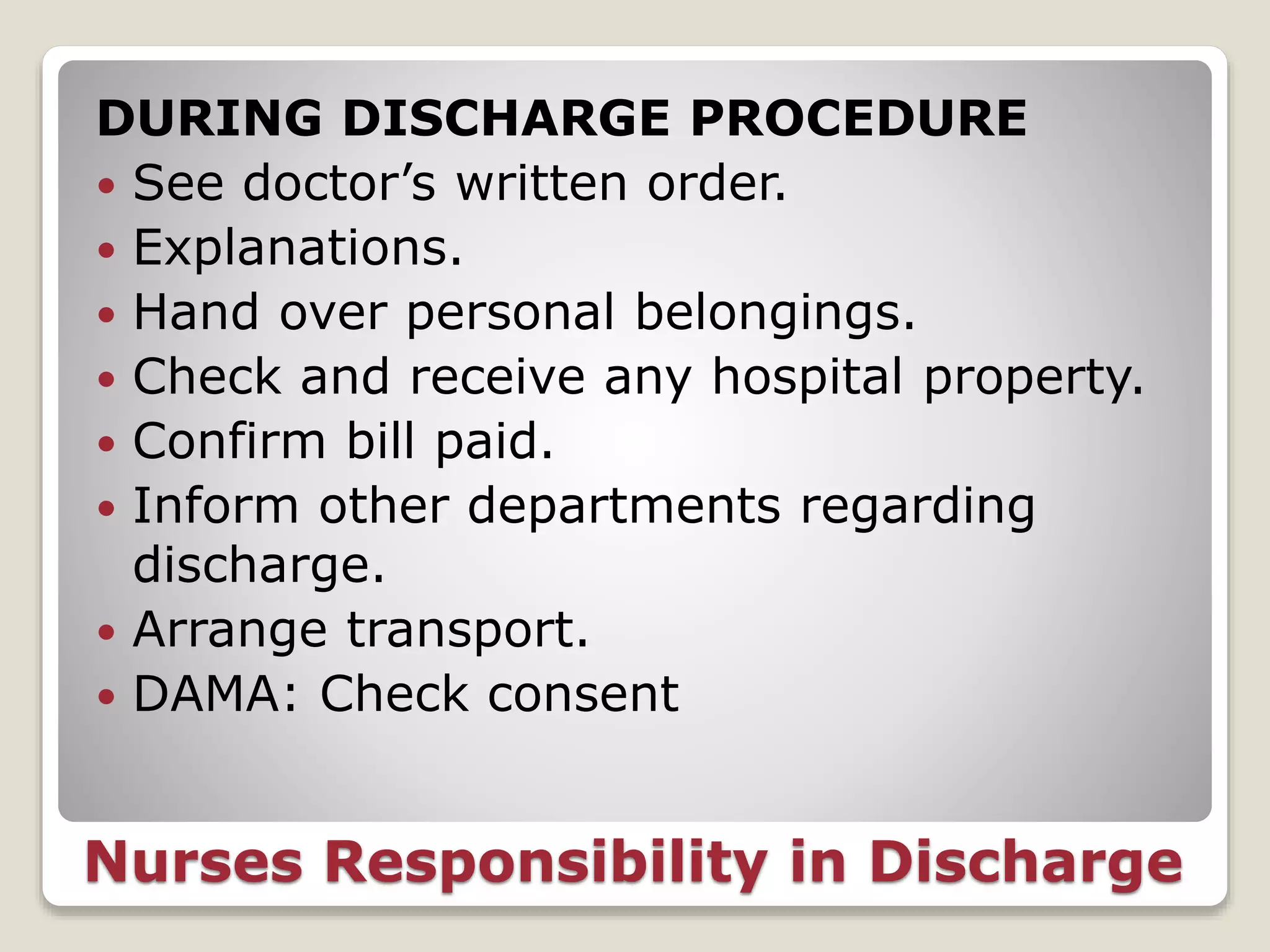
DURING DISCHARGE PROCEDURE
 See doctor’s written order.
 Explanations.
 Hand over personal belongings.
 Check and receive any hospital property.
 Confirm bill paid.
 Inform other departments regarding
discharge.
 Arrange transport.
 DAMA: Check consent
Nurses Responsibility in Discharge
AFTER DISCHARGE
 Documentation.
 Care of patient’s room and articles.
Nurses responsibility in MLC
Discharge
 Check for medico legal history.
 Notify medical officer in charge.
 Abscond cases immediately contact
medical officer in charge.
 Maintain all documents in a proper
manner.
 Take in written handing over and taking of
articles.
 Never discharge patient without written
order by physician.
THANKYOU

ADM AND DISCHARGE.pptx

  • 1.
  • 2.
  • 3.
     Admission isdefined as allowing a patient to stay in hospital for observation, investigation, treatment and care.  Admission is the entry of a patient into a hospital /ward for therapeutic /diagnostic purposes.
  • 4.
    Purposes of admission To undergo evaluation & treatment.  To know what is really happening in his/her body right oft it to be fixed.  To provide emotional security to the newly admitted patient and his family.
  • 5.
    Types of admission 1.Emergency admission 2. Routine admission  Emergency admission: In this, patients are admitted in acute conditions requiring immediate treatment. Examples. Patient with RTA, Poisoning, burns and cardiac or respiratory emergency.  Routine admission: In this, patients are admitted for investigation, diagnostic and medical or surgical treatment. Treatment is given according to patients problem. E.g. Patient with hypertension, diabetes mellitus etc.
  • 6.
    Unit and it’spreparation  It is a place where the patient is kept during hospital stay. The admitting department notifies the unit prior to the patients arrival so that room /bed can be prepared.  Prepare the treatment table.  Ensure all the equipment are completed.  Check ventilation.  Ensure patient privacy
  • 7.
    Special consideration  Admissioncause undue stress (emotional factors as well as financial capability must given utmost importance)  Be observant consider the individual patient needs.  Provide an individual admission procedure  Show may efficiency and concerns.
  • 8.
    Admission procedure  Receivethe patient.  Verify the patient data, by checking the record sheet, chart.  Introduce immediate personal.  Assist patient to the treatment area.  Ask the patient to change clothes into hospital gown if necessary.
  • 9.
     Perform examinationand evaluation procedure  Perform examination and evaluation procedure establish base line values like vital signs, do history taking, physical examination etc.  Coordinate with the physician and carry out initial orders.  Give the treatment and instructions as need.
  • 10.
     Orientation tothe patient and relatives.  The equipment /instruments.  Use of call system and telephone.  Treatment schedule.  Visitors timings.  Other health care team members.  Policy and rules and regulations.  Care of patients valuable etc.
  • 11.
    Record & Report Admission Book  Preparation of Paper  Drug Book  Diet Book  HMIS Entry  Cost List
  • 12.
    Medico – Legalissues  Medico-legal cases (MLC) are an integral part of medical practice that is frequently encountered by Medical Officers.  Proper handling and accurate documentation of these cases is of prime importance to avoid legal complications and to ensure that the Next of Kin (NOK) receive the entitled benefits.
  • 13.
    Definition MLC is definedas “any case of injury or ailment where, the attending doctor after history taking and clinical examination, considers that investigations by law enforcement agencies (and also superior military authorities) are warranted to ascertain circumstances and fix responsibility regarding the said injury or ailment according to the law”.
  • 14.
    Examples of MLCs Accidents like Road Traffic Accidents  Cases of trauma with suspicion of foul play (d) Electrical injuries  Poisoning, Alcohol Intoxication  Burns and Scalds  Sexual Offences  Attempted suicide
  • 15.
    Role and Responsibilitiesof Nurse in admission procedure  Nurse should deal every effort to be friendly and courteous with the patient and family members.  Make proper observation of patients condition  Orient patient and relatives regarding hospital polices.  Deal with patient carefully who is suffering from communicable disease or illness. Isolate if necessary.  Patients valuables and clothes should be handed over to relatives with proper recording.
  • 16.
  • 17.
    Discharge Procedure  Thepatient, the family, medical staff, nursing staff, social worker, dietician all work together to coordinate the discharge.  The doctor plans the discharge with the patient and leaves a written order on the patient’s chart.
  • 18.
    Introduction  The patientmay have concerns regarding managing own care at home.  Provisions such as home health care may be needed, as ordered.  Assessment needs to be done as to what help the patient will need at home.  Discharge planning involves the entire healthcare team.
  • 19.
    Definition “Discharge of patientfrom the hospital means, reliving a person from hospital setting, who admitted as an inpatient in that hospital”.
  • 20.
    Types of Discharge 1.PLANNED DISCHARGE: Patient completes the initial, actual management in the hospital and now he or she need not to be under direct supervision of that hospital. 2. DAMA/LAMA: Discharge/Leave Against Medical Advice. 3. TRANSFER: Transfer to other unit or hospital. 4. ABSCOND: Abscond from Hospital 5. REFFERAL : Referred for further management
  • 21.
    Consent for DAMA Iam leaving the hospital ward against medical advice. Doctor explained me about my disease condition and ill effects of discharge against medical advice. Doctors and Nursing staffs will not be responsible for any ill effects happening after my departure”. Name of the patient / relative Relation Signature Date Time
  • 22.
    Discharge planning 1. Nursesplay an important role in discharge planning in the hospital. 2. Continuity of care is important. 3. To achieve continuity of care, nurses use critical thinking skills and apply the nursing process. 4. Discharge planning is a centralized, coordinated, interdisciplinary process
  • 23.
    ESSENTIALS OF PLANNED DISCHARGE 1.Written order by doctor. 2. Discharge card. 3. Informing other departments. 4. Check payment of the bills. 5. Hospital glossaries taken back. 6. Returning of the personal belongings. 7. Arrangement for transport. 8. Documentation.
  • 24.
    Steps involved inthe Discharge Planning 1. Evaluation of the patient by qualified personnel. 2. Discussion with the patient or his relatives. 3. Planning for homecoming or transfer to other place. 4. Determining if caregiver training or for other support. 5. Referrals to home care agency or appropriate support. 6. Arranging for follow-up appointments or tests.
  • 25.
    Nurses Responsibility inDischarge PREPARATION FOR DISCHARGE  Planning in the beginning.  Plan for rehabilitation and follow-up need.  Teach nursing procedures to be continued at home, get it’s practice done.  Arrangement for transport.
  • 26.
    Nurses Responsibility inDischarge DURING DISCHARGE PROCEDURE  See doctor’s written order.  Explanations.  Hand over personal belongings.  Check and receive any hospital property.  Confirm bill paid.  Inform other departments regarding discharge.  Arrange transport.  DAMA: Check consent
  • 27.
    Nurses Responsibility inDischarge AFTER DISCHARGE  Documentation.  Care of patient’s room and articles.
  • 28.
    Nurses responsibility inMLC Discharge  Check for medico legal history.  Notify medical officer in charge.  Abscond cases immediately contact medical officer in charge.  Maintain all documents in a proper manner.  Take in written handing over and taking of articles.  Never discharge patient without written order by physician.
  • 29.