GOVERNMENT NURSING
COLLEGEHALDWANI
Submitted By
SATISH
Louthani
Bsc Nursing 1st
Semester GNC
Haldwani
Skill presentation
DISCHARGE PLANNING
Submitted T
o
Miss.Geeta Arya
Ma’am Tutor
GNC Haldwani
DISCHARGE
PROCEDURE
CONTENT :
-
• Introduction
• Defilation
• Objective
• Types of discharge
• Discharge planning
• Discharge procedure
• Purpose
• Reason for discharge
• Equipment
• Departments to be informed
• preliminary assessment
• Procedure
• After discharge
• Documentation
• Role and responsibilities of the
nurse
INTRODUCTIO
N
•Hospital discharge corresponds the point at
which
impatient hospital care ends with ongoing care
transferred to other primary ,common domestic
environment . Indicating this , hospital discharge
is not an end point, but rather One of multiple
transitions within the patient ‘s health care
journey
•Discharge of a patient means departure of a
patient
from the hospital . It is also known as
dismissal of patient from the hospital
DEFINITION
OBJECTIVE
•T
o complete obligation to hospital .
•T
o ensure proper medical care after discharge.
•T
o motivate the patient and relatives.
•T
o promote independence and self reliance
throughout illness.
•T
o promote good public relations.
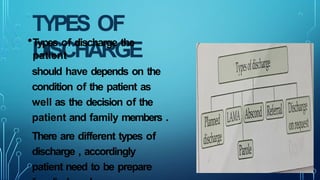
TYPES OF
DISCHARGE
•Types of discharge the
patient
should have depends on the
condition of the patient as
well as the decision of the
patient and family members .
There are different types of
discharge , accordingly
patient need to be prepare
•Planned discharge – Planned discharge means patient
has completed the intial and actual management of
disease in the hospital . Now patient does not need
the direct supervision . Planned discharge is done
when the patient’s condition stabilizer and patient is
ready to go to home . The decision of planned
discharge is taken by the attending physician or the
consultant.
•Abscond – Absconding – patient leaving the
ward/ hospital without permission.
•Leave against Medical Request (LAMA) - This is also known
as discharge against
medical advice (DAMA)
•In case of LAMA , doctor clearly explained the patient and family
members that taking the patient from the hospital may impose risk to
the life of the patient , but still patient on patient’s family want to
take the patient to some other hospital or to the home.
•In case of LAMA patient or patient’s relative will sign a declaration
from saying that the risks and consequences of taking the patient
from the hospital were informed to the patient or family.
•Discharge summary will be provide by the hospital.
•Parole – Parole is used in psychiatric hospitals .The patient can
be
sent to home for 2-3 or 4 days by the approval of psychiatrist
incharge . If patient does not return after the parole , the
discharge process should be done according to the hospital
protocol and policy.
•Referral – Referral means shift the patient to other units or to
the hospital for further management.
•Discharge on request – In this type of discharge ,treatment is
not complete, but by taking the patient out of hospital, there is
no immediate danger to the life of the patient.
DISCHARGE
PLANNING
•The patient , the patient’s family members, medical staff,
social
worker, dietician all work together to coordinate the
discharge The doctor plans the discharge with the patient
and leaves a written order on the patient’s chart.
• The discharge planning should be ideal . Involve the patient
and the family members in the discharge planning of the
patient . The pneumonic that used to described the discharge
planning is IDEAL.
•The IDEAL discharge planning approach focus on the key
points
of involving the patient and the family members in
discharge process .
•IDEAL
•I – Include
•D- Discuss
•E – Educate
•A – Assess
•L - Listen
•Include – Include the patient and the family members in
the
process of discharge planning Following points need to
be considered .
Always include the patient and the family members
in group meetings about the discharge.
Recognize the family members who will provide care to
the patient at home. Include them in the conversations.
•Discuss – Five main area to avoid problems at home need
to discuss with patient and the family members. It
include:
1. Explain what life at home , will be like home
eat , and the activities to do or not to do.
2. Discuss the medications, purposes of each medication, how much to
take
,how to take and the side effects of each medications.
3. Discuss the warning signs . Discuss with patient and the family
members
, how to identify the warning signs or potential problems . Instruct to
write down the name as contact information of someone to call if there
is a problem .
Explain test results to the patient and family . If the test results are not a
available at time of discharge, let the patient and his / her family
members must know when it will be available.
Discuss regarding the follow- up visit . Offer to make follow –
up appointment for the patient.
•Educate – Educate the patient and the family members in
simple language about the condition of the patient .
Education regarding the diet , exercise and medications
should be given . Also educate regarding the changes that
may be needed at home like side rails for elderly patients or
anti skid mat in washroom to prevent the accidents.
•Assess – Asses how well doctors and nurses has explained
the diagnosis, condition , and the steps in the patient’s care
to the patient and the family members and use teach back
method to confirm.
•Listen - Listen to the patient and his/her families
goals preferences , observations, and concerns.
DISCHARGE
PROCEDURE
The discharge procedure typically involves
finalizing paperwork , setting any outstanding
bills , providing
post-care instructions and arranging transportation for
the patient leaving the hospital or healthcare facility .
PURPOSE
S
•T
o ensure continuity of care to patient after discharge
•T
o assist patient to complete hospital formalities before
returning home.
•T
o assist patient to return to a state of optimal
independent living.
•T
o assist the patient in discharge process.
•T
o acknowledge patients right in
deciding to leave hospital.
REASON FOR DISCHARGE
•Cured
•Transfer to other hospital
•Discharge at request
•Discharge against medical
advice
•Death
DEPARTMENT TO BE
INFORMED
•Drug return to pharmacy
department
•Diet cancellation
•Oxygen/ ventilator charges
summary
•Accounts department
•Billing section
PRELIMINAR
Y
ASSESSMENT
•Check doctor’s written orders for discharge
•Inform patient and relatives about discharge
•Document relevant discharge information
• Make sure all the fees are included such as special
investigation, special matters or devices, doctors or
surgeon’s fees and narcotic drug used ( if any)
•Obtain discharge prescription after retaining the medicines to be
continued for that day and after discharge . Send all other
medicines for refunding ( including ward replacement )
•Send chart to billing section with relevant information
•One bill is ready and chart is received back in ward , ensure that
bill is settled. Check the cashier’s signature in the discharge bill
•Help the patient to obtain discharge summary , medical
certificate and drugs
•Ensure that patient is instructed regarding medication follow
up, outpatient visit etc.
•Accompany the patient up to transport near exit gate.
PROCEDUR
E
•Before the day of discharge , inform the patient’s family of
the time and date of discharge
•Obtain a written discharge order from the physician . If the
patient discharge himself against medical advice , obtain
the appropriate form
•If the patient requires home medical care, confirm
arrangements with the appropriate facility department or
community agency
•On the day of discharge , review the patient’s discharge care
plan ( initiated on admission and modified during his
hospitalization) with the patient and his family . List
prescribed drugs on the patient instruction sheet along with
the dosage, prescribed time schedule , and adverse reactions
that he should report to the physician . Ensure that the drug
schedule is consistent with the patient’s lifestyle to prevent
improper administrative and to promote patient compliance
•Review procedures the patient or his family will perform
at home. If necessary, demonstrate these procedures,
provide written instructions , and check performance
with a return demonstration
•List dietary and activity instructions , if applicable , on the
patient instruction sheet and review the reason for them.
•Check with the physician about the patient’s next office
appointment
; if the physician hasn’t yet done so, inform the patient of the
date , time and location
•Retrieve the patient’s valuables from the facility’s safe and
review each item with him. The obtain the patient’s signature to
verify receipt of his valuables
•Obtain from the pharmacy any drugs the patient brought with
him
•If appropriate, take and record the patient’s vital signs on
the discharge summary form. Notify the physician if any
signs are abnormal such as an elevated temperature
•Help the patient get dressed if necessary
•Collect the patient’s personal belongings from his room
•After checking the room for misplaced belongings , help
the patient into the wheelchair, and escort him to the
exit; if the patient is leaving by ambulance, help him
onto the litter
•After the patient has left the area, strip the bed linens and
notify the housekeeping staff that the room is ready for
terminal cleaning .
AFTER
DISCHARGE
•Record time date and condition of the patient at departure.
•Send chart to medical record department and inform to
the concern departments
•After the patient has gone , the bed should be
washed , blankets kept in sunlight , Mackintosh
washed and dried.
•The room and all utensils should be cleaned and kept ready
for next use.
•In case of infected cases, utensils should be disinfected and
the
cleaned . The linen should be disinfectant and then send
to laundry
•When discharging the medicolegal cases , the patient’s
dead body should be handed over to the
police station should be informed about the patient’s
discharge/ death
•Patient or dead body is handed over to the police and asks
the police to sign with date and time
DOCUMENTATIO
N
•Record the time and date of recharge
•The patient’s physical condition
•Special dietary or activity instructions
•The type and frequency of home care procedures
•The patient’s drug regimen
•The dates of follow – up appointments
•The mode of departure and name of the patient’s
escort
ROLE AND
RESPONSIBILITIES OF THE
NURSE
•Inform the patient and the relatives a day or so two before
the discharge
•Get the discharge slip prepared after checking the vital
signs and examining the patient.
•The nurses should see that the patient’s personnel hygiene is
maintained; he is dressed in home clothes and has taken
meals.
•Hand over the patient’s belongings and valuables, which
have been kept safely, to the patient or the relative under
•Complete the unit admission and discharge registers, casesheet
and other records.
•Handover the casesheet and other records to medical
record department under proper receipt.
•Inform the hospital authorities about the discharge if the patient
is medicolegal.
•Handover the discharge slip to the patient or relative.
•See that the patient receives all the medicines as per discharge
slip.
•Check the hospital things before the patient leaves the ward.
•Care of unit after discharge.
SUMMAR
Y
THANK
YOU