This is the ppt of Admission and discharge in hospital which includes the procedure of admission and discharge along with the types of admission and discharge respectively.
ADMISSION:-
The entranceof a patient into a health care agency such
as hospital or a private clinic is termed as admission.
Admission is the entry of an individual into a hospital/
ward for diagnostic, therapeutic or rehabilitative
purposes.
3.
DEFINITION OF ADMISSION:-
Receiving a patient to stay in a hospital for observation,
investigation, diagnosis, treatment and care.
4.
Purposes of admission:-
To provide immediate care.
To provide safety and comfort to the patient.
To manage and improve the general condition of patient.
To diagnose the condition by observing signs and symptoms
of a disease condition.
To be ready for any emergency.
To facilitate follow up of the patient.
To obtain information about patient such as any information
that serves as a basis of care e.g. Allergy, Diabetes etc.
To establish IPR (INTERPERSONAL RELATIONSHIP).
5.
Indications of admission:-
Diagnostic purposes.
Therapeutic aspect for treatment.
Surgical interventions.
Conditions requiring expert care.
6.
Types of hospitaladmission:-
There are various types of admission:-
EMERGENCY/ UNPLANNED/ NON ELECTIVE ADMISSION.
When patient requires immediate treatment.
E.g. accident, poisoning.
ROUTINE/ PLANNED ADMISSION.
Patient who requires long term care.
E.g. surgeries, cancer or any chronic condition.
7.
TYPES BASED ONSTAY:-
IN PATIENT (IPD):-
Length of stay generally more than 24 hours.
Includes planned, emergency and direct admission.
OUT PATIENT (OPD):-
Length of stay less than 24 hours.
Includes observational admissions.
8.
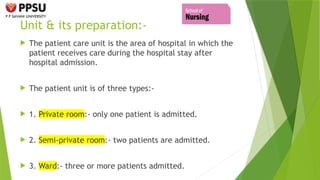
Unit & itspreparation:-
The patient care unit is the area of hospital in which the
patient receives care during the hospital stay after
hospital admission.
The patient unit is of three types:-
1. Private room:- only one patient is admitted.
2. Semi-private room:- two patients are admitted.
3. Ward:- three or more patients admitted.
9.
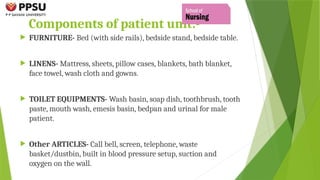
Components of patientunit:-
FURNITURE- Bed (with side rails), bedside stand, bedside table.
LINENS- Mattress, sheets, pillow cases, blankets, bath blanket,
face towel, wash cloth and gowns.
TOILET EQUIPMENTS- Wash basin, soap dish, toothbrush, tooth
paste, mouth wash, emesis basin, bedpan and urinal for male
patient.
Other ARTICLES- Call bell, screen, telephone, waste
basket/dustbin, built in blood pressure setup, suction and
oxygen on the wall.
10.
PREPARATION OF UNIT/ADMITTING THE
PATIENT:-
While admitting the patient into ward the nurses completes a
number of procedures includes:-
Prepared admission bed.
Orientation of the patient to ward and unit procedures.
Collection of history and physical assessment.
11.
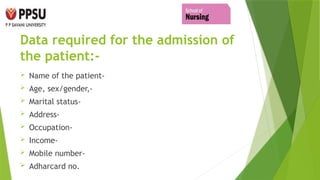
Data required forthe admission of
the patient:-
Name of the patient-
Age, sex/gender,-
Marital status-
Address-
Occupation-
Income-
Mobile number-
Adharcard no.
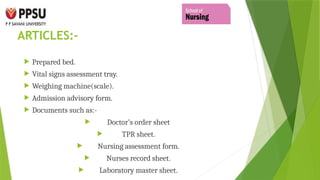
Preparation of articles:-
Articles:-
Prepared bed.
Vital signs tray.
Weighing machine.
Kidney tray.
Documentation sheet.
Screen.
Emergency trolley.
Rationale:-
To receive the patients.
To monitor vital signs of patient.
To measure weight of patient.
To collect waste product.
For proper documentation.
To provide privacy.
For any emergency.
15.
PROCEDURE-ADMISSION:-
In routineadmission:-
OPD
Gathers info of the patient & record.
DOCTOR’S OFFICE
Doctors make decision for admission.
ADMISSION OFFICE
For allocation of ward & bed.
WARD
16.
In emergencyadmission:-
This is the situation in which every second is precious.
So patient is directly admitted in the causality/
emergency department.
The bed should be prepared and the emergency tray and
trolley should be ready.
The equipment should be checked and should be in a
working condition to save time.
17.
ADMISSION PROCEDURE- NURSINGACTION:-
Receive the patient cordially.
Introduce yourself and greet them.
Check’s the patient identification and general condition.
Make the patient feel comfortable.
Prepare all required equipment and bring the articles to the bedside.
Orient the patient to physical setup of ward and nurse’s station.
Assist the patient to bed and provide comfortable position.
Complete necessary records according to hospital policy which includes nursing history and
assessment (vitals, height & weight etc).
18.
Preliminary observation ofthe patient:-
Patient’s general facial expressions – denote not only their
emotional reactions but also the presence of pain or
fatigue.
Any discoloration of the skin such as yellowish or pale –
denotes-jaundice, bluish-denotes-cyanosis.
Observe the patient if undernourished/ malnourished.
Further observation can be made while rendering care to
the patient.
19.
Special considerations:-
Isolatethe patient if suffering from communicable disease.
Orient the patient and his/her relatives to hospital/ward policies.
Avoid physical or psychological trauma.
Be cautious and kind to the patient & relatives.
Observe policies in dealing with medico-legal cases.
Never leave the patient alone in the causality.
20.
MEDICO-LEGAL CASES/ISSUES (MLC):-
An MLC is defined as “any case of injury or ailment where,
the attending doctor after history taking and clinical
examination considers that investigations by law
enforcement agencies are warranted to ascertain
circumstances and fix responsibility regarding the said
injury or ailment according to law”.
Simply it is a medical case with legal implications for the
attending doctor where the attending dr. after eliciting
history and examining patient, thinks that some
investigation by law enforcement agencies is essential.
Or a legal case requiring medical expertise when brought
by the police for examination.
21.
Examples of medico-legalcases:-
Accidents (RTA, industrial accidents).
Burns and scalds.
Sexual offences.
Criminal abortions.
Attempted suicide.
Poisoning, alcohol intoxication.
Cases of trauma with suspicion of foul play.
Electrical injuries, chemical injuries.
Domestic violence, child abuse.
22.
Legal implications inadmission:-
Immediately inform the physician.
OPD records, admission cards should be kept under lock
and key and do not show records to anyone else from the
health care team.
All the belongings should be kept under custody.
Accurate recording of the body discharge should be there.
Do not discard or destroy any evidence without discussing
with the physician.
Take the consent from the relatives before any procedure.
23.
ROLES & RESPONSIBILITIESOF THE
NURSE:-
When the patient comes, take case sheet & receive
patient in admission bed.
If patient is very ill, inform dr. incharge immediately.
Complete the admission register & other admission
records side by side.
Make general observation from head to toe, check height,
weight & vital signs.
24.
Hand overthe patient’s belongings & valuables to relative or ward incharge for
safe custody.
Assist the physician in examining patient and carry out the orders &
investigations.
Subsequently learn the patient’s habits, interests, hobbies & health history.
If patient is admitted for operation or any treatment requiring anesthesia, take
the consent.
If patient is on specific diet, encourage patient to take diet from hospital only.
25.
DISCHARGE FROM THEHOSPITAL.
Discharge of patient from the hospital means, relieving
a person from hospital setting, who admitted as an
inpatient in that hospital.
This is the stage when patient is shifted from hospital
to home. A formal statement in written form is given
from the hospital.
26.
TYPES-
Planned discharge/cured& discharge:
Patient is cured and leaves hospital after physician’s
advice.
DAMA/LAMA: Discharge Against Medical
Advice/Leave Against Medical Advice.
TRANSFER:- transfer to other unit or hospital.
27.
REFFERAL:- Referredfor further management or better
treatment by physician.
ABSCOND:- when patient leaves hospital without any
prior information to hospital staff & also without
clearing dues.
DOR (Discharge On Request):- discharge is given on
personal request of patient when not willing to take
treatment.
DEATH:- When patient not recovered from illness & dies.
28.
CONSENT FOR DAMA/LAMA:-
I am leaving the hospital ward against medical advice.
Doctor explained me about my disease condition and ill
effects of discharge against medical advice. Doctors and
nursing staffs will not be responsible for any ill effects
happening after my departure.
Name of the patient/relative:
Relation:
Signature:
Date & time:
29.
DISCHARGE PLANNING:-
“IDEAL”DISCHARGE PLANNING;
I:- Include the patient & family members as partner in
discharge process.
D:- Discuss with patient & family 5 key areas to prevent
problems.
1. management of disease at home.
2. warning signs & problems.
3. explain test results.
4. explain medications.
5. follow up.
30.
E:- Educatepatient & family about discharge process to
reduce anxiety.
A:- Assess whether patient is able to understand the
process.
L:- Listen to patient & family members and respect
their preferences.
31.
ESSENTIALS OF PLANNEDDISCHARGE:
Written order by Doctor/physician.
Discharge card.
Informing other department.
Check payment of the bills(no due).
Hospital glossaries taken back.
Returning of the personal belongings.
Arrangement for transport.
Documentation.
32.
Points to remember:-
Ensure that no dues certificate is taken before handling
over the discharge slip to patient.
Inform the relatives well in advance about discharge.
Change the dressings when the patient is ready for
discharge.
Provide clear instructions in regard to the use of drugs,
diet to be taken, personal & environmental hygiene and
follow up units.
Keep the record in safe custody & hand over to central
registration office.
33.
DISCHARGE PROCEDURE:-
Thephysician writes on patient’s chart that which
patient is to be discharged.
The patient & family members are instructed regarding
medication, treatment and follow up.
Patient’s personal belongings which were entrusted to
the hospital personnel at time of admission should be
checked and returned to them. The nurse should
receive a receipt from the patient.
34.
The articlesin patient’s unit should be checked and ensure
that they are complete, including bed linens.
Check the payment of all hospital bills.
Arrange a wheel chair or stretcher if patient is not able to walk
or not allowed to walk.
If any patient leaves the hospital against medical advice
he/she should be asked to sign a release form. The form
should state that patient is leaving against the advice of Dr.
nor the hospital can be held responsible for any ill-effects
happening after his/her departure.
35.
Complete allthe records of patient and send them to
record section.
36.
MEDICO-LEGAL ISSUES:-
Informhospital authorities about discharge of medico
legal patients.
On Discharge:-
If patient is transferred from one ward to another, it
should be clearly entered & signed.
Discharge notes must be kept under lock and key.
37.
In caseof death of patient:-
Physician must inform CMO (Chief Medical Officer)
and send the body for post mortem examination.
Nurse must provide written instructions for handling
the body to mortuary/police officer with complete
name, address, identification number and signature of
witness.
List of all articles of the patient should be maintained.
38.
ROLES & RESPONSIBILITIESOF THE
NURSE:-
Preparation for discharge:-
Planning in the beginning.
Plan for rehabilitation & follow up need.
Teach nursing procedures to be continued at
home, get its practice done.
Arrangement for transport.
39.
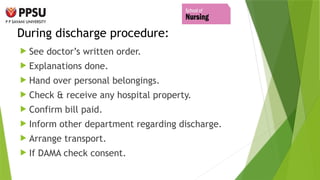
During discharge procedure:
See doctor’s written order.
Explanations done.
Hand over personal belongings.
Check & receive any hospital property.
Confirm bill paid.
Inform other department regarding discharge.
Arrange transport.
If DAMA check consent.
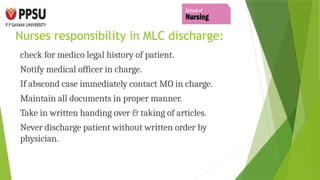
Nurses responsibility inMLC discharge:
check for medico legal history of patient.
Notify medical officer in charge.
If abscond case immediately contact MO in charge.
Maintain all documents in proper manner.
Take in written handing over & taking of articles.
Never discharge patient without written order by
physician.
CARE OF THEUNIT AFTER DISCHARGE:-
After the patient is discharged, room is cleaned.
Windows and rooms are opened.
All the articles used by the patient are washed and
sterilized or disinfected by chemicals.
Disposable things are discarded and linens send to
laundry.
Mattress, blankets and pillows are posed to the sunlight.
In c/o communicable diseased patient fumigation of
room & articles should be done.

 Most read