HOSPITAL
Hospitalhas been derived from the Latin
word HOSPES signifying a stranger or
foreigner , hence a guest.
Definition
Hospital is an institution providing medical
and surgical treatment and nursing care for
sick or injured people.
FUNCTION OfHOSPITAL
Patient care.
Diagnosis and treatment of the sick or injured
person.
Immunization ,prevention of diseases and
promotion of health.
Medical education and training.
Training of paramedical staff.
Medical and nursing Research
5.
Admission
Definition
Admission isa process of receiving a new patient
to an individual unit of the hospital.
OR
It is the entry and acceptance of a patient to stay
in a health faculty for care, observation and
treatment.
Types of admission
Elective Admission
Emergency Admission
6.
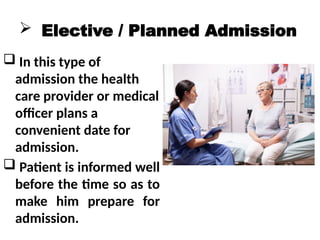
Elective /Planned Admission
In this type of
admission the health
care provider or medical
officer plans a
convenient date for
admission.
Patient is informed well
before the time so as to
make him prepare for
admission.
7.
Continue…
Patient istaken through the admission process
from OPD. [ out door patient department]
Elective admission there is known medical
condition or complaint that requires further
workup , treatment or surgery.
Example
Surgery
Dialysis
chemotherapy
8.
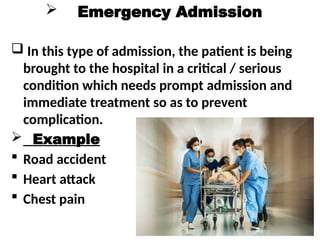
Emergency Admission
In this type of admission, the patient is being
brought to the hospital in a critical / serious
condition which needs prompt admission and
immediate treatment so as to prevent
complication.
Example
Road accident
Heart attack
Chest pain
9.
Purpose ofadmission
Identify intradisciplinary assessment [Inspection,
palpation , percussion , Auscultation] parameters
in order to plan or deliver the appropriate level of
care to meet the patient need.
To establish unified process of assessment and
reassessment of patient admitted to the unit.
Admission physical assessment shall be done
within four hours in general unit.
Admission physical assessment shall be done
within one hour in special care unit.
10.
Continue…
Data thatis not obtained within four hours
of admission should be documented at the
end of shift by assigned nurse.
Documentation should be in permanent ink
( Blue or Black ).
The nurse should write her / his Name or
signature.
11.
Discharge ofPatient
Definition
Shifting or
departure of
patient from
hospital to home
or another
hospital.
12.
TYPES OfDISCHARGE
Formal discharge [ when patient treatment over
doctor discharge the patient ]
LAMA / DAMA [ Leave / Discharge against
medical advice ]
Discharge at request.
Abscond [ leave without any information ]
Transferred to other hospital.
Relieved from hospital.
Temporary relieved from hospital.
13.
Purpose ofdischarge
For providing continuously care at home.
When patient have no longer need to
receive care.
Provide critical information for patient to
manage their own care.
To provide for a safe return of the patient
clothing and valuables.
14.
Role ofNURSE in preparing
Pt. for DISCHARGE
Prepared patient for discharge.
Nurse should provide support to the patient and
patient relative.
Identify patient strength and weakness.
Physician’s discharge orders have been written.
Notify all hospital department.
Ensure that all Lab work , X-Ray, treatment and
procedure are completed.
15.
Continue…
Help patientwith hygiene , dressing and
packing.
Remember that each individual handle
termination letter in his/ her own.
If patient is unable to walk , Provide
stretcher or wheel chair.
16.
Role ofNurse after Discharging
patient
After patient has gone the bed should be
cleaned , Blanket should be kept in
sunlight , room should be cleaned.
Kept ready for next use.
Responsibility of hospital staff to protect the
record of patient.
17.
Discharge Teaching
Educate patient about medication , diet ,
physical activities.
Educate patient family to continue Care.
Educate patient about his / her own health.
Explain the patient to follow up.
Tell patient to bring all documents during
follow up.
18.
Continue..
5. Ask forclarification on vital issues pertaining to the
patient's condition from the accompanying nurse.
6. Introduce self and other nurses around to patient and
relatives.
7. Do a quick assessment of the patient's condition and
needs and act accordingly.
8. Admit patient using the nursing process.
9. Orientate patient and relatives to ward and its
environment, routine of the unit if necessary.
10. Document time of patient's arrival in the nurses note ,
admission and discharge book and ward state.
19.
TRANSFER
DEFINITION
Discharging a patientfrom one unit or agency
and admitting them to another unit.
Inform patient / family.
Speaks with nurse on transfer unit.
Types of Transfer
There are two types of transfer.
Transfer - in
Transfer- out
20.
Transfer –in
Definition Patient is moved from one unit or ward of first
admission to a new unit or ward .
E.G : Medical to surgical ward.
ROLE
1. Prepare a suitable bed to receive patient.
2. Assemble the necessary equipment depending on the
patients condition . i.e. oxygen apparatus, suction machine,
vital signs tray.
3. Receive incoming patient, relatives and accompanying
nurse warmly.
4. Take over the transfer notes and personal belonging of
the patient.
21.
TRANSFER -OUT
Definition
It could be from unit to unit or facility to facility
Role
1. Confirm with receiving unit.
2. Assess patients condition.
3. Arrange for appropriate vehicle-where applicable.
4. Arrange for accompanying nurse.
5. Collect all necessary data.
6. Explain reason of transfer to patient and relatives
and reassure them to reduce anxiety.
22.
CONTINUE..
7. Obtain writtenconsent for transfer.
8. Pack patient belonging.9. Collect patient
medication , Investigation result and transfer notes.
10. Assist patient to dress up.
11. Assist patient into wheel chair, stretcher,
ambulance where applicable.
12. Enter patient name in the A and D book, ward
state and nurse note.
13. Hand over patient's notes and belonging to the
accompanying nurse.
23.
Responsibility ofNurse during
Admission
Arrange patients unit
Greet the patient and orient to ward , other patients , patient room
and Equipment .
Tells rules and regulation to patient.
Complete patients admission charts.
Takes Temperature ,blood pressure , respiration and pulse of patient.
Carry on required investigation.
Follow the physician order , administer prescribed medicine.
Enquire from patients ,if he is allergic to any medicine , apply allergy
band and inform the physician.
Give instruction to patient to take care of belonging and valuable
24.
Responsibility ofnurse during
Discharge
Check for medico legal history.
Notify medical officer incharge .
Abscond cases immediately contact medical
officer incharge .
Maintain all documents in a proper Manner.
Take in written handing over.
Taking of articles.
Never discharge patient without Written order by
physician.
25.
Admission Procedure
AdmittingDepartment
Fill out admission form.
Take admission consent.
Provide identification Band.
Allocate hospitals bed.
Take care of personal belonging.
Arrival on nursing unit
Height and weight.
Vital signs.
Send sample for lab investigation
Reporting the admission.
Admission documentation.
26.
Continue..
Hospital Orientation
WardRoutine.( Doctor and Nurses round)
Physical facilities in room
Internet, TV, Bathroom , Telephone etc.
Hospital services and timing
Meals , Medication, Medicine / surgery supply
linen.
Hospital policies
Smoking policy, lama( leave against medical advice,
ML
Transfer procedure
Check the doctor’s order for transfer.
Inform the patient and relatives.
Inform the ward sister where the patient need to
be transferred.
Check the chart for complete recording of vital
signs ,nursing care and treatment given .
Collect patients X-Ray ,medicine and other
belongings.
Cancel the hospital diet or transfer.
Assist the relative to collect other belongings.
29.
Continue…
Make arrangementto settle the due bills if
going to other hospital .
Record time made of transfer and general
condition of the patient .
Assist in transferring sick patient to
wheelchair/stretcher and accompany patient to
new area.
Handover patient documents ,belonging and
report verbally to the incharge nurse/ sister.
Collect the word articles.
30.
Discharge procedure
Instructions regarding further care ,medications follow
up should be clearly written.
Client personal belonging such as money ,clothing
other valuable things which were taken by hospital
personal at the time of admission should be checked
and written return to him. The nurse should get a
receipt from to the client at the time of delivery.
The articles in the client’s unit should be checked and
so that they are complete including bed and linen.
Before the client leave the hospital the nurse should
confirm whether he has paid all the hospitals bills.
31.
CONTINUE…
See thatthe client is ready to go home, recently
bathed , hair combed and dressed in clean cloths.
The diet department should be inform the client
discharge.
If any client leave the hospital against a medical
order , she/ he should be asked to sign the
release form.
The nurse should see the charts are complete
and sent to record section.

 Most read


 Most read

 Most read