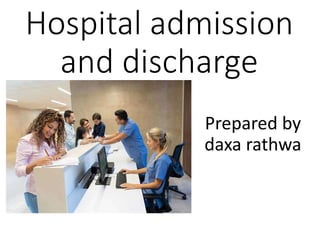
Hospital admission
and discharge
Prepared by
daxa rathwa
Content
•Definition
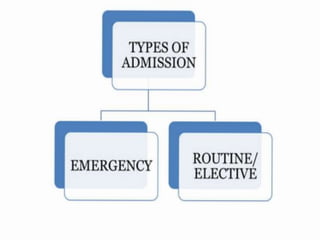
•Types of admission
• Purpose of admission
•Preparing unit for admission
•Admission procedure
•Medico ligal case
•Role and responsibility during admission
procedure
Admission
•Discharge
Definition of discharge
Types of discharge
Purpose of discharge
Role and responsibility of nurse during
discharge procedure
Care of unit after discharge
Admission definition
"Admission of a client means, allowing a
client to stay in the hospital for observation,
investigations and treatment of the disease
he/she is suffering from."
• "Admission is the entry of a patient into a
hospital /ward for therapeutic /diagnosis
EMERGENCY ADMISSION
Clients are admitted in acute conditions
requiring
•immediate treatment. E.g.: patient with
heart attack, poisoning, breathing difficulty,
RTA(Road traffic accident) etc
•• Patient should be admitted in casualty or
emergency department to save the life of
ROUTINE/ELECTIVE
ADMISSION
• Clients are admitted for investigations
and planned treatment and surgeries.
E.g.: patient with appendicitis, jaundice,
diabetes,hypertension,
Purpose of admission
• • To receive the patient in ward for
admission
• according to his/her condition
• • To welcome the patient
• • To provide comfort and safety to the
patient
• • To provide immediate care
• • To be ready for any emergency
To assist the patient in adjusting to the
hospital environment
• • To obtain information about patient such as
address,
• guardian, any information that serves as a
basis of
• care e.g. Allergy, diabetes.
• • To establish Nurse-patient relationship
•EMOTIONA REACTION
•Anxiety
•• Fear
•• Denial
•Emotionally upset
•Anger
•• Sad
Preparing the unit for
admission
• The admitting office notifies the unit prior to the
patient's arrival, so that the room/bed can be
prepared.
• • Some of the activities carried out by the nurse
before the
• patient is to be admitted are:
• Keeping the bed ready: open the bed, fold back the
bedspread, top blanket, and top sheet. Cover the
bed with full length mackintosh and two bath
towels in order to protect from soiling
• • Position the bed: for ambulatory client, the
bed should be in normal position. If client has to
arrive on stretcher, the bed should be in lowest
position. Make sure furniture in the room is
arranged to ensure easy access to the bed
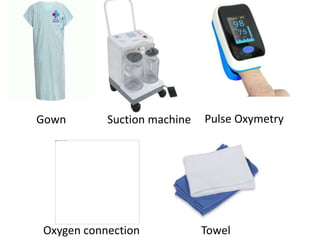
• • Assemble the necessary equipment and
supplies: hospital admission pack, which
contains items such as drinking glass, papers,
lotion etc should be ready at bedside. A hospital
gown should be available, although the client
may choose to wear own clothes
•• Assemble special equipment and
supplies: the client may require
oxygen therapy, cardiac monitoring
or suction equipment. The nurse
should make sure that the
equipment is functioning properly
and is ready for patient use.
Gown Suction machine Pulse Oxymetry
Oxygen connection Towel
Class and plate Cardiac monitor
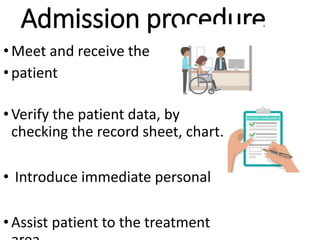
Admission procedure
Perform examination and
evaluation procedure
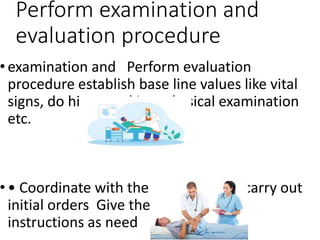
• examination and Perform evaluation
procedure establish base line values like vital
signs, do history taking, physical examination
etc.
• • Coordinate with the physician and carry out
initial orders Give the treatment and
instructions as need
Orientation to the patient and
relatives
Use of call system and telephone
•Treatment schedule
•Visitors timings
•Other health care team members
•*Policy and rules and regulations
•Care of patients valuable etc.
Medico ligal case
• A medico-legal case is one where
besides the medical treatment;
investigations by law enforcing
agencies, are essential to fix the
responsibility regarding the present
state/ condition of the patient.
Medico ligal cases include
•• Accidents like Road Traffic Accidents (RTA),
Industrial accidents
• Cases of trauma with suspicion of foul play
•Electrical injuries
•Poisoning
•Chemical injuries • Burns
•Sexual Offences
•Attempted suicide
• Domestic violence and child abuse
-Cases of asphyxia as a result of
hanging, drowning,
•suffocation
•Death in the operation theatre
•Drug overdose
•Drug abuse
Role during MLC
• In emergencies, resuscitation and stabilization of the
patient will be carried out first and medico legal
formalities may be completed subsequently. The
consent for treatment is implied in all emergencies
• Hospitals will maintain a MLC register and the MLC
will be initiated and documented in the register. •
Medicolegal documents should be considered as
• confidential records and should be stored under safe
ROLES & RESPONSIBILITIES OF
NURSE DURING ADMISSION
PROCEDURE
At the time of admission, the registered nurse
perform complete assessment of the patient.
Enter patient name, date and time of
admission, chief complains, medical diagnosis
in the admission file or patient file.
• Document if patient and family has valuables
brought to the hospital. If yes, hand it over to the
relatives with their signatures.
• family will be given orientation regarding the
unit,
• visiting rooms, patients right and
responsibilities.
• • In medico-legal case, the police has to be
informed and the nurse has to keep
documents confidential & under safe
At the time of arrival to the unit or ward patient
and
family will be given orientation regarding the
unit,
visiting rooms, patients right and
responsibilities.
DISCHARGE DEFINITION
• • "Discharge of patient from the hospital
means, relieving a perso from hospital
setting, who admitted as an inpatient in that
hospital"
• • "Discharge from the hospital is the point at
which the patient leaves the hospital and
either returns home or is transferred to
another facility such as one for rehabilitation
or to a nursing home."
Types of discharge
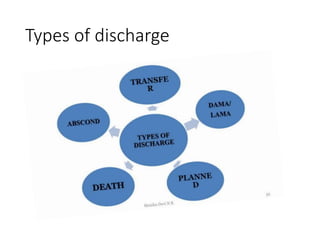
• PLANNED DISCHARGE: Patient's treatment is over
and the attending physician has discharged the
patient
• ABSCOND: Patient leaves the hospital without prior
information
• LAMA/DAMA (left against medical advise discharge
against medical advise): In LAMA/DAMA, patient
chooses to leave the hospital before the treating
physician recommends discharge
• • TRANSFER: Patient is transferred to another
health care facility or within the same hospital
from one ward to another
• • DEATH: after death of patient, the dead body is
handed over to the relatives after completing the
discharge procedure
PURPOSE OF DISCHARGE
• To be certain that the patient has the information
on his/her condition.
• To inform about the follow-up visits or referral to
other health agencies.
• To teach the Nursing procedure or care he/she
needs at home & to take re-demonstration
• To provide for a safe, efficient return of all patient's
clothing, valuables & to check that all hospital
equipment & clothing in the hospital.
ROLES & RESPONSIBILITIES OF
NURSE DURING DISCHARGE
PROCEDURE
• 1. See doctor's written order for discharge: no
client should be discharged without doctor's
written order
• 2. Explanation of discharge procedure
• 3. Hand over personal belongings: clothing,
jewellery or other valuables that were entrusted
with hospital at the time of admission should be
returned to client.
• 4. Check and receive any hospital property: any of
the hospital property that was given to client for
his/her use in hospital should be checked and
received back before he/she leaves
• 5. Teach nursing procedures to be continued at
home, get it's practice done: Provide instructions
regarding medication, follow-up visit
6. Confirm bill paid: Before client leaves,
nurse should confirm that the client has
paid the hospital bills.
7. Inform other departments regarding
discharge.
8. Documentation: the nurse should
check that the charts & files are
completed
9. Arrange transport: if the client is not able
to walk, then the nurse should see that
he/she is transferred either on a wheel
chair or stretcher
• 10. If DAMA :-check consent, the form
should state that the person is leaving
against medical advise of doctor and that
neither doctor nor the hospital can be held
responsible for any ill effect happening after
the departure
• 11.Care of patient's room and articles after
discharge
CARE OF UNIT AFTER
DISCHARGE
• After a client is discharged & before admitting
another patient, the room is cleaned & aired.
• All articles used by client should be taken to
utility room, washed, cleaned, sterilized if
necessary or disinfected by chemicals. The
articles are re-arranged and kept ready for next
client
• Used linen should be sent to laundry • Mattress,
pillows, blankets etc should be exposed to
sunlight and then the
•bed is made with fresh linen
•If the room was used for a client with
communicable disease, it should
befumigated
admission and discharge.pptx