Community Based
Natural Resource Management
(CBNRM)
Proposed Organizational Structures for
Nairobi Rivers Management
Presented by Milla Menga on 22nd April 2014 Stakeholders Meeting at Dandora
Organizational Structures Forms
Four types, depending on the key organizations for natural
resource management (NRM):
District-level organizations
Village organizations supported by sectorial departments
(e.g. Village Forest Committees)
Organizations or authorities outside the state hierarchy(e.g.
traditional authority, residents’ associations)
Corporate organizations at the village level (e.g. Trusts,
conservancies, property associations)
Case 1
Cases where decentralization has resulted in district
organizations being the new locus of authority. These can
be local government organizations, such as district councils
(Zimbabwe Sengwe case of CAMPFIRE), or multi-
stakeholder, district organizations aligned to sectorial
departments (Zambia cases). In these cases the CBNRM
agenda is driven by central state authorities at a district
level. There is little community involvement in planning or
decision-making, and a large percentage of the revenue is
retained at district level. Consequently, people on the
ground rarely identify with these initiatives and few have a
clear understanding of their purpose and objectives. This
paints a bleak picture for the future of CBNRM in these
areas.
Case 2
Cases where sectorial government departments support village
committees at lower levels, such as Village Natural Resource
Management Committees in the Malawi case, which are
supported by the Forestry Department. Many of these
committees appear relatively successful as CBNRM
organizations, provided they do not become elitist but remain
accountable to the community at large (mechanisms to ensure
this need to be in place). Furthermore, the greater the authority
such committees receive and the more the state is willing to let
go, the more likely they are to succeed. Thus, in Malawi and
Tanzania the committees, in consultation with the community,
can formulate their own by-laws, while the Resource
Management Committees in the Zimbabwe Gokwe case are
weak and still largely controlled by the Forestry Commission.
Case 3
Cases where NRM at the lower level is largely
based on organizations or authorities outside of
the state hierarchy. Within this category we have
two very different kinds of cases, one based on
traditional leaders in the Zimbabwe Chivi case
and one based on Residents Associations in the
South Africa Fish River case. In these cases, the
lack of external support and the absence of any
clear policy and legal framework for CBNRM are
limiting the achievement of sustainable NRM.
Case 4
 Cases where organizations consisting of community members
themselves are the locus of authority in some kind of Corporate
organization (Trusts, Conservancies, Associations as in the cases in
Botswana, Namibia, Makuleke and perhaps Lesotho, and Villages in
the case of Tanzania). In these cases local residents or resource
users have received user or proprietary rights over resources. This
provides them with the authority, through their elected executives or
boards, to make rules, approve developments, enter in partnerships
with the private sector, receive revenues, and distribute benefits. Most
to all of cash benefits are returned to the community. Community-
members are particularly behind the schemes in these cases, and in
some countries (e.g. Namibia) a demand-driven movement to
establish further such CBNRM initiatives is emerging. The level of
interference by the state is less than in the preceding cases, but it still
retains ultimate authority and continues to make decisions that impact
on the CBNRM organizations. Recent developments in Namibia and
Botswana illustrate this.
Recommendation
Attitudes towards district-level schemes
amongst local people are generally negative.
The greater the authority village organizations
receive the more likely they are to succeed. In
the cases with corporate organizations, local
residents have received user or proprietary
rights over resources. Such cases reflect the
best chances of community-based natural
resources management (CBNRM) being
successful.
Best Structure for NRWC is Case 4
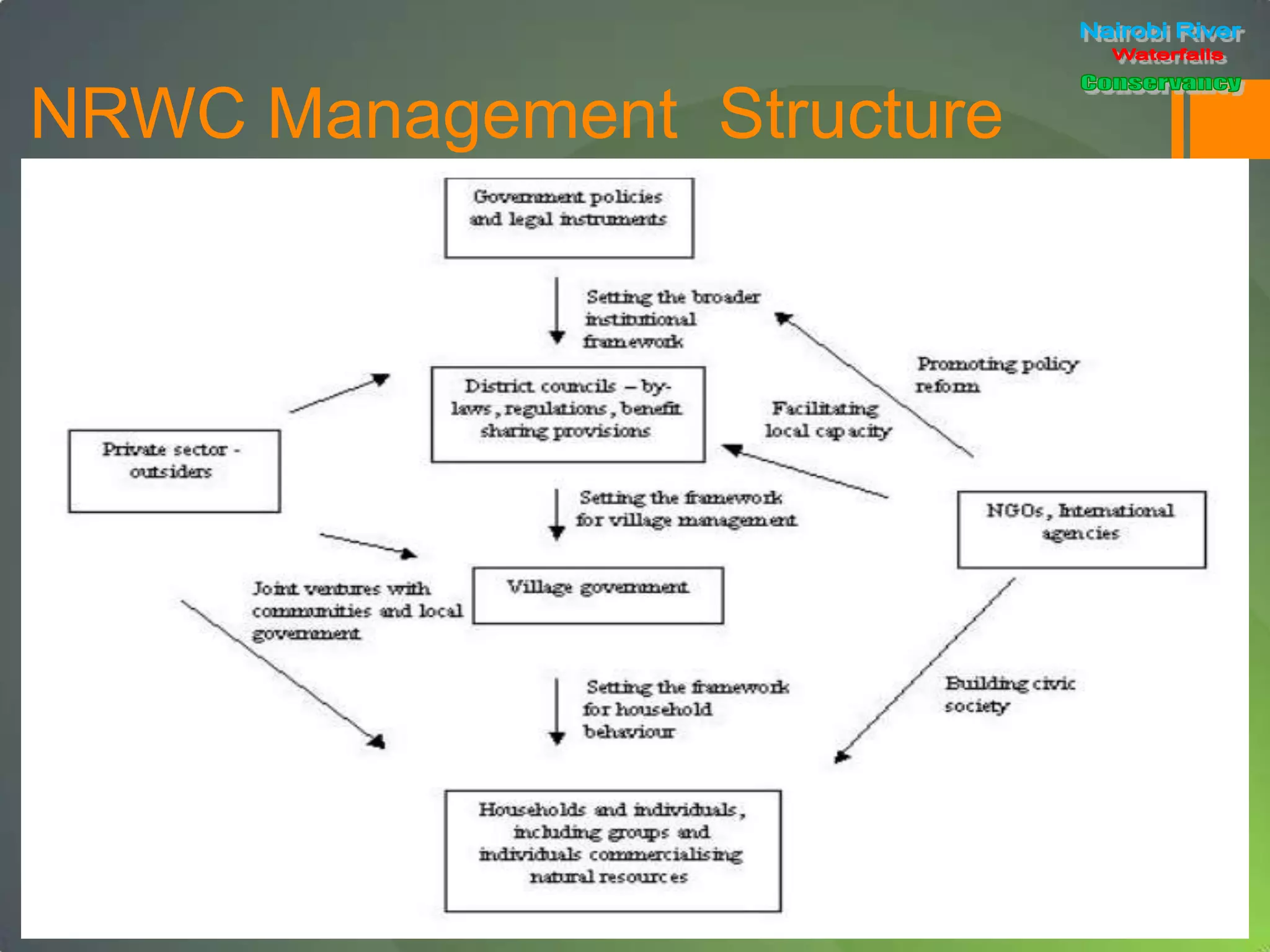
NRWC Management Structure
Way forward
Registration of Nairobi River Waterfalls Conservancy as a Trust
with the Ministry of Lands, Housing and Urban Development
and capacity building of a management team including clarifying
terms of reference, establishing a reference point, secure
resources, mainly funding for management and activities.
Incorporate sector wide multi-stakeholder partnership and
sponsorship at County Level through Friends of Nairobi River
Waterfalls Conservancy and clarify individual organizations
terms of reference in relation to this initiative.
Capacity Building of Nairobi Rivers Riparian Villages
Conservation Committees including Village Councils,
Community Forest Associations, Youth Bunges, Small Christian
Communities, Water Resource Users Associations, etc for
grassroots co-management
Proposed Nairobi River Waterfalls Conservancy Structure

Proposed Nairobi River Waterfalls Conservancy Structure

  • 1.
    Community Based Natural ResourceManagement (CBNRM) Proposed Organizational Structures for Nairobi Rivers Management Presented by Milla Menga on 22nd April 2014 Stakeholders Meeting at Dandora
  • 2.
    Organizational Structures Forms Fourtypes, depending on the key organizations for natural resource management (NRM): District-level organizations Village organizations supported by sectorial departments (e.g. Village Forest Committees) Organizations or authorities outside the state hierarchy(e.g. traditional authority, residents’ associations) Corporate organizations at the village level (e.g. Trusts, conservancies, property associations)
  • 3.
    Case 1 Cases wheredecentralization has resulted in district organizations being the new locus of authority. These can be local government organizations, such as district councils (Zimbabwe Sengwe case of CAMPFIRE), or multi- stakeholder, district organizations aligned to sectorial departments (Zambia cases). In these cases the CBNRM agenda is driven by central state authorities at a district level. There is little community involvement in planning or decision-making, and a large percentage of the revenue is retained at district level. Consequently, people on the ground rarely identify with these initiatives and few have a clear understanding of their purpose and objectives. This paints a bleak picture for the future of CBNRM in these areas.
  • 4.
    Case 2 Cases wheresectorial government departments support village committees at lower levels, such as Village Natural Resource Management Committees in the Malawi case, which are supported by the Forestry Department. Many of these committees appear relatively successful as CBNRM organizations, provided they do not become elitist but remain accountable to the community at large (mechanisms to ensure this need to be in place). Furthermore, the greater the authority such committees receive and the more the state is willing to let go, the more likely they are to succeed. Thus, in Malawi and Tanzania the committees, in consultation with the community, can formulate their own by-laws, while the Resource Management Committees in the Zimbabwe Gokwe case are weak and still largely controlled by the Forestry Commission.
  • 5.
    Case 3 Cases whereNRM at the lower level is largely based on organizations or authorities outside of the state hierarchy. Within this category we have two very different kinds of cases, one based on traditional leaders in the Zimbabwe Chivi case and one based on Residents Associations in the South Africa Fish River case. In these cases, the lack of external support and the absence of any clear policy and legal framework for CBNRM are limiting the achievement of sustainable NRM.
  • 6.
    Case 4  Caseswhere organizations consisting of community members themselves are the locus of authority in some kind of Corporate organization (Trusts, Conservancies, Associations as in the cases in Botswana, Namibia, Makuleke and perhaps Lesotho, and Villages in the case of Tanzania). In these cases local residents or resource users have received user or proprietary rights over resources. This provides them with the authority, through their elected executives or boards, to make rules, approve developments, enter in partnerships with the private sector, receive revenues, and distribute benefits. Most to all of cash benefits are returned to the community. Community- members are particularly behind the schemes in these cases, and in some countries (e.g. Namibia) a demand-driven movement to establish further such CBNRM initiatives is emerging. The level of interference by the state is less than in the preceding cases, but it still retains ultimate authority and continues to make decisions that impact on the CBNRM organizations. Recent developments in Namibia and Botswana illustrate this.
  • 7.
    Recommendation Attitudes towards district-levelschemes amongst local people are generally negative. The greater the authority village organizations receive the more likely they are to succeed. In the cases with corporate organizations, local residents have received user or proprietary rights over resources. Such cases reflect the best chances of community-based natural resources management (CBNRM) being successful. Best Structure for NRWC is Case 4
  • 8.
  • 9.
    Way forward Registration ofNairobi River Waterfalls Conservancy as a Trust with the Ministry of Lands, Housing and Urban Development and capacity building of a management team including clarifying terms of reference, establishing a reference point, secure resources, mainly funding for management and activities. Incorporate sector wide multi-stakeholder partnership and sponsorship at County Level through Friends of Nairobi River Waterfalls Conservancy and clarify individual organizations terms of reference in relation to this initiative. Capacity Building of Nairobi Rivers Riparian Villages Conservation Committees including Village Councils, Community Forest Associations, Youth Bunges, Small Christian Communities, Water Resource Users Associations, etc for grassroots co-management