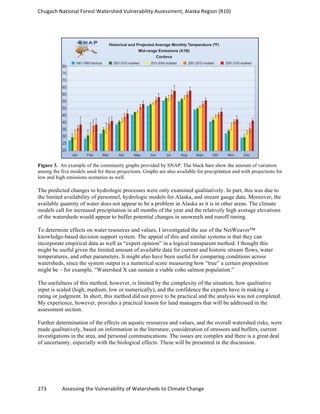
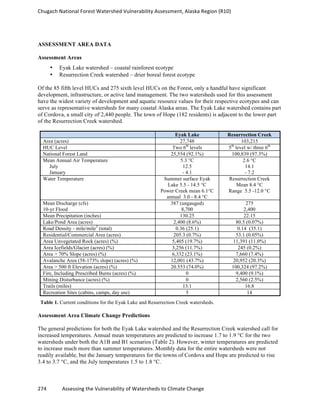
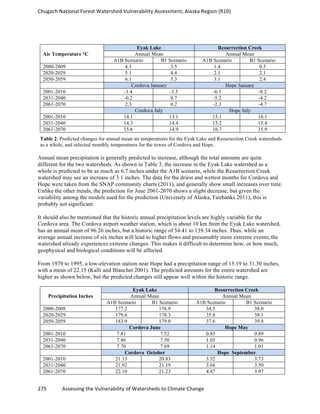
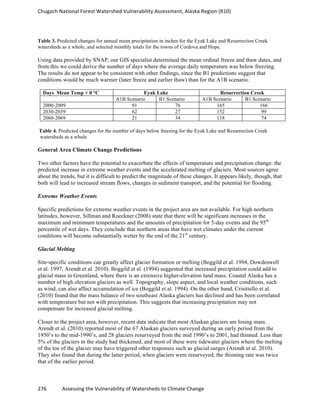
Authors*
Michael J. Furniss, Pacific Northwest Research Station
Ken B. Roby, Lassen National Forest, retired
Dan Cenderelli, Stream Systems Technology Center
John Chatel, Sawtooth National Forest
Caty F. Clifton, Umatilla National Forest
Alan Clingenpeel, Quachita National Forest
Polly E. Hays, Rocky Mountain Regional Office
Dale Higgins, Chequamegon-Nicolet National Forest
Ken Hodges, Chugach National Forest
Carol Howe, Grand Mesa, Uncompahgre, and
Gunnison National Forests
Laura Jungst, Helena National Forest
Joan Louie, Gallatin National Forest
Christine Mai, Shasta-Trinity National Forest
Ralph Martinez, Plumas National Forest
Kerry Overton, Rocky Mountain Research Station
Brian P. Staab, Pacific Northwest Region
Rory Steinke, Coconino National Forest
Mark Weinhold, White River National Forest
* All are USDA Forest Service, with units specified
Contributors and Reviewers**
Christopher P. Carlson, Washington Office National Forest System
Jim Morrison, Northern Regional Office
Janine Rice, Rocky Mountain Research Station
Jeremy Littel, Climate Impacts Group, University of Washington
Dan Isaak, Rocky Mountain Research Station
Charlie H. Luce, Rocky Mountain Research Station
Linda Joyce, Rocky Mountain Research Station
David Cleaves, Washington Office Research and Development
Sherry Hazelhurst, Washington Office National Forest System
Sarah J. Hines, Rocky Mountain Research Station
John Potyondy, Stream Systems Technology Center
Ryan Foote, Lassen National Forest
Ann Rosecrance, Ventura River Watershed Council
Derik Olson, Council on Environmental Quality
** All are USDA Forest Service, with units specified,
except Jeremy Littel. Ann Rosecrance, and Derik Olson
Design and Layout
April Kimmerly, Peters Kimmerly Design Associates
Margaret Livingston
Cover Photograph
North Pole Basin, Sopris Ranger District, White River National Forest,
by Cindy Dean, White River National Forest
AUTHORS AND CONTRIBUTORS
The U.S. Department of Agriculture (USDA) prohibits discrimination
in all its programs and activities on the basis of race, color, national
origin, age, disability, and where applicable, sex, marital status,
familial status, parental status, religion, sexual orientation, genetic
information, political beliefs, reprisal, or because all or part of an
individual’s income is derived from any public assistance program.
(Not all prohibited bases apply to all programs.) Persons with
disabilities who require alternative means for communication of
program information (Braille, large print, audiotape, etc.) should
contact USDA’s TARGET Center at (202) 720-2600 (voice and TDD).
To file a complaint of discrimination, write USDA, Director, Office
of Civil Rights, 1400 Independence Avenue, SW, Washington, DC
20250-9410 or call (800) 795-3272 (voice) or (202) 720-6382 (TDD).
USDA is an equal opportunity provider and employer.
Recommended Citation
Michael J. Furniss, Roby, Ken B., Cenderelli, Dan; Chatel, John; Clifton, Caty F.;
Clingenpeel, Alan; Hays, Polly E.; Higgins, Dale; Hodges, Ken; Howe, Carol; Jungst,
Laura; Louie, Joan; Mai, S Christine; Martinez, Ralph; Overton, Kerry; Staab, Brian P.;
Steinke, Rory; Weinhold, Mark. 2012. Assessing the Vulnerability of Watersheds to
Climate Change: Results of National Forest Watershed Vulnerability Pilot Assessments.
Climate Change Resource Center. U.S. Department of Agriculture, Forest Service 305p.
www.fs.fed.us/ccrc/wva
Online Presentations by the pilot National Forests
Two sets of oral presentations that describe the analyses were conducted and recorded:
1) An early set of detailed presentations by each pilot National Forest, presented to
other pilot Forest staff in Salt Lake City in September of 2010, can be found here:
==> www.fsl.orst.edu/fs-pnw/wva/ Presentations are ~50 minutes each, and reflect
analyses-in-progress.
2) A series of 3 webinars were given in Januay and February of 2012 by each of the pilot
National Forests. These are more advanced and refined than the previous set, but are
shorter and have less detail. Basic recordings of the webinars may be found here:
==> www.fs.fed.us/ccrc/livelearn/wva/
ASSESSSING THE VULNERABILITY OF WATERSHEDS
TO CLIMATE CHANGE:
Results of National Forest Watershed Vulnerability Pilot Assessments
ABSTRACT
Existing models and predictions project serious changes to
worldwide hydrologic processes as a result of global climate
change. Projections indicate that significant change may threaten
National Forest System watersheds that are an important source of
water used to support people, economies, and ecosystems.
Wildland managers are expected to anticipate and respond to
these threats, adjusting management priorities and actions.
Because watersheds differ greatly in: (1) the values they support;
(2) their exposure to climatic changes; and (3) their sensitivity to
climatic changes, understanding these differences will help inform
the setting of priorities and selection of management approaches.
Drawing distinctions in climate change vulnerability among
watersheds on a National Forest or Grassland allows more efficient
and effective allocation of resources and better land and watershed
stewardship.
Eleven National Forests from throughout the United States,
representing each of the nine Forest Service regions, conducted
assessments of potential hydrologic change due to ongoing and
expected climate warming. A pilot assessment approach was
developed and implemented. Each National Forest identified
water resources important in that area, assessed climate change
exposure and watershed sensitivity, and evaluated the relative
vulnerabilities of watersheds to climate change. The assessments
provided management recommendations to anticipate and respond
to projected climate-hydrologic changes.
Completed assessments differed in level of detail, but all
assessments identified priority areas and management actions
to maintain or improve watershed resilience in response to a
changing climate. The pilot efforts also identified key principles
important to conducting future vulnerability assessments.
CONTENTS
THE CHALLENGE .  .  .  .  .  .  .  .  .  .  .  .  .  .  .  .  .  .  .  .  .  .  .  .  .  .  .  .  .  .  .  .  .  .  .  .  .  .  .  .  .  .  .  .  .  .  .  .  .  .  . 1
WATERSHED CONDITION, RESILIENCE, AND HEALTH...
WHAT'S THE DIFFERENCE?. .  .  .  .  .  .  .  .  .  .  .  .  .  .  .  .  .  .  .  .  .  .  .  .  .  .  .  .  .  .  .  .  .  .  .  .  .  .  . 2
THE PILOT ASSESSMENT APPROACH .  .  .  .  .  .  .  .  .  .  .  .  .  .  .  .  .  .  .  .  .  .  .  .  .  .  .  .  .  .  .  .  . 2
IDENTIFY WATER RESOURCE VALUES AND SCALES OF ANALYSIS.  .  .  .  .  .  . 4
Water Resource Values .  .  .  .  .  .  .  .  .  .  .  .  .  .  .  .  .  .  .  .  .  .  .  .  .  .  .  .  .  .  .  .  .  .  .  .  .  .  .  . 4
Scale(s) of Analysis and Reporting.  .  .  .  .  .  .  .  .  .  .  .  .  .  .  .  .  .  .  .  .  .  .  .  .  .  .  .  .  . 6
ASSESS EXPOSURE.  .  .  .  .  .  .  .  .  .  .  .  .  .  .  .  .  .  .  .  .  .  .  .  .  .  .  .  .  .  .  .  .  .  .  .  .  .  .  .  .  .  .  .  .  .  .  .  . 7
Using Historic Data.  .  .  .  .  .  .  .  .  .  .  .  .  .  .  .  .  .  .  .  .  .  .  .  .  .  .  .  .  .  .  .  .  .  .  .  .  .  .  .  .  .  .  .  . 7
Climate Change Projections .  .  .  .  .  .  .  .  .  .  .  .  .  .  .  .  .  .  .  .  .  .  .  .  .  .  .  .  .  .  .  .  .  .  .  . 8
Evaluating Hydrologic Changes .  .  .  .  .  .  .  .  .  .  .  .  .  .  .  .  .  .  .  .  .  .  .  .  .  .  .  .  .  .  .  .  . 10
Applying Exposure Projections .  .  .  .  .  .  .  .  .  .  .  .  .  .  .  .  .  .  .  .  .  .  .  .  .  .  .  .  .  .  .  .  . 11
EVALUATE WATERSHED SENSITIVITY.  .  .  .  .  .  .  .  .  .  .  .  .  .  .  .  .  .  .  .  .  .  .  .  .  .  .  .  .  .  .  . 14
EVALUATE AND CATEGORIZE VULNERABILITY.  .  .  .  .  .  .  .  .  .  .  .  .  .  .  .  .  .  .  .  .  .  .  . 18
IDENTIFY ADAPTIVE MANAGEMENT RESPONSES .  .  .  .  .  .  .  .  .  .  .  .  .  .  .  .  .  .  .  . 20
CRITIQUE THE ASSESSMENT. .  .  .  .  .  .  .  .  .  .  .  .  .  .  .  .  .  .  .  .  .  .  .  .  .  .  .  .  .  .  .  .  .  .  .  .  .  .  . 23
Data Gaps and Uncertainty.  .  .  .  .  .  .  .  .  .  .  .  .  .  .  .  .  .  .  .  .  .  .  .  .  .  .  .  .  .  .  .  .  .  .  .  . 23
Other Lessons Learned .  .  .  .  .  .  .  .  .  .  .  .  .  .  .  .  .  .  .  .  .  .  .  .  .  .  .  .  .  .  .  .  .  .  .  .  .  .  . 24
SUMMARY. .  .  .  .  .  .  .  .  .  .  .  .  .  .  .  .  .  .  .  .  .  .  .  .  .  .  .  .  .  .  .  .  .  .  .  .  .  .  .  .  .  .  .  .  .  .  .  .  .  .  .  .  .  .  . 25
REFERENCES. .  .  .  .  .  .  .  .  .  .  .  .  .  .  .  .  .  .  .  .  .  .  .  .  .  .  .  .  .  .  .  .  .  .  .  .  .  .  .  .  .  .  .  .  .  .  .  .  .  .  .  . 26
NATIONAL FOREST REPORTS.  .  .  .  .  .  .  .  .  .  .  .  .  .  .  .  .  .  .  .  .  .  .  .  .  .  .  .  .  .  .  .  .  .  .  .  .  . 28
Northern Region (R1): Gallatin National Forest.  .  .  .  .  .  .  .  .  .  .  .  .  .  .  .  .  .  .  .  . 30
Northern Region (R1): Helena National Forest. .  .  .  .  .  .  .  .  .  .  .  .  .  .  .  .  .  .  .  .  . 46
Rocky Mountain Region (R2): Grand Mesa, Uncompahgre, and
Gunnison National Forests.  .  .  .  .  .  .  .  .  .  .  .  .  .  .  .  .  .  .  .  .  .  .  .  .  .  .  .  .  .  .  .  .  .  .  .  . 64
Rocky Mountain Region (R2): White River National Forest. .  .  .  .  .  .  .  .  .  . 112
Southwest Region (R3): Coconino National Forest.  .  .  .  .  .  .  .  .  .  .  .  .  .  .  .  .  . 130
Intermountain Region (R4): Sawtooth National Forest.  .  .  .  .  .  .  .  .  .  .  .  .  . 158
Pacific Southwest Region (R5): Shasta-Trinity National Forest. .  .  .  .  .  .  . 185
Pacific Northwest Region (R6): Umatilla National Forest .  .  .  .  .  .  .  .  .  .  .  . 210
Southern Region (R8): Ouachita National Forest. . . . . . . . . . . . . . . . . . . 226
Eastern Region (R9): Chequamegon-Nicolet National Forest.  .  .  .  .  .  .  .  . 236
Alaska Region (R10): Chugach National Forest .  .  .  .  .  .  .  .  .  .  .  .  .  .  .  .  .  .  .  . 266
ASSESSSING THE VULNERABILITY OF WATERSHEDS
TO CLIMATE CHANGE:
Results of National Forest Watershed Vulnerability Pilot Assessments
1 | ASSESSING THE VULNERABILITY OF WATERSHEDS TO CLIMATE CHANGE
THE CHALLENGE
Water and its availability and quality will be
the main pressures on, and issues for, societies
and the environment under climate change. 					
—IPCC 2007
Climate change poses important challenges to the
US Forest Service (USFS), the agency charged with
management of more than 193 million acres of public
forests and grasslands. Current and projected trends
in global warming present risks to a wide range of
ecosystem values and services, and the impacts are
most closely associated with water resources, including
changes in volume, timing, and quality.
In response, initial priorities of the USFS climate
change strategy are to build knowledge, skills, and
expertise, and to develop experience and partnerships.
These initial steps build toward planning and designing
management actions to improve ecosystem resilience
(Furniss et al. 2010). In this report, and for the pilot
analysis, the term “resilience” means both the resistance
to adverse changes and the ability of a watershed to
recover following adverse changes.
Principles of Vulnerability Assessment
Derived from WVA Pilots
(detailed in boxes throughout report)
1.	 Use resource values to focus the analysis.
2.	 The HUC-6 is currently the best scale for
analysis and reporting.
3.	 Local climate data provides context.
4.	 Analyze exposure before sensitivity.
5.	 Don’t get lost in exposure data.
6.	 Keep the end product in mind.
to implement effective management measures is
constrained by available resources (budgets and
staffing). Priorities that integrate the impacts of climate
change are needed to effectively allocate resources and
focus management activities.
Climatic changes are not expressed uniformly across the
landscape. Not all watersheds are equally vulnerable.
Some support more water resource values and some are
inherently more sensitive to change. Identifying these
important differences is critical to setting priorities and
identifying responses for management.
Despite these challenges, Forest Service managers
are being directed to act. The agency’s climate change
strategy has been launched, and efforts to adapt to
climate change are now a reporting requirement for
Forest Supervisors. A Climate Change Scorecard
measures progress made by each National Forest
and Grassland in four areas, including assessment of
resource vulnerabilities.
Currently there are few examples of assessments that
inform managers about vulnerability of watersheds
to climate change. Existing assessments are limited
to analyses of vulnerability of particular species or
habitats (e.g., Gardali 2012). Likewise, existing protocols
for vulnerability assessments (e.g., Glick et al. 2011)
focus primarily on single species or specific biological
communities. Informative examples of place-based
assessments that provide relative ratings of vulnerability
of watersheds to climate change are not available.
In response to this information gap, the Forest
Service Stream Systems Technology Center funded
the Watershed Vulnerability Assessment (WVA) Pilot
project to determine if watershed-focused climate change
assessments could be prepared by National Forest staff,
using existing data sources. The goal of the pilot project
was to provide land managers with assessments of the
relative vulnerability of watersheds to climate change.
The project involved substantial collaboration between
National Forest System and Research and Development
Clean and abundant water is often considered the
most valuable ecosystem service provided by the
National Forests and Grasslands, and most climate
changes affect hydrologic processes. Water from
these lands is important for domestic, agricultural,
and industrial uses, and for hydropower generation.
It supports recreational uses and provides crucial
habitat for threatened, endangered, and sensitive
aquatic species.
Maintaining or improving resilience is widely accepted
as the best means to adapt to climate change (Williams
et al. 2007). Forest Service managers have extensive
experience in implementing practices that improve
watershed health and resilience, such as restoring
connectivity to aquatic habitats, restoring degraded
wetlands, and using prescribed burning to restore fire
regimes.
While much is known about the hydrologic impacts of
climate change and the means to improve watershed
resilience, linkages to integrate this knowledge
into existing programs and priorities are needed.
The capacity of National Forests and Grasslands
2 | ASSESSING THE VULNERABILITY OF WATERSHEDS TO CLIMATE CHANGE
staff; the task group included representation from two
Research Stations and each Forest Service Region.
This report summarizes the pilot effort. Because each
National Forest System unit has different levels of
staffing and data availability, the results represent
a diversity of approaches on how to conduct a
vulnerability assessment. We provide an overview of
core assessment components, and highlight similarities
and differences of the eleven pilot assessments. We
also share important concepts that emerged during
completion of the pilot assessments. These “Assessment
Principles” could be applied in assessments in other
National Forests and Grasslands, and are described in
boxes located throughout the report.
Each individual pilot assessment is locally based and has
relevance at local scales. We do not attempt to summarize
all of the findings of these assessments; they are included
as attachments to this report. The assessments represent
a broad range of conditions similar to those found on
National Forests and Grasslands across the country,
and provide examples of approaches for a wide variety
of environmental contexts. Readers are encouraged
to review the individual pilot reports for details on
methods used and results produced.
WATERSHED CONDITION,
HEALTH, AND RESILIENCE...
WHAT'S THE DIFFERENCE?
Everyone is entitled to their own opinions, but
they are not entitled to their own facts.
—Daniel Patrick Moynihan, US Senator (NY)
For the purposes of this report, two frequently used
terms—watershed condition and health—are considered
interchangeable. Resilience is the capacity of a system
to absorb disturbance and reorganize while undergoing
change and still retain the same functions, structure,
identity, and feedbacks (Walker et al. 2004). Because the
term “resilience” is used most frequently in the climate
change literature, we have used this term throughout
this project and report. Watershed resilience can be
described as a subset or synthesis of “watershed health”
or “watershed condition” (Furniss et al. 2010).
The Forest Service has recently published a methodology
to assess watershed condition (defined in box below),
and has conducted baseline assessments across the
entire 193-million-acre National Forest System (USDA
2011a). This national program was initiated concurrent
with the pilot WVAs.
THE PILOT ASSESSMENT APPROACH
The scientist is not a person who gives the
right answers; he’s the one who asks the right
questions. —Claude Levi-Strauss
The WVA pilot team was composed of watershed and
aquatic specialists from each of the nine regions of the
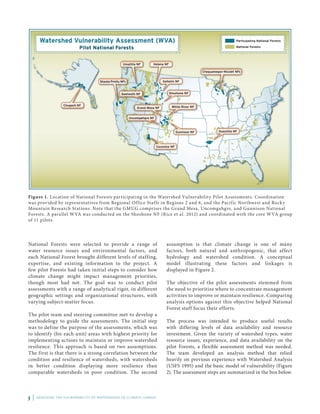
Forest Service, stationed on eleven National Forests
(see Figure 1). The group was supported by a steering
committee composed of representatives from two
Research Stations and two Regional Offices. Pilot
“Watershed condition is the state of the physical
and biological characteristics and processes within
a watershed that affect the soil and hydrologic
functions supporting aquatic ecosystems.... When
watersheds are functioning properly, they create
and sustain functional terrestrial, riparian, aquatic,
and wetland habitats that are capable of supporting
diverse populations of native aquatic- and riparian-
dependent species. In general, the greater the
departure from the natural pristine state, the more
impaired the watershed condition is likely to be....”
Watersheds that are functioning properly have five
important characteristics (Williams et al. 1997):
1. 	They provide for high biotic integrity, which
includes habitats that support adaptive animal
and plant communities that reflect natural
processes.
2. 	They are resilient and recover rapidly from
natural and human disturbances.
3. 	They exhibit a high degree of connectivity
longitudinally along the stream, laterally across
the floodplain and valley bottom, and vertically
between surface and subsurface flows.
4. 	They provide important ecosystem services, such
as high quality water, the recharge of streams
and aquifers, the maintenance of riparian
communities, and the moderation of climate
variability and change.
5. 	They maintain long-term soil productivity.
From the USFS Watershed Condition Framework
(USDA 2011b)
3 | ASSESSING THE VULNERABILITY OF WATERSHEDS TO CLIMATE CHANGE
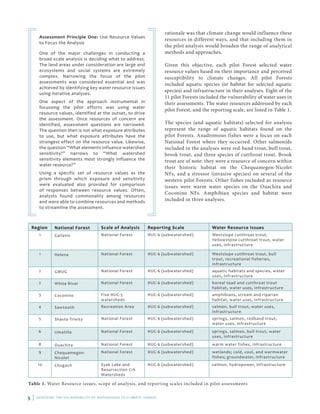
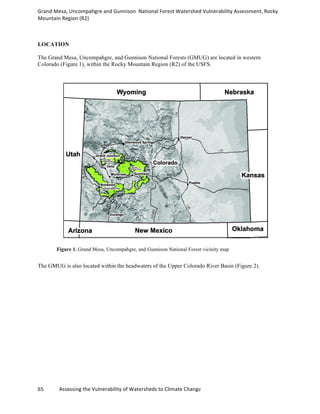
Figure 1. Location of National Forests participating in the Watershed Vulnerability Pilot Assessments. Coordination
was provided by representatives from Regional Office Staffs in Regions 2 and 6, and the Pacific Northwest and Rocky
Mountain Research Stations. Note that the GMUG comprises the Grand Mesa, Uncomgahgre, and Gunnison National
Forests. A parallel WVA was conducted on the Shoshone NF (Rice et al. 2012) and coordinated with the core WVA group
of 11 pilots.
National Forests were selected to provide a range of
water resource issues and environmental factors, and
each National Forest brought different levels of staffing,
expertise, and existing information to the project. A
few pilot Forests had taken initial steps to consider how
climate change might impact management priorities,
though most had not. The goal was to conduct pilot
assessments with a range of analytical rigor, in different
geographic settings and organizational structures, with
varying subject-matter focus.
The pilot team and steering committee met to develop a
methodology to guide the assessments. The initial step
was to define the purpose of the assessments, which was
to identify (for each unit) areas with highest priority for
implementing actions to maintain or improve watershed
resilience. This approach is based on two assumptions.
The first is that there is a strong correlation between the
condition and resilience of watersheds, with watersheds
in better condition displaying more resilience than
comparable watersheds in poor condition. The second
assumption is that climate change is one of many
factors, both natural and anthropogenic, that affect
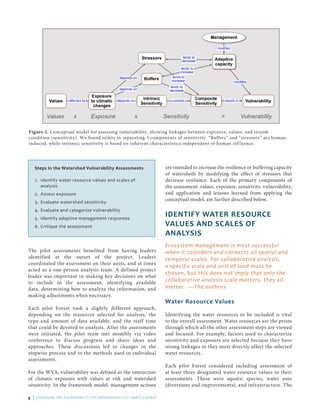
hydrology and watershed condition. A conceptual
model illustrating these factors and linkages is
displayed in Figure 2.
The objective of the pilot assessments stemmed from
the need to prioritize where to concentrate management
activities to improve or maintain resilience. Comparing
analysis options against this objective helped National
Forest staff focus their efforts.
The process was intended to produce useful results
with differing levels of data availability and resource
investment. Given the variety of watershed types, water
resource issues, experience, and data availability on the
pilot Forests, a flexible assessment method was needed.
The team developed an analysis method that relied
heavily on previous experience with Watershed Analysis
(USFS 1995) and the basic model of vulnerability (Figure
2). The assessment steps are summarized in the box below.
4 | ASSESSING THE VULNERABILITY OF WATERSHEDS TO CLIMATE CHANGE
Steps in the Watershed Vulnerability Assessments
1.	 Identify water resource values and scales of
analysis
2.	 Assess exposure
3.	 Evaluate watershed sensitivity
4.	 Evaluate and categorize vulnerability
5.	 Identify adaptive management responses
6.	 Critique the assessment
The pilot assessments benefited from having leaders
identified at the outset of the project. Leaders
coordinated the assessment on their units, and at times
acted as a one-person analysis team. A defined project
leader was important in making key decisions on what
to include in the assessment, identifying available
data, determining how to analyze the information, and
making adjustments when necessary.
Each pilot Forest took a slightly different approach,
depending on the resources selected for analysis, the
type and amount of data available, and the staff time
that could be devoted to analysis. After the assessments
were initiated, the pilot team met monthly via video
conference to discuss progress and share ideas and
approaches. These discussions led to changes in the
stepwise process and to the methods used in individual
assessments.
For the WVA, vulnerability was defined as the interaction
of climatic exposure with values at risk and watershed
sensitivity. In the framework model, management actions
are intended to increase the resilience or buffering capacity
of watersheds by modifying the effect of stressors that
decrease resilience. Each of the primary components of
the assessment: values, exposure, sensitivity, vulnerability,
and application and lessons learned from applying the
conceptual model, are further described below.
IDENTIFY WATER RESOURCE
VALUES AND SCALES OF
ANALYSIS
Ecosystem management is most successful
when it considers and connects all spatial and
temporal scales. For collaborative analysis,
a specific scale and unit of land must be
chosen, but this does not imply that only the
collaborative analysis scale matters: they all
matter. —The authors
Water Resource Values
Identifying the water resources to be included is vital
to the overall assessment. Water resources are the prism
through which all the other assessment steps are viewed
and focused. For example, factors used to characterize
sensitivity and exposure are selected because they have
strong linkages or they most directly affect the selected
water resources.
Each pilot Forest considered including assessment of
at least three designated water resource values in their
assessments. These were aquatic species, water uses
(diversions and improvements), and infrastructure. The
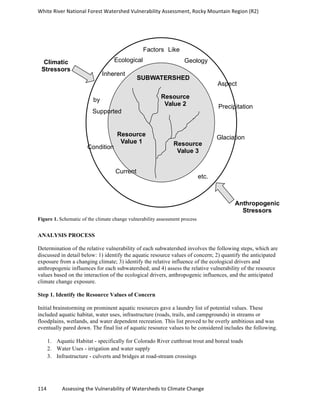
Figure 2. Conceptual model for assessing vulnerability, showing linkages between exposure, values, and system
condition (sensitivity). We found utility in separating 3 components of sensitivity. “Buffers” and “stressors” are human-
induced, while intrinsic sensitivity is based on inherent characteristics independent of human inf luence.
5 | ASSESSING THE VULNERABILITY OF WATERSHEDS TO CLIMATE CHANGE
Assessment Principle One: Use Resource Values
to Focus the Analysis
One of the major challenges in conducting a
broad-scale analysis is deciding what to address.
The land areas under consideration are large and
ecosystems and social systems are extremely
complex. Narrowing the focus of the pilot
assessments was considered essential and was
achieved by identifying key water resource issues
using iterative analyses.
One aspect of the approach instrumental in
focussing the pilot efforts was using water
resource values, identified at the outset, to drive
the assessment. Once resources of concern are
identified, assessment questions are narrowed.
The question then is not what exposure attributes
to use, but what exposure attributes have the
strongest effect on the resource value. Likewise,
the question “What elements influence watershed
sensitivity?” narrows to “What watershed
sensitivity elements most strongly influence the
water resource?”
Using a specific set of resource values as the
prism through which exposure and sensitivity
were evaluated also provided for comparison
of responses between resource values. Often,
analysts found commonality among resources
and were able to combine resources and methods
to streamline the assessment.
rationale was that climate change would influence these
resources in different ways, and that including them in
the pilot analysis would broaden the range of analytical
methods and approaches.
Given this objective, each pilot Forest selected water
resource values based on their importance and perceived
susceptibility to climate changes. All pilot Forests
included aquatic species (or habitat for selected aquatic
species) and infrastructure in their analyses. Eight of the
11 pilot Forests included the vulnerability of water uses in
their assessments. The water resources addressed by each
pilot Forest, and the reporting scale, are listed in Table 1.
The species (and aquatic habitats) selected for analysis
represent the range of aquatic habitats found on the
pilot Forests. Anadromous fishes were a focus on each
National Forest where they occurred. Other salmonids
included in the analyses were red-band trout, bull trout,
brook trout, and three species of cutthroat trout. Brook
trout are of note: they were a resource of concern within
their historic habitat on the Chequamegon-Nicolet
NFs, and a stressor (invasive species) on several of the
western pilot Forests. Other fishes included as resource
issues were warm water species on the Ouachita and
Coconino NFs. Amphibian species and habitat were
included in three analyses.
Region National Forest Scale of Analysis Reporting Scale Water Resource Issues
1 Gallatin National Forest HUC-6 (subwatershed) Westslope cutthroat trout,
Yellowstone cutthroat trout, water
uses, infrastructure
1 Helena National Forest HUC-6 (subwatershed) Westslope cutthroat trout, bull
trout, recreational fisheries,
infrastructure
2 GMUG National Forest HUC-6 (subwatershed) aquatic habitats and species, water
uses, infrastructure
2 White River National Forest HUC-6 (subwatershed) boreal toad and cutthroat trout
habitat, water uses, infrastructure
3 Coconino Five HUC-5
watersheds
HUC-6 (subwatershed) amphibians, stream and riparian
habitat, water uses, infrastructure
4 Sawtooth Recreation Area HUC-6 (subwatershed) salmon, bull trout, water uses,
infrastructure
5 Shasta-Trinity National Forest HUC-6 (subwatershed) springs, salmon, redband trout,
water uses, infrastructure
6 Umatilla National Forest HUC-6 (subwatershed) springs, salmon, bull trout, water
uses, infrastructure
8 Ouachita National Forest HUC-6 (subwatershed) warm water fishes, infrastructure
9 Chequamegon-
Nicolet
National Forest HUC-6 (subwatershed) wetlands; cold, cool, and warmwater
fishes; groundwater, infrastructure
10 Chugach Eyak Lake and
Resurrection Crk
Watersheds
HUC-6 (subwatershed) salmon, hydropower, infrastructure
Table 1. Water Resource issues, scope of analysis, and reporting scales included in pilot assessments
6 | ASSESSING THE VULNERABILITY OF WATERSHEDS TO CLIMATE CHANGE
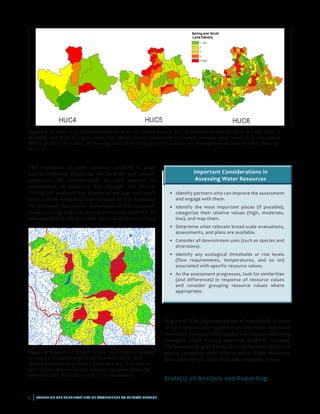
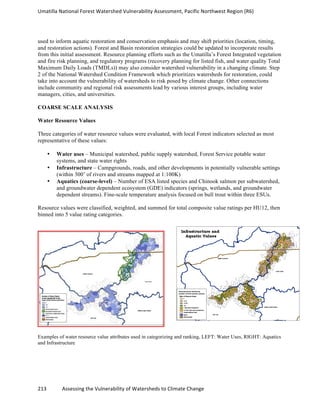
The evaluation of water resources resulted in maps
and descriptions displaying the location and relative
importance by subwatersheds for each resource or
combination of resources. For example, the Shasta-
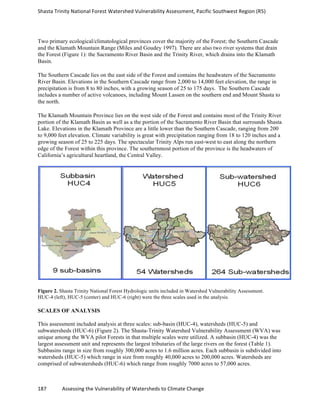
Trinity NF analyzed the density of springs and small
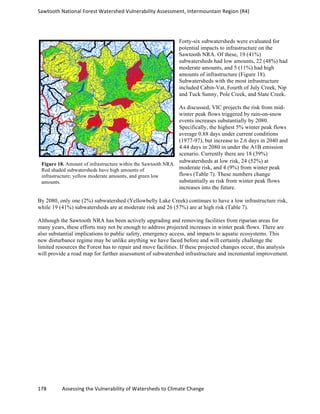
lakes at three watershed scales (Figure 3). The Sawtooth
NF displayed the relative importance of infrastructure
(road crossings and near-stream recreation facilities) by
subwatershed in the Sawtooth National Recreation Area
Figure 3. Density of springs and small lakes on the Shasta-Trinity NFs. Results are shown for HUC-4 (left), HUC‑5
(middle), and HUC-6 (right) scales. The Shasta-Trinity assessment evaluated resource value, sensitivity, and vulner­
ability at the three scales, all showing that identifying priority locations for management actions was best done by
HUC-6.
Figure 4. Amount of infrastructure (roads and developed
recreation facilities) within the Sawtooth NRA. Red-
shaded subwatersheds have highest density of infra­struc­
ture, yellow show moderate density, and green show the
lowest density. Red lines are HUC-4 boundaries.
Important Considerations in
Assessing Water Resources
•	 Identify partners who can improve the assessment
and engage with them.
•	 Identify the most important places (if possible),
categorize their relative values (high, moderate,
low), and map them.
•	 Determine what relevant broad-scale evaluations,
assessments, and plans are available.
•	 Consider all downstream uses (such as species and
diversions).
•	 Identify any ecological thresholds or risk levels
(flow requirements, temperatures, and so on)
associated with specific resource values.
•	 As the assessment progresses, look for similarities
(and differences) in response of resource values
and consider grouping resource values where
appropriate.
(Figure 4). The characterization of watersheds in terms
of the resources they support is an important step in any
watershed planning effort and a first step in informing
managers where limited resources might be invested.
The assessment goal was to identify the most important
places, categorize their relative value (high, moderate,
low), and map the individual and composite values.
Scale(s) of Analysis and Reporting
7 | ASSESSING THE VULNERABILITY OF WATERSHEDS TO CLIMATE CHANGE
The Pilot Assessments were conducted over relatively
large geographic areas, typically (8 of the 11 pilots) an
entire Forest. Three Forests analyzed smaller areas for
specific reasons. The Chugach NF (R-10) focused on
subwatersheds where management activities would be
most influenced by the results of the assessment. The
Assessment Principle Two: The HUC-6 is Currently
the Best Scale for Analysis and Reporting
The scale for the pilot assessments was not
prescribed, but all pilot Forests elected to use
the HUC-6 (subwatershed) scale to characterize
and map results. Climatic exposure data was
often available, displayed, and assessed at scales
larger than HUC-6; the work by the Shasta-Trinity
NFs demonstrated that HUC-4 and HUC-5 scales
are usually too large to effectively manage for
water values, sensitivity, adaptive capacity, and
resilience. The HUC-6 is the appropriate size
for planning and implementing management
strategies to sustain or improve watershed
condition. In addition, HUC-6 is also the scale
used to assess and report conditions for the
Classification portion of the Watershed Condition
Framework.
Coconino NF (R-3) included 5 watersheds (HUC-5) that
support the majority of aquatic resources on the Forest.
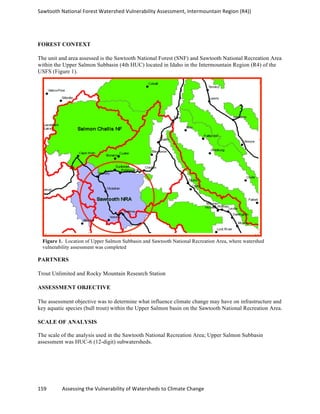
The Sawtooth NF limited its evaluation to the Sawtooth
National Recreation Area because it supports remaining
strongholds for steelhead, bull trout, and Chinook and
sockeye salmon listed under the Endangered Species Act
and significant data were available for this area of the
forest.
All of the pilot Forests used the subwatershed (HUC-6)
scale for analysis and reporting. This arose from the
shared conclusion that subwatersheds provide a logical
unit and scale for setting priorities and implementing
management activities on National Forest system lands.
The Shasta-Trinity NFs also used the HUC-6 as the scale
to apply results of the vulnerability assessment, and, in
addition, evaluated water resource values, watershed
sensitivity, and vulnerability at two broader scales
(HUC-4 and HUC-5). The results from the Shasta-
Trinity suggest that general trends can be expressed at
broader scales, but as might be expected, detail shown
at the HUC-6 scale is lost at each higher level (Figure 3).
While HUC-6 was determined to be the best reporting
unit for displaying water resource values, sensitivity,
and vulnerability, exposure information is generally
available and appropriately used only at broader scales.
As a result, most pilot Forests evaluated exposure at the
HUC-5 scale.
ASSESS EXPOSURE
So why worry about global warming, which
is just one more scale of climate change? The
problem is that global warming is essentially
off the scale of normal in two ways: the rate at
which this climate change is taking place, and
how different the "new" climate is compared
to what came before. —Anthony D. Barnosky
The consideration of climate change exposure data is the
primary difference between the WVA and evaluations
that Forest Service professionals have previously
produced. Past assessments have been conducted
for watershed analysis, restoration planning, and
watershed condition. Pilot team members built upon
this experience but few team members had used or were
familiar with climate change projections.
Analysis of exposure included four components: 1) review
and evaluation of pertinent local historic climatic data,
Assessment Principle Three: Local Climate Data
Provides Context
Local or regional examples of historic changes
in climate and to valued resources should be
incorporated as components of the assessment.
Such information (e.g., historic trends in
temperature and precipitation, changes in ice
duration, or species phenology) can readily
illustrate current influences on water resources.
These data are local, and usually of high confidence.
Use of local and regional climatological data, field
observations, and local knowledge helps to frame
the importance of climate change in terms that are
better understood and appreciated than relying
only on model-based projections of future climate.
2) selection and use of one or two modeled projections
of future climate conditions, 3) analyses of historic and
projected changes to hydrologic processes that might
affect water resources, and 4) selection of metrics to
analyze and display differences in exposure across each
analysis area.
8 | ASSESSING THE VULNERABILITY OF WATERSHEDS TO CLIMATE CHANGE
Using Historic Data
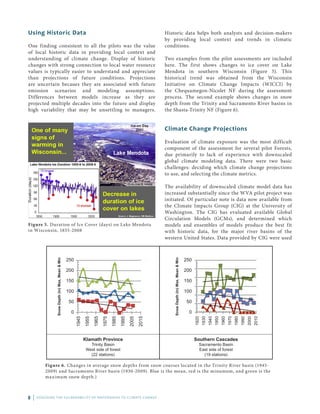
One finding consistent to all the pilots was the value
of local historic data in providing local context and
understanding of climate change. Display of historic
changes with strong connection to local water resource
values is typically easier to understand and appreciate
than projections of future conditions. Projections
are uncertain becaues they are associated with future
emission scenarios and modeling assumptions.
Differences between models increase as they are
projected multiple decades into the future and display
high variability that may be unsettling to managers.
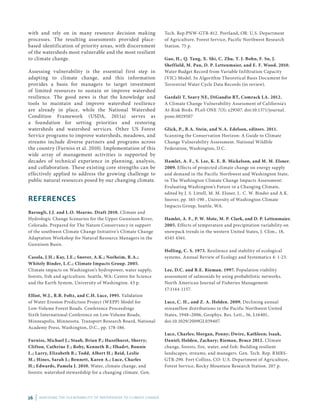
Figure 5. Duration of Ice Cover (days) on Lake Mendota
in Wisconsin, 1855-2008
SnowDepth(in)Max,Mean&Min
250
200
150
100
50
0
1945
1955
1965
1975
1985
1995
2005
2015
SnowDepth(in)Max,Mean&Min
250
200
150
100
50
0
1920
1930
1940
1950
1960
1970
1980
1990
2000
2010
Klamath Province
Trinity Basin
West side of forest
(22 stations)
Southern Cascades
Sacramento Basin
East side of forest
(19 stations)
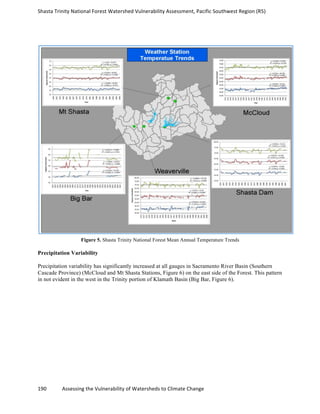
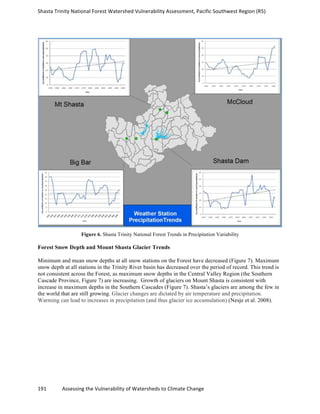
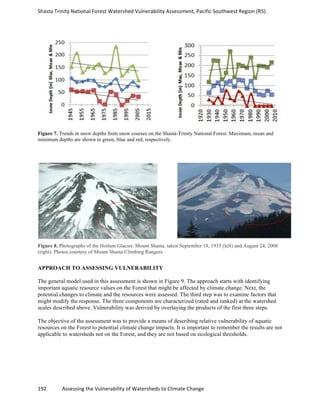
Figure 6. Changes in average snow depths from snow courses located in the Trinity River basin (1945-
2009) and Sacramento River basin (1930-2009). Blue is the mean, red is the minumum, and green is the
maximum snow depth.)
Historic data helps both analysts and decision-makers
by providing local context and trends in climatic
conditions.
Two examples from the pilot assessments are included
here. The first shows changes to ice cover on Lake
Mendota in southern Wisconsin (Figure 5). This
historical trend was obtained from the Wisconsin
Initiative on Climate Change Impacts (WICCI) by
the Chequamegon-Nicolet NF during the assessment
process. The second example shows changes in snow
depth from the Trinity and Sacramento River basins in
the Shasta-Trinity NF (Figure 6).
Climate Change Projections
Evaluation of climate exposure was the most difficult
component of the assessment for several pilot Forests,
due primarily to lack of experience with downscaled
global climate modeling data. There were two basic
challenges: deciding which climate change projections
to use, and selecting the climate metrics.
The availability of downscaled climate model data has
increased substantially since the WVA pilot project was
initiated. Of particular note is data now available from
the Climate Impacts Group (CIG) at the University of
Washington. The CIG has evaluated available Global
Circulation Models (GCMs), and determined which
models and ensembles of models produce the best fit
with historic data, for the major river basins of the
western United States. Data provided by CIG were used
9 | ASSESSING THE VULNERABILITY OF WATERSHEDS TO CLIMATE CHANGE
for evaluations conducted in Regions 1, 2, 3, 4, and 6. The
GMUG NFs used projections from CIG, and additional
projections for the Upper Gunnison River (Barsugli
and Mearns Draft 2010). In retrospect, providing data
available from CIG at the outset would have expedited
some analyses and greatly assisted the process.
Increases in temperature (ºF) Percent change in precipitation
B1 2050 B1 2080 A1B 2050 A1B 2080 B1 2050 B1 2080 A1B 2050 A1B 2080
January 2.70 4.42 4.38 6.00 (0.69) 8.85 5.98 1.68
February 3.50 4.01 4.46 5.19 (0.97) (4.50) (2.54) (1.24)
March 3.46 4.25 4.70 5.74 (0.75) (4.30) 0.63 (5.17)
April 2.99 4.46 4.49 5.93 5.42 2.45 (1.19) 0.67
May 3.68 4.48 5.02 7.16 (8.46) (1.28) (6.26) (10.68)
June 3.90 4.64 5.34 7.04 (5.87) (7.17) (8.76) (12.37)
July 4.14 4.98 5.40 7.28 (8.34) (2.70) (7.39) (12.84)
August 4.13 5.04 5.21 6.84 1.20 6.97 1.52 2.61
September 4.23 5.49 5.35 7.45 (0.49) 1.10 (3.47) 1.32
October 4.12 5.46 5.29 7.15 (13.81) (8.17) (9.75) (8.17)
November 3.52 4.36 4.93 6.15 0.91 (5.08) (7.93) (8.75)
December 3.18 4.40 4.11 5.97 5.20 (9.39) (1.69) (1.68)
Annual 3.63 4.67 4.89 6.49 (2.22) (1.93) (3.40) (4.55)
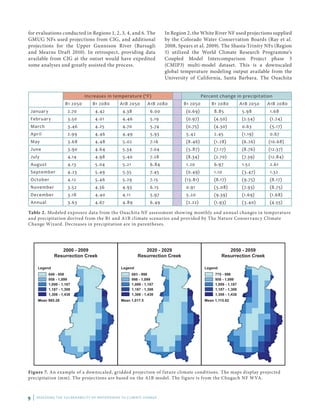
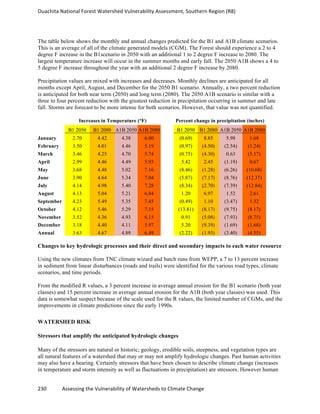
Table 2. Modeled exposure data from the Ouachita NF assessment showing monthly and annual changes in temperature
and precipitation derived from the B1 and A1B climate scenarios and provided by The Nature Conservancy Climate
Change Wizard. Decreases in precipitation are in parentheses.
2000 - 2009
Resurrection Creek
2020 - 2029
Resurrection Creek
2050 - 2059
Resurrection Creek
649 - 958
958 - 1,099
1,099 - 1,187
1,187 - 1,308
1,308 - 1,438
Legend
Mean 985.28
683 - 998
998 - 1,099
1,099 - 1,187
1,187 - 1,308
1,308 - 1,438
Legend
Mean 1,017.5
775 - 998
958 - 1,099
1,099 - 1,187
1,187 - 1,308
1,308 - 1,438
Legend
Mean 1,115.62
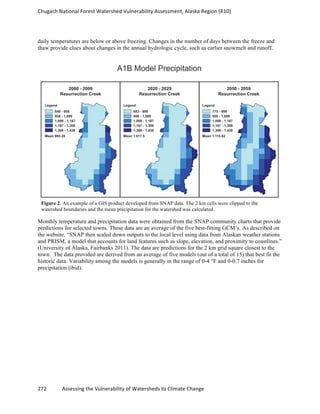
Figure 7. An example of a downscaled, gridded projection of future climate conditions. The maps display projected
precipitation (mm). The projections are based on the A1B model. The figure is from the Chugach NF WVA.
In Region 2, the White River NF used projections supplied
by the Colorado Water Conservation Boards (Ray et al.
2008, Spears et al. 2009). The Shasta-Trinity NFs (Region
5) utilized the World Climate Research Programme's
Coupled Model Intercomparison Project phase 3
(CMIP3) multi-model dataset. This is a downscaled
global temperature modeling output available from the
University of California, Santa Barbara. The Ouachita
10 | ASSESSING THE VULNERABILITY OF WATERSHEDS TO CLIMATE CHANGE
NF (Region 8) relied on information from The Nature
Conservancy’s Climate Change Wizard (Table 2). The
Chequamegon-Nicolet NF (Region 9) employed data
from WICCI, and the Chugach NF (Region 10) utilized
projections provided by the University of Alaska,
Fairbanks (UAF) Scenarios Network for Alaska Planning
Project (Figure 7).
All the pilot assessments used air temperature change
projections in their analyses and most pilots included
projected changes to precipitation. These projections
were obtained from the variety of publically available
state or regional climate sources listed above. All
projections of future climate are based on General
Circulation Models (GCM). These models are
mathematical representations of atmospheric and
oceanic motion, physics, and chemistry, and employ
different emission scenarios to yield predictions of
temperature and precipitation change. The global-
scale model outputs are very coarse, so data are
often downscaled and used as inputs to macro-scale
hydrologic models for use in regional and finer scale
analysis, such as the WVA pilots. The accuracy of the
data becomes more uncertain with each subsequent layer
of modeling. The greatest certainty is associated with
air temperature projections. Precipitation projections
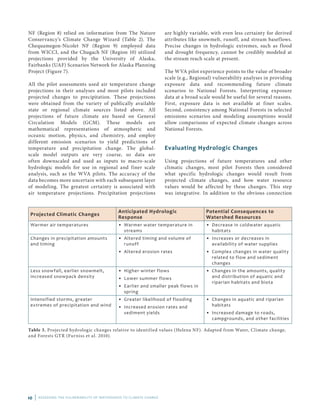
Projected Climatic Changes
Anticipated Hydrologic
Response
Potential Consequences to
Watershed Resources
Warmer air temperatures •	 Warmer water temperature in
streams
•	 Decrease in coldwater aquatic
habitats
Changes in precipitation amounts
and timing
•	 Altered timing and volume of
runoff
•	 Altered erosion rates
•	 Increases or decreases in
availability of water supplies
•	 Complex changes in water quality
related to flow and sediment
changes
Less snowfall, earlier snowmelt,
increased snowpack density
•	 Higher winter flows
•	 Lower summer flows
•	 Earlier and smaller peak flows in
spring
•	 Changes in the amounts, quality
and distribution of aquatic and
riparian habitats and biota
Intensified storms, greater
extremes of precipitation and wind
•	 Greater likelihood of flooding
•	 Increased erosion rates and
sediment yields
•	 Changes in aquatic and riparian
habitats
•	 Increased damage to roads,
campgrounds, and other facilities
Table 3. Projected hydrologic changes relative to identified values (Helena NF). Adapted from Water, Climate change,
and Forests GTR (Furniss et al. 2010).
are highly variable, with even less certainty for derived
attributes like snowmelt, runoff, and stream baseflows.
Precise changes in hydrologic extremes, such as flood
and drought frequency, cannot be credibly modeled at
the stream reach scale at present.
The WVA pilot experience points to the value of broader
scale (e.g., Regional) vulnerability analyses in providing
exposure data and recommending future climate
scenarios to National Forests. Interpreting exposure
data at a broad scale would be useful for several reasons.
First, exposure data is not available at finer scales.
Second, consistency among National Forests in selected
emissions scenarios and modeling assumptions would
allow comparisons of expected climate changes across
National Forests.
Evaluating Hydrologic Changes
Using projections of future temperatures and other
climatic changes, most pilot Forests then considered
what specific hydrologic changes would result from
projected climate changes, and how water resource
values would be affected by these changes. This step
was integrative. In addition to the obvious connection
11 | ASSESSING THE VULNERABILITY OF WATERSHEDS TO CLIMATE CHANGE
between exposure and water resources, the evaluation
served to stimulate thinking about which watershed
characteristics might influence (either moderate or
exacerbate) the hydrologic response to climate change,
providing a segue to evaluating watershed sensitivity.
An example of this type of analysis, which tracks
climate changes through hydrologic responses to
potential impacts on water resources from the Helena
NF, is provided in Table 3.
Applying Exposure Projections
Once the hydrologic processes important to selected
water resource values were identified, exposure metrics
closely linked to those processes were identified.
The list of metrics used to characterize exposure was
limited because of the commonality in water resources
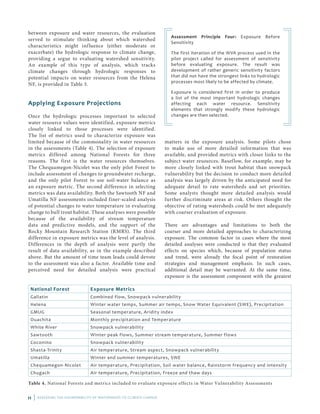
in the assessments (Table 4). The selection of exposure
metrics differed among National Forests for three
reasons. The first is the water resources themselves.
The Chequamegon-Nicolet was the only pilot Forest to
include assessment of changes to groundwater recharge,
and the only pilot Forest to use soil-water balance as
an exposure metric. The second difference in selecting
metrics was data availability. Both the Sawtooth NF and
Umatilla NF assessments included finer-scaled analysis
of potential changes to water temperature in evaluating
change to bull trout habitat. These analyses were possible
because of the availability of stream temperature
data and predictive models, and the support of the
Rocky Mountain Research Station (RMRS). The third
difference in exposure metrics was the level of analysis.
Differences in the depth of analysis were partly the
result of data availability, as in the example described
above. But the amount of time team leads could devote
to the assessment was also a factor. Available time and
perceived need for detailed analysis were practical
National Forest Exposure Metrics
Gallatin Combined flow, Snowpack vulnerability
Helena Winter water temps, Summer air temps, Snow Water Equivalent (SWE), Precipitation
GMUG Seasonal temperature, Aridity index
Ouachita Monthly precipitation and Temperature
White River Snowpack vulnerability
Sawtooth Winter peak flows, Summer stream temperature, Summer flows
Coconino Snowpack vulnerability
Shasta-Trinity Air temperature, Stream aspect, Snowpack vulnerability
Umatilla Winter and summer temperatures, SWE
Chequamegon-Nicolet Air temperature, Precipitation, Soil water balance, Rainstorm frequency and intensity
Chugach Air temperature, Precipitation, Freeze and thaw days
Table 4. National Forests and metrics included to evaluate exposure effects in Water Vulnerability Assessments
Assessment Principle Four: Exposure Before
Sensitivity
The first iteration of the WVA process used in the
pilot project called for assessment of sensitivity
before evaluating exposure. The result was
development of rather generic sensitivity factors
that did not have the strongest links to hydrologic
processes most likely to be affected by climate.
Exposure is considered first in order to produce
a list of the most important hydrologic changes
affecting each water resource. Sensitivity
elements that strongly modify these hydrologic
changes are then selected.
matters in the exposure analysis. Some pilots chose
to make use of more detailed information that was
available, and provided metrics with closer links to the
subject water resources. Baseflow, for example, may be
more closely linked with trout habitat than snowpack
vulnerability but the decision to conduct more detailed
analysis was largely driven by the anticipated need for
adequate detail to rate watersheds and set priorities.
Some analysts thought more detailed analysis would
further discriminate areas at risk. Others thought the
objective of rating watersheds could be met adequately
with coarser evaluation of exposure.
There are advantages and limitations to both the
coarser and more detailed approaches to characterizing
exposure. The common factor in cases where the most
detailed analyses were conducted is that they evaluated
effects on species which, because of population status
and trend, were already the focal point of restoration
strategies and management emphasis. In such cases,
additional detail may be warranted. At the same time,
exposure is the assessment component with the greatest
12 | ASSESSING THE VULNERABILITY OF WATERSHEDS TO CLIMATE CHANGE
level of uncertainty. Though there may be uncertainty
in characterizing resource value, especially when ratings
comprise more than one resource (for example, frogs plus
fish species), descriptions of resource locations generally
have little error. Likewise, assessments of sensitivity, as
we will see in the next section, are composites of both
intrinsic and anthropogenic factors. Schemes to combine
or weigh the factors contain error, relative to how these
factors are expressed in nature. Nevertheless, these
assessment components are likely to be more accurate
than projections of future temperature and snowpack,
especially regarding what will actually occur decades
from now.
On the White River, Gallatin, and Coconino NFs,
changes to snowmelt hydrology were determined to
be the primary hydrologic change affecting selected
resources. In both the White River NF and Coconino
NF assessments, changes to the existing snow line due
to projected temperature increases were anticipated. The
watershed area within zones of predicted snow elevation
change was used to characterize relative exposure
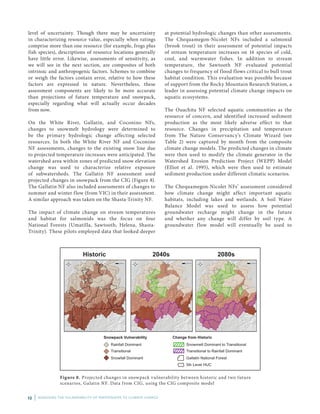
of subwatersheds. The Gallatin NF assessment used
projected changes in snowpack from the CIG (Figure 8).
The Gallatin NF also included assessments of changes to
summer and winter flow (from VIC) in their assessment.
A similar approach was taken on the Shasta-Trinity NF.
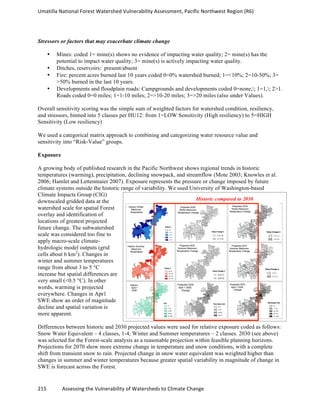
The impact of climate change on stream temperatures
and habitat for salmonids was the focus on four
National Forests (Umatilla, Sawtooth, Helena, Shasta-
Trinity). These pilots employed data that looked deeper
at potential hydrologic changes than other assessments.
The Chequamegon-Nicolet NFs included a salmonid
(brook trout) in their assessment of potential impacts
of stream temperature increases on 16 species of cold,
cool, and warmwater fishes. In addition to stream
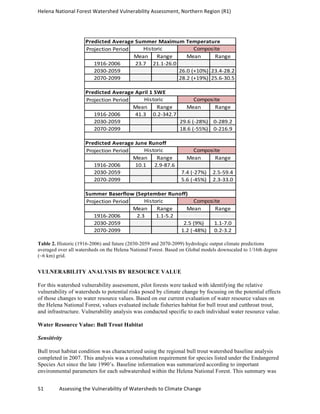
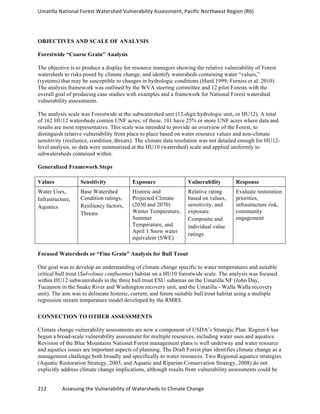
temperature, the Sawtooth NF evaluated potential
changes to frequency of flood flows critical to bull trout
habitat condition. This evaluation was possible because
of support from the Rocky Mountain Research Station, a
leader in assessing potential climate change impacts on
aquatic ecosystems.
The Ouachita NF selected aquatic communities as the
resource of concern, and identified increased sediment
production as the most likely adverse effect to that
resource. Changes in precipitation and temperature
from The Nature Conservancy’s Climate Wizard (see
Table 2) were captured by month from the composite
climate change models. The predicted changes in climate
were then used to modify the climate generator in the
Watershed Erosion Prediction Project (WEPP) Model
(Elliot et al. 1995), which were then used to estimate
sediment production under different climatic scenarios.
The Chequamegon-Nicolet NFs’ assessment considered
how climate change might affect important aquatic
habitats, including lakes and wetlands. A Soil Water
Balance Model was used to assess how potential
groundwater recharge might change in the future
and whether any change will differ by soil type. A
groundwater flow model will eventually be used to
Historic 2040s 2080s
Snowpack Vulnerability
Rainfall Dominant
Transitional
Snowmelt Dominant to Transitional
Transitional to Rainfall Dominant
Gallatin National Forest
5th Level HUC
Snowfall Dominant
Change from Historic
Figure 8. Projected changes in snowpack vulnerability between historic and two future
scenarios, Galatin NF. Data from CIG, using the CIG composite model
13 | ASSESSING THE VULNERABILITY OF WATERSHEDS TO CLIMATE CHANGE
determine changes in groundwater levels and flow rates
to lakes, streams, and wetlands.
The analysis on the GMUG NFs differed from other
assessments, in that results were displayed at a large scale.
Six large geographic areas, stratified by climatic regime
and elevation, were used for graphical analysis. Projected
changes to maximum and minimum air temperatures
and an index of aridity were factors used to rate exposure
in each of these geographical areas. This analysis
technique was at least partially driven by the resolution
of the downscaled exposure data, which is typically on
a grid of 6 km2 (Figure 7). This fairly gross resolution
results in as few as two or three data points for a HUC-6,
making discrimination at this scale inappropriate. As a
result, pilots typically used HUC-6 for distinguishing
differences in resource densities and sensitivity, overlaid
with a larger-scale rating of exposure.
Climate models typically provide predictions of
temperature and precipitation. These data are then
combined with characterizations of watershed
characteristics and vegetation in modeling of
other hydrologic variables. CIG has also developed
predictions of hydrologic change based on the Variable
Infiltration Capacity (VIC) model (Gao et al. in review).
The CIG was extremely helpful in releasing data for
use during the pilot study, and in explaining its utility
and limitations. VIC is a distributed, largely physically-
based macro-scale model that balances water and energy
fluxes at the land surface and takes into account soil
moisture, infiltration, runoff, and baseflow processes
within vegetation classes. It has been widely used in
Assessment Principle Five: Don't Get Lost in
Exposure Data
Pilot Forests used exposure data of different
specificity and detail (for example, in one
case, only air temperature change; in another,
predicted stream temperatures). The level of
detail influenced the analysis, but the take-home
message is that all levels of exposure projections
produced useable vulnerability assessments.
Detailed projections at management-relevant
scales are not necessary to gauge relative
vulnerability of watersheds. It is more productive
to move forward with the analysis than to get lost
in the details of refining exposure data.
the western U.S. to study past and potential future
changes to water flow regimes (e.g., Hamlet et al. 2009),
snowpacks (Hamlet et al. 2005), and droughts (Luo and
Wood 2007). Several pilots (Helena, GMUG, Coconino,
and Sawtooth NFs) made use of the VIC model outputs
to evaluate exposure. VIC attributes evaluated by pilots
included runoff, baseflow, and snow water equivalent.
Several pilots employed projections of changes to flow
characteristics. These were selected because of their
important influence on habitat for species of concern.
Flow metrics were also useful in describing relative
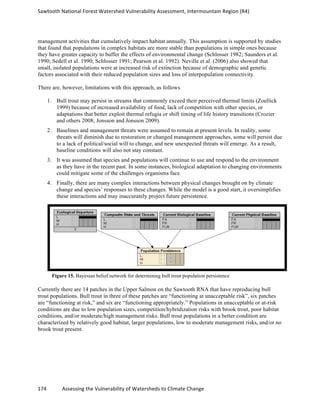
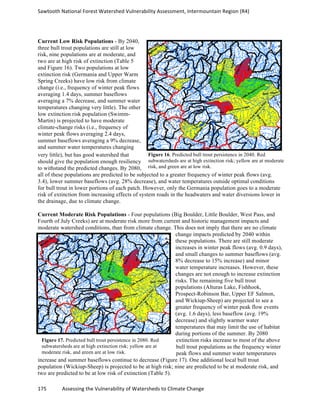
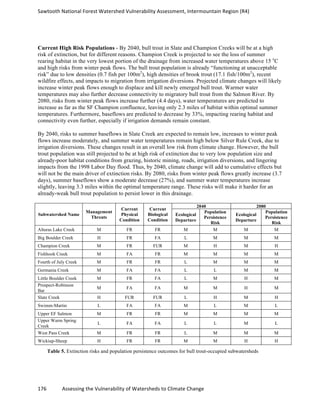
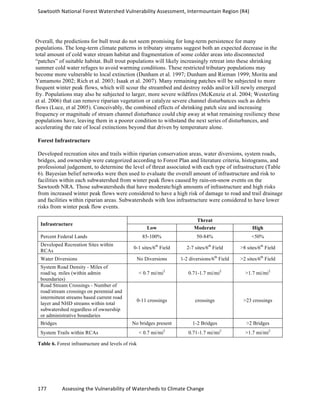
exposure of water uses. In contrast, predictions of peak-
and low-flow responses to climate change are limited
and consist primarily of generalized predictions of
higher peaks and more severe droughts with warming
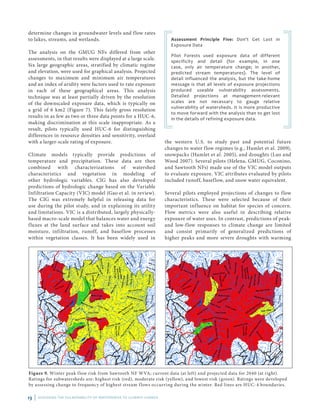
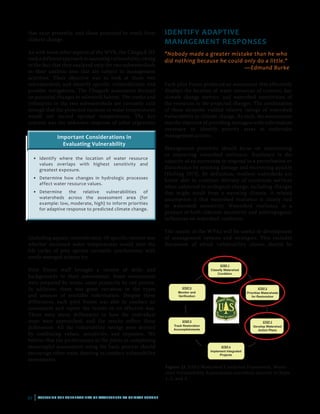
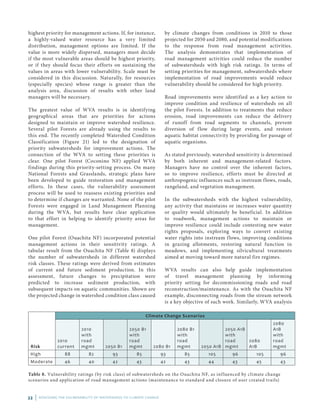
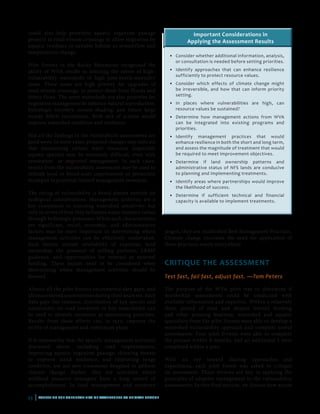
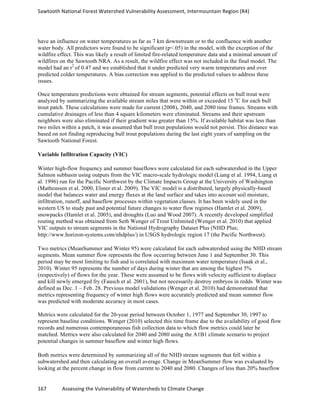
Figure 9. Winter peak flow risk from Sawtooth NF WVA; current data (at left) and projected data for 2040 (at right).
Ratings for subwatersheds are: highest risk (red), moderate risk (yellow), and lowest risk (green). Ratings were developed
by assessing change to frequency of highest stream flows occurring during the winter. Red lines are HUC-4 boundaries.
14 | ASSESSING THE VULNERABILITY OF WATERSHEDS TO CLIMATE CHANGE
climate (Casola et al. 2005). Only the Sawtooth NF
applied a tool useful in describing exposure relative to
increased peak flows and infrastructure. This analysis
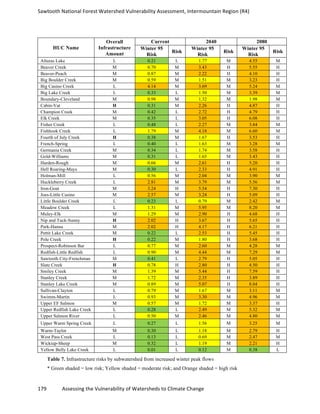
used the VIC-generated “Winter 95” metric. Winter 95
represents the number of days during winter that are
among the highest 5% of flows for the year. Winter was
defined as Dec. 1 – Feb. 28. Changes in Winter 95 were
determined by comparing the increase in the number
of days with the highest 5% flows between current and
predicted conditions (2040 and 2080). Subwatersheds
with less than a 0.5-day increase were considered low
risk, those with 0.5- to 2-day increases were considered
moderate risk, and subwatersheds with increases greater
than 2 days were considered high risk. Results of this
analysis for 2040 are depicted in Figure 9.
At first glance, the difference in metrics and the level of
detail might suggest pilots took very different paths in
their characterization of exposure. In fact, all the pilots
Important Considerations in
Evaluating Exposure
•	 Quantify trends in available, relevant, historical
climate datasets. Local and regional data that
display significant changes demonstrate the
likelihood that changes will continue into the
future. Observed changes and trends in ecosystem
traits, such as ice duration, species phenology,
and species composition, are of great value.
•	Use best available climate change projections.
Focus on near-term time frames.
•	Identify the effects of a changing climate on
watershed processes to inform iterations of
exposure data acquisition and assessment.
•	Identify hydrologic processes important to the
identified resource value.
•	 Determine how projected changes in hydrologic
processes might affect each resource value.
•	 Quantify the relative magnitude of differences in
effects, including spatial and temporal variability.
•	 Include disturbance regimes in the analysis and
quantify disturbance-related effects.
•	Document critical data gaps, rationale and
assumptions for inferences, references for
data sources, and confidence associated with
assessment outputs.
took very similar approaches. All used review of historic
data to display the trend in local climatic conditions. All
pilot Forests also first looked at projected temperature
and precipitation changes. Sometimes this information
had been compiled for states, sometimes for river basins
or larger geographical areas. The commonality is that
the analysis was broad-scale. Next, pilots considered
what impacts the climatic changes would have on
hydrologic processes, and then how the hydrologic
changes would impact water resources. Differences
in pilot outputs resulted from decisions made at this
point, primarily influencing the level of detail used to
characterize the hydrologic changes. Perhaps the most
valuable lesson learned by pilots in assessing exposure
was that you don’t have to become a climate scientist to
do a climate change vulnerability assessment.
EVALUATE WATERSHED
SENSITIVITY
Models are tools for thinkers, not crutches for
the thoughtless. —Michael Soule
The goal of assessing sensitivity was to place areas
(subwatersheds) into categories based on how they
would respond to the expected climate-induced changes
to hydrologic processes. The sensitivity of watersheds
to any change is partially a function of parent geology,
soils, typical climate, topography, and vegetation.
Human influences also affect watershed resilience,
depending on the extent and location of management-
related activities.
The Forest Service often evaluates watershed condition;
watershed specialists routinely describe watershed
condition in NEPA analyses, and many National Forests
have watershed or aquatic species restoration plans in
place that weigh heavily on assessments of watershed
condition. Several pilots were able to take advantage of
existing watershed condition ratings and apply them to
their WVA. This included use of the Blue Mountains
Forest Plan revision watershed condition (Umatilla NF)
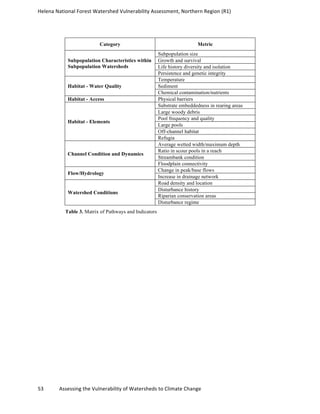
and “Matrix of Pathways and Indicators” determination
of watershed condition factors in conjunction with
Endangered Species Act compliance for several
salmonid species (Helena, Gallatin and Sawtooth NFs).
Sensitivity indicators were selected that most influenced
the hydrologic process and water resource value in
question. Some indicators tend to dampen effects
15 | ASSESSING THE VULNERABILITY OF WATERSHEDS TO CLIMATE CHANGE
Intrinsic Anthropogenic
Geology Road Density
Soil Types Road-Stream Proximity
Risk of Mass Wasting Road Crossings
Groundwater-Baseflow Range Condition
Slope Water Diverted
Aspect Vegetation Condition
Table 5. Attributes most commonly used in assessing
sensitivity by the pilot Forests
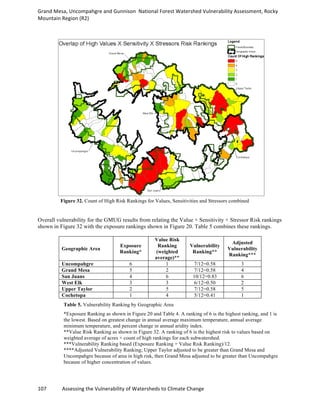
Grand Mesa
Uncompahgre
West Elk
Upper Taylor
Cochetopa
San Juans
Legend
Erosion Sensitivity Rankings
Forest Boundary
Geographic Areas
Low
Moderate
High
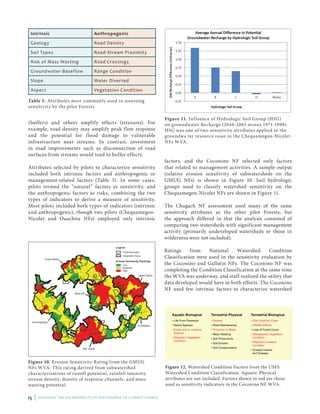
Figure 10. Erosion Sensitivity Rating from the GMUG
NFs WVA. This rating derived from subwatershed
characterizations of runoff potential, rainfall intensity,
stream density, density of response channels, and mass
wasting potential.
(buffers) and others amplify effects (stressors). For
example, road density may amplify peak flow response
and the potential for flood damage to vulnerable
infrastructure near streams. In contrast, investment
in road improvements such as disconnection of road
surfaces from streams would tend to buffer effects.
Attributes selected by pilots to characterize sensitivity
included both intrinsic factors and anthropogenic or
management-related factors (Table 5). In some cases,
pilots termed the “natural” factors as sensitivity, and
the anthropogenic factors as risks, combining the two
types of indicators to derive a measure of sensitivity.
Most pilots included both types of indicators (intrinsic
and anthropogenic), though two pilots (Chequamegon-
Nicolet and Ouachita NFs) employed only intrinsic
Figure 11. Influence of Hydrologic Soil Group (HSG)
on groundwater Recharge (2046-2065 minus 1971-1990).
HSG was one of two sensitivity attributes applied to the
groundwa ter resource issue in the Chequamegon-Nicolet
NFs WVA.
factors, and the Coconino NF selected only factors
that related to management activities. A sample output
(relative erosion sensitivity of subwatersheds on the
GMUG NFs) is shown in Figure 10. Soil hydrologic
groups used to classify watershed sensitivity on the
Chequamegon-Nicolet NFs are shown in Figure 11.
The Chugach NF assessment used many of the same
sensitivity attributes as the other pilot Forests, but
the approach differed in that the analysis consisted of
comparing two watersheds with significant management
activity (primarily undeveloped watersheds or those in
wilderness were not included).
Ratings from National Watershed Condition
Classification were used in the sensitivity evaluation by
the Coconino and Gallatin NFs. The Coconino NF was
completing the Condition Classification at the same time
the WVA was underway, and staff realized the utility that
data developed would have in both efforts. The Coconino
NF used few intrinsic factors to characterize watershed
Aquatic Biological
• Life Form Presence
• Native Species
• Exotic and or Invasive
Species
• (Riparian) Vegetation
Condition
Terrestrial Physical
• Density
• Road Maintenance
• Proximity to Water
• Mass Wasting
• Soil Productivity
• Soil Erosion
• Soil Contamination
Terrestrial Biological
• Fire Condition Class
• Wildfire Effects
• Loss of Forest Cover
• (Rangeland) Vegetation
Condition
• (Riparian) Invasive
Condition
• (Forest) Insects
and Disease
Figure 12. Watershed Condition Factors from the USFS
Watershed Condition Classification. Aquatic-Physical
attributes are not included. Factors shown in red are those
used as sensitivity indicators in the Coconino NF WVA.
16 | ASSESSING THE VULNERABILITY OF WATERSHEDS TO CLIMATE CHANGE
sensitivity. Most were derived from the Watershed
Condition Classification (Figure 12). The Gallatin NF
characterization of sensitivity had two components:
one included intrinsic watershed attributes, the other
included levels of disturbance. The Watershed Condition
Classification ratings of “functioning,” “functioning at
risk,” and “non-functioning” were used to characterize
disturbance. Since National Forests and Grasslands now
have completed the Watershed Condition Classification,
this data would be useful in conducting future WVAs.
Pilot Forests that took advantage of existing condition
ratings tended to apply them to all resource issues. Several
pilot Forests, however, identified different indicators for
each resource value. While many indicators are important
influences on multiple water resources, some are not.
For instance, the most important factors affecting peak
flows and infrastructure may differ from those that most
influence springs and other aquatic habitats.
Pilot Forests took several approaches to developing
ratings of watershed sensitivity. In the simplest
applications (Ouachita and Chequamegon-Nicolet
NFs), sensitivity indicators (e.g., basin slope, peat land
type) were used to place watersheds into different
categories. Other pilot Forests produced sensitivity
ratings based on numerous indicators. When multiple
indicators were used, pilot Forests developed methods
of weighting and rating the relative influence of the
attributes. For example, when considering influences
on stream habitat, the amount of water withdrawn
from a subwatershed is likely more important than the
condition of terrestrial vegetation, and would therefore
be given greater weight in calculating a sensitivity score.
One approach to weighting sensitivity indicators, from
Subwatershed Attribute Type of Attribute Relative Weight
Net Effect Relative to
Climate Change
Geochemistry of parent geology Inherent to watershed 0.25 Buffer
Extent of glaciation Inherent to watershed 0.75 Buffer
Aspect Inherent to watershed 0.50 Additive
Hydroclimatic regime Inherent to watershed 1.0 Additive
Weighted precipitation Inherent to watershed 1.0 Buffer
Extent of surface water features Inherent to watershed 1.0 Buffer
Extent of large-scale pine beetle
mortality
Inherent to watershed 0.5 Buffer (short term)
Water uses Anthropogenic 1.0 Additive
Development (primarily roads) Anthropogenic 0.5 Additive
Extent of beetle salvage Anthropogenic 0.5 Additive (short term)
Table 6. Summary of attribute types affecting subwatershed resilience to climate change (White River NF)
Stressors
Sensitivity
Low Moderate
LowLow
LowModerate
Low Low
High
High
HighHighHighHigh
Low
Sensitivity x Stressors
Risk Ranking Matrix
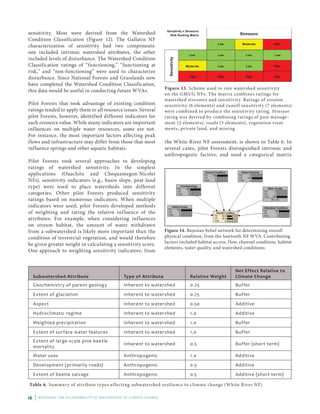
Figure 13. Scheme used to rate watershed sensitivity
on the GMUG NFs. The matrix combines ratings for
water­shed stressors and sensitivity. Ratings of erosion
sensitivity (6 elements) and runoff sensitivity (7 elements)
were combined to produce the sensitivity rating. Stressor
rating was derived by combining ratings of past manage­
ment (2 elements), roads (3 elements), vegetation treat­
ments, private land, and mining.
the White River NF assessment, is shown in Table 6. In
several cases, pilot Forests distinguished intrinsic and
anthropogenic factors, and used a categorical matrix
Figure 14. Bayesian belief network for determining overall
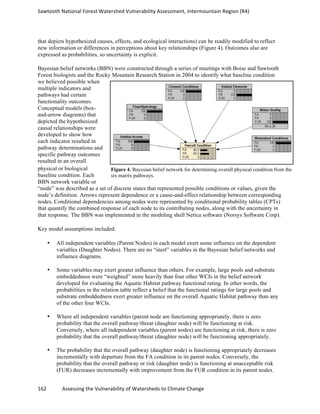
physical condition, from the Sawtooth NF WVA. Contri­buting
factors included habitat access, flow, channel condition, habitat
elements, water quality, and watershed conditions.
17 | ASSESSING THE VULNERABILITY OF WATERSHEDS TO CLIMATE CHANGE
approach to combining and categorizing sensitivity, into
a single rating. An example of such an approach (from
the GMUG NFs) is displayed in Figure 13.
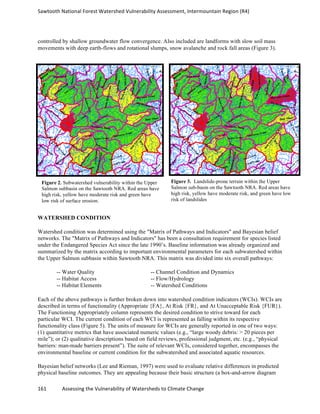
On the Sawtooth NF, assessment of watershed condition
was aided by use of Bayesian belief networks (Lee and
Rieman 1997). The networks were used to evaluate
relative differences in predicted physical baseline
outcomes. The basic structure employs a box-and-
arrow diagram depicting hypothesized causes, effects,
and ecological interactions (see Figure 14). The system
was used to weight the relative importance of, and
connections between, a comprehensive list of intrinsic
and management attributes, and watershed and habitat
elements. As with the other pilot assessments, results
from this process were used to rate watershed condition
as high, moderate, or low.
While there was no detailed comparison of the
products developed from these varied approaches,
they had one thing in common: they all made use of
available information to the greatest degree possible.
By using existing condition and/or sensitivity ratings
or developing them from scratch, each pilot produced
useful ratings of watershed vulnerability. It is very
important to determine what intrinsic and management-
related attributes are important influences on watershed
condition as they strongly affect the selected water
resources. If available data, analyses, or assessments
include attributes that match those identified in the
WVA process or may serve as surrogates, it makes sense
to use them.
Sensitivity
High
Moderate/High
Moderate
Moderate/Low
Low
Subwatersheds
Umatilla National Forest
Sensitivity
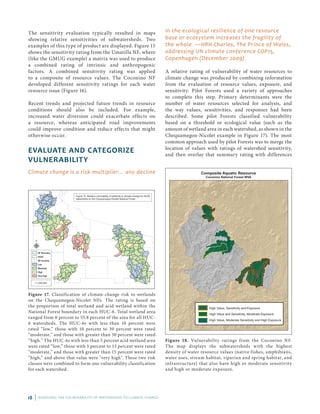
Figure 15. Composite rating of watershed sensitivity
from the Umatilla NF. Factors used in the rating include
groundwater dependence, watershed restoration invest­ment
category, road density, near stream road length, road grade,
range condition, forest vegetation condition, and aquatic
habitat condition. White areas have no NFS ownership.
Stream Habitat Sensitivity Rating
Coconino National Forest WVA
High
Medium
Low
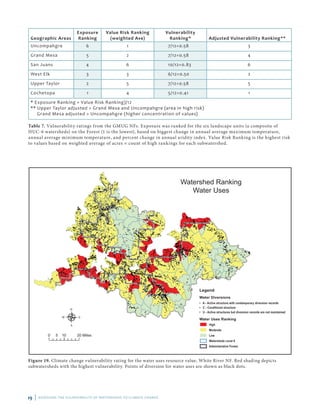
Figure 16. Watershed Sensitivity for Stream Habitats,
Coconino NF. Attributes contributing to this rating were
derived from the Forest’s Watershed Condition Classi­
fication. Stressors included water diversions, terrestrial
vegetation condition, riparian vegetation condition and
invasive species, road proximity to streams, and wildfire.
Buffers included holding instream water rights and degree
of implementation of regional groundwater policy.
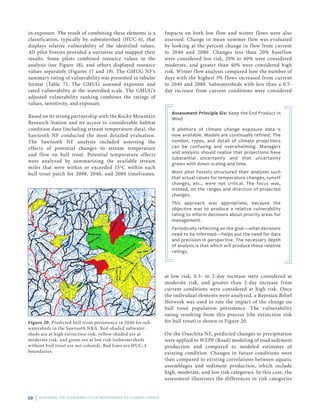
Important Considerations in
Evaluating Sensitivity
•	 Determine the intrinsic factors (such as geology,
soils, and topography) affecting the hydrologic
processes of concern—those that can most affect
the resource values.
•	 Determine the management factors (such as roads
and reservoirs) affecting the hydrologic processes
of concern.
•	 Determine if management activities will serve as
buffers or stressors.
•	 Consider weighing the relative importance of the
buffers and stressors in influencing condition and
response.
•	 Evaluate trends or expected trends in stressors,
and how management actions and restoration
could affect them.
18 | ASSESSING THE VULNERABILITY OF WATERSHEDS TO CLIMATE CHANGE
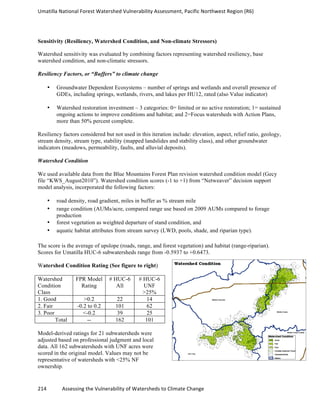
The sensitivity evaluation typically resulted in maps
showing relative sensitivities of subwatersheds. Two
examples of this type of product are displayed. Figure 15
shows the sensitivity rating from the Umatilla NF, where
(like the GMUG example) a matrix was used to produce
a combined rating of intrinsic and anthropogenic
factors. A combined sensitivity rating was applied
to a composite of resource values. The Coconino NF
developed different sensitivity ratings for each water
resource issue (Figure 16).
N
1:1,000,000
NF Boundary
HUC6
WI Counties
Low
Moderate
High
Very High
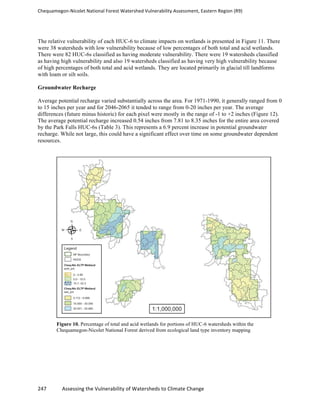
Figure 10. Relative vulnerability of wetlands to climate change for HUC6
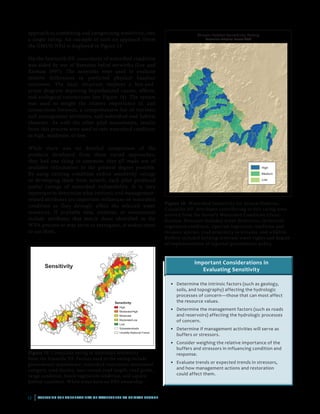
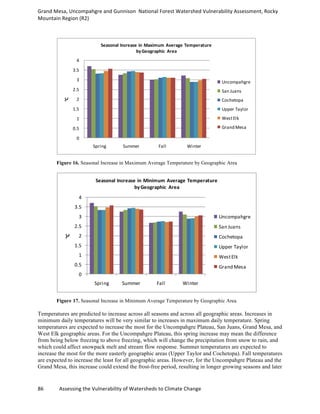
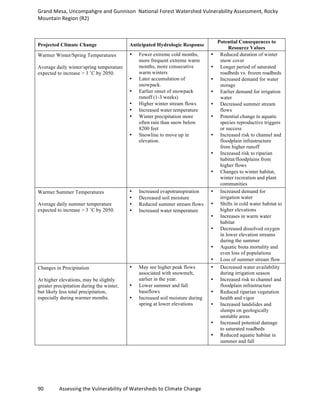
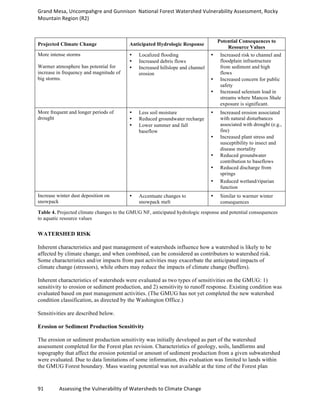
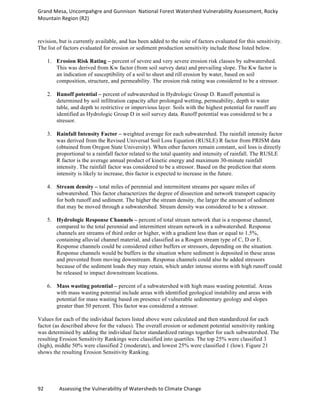
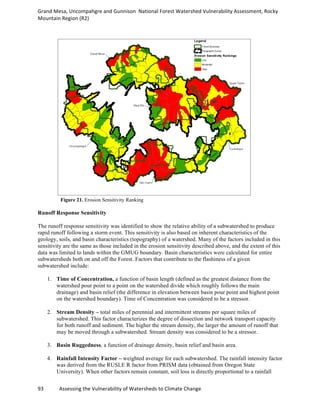
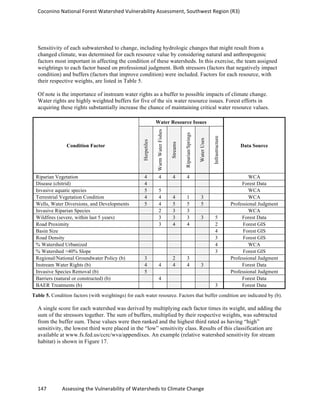
watersheds on the Chequamegon-Nicolet National Forest.
Figure 17. Classification of climate-change risk to wetlands
on the Chequamegon-Nicolet NFs. The rating is based on
the proportion of total wetland and acid wetland within the
National Forest boundary in each HUC-6. Total wetland area
ranged from 0 percent to 55.8 percent of the area for all HUC-
6 watersheds. The HUC-6s with less than 10 percent were
rated “low,” those with 10 percent to 30 percent were rated
“moderate,” and those with greater than 30 percent were rated
“high.” The HUC-6s with less than 5 percent acid wetland area
were rated “low,” those with 5 percent to 15 percent were rated
“moderate,” and those with greater than 15 percent were rated
“high,” and above that value were "very high". These two risk
classes were combined to form one vulnerability classification
for each watershed.
Composite Aquatic Resource
Coconino National Forest WVA
High Value, Sensitivity and Exposure
High Value and Sensitivity, Moderate Exposure
High Value, Moderate Sensitivity and High Exposure
Figure 18. Vulnerability ratings from the Coconino NF.
The map displays the subwatersheds with the highest
density of water resource values (native fishes, amphi­bians,
water uses, stream habitat, riparian and spring habitat, and
infrastructure) that also have high or moderate sensitivity
and high or moderate exposure.
in the ecological resilience of one resource
base or ecosystem increases the fragility of
the whole —HRH Charles, The Prince of Wales,
addressing UN climate conference COP15,
Copenhagen (December 2009)
A relative rating of vulnerability of water resources to
climate change was produced by combining information
from the evaluation of resource values, exposure, and
sensitivity. Pilot Forests used a variety of approaches
to complete this step. Primary determinants were the
number of water resources selected for analysis, and
the way values, sensitivities, and responses had been
described. Some pilot Forests classified vulnerability
based on a threshold or ecological value (such as the
amount of wetland area in each watershed, as shown in the
Chequamegon-Nicolet example in Figure 17). The most
common approach used by pilot Forests was to merge the
location of values with ratings of watershed sensitivity,
and then overlay that summary rating with differences
Recent trends and projected future trends in resource
conditions should also be included. For example,
increased water diversion could exacerbate effects on
a resource, whereas anticipated road improvements
could improve condition and reduce effects that might
otherwise occur.
EVALUATE AND CATEGORIZE
VULNERABILITY
Climate change is a risk-multiplier… any decline
19 | ASSESSING THE VULNERABILITY OF WATERSHEDS TO CLIMATE CHANGE
0 5 10 20 Miles
Watershed Ranking
Water Uses
N
S
EW
Legend
Water Diversions
• A - Active structure with contemporary diversion records
• C - Conditional structure
• U - Active structures but diversion records are not maintained
Water Uses Ranking
High
Moderate
Low
Watersheds Level 6
Administrative Forest
Figure 19. Climate change vulnerability rating for the water uses resource value, White River NF. Red shading depicts
subwatersheds with the highest vulnerability. Points of diversion for water uses are shown as black dots.
Geographic Areas
Exposure
Ranking
Value Risk Ranking
(weighted Ave)
Vulnerability
Ranking* Adjusted Vulnerability Ranking**
Uncompahgre 6 1 7/12=0.58 3
Grand Mesa 5 2 7/12=0.58 4
San Juans 4 6 10/12=0.83 6
West Elk 3 3 6/12=0.50 2
Upper Taylor 2 5 7/12=0.58 5
Cochetopa 1 4 5/12=0.41 1
* Exposure Ranking + Value Risk Ranking)/12
** Upper Taylor adjusted > Grand Mesa and Uncompahgre (area in high risk)
Grand Mesa adjusted > Uncompahgre (higher concentration of values)
Table 7. Vulnerability ratings from the GMUG NFs. Exposure was ranked for the six landscape units (a composite of
HUC-6 watersheds) on the Forest (1 is the lowest), based on biggest change in annual average maximum temperature,
annual average minimum temperature, and percent change in annual aridity index. Value Risk Ranking is the highest risk
to values based on weighted average of acres × count of high rankings for each subwatershed.
20 | ASSESSING THE VULNERABILITY OF WATERSHEDS TO CLIMATE CHANGE
in exposure. The result of combining these elements is a
classification, typically by subwatershed (HUC-6), that
displays relative vulnerability of the identified values.
All pilot Forests provided a narrative and mapped their
results. Some pilots combined resource values in the
analysis (see Figure 18), and others displayed resource
values separately (Figures 17 and 19). The GMUG NF’s
summary rating of vulnerability was presented in tabular
format (Table 7). The GMUG assessed exposure and
rated vulnerability at the watershed scale. The GMUG’s
adjusted vulnerability ranking combines the ratings of
values, sensitivity, and exposure.
Based on its strong partnership with the Rocky Mountain
Research Station and its access to considerable habitat
condition data (including stream temperature data), the
Sawtooth NF conducted the most detailed evaluation.
The Sawtooth NF analysis included assessing the
effects of potential changes to stream temperature
and flow on bull trout. Potential temperature effects
were analyzed by summarizing the available stream
miles that were within or exceeded 15ºC within each
bull trout patch for 2008, 2040, and 2080 timeframes.
Assessment Principle Six: Keep the End Product in
Mind
A plethora of climate change exposure data is
now available. Models are continually refined. The
number, types, and detail of climate projections
can be confusing and overwhelming. Managers
and analysts should realize that projections have
substantial uncertainty and that uncertainty
grows with down-scaling and time.
Most pilot Forests structured their analyses such
that actual values for temperature changes, runoff
changes, etc., were not critical. The focus was,
instead, on the ranges and direction of projected
changes.
This approach was appropriate, because the
objective was to produce a relative vulnerability
rating to inform decisions about priority areas for
management.
Periodically reflecting on the goal—what decisions
need to be informed—helps put the need for data
and precision in perspective. The necessary depth
of analysis is that which will produce these relative
ratings.
Impacts on both low flow and winter flows were also
assessed. Change in mean summer flow was evaluated
by looking at the percent change in flow from current
to 2040 and 2080. Changes less than 20% baseflow
were considered low risk, 20% to 40% were considered
moderate, and greater than 40% were considered high
risk. Winter flow analysis compared how the number of
days with the highest 5% flows increased from current
to 2040 and 2080. Subwatersheds with less than a 0.5-
day increase from current conditions were considered
Figure 20. Predicted bull trout persistence in 2040 for sub­
watersheds in the Sawtooth NRA. Red-shaded subwater­
sheds are at high extinction risk, yellow-shaded are at
moderate risk, and green are at low risk (subwatersheds
with­out bull trout are not colored). Red lines are HUC-4
boundaries.
at low risk, 0.5- to 2-day increase were considered at
moderate risk, and greater than 2-day increase from
current conditions were considered at high risk. Once
the individual elements were analyzed, a Bayesian Belief
Network was used to rate the impact of the change on
bull trout population persistence. The vulnerability
rating resulting from this process (the extinction risk
for bull trout) is shown in Figure 20.
On the Ouachita NF, predicted changes to precipitation
were applied to WEPP (Road) modeling of road sediment
production and compared to modeled estimates of
existing condition. Changes in future conditions were
then compared to existing correlations between aquatic
assemblages and sediment production, which include
high, moderate, and low risk categories. In this case, the
assessment illustrates the differences in risk categories
21 | ASSESSING THE VULNERABILITY OF WATERSHEDS TO CLIMATE CHANGE
that exist presently, and those projected to result from
climate change.
As with some other aspects of the WVA, the Chugach NF
took a different approach to assessing vulnerability, owing
to the fact that they analyzed only the two subwatersheds
in their analysis area that are subject to management
activities. Their objective was to look at those two
subwatersheds and identify specific vulnerabilities and
possible mitigations. The Chugach assessment focused
on potential changes to salmonid habitat. The creeks and
tributaries in the two subwatersheds are currently cold
enough that the projected increase in water temperatures
would not exceed optimal temperatures. The key
concern was the unknown response of other organisms
STEP 1
Classify Watershed
Condition
STEP 2
Prioritize Watersheds
for Restoration
STEP 3
Develop Watershed
Action Plans
STEP 4
Implement Integrated
Projects
STEP 5
Track Restoration
Accomplishments
STEP 5
Monitor and
Verification
Figure 21. USFS Watershed Condition Framework. Water­
shed Vulnerability Assessments contribute directly to Steps
1, 2, and 3.
(including aquatic invertebrates). Of specific interest was
whether increased water temperatures would alter the
life cycles of prey species currently synchronous with
newly-emerged salmon fry.
Pilot Forest staff brought a variety of skills and
backgrounds to their assessments. Some assessments
were prepared by teams, some primarily by one person.
In addition, there was great variation in the types
and amount of available information. Despite these
differences, each pilot Forest was able to conduct an
assessment and report the results in an effective way.
There were many differences in how the individual
steps were approached, and the results reflect these
differences. All the vulnerability ratings were derived
by combining values, sensitivity, and exposure. We
believe that the performance of the pilots in completing
meaningful assessments using the basic process should
encourage other units desiring to conduct vulnerability
assessments.
Important Considerations in
Evaluating Vulnerability
•	Identify where the location of water resource
values overlaps with highest sensitivity and
greatest exposure.
•	 Determine how changes in hydrologic processes
affect water resource values.
•	Determine the relative vulnerabilities of
watersheds across the assessment area (for
example: low, moderate, high) to inform priorities
for adaptive response to predicted climate change.
IDENTIFY ADAPTIVE
MANAGEMENT RESPONSES
"Nobody made a greater mistake than he who
did nothing because he could only do a little."
				 —Edmund Burke
Each pilot Forest produced an assessment that effectively
displays the location of water resources of concern, key
climate change metrics, and watershed sensitivities of
the resources to the projected changes. The combination
of these elements yielded relative ratings of watershed
vulnerability to climate change. As such, the assessments
met the objective of providing managers with information
necessary to identify priority areas to undertake
management actions.
Management priorities should focus on maintaining
or improving watershed resilience. Resilience is the
capacity of an ecosystem to respond to a perturbation or
disturbance by resisting damage and recovering quickly
(Holling 1973). By definition, resilient watersheds are
better able to continue delivery of ecosystem services
when subjected to ecological change, including changes
that might result from a warming climate. A related
assumption is that watershed resilience is closely tied
to watershed sensitivity. Watershed resilience is a
product of both inherent sensitivity and anthropogenic
influences on watershed condition.
The results of the WVAs will be useful in development
of management options and strategies. This includes
discussion of which vulnerability classes should be
22 | ASSESSING THE VULNERABILITY OF WATERSHEDS TO CLIMATE CHANGE
highest priority for management actions. If, for instance,
a highly-valued water resource has a very limited
distribution, management options are limited. If the
value is more widely dispersed, managers must decide
if the most vulnerable areas should be highest priority,
or if they should focus their efforts on sustaining the
values in areas with lower vulnerability. Scale must be
considered in this discussion. Naturally, for resources
(especially species) whose range is greater than the
analysis area, discussion of results with other land
managers will be necessary.
The greatest value of WVA results is in identifying
geographical areas that are priorities for actions
designed to maintain or improve watershed resilience.
Several pilot Forests are already using the results to
this end. The recently completed Watershed Condition
Classification (Figure 21) led to the designation of
priority subwatersheds for improvement actions. The
connection of the WVA to setting these priorities is
clear. One pilot Forest (Coconino NF) applied WVA
findings during this priority-setting process. On many
National Forests and Grasslands, strategic plans have
been developed to guide restoration and management
efforts. In these cases, the vulnerability assessment
process will be used to reassess existing priorities and
to determine if changes are warranted. None of the pilot
Forests were engaged in Land Management Planning
during the WVA, but results have clear application
to that effort in helping to identify priority areas for
management.
One pilot Forest (Ouachita NF) incorporated potential
management actions in their sensitivity ratings. A
tabular result from the Ouachita NF (Table 8) displays
the number of subwatersheds in different watershed
risk classes. These ratings were derived from estimates
of current and future sediment production. In this
assessment, future changes to precipitation were
predicted to increase sediment production, with
subsequent impacts on aquatic communities. Shown are
the projected change in watershed condition class caused
by climate changes from conditions in 2010 to those
projected for 2050 and 2080, and potential modifications
to the response from road management activities.
The analysis demonstrates that implementation of
road management activities could reduce the number
of subwatersheds with high risk ratings. In terms of
setting priorities for management, subwatersheds where
implementation of road improvements would reduce
vulnerability should be considered for high priority.
Road improvements were identified as a key action to
improve condition and resilience of watersheds on all
the pilot Forests. In addition to treatments that reduce
erosion, road improvements can reduce the delivery
of runoff from road segments to channels, prevent
diversion of flow during large events, and restore
aquatic habitat connectivity by providing for passage of
aquatic organisms.
As stated previously, watershed sensitivity is determined
by both inherent and management-related factors.
Managers have no control over the inherent factors,
so to improve resilience, efforts must be directed at
anthropogenic influences such as instream flows, roads,
rangeland, and vegetation management.
In the subwatersheds with the highest vulnerability,
any activity that maintains or increases water quantity
or quality would ultimately be beneficial. In addition
to roadwork, management actions to maintain or
improve resilience could include contesting new water
rights proposals, exploring ways to convert existing
water rights into instream flows, improving conditions
in grazing allotments, restoring natural function in
meadows, and implementing silvicultural treatments
aimed at moving toward more natural fire regimes.
WVA results can also help guide implementation
of travel management planning by informing
priority setting for decommissioning roads and road
reconstruction/maintenance. As with the Ouachita NF
example, disconnecting roads from the stream network
is a key objective of such work. Similarly, WVA analysis
Risk
Climate Change Scenarios
2010
current
2010
with
road
mgmt 2050 B1
2050 B1
with
road
mgmt 2080 B1
2080 B1
with
road
mgmt 2050 A1B
2050 A1B
with
road
mgmt
2080
A1B
2080
A1B
with
road
mgmt
High 88 82 93 85 93 85 105 96 105 96
Moderate 46 40 42 43 42 43 44 43 45 43
Table 8. Vulnerability ratings (by risk class) of subwatersheds on the Ouachita NF, as influenced by climate change
scenarios and application of road management actions (maintenance to standard and closure of user created trails)
23 | ASSESSING THE VULNERABILITY OF WATERSHEDS TO CLIMATE CHANGE
Important Considerations in
Applying the Assessment Results
•	 Consider whether additional information, analysis,
or consultation is needed before setting priorities.
•	 Identify approaches that can enhance resilience
sufficiently to protect resource values.
•	 Consider which effects of climate change might
be irreversible, and how that can inform priority
setting.
•	In places where vulnerabilities are high, can
resource values be sustained?
•	 Determine how management actions from WVA
can be integrated into existing programs and
priorities.
•	Identify management practices that would
enhance resilience in both the short and long term,
and assess the magnitude of treatment that would
be required to meet improvement objectives.
•	Determine if land ownership patterns and
administrative status of NFS lands are conducive
to planning and implementing treatments.
•	 Identify areas where partnerships would improve
the likelihood of success.
•	Determine if sufficient technical and financial
capacity is available to implement treatments.
could also help prioritize aquatic organism passage
projects at road-stream crossings to allow migration by
aquatic residents to suitable habitat as streamflow and
temperatures change.
Pilot Forests in the Rocky Mountains recognized the
utility of WVA results in selecting the subset of high-
vulnerability watersheds in high pine-beetle-mortality
areas. These areas are high priority for upgrades of
road-stream crossings, to protect them from floods and
debris flows. The same watersheds are also priorities for
vegetation management to enhance natural reproduction,
hydrologic recovery, stream shading, and future large
woody debris recruitment. Both sets of actions would
improve watershed condition and resilience.
Not all the findings in the vulnerability assessments are
good news. In some cases, projected changes may indicate
that maintaining certain water resources (especially
aquatic species) may be extremely difficult, even with
restoration or improved management. In such cases,
results from the vulnerability assessment may be used to
rethink local or broad-scale improvement or protection
strategies to prioritize limited management resources.
The rating of vulnerability is based almost entirely on
ecological considerations. Management activities are a
key component in assessing watershed sensitivity, but
only in terms of how they influence water resource values
through hydrologic processes. While such characteristics
are significant, social, economic, and administrative
factors may be more important in determining where
management activities can be effectively undertaken.
Such factors include availability of expertise, land
ownership, the presence of willing partners, LRMP
guidance, and opportunities for internal or external
funding. These factors need to be considered when
determining where management activities should be
focused.
Almost all the pilot Forests encountered data gaps, and
all encountered uncertainties during their analyses. Such
data gaps (for instance, distribution of key species and
uncertainty on road condition in key watersheds) can
be used to identify inventory or monitoring priorities.
Results from these efforts can, in turn, improve the
utility of management and restoration plans.
It is noteworthy that the specific management activities
discussed above, including road improvements,
improving aquatic organism passage, thinning forests
to improve stand resilience, and improving range
condition, are not new treatments designed to address
climate change. Rather, they are activities where
wildland resource managers have a long record of
accomplishment. In land management and statutory
jargon, they are established Best Management Practices.
Climate change increases the need for application of
these practices nearly everywhere.
CRITIQUE THE ASSESSMENT
Test fast, fail fast, adjust fast. —Tom Peters
The purpose of the WVA pilot was to determine if
worthwhile assessments could be conducted with
available information and expertise. Within a relatively
short period of time and despite limited funding
and other pressing business, watershed and aquatic
specialists from the pilot Forests were able to develop a
watershed vulnerability approach and complete useful
assessments. Four pilot Forests were able to complete
the process within 8 months, and an additional 5 were
completed within a year.
With an eye toward sharing approaches and
experiences, each pilot Forest was asked to critique
its assessment. These reviews are key in applying the
principles of adaptive management to the vulnerability
assessments. In this final section, we discuss how access
24 | ASSESSING THE VULNERABILITY OF WATERSHEDS TO CLIMATE CHANGE
to information affected the assessments and share
additional lessons learned by the pilots.
Data Gaps and Uncertainty
Assessing the sensitivity and vulnerability of watersheds
to climate change is complex. At each step of the
assessment process, pilot Forests encountered data gaps
and uncertainty. Uncertainty was prevalent in estimates
of exposure, but each analytical step contained some
uncertainty (for instance, the expected response
of hydrologic processes to climate change, and the
response of aquatic resources to the hydrologic change).
Lack of information also contributes to uncertainty; at
the least, it limits the detail of the assessment. Every
pilot Forest identified data needs, and each made
assumptions about system responses and interactions.
These were captured in the pilot reports as monitoring
needs and included validating assumptions made in the
assessment, tracking trends in key resource values, and
providing data to inform key adaptive responses.
Acquiring and applying data to improve the analysis
would produce assessments with a higher level of
confidence, but lack of data should not be used as a
reason for not conducting an assessment. Some pilot
Forests were data-rich, in terms of water resource,
watershed sensitivity, and exposure information, and
some were data-poor. In spite of these differences,
all were able to apply the available information and
complete a vulnerability assessment. Again, the
objective of producing a relative rating of vulnerability
(rather than a more rigorous, quantitative description of
vulnerability) explains the favorable outcome.
Other Lessons Learned
The pilot assessment effort was successful in that it
demonstrated that vulnerability assessments could
be completed by National Forest staff using existing
information and tools. Some of the primary reasons for
this success have already been discussed; a few others
are worth noting.
While we have discussed how availability of data
influenced the results, we have not articulated the
importance of the format of the data. National Forests
with digital data progressed much faster than those
that had to convert paper summaries to digital formats.
In some cases, lack of useable data caused elements of
the assessment (for example, sensitivity factors) to be
deferred. Ideally, necessary data would be gathered
and prepared in anticipation of assessments. A credible
The Forest Service Climate Change Resource Center
The Climate Change Resource Center (www.fs.fed.us/
ccrc) provides land managers with an online portal
to science-based information and tools concerning
climate change and ecosystem management options.
The CCRC’s objectives are to:
(1) Synthesize scientific literature on ecosystem
response, adaptation, and mitigation;
(2) Highlight recent scientific research that has
practical applications for practitioners on public and
private lands;
(3) Support communication of information through
a user-friendly interface and appropriate use of
multimedia; and
(4) Work with scientists to develop educational
resources.
expectation that watershed vulnerability assessments
will occur could help make this happen.
Connection of the pilot Forests with ongoing climate
change research and experienced scientists resulted in
a more detailed analysis. The partnership between the
Sawtooth NF and the Rocky Mountain Research Station
yielded the most detailed pilot assessment. Collaborative
work in downscaling climate change projections to
assess potential changes in stream temperature was
underway, and was well-utilized by the Sawtooth NF.
Connection to sources of exposure data (especially CIG)
also aided pilot Forests.
As with most endeavors, the resulting products were
strongly influenced by the experience and expertise of
those participating. Those participants with the greatest
localized knowledge of forest resources and interactions
tended to have the easiest time with the process. Use of
the pilot participants as trainers or facilitators for future
assessments would streamline and focus those efforts.
At the outset of the pilot project, several National
Forests declined to participate, due to other priorities.
The reality is that all participating National Forests
managed to work on the WVA despite heavy workloads.
Agreement to participate in the WVA process reflected
recognition of the potential value of conducting
WVAs. Pilot Forests where line and staff were more
engaged with the assessments made resources (ID team
members and GIS expertise) available to project leads,
generally completed assessments sooner, and produced
assessments of greater depth and detail.
Recently-available electronic communication tools that
facilitate information exchange proved extremely useful
25 | ASSESSING THE VULNERABILITY OF WATERSHEDS TO CLIMATE CHANGE
to the pilot effort. The pilot project applied both a
collaborative web space (a wiki bulletin board and a file
repository) and videoconferencing to great advantage.
Pilot leads were located across the country; monthly
videoconferencing facilitated sharing of information
and approaches, and helped cultivate a community
of practice. The collaborative web space proved a
very effective means of sharing written information,
publications, announcements, and web links. The
exchange of information enabled team members to learn
from each other about processes and approaches that
were working, and those that were posing difficulties.
As a result, the individual pilot efforts were strongly
influenced by each other. Readers who anticipate
conducting an assessment are encouraged to contact
members of the pilot assessment team, who can provide
advice and counsel.
Finally, it is clear that establishing an analytical
methodology was of great value. As the WVA pilots
evolved, participants made modifications to meet their
needs, but the basic approach provided a consistent
framework for pilots to apply. The success of the pilot
Forests, which comprise a wide range of geographies,
uses, and sensitivities, demonstrates that the conceptual
basis of the approach is sound and likely applicable
across the entire National Forest system. It will probably
be applicable for all types of climate vulnerability
assessments, not just water resources. Also of note is
that we defined the component vulnerability terms
at the outset, as this can be a source of confusion and
unproductive debate; consistently sticking to and
applying the terminology throughout the process
assisted in moving the assessments forward.
SUMMARY
Observations clearly demonstrate that the Earth’s
climate is warming and ecosystems are changing in
response. Climate models predict substantial additional
changes to world-wide temperatures and hydrologic
processes throughout the 21st century. These changes
will have complex and variable effects on the nation’s
watersheds and impact their ability to sustain the
ecosystem services upon which people depend. These
effects pose significant challenges to the Forest Service
and other land management agencies. To date, limited
resources have been directed specifically towards
planning for or responding to these changes on National
Forests and Grasslands. This is largely due to the fact
that managers have limited experience applying global
or regional scale climate change information at the local
scale. This has led to uncertainties about likely impacts
and appropriate responses for individual National
Forests or Grasslands.
To address this need, we implemented a Pilot Watershed
Vulnerability Assessment Project that developed and
tested a process that National Forest personnel can
use to complete useful, locally-based assessments of
water resource vulnerability to climate change. These
evaluations followed a process patterned after watershed
analysis on federal lands in the Pacific Northwest (USFS,
1995). The assessments covered relatively large areas (e.g.,
entire National Forests) with modest investments of time
and effort. Regional climate projections, local historical
data, and the Watershed Condition Classification recently
completed by all National Forests in the US (www.fs.fed.
us/publications/watershed), provided a solid base of
information to support the assessments.
In conducting the vulnerability assessments, forest staff
became familiar with available historic climate data and
climate projections for their geographic areas. Sorting
through this information and learning how to use it
was an important step in the process. Many forests
found that partners had already compiled climate data
and projections that could be utilized for the forest
level assessments. Knowing future climates precisely or
accurately is not possible, but this was not a barrier to
producing effective, efficient, informative assessments.
In addition to climate data, the pilot assessments used
existing information on watershed sensitivity and water
resource values, data that land managers are familiar
26 | ASSESSING THE VULNERABILITY OF WATERSHEDS TO CLIMATE CHANGE
with and rely on in many resource decision making
processes. The resulting assessments provided place-
based identification of priority areas, with discernment
of the watersheds most vulnerable and the most resilient
to climate change.
Assessing vulnerability is the essential first step in
adapting to climate change, and this information
provides a basis for managers to target investment
of limited resources to sustain or improve watershed
resilience. The good news is that the knowledge and
tools to maintain and improve watershed resilience
are already in place, while the National Watershed
Condition Framework (USDA, 2011a) serves as
a foundation for setting priorities and restoring
watersheds and watershed services. Other US Forest
Service programs to improve watersheds, meadows, and
streams include diverse partners and programs across
the country (Furniss et al. 2010). Implementation of this
wide array of management activities is supported by
decades of technical experience in planning, analysis,
and collaboration. These existing core strengths can be
effectively applied to address the growing challenge to
public natural resources posed by our changing climate.
REFERENCES
Barsugli, J.J. and L.O. Mearns. Draft 2010. Climate and
Hydrologic Change Scenarios for the Upper Gunnison River,
Colorado. Prepared for The Nature Conservancy in support
of the southwest Climate Change Initiative’s Climate Change
Adaptation Workshop for Natural Resource Managers in the
Gunnison Basin.
Casola, J.H.; Kay, J.E.; Snover, A.K.; Norheim, R.A.;
Whitely Binder, L.C.; Climate Impacts Group. 2005.
Climate impacts on Washington’s hydropower, water supply,
forests, fish and agriculture. Seattle, WA: Centre for Science
and the Earth System, University of Washington. 43 p.
Elliot, W.J., R.B. Foltz, and C.H. Luce, 1995. Validation
of Water Erosion Prediction Project (WEPP) Model for
Low-Volume Forest Roads. Conference Proceedings
Sixth International Conference on Low-Volume Roads,
Minneapolis, Minnesota. Transport Research Board, National
Academy Press, Washington, D.C., pp. 178-186.
Furniss, Michael J.; Staab, Brian P.; Hazelhurst, Sherry;
Clifton, Cathrine F.; Roby, Kenneth B.; Ilhadrt, Bonnie
L.; Larry, Elizabeth B.; Todd, Albert H.; Reid, Leslie
M.; Hines, Sarah J.; Bennett, Karen A.; Luce, Charles
H.; Edwards, Pamela J. 2010. Water, climate change, and
forests: watershed stewardship for a changing climate. Gen.
Tech. Rep.PNW-GTR-812. Portland, OR: U.S. Department
of Agriculture, Forest Service, Pacific Northwest Research
Station. 75 p.
Gao, H., Q. Tang, X. Shi, C. Zhu, T. J. Bohn, F. Su, J.
Sheffield, M. Pan, D. P. Lettenmaier, and E. F. Wood. 2010.
Water Budget Record from Variable Infiltration Capacity
(VIC) Model. In Algorithm Theoretical Basis Document for
Terrestrial Water Cycle Data Records (in review).
Gardali T, Seavy NE, DiGaudio RT, Comrack LA. 2012.
A Climate Change Vulnerability Assessment of California's
At-Risk Birds. PLoS ONE 7(3): e29507. doi:10.1371/journal.
pone.0029507
Glick, P., B.A. Stein, and N.A. Edelson, editors. 2011.
Scanning the Conservation Horizon: A Guide to Climate
Change Vulnerability Assessment. National Wildlife
Federation, Washington, D.C.
Hamlet, A. F., S. Lee, K. E. B. Mickelson, and M. M. Elsner.
2009. Effects of projected climate change on energy supply
and demand in the Pacific Northwest and Washington State,
in The Washington Climate Change Impacts Assessment:
Evaluating Washington’s Future in a Changing Climate,
edited by J. S. Littell, M. M. Elsner, L. C. W. Binder and A.K.
Snover, pp. 165-190 , University of Washington Climate
Impacts Group, Seattle, WA.
Hamlet, A. F., P. W. Mote, M. P. Clark, and D. P. Lettenmaier.
2005. Effects of temperature and precipitation variability on
snowpack trends in the western United States, J. Clim., 18,
4545 4561.
Holling, C. S. 1973. Resilience and stability of ecological
systems. Annual Review of Ecology and Systematics 4: 1-23.
Lee, D.C. and B.E. Rieman. 1997. Population viability
assessment of salmonids by using probabilistic networks.
North American Journal of Fisheries Management
17:1144-1157.
Luce, C. H., and Z. A. Holden. 2009. Declining annual
streamflow distributions in the Pacific Northwest United
States, 1948–2006, Geophys. Res. Lett., 36, L16401,
doi:10.1029/2009GL039407.
Luce, Charles; Morgan, Penny; Dwire, Kathleen; Isaak,
Daniel; Holden, Zachary; Rieman, Bruce 2012. Climate
change, forests, fire, water, and fish: Building resilient
landscapes, streams, and managers. Gen. Tech. Rep. RMRS-
GTR-290. Fort Collins, CO: U.S. Department of Agriculture,
Forest Service, Rocky Mountain Research Station. 207 p.
27 | ASSESSING THE VULNERABILITY OF WATERSHEDS TO CLIMATE CHANGE
Luo, L. F., and E. F. Wood. 2007. Monitoring and predicting
the 2007 U.S. drought, Geophys. Res. Lett., 34, 6.
Mote, P.W., A. F. Hamlet, M. P. Clark, and D. P.
Lettenmaier. 2005. Declining mountain snowpack in western
North America. Bull. Amer. Meteor. Soc., 86, 39–49.
Ray, A.J., J.J. Barsugli, K.B. Averyt, K. Wolter, M. Hoerling,
N. Doesken, B. Udall, R.S. Webb. 2008. Climate Change
in Colorado: a Synthesis to Support Water Resources
Management and Adaptation. Western Water Assessment.
Boulder, CO.
Rice, Janine; Tredennick, Andrew; Joyce, Linda A. 2012.
Climate change on the Shoshone National Forest, Wyoming: a
synthesis of past climate, climate projections, and ecosystem
implications. Gen. Tech. Rep. RMRS-GTR-264. Fort Collins,
CO: U.S. Department of Agriculture, Forest Service, Rocky
Mountain Research Station. 60 p.
Spears, M., L. Brekke, A. Harrison, and J Lyons. 2009.
Literature Synthesis on Climate Change Implications for
Reclamation’s Water Resources. Technical memorandum
86-68210-091. U.S. Department of the Interior, Bureau of
Reclamation, Research and Development Office. Denver, CO.
USFS. 1995. Ecosystem Analysis at the Watershed Scale.
Federal Guide for Watershed Analysis. USFS Northwest
Region. Regional Ecosystem Office. Portland, Oregon. 26p.
U.S. Department of Agriculture (USDA) Forest Service.
2011a. Forest Service watershed condition classification
technical guide. Washington, DC: U.S. Department of
Agriculture, Forest Service, Watershed, Fish, Wildlife, Air,
and Rare Plants Program.
U.S. Department of Agriculture (USDA) Forest Service.
2011b. Forest Service watershed condition classification
28	


  Assessing	
  the	
  Vulnerability	
  of	
  Watersheds	
  to	
  Climate	
  Change
Pilot National Forest Reports
Contents	
  
Gallatin National Forest ......................................................................... 30	
  
Helena National Forest........................................................................... 46	
  
Grand Mesa, Uncompahgre and Gunnison National Forests................ 64	
  
White River National Forest ................................................................ 112	
  
Coconino National Forest .................................................................... 130	
  
Sawtooth National Forest..................................................................... 158	
  
Shasta Trinity National Forest ............................................................. 185	
  
Umatilla National Forest...................................................................... 210	
  
Ouachita National Forest...................................................................... 226	
  
Chequamegon-Nicolet National Forest................................................ 236	
  
Chugach National Forest...................................................................... 266	
  
29	


  Assessing	
  the	
  Vulnerability	
  of	
  Watersheds	
  to	
  Climate	
  Change
Example of Recommended Citation Format for Forest Reports
Caty Clifton; Day, Kate; Johnson, Allison. 2012. Assessment of Watershed Vulnerability to Climate Change,
Umalilla National Forest. In: Michael J. Furniss, Roby, Ken B., Cenderelli, Dan; Chatel, John; Clifton, Caty F.;
Clingenpeel, Alan; Hays, Polly E.; Higgins, Dale; Hodges, Ken; Howe, Carol; Jungst, Laura; Louie, Joan; Mai, S
Christine; Martinez, Ralph; Overton, Kerry; Staab, Brian P.; Steinke, Rory; Weinhold, Mark. 2012. Assessing	
  the	
  
Vulnerability	
   of	
   Watersheds	
   to	
   Climate	
   Change:	
   Results	
   of	
   National	
   Forest	
   Watershed	
   Vulnerability	
  
Pilot	
   Assessments. Climate Change Resource Center. U.S. Department of Agriculture, Forest Service 305p.
www.fs.fed.us/ccrc/wva
30	


  Assessing	
  the	
  Vulnerability	
  of	
  Watersheds	
  to	
  Climate	
  Change
Assessment of Watershed Vulnerability
to Climate Change
Gallatin National Forest
April, 2012
Prepared By:
Joan Y. Louie
Fisheries Biologist/GIS Analyst
R1 Regional Office, Missoula, Montana
Gallatin	
  National	
  Forest	
  Watershed	
  Vulnerability	
  Assessment,	
  Northern	
  Region	
  (R1)	


31	


  Assessing	
  the	
  Vulnerability	
  of	
  Watersheds	
  to	
  Climate	
  Change
BACKGROUND
The Gallatin National Forest (GNF) is located in southwestern Montana within the Northern Region (R1)
of the U.S. Forest Service (USFS) and is part of the Greater Yellowstone Ecosystem, the largest intact
ecosystem in the continental United States (Figure 1). The 1.8 million acre Forest contains more than
1,900 miles of fish-bearing streams and 700 high mountain lakes, and supports important, high-profile
recreational fisheries.
Figure 1. The Gallatin National Forest is located in southwestern Montana, within the Greater
Yellowstone Ecosystem.
Gallatin	
  National	
  Forest	
  Watershed	
  Vulnerability	
  Assessment,	
  Northern	
  Region	
  (R1)	


32	


  Assessing	
  the	
  Vulnerability	
  of	
  Watersheds	
  to	
  Climate	
  Change 	
  
PARTNERS
Data were provided by:
• The Montana Natural Resource Information System (NRIS)
• Montana Bureau of Mines and Geology (MBMG)
• US Geology Survey (USGS)
• University of Washington Climate Impacts Group (CIG)
• Montana Fisheries Information System (MFISH)
• US Forest Service (USFS) R1 Geospatial Group
• Ecoshare
Assistance with the analysis was provided by:
• Kerry Overton et al., Rocky Mountain Research Station
• Ralph Martinez, Plumas National Forest
• Jim Morrison, R1 Regional Office
ASSESSMENT OBJECTIVES
The objective of this project was to develop a reliable method to prioritize all HUC-6 watersheds within
the GNF in order to focus forest resource conservation and restoration efforts. A watershed
characterization process was first developed to assess the relative sensitivity of the watersheds to
disturbance, based on various environmental parameters. A vulnerability assessment further prioritized
watersheds using the Watershed Condition Framework, resources of value, and exposure (climate
projections).
The proposed analysis has been developed in part to address the USFS initiative in considering climate
change in land management decisions. Current studies show climate change is occurring, but climate
model projections are uncertain and models at common management scales are nonexistent. Therefore,
alternative methods of examining the potential impacts of climate change and other environmental
stressors are needed. While this initial framework was originally designed from a watershed perspective,
the results can also have implications for terrestrial management, such as fire, rangeland and wildlife
management activities on the GNF. This process is intended to make it easy to update previous runs or
examine other resources simply by rotating in the appropriate datasets. This project will also provide an
example for other Forests in Region 1 to develop similar vulnerability assessments.
SCALE OF ANALYSIS
The scale of the analysis used in the GNF assessment was HUC-6 (12-digit) subwatersheds (Figure 2) and
HUC-5 (10-digit) watersheds (Figure 3).
Gallatin	
  National	
  Forest	
  Watershed	
  Vulnerability	
  Assessment,	
  Northern	
  Region	
  (R1)	


33	


  Assessing	
  the	
  Vulnerability	
  of	
  Watersheds	
  to	
  Climate	
  Change 	
  
Figure 2. Subwatersheds (HUC-6) on the Gallatin National Forest
Figure 3. Watersheds (HUC-5) on the Gallatin National Forest
Gallatin	
  National	
  Forest	
  Watershed	
  Vulnerability	
  Assessment,	
  Northern	
  Region	
  (R1)	


34	


  Assessing	
  the	
  Vulnerability	
  of	
  Watersheds	
  to	
  Climate	
  Change 	
  
CONNECTIONS TO OTHER PROJECTS AND ASSESSMENTS
GNF Stream Temperature Modeling
The objective of this project is to develop a broad-scale geographic information system (GIS) model to
predict the effects of climate change on stream thermal regimes that in turn, provide the basis for
estimating impacts on fisheries resources. A standardized approach was developed to collect and share
temperature information among partner agencies and the public. The results will be used in conjunction
with the GNF Watershed Vulnerability Assessment (WVA) to identify thermally-sensitive habitats and
vulnerable native fish populations, and to prioritize future restoration activities to mitigate the effects of
climate change on aquatic resources.
GIS analysis identified locations for deployment of stream temperature loggers in HUC-6 watersheds
intersecting the Gallatin and Custer National Forests. A matrix was developed comparing stream size (y-
axis) and elevation (x-axis). Multiple temperature deployment locations were chosen from each cell of the
matrix across broad spatial scales (see Figure 4 for the Lower East Boulder River HUC-6 watershed).
Approximately 100 stream temperature loggers will be deployed, which include 40 long-term/multi-year
deployments and 60 short-term/annual deployments. The data collected will be used to develop a model
to predict changes in stream temperature with respect to elevation, contributing area (stream size), and air
temperature.
The methods employed were developed by the Rocky Mountain Research Station. For a complete
description, refer to the following website.
www.fs.fed.us/rm/boise/AWAE/projects/stream_temp/multregression/methods.shtml
Figure 4. Temperature deployment locations within the Lower East Boulder
River HUC-6 watershed
East Boulder River
W
rightGulch
Canyon Creek
Dry Fork Creek
Burnt Gulch
Blakely Creek
Gallatin	
  National	
  Forest	
  Watershed	
  Vulnerability	
  Assessment,	
  Northern	
  Region	
  (R1)	


35	


  Assessing	
  the	
  Vulnerability	
  of	
  Watersheds	
  to	
  Climate	
  Change 	
  
Watershed Condition Framework
The Watershed Condition Framework (WCF) was included as one step in the process. The WCF
established a nationally consistent method for classifying watershed condition and documenting
improvements in watershed condition at the forest, regional, and national scales (US Forest Service.
2011). This process uses 12 indicators and 24 attributes to serve as surrogate variables representing
fundamental ecological, hydrological, and geomorphic functions, and processes that affect watershed
condition. The primary emphasis is on ecological processes and conditions that Forest Service
management activities can influence.
There are three watershed condition classes identified in this process:
• Class 1 = Functioning Properly
• Class 2 = Functioning at Risk
• Class 3 = Functionally Impaired
Watersheds considered to be Functioning Properly have ecosystem processes functioning within their
range of natural variability. In general, the greater the departure from the natural pristine state, the more
impaired the watershed condition is likely to be (USFS 2011).
Climate Change Performance Scorecard
The Climate Change Performance Scorecard is the Forest Service’s tracking tool to assess progress in
integrating climate change considerations into programs, plans, and projects. It is composed of 10
performance elements, with a national goal of 100% of Forests/Grasslands to achieve a “Yes” rating on 7
of the 10 elements by FY 2015. One of these elements is a vulnerability assessment, which the WVA
would fulfill.
Forest Landscape and Rapid Assessments
The WVA would not replace these assessments but can help validate priorities being identified in these
assessments.
Gallatin	
  National	
  Forest	
  Watershed	
  Vulnerability	
  Assessment,	
  Northern	
  Region	
  (R1)	


36	


  Assessing	
  the	
  Vulnerability	
  of	
  Watersheds	
  to	
  Climate	
  Change 	
  
WATERSHED VULNERABILITY ASSESSMENT PROCESS
Figure 5. The Gallatin National Forest Watershed Vulnerability Assessment Model. The assessment consists of
several different types of information (added and removed as necessary) to identify vulnerable watersheds.
Geophysical/Sensitivity Characterization
The first step of the WVA process, the geophysical/sensitivity characterization, was the most time-
consuming. As interdisciplinary team (fish biologist, hydrologist, and soil scientist), identified the
dominant physical processes and features of the watershed that affect ecosystem function and condition.
Identifying which watersheds are the most geophysically reactive can indicate how much a watershed
responds to disturbances such as floods, drought, intense precipitation, and fires. The datasets determined
to be most important for the watershed characterization were soils, geology, hydrology, terrain, and
groundwater.
The initial run of this analysis utilized pre-existing datasets (often outdated and of lower resolution and
accuracy). These datasets include the GNF Soil Survey (slope classes, surficial geology, and shallow
groundwater) and datasets derived from the National Hydrography Dataset, National Elevation Dataset,
and R1 VMap (water yield, high flows, and low flows). After this initial run, the team met again to
evaluate the results and determine which watershed characteristics were most important.
The second run of the analysis included newer datasets developed for the analysis. The state surficial
geology layer from MBMG was reclassified into broad rock class categories to identify sensitive
geologies. A compound index of slope and aspect from 10m digital elevation models (USGS) was derived
to identify sensitive terrain areas. The original hydrology metrics were omitted in the second run due to
their strong correlation with the terrain analysis (see Hydrology section below).
Each variable was quantified by subwatershed and given a rating of 1, 2, or 3, based on specific threshold
values identified by literature and professional judgment. All scores were added together by
subwatershed. Higher scores indicate higher sensitivity to disturbance.
Geology Sensitivity
Gallatin	
  National	
  Forest	
  Watershed	
  Vulnerability	
  Assessment,	
  Northern	
  Region	
  (R1)	


37	


  Assessing	
  the	
  Vulnerability	
  of	
  Watersheds	
  to	
  Climate	
  Change 	
  
The surficial geology layer covering the GNF was reclassified, based on a relative assessment of soil
erosion/sediment delivery and rapid runoff potential from different bedrock types. Three classes were
created (low, moderate, and high) to identify geology sensitivity by each HUC-6 subwatershed.
Terrain Sensitivity
A mathematical equation was used to explain the empirical relationship between slope, aspect, and
elevation. The results of this analysis have been extrapolated beyond Forest boundaries to allow
characterization of entire subwatersheds, however characterizations are truly only valid within Forest
boundaries. The equation is developed for montane areas and will need to be recalibrated for use on flatter
areas (outside of GNF boundaries). Three classes were created (low, moderate, and high) to identify
terrain sensitivity for each HUC-6 subwatershed. A future iteration of this analysis will expand this
terrain analysis beyond Forest boundaries to increase the accuracy.
Geophysical Characterization
The geology sensitivity and terrain sensitivity datasets were combined and reclassified with more weight
given to the terrain dataset (Figure 6).
Hydrology
Groundwater is expected to play an important role in buffering the impacts of changing flows and stream
temperatures, however currently there is no accurate and comprehensive dataset for groundwater. This
information will be included in the model as better and more reliable methods of identifying groundwater
data are determined.
The first run of the WVA analysis developed hydrology metrics for water yield, high discharge, and low
flows. Each metric was categorized into high, moderate, and low categories. The water yield sensitivity
map compares reasonably well with the newly developed terrain sensitivity dataset.
The main hydrology variable, water yield, appears to be accurately characterized, and is heavily
influenced by the elevation variable. The aspect and slope steepness terrain variable further refines the
elevation variable, accounting for less water yield on 150- to 210-degree aspect slopes and faster runoff
on steep (35%+
) slopes. The hydrologic factors determined to be the most influential in watershed
sensitivity to climate change are best represented by the terrain sensitivity analysis and, therefore, no
hydrology metrics were included in the second run of the WVA.
Gallatin	
  National	
  Forest	
  Watershed	
  Vulnerability	
  Assessment,	
  Northern	
  Region	
  (R1)	


38	


  Assessing	
  the	
  Vulnerability	
  of	
  Watersheds	
  to	
  Climate	
  Change 	
  
Figure 6. Geophysical characterization of Gallatin National Forest subwatersheds.
Gallatin	
  National	
  Forest	
  Watershed	
  Vulnerability	
  Assessment,	
  Northern	
  Region	
  (R1)	


39	


  Assessing	
  the	
  Vulnerability	
  of	
  Watersheds	
  to	
  Climate	
  Change 	
  
Watershed Condition Framework
The second step in the WVA assessment is the WCF dataset. This dataset identifies the level of human
disturbance on the landscape. All of the GNF subwatersheds analyzed through this process were
determined to be either Functioning Properly or Functioning at Risk (Figure 7). Because of this
determination, some of the potentially more important watersheds may have been de-emphasized and
future runs will need to confirm and/or modify this as needed.
Figure 7. Watershed Condition Framework for the Gallatin National Forest
Gallatin	
  National	
  Forest	
  Watershed	
  Vulnerability	
  Assessment,	
  Northern	
  Region	
  (R1)	


40	


  Assessing	
  the	
  Vulnerability	
  of	
  Watersheds	
  to	
  Climate	
  Change 	
  
Water Resources/Values
The following water resources and values were chosen for the vulnerability analysis.
1. Infrastructure
• Roads
• Trails
• Developed recreation sites
2. Water use and water developments
• Point of use locations
• Diversions
3. Cutthroat Trout
• “Sensitive species” designation by Forest Service
• “Species of special concern” designation by state of Montana
• Management indicator species for the GNF
The purpose of this dataset is to quantify selected water resource values in each HUC-6 subwatershed.
Areas with the greatest density of values may indicate important sites where there may have been
significant economic investment and/or would require the greatest investment to maintain/conserve the
resource. Datasets for each value were used to place subwatersheds into three classes (low, medium, and
high) based on natural breaks in the data. All of the datasets were then combined to create one Values
dataset, identifying subwatersheds with the lowest to highest amount of values (Figure 8).
Figure 8. Levels of watershed resource/values by subwatershed.
Gallatin	
  National	
  Forest	
  Watershed	
  Vulnerability	
  Assessment,	
  Northern	
  Region	
  (R1)	


41	


  Assessing	
  the	
  Vulnerability	
  of	
  Watersheds	
  to	
  Climate	
  Change 	
  
Exposure
To evaluate exposure, we used the regional downscaled climate and hydrological projections developed
by Littell et al. (2011), which build on research and data from the Climate Impacts Group (CIG) at the
University of Washington. We chose their Ensemble model to examine potential climate change impacts
more closely. This model is composed of the 10 best-fitting global circulation models (GCMs) for the
Upper Missouri River Basin region. The modeled time periods available are 1916-2006 (historic), 2030-
2049 (mid-21st
century), and 2070-2099 (late 21st
century).
The climate projections are downscaled to 6 km2
resolution and are most appropriately summarized at the
HUC-5 scale. The HUC-6 subwatersheds were overlaid to examine how they may be influenced by these
climate projections. The metrics retrieved for the most current run of the WVA include variable
infiltration capacity (VIC) derived (Liang et al. 1994; Liang et al. 1996) hydrological projections:
combined annual flow, seasonality of flow, and snowpack vulnerability (hydrologic regime). For the
Upper Missouri River Basin, some of the overall trends predicted for the mid- to late 21st
century include
increases in average annual air temperature, increases in seasonal air temperatures, increases in winter
precipitation, and decreases in summer precipitation.
Currently, we have used only the air temperature projections to examine predicted trends. In the future,
these predicted air temperatures, combined with our stream temperature model (in development) and local
air temperature data, may be used to model and predict stream temperatures across the forest.
Potential Impacts to Water Resources
1. Increased instances of low flows and lower flows
• Water uses/diversions would amplify the anticipated low flows
• Culverts currently passable by fish may become barriers during low flows
2. Changes in flow regime
• Increased winter flooding could increase summer low flows; increased/prolonged drought
in the summer will further amplify the effects of changes in flow
• Increased winter scouring of fall spawners (brook trout)
− May favor native cutthroat trout
3. Increased stream temperatures
• Previously unsuitable stream habitats (too cold) may become suitable for fish
• At lower elevations, native cold-water fish will be negatively affected
− More tolerant invasive fish species may outcompete natives
−
4. Increased precipitation events
• Roads would have increased sedimentation into streams
• Culverts may need to be enlarged and/or maintained more frequently to accommodate
higher flow
• Some roads may need more frequent maintenance
5. Increased drought events
• Water use/diversions would exacerbate drought events
• Possible increases in wildfires
	
  
Gallatin	
  National	
  Forest	
  Watershed	
  Vulnerability	
  Assessment,	
  Northern	
  Region	
  (R1)	


42	


  Assessing	
  the	
  Vulnerability	
  of	
  Watersheds	
  to	
  Climate	
  Change 	
  
RESULTS	
  
Datasets for the geophysical characterization, Watershed Condition Framework, and water
resources/values were overlaid for a composite result (Figure 9). The red and yellow subwatersheds
indicate where our areas of interest have the most overlap.
Figure 9. Composite result of the geophysical characterization, WCF, and water resources/values datasets
Gallatin	
  National	
  Forest	
  Watershed	
  Vulnerability	
  Assessment,	
  Northern	
  Region	
  (R1)	


43	


  Assessing	
  the	
  Vulnerability	
  of	
  Watersheds	
  to	
  Climate	
  Change 	
  
SUMMARY
The physical characterization of watersheds was the most time-consuming step of the WVA. We felt it
was most important to first develop a robust analysis to characterize the geophysical reactivity of each
subwatershed. We hoped to utilize the most up-to-date and readily available datasets. After our initial run
using existing datasets of lower quality, we developed a repeatable method for the physical
characterization of watersheds. The results appear to be reasonably accurate, although additional
validations are needed. The terrain and geology sensitivity datasets may be used to derive other datasets,
such as soils, for use in future iterations of this assessment and other Forest analyses.
We expect this to be an iterative process that is never truly “complete.” The WVA was designed to be
easily updated with the latest datasets as they are developed. This design allows different resource areas
to be assessed together or separately, by incorporating the relevant datasets. Even as climate change
projections are refined in the future, the physical characterization of our subwatersheds should remain the
same, enabling quick evaluation of the subwatersheds through the latest climate scenarios without
additional analysis.
APPLICATIONS
Management
These results may aid GNF managers in prioritizing subwatersheds for resource conservation and
restoration efforts. The results can also be used to validate priorities identified by the rapid assessments
and landscape assessments on the Forest.
Monitoring
The identification of the potentially most sensitive and most vulnerable subwatersheds can be used to
prompt monitoring in those areas at risk.
Collaboration, Education and Outreach
This analysis, and others like it, will hopefully provide more reason and opportunity for the USFS to
educate the general public on climate change and our adaptive management strategies to address it. In
addition, these analyses will provide opportunities to collaborate with other state, federal, and tribal
agencies and non-governmental organizations (NGOs) to address climate change.
CRITIQUE
What important questions were not considered?
Currently, the WVA should not be considered valid beyond the Forest boundaries. The terrain sensitivity
analysis will need to be further refined to characterize the subwatersheds beyond the Forest boundaries.
What were the most useful data sources?
1. National datasets which do not end at the Forest boundaries (NHD, NED).
− NED was very useful for deriving other datasets as well.
2. Ecoshare (website) is a well-organized source for climate projections data for Region 1.
3. Montana NRIS provided statewide datasets.
Gallatin	
  National	
  Forest	
  Watershed	
  Vulnerability	
  Assessment,	
  Northern	
  Region	
  (R1)	


44	


  Assessing	
  the	
  Vulnerability	
  of	
  Watersheds	
  to	
  Climate	
  Change 	
  
4. Montana Bureau of Mines and Geology provided statewide surficial geology coverage.
What were the most important data deficiencies?
1. Data beyond forest boundaries.
− The mathematical equation used to develop the terrain sensitivity analysis will theoretically
work on any landscape, but currently has only been calibrated to a montane landscape. More
effort will be needed to modify the equation and more accurately characterize entire
subwatersheds that go beyond Forest boundaries.
− The R1 VMap dataset may have great potential in future runs of the WVA; unfortunately, this
is limited to the Forest boundaries and will likely stay that way.
2. Groundwater data would be extremely helpful for this analysis, particularly to identify areas with
buffering capacities to increased stream temperatures. Unfortunately, this data is currently lacking
and it will be very time-consuming to develop an accurate dataset.
3. Stream temperature data is also lacking on the GNF. We have only just begun a comprehensive
effort in collecting this data, which, along with local air temperature data, will be helpful in the
modeling and prediction of future stream temperatures.
4. Field validations will be essential when there is available time and money. The physical
characterization node of the WVA currently has only been “validated” by professional
knowledge.
What tools were most useful?
1. ArcGIS – Without this program, spatial analyses would have been severely limited, particularly
because open-source GIS programs are significantly less well-developed in user-friendliness,
tools, and options.
2. Google Earth is a useful tool to disseminate some of this spatial information for users who are not
GIS-savvy.
3. Video/phone conference calls, website and webinar technology greatly facilitated the group’s
information-sharing and coordination, especially with limited funds for agency travel.
What tools were most problematic?
1. Citrix and T: drive on the Forest Service network. When fully functioning, these are excellent
tools and make GIS more accessible for any Forest Service employee. Unfortunately, they have
not yet reached their full potential and instead have created numerous issues for GIS users.
2. ArcGIS often contains bugs and is not always the most intuitive for non-GIS people. New
versions also come out relatively often and are mostly incompatible with the previous versions.
This a non-issue for Forest Service employees utilizing Citrix, but can cause more issues when
working with external agencies that cannot keep up with the latest ArcGIS versions.
PROJECT TEAM
Joan Louie, GIS analyst/fisheries biologist (R1 Regional Office)
Scott Barndt, Forest fisheries biologist (GNF)
Mark Story, Forest hydrologist (GNF)
Tom Keck, Soil scientist (GNF)
Gallatin	
  National	
  Forest	
  Watershed	
  Vulnerability	
  Assessment,	
  Northern	
  Region	
  (R1)	


45	


  Assessing	
  the	
  Vulnerability	
  of	
  Watersheds	
  to	
  Climate	
  Change 	
  
PROJECT CONTACT
Joan Louie, GIS Analyst, R1 Regional Office
Gallatin National Forest
Office: (406) 329-3209
Email: joanlouie@fs.fed.us
REFERENCES
Littell, J.S., M.M. Elsner, G. S. Mauger, E. Lutz, A.F. Hamlet, and E. Salathe. 2011. Regional
Climate and Hydrologic Change in the Northern US Rockies and Pacific Northwest: Internally Consistent
Projections of Future Climate for Resource Management. Available online at:
http://cses.washington.edu/picea/USFS/pub/Littell_etal_2010/
Liang, X., D. P. Lettenmaier, E. F. Wood, and S. J. Burges. 1994. A simple hydrologically based
model of land-surface water and energy fluxes for general-circulation models, J. Geophys. Res.-
Atmospheres, 99, 14415-14428.
Liang, X., E. F. Wood, and D. P. Lettenmaier. 1996. Surface soil moisture parameterization of the
VIC�2L model: Evaluation and modification, Global Planet. Change, 13, 195–206.
Rieman, B.E., Isaak, D.J. 2010. Climate Change, Aquatic Ecosystems, and Fishes in the Rocky
Mountain West: Implications and Alternatives for Management. Gen. Tech. Rep. RMRS-GTR-250. Fort
Collins, CO: U.S. Department of Agriculture, Forest Service, Rocky Mountain Research Station. 46 p.
US Forest Service. 2011. Watershed Condition Framework – A Framework for Assessing and Tracking
Changes to Watershed Condition. FS-977. May 2011. http://www.fs.fed.us/publications/watershed/
10/3/11.
Wenger, S.J., Isaak, D.J., Dunham, J.B., Fausch, K.D., Luce, C.H., Neville, H.M., Rieman, B.E.,
Young, M.K., Nagel, D.E., Horan, D.L., Chandler, G.L. 2011. Role of climate and invasive species in
structuring trout distributions in the interior Columbia River Basin, USA. Can. J. Fish. Aquatic Sci. 68:
988-1008.
Wenger, S.J., Isaak, D.J., Luce, C.H., Neville, H.M., Fausch, K.D., Dunham, J.B., Dauwalter, D.C.,
Young, M.K., Elsner, M.M., Rieman, B.E., Hamlet, A.F., Williams, J.E. 2011. Flow regime,
temperature, and biotic interactions drive differential declines of trout species under climate change.
Proceedings of the National Academy of Sciences. 108: 14175-14180.
46	


  Assessing	
  the	
  Vulnerability	
  of	
  Watersheds	
  to	
  Climate	
  Change 	
  
Assessment of Watershed Vulnerability
to Climate Change
Helena National Forest
April, 2012
Prepared By:
Laura Jungst
Hydrologist
Helena National Forest, Helena, Montana
Helena	
  National	
  Forest	
  Watershed	
  Vulnerability	
  Assessment,	
  Northern	
  Region	
  (R1)	


47	


  Assessing	
  the	
  Vulnerability	
  of	
  Watersheds	
  to	
  Climate	
  Change
	
  
BACKGROUND AND FOREST CONTEXT
The Helena National Forest is located in west-central Montana within the Northern Region (R1) of the
USFS. The Forest consists of nearly 1 million acres of distinctive landscapes and lies on either side of the
Continental Divide, resulting in a very diverse climate and landscape (Figure 1). The Forest’s watersheds
make up the headwaters for both the Missouri and Columbia River basins. The western portion of the
Forest straddles the Continental Divide starting at the southern tip of the Bob Marshall Wilderness and
ending just east of Deer Lodge. The eastern side includes the lower, drier Big Belt Mountains. The Forest
is composed of a mixture of grass and sagebrush covered lowlands with pockets of lodgepole pine and
mountainous areas composed of Douglas fir, spruce and larch. Elevations do not exceed 10,000 feet
(3,000 m).
Figure 1. Helena National Forest (green) and nearby communities and rivers
The Helena National Forest has a continental climate modified by the invasion of Pacific Ocean air
masses. The Forest lies in the strong belt of westerly winds that move out of the Pacific Ocean and
deposit much of their precipitation on the mountain ranges in western Montana. Summers are warm in
most valleys and cooler in the mountains. Winter months are relatively cold. Most precipitation falls as
snow, and a deep snowpack accumulates in the mountains. East of the Continental Divide, occasional
down slope warming winds, Chinooks, can occur in the winter months, resulting in a rapid rise in air
temperature. The average annual precipitation ranges from 11.21 inches at Townsend in an intermountain
valley to 50.30 inches at Copper Creek on an alpine mountain ridge. Valleys generally receive two-thirds
to three-fourths of their annual precipitation during the growing season with seasonal peaks in May and
June and again in September. The mountainous areas receive a larger percentage of their precipitation as
snow during the winter. Average annual snowfall varies from 30 inches at Holter Dam to 108 inches at
Lincoln Ranger Station (Sirucek, 2001).
ANALYSIS OVERVIEW
The WVA was completed for all subwatersheds under the management of the Helena National Forest.
Three steps were completed to determine the vulnerability of each subwatershed (Hydrologic Unit Code
level 6 (HUC-6)) to predicted changes in climate. First, the sensitivity of each subwatershed was
determined, based on existing data representing the current condition of the subwatershed for each
individual resource value of concern. Next, an exposure analysis was conducted based on the selected
Helena	
  National	
  Forest	
  Watershed	
  Vulnerability	
  Assessment,	
  Northern	
  Region	
  (R1)	
  
48	


  Assessing	
  the	
  Vulnerability	
  of	
  Watersheds	
  to	
  Climate	
  Change
climate variables assigned to each resource value. Lastly the sensitivity analysis outcome was overlaid
with the exposure analysis outcome to show final watershed vulnerability for each HUC-6.
Several different analysis units were used as part of this assessment. Sensitivity analysis was summarized
at the subwatershed level as delineated by the sixth level (12-digit) hydrologic unit (HUC-6) hierarchy in
the US Geological Survey (USGS) National Hydrography Dataset (NHD). Because many of the forest
management decisions and projects are conducted at the subwatershed scale or smaller, we chose to use
this scale to make this analysis most useful on the ground. This analysis includes 151 subwatersheds
within the assessment area.
The exposure analysis was conducted at the watershed scale (HUC-5) (Figure 2). This scale was used
because the climate data was downscaled to around a 6 km hydrologic output; this data fit our analysis
best at the HUC-5 watershed level.
To resolve these differences in scale, we used the sensitivity analysis at the subwatershed scale and
overlaid climate predications at the watershed scale to show how underlying subwatersheds may be
influenced by the climate predictions, while keeping the focus at a reasonable management scale.
Figure 2. HUC-6 subwatersheds and HUC-5 watersheds within Helena National Forest
WATER RESOURCE VALUES
The following water resource values were chosen for the vulnerability analysis. Although there are many
water resource values on the Helena National Forest, we analyzed the three values that we believe are of
greatest concern to the Forest.
Helena	
  National	
  Forest	
  Watershed	
  Vulnerability	
  Assessment,	
  Northern	
  Region	
  (R1)	


49	


  Assessing	
  the	
  Vulnerability	
  of	
  Watersheds	
  to	
  Climate	
  Change
	
  
Bull trout
• Listed as a Threatened Species throughout their range under the Endangered Species Act since
1999.
• Have important habitat on the Helena National Forest west of the continental divide in the
headwaters of the Columbia River.
• Require colder water temperatures than most salmonids.
• Require the cleanest stream substrates for spawning and rearing.
• Need complex habitats, including streams with riffles and deep pools, undercut banks, and lots of
large logs.
• Rely on river, lake, and ocean habitats that connect to headwater streams for annual spawning and
feeding migrations.
Cutthroat trout
• One of two subspecies of native cutthroat found in Montana.
• Montana’s state fish.
• Historic range was west of the Continental Divide as well as the upper Missouri River drainage.
• Range has been seriously reduced due to hybridization with rainbow and/or Yellowstone
cutthroat and habitat loss and degradation.
• Designated a Montana Fish of Special Concern in Montana.
• Common in both headwaters lake and stream environments.
Infrastructure
• Roads, campgrounds near streams and rivers, water diversions, bridges, etc.
• Can become a safety concern for all forest users recreating in areas where streams are subject to
higher flows, flash floods, etc.
• Important financial investment for the Forest Service.
EXPOSURE
Information on predicted climate changes anticipated on the Helena National Forest came from a variety
of sources. Published reports from the Rocky Mountain Research station were used to describe the
general projections for the region including the projected change in the climate variable, the anticipated
watershed response, and the potential consequences to watershed services (Table 1) (Rieman and Isaak,
2010). Generally, predictions agree on a warmer and sometimes drier climate (Rieman and Isaak, 2010).
This will include an increase in summer maximum temperatures of approximately 3 °C by the mid-21st
century, and an increase in spring and summer precipitation accompanied by a decrease in fall and winter
precipitation.
Helena	
  National	
  Forest	
  Watershed	
  Vulnerability	
  Assessment,	
  Northern	
  Region	
  (R1)	


50	


  Assessing	
  the	
  Vulnerability	
  of	
  Watersheds	
  to	
  Climate	
  Change
	
  
Projected Climatic
Changes
Anticipated Watershed
Response
Potential Consequences to Watershed
Services
Warmer air temperatures • Warmer water
temperature in streams
• Decrease in coldwater aquatic habitats
Changes in precipitation
amounts and timing
• Altered timing and
volume of runoff
• Altered erosion rates
• Increases or decreases in availability of
water supplies
• Complex changes in water quality related
to flow and sediment changes
Less snowfall, earlier
snowmelt, increased
snowpack density
• Higher winter flows
• Lower summer flows
• Earlier and smaller peak
flows in spring
• Changes in the amounts, quality and
distribution of aquatic and riparian
habitats and biota
Intensified storms,
greater extremes of
precipitation and wind
• Greater likelihood of
flooding
• Increased erosion rates
and sediment yields
• Changes in aquatic and riparian habitats
• Increased damage to roads, campgrounds,
and other facilities
Table 1. Projected hydrologic changes relative to the HNF identified values. Adapted from Water, Climate Change,
and Forests GTR (Rieman and Isaak, 2010)
The models used to predict climate changes were developed by the Climate Impacts Group (CIG) at the
University of Washington. The Climate Impacts Group selected the A1B climate scenario to provide
projections most relevant for vulnerability assessment and scenario planning exercises. They then
modeled change (from time period 1916-2006 representing historic) and for two future time periods
representing the mid-21st
century (2030-2049) and late 21st
century (2070-2099), using the emissions
scenario A1B with the composite climate model. The composite model is an ensemble of climate models
that falls between those models that predict cooler and warmer climate scenarios. It includes 10 Global
Circulation Models that perform similarly well in the PNW / Columbia Basin, the Northern Rockies /
Upper Missouri Basin, and the Central Rockies / Upper Colorado Basin and this is what the Helena
National Forest chose to use to represent climate change in this analysis. Data was summarized at the
HUC-5 scale for the entire Forest (downloaded from ftp://ftp2.fs.fed.us/incoming/gis/PNF/WVA/ on
12/10/2010).
Predicted changes in selected hydrologic attributes were derived from the Variable Infiltration Capacity
(VIC) model. Parameters from VIC modeling were used to assess potential impacts to the selected forest
water resource values. We compared the HUC-5 scale CIG’s VIC outputs for the historic trend and
composite models for the following parameters (by resource value):
1. Bull trout – Average summer maximum air temperature
2. Cutthroat trout – Average summer maximum air temperature
3. Infrastructure – Snowpack vulnerability (defined as the ratio of April1 snow water equivalent and
October-March precipitation)
Helena	
  National	
  Forest	
  Watershed	
  Vulnerability	
  Assessment,	
  Northern	
  Region	
  (R1)	


51	


  Assessing	
  the	
  Vulnerability	
  of	
  Watersheds	
  to	
  Climate	
  Change
	
  
Projection	
  Period
Mean Range Mean Range
1916-­‐2006 23.7 21.1-­‐26.0
2030-­‐2059 26.0	
  (+10%) 23.4-­‐28.2
2070-­‐2099 28.2	
  (+19%) 25.6-­‐30.5
Projection	
  Period
Mean	
   Range Mean Range
1916-­‐2006 41.3 0.2-­‐342.7
2030-­‐2059 29.6	
  (-­‐28%) 0-­‐289.2
2070-­‐2099 18.6	
  (-­‐55%) 0-­‐216.9
Projection	
  Period
Mean	
   Range Mean Range
1916-­‐2006 10.1 2.9-­‐87.6
2030-­‐2059 7.4	
  (-­‐27%) 2.5-­‐59.4
2070-­‐2099 5.6	
  (-­‐45%) 2.3-­‐33.0
Projection	
  Period
Mean	
   Range Mean Range
1916-­‐2006 2.3 1.1-­‐5.2
2030-­‐2059 2.5	
  (9%) 1.1-­‐7.0
2070-­‐2099 1.2	
  (-­‐48%) 0.2-­‐3.2
Historic Composite
Summer	
  Baserflow	
  (September	
  Runoff)
Predicted	
  Average	
  Summer	
  Maximum	
  Temperature
Historic Composite
Predicted	
  Average	
  June	
  Runoff
Predicted	
  Average	
  April	
  1	
  SWE
Historic	
   Composite
Historic Composite
Table 2. Historic (1916-2006) and future (2030-2059 and 2070-2099) hydrologic output climate predictions
averaged over all watersheds on the Helena National Forest. Based on Global models downscaled to 1/16th degree
(~6 km) grid.
VULNERABILITY ANALYSIS BY RESOURCE VALUE
For this watershed vulnerability assessment, pilot forests were tasked with identifying the relative
vulnerability of watersheds to potential risks posed by climate change by focusing on the potential effects
of those changes to water resource values. Based on our current evaluation of water resource values on
the Helena National Forest, values evaluated include fisheries habitat for bull trout and cutthroat trout,
and infrastructure. Vulnerability analysis was conducted specific to each individual water resource value.
Water Resource Value: Bull Trout Habitat
Sensitivity
Bull trout habitat condition was characterized using the regional bull trout watershed baseline analysis
completed in 2007. This analysis was a consultation requirement for species listed under the Endangered
Species Act since the late 1990’s. Baseline information was summarized according to important
environmental parameters for each subwatershed within the Helena National Forest. This summary was
Helena	
  National	
  Forest	
  Watershed	
  Vulnerability	
  Assessment,	
  Northern	
  Region	
  (R1)	


52	


  Assessing	
  the	
  Vulnerability	
  of	
  Watersheds	
  to	
  Climate	
  Change
	
  
divided into six overall pathways (Table 3). Each of the pathways is categorized in terms of functionality;
either Functioning Appropriately (FA), Functioning at Risk (FAR), or Functioning at Unacceptable Risk
(FUR). The final rating is based on a suite of metrics which are either (1) quantitative metrics of collected
field data or GIS driven attributes (e.g. road density) or (2) qualitative descriptions based on field reviews,
professional judgment, etc.
The composite watershed sensitivity based on the baseline analysis is depicted in Figure 3. Based on these
parameters, the Helena National Forest has three subwatersheds rated as FA, ten rated as FAR and five
rated as FUR. These rating is applied to only those subwatersheds where there are known populations of
bull trout. Evaluation of those watersheds that could have potential for bull trout habitat but do not
currently have viable populations were not included in this analysis.
Exposure
Summer maximum air temperature predictions were used as a surrogate for stream temperature because
stream temperature data was not widely available. At the time of our analysis this was our best available
dataset, in the future, it might be better to use mean summer temperature as better correlations have been
found between air-water temperatures using the mean vs. max, even though these were very strongly
correlated (Wenger et al. 2011a). Summer maximum air temperatures were predicted to increase by
approximately 2 °C uniformly across the forest for the 2030-2059 predictive period and approximately 5
°C uniformly for the 2070-2099 predictive period. Consequently, it is predicted that not any one
watershed will be more impacted by this change in summer maximum air temperature than another.
However, we can develop conservation strategies based on current conditions in order to buffer more
highly valued watersheds.
Summer baseflow was considered as an exposure element, but not carried forward because Wenger’s
(2011a) work showed temperature to be the key climate change variable related to bull trout habitat. Bull
trout are likely sensitive to increase in winter high flows (Wenger 2011b), but this data is available at the
reach level and time at this point does not allow for this kind of analysis. Winter 95 represents the number
of days during winter that are among the highest 5% (respectively) of flows for the year. Winter 95 was
used as the variable for winter high flows which would affect bull trout and brook trout, but not the spring
spawning Westslope cutthroat trout.
Watershed Vulnerability
By overlaying the climate exposure data to the bull trout fisheries baseline data we see which habitat
currently supporting bull trout populations is most likely to be adversely impacted by changes such as
increased temperatures. Research has found bull trout currently inhabit the coldest available headwater
streams which leaves little potential to shift to higher elevation habitats to avoid temperature increases
(Wenger 2011a). Because the predicted temperature changes on the Helena National Forest are very
uniform across all bull trout habitat, we assumed that it all has similar potential to be impacted by changes
in climate. However, forest managers have the capability to maintain or increase the resiliency of
watersheds that support the most valued bull trout fisheries. These areas can be selected as high priority
for management activities. Because exposure to increased air temperatures is essentially uniform across
the Forest, composite watershed vulnerability for bull trout habitat is equal to the watershed sensitivity
analysis (Figure 3) or the current condition of the fisheries habitat. Incorporation of other climate change
indicators may or may not change the overall potential vulnerability of these watersheds.
Helena	
  National	
  Forest	
  Watershed	
  Vulnerability	
  Assessment,	
  Northern	
  Region	
  (R1)	


53	


  Assessing	
  the	
  Vulnerability	
  of	
  Watersheds	
  to	
  Climate	
  Change
	
  
Category Metric
Subpopulation Characteristics within
Subpopulation Watersheds
Subpopulation size
Growth and survival
Life history diversity and isolation
Persistence and genetic integrity
Habitat - Water Quality
Temperature
Sediment
Chemical contamination/nutrients
Habitat - Access Physical barriers
Habitat - Elements
Substrate embeddedness in rearing areas
Large woody debris
Pool frequency and quality
Large pools
Off-channel habitat
Refugia
Channel Condition and Dynamics
Average wetted width/maximum depth
Ratio in scour pools in a reach
Streambank condition
Floodplain connectivity
Flow/Hydrology
Change in peak/base flows
Increase in drainage network
Watershed Conditions
Road density and location
Disturbance history
Riparian conservation areas
Disturbance regime
Table 3. Matrix of Pathways and Indicators
Helena	
  National	
  Forest	
  Watershed	
  Vulnerability	
  Assessment,	
  Northern	
  Region	
  (R1)	


54	


  Assessing	
  the	
  Vulnerability	
  of	
  Watersheds	
  to	
  Climate	
  Change
	
  
Figure 3. Composite watershed sensitivity rating for bull trout
Helena	
  National	
  Forest	
  Watershed	
  Vulnerability	
  Assessment,	
  Northern	
  Region	
  (R1)	


55	


  Assessing	
  the	
  Vulnerability	
  of	
  Watersheds	
  to	
  Climate	
  Change
	
  
Water Resource Value: Westslope Cutthroat Trout Habitat
Sensitivity
Cutthroat trout habitat was assessed using the “Matrix of Pathways and Indicators” for bull trout fisheries
described above (Table 3) in combination with the cutthroat distribution information and professional
knowledge of the specific subwatersheds. The ratings of FA, FAR and FUR were given to those
watersheds with known populations of cutthroat trout. Of the 155 watersheds with some portion of their
area under forest management, 76 have known populations of cutthroat trout. Five of these have a rating
of FA, 19 are FAR, and 52 are FUR (Figure 4).
Exposure
Westslope cutthroat trout are closely associated with headwater habitats which are often more stable than
downstream reaches. Therefore, they may be less influenced by changes in large scale environmental
conditions (Copeland, 2011, Wenger 2011a). Cutthroat trouts have a strong negative response to brook
trout presence at the subwatershed scale (Wenger, 2011b). Brook trout are highly sensitive to increasing
temperature, so the cutthroat trout could have an indirect positive response to climate change (Wenger,
2011b). Most of the subwatersheds on the Helena National Forest have a population of invasive brook
trout, brown trout or both. Only 17 of the subwatersheds do not have known populations of these invasive
species (Figure 5). We analyzed the effects of average summer maximum temperature increase as a net
positive interaction with cutthroat trout due to the parameter’s negative interaction with the invasive
populations of brook trout (Wenger, 2011b).
Figure 4. Composite watershed sensitivity rating for Westslope cutthroat trout
Helena	
  National	
  Forest	
  Watershed	
  Vulnerability	
  Assessment,	
  Northern	
  Region	
  (R1)	


56	


  Assessing	
  the	
  Vulnerability	
  of	
  Watersheds	
  to	
  Climate	
  Change
	
  
Composite Watershed Vulnerability
Cutthroat trout will experience the same changes in temperature that bull trout experience because they
too inhabit headwater streams. Summer maximum air temperatures were predicted to increase by
approximately 2 °C uniformly across the forest for the 2030-2059 predictive period and approximately 5
°C uniformly for the 2070-2099 predictive period. These temperature changes are assumed to have little
impact on cutthroat populations; however there could be a net positive effect due to the predicted decrease
in invasive populations (Figure 5).
Figure 5. Composite watershed sensitivity rating for Westslope cutthroat trout with invasive fish species (bull trout
and brown trout) habitat overlay
Water Resource Value: Infrastructure
Sensitivity
Based on the indicators used to determine sensitivity (Table 5), a rank was developed to show those
watersheds that are least resilient (most sensitive). The overall sensitivity score was determined by
calculating the average of the ranked values given to each of the sensitivity factor. Density of high value
near-stream developments (table 5) were used to characterize infrastructure value (Figure 6).
Helena	
  National	
  Forest	
  Watershed	
  Vulnerability	
  Assessment,	
  Northern	
  Region	
  (R1)	


57	


  Assessing	
  the	
  Vulnerability	
  of	
  Watersheds	
  to	
  Climate	
  Change
	
  
Resource Value at Risk Description
Water diversions
Number of diversions per subwatershed. Based on
Montana State water rights and diversion data.
Municipal Watershed Current municipal water use.
Recreation Developments
Developed recreation sites within 200' of stream (i.e.,
campgrounds, picnic grounds, trailheads, etc.)
Riparian roads Roads miles within 150' of a stream.
Sensitivity Factor Description
Number of Road/Stream Crossings
Stream crossings were determined by intersecting
perennial and intermittent streams with existing roads.
Soils
Percent severe and/or moderate erosion potential
determined using the erosion potential designated by the
Helena National Forest Soil Survey.
Roads Road miles by subwatershed.
Riparian roads Roads miles within 150' of a stream.
Table 5. Resource values considered and indicators used to determine infrastructure sensitivity
Figure 6. Sensitivity ratings for the infrastructure value on the Helena National Forest. Map highlights
Tenmile watershed, a watershed with high sensitivity due to its function as a municipal watershed.
Helena	
  National	
  Forest	
  Watershed	
  Vulnerability	
  Assessment,	
  Northern	
  Region	
  (R1)	


58	


  Assessing	
  the	
  Vulnerability	
  of	
  Watersheds	
  to	
  Climate	
  Change
	
  
Exposure
Many parameters influence the timing and magnitude of runoff for a given watershed. Average winter
precipitation and average maximum winter temperature were initially analyzed to determine watershed
exposure to changes in climate variables.
Precipitation average over the entire forest is projected to increase slightly. All elevations on the forest are
above approximately 3,500 feet. The average elevation is approximately 6,200 feet and the maximum
elevation approximately 9,500 feet. Precipitation is predicted to increase in the winter, spring and fall and
decrease in the summer season.
Projected maximum winter temperatures (Dec-Jan-Feb) for the Helena National Forest for the 2040s time
period are expected to increase. The average temperature across all HUCs went from 0 °C historically to
1.3 °C projected for the 2040s time period. Temperatures are expected to remain relatively cold with the
average maximum winter temperature not exceeding 3 °C for any individual watershed. Temperature is
predicted to continue to increase into the 2080s time period where the average maximum winter
temperature for all watersheds is predicted to be near 3 °C. Hamlet and Lettenamaier, 2007, found
through a series of models of the northwestern United States, that cold river basins, where snow processes
dominate the annual hydrologic cycle (< 6 °C average in midwinter), typically show reductions in flood
risk due to overall reductions in spring snowpack. The Helena National Forest is well below 6 °C average
midwinter and may see reductions in spring runoff flows for this reason.
Since changes in summer and winter temperature are not expected to have a direct effect on infrastructure
and development, change in watershed snowpack (the ratio of April 1st
SWE to Oct-Mar precipitation)
was the only climate factor used to assess exposure. This value has been calculated using downscaled
climate and hydrologic projections for the entire Columbia, upper Missouri and upper Colorado basins.
Figures 7 and 8 show predicted watershed snowpack vulnerability (Littell et al.) watershed for the 2030-
2059 and 2070-2099 time periods, respectively. Both the North Fork of the Blackfoot River and The
Landers Fork watersheds are projected to see the most change in snowpack.
Helena	
  National	
  Forest	
  Watershed	
  Vulnerability	
  Assessment,	
  Northern	
  Region	
  (R1)	


59	


  Assessing	
  the	
  Vulnerability	
  of	
  Watersheds	
  to	
  Climate	
  Change
	
  
Figure 7. Changes in rainfall/snowmelt dominance for HUC-5 watersheds on the
Helena National Forest predicted for the 2030-2059 time period
Figure 8. Changes in rainfall/snowmelt dominance for HUC-5 watershed on the
Helena National Forest predicted for the 2070-2099 time period
Helena	
  National	
  Forest	
  Watershed	
  Vulnerability	
  Assessment,	
  Northern	
  Region	
  (R1)	


60	


  Assessing	
  the	
  Vulnerability	
  of	
  Watersheds	
  to	
  Climate	
  Change
	
  
Composite Watershed Vulnerability
Watershed vulnerability was determined by overlaying the sensitivity analysis with the exposure analysis.
Watersheds with include high value infrastructure and high sensitivity that also had highest risk of
snowpack loss where rated as most vulnerable. The most vulnerable watersheds (Figures 9 and 10) are
found in the northernmost section of the forest where changes in winter snowpack possibly resulting in
rain on snow events pose the highest risk to forest infrastructure.
Figure 9. Watershed vulnerability with regards to forest infrastructure is based on
watershed sensitivity and exposure results for the 2030-2059 time periods
Helena	
  National	
  Forest	
  Watershed	
  Vulnerability	
  Assessment,	
  Northern	
  Region	
  (R1)	


61	


  Assessing	
  the	
  Vulnerability	
  of	
  Watersheds	
  to	
  Climate	
  Change
	
  
Figure 10. Watershed vulnerability with regards to forest infrastructure is based on watershed
sensitivity and exposure results for the 2070-2099 time periods
CONNECTIONS TO OTHER ASSESSMENTS AND POTENTIAL APPLICATIONS
• The WVA will provide a basis for incorporating climate change considerations into project
planning and implementation. Identified climate change considerations may also be designed into
forest plan desired conditions, objectives, and standards and guidelines.
• Information from the WVA, while not specifically part of the watershed condition framework,
can be used to help identify priority watersheds for future restoration activities.
• Completing the WVA will aide in the completion of the climate change scorecard. The WVA
analysis helps fulfill element 6 (vulnerability assessment), element 7 (adaptation activities), and
element 8 (monitoring).
• The WVA utilized work done by the Fisheries Watershed Baseline for the bull trout and
Cutthroat trout sensitivity analysis.
CRITIQUE
What important questions were not considered?
1. The watershed vulnerability assessment focused only on water resources and did not consider
predicted changes to terrestrial resources. While this analysis was designed to focus on water
resources, composite effects on terrestrial ecosystems can have significant influence on watershed
hydrology.
2. Did not account for all resilience factors and did not use all climate exposure factors, including
flow metrics.
Helena	
  National	
  Forest	
  Watershed	
  Vulnerability	
  Assessment,	
  Northern	
  Region	
  (R1)	


62	


  Assessing	
  the	
  Vulnerability	
  of	
  Watersheds	
  to	
  Climate	
  Change
	
  
What were the most useful data sources?
1. The Forest Service GIS database as well as the state GIS database (NRIS) was useful in
describing sensitivity on a watershed basis (http://nris.mt.gov/).
2. VIC data available from the Climate Impacts group was useful in describing projected climate
change under several models.
What were the most important data deficiencies?
1. The data analyzed was based on layers that were approximations of what is on the ground. For
example, NHD Streams and the roads layers are approximations and resulting stream crossing
point layer is not necessarily an accurate representation. Field inventories in general are not
complete. This is a data gap that could be improved in the future.
2. Climate data was complex and time consuming to use.
What tools were most useful?
1. Examples of how the analysis was approached on other units including what kind of data to
include and how to organize and display the information.
2. Communication and support from all members of the WVA group willing to share their ideas and
experiences throughout the process. Information sharing included monthly conference calls and
Google share site.
3. ArcGIS was a necessary tool throughout the entire process including evaluation and display of all
data.
4. Microsoft Excel was used as an interface between tabular data and spatial data. Often tables
would be exported from ArcGIS to excel, manipulated and then imported and new values could
then be displayed spatially.
What tools were most problematic?
1. Downscaled climate data
2. Forest level GIS data
3. Accurately displaying climate change projections and resolving differences in scale between the
forest level data and downscaled climate data.
PROJECT TEAM
Core Team: Laura Jungst, Hydrologist; Dave Callery, Hydrologist; Len Walch, Fisheries Biologist
Support: Melanie Scott, GIS analyst; Kerry Overton, RMRS
Data: Climate Impacts Group (Variable Infiltration Capacity (VIC) modeled data for several climate
change scenarios at the HUC-5 scale and raster data at the 6 km grid scale)
• RMRS – Boise, Kerry Overton
• Jim Morrisson
• Montana Natural Resource Information System Digital Atlas of Montana
(http://maps2.nris.mt.gov/mapper/)
• Helena National Forest GIS analyst Melanie Scott
Helena	
  National	
  Forest	
  Watershed	
  Vulnerability	
  Assessment,	
  Northern	
  Region	
  (R1)	


63	


  Assessing	
  the	
  Vulnerability	
  of	
  Watersheds	
  to	
  Climate	
  Change
	
  
• Western US Stream Flow Metric Dataset
(http://www.fs.fed.us/rm/boise/AWAE/projects/modeled_stream_flow_metrics.shtml)
• Helena National Forest Fisheries Watershed Baseline
PROJECT CONTACT
Laura Jungst, Hydrologist
Helena National Forest
ljungst@fs.fed.us
(406) 495-3723
REFERENCES
Copeland, T., Meyer, K.A. 2011. Interspecies Synchrony in Salmonid Densities Associated with Large-
Scale Bioclimatic Conditions in Central Idaho, Transactions of the American Fisheries Society, 140:4,
928-942
Hamlet, A.F., Lettenmaier, D.P. 2007. Effects of 20th
century warming and climate variability on flood
risk in the western U.S. Water Resources Research, 43, W06427.
Sirucek, D., 2001. Soil Survey of the Helena National Forest Area, Montana. USDA Forest Service and
natural Resources Conservation Service. Northern Region.
Littell, J.S., M.M. Elsner, G. S. Mauger, E. Lutz, A.F. Hamlet, and E. Salathé. 2011. Regional
Climate and Hydrologic Change in the Northern US Rockies and Pacific Northwest: Internally Consistent
Projections of Future Climate for Resource Management. Draft report: January 7, 2011. Online at:
http://cses.washington.edu/picea/USFS/pub/Littell_etal_2010/
Wenger, S.J., Isaak, D.J., Luce, C.H., Neville, H.M., Fausch, K.D., Dunham, J.B., Dauwalter, D.C.,
Young, M.K., Elsner, M.M., Rieman, B.E., Hamlet, A.F., Williams, J.E. 2011(a). Flow regime,
temperature, and biotic interactions drive differential declines of trout species under climate change.
Proceedings of the National Academy of Sciences. 108: 14175-14180.
Wenger, S.J., Isaak, D.J., Dunham, J.B., Fausch, K.D., Luce, C.H., Neville, H.M., Rieman, B.E.,
Young, M.K., Nagel, D.E., Horan, D.L., Chandler, G.L. 2011(b). Role of climate and invasive species
in structuring trout distributions in the interior Columbia River Basin, USA. Can. J. Fish. Aquatic Sci. 68:
988-1008.
Rieman, B.E., Isaak, D.J. 2010. Climate Change, Aquatic Ecosystems, and Fishes in the Rocky
Mountain West: Implications and Alternatives for Management. Gen. Tech. Rep. RMRS-GTR-250. Fort
Collins, CO: U.S. Department of Agriculture, Forest Service, Rocky Mountain Research Station. 46 p.
64	


  Assessing	
  the	
  Vulnerability	
  of	
  Watersheds	
  to	
  Climate	
  Change
Assessment of Watershed Vulnerability
to Climate Change
Grand Mesa, Uncompahgre and Gunnison
National Forests
March, 2012
Prepared by:
Carol S. Howe
Resource Information Specialist, Climate Change Coordinator
and John Almy, Clay Speas, Warren Young and Ben Stratton,
Grand Mesa, Uncompahgre and Gunnison
National Forests, Delta, Colorado
Grand	
  Mesa,	
  Uncompahgre	
  and	
  Gunnison	
  	
  National	
  Forest	
  Watershed	
  Vulnerability	
  Assessment,	
  Rocky	
  
Mountain	
  Region	
  (R2)	
  
65	


  Assessing	
  the	
  Vulnerability	
  of	
  Watersheds	
  to	
  Climate	
  Change
LOCATION
The Grand Mesa, Uncompahgre, and Gunnison National Forests (GMUG) are located in western
Colorado (Figure 1), within the Rocky Mountain Region (R2) of the USFS.
Figure 1. Grand Mesa, Uncompahgre, and Gunnison National Forest vicinity map
The GMUG is also located within the headwaters of the Upper Colorado River Basin (Figure 2).
Grand	
  Mesa,	
  Uncompahgre	
  and	
  Gunnison	
  	
  National	
  Forest	
  Watershed	
  Vulnerability	
  Assessment,	
  Rocky	
  
Mountain	
  Region	
  (R2)	
  
66	


  Assessing	
  the	
  Vulnerability	
  of	
  Watersheds	
  to	
  Climate	
  Change
	
  
Figure 2. Upper Colorado River Basin
PARTNERS
Data were obtained from the following groups:
•• Rocky Mountain Research Station (facilitated training on use of climate tools, developed climate
record for GMUG (pending), PRISM data, from Linda Joyce, Chuck Rhoades, David Coulson)
•• Western Water Assessment (WWA) (climate data websites from Jeff Lucas)
•• The Nature Conservancy (climate change scenarios for the Gunnison Basin, prepared by Joe
Barsugli (WWA) and Linda Mearns (National Center for Atmospheric Research))
•• Climate Impacts Group (Variable Infiltration Capacity (VIC) modeled data for several climate
change scenarios at the HUC-5 scale and raster data at the 6 km-grid scale)
Grand	
  Mesa,	
  Uncompahgre	
  and	
  Gunnison	
  	
  National	
  Forest	
  Watershed	
  Vulnerability	
  Assessment,	
  Rocky	
  
Mountain	
  Region	
  (R2)	
  
67	


  Assessing	
  the	
  Vulnerability	
  of	
  Watersheds	
  to	
  Climate	
  Change
	
  
•• Colorado Department of Water Resources (surface and groundwater sources, water rights
information)
•• Colorado Department of Public Health and Environment (source water protection areas)
SCALES OF ANALYSIS
Area Assessed
The WVA was completed for the entire Forest and surrounding areas, in general; and specifically for
those portions of the GMUG within watersheds that were mostly on National Forest System lands.
Analysis Units
Several different analysis units were used as part of this WVA. Analyses were summarized primarily at
the subwatershed level (-6), as delineated by the sixth level (12-digit) of the hydrologic unit hierarchy in
the US Geological Survey (USGS) National Hydrography Dataset (NHD) and the US Department of
Agriculture (USDA) Natural Resources Conservation Service (NRCS) Watershed Boundary Dataset
(WBD). There are 205 subwatersheds within the assessment area for this WVA.
Some subwatersheds were merged together for analysis purposes so that complete catchment basins were
delineated (some HUC-6 subwatershed delineations from NHD/WBD separated upper portions of
watersheds from lower portions). This resulted in 152 modified HUC-6 subwatersheds. These modified
HUC-6 subwatershed analysis units were used to summarize information on aquatic resource values, and
watershed risks described below as inherent sensitivities and anthropogenic stressors.
Anticipated climate changes, or exposure (also described below) were evaluated using several different
analysis units. Watersheds (HUC-5), delineated at the fifth level (10-digit) of the hydrologic unit
hierarchy in NHD/WBD were used to summarize predicted climate changes output by the VIC model.
There are 49 HUC-5 watersheds that overlap the assessment area for this WVA.
In addition, exposure was also evaluated using geographic areas that have similar climatic regimes. These
geographic areas also roughly correspond to areas used in Forest planning. Modified HUC-6
subwatersheds were aggregated into six geographic areas within the assessment area.
Figure 3 shows the original NHD/WBD HUC-6 delineations, the modified HUC-6s used for this analysis,
and the HUC-5 watersheds as they overlap the GMUG. Figure 4 shows the geographic overlap of the
modified HUC-6 subwatersheds and the GMUG.
Grand	
  Mesa,	
  Uncompahgre	
  and	
  Gunnison	
  	
  National	
  Forest	
  Watershed	
  Vulnerability	
  Assessment,	
  Rocky	
  
Mountain	
  Region	
  (R2)	
  
68	


  Assessing	
  the	
  Vulnerability	
  of	
  Watersheds	
  to	
  Climate	
  Change
	
  
Figure 3. Modified HUC-6 Subwatersheds and HUC-5 Watersheds used in Watershed Vulnerability Assessment
Figure 4. Geographic Area and Modified HUC-6 Subwatersheds used in Watershed Vulnerability Assessment
Grand Mesa
Uncompahgre
San Juans
Cochetopa
Upper Taylor
West Elks
Grand	
  Mesa,	
  Uncompahgre	
  and	
  Gunnison	
  	
  National	
  Forest	
  Watershed	
  Vulnerability	
  Assessment,	
  Rocky	
  
Mountain	
  Region	
  (R2)	
  
69	


  Assessing	
  the	
  Vulnerability	
  of	
  Watersheds	
  to	
  Climate	
  Change
	
  
CONNECTIONS TO OTHER ASSESSMENTS, PLANS AND EFFORTS
The WVA used data and results from a previous watershed assessment completed as part of the 2005-
2007 Forest plan revision process, specifically: 1) a summary of past activities that have occurred in each
subwatershed (used as the anthropogenic stressors in the WVA); 2) a summary of intrinsic characteristics
of each subwatershed (i.e. geology, soil types, topography) that indicate how sensitive a given watershed
is to erosion (used as the indicator for erosion and sediment production for the WVA); and 3) a summary
of water uses by subwatershed (used as the water uses values for this WVA). Data and results from the
Forest plan watershed assessment were limited to National Forest System lands. Off-Forest data were
lacking or very limited and were not incorporated into the existing data for the WVA. The WVA will
incorporate consideration of potential effects of predicted climate changes, which was not previously
done.
Results of the WVA will be used as part of a vulnerability assessment for the Upper Gunnison Basin, an
ongoing collaborative effort with The Nature Conservancy (part of its Southwest Climate Change
Initiative), the BLM, National Park Service, Gunnison County, Colorado Division of Wildlife, Colorado
River Conservation Board and the USFS. The Upper Gunnison Basin vulnerability assessment will
incorporate terrestrial resources that the WVA did not, as well as aquatic resources that occur off the
National Forest.
The WVA will also inform additional outcomes from the Upper Gunnison Basin collaborative effort,
which include: 1) developing landscape-scale strategic guidance for climate adaptation and resilience-
building for a set of conservation targets (e.g., Gunnison sage-grouse); 2) developing tools and
information to make current conservation projects climate smart; and 3) developing a climate adaptation
demonstration project.
The WVA and the subsequent vulnerability assessment for the Gunnison Basin will provide a basis for
incorporating climate change considerations into project planning and implementation. When Forest plan
revision efforts resume on the GMUG, identified climate change considerations can also be designed into
Forest plan desired conditions, objectives, standards, and guidelines.
Data gaps and uncertainties in predicting climate changes and potential effects are needs that can be filled
through a variety of monitoring efforts.
In 2011, the GMUG NF completed a Watershed Condition Classification. Information from the WVA,
while not specifically part of the watershed condition classification protocol, can be used to help identify
priority watersheds for future restoration activities.
WATER RESOURCES
This WVA is intended to identify the relative vulnerability of watersheds to potential risks posed by
climate change, by focusing on the potential effects of those changes to water resource values. For the
pilot project, water resource values needed to include floodplain and in-channel infrastructure, water uses,
and aquatic species. Following this direction, the GMUG team initially identified a list of resources in
these three categories. As we worked through the process, lack of available data and time constraints
reduced the list of values that were ultimately evaluated. We also adjusted how several resource values
were grouped so that the final three categories combined values that would respond in similar ways to
predicted climate changes. Modifications made during the process are discussed for each category, below.
Grand	
  Mesa,	
  Uncompahgre	
  and	
  Gunnison	
  	
  National	
  Forest	
  Watershed	
  Vulnerability	
  Assessment,	
  Rocky	
  
Mountain	
  Region	
  (R2)	
  
70	


  Assessing	
  the	
  Vulnerability	
  of	
  Watersheds	
  to	
  Climate	
  Change
	
  
Infrastructure Values
Infrastructure includes roads, trails, culverts, bridges, recreation developments, and other structures that
have been constructed for some purpose. Infrastructure associated with stream channels, floodplains, and
riparian areas was believed to be most vulnerable to changes in timing or magnitude of stream flow. The
NHD flowline data were used to identify stream courses. Floodplains and riparian areas were identified
using the Forest riparian habitat layer (created from aerial photo interpretation to identify wetlands, fens,
waterbodies, and 100-foot buffer of perennial streams).
The infrastructure values evaluated in this WVA are listed below, along with the metric used to rank these
values by watershed. Note: Data for riparian areas, roads and trails, recreation developments, and
recreation residences were limited to National Forest System lands and what is available in USFS
databases. Stream network information extended off-Forest. The discrepancies in data extent means the
confidence in results varies for subwatersheds that are completely or mostly within the GMUG as
compared to those subwatersheds that extend beyond the GMUG boundary or that have developments on
private inholdings.
Road and Trail Stream Crossings - number of open road and trail crossings per miles of perennial and
intermittent streams within a given subwatershed. Stream crossings were determined by intersecting
perennial and intermittent streams with existing and open roads and trails. Figure 5 shows where these
stream crossings occur. The crossing count for a given subwatershed was then divided by the miles of
perennial and intermittent streams for that same subwatershed, to get a count of crossings per mile of
perennial and intermittent streams within a given subwatershed. Counts of crossings per mile of perennial
and intermittent streams by subwatershed ranged from 0 to 1.2.
Note: The NHD Flowline and the roads and trails layers are approximations and the resulting intersection
point layer is not necessarily an accurate representation of all actual crossings. This information also does
not identify if the crossing is a culvert, a bridge, or a ford. Existing culvert and bridge inventories are not
complete. These are data gaps that need to be addressed in the future.
Grand	
  Mesa,	
  Uncompahgre	
  and	
  Gunnison	
  	
  National	
  Forest	
  Watershed	
  Vulnerability	
  Assessment,	
  Rocky	
  
Mountain	
  Region	
  (R2)	
  
71	


  Assessing	
  the	
  Vulnerability	
  of	
  Watersheds	
  to	
  Climate	
  Change
	
  
Figure 5. Road and Trail Stream Crossings
Roads and Trails within Riparian Areas - miles of open roads and trails per square mile of riparian
areas within a given subwatershed. This was determined by identifying those segments of open roads and
trails that occur within riparian areas, for each subwatershed. This length was then divided by the square
miles of riparian areas for each subwatershed. Figure 6 shows where roads and trails occur within riparian
areas. Miles of open roads and trails per square mile of riparian areas within a given subwatershed ranged
from 0 to 10.
Grand	
  Mesa,	
  Uncompahgre	
  and	
  Gunnison	
  	
  National	
  Forest	
  Watershed	
  Vulnerability	
  Assessment,	
  Rocky	
  
Mountain	
  Region	
  (R2)	
  
72	


  Assessing	
  the	
  Vulnerability	
  of	
  Watersheds	
  to	
  Climate	
  Change
	
  
Figure 6. Roads and Trails in Riparian Areas
Recreation Developments within Riparian Areas - density of recreation developments per square mile
of riparian areas within a given subwatershed. This was determined by identifying where recreation
developments (i.e., campgrounds, picnic grounds, trailheads, parking areas, toilets) occur in riparian areas
and dividing the count of these occurrences by the square miles of riparian areas for each subwatershed.
Note: Only developed recreation sites were included; dispersed sites without structures were not. Figure 7
shows where recreation developments occur within riparian areas. Recreation developments within
riparian areas occur in 28 subwatersheds. Densities within riparian areas range from less than one to nine.
Recreation Residences within Riparian Areas - density of recreation residences per square mile of
riparian areas within a given subwatershed. This was determined by identifying where recreation
residences occur within riparian areas. Note: Only those recreation residences that are permitted were
included; residences that occur on private inholdings or areas outside the Forest boundary were not.
Figure 7 also shows where recreation residences occur within riparian areas. Recreation residences within
riparian areas occur in two subwatersheds. Densities ranged from less than one to three.
Grand	
  Mesa,	
  Uncompahgre	
  and	
  Gunnison	
  	
  National	
  Forest	
  Watershed	
  Vulnerability	
  Assessment,	
  Rocky	
  
Mountain	
  Region	
  (R2)	
  
73	


  Assessing	
  the	
  Vulnerability	
  of	
  Watersheds	
  to	
  Climate	
  Change
	
  
Figure 7. Recreation Residences and Developed Sites in Riparian Areas
Initially, water use diversions and storage structures were going to be included as part of the infrastructure
value. These values were ultimately considered in the Water Use Values, below, where both the structures
and the amount of the associated water use (in acre feet for storage or cubic feet per second for flow) were
evaluated.
It is not enough to know which subwatersheds have the most infrastructure values. Two different
watersheds may have the same number of road and trail stream crossings, but there may be twice as many
miles of streams in one watershed than the other, which could potentially have much larger stream flows
and sediment/debris loads that could impact the crossings. Metrics used were designed to compare
subwatersheds in a more relative way. For each individual infrastructure value, the results were
standardized (results for each subwatershed were divided by the largest result of all the subwatersheds).
The standardized results for each infrastructure value were then summed to get a cumulative
infrastructure value (Stream Crossings + Roads and Trails in Riparian Areas + Recreation Developments
in Riparian Areas + Recreation Residences in Riparian Areas = Infrastructure Value Ranking). The
cumulative Infrastructure Value Rankings were classified into quartiles. The top 25% were classified 3
(high), middle 50% were classified 2 (moderate), lowest 25% were classified 1 (low). Figure 8 shows the
resulting Infrastructure Values Ranking.
Grand	
  Mesa,	
  Uncompahgre	
  and	
  Gunnison	
  	
  National	
  Forest	
  Watershed	
  Vulnerability	
  Assessment,	
  Rocky	
  
Mountain	
  Region	
  (R2)	
  
74	


  Assessing	
  the	
  Vulnerability	
  of	
  Watersheds	
  to	
  Climate	
  Change
	
  
Figure 8. Infrastructure Values Ranking
The Upper Taylor geographic area has the largest area in a high ranking for infrastructure values. The
Cochetopa geographic area has the second largest area in high infrastructure values ranking, due primarily
to road and trail stream crossings and miles of routes within riparian areas. The San Juans geographic area
has the third highest amount of area in a high ranking for infrastructure values, mostly due to the density
of road and trail stream crossings, with a few subwatersheds having a higher density of developed sites
within riparian areas. The Uncompahgre geographic area has the lowest ranking for infrastructure values.
Water Uses Values
An initial purpose of the National Forest system was and remains to “secure favorable conditions of water
flows.” Many water use values depend upon the runoff generated from the GMUG. Those values are
realized both on and off the Forest. Water use values are both consumptive and non-consumptive. For this
WVA, both public and private water uses were evaluated, and are listed below.
Water Rights Quantification - acre feet per acre of subwatershed for water storage rights, or cubic feet
per second per acre of subwatershed for water flow rights. Water rights included were those held by the
US Forest Service, municipalities and other public entities, as well as private individuals and water user
groups. Water uses associated with these rights are primarily for irrigation and stockwater, with some
domestic water use. Data used to identify water rights originated with the State of Colorado Division of
Water Resources. The state’s Division 4 overlaps all but the northern half of the Grand Mesa on the
GMUG, which is within the State’s Division 5. Data for Division 4 included water rights/uses both on and
off National Forest system land; Division 5 data used in this analysis were only for National Forest
system land on the GMUG. Only actual, developed water rights were included. Water rights exist for
approximately 1,704,070 acre feet of storage (quantification of water rights in acre feet per acre of
subwatershed ranged from 0 to 79) and 24,620 cubic feet per second flow (quantification of water rights
Grand	
  Mesa,	
  Uncompahgre	
  and	
  Gunnison	
  	
  National	
  Forest	
  Watershed	
  Vulnerability	
  Assessment,	
  Rocky	
  
Mountain	
  Region	
  (R2)	
  
75	


  Assessing	
  the	
  Vulnerability	
  of	
  Watersheds	
  to	
  Climate	
  Change
	
  
in cubic feet per second per acre of subwatershed ranged from 0 to 0.3). Figure 9 shows approximate
locations where water rights occur in the WVA analysis area. NOTE: Many water rights locations in the
state’s data are based on approximate quarter quad descriptions and not actual coordinates.
Water Rights Structures - count of structures associated with each quantified water right per acre of
subwatershed. The state’s data identify the type of structures associated with each water right. This varies
among ditch, well, reservoir, pipeline, spring box and pump. There are 9,775 structures associated with
water rights, with counts per acre of subwatershed ranging from 0 to 0.01.The water rights locations in
Figure 9 are the approximate locations of these structures.
Figure 9. Water Rights
Surface Source Water Protection Areas - percent of source water protection area on GMUG by
watershed. A number of communities rely on surface and groundwater originating on the GMUG NFs for
their public drinking water supplies. Analysis of surface community water supplies previously conducted
for the Forest plan revision process was used for this WVA. This analysis was limited to lands within the
GMUG. There are a total of 18 surface water providers (32 separate systems or source water areas) that
include at least some GMUG-administered lands. These source areas include portions of one or more
subwatersheds on the GMUG. The source areas range from 500 acres to over 2 million acres in size, with
the proportion lying within GMUG NFs varying from approximately 4% to 100%. Generally, the greater
the proportion of NF lands in a source water area, the greater the potential to be directly affected by
Forest Service land use and management activities. GMUG lands are considered the principal source of
water where 70% or more of the total supply area lies within the Forest boundary. Forest-wide that
includes 21 separate systems (managed by 16 providers), totaling approximately 1,038,000 acres. Figure
10 shows subwatersheds where greater than 70% of a given source water protection area is on the Forest
in pink. Portions of the GMUG that are included in source water areas where less than 70% is on the
Forest are shown in green.
Grand	
  Mesa,	
  Uncompahgre	
  and	
  Gunnison	
  	
  National	
  Forest	
  Watershed	
  Vulnerability	
  Assessment,	
  Rocky	
  
Mountain	
  Region	
  (R2)	
  
76	


  Assessing	
  the	
  Vulnerability	
  of	
  Watersheds	
  to	
  Climate	
  Change
	
  
Figure 10. Source Water Areas
Instream Flow Water Rights - miles of instream flow water rights per square mile of subwatershed.
The Colorado Water Conservation Board (CWCB) holds instream flow water rights on approximately
1,800 miles of stream in 107 subwatersheds across the Forest (Figure 11). The quantity and timing of
those flows vary by individual stream, but the CWCB program objective is to “preserve and improve the
natural environment to a reasonable degree.” This nonconsumptive water use is designed to retain a
minimum amount of water within a given stream, to protect the natural environment (which can include
coldwater fisheries and riparian habitats, among other environmental factors).
Grand	
  Mesa,	
  Uncompahgre	
  and	
  Gunnison	
  	
  National	
  Forest	
  Watershed	
  Vulnerability	
  Assessment,	
  Rocky	
  
Mountain	
  Region	
  (R2)	
  
77	


  Assessing	
  the	
  Vulnerability	
  of	
  Watersheds	
  to	
  Climate	
  Change
	
  
Figure 11. Instream Flow Water Rights
Other water uses, such as water dependent recreation (fishing, rafting, kayaking), were initially
considered but eventually eliminated from the WVA because they were either limited in their distribution
or were represented by other values (e.g., fishing would occur where cold water fisheries are present).
As with the infrastructure values, above, water use value metrics were designed to compare
subwatersheds in a more relative way. For each individual water use value, the results were standardized
(results for each subwatershed were divided by the largest result of all the subwatersheds). The
standardized results for each water use value were then summed to get a cumulative water use value
(water rights quantification + water rights structure + Surface Source Water Protection Areas + instream
flow water rights = Water Uses Value Ranking). The cumulative Water Uses Value Rankings were
classified into quartiles. The top 25% were classified 3 (high), middle 50% were classified 2 (moderate),
lowest 25% were classified 1 (low). Figure 12 shows the resulting Water Uses Values Ranking.
Grand	
  Mesa,	
  Uncompahgre	
  and	
  Gunnison	
  	
  National	
  Forest	
  Watershed	
  Vulnerability	
  Assessment,	
  Rocky	
  
Mountain	
  Region	
  (R2)	
  
78	


  Assessing	
  the	
  Vulnerability	
  of	
  Watersheds	
  to	
  Climate	
  Change
	
  
Figure 12. Water Uses Values Ranking
The Upper Taylor geographic area has the largest area ranked high for water uses. The San Juans
geographic area has the second-highest area ranked high for water uses. Because the water rights
information from the State of Colorado did not include off-Forest data for Division 5 (the northern half of
the Grand Mesa), the rankings for these subwatersheds are lower than they should be. Once data are
acquired, the rankings should be re-evaluated for these subwatersheds. The Grand Mesa geographic area
has several subwatersheds with the highest rankings for water use values on the GMUG. The
Uncompahgre geographic area has the least area ranked high for water uses.
Aquatic Ecological Values
Aquatic Ecological Values identified for this WVA include both habitats and species. The GMUG team
focused on those aquatic habitats and species that were of most concern and that would be representative
of other aquatic habitats/species not selected. As with the other values, a mixture of data extent and
availability for different aquatic values affects the confidence in the resulting watershed rankings. The
aquatic ecological values included in this WVA are listed below.
Fens, wetlands and riparian areas - density of riparian habitats measured as acres of habitat per square
mile of subwatershed. A combination of a recent fen/wetland inventory database and an existing riparian
habitat layer were used to identify where these aquatic habitats occur on the GMUG. Densities ranged
from 0 to 121 acres of riparian habitats per square mile of subwatershed. (Data were limited to lands
within the GMUG boundary.) The existing riparian habitat layer also includes waterbodies, so
waterbodies were not evaluated separately. Figure 13 displays fens, wetlands, and riparian areas.
Waterbodies are also display in this figure.
Grand	
  Mesa,	
  Uncompahgre	
  and	
  Gunnison	
  	
  National	
  Forest	
  Watershed	
  Vulnerability	
  Assessment,	
  Rocky	
  
Mountain	
  Region	
  (R2)	
  
79	


  Assessing	
  the	
  Vulnerability	
  of	
  Watersheds	
  to	
  Climate	
  Change
	
  
Figure 13. Fens, Wetlands, Riparian Areas, and Waterbodies
Coldwater Fisheries - miles of third order or higher perennial streams compared to the miles of perennial
and intermittent streams in a subwatershed. An inventory of existing coldwater fisheries does not exist for
the GMUG. We assumed that third order or higher perennial streams (not including crenulations) were
likely to support salmonid fishes (brook trout (Salvelinus fontinalis), brown trout (Salmo trutta), rainbow
trout (Oncorhynchus mykiss), and cutthroat trout (O. clarkii)) and associated fisheries. There are
approximately 2,300 miles of third order or higher perennial streams identified on the GMUG. Figure 14
displays these streams. (Note: not all perennial streams on the GMUG are considered to be third order or
higher, so some fisheries habitat may have been overlooked in this evaluation. Lake and reservoir
fisheries were not included because an inventory is lacking.)
Cutthroat Trout Fisheries - miles of streams occupied by cutthroat trout per miles of coldwater fisheries
streams by subwatershed. Native cutthroat trout populations on the GMUG include both the Colorado
River and greenback lineages of Colorado River cutthroat trout (O. c. pleuriticus). Known occurrences of
conservation populations of native cutthroat trout were included in this analysis. Conservation
populations are those having less than 10 % non-native genes (Hirsch et al. 2006). These populations
represent the highest conservation priority for fisheries resources on the GMUG. Figure 14 shows the
extent of known cutthroat trout conservation populations.
Grand	
  Mesa,	
  Uncompahgre	
  and	
  Gunnison	
  	
  National	
  Forest	
  Watershed	
  Vulnerability	
  Assessment,	
  Rocky	
  
Mountain	
  Region	
  (R2)	
  
80	


  Assessing	
  the	
  Vulnerability	
  of	
  Watersheds	
  to	
  Climate	
  Change
	
  
Figure 14. Coldwater Fisheries and Known Cutthroat Trout Occurrences
Initially, the list of aquatic ecological values to be evaluated in this WVA was more extensive. Springs
were identified as an important resource value likely to be affected by climate change; however, the
spring inventory for the Forest is very limited. Boreal toad (Anaxyrus boreas boreas, a sensitive species)
was not included because known occurrences are limited to very few sites on the Forest, and evaluation of
effects to riparian habitats would address the effects to boreal toads and other amphibian species. Four
warm water-sensitive fish species (bluehead sucker (Catostomus discobolus), flannelmouth sucker (C.
latipinnis), mountain sucker (C. platyrhynchus), and roundtail chub (Gila robusta)) were also not
included in the WVA because of limited data on occurrence and stream temperatures. Botanical species
and communities were eliminated from consideration because general effects to their habitat would also
be addressed through riparian habitats.
Aquatic ecological value metrics were designed to compare subwatersheds in a more relative way. For
each individual value, the results were standardized (results for each subwatershed were divided by the
largest result of all the subwatersheds). The standardized results for each value were then summed to get a
cumulative aquatic ecological value (Fen/wetland/riparian habitat + coldwater fisheries + cutthroat trout
fisheries = Aquatic Ecological Value Ranking). The cumulative Aquatic Ecological Value Rankings were
classified into quartiles. The top 25% were classified 3 (high), middle 50% were classified 2 (moderate),
lowest 25% were classified 1 (low). Figure 15 shows the resulting Aquatic Ecological Values Ranking.
Grand	
  Mesa,	
  Uncompahgre	
  and	
  Gunnison	
  	
  National	
  Forest	
  Watershed	
  Vulnerability	
  Assessment,	
  Rocky	
  
Mountain	
  Region	
  (R2)	
  
81	


  Assessing	
  the	
  Vulnerability	
  of	
  Watersheds	
  to	
  Climate	
  Change
	
  
Figure 15. Aquatic Ecological Value Rankings
The Grand Mesa has the largest area with high rankings for aquatic ecological values, primarily due to the
dense concentration of riparian and wetland areas and associated waterbodies. The Grand Mesa also has
subwatersheds with cutthroat trout populations. The Upper Taylor geographic area has the second largest
area with high rankings, also for a combination of aquatic habitats as well as cutthroat trout populations.
The lower, drier Uncompahgre geographic area has the lowest rankings for aquatic ecological values.
EXPOSURE
Information on exposure, or the predicted climate changes anticipated to occur on the GMUG, came from
a variety of sources. Published climate change reports for the State of Colorado were used as sources for
predicted climate changes (Colorado Water Conservation Board Draft 2010; Ray et al. 2008; Spears et al.
2009). This information was downscaled from global circulation models to the State of Colorado and the
Upper Colorado River Basin. Further downscaled information was obtained from a report describing
several climate and hydrologic change scenarios for the Upper Gunnison River (Barsugli and Mearns
Draft 2010). Regional implications of climate change to fisheries information came from Rieman and
Isaak (2010). Data modeled using the Variable Infiltration Capacity (VIC) hydrologic model were also
used to evaluate potential climate changes for the GMUG. These data are described below.
Anticipated Climate Change
State of Colorado
Grand	
  Mesa,	
  Uncompahgre	
  and	
  Gunnison	
  	
  National	
  Forest	
  Watershed	
  Vulnerability	
  Assessment,	
  Rocky	
  
Mountain	
  Region	
  (R2)	
  
82	


  Assessing	
  the	
  Vulnerability	
  of	
  Watersheds	
  to	
  Climate	
  Change
	
  
Climate change projections for the State of Colorado are summarized in “Climate Change in Colorado: A
Synthesis to Support Water Resources Management and Adaptation” (Ray et al. 2008) and include the
following projections.
1. In Colorado, temperatures have increased about 2 ˚F in the past 30 years. Climate models project
Colorado will continue to warm 2.5 ˚F [+1.5 to +3.5 ˚F] by 2025, relative to the 1950-99 baseline,
and 4 ˚F [+2.5 to +5.5 ˚F] by 2050. The 2050 projections show summers warming by +5 ˚F [+3 to
+7 ˚F], and winters by +3 ˚F [+2 to +5 ˚F].
2. Winter projections show fewer extreme cold months, more extreme warm months, and more
strings of consecutive warm winters.
3. In all seasons, the climate of the mountains is projected to migrate upward in elevation, and the
climate of the desert southwest is projected to progress up into the valleys of the Western Slope.
4. Variability in annual precipitation is high and no long-term trend in annual precipitation has been
detected for Colorado. Multi-model average projections show little change in future annual mean
precipitation, although seasonal shift in precipitation does emerge.
5. Dramatic declines in lower-elevation (< 8,200 ft) snowpack are projected, due to more winter
precipitation coming as rain than snow. Modest declines in snowpack are projected (10%-20%)
for Colorado’s high-elevations (> 8,200 ft) by 2050.
6. Between 1978 and 2004, the onset of spring runoff from melting snow has shifted earlier by two
weeks. By 2050, the timing of runoff is projected to shift earlier in the spring, and late-summer
flows may be reduced. These changes are projected to occur regardless of changes in
precipitation.
7. The Upper Colorado River Basin average runoff is projected to decrease as much as 20% by
2050, compared to the 20th
century average.
8. Increased storm intensity and variability are projected to elevate risks for floods and droughts.
9. Increasing temperature and soil moisture changes may shift mountain habitats higher in elevation.
Forest, rangeland, and riparian plant communities may change with more xeric, drought-tolerant
species becoming more abundant.
10. More extensive wildfire activity, especially at lower elevation/fire dominated ecosystems is
predicted.
11. Decreased snowpack and earlier spring melt could diminish recharge of subsurface aquifers that
support late summer and winter baseflows.
Downscaled Scenarios for Gunnison Basin for 2040-2060
Downscaled climate changes were also available for the GMUG. Barsugli and Mearns (Draft 2010)
developed two climate change scenarios for a Climate Change Adaptation Workshop for Natural
Resource Managers in the Gunnison Basin, facilitated by The Nature Conservancy. These scenarios were
specifically designed to represent a “moderate” and a “more extreme” scenario for the 2040-2060
timeframe. These scenarios were designed using the A2 emissions scenario because the world is already
on this scenario path. Two hydrologic change scenarios were developed in tandem with the climate
change scenarios, which produced quantitative estimates of how soil moisture, snowpack, and runoff
would change, consistent with the temperature and precipitation change scenarios. These hydrologic
scenarios were developed using the Sacramento Soil Moisture Accounting hydrology model, coupled to
the “Snow-17” snow model, developed by the NOAA.
Grand	
  Mesa,	
  Uncompahgre	
  and	
  Gunnison	
  	
  National	
  Forest	
  Watershed	
  Vulnerability	
  Assessment,	
  Rocky	
  
Mountain	
  Region	
  (R2)	
  
83	


  Assessing	
  the	
  Vulnerability	
  of	
  Watersheds	
  to	
  Climate	
  Change
	
  
These two scenarios describe a range in climate change predictions that may occur on the GMUG. The
predictions are consistent with the state-wide changes described above, and further refine the potential
effects that may be seen on the GMUG.
Table 1 displays the predicted annual and seasonal changes in precipitation and temperature for the
“moderate” scenario.
Season Precipitation (%) Temperature (˚C) Temperature (˚F)
Annual ~0.0 +2.0 to +3.0 +3.6 to +5.4
Winter +15.0 +2.0 +3.6
Spring -12.0 +2.5 +4.5
Summer -15.0 +3.0 +5.4
Fall +4.0 +2.5 +4.5
Table 1. Temperature and Precipitation Changes for “Moderate” Climate Change Scenario developed
by Barsugli and Mearns for the Gunnison Basin
Predicted changes under the “moderate” scenario include:
1. Increase in annual temperatures of 2-3 ˚C (3.6-5.4 ˚F).
2. No substantial change in annual precipitation, but an increase in cool season precipitation and a
decrease in warm season precipitation.
3. Decrease in annual natural stream flows of 5% to 10%, due to increased temperature, even if
annual precipitation remains the same.
4. Warming temperatures lead to a later accumulation of snow in the fall and earlier snowmelt in the
spring. However, because of the increased precipitation in winter and the generally cold, high-
elevation nature of the upper Gunnison basin, the mid-winter snowpack may be similar to the
present.
5. Snowmelt-driven stream flow will occur earlier in the spring by about a week on average. (Note:
this shift is due to warming and does not include the effects of dust-on-snow, which can result in
an even earlier shift in snowmelt.)
6. The earlier melt, along with decreased summertime precipitation and increased summertime
temperatures, results in lower amounts of water stored in the soils during summer and fall.
Table 2 displays the predicted annual and seasonal changes for the “more extreme” scenario. The “more
extreme” scenario is warmer and drier than the “moderate” scenario.
Grand	
  Mesa,	
  Uncompahgre	
  and	
  Gunnison	
  	
  National	
  Forest	
  Watershed	
  Vulnerability	
  Assessment,	
  Rocky	
  
Mountain	
  Region	
  (R2)	
  
84	


  Assessing	
  the	
  Vulnerability	
  of	
  Watersheds	
  to	
  Climate	
  Change
	
  
Season Precipitation (%) Temperature (˚C) Temperature (˚F)
Annual -10.0 +3.0 +5.4
Winter ~0.0 +3.0 +5.4
Spring -15.0 +3.0 +5.4
Summer -20.0 +4.0 +7.0
Fall -10.0 +3.0 +5.4
Table 2. Temperature and Precipitation Changes for “More Extreme” Climate Change Scenario
developed by Barsugli and Mearns for the Gunnison Basin
Predicted changes under the “more extreme” scenario include:
1. Increase in annual temperatures of 3 ˚C (5.4 ˚F).
2. A 10% decrease in annual precipitation, with greater decreases in warm season precipitation.
3. Decrease in precipitation and increase in temperature, both act to reduce annual stream flow totals
in the range of 20% to 25%.
4. Warming temperatures lead to a later accumulation of snow in the fall and earlier snowmelt in the
spring. Because this likely represents a hot/dry scenario for much of the west, the potential exists
for more frequent dust deposition events, which also may lead to an earlier melt and to reduced
water yield from the snowpack.
5. Snowmelt-driven stream flow will peak about two or more weeks earlier in the spring, though this
effect may be less if dust effects on snowmelt are strong. The combined effects of dust and
temperature on snowmelt timing tend to be dominated by the dust effects.
6. The much earlier melt, along with decreased summer precipitation and increased summer
temperatures, will result in extremely low amounts of water stored in the soils during summer and
fall.
VIC Model Climate Change Predictions
The primary predictive model used to display climate changes was the VIC hydrologic model. Data
derived using the VIC model were available from the Climate Impacts Group (CIG) at the University of
Washington. Historic trends were developed from the climate record from 1916 to 2006. Future
prediction results for temperature- and precipitation-related parameters were generated using: 1) a
composite of the 10 climate models that best resembled the historic trend, 2) the MIROC_3.2 model
(more extreme temperature increases), and 3) the PCM1 model (less extreme temperatures increases) for
two time periods (2030-2059 and 2070-2099) using the A1B emissions scenario. Data were available at
the ~6 km-grid scale for monthly averages for 21 parameters for each model, but not all parameters were
reviewed by the GMUG team. (Data downloaded from
ftp://ftp.hydro.washington.edu/pub/climate/USFS_monthly_summaries/CO/ on 11/5/2010).
In addition, some of the data were summarized at the HUC-5 scale. (Data downloaded from
ftp://ftp2.fs.fed.us/incoming/gis/PNF/WVA/ on 10/22/2010). Outputs obtained from the VIC Model data
are described below.
Grand	
  Mesa,	
  Uncompahgre	
  and	
  Gunnison	
  	
  National	
  Forest	
  Watershed	
  Vulnerability	
  Assessment,	
  Rocky	
  
Mountain	
  Region	
  (R2)	
  
85	


  Assessing	
  the	
  Vulnerability	
  of	
  Watersheds	
  to	
  Climate	
  Change
	
  
Initially, we reviewed the HUC-5 data for the composite, and MIROC_3.2 models, comparing projections
of historic condition with two time periods (2030-2059 and 2070-2099) for the following parameters:
• precipitation (monthly total, seasonal* total)
• tmax (daily maximum temperature monthly average, seasonal* average)
• tmin (daily minimum temperature monthly average, seasonal* average)
• runoff (monthly total, seasonal* total)
• baseflow (monthly total, seasonal* total)
• hydrograph (runoff + baseflow as monthly total, seasonal* total)
*Seasonal breakdown: winter = December, January, February; spring = March, April, May;
summer = June, July, August; fall = September, October, November
Charts for each HUC-5 were created to compare the composite and MIROC_3.2 model results to the
historic trend for these parameters (this information is available as GMUG Appendix A at
www.fs.fed.us/ccrc/wva/appendixes). (Note: We did not chart the PCM1model results that averaged
between the composite and MIROC_3.2 results). For most HUC-5 watersheds, the data display future
decreases in summer and fall precipitation and shifts in precipitation between winter and spring.
Temperature increases of 2 to 3 ˚C are predicted for both maximum and minimum temperatures
throughout the year. Runoff periods are predicted to shift one to two months earlier and total runoff is
reduced. (Note: these predictions are in addition to the changes already seen since 1978, described
earlier.)
Because some HUC-5 watersheds include a wide range of elevations (ranges of 5,000 to 7,000 feet), we
also reviewed the 6 km-grid scale VIC data. Predicted results for the composite and MIROC_3.2 models
were compared to the historic trend for the same parameters listed above, as well as for
evapotranspiration. We looked at the actual change between modeled and historic results, and the percent
change on a monthly basis at the 6 km-grid scale. Maps showing monthly results at the grid scale display
large differences between higher and lower elevation areas (see this information is available as GMUG
Appendix B at www.fs.fed.us/ccrc/wva/appendixes).
We used the six geographic areas (areas with similar climatic regimes and elevation ranges) to examine
predicted climate changes (see Figure 4). Since most of the lower elevations within the HUC-5 scale
watersheds are actually below the GMUG Forest boundary, reviewing exposure parameters at the
geographic area scale is more representative for the GMUG.
We chose to focus on a smaller subset of VIC parameters at the geographic area scale. We compared the
predicted seasonal temperature changes (both maximum and minimum averages) from the MIROC_3.2
model to the historic model. Figure 16 displays the seasonal increase in maximum average temperature by
geographic area. Figure 17 displays the seasonal increase in minimum average temperature by geographic
area.
Grand	
  Mesa,	
  Uncompahgre	
  and	
  Gunnison	
  	
  National	
  Forest	
  Watershed	
  Vulnerability	
  Assessment,	
  Rocky	
  
Mountain	
  Region	
  (R2)	
  
86	


  Assessing	
  the	
  Vulnerability	
  of	
  Watersheds	
  to	
  Climate	
  Change
	
  
Figure 16. Seasonal Increase in Maximum Average Temperature by Geographic Area
Figure 17. Seasonal Increase in Minimum Average Temperature by Geographic Area
Temperatures are predicted to increase across all seasons and across all geographic areas. Increases in
minimum daily temperatures will be very similar to increases in maximum daily temperature. Spring
temperatures are expected to increase the most for the Uncompahgre Plateau, San Juans, Grand Mesa, and
West Elk geographic areas. For the Uncompahgre Plateau, this spring increase may mean the difference
from being below freezing to above freezing, which will change the precipitation from snow to rain, and
which could affect snowpack melt and stream flow response. Summer temperatures are expected to
increase the most for the more easterly geographic areas (Upper Taylor and Cochetopa). Fall temperatures
are expected to increase the least for all geographic areas. However, for the Uncompahgre Plateau and the
Grand Mesa, this increase could extend the frost-free period, resulting in longer growing seasons and later
0
0.5
1
1.5
2
2.5
3
3.5
4
Spring Summer Fall Winter
°C
Seasonal	
  Increase	
  in	
  Maximum	
  Average	
  Temperature	
  
by	
  Geographic	
   Area
Uncompahgre
San	
  Juans
Cochetopa
Upper	
  Taylor
West	
  Elk
Grand	
  Mesa
0
0.5
1
1.5
2
2.5
3
3.5
4
Spring Summer Fall Winter
°C
Seasonal	
  Increase	
  in	
  Minimum	
  Average	
  Temperature	
  
by	
  Geographic	
   Area
Uncompahgre
San	
  Juans
Cochetopa
Upper	
  Taylor
West	
  Elk
Grand	
  Mesa
Grand	
  Mesa,	
  Uncompahgre	
  and	
  Gunnison	
  	
  National	
  Forest	
  Watershed	
  Vulnerability	
  Assessment,	
  Rocky	
  
Mountain	
  Region	
  (R2)	
  
87	


  Assessing	
  the	
  Vulnerability	
  of	
  Watersheds	
  to	
  Climate	
  Change
	
  
onset of snowpack. The largest annual increase in temperatures is predicted for the Uncompahgre Plateau,
followed in order by Grand Mesa, San Juans, West Elk, Upper Taylor, and Cochetopa.
An aridity index was used to forecast where water availability may be most affected. By determining the
ratio of precipitation to potential evapotranspiration, we identified, in a very simplistic way, those
locations where water surpluses or deficits are most likely to occur. A reduction in precipitation with an
increase in potential evapotranspiration will reduce soil moisture, fuel moisture, groundwater recharge,
and availability of water to contribute to sustained stream flow. An aridity index of 1.0 means
precipitation meets the demand of potential evapotranspiration. An aridity index of less than 1.0 means
potential evapotranspiration exceeds precipitation and plants are under water stress. An aridity index
greater than 1.0 means precipitation exceeds potential evapotranspiration and there is available water in
the system. We compared the change in the seasonal aridity index for the MIROC_3.2 model to the
historic trend (Figure 18).
Figure 18. Seasonal Aridity Indices by Geographic Area
The MIROC_3.2 model predictions indicate a significant change in aridity indices throughout the year,
but once again, spring appears to be the season that may be most affected by climate change. Historically,
only the Uncompahgre Plateau has had an aridity index below 1.0 in the spring. Predictions from the
MIROC_3.2 model indicate the Cochetopa and West Elk geographic areas may also become water-
stressed in the spring. All geographic areas have had and will continue to have aridity indices below 1.0 in
the summer. Water availability has not generally been a limiting factor in the fall for any of the
geographic areas, but the aridity index is expected to drop to less than 1.0 for the three driest geographic
0
10
20
30
40
50
60
70
Aridity	
  Index
WinterHistoric
MIROC	
  Prediction
0.0
0.5
1.0
1.5
2.0
2.5
3.0
3.5
Aridity	
  Index
SummerHistoric
MIROC	
  Prediction
0.0
0.5
1.0
1.5
2.0
2.5
3.0
3.5
Aridity	
  Index
SpringHistoric
MIROC	
  Prediction
0.0
0.5
1.0
1.5
2.0
2.5
3.0
3.5
Aridity	
  Index
FallHistoric
MIROC	
  Prediction
Grand	
  Mesa,	
  Uncompahgre	
  and	
  Gunnison	
  	
  National	
  Forest	
  Watershed	
  Vulnerability	
  Assessment,	
  Rocky	
  
Mountain	
  Region	
  (R2)	
  
88	


  Assessing	
  the	
  Vulnerability	
  of	
  Watersheds	
  to	
  Climate	
  Change
	
  
areas (Cochetopa, Uncompahgre, and West Elk). The amount of available water is expected to become
limiting in the Uncompahgre, Cochetopa, and West Elk geographic areas for three out of four seasons.
Figure 19 displays the annual change in aridity indices for both the composite and MIROC_3.2 models,
compared to the historic trend. All geographic areas are predicted to become drier. The largest changes
will actually occur at the highest elevations (San Juans, Upper Taylor, and Grand Mesa) in those
geographic areas with the highest precipitation. These areas also have the greatest capacity to buffer the
effects of climate change because of the high levels of water produced from snowmelt and higher
occurrence of aquatic habitats. These areas also support high levels of water development for human uses,
so any increase in aridity could have a dramatic effect on water uses. This is potentially a very big
concern in the Grand Mesa geographic area, where the annual aridity index is predicted to drop below 1.
Figure 19. Annual Change in Aridity Index by Geographic Area
Geographic areas were ranked for exposure, based on the predicted changes (from the MIROC_3.2
model outputs) for maximum and minimum temperatures and the annual percent change in aridity index
(Table 3). A score of 1 indicates lower exposure; a score of 6 indicates higher exposure. Figure 20
displays this ranking.
1.29	
  
1.07	
  
0.88	
   0.87	
  
0.75	
  
-­‐11.18%	
  
-­‐9.37%	
  
-­‐11.87%	
  
-­‐8.72%	
   -­‐9.53%	
   -­‐8.57%	
  
-­‐23.35%	
  
-­‐18.31%	
  
-­‐22.00%	
  
-­‐18.05%	
   -­‐18.79%	
   -­‐18.80%	
  
-­‐100%	
  
-­‐90%	
  
-­‐80%	
  
-­‐70%	
  
-­‐60%	
  
-­‐50%	
  
-­‐40%	
  
-­‐30%	
  
-­‐20%	
  
-­‐10%	
  
0%	
  
0.0	
  
0.5	
  
1.0	
  
1.5	
  
2.0	
  
2.5	
  
3.0	
  
3.5	
  
4.0	
  
4.5	
  
5.0	
  
San	
  Juans	
   Upper	
  Taylor	
   Grand	
  Mesa	
   West	
  Elk	
   Cochetopa	
   Uncompahgre	
  
Percent	
  Change	
  (%)	
  
Airidity	
  Index	
  (mm/mm)	
  	
  
Historic	
  
COMP	
  
MIROC	
  
Grand	
  Mesa,	
  Uncompahgre	
  and	
  Gunnison	
  	
  National	
  Forest	
  Watershed	
  Vulnerability	
  Assessment,	
  Rocky	
  
Mountain	
  Region	
  (R2)	
  
89	


  Assessing	
  the	
  Vulnerability	
  of	
  Watersheds	
  to	
  Climate	
  Change
	
  
Geographic Area
Tmin
Rank*
TMax
Rank*
Aridity
Index Rank*
Exposure
Rank**
Exposure
Rank
(numeric)
Uncompahgre 6 6 4 0.89 6
Grand Mesa 5 5 5 0.83 5
San Juans 4 4 6 0.78 4
West Elk 3 3 1 0.39 3
Upper Taylor 2 2 2 0.33 2
Cochetopa 1 1 3 0.28 1
Table 3. Geographic Area Exposure Ranking
* Highest number has most change
** (Tmin Rank + Tmax Rank + Aridity Index Rank) / 18
Figure 20. Geographic Area Exposure Ranking
Table 4 summarizes key potential climate changes described above and their potential effects to
hydrologic process and identified aquatic resource values. This table was modified from Table 2
found in Furniss et al (2010).
Grand	
  Mesa,	
  Uncompahgre	
  and	
  Gunnison	
  	
  National	
  Forest	
  Watershed	
  Vulnerability	
  Assessment,	
  Rocky	
  
Mountain	
  Region	
  (R2)	
  
90	


  Assessing	
  the	
  Vulnerability	
  of	
  Watersheds	
  to	
  Climate	
  Change
	
  
Projected Climate Change Anticipated Hydrologic Response
Potential Consequences to
Resource Values
Warmer Winter/Spring Temperatures
Average daily winter/spring temperature
expected to increase > 3 ˚C by 2050.
• Fewer extreme cold months,
more frequent extreme warm
months, more consecutive
warm winters
• Later accumulation of
snowpack.
• Earlier onset of snowpack
runoff (1-3 weeks)
• Higher winter stream flows
• Increased water temperature
• Winter precipitation more
often rain than snow below
8200 feet
• Snowline to move up in
elevation.
• Reduced duration of winter
snow cover
• Longer period of saturated
roadbeds vs. frozen roadbeds
• Increased demand for water
storage
• Earlier demand for irrigation
water
• Decreased summer stream
flows
• Potential change to aquatic
species reproductive triggers
or success
• Increased risk to channel and
floodplain infrastructure
from higher runoff
• Increased risk to riparian
habitat/floodplains from
higher flows
• Changes to winter habitat,
winter recreation and plant
communities
Warmer Summer Temperatures
Average daily summer temperature
expected to increase > 3 ˚C by 2050.
• Increased evapotranspiration
• Decreased soil moisture
• Reduced summer stream flows
• Increased water temperature
• Increased demand for
irrigation water
• Shifts in cold water habitat to
higher elevations
• Increases in warm water
habitat
• Decreased dissolved oxygen
in lower elevation streams
during the summer
• Aquatic biota mortality and
even loss of populations
• Loss of summer stream flow
Changes in Precipitation
At higher elevations, may be slightly
greater precipitation during the winter,
but likely less total precipitation,
especially during warmer months.
• May see higher peak flows
associated with snowmelt,
earlier in the year.
• Lower summer and fall
baseflows
• Increased soil moisture during
spring at lower elevations
• Decreased water availability
during irrigation season
• Increased risk to channel and
floodplain infrastructure
• Reduced riparian vegetation
health and vigor
• Increased landslides and
slumps on geologically
unstable areas
• Increased potential damage
to saturated roadbeds
• Reduced aquatic habitat in
summer and fall
Grand	
  Mesa,	
  Uncompahgre	
  and	
  Gunnison	
  	
  National	
  Forest	
  Watershed	
  Vulnerability	
  Assessment,	
  Rocky	
  
Mountain	
  Region	
  (R2)	
  
91	


  Assessing	
  the	
  Vulnerability	
  of	
  Watersheds	
  to	
  Climate	
  Change
	
  
Projected Climate Change Anticipated Hydrologic Response
Potential Consequences to
Resource Values
More intense storms
Warmer atmosphere has potential for
increase in frequency and magnitude of
big storms.
• Localized flooding
• Increased debris flows
• Increased hillslope and channel
erosion
• Increased risk to channel and
floodplain infrastructure
from sediment and high
flows
• Increased concern for public
safety
• Increased selenium load in
streams where Mancos Shale
exposure is significant.
More frequent and longer periods of
drought
• Less soil moisture
• Reduced groundwater recharge
• Lower summer and fall
baseflow
• Increased erosion associated
with natural disturbances
associated with drought (e.g.,
fire)
• Increased plant stress and
susceptibility to insect and
disease mortality
• Reduced groundwater
contribution to baseflows
• Reduced discharge from
springs
• Reduced wetland/riparian
function
Increase winter dust deposition on
snowpack
• Accentuate changes to
snowpack melt
• Similar to warmer winter
consequences
Table 4. Projected climate changes to the GMUG NF, anticipated hydrologic response and potential consequences
to aquatic resource values
WATERSHED RISK
Inherent characteristics and past management of watersheds influence how a watershed is likely to be
affected by climate change, and when combined, can be considered as contributors to watershed risk.
Some characteristics and/or impacts from past activities may exacerbate the anticipated impacts of
climate change (stressors), while others may reduce the impacts of climate change (buffers).
Inherent characteristics of watersheds were evaluated as two types of sensitivities on the GMUG: 1)
sensitivity to erosion or sediment production, and 2) sensitivity to runoff response. Existing condition was
evaluated based on past management activities. (The GMUG has not yet completed the new watershed
condition classification, as directed by the Washington Office.)
Sensitivities are described below.
Erosion or Sediment Production Sensitivity
The erosion or sediment production sensitivity was initially developed as part of the watershed
assessment completed for the Forest plan revision. Characteristics of geology, soils, landforms and
topography that affect the erosion potential or amount of sediment production from a given subwatershed
were evaluated. Due to data limitations of some information, this evaluation was limited to lands within
the GMUG Forest boundary. Mass wasting potential was not available at the time of the Forest plan
Grand	
  Mesa,	
  Uncompahgre	
  and	
  Gunnison	
  	
  National	
  Forest	
  Watershed	
  Vulnerability	
  Assessment,	
  Rocky	
  
Mountain	
  Region	
  (R2)	
  
92	


  Assessing	
  the	
  Vulnerability	
  of	
  Watersheds	
  to	
  Climate	
  Change
	
  
revision, but is currently available, and has been added to the suite of factors evaluated for this sensitivity.
The list of factors evaluated for erosion or sediment production sensitivity include those listed below.
1. Erosion Risk Rating – percent of severe and very severe erosion risk classes by subwatershed.
This was derived from Kw factor (from soil survey data) and prevailing slope. The Kw factor is
an indication of susceptibility of a soil to sheet and rill erosion by water, based on soil
composition, structure, and permeability. The erosion risk rating was considered to be a stressor.
2. Runoff potential – percent of subwatershed in Hydrologic Group D. Runoff potential is
determined by soil infiltration capacity after prolonged wetting, permeability, depth to water
table, and depth to restrictive or impervious layer. Soils with the highest potential for runoff are
identified as Hydrologic Group D in soil survey data. Runoff potential was considered to be a
stressor.
3. Rainfall Intensity Factor – weighted average for each subwatershed. The rainfall intensity factor
was derived from the Revised Universal Soil Loss Equation (RUSLE) R factor from PRISM data
(obtained from Oregon State University). When other factors remain constant, soil loss is directly
proportional to a rainfall factor related to the total quantity and intensity of rainfall. The RUSLE
R factor is the average annual product of kinetic energy and maximum 30-minute rainfall
intensity. The rainfall factor was considered to be a stressor. Based on the prediction that storm
intensity is likely to increase, this factor is expected to increase in the future.
4. Stream density – total miles of perennial and intermittent streams per square miles of
subwatershed. This factor characterizes the degree of dissection and network transport capacity
for both runoff and sediment. The higher the stream density, the larger the amount of sediment
that may be moved through a subwatershed. Stream density was considered to be a stressor.
5. Hydrologic Response Channels – percent of total stream network that is a response channel,
compared to the total perennial and intermittent stream network in a subwatershed. Response
channels are streams of third order or higher, with a gradient less than or equal to 1.5%,
containing alluvial channel material, and classified as a Rosgen stream type of C, D or E.
Response channels could be considered either buffers or stressors, depending on the situation.
Response channels would be buffers in the situation where sediment is deposited in these areas
and prevented from moving downstream. Response channels could also be added stressors
because of the sediment loads they may retain, which under intense storms with high runoff could
be released to impact downstream locations.
6. Mass wasting potential – percent of a subwatershed with high mass wasting potential. Areas
with mass wasting potential include areas with identified geological instability and areas with
potential for mass wasting based on presence of vulnerable sedimentary geology and slopes
greater than 50 percent. This factor was considered a stressor.
Values for each of the individual factors listed above were calculated and then standardized for each
factor (as described above for the values). The overall erosion or sediment potential sensitivity ranking
was determined by adding the individual factor standardized ratings together for each subwatershed. The
resulting Erosion Sensitivity Rankings were classified into quartiles. The top 25% were classified 3
(high), middle 50% were classified 2 (moderate), and lowest 25% were classified 1 (low). Figure 21
shows the resulting Erosion Sensitivity Ranking.
Grand	
  Mesa,	
  Uncompahgre	
  and	
  Gunnison	
  	
  National	
  Forest	
  Watershed	
  Vulnerability	
  Assessment,	
  Rocky	
  
Mountain	
  Region	
  (R2)	
  
93	


  Assessing	
  the	
  Vulnerability	
  of	
  Watersheds	
  to	
  Climate	
  Change
	
  
Figure 21. Erosion Sensitivity Ranking
Runoff Response Sensitivity
The runoff response sensitivity was identified to show the relative ability of a subwatershed to produce
rapid runoff following a storm event. This sensitivity is also based on inherent characteristics of the
geology, soils, and basin characteristics (topography) of a watershed. Many of the factors included in this
sensitivity are the same as those included in the erosion sensitivity described above, and the extent of this
data was limited to lands within the GMUG boundary. Basin characteristics were calculated for entire
subwatersheds both on and off the Forest. Factors that contribute to the flashiness of a given
subwatershed include:
1. Time of Concentration, a function of basin length (defined as the greatest distance from the
watershed pour point to a point on the watershed divide which roughly follows the main
drainage) and basin relief (the difference in elevation between basin pour point and highest point
on the watershed boundary). Time of Concentration was considered to be a stressor.
2. Stream Density – total miles of perennial and intermittent streams per square miles of
subwatershed. This factor characterizes the degree of dissection and network transport capacity
for both runoff and sediment. The higher the stream density, the larger the amount of runoff that
may be moved through a subwatershed. Stream density was considered to be a stressor.
3. Basin Ruggedness, a function of drainage density, basin relief and basin area.
4. Rainfall Intensity Factor – weighted average for each subwatershed. The rainfall intensity factor
was derived from the RUSLE R factor from PRISM data (obtained from Oregon State
University). When other factors remain constant, soil loss is directly proportional to a rainfall
Grand	
  Mesa,	
  Uncompahgre	
  and	
  Gunnison	
  	
  National	
  Forest	
  Watershed	
  Vulnerability	
  Assessment,	
  Rocky	
  
Mountain	
  Region	
  (R2)	
  
94	


  Assessing	
  the	
  Vulnerability	
  of	
  Watersheds	
  to	
  Climate	
  Change
	
  
factor related to the total quantity and intensity of rainfall. The RUSLE R factor is the average
annual product of kinetic energy and maximum 30-minute rainfall intensity. The rainfall factor
was considered to be a stressor. Based on the prediction that storm intensity is likely to increase,
this factor is expected to increase in the future.
5. Runoff potential – percent of subwatershed in Hydrologic Group D. Runoff potential is
determined by soil infiltration capacity after prolonged wetting, permeability, depth to water
table, and depth to restrictive or impervious layer. Soils with the highest potential for runoff are
identified as Hydrologic Group D in soil survey data. Runoff potential was considered to be a
stressor.
6. Waterbodies, riparian and wetland areas – density of these aquatic features within a given
subwatershed. Waterbodies and riparian and wetland areas were considered buffers to runoff
response and the ratings for this factor were given negative values so they would buffer the
combined runoff response ranking.
7. Average annual baseflow – weighted average annual baseflow for each subwatershed. This
value was determined from VIC data (modeled data for historic baseflow at the 6 km-grid scale).
Baseflow is considered a buffer to runoff response and the ratings for this factor were given
negative values so they would buffer the combined runoff response ranking.
Values for each of the individual factors listed above were calculated and standardized for each factor (as
described above for values). The overall runoff response sensitivity ranking was determined by adding the
individual factor standardized ratings together for each subwatershed. The resulting Runoff Sensitivity
Rankings were classified into quartiles. The top 25% were classified 3 (high), middle 50% were classified
2 (moderate), and lowest 25% were classified 1 (low). Figure 22 shows the resulting Erosion Sensitivity
Ranking.
Grand	
  Mesa,	
  Uncompahgre	
  and	
  Gunnison	
  	
  National	
  Forest	
  Watershed	
  Vulnerability	
  Assessment,	
  Rocky	
  
Mountain	
  Region	
  (R2)	
  
95	


  Assessing	
  the	
  Vulnerability	
  of	
  Watersheds	
  to	
  Climate	
  Change
	
  
Figure 22. Runoff Sensitivity Ranking
Past Management Activity Stressors
Data used to evaluate past management or activity stressors were taken from the watershed assessment
conducted for the Forest plan revision. (Additional discussion of the data uses, limitations of that data,
and the effects of these anthropogenic stressors can be found in the Chapter 5, Section C of the watershed
assessment completed for the Forest plan revision (2005).) A mix of long-term effects (e.g., dams and
major roads) and short-term effects (e.g., timber harvests) have been included. Some stressors have direct
effects on or near channels; others affect areas throughout a subwatershed. Several individual stressors
were combined so that effects were not overweighed in the final subwatershed rankings. Data used for
this evaluation were limited to areas within the GMUG boundary. For watersheds that have a large
portion of off-Forest area, these rankings may need to be adjusted as off-Forest data become available.
Individual activity stressors considered include those listed below.
Flow Related Stressors
1. Stream miles below diversions, expressed as a percentage of perennial and intermittent stream
network in a watershed. There are some significant caps in understanding of the specific effects
of diversions on aquatic systems. Operation information is only available for the major diversion,
concerning timing and quantity of water diverted from or into the natural stream network
2. Stream miles below reservoirs, expressed as a percentage of perennial and intermittent stream
network in a watershed. Only reservoirs of 50 surface acres or larger were included. There are
many smaller reservoirs and stockponds whose effects are not addressed; however, it was felt that
these smaller reservoirs would have limited ability to influence flow regimes. Operation of larger
reservoirs can regulate flows in ways that benefit fisheries and other aquatic values.
Grand	
  Mesa,	
  Uncompahgre	
  and	
  Gunnison	
  	
  National	
  Forest	
  Watershed	
  Vulnerability	
  Assessment,	
  Rocky	
  
Mountain	
  Region	
  (R2)	
  
96	


  Assessing	
  the	
  Vulnerability	
  of	
  Watersheds	
  to	
  Climate	
  Change
	
  
3. Stream miles inundated by reservoirs, expressed as a percentage of perennial and intermittent
stream network in a watershed inundated by reservoirs greater than 50 acres in size, because at
that scale entire stream reaches or major wetland complexes would be impacted.
Route Related
1. Motorized route (roads and trails) density, expressed as miles of route per sq mi. of watershed.
(Note: Travel management decisions made since 2005 are not reflected in these results.)
2. Motorized route density within buffered riparian area, expressed as miles of routes within the
area of riparian habitat and a 100-foot buffer around riparian habitat by watershed.
3. Motorized route crossing density, expressed as number of crossing (determined by intersecting
roads and trails layers with stream layer) compared to the total stream network (perennial and
intermittent streams).
Past vegetative treatments, expressed as a percentage of the watershed treated by some vegetation
management within the past 50 years.
High frequency of streamside recreational use, expressed as a percentage of the total miles of stream
network in a watershed that have high levels of recreational use (camping, fishing, roads and trails,
developed sites).
Private land inholdings, expressed as a percentage of the total watershed area, was used as a measure of
urban influences based on the assumption that as the amount of inholdings increases there is a greater
potential for developments activities to be located on those private lands as opposed to surrounding NFS
lands.
Abandoned mine land site density, expressed as number of adits and tailings piles by area of each
watershed.
Values for each of the individual factors listed above were calculated and standardized for each factor (as
described above for the values). The overall activity stressors ranking was determined by adding the
individual factor standardized ratings together for each subwatershed. The resulting Activity Stressors
Rankings were classified into quartiles. The top 25% were classified 3 (high), middle 50% were classified
2 (moderate), and lowest 25% were classified 1 (low). Figure 23 shows the resulting Activity Stressors
Ranking.
Grand	
  Mesa,	
  Uncompahgre	
  and	
  Gunnison	
  	
  National	
  Forest	
  Watershed	
  Vulnerability	
  Assessment,	
  Rocky	
  
Mountain	
  Region	
  (R2)	
  
97	


  Assessing	
  the	
  Vulnerability	
  of	
  Watersheds	
  to	
  Climate	
  Change
	
  
Figure 23. Activity Stressors Ranking
Method Used to Characterize Watershed Risk Due to Sensitivities and Stressors
Watershed risk was evaluated in two ways, based on the two different sensitivities discussed above. Each
sensitivity was combined with the activity stressors: 1) Erosion or Sediment Production Sensitivity
combined with Activity Stressors, and 2) Runoff Response Sensitivity combined with Activity Stressors,
with the resulting Watershed Risk rankings being determined using the following matrix.
Grand	
  Mesa,	
  Uncompahgre	
  and	
  Gunnison	
  	
  National	
  Forest	
  Watershed	
  Vulnerability	
  Assessment,	
  Rocky	
  
Mountain	
  Region	
  (R2)	
  
98	


  Assessing	
  the	
  Vulnerability	
  of	
  Watersheds	
  to	
  Climate	
  Change
	
  
Sensitivity × Stressors Risk
Ranking Matrix
Sensitivity x Stressors
Low Moderate High
Sensitivity
Low Low Low Low
Moderate Low Low High
High High High High
The GMUG team working on the WVA felt that the inherent characteristics of a subwatershed would
have greater influence on the overall watershed risk than the effects of past management activities. For
this reason, if a subwatershed was ranked “High” for either one of the sensitivities, the watershed risk
ranking was “High.” If the subwatershed ranking for either sensitivity was “Low,” the watershed risk
ranking was “Low.” The following figures show the resulting watershed risk ranking for the erosion
sensitivity combined with activity stressors (Figure 24) and the resulting watershed risk ranking for the
runoff response sensitivity combined with activity stressors (Figure 25). In both figures, the
subwatersheds with the highest risk are shown in red, and those with the lowest risk are shown in green.
Figure 24. Erosion Sensitivity × Activity Stressors Ranking
Grand	
  Mesa,	
  Uncompahgre	
  and	
  Gunnison	
  	
  National	
  Forest	
  Watershed	
  Vulnerability	
  Assessment,	
  Rocky	
  
Mountain	
  Region	
  (R2)	
  
99	


  Assessing	
  the	
  Vulnerability	
  of	
  Watersheds	
  to	
  Climate	
  Change
	
  
There are a total of 58 “High” risk subwatersheds for Erosion Sensitivity × Activity Stressors. The
majority of these subwatersheds are found in the San Juans, Upper Taylor, and West Elk geographic
areas. Twenty-three of these subwatersheds have a “High” Risk Rating just for Erosion Sensitivity ×
Activity Stressors alone, and 35 also have a “High” risk for Runoff Response Sensitivity × Activity
Stressors (compare with Figure 25).
Figure 25. Runoff Response Sensitivity × Activity Stressors Ranking
There are 63 “High” risk subwatersheds for Runoff Response Sensitivity × Activity Stressors. The
majority of these subwatersheds are found in the San Juans and Grand Mesa geographic areas. Of these,
28 subwatersheds have a “High” risk rating for Runoff Response Sensitivity × Activity Stressors, while
the remaining 35 are also “High” risk for Erosion Sensitivity × Activity Stressors (compare with Figure
24).
RESULTS (VULNERABILITY)
To determine relative vulnerability of identified aquatic resources to predicted climate change, we need to
combine all the pieces described above (resource values, risk [inherent sensitivity of the land and past
management], and exposure) to see where they overlap. Resources of concern are most vulnerable where
they occur in subwatersheds with highest sensitivity. The additional stress from climate change is most
likely to have greatest impact in these areas.
Method Used to Rank Resource Values Relative to Watershed Risk
The different aquatic resource values of concern identified for this WVA can be affected by
erosion/sedimentation and runoff in different ways. For this reason, the results of the two different risk
Grand	
  Mesa,	
  Uncompahgre	
  and	
  Gunnison	
  	
  National	
  Forest	
  Watershed	
  Vulnerability	
  Assessment,	
  Rocky	
  
Mountain	
  Region	
  (R2)	
  
100	


  Assessing	
  the	
  Vulnerability	
  of	
  Watersheds	
  to	
  Climate	
  Change
	
  
rankings based on the different types of sensitivities were each related to the three aquatic resource
values. The process used to compare the Resource Values Rankings to the Sensitivities x Stressors Risk
Rankings is displayed in the following matrix.
Values × Sensitivity Stressors
Risk Ranking Matrix
Sensitivity × Stressors
Low High
Values
Low Low Low
Moderate Low High
High Low High
Subwatersheds with a High Sensitivity × Stressor Risk Ranking and a High or Moderate Values ranking
were rated as High. Subwatersheds with a High Sensitivity × Stressor Risk Ranking but a Low Values
ranking were rated Low because of the reduced level of concern for the values. All Subwatersheds with a
Low Sensitivity × Stressor Ranking were rated as Low when compared to Values because there is lower
risk from the existing conditions within these subwatersheds. The results of the values related risk
rankings are discussed below.
Infrastructure Values Vulnerability
Infrastructure in and near streams and rivers are vulnerable to flooding and/or sediment and debris flows
that may result from climate change-related disturbances. These effects are most likely to occur in
subwatersheds that have the highest risk due to inherent sensitivities for erosion or runoff response and a
concentration of past management activities.
Infrastructure values were related to Erosion Sensitivity × Activity Stressors with results displayed in
Figure 26. Subwatersheds where infrastructure values are at the highest risk from erosion or sediment
production are in the Upper Taylor, San Juans, and West Elk geographic areas. Infrastructure values were
related to Runoff Response Sensitivity × Activity Stressors with results displayed in Figure 27.
Subwatersheds with the highest risk from rapid runoff response are mostly in the San Juans, with some
localized areas in the Grand Mesa, Upper Taylor, and Cochetopa geographic areas.
Increased runoff could erode sections of roads and trails, and could wash out crossings and structures.
High densities of roads and trails can collect overland flow and divert it into stream networks, adding to
high flow conditions. Road networks with undersized pipes to accommodate existing flows will become
more vulnerable. Increased sediment or debris loads could also plug culverts at crossings or bury sections
of roads or structures. All results could threaten public safety and greatly increase maintenance costs.
Grand	
  Mesa,	
  Uncompahgre	
  and	
  Gunnison	
  	
  National	
  Forest	
  Watershed	
  Vulnerability	
  Assessment,	
  Rocky	
  
Mountain	
  Region	
  (R2)	
  
101	


  Assessing	
  the	
  Vulnerability	
  of	
  Watersheds	
  to	
  Climate	
  Change
	
  
Figure 26. Risk Ranking for Infrastructure Values related to Erosion Sensitivities and Stressors
Figure 27. Risk Ranking for Infrastructure Values related to Runoff Response Sensitivities and Stressors
Grand	
  Mesa,	
  Uncompahgre	
  and	
  Gunnison	
  	
  National	
  Forest	
  Watershed	
  Vulnerability	
  Assessment,	
  Rocky	
  
Mountain	
  Region	
  (R2)	
  
102	


  Assessing	
  the	
  Vulnerability	
  of	
  Watersheds	
  to	
  Climate	
  Change
	
  
Warmer fall, winter, and spring temperatures can result in more precipitation falling as rain instead of
snow, particularly at elevations less than 8,200 feet. Most of the GMUG NF is above 8,200 feet in
elevation, so the chance of rain-on-snow related flood events is judged to be relatively minor. (Only the
Uncompahgre geographic area has significant area at elevations below 8,200 feet.) Periods of freezing
weather will likely be shortened, especially on the Uncompahgre and Grand Mesa geographic areas, and
road and trail surfaces at lower elevations can remain saturated and subject to rutting for longer periods.
Warmer winter and spring temperatures will also result in earlier and more rapid snowmelt runoff, which
can result in flooding and increased sediment/debris flows. Dust-on-snow events have already been
documented to result in earlier and more rapid snowmelt runoff, with or without temperature increases
(Painter et al. 2010).
The greater risk to infrastructure values has to do with an increased severity in summer thunderstorm
events. Increased summer temperatures are likely to increase the potential energy associated with
convective storm development. These types of storms can result in very high-intensity rainfall events,
capable of localized flooding, and in certain geomorphic settings (i.e., those subwatersheds with high risk
for erosion or sediment production), triggering debris flows that are capable of great damage and risk to
life. While high intensity summer storms could potentially occur anywhere on the Forest, they historically
occur most frequently in the San Juans geographic area. Considering all this information, infrastructure
values are most vulnerable in the San Juans and Upper Taylor geographic areas.
Water Use Values Vulnerability
Water use values are vulnerable to predicted climate change impacts in several ways. Structures related to
water use values (dams, reservoirs, ponds, ditches, diversions) are most vulnerable to flooding and/or
sediment and debris flows, similar to infrastructure values. Water Use Values related to Erosion
Sensitivity × Activity Stressors are shown in Figure 28. The areas where erosion or sediment potential has
the highest risk of affecting water use values structures are highest in the Upper Taylor, San Juans, and
West Elk geographic areas. Because off-Forest water use data were not available for the Grand Mesa
geographic area, some additional subwatersheds on the Battlement and Sunnyside areas could actually
have higher risk rankings related to erosion sensitivity.
Water Use Values related to Runoff Response Sensitivity × Activity Stressors are shown in Figure 29.
The areas where runoff potential has the highest risk of affecting water-use-value-related structures are
mostly in the San Juans geographic area, with smaller groupings of subwatersheds in the remaining
geographic areas. Increasing peak flow and duration of high-stage events could result in storage and/or
diversion facilities being overtopped or washed away. Timing of runoff may also come at periods where
storage structures are full or are normally releasing water in preparation for later seasonal inputs.
Increased sediment loads that could result from flooding may fill in storage structures and diversions,
reducing the amount of water these facilities could hold or transport; this could potentially increase
maintenance costs to dredge, replace, or repair affected structures. Geographic areas where water use
related structures are most vulnerable are the San Juans and Upper Taylor.
Grand	
  Mesa,	
  Uncompahgre	
  and	
  Gunnison	
  	
  National	
  Forest	
  Watershed	
  Vulnerability	
  Assessment,	
  Rocky	
  
Mountain	
  Region	
  (R2)	
  
103	


  Assessing	
  the	
  Vulnerability	
  of	
  Watersheds	
  to	
  Climate	
  Change
	
  
Figure 28. Risk Ranking for Water Use Values related to Erosion Sensitivities and Stressors
Figure 29. Risk Ranking for Water Use Values related to Runoff Response Sensitivities and Stressors
Grand	
  Mesa,	
  Uncompahgre	
  and	
  Gunnison	
  	
  National	
  Forest	
  Watershed	
  Vulnerability	
  Assessment,	
  Rocky	
  
Mountain	
  Region	
  (R2)	
  
104	


  Assessing	
  the	
  Vulnerability	
  of	
  Watersheds	
  to	
  Climate	
  Change
	
  
Consumptive water use values (public and private water rights for irrigation, domestic and stock water
use, and source water protection areas for communities) are vulnerable due to predicted changes in
temperature and precipitation. Increased temperatures can alter the timing of runoff and lengthen the
season of demand for water in the spring and fall. Aridity indices are expected to decrease even if
precipitation does not change, because warmer temperatures will result in increased evapotranspiration.
The result is potentially less available water for ecological processes and human use. Predicted reductions
in annual precipitation, along with the potential for longer and more frequent droughts, further reduce
water availability. Water will be most limited in those areas with aridity indices below 1.0 (Uncompahgre,
West Elk, and Cochetopa). If these landscapes become more arid, existing water developments may no
longer hold water, potentially reducing livestock management opportunities. Consumptive water uses on
the Grand Mesa geographic area may be most vulnerable, because the aridity index is predicted to
decrease to less than 1.0. It is not clear how the large concentration of existing waterbodies and associated
riparian/wetland habitats found on the Grand Mesa may buffer predicted effects.
Aquatic Ecological Values Vulnerability
Similar to water use values discussed above, aquatic ecological values are vulnerable to predicted climate
changes in several ways. Aquatic values, such as fisheries and riparian/wetland habitats associated with
streams, are vulnerable to flooding and sediment/debris loading. Risk is exacerbated in subwatersheds
that have inherent sensitivity and are impacted by past management activities. Aquatic Ecological Values
related to Erosion Sensitivity × Activity Stressors are shown in Figure 30. The areas where erosion or
sediment potential has the highest risk of affecting aquatic ecological values are highest in the Upper
Taylor and San Juans geographic areas. Aquatic Ecological Values related to Runoff Response Sensitivity
× Activity Stressors are shown in Figure 31. The areas where runoff potential has the highest risk of
affecting aquatic ecological values are in the San Juans geographic area, with smaller groupings of
subwatersheds in the remaining geographic areas.
Flooding due to earlier and/or rapid runoff can result in scouring out of aquatic habitats, resulting in loss
of vegetation and other habitat features, as well as flushing resident trout or eggs out of the most suitable
habitats. Increased sediment loads could fill in aquatic habitats and riparian areas, as well as smother
nesting gravels for stream-dwelling fish. Debris flows simplify channel habitats through removal of banks
and large wood, especially in headwater streams with moderate to high gradient. Wetlands and off-
channel habitats become filled with sediment, reducing the size and functionality of these habitats.
Subwatersheds with aquatic ecological values in the Upper Taylor and San Juans geographic areas are
most vulnerable to these combined effects.
Grand	
  Mesa,	
  Uncompahgre	
  and	
  Gunnison	
  	
  National	
  Forest	
  Watershed	
  Vulnerability	
  Assessment,	
  Rocky	
  
Mountain	
  Region	
  (R2)	
  
105	


  Assessing	
  the	
  Vulnerability	
  of	
  Watersheds	
  to	
  Climate	
  Change
	
  
Figure 30. Risk Ranking for Aquatic Ecological Values related to Erosion Sensitivities and Stressors
Figure 31. Risk Ranking for Aquatic Ecological Values related to Runoff Response Sensitivities
and Stressors
Grand	
  Mesa,	
  Uncompahgre	
  and	
  Gunnison	
  	
  National	
  Forest	
  Watershed	
  Vulnerability	
  Assessment,	
  Rocky	
  
Mountain	
  Region	
  (R2)	
  
106	


  Assessing	
  the	
  Vulnerability	
  of	
  Watersheds	
  to	
  Climate	
  Change
	
  
Fisheries and aquatic habitats can be directly affected by the predicted changes in temperature and
precipitation. Temperature increase may have both negative and positive effects on cold-water fisheries in
general and on cutthroat trout populations in particular. Occupied habitats at lower elevations may be
eliminated as stream temperatures increase due to increases in air temperatures. The loss of cold-water
fisheries may allow an expansion of occupied habitat for several sensitive species (e.g., bluehead sucker,
roundtail chub) currently only found in streams and rivers at lower elevations. Increases in stream
temperatures at higher elevations may actually benefit fish populations by making these streams more
productive due to increasing growth rates of the fish that occupy them. Our current thinking is that low
water temperatures in high-elevation streams limit fish growth and recruitment. Because current stream
temperature data are lacking for most of the Forest, it is unknown if and specifically where low stream
temperature could be having these effects. In 2011, the Forest began a multi-year project to collect and
summarize baseline stream temperature data. The collection effort will focus on streams that support
conservation populations of cutthroat trout; however, additional streams will be sampled in order to
develop a robust dataset from which changes in stream temperature may be modeled.
Botanical aquatic habitats (fens, wetlands, riparian areas) can also be directly impacted by predicted
changes in temperature and precipitation, in much the same way water use values were affected. Predicted
increases in temperature, associated increases in evapotranspiration, and decreases in aridity indices will
all result in reducing water availability. Prolonged drought will further reduce groundwater recharge.
Aquatic habitats in areas where these changes are more pronounced will be most vulnerable. Aquatic
habitats are currently limited in the drier geographic areas (Uncompahgre, West Elk, Cochetopa) and are
likely to become even more so. Aquatic habitats on the Grand Mesa may be most vulnerable because the
aridity index is predicted to drop from above 1 to below 1.
In reviewing the six previous figures, some areas have high risk much more often than others. Figure 32
displays a count of how often a given subwatershed has a high risk ranking for the combination of values,
sensitivities, and stressors. The San Juans geographic area has the largest area (339,717 acres) and largest
number of subwatersheds (9) that received “High” rankings for all combinations of values, sensitivities,
and stressors. The Upper Taylor geographic area has the largest area (476,936 acres) of subwatersheds
with three or more “High” risk rankings.
Grand	
  Mesa,	
  Uncompahgre	
  and	
  Gunnison	
  	
  National	
  Forest	
  Watershed	
  Vulnerability	
  Assessment,	
  Rocky	
  
Mountain	
  Region	
  (R2)	
  
107	


  Assessing	
  the	
  Vulnerability	
  of	
  Watersheds	
  to	
  Climate	
  Change
	
  
Figure 32. Count of High Risk Rankings for Values, Sensitivities and Stressors combined
Overall vulnerability for the GMUG results from relating the Value × Sensitivity × Stressor Risk rankings
shown in Figure 32 with the exposure rankings shown in Figure 20. Table 5 combines these rankings.
Geographic Area
Exposure
Ranking*
Value Risk
Ranking
(weighted
average)**
Vulnerability
Ranking**
Adjusted
Vulnerability
Ranking***
Uncompahgre 6 1 7/12=0.58 3
Grand Mesa 5 2 7/12=0.58 4
San Juans 4 6 10/12=0.83 6
West Elk 3 3 6/12=0.50 2
Upper Taylor 2 5 7/12=0.58 5
Cochetopa 1 4 5/12=0.41 1
Table 5. Vulnerability Ranking by Geographic Area
*Exposure Ranking as shown in Figure 20 and Table 4. A ranking of 6 is the highest ranking, and 1 is
the lowest. Based on greatest change in annual average maximum temperature, annual average
minimum temperature, and percent change in annual aridity index.
**Value Risk Ranking as shown in Figure 32. A ranking of 6 is the highest risk to values based on
weighted average of acres × count of high rankings for each subwatershed.
***Vulnerability Ranking based (Exposure Ranking + Value Risk Ranking)/12.
****Adjusted Vulnerability Ranking; Upper Taylor adjusted to be greater than Grand Mesa and
Uncompahgre because of area in high risk, then Grand Mesa adjusted to be greater than Uncompahgre
because of higher concentration of values.
Grand	
  Mesa,	
  Uncompahgre	
  and	
  Gunnison	
  	
  National	
  Forest	
  Watershed	
  Vulnerability	
  Assessment,	
  Rocky	
  
Mountain	
  Region	
  (R2)	
  
108	


  Assessing	
  the	
  Vulnerability	
  of	
  Watersheds	
  to	
  Climate	
  Change
	
  
APPLICATION
Data gaps identified in this WVA indicate future inventory needs. More exact locations of road and trail
crossings can be inventoried. Culverts can be inventoried to determine if they are properly sized for
potential flood events. Bridges or other crossing structures can be evaluated to determine if they will
allow debris/sediment/water flow to pass. Crossing inventories should be prioritized in subwatersheds
with infrastructure at the highest risk and vulnerability.
Data gaps identified in this WVA indicate future monitoring needs. Stream temperature monitoring can
be established in those streams of most concern for cutthroat trout, in subwatersheds with the highest risk
and vulnerability. If strong correlations between increases in air temperature and increases in stream
temperature can be made, this should identify streams/subwatersheds where cutthroat trout populations
may be supported in the future
The WVA can be used to identify where monitoring climate changes (temperature, precipitation, runoff,
extreme storm events, etc.) can be continued at established weather stations, and expanded into areas
where climate information is currently extrapolated, to see if predicted changes occur.
Results from the WVA could be used to identify where predicted changes in runoff overlap with areas
that have extensive water development, diversion, and allocation. There may be increased pressure to
enlarge existing developments or construct new storage capacity to capture enough water to meet
increasing demands downstream in these high use locations.
The WVA results could be incorporated into future project design and evaluation in those subwatersheds
that are most vulnerable. Examples include the following.
• Infrastructure construction/reconstruction in subwatersheds with high risk (sensitivities ×
stressors) may need to be designed to handle higher flood levels or located in less-vulnerable
areas.
• Roads should be disconnected from drainage networks. Roads and other manmade features that
constrain or disconnect channels and floodplains should be removed.
• Riparian and wetland ecosystems currently in poor ecological health or degraded by loss of
groundwater should be restored in those subwatersheds/geographic areas expected to become
more arid.
• Protect and restore critical or unique habitats that support species survival during critical periods
(drought, late summer low flows, etc.).
• The climate change information collected for this WVA can be used in further vulnerability
assessments of terrestrial resources.
The WVA can be counted as an accomplishment on the new Performance Scorecard for Implementing the
Forest Service Climate Change Strategy.
CRITIQUE
What important questions were not considered?
Grand	
  Mesa,	
  Uncompahgre	
  and	
  Gunnison	
  	
  National	
  Forest	
  Watershed	
  Vulnerability	
  Assessment,	
  Rocky	
  
Mountain	
  Region	
  (R2)	
  
109	


  Assessing	
  the	
  Vulnerability	
  of	
  Watersheds	
  to	
  Climate	
  Change
	
  
This watershed vulnerability assessment was focused on water-related resources and did not incorporate
predicted changes to terrestrial resources, particularly vegetation, and the implications of warmer
temperatures and potentially reduced precipitation to changes in disturbance regimes (fire, insect, and
disease), shifts in species composition (increase of invasive species) and the resulting viability of existing
vegetation communities. Compounding effects on terrestrial ecosystems can have significant influences
over hydrologic regimes. Similarly, changes in vegetation due to inherent sensitivities (high fire risk) may
have more influence over watershed conditions than climate changes.
What were the most useful data sources?
Climate change reports for the State of Colorado (Ray et al. 2008; Colorado Water Conservation Board
Draft 2010) provided general statewide projections that also provided information relative to the GMUG.
Downscaled information and development of two climate change scenarios (Barsugli and Mearns Draft
2010) served to further describe the range of climate changes that are likely to happen specifically in the
Gunnison Basin; however, the area where the two scenarios may apply included the entire GMUG Forest
area.
VIC data available from the Climate Impacts Group further refined the potential climate changes that may
occur under several different models. Raster data available at the 6 km-grid scale (approximately) were
reviewed to see the elevation differences in parameter outputs. Data were also summarized at the HUC-5
watershed scale. We further summarized data at the geographic-area scale on the GMUG (see Figure 4) to
see how predicted climate changes might occur on different areas of the Forest that had similar climatic
regimes.
What were the most important data deficiencies?
Much of the data assembled concerning values, sensitivities, and stressors were limited to that available
for NFS lands. Some of these data were not complete inventories for the entire GMUG, or the data did not
portray exact locations (e.g., culvert/crossing locations, stream locations, water rights locations). As a
result, the composite rankings are more accurate for those subwatersheds (HUC-6) that occur mostly on
NFS lands, while subwatersheds with larger amounts of off-Forest areas may have erroneous results,
causing the assessment to compound uncertainties. Collaborative efforts with other agencies and
landowners/land managers of non-NFS lands within subwatersheds on the GMUG needs to occur so that
these data gaps can be filled and management implications of climate change can be addressed at a
complete subwatershed/watershed scale.
In an effort to save time and build on previous analyses on the GMUG, we used data compiled in 2005 for
unrelated analyses, and these data were collected at slightly different scales. In some cases, these data are
no longer current. In others, conversion from the scale used in earlier analyses to the modified
subwatershed scale used for the WVA was done mathematically, using weighted averages, rather than
based on spatial data. This introduced further uncertainties into the WVA.
Because of the inherent sensitivities for erosion/sediment production and runoff response of many
subwatersheds on the GMUG, the potential effect of extreme storm events is considered to be a big
vulnerability. There is limited information on extreme storm event frequency and location, and current
climate change models do not provide projections of storm.
Baseline stream temperature data is extremely limited, making it hard to interpret what the potential
effects will be of increased air temperature on stream temperature and changes in cold-water fisheries
habitat.
Grand	
  Mesa,	
  Uncompahgre	
  and	
  Gunnison	
  	
  National	
  Forest	
  Watershed	
  Vulnerability	
  Assessment,	
  Rocky	
  
Mountain	
  Region	
  (R2)	
  
110	


  Assessing	
  the	
  Vulnerability	
  of	
  Watersheds	
  to	
  Climate	
  Change
	
  
What tools were most useful?
Examples from other units of methods used to deal with different aspects of the analysis were helpful.
Similarly, examples of vulnerability assessments in general were useful because they provided methods to
rank different data.
ArcGIS was the most useful tool to display and evaluate all the spatial data. Microsoft Excel was a useful
tool to manipulate and summarize tabular data, as well as display modeled outputs. People with expertise
in these programs are necessary in the team makeup.
What tools were most problematic?
On the GMUG, while we had a relative wealth of information related both to the spatial resource data and
climate change predictions, we lacked the knowledge to identify and evaluate the implications of
predicted climate changes to our resource values of concern beyond a very general level. Forests
completing watershed vulnerability analyses should be teamed up with research station personnel who
can provide expertise in interpreting the climate change implications portion of the vulnerability
assessment. It was clear that previous work between the Sawtooth NF and Boise research station had
created a high level of understanding about the implications of climate change predictions, and familiarity
with tools available to evaluate where changes are likely to occur and what the impacts of those changes
may be.
PROJECT TEAM
Carol Howe, Resource Information Specialist (GIS), Climate Change Coordinator
John Almy, Forest Hydrologist
Clay Speas, Wildlife, Fish and Rare Plants Program Lead
Warren Young, Forest Soils Scientist
Ben Stratton, Hydrologist
Steven Jay, Hydrology Technician
Sherry Hazelhurst, Deputy Forest Supervisor
PROJECT CONTACT
Carol Howe
Grand Mesa, Uncompahgre and Gunnison National Forests
2250 Hwy 50
Delta CO, 81416
970-874-6647
chowe@fs.fed.us
REFERENCES
Barsugli, J.J. and L.O. Mearns. Draft 2010. Climate and Hydrologic Change Scenarios for the Upper
Gunnison River, Colorado. Prepared for The Nature Conservancy in support of the southwest Climate
Change Initiative’s Climate Change Adaptation Workshop for Natural Resource Managers in the
Gunnison Basin.
Grand	
  Mesa,	
  Uncompahgre	
  and	
  Gunnison	
  	
  National	
  Forest	
  Watershed	
  Vulnerability	
  Assessment,	
  Rocky	
  
Mountain	
  Region	
  (R2)	
  
111	


  Assessing	
  the	
  Vulnerability	
  of	
  Watersheds	
  to	
  Climate	
  Change
	
  
Christensen, N.S., and D.P. Lettenmaier. 2007. “A multimodel ensemble approach to assessment of
climate change impacts on the hydrology and water resources of the Colorado River Basin.” Hydrol.
Earth Syst. Sci., 11, 1417–1434 (www.hydrol-­‐earth-­‐syst-­‐sci.net/11/1417/2007/).”
Colorado Water Conservation Board. Draft 2010. Colorado River Water Availability Study; Phase I
Report.
Furniss, M.J., B.P. Staab, S. Hazelhurst, C.F. Clifton, K.B. Roby, B.L. Ilhadrt, E.B. Larry, A.H.
Todd, L.M. Reid, S.J. Hines, K.A. Bennett , C.H. Luce, P.J. Edwards. 2010. Water, climate change
and forests: watershed stewardship for a changing climate. Gen. Tech. Rep. PNW_GTR-812. USDA
Forest Service, Pacific Northwest Research Station. Portland OR.
Hirsch, C.L., S. E. Albeke, and T. P. Nessler. 2006. Range-wide status of Colorado River cutthroat
trout (Oncorhynchus clarkii pleuriticus): 2005. Colorado Division of Wildlife, Denver, CO.
IPCC. 2008. Technical Paper of the Intergovernmental Panel on Climate Change on Climate Change and
Water. [Bates, B.C., Z.W. Kundzewicz, S.Wu, and J.P. Palutikof, (eds.)] IPCC Secretariate, Geneva.
(Available at: http://ipcc.ch/pdf/technical-­‐papers/climate-­‐change-­‐water-­‐en.pdf).
Painter, T.H., J. Deems, J. Belnap, A. Hamlet, C.C. Landry, and B. Udall. 2010. Response of
Colorado river runoff to dust radiative forcing in snow. Proceedings of the North Academy of Sciences.
(accessed at www.pnas.org/content/early/2010/09/14/0913139107.full.pdf+html)
Ray, A.J., J.J. Barsugli, K.B. Averyt, K. Wolter, M. Hoerling, N. Doesken, B. Udall, R.S. Webb.
2008. Climate Change in Colorado: a Synthesis to Support Water Resources Management and
Adaptation. Western Water Assessment. Boulder, CO.
Rieman, B.E. and D.J. Isaak. 2010. Climate Change, Aquatic Ecosystems, and Fishes in the Rocky
Mountain West: implications and alternatives for management. Gen. Tech. Rep. RMRS-GTR-250. USDA
Forest Service, Rocky Mountain Research Station. Fort Collins, CO.
Spears, M., L. Brekke, A. Harrison, and J Lyons. 2009. Literature Synthesis on Climate Change
Implications for Reclamation’s Water Resources. Technical memorandum 86-68210-091. U.S.
Department of the Interior, Bureau of Reclamation, Research and Development Office. Denver, CO.
112	


  Assessing	
  the	
  Vulnerability	
  of	
  Watersheds	
  to	
  Climate	
  Change
	
  
Assessment of Watershed Vulnerability
to Climate Change
White River National Forest
March, 2012
Prepared by:
Mark Weinhold
Forest Hydrologist
White River National Forest
Glenwood Springs, Colorado
White	
  River	
  National	
  Forest	
  Watershed	
  Vulnerability	
  Assessment,	
  Rocky	
  Mountain	
  Region	
  (R2)	


113	


  Assessing	
  the	
  Vulnerability	
  of	
  Watersheds	
  to	
  Climate	
  Change
	
  
BACKGROUND
The White River National Forest is located in west central Colorado, on the western slope of the Rocky
Mountains in the Rocky Mountain Region (R2) of the USFS. Over the 2.3 million acre forest, elevations
start from a low of about 5,500 feet and rise to include several peaks over 14,000 feet. Glaciation has
shaped the higher elevations. Granitic rocks are prevalent on the eastern side of the forest; sedimentary
formations dominate the western side. Most of the precipitation falls as snow in the winter, although
summer thunderstorms are common. Snowmelt from the forest into the Colorado River provides water to
27 million people in 7 states and two countries (Painter et al. 2010). Peak flows are generally associated
with snowmelt, except for the western edge of the forest.
The White River is the most visited National Forest in the country, largely because of winter sports. Most
of Colorado’s largest ski areas (Vail, Keystone, Breckenridge, Aspen, etc.) are permit holders on the
Forest. Consequently, there is a keen interest in how a changing climate may affect air temperatures and
precipitation.
INTRODUCTION
Aquatic biological systems, such as those supported by National Forests, have evolved under certain
climatic conditions. As the climate changes, it is reasonable to anticipate that a watershed’s ecological or
biological values could also change. The analysis described herein is an attempt to apply expected
changes in climate to large portions of the landscape, and determine which areas (and their associated
resource values) are least resilient and therefore most susceptible to adverse effects from a changing
climate.
The objective of this effort is to define a process that sorts blocks of the landscape (HUC-6 subwatersheds
in this case) into categories that express their relative vulnerability to climate change. By way of analogy,
we propose to take all the subwatersheds on the forest and (mentally) shake them through a series of
sieves in order to identify those that have the least resiliency to the anticipated changes in temperature,
precipitation, and runoff.
Because this process is intended to cover large landscapes (2.3 million acres in this case), it is necessary
to rely on existing data. The GIS queries that make up the basis for the assessment rely on common
corporate layers from either the Forest Service or state agencies.
A key step at the outset of this process was the identification of an appropriate scale of analysis. Since
the analysis is aquatics-based, watershed boundaries were chosen. Because subwatersheds generally
coincide with the management scale of most Forest activities, and are also small enough to allow local
expression of factors such as aspect, elevation, vegetation type, etc., they were chosen as the unit of
analysis.
The schematic in Figure 1 shows the general thought process behind the analysis protocol. Resource
values (for example, a sensitive species of trout), are supported by a complex interaction of ecological
landscape-scale drivers. These drivers define the ecological context (environment) of the watershed and
can include such attributes as geology, aspect, precipitation, and glaciation, etc. Changes to this
environment occur constantly, but large changes from anthropogenic or climatic stressors may affect the
resiliency of the resource value of concern. Determining how these ecological and anthropogenic
characteristics interact with anticipated climatic stressors to affect the relative resiliency of each
subwatershed is the objective of this analysis.
White	
  River	
  National	
  Forest	
  Watershed	
  Vulnerability	
  Assessment,	
  Rocky	
  Mountain	
  Region	
  (R2)	
  
114	


  Assessing	
  the	
  Vulnerability	
  of	
  Watersheds	
  to	
  Climate	
  Change
	
  
Figure 1. Schematic of the climate change vulnerability assessment process
ANALYSIS PROCESS
Determination of the relative vulnerability of each subwatershed involves the following steps, which are
discussed in detail below: 1) identify the aquatic resource values of concern; 2) quantify the anticipated
exposure from a changing climate; 3) identify the relative influence of the ecological drivers and
anthropogenic influences for each subwatershed; and 4) assess the relative vulnerability of the resource
values based on the interaction of the ecological drivers, anthropogenic influences, and the anticipated
climate change exposure.
Step 1. Identify the Resource Values of Concern
Initial brainstorming on prominent aquatic resources gave a laundry list of potential values. These
included aquatic habitat, water uses, infrastructure (roads, trails, and campgrounds) in streams or
floodplains, wetlands, and water dependent recreation. This list proved to be overly ambitious and was
eventually pared down. The final list of aquatic resource values to be considered includes the following.
1. Aquatic Habitat - specifically for Colorado River cutthroat trout and boreal toads
2. Water Uses - irrigation and water supply
3. Infrastructure - culverts and bridges at road-stream crossings
Anthropogenic
Stressors
Resource
Value 1
Resource
Value 2
Resource
Value 3
SUBWATERSHED
Inherent
Ecological
Factors Like
Geology
Aspect
Precipitation
Glaciation
etc.
Condition
Supported
Current
Climatic
Stressors
by
White	
  River	
  National	
  Forest	
  Watershed	
  Vulnerability	
  Assessment,	
  Rocky	
  Mountain	
  Region	
  (R2)	
  
115	


  Assessing	
  the	
  Vulnerability	
  of	
  Watersheds	
  to	
  Climate	
  Change
	
  
This abbreviated list was considered comprehensive enough to cover the most significant aquatic issues
while not generating redundant information across a long list of resource values. It became apparent that
narrowing the list of resource values was justified since there is only modest variability in the final
relative vulnerability of the three selected resource values.
Step 2. Quantify the Anticipated Exposure from Climate Change
Exposure is the term used to describe the amount of anticipated change in climate over time. The types of
exposure typically considered for the mountainous West include changes in air temperature, changes in
precipitation, and changes in runoff.
Exposure estimates are not only highly variable but are highly uncertain as well. Variability of exposure
estimates arise primarily from differences in carbon emission scenarios and the time frame of concern.
High (A2) and low (B1) emission scenarios give very different exposure results when modeled at mid-
century (often shown as year 2040 or 2050) versus those modeled at the end of the century.
Uncertainty is also a major factor in estimating exposure. Exposure estimates, whether for temperature,
precipitation, or runoff, are generated from global circulation models that attempt to predict weather
patterns around the globe simultaneously for any given emission scenario. These large-scale global
estimates are then down-scaled to smaller areas of concern, such as a state or some smaller region. A
single model is rarely used to estimate exposure in a given locale. Rather, many different models are run
and the exposure value presented is often the median of the predictions, along with a potential range of
values.
Since water supply is such a significant issue in the arid west, many states have compiled summaries of
climate change predictions in order to assess future water supplies. Colorado is one of those states. For
this analysis, climate change exposure data were taken from the 2008 report for the Colorado Water
Conservation Boards entitled Climate Change in Colorado: A Synthesis to Support Water Resources
Management and Adaptation (Ray et al. 2008).
Predicted changes to temperature, precipitation, snowpack, and runoff (Christensen and Lettenmaire,
2006) are shown below in Figures 2 through 5. Figure 2 shows that air temperatures are predicted to
increase over time. For the high-emission scenario (A2), the median predictions suggest an increase of 2.5
to 4.5 degrees Fahrenheit for mid- and late-century timeframes, respectively. This is in addition to an
estimated 2 degree increase that has occurred over the last 30 years. Summers are projected to warm more
than winters; winter projections show fewer extreme cold months, more extreme warm months, and more
strings of consecutive warm winters (Ray et al. 2008). These warmer temperatures are likely to influence
precipitation type, stream temperatures, and stream flow rates.
White	
  River	
  National	
  Forest	
  Watershed	
  Vulnerability	
  Assessment,	
  Rocky	
  Mountain	
  Region	
  (R2)	
  
116	


  Assessing	
  the	
  Vulnerability	
  of	
  Watersheds	
  to	
  Climate	
  Change
	
  
Figure 2. Possible air temperature changes predicted from down-scaled global circulation models for the Colorado
River basin (Christensen and Lettenmaier 2006)
Figure 3 shows predicted changes in precipitation relative to the long-term historical record. Given the
variability of the predictions, no consistent trend in annual precipitation is evident. However, other
research has shown that shifts in the type of precipitation (primarily snow to rain) and shifts in the
seasonal distribution are likely (Ray et al. 2008).
White	
  River	
  National	
  Forest	
  Watershed	
  Vulnerability	
  Assessment,	
  Rocky	
  Mountain	
  Region	
  (R2)	
  
117	


  Assessing	
  the	
  Vulnerability	
  of	
  Watersheds	
  to	
  Climate	
  Change
	
  
Figure 3. Possible changes in annual precipitation predicted from down-scaled global circulation models for the
Colorado River basin (Christensen and Lettenmaier 2006)
Regarding precipitation, of particular interest is the change in snowpack with elevation. Figure 4 shows
results from Christensen and Lettenmaier (2006), which suggest that snowpacks are expected to decline at
elevations below about 8,500 feet. In western Colorado, the current transition from a rain-snow
dominated precipitation regime to a snow-dominated regime occurs at around 7,500 feet elevation. This
transition elevation is expected to rise with time and emissions. For this analysis, we considered the
elevation band from 7,500 to 8,500 feet elevation to include snowpack at risk. That is, we expect more of
the precipitation to occur as rainfall, as opposed to snow, which would affect both the timing and
magnitude of streamflow.
White	
  River	
  National	
  Forest	
  Watershed	
  Vulnerability	
  Assessment,	
  Rocky	
  Mountain	
  Region	
  (R2)	
  
118	


  Assessing	
  the	
  Vulnerability	
  of	
  Watersheds	
  to	
  Climate	
  Change
	
  
Figure 4. Predicted changes in Colorado River basin snowpack (Christensen and Lettenmaier 2006)
Lastly, Figure 5 shows the predicted decrease in annual runoff for the Colorado River Basin. Median
estimates from the multi-model runs approach 10% by mid and late century. Multiple studies in the
Colorado River basin show predicted decreases in runoff between 6% and 20% by 2050 (Ray et al. 2008).
Lower runoff is also coupled with a shift in the peak flow hydrograph. The peak is anticipated to occur
earlier by two to four weeks, perhaps more, depending on the influence of dust on the snow surface.
Recent research in Colorado has suggested that peak flows occur up to 3 weeks earlier than they did
historically. This is at least partially due to dust layers on the snow surface that reduce snow reflectivity
and increase the amount of solar radiation absorbed in the snowpack (Painter et al. 2010). Thus, not only
will there be less water in streams and available for water uses, but the peaks flows will likely be
occurring before the irrigation season begins. This would surely lead to an increase in the number of
proposals for water storage.
White	
  River	
  National	
  Forest	
  Watershed	
  Vulnerability	
  Assessment,	
  Rocky	
  Mountain	
  Region	
  (R2)	
  
119	


  Assessing	
  the	
  Vulnerability	
  of	
  Watersheds	
  to	
  Climate	
  Change
	
  
Figure 5. Possible runoff changes predicted from down-scaled global circulation models for the Colorado River
basin (Christensen and Lettenmaier 2006)
In summary, there are three potential outcomes of the anticipated climate change exposure. Most
importantly, runoff volumes are likely to decrease, potentially exacerbating low flow conditions. This
would likely be accompanied by higher water demand for irrigation, associated with higher air
temperatures. All signs suggest an inevitable conflict between the Aquatic Habitat and Water Uses
resource values.
Secondly, although the published exposure data make little reference to flood events, there appears to be a
trend toward more extreme weather events. The possibility of higher and more frequent flood events
would have a direct impact on the Infrastructure/roads resource value.
Lastly, as noted previously, we have seen average air temperatures increase over the last 30 years, and the
data suggest a continuation of that trend. This would logically translate to increases in stream
temperatures. However, since Colorado River cutthroat are typically pushed to the upper limits of their
range through competition with brook trout, their reproductive success can be limited by cold water
temperatures. In this rare case, an increase in stream temperatures may actually work to their benefit. For
White	
  River	
  National	
  Forest	
  Watershed	
  Vulnerability	
  Assessment,	
  Rocky	
  Mountain	
  Region	
  (R2)	
  
120	


  Assessing	
  the	
  Vulnerability	
  of	
  Watersheds	
  to	
  Climate	
  Change
	
  
this reason, projected increases in stream temperatures are not carried forward in this process as a
potential impact.
Step 3. Identify Landscape-Scale Ecological and Anthropogenic Drivers
At this point in the analysis, we have a general idea about the magnitude and direction of effects to
aquatic systems from climate change. From the exposure data, we can see that temperatures will increase,
some elevations will experience more rain than snow, and runoff timing may shift earlier while overall
volume may decrease. With these potential changes in mind, we looked at the landscape-level drivers,
both inherent to the subwatershed and human-created, that could either exacerbate or buffer these effects.
Inherent Attributes of the Project Area Subwatersheds
The resiliency of a watershed to any change is largely a function of parent geology, typical climate,
topography, and vegetation. For this analysis, these factors were subdivided into more specific attributes
that could be queried in GIS by subwatershed. The attributes considered most important for the White
River National Forest are as follows:
Geochemistry of the parent geology. Aquatic systems are intimately linked with the chemistry of the
parent geology. In particular, calcareous geologies contain calcium carbonate (CaCO3), which dissolves
to form ions that influence primary productivity in a stream. The weathering of these rocks also raises the
stream pH and produces carbon dioxide for photosynthesis (Staley 2008). Because of the buffering effects
to aquatic ecosystems from increased productivity, the percentage of a subwatershed with calcareous
parent geology was used as a measure of resiliency to climate change.
Extent of glaciation. Glacial processes have made some landscapes more suitable for wetland and
riparian area developments by flattening the gradient of high mountain valleys and slowing runoff.
Lateral and terminal moraines have created topography that encourages the slow movement and retention
of large volumes of snowmelt-recharged groundwater. Consequently, glaciated environments typically
have the highest densities of high-quality wetlands on the forest. Since glaciation generally led to a
significant local influence on water availability and distribution, the percent of a subwatershed that was
glaciated is used as a measure of inherent resiliency to climate change.
Aspect. In snow dominated systems, aspect is a key factor affecting the size and longevity of the
snowpack. South aspects tend to lose snow to evaporation or sublimation, even in the middle of winter.
Subwatersheds dominated by southern aspects are expected to carry less snow for shorter periods under a
warming climate scenario. Therefore, the percent of a subwatershed with a south, southeast, or southwest
aspect is used as a measure of inherent resiliency to climate change.
Hydroclimatic regime. This refers to the typical precipitation regime for a subwatershed. In the central
Colorado Rocky Mountains, landscapes below about 7,500 feet typically have much of their precipitation
and storm peaks associated with rainfall. Landscapes above about 7,500 feet in elevation typically have
most of their precipitation and storm peaks associated with snowfall and snowmelt. As the climate warms,
we expect that the transition from a snow-dominated to rain-snow-dominated precipitation regime will
migrate upslope. The elevation band from 7,500 to 8,500 feet is considered to be an at-risk zone for
snowpack. For this analysis, the percent of a subwatershed within the at-risk snow elevation band is used
as a measure of inherent resiliency.
Weighted precipitation. This attribute refers to the amount of precipitation that falls on the landscape as
either snow or rain. In the Rocky Mountains, precipitation amount varies significantly with elevation and
orographic effects. The Parameter-elevation Regressions on Independent Slopes Model (PRISM) database
White	
  River	
  National	
  Forest	
  Watershed	
  Vulnerability	
  Assessment,	
  Rocky	
  Mountain	
  Region	
  (R2)	
  
121	


  Assessing	
  the	
  Vulnerability	
  of	
  Watersheds	
  to	
  Climate	
  Change
	
  
available from Oregon State University was used to determine composite precipitation values for each
subwatershed, weighted by elevation. Since the amount of precipitation a subwatershed receives has a
direct effect on aquatic ecosystems, weighted precipitation is used as a measure on inherent resiliency.
Extent of surface water features. Groundwater movement and storage plays a large role in maintaining
streamflow and stream temperatures. We found that the parent geology was not necessarily a reasonable
predictor of shallow groundwater that regularly interacts with surface water. Instead, the presence of
surface water and springs from the National Hydrography Dataset (NHD) GIS layers was used to estimate
the percentage of a subwatershed with surface water or springs. Because of the buffering effects shallow
groundwater has on aquatic ecosystems, this attribute was also used as a measure of inherent resiliency.
Extent of large-scale pine beetle mortality. In snow-dominated systems, vegetation locally affects
hydrology through evapotranspiration, canopy interception, and extent of snow scour. As the pine beetle
epidemic progresses across western Colorado, we expect to see less evapotranspiration, less canopy
interception, and more redistribution of snow as forest openings increase. Because of these effects on the
annual hydrograph, the percentage of a subwatershed affected by pine beetle mortality was used as a
measure of resiliency to a changing climate.
Anthropogenic Influences in the Project Area Subwatersheds
Human influences can also affect the resiliency of a subwatershed, depending on the amount of
management-related activity that occurs. For the White River National Forest, the following
anthropogenic influences were considered to have potentially significant effects on aquatic resources:
Water uses. The amount of water withdrawn from a steam has a direct effect on the health of the aquatic
system. The more water that is withdrawn, the more stress a system is exposed to and the less resilient it
is to additional changes in water supply. Additionally, changes in streamflow have been associated with a
competitive advantage for invasive species (Merritt and Poff 2010). In order to capture the cumulative
change to the natural hydrology, the number of diversions per square mile was used as a measure of
resiliency to climate change.
Development (primarily roads). Roads and road ditches can have significant effects on how water is
routed across the landscape. Ditches collect surface water (or intercept shallow subsurface water) on hill
slopes, and act as tributary extensions of the stream network. Routing water off the landscape more
quickly would have the net effect of exacerbating anticipated effects of climate change on runoff. In order
to capture the influence of roads on the stream network, the road density, calculated as miles per square
mile, was used as a measure of resiliency to climate change.
Extent of beetle salvage. Performing salvage logging operations to remove standing dead trees can have
additional effects on watershed hydrology. First, removing standing dead trees further reduces the
interception of snow and can increase snow scour as openings increase in size. Additionally, most logging
operations typically involve some new roads, at least temporarily. These effects may be slightly buffered
in the long term since removal of trees may allow for quicker reforestation and subsequent hydrologic
recovery. The percentage of a watershed proposed for salvage logging was used as a measure of
resiliency to climate change.
Step 4. Assess the Relative Vulnerability of the Resource Values
In order for the relative vulnerability among subwatersheds to be determined, each inherent and
anthropogenic attribute needs to be broken into categories of high, medium or low. Then each attribute
White	
  River	
  National	
  Forest	
  Watershed	
  Vulnerability	
  Assessment,	
  Rocky	
  Mountain	
  Region	
  (R2)	
  
122	


  Assessing	
  the	
  Vulnerability	
  of	
  Watersheds	
  to	
  Climate	
  Change
	
  
needs to be weighted in order to combine them into a meaningful aggregate score. The processes for
assigning categories and relative weights are as follows.
Determination of High, Moderate, and Low Categories for Subwatershed Attributes
In order to apply a simple mathematical ranking system by subwatershed, each of the previously
discussed attributes required binning into categories. The amount of influence that an attribute exerts
within a given subwatershed was categorized as high, moderate, or low.
Upon inspection, most of the attributes or influences have no physical threshold to suggest a breakpoint
between categories. For example, we don’t have any data to suggest how many diversions per square mile
a subwatershed can contain and still have a low influence on aquatic systems. Since the objective of this
analysis was to determine relative vulnerability between subwatersheds, a simple and objective approach
was used. For each attribute listed, the distribution of the 166 subwatersheds was plotted and the quartiles
determined. By definition, the first quartile is the 25th
percentile of the ranked data, the second quartile is
the median, and the third quartile is the 75th
percentile of the ranked data. Subwatersheds below the first
quartile (lowest 25%) were ranked as low influence; subwatersheds between the first and third quartile
(middle 50%) were ranked as moderate; subwatersheds above the third quartile (top 25%) were ranked as
high. See the example plot for road density below in Figure 6.
Figure 6. A sample histogram of diversions per square mile across all subwatersheds, and the use of quartiles to
categorize the relative influence on resiliency as high, moderate, or low
Determination of the Relative Weights of Inherent and Anthropogenic Attributes
While each of the attributes listed has some effect on the ultimate resiliency of the subwatersheds, they do
not have equal effects. For example, the amount of precipitation or the amount of water withdrawn from a
subwatershed is likely more important than a primary productivity increase from calcareous geology.
Consequently, a simple method of scaling the relative influence of the attributes was developed.
Since physically removing water from the stream (water uses) has the most direct effect on aquatic
systems, each attribute was weighted relative to that, with values ranging from 0.25 (1/4 the effect) to 1
(similar effect). The assigned weights are as follows: geochemistry of parent geology (0.25), extent of
White	
  River	
  National	
  Forest	
  Watershed	
  Vulnerability	
  Assessment,	
  Rocky	
  Mountain	
  Region	
  (R2)	
  
123	


  Assessing	
  the	
  Vulnerability	
  of	
  Watersheds	
  to	
  Climate	
  Change
	
  
glaciation (0.75), south aspect (0.50), hydroclimatic regime (1.0), weighted precipitation (1.0), extent of
surface water features (1.0), extent of pine beetle mortality (0.5), water uses (1.0), development/roads
(0.5), and the extent of beetle salvage (0.5).
Determination of a Summary Numeric Ranking for Each Subwatershed
At this point, the seven natural and three anthropogenic attributes that could either add to or buffer the
expected climate change effects have been identified. These factors have also been categorized as having
a high, moderate, or low influence and they have been weighted based on the relative strength of their
influence. See the summary in Table 1 below.
In order to aggregate these factors into a single rating, a simple numeric scheme was used. Factors
exerting a high influence were assigned a value of 5, medium a value of 3, and low a value of 1. The
score for each attribute was multiplied by the weighting factor, and those products were averaged for all
attributes within a subwatershed.
Once the average score was calculated for all the subwatersheds, they could easily be partitioned into
groups based on their numeric ‘vulnerability.’ Again, given that no actual physical/biological thresholds
exist based on the numbering scheme used, quartiles served as a consistent and systematic way to
categorize subwatersheds with high, moderate, and low risk of impacts from climate change. Of all the
166 subwatersheds evaluated, the 25% with the highest overall scores were ranked as high vulnerability.
The 25% with the lowest overall scores were ranked as low vulnerability. The middle 50% were ranked as
moderate vulnerability.
Subwatershed Attribute Name Type of Attribute
Relative
Weight
Net Effect Relative to
Climate Change
Geochemistry of parent geology Inherent to watershed 0.25 Buffer
Extent of glaciation Inherent to watershed 0.75 Buffer
Aspect Inherent to watershed 0.50 Additive
Hydroclimatic regime Inherent to watershed 1.0 Additive
Weighted precipitation Inherent to watershed 1.0 Buffer
Extent of surface water features Inherent to watershed 1.0 Buffer
Extent of large-scale pine beetle mortality Inherent to watershed 0.5 Buffer (short term)
Water uses Anthropogenic 1.0 Additive
Development (primarily roads) Anthropogenic 0.5 Additive
Extent of beetle salvage Anthropogenic 0.5 Additive (short term)
Table 1. Summary of attribute types affecting subwatershed resiliency to climate change
Presentation of Results
Recall that the subwatershed attributes were rated based on their effect on one of the resource values
(Aquatic Habitat, Water Uses, or Infrastructure/roads). Consequently, the previously described steps had
to be repeated for each resource value. The results are graphically shown in Figures 7 through 9.
Note that the presence or absence of the resource value did not play a role in the numeric ranking and
categorization. Rather, the subwatershed’s vulnerability was assessed based on the natural and
anthropogenic attributes, then the known resource value occurrences were overlaid on top of those
ratings. In this case, the mapped elements included Colorado River cutthroat trout and boreal toad
populations for the Aquatic Habitat resource value, points of diversion for Water Uses resource value, and
road-stream crossing locations for the Infrastructure/Roads resource value. Therefore, areas of initial
concern for managers would be those subwatersheds with high vulnerability AND a high concentration of
the resource value.
White	
  River	
  National	
  Forest	
  Watershed	
  Vulnerability	
  Assessment,	
  Rocky	
  Mountain	
  Region	
  (R2)	
  
124	


  Assessing	
  the	
  Vulnerability	
  of	
  Watersheds	
  to	
  Climate	
  Change
	
  
Figure 7. Climate change vulnerability rating for the Aquatic Habitat resource value. Red shading depicts
subwatersheds with the highest vulnerability. Cutthroat trout and boreal toad populations are shown as green lines
and green dots, respectively.
White	
  River	
  National	
  Forest	
  Watershed	
  Vulnerability	
  Assessment,	
  Rocky	
  Mountain	
  Region	
  (R2)	
  
125	


  Assessing	
  the	
  Vulnerability	
  of	
  Watersheds	
  to	
  Climate	
  Change
	
  
Figure 8. Climate change vulnerability rating for the Water Uses resource value. Red shading depicts
subwatersheds with the highest vulnerability. Points of diversion for water uses are shown as black dots.
White	
  River	
  National	
  Forest	
  Watershed	
  Vulnerability	
  Assessment,	
  Rocky	
  Mountain	
  Region	
  (R2)	
  
126	


  Assessing	
  the	
  Vulnerability	
  of	
  Watersheds	
  to	
  Climate	
  Change
	
  
Figure 9. Climate change vulnerability rating for the Infrastructure/Roads resource value. Red shading depicts
subwatersheds with the highest vulnerability. Road-stream crossings are shown as blue dots.
As expected, the lower elevation subwatersheds are those that display the highest vulnerability to a
changing climate. These are the watersheds with lower precipitation, more area in the rain-snow transition
zone, and an absence of glaciated terrain. Because of the low elevation, these subwatersheds also tend to
have a large private-land component and the highest number of irrigation diversions.
Note that even as the resource value changes, there is not a huge variability in the mapped outcome. The
natural and anthropogenic factors do not radically change, which supports the notion of minimizing the
number of resource values considered. In this case, two resource values areas could have sufficed: One
that captures effects from decreasing low flows (droughts) and one that captures increasing high flows
(floods).
APPLICATION
Focus on Anthropogenic Influences
As a whole, management activities on National Forests don’t create a lot of greenhouse gasses. So instead
of focusing on the causes of climate change, our concern might center on increasing the resiliency of our
landscapes to minimize their negative response to climate change. Looking back at the analysis process
used, our role in increasing resiliency is ultimately very narrow, because much of a subwatershed’s
White	
  River	
  National	
  Forest	
  Watershed	
  Vulnerability	
  Assessment,	
  Rocky	
  Mountain	
  Region	
  (R2)	
  
127	


  Assessing	
  the	
  Vulnerability	
  of	
  Watersheds	
  to	
  Climate	
  Change
	
  
sensitivity is an artifact of its inherent characteristics, such as geology, elevation, precipitation, etc. In
other words, we can’t affect most of the attributes that influence resiliency. Therefore, the focus narrows
to the few things that management can actually affect – the anthropogenic influences such as water uses,
roads, and vegetation management.
In the subwatersheds with the highest sensitivities, any activity that maintains or increases water quantity
or runoff timing would ultimately be beneficial. Specific actions could include contesting new water
rights proposals, exploring ways to convert existing water rights into instream flows, and anticipating
storage proposals (which are likely to increase in both size and frequency).
This analysis could also help guide implementation of our travel management plan by directing where
roads should be decommissioned or where reconstruction/maintenance should be scheduled to
hydrologically disconnect roads from the stream network. Similarly, this analysis could also help
prioritize aquatic organism passage projects at road-stream crossings to ensure that aquatic residents are
able to migrate to suitable habitat as streamflow and temperatures change. Selecting the subset of high
vulnerability watersheds in high pine beetle mortality areas would also help prioritize road-stream
crossings for upgrades relative to floods and debris.
Lastly, with a half million acres of pine beetle mortality on the Forest, the results of this analysis could
help direct where active vegetation management could benefit the recovery process by enhancing natural
reproduction, hydrologic recovery, stream shading, and future large woody debris recruitment.
Integration with the Watershed Condition Framework Process
The recently completed process for the watershed condition assessment ended with a condition rating for
each subwatershed on the forest. There were 12 attributes that were rated, but the following subset of
those could be directly affected by climate change:
• 1.2 - Water Quality Problems
• 2.1 - Water Quantity
• 4 - Aquatic Biota (Exotics and Invasives)
• 10.1 - Vegetation Condition
• 12 - Forest Health (Insects and Disease)
Changes in runoff from climate change would have direct effects on water quantity (attribute 2.1), and
indirect effects on water quality (attribute 1.2) as dilution flows diminish. Less runoff may also mean
more indirect effects on aquatic and riparian biota (attribute 4.0), because exotic species tend to compete
well in environments with modified flows and temperatures.
Changes in air temperature and the distribution of precipitation types would eventually affect the
distribution of vegetation types and the overall vegetation condition (attribute 10.1). Local experience
with the mountain pine beetle has shown that insects and diseases (attribute 12) can propagate in
unexpected ways with small changes in air temperature.
Since the Watershed Condition Framework assessment and this climate change vulnerability assessment
were both conducted at the subwatershed scale, they are easily integrated. Identifying areas where
diminished watershed condition attributes overlap with high climate change vulnerability can help target
restoration priorities.
White	
  River	
  National	
  Forest	
  Watershed	
  Vulnerability	
  Assessment,	
  Rocky	
  Mountain	
  Region	
  (R2)	
  
128	


  Assessing	
  the	
  Vulnerability	
  of	
  Watersheds	
  to	
  Climate	
  Change
	
  
LESSONS LEARNED
The important thing to remember is that this analysis is an attempt to determine the relative vulnerability
of subwatersheds to the anticipated effects of climate change and to give managers a general idea about
geographic areas of concern. It is, by nature, a broad-brush approach, and the level of precision and detail
of the input parameters need to be commensurate with the precision of the final product. To a significant
degree, less is more.
As an example, when the scope of the analysis is being determined, there is inevitably a lot of
brainstorming about what resource values would be affected by certain aspects of a changing climate. The
initial list of resource values can be long. We found that resource issues often had similar sensitivities and
expected responses. For example, two resource values that both respond negatively to decreases in
streamflow are likely to give very similar vulnerability results. In the mountainous region of the Rocky
Mountain west, it may be reasonable to limit resource values to one affected by timing/magnitude of
decreasing flows, one affected by timing/magnitude of increasing peak flows, and/or one affected by
changes in stream temperatures.
Similarly, the list of inherent subwatershed attributes and anthropogenic influences (e.g., geology,
precipitation, roads) that affect the vulnerability of a resource value can also be quite long. Although
many small factors can cumulatively affect resource value vulnerability, they may not exert much
influence in a particular numeric rating scheme. We found that factors with a low influence (assigned
weights) had very little influence on the final rating. It would be a simple matter to do a sensitivity
analysis of the numeric results to see if some attributes could be dropped early in the process, to
streamline the analyses.
Finally, as time goes on, much more detailed data on climate change exposure becomes available. Models
are constantly being tuned and down-scaled to smaller areas. These data have limits based on their
uncertainty, and that uncertainty grows with down-scaling. We structured this analysis so that the actual
values for temperature changes, runoff changes, etc. were not critical. Rather, we focused on the
magnitude and direction of the predicted change. We were more concerned with the direction of change
(increasing or decreasing) and whether that change was a big number or small number relative to the
annual variability that we see now. Not getting lost in the myriad of details of the Variable Infiltration
Capacity model results was easily justified by keeping the original goal of the process in mind.
REFERENCES
Christensen, N. and D.P. Lettenmaier. 2006. A multimodel ensemble approach to assessment of
climate change impacts on the hydrology and water resources of the Colorado River basin. Hydrology and
Earth System Sciences Discussion, 3:1-44.
Merritt, D.M. and N.L. Poff. 2010. Shifting dominance of riparian Populus and Tamarix along gradients
of flow alteration in western North American rivers. Ecological Applications, 20(1): 135-152.
Painter, T.H., J.S. Deems, J. Belnap, A.F. Hamlet, C.C. Landry and B. Udall. 2010. Response of
Colorado River runoff to dust radiative forcing in snow. Proceedings of the National Academy of
Sciences of the United States of America. 6 pp. Full report available at
http://www.pnas.org/content/early/2010/09/14/0913139107.full.pdf+html
White	
  River	
  National	
  Forest	
  Watershed	
  Vulnerability	
  Assessment,	
  Rocky	
  Mountain	
  Region	
  (R2)	
  
129	


  Assessing	
  the	
  Vulnerability	
  of	
  Watersheds	
  to	
  Climate	
  Change
	
  
Ray, R.J, J.J Barsugli, and K.B. Averyt. 2008. Climate change in Colorado: a synthesis to support
water resources management and adaptation. A report by the Western Water Assessment for the Colorado
Water Conservation Board. 52 pp. Full report available at
http://wwa.colorado.edu/CO_Climate_Report/index.html
Staley, D.M., D.J. Cooper, and E. Wohl, 2008. White River National Forest – Aquatic and Riparian
and Wetland Assessment. Draft Report, USDA Forest Service, Rocky Mountain Region. Denver, CO.
130	


  Assessing	
  the	
  Vulnerability	
  of	
  Watersheds	
  to	
  Climate	
  Change
	
  
Assessment of Watershed Vulnerability
to Climate Change
Coconino National Forest
April 2012
Prepared by:
Rory Steinke, CPSSc
Watershed Program Manager
Coconino National Forest
Flagstaff, Arizona
Coconino	
  National	
  Forest	
  Watershed	
  Vulnerability	
  Assessment,	
  Southwest	
  Region	
  (R3)	


131	


  Assessing	
  the	
  Vulnerability	
  of	
  Watersheds	
  to	
  Climate	
  Change
	
  
INTRODUCTION
This report presents the results of a Watershed Vulnerability Assessment (WVA) conducted on the
Coconino National Forest (CNF) during 2010 and 2011. The Forest is located in Arizona in the Southwest
Region (R3) of the USFS. The CNF volunteered to participate in a collaborative project between USFS
and FS Research to develop processes to assess watershed climate vulnerability.
The objective of the assessment was to evaluate the relative vulnerabilities of watersheds to hydrologic
changes that could result from a changing climate.
The pilot assessment process employed a very simple model of vulnerability, based on the combination of
values at risk, the sensitivity of those values to change, and the potential for exposure. The model is
illustrated in Figure 1.
Figure 1. Conceptual Model for Assessing Watershed Vulnerability
The pilot team also established a step-wise approach to the vulnerability assessment. The process is
patterned after Watershed Analysis (USDA, 1994). The organization of this report follows the WVA
process steps, which are as follows.
• Step 1 - Establish the Scope and Water Resource Values that Will Drive the Assessment
• Step 2 - Assess Exposure
• Step 3 - Assess Watershed Sensitivity and Watershed Condition
• Step 4 - Evaluate and Categorize Vulnerability
• Step 5 - Response and Recommendations for Making WVA Useful for Managers
• Step 6 - Critique the Vulnerability Assessment
STEP 1 - Establish the Scope and Water Resource Values that Will Drive the Assessment
Five fifth-field watersheds on the Forest were selected for analysis. These watersheds were selected
because they support most of the aquatic resource values on the Forest. The watersheds are listed in Table
1, and displayed in Figure 2.
Coconino	
  National	
  Forest	
  Watershed	
  Vulnerability	
  Assessment,	
  Southwest	
  Region	
  (R3)	
  
132	


  Assessing	
  the	
  Vulnerability	
  of	
  Watersheds	
  to	
  Climate	
  Change
	
  
Watershed HUC
Upper Clear Creek 1502000803
West Clear Creek 1506020301
Fossil Creek 1506020303
Beaver Creek 1506020206
Oak Creek 1506020205
Table 1. Watersheds on the Coconino NF included in the Watershed Vulnerability Assessment
Figure 2. Watersheds included in the Coconino NF Watershed Vulnerability Assessment
Water is an extremely important resource on the CNF. Parts of the Forest lie within the Central Highlands
of Arizona. This area receives higher precipitation than most of the state, and therefore is an important
source of runoff and groundwater, locally and regionally (Figure 3). Water from the watersheds selected
for the assessment supports a variety of important aquatic resources that include both natural systems and
human uses. Perennial water is relatively scarce, and demands for both instream uses and diverted water
are high.
Coconino	
  National	
  Forest	
  Watershed	
  Vulnerability	
  Assessment,	
  Southwest	
  Region	
  (R3)	
  
133	


  Assessing	
  the	
  Vulnerability	
  of	
  Watersheds	
  to	
  Climate	
  Change
	
  
Figure 3. Annual precipitation for Arizona. Coconino NF and selected assessment watersheds include areas
of relatively high precipitation for the region (from NOAA, 1994).
Habitat degradation and competition with invasive species have severely restricted the distribution of
numerous aquatic species. The regional human population continues to grow, as does demand for water.
Competing demands for water will continue, and these demands are likely to be exacerbated by climate
change. The National WVA pilot proposed that aquatic species, water uses, and infrastructure be included
in each assessment. The CNF assessment included those values as well as two other resource values
riparian and spring habitats, stream habitat) in the assessment. Each resource is briefly described below.
Coconino	
  National	
  Forest	
  Watershed	
  Vulnerability	
  Assessment,	
  Southwest	
  Region	
  (R3)	
  
134	


  Assessing	
  the	
  Vulnerability	
  of	
  Watersheds	
  to	
  Climate	
  Change
	
  
Figures 4 a-b. Historic and existing distribution of selected aquatic species on the Coconino NF
Native Aquatic Species
The CNF supports a wide variety of native aquatic species. The distribution of these species has been
greatly reduced due to water development, degraded habitat, and invasive non-native species (see Figures
4 a-b). Species in the analysis include both native warm water fishes and herpetiles.
The CNF is home to an extensive list of Threatened, Endangered and Sensitive (TES) fish species. The
fisheries biologist selected four fish species for inclusion in the analysis, all of which are currently present
in subwatersheds within the analysis area (rather than downstream). The species selected for inclusion are
listed in Table 2. Several are listed under the Endangered Species Act, and on the CNF, some are
currently found only in the analysis area.
Four other listed, candidate or species of concern were included as resources in initial assessment efforts
but not carried forward due to their very limited distribution and co-location with other species. These
were Gila Trout (re-introductions of the species on CNF have been discussed), Red Rock Stone fly, and
the Fossil Springs and Page Springs spring snails.
Coconino	
  National	
  Forest	
  Watershed	
  Vulnerability	
  Assessment,	
  Southwest	
  Region	
  (R3)	
  
135	


  Assessing	
  the	
  Vulnerability	
  of	
  Watersheds	
  to	
  Climate	
  Change
	
  
Species Species Status
Amphibian Species
Chiricahua Leopard Frog Threatened
Lowland Leopard Frog Sensitive
Northern Leopard Frog Sensitive
Arizona Toad Sensitive
Reptiles Species
Narrow-headed Garter Snake Sensitive
Mexican Garter Snake Sensitive
Warm Water Fish Species
Little Colorado Spine Dace Threatened
Gila Chub Endangered
Loach Minnow Threatened
Spikedace Threatened
Table 2. Aquatic species (and their status) included in the analysis
For the analysis, resource value was rated based on the number of herpetile species present in each
watershed. Likewise, the number of the four warm-water fish species found in each subwatershed was
used to rate the resource value. Results of these ratings are shown in Figures 5 a-b.
Coconino	
  National	
  Forest	
  Watershed	
  Vulnerability	
  Assessment,	
  Southwest	
  Region	
  (R3)	
  
136	


  Assessing	
  the	
  Vulnerability	
  of	
  Watersheds	
  to	
  Climate	
  Change
	
  
Figures 5 a-b. Location of selected herpetile and warm water fish species
Coconino	
  National	
  Forest	
  Watershed	
  Vulnerability	
  Assessment,	
  Southwest	
  Region	
  (R3)	
  
137	


  Assessing	
  the	
  Vulnerability	
  of	
  Watersheds	
  to	
  Climate	
  Change
	
  
Infrastructure
The Forest has a relatively high density of roads, with associated stream crossings. Several campgrounds
are located within or adjacent to floodplains and may be susceptible to flood damage. In addition,
numerous forest service roads, county roads, and state highways are located adjacent to stream channels
and may be vulnerable to flooding. Characterization of the value of each subwatershed (HUC-6) for the
resource was based on the density of road crossings (data source: Forest road route and stream route
layers). Frequency distribution of the sixth field densities was used to rate each watershed as high,
moderate, or low. This rating was made after analysis of both channel crossings and miles of road within
150 ft of channels. Results showed a very high correlation (>0.90) between the frequency of road
crossings and the miles of road within 150 feet of channels. It was assumed that including the miles of
adjacent roads added little to the analysis, so the road crossing data were used for the infrastructure
resource ratings.
Figure 6. Density of road stream crossings and location of campgrounds (red triangles) within 300 ft of stream
channels. Darker colors represent highest density; grey indicates lack of data.
Campgrounds located within 300 ft of a channel were also considered (see Figure 6). Campgrounds were
not included in the infrastructure rating, because it was felt that the site characteristics of each facility,
including location of facilities, the size of the adjacent channel, etc., necessitated a site-specific risk
assessment at each facility. The infrastructure subwatershed sensitivity ratings do provide a generalized,
Coconino	
  National	
  Forest	
  Watershed	
  Vulnerability	
  Assessment,	
  Southwest	
  Region	
  (R3)	
  
138	


  Assessing	
  the	
  Vulnerability	
  of	
  Watersheds	
  to	
  Climate	
  Change
	
  
relative assessment of risk for recreation facilities. Results of the infrastructure rating (with the location of
campgrounds within 300 ft of channels) are shown in Figure 6.
Water Uses
Water from the forest supports domestic, livestock, wildlife and fish, recreational, and agricultural uses
downstream, and all watersheds within the analysis area are highly valued for this reason. Additionally,
water for domestic use is captured by and delivered from the C.C. Cragen Reservoir. Substantial surface
water is stored close to its source in stockponds or tanks, where it used for stock water and wildlife
purposes. Numerous agricultural diversions exist on the lower reaches of Oak, Beaver, and West Clear
Creeks and the Verde River.
Ratings of relative subwatershed values for water uses were based on a combination of all these factors.
The amount of water (acre ft) diverted in each watershed was determined, and subwatersheds with no
diversions were given a low value, watersheds with less than 500 acre ft diverted (annually) were classed
as moderate, and those with greater than 500 acre ft were rated as high. GIS was used to obtain a count of
tanks per subwatershed. Subwatersheds were divided into three classes: those subwatersheds with 16 or
fewer tanks were given the lowest value, those with 17 to 32 had moderate value, and those with more
than 32 received the highest rating. Tanks and diversions were given equal weight, and were combined to
produce a single water resource score. These values were then divided into thirds, with the highest third
of subwatersheds given a rating of “high.” Finally, all subwatersheds that contribute flow to the C.C.
Cragen reservoir were rated as high. The results of the water-uses rating are displayed in Figure 7.
Riparian and Spring Habitats
Relative to other areas of the country, the amount of aquatic and riparian habitat (including springs) on
the CNF is limited. Riparian areas represent 0.7% of the area on the Forest. These spatially limited areas
provide habitat for 80% of the Forest’s bird species, including neotropical species. Eighty percent of the
Forest’s vertebrate species depend on riparian habitat for at least half of their life cycles. These habitats
are vitally important as habitat for numerous reptiles and amphibians not listed above and other aquatic
organisms, such as macroinvertebrates. Springs also provide habitat for aquatic and riparian species,
including numerous endemic macroinvertebrate species.
The relative value of subwatersheds for this resource was based on two data sources: miles of riparian
habitat and the number of springs. GIS was used to determine the miles of riparian habitat in each
subwatershed. As with other attributes, values for each watershed were ranked and then grouped into
thirds, with subwatersheds with the most riparian habitat (>17 miles) given the highest scores. Forest GIS
data for springs were used to determine the number of springs per watershed; these were then grouped
into thirds. A riparian-spring rating was obtained by combining the subwatershed scores for the individual
factors, with the riparian value given twice as much weight as the spring rating. To be clear, ratings of
“high” were given a score of 3, and low ratings were given a score of 2. The combined scores were then
ranked and divided into thirds, with the highest third rated as high value.
Coconino	
  National	
  Forest	
  Watershed	
  Vulnerability	
  Assessment,	
  Southwest	
  Region	
  (R3)	
  
139	


  Assessing	
  the	
  Vulnerability	
  of	
  Watersheds	
  to	
  Climate	
  Change
	
  
Figures 7 and 8. Relative Ratings of Water Uses and Riparian and Spring Habitats
Coconino	
  National	
  Forest	
  Watershed	
  Vulnerability	
  Assessment,	
  Southwest	
  Region	
  (R3)	
  
140	


  Assessing	
  the	
  Vulnerability	
  of	
  Watersheds	
  to	
  Climate	
  Change
	
  
It should be noted that the ID team questioned the accuracy of the stream spring layer because it only
includes about 200 springs and there are at least 100-150 more known springs not digitized in the forest
GIS. Additional spring data were obtained from Northern Arizona University (NAU). NAU and other
studies have identified at least 100-150 more springs located in the fifth-field watersheds included in this
assessment.
Results of the riparian spring ratings are shown in Figure 8.
Perennial Stream Habitat
As mentioned earlier, perennial stream habitat on the CNF is relatively uncommon, and supports a wide
variety of environmental and human uses. Initially, streams were combined with riparian and spring
habitat, but further consideration by the ID team resulted in the decision to look at the perennial stream
resource by itself. The team felt that the data for perennial streams were slightly better than that for either
riparian habitat or springs, and that the existing and future demands on the perennial stream resource
justified the switch. Miles of stream were calculated for each subwatershed. The results, displayed in
Figure 9, reflect ratings based on ranking of the subwatersheds by miles of stream and then grouping
them into thirds. The break for these groupings is less than 16 miles for low, and greater than 27 miles for
a high rating.
Figure 9. Relative values of subwatershed for perennial stream habitat
Coconino	
  National	
  Forest	
  Watershed	
  Vulnerability	
  Assessment,	
  Southwest	
  Region	
  (R3)	
  
141	


  Assessing	
  the	
  Vulnerability	
  of	
  Watersheds	
  to	
  Climate	
  Change
	
  
STEP 2 - Assess Exposure
Background
During initial work on this assessment, exposure was included after a generic assessment of water
sensitivity. In the final assessment procedure, exposure was evaluated prior to sensitivity. This allowed
the team to focus on a narrower list of potential hydrologic changes, derived from consideration of how
predicted exposure would affect hydrology, and which of those changes were important to the water
resource values included in the assessment.
Historic Changes
The first step in assessment of exposure of the selected watersheds to potential climate change was to
look at relevant historic climatic data. Review of some available long-term data from Flagstaff shows a
general pattern of warming (Figure 10), with a less-clear pattern relative to precipitation and snowfall
(Figure 11). Regional long term data from the Arizona Water Atlas (Figure 12) indicates a much more
dramatic increase in air temperature since 1960, and a decline in precipitation starting about 1966, except
for a few years of above-average precipitation in the late 1970’s to mid 1980’s.
Figure 10. Average daily air temperatures from Flagstaff, 1950-2006 (Staudenmaier et al. 2007)
Coconino	
  National	
  Forest	
  Watershed	
  Vulnerability	
  Assessment,	
  Southwest	
  Region	
  (R3)	
  
142	


  Assessing	
  the	
  Vulnerability	
  of	
  Watersheds	
  to	
  Climate	
  Change
	
  
Figure 11. Snowfall at Flagstaff (Staudenmaier et al. 2007)
Figure 12. Air temperature and precipitation from the Central Highlands of Arizona 1930-2005 (ADWR 2011)
Coconino	
  National	
  Forest	
  Watershed	
  Vulnerability	
  Assessment,	
  Southwest	
  Region	
  (R3)	
  
143	


  Assessing	
  the	
  Vulnerability	
  of	
  Watersheds	
  to	
  Climate	
  Change
	
  
Modeled Predictions
Available to the team were predictions of climate change prepared by the Climate Impacts Group (CIG)
of the University of Washington. CIG compared available predictions with historic data for the western
United States, and combined models with the best correlations to develop composite models for the
western United States (Littell et al. 2011). Downscaled data from these models were provided to National
Forests participating in the WVA pilot, including the Coconino NF. This analysis used the CIG composite
model, and predictions for 2030 and 2080. These were compared for the composite modeling of the
historic condition.
The models predict nearly-uniform air temperature increases across the Coconino NF, of about 4 degrees
F in 2030, and 7 degrees F in 2080. Modeled comparisons, by season, are displayed in Table 3. Results
for maximum July temperatures in 2030, as compared to the historic condition, are shown in Figure 13.
Season Historic 2030 2080
2030
Change
2080
Change
DJF 50.6 53.9 56.7 3.3 6.1
MAM 66.7 70.7 73.8 3.9 7.1
JJA 87.0 91.4 94.5 4.4 7.6
SON 70.6 75.0 78.3 4.4 7.8
Annual 68.7 72.7 75.9 4.0 7.1
Table 3. Results from CIG composite model for air temperature. Values are averages for the entire analysis area.
Figure 13. Results from CIG composite model projection for air temperature daily
maximum for July. Results are the difference between the 2030 and historic simulations.
Coconino	
  National	
  Forest	
  Watershed	
  Vulnerability	
  Assessment,	
  Southwest	
  Region	
  (R3)	
  
144	


  Assessing	
  the	
  Vulnerability	
  of	
  Watersheds	
  to	
  Climate	
  Change
	
  
The CIG applied the Variable Infiltration Capacity (VIC) (Liang et al. 1994) model to their modeled
changes in temperature and precipitation, to predict changes to different hydrologic characteristics. Of
most interest to the ID team were changes to snow, and runoff (Figures 14-15). Predictions again show
fairly uniform changes across the forest, but with more change at higher elevations. This is logical, as this
is where the most snow currently falls. If temperatures increase, a decrease in snow could be expected,
with resultant changes in runoff timing and amount.
Figures 14 and 15. Left, Predicted changes in Snow Water Equivalent (mm) between modeled historic and modeled
conditions in 2070, based on the CIG composite model. Right, Predicted changes in runoff (mm/acre) between
modeled historic and modeled conditions in 2030, based on the CIG composite model.
The CIG composite model predicts almost no change in the annual precipitation, but does predict changes
in the timing, with less precipitation falling in the spring, and more delivered by monsoons in the fall.
Results of this modeling are shown in Table 4, and are averages for all the watersheds in the analysis area.
Month Historic 2030 2030 2080 2080
January 2.4 2.5 0.1 2.3 -0.2
February 2.4 2.5 0.1 2.5 0.2
March 2.4 2.0 -0.4 1.9 -0.5
April 1.4 1.1 -0.3 0.9 -0.5
May 0.6 0.4 -0.2 0.3 -0.2
June 0.4 0.4 0.0 0.4 0.0
July 2.3 2.3 0.1 2.8 0.6
August 3.1 3.3 0.2 3.9 0.8
September 1.9 2.5 0.6 2.6 0.8
October 1.6 2.0 0.4 2.1 0.5
November 1.6 1.5 -0.1 1.3 -0.3
December 2.4 2.2 -0.2 2.3 -0.1
Coconino	
  National	
  Forest	
  Watershed	
  Vulnerability	
  Assessment,	
  Southwest	
  Region	
  (R3)	
  
145	


  Assessing	
  the	
  Vulnerability	
  of	
  Watersheds	
  to	
  Climate	
  Change
	
  
Annual 22.5 22.8 0.4 23.4 0.9
Table 4. Modeled precipitation (inches) and predicted changes from historic, by month for the Coconino
NF analysis area
The team also considered modeling conducted by Rajagupal (Rajagupal et al. 2010) in his assessment of
hydrologic change in the Black and Verde Rivers. This analysis included the entire WVA area, with the
exception of the Upper Clear Creek (East Clear Creek) watershed. The selection of these models was
based on a “best fit” comparison of all available models with historic temperature and precipitation
records that was completed by Dominguez et al. (2009). Some of their results are displayed in Figure 16,
and show a fairly substantial decrease in spring runoff for all future projections, with a slight increase in
fall flows.
Figure 16. Simulated annual hydrograph for the Salt and Verde Rivers, based on VIC modeling. Periods1:2009-
2038; 2:2039-2068; and 3:2069-2098.
Hydrologic Changes of Concern
The Forest team considered the potential changes as indicated by the CIG and Rajagupal modeling, and
considered how these potential changes might impact the selected aquatic resources. The following is a
brief summary of those considerations for each water resource value.
Herpetiles
• Less spring precipitation and runoff could result in drying of springs wetland habitats such that
habitats might not persist through the summer, resulting in reduced populations or loss of species.
• Dispersal might be improved in fall (more water).
Warm Water Species
• Natives spawn in spring triggered by snowmelt hydrograph, spawning success may be reduced.
Coconino	
  National	
  Forest	
  Watershed	
  Vulnerability	
  Assessment,	
  Southwest	
  Region	
  (R3)	
  
146	


  Assessing	
  the	
  Vulnerability	
  of	
  Watersheds	
  to	
  Climate	
  Change
	
  
• Springs and headwaters are now important to natives due to the presence of invasives
downstream. These habitats may be further restricted, resulting in reduced populations or loss of
species.
• Decrease in perennial stream habitat is likely.
• Increased water temperatures are likely; in habitat with poor cover, temperatures could approach
tolerance limits.
• Reduced connectivity due to reduction in perennial (and seasonal) habitat.
• Increase in flows in the fall could trigger spawning and might result in less overwinter survival.
• Higher water temperatures result in lower O2 and higher primary productivity.
Water Uses
• Runoff will come earlier and baseflow will decrease during critical, dryer periods.
• Less flow during periods of current diversion.
• Warmer temperatures result in higher evaporative loss from reservoirs.
Riparian and Stream Habitats
• Year-round utilization of riparian vegetation by ungulates in Upper Clear and Upper West Clear
Creek. This has led to impacts to aspen and other tree species in other areas.
• Lower water tables will shrink the riparian areas longitudinally and by width.
• Conversion of interrupted perennial streams to intermittent is likely.
• Conversion of intermittent riparian areas to ephemeral or non-riparian areas is likely.
• Reduced water quality from loss of buffer.
• Changes to energy input (allochthunous).
• There may be some shift in ephemerals from spring to fall.
• Likely that fall flows will be flashier, resulting in poorer water quality.
• Perennials streams are likely to shrink.
Infrastructure
• Higher-intensity storms expected; peak flows will increase.
• More peaks may occur later in spring.
The key hydrologic process potentially affected by climate change on the CNF is the amount and timing
of precipitation. Aquatic and riparian habitats on the CNF are not abundant, and in many cases are already
stressed. If precipitation were reduced, or flow regimes adversely affected by timing or increased
temperatures, loss of the habitats would be expected.
Secondary effects are likely to further stress aquatic systems. Evapotranspiration will likely increase as a
result of increased seasonal temperatures and longer growing seasons. Flow regimes are likely to be
further impacted, as a result.
STEP 3 - Consideration of Watershed Sensitivity and Watershed Condition
The current condition of the watersheds is important because it will affect how each watershed responds
to changes in hydrologic processes. In this step, the existing condition of watersheds within the
assessment area was categorized in terms of current condition and natural sensitivity to potential change.
The assumption driving this analysis is that watersheds in good condition are more resilient than
watersheds in poor condition. It is also assumed that resilient watersheds will respond better (change less
in terms of outputs and ability to support resources) than watersheds that lack resiliency.
Coconino	
  National	
  Forest	
  Watershed	
  Vulnerability	
  Assessment,	
  Southwest	
  Region	
  (R3)	
  
147	


  Assessing	
  the	
  Vulnerability	
  of	
  Watersheds	
  to	
  Climate	
  Change
	
  
Sensitivity of each subwatershed to change, including hydrologic changes that might result from a
changed climate, was determined for each resource value by considering natural and anthropogenic
factors most important in affecting the condition of these watersheds. In this exercise, the team assigned
weightings to each factor based on professional judgment. Both stressors (factors that negatively impact
condition) and buffers (factors that improve condition) were included. Factors for each resource, with
their respective weights, are listed in Table 5.
Of note is the importance of instream water rights as a buffer to possible impacts of climate change.
Water rights are highly weighted buffers for five of the six water resource issues. Forest efforts in
acquiring these rights substantially increase the chance of maintaining critical water resource values.
Condition Factor
Water Resource Issues
Data SourceHerpetiles
WarmWaterFishes
Streams
Riparian/Springs
WaterUses
Infrastructure
Riparian Vegetation 4 4 4 4 WCA
Disease (chitrid) 4 Forest Data
Invasive aquatic species 5 5 WCA
Terrestrial Vegetation Condition 4 4 4 1 3 WCA
Wells, Water Diversions, and Developments 5 4 5 5 5 Professional Judgment
Invasive Riparian Species 2 3 3 WCA
Wildfires (severe, within last 5 years) 3 3 3 3 5 Forest Data
Road Proximity 3 4 4 2 Forest GIS
Basin Size 4 Forest GIS
Road Density 3 Forest GIS
% Watershed Urbanized 4 WCA
% Watershed >40% Slope 3 Forest GIS
Regional/National Groundwater Policy (b) 3 2 3 Professional Judgment
Instream Water Rights (b) 4 4 4 4 3 Forest Data
Invasive Species Removal (b) 5 Professional Judgment
Barriers (natural or constructed) (b) 4 Forest Data
BAER Treatments (b) 3 Forest Data
Table 5. Condition factors (with weightings) for each water resource. Factors that buffer condition are indicated by (b).
A single score for each watershed was derived by multiplying each factor times its weight, and adding the
sum of the stressors together. The sum of buffers, multiplied by their respective weights, was subtracted
from the buffer sum. These values were then ranked and the highest third rated as having “high”
sensitivity, the lowest third were placed in the “low” sensitivity class. Results of this classification are
available at www.fs.fed.us/ccrc/wva/appendixes. An example (relative watershed sensitivity for stream
habitat) is shown in Figure 17.
Coconino	
  National	
  Forest	
  Watershed	
  Vulnerability	
  Assessment,	
  Southwest	
  Region	
  (R3)	
  
148	


  Assessing	
  the	
  Vulnerability	
  of	
  Watersheds	
  to	
  Climate	
  Change
	
  
Figure 17. Relative watershed sensitivities for Stream Habitat
Data sources for each sensitivity factor are listed in Table 5. The Watershed Condition Assessment
provided much of these data. Other data sources were the Forest records, GIS, and professional judgment.
To assess how the location of highly-valued resources related to watershed sensitivities, maps were
created that combined these two factors. An example (for stream habitat) is displayed as Figure 18.
Coconino	
  National	
  Forest	
  Watershed	
  Vulnerability	
  Assessment,	
  Southwest	
  Region	
  (R3)	
  
149	


  Assessing	
  the	
  Vulnerability	
  of	
  Watersheds	
  to	
  Climate	
  Change
	
  
Figure 18. Stream Habitat, relative rating of value and sensitivity
As seen in Figure 18, the ID team decided to focus on the subwatersheds where resource values were
highest, and sensitivity was either high or moderate. The logic for this approach was that since the factors
that contributed to the sensitivity ratings were strongly influenced by management, sensitivity ratings
could likely be influenced by focused management. Therefore, those areas where management might
improve sensitivity were deemed to be highest priority, and are highlighted. Results for each resource are
available at www.fs.fed.us/ccrc/wva/appendixes. The results for the combination of all resources and
combined sensitivities are shown in Figure 19.
Coconino	
  National	
  Forest	
  Watershed	
  Vulnerability	
  Assessment,	
  Southwest	
  Region	
  (R3)	
  
150	


  Assessing	
  the	
  Vulnerability	
  of	
  Watersheds	
  to	
  Climate	
  Change
	
  
Figure 19. Combined Values and Sensitivities
STEP 4 - Evaluate and Categorize Vulnerability
The final analysis step was to overlay areas with the highest exposure to potential climate change with
areas identified as having the highest resource value and sensitivity. As discussed in the section on
exposure, predicted temperature and precipitation changes across the Forest appear to be fairly uniform,
with the greatest hydrologic change likely to be the result of changes in snowmelt. Based on review of
the projections for change to runoff and snow water equivalent, and knowledge of the Forest conditions
and runoff processes, the ID team decided that those watersheds with elevations above 6400 ft would
probably be most susceptible to change, and could be termed most vulnerable. Subwatersheds were
evaluated and placed into three categories as displayed in Figure 20. These are low exposure, with no area
above 6400 ft; moderate exposure, with 10% of area above 6400 ft; and high exposure, with 90% of area
above 6400 ft.
Coconino	
  National	
  Forest	
  Watershed	
  Vulnerability	
  Assessment,	
  Southwest	
  Region	
  (R3)	
  
151	


  Assessing	
  the	
  Vulnerability	
  of	
  Watersheds	
  to	
  Climate	
  Change
	
  
Figure 20. Relative exposure to potential climate change effects, based on % of subwatershed above 6400 ft
Once exposure was categorized, this rating was combined with the assessment of sensitivity and value, to
produce a relative assessment of vulnerability for each resource, and for the combined resources. The
vulnerability ratings for stream habitat and for all resources combined are displayed in Figures 21 and 22.
Results for all resources are available at www.fs.fed.us/ccrc/wva/appendixes.
Both examples reflect highest exposure at elevations above 6400 ft. Subwatersheds in the East Clear
Creek drainage are consistently rated highly vulnerable, due to the combination of elevation, relatively
high sensitivities, and high combined resource values. High values are associated with water uses (C.C.
Cragen Reservoir) the presence of warm water fish species, and relatively high amounts of stream habitat.
Pumphouse Wash in the Oak Creek watershed is the other subwatershed that displays the highest
vulnerability.
Coconino	
  National	
  Forest	
  Watershed	
  Vulnerability	
  Assessment,	
  Southwest	
  Region	
  (R3)	
  
152	


  Assessing	
  the	
  Vulnerability	
  of	
  Watersheds	
  to	
  Climate	
  Change
	
  
Figure 21. Areas with highest exposure, resource value, and sensitivity for stream habitat resource values
Coconino	
  National	
  Forest	
  Watershed	
  Vulnerability	
  Assessment,	
  Southwest	
  Region	
  (R3)	
  
153	


  Assessing	
  the	
  Vulnerability	
  of	
  Watersheds	
  to	
  Climate	
  Change
	
  
Figure 22. Areas with highest exposure, resource value, and sensitivity for all water resource values combined
STEP 5 - Response and Recommendations for Making WVA Useful for Managers
The CNF sees the WVA results as a useful tool to help assess climate vulnerability of watersheds at
various scales from landscape and sixth-level HUC or finer. The WVA should help identify watershed
vulnerability to climate change necessary to identify and prioritize project-level proposal selection and
management.
Two management approaches and guidelines are recommended, which could integrate the WVA with the
Watershed Condition Framework (WCF) and projects outside the WCF. The first is the sixth HUC WCF
priority based management and the second is for projects not included in identified WCF sixth HUC
priority watersheds or restoration action plans (WRAPs).
Coconino	
  National	
  Forest	
  Watershed	
  Vulnerability	
  Assessment,	
  Southwest	
  Region	
  (R3)	
  
154	


  Assessing	
  the	
  Vulnerability	
  of	
  Watersheds	
  to	
  Climate	
  Change
	
  
Management Approach #1 and Guidelines for Integration of WVA and the WCF
Findings of the WVA can be used to help prioritize sixth field HUC watersheds in the WCF. Findings of
the WVA can be used to help identify project areas with moderate or high value and moderate or high
sensitivity that are most vulnerable to climate change. Up to now, climate vulnerability has not been
included in the prioritization of sixth field HUC watersheds in the WCF process.
Guidelines:
1. Focus on WCF priority watersheds first (top 5) and allow the WVA to inform prioritization and
condition classification of the sixth HUCs.
2. Reprioritize (if needed) selected priority watersheds based on results of WVA, to include climate
vulnerability.
3. Select only high-value or moderate-value watersheds from WVA.
4. Consider highly and moderately sensitive HUCs before low-sensitivity HUCs.
5. Filter to see if TES species are present in watershed and then consider prioritization. Start with
species that are listed and have critical habitat (including spinedace, Gila chub, loach minnow
spike dace, Chiricahua leopard frog) and/or critical and historical habitat.
6. Look closer at the most vulnerable sixth-field HUCs that have high exposure to change in
baseflow (based on VIC projections).
7. Verify to see if stressor (high or moderate sensitivity) can be effectively managed to improve
conditions, and if so, prioritize accordingly.
8. The WRAP will identify practices that will enhance restoration in the short and long term.
Management Approach #2 and Guidelines for Integration of WVA and Projects Outside of WCF
Findings of the WVA can be used to help identify and prioritize project areas with moderate or high value
and moderate or high sensitivity that are most vulnerable to climate change. Up to now, climate
vulnerability has not been included in assessments or project identification process.
Guidelines:
1. Select only high value or moderate value watersheds from WVA.
2. Consider highly and moderately sensitive HUCs before low-sensitivity HUCs.
3. Filter to see if TES species are present in watershed and then consider prioritization. Start with
ones that are listed and have critical habitat (including spinedace, Gila chub, loach minnow, and
spike dace) and/or critical and historical habitat. Also consider the Chiricahua leopard frog.
4. Look closer at the most vulnerable sixth-field HUCs that have high exposure to change in
baseflow (based on VIC projections). Verify to see if stressor (high or moderate sensitivity) can
be effectively managed to improve conditions, and if so, prioritize accordingly.
5. Practices to enhance and improve resource conditions to be determined by IDT.
Coconino	
  National	
  Forest	
  Watershed	
  Vulnerability	
  Assessment,	
  Southwest	
  Region	
  (R3)	
  
155	


  Assessing	
  the	
  Vulnerability	
  of	
  Watersheds	
  to	
  Climate	
  Change
	
  
Additional Management Considerations
1. How do the results from WVA influence/modify existing Forest Priorities, Project Planning, and
NEPA? The WVA highlights those valuable and sensitive water resources potentially most
affected by climate change and better informs the need for change.
2. How does the outcome from WVA affect Forest Planning? For the CNF, the WVA does not
inform the current forest plan revision, because we are about to release our DEIS. For upcoming
forests in revision, the WVA should inform the ecological need for change with respect to the
most valuable and sensitive water resources as they may be affected by climate change. This may
result in a change in short- and long-term planning direction.
3. Completing WVA will allow the Forest to complete portions of the climate change scorecard.
4. How do we integrate the climate change (WVA) into watershed condition classification? This is
disclosed above through two potential management approaches and guidelines.
5. How do we use WVA to guide the identification of priority baseline watersheds using the
watershed restoration framework? This is disclosed above through two potential management
approaches and guidelines.
6. How does the outcome from WVA affect special-use authorizations (ski areas, additional snow-
making needs; water diversions; new reservoirs; expansion of reservoirs; grazing allotments)?
The WVA will inform potential deficiencies in water quantity and location in the long-term
(greater than 20-70 years). This may result in a change in short- and long-term planning direction
and issuance of association special uses.
7. How does the outcome from WVA road infrastructure affect water resources? For the CNF, the
WVA highlighted road stream crossings as a stressor. A reduction of water quality may occur as
riparian streamside management zones (buffers) decrease due to climate change. It also helps
identify watersheds where decommissioning roads would improve water quality, because their
location currently contributes to water quality degradation.
8. How does the outcome from WVA affect recreation areas (location)? Riparian areas are expected
to shrink and may cause developed and dispersed sites to locate even closer to water, thus
impacting riparian function and water quality. However, the recent TMR decision should remove
some of the recreation sites posing risk to water resources. Fall flows would be flashier, putting
some recreation sites and roads at risk of flooding and damage. Site-specific analysis of these
facilities is necessary to assess these risks.
9. How does the outcome from WVA affect restoration priorities (e.g., remove barriers, reduce
habitat fragmentation, restore and protect riparian areas)? The WVA provides additional
information for assessment of the ecological need for change for the selected water resource
values, and should assist in focused management in those watersheds.
STEP 6 - Critique the Vulnerability Assessment
1. Values identified in the WVA were limited to water resources, aquatic habitat, and biota, and did
not include terrestrial bio-physical resources such as soils and upland vegetation. Therefore, fifth
Coconino	
  National	
  Forest	
  Watershed	
  Vulnerability	
  Assessment,	
  Southwest	
  Region	
  (R3)	
  
156	


  Assessing	
  the	
  Vulnerability	
  of	
  Watersheds	
  to	
  Climate	
  Change
	
  
and sixth HUC watersheds without many water resources have not been assessed for climate
vulnerability and will not inform sixth HUC WCF prioritization or projects outside of the WCF.
2. Following the WVA process, watersheds without many water resources will have low value, even
though climate change can significantly alter upland vegetation types. Thus, results are biased
towards watersheds with many water resources. The process could be expanded to assess
vulnerability of other resources to better assist management.
3. We need to effectively present the framework so that Forest staff understand the process and do
not have to start from scratch. It seems that the 6-step process varied somewhat between pilot
Forests.
4. Integration with the resource specialists was necessary to identify the resource values of concern,
assess how potential hydrologic changes might affect the resources, and identify and weigh
stressors and buffers.
5. Need to be able to effectively address the time, cost, and relevance of performing a WVA to the
leadership team to make it useful to managers.
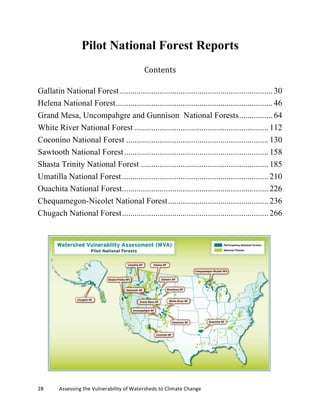
PROJECT TEAM
The following team members contributed to this assessment:
Amina Sena, CNF, hydrologist
Mike Childs, CNF, fisheries
Janie Agyagus, CNF, wildlife
Ralph Martinez, Plumas NF, GIS
Ken Roby, Lassen NF (retired)
REFERENCES
Arizona Department of Water Resources. 2011. Arizona Water Atlas Volume 5: Central Highlands
Planning Area.
http://www.azwater.gov/AzDWR/StatewidePlanning/WaterAtlas/CentralHighlands/default.htm
Dominguez, F. and J. Cañon and J. Valdes. 2009. IPCC-AR4 climate simulations for the Southwestern
US: the importance of future ENSO projections. Climatic Change DOI: 10.1007/s10584-009-9672-5
Liang, X., D. P. Lettenmaier, E. F. Wood, and S. J. Burges. 1994. A Simple hydrologically Based
Model of Land Surface Water and Energy Fluxes for GSMs, J. Geophys. Res., 99(D7), 14,415-14,428.
Littell, J.S., M.M. Elsner, G.S. Mauger, E.R. Lutz, A.F. Hamlet, and E.P. Salathé. 2011. Hydrologic
Change in the Northern U.S. Rockies and Pacific Northwest: Internally Consistent Projections of Future
Climate for Resource Management. Regional Climate and Preliminary project report, USFS JVA 09-JV-
11015600-039. Prepared by the Climate Impacts Group, University of Washington, Seattle.
National Oceanic and Atmospheric Administration. 1994. National Climatic Data Center. Mean Total
Precipitation - Annual vector digital data. Available on line at: Server=geodata.library.arizona.edu;
Service=5151; Database=atlas01; User=NCDC; Version=dbo.DEFAULT
Coconino	
  National	
  Forest	
  Watershed	
  Vulnerability	
  Assessment,	
  Southwest	
  Region	
  (R3)	
  
157	


  Assessing	
  the	
  Vulnerability	
  of	
  Watersheds	
  to	
  Climate	
  Change
	
  
Rajagopal S., Gupta H. V., Troch P. A., Dominguez F., Castro C. L. 2010. Climate change impacts on
the water balance of a semi arid catchment in central Arizona using statistically downscaled climate data.
(in preparation).
Staudenmaier, Mike Jr., Preston, Reginald and Sorenson, Paul. 2007. Climate of Flagstaff, Arizona.
NOAA Technical Memorandum NWS WR-273. 76 p.
U.S. Department of Agriculture. 1994. A Federal Guide for Pilot Watershed Analysis, Version 1.2.
Portland, OR. 202 pp
Coconino	
  National	
  Forest	
  Watershed	
  Vulnerability	
  Assessment,	
  Southwest	
  Region	
  (R3)	


158	


  Assessing	
  the	
  Vulnerability	
  of	
  Watersheds	
  to	
  Climate	
  Change
	
  
Assessment of Watershed Vulnerability
to Climate Change
Sawtooth National Forest
March, 2012
Prepared by:
John Chatel
Aquatics Program Manager
Sawtooth National Forest
Twin Falls Idaho
Sawtooth	
  National	
  Forest	
  Watershed	
  Vulnerability	
  Assessment,	
  Intermountain	
  Region	
  (R4))	
  
159	


  Assessing	
  the	
  Vulnerability	
  of	
  Watersheds	
  to	
  Climate	
  Change
	
  
FOREST CONTEXT
The unit and area assessed is the Sawtooth National Forest (SNF) and Sawtooth National Recreation Area
within the Upper Salmon Subbasin (4th HUC) located in Idaho in the Intermountain Region (R4) of the
USFS (Figure 1).
PARTNERS
Trout Unlimited and Rocky Mountain Research Station
ASSESSMENT OBJECTIVE
The assessment objective was to determine what influence climate change may have on infrastructure and
key aquatic species (bull trout) within the Upper Salmon basin on the Sawtooth National Recreation Area.
SCALE OF ANALYSIS
The scale of the analysis used in the Sawtooth National Recreation Area; Upper Salmon Subbasin
assessment was HUC-6 (12-digit) subwatersheds.
Figure 1. Location of Upper Salmon Subbasin and Sawtooth National Recreation Area, where watershed
vulnerability assessment was completed
Sawtooth	
  National	
  Forest	
  Watershed	
  Vulnerability	
  Assessment,	
  Intermountain	
  Region	
  (R4)	
  
160	


  Assessing	
  the	
  Vulnerability	
  of	
  Watersheds	
  to	
  Climate	
  Change
	
  
WATER RESOURCE VALUES
Columbia River Bull Trout
• Threatened Species under Endangered Species Act since1998
• Sawtooth NF Management Indicator Species
• More specific habitat requirements than other salmonids
• Associated with the coldest streams; upper tolerance limits appear to be 12-15°C
• Climate change could lead to smaller and more isolated habitat patches and the loss of local
populations in the Upper Salmon.
• Embryos and juveniles are vulnerable to channel scour associated with the rain-on-snow events
and winter peak flows.
Infrastructure
• Roads, campgrounds, water diversions, bridges, etc., with poor drainage or in riparian areas will
be at increased risk from rain-on-snow events and winter peak flows.
Water
Resource
Value
Indicators
Projected Hydrologic
Changes
Analysis Tools Potential Impacts
Infrastructure Recreation Sites
(Campgrounds)
Water Diversions
System Roads and
Trails
Private Ownership
Rain-on-Snow Events
Increased Winter Peak
Flows
VIC – Winter 95
(# of days in the winter in
which flows are among the
highest 5% for year)
Flood Damage
Aquatics Bull Trout Rain-on-Snow Events
Increased Winter Peak
Flows
Lower Summer Base
Flows
Increased Summer Water
Temps
VIC – Winter 95
VIC – MeanSummer
(Mean flow during June 1
to September 30)
Stream Temperature
Model (Summer Maximum
Weekly Temperature)
Egg and Juvenile
Scour
Habitat Reduction
Habitat
Fragmentation
Table 1. Water resource values, indicators, and analysis tools
WATERSHED SENSITIVITY
Watershed sensitivity includes natural risks from increased sediment, debris flows, and landslides to fish
populations. The following factors were considered.
Subwatershed Vulnerability - Percent of a subwatershed with sensitive land types (e.g., inherent surface
soil erosion, sediment yield, and mass stability) (Figure 2).
Landslide Prone Terrain – Included are areas with a tendency for rapid soil mass movements typified
by shallow, non-cohesive soils on slopes with shallow translational planar landsliding phenomena are
Sawtooth	
  National	
  Forest	
  Watershed	
  Vulnerability	
  Assessment,	
  Intermountain	
  Region	
  (R4)	
  
161	


  Assessing	
  the	
  Vulnerability	
  of	
  Watersheds	
  to	
  Climate	
  Change
	
  
controlled by shallow groundwater flow convergence. Also included are landforms with slow soil mass
movements with deep earth-flows and rotational slumps, snow avalanche and rock fall areas (Figure 3).
WATERSHED CONDITION
Watershed condition was determined using the "Matrix of Pathways and Indicators" and Bayesian belief
networks. The "Matrix of Pathways and Indicators" has been a consultation requirement for species listed
under the Endangered Species Act since the late 1990’s. Baseline information was already organized and
summarized by the matrix according to important environmental parameters for each subwatershed within
the Upper Salmon subbasin within Sawtooth NRA. This matrix was divided into six overall pathways:
-- Water Quality -- Channel Condition and Dynamics
-- Habitat Access -- Flow/Hydrology
-- Habitat Elements -- Watershed Conditions
Each of the above pathways is further broken down into watershed condition indicators (WCIs). WCIs are
described in terms of functionality (Appropriate {FA}, At Risk {FR}, and At Unacceptable Risk {FUR}).
The Functioning Appropriately column represents the desired condition to strive toward for each
particular WCI. The current condition of each WCI is represented as falling within its respective
functionality class (Figure 5). The units of measure for WCIs are generally reported in one of two ways:
(1) quantitative metrics that have associated numeric values (e.g., “large woody debris: > 20 pieces per
mile”); or (2) qualitative descriptions based on field reviews, professional judgment, etc. (e.g., “physical
barriers: man-made barriers present”). The suite of relevant WCIs, considered together, encompasses the
environmental baseline or current condition for the subwatershed and associated aquatic resources.
Bayesian belief networks (Lee and Rieman, 1997) were used to evaluate relative differences in predicted
physical baseline outcomes. They are appealing because their basic structure (a box-and-arrow diagram
Figure 2. Subwatershed vulnerability within the Upper
Salmon subbasin on the Sawtooth NRA. Red areas have
high risk, yellow have moderate risk and green have
low risk of surface erosion.
Figure 3. Landslide-prone terrain within the Upper
Salmon sub-basin on the Sawtooth NRA. Red areas have
high risk, yellow have moderate risk, and green have low
risk of landslides
Sawtooth	
  National	
  Forest	
  Watershed	
  Vulnerability	
  Assessment,	
  Intermountain	
  Region	
  (R4)	
  
162	


  Assessing	
  the	
  Vulnerability	
  of	
  Watersheds	
  to	
  Climate	
  Change
	
  
that depicts hypothesized causes, effects, and ecological interactions) can be readily modified to reflect
new information or differences in perceptions about key relationships (Figure 4). Outcomes also are
expressed as probabilities, so uncertainty is explicit.
Bayesian belief networks (BBN) were constructed through a series of meetings with Boise and Sawtooth
Forest biologists and the Rocky Mountain Research Station in 2004 to identify what baseline condition
we believed possible when
multiple indicators and
pathways had certain
functionality outcomes.
Conceptual models (box-
and-arrow diagrams) that
depicted the hypothesized
causal relationships were
developed to show how
each indicator resulted in
pathway determinations and
specific pathway outcomes
resulted in an overall
physical or biological
baseline condition. Each
BBN network variable or
“node” was described as a set of discrete states that represented possible conditions or values, given the
node’s definition. Arrows represent dependence or a cause-and-effect relationship between corresponding
nodes. Conditional dependencies among nodes were represented by conditional probability tables (CPTs)
that quantify the combined response of each node to its contributing nodes, along with the uncertainty in
that response. The BBN was implemented in the modeling shell Netica software (Norsys Software Corp).
Key model assumptions included:
• All independent variables (Parent Nodes) in each model exert some influence on the dependent
variables (Daughter Nodes). There are no “inert” variables in the Bayesian belief networks and
influence diagrams.
• Some variables may exert greater influence than others. For example, large pools and substrate
embeddedness were “weighted” more heavily than four other WCIs in the belief network
developed for evaluating the Aquatic Habitat pathway functional rating. In other words, the
probabilities in the relation table reflect a belief that the functional ratings for large pools and
substrate embeddedness exert greater influence on the overall Aquatic Habitat pathway than any
of the other four WCIs.
• Where all independent variables (parent node are functioning appropriately, there is zero
probability that the overall pathway/threat (daughter node) will be functioning at risk.
Conversely, where all independent variables (parent nodes) are functioning at risk, there is zero
probability that the overall pathway/threat (daughter node) will be functioning appropriately.
• The probability that the overall pathway (daughter node) is functioning appropriately decreases
incrementally with departure from the FA condition in its parent nodes. Conversely, the
probability that the overall pathway or risk (daughter node) is functioning at unacceptable risk
(FUR) decreases incrementally with improvement from the FUR condition in its parent nodes.
Figure 4. Bayesian belief network for determining overall physical condition from the
six matrix pathways.
Sawtooth	
  National	
  Forest	
  Watershed	
  Vulnerability	
  Assessment,	
  Intermountain	
  Region	
  (R4)	
  
163	


  Assessing	
  the	
  Vulnerability	
  of	
  Watersheds	
  to	
  Climate	
  Change
	
  
Figure 5. Overall physical baseline condition of subwatersheds within the Upper
Salmon subbasin on the Sawtooth NRA. Red areas have conditions “functioning
at unacceptable risk,” yellow areas have conditions “functioning at risk,” and green
areas have conditions “functioning appropriately.”
Sawtooth	
  National	
  Forest	
  Watershed	
  Vulnerability	
  Assessment,	
  Intermountain	
  Region	
  (R4)	
  
164	


  Assessing	
  the	
  Vulnerability	
  of	
  Watersheds	
  to	
  Climate	
  Change
	
  
Stressors that currently affect condition or may affect condition in the future
Stressors or threats to aquatic resources were determined by 13 indicators of past and current management
activities. These indicators included, among others, the amount of federal ownership within each
subwatershed, number of abandoned mines, number of dispersed and developed recreation sites, route
densities, water diversions, culvert barriers, and allotments. (Table 2). Criteria for each indicator were
determined based on the Forest Plan (e.g., water quality and geomorphic integrity), literature (e.g., route
densities), distribution through histograms (e.g., recreation) and professional judgment (e.g., culvert
barriers) to determine the level of threat.
Indicators Low Threat Moderate Threat High Threat
Percent Federal Ownership 85-100% 50-84% <50%
Abandoned Mines 0-9 sites/6th
Field 10-31 sites/6th
Field >32 sites/6th
Field
Dispersed Recreation Sites 0-8 sites/6th
Field 9-31/6th
Field >31/6th
Field
Developed Recreation Sites 0-1 sites/6th
Field 2-7 sites/6th
Field >7 sites/6th
Field
Route Density
Miles of road/sq. miles of classified and
unauthorized roads (w/in admin
boundaries)
< 0.7 mi/mi2 0.71-1.7 mi/mi2
>1.7 mi/mi2
RCA Route Density
Miles of road/sq. miles of classified and
unauthorized roads (w/in admin
boundaries) within RCAs
< 0.7 mi/mi2 0.71-1.7 mi/mi2
>1.7 mi/mi2
Landslide Prone Road Density <0.5 mi/mi2 0.5-0.7 mi/mi2
> 0.7 mi/mi2
Water Diversions No Diversions 1-2 diversions/6th
Field >2 sites/6th
Field
Culvert Barriers No barriers present Culverts are partial
barriers (passable to
adults, but barrier to
juveniles) or complete
barriers, but less than
0.5 miles are blocked
on minor tributary
Barriers to all life
stages (juveniles and
adults)
Water Quality Integrity
Ratings are based on the cumulative
effects of localized physical problems—
such as poorly constructed roads,
mineral activities, failed culverts, and
landslides—or dispersed sources such as
areas of extensive grazing, timber
harvest, road construction or wildfire.
The ratings determine the streams and
riparian water quality relative to their
potential.
No damaged stream
segments; fully
supports beneficial
uses
<20% stream segments
damaged; may not fully
support beneficial uses
(303d-listed)
>20% stream
segments damaged;
does not fully support
beneficial uses
(TMDL developed)
Sawtooth	
  National	
  Forest	
  Watershed	
  Vulnerability	
  Assessment,	
  Intermountain	
  Region	
  (R4)	
  
165	


  Assessing	
  the	
  Vulnerability	
  of	
  Watersheds	
  to	
  Climate	
  Change
	
  
Geomorphic Integrity
Rating determinations are based on the
ability of subwatershed soil-hydrologic
conditions to function as a sponge-and-
filter system to absorb and store inputs
of water, and on geomorphic resilience
of streams, and riparian and wetland
areas. Both natural and anthropogenic
disturbances were used to estimate
existing geomorphic conditions of each
subwatershed.
Subwatershed is in
good condition, near
or at properly
functioning condition,
and has low risk from
further disturbance.
Subwatershed is in fair
condition, functioning
at risk, and has
moderate risk from
additional disturbance.
Subwatershed is in
poor condition, not
properly functioning,
and has high risk
from additional
disturbance.
Allotments No allotments Sheep/Goat allotments
and less than 25% of 6th
Field in Cattle/Horse
allotment
Greater than 25% of
6th
Field in
Cattle/Horse
allotment and
Sheep/Goat
allotments present
Equivalent Clearcut Acres <15% 15-20% >20%
Table 2. Indicators and criteria used to determine threats to aquatic resources
After each indicator was rated (low, moderate, or high), outcomes were entered into a Bayesian belief
network to determine a composite threat rating for each subwatershed within the Upper Salmon subbasin
on the Sawtooth National Recreation Area (Figure 6). Threat ratings were used later in this analysis to
determine bull trout persistence. A key assumption in this analysis is that subwatersheds with a higher
composite risk rating would be more at risk to the influences of climate change.
Figure 7. Composite threat rating for subwatersheds in the Upper
Salmon subbasin on the Sawtooth NRA. Red areas have the most
threats, yellow areas have moderate threat levels, and green areas
have low threat levels.
Figure 6. Bayesian belief network for determining overall
threat level for each subwatershed on the Sawtooth NRA.
Sawtooth	
  National	
  Forest	
  Watershed	
  Vulnerability	
  Assessment,	
  Intermountain	
  Region	
  (R4)	
  
166	


  Assessing	
  the	
  Vulnerability	
  of	
  Watersheds	
  to	
  Climate	
  Change
	
  
CLIMATE CHANGE EXPOSURE MODELS
Water Temperature
Potential effects of increased water temperatures due to climate change to bull trout were evaluated using
a non-spatial multiple regression stream temperature model (Isaak et al. 2010). This model was created
using an extensive, but non-random database of stream temperature measurements within the upper
Salmon River, Upper S.F. Payette and Upper S.F. Boise subbasins on the SNF. More than 450
temperature measurements (Hobo and Tidbit models) were used from numerous resource agencies from
1994–2008. The majority of thermographs were placed in streams before mid-July, geo-referenced, and
retrieved after mid-September. This sample period encompassed the warmest portion of the year when
variation in temperatures among areas is most pronounced and influence on fish growth, behavior, and
distribution is potentially greatest (Scarnecchia and Bergersen 1987, Royer and Minshall 1997).
Predictor variables (i.e., geomorphic, climatic, and categorical) were used to describe spatial and temporal
attributes associated with the stream network. Geomorphic predictors included watershed contributing
area, elevation, and channel slope. Predictors in this category represented relatively static features of the
river network, valley bottoms, and upstream watersheds that were hypothesized to affect stream
temperatures.
Interannual variation in climatically-influenced factors such as air temperature and stream flow have
important consequences for stream temperatures. Air temperature affects stream temperature through
sensible heat exchange near the surface of the stream and by influencing temperatures of near surface
groundwater, which is an important component of summer flows. Stream flow determines the volume of
water available for heating; larger flows have greater thermal capacities and are less responsive to heating
(Hockey et al. 1982, Caissie 2006).
Climate predictors included air temperature measurements derived from extrapolations of the observed 30
year trends at cooperative weather stations (Ketchum and Stanley) on the Sawtooth National Forest, and
the 50 year trends at the USGS gauges (S.F. Boise River near Featherville, S.F. Payette River at Lowman,
and Salmon River below Yankee Fork near Clayton) with the longest records on or near the SNF. The air
temperature data between weather stations was strongly correlated (r2
= 0.74–0.91), so the individual time
series were averaged and the same summary metrics that were applied to model stream temperatures were
applied (i.e., MWMT). Flow data were obtained from two USGS stream gauges in the basin (Twin
Springs and Featherville gauges). These two sets of data were also strongly correlated (r2
= 0.97) and were
averaged to calculate annual mean flow (m3
/s) from 15 July to 15 September.
Air temperature projections, used in the water temperature model, assume climate change will continue at
the same rate that has occurred in the last 50 years on the forest. This likely underestimates the amount of
change (as predicted by or some IPCC climate change scenarios). These scenarios generally predict the
rate of air temperature change to accelerate due to increased carbon dioxide (Isaak/Wegner, pers. comm.).
The advantage of using empirical estimates is that they're based on data from the Forest, are easy to
understand. They provide estimates comparable to those from the IPCC scenarios for future values at
mid-century.
Categorical predictors included effects due to increased water temperature in lake outflows, water
diversions, wildfires, and professional judgment. All upstream wildfires that occurred within the past 20
years were considered. Water diversion effects on water temperatures were coded from zero (when they
diverted less than 5% of flow) to three (when they diverted more than 30% of flow). Diversion effects on
stream temperature were assumed to extend as far as 7 km downstream of the diversion or to a confluence
with a larger river or stream. Finally, lakes larger than 0.1 km2,
or groups of lakes, were considered to
Sawtooth	
  National	
  Forest	
  Watershed	
  Vulnerability	
  Assessment,	
  Intermountain	
  Region	
  (R4)	
  
167	


  Assessing	
  the	
  Vulnerability	
  of	
  Watersheds	
  to	
  Climate	
  Change
	
  
have an influence on water temperatures as far as 7 km downstream or to the confluence with another
water body. All predictors were found to be significant (p<.05) in the model, with the exception of the
wildfire effect. This was likely a result of limited fire-related temperature data and a minimal amount of
wildfires on the Sawtooth NRA. As a result, the wildfire effect was not included in the final model. The
model had an r2
of 0.47 and we established that it under predicted very warm temperatures and over
predicted colder temperatures. A bias correction was applied to the predicted values to address these
issues.
Once temperature predictions were obtained for stream segments, potential effects on bull trout were
analyzed by summarizing the available stream miles that were within or exceeded 15 o
C for each bull
trout patch. These calculations were made for current (2008), 2040, and 2080 time frames. Streams with
cumulative drainages of less than 4 square kilometers were eliminated. Streams and their upstream
neighbors were also eliminated if their gradient was greater than 15%. If available habitat was less than
two miles within a patch, it was assumed that bull trout populations would not persist. This distance was
based on not finding reproducing bull trout populations during the last eight years of sampling on the
Sawtooth National Forest.
Variable Infiltration Capacity (VIC)
Winter high-flow frequency and summer baseflows were calculated for each subwatershed in the Upper
Salmon subbasin using outputs from the VIC macro-scale hydrologic model (Liang et al. 1994, Liang et
al. 1996) run for the Pacific Northwest by the Climate Impacts Group at the University of Washington
(Matheussen et al. 2000, Elsner et al. 2009). The VIC model is a distributed, largely physically-based
model that balances water and energy fluxes at the land surface and takes into account soil moisture,
infiltration, runoff, and baseflow processes within vegetation classes. It has been widely used in the
western US to study past and potential future changes to water flow regimes (Hamlet et al. 2009),
snowpacks (Hamlet et al. 2005), and droughts (Luo and Wood 2007). A recently developed simplified
routing method was obtained from Seth Wenger of Trout Unlimited (Wenger et al. 2010) that applied
VIC outputs to stream segments in the National Hydrography Dataset Plus (NHD Plus;
http://www.horizon-systems.com/nhdplus/) in USGS hydrologic region 17 (the Pacific Northwest).
Two metrics (MeanSummer and Winter 95) were calculated for each subwatershed using the NHD stream
segments. Mean summer flow represents the flow occurring between June 1 and September 30. This
period may be most limiting to fish and is correlated with maximum water temperature (Isaak et al.,
2010). Winter 95 represents the number of days during winter that are among the highest 5%
(respectively) of flows for the year. These were assumed to be flows with velocity sufficient to displace
and kill newly emerged fry (Fausch et al. 2001), but not necessarily destroy embryos in redds. Winter was
defined as Dec. 1 – Feb. 28. Previous model validations (Wenger et al. 2010) had demonstrated that
metrics representing frequency of winter high flows were accurately predicted and mean summer flow
was predicted with moderate accuracy in most cases.
Metrics were calculated for the 20-year period between October 1, 1977 and September 30, 1997 to
represent baseline conditions. Wenger (2010) selected this time frame due to the availability of good flow
records and numerous contemporaneous fish collection data to which flow metrics could later be
matched. Metrics were also calculated for 2040 and 2080 using the A1B1 climate scenario to project
potential changes in summer baseflow and winter high flows.
Both metrics were determined by summarizing all of the NHD stream segments that fell within a
subwatershed and then calculating an overall average. Change in MeanSummer flow was evaluated by
looking at the percent change in flow from current to 2040 and 2080. Changes of less than 20% baseflow
Sawtooth	
  National	
  Forest	
  Watershed	
  Vulnerability	
  Assessment,	
  Intermountain	
  Region	
  (R4)	
  
168	


  Assessing	
  the	
  Vulnerability	
  of	
  Watersheds	
  to	
  Climate	
  Change
	
  
were considered low risk, 20 to 40% were considered moderate, and greater than 40% were considered
high risk. Changes in Winter 95 were determined by seeing how many days with the highest 5% flows
increased from current to 2040 and 2080. Subwatersheds with less than a 0.5 day increase were
considered low risk, 0.5 to 2 day increases were considered moderate risk, and increases greater than 2
days were considered high risk. Risk ratings for Winter 95 and MeanSummer were provided by Seth
Wenger, based on his recent work evaluating climate variables relative to geomorphic and land use in
determining the distributions of bull trout and other species in the Interior Columbia River Basin (Wenger
et al. (in press)).
EXPOSURE RESULTS
Winter Peak Flows (Winter 95) – The Upper Salmon
subbasin has many high-elevation subwatersheds and
is surrounded by 12,000-foot snow-capped peaks of
the White Cloud and Sawtooth Mountains. Cold, dense
air sinking from the mountains into the valley is the
main reason for the chilly early-morning temperatures
that are frequently the lowest in the lower 48 states. As
a result, mid-winter rain-on-snow events are currently
very rare. Rain-on-snow events that do occur typically
happen in late April to May. The high elevation terrain
and cold winter temperatures should help to buffer
snow packs from winter flooding. However, as air
temperatures increase, this natural buffering capacity
will diminish, especially in those subwatersheds where
temperatures hover around freezing. By 2100, air
temperatures in Idaho could increase by 5°F (with a
range of 2-9°F) in winter and summer (EPA 1998).
The VIC model projects that the risk from mid-winter
peak flows triggered by rain-on-snows events will
increase by 2080. Specifically, the highest 5% winter-
peak flows average 0.88 days under current conditions
(1977-1997), but increase to 2.6 days in 2040 and to
4.44 days in 2080 on the Sawtooth NRA under the
A1B emission scenario. Wenger et al. (in press) found
some areas in the interior Columbia River basin within
the 1977-1997 timeframe to have up to 8.4 days at the
highest 5% winter peak flow. Thus, the current risk of
mid-winter peak flows is relatively low in comparison
to other areas. However, these risks will be increasing.
By 2040, three (5.9%) of the 51 subwatersheds
analyzed have less than a 0.5 day (low risk) increase in
winter peak low from current; 34 (66.7%) have a 0.5 to
2 day (moderate risk) increase from current; and 14
(27.4%) have a greater-than-2-day (high risk) increase
from current (Figure 8). Meadow, Stanley Lake, and
Smiley Creek have the highest risk with each having
over a 4 day increase in winter peak flows by 2040.
Figure 8. Winter peak flow risk in 2040; highest
(red); moderate (yellow); and lowest (green)
Figure 9. Winter peak flow risk in 2080; highest
(red); moderate (yellow); and lowest (green)
Sawtooth	
  National	
  Forest	
  Watershed	
  Vulnerability	
  Assessment,	
  Intermountain	
  Region	
  (R4)	
  
169	


  Assessing	
  the	
  Vulnerability	
  of	
  Watersheds	
  to	
  Climate	
  Change
	
  
By 2080, only one (2.0%) subwatershed remains in a low risk category and three (5.9%) subwatersheds
remain in a moderate risk category (Figure 9). The remaining 47 (92.1%) subwatersheds are in a high risk
category, with Elk, Meadow, Pettit Lake, Smiley, Stanley Lake, and Upper Redfish Lake Creeks showing
over a 5-day increase in winter peak flows.
Summer Baseflows (Mean Summer)
The VIC model projects that summer baseflows
may decrease from current conditions (1977-1997)
by 22% in 2040 and 29% in 2080, for the entire
Sawtooth NRA under the A1B emission scenario.
This is not unexpected, because air temperatures
and evapotranspiration are expected to increase.
Increasing winter air temperatures will reduce the
amount of snow (e.g., more precipitation falling as
rain than snow), as already observed in several
parts of the western United States (Aguado et al.
1992; Dettinger and Cayan 1995). Higher spring
temperatures will also initiate earlier runoff and
peak streamflows in snowmelt-dominated basins
(Aguado et al. 1992; Cayan et al. 2001).
By 2040, 18 (35.3%) of the 51 subwatersheds
analyzed are predicted to see moderate risks (20-
40%) from decreases in baseflow, and 33
subwatersheds will see low risk (< 20%) (Figure 10).
By 2080, only 5 (9.8%) subwatersheds are predicted
to remain in a low risk category and 42 (89.4%)
subwatersheds in a moderate risk category (Figure
11). The remaining 4 (7.8%) subwatersheds (Beaver,
Elk, Fishhook, and Park-Hanna) are predicted to be
in a high risk category, with baseflow decreases of
37% or greater. These model predictions, however,
should not be viewed as absolute changes, but
instead as more reflective of a general trend of
declining baseflows. This is because the VIC does
not model groundwater, which causes it to
underestimate summer flows where groundwater
contributes. Conversely, the model also
overestimates summer flows in drainages that lose
stream flow.
Still, the prediction of lower baseflows is consistent with other studies. Since 1950, stream discharge in
both the Colorado and Columbia River basins has decreased (Walter et al. 2004). Regonda et al. (2005)
Figure 10. Summer baseflow risk in 2040; moderate
(yellow); and lowest (green)
Figure 11. Summer baseflow risk in 2080; highest
(red); moderate (yellow); and lowest (green)
Sawtooth	
  National	
  Forest	
  Watershed	
  Vulnerability	
  Assessment,	
  Intermountain	
  Region	
  (R4)	
  
170	


  Assessing	
  the	
  Vulnerability	
  of	
  Watersheds	
  to	
  Climate	
  Change
	
  
and Stewart et al. (2005) found that stream runoff steadily advanced during the latter half of the twentieth
century and now occurs 1 to 3 weeks earlier, due largely to concurrent decreases in snowpack and earlier
spring melt (Mote et al. 2005). These changes diminished recharge of subsurface aquifers that support
summer baseflows (Hamlet et al. 2005). Luce and Holden (2009) found that three-fourths of the 43 gauge
records they examined from the Pacific Northwest exhibited statistically significant declines in summer
low flows. Luce and Holden (2009) also found that the driest 25% of years are becoming drier across the
majority of the Pacific Northwest sites, with most streams showing decreases exceeding 29% and some
showing decreases approaching 50% between 1948 and 2006. Sites on or near the Sawtooth National
Forest showed similar declines in mean annual flow (Table 3).
Site Name
Average
Annual Flow
(mm)
25th
Percentile
Change
Median
Change
75th
Percentile
Change
Mean
Change
13139510
Big Wood River at
Hailey
257 -31% -13% -6% -7%
13186000
SF Boise River NF
Featherville
411 -43% -30% 1% -21%
13302500
Salmon River at
Salmon
182 -42% -29% -11% -26%
Table 3. Mean annual flow from 1948-2006
In the upper Salmon River drainage, there are numerous irrigation diversions on federal and private land
within the Sawtooth NRA. There are nine subwatersheds (Champion, Elk, Fisher, Huckleberry, Iron-
Goat, Park-Hanna, Pole, Slate, and Smiley Creeks) at risk from declining baseflows and water diversion
(Table 4). Future decreases in summer baseflows in these subwatersheds are likely to have severe
consequences for aquatic ecosystems where there are already high water demands from diversions.
HUC-6 Name
% Decrease in MeanSummer
Baseflows from Current
Water Diversions
2040 2080 Overall Influence
Miles of Stream
Impacted
Alturas Lake 24 39 None --
Beaver Creek 30 42 Low 1.21
Beaver-Peach 14 25 Low 3.88
Big Boulder Creek 109 15 Low 0.58
Big Casino Creek 10 14 Moderate 1.06
Big Lake Creek 11 20 None --
Bluett-Baker 10 22 Low 3.96
Boundary-Cleveland 15 28 Low 5.25
Cabin-Vat 22 34 Low 1.99
Champion Creek 17 33 Mod/High 3.13
East Basin-Kelly 24 30 None --
Elk Creek 25 53 Moderate 0.30
Fisher Creek 24 27 High 1.95
Fishhook Creek 25 37 None --
Fourth of July Creek 122 21 Low/Mod 4.52
French-Spring 13 24 Low 5.16
Germania Creek 13 27 None --
Sawtooth	
  National	
  Forest	
  Watershed	
  Vulnerability	
  Assessment,	
  Intermountain	
  Region	
  (R4)	
  
171	


  Assessing	
  the	
  Vulnerability	
  of	
  Watersheds	
  to	
  Climate	
  Change
	
  
HUC-6 Name
% Decrease in MeanSummer
Baseflows from Current
Water Diversions
2040 2080 Overall Influence
Miles of Stream
Impacted
Gold-Williams 16 29 Low/Mod 10.77
Harden-Rough 15 28 None --
Hell Roaring-Mays 20 32 Low 2.63
Holman-Mill 14 24 Low 2.88
Huckleberry Creek 18 23 High 1.64
Iron-Goat 26 35 High 13.22
Joes-Little Casino 15 28 Low 5.58
Little Boulder Creek 8 22 Low 0.15
Lower Yankee Fork 17 23 None --
Meadow Creek 34 38 None --
Muley-Elk 15 26 None --
Nip and Tuck-Sunny 15 29 Low 7.27
Park-Hanna 32 42 High 8.46
Pettit Lake Creek 18 31 None --
Pole Creek 26 37 High 3.19
Prospect-Robinson Bar 12 27 None --
Redfish-Little Redfish 11 29 None --
Sawtooth City-Frenchman 29 35 Low 3.14
Slate Creek 15 27 Moderate 6.42
Smiley Creek 31 35 Moderate 0.92
Spud-Clayton 12 22 None --
Stanley Creek 25 34 None --
Stanley Lake Creek 25 33 Low 1.19
Sullivan-Clayton 12 22 None --
Swimm-Martin 9 29 None --
Thompson Creek 5 10 None --
Upper EF Salmon 23 32 None --
Upper Redfish Lake Creek 5 33 None --
Upper Salmon River 31 37 Low 4.04
Upper Warm Spring Creek 1 29 None --
Warm-Taylor 38 35 Low 9.00
West Pass Creek 8 12 Moderate 0.54
Wickiup-Sheep 11 23 Low 4.66
Yellow Belly Lake Creek 9 31 None --
Table 4. Comparison of summer baseflow changes and subwatersheds with water diversions
* Green shaded (low risk) = < 20% decrease in baseflow; Yellow shaded (moderate risk) = 20 to 40% decrease; and
Orange shaded (high risk) = > 40% decrease in baseflow.
* Overall water diversion influence takes into account the number of diversions and miles of stream impacted by
water withdrawals within each subwatershed.
Sawtooth	
  National	
  Forest	
  Watershed	
  Vulnerability	
  Assessment,	
  Intermountain	
  Region	
  (R4)	
  
172	


  Assessing	
  the	
  Vulnerability	
  of	
  Watersheds	
  to	
  Climate	
  Change
	
  
Summer Water Temperatures (Maximum weekly maximum temperature)
The temperature model predicts that summer maximum weekly maximum water temperatures will see a
steady increase over the next 70 years (0.9 o
C in 2033, 1.1 o
C in 2040, 1.7 o
C in 2058, and 2.5 o
C in 2080)
on the Sawtooth NRA. As a result, bull trout habitat within the 15 o
C optimal temperature range will see a
steady decrease. The stream temperature model currently projects that 102 miles of bull trout habitat
within optimal temperatures exist across the Sawtooth NRA. Suitable habitat will see a slight decrease to
100 miles by 2040, but a substantial decrease (35%) to 66.7 miles by 2080 (Figures 12 and 13).
Figure 12. Available thermal bull trout habitat in
Valley Creek on the Sawtooth NRA in 2008.
Streams with optimal temperatures are portrayed in
purple and those outside optimal range in red.
Figure 13. Available thermal bull trout habitat in
Valley Creek on the Sawtooth NRA in 2080.
Streams with optimal temperatures are portrayed in
purple and those outside optimal range in red.
Sawtooth	
  National	
  Forest	
  Watershed	
  Vulnerability	
  Assessment,	
  Intermountain	
  Region	
  (R4)	
  
173	


  Assessing	
  the	
  Vulnerability	
  of	
  Watersheds	
  to	
  Climate	
  Change
	
  
Water temperature increases are not surprising, as mean air temperatures have seen a 0.49 o
C increase per
decade (1979-2008) at local weather stations and projections show air temperatures increases of another
3.9 o
C by 2080. At the same time, annual stream flows have decreased 5%/decade (1957-2008) at local
USGS gauging stations and are projected to decrease an additional 54% by 2080. However, not every
future year is expected to see warmer air temperatures and lower stream. The most pronounced changes
will likely be associated with short-term cycles such as the Pacific Decadal Oscillation and the El Nino-
Southern Oscillation. As climate change progresses, long-term warming trends will result in more
frequent droughts and periods of unusually warm weather that were considered extreme in the twentieth
century. When these events occur, the most affected watersheds will be those that have a high percentage
of low-elevations terrain and channel conditions prone to heating (wide, shallow, lack of riparian
vegetation) (Crozier and Zabel 2006).
Projected decreases in thermally optimal bull trout habitat are similar to those by O’Neal (2002), who
concluded that 2%-7% of current trout habitat in the Pacific Northwest would be unsuitable by 2030, 5%-
20% by 2060, and 8%-33% by 2090. Williams et al. (2009) also concluded that cold-water fish habitat in
the Rocky Mountain region could lose up to 35% of its habitat by 2050 and 50% by 2100.
Ecological Departure
Bayesian belief networks were used to determine the overall influence of stream temperature, summer
baseflow, and winter peak flow changes due to climate change on current and historic bull trout habitat
(Figure 14). BBN’s were constructed through a series of meetings with Sawtooth National Forest and the
Rocky Mountain Research Station in 2010 to determine how much collective change would need to occur
before a certain level of ecological departure impacted aquatic habitat within each subwatershed that
supported current or historic bull trout populations.
Bayesian models predicted that habitat in 6 (16%) bull trout patches on the Sawtooth NRA would be at
high risk from ecologically-departed flow and temperature conditions. It also predicted that habitat would
be at moderate risk in 17 (46%) bull trout patches and at low risk in 14 (38%) bull trout patches. By 2080,
risks to habitat from changed flows and water temperatures increase greatly. Only one (3%) bull trout
patch (Big Casino Creek) would have low risk from ecologically-departed flow and temperature
conditions, while habitat in 22
(59%) patches would be at
moderate risk and 14 (38%)
patches would be at high risk.
Bull Trout Persistence
Bayesian belief networks were
used to determine bull trout
persistence in the future on the
Sawtooth NRA. Persistence of
bull trout was based on a
combination of factors. These
included (Figure 15): the influence
of increasing stream temperature,
decreasing summer baseflow, and more frequent winter peak flow events due to climate change; the
composite rating for risks and threats (i.e. landslide terrain, water diversions, route density, etc.); and
current biological (i.e., local population size, life history diversity, etc.) and physical (i.e., overall
watershed condition) baselines. The key assumption with this approach is that smaller, weaker, bull trout
populations will be more susceptible to climate change in patches with poor baseline conditions and with
Figure 14. Bayesian belief network for determining ecological departure from
changes in mean summer baseflows, winter 95 rain on snow risks, and changes in
optimal stream temperatures for bull trout
Sawtooth	
  National	
  Forest	
  Watershed	
  Vulnerability	
  Assessment,	
  Intermountain	
  Region	
  (R4)	
  
174	


  Assessing	
  the	
  Vulnerability	
  of	
  Watersheds	
  to	
  Climate	
  Change
	
  
management activities that cumulatively impact habitat annually. This assumption is supported by studies
that found that populations in complex habitats are more stable than populations in simple ones because
they have greater capacity to buffer the effects of environmental change (Schlosser 1982; Saunders et al.
1990; Sedell et al. 1990; Schlosser 1991; Pearson et al. 1992). Neville et al. (2006) also showed that
small, isolated populations were at increased risk of extinction because of demographic and genetic
factors associated with their reduced population sizes and loss of interpopulation connectivity.
There are, however, limitations with this approach, as follows
1. Bull trout may persist in streams that commonly exceed their perceived thermal limits (Zoellick
1999) because of increased availability of food, lack of competition with other species, or
adaptations that better exploit thermal refugia or shift timing of life history transitions (Crozier
and others 2008; Jonsson and Jonsson 2009).
2. Baselines and management threats were assumed to remain at present levels. In reality, some
threats will diminish due to restoration or changed management approaches, some will persist due
to a lack of political/social will to change, and new unexpected threats will emerge. As a result,
baseline conditions will also not stay constant.
3. It was assumed that species and populations will continue to use and respond to the environment
as they have in the recent past. In some instances, biological adaptation to changing environments
could mitigate some of the challenges organisms face.
4. Finally, there are many complex interactions between physical changes brought on by climate
change and species’ responses to these changes. While the model is a good start, it oversimplifies
these interactions and may inaccurately project future persistence.
Currently there are 14 patches in the Upper Salmon on the Sawtooth RNA that have reproducing bull
trout populations. Bull trout in three of these patches are “functioning at unacceptable risk”, six patches
are “functioning at risk,” and six are “functioning appropriately.” Populations in unacceptable or at-risk
conditions are due to low population sizes, competition/hybridization risks with brook trout, poor habitat
conditions, and/or moderate/high management risks. Bull trout populations in a better condition are
characterized by relatively good habitat, larger populations, low to moderate management risks, and/or no
brook trout present.
Figure 15. Bayesian belief network for determining bull trout population persistence
Sawtooth	
  National	
  Forest	
  Watershed	
  Vulnerability	
  Assessment,	
  Intermountain	
  Region	
  (R4)	
  
175	


  Assessing	
  the	
  Vulnerability	
  of	
  Watersheds	
  to	
  Climate	
  Change
	
  
Current Low Risk Populations - By 2040,
three bull trout populations are still at low
risk, nine populations are at moderate, and
two are at high risk of extinction (Table 5
and Figure 16). Two populations at low
extinction risk (Germania and Upper Warm
Spring Creeks) have low risk from climate
change (i.e., frequency of winter peak flows
averaging 1.4 days, summer baseflows
averaging a 7% decrease, and summer water
temperatures changing very little). The other
low extinction risk population (Swimm-
Martin) is projected to have moderate
climate-change risks (i.e., frequency of
winter peak flows averaging 2.4 days,
summer baseflows averaging a 9% decrease,
and summer water temperatures changing
very little), but has good watershed that
should give the population enough resiliency
to withstand the predicted changes. By 2080,
all of these populations are predicted to be subjected to a greater frequency of winter peak flows (avg.
3.4), lower summer baseflows (avg. 28% decrease), and water temperatures outside optimal conditions
for bull trout in lower portions of each patch. However, only the Germania population goes to a moderate
risk of extinction from increasing effects of system roads in the headwaters and water diversions lower in
the drainage, due to climate change.
Current Moderate Risk Populations - Four populations (Big Boulder, Little Boulder, West Pass, and
Fourth of July Creeks) are at moderate risk more from current and historic management impacts and
moderate watershed conditions, than from climate change. This does not imply that there are no climate
change impacts predicted by 2040 within
these populations. There are still moderate
increases in winter peak flows (avg. 0.9 days),
and small changes to summer baseflows (avg.
8% decrease to 15% increase) and minor
water temperature increases. However, these
changes are not enough to increase extinction
risks. The remaining five bull trout
populations (Alturas Lake, Fishhook,
Prospect-Robinson Bar, Upper EF Salmon,
and Wickiup-Sheep) are projected to see a
greater frequency of winter peak flow events
(avg. 1.6 days), less baseflow (avg. 19%
decrease) and slightly warmer water
temperatures that may limit the use of habitat
during portions of the summer. By 2080
extinction risks increase to most of the above
bull trout populations as the frequency winter
peak flows and summer water temperatures
increase and summer baseflows continue to decrease (Figure 17). One additional local bull trout
population (Wickiup-Sheep) is projected to be at high risk; nine are predicted to be at moderate risk, and
two are predicted to be at low risk of extinction (Table 5).
Figure 16. Predicted bull trout persistence in 2040. Red
subwatersheds are at high extinction risk; yellow are at moderate
risk, and green are at low risk.
Figure 17. Predicted bull trout persistence in 2080. Red
subwatersheds are at high extinction risk; yellow are at
moderate risk, and green are at low risk.
Sawtooth	
  National	
  Forest	
  Watershed	
  Vulnerability	
  Assessment,	
  Intermountain	
  Region	
  (R4)	
  
176	


  Assessing	
  the	
  Vulnerability	
  of	
  Watersheds	
  to	
  Climate	
  Change
	
  
Current High Risk Populations - By 2040, bull trout in Slate and Champion Creeks will be at a high
risk of extinction, but for different reasons. Champion Creek is projected to see the loss of summer
rearing habitat in the very lowest portion of the drainage from increased water temperatures above 15 o
C
and high risks from winter peak flows. The bull trout population is already “functioning at unacceptable
risk” due to low densities (0.7 fish per 100m2
), high densities of brook trout (17.1 fish/100m2
), recent
wildfire effects, and impacts to migration from irrigation diversions. Projected climate changes will likely
increase winter peak flows enough to displace and kill newly emerged bull trout. Warmer water
temperatures may also further decrease connectivity to migratory bull trout from the Salmon River. By
2080, risks from winter peak flows increase further (4.4 days), water temperatures are predicted to
increase as far as the SF Champion confluence, leaving only 2.3 miles of habitat within optimal summer
temperatures. Furthermore, baseflows are predicted to decrease by 33%, impacting rearing habitat and
connectivity even further, especially if irrigation demands remain constant.
By 2040, risks to summer baseflows in Slate Creek are expected to remain low, increases to winter peak
flows increase moderately, and summer water temperatures remain high below Silver Rule Creek, due to
irrigation diversions. These changes result in an overall low risk from climate change. However, the bull
trout population was still projected to be at high risk of extinction due to very low population size and
already-poor habitat conditions from grazing, historic mining, roads, irrigation diversions, and lingering
impacts from the 1998 Labor Day flood. Thus, by 2040, climate change will add to cumulative effects but
will not be the main driver of extinction risks. By 2080, risks from winter peak flows greatly increase (3.7
days), summer baseflows show a moderate decrease (27%), and summer water temperatures increase
slightly, leaving 3.3 miles within the optimal temperature range. These risks will make it harder for an
already-weak bull trout population to persist lower in this drainage.
Subwatershed Name
Management
Threats
Current
Physical
Condition
Current
Biological
Condition
2040 2080
Ecological
Departure
Population
Persistence
Risk
Ecological
Departure
Population
Persistence
Risk
Alturas Lake Creek M FR FR M M M M
Big Boulder Creek H FR FA L M M M
Champion Creek M FR FUR M H M H
Fishhook Creek M FA FR M M M M
Fourth of July Creek M FR FR L M M M
Germania Creek M FA FA L L M M
Little Boulder Creek M FR FA L M H M
Prospect-Robinson
Bar
M FA FA M M H M
Slate Creek H FUR FUR L H M H
Swimm-Martin L FA FA M L M L
Upper EF Salmon M FR FR M M M M
Upper Warm Spring
Creek
L FA FA L L M L
West Pass Creek M FR FR L M M M
Wickiup-Sheep H FR FR M M H H
Table 5. Extinction risks and population persistence outcomes for bull trout-occupied subwatersheds
Sawtooth	
  National	
  Forest	
  Watershed	
  Vulnerability	
  Assessment,	
  Intermountain	
  Region	
  (R4)	
  
177	


  Assessing	
  the	
  Vulnerability	
  of	
  Watersheds	
  to	
  Climate	
  Change
	
  
Overall, the predictions for bull trout do not seem promising for long-term persistence for many
populations. The long-term climate patterns in tributary streams suggest both an expected decrease in the
total amount of cold water stream habitat and fragmentation of some colder areas into disconnected
“patches” of suitable habitat. Bull trout populations will likely increasingly retreat into these shrinking
summer cold water refuges to avoid warming conditions. These restricted tributary populations may
become more vulnerable to local extinction (Dunham et al. 1997; Dunham and Rieman 1999; Morita and
Yamamoto 2002; Rich et al. 2003; Isaak et al. 2007). Many remaining patches will be subjected to more
frequent winter peak flows, which will scour the streambed and destroy redds and/or kill newly emerged
fry. Populations may also be subjected to larger, more severe wildfires (McKenzie et al. 2004; Westerling
et al. 2006) that can remove riparian vegetation or catalyze severe channel disturbances such as debris
flows (Luce, et al 2005). Conceivably, the combined effects of shrinking patch size and increasing
frequency or magnitude of stream channel disturbance could chip away at what remaining resiliency these
populations have, leaving them in a poorer condition to withstand the next series of disturbances, and
accelerating the rate of local extinctions beyond that driven by temperature alone.
Forest Infrastructure
Developed recreation sites and trails within riparian conservation areas, water diversions, system roads,
bridges, and ownership were categorized according to Forest Plan and literature criteria, histograms, and
professional judgement, to determine the level of threat associated with each type of infrastructure (Table
6). Bayesian belief networks were then used to evaluate the overall amount of infrastructure and risk to
facilities within each subwatershed from winter peak flows caused by rain-on-snow events on the
Sawtooth NRA. Those subwatersheds that have moderate/high amounts of infrastructure and high risks
from increased winter peak flows were considered to have a high risk of damage to road and trail drainage
and facilities within riparian areas. Subwatersheds with less infrastructure were considered to have lower
risks from winter peak flow events.
Infrastructure
Threat
Low Moderate High
Percent Federal Lands 85-100% 50-84% <50%
Developed Recreation Sites within
RCAs
0-1 sites/6th
Field 2-7 sites/6th
Field >8 sites/6th
Field
Water Diversions No Diversions 1-2 diversions/6th
Field >2 sites/6th
Field
System Road Density - Miles of
road/sq. miles (within admin
boundaries)
< 0.7 mi/mi2
0.71-1.7 mi/mi2
>1.7 mi/mi2
Road Stream Crossings - Number of
road/stream crossings on perennial and
intermittent streams based current road
layer and NHD streams within total
subwatershed regardless of ownership
or administrative boundaries
0-11 crossings crossings >23 crossings
Bridges No bridges present 1-2 Bridges >2 Bridges
System Trails within RCAs < 0.7 mi/mi2
0.71-1.7 mi/mi2
>1.7 mi/mi2
Table 6. Forest infrastructure and levels of risk
Sawtooth	
  National	
  Forest	
  Watershed	
  Vulnerability	
  Assessment,	
  Intermountain	
  Region	
  (R4)	
  
178	


  Assessing	
  the	
  Vulnerability	
  of	
  Watersheds	
  to	
  Climate	
  Change
	
  
Forty-six subwatersheds were evaluated for
potential impacts to infrastructure on the
Sawtooth NRA. Of these, 19 (41%)
subwatersheds had low amounts, 22 (48%) had
moderate amounts, and 5 (11%) had high
amounts of infrastructure (Figure 18).
Subwatersheds with the most infrastructure
included Cabin-Vat, Fourth of July Creek, Nip
and Tuck Sunny, Pole Creek, and Slate Creek.
As discussed, VIC projects the risk from mid-
winter peak flows triggered by rain-on-snow
events increases substantially by 2080.
Specifically, the highest 5% winter peak flows
average 0.88 days under current conditions
(1977-97), but increase to 2.6 days in 2040 and
4.44 days in 2080 in under the A1B emission
scenario. Currently there are 18 (39%)
subwatersheds at low risk, 24 (52%) at
moderate risk, and 4 (9%) from winter peak
flows (Table 7). These numbers change
substantially as risk from winter peak flows
increases into the future.
By 2080, only one (2%) subwatershed (Yellowbelly Lake Creek) continues to have a low infrastructure risk,
while 19 (41%) subwatersheds are at moderate risk and 26 (57%) are at high risk (Table 7).
Although the Sawtooth NRA has been actively upgrading and removing facilities from riparian areas for
many years, these efforts may not be enough to address projected increases in winter peak flows. There are
also substantial implications to public safety, emergency access, and impacts to aquatic ecosystems. This
new disturbance regime may be unlike anything we have faced before and will certainly challenge the
limited resources the Forest has to repair and move facilities. If these projected changes occur, this analysis
will provide a road map for further assessment of subwatershed infrastructure and incremental improvement.
Figure 18. Amount of infrastructure within the Sawtooth NRA.
Red shaded subwatersheds have high amounts of
infrastructure; yellow moderate amounts, and green low
amounts.
Sawtooth	
  National	
  Forest	
  Watershed	
  Vulnerability	
  Assessment,	
  Intermountain	
  Region	
  (R4)	
  
179	


  Assessing	
  the	
  Vulnerability	
  of	
  Watersheds	
  to	
  Climate	
  Change
	
  
HUC Name
Overall
Infrastructure
Amount
Current 2040 2080
Winter 95
Risk
Risk
Winter 95
Risk
Risk
Winter 95
Risk
Risk
Alturas Lake L 0.21 L 1.77 M 4.55 M
Beaver Creek M 0.70 M 3.43 H 5.55 H
Beaver-Peach M 0.87 M 2.22 H 4.10 H
Big Boulder Creek M 0.59 M 1.51 M 3.23 H
Big Casino Creek L 4.14 M 3.69 M 5.24 M
Big Lake Creek L 0.33 L 1.50 M 3.39 M
Boundary-Cleveland M 0.98 M 1.32 M 1.98 M
Cabin-Vat H 0.31 M 2.26 H 4.87 H
Champion Creek M 0.42 L 2.72 H 4.79 H
Elk Creek M 0.35 L 3.05 H 6.08 H
Fisher Creek L 0.48 L 2.27 M 3.84 M
Fishhook Creek L 1.79 M 4.18 M 6.60 M
Fourth of July Creek H 0.38 M 1.67 H 3.53 H
French-Spring L 0.40 L 1.63 M 3.28 M
Germania Creek M 0.34 L 1.74 M 3.58 H
Gold-Williams M 0.31 L 1.65 M 3.43 H
Harden-Rough M 0.66 M 2.61 H 5.20 H
Hell Roaring-Mays M 0.30 L 2.33 H 4.91 H
Holman-Mill L 0.56 M 2.04 M 3.90 M
Huckleberry Creek L 2.81 M 3.79 M 5.56 M
Iron-Goat M 3.24 H 5.54 H 7.30 H
Joes-Little Casino M 2.57 M 3.24 H 5.09 H
Little Boulder Creek L 0.23 L 0.79 M 2.42 M
Meadow Creek L 1.31 M 5.95 M 8.20 M
Muley-Elk M 1.29 M 2.90 H 4.68 H
Nip and Tuck-Sunny H 2.02 H 3.67 H 5.65 H
Park-Hanna M 2.02 H 4.17 H 6.21 H
Pettit Lake Creek M 0.22 L 2.53 H 5.45 H
Pole Creek H 0.22 M 1.80 H 3.68 H
Prospect-Robinson Bar L 0.77 M 2.60 M 4.28 M
Redfish-Little Redfish L 0.90 M 4.44 M 7.29 M
Sawtooth City-Frenchman M 0.41 L 2.79 H 5.05 H
Slate Creek H 0.78 H 2.80 H 4.50 H
Smiley Creek M 1.39 M 5.44 H 7.59 H
Stanley Creek M 1.72 M 2.35 H 3.89 H
Stanley Lake Creek M 0.89 M 5.07 H 8.04 H
Sullivan-Clayton L 0.79 M 1.67 M 3.11 M
Swimm-Martin L 0.93 M 3.30 M 4.96 M
Upper EF Salmon M 0.57 M 1.72 M 3.37 H
Upper Redfish Lake Creek L 0.28 L 2.49 M 5.32 M
Upper Salmon River L 0.50 M 2.46 M 4.80 M
Upper Warm Spring Creek L 0.27 L 1.56 M 3.25 M
Warm-Taylor M 0.30 L 1.18 M 2.79 H
West Pass Creek L 0.13 L 0.69 M 2.47 M
Wickiup-Sheep M 0.32 L 1.19 M 2.21 H
Yellow Belly Lake Creek L 0.01 L 0.12 M 0.38 L
Table 7. Infrastructure risks by subwatershed from increased winter peak flows
* Green shaded = low risk; Yellow shaded = moderate risk; and Orange shaded = high risk	
  
Sawtooth	
  National	
  Forest	
  Watershed	
  Vulnerability	
  Assessment,	
  Intermountain	
  Region	
  (R4)	
  
180	


  Assessing	
  the	
  Vulnerability	
  of	
  Watersheds	
  to	
  Climate	
  Change
	
  
APPLICATION
The results from this analysis can be applied to the following four main areas.
Monitoring – Continue to expand our summer stream temperature monitoring and establish year-round
monitoring sites in select subwatersheds that are projected to have temperature increases by 2040 and in
higher elevation subwatersheds that are projected to have minimum temperature increase. Continue to
monitor management activities that reduce stream shading and baseflows. Consider establishing stream
channel/riparian monitoring sites in subwatersheds projected to see winter peak flow increases. Partner
with other agencies and groups in these efforts.
Watershed Aquatic Recovery Strategy (WARS) – Re-examine restoration priorities in the Forest’s
WARS strategy to determine if designated high-priority subwatersheds should remain the focus of
restoration. Within these and other priority subwatersheds, determine where infrastructure replacements
or restoration can be most meaningful (i.e., improving riparian condition, streams flows, culvert barriers,
etc.) to increase aquatic species and watershed resiliency.
Education – Share results and develop educational tools to show how large-scale climate information can
be used at smaller scales and what new challenges/opportunities exist.
Improve Coordination - Forests are critical sources of water and habitat, but resource availability and
conditions are changing, causing more uncertainty. Engage with communities and other agencies in
adaptation strategies.
CRITIQUE
What important questions were not considered? – I would have liked to complete an evaluation on
what climate will mean to fire severity and intensity in the Upper Salmon. Then see what cumulative
impacts this would have had with other risks/threats. I would have also wanted to look at summer
baseflow changes and water diversion closer.
What were the most useful data sources? – By far the most important data sources for climate change
predictions were local water temperature thermographs, weather stations, and USGS stream gauges used
to construct the stream temperature model. The VIC model was essential for predicting changes in stream
flow. Information on existing watershed and fish population condition and management threats was also
critical to evaluate extinction risks to bull trout.
What were the most important data deficiencies? – Many landscapes have some natural buffering
capacity that will help minimize some climate change effects. We lacked information on groundwater,
local air temperature data to determine which subwatersheds have the coldest summer temperatures, and
water temperature data from high mountain lakes and streams that could have helped to evaluate this
buffering capacity.
What tools were most useful? – Bayesian belief networks were essential to evaluate the interaction of
numerous variables and outcomes for baseline, risk/threats, ecological departure, and population
extinction risks. Rocky Mountain Research Station stream temperature and VIC models were critical in
looking at future climate change risks.
What tools were most problematic? – The VIC model outputs were challenging to interpret. How much
of an increase or decrease in flows was too much? How much change needed to occur before it would
Sawtooth	
  National	
  Forest	
  Watershed	
  Vulnerability	
  Assessment,	
  Intermountain	
  Region	
  (R4)	
  
181	


  Assessing	
  the	
  Vulnerability	
  of	
  Watersheds	
  to	
  Climate	
  Change
	
  
impact populations or destabilize watershed conditions? Without assistance from researchers it would
have been even a more subjective process in determining risk levels from certain climate changes.
What could have been done differently in this process? – Each pilot Forest jumped into this very
complex topic without a clear understanding of what basic climate change data was available in their area,
what the best models are for future climate change predictions, and how to synthesize all this information
to answer their key questions. There is a fine line between getting too much or too little direction. Too
much direction can stifle creative approaches, and at times it was good to struggle through what was out
there and how best to use it. However, it would have been helpful if the steering committee had made
contacts with key climate change researchers before Forests proceeded too far in their analysis. For
example, where is VIC data available nationally, what scale is the data, and how should it best be used to
answer our key questions? If I had not had assistance from Trout Unlimited and Rocky Mountain
Research Station, it would have been very difficult to complete and interpret the VIC and stream
temperature models.
PROJECT TEAM
Core Team Assistance
John Chatel (Sawtooth NF) Charlie Luce (RMRS)
Kerry Overton (RMRS) Bruce Rieman (Emeritus Fisheries Scientist)
Dan Isaak (RMRS) Emily Leavitt (RMRS)
Seth Wenger (Trout Unlimited) Dona Horan (RMRS)
Scott Vuono (Sawtooth NF)
Jill Kuenzi (Sawtooth NF)
PROJECT CONTACT
John Chatel, Aquatics Program Managers, Sawtooth National Forest
REFERENCES
Aguado, E., D. R. Cayan, L. G. Riddle, and M. Roos, 1992. Climatic fluctuations and the timing of
West Coast streamflow. J. Climate, 5, 1468–1483.
Caissie, D. 2006. The thermal regime of rivers: a review. Freshwater Biology 51:1389–1406.
Cayan DR, Kammerdiener S, Dettinger MD, Caprio JM, Peterson DH.2001. Changes in the onset of
spring in the western United States. Bull Am Meteorol Soc 82(3):399–415.
Crozier, L. G., and R. W. Zabel. 2006. Climate impacts at multiple scales: evidence for differential
population responses in juvenile Chinook salmon. Journal of Animal Ecology 75:1100–1109.
Dunham, J. B., and B. E. Rieman. 1999. Metapopulation structure of bull trout: influences of physical,
biotic, and geometrical landscape characteristics. Ecological Applications 9:642–655.
Dettinger, M. D. and D. R. Cayan, 1995. Large-scale atmospheric forcing of recent trends toward early
snowmelt runoff in California. J. of Climate, 8, 606-623.
Dunham, J. B., G. L. Vinyard, and B. E. Rieman. 1997. Habitat fragmentation and extinction risk of
Lahontan cutthroat trout. North American Journal of Fisheries Management 17:1126–1133.
Sawtooth	
  National	
  Forest	
  Watershed	
  Vulnerability	
  Assessment,	
  Intermountain	
  Region	
  (R4)	
  
182	


  Assessing	
  the	
  Vulnerability	
  of	
  Watersheds	
  to	
  Climate	
  Change
	
  
Elsner, M. M., L. Cuo, N. Voisin, J. S. Deems, A. F. Hamlet, J. A. Vano, K. E. B. Mickelson, S.
Lee, and D. P. Lettenmaier. 2009. Implications of 21st Century Climate Change for the Hydrology of
Washington State, in The Washington Climate Change Impacts Assessment: Evaluating Washington’s
Future in a Changing Climate, edited by J. S. Littell, M. M. Elsner, L. C. W. Binder and A.K. Snover, pp.
69-106, University of Washington Climate Impacts Group, Seattle, WA.
Fausch, K. D., Y. Taniguchi, S. Nakano, G. D. Grossman, and C. R. Townsend. 2001. Flood
disturbance regimes influence rainbow trout invasion success among five holarctic regions, Ecol. Appl.,
11, 1438-1455.
Hamlet, A. F., S. Lee, K. E. B. Mickelson, and M. M. Elsner. 2009. Effects of projected climate
change on energy supply and demand in the Pacific Northwest and Washington State, in the
Washington Climate Change Impacts Assessment: Evaluating Washington’s Future in a
Changing Climate, edited by J. S. Littell, M. M. Elsner, L. C. W. Binder and A.K. Snover, pp. 165-190,
University of Washington Climate Impacts Group, Seattle, WA.
Hamlet, A. F., P. W. Mote, M. P. Clark, and D. P. Lettenmaier. 2005. Effects of temperature
and precipitation variability on snowpack trends in the western United States, J. Clim., 18, 4545 4561.
Hockey, J. B., I. F. Owens, and N. J. Tapper. 1982. Empirical and theoretical models to isolate the
effect of discharge on summer water temperatures in the Hurunui River. Journal of Hydrology (New
Zealand) 21:1–12.
Isaak, D.I, Luce, C.H, Rieman, B.E, Nagel, D.E., Peterson, E.E, Horan, D.L., Parkes, S., and
Chandler, G.L. 2010. Effects of climate change and wildfire on stream temperatures and salmonid
thermal habitat in a mountain river network. Ecological Applications, 20(5), 2010, pp. 1350–137.
Isaak, D. J., Thurow, R. F., Rieman, B. E., Dunham, J. B. 2007. Relative roles of habitat size,
connectivity, and quality on Chinook salmon use of spawning patches. Ecological Applications. 17: 352-
364.
Jonsson B and N. Jonsson. 2009. A review of the likely effects of climate change on anadromous
Atlantic salmon Salmo salar and brown trout Salmo trutta, with particular reference to water temperature
and flow. Journal of Fish Biology 75: 2381-2447.
Lee, D.C. and B.E. Rieman. 1997. Population viability assessment of salmonids by using probabilistic
networks North American Journal of Fisheries Management 17:1144-1157.
Legendre, P. 1993. Spatial autocorrelation: Trouble or new paradigm? Ecology 74:1659–1673.
Liang, X., D. P. Lettenmaier, E. F. Wood, and S. J. Burges. 1994. A simple hydrologically
based model of land-surface water and energy fluxes for general-circulation models, J. Geophys. Res.-
Atmospheres, 99, 14415-14428.
Liang, X., E. F. Wood, and D. P. Lettenmaier. 1996. Surface soil moisture parameterization of the
VIC-­‐2L model: Evaluation and modification, Global Planet. Change, 13, 195–206.
Luce, C. H., and Z. A. Holden. 2009. Declining annual streamflow distributions in the Pacific Northwest
United States, 1948–2006, Geophys. Res. Lett., 36, L16401, doi:10.1029/2009GL039407.
Sawtooth	
  National	
  Forest	
  Watershed	
  Vulnerability	
  Assessment,	
  Intermountain	
  Region	
  (R4)	
  
183	


  Assessing	
  the	
  Vulnerability	
  of	
  Watersheds	
  to	
  Climate	
  Change
	
  
Luce, Charles H., Tarboton, David G., Istanbulluoglu, Erkan, Pack, Robert T. 2005. Reply to
comment by Jonathan J. Rhodes on ‘‘Modeling of the interactions between forest vegetation,
disturbances, and sediment yields,’’ J. Geophys. Res., 110, F01013, doi:10.1029/2004JF000279.
Luo, L. F., and E. F. Wood. 2007. Monitoring and predicting the 2007 U.S. drought, Geophys.
Res. Lett., 34, 6.
Matheussen, B., R. L. Kirschbaum, I. A. Goodman, G. M. O'Donnell, and D. P. Lettenmaier. 2000.
Effects of land cover change on streamflow in the interior Columbia River Basin (USA and Canada),
Hydrol. Processes, 14, 867-885.
McKenzie, D., Gedalof, Z., Peterson, D. L., Mote, P. 2004. Climate change, wildfire, and conservation.
Conservation Biology. 18: 890-902.
Morita, K., and Yamamoto, S. 2002. Effect of habitat fragmentation by damming on the persistence of
stream-dwelling charr populations. Conservation Biology. 16: 1318-1323.
Mote, P. W., A. F. Hamlet, M. P. Clark, and D. P. Lettenmaier. 2005. Declining mountain snowpack
in western North America, Bull. Am. Meteorol. Soc., 86, 39–49.
Neville, H. M., J. B. Dunham, and M. M. Peacock. 2006. Landscape attributes and life history
variability shape genetic structure of trout populations in a stream network. Landscape Ecology 21:901–
916.
O’Neal, K. 2002. Effects of Global Warming on Trout and Salmon in U.S. Streams, Defenders of
Wildlife and National Resources Defense Council, Washington, DC
Pearsons, T. N., H. W. Li, and G. A. Lamberti. 1992. Influence of habitat complexity on resistance to
flooding and resilience of stream fish assemblages. Transactions of the American Fisheries Society
121:427–436.
Regonda, S. K., B. Rajagopalan, M. Clark, and J. Pitlick. 2005. Seasonal cycle shifts in
hydroclimatology over the western United States, J. Clim., 18, 372–384.
Rich, C. F., T. E. McMahon, B. E. Rieman, and W. L. Thompson. 2003. Local-habitat, watershed, and
biotic features associated with bull trout occurrence in Montana streams. Transactions of the American
Fisheries Society 132: 1053–1064.
Royer, T. V. and G. W. Minshall. 1997. Temperature patterns in small streams following wildfire.
Archiv fu r Hydrobiologie 140:237–242.
Saunders, H.R., R.J. Hobbs, and C.R. Margules. 1990. Biological consequences of ecosystem
fragmentation: a review. Conservation Biology 5:18-32.
Scarnecchia, D. L., and E. P. Bergersen. 1987. Trout production and standing crop in Colorado’s small
streams, as related to environmental features. North American Journal of Fisheries Management 7:315–
330.
Schlosser, J.J. 1991. Stream fish ecology: a landscape perspective. Bioscience 41:704-712.
Schlosser, J.J. 1982. Trophic structure reproductive success and growth rate of fishes in a natural and
modified headwater streams. Canadian Journal of Fisheries and Aquatic Sciences 39:968-978.
Sawtooth	
  National	
  Forest	
  Watershed	
  Vulnerability	
  Assessment,	
  Intermountain	
  Region	
  (R4)	
  
184	


  Assessing	
  the	
  Vulnerability	
  of	
  Watersheds	
  to	
  Climate	
  Change
	
  
Sedell, J.R., G.H. Reeves, F.R. Hauer, J.A. Stanford, and C.P. Hawkins. 1990. Role of refugia in
recovery from disturbances: modern fragmented and disconnected river systems. Environmental
Management 14:711-724.
Stewart, I. T., D. R. Cayan, and M. D. Dettinger. 2005. Changes toward earlier streamflow timing
across western North America, J. Clim., 18, 1136–1155.
Walter, M.T., D.S. Wilks, J.Y. Parlange and B.L. Schneider. 2004. Increasing evapotranspiration from
the conterminous United States. J. Hydrometeorol., 5, 405-408.
Wenger, S. J., Luce, C. H., Hamlet, A. F., Isaak, D. J., and Neville, H. M. 2010. Macroscale
hydrologic modeling of ecologically relevant flow metrics, Water Resour. Res., 46, W09513, doi:
10.1029/2009WR008839.
Wenger, S. J., Dunham, J.B., Fausch, K.D., Rieman, B.E., Luce, C. H., Young, M.K., Isaak, D. J.,
Horan, D.L., Chandler, G.L., and Neville, H. M. (in press). Role of climate and invasive species in
structuring trout distributions in the Interior Columbia Basin. Canadian Journal of Fisheries and Aquatic
Sciences.
Westerling, A. L., Hidalgo, H. G., Cayan, D. R., Swetnam, T. W. 2006. Warming and earlier spring
increases western U.S. forest wildfire activity. Science. 313: 940-943.
Williams, J.E., Haak, A.L., Neville, H.M., and Colyer, W.T. 2009. Potential Consequences of Climate
Change to Persistence of Cutthroat Trout Populations. N. Am. J. Fish. Manag. 29(3): 533-548.
United States Environmental Protection Agency. 1998. Climate change and Idaho. Office of Policy,
EPA 236-F-98-007f.
Zoellick, B. 1999. Stream Temperatures and Elevational Distribution of Redband Trout in Idaho. Great
Basin Naturalist 59:136–
185	


  Assessing	
  the	
  Vulnerability	
  of	
  Watersheds	
  to	
  Climate	
  Change
	
  
Assessment of Watershed Vulnerability
to Climate Change
Shasta Trinity National Forest
April, 2012
Prepared by:
Christine Mai, Forest Hydrologist
and Fred Levitan, Steve Bachman, and William Brock
Shasta-Trinity National Forest
Redding, California
Shasta	
  Trinity	
  National	
  Forest	
  Watershed	
  Vulnerability	
  Assessment,	
  Pacific	
  Southwest	
  Region	
  (R5)	
  
186	


  Assessing	
  the	
  Vulnerability	
  of	
  Watersheds	
  to	
  Climate	
  Change
	
  
BACKGROUND
Eleven National Forests across the country participated in a pilot study evaluating potential impacts of
climate-induced hydrologic change on local water resources. Each forest identified its specific water
resource values at risk, assessed the associated watershed sensitivities, and then considered expected
effects from future climate change exposure to evaluate the relative vulnerabilities of forest watersheds to
climatic change. This report summarizes the results from the Shasta Trinity National Forest, representing
California and the Pacific South West Region.
A primary objective of these assessments is to assist forests in developing strategies to guide forest
management in response to climate change and promote sound resource investments. Determining areas
that are most vulnerable to climate change impacts would help focus on the adaptation opportunities that
may exist within these areas. Knowing what is at risk and how it may be affected presents the opportunity
to incorporate watershed vulnerability into future management actions. Promoting resiliency in areas that
are susceptible to hydrologic change is proposed as the appropriate management strategy.
Water supplies, aquatic habitat, and the stability of forest infrastructure are all subject to significant
changes as a result of climate change. More severe droughts, more frequent and larger floods, lower
seasonal stream flows, higher peak flows, increasing water temperatures, increasing erosion and
sedimentation are just a few of the changes that are likely to occur as a result of climate change,
especially in the western United States. This vulnerability assessment evaluates the relative risk of impact
from climate change to aquatic resources and infrastructure on the Shasta Trinity National Forest.
Figure 1. Location of Shasta-
Trinity NF, and river basin and
climatic sections
The Shasta Trinity National Forest manages 2.1 million acres of public land located in Northern
California (Figure 1) with forest headquarters located in Redding California. The Forest is in the Pacific
Southwest Region (R5) of the USFS. Mediterranean climate of northern California is characterized by hot
dry summers and cool wet winters. All climate zones in the continental United States receive precipitation
in the summer except California.
Shasta	
  Trinity	
  National	
  Forest	
  Watershed	
  Vulnerability	
  Assessment,	
  Pacific	
  Southwest	
  Region	
  (R5)	


187	


  Assessing	
  the	
  Vulnerability	
  of	
  Watersheds	
  to	
  Climate	
  Change
	
  
Two primary ecological/climatological provinces cover the majority of the Forest; the Southern Cascade
and the Klamath Mountain Range (Miles and Goudey 1997). There are also two river systems that drain
the Forest (Figure 1): the Sacramento River Basin and the Trinity River, which drains into the Klamath
Basin.
The Southern Cascade lies on the east side of the Forest and contains the headwaters of the Sacramento
River Basin. Elevations in the Southern Cascade range from 2,000 to 14,000 feet elevation, the range in
precipitation is from 8 to 80 inches, with a growing season of 25 to 175 days. The Southern Cascade
includes a number of active volcanoes, including Mount Lassen on the southern end and Mount Shasta to
the north.
The Klamath Mountain Province lies on the west side of the Forest and contains most of the Trinity River
portion of the Klamath Basin as well as a the portion of the Sacramento River Basin that surrounds Shasta
Lake. Elevations in the Klamath Province are a little lower than the Southern Cascade, ranging from 200
to 9,000 feet elevation. Climate variability is great with precipitation ranging from 18 to 120 inches and a
growing season of 25 to 225 days. The spectacular Trinity Alps run east-west to east along the northern
edge of the Forest within this province. The southernmost portion of the province is the headwaters of
California’s agricultural heartland, the Central Valley.
Figure 2. Shasta Trinity National Forest Hydrologic units included in Watershed Vulnerability Assessment.
HUC-4 (left), HUC-5 (center) and HUC-6 (right) were the three scales used in the analysis.
SCALES OF ANALYSIS
This assessment included analysis at three scales: sub-basin (HUC-4), watersheds (HUC-5) and
subwatersheds (HUC-6) (Figure 2). The Shasta-Trinity Watershed Vulnerability Assessment (WVA) was
unique among the WVA pilot Forests in that multiple scales were utilized. A subbasin (HUC-4) was the
largest assessment unit and represents the largest tributaries of the large rivers on the forest (Table 1).
Subbasins range in size from roughly 300,000 acres to 1.6 million acres. Each subbasin is subdivided into
watersheds (HUC-5) which range in size from roughly 40,000 acres to 200,000 acres. Watersheds are
comprised of subwatersheds (HUC-6) which range from roughly 7000 acres to 57,000 acres.
Shasta	
  Trinity	
  National	
  Forest	
  Watershed	
  Vulnerability	
  Assessment,	
  Pacific	
  Southwest	
  Region	
  (R5)	


188	


  Assessing	
  the	
  Vulnerability	
  of	
  Watersheds	
  to	
  Climate	
  Change
	
  
Winte Summe
Klamath
River Basin
Subbasins Sacramento
River Basin
Subbasins
Shasta River Lower Pitt River
Trinity River
(Main stem)
McCloud River
Sacramento Headwaters
South Fork Trinity River Sacramento/Clear
Cow Creek
Cottonwood Creek
Table 1. River Basins and nested Sub-basins on the Shasta Trinity National Forest
The most relevant scale depends on assessment objectives and on the distribution of values and/or risks.
Ultimately the finest scales of analysis provide the greatest level of information. If the data within the
units are relatively equally distributed then smaller scales do not provide much additional information.
Small scales are impractical when the scale of data available is larger than the units assessed. In this case,
there are no differences between finer and larger scales.
RECENT CLIMATE TRENDS IN CALIFORNIA
Mean Summer and Winter Temperatures
Cleland used Parameter-elevation Regressions on Independent Slopes Model (PRISM) data to analyze
climate change across the United States. The 1961-1990 and 1991-2007 time periods were compared. The
greatest difference in mean summer temperatures appears to be in the Southwestern United States. The
mean summer temperatures are slightly warmer (0.6 º - 3.3ºF) throughout most of the California;
however, in a small section in the north (home of Shasta Trinity Forest) and in a small strip along the
Sierra Nevada, mean summer temperatures appear to be slightly cooler (0.2 º - 1.5 ºF).
Figure 3. Winter (left) and summer (right)
(from Cleland, 2010)
Shasta	
  Trinity	
  National	
  Forest	
  Watershed	
  Vulnerability	
  Assessment,	
  Pacific	
  Southwest	
  Region	
  (R5)	


189	


  Assessing	
  the	
  Vulnerability	
  of	
  Watersheds	
  to	
  Climate	
  Change
	
  
Precipitation
Differences in winter precipitation throughout California appear to have increased from 0.1 to 7.9 inches
with the greatest increases in the north (Figures 3 and 4). California shows great variability in growing
season precipitation, compared to the rest of the nation. Northern California received more precipitation
(0.1 to 2.1 inches) while southern California has received less (0.1 to 1.3 inches).
RECENT CLIMATE TRENDS ON FOREST (Summarized from Butz and Safford 2010)
Mean Annual Temperatures
Most of the Forest has had an increase of about 2 degrees Fahrenheit in mean annual temperature over the
last 75 years, driven primarily by nighttime temperature increases (Figure 5). No changes in temperature
have occurred at the Mt Shasta weather station (northern most portions of the forest in the Southern
Cascade Ecoregion). PRISM data suggest mean annual temperature increases are slightly less at lower
elevations (1ºC, 1.8º F).
Figure 4. Winter and growing season changes in precipitation (PRISM Data: 1961-1990 vs.1991-2007)
Shasta	
  Trinity	
  National	
  Forest	
  Watershed	
  Vulnerability	
  Assessment,	
  Pacific	
  Southwest	
  Region	
  (R5)	


190	


  Assessing	
  the	
  Vulnerability	
  of	
  Watersheds	
  to	
  Climate	
  Change
	
  
Figure 5. Shasta Trinity National Forest Mean Annual Temperature Trends
Precipitation Variability
Precipitation variability has significantly increased at all gauges in Sacramento River Basin (Southern
Cascade Province) (McCloud and Mt Shasta Stations, Figure 6) on the east side of the Forest. This pattern
in not evident in the west in the Trinity portion of Klamath Basin (Big Bar, Figure 6).
Shasta	
  Trinity	
  National	
  Forest	
  Watershed	
  Vulnerability	
  Assessment,	
  Pacific	
  Southwest	
  Region	
  (R5)	


191	


  Assessing	
  the	
  Vulnerability	
  of	
  Watersheds	
  to	
  Climate	
  Change
	
  
Figure 6. Shasta Trinity National Forest Trends in Precipitation Variability
Forest Snow Depth and Mount Shasta Glacier Trends
Minimum and mean snow depths at all snow stations on the Forest have decreased (Figure 7). Maximum
snow depth at all stations in the Trinity River basin has decreased over the period of record. This trend is
not consistent across the Forest, as maximum snow depths in the Central Valley Region (the Southern
Cascade Province, Figure 7) are increasing. Growth of glaciers on Mount Shasta is consistent with
increase in maximum depths in the Southern Cascades (Figure 7). Shasta’s glaciers are among the few in
the world that are still growing. Glacier changes are dictated by air temperature and precipitation.
Warming can lead to increases in precipitation (and thus glacier ice accumulation) (Nesje et al. 2008).
Shasta	
  Trinity	
  National	
  Forest	
  Watershed	
  Vulnerability	
  Assessment,	
  Pacific	
  Southwest	
  Region	
  (R5)	


192	


  Assessing	
  the	
  Vulnerability	
  of	
  Watersheds	
  to	
  Climate	
  Change
	
  
Figure 7. Trends in snow depths from snow courses on the Shasta-Trinity National Forest. Maximum, mean and
minimum depths are shown in green, blue and red, respectively.
Figure 8. Photographs of the Hotlum Glacier, Mount Shasta, taken September 18, 1935 (left) and August 24, 2008
(right). Photos courtesy of Mount Shasta Climbing Rangers.
APPROACH TO ASSESSING VULNERABILITY
The general model used in this assessment is shown in Figure 9. The approach starts with identifying
important aquatic resource values on the Forest that might be affected by climate change. Next, the
potential changes to climate and the resources were assessed. The third step was to examine factors that
might modify the response. The three components are characterized (rated and ranked) at the watershed
scales described above. Vulnerability was derived by overlaying the products of the first three steps.
The objective of the assessment was to provide a means of describing relative vulnerability of aquatic
resources on the Forest to potential climate change impacts. It is important to remember the results are not
applicable to watersheds not on the Forest, and they are not based on ecological thresholds.
Shasta	
  Trinity	
  National	
  Forest	
  Watershed	
  Vulnerability	
  Assessment,	
  Pacific	
  Southwest	
  Region	
  (R5)	


193	


  Assessing	
  the	
  Vulnerability	
  of	
  Watersheds	
  to	
  Climate	
  Change
	
  
Figure 9. Model used in the Shasta-Trinity NF Watershed Vulnerability Assessment. Note that stressors are limited
to those relative to climate change exposure.
WATER RESOURCE VALUES
Three resource issues were selected for analysis, warming, drying, and extreme events. The aquatic values
of focus are the aquatic habitats associated with lakes and streams (fish focus), ponds and springs
(sensitive aquatic species), and infrastructure (stream crossings and near-stream recreation facilities).
These resources are likely to be impacted by climate change in different ways. Fish populations are most
likely to be affected by warming of rivers and streams. Sensitive aquatic species are most likely to be
affected by the drying of ponds, small lakes, and springs. Infrastructure is at increased risk of damage
from runoff from extreme precipitation events.
Fisheries
Fish species on the Forest include several USFS-sensitive species as well as species listed as threatened
and endangered under the Endangered Species Act (ESA). ESA-listed species include Sacramento River
winter run Chinook, Central Valley spring- and fall-run Chinook, North Coast winter coho, Northern
California steelhead, and Great Basin Redband trout. The distribution of these species is shown in Figure
10. Impacts to these species are likely to occur as increased temperatures reduce the amount of suitable
habitat. California lakes have been found, on average, to be warming at 0.2 degrees per year over the past
several decades (Schneider et al. 2009). Warmer water temperatures and shifts in timing of hydrographs
will likely disturb breeding and rearing lifecycles, and also impact food-source organisms upon which the
species depend, resulting in additional stress. Increased stresses could result in loss of species already at
risk.
Shasta	
  Trinity	
  National	
  Forest	
  Watershed	
  Vulnerability	
  Assessment,	
  Pacific	
  Southwest	
  Region	
  (R5)	


194	


  Assessing	
  the	
  Vulnerability	
  of	
  Watersheds	
  to	
  Climate	
  Change
	
  
Figure 10. Distribution of salmonid and resident fishes on the Shasta-Trinity NF. Density of TES fish species are
shown for HUC-4, HUC-5 and HUC-6.
Sensitive Species
There are 28 USFS sensitive species on the Forest; over 70% of these are aquatic species (Table 2). Most
of these species are already at risk due to loss of habitat and habitat fragmentation. Additional stress to
species is probable due to influences of warming on hydrologic processes. Periods of extended drought
would also exacerbate the effects of drying on small aquatic habitats. Timing and volume of hydrographs
are likely to shift. These increased stresses could result in loss of habitats and the species they support.
The non-fish species are strongly associated with springs and other water bodies less than one acre in size
(Figure 11). This analysis uses impacts to these habitats as the proxy for species effects.
Shasta	
  Trinity	
  National	
  Forest	
  Watershed	
  Vulnerability	
  Assessment,	
  Pacific	
  Southwest	
  Region	
  (R5)	


195	


  Assessing	
  the	
  Vulnerability	
  of	
  Watersheds	
  to	
  Climate	
  Change
	
  
Fishes Amphibians & Reptiles Terrestrial & Aquatic Invertebrates
Hardhead
Southern torrent
salamander
Shasta sideband snail Shasta hesperian snail
redband trout
Foothill yellow legged
frog
Wintu sideband snail
CA floater
(freshwater mussel)
Steelhead Cascade frog Shasta chaparral snail Nugget Pebble Snail
Spring-run Chinook
salmon
Shasta salamander Tehama chaparral snail Scalloped Juga (snail)
Fall-run Chinook salmon
Northwestern pond turtle
(reptile)
Pressley hesperian snail Montane peaclam
Table 2. Shasta Trinity National Forest Sensitive species (List since 2007)
Figure 11. Distribution of springs and lentic habitats less than an acre in size on the Shasta-Trinity NF. Densities of
habitats are shown for HUC-4, HUC-5 and HUC-6.
Infrastructure
Forest infrastructure located in or near water bodies includes road crossings (including bridges) and near-
stream road segments, campgrounds, and water diversion facilities. As temperatures warm and more
energy drives the hydrologic cycle, increases in the size of peak precipitation and flow events is
anticipated. These increases will increase the risk of damage to near channel infrastructure from increased
winter peak flows, including rain-on-snow events. Data used to characterize location and density of
infrastructure included the distributions of stream crossings, water diversions, and areas that are
susceptible to debris flows, mass wasting and flooding.
Shasta	
  Trinity	
  National	
  Forest	
  Watershed	
  Vulnerability	
  Assessment,	
  Pacific	
  Southwest	
  Region	
  (R5)	


196	


  Assessing	
  the	
  Vulnerability	
  of	
  Watersheds	
  to	
  Climate	
  Change
	
  
CLIMATE CHANGE INFLUENCE ON HYDROLOGIC PROCESSES
Implications of climate change on water resources are very complex. Based on climate trends already
observed and discussion of potential effects of changing climate on hydrologic processes (Furniss et al,
2010), the team identified several changes. These were briefly addressed in the discussion of each
resource value, and are displayed in Figure 12. Next, the team considered how these changes might
influence key aquatic resource values. The assessment assumes the effects will be moderated in resilient
watersheds. These inter-relationships are shown in Table 3.
Figure 12. Summary of likely climate change effects on hydrologic processes, and on selected resource values
Stressors (Exposure)
Two elements were combined to rate exposure of watersheds to climate change. The first is temperature
increases predicted by the A2 Climate Scenario from the World Climate Research Programme's
(WCRP's) Coupled Model Intercomparison Project phase 3 (CMIP3) multi-model dataset. This is a
downscaled global temperature modeling output available from the University of California, Santa
Barbara. The second element of the exposure analysis was characterization of each stream and river
segment’s relative solar exposure. The NetMap Modeling Product (citation) was used for this
characterization.
Projected Temperature Increases
The CMIP3 multi-model dataset displayed below uses an A2 emission scenario represents a world that
has a self-reliant focus on local or regional concerns as opposed to cooperative global concerns; it’s also
driven by greater emphasis on economics than on environmental concerns. The result is temperatures at
the high end of the range of projections. Projected temperatures are displayed in Figure 13. Note that in
Shasta	
  Trinity	
  National	
  Forest	
  Watershed	
  Vulnerability	
  Assessment,	
  Pacific	
  Southwest	
  Region	
  (R5)	


197	


  Assessing	
  the	
  Vulnerability	
  of	
  Watersheds	
  to	
  Climate	
  Change
	
  
contrast to other characterizations, temperature increases are not displayed at all three scales, because the
downscaled data do not allow discrimination at the HUC-6 level.
Figure 13. Projected Climate Change (World Climate Research Program (WCRP), Coupled Model Intercomparison
Project Multi Model Dataset
Solar Exposure
Products from the NetMap Model (Earth Systems Institute) were utilized to display areas that have the
greatest percentage of each hydrologic unit that is susceptible to solar exposure using digital elevation
modeling (Figure 14). Flat areas are considered to have the greatest level of exposure, and steeper ground
is most variable, with aspects determining overall percentages that have a higher or lower degree of solar
exposure.
Shasta	
  Trinity	
  National	
  Forest	
  Watershed	
  Vulnerability	
  Assessment,	
  Pacific	
  Southwest	
  Region	
  (R5)	


198	


  Assessing	
  the	
  Vulnerability	
  of	
  Watersheds	
  to	
  Climate	
  Change
	
  
Figure 14. Thermal exposure of streams on the Shasta-Trinity NF
Watershed Sensitivity and Resiliency
Numerous factors were considered in the assessment of what might modify potential changes to
hydrologic factors. Of these, two factors were thought to be most important. These are the percentage of
each watershed where snow is the dominate runoff process, and the percentage of each watershed
composed of geologies where groundwater is a primary influence.
Groundwater Influence
Though future changes in precipitation will affect all geologies, areas with groundwater influence are less
likely to be rapidly altered by climatic influences and should supply more reliable water sources. Because
infiltration rates are relatively high in such areas, they buffer changes to runoff timing, and increased
water temperature. The percentage of a hydrologic unit that contains volcanic basalt or limestone was
used to represent areas that are ground dominated systems with limited surface water flows and a
tempered/ delayed hydrologic response.
Shasta	
  Trinity	
  National	
  Forest	
  Watershed	
  Vulnerability	
  Assessment,	
  Pacific	
  Southwest	
  Region	
  (R5)	


199	


  Assessing	
  the	
  Vulnerability	
  of	
  Watersheds	
  to	
  Climate	
  Change
	
  
Figure 15. Percentage of hydrologic units in volcanic and limestone geologies; representing groundwater influence.
While geologies that promote infiltration and groundwater may tend to buffer climate change effects,
areas that are currently dominated by snowmelt processes are likely to be most susceptible to change.
Snowmelt-Dominated Hydrology
An evaluation of the climatic subsections (Ecomap 1997) was used to rate areas most susceptible to
hydrologic transitions based on elevation and snow dominated runoff (Figure 16). Ecological subsections
on the Forest were ranked based on the amount of snow dominated runoff. The percentages of each
hydrologic unit containing the ranked climatic subsections determined the overall sensitivity of the
hydrologic units.
Shasta	
  Trinity	
  National	
  Forest	
  Watershed	
  Vulnerability	
  Assessment,	
  Pacific	
  Southwest	
  Region	
  (R5)	


200	


  Assessing	
  the	
  Vulnerability	
  of	
  Watersheds	
  to	
  Climate	
  Change
	
  
Figure 16. Ranking of watershed sensitivity based on snow dominated runoff processes. Higher numerical scores
represent higher percentage of the watershed with snow.
Combining Values, Exposure (Stressor) and Sensitivity
A rating of each element (resource value, exposure, and sensitivity) was derived for each watershed, and
these scores divided into fifths to obtain relative ratings of 1-5, based solely on values on the Shasta
Trinity National Forest. They do not represent ecological thresholds. A “one” represents the lowest value
(or stressor). A “five” corresponds to the highest value (or stressor).
Each of the ratings is the combination of several elements. For example, the aquatic features resource
combined information on both springs and lakes (see Table 3). The scores were then added together using
the weighted average approach from the WVA (USDA 2011) to obtain a total “resource value” score, a
total “exposure” score and a total sensitivity score.
The process of combining two data sets into one combined ranking is displayed by using both Table 3 and
Figure 17. For example, the final “value score” in Table 3 (6th
column from the left) is multiplied by 10.
Refer next to the matrix (Figure 17) to find the intersection of this “resource value” score (10 to 50) and
the corresponding “exposure” score (1 to 5); this intersection (labeled from Low to High) represents the
combined “value/exposure” ranking. Again, a “low” combined score is represented by the number 1, up
Shasta	
  Trinity	
  National	
  Forest	
  Watershed	
  Vulnerability	
  Assessment,	
  Pacific	
  Southwest	
  Region	
  (R5)	


201	


  Assessing	
  the	
  Vulnerability	
  of	
  Watersheds	
  to	
  Climate	
  Change
	
  
to “high” as a 5. The process is repeated, merging this new combined data set with the sensitivity ranking.
This is done to produce an overall score of vulnerability that includes values, stressors, and sensitivity.
Aquatic Features Susceptible to Loss from Drying
Values at Risk Exposure
Combined
Value &
Exposure
Subbasins
Drying
Lake
Density
Rank
Spring
Density
Rank
Sum of
Values
Weighted
Value
(Sum-
Min/Max-
Min)1
Value
Score
Matrix
Value
Score =
Value
x 10
NetMap
Thermal
Exposure
Rank
2030 A2
Global
Climate
Model
Rank
Sum of
Exposure
Weighted
Exposure
(Sum-Min
/Max-Min)
Exposure
Score
Value
Exposure
Score2
Cottonwood 1 2 3 0.1 1 10 1 1 2 0.3 2 1
Cow 4 5 9 0.9 5 50 1 1 0.0 1 3
Lower Pit
River 3 2 5 0.4
2 20
5 5 10 1.0 5 4
McCloud 1 4 5 0.4 2 20 4 5 9 0.9 5 4
Sacramento
Headwaters 2 5 7 0.6
4 40
2 4 6 0.5 3 4
Sacramento/
Clear 4 1 5 0.4
2 20
1 5 6 0.5 3 2
Shasta 5 5 10 1.0 5 50 4 4 0.8 4 5
South Fork
Trinity River 2 3 5 0.4
2 20
3 3 6 0.5 3 2
Trinity 3 3 6 0.5 3 30 2 4 6 0.5 3 3
Table 3. Combining multiple attributes into final scores (sample table)
High Exposure Low
Rank 5 4 3 2 1 Rank
High 50 H H H MH M 50 High
Values
40 H H MH M ML 40 Values
30 MH MH M ML ML 30
20 MH M ML L L 20
Low 10 M ML L L L 10 Low
Rank 5 4 3 2 1 Rank
High Exposure Low
Figure 17. Example of matrix used to combine resource and sensitivity (stressor) ratings. Results shown in pink
received overall rating of “5”; those in light blue received a rating of “1”.
It is important to note that this very simplistic model has many limitations. Other factors and more refined
datasets could be employed to improve this model. The results presented are a first cut at identifying and
analyzing factors that can be considered in evaluating watershed vulnerability to climate change.
1
	
  This	
  calculation	
  is	
  based	
  on	
  the	
  weighted	
  average	
  approach	
  used	
  in	
  the	
  Watershed	
  Vulnerability	
  Assessment.	
  
Technical	
  Guide	
  USDA	
  2011.	
  (	
  5=	
  >0.8,	
  	
  4=0.6	
  to	
  0.8,	
  3=	
  0.4	
  to	
  0.6,	
  2=0.2	
  to	
  0.4	
  and	
  1	
  =	
  <0.2)	
  
2
	
  This	
  column	
  is	
  derived	
  from	
  using	
  matrix	
  shown	
  in	
  Figure	
  21.	
  
Shasta	
  Trinity	
  National	
  Forest	
  Watershed	
  Vulnerability	
  Assessment,	
  Pacific	
  Southwest	
  Region	
  (R5)	


202	


  Assessing	
  the	
  Vulnerability	
  of	
  Watersheds	
  to	
  Climate	
  Change
	
  
Watershed Vulnerability Results
Fisheries
This assessment considered increase in water temperature considered to be the primary risk to fisheries
and fisheries habitat. Fish values were characterized by the density of fish presence with higher weighting
for threatened, endangered and sensitive species than for resident species. The result of the analysis for
fish is shown in Figure 18. Areas in green contain habitats that may provide greatest resilience, and
watersheds in red support habitats that may be the most vulnerable to impacts associated with climate
change. Watersheds shown in yellow are considered to have moderate resilience.
Figure 18. Combined ratings of resources, stressors and exposure produce relative ratings of watershed vulnerability
Investing in fish habitat or watershed improvement projects is expected to be most effective in watersheds
with high resilience (green), or moderately resilient watersheds (yellow) adjacent to watersheds with high
resilience, because these would provide a greater level of connectivity. Enhancement of connectivity is a
vitally important form of restoration in response to climate change. Restoration has traditionally been
driven by a combination of political and biological considerations. It is highly important that scarce
restoration funds for species recovery be allotted based on a hierarchy that considers resource values and
includes long-term sustainability in the face of climate change. Site selection should prioritize areas of
high resource value, tempered by considerations of resiliency to climate change. Areas of high resource
value would include both population strongholds and habitat that will act as refugia from the change.
Shasta	
  Trinity	
  National	
  Forest	
  Watershed	
  Vulnerability	
  Assessment,	
  Pacific	
  Southwest	
  Region	
  (R5)	


203	


  Assessing	
  the	
  Vulnerability	
  of	
  Watersheds	
  to	
  Climate	
  Change
	
  
Highest priority actions are habitat protection and improving connectivity and access to existing habitat
not currently occupied.
Aquatic Species
Sensitive aquatic species are represented in the analysis by springs and lentic habitats less than one acre in
size. The primary risks to these habitats (and the species they support) are loss of suitability from
warming and complete loss due to drying. Resource values were characterized by the density of the small
waterbodies. Results of this analysis are displayed in Figure 19. Areas in green are watersheds supporting
aquatic habitats that may provide greatest resilience to impacts associated with climate. Watersheds
depicted in red are areas where habitats may be the most vulnerable to change. Investing in sensitive
aquatic species habitat improvement projects may be most efficient in watersheds that are most resilient,
and in watersheds with moderate resilience (yellow) that are adjacent to more resilient watersheds.
Developing more reliable water sources and protesting acquisition of additional water rights in may
improve resilience in all watersheds, and may help to retain water in small ponds and springs.
Figure 19. Vulnerability of small aquatic features to drying
Shasta	
  Trinity	
  National	
  Forest	
  Watershed	
  Vulnerability	
  Assessment,	
  Pacific	
  Southwest	
  Region	
  (R5)	


204	


  Assessing	
  the	
  Vulnerability	
  of	
  Watersheds	
  to	
  Climate	
  Change
	
  
Infrastructure
Figure 20 displays results from the assessment of relative risk to infrastructure. Resource value was based
on relative densities of roads and recreation sites in nearstream areas, road crossings and water diversions.
Areas depicted in green are least likely to have infrastructure affected by extreme events. Watersheds
shown in red are expected to have the greatest changes in peak flows and will be most vulnerable to
impacts associated with extreme events. Investing in watershed improvements that buffer runoff response
(disconnecting road crossings, etc.) may be most efficient in watersheds with greater resilience (green).
This model needs more work to better synthesize resource values. Wilderness areas obviously should
have greater resiliency and lower vulnerability; at this point, trail crossings are included in the model and
result in higher vulnerability ratings.
Figure 20. Watershed Vulnerability to Climate Change from Extreme Events
RESPONDING TO CLIMATE CHANGE
In ecology, resilience describes how much disturbance a system can "absorb" without substantially
changing its condition and structure (Bakke 2009). In regard to recovery, habitat restoration, and
conservation of at-risk aquatic species, resiliency also requires that certain key habitat characteristics or
processes will change little, or not at all, in response to climate change (Bakke 2009).
Shasta	
  Trinity	
  National	
  Forest	
  Watershed	
  Vulnerability	
  Assessment,	
  Pacific	
  Southwest	
  Region	
  (R5)	


205	


  Assessing	
  the	
  Vulnerability	
  of	
  Watersheds	
  to	
  Climate	
  Change
	
  
It is vitally important to understand that healthy hydrologic units are the most resilient to change and thus
are a first step in considering where to apply future management. Proven management actions that
maintain or improve resilience include the following.
• Maintain or increase habitat accessibility
• Prioritize aquatic habitat connectivity in refugia
• Road improvements to reduce sediment delivery and disconnect channel crossings
• Implementation of erosion prevention BMPs
• Replace undersized and damaged culverts
• Practice water conservation practices such as replacing leaky pipes, installing floats to force
pump shutoff, and better controlling or eliminating overflow from developed water sources.
• Riparian improvements- thinning, enhancing native communities
• Meadow and stream improvements
• Maintain or increase water developments supporting key species
• Acquire water rights for critical resources
• Promote stricter enforcement of illegal water drafting, contest new applications for use and
storage
• Explore creative solutions for FERC flows, relocating species above dams, removal of natural
barriers, collaboration and communications
• Apply actions strategically (where infrastructure replacements or restoration can be most
meaningful to increase aquatic species and watershed resiliency)
The list is not complete and should be expanded to consider things like strategic planting of aquatic
species that favor adaptation to expected change to increase survival. It could also include fuel treatment
to break up continuity of continuous dead fuels to make the watersheds more resilient to wildfire.
Reducing road densities and other erosion and sedimentation sources also help promote watershed
resiliency. Maintaining or improving riparian areas through distributions of diverse native species of all
age classes is also key.
Maintaining and increasing habitat accessibility, accomplished primarily by replacing and removing
anthropogenic barriers that block access to historic or suitable is also important, especially to replace
habitat loss to warming. These actions include upgrading road stream crossings and reducing or
mitigating the barriers associated with dams and diversions.
The other major area of critical focus is careful management of water supplies. There is a need to consider
potential climate change effects in the review and implementation of FERC licenses. Consider developing
additional water sources and acquiring water rights to provide supplies for threatened and endangered
species. Consider objecting to water-use developments that might further limit water supplies. Maintain
and improve water infrastructure to reduce water loss and waste. Increasing the enforcement of illegal
water drafting will become even more prevalent and more significant to maintain water in streams. Illegal
drafting is already completely dewatering portions of streams that would otherwise be perennial.
While the Forest has the experience and capacity to implement these actions, it does not have the
resources to implement them everywhere. Therefore planning is needed to identify priority areas for
implementation. Results of the vulnerability assessment should be used to review, and modify as
necessary, existing forest improvement and restoration plans.
Finally, there is a need to share our experience and knowledge with partners and adjacent landowners
with whom the Forest can collaborate to provide watershed-wide climate adaptation strategies that will
Shasta	
  Trinity	
  National	
  Forest	
  Watershed	
  Vulnerability	
  Assessment,	
  Pacific	
  Southwest	
  Region	
  (R5)	


206	


  Assessing	
  the	
  Vulnerability	
  of	
  Watersheds	
  to	
  Climate	
  Change
	
  
better protect our precious water resources. The Forest needs to share results and develop educational
tools to show how large scale climate information can be used at smaller scales and what new challenges
and opportunities exist.
LESSONS LEARNED
• Scale Matters
• Simplify Assessments
− Focus on “processes” related to key values
− Identify, locate and prioritize solutions based on these same key processes and potential
effects.
• Synthesis is key and most challenging
− Seek assistance and involve critical thinkers!
PROJECT TEAM
• Tyler Putt, GIS Specialist, Shasta Trinity National Forest
• Lois Shoemaker, Fire Ecologist, Shasta Trinity National Forest
• Ralph Martinez, GIS Specialist, Plumas National Forest
• Brenda Olson, Biologist Fish and Wildlife Service
• Michael Wopat, Engineering Geologist, California Geological Survey
• Sherry Mitchell Bruker, Hydrologist, Lassen National Forest
The above individuals provided many reference resources and participated in initial brainstorming
processes or development of data layers and critical reviews that helped to guide this project.
Ken Roby, Lassen National Forest and USFS Stream Systems Technology Center (retired) provided
advice during the analysis, and edited the draft report.
Dr Lee Benda of Earth Systems Institute provided solar exposure to stream dataset products from the Net
Map Model.
We acknowledge the modeling groups, the Program for Climate Model Diagnosis and Intercomparison
(PCMDI) and the WCRP's Working Group on Coupled Modelling (WGCM) for their roles in making
available the WCRP CMIP3 multi-model dataset. Support of this dataset is provided by the Office of
Science, U.S. Department of Energy.
REFERENCES
Aguado, E., D. R. Cayan, L. G. Riddle, and M. Roos. 1992. Climatic fluctuations and the timing of
West Coast streamflow. J. Climate, 5, 1468–1483.
Bailey. 1994. Hierarchy of Ecoregions at a Range of Scales.
Bakke, Jostein; Lie, Øivind; Heegaard, Einar; Dokken, Trond Martin; Haug, Gerald; Birks,
Hilary H; Dulski, Peter; Nilsen, Trygve. 2009. Rapid oceanic and atmospheric changes during the
Younger Dryas cold period. Nature Geoscience 2, s. 202-205. (html)
Shasta	
  Trinity	
  National	
  Forest	
  Watershed	
  Vulnerability	
  Assessment,	
  Pacific	
  Southwest	
  Region	
  (R5)	


207	


  Assessing	
  the	
  Vulnerability	
  of	
  Watersheds	
  to	
  Climate	
  Change
	
  
Benda, L., Miller, D. J., Andras, K., Bigelow, P., Reeves, G., and Michael, D. 2007. NetMap: A new
tool in support of watershed science and resource management, Forest Sci., 52, 206–219,
Caissie, D. 2006. The thermal regime of rivers: a review. Freshwater Biology 51:1389–1406.
Cayan DR, Kammerdiener S, Dettinger MD, Caprio JM, Peterson DH. 2001. Changes in the onset of
spring in the western United States. Bull Am Meteorol Soc 82(3):399–415
Crozier, L. G., and R. W. Zabel. 2006. Climate impacts at multiple scales: evidence for differential
population responses in juvenile Chinook salmon. Journal of Animal Ecology 75:1100–1109.
Daly, Christopher. 2010. PRISM (Parameter-elevation Regressions on Independent Slopes Model)
climate mapping system, PRISM Climate Group director. http://prism.oregonstate.edu/
Dettinger, M. D. and D. R. Cayan. 1995. Large-scale atmospheric forcing of recent trends toward early
snowmelt runoff in California. J. of Climate, 8, 606-623.
Fausch, K. D., Y. Taniguchi, S. Nakano, G. D. Grossman, and C. R. Townsend. 2001. Flood
disturbance regimes influence rainbow trout invasion success among five holarctic regions, Ecol. Appl.,
11, 1438-1455.
Hamlet, A. F., P. W. Mote, M. P. Clark, and D. P. Lettenmaier. 2005. Effects of temperature
and precipitation variability on snowpack trends in the western United States, J. Clim., 18, 4545 4561.
Isaak, D.I, Luce, C.H, Rieman, B.E, Nagel, D.E., Peterson, E.E, Horan, D.L., Parkes, S., and
Chandler, G.L 2010. Effects of climate change and wildfire on stream temperatures and salmonid
thermal habitat in a mountain river network. Ecological Applications, 20(5), 2010, pp. 1350–137.
Isaak, D. J.; Thurow, R. F.; Rieman, B. E.; Dunham, J. B. 2007. Relative roles of habitat size,
connectivity, and quality on Chinook salmon use of spawning patches. Ecological Applications. 17: 352-
364.
Liang, X., D. P. Lettenmaier, E. F. Wood, and S. J. Burges. 1994. A simple hydrologically
based model of land-surface water and energy fluxes for general-circulation models, J. Geophys. Res.-
Atmospheres, 99, 14415-14428.
Liang, X., E. F. Wood, and D. P. Lettenmaier. 1996. Surface soil moisture parameterization of the
VIC-­‐2L model: Evaluation and modification, Global Planet. Change, 13, 195–206.
Luce, C. H., and Z. A. Holden. 2009. Declining annual streamflow distributions in the Pacific Northwest
United States, 1948–2006, Geophys. Res. Lett., 36, L16401, doi:10.1029/2009GL039407.
Luo, L. F., and E. F. Wood. 2007. Monitoring and predicting the 2007 U.S. drought, Geophys.
Res. Lett., 34, 6.
Maurer, E. P., L. Brekke, T. Pruitt, and P. B. Duffy. 2007. 'Fine-resolution climate projections
enhance regional climate change impact studies', Eos Trans. AGU, 88(47), 504. "bias-corrected and
spatially downscaled climate projections derived from CMIP3 data and served at: http://gdo-
dcp.ucllnl.org/downscaled_cmip3_projections/, described by Maurer et al (2007)."
Shasta	
  Trinity	
  National	
  Forest	
  Watershed	
  Vulnerability	
  Assessment,	
  Pacific	
  Southwest	
  Region	
  (R5)	


208	


  Assessing	
  the	
  Vulnerability	
  of	
  Watersheds	
  to	
  Climate	
  Change
	
  
Matheussen, B., R. L. Kirschbaum, I. A. Goodman, G. M. O'Donnell, and D. P. Lettenmaier. 2000.
Effects of land cover change on streamflow in the interior Columbia River Basin (USA and Canada),
Hydrol. Processes, 14, 867-885.
McKenzie, D., Gedalof, Z., Peterson, D. L., Mote, P. 2004. Climate change, wildfire, and conservation.
Conservation Biology. 18: 890-902.
Miles, Scott and Charles Goudey. 1997. Ecological Subregions of California, Section and Subsection
Descriptions. USDA, Forest Service Pacific Southwest Region, San Francisco, CA Prepared in
cooperation with: USDA, Natural Resources Conservation Service USDI, Bureau of Land Management.
http://fsgeodata.fs.fed.us/other_resources/ecosubregions.html
Mote, P. W., A. F. Hamlet, M. P. Clark, and D. P. Lettenmaier. 2005. Declining mountain snowpack
in western North America, Bull. Am. Meteorol. Soc., 86, 39–49.
Nesje, A. 2008. Norwegian mountain glaciers in the past, present and future. Global and Planetary
Change 60 (2008) 10–27. Available online at www.sciencedirect.com or at
http://www.uio.no/studier/emner/matnat/geofag/GEG2130/h09/Reading%20list/Norwegian%20mountain
%20glaciers%20in%20the%20past,%20present%20and%20future.pdf
Neville, H. M., J. B. Dunham, and M. M. Peacock. 2006. Landscape attributes and life history
variability shape genetic structure of trout populations in a stream network. Landscape Ecology 21:901–
916.
O’Neal, K. 2002. Effects of Global Warming on Trout and Salmon in U.S. Streams, Defenders of
Wildlife and National Resources Defense Council, Washington, DC
Pearsons, T. N., H. W. Li, and G. A. Lamberti. 1992. Influence of habitat complexity on resistance to
flooding and resilience of stream fish assemblages. Transactions of the American Fisheries Society
121:427–436.
Regonda, S. K., B. Rajagopalan, M. Clark, and J. Pitlick. 2005. Seasonal cycle shifts in
hydroclimatology over the western United States, J. Clim., 18, 372–384.
Royer, T. V. and G. W. Minshall. 1997. Temperature patterns in small streams following wildfire.
Archiv fu r Hydrobiologie 140:237–242.
Saunders, H.R., R.J. Hobbs, and C.R. Margules. 1990. Biological consequences of ecosystem
fragmentation: a review. Conservation Biology 5:18-32.
Schlosser, J.J. 1982. Trophic structure reproductive success and growth rate of fishes in a natural and
modified headwater streams. Canadian Journal of Fisheries and Aquatic Sciences 39:968-978.
Sedell, J.R., G.H. Reeves, F.R. Hauer, J.A. Stanford, and C.P. Hawkins. 1990. Role of refugia in
recovery from disturbances: modern fragmented and disconnected river systems. Environmental
Management 14:711-724.
Stewart, I. T., D. R. Cayan, and M. D. Dettinger. 2005. Changes toward earlier streamflow timing
across western North America, J. Clim., 18, 1136–1155.
Shasta	
  Trinity	
  National	
  Forest	
  Watershed	
  Vulnerability	
  Assessment,	
  Pacific	
  Southwest	
  Region	
  (R5)	


209	


  Assessing	
  the	
  Vulnerability	
  of	
  Watersheds	
  to	
  Climate	
  Change
	
  
USDA Forest Service. 2011. Watershed Condition Classification Technical Guide. FS- 978. Primary
Author John Potyndy. http://www.fs.fed.us/publications/watershed/watershed_classification_guide.pdf
Waananen, A.O. and Crippen, J.R., 1977. Magnitude and frequency of floods in California: U.S.
Geological Survey Water-Resources Investigations Report 77-21, 102p.
Wenger, S. J., Luce, C. H., Hamlet, A. F., Isaak, D. J., and Neville, H. M. 2010. Macroscale
hydrologic modeling of ecologically relevant flow metrics, Water Resources., 46, W09513, doi:
10.1029/2009WR008839.
Wikipedia. 2011. Climate Zones of the United States (Image)
210	


  Assessing	
  the	
  Vulnerability	
  of	
  Watersheds	
  to	
  Climate	
  Change
	
  
Assessment of Watershed Vulnerability
to Climate Change
Umatilla National Forest
March, 2012
Prepared by:
Caty Clifton, Forest Hydrologist
Kate Day, Hydrologist
Allison Johnson, Fishery Biologist
Umatilla National Forest
Pendleton, Oregon and Ukiah, Oregon
Umatilla	
  National	
  Forest	
  Watershed	
  Vulnerability	
  Assessment,	
  Pacific	
  Northwest	
  Region	
  (R6)
211	


  Assessing	
  the	
  Vulnerability	
  of	
  Watersheds	
  to	
  Climate	
  Change
	
  
BACKGROUND AND FOREST CONTEXT
National Forests across the country are evaluating the risk posed by climate change to important water
resources on the forests and adjoining lands. These evaluations are focused on climate-induced hydrologic
change, impacts on water diversions and aquatic species, and interactions with infrastructure. These
Watershed Vulnerability Assessments (WVAs) provide real world examples of issue-based and
landscape-specific approaches to assessing the vulnerability of national forest watersheds and resources to
climatic changes, and planning and implementing effective adaptation.
The general intent is to display, for managers, the relative vulnerability of watersheds to climate change,
and identify watersheds containing water “values,” or systems that may be susceptible to changes in
hydrologic conditions (Hurd et al. 1999; Furniss et al. 2010). On the Umatilla National Forest (UNF),
vulnerability was considered at the following two landscape and issue scales.
1. Forestwide at the HU12 scale (162 subwatersheds have UNF ownership from <1% to 100%),
using categorical data and risk ratings for a suite of water resource values.
2. Fine-scale analysis of three Evolutionarily Significant Units (ESUs) for bull trout (a temperature
sensitive species) using a predictive model developed by the Rocky Mountain Research Station
(RMRS).
The 1.4 million acres of the UNF (located in SE Washington and
NE Oregon – see figure to the right) are within the lower Snake
River basin, the mid-Columbia basin, and the John Day River
basin. The UNF is one of four National Forests in the Blue
Mountains physiographic province, an area of diverse geologic
terrains, climate, systems, and vegetation groups. The Forest is in
the Pacific Northwest Region (R6) of the USFS. The figures
below show the major river basins and subbasins and the
complex mixed climate geology systems of the Forest.
LEFT: Major River Basins and Subbasins, elevations range 2000 to 7000’. RIGHT: Complex mixed climate-
geology systems with marine influence climate, Columbia River Basalt group, and mesic conifer forests north half;
continental climate with mixed volcanics, dry forests, and more rangelands on the south half.
Umatilla	
  National	
  Forest	
  Watershed	
  Vulnerability	
  Assessment,	
  Pacific	
  Northwest	
  Region	
  (R6)
212	


  Assessing	
  the	
  Vulnerability	
  of	
  Watersheds	
  to	
  Climate	
  Change
	
  
OBJECTIVES AND SCALE OF ANALYSIS
Forestwide “Coarse Grain” Analysis
The objective is to produce a display for resource managers showing the relative vulnerability of Forest
watersheds to risks posed by climate change, and identify watersheds containing water “values,”
(systems) that may be susceptible to changes in hydrologic conditions (Hurd 1999; Furniss et al. 2010).
The analysis framework was outlined by the WVA steering committee and 12 pilot Forests with the
overall goal of producing case studies with examples and a framework for National Forest watershed
vulnerability assessments.
The analysis scale was Forestwide at the subwatershed unit (12-digit hydrologic unit, or HU12). A total
of 162 HU12 watersheds contain UNF acres; of these, 101 have 25% or more UNF acres where data and
results are most representative. This scale was intended to provide an overview of the Forest, to
distinguish relative vulnerability from place to place based on water resource values and non-climate
sensitivity (resilience, condition, threats). The climate data resolution was not detailed enough for HU12-
level analysis, so data were summarized at the HU10 (watershed) scale and applied uniformly to
subwatersheds contained within.
Generalized Framework Steps
Values Sensitivity Exposure Vulnerability Response
Water Uses,
Infrastructure,
Aquatics
Base Watershed
Condition ratings,
Resiliency factors,
Threats
Historic and
Projected Climate
(2030 and 2070)
Winter Temperature,
Summer
Temperature, and
April 1 Snow water
equivalent (SWE)
Relative rating
based on values,
sensitivity, and
exposure.
Composite and
individual value
ratings
Evaluate restoration
priorities,
infrastructure risk,
community
engagement
Focused Watersheds or “Fine Grain” Analysis for Bull Trout
Our goal was to develop an understanding of climate change specific to water temperatures and suitable
critical bull trout (Salvelinus confluentus) habitat on a HU10 forestwide scale. The analysis was focused
within HU12 subwatersheds in the three bull trout ESU subareas on the Umatilla NF (John Day,
Tucannon in the Snake River and Washington recovery unit, and the Umatilla - Walla Walla recovery
unit). The aim was to delineate historic, current, and future suitable bull trout habitat using a multiple
regression stream temperature model developed by the RMRS.
CONNECTION TO OTHER ASSESSMENTS
Climate change vulnerability assessments are now a component of USDA’s Strategic Plan. Region 6 has
begun a broad-scale vulnerability assessment for multiple resources, including water uses and aquatics.
Revision of the Blue Mountains National Forest management plans is well underway and water resource
and aquatics issues are important aspects of planning. The Draft Forest plan identifies climate change as a
management challenge both broadly and specifically to water resources. Two Regional aquatics strategies
(Aquatic Restoration Strategy, 2005, and Aquatic and Riparian Conservation Strategy, 2008) do not
explicitly address climate change implications, although results from vulnerability assessments could be
Umatilla	
  National	
  Forest	
  Watershed	
  Vulnerability	
  Assessment,	
  Pacific	
  Northwest	
  Region	
  (R6)
213	


  Assessing	
  the	
  Vulnerability	
  of	
  Watersheds	
  to	
  Climate	
  Change
	
  
used to inform aquatic restoration and conservation emphasis and may shift priorities (location, timing,
and restoration actions). Forest and Basin restoration strategies could be updated to incorporate results
from this initial assessment. Resource planning efforts such as the Umatilla’s Forest Integrated vegetation
and fire risk planning, and regulatory programs (recovery planning for listed fish, and water quality Total
Maximum Daily Loads (TMDLs)) may also consider watershed vulnerability in a changing climate. Step
2 of the National Watershed Condition Framework which prioritizes watersheds for restoration, could
take into account the vulnerability of watersheds to risk posed by climate change. Other connections
include community and regional risk assessments lead by various interest groups, including water
managers, cities, and universities.
COARSE SCALE ANALYSIS
Water Resource Values
Three categories of water resource values were evaluated, with local Forest indicators selected as most
representative of these values:
• Water uses – Municipal watershed, public supply watershed, Forest Service potable water
systems, and state water rights
• Infrastructure – Campgrounds, roads, and other developments in potentially vulnerable settings
(within 300’ of rivers and streams mapped at 1:100K)
• Aquatics (coarse-level) – Number of ESA listed species and Chinook salmon per subwatershed,
and groundwater dependent ecosystem (GDE) indicators (springs, wetlands, and groundwater
dependent streams). Fine-scale temperature analysis focused on bull trout within three ESUs.
Resource values were classified, weighted, and summed for total composite value ratings per HU12, then
binned into 5 value rating categories.
Examples of water resource value attributes used in categorizing and ranking, LEFT: Water Uses, RIGHT: Aquatics
and Infrastructure
Umatilla	
  National	
  Forest	
  Watershed	
  Vulnerability	
  Assessment,	
  Pacific	
  Northwest	
  Region	
  (R6)
214	


  Assessing	
  the	
  Vulnerability	
  of	
  Watersheds	
  to	
  Climate	
  Change
	
  
Sensitivity (Resiliency, Watershed Condition, and Non-climate Stressors)
Watershed sensitivity was evaluated by combining factors representing watershed resiliency, base
watershed condition, and non-climatic stressors.
Resiliency Factors, or “Buffers” to climate change
• Groundwater Dependent Ecosystems – number of springs and wetlands and overall presence of
GDEs, including springs, wetlands, rivers, and lakes per HU12, rated (also Value indicator)
• Watershed restoration investment – 3 categories: 0= limited or no active restoration; 1= sustained
ongoing actions to improve conditions and habitat; and 2=Focus watersheds with Action Plans,
more than 50% percent complete.
Resiliency factors considered but not used in this iteration include: elevation, aspect, relief ratio, geology,
stream density, stream type, stability (mapped landslides and stability class), and other groundwater
indicators (meadows, permeability, faults, and alluvial deposits).
Watershed Condition
We used available data from the Blue Mountains Forest Plan revision watershed condition model (Gecy
file “KWS_August2010”). Watershed condition scores (-1 to +1) from “Netweaver” decision support
model analysis, incorporated the following factors:
• road density, road gradient, miles in buffer as % stream mile
• range condition (AUMs/acre, compared range use based on 2009 AUMs compared to forage
production
• forest vegetation as weighted departure of stand condition, and
• aquatic habitat attributes from stream survey (LWD, pools, shade, and riparian type).
The score is the average of upslope (roads, range, and forest vegetation) and habitat (range-riparian).
Scores for Umatilla HUC-6 subwatersheds range from -0.5937 to +0.6473.
Watershed Condition Rating (See figure to right)
Watershed
Condition
Class
FPR Model
Rating
# HUC-6
All
# HUC-6
UNF
>25%
1. Good >0.2 22 14
2. Fair -0.2 to 0.2 101 62
3. Poor <-0.2 39 25
Total -- 162 101
Model-derived ratings for 21 subwatersheds were
adjusted based on professional judgment and local
data. All 162 subwatersheds with UNF acres were
scored in the original model. Values may not be
representative of watersheds with <25% NF
ownership.
Umatilla	
  National	
  Forest	
  Watershed	
  Vulnerability	
  Assessment,	
  Pacific	
  Northwest	
  Region	
  (R6)
215	


  Assessing	
  the	
  Vulnerability	
  of	
  Watersheds	
  to	
  Climate	
  Change
	
  
Stressors or factors that may exacerbate climate change
• Mines: coded 1= mine(s) shows no evidence of impacting water quality; 2= mine(s) has the
potential to impact water quality; 3= mine(s) is actively impacting water quality.
• Ditches, reservoirs: present/absent
• Fire: percent acres burned last 10 years coded 0=0% watershed burned; 1=<10%; 2=10-50%; 3=
>50% burned in the last 10 years.
• Developments and floodplain roads: Campgrounds and developments coded 0=none,; 1=1,; 2>1.
Roads coded 0=0 miles; 1=1-10 miles; 2=>10-20 miles; 3=>20 miles (also under Values).
Overall sensitivity scoring was the simple sum of weighted factors for watershed condition, resiliency,
and stressors, binned into 5 classes per HU12: from 1=LOW Sensitivity (High resiliency) to 5=HIGH
Sensitivity (Low resiliency)
We used a categorical matrix approach to combining and categorizing water resource value and
sensitivity into “Risk-Value” groups.
Exposure
A growing body of published research in the Pacific Northwest shows regional trends in historic
temperatures (warming), precipitation, declining snowpack, and streamflow (Mote 2003; Knowles et al.
2006; Hamlet and Lettenmaier 2007). Exposure represents the pressure or change imposed by future
climate systems outside the historic range of variability. We used University of Washington-based
Climate Impacts Group (CIG)
downscaled gridded data at the
watershed scale for spatial Forest
overlay and identification of
locations of greatest projected
future change. The subwatershed
scale was considered too fine to
apply macro-scale climate-
hydrologic model outputs (grid
cells about 6 km2
). Changes in
winter and summer temperatures
range from about 3 to 5 °C
increase but spatial differences are
very small (<0.5 °C). In other
words, warming is projected
everywhere. Changes in Apr1
SWE show an order of magnitude
decline and spatial variation is
more apparent.
Differences between historic and 2030 projected values were used for relative exposure coded as follows:
Snow Water Equivalent – 4 classes, 1-4, Winter and Summer temperatures – 2 classes. 2030 (see above)
was selected for the Forest-scale analysis as a reasonable projection within feasible planning horizons.
Projections for 2070 show more extreme change in temperature and snow conditions, with a complete
shift from transient snow to rain. Projected change in snow water equivalent was weighted higher than
changes in summer and winter temperatures because greater spatial variability in magnitude of change in
SWE is forecast across the Forest.
Historic compared to 2030
Umatilla	
  National	
  Forest	
  Watershed	
  Vulnerability	
  Assessment,	
  Pacific	
  Northwest	
  Region	
  (R6)
216	


  Assessing	
  the	
  Vulnerability	
  of	
  Watersheds	
  to	
  Climate	
  Change
	
  
Three categorical exposure values were summed for total exposure risk (from 3, least exposure to 7,
greatest exposure). The climate exposure risk rating for each HU6 subwatershed was then combined with
the Risk-Value rating.
Composite Watershed Vulnerability
Each step in the analysis is displayed below for the 162 HU12 subwatersheds using 5 categories for value,
sensitivity, and exposure, and combined into a simplified three-factor “composite watershed
vulnerability” rating.
Watershed values were ranked 10-50 in multiples of ten in an unequal distribution of arbitrary breaks based on the
total number of values. Rankings were based on the sum of all values categorized as follows: 3-4 values=10 (Low);
5 values=20 (Moderate/Low); 6 values=30 (Moderate); 7-8 values=40 (Moderate/High); 9-13 values=50 (High).
Watershed sensitivity was ranked 1-5 in an approximately equal distribution. Rankings were based on
sum of all values categorized as follows: 5-7=1 (Low); 8=2 (Moderate/Low); 9=3 (Moderate); 10=4
(Moderate/High); 11-14=5 (High).
Umatilla	
  National	
  Forest	
  Watershed	
  Vulnerability	
  Assessment,	
  Pacific	
  Northwest	
  Region	
  (R6)
217	


  Assessing	
  the	
  Vulnerability	
  of	
  Watersheds	
  to	
  Climate	
  Change
	
  
Value-Risk Matrix
Low Risk/Value High
Rank L ML M MH H Rank
High 7 M MH H H H 7 High
Vulnerability
6 ML M MH H H 6
Vulnerability
5 ML ML M MH MH 5
4 L L ML M MH 4
Low 3 L L L ML M 3 Low
Rank L ML M MH H Rank
Low Risk/Value High
Exposure was ranked from 3 to 7 and categorized as follows: 0-3=L; 4=ML; 5=M; 6=MH; 7=H.
Data were categorized into 5 categories for values, sensitivity, and exposure, but were simplified into 3
categories for the composite relative watershed vulnerability using the matrix.
The composite analysis included all resource values and sensitivity and climate factors, to produce a
composite relative watershed vulnerability rating. Two individual coarse-scale analyses were also
performed to assess relative vulnerability of individual values for aquatic species and infrastructure in a
similar process; however, only individual values and stressors and climate variables that could affect
those individual values were included in the analysis.
Individual Value Ranking: Infrastructure Vulnerability
Infrastructure vulnerability (see figure below) was assessed using high-value developments
(campgrounds, guard stations, and other buildings) as the value metrics. Sensitivity and vulnerability
factors included in the analysis were similar to those used in composite analysis, with the exclusion of
roads and developments. Change in SWE was the only climate factor used to assess exposure; changes in
summer and winter temperature are not expected to have a direct effect on infrastructure and
development.
Umatilla	
  National	
  Forest	
  Watershed	
  Vulnerability	
  Assessment,	
  Pacific	
  Northwest	
  Region	
  (R6)
218	


  Assessing	
  the	
  Vulnerability	
  of	
  Watersheds	
  to	
  Climate	
  Change
	
  
Individual Value Ranking: Aquatic species vulnerability
Aquatic species’ vulnerability was assessed using the number of focal aquatic species per subwatershed as
the value metric. All sensitivity and threats variables, as used in the composite analysis, were used in this
analysis. All climate factors, including winter and summer temperature and SWE, were also included in
the analysis. Results were placed in three categories; high, medium, and low. Greatest vulnerability tends
to be in subwatersheds with 3 focal aquatic species; however, not all subwatersheds with 3 focal aquatic
species show high vulnerability.
Umatilla	
  National	
  Forest	
  Watershed	
  Vulnerability	
  Assessment,	
  Pacific	
  Northwest	
  Region	
  (R6)
219	


  Assessing	
  the	
  Vulnerability	
  of	
  Watersheds	
  to	
  Climate	
  Change
	
  
FINE SCALE ANALYSIS FOR BULL TROUT
Bull trout (Salvelinus confluentus) was used as our aquatic focal species in the WVA because bull trout
require cold (≤ 17 °C) and relatively low gradient, pristine waters to rear and spawn. They have a small
thermal niche and are very responsive to changes in stream temperature. Analysis of suitable habitat on
the UNF is necessary because bull trout are on the edge of their bioclimatic envelope (Beever et al. 2010,
Dunham et al. 2003); the UNF is a fairly low elevation, dry forest landscape. Bull trout populations in the
southern parts of the UNF can also be described as peripheral populations or species that are at the
geographic edge of their range; they often have increased conservation value because they maximize
within-species biodiversity, retain important evolutionary legacies, and may provide a “gene pool” for
future adaptation (Haak et al. 2010). Previous research suggests future stream temperature increases on
the forest, but influences on distribution and abundance of stream organisms is not well documented
(Rieman et al. 2007). To begin the analysis, current bull trout distributions were identified in the
Umatilla, Walla Walla, Tucannon, Lookingglass, and North Fork John Day (NFJD) drainages. Previous
stream surveys conducted by USFS and ODFW/WDFW were used to verify current bull trout
distribution.
Multiple Regression Stream Temperature Model
A multiple regression stream temperature model developed by the RMRS was used to model historic,
current and future (years 2033, 2058, 2080) suitable bull trout habitat. Stream temperature model
information and methods to the can be found at
www.fs.fed.us/rm/boise/AWAE/projects/stream_temperature.shtml
The regression model used observed mean weekly maximum temperature (MWMT) and physical
parameters or predictor variables and geomorphic variables that have direct effects on stream
temperatures. (The regression equation and coefficients can be found at
www.fs.fed.us/ccrc/wva/appendixes.)
Physical metrics:
• Water diversion
• Wildfire – Used data from the last 20 years; ~4km from the stream.
• Groundwater Dependent Ecosystems (resiliency): number of springs and wetlands per HU12,
rated
Geomorphic variables or metrics (National hydrologic data set):
• Cumulative drainage area (km2
)
• Slope (%)
• Elevation (m)
Observed Stream Temperature and Climate Data
Observed summer MWMT were taken from 37 locations and provided a total of 333 stream observations.
A separate regression model was developed to predict historic and future stream temperatures using the
same physical and geomorphic predictor vales, however, air MWMT data (1979-2009) and flow (m3
/s)
data (1957-2009) were considered. (Details about this regression model are available at
www.fs.fed.us/ccrc/wva/appendixes.)
Umatilla	
  National	
  Forest	
  Watershed	
  Vulnerability	
  Assessment,	
  Pacific	
  Northwest	
  Region	
  (R6)
220	


  Assessing	
  the	
  Vulnerability	
  of	
  Watersheds	
  to	
  Climate	
  Change
	
  
Historic Record 2033 2058 2080
Air MWMT (°C) 35.7 36.7 37.7 38.7
Flow (m3
/s) 2.02 2.00 1.98 1.96
Air MWMT - 0.42 °C decadal increase, Flow (m3
/s) - 0.009 m3
/s decadal decrease
Results: Suitable bull trout critical habitat (2033-2080)
It was difficult to quantitatively measure suitable bull trout habitat loss between the years 2033-2080 for
many reasons. The model predicted that only 8% of all suitable bull trout habitat forestwide would be lost
by the year 2080 (~9,804 total miles with 769 miles lost). This underestimates loss because not all stream-
miles included in this forestwide analysis have presence of bull trout, so the calculated habitat loss seems
small.
When more closely examining the NFJD subwatershed, where there is known presence of migratory and
rearing bull trout habitat, the critical habitat that is lost is approximately 22% (~81 miles of suitable
habitat and ~18 miles lost by 2080). This may also be an underestimate because not all habitats that were
projected “suitable” were historically or currently occupied with viable bull trout populations. From our
current understanding, only a small percentage of streams in the upper NFJD provide rearing habitat for
juvenile bull trout. Therefore, when looking at known juvenile bull trout distribution, a 34% loss of
suitable bull trout habitat may be a better estimate of habitat loss in the NFJD watershed.
Major habitat losses:
• Tucannon - 9.43 mi
• Mill Cr. - 20.43 mi
• Umatilla and NF Umatilla - 15.28 mi
• Upper NFJD watershed - 15.12 mi
(Most of the habitat lost was tributary habitat.)
Watersheds more resilient to bull trout habitat loss, possibly due to groundwater influence and habitat
complexity:
• Lookingglass
Umatilla	
  National	
  Forest	
  Watershed	
  Vulnerability	
  Assessment,	
  Pacific	
  Northwest	
  Region	
  (R6)
221	


  Assessing	
  the	
  Vulnerability	
  of	
  Watersheds	
  to	
  Climate	
  Change
	
  
• Little Lookingglass
• Upper Walla Walla
Discussion/Management Objectives
It is important to apply this knowledge to active restoration and to highlight the importance of stream
connectivity and aquatic organism passage. Resilience of local bull trout populations to disturbance is
linked to the condition, structure, and interaction of populations and habitats at larger scales (Dunham and
Rieman 1999; Neville et al. 2009; Isaak et al. 2010). Thus, active riparian restoration and improvement to
passage barriers are important in addressing any thermal or anthropogenic barriers that may alter bull
trout movement. In addition, because bull trout on the UNF are on the edge of their “bioclimatic
envelope,” they may provide a leading edge for range shifts with warming temperatures, and it is
important to establish this baseline. These peripheral populations may be our best avenue for maximizing
future adaptive potentials for high temperature tolerance. Implementing a monitoring protocol or making
habitat improvements to bull trout habitat can be costly and prioritizing management response is
important, especially because this analysis shows that some watersheds have more temperature resilience
than others.
Prioritize Key Watersheds: Upper NFJD
The responses of most salmonid populations to habitat alteration due to temperature increases have been
difficult to quantify, and most efforts with bull
trout have focused on linkages between habitat
condition and survival of life stages. For
example, a slow-growing resident population
may not persist even after modest habitat
change, while migratory or fast-growing stock
might be viable in similar or worse situations
(Rieman and McIntyre 1993). The bull trout
populations in the upper NFJD and Desolation
Creek are examples of small, isolated, slow-
growing populations and are especially
vulnerable to anthropogenic disturbances such
as road density and nonnative fish
introductions. There have been many efforts in
active stream restoration in the upper Granite
Creek drainage to improve stream habitat
complexity. Continued restoration efforts are
essential for persistence of this bull trout population and are necessary because this population is one of
the last strongholds on the NFJD. It is also important to mention that John Day bull trout populations have
different allele frequencies from Walla Walla and Umatilla populations and are similar to only a few
Grande Ronde populations (Spruell and Allendorf 1997).
The Lookingglass drainage and the Upper Walla Walla rivers show a strong resilience to future critical
habitat loss, possibly due to groundwater influence, few cumulative stresses (nonnative fish threats), and
intact stream complexity. Because of these drainages, a thorough monitoring program is needed.
Lookingglass Creek springs , Fall spawning survey, 2009
Umatilla	
  National	
  Forest	
  Watershed	
  Vulnerability	
  Assessment,	
  Pacific	
  Northwest	
  Region	
  (R6)
222	


  Assessing	
  the	
  Vulnerability	
  of	
  Watersheds	
  to	
  Climate	
  Change
	
  
SUMMARY OF FINDINGS AND MANAGEMENT ACTIONS
Forest-scale rating of relative watershed vulnerability to climate change shows that a majority of the
Forest has “moderate” to “high” vulnerability, using categorical indicators for Water Values, Sensitivity,
and Exposure. Two “hot spots,” or cluster watersheds, show the highest rating: mid-Columbia marine
influence zone (temperature vulnerability), and upper NFJD, higher elevation snow zone (water supply
vulnerability). A total of 29 HU12 subwatersheds, or 18%, ranked highest vulnerability. (A summary of
vulnerability factors and management options is available at www.fs.fed.us/ccrc/wva/appendixes.)
Bull trout habitat modeling shows current habitat quality and projected losses and fragmentation in
response to warming climate. Populations in Upper NFJD may be more susceptible to human impacts.
Groundwater and habitat complexity may buffer climate impacts in some watersheds. More resilient areas
in Upper Lookingglass and Walla Walla could be a focus for protection and restoration.
Management Actions
• Verification: Field verification of potential susceptibility to hydrologic regime changes of
campground and other high value developments. GIS analysis of these values was limited by
quality of spatial data; some developments may or may not be vulnerable. Field verification and
more detailed hydrologic modeling is needed.
• Increase resilience: Use existing programs for protecting watersheds; measures include “Best
Management Practices”, Forest Flood Emergency Response Plan, and land allocations
(wilderness and roadless areas as refugia).
• Actively restore: Evaluate restoration priorities and activities, and address vulnerable
infrastructure, passage barriers, and riparian conditions.
• Improve coordination: Forests are critical sources of water and habitat, but resource availability
and conditions are changing, with more uncertainty. Consider findings in Forest planning,
Regional vulnerability assessments, and restoration strategies. Engage with communities in
adaptation strategies. Assess current juvenile bull trout populations in the key watersheds to begin
the process of establishing the “thermal” limit of juvenile bull trout.
• Improve monitoring: Follow the bull trout monitoring protocol and example application in the
Secesh River basin (published by RMRS) to design bull trout monitoring protocol for the UNF.
• Expand inventory of culvert barriers and compile other cumulative effects that may alter bull
trout distribution.
• Refine modeling to address variation in stream temperature scale; for example, site versus
systematic variation at stream, landscape, and regional scales is an issue with many temperature
studies (Isaak et al. 2010). There is a need to collect further climatic data at finer scales and
consult PRISM data (OSU application) to make improvements to temperature models.
Umatilla	
  National	
  Forest	
  Watershed	
  Vulnerability	
  Assessment,	
  Pacific	
  Northwest	
  Region	
  (R6)
223	


  Assessing	
  the	
  Vulnerability	
  of	
  Watersheds	
  to	
  Climate	
  Change
	
  
CRITIQUE
Questions not considered: This first run-through for the Forest and initial fine-scale analysis for the bull
trout did not address many questions, such as downstream resource values at risk. The analysis also does
not fully represent resilience factors and did not use a full suite of climate exposure factors, including
flow metrics.
Most useful data sources: Forest Plan revision watershed condition data, CIG data, and Forest water
temperature data.
Most important data deficiencies: Physical framework, water uses data, and complexity of using
gridded climate data.
Useful tools: ArcGIS, RMRS temperature model, with caveats (need technical assistance)
Problem tools: Water rights data and climate data sets.
FUTURE WORK
• Refine coarse-scale analysis: validate ratings, run individual values with specific climate
exposure (Water Uses and SWE), and consider 2070 timeframe.
• Improve fine-scale model analysis – incorporate finer-scale historic climate data into model,
identify where habitat losses and disconnects are likely. In Forest Restoration strategy, consider
individual actions to improve connectivity and maintain habitat. Identify “lost causes.”
• Comparison of bull trout habitat modeling to coarse-scale aquatic species vulnerability analysis.
• Use flow metrics in more detailed hydrologic analysis (Wenger et al, 2010).
PROJECT TEAM
Core Team: Caty Clifton, Forest hydrologist; Kate Day, hydrologist; Allison Johnson, fish biologist
Support: Kristy Groves, Dave Crabtree, Tracii Hickman - fish biologists, aquatic analysis.
Bob Gecy - watershed condition ratings from the Blue Mountains Forest plan revision, basis for
sensitivity rating, and analysis of historic climate and gage data in the Blue Mountains
RMRS: Dan Isaak and Dona Horan - temperature modeling and data processing assistance
Ralph Martinez, - GIS analyst, Plumas NF - support preparing CIG climate data.
Pilot Forests - for a community of practice; in particular, Christine Mai for risk matrix concept
External: Ken Roby, USFS fish biologist emeritus - project support and coordination
Rich Carmichael, ODFW - Mid Columbia Steelhead Recovery Plan vulnerability assessment example
Climate Impacts Group: Jeremy Littell - climate data, expertise, and advice
The Nature Conservancy, Oregon: Jenny Brown - groundwater assessment data
PROJECT CONTACT
Caty Clifton, Forest Hydrologist
Umatilla National Forest
cclifton@fs.fed.us
(541) 278-3822
Umatilla	
  National	
  Forest	
  Watershed	
  Vulnerability	
  Assessment,	
  Pacific	
  Northwest	
  Region	
  (R6)
224	


  Assessing	
  the	
  Vulnerability	
  of	
  Watersheds	
  to	
  Climate	
  Change
	
  
REFERENCES
Beever, A., C. Ray, P. Mote, and J.L. Wilkening. 2010. Testing alternative models of climate-mediated
extirpations. Ecological Applications 20(1): 164-178.
Dunham, J.B., and B.E. Rieman. 1999. Metapopulation structure of bull trout: influences of physical,
biotic, and geometrical landscape characteristics. Ecological Applications 9(2): 642-655.
Dunham, J.B., B.E. Rieman, and G. Chandler. 2003. Influences of temperature and environmental
variables on the distribution of bull trout within streams at the southern margin of its range. North
American Journal of Fisheries Management 23: 894-904.
Furniss, M.J. et al. 2010. Water, climate change, and forests: watershed stewardship for a changing
climate (PNW-GTR-812).
Hamlet, A.F. and D.P. Lettenmaeir. 2007. Effects of 20th
century warming and climate variability on
flood risk in the western US (WRR v. 43).
Hurd et al. 1999. Relative regional vulnerability of water resources to climate change (JAWRA, v35, No.
6).
Haak A., J.E. Williams, H.M. Neville, D.C. Dauwalter, and W.T. Colyer. 2010. Conserving peripheral
trout populations: the values and risks of life on the edge. Fisheries Management 35(11): 530-548.
Isaak, D.J., C.H. Luce, B.E. Rieman, D.E. Nagel, E.E. Peterson, D.L. Horan, S. Parkes, and G.L.
Chandler. 2010. Effects of climate change and wildfire on stream temperatures and salmonid thermal
habitat in a mountain river network. Ecological Applications 20(5): 1350-1371.
Isaak, D.J., B.E. Rieman, and D.L. Horan. 2008. A bull trout monitoring protocol and example
application in the Secesh River Basin. Rocky Mountain Research Station publication.
www.fs.fed.us/rm/boise/AWAE/projects/stream_temperature.shtml
Knowles, N, Dettinger, M., and D. Cayan. 2006. Trends in snowfall versus rainfall in the western US
(J. of Climate).
Mote, P.W. 2003. Trends in temperature and precipitation in the PNW during the 20th
century (NW
Science v77, No4).
Neville, H., J. Dunham, A. Rosenberger, J. Umek, B. Nelson. 2009. Influences of Wildfire, Habitat
Size, and Connectivity on Trout in Headwater Streams Revealed by Patterns of Genetic Diversity.
Transactions of the American Fisheries Society 138: 1314-1327.
Rieman, B.E., D. Isaak, S. Adams, D. Horan, D. Nagel, and C. Luce. 2007. Anticipated Climate
Warming Effects on Bull Trout Habitats and Populations Across the Interior Columbia River Basin.
Trans. American Fisheries Society 136(6):
Rieman, B.E., J.D. McIntyre. 1993. Demographic and Habitat Requirements for Conservation of bull
trout. USDA Intermountain research General Technical Report INT-302.
Umatilla	
  National	
  Forest	
  Watershed	
  Vulnerability	
  Assessment,	
  Pacific	
  Northwest	
  Region	
  (R6)
225	


  Assessing	
  the	
  Vulnerability	
  of	
  Watersheds	
  to	
  Climate	
  Change
	
  
Rieman, B.E., D.J. Isaak, S. Adams, D. Horan, D. Nagel, C. Luce, D. Myers. 2007. Anticipated
climate warming effects on bull trout habitats and populations across the Interior Columbia River Basin.
Transactions of the American Fisheries Society 136: 1552-1565.
Spruell, P., F.W. Allendorf. 1997. Nuclear DNA analysis of Oregon bull trout. Final report for ODFW
Report 97/5.
Wenger, S.J., Luce, C.H., Hamlet, A.F., Isaak, D.J., and H.M. Neville. 2010. Macroscale hydrologic
modeling of ecologically relevant flow metrics. Water Resource Res., Vol. 46, WO19513. 10 p.
226	


  Assessing	
  the	
  Vulnerability	
  of	
  Watersheds	
  to	
  Climate	
  Change
	
  
Assessment of Watershed Vulnerability
to Climate Change
Ouachita National Forest
March, 2012
Prepared by:
J. Alan Clingenpeel
Forest Hydrologist
Ouachita National Forest
Hot Springs, Arkansas
Ouachita	
  National	
  Forest	
  Watershed	
  Vulnerability	
  Assessment,	
  Southern	
  Region	
  (R8)	


227	


  Assessing	
  the	
  Vulnerability	
  of	
  Watersheds	
  to	
  Climate	
  Change
	
  
FOREST CONTEXT
The Ouachita National Forest covers over 1.7 million acres in western Arkansas and eastern Oklahoma,
and is located within the Southern Region (R8) of the USFS. The forest is primarily composed of
shortleaf pine and hardwoods and is largely within the Ouachita Mountain Ecoregion with some
ownership in the Arkansas Valley and Mid Coastal Plains - Western Ecoregion. The Ouachita Mountains
form the backbone of the forest with an east-west orientation. Weather patterns for the Ouachita
Mountains in Arkansas and Oklahoma are characterized by a temperate climate due to its location in the
center of the North American continent. Air masses that move across the national forest generally
originate from the Eastern Pacific Ocean, Western United States, the Gulf of Mexico, and Canada. The
sources of moisture for the region are the Pacific Ocean and the Gulf of Mexico. Because of the general
circulation characteristics of the atmosphere, weather systems generally move from west to east across the
Ouachita Mountains (USDA Forest Service, 1999). Mean annual precipitation ranges from 39.4 inches
per year (Fort Smith, AR) in the northwestern area of the forest to 55.5 inches per year (Hot Springs, AR)
in the southeastern areas of the forest. Corresponding surface runoff values range from 14 to 22 inches per
year.
PARTNERS
The forest was fortunate in that a subwatershed
analysis was recently completed with the Travel
Management Project. In addition, the climate
change study included consultations with Bill
Elliot (Rocky Mountain Research Station), Dan
Marion (Southern Research Station), and Steve
McNulty (Southern Research Station). Data for
climate scenarios was taken from the TNC
Climate Wizard website
(http://www.climatewizard.org/).
Ouachita	
  National	
  Forest	
  Watershed	
  Vulnerability	
  Assessment,	
  Southern	
  Region	
  (R8)	


228	


  Assessing	
  the	
  Vulnerability	
  of	
  Watersheds	
  to	
  Climate	
  Change
	
  
ASSESSMENT OBJECTIVE
The assessment objective, using the Aquatic Cumulative Effects (ACE) model, is to determine changes in
risk level for aquatic biota for each subwatershed for two climate scenarios (B1 and A1B) for the near
term (year 2050) and long term (year 2080).
SCALES OF ANALYSIS
There are 13 fourth-level
cataloging units on the forest
and 50 fifth-level watersheds.
Within those fifth-level units,
190 sixth-level subwatersheds
have some NFS ownership. The
area assessed included all NFS
ownerships under the
management of the Ouachita
National Forests. Subwatersheds
are also referred to as sixth-level
watersheds or 12 digit
hydrologic units. They are
typically 10,000 to 40,000 acres
in size.
CONNECTIONS TO OTHER ASSESSMENTS, PLANS AND EFFORTS
This analysis has several connections within the Forest and across the Region. The Forest has participated
in a number of assessments at various scales. The first and largest assessment was the Ozark Ouachita
Highlands Assessment (OOHA) Aquatic Condition report (USDA Forest Service, 1999). This assessment
addressed water quality and management concerns across a three state area at the fourth-level cataloging
units (eight digit hydrologic units).
From 1999 through 2001, the Region (including the Ouachita) completed a series of forest-level
assessments using the East-wide Watershed Assessment Protocol (EWAP, 2000). This assessment
occurred at the fifth-level watershed scale. It addressed a number of conditions and vulnerabilities for
each watershed and applied a ranking system for condition, vulnerability, and overall watershed health
among the fifth level watersheds on the forest.
From that exercise, watershed condition was determined for many forest-level plan revisions across the
region. The Ouachita was one of the forests that took the information from the assessments and developed
a disturbance (based on sediment) model to address cumulative effects. The value of the model was that it
provided a correlation of disturbance to fish guild communities. For the first time, this allows a numerical
assessment of the effect of management actions on fish communities. Again this exercise was at the fifth-
level watershed. To date, this process has been applied on 10 of 16 forests in the Southern Region.
The Ouachita NF developed a project level analysis using the same protocols found in the forest plan.
This model is referred to as the Aquatic Cumulative Effects (ACE) model. This forest level model was
modified to address the short and long term risks of climate change for two different climate scenarios.
Ouachita	
  National	
  Forest	
  Watershed	
  Vulnerability	
  Assessment,	
  Southern	
  Region	
  (R8)	
  
229	


  Assessing	
  the	
  Vulnerability	
  of	
  Watersheds	
  to	
  Climate	
  Change
	
  
WATER RESOURCES
The ACE model is a disturbance model that uses changes in sediment to compare various management
scenarios and determine the effect on aquatic biota. Model inputs include the following.
• Watershed layer
• Current land use (grid)
• Ecoregion (section level)
• Ownership (forest service or other)
• Slope class (derived from dems)
• Roads and trails (ownership, maintenance level and surface)
• Recreation use (motorized recreation use)
For terrestrial sediment yields; land use, ecoregion, slope class, and recreation use were summarized by
30 meter grids. An erosion coefficient (pounds/acre/year) was determined for each grid combination and
the grids were accumulated for each subwatershed. Sediment was determined using Roehl (1962). Roads
and trails were identified by ownership, maintenance level, ecoregion, and recreation use level. A
sediment coefficient (tons/mile/year) was determined from Water Erosion Prediction Project (WEPP,
1999) surveys for each road or trail combination. The roads and trails were clipped by subwatershed and
summarized by total miles of each combination.
EXPOSURE (CLIMATIC CHANGES)
Predictive Models Used
The forest ACE model was used to establish current condition and potential current condition (assuming
fully funded and implemented road and trail maintenance). The ACE model calculates general land uses
and linear events (roads and trails) separately.
From the TNC climate wizard, changes in precipitation and temperature were captured by month from the
composite climate change models. The changes in climate were used to modify the climate generator in
WEPP. Roads and trails coefficients were reanalyzed in WEPP Road to determine changes in sediment
production from roads and road use levels. Because of the time consuming nature of recalculating
individual climates, a proportional relationship for road and trail sediment increases was used.
The Universal Soil Loss Equation (USLE) (Dissmeyer and Foster, 1984) was used for terrestrial
coefficients. The R factor was modified using information from Phillips (1993). The new R value for the
climate change scenarios was used in the USLE equation. Results were proportionally distributed for
terrestrial coefficients.
Storm intensity was determined for roads and trail by reducing the number of days of precipitation in the
climate generator model. In theory, this should force the generator to predict more intense storms. The
value used was half of the percent change in precipitation volumes (personal communication, Bill Elliot).
Anticipated Climate Change
Ouachita	
  National	
  Forest	
  Watershed	
  Vulnerability	
  Assessment,	
  Southern	
  Region	
  (R8)	
  
230	


  Assessing	
  the	
  Vulnerability	
  of	
  Watersheds	
  to	
  Climate	
  Change
	
  
The table below shows the monthly and annual changes predicted for the B1 and A1B climate scenarios.
This is an average of all of the climate generated models (CGM). The Forest should experience a 2 to 4
degree F increase in the B1scenario in 2050 with an additional 1 to 2 degree F increase to 2080. The
largest temperature increase will occur in the summer months and early fall. The 2050 A1B shows a 4 to
5 degree F increase throughout the year with an additional 2 degree F increase by 2080.
Precipitation values are mixed with increases and decreases. Monthly declines are anticipated for all
months except April, August, and December for the 2050 B1 scenario. Annually, a two percent reduction
is anticipated for both near term (2050) and long term (2080). The 2050 A1B scenario is similar with a
three to four percent reduction with the greatest reduction in precipitation occurring in summer and late
fall. Storms are forecast to be more intense for both scenarios. However, that value was not quantified.
Increases in Temperature (°F) Percent change in precipitation (inches)
B1 2050 B1 2080 A1B 2050 A1B 2080 B1 2050 B1 2080 A1B 2050 A1B 2080
January 2.70 4.42 4.38 6.00 (0.69) 8.85 5.98 1.68
February 3.50 4.01 4.46 5.19 (0.97) (4.50) (2.54) (1.24)
March 3.46 4.25 4.70 5.74 (0.75) (4.30) 0.63 (5.17)
April 2.99 4.46 4.49 5.93 5.42 2.45 (1.19) 0.67
May 3.68 4.48 5.02 7.16 (8.46) (1.28) (6.26) (10.68)
June 3.90 4.64 5.34 7.04 (5.87) (7.17) (8.76) (12.37)
July 4.14 4.98 5.40 7.28 (8.34) (2.70) (7.39) (12.84)
August 4.13 5.04 5.21 6.84 1.20 6.97 1.52 2.61
September 4.23 5.49 5.35 7.45 (0.49) 1.10 (3.47) 1.32
October 4.12 5.46 5.29 7.15 (13.81) (8.17) (9.75) (8.17)
November 3.52 4.36 4.93 6.15 0.91 (5.08) (7.93) (8.75)
December 3.18 4.40 4.11 5.97 5.20 (9.39) (1.69) (1.68)
Annual 3.63 4.67 4.89 6.49 (2.22) (1.93) (3.40) (4.55)
Changes to key hydrologic processes and their direct and secondary impacts to each water resource
Using the new climates from TNC climate wizard and batch runs from WEPP, a 7 to 13 percent increase
in sediment from linear disturbances (roads and trails) were identified for the various road types, climate
scenarios, and time periods.
From the modified R values, a 3 percent increase in average annual erosion for the B1 scenario (both year
classes) and 15 percent increase in average annual erosion for the A1B (both year classes) was used. This
data is somewhat suspect because of the scale used for the R values, the limited number of CGMs, and the
improvements in climate predictions since the early 1990s.
WATERSHED RISK
Stressors that amplify the anticipated hydrologic changes
Many of the stressors are natural or historic; geology, erodible soils, steepness, and vegetation types are
all natural features of a watershed that may or may not amplify hydrologic changes. Past human activities
may also have a bearing. Certainly stressors that have been chosen to describe climate change (increases
in temperature and storm intensity as well as fluctuations in precipitation) are stressors. However human
Ouachita	
  National	
  Forest	
  Watershed	
  Vulnerability	
  Assessment,	
  Southern	
  Region	
  (R8)	
  
231	


  Assessing	
  the	
  Vulnerability	
  of	
  Watersheds	
  to	
  Climate	
  Change
	
  
activities, such as past and current land use and roads and trails, are factors directly affecting hydrologic
change within a watershed.
Buffers that modify the anticipated hydrologic changes
Land use and changes in land use is a useful tool to anticipate changes in sediment. This is the primary
vehicle used in the ACE model to address cumulative effects. For the purposes of this exercise, the
current land use condition was frozen for both scenarios and time frames. In addition, forest management
was not addressed. No forest management activities (e.g. clearcuts or thinnings) were modeled.
Roads and trails (including their current condition and level of use) is the other useful stressor to address
changes in sediment yield. Currently, many forest roads on the Ouachita National Forest are seeing
increased off highway vehicle (OHV) use and substantial reductions in maintenance. Bringing these forest
roads/trails up to an acceptable level of construction standard and providing maintenance is the easiest
way to buffer sediment losses. Reducing user created trails is another method to buffer sediment losses.
For this exercise, the current road and trail condition and potential current condition (assuming roads and
trails built to standard and maintained) were used in the climate change predictions.
Other methods not addressed could include
reducing road and trail miles (obliteration
or maintenance level 1) or reducing the
numbers of OHV users. County road
maintenance and design could also be
addressed and improved.
Method used to characterize watershed
risk
Increases in sediment can directly affect
stream habitats by reducing available
substrate, and reducing pool volumes and
pool depths. Indirectly changes
in habitat can affect fish
communities. The sensitivity of
these changes was established by
taking known fish population
samples and determining the
annual sediment contribution
from the watershed above the
sample location. Percent
sediment increase (over a
baseline condition) was
compared to the relative
abundance of various fish guilds.
Ecoregions and slope (how steep
the watershed is) were used to
generate broad categories. When
a wedge pattern was found,
sensitivity thresholds were
Ouachita	
  National	
  Forest	
  Watershed	
  Vulnerability	
  Assessment,	
  Southern	
  Region	
  (R8)	
  
232	


  Assessing	
  the	
  Vulnerability	
  of	
  Watersheds	
  to	
  Climate	
  Change
	
  
identified through quadrants. These quadrants were then used to evaluate watershed health and the
potential risk to fisheries from increases in sediment (green is a low risk, yellow is a moderate risk, and
red is a high risk.
RESULTS
The following map shows the surface ownership
for the Ouachita National Forest and the sixth-
level subwatersheds associated with that
ownership.
The map below identifies the subwatershed risk
levels for the current condition and the potential
risk to aquatic biota. This analysis was
taken from the Travel Management
Assessment that the forest completed in
January of 2010. Green subwatersheds are
low risk to aquatic biota, yellow are
moderate, and red are high risk. This
assessment found 88 subwatersheds with a
high risk, 46 with a moderate risk and 56
with a low risk.
Two factors exist for this analysis.
The first is that the Forest has not
implemented its Travel Analysis.
This means that the forest floor is
still open and that user created
trails still exist. The second factor
is that the maintenance level 1 and
2 roads and motorized trails are not
being maintained and have fallen
below an acceptable road
construction standard.
To demonstrate the ability of the
model to respond to change, the
model was recalibrated to assume
that the roads and trail systems
were brought up to the forest
standard for construction and
maintenance. The map to the right
shows the difference between the
Ouachita	
  National	
  Forest	
  Watershed	
  Vulnerability	
  Assessment,	
  Southern	
  Region	
  (R8)	
  
233	


  Assessing	
  the	
  Vulnerability	
  of	
  Watersheds	
  to	
  Climate	
  Change
	
  
current condition and a condition with road maintenance and the forest floor closed to OHV use. All
subwatersheds show improvement. Some subwatersheds show enough improvement to move to a lower
risk category. The dark green subwatershed would actually move from a high risk to a low risk and five
other subwatersheds would move from a high risk to a moderate risk. Eleven subwatersheds would move
from moderate to low risk (light green).
Current Condition and B1
The B1 scenario for 2050 found that an
additional four subwatersheds would move
from a moderate risk to a high risk (shown in
dark red) and that one subwatershed would
move from a low risk to a moderate risk
(shown in red). Comparing the current
condition for 2080 B1 scenario provided the
same results. There was no change for the B1
scenario between the near term and long
term predictions.
Current Condition and A1B
The current condition and A1B predicts a
poorer condition than B1. There are 16
subwatersheds that moved from a moderate
risk to a high risk for aquatic biota. In
addition, 15 subwatersheds moved from a
low risk to a moderate risk. The long term
climate change prediction (2080) is worse
with an additional subwatershed moving
from a low risk to a moderate risk.
CONCLUSIONS
The predicted climate changes from TNC
climate wizard and their application to
WEPP is a useful tool to predict different
climate scenarios. The use of Phillips (1993)
was not as useful because of the scale the
data is represented at and improvements in
climate predictions from the early 1990s.
The current Forest watershed condition has 88 watersheds with a high risk and 46 with a moderate risk.
The simple act of maintaining of roads, bringing them up to plan standards, and limiting recreation use
can reduce the number of subwatersheds with high risk by six. The number of subwatershed with a
moderate risk would decrease by 11. Seventeen subwatersheds (almost 10 percent of all subwatersheds)
would move from a higher risk category to a lower risk category by complying with the forest plan (road
and trail standards) and providing maintenance. Over time, all of the various scenarios suggest an
increased risk to aquatic biota. There are many approaches to managing that risk, the least of which is to
provide maintenance.
Ouachita	
  National	
  Forest	
  Watershed	
  Vulnerability	
  Assessment,	
  Southern	
  Region	
  (R8)	
  
234	


  Assessing	
  the	
  Vulnerability	
  of	
  Watersheds	
  to	
  Climate	
  Change
	
  
Scenario
2010
Current
2010
Mngt
resp*
2040
B1
2040
B1
Mngt
resp
2080
B1
2080
B1
Mngt
resp
2040
A1B
2040
A1B
Mngt
resp
2080
A1B
2080
A1B
Mngt
resp
Risk
High 88 82 93 85 93 85 105 96 105 96
Moderate 46 40 42 43 42 43 44 43 45 43
Low 56 68 55 62 55 62 41 51 40 51
*Mngt resp – responsible management that brings roads and trail up to FS standards
APPLICATION
This project is applicable at the sixth-level subwatershed scale. Conceivably, it is applicable at the fourth
and fifth level scales as well. However, the risk levels would have to be reevaluated at the fourth-level
basin scale.
The information exists for application across the south – many forests have established aquatic thresholds
by ecoregion. It is also applicable on the project level when used at the subwatershed scale.
CRITIQUE
What important questions were not considered?
• This approach uses thresholds for fish. Other aquatic biota such as mussels are more sensitive to
changes in sediment.
• This particular exercise did not include water yield and regimen which could easily provide
additional stress to aquatic biota.
• The analysis is based on averages. Extreme events such as droughts or floods which would
modify aquatic and riparian habitats were not taken into account.
What were the most useful data sources?
• TNC climate wizard
− user friendly
− multiple scenarios with multiple GCMs
• WEPP climate generator
− Individual sites are easily modified
− A national application for the lower 48 states
What were the most important data deficiencies?
• The USLE R-factor. Given more time or knowledge, I would have recalculated those values.
This was the weakest part of the analysis.
What tools were most useful?
• TNC climate wizard
• WEPP climate generator
• ArcView and ArcMap
Ouachita	
  National	
  Forest	
  Watershed	
  Vulnerability	
  Assessment,	
  Southern	
  Region	
  (R8)	
  
235	


  Assessing	
  the	
  Vulnerability	
  of	
  Watersheds	
  to	
  Climate	
  Change
	
  
PROJECT CONTACT
Alan Clingenpeel
Ouachita National Forest
(501) 321-5246
aclingenpeel@fs.fed.us
REFERENCES
Dissmeyer, G.E., and G.R. Foster. 1984. A guide for predicting sheet and rill erosion on forestland.
USDA For. Serv. Gen. Tech. Publ. R8-TP 6. 40.
EWAP. 2000. http://www.fs.usda.gov/Internet/FSE_DOCUMENTS/stelprdb5291793.pdf.
Phillips, D.L., D. White, and C.B. Johnson. 1993. Implications of climate change scenarios for soil
erosion potential in the United States. Land Degradation and Rehabilitation 4: 61-72.
Roehl, J. W. 1962. Sediment source areas, delivery ratios, and influencing morphological factors. IASH
Comm of Land Eros, Pub 59:202-213.
USDA Forest Service. 1999. Ozark-Ouachita Highlands Assessment: aquatic conditions. Report 3 of 5.
GTR SRS-33. Asheville, NC: USDA, Forest Service, Southern Research Station. 317 p.
WEPP. 1999. http://forest.moscowfsl.wsu.edu/fswepp/docs/fsweppdoc.html


236	


  Assessing	
  the	
  Vulnerability	
  of	
  Watersheds	
  to	
  Climate	
  Change
	
  
Assessment of Watershed Vulnerability
to Climate Change
Chequamegon-Nicolet National Forest
July, 2012
Prepared By:
Dale Higgins
Hydrologist
Chequamegon-Nicolet National Forest
Park Falls, WI
Chequamegon-­‐Nicolet	
  National	
  Forest	
  Watershed	
  Vulnerability	
  Assessment,	
  Eastern	
  Region	
  (R9)	


237	


  Assessing	
  the	
  Vulnerability	
  of	
  Watersheds	
  to	
  Climate	
  Change
	
  
INTRODUCTION
Maintaining and restoring watershed resilience is an appropriate strategy for responding to climate change
because changes are anticipated to affect every component of the hydrologic cycle. But watersheds can
differ greatly in their vulnerability to climate change. Understanding differences in watershed
vulnerabilities is necessary to develop adaptive management strategies and implement targeted land
management practices.
Several National Forests, representing each region of the US Forest Service, are working to assess the
potential impacts of climate-induced hydrologic change on important water resources. Each forest is
identifying important water resources, assessing their exposure to climate change, evaluating risk,
categorizing watershed vulnerability, and recommending potential management responses.
The Chequamegon-Nicolet National Forest (CNNF) is one of the pilot Forests. This report summarizes an
assessment of watershed vulnerability associated with four important water resources: wetlands,
groundwater recharge, stream fishes and infrastructure (culverts at road stream crossings). More detailed
individual reports are available for each of these resource assessments.
These four resources were selected because of their importance to people and the local environment.
Wetlands (with an emphasis on bogs) were selected because of their importance to the northern
Wisconsin landscape and their apparent vulnerability to increased potential evapotranspiration.
Groundwater recharge was selected because of the importance of groundwater to the ecology of many
streams, lakes, and wetlands; the potential for changes associated with higher evapotranspiration; and to
take advantage of a groundwater inventory currently underway on the Forest. The ultimate goal will be to
model the projected effects of changes in groundwater recharge on aquifer levels, flow paths and flow
rates and to evaluate those effects on surface water resources. Wetlands and groundwater recharge were
also selected because they were unlikely to be addressed by the other National Forests in the pilot.
Infrastructure was selected because there is a concern that precipitation frequency and intensity may
increase in the future, threatening culverts that are not properly sized. This is one of the most urgent
management considerations because culverts installed now need to last up to 100 years. Stream fish-water
temperature was selected because of the potential for future stream temperature increases and the
subsequent effects on cold and cool water fish. It was also selected because there was an opportunity to
take advantage of a statewide analysis of the potential effects of climate change on stream fish in
Wisconsin.
METHODS
Methods are summarized here; more detail is provided in the following sections. In all cases, the
assessment included two basic steps: (1) some type of modeling to characterize the potential effect or risk
of projected climate change on the water resource, and (2) extrapolation of that potential risk to
characterize the vulnerability of that resource at the watershed scale. The five individual vulnerability
ratings (wetlands, groundwater recharge, infrastructure, cold water fish, and cool water fish) were
combined into one composite numerical watershed vulnerability ranking with the following thresholds:
1.0, very low; 1.2-2.4, low; 2.6-3.0, moderate; and 3.2-4.0, high. The composite rankings were based on
averages of the individual resource ratings.
Climate data required for modeling were obtained from the Wisconsin Initiative on Climate Change
Impacts (WICCI) program (www.wicci.wisc.edu/). The WICCI Climate Working Group has developed a
regional-scale, daily dataset of historical and future projections of total precipitation, and maximum and
minimum temperature for the time period 1950-2099 at an 8-km spatial resolution across Wisconsin. This
Chequamegon-­‐Nicolet	
  National	
  Forest	
  Watershed	
  Vulnerability	
  Assessment,	
  Eastern	
  Region	
  (R9)	


238	


  Assessing	
  the	
  Vulnerability	
  of	
  Watersheds	
  to	
  Climate	
  Change
	
  
data is available for 14 global circulation models (GCMs) and three future scenarios for greenhouse gas
emissions (A2, A1B, B1). It was developed by downscaling the coarse-scale climate projections of the
GCMs. The ideal approach for climate change analyses would be to model the effects for all 14 GCMs
and all three scenarios to evaluate the full range of potential climate change impacts. Given limited time
and resources, this assessment used just one GCM, the GFDL-CM2.0, and one scenario for one pixel of
data located on the Park Falls unit of the CNNF. The A1B scenario was selected because it provides an
intermediate level of greenhouse gas emissions relative to the other scenarios.
Wetlands
Potential changes in wetland hydrology were determined using the Peatland Hydrologic Impact Model
(PHIM) (Guertin et al. 1987; Brooks et al. 1995). PHIM is a physically-based, continuous simulation
model for predicting water yield and streamflow from peatland and upland watersheds typical of the
northern Great Lakes region.
The PHIM was run with 40 years of historic climate data (1961-2000) and 20 years of projected climate
data (2046-2065). The potential effect of climate change on bog hydrology was evaluated by determining
differences in average annual and seasonal runoff and evaporation from the upland-peatland complex, and
average annual and seasonal water level in the bog. The results were extrapolated to all HUC-6
watersheds encompassing the National Forest based on the proportion of total wetland and acid wetland
in each HUC-6 watershed.
Groundwater Recharge
The groundwater recharge portion of the analysis focused on the Park Falls unit of the Forest to take
advantage of a recently initiated project characterizing groundwater resources on this portion of the
Forest. This project is being conducted by the Wisconsin Geological and Natural History Survey
(WGNHS) and United States Geological Survey (USGS).
Potential changes in groundwater recharge were determined for the Park Falls unit using the Soil Water
Balance Model (SWBM) (Westenbroek et al. 2010; Dripps and Bradbury 2007). The SWBM estimates
recharge using gridded watershed data and tabular climatic data. The watershed data include soil water
capacity, hydrologic soil group (HSG), flow direction, and land use.
The results of the Park Falls modeling were extrapolated to all HUC-6s encompassing the National Forest
based on the proportion of HSG in each HUC-6. Watersheds with no or reduced recharge were considered
most vulnerable while those with increases in recharge were considered least vulnerable or most resilient.
Infrastructure-Culverts
The analysis included four primary steps: (1) evaluating climate change projections to determine the
potential for increases in flood magnitudes, (2) reviewing culvert sizing criteria and hydraulic modeling
results, (3) determining road-stream crossing density and runoff potential for HUC-6s within the CNNF,
and (4) characterizing the vulnerability of HUC-6s to increased flood flows and failure of culvert
infrastructure based on steps 1-3.
WICCI summary data were evaluated for evidence that flood flows may increase in the future. Key data
used for this evaluation were projections for the frequency of 1-, 2-, and 3-inch rainstorms and for annual
and seasonal precipitation and air temperatures.
Chequamegon-­‐Nicolet	
  National	
  Forest	
  Watershed	
  Vulnerability	
  Assessment,	
  Eastern	
  Region	
  (R9)	


239	


  Assessing	
  the	
  Vulnerability	
  of	
  Watersheds	
  to	
  Climate	
  Change
	
  
Culvert sizing criteria were obtained from the CNNF Forest Plan (USDA Forest Service 2004) and
Stream Simulation (USDA Forest Service 2008) guidelines. The results of hydraulic modeling for a select
number of recent culvert replacements on the CNNF were reviewed and compared to the culvert sizing
criteria. These included several sites with low to moderate runoff potential and one with high runoff
potential.
The number of road-stream crossings and their density (#/sq mi) within the CNNF boundary were
determined from an inventory conducted by the CNNF. The watersheds were placed into one of four
classes based on road-stream crossing density. Runoff potential was estimated from hydrologic soil
groups. Watersheds were placed into one of four classes based on their average HSG rating.
The vulnerability of individual HUC-6s to increased flood flows and failure of culvert infrastructure was
estimated by combining the road-stream crossing density and runoff potential classes. The ratings for
these two parameters were combined to classify the vulnerability of each HUC-6 as either very low, low,
moderate, or high. In this classification, HSG ratings were given twice the weight of crossing density
ratings because HUC-6s with high runoff potential were expected to experience higher increases in flow,
making infrastructure in those watersheds more vulnerable than watersheds with low runoff potential,
regardless of the crossing density.
Stream Fishes
The analysis included two primary steps: (1) evaluating statewide modeling of the potential impacts of
climate warming on stream fish distributions at the Forest level, and (2) summarizing those results to
characterize the vulnerability of cold and cool-transitional stream fishes to climate change at the
watershed scale.
Lyons et al. (2010) analyzed the potential effects of climate change on water temperature and 50 stream
fishes in Wisconsin. They utilized habitat models developed from the Wisconsin aquatic gap program to
estimate existing and future distributions of each fish. These models were applied to 86,898 km of stream
(at the 1:100,000 scale) in Wisconsin under four different climate scenarios, including current conditions,
minor warming (summer air temperature increases 1 °C and water 0.8 o
C), moderate warming (air 3 o
C
and water 2.4 o
C) and major warming (air 5 o
C and water 4.0 o
C). The water temperature increase of
0.8o
C for each 1.0 o
C increase in air temperature used in their study was an oversimplification
necessitated by the statewide study that did not take into account how groundwater input, land uses, or
changes in flow might alter the response of streams to air temperature increases.
For the CNNF analysis, the GIS layers of predicted fish distributions developed by Lyons et al. (2010)
were obtained for 15 fish species from the Wisconsin Department of Natural Resources (WDNR) and
USGS. The selected species included 2 cold water fishes (brook trout and mottled sculpin), 8 cool or
transitional water fishes (blacknose dace, brook stickleback, creek chub, longnose dace, northern
hogsucker, northern redbelly dace, walleye, white sucker) and 5 warm water fishes (black crappie,
hornyhead chub, logperch, smallmouth bass, and stonecat). The distributions for each climate scenario
and species were intersected with CNNF HUC-6 delineations. The amount of predicted habitat for the
current climate and moderate warming was determined for each species by HUC-6 and for all HUC-6s
combined. One additional cold water species, brown trout, was modeled but not carried through the
analysis.
The vulnerability of individual HUC-6s was estimated by determining the percentage change in habitat
for each species in the watershed. That percentage was based on the total habitat for all HUC-6s for that
species. Within each HUC-6, cold and cool water species were combined by calculating a simple
arithmetic average. Each HUC-6 was then classified according to its vulnerability to climate change
Chequamegon-­‐Nicolet	
  National	
  Forest	
  Watershed	
  Vulnerability	
  Assessment,	
  Eastern	
  Region	
  (R9)	


240	


  Assessing	
  the	
  Vulnerability	
  of	
  Watersheds	
  to	
  Climate	
  Change
	
  
impacts to cold and cool water species by developing and applying thresholds for average change in fish
distribution.
EXPOSURE
Northern Wisconsin has a typical continental climate with cold winters and warm summers. Precipitation
averages 32 inches per year, two-thirds of which falls during the growing season. Snowfall generally
averages 50 to 60 inches per year but some localized areas receive 70 to 140 inches. There are normally
110 to 130 days with snow cover greater than 1 inch. Evapotranspiration and runoff average 20 inches
and 12 inches per year, respectively. Average annual temperature is 40 o
F (4.4 o
C) with a January average
of 10 o
F (-12.2 o
C) and July average of 66 o
F (18.9 o
C).
The WICCI downscaled data from 14 GCMs for the A1B scenario projects that northern Wisconsin will
likely experience an increase in average annual air temperature of 6.5 o
F (3.6 o
C) by the mid-21st
century
(Figure 1). Warming will be most pronounced in winter (increase of 8.5 o
F, 4.7 o
C) and least pronounced
in summer (increase of 6.5 o
F, 3.6 o
C) (Figure 2). Average annual precipitation is expected to increase by
2.0 inches with most of the increase occurring in fall, winter, and spring (Figure 3).
Figure 1. Projected increase in average annual air temperature for WI, A1B scenario
Chequamegon-­‐Nicolet	
  National	
  Forest	
  Watershed	
  Vulnerability	
  Assessment,	
  Eastern	
  Region	
  (R9)	


241	


  Assessing	
  the	
  Vulnerability	
  of	
  Watersheds	
  to	
  Climate	
  Change
	
  
Figure 2. Projected increase in seasonal air temperatures for WI, A1B scenario
Rainfall intensity is expected to increase. The number of days with precipitation greater than 2 inches is
expected to increase from seven days per decade to about 9.5 or 10 days per decade (Figure 4). Much of
this increase is projected to occur in spring and fall (Figure 5). The frequency of storms producing more
than 3.0 inches of rainfall in 24 hours is also expected to increase, especially in spring and fall. There will
also be a shorter snow season with less snowfall and snow depth.
The GFDL-CM2.0 model produced average annual temperatures for the historic and future periods of 4.6
0
C (40.3 o
F) and 8.1 o
C (46.6 o
F), respectively (Table 1). Average annual precipitation was predicted to
increase by 0.8 inches or 2.6 percent from 31.1 to 31.9 inches (Table 1). Average monthly precipitation
would increase by about 0.5-1.5 inches in January, March, April, and May and decrease a similar amount
in June, July, and October (Figure 6).
Chequamegon-­‐Nicolet	
  National	
  Forest	
  Watershed	
  Vulnerability	
  Assessment,	
  Eastern	
  Region	
  (R9)	


242	


  Assessing	
  the	
  Vulnerability	
  of	
  Watersheds	
  to	
  Climate	
  Change
	
  
Figure 3. Projected change in average annual precipitation for WI, A1B scenario
Figure 4. Projected increase in days with 2” precipitation events in WI, A1B scenario
Chequamegon-­‐Nicolet	
  National	
  Forest	
  Watershed	
  Vulnerability	
  Assessment,	
  Eastern	
  Region	
  (R9)	


243	


  Assessing	
  the	
  Vulnerability	
  of	
  Watersheds	
  to	
  Climate	
  Change
	
  
Figure 5. Projected increase in 2”-24” precipitation by month for WI
Figure 6. Average monthly precipitation for PHIM runs for Park Falls unit
-­‐15	
  
-­‐10	
  
-­‐5	
  
0	
  
5	
  
10	
  
15	
  
20	
  
25	
  
Jan	
   Feb	
   Mar	
   Apr	
   May	
   Jun	
   Jul	
   Aug	
   Sep	
   Oct	
   Nov	
   Dec	
  
Average	
  Air	
  Temperature	
  (oC)	
  
Month	
  
1960-­‐2000	
  
2046-­‐2065	
  
Peatland	
  Hydrologic	
  Impact	
  Model	
  (PHIM)	
  
Calibrated	
  S2	
  Bog	
  WS	
  from	
  Marcel	
  Exp	
  Forest	
  in	
  MN	
  
WICCI	
  Climate	
  Data	
  for	
  longitude	
  -­‐90.1,	
  ladtude	
  45.8	
  
(located	
  on	
  Park	
  Falls	
  unit	
  of	
  Chequamegon-­‐Nicolet	
  NF)	
  
GFDL_CM2.0	
  Model,	
  Scenario	
  A1B	
  
Chequamegon-­‐Nicolet	
  National	
  Forest	
  Watershed	
  Vulnerability	
  Assessment,	
  Eastern	
  Region	
  (R9)	


244	


  Assessing	
  the	
  Vulnerability	
  of	
  Watersheds	
  to	
  Climate	
  Change
	
  
RESULTS
Wetlands
For the historic period, the PHIM produced an average monthly snowpack that peaks in March at 2.2
inches of water equivalent and normally melts by mid-April (Figure 7). With warmer winters in the
future, PHIM projects that average monthly snow water equivalent would peak in February at 1.7 inches
and melt by mid-March. This represents a decline in average snow water of nearly 25 percent with melt
occurring about one month earlier.
The modeling results indicate average annual evapotranspiration from the upland-peatland complex
would increase by 3.2 inches (from 21.7 to 24.9 inches), a 15 percent increase (Table 1). Average annual
runoff would decline by 1.3 inches (from 5.5 to 4.2 inches), which represents a 24 percent decline. From a
seasonal standpoint, runoff would remain the same in winter, increase in spring by 0.4 inches, and
substantially decline in summer and fall (Table 1).
Average annual water levels would decline only slightly in the bog but changes for individual seasons and
months would be much greater. Average annual water levels in the bog would decline from 9.5 to 8.1
inches, or about 15 percent (Table 1). Monthly water levels would be unchanged in Jan-Feb, increase 0.5-
1.25 inches in Mar-May, and decline 0.5-4.5 inches in Jun-Dec (Figure 8). No flow days were predicted
to occur 4.4 percent of the time (16 days/yr) for the current climate but would increase to 23.4 percent of
time (85 days/yr) under the climate change scenario. The 4.5-inch decline in water levels in August and
September and large increase in no-flow days could have a substantial effect on plant communities and
carbon processes in the bog.
Figure 7. PHIM average monthly watershed snow water equivalent for 1961-2000 and 2046-2065
The results indicating earlier snowmelt and higher initial water levels in the spring are similar to the
results obtained by McAdams et al. (1993) who used PHIM to model streamflow and water table changes
in the S2 bog due to climate change. S2 is an experimental peatland watershed located on the Marcell
Experimental Watershed in northern Minnesota. The researchers used temperature and precipitation
0.0	
  
0.5	
  
1.0	
  
1.5	
  
2.0	
  
2.5	
  
Jan	
   Feb	
   Mar	
   Apr	
   May	
   Jun	
   Jul	
   Aug	
   Sep	
   Oct	
   Nov	
   Dec	
  
Ave	
  Snow	
  Water	
  Equivalnet	
  (inches)	
  
Month	
  
1960-­‐2000	
  
2046-­‐2065	
  
Peatland	
  Hydrologic	
  Impact	
  Model	
  
Calibrated	
  S2	
  Bog	
  WS	
  	
  
from	
  Marcel	
  Exp	
  Forest	
  in	
  MN	
  
WICCI	
  Climate	
  Data	
  	
  
longitude	
  -­‐90.1,	
  ladtude	
  45.8	
  
(located	
  on	
  Park	
  Falls	
  unit	
  	
  
of	
  Chequamegon-­‐Nicolet	
  NF)	
  
GFDL_CM2.0	
  Model,	
  Scenario	
  A1B	
  
Chequamegon-­‐Nicolet	
  National	
  Forest	
  Watershed	
  Vulnerability	
  Assessment,	
  Eastern	
  Region	
  (R9)	


245	


  Assessing	
  the	
  Vulnerability	
  of	
  Watersheds	
  to	
  Climate	
  Change
	
  
increases projected for northern Minnesota by the GISS global climate model at the time of their study.
These included monthly increases of 3 to 6 o
C for temperature and 5 to 25 percent for precipitation. In
their case, though, growing-season water levels in the bog were projected to decline by only 0.2-0.6
inches because higher evapotranspirational losses would be offset by higher summer precipitation.
There was one modeling problem that remained unresolved. The spring runoff hydrograph for the historic
period appears to peak at about 25 to 50 percent of expected runoff during the spring snowmelt season
(Figure 9). It also appears to produce slightly higher runoff than expected in the fall.
While this modeling problem causes some concern, the overall results seem to provide reasonable
estimates of the potential impacts of climate change on bog hydrology in northern Wisconsin. These
include future increases in average annual evapotranspiration of about 3.2 inches, decreases in runoff of
1.3 inches (about 25 percent) with an increase in spring and decreases in summer and fall, and lower
water levels in the bog in summer and fall of 2-4.5 inches with an increase in no-flow days.
Although the ecological implications of these potential changes in wetland hydrology need further
evaluation, for the purposes of this analysis they were considered sufficient to conclude that climate
change poses some risk to the Forest’s wetlands in general and to bogs in particular. These risks include
loss of wetland area, changes in wetland plant communities, and alteration of wetland processes such as
water chemistry, peat accumulation, and geochemical cycling.
Season
Time
Period
Air
Temp.
(o
C)
Ppt.
(in)
ET
(in)
RO
(in)
Water
Level
(in)
Winter 1961-2000 -10.3 3.2 0.2 0.4 8.6
2046-2065 -7.0 3.9 0.4 0.4 8.2
Spring 1961-2000 4.3 7.5 4.7 1.6 9.5
2046-2065 7.6 9.7 6.0 2.0 10.3
Summer 1961-2000 17.9 11.7 12.5 1.3 9.3
2046-2065 22.3 10.3 14.8 0.8 6.7
Autumn 1961-2000 6.3 8.7 3.7 2.1 10.5
2046-2065 9.2 8.0 4.4 0.8 7.3
Annual 1961-2000 4.6 31.1 21.7 5.5 9.5
2046-2065 8.1 31.9 24.9 4.2 8.1
Table 1. Average seasonal and annual water balance components from modeling of potential climate change
impacts to wetlands on the Chequamegon-Nicolet National Forest. WICC climate data for longitude 90.1, latitude
45.8 located on Park Falls Unit of Chequamegon-Nicolet NF, GFDL_CM2.0 Model, A1B scenario. Water level
estimates from Peatland Hydrologic Model (PHIM).
Chequamegon-­‐Nicolet	
  National	
  Forest	
  Watershed	
  Vulnerability	
  Assessment,	
  Eastern	
  Region	
  (R9)	


246	


  Assessing	
  the	
  Vulnerability	
  of	
  Watersheds	
  to	
  Climate	
  Change
	
  
Figure 8. PHIM monthly average bog levels for 1961-2000 and 2046-2065
Classification of watershed vulnerability to wetland impacts from climate change was based on the
proportions of total wetland and acid wetland within the National Forest boundary of each HUC-6 (Figure
10). Three risk categories were established for both total and acid wetlands. The percentage of total
wetland area ranged from 0 to 55.8 percent. Those with less than 10 percent were rated low, 10 to 30
percent were rated moderate, and greater than 30 percent were rated high. Acid wetland ranged from 0 to
42.8 percent of the area for all HUC-6s. Those with less than 5 percent were rated low, 5 to 15 percent
were rated moderate, and greater than 15 percent were rated high. These two risk classes were combined
to form one vulnerability classification for each watershed, as indicated in Table 2.
Figure 9. PHIM average monthly bog runoff for 1961-­‐2000 and 2046-­‐2065
4.0	
  
5.0	
  
6.0	
  
7.0	
  
8.0	
  
9.0	
  
10.0	
  
11.0	
  
12.0	
  
Jan	
   Feb	
   Mar	
   Apr	
   May	
   Jun	
   Jul	
   Aug	
   Sep	
   Oct	
   Nov	
   Dec	
  
Water	
  Level	
  (inches)	
  
Month	
  
1960-­‐2000	
  
2046-­‐2065	
  
Peatland	
  Hydrologic	
  Impact	
  Model	
  
Calibrated	
  S2	
  Bog	
  WS	
  	
  
from	
  Marcel	
  Exp	
  Forest	
  in	
  MN	
  
WICCI	
  Climate	
  Data	
  	
  
longitude	
  -­‐90.1,	
  ladtude	
  45.8	
  
(located	
  on	
  Park	
  Falls	
  unit	
  	
  
of	
  Chequamegon-­‐Nicolet	
  NF)	
  
GFDL_CM2.0	
  Model,	
  Scenario	
  A1B	
  
0.0	
  
0.1	
  
0.2	
  
0.3	
  
0.4	
  
0.5	
  
0.6	
  
0.7	
  
0.8	
  
0.9	
  
1.0	
  
Jan	
   Feb	
   Mar	
   Apr	
   May	
   Jun	
   Jul	
   Aug	
   Sep	
   Oct	
   Nov	
   Dec	
  
Runoff	
  (inches)	
  
Month	
  
1960-­‐2000	
  
2046-­‐2065	
  
Peatland	
  Hydrologic	
  Impact	
  Model	
  (PHIM)	
  
Calibrated	
  S2	
  Bog	
  WS	
  from	
  Marcel	
  Exp	
  Forest	
  in	
  MN	
  
WICCI	
  Climate	
  Data	
  for	
  longitude	
  -­‐90.1,	
  ladtude	
  45.8	
  
(located	
  on	
  Park	
  Falls	
  unit	
  of	
  Chequamegon-­‐Nicolet	
  NF)	
  
GFDL_CM2.0	
  Model,	
  Scenario	
  A1B	
  
Chequamegon-­‐Nicolet	
  National	
  Forest	
  Watershed	
  Vulnerability	
  Assessment,	
  Eastern	
  Region	
  (R9)	


247	


  Assessing	
  the	
  Vulnerability	
  of	
  Watersheds	
  to	
  Climate	
  Change
	
  
The relative vulnerability of each HUC-6 to climate impacts on wetlands is presented in Figure 11. There
were 38 watersheds with low vulnerability because of low percentages of both total and acid wetlands.
There were 82 HUC-6s classified as having moderate vulnerability. There were 19 watersheds classified
as having high vulnerability and also 19 watersheds classified as having very high vulnerability because
of high percentages of both total and acid wetlands. They are located primarily in glacial till landforms
with loam or silt soils.
Groundwater Recharge
Average potential recharge varied substantially across the area. For 1971-1990, it generally ranged from 0
to 15 inches per year and for 2046-2065 it tended to range from 0-20 inches per year. The average
differences (future minus historic) for each pixel were mostly in the range of -1 to +2 inches (Figure 12).
The average potential recharge increased 0.54 inches from 7.81 to 8.35 inches for the entire area covered
by the Park Falls HUC-6s (Table 3). This represents a 6.9 percent increase in potential groundwater
recharge. While not large, this could have a significant effect over time on some groundwater dependent
resources.
Figure 10. Percentage of total and acid wetlands for portions of HUC-6 watersheds within the
Chequamegon-Nicolet National Forest derived from ecological land type inventory mapping
Chequamegon-­‐Nicolet	
  National	
  Forest	
  Watershed	
  Vulnerability	
  Assessment,	
  Eastern	
  Region	
  (R9)	


248	


  Assessing	
  the	
  Vulnerability	
  of	
  Watersheds	
  to	
  Climate	
  Change
	
  
Wetland Vulnerability Rating
All Acid Combined
low (0-10%) low (0-<5%) low
low (0-10%) moderate (5-10%) moderate
moderate (>10-30%) low (0-<5%) moderate
moderate (>10-30%) moderate (5-10%) moderate
moderate (>10-30%) high (>10%) high
high (>30%) low (0-<5%) high
high (>30%) moderate (5-10%) high
high (>30%) high (>10%) very high
Table 2. Wetland vulnerability ranking criteria for HUC-6 watersheds
on the Chequamegon-Nicolet National Forest
Figure 11. Relative vulnerability of wetlands to climate change for HUC-6 watersheds on the Chequamegon-Nicolet
National Forest
The small increase in potential groundwater recharge can be explained by the timing of groundwater
recharge and projected changes in the climate of northern Wisconsin. In northern Wisconsin and
throughout much of the Lake States, most groundwater recharge occurs in spring when there is excess soil
moisture at the end of the snowmelt season and prior to the onset of summer (Boelter and Verry 1977).
While the GCM projections for precipitation are generally less consistent than for temperature, they tend
Chequamegon-­‐Nicolet	
  National	
  Forest	
  Watershed	
  Vulnerability	
  Assessment,	
  Eastern	
  Region	
  (R9)	


249	


  Assessing	
  the	
  Vulnerability	
  of	
  Watersheds	
  to	
  Climate	
  Change
	
  
to show a small increase in precipitation during fall, winter, and spring for northern Wisconsin. This
additional water, available at the time of year when evapotranspiration is low, will most likely go to
satisfying soil moisture deficits and recharging groundwater.
Both the absolute potential groundwater recharge and the difference for the two time periods varied by
soil type. Highly permeable soils have greater potential recharge and showed a greater positive difference
than heavy or peatland soils. Average potential recharge ranged from 13.5 inches for HSG A to 3.5 inches
for HSG D (Table 3). HSGs A, B, C, and D had average increases of 1.3, 0.8, 0.7, and 0.0 inches,
respectively (Table 3, Figure 13). HSGs are based on runoff potential when soils are thoroughly wet,
considering texture, presence of impermeable layers, and depth to water table. HSG A soils have low
runoff potential and consist primarily of sand and gravel. HSG B soils have moderately low runoff
potential, consisting of mostly loamy sand and sandy loam textures. HSG C soils have moderately high
runoff potential and finer textures such as loam, silt loam, sandy clay loam, clay loam and silty clay loam.
Hydrologic
Soil Group
Area
(acres)
Avg. Annual Potential Recharge
(inches)
2046-
2065
1971-
1990
Mean
Difference
A 62,351 14.88 13.54 1.34
B 96,384 11.51 10.75 0.76
C 37,134 7.16 6.51 0.65
D 116,218 3.47 3.51 -0.04
Water 14,144 1.19 1.17 0.02
Total 326,231 8.35 7.81 0.54
Table 3. Summary of average annual potential groundwater recharge (inches) by hydrologic soil group for HUC-6
watersheds on the Park Falls Unit of the Chequamegon-Nicolet NF
HSG D soils have high runoff potential because of clayey textures, an impermeable layer within 20
inches, or water table within 24 inches. Based on the results of the groundwater recharge modeling, HSG
As were considered least vulnerable or most resilient to climate change impacts while HSG Ds were
considered most vulnerable or least resilient.
Because the response of potential groundwater recharge to the projected climate change varied by HSG,
this information was used to estimate potential groundwater recharge and vulnerability to climate change
for each HUC-6 on the Forest. An HSG index was developed for each HUC-6, based on the area-
weighted proportion in each HSG, with A=1, B=2, C=3, and D=4. This index was used, along with the
presence of surface water features, to classify the watersheds into four classes: groundwater recharge
(HSG index<1.82), groundwater (HSG index 1.83-2.42), mixed (HSG index 2.44-2.837) and surface
(HSG index>2.837). Regression analysis was used to relate this index to the future and historic potential
groundwater recharge for the HUC-6s on the Park Falls unit. These regression equations were then used
to estimate and summarize potential historic and future recharge for all HUC-6s across the Forest.
Chequamegon-­‐Nicolet	
  National	
  Forest	
  Watershed	
  Vulnerability	
  Assessment,	
  Eastern	
  Region	
  (R9)	


250	


  Assessing	
  the	
  Vulnerability	
  of	
  Watersheds	
  to	
  Climate	
  Change
	
  
Figure 12. Difference in potential groundwater recharge average 2046-2065 minus 1971-1990, Park Falls Unit,
Chequamegon-Nicolet NF
Chequamegon-­‐Nicolet	
  National	
  Forest	
  Watershed	
  Vulnerability	
  Assessment,	
  Eastern	
  Region	
  (R9)	


251	


  Assessing	
  the	
  Vulnerability	
  of	
  Watersheds	
  to	
  Climate	
  Change
	
  
Figure 13. Average annual difference in potential groundwater recharge by hydrologic soil group
These estimates need to be viewed cautiously; but in spite of these shortcomings, the regressions are
strong, they are consistent with the modeled results by HSG, and the climatic differences across the Forest
are not large. Therefore, they should provide reasonable estimates for the entire Forest until more
comprehensive modeling can be conducted.
The number, location, and relative vulnerability of the four HUC-6 classes are presented in Figure 14.
The groundwater recharge watersheds have few or no streams, very high permeability, and are entirely
groundwater recharge zones that were considered to be resilient or to have very low vulnerability to
impacts from the projected climate change. There were 12 watersheds in this class; nine were split HUC-
6s and three were complete HUC-6s. All were located on the Bayfield Peninsula. The estimated average
annual future and historic potential groundwater recharge for these watersheds were 13.4 and 12.4 inches,
respectively, resulting in an average increase of 1.0 inch (Table 4). These watersheds may provide the
best opportunities on the Forest to implement adaptive management practices to respond to climate
change for resources other than water.
HUC-6 # of Est. Avg. Annual Potential
Watershed HUC-6 Groundwater Recharge (inches)
Class Watersheds 2046-2065 1971-1990 Difference
Groundwater Recharge 12 13.4 12.4 1.0
Groundwater Runoff 50 10.1 9.4 0.7
Mixed Runoff 59 8.6 8.1 0.6
Surface Runoff 37 7.0 6.6 0.4
Table 4. Estimated Average Potential Groundwater Recharge for the historic (1971-1990)
and future (2046-2065) time periods for HUC-6 watersheds on the Chequamegon-Nicolet NF
-­‐0.25	
  
0	
  
0.25	
  
0.5	
  
0.75	
  
1	
  
1.25	
  
1.5	
  
A	
   B	
   C	
   D	
   Water	
  
GW	
  Recharge	
  Difference	
  (inches/yr)	
  
Hydrologic	
  Soil	
  Group	
  
Chequamegon-­‐Nicolet	
  National	
  Forest	
  Watershed	
  Vulnerability	
  Assessment,	
  Eastern	
  Region	
  (R9)	


252	


  Assessing	
  the	
  Vulnerability	
  of	
  Watersheds	
  to	
  Climate	
  Change
	
  
Figure 14. Relative vulnerability of groundwater recharge to climate change for HUC-6 watersheds on
Chequamegon-Nicolet NF
Runoff from the groundwater watersheds is dominated by groundwater discharge and they were
considered to have low vulnerability. There were 50 HUC-6s classified as groundwater runoff. They were
located predominantly in outwash sands on Lakewood/Laona RD, northern Eagle River/Florence RD, and
western Great Divide RD. The estimated average annual future and historic potential groundwater
recharge for these watersheds was 10.1 and 9.4 inches, resulting in an average increase of 0.7 inches
(Table 4). These watersheds are most likely to provide refugia for groundwater-dependent resources such
as brook trout and other cold water stream fish. They may be an area to focus adaptive management for
these resources.
Runoff from mixed watersheds includes a combination of groundwater and surface water and these
watersheds were considered to have moderate vulnerability. There were 59 mixed HUC-6s located on
Park Falls units, eastern Great Divide RD, and Eagle River/Florence RD. The estimated average annual
future and historic potential groundwater recharge for these watersheds was 8.6 and 8.1 inches, resulting
in an average increase of 0.6 inches (Table 4). Some of these watersheds may have a few cold water
streams in local areas where soil and topography provide adequate groundwater recharge and discharge
and these streams may be vulnerable yet important potential refugia.
Runoff from surface watersheds is dominated by surface runoff processes and these watersheds were
considered to be most vulnerable. There were 37 watersheds classified as surface runoff; 30 were
Chequamegon-­‐Nicolet	
  National	
  Forest	
  Watershed	
  Vulnerability	
  Assessment,	
  Eastern	
  Region	
  (R9)	


253	


  Assessing	
  the	
  Vulnerability	
  of	
  Watersheds	
  to	
  Climate	
  Change
	
  
complete HUC-6s and seven were split watersheds. These were located in the moraines on the Medford
unit, the clay plain along Lake Superior, the southern half of Park Falls unit, southwest portion of Eagle
River/Florence RD, and central portion of Great Divide RD. The estimated average annual future and
historic potential groundwater recharge for these watersheds was 7.0 and 6.6 inches, resulting in an
average increase of 0.4 inches (Table 4). With a few exceptions, these watersheds will contain very few
surface waters that are substantially fed by groundwater and these will be the most susceptible to climate
change impacts. The exceptions are the split watersheds on the Bayfield Peninsula, which have low
groundwater recharge themselves but many of whose main streams are heavily fed by groundwater from
upslope groundwater recharge watersheds and an occasional isolated coldwater stream.
Infrastructure
While it is not possible at this time to predict changes in flood frequency and magnitude due to climate
change, the WICCI downscaled projections provide sufficient evidence that the frequency and intensity of
large precipitation events will increase and are likely to increase floods. The WICCI Stormwater Working
Group reported that more frequent and severe flooding in rural areas are likely from the projected
increases in rainfall and shifting precipitation patterns that favor more rain during periods of low
evapotranspiration and high soil moisture which result in lower infiltration rates (Potter et al. 2010).
Maintaining the current infrastructure, minimizing natural resource impacts, and reducing life cycle
maintenance costs will logically require road crossing designs that will last at least 75 and preferably 100
years. Structures installed in the near future must last until the late 21st
century and survive future climate
changes.
The CNNF 2004 Forest Plan revision included a guideline that all road and trail stream crossings be
designed to pass the 100-yr flood (USDA Forest Service 2004). Since 2004, the CNNF has attempted to
design all crossings to pass the 100-year flood with the headwater-to-depth (HW/D) ratio of less than 1
(i.e., water level below the top of the culvert) to prevent pressurized flow or surcharging in the structure
and to provide freeboard. In 2008, the US Forest Service published a guide for simulating stream
channels at road and trail stream crossings to maintain or restore ecological connectivity (USDA Forest
Service 2008). This design procedure also maximizes structure life and minimizes maintenance
requirements. Using this guide, a structure width is selected that will allow the construction of a channel
with bankfull width and stable banks, and a structure height is selected that will prevent pressurized flow
and maintain sediment transport.
In recent years, the CNNF has used two procedures to design road and trail stream crossings: no-slope
with tailwater control, and stream simulation. Both procedures consider bankfull width and pass the 100-
yr flood with HW/D<1. Experience on the CNNF indicates that in many cases, structures that exceed
bankfull width will pass the 100-yr flood and in some case the 500-yr flood with the HW/D<1 (i.e., no
pressurized flow). Riley Creek at Forest Road 2161 provides a good example. The site has a drainage area
of 2.25 square miles and flood flow estimates of 56 and 70 cfs for the 100- and 500-yr floods,
respectively, based on the Wisconsin regressions equations (Walker and Krug 2003). Riley Creek is a
low-gradient stream with average and minimum bankfull widths of 9.2 and 7.0 feet, respectively. The
hydraulic modeling for an 87” x 63” (7.25’ x 5.25’) pipe-arch culvert shows the structure will pass the
100- and 500-yr floods with the water surface more than one foot below the top of the culvert (Figure 15).
An exception to this rule of thumb would be those watersheds with very high runoff potential. Road and
trail stream crossing sites in such watersheds might be the most vulnerable to increases in flood flows
caused by climate change. In these cases, hydraulic modeling should be conducted to ensure structures
pass the 100-yr flood, and preferably the 500-yr flood, with the HW/D<1.
Chequamegon-­‐Nicolet	
  National	
  Forest	
  Watershed	
  Vulnerability	
  Assessment,	
  Eastern	
  Region	
  (R9)	


254	


  Assessing	
  the	
  Vulnerability	
  of	
  Watersheds	
  to	
  Climate	
  Change
	
  
Figure 15. Modeled 100 and 500 year flood water surface elevations for an 87”x63” pipe-­‐arch culvert at Riley
Creek and Forest Road 2161 with a minimum bankfull width of 7.0 feet
Road and trail stream crossings inventoried on the CNNF were used to estimate crossing density for each
HUC-6. Densities for each HUC-6 ranged from 0.0 to 1.83 crossings per square mile. Watersheds were
rated for their vulnerability to infrastructure impacts based on the following crossing densities (mi/sq mi):
very low, 0.0-0.15; low, 0.16-0.39; moderate, 0.40-0.83; and high, 0.84-1.83. Watersheds were rated for
their vulnerability to increased floods based on the following HSG indices: very low, 1.049-1.816; low,
1.862-2.422; moderate, 2.446-2.837; and high, 2.838-5.894.
Combining the HSG and crossing density indices while giving the HSG index double weight resulted in
26 HUC-6s rated very low, 50 low, 46 moderate, and 37 high (Figure 16). The most vulnerable HUC-6s
have high runoff potential and high crossing density while the least vulnerable have the opposite
characteristics. However, it is possible to adapt to potential increases in flood flows in all watersheds by
sizing stream crossing structures to bankfull width or greater and conducting hydrologic and hydraulic
analyses to ensure the 100-yr flood elevation is below the top of the culvert to provide freeboard for
future increases in flood flows. Such sizing will also help to restore or maintain aquatic organism passage
and channel morphology, reduce maintenance, and extend structure life.
Chequamegon-­‐Nicolet	
  National	
  Forest	
  Watershed	
  Vulnerability	
  Assessment,	
  Eastern	
  Region	
  (R9)	


255	


  Assessing	
  the	
  Vulnerability	
  of	
  Watersheds	
  to	
  Climate	
  Change
	
  
Figure 16. HUC-6 watershed vulnerability to infrastructure (stream crossing) impacts from climate change on the
Chequamegon-Nicolet National Forest
Stream Fishes
Both cold water species, brook trout and mottled sculpin, are very vulnerable to all levels of warming but
especially to moderate and major warming. The projected existing and future brook trout distributions are
provided in Figure 17. Brook trout and mottled sculpin were predicted to decline by 81 and 76 percent,
respectively, under moderate warming, and 100 and 90 percent under moderate warming (Table 5). These
two species are fairly common in small- to medium-sized streams across the CNNF and brook trout are a
popular sport fish. Such declines could have a dramatic effect on recreational fishing opportunities and
cold water stream ecology.
As a group, cool water species appear to be very vulnerable to moderate and major warming. They were
predicted to decline by 15 to 98 percent under moderate warming and only two of these species, brook
stickleback and northern hogsucker, were predicted to decline by less than 47 percent (Table 5). These
eight species are very common and occur in a wide range of stream habitats across the Forest. Such
declines could have a dramatic effect on the abundance and distribution of stream fishes and on stream
ecology.
Chequamegon-­‐Nicolet	
  National	
  Forest	
  Watershed	
  Vulnerability	
  Assessment,	
  Eastern	
  Region	
  (R9)	


256	


  Assessing	
  the	
  Vulnerability	
  of	
  Watersheds	
  to	
  Climate	
  Change
	
  
Figure 17. Predicted distribution of brook trout (Salvelinus fontinalis), a cold water species, for current climate and
moderate warming (increase air 3 deg C, water 2.4 deg C), Chequamegon-Nicolet NF
With the exception of hornyhead chub, warm water species considered in this analysis were predicted to
remain the same or expand habitat. Black crappie and stonecat were predicted to expand substantially on
a percentage basis but because their existing habitat is very limited (4 and 1%, respectively, of total
stream length), the absolute increase in habitat would be less dramatic (10 and 21%, respectively, of total
stream length) (Table 5).
Since all fish habitat used in this analysis was predicted from modeling, including habitat for the present
climate, this data is most useful when viewed as an index of the relative magnitude and general pattern of
species distribution changes in response to future warming scenarios. This modeled habitat has been used
here to classify the vulnerability of individual HUC-6s but the results for any individual HUC-6 should be
viewed carefully and the use of more detailed and site specific data should be considered.
For cold water fish, there were 35 HUC-6s (22%) classified as having high vulnerability, 35 (22%) as
moderately vulnerable, 37 (24%) as low vulnerability, and 51 (32%) as having very low vulnerability
(Figure 18). For cool water fish, there were 40 HUC-6s (25%) classified as having high vulnerability, 40
(25%) classified as moderately vulnerable, 39 (25%) classified as low vulnerability, and 39 (25%)
classified as having very low vulnerability (Figure 19).
Chequamegon-­‐Nicolet	
  National	
  Forest	
  Watershed	
  Vulnerability	
  Assessment,	
  Eastern	
  Region	
  (R9)	


257	


  Assessing	
  the	
  Vulnerability	
  of	
  Watersheds	
  to	
  Climate	
  Change
	
  
Climate Warming Scenarios
Current Climate Limited Warming Moderate Warming Major Warming
Fish Species
Thermal
Class
Sensitivit
y Class
Size
Class
Length
(km)
% of
Total
Length
Length
(km)
%
Change
% of
Total
Length
Length
(km)
%
Change
% of
Total
Change
Length
(km)
%
Change
% of
Total
Length
brook trout (Salvelinus
fontinalis)
cold S H 3122 50 2743 -12 44 603 -81 10 0 -100 0
brown trout (Salmo trutta) cold S H 634 10 633 0 10 582 -8 9 289 -54 5
mottled sculpin (Cottus
bairdii)
cold S H 4700 76 2983 -37 48 1137 -76 18 448 -90 7
blacknose dace (Rhinichthys
obtusus)
cool T H 4927 79 4836 -2 78 1049 -79 17 613 -88 10
brook stickleback (Culaea
inconstans)
cool T H 2913 47 2906 0 47 2467 -15 40 1200 -59 19
creek chub (Semotilus
atromaculatus)
cool T H 5244 85 4501 -14 73 1878 -64 30 1003 -81 16
longnose dace (Rhinichthys
cataractae)
cool S M 2051 33 2045 0 33 728 -65 12 126 -94 2
northern hogsucker
(Hypentelium nigricans)
cool S R 1180 19 1143 -3 18 874 -26 14 183 -84 3
northern redbelly dace
(Phoxinus eos)
cool S H 4877 79 4594 -6 74 82 -98 1 0 -100 0
walleye (Sander vitreus) cool S R 289 5 283 -2 5 152 -47 2 0 -100 0
white sucker (Catostomus
commersonii)
cool T U 3164 51 2836 -10 46 711 -78 11 158 -95 3
black crappie (Pomoxis
nigromaculatus)
warm M R 222 4 534 141 9 1261 468 20 1261 468 20
hornyhead chub (Nocomis
biguttatus)
warm S M 3211 52 3192 -1 51 679 -79 11 760 -76 12
logperch (Percina caprodes) warm S R 1307 21 1159 -11 19 1086 -17 18 1407 8 23
smallmouth bass
(Micropterus dolomieu)
warm S R 613 10 613 0 10 613 0 10 613 0 10
stonecat (Noturus flavus) warm S M 55 1 334 507 5 590 973 10 633 1051 10
Table 5. Summary of predicted fish habitat under three warming scenarios for HUC6 watersheds encompassing the Chequamegon-Nicolet National Forest (for
sensitivity: S=sensitive, M=moderate, T=tolerant; for size class: H=headwater, M=mainstem, R=riverine, U=ubiquitous; findings based on Lyons et al. 2010)
Chequamegon-­‐Nicolet	
  National	
  Forest	
  Watershed	
  Vulnerability	
  Assessment,	
  Eastern	
  Region	
  (R9)	


258	


  Assessing	
  the	
  Vulnerability	
  of	
  Watersheds	
  to	
  Climate	
  Change
	
  
Figure 18. Predicted vulnerability of 2 species of coldwater fish by 6th level watershed for moderate warming
(3 deg C increase), for Chequamegon-Nicolet NF
Chequamegon-­‐Nicolet	
  National	
  Forest	
  Watershed	
  Vulnerability	
  Assessment,	
  Eastern	
  Region	
  (R9)	


259	


  Assessing	
  the	
  Vulnerability	
  of	
  Watersheds	
  to	
  Climate	
  Change
	
  
Figure 19. Predicted vulnerability of 8 species of coolwater fish by 6th level watershed for moderate warming
3 deg C increase), for Chequamegon-Nicolet NF
Composite Watershed Vulnerability
Based on the composite watershed vulnerability ratings, 11 HUC-6s were rated very low, 59 low, 64
moderate, and 24 high (Figure 20). The watersheds with very low vulnerability were exclusively or
predominantly groundwater recharge zones. These were rated very low because they support low
densities of the water resource values (wetlands, stream crossings, cold and cool water stream fisheries).
They also contain highly permeable soils, in which adverse effects to groundwater recharge from climate
changes are least likely. The vulnerability of other watersheds depended on the combined occurrence of
wetlands, runoff potential, road-stream crossing density and the presence of cold and cool water fisheries.
As the occurrence of these attributes increased, so did overall watershed vulnerability to climate changes.
Chequamegon-­‐Nicolet	
  National	
  Forest	
  Watershed	
  Vulnerability	
  Assessment,	
  Eastern	
  Region	
  (R9)	


260	


  Assessing	
  the	
  Vulnerability	
  of	
  Watersheds	
  to	
  Climate	
  Change
	
  
Figure 20. HUC-6 vulnerability to climate change based on 5 attributes (groundwater, wetlands, cold and cool water
stream fish, and infrastructure-culverts) for Chequamegon-Nicolet NF
CONCLUSIONS
Wetlands
Hydrologic modeling of an upland-bog complex with PHIM for the Park Falls unit of the Chequamegon-
Nicolet NF, using WICCI downscaled data for one location, just one GCM (GFDL-CM2.0) and one
climate change scenario (A1B), indicates that bogs may be susceptible to climate change impacts.
Average annual evapotranspiration would increase about 3.2 inches or 15 percent, runoff could decrease
about 1.3 inches or roughly 25 percent with increases in spring and decreases in summer and fall, water
levels in the bog would be 2-4.5 inches lower in summer and fall, and no-flow days would increase from
about 4 to 23 percent of time.
The PHIM modeling may have underestimated runoff, especially in spring, but the overall results seem to
provide reasonable estimates of the potential impacts of climate change on bog hydrology. Based on the
modeling, it was concluded that climate change poses some risk to Chequamegon-Nicolet National Forest
wetlands, especially bogs. These risks include loss of wetland area, changes in wetland plant
communities, and alteration of wetland processes such as water chemistry, peat accumulation, and
Chequamegon-­‐Nicolet	
  National	
  Forest	
  Watershed	
  Vulnerability	
  Assessment,	
  Eastern	
  Region	
  (R9)	


261	


  Assessing	
  the	
  Vulnerability	
  of	
  Watersheds	
  to	
  Climate	
  Change
	
  
geochemical cycling. These results were extrapolated to all HUC-6s on the Forest based on their
percentage of total and acid wetland, and each watershed was placed into one of four classes representing
its vulnerability to climate change impacts on wetlands.
Groundwater Recharge
Results from soil water balance modeling for the Park Falls unit of the Chequamegon-Nicolet NF, using
WICCI downscaled data for one location, just one GCM (GFDL-CM2.0), and one scenario (A1B),
indicates potential groundwater recharge may increase about 7 percent in the future. While these are
preliminary results, they indicate that groundwater recharge might be somewhat resilient to climate
change impacts.
Potential groundwater recharge and increases in recharge were related to hydrologic soil group with
coarse textured soils having the highest potential average recharge (13.5 in/yr) and increase in recharge
(1.4 in) and fine textured or peat soils having the least potential average recharge (3.5 in/yr) and increase
in recharge (0.0 in).
These results were extrapolated to all HUC-6s on the Forest and each watershed was placed into one of
four classes representing its vulnerability or resilience to climate change impacts on potential
groundwater recharge.
Infrastructure-Culverts
The WICCI downscaled climate projections provide sufficient scientific evidence that the frequency and
intensity of large precipitation events will increase and will likely increase floods. Indices of road-stream
crossing density and runoff potential based on HSG were developed and used to classify the vulnerability
of HUC-6s to impacts on infrastructure. The most vulnerable watersheds have high runoff potential and
high stream crossing densities. For watersheds with low to moderate runoff potential, sizing stream
crossing structures to channel bankfull width is an adaptive strategy that will most likely accommodate
future increases in flood flows. And while hydrologic and hydraulic modeling should be conducted for all
stream crossing designs, it is especially important for watersheds with very high runoff potential. In those
cases, hydraulic modeling should be conducted to ensure structures pass the 100-yr flood, and preferably
the 500-yr flood, with the HW/D<1.
Stream Fishes
The statewide modeling used by Lyons et al. (2010) to predict stream fish distributions for the current
climate and three warming scenarios was evaluated for all HUC-6s encompassing the CNNF. Fifteen of
50 fishes were evaluated including two cold, eight cool or transitional, and five warm water species.
Cold water species were predicted to decline by about 80 percent under moderate warming (3.0 o
C
increase in air temperature, 2.4 o
C increase in water temperature) and no brook trout were predicted to
persist under major warming. These results were not surprising since these species are limited by warm
water temperatures.
Somewhat unexpectedly, all cool water species were predicted decline with moderate warming and six of
the eight species were predicted to decline by 47-98 percent. Since cool water species are less sensitive to
increases in maximum water temperature than cold water species, these results suggest these species may
be more sensitive to other aspects of the thermal regime. Additional research into this topic would help to
clarify the vulnerability of cool water species to warming and opportunities for their future management.
Chequamegon-­‐Nicolet	
  National	
  Forest	
  Watershed	
  Vulnerability	
  Assessment,	
  Eastern	
  Region	
  (R9)	


262	


  Assessing	
  the	
  Vulnerability	
  of	
  Watersheds	
  to	
  Climate	
  Change
	
  
Changes to predicted available habitat for the five warm water fishes under a moderate warming scenario
vary significantly. Two were predicted to increase by 468 to 973 percent two were predicted to remain
about the same, and one was predicted to decline by 79 percent.
These results indicate that cold and cool water fish on the CNNF are very vulnerable to moderate and
major warming. Such warming could cause large declines in these fish, which could substantially impact
stream ecology throughout the CNNF.
The predicted fish distributions for the current climate and moderate warming were analyzed to determine
the percent change in cold and cool water fish habitat in each HUC-6 on the CNNF. These results were
used to place each watershed into one of four vulnerability classes. The most vulnerable HUC-6s are
those predicted to contain a substantial amount of habitat under the current climate but which also had
substantial declines in predicted habitat with moderate warming. The least vulnerable HUC-6s are
primarily those with little or no predicted habitat given the existing climate.
The increase of 0.8 o
C for each 1.0 o
C increase in air temperature used by Lyons et al. (2010) in their
study was an oversimplification necessitated by the statewide study that did not take into account how
groundwater input, land uses, or changes in flow might alter the response of streams to air temperature
increases.
Composite Watershed Vulnerability
Watersheds with very low composite vulnerability were exclusively or predominantly groundwater
recharge zones. These were rated very low because they support low densities of the water resource
values (wetlands, stream crossings, cold and cool water stream fisheries). They also contain highly
permeable soils, in which adverse effects to groundwater recharge from climate changes are least likely.
The vulnerability of other watersheds depended on the combined occurrence of wetlands, runoff potential,
road-stream crossing density, and the presence of cold and cool water fisheries. As the occurrence of
these attributes increased, so did overall watershed vulnerability to climate changes.
RECOMMENDATIONS
Wetlands
There is a need to conduct much more comprehensive wetland modeling with downscaled data from
additional GCMs, scenarios, and locations to verify and refine the preliminary results described above.
Modeling should also be conducted for a variety of bogs with different wetland and contributing
watershed areas.
Other wetland types, including vernal ponds, fens, and weak fens, should be modeled and evaluated for
their vulnerability to climate change.
Existing mapping that includes wetland units, such as Wisconsin Wetland Inventory, WISCLAND and
Forest Service stand inventory, is inadequate to fully evaluate the potential impacts of climate change on
wetlands because it does not adequately characterize water source and flow regimes. In addition, this
mapping frequently does not include vernal ponds, does not incorporate watershed divides through
wetlands, and may have inaccuracies due to limited field verification. National Forest ecological land type
inventory mapping provides the most accurate information, but is limited to areas within the National
Forest boundary. Wetland inventories and mapping should be upgraded as soon as to solve these
shortcomings and to allow more accurate determination of wetland vulnerability to climate change.
Chequamegon-­‐Nicolet	
  National	
  Forest	
  Watershed	
  Vulnerability	
  Assessment,	
  Eastern	
  Region	
  (R9)	


263	


  Assessing	
  the	
  Vulnerability	
  of	
  Watersheds	
  to	
  Climate	
  Change
	
  
If the above recommendations are completed, the results should be used to identify and develop more
specific adaptations to minimize the impact of climate change on wetlands.
Groundwater Recharge
More comprehensive soil water balance modeling should be conducted with downscaled data from
additional GCMs, scenarios, and locations to verify and refine the preliminary results described above.
These results could then be incorporated into groundwater flow modeling to predict effects on aquifers,
groundwater flow paths, and surface waters dependent on groundwater flow.
Once such groundwater modeling is completed, the results need to be evaluated with regard to potential
effects on important groundwater-dependent resources such as cold water streams, wetland fens,
groundwater-fed lakes, and water supply wells.
Use the results from the above activities to identify and develop more specific actions to adapt to the
impacts of climate change on watersheds and water resources.
Infrastructure-Culverts
There is a need to conduct hydrologic modeling using the WICCI downscaled daily precipitation data and
a variety of watershed conditions to more accurately determine potential increases in flood flows
associated with the projected changes in future climate. The CNNF should support such work to the
extent practicable.
The CNNF should conduct additional analyses of culverts. The evaluation should determine where sizing
to bankfull channel width will adequately adapt to climate change and also assess aquatic organism
passage and channel morphology.
The CNNF should continue to size stream crossing structures using stream simulation guidelines.
Structures should be sized to at least match minimum bankfull width and pass the 100-year and preferably
500-yr flood with the HW/D<1.
Give priority to completing the inventory and assessment of road-stream crossings in high and moderate
vulnerability HUC-6s.
Stream Fishes
The predicted effect of warming on cold and cool water fish as a result of climate change would occur
gradually over time and would be most pronounced in the mid and late 21st
century. This provides some
time in the near future during which additional modeling should be conducted to incorporate groundwater
influence and potential changes in flow on stream temperatures and fish habitat. Some of this work is
currently underway by the WDNR and USGS and should be supported by the CNNF and USFS.
The CNNF should utilize trout class mapping, the CNNF stream segment classification, water
temperature data and a groundwater inventory that is underway to identify existing cold water stream
habitat on HUC-6s that encompass the CNNF, and to refine the vulnerability of each stream system,
utilizing the existing water temperature data and results from the groundwater inventory. These results
should be used to develop adaptive management recommendations, which would include restoration and
management activities on specific streams most likely to maintain a cold water stream community.
Chequamegon-­‐Nicolet	
  National	
  Forest	
  Watershed	
  Vulnerability	
  Assessment,	
  Eastern	
  Region	
  (R9)	


264	


  Assessing	
  the	
  Vulnerability	
  of	
  Watersheds	
  to	
  Climate	
  Change
	
  
Additional research should be conducted regarding the thermal requirements and tolerance of cool water
fish, to better clarify their vulnerability to warming and potential management options. This work should
be supported by the CNNF and US Forest Service. The CNNF stream segment classification system
should be used to better identify existing cool water stream habitat.
The CNNF should continue to (1) implement best management practices for water quality, (2) practice
sound watershed management, and (3) restore streams (e.g. properly replace stream crossings that
impound water or prevent fish passage, restore streams impacted by log drives, manage beaver in critical
habitat) to improve their resilience to climate change impacts.
The CNNF should also continue to monitor stream temperatures across a variety of stream types to (1),
gather year round temperature data, (2) provide up-to-date data on current stream temperatures, (3) more
accurately identify vulnerable streams, (4) establish trends in stream temperature, and (5) facilitate more
accurate modeling of response to climate change.
REFERENCES
Boelter, D.H. and E.S. Verry. 1977. Peatland and Water in the northern Lake States. USDA Forest
Service General Technical Report NC-31, North Central Forest Experiment Station, St. Paul, MN, 22 p.
Brooks, K.N., S.Y. Lu and T.V.W. McAdams. 1995. User Manual for Peatland Hydrologic Impact
Model (PHIM), Version 4. College of Natural Resources, University of Minnesota, St. Paul, MN, 55108,
150 p.
Dripps, W.R. and K.R. Bradbury, K.R.. 2007. A simple daily soil-water balance model for estimating
the spatial and temporal distribution of groundwater recharge in temperate humid areas. J. of
Hydrogeology 15: 433-444.
Eggers, S.D. and D.M. Reed. 1987. Wetland Plants and Plant Communities of Minnesota and
Wisconsin. US Army Corps of Engineers, St. Paul District, St. Paul, MN, 201 p.
Guertin, D.P., P.K. Barten and K.N. Brooks. 1987. The Peatland Hydrologic Impact Model:
Development and Testing. Nordic Hydrology 18, p. 79-100.
Hawkinson, C.F. and E.S. Verry. 1975. Specific Conductance Identifies Perched and Ground Water
Lakes. USDA Forest Service Research Paper NC-120, North Central Forest Experiment Station, St. Paul,
MN, 5 p.
Lyons, J., J. S. Stewart and M. Mitro. 2010. Predicted effects of climate warming on the distribution of
50 stream fishes in Wisconsin, U.S.A. J. of Fish Biology 77:1867-1898.
McAdams, T.V., K.N. Brooks and E.S. Verry. 1993. Modeling Water Table Response to Climate
Change in a Northern Minnesota Peatland. In: Management of Irrigation and Drainage Systems
Symposium, July 21-23, 1993, ASCE, Park City, Utah, p. 358-365.
Urie, Dean. 1977. Groundwater differences on pine and hardwoods forests of the Udell Experimental
Forest in Michigan. USDA Forest Service Research Paper NC-145, North Central Forest Experiment
Station, St. Paul, MN, 12 p.
Chequamegon-­‐Nicolet	
  National	
  Forest	
  Watershed	
  Vulnerability	
  Assessment,	
  Eastern	
  Region	
  (R9)	


265	


  Assessing	
  the	
  Vulnerability	
  of	
  Watersheds	
  to	
  Climate	
  Change
	
  
USDA Forest Service. 2008. Stream Simulation: An Ecological Approach to Providing Passage for
Aquatic Organisms at Road-Stream Crossings. USDA Forest Service, National Technology and
Development Program, 7700 Transportation Management, 0877 1801-SDTDC, 646 p.
USDA Forest Service. 2004. Chequamegon-Nicolet National Forests, 2004 Land and Resource
Management Plan. Chequamegon-Nicolet National Forest, R9-CN-FP, 500 Hanson Lake Road,
Rhinelander, WI 54501.
US Geological Survey and US Department of Agriculture, Natural Resources Conservation Service.
2009. Federal guidelines, requirements, and procedures for the national Watershed Boundary Dataset:
U.S. Geological Survey Techniques and Methods 11–A3, 55 p.
Walker, J.F. and W.R Krug. 2003. Flood-Frequency Characteristics of Wisconsin Streams. US
Geological Survey, Water Resources Investigations Report 03-4250, 37 p.
Westenbroek, Kelson, Dripps, Hunt and Bradbury. 2010. SWB-A modified Thornthwaite-Mather Soil
Water Balance code for estimating groundwater recharge. US Geological Survey Techniques and
Methods 6-A31, 60 p.
266	


  Assessing	
  the	
  Vulnerability	
  of	
  Watersheds	
  to	
  Climate	
  Change
	
  
Assessment of Watershed Vulnerability
to Climate Change
Chugach National Forest
March, 2012
Prepared By:
Ken Hodges
Fisheries Biologist
Cordova Ranger District, Chugach National Forest
Cordova, Alaska
267	


  Assessing	
  the	
  Vulnerability	
  of	
  Watersheds	
  to	
  Climate	
  Change
SUMMARY
This study was conducted as part of the USDA Forest Service Watershed Vulnerability Assessment Pilot
Project. The goal of this study is to determine methods for assessing the vulnerability of aquatic resources
to the predicted effects of climate change in the Chugach National Forest of southcentral Alaska. Many of
the findings would also be applicable to coastal areas of southeast Alaska as well.
The Chugach National Forest is somewhat exceptional in the National Forest system. Most of the Forest
is undisturbed, with only 272 miles of road on 5.5 million acres, mainly state highways. There are no
grazing allotments, no current commercial timber production to speak of, and limited active mineral
extraction. Most of the Forest is managed for recreation and the conservation of fish and wildlife habitat.
Climate change data were obtained from the University of Alaska, Fairbanks Scenarios Network for
Alaska Planning program. Data are available online and some custom services were provided by the
University. A review of the literature was conducted to determine how these changes are predicted to
affect fish and wildlife, glaciers, and vegetation.
Given that most of the watersheds in the Chugach are relatively pristine, ranking the vulnerability of all of
the watersheds did not seem necessary. The large differences between ecosystem types were also not
conducive to meaningful comparisons. Instead, two representative watersheds were selected for analysis:
the Eyak Lake watershed near Cordova was chosen as representative of the coastal temperate rain forest
ecosystem, and the Resurrection Creek watershed near Hope as more typical of the drier boreal forest of
the Kenai Peninsula. Both watersheds are among the most developed on the Forest, although the overall
disturbance may be considered low.
Mean annual temperatures, precipitation, and days below freezing were developed for the watersheds by a
Forest GIS specialist. Monthly data for Cordova and Hope, and other data are available online. Air
temperature are predicted to increase in both areas, with summer temperatures increasing about 1.5 °C,
but winter temperatures increasing about 4 °C. Precipitation is predicted to increase for all months in both
watersheds, with a mean annual increase of 2 inches in the Resurrection Creek watershed and of 6 inches
in the Eyak Lake watershed. All of these changes are well within the historic extremes. No predictions
for extreme events in the future are available.
Streamflow and water temperature data are limited in much of Alaska, and for the remote parts of the
Chugach in particular. There are some stream gauge data for Resurrection Creek and Power Creek, which
flows into Eyak Lake; however, the number of years of data are limited. I am unaware of VIC or other
models that can be used to predict future flows with the available climate change data. Modeling flows is
also complicated by conflicting factors. Snowpacks at lower elevations may be reduced by warmer
temperatures in the fall and early spring, but this may be offset by higher precipitation and more snow at
higher elevations. In addition, increased glacial melting may augment flows in late summer, which may
compensate for an earlier melting of the snowpack – at least until the glaciers are gone. Given this
complexity and limitations on the availability of modeling expertise, future conditions were judged
qualitatively for each watershed.
The assessment focused on the resource values in the watersheds, and particularly on the actions that
could be taken to mitigate the predicted effects. Increased precipitation and the greater risk of rain-on-
snow events make flooding and its effect on salmon habitat one of the greatest threats in both watersheds.
Maintaining floodplain connectivity in the Eyak Lake watershed and restoring connectivity in the
Resurrection Creek watershed are seen as the two most important mitigation measures to reduce the risks
of salmon redd scour and other habitat damage. Increased erosion caused by higher precipitation, snow
Chugach	
  National	
  Forest	
  Watershed	
  Vulnerability	
  Assessment,	
  Alaska	
  Region	
  (R10)	
  
268	


  Assessing	
  the	
  Vulnerability	
  of	
  Watersheds	
  to	
  Climate	
  Change
	
  
avalanches, and exposure of glacial moraines could lead to higher bedload transport and channel shifts in
depositional areas. This deposition, however, is seen as a natural response and does not pose risks to
infrastructure or other values. Some forms of fish habitat enhancement that might be considered for
mitigation, such as instream structures, may not be appropriate due to the potential channel instability.
Managers also need to review existing restoration plans, road maintenance plans, and other work that
already has been identified. Mitigation measures for the increased risk of fire in the Resurrection Creek
watershed are already spelled out in the All Lands/All Hands program developed with other agencies and
the Kenai Peninsula Borough. Fuel reduction goals, public education, and emergency preparedness
measures are already lined out and are being implemented. Other entities, such as the Copper River
Watershed Project in the Cordova area, have ongoing restoration programs, including the Million Dollar
Eyak Lake project. Thus, Forest Service managers may have many opportunities for collaborative work.
The greatest issue, however, may be the uncertainty as to how fish and wildlife species may respond to
the effects of climate change. Salmon, in particular, are a key part of the ecosystem and the economy in
Alaska. Unlike areas in the lower 48 states, coastal streams will have more, not less, water, and water
temperatures will not rise enough for lethal effects to salmonids. Direct mortality is unlikely, but
increased water temperatures could disrupt seasonal timing and life history cycles of both the fish and the
food chains upon which they depend. If, for example, warmer water temperatures cause salmon eggs to
mature more quickly, the fry could hatch too early in the season when no prey is available – unless the
maturation of zooplankton and other organisms is temperature-dependent and increases as well. Without
this basic knowledge, it is difficult to determine how the resources will be affected.
There are a number of other biological questions, particularly whether species have the genetic/behavioral
plasticity to adapt to changes. As an example, most salmon can have a wide range of spawning times,
habitats, and life-history patterns. If eggs develop more quickly with warmer water, perhaps late-
spawning stocks will preserve the species. Perhaps the best mitigation is for land managers to maintain or
restore diverse habitats and the genetic stocks that use them (something managers should be doing
anyway). This is not to say populations will not be stressed, and population managers may well need to
reduce harvests or take other actions as species adjust.
To answer some of the biological questions, researchers from the Pacific Northwest Research Station and
a number of universities are conducting studies in the Cordova area. Two current studies involve looking
at differences in salmon and aquatic invertebrate life histories and timing, based on different temperature
conditions across the Copper River Delta, including some sites in the Eyak Lake watershed. In these
cases, physical locations are being used as a surrogate for the temperature changes that are predicted from
climate change. Additional baseline data is also being collected on surface and groundwater temperatures,
another major data gap.
In summary, extensive climate data resources are available through the University of Alaska, Fairbanks,
but limited historic data and models may hinder quantitative assessments. However, determining climate
change trends, identifying resource values, and analyzing how those resources might be affected may be a
sufficient start for determining future actions. In Alaska, where most areas are relatively pristine, it made
more sense to focus on more developed watersheds to identify specific issues and actions.
Much of the mitigation efforts that need to be done are actions that may already be planned or should be
the normal plan of work. Stream projects that restore natural flows and functions may be the best way to
protect fish habitat and reduce the risks of floods. Most Forests have conducted watershed assessments,
road condition surveys, and fire management plans. The standards may need to be reviewed in light of
predicted changes, such as increasing cross drainage or culvert sizes for roads, but most of the problems
may already be identified. Lastly, a number of other government entities, agencies, community groups,
Chugach	
  National	
  Forest	
  Watershed	
  Vulnerability	
  Assessment,	
  Alaska	
  Region	
  (R10)	
  
269	


  Assessing	
  the	
  Vulnerability	
  of	
  Watersheds	
  to	
  Climate	
  Change
	
  
and NGO’s may have existing programs or grants. This is the case even in the small fishing town of
Cordova, Alaska, and the rural Kenai Peninsula.
INTRODUCTION
The Chugach National Forest is somewhat exceptional in the National Forest system. Most of the Forest
is undisturbed, with only 272 miles of road on 5.5 million acres, 175 of which are state or Forest
highways. No roads for timber harvest remain open. There are no grazing allotments, no current
commercial timber production to speak of, and limited active mineral extraction. From 1985 to 1997,
timber harvest averaged 2 million board ft/year, but this was due mostly to the salvage of beetle-killed
spruce in the early 1990’s. By 1997, commercial harvest was no longer economically viable.
The aquatic resource issues are limited as well. There are no threatened, endangered, or sensitive aquatic
species unless one includes the Forest Service Alaska Region-designated sensitive dusky Canada goose
(Branta canadensis occidentalis) that nests in the wetlands of the Copper River Delta. With small human
population centers in the surrounding areas, limited industry, high precipitation, and no local agriculture,
the demand for water is relatively low. There are, however, two diversions for hydroelectric power
generation. The main aquatic resource issue is maintaining the high salmon productivity in the streams for
the sport, commercial, and subsistence fisheries. Of particular importance are sockeye (Oncorhynchus
nerka), coho (O. kisutch), chinook (O. tshawytscha), and pink (O. gorbuscha) salmon.
The 2002 Forest Plan and its updates anticipate little development on Forest land except for tourism-
related projects such as the expansion of existing campgrounds, additional trails, and more recreation
cabins. Water use and the amount of area affected by these activities would be relatively small. Adjacent
landowners have not proposed major development projects.
Most of the remaining FS management activities are related to fuel reduction or wildlife and fish habitat
restoration and enhancement. Vegetation management for ungulate browse would affect the greatest
amount of land with up to 10,000 acres treated with prescribed burns, cutting back mature shrubs, or other
treatments. Fuel reduction would affect 4,000 acres over 10 years. Additional areas may be treated with
prescribed fire for wildlife enhancement.
Most of the necessary stream restoration work has been completed, with the exception of continued
restoration of placer-mined areas along Resurrection Creek and Cooper Creek. The trend for fish habitat
projects in the future will be elective enhancement projects on a small scale.
A recent watershed condition classification study has been completed for the Chugach National Forest. Of
the 275 sixth level watersheds, 268 were rated as Condition Class 1 (the best ranking), 7 as Class 2, and
none as Class 3. Thus, most of the watersheds are intact and functioning properly. Large landscape
disturbances from future development are not foreseen. With some exceptions, when managers examine
the effects of climate change, they may find that there is little they can do to improve matters without
altering natural conditions.
ASSESSMENT OBJECTIVES
This study was conducted as part of the USDA Forest Service Watershed Vulnerability Assessment Pilot
Project. The purpose of this assessment is to provide land managers on the Chugach National Forest, and
similar areas of Alaska, with a method of assessing the vulnerability of watersheds to the effects of
predicted climate change. This entails the identification of the important aquatic resources or values, the
type and degree of climate change, and the effects on the values. Most important, however, this
Chugach	
  National	
  Forest	
  Watershed	
  Vulnerability	
  Assessment,	
  Alaska	
  Region	
  (R10)	
  
270	


  Assessing	
  the	
  Vulnerability	
  of	
  Watersheds	
  to	
  Climate	
  Change
	
  
assessment will stress the course of action that managers can take to mitigate the predicted negative
effects.
Realistically, there are a number of limitations on the analysis, particularly simple hydrologic data. Most
of the Forest is accessible only by aircraft or boat, so data collection has generally been limited to project-
specific sites on a short-term basis. Since many of the watersheds have little historic or proposed human
disturbance, data collection has not been a priority.
I also assume that given the predicted climate changes for the area, undisturbed watersheds are best left
alone. Predictions for coastal Alaska include increased precipitation, higher temperatures, and more
intense storm events. While there may well be changes in stream flows, flow timing, or other effects,
trying to “correct” those effects without altering other natural processes may be difficult. In addition,
where there are no direct effects to infrastructure or threats to population centers, land managers may
have higher priorities.
Thus, instead of looking at all of the watersheds on the Forest and trying to rank their vulnerability, this
assessment focuses on two of the more highly developed watersheds where more data are available,
where a wider variety of restoration activity might occur, and that are representative of their ecological
areas. These are the Eyak Lake watershed in a coastal rainforest ecosystem near Cordova, and the
Resurrection Creek watershed in a relatively drier boreal forest setting on the Kenai Peninsula.
Figure 1. The Chugach National Forest, its location in Alaska, and the two watersheds that were examined for this
study
Another limitation is that many of the biological effects are intuitively predictable – such as warmer water
temperatures causing salmon eggs to develop and hatch sooner – but how these individual effects interact
with other components of the ecosystem are unknown or cannot be quantified. Thus, there is a vast need
for biological research that can help land managers reach decisions for on-the-ground mitigation
activities.
Chugach	
  National	
  Forest	
  Watershed	
  Vulnerability	
  Assessment,	
  Alaska	
  Region	
  (R10)	
  
271	


  Assessing	
  the	
  Vulnerability	
  of	
  Watersheds	
  to	
  Climate	
  Change
	
  
This assessment was made based on the conditions of the Chugach National Forest along the southcentral
coast of Alaska, but it could be applicable to other areas in coastal Alaska, including southeast Alaska.
The intent of focusing on just two watersheds is to have them serve as examples for land managers who
may have watersheds with similar issues.
METHODS
The directions that participants in this pilot project were given included a number of practical steps. These
included:
• Describing the assessment areas, existing conditions, and the major water resources, or the water-
related values or benefits in these areas.
• Determining the anticipated climate change and its degree, using various predictive climate
models.
• Describing the predicted changes to hydrologic processes.
• Determining the effects on water resources or values.
• Describing the conditions that might amplify the changes and effects (stressors) or reduce them
(buffers).
• Determining the degree of watershed risk.
• Describing how the findings might be applied to management activities at various geographic
levels.
The initial steps required consultations with area managers, literature searches (particularly of the gray
literature), collecting historic temperature and precipitation data, and determining the availability of site
specific data such as stream flows or water temperatures.
The University of Alaska, Fairbanks (UAF), in collaboration with government agencies and non-
governmental organizations, conducts the Scenarios Network for Alaska Planning project (SNAP), which
provides climate change data using a variety of Global Circulation Models (GCM) linked with historic
Parameter-elevation Regressions on Independent Slope Models (PRISM) data. The resulting SNAP data
can then make climate change predictions based on historic data that also take into account elevation,
topographic facet, coastal proximity, slope, and distance from weather stations. This is particularly
important in Alaska where there are large areas with few or no stations.
There are ready-made maps with 2 km cells available online for temperature and precipitation, but the
scale increments are somewhat coarse: 3 °C for temperatures close to freezing and 50 mm increments for
precipitation. However, these maps are sufficient to determine overall trends and a rough estimate of the
amount of change. Analysis requires downloading the data.
For the initial efforts, UAF provided me with GIS layers of the Eyak Lake watershed where I could
manipulate the scales to better detect freezing points and finer changes in precipitation. Since the
elevations range from near sea level to 4,600 ft, the temperatures and precipitation vary significantly over
short distances. The data were an average of the five GCM’s that best matched historical data.
After the project was expanded to include Resurrection Creek, a GIS specialist for the Chugach National
Forest downloaded and manipulated additional data available from SNAP for both watersheds. By using
the raw data for each 2 km cell, the GIS specialist was able to average and obtain mean values for the
watersheds as a whole. This was done for annual mean temperatures, annual mean precipitation, the
freeze day, and the thaw day. The freeze and thaw days are extrapolated predictions of when the average
Chugach	
  National	
  Forest	
  Watershed	
  Vulnerability	
  Assessment,	
  Alaska	
  Region	
  (R10)	
  
272	


  Assessing	
  the	
  Vulnerability	
  of	
  Watersheds	
  to	
  Climate	
  Change
	
  
daily temperatures are below or above freezing. Changes in the number of days between the freeze and
thaw provide clues about changes in the annual hydrologic cycle, such as earlier snowmelt and runoff.
Monthly temperature and precipitation data were obtained from the SNAP community charts that provide
predictions for selected towns. These data are an average of the five best-fitting GCM’s. As described on
the website, “SNAP then scaled down outputs to the local level using data from Alaskan weather stations
and PRISM, a model that accounts for land features such as slope, elevation, and proximity to coastlines.”
(University of Alaska, Fairbanks 2011). The data are predictions for the 2 km grid square closest to the
town. The data provided are derived from an average of five models (out of a total of 15) that best fit the
historic data. Variability among the models is generally in the range of 0-4 °F and 0-0.7 inches for
precipitation (ibid).
Figure 2. An example of a GIS product developed from SNAP data. The 2 km cells were clipped to the
watershed boundaries and the mean precipitation for the watershed was calculated.
Chugach	
  National	
  Forest	
  Watershed	
  Vulnerability	
  Assessment,	
  Alaska	
  Region	
  (R10)	
  
273	


  Assessing	
  the	
  Vulnerability	
  of	
  Watersheds	
  to	
  Climate	
  Change
	
  
Figure 3. An example of the community graphs provided by SNAP. The black bars show the amount of variation
among the five models used for these projections. Graphs are also available for precipitation and with projections for
low and high emissions scenarios as well.
The predicted changes to hydrologic processes were only examined qualitatively. In part, this was due to
the limited availability of personnel, hydrologic models for Alaska, and stream gauge data. Moreover, the
available quantity of water does not appear to be a problem in Alaska as it is in other areas. The climate
models call for increased precipitation in all months of the year and the relatively high average elevations
of the watersheds would appear to buffer potential changes in snowmelt and runoff timing.
To determine effects on water resources and values, I investigated the use of the NetWeaver™
knowledge-based decision support system. The appeal of this and similar systems is that they can
incorporate empirical data as well as “expert opinion” in a logical transparent method. I thought this
might be useful given the limited amount of available data for current and historic stream flows, water
temperatures, and other parameters. It might also have been useful for comparing conditions across
watersheds, since the system output is a numerical score measuring how “true” a certain proposition
might be – for example, “Watershed X can sustain a viable coho salmon population.”
The usefulness of this method, however, is limited by the complexity of the situation, how qualitative
input is scaled (high, medium, low or numerically), and the confidence the experts have in making a
rating or judgment. In short, this method did not prove to be practical and the analysis was not completed.
My experience, however, provides a practical lesson for land managers that will be addressed in the
assessment section.
Further determination of the effects on aquatic resources and values, and the overall watershed risks, were
made qualitatively, based on information in the literature, consideration of stressors and buffers, current
investigations in the area, and personal communications. The issues are complex and there is a great deal
of uncertainty, especially with the biological effects. These will be presented in the discussion.
Chugach	
  National	
  Forest	
  Watershed	
  Vulnerability	
  Assessment,	
  Alaska	
  Region	
  (R10)	
  
274	


  Assessing	
  the	
  Vulnerability	
  of	
  Watersheds	
  to	
  Climate	
  Change
	
  
ASSESSMENT AREA DATA
Assessment Areas
• Eyak Lake watershed – coastal rainforest ecotype
• Resurrection Creek watershed – drier boreal forest ecotype
Of the 85 fifth level HUCs and 275 sixth level HUCs on the Forest, only a handful have significant
development, infrastructure, or active land management. The two watersheds used for this assessment
have the widest variety of development and aquatic resource values for their respective ecotypes and can
serve as representative watersheds for many coastal Alaska areas. The Eyak Lake watershed contains part
of Cordova, a small city of 2,440 people. The town of Hope (182 residents) is adjacent to the lower part
of the Resurrection Creek watershed.
Eyak Lake Resurrection Creek
Area (acres) 27,748 103,215
HUC Level Two 6th
levels 5th
level w/ three 6th
National Forest Land 25,554 (92.1%) 100,839 (97.3%)
Mean Annual Air Temperature
July
January
5.3 °C
12.5
- 4.1
2.6 °C
14.1
- 7.2
Water Temperature Summer surface Eyak
Lake 5.5 - 14.5 °C
Power Creek mean 6.1°C
annual 3.0 - 8.4 °C
Resurrection Creek
Mean 8.4 °C
Range 5.5 -12.0 °C
Mean Discharge (cfs)
10-yr Flood
387 (ungauged)
8,700
275
2,400
Mean Precipitation (inches) 130.25 22.15
Lake/Pond Area (acres) 2,400 (8.6%) 80.5 (0.07%)
Road Density - mile/mile2
(total) 0.36 (25.1) 0.14 (35.1)
Residential/Commercial Area (acres) 205.3 (0.7%) 53.1 (0.05%)
Area Unvegetated Rock (acres) (%) 5,405 (19.7%) 11,391 (11.0%)
Area Icefields/Glacier (acres) (%) 3,256 (11.7%) 245 (0.2%)
Area > 70% Slope (acres) (%) 6,332 (23.1%) 7,660 (7.4%)
Avalanche Area (58-173% slope) (acres) (%) 12,001 (43.7%) 20,952 (20.3%)
Area > 500 ft Elevation (acres) (%) 20.553 (74.0%) 100,324 (97.2%)
Fire, Including Prescribed Burns (acres) (%) 0 9,400 (9.1%)
Mining Disturbance (acres) (%) 0 2,560 (2.5%)
Trails (miles) 13.1 16.8
Recreation Sites (cabins, camps, day use) 5 14
Table 1. Current conditions for the Eyak Lake and Resurrection Creek watersheds.
Assessment Area Climate Change Predictions
The general predictions for both the Eyak Lake watershed and the Resurrection Creek watershed call for
increased temperatures. Annual mean temperatures are predicted to increase 1.7 to 1.9 °C for the two
watersheds under both the A1B and B1 scenarios (Table 2). However, winter temperatures are predicted
to increase much more than summer temperatures. Monthly data for the entire watersheds were not
readily available, but the January temperatures for the towns of Cordova and Hope are predicted to rise
3.4 to 3.7 °C, and the July temperatures 1.5 to 1.8 °C.
Chugach	
  National	
  Forest	
  Watershed	
  Vulnerability	
  Assessment,	
  Alaska	
  Region	
  (R10)	
  
275	


  Assessing	
  the	
  Vulnerability	
  of	
  Watersheds	
  to	
  Climate	
  Change
	
  
Air Temperature °C
Eyak Lake Resurrection Creek
Annual Mean Annual Mean
A1B Scenario B1 Scenario A1B Scenario B1 Scenario
2000-2009 4.3 3.5 1.4 0.5
2020-2029 5.1 4.4 2.1 2.1
2050-2059 6.1 5.3 3.1 2.4
Cordova January Hope January
2001-2010 -1.4 -3.3 -6.1 -8.2
2031-2040 -0.2 0.7 -5.2 -4.2
2061-2070 2.3 0.2 -2.3 -4.7
Cordova July Hope July
2001-2010 14.1 13.1 15.1 14.1
2031-2040 14.3 14.4 15.2 15.4
2061-2070 15.6 14.9 16.7 15.9
Table 2. Predicted changes for annual mean air temperatures for the Eyak Lake and Resurrection Creek watersheds
as a whole, and selected monthly temperatures for the towns of Cordova and Hope.
Annual mean precipitation is generally predicted to increase, although the total amounts are quite
different for the two watersheds. As shown in Table 3, the increase in the Eyak Lake watershed as a
whole is predicted to be as much as 6.7 inches under the A1B scenario, while the Resurrection Creek
watershed may see an increase of 3.1 inches. The data for the driest and wettest months for Cordova and
Hope were taken from the SNAP community charts (2011), and generally show small increases over time.
Unlike the other trends, the prediction for June 2061-2070 shows a slight decrease, but given the
variability among the models used for the prediction (University of Alaska, Fairbanks 2011), this is
probably not significant.
It should also be mentioned that the historic annual precipitation levels are highly variable for the
Cordova area. The Cordova airport weather station, which is about 10 km from the Eyak Lake watershed,
has an annual mean of 96.26 inches, but a historic range of 54.41 to 139.34 inches. Thus, while an
average annual increase of six inches will lead to higher flows and presumably more extreme events, the
watershed already experiences extreme changes. This makes it difficult to determine how, or how much,
geophysical and biological conditions will be affected.
From 1979 to 1995, a low-elevation station near Hope had a precipitation range of 15.19 to 31.30 inches,
with a mean of 22.15 (Kalli and Blanchet 2001). The predicted amounts for the entire watershed are
higher as shown below, but the predicted changes still appear well within the historic range.
Precipitation Inches
Eyak Lake Resurrection Creek
Annual Mean Annual Mean
A1B Scenario B1 Scenario A1B Scenario B1 Scenario
2000-2009 177.2 176.9 34.5 38.0
2020-2029 179.6 178.3 35.8 38.1
2050-2059 183.9 179.0 37.6 39.8
Cordova June Hope May
2001-2010 7.81 7.52 0.85 0.89
2031-2040 7.86 7.50 1.05 0.96
2061-2070 7.70 7.69 1.14 1.01
Cordova October Hope September
2001-2010 21.13 20.83 3.52 3.73
2031-2040 21.92 21.19 3.68 3.50
2061-2070 22.10 21.23 4.47 3.97
Chugach	
  National	
  Forest	
  Watershed	
  Vulnerability	
  Assessment,	
  Alaska	
  Region	
  (R10)	
  
276	


  Assessing	
  the	
  Vulnerability	
  of	
  Watersheds	
  to	
  Climate	
  Change
	
  
Table 3. Predicted changes for annual mean precipitation in inches for the Eyak Lake and Resurrection Creek
watersheds as a whole, and selected monthly totals for the towns of Cordova and Hope.
Using data provided by SNAP, our GIS specialist determined the mean ordinal freeze and thaw dates, and
from this we could derive the number of days where the average daily temperature was below freezing.
The results do not appear to be consistent with other findings, since the B1 predictions suggest that
conditions would be much warmer (later freeze and earlier thaw) than for the A1B scenario.
Days Mean Temp < 0 °C Eyak Lake Resurrection Creek
A1B Scenario B1 Scenario A1B Scenario B1 Scenario
2000-2009 91 76 165 166
2030-2039 62 27 152 99
2060-2069 21 34 118 74
Table 4. Predicted changes for the number of days below freezing for the Eyak Lake and Resurrection Creek
watersheds as a whole
General Area Climate Change Predictions
Two other factors have the potential to exacerbate the effects of temperature and precipitation change: the
predicted increase in extreme weather events and the accelerated melting of glaciers. Most sources agree
about the trends, but it is difficult to predict the magnitude of these changes. It appears likely, though, that
both will lead to increased stream flows, changes in sediment transport, and the potential for flooding.
Extreme Weather Events
Specific predictions for extreme weather events in the project area are not available. For high northern
latitudes, however, Sillman and Roeckner (2008) state that there will be significant increases in the
maximum and minimum temperatures and the amounts of precipitation for 5-day events and the 95th
percentile of wet days. They conclude that northern areas that have wet climates under the current
conditions will become substantially wetter by the end of the 21st
century.
Glacial Melting
Site-specific conditions can greatly affect glacier formation or melting (Boggild et al. 1994, Dowdeswell
et al. 1997, Arendt et al. 2010). Boggild et al. (1994) suggested that increased precipitation could add to
glacial mass in Greenland, where there is an extensive higher-elevation land mass. Coastal Alaska has a
number of high elevation glaciers as well. Topography, slope aspect, and local weather conditions, such
as wind, can also affect accumulation of ice (Boggild et al. 1994). On the other hand, Crisitiello et al.
(2010) found that the mass balance of two southeast Alaska glaciers has declined and has been correlated
with temperature but not with precipitation. This suggests that increasing precipitation may not
compensate for increased glacial melting.
Closer to the project area, however, recent data indicate that most Alaskan glaciers are losing mass.
Arendt et al. (2010) reported most of the 67 Alaskan glaciers surveyed during an early period from the
1950’s to the mid-1990’s, and 28 glaciers resurveyed from the mid 1990’s to 2001, had thinned. Less than
5% of the glaciers in the study had thickened, and most of these were tidewater glaciers where the melting
of the toe of the glacier may have triggered other responses such as glacial surges (Arendt et al. 2010).
They also found that during the latter period, when glaciers were resurveyed, the thinning rate was twice
that of the earlier period.
Chugach	
  National	
  Forest	
  Watershed	
  Vulnerability	
  Assessment,	
  Alaska	
  Region	
  (R10)	
  
277	


  Assessing	
  the	
  Vulnerability	
  of	
  Watersheds	
  to	
  Climate	
  Change
	
  
The glaciers that had thinned included the Scott Glacier that is adjacent to the Eyak Lake watershed and
the Wolverine Glacier and Harding Icefield complex on the Kenai Peninsula, about 50 miles from the
Resurrection Creek watershed. Thus, although we have no data for glacier or icefield melting within these
watersheds, and cannot predict how increased precipitation might affect the mass balance, the recent
trends suggest that there will be an eventual loss of glaciers.
The predicted effects of glaciers melting are varied. Haufler et al. (2010) suggest that flows may initially
increase with the additional meltwater, but that over time, the reduction in melting ice may cause streams
to disappear. The higher meltwater flows may also erode unconsolidated glacial moraines, especially
where glaciers have recently receded and the moraines are not vegetated. This could lead to increased
sediment transport and eventual deposition in downstream areas.
ASSESSMENT AREA RESULTS AND FINDINGS
Eyak Lake Watershed
Figure 4. Eyak Lake Watershed. The downstream delineation of the watershed is somewhat arbitrary as it is joined
by the glacial Scott River to form an interwoven complex of channels before entering the Gulf of Alaska to the
south.
Area Description
The primary reason for selecting the Eyak Lake watershed is that it is the most developed watershed of
the eastern two-thirds of the Chugach National Forest. It also has the greatest range of aquatic resource
values that might be affected by climate change. Predicted increases in air temperature, precipitation, and
extreme weather events could result in damage to salmonid habitat, changes to salmonid life histories,
Chugach	
  National	
  Forest	
  Watershed	
  Vulnerability	
  Assessment,	
  Alaska	
  Region	
  (R10)	
  
278	


  Assessing	
  the	
  Vulnerability	
  of	
  Watersheds	
  to	
  Climate	
  Change
	
  
damage to infrastructure, changes in hydroelectric production, and increased flooding of residential and
commercial areas. Flooding is already a problem on a 5- to 10- year basis.
The Eyak Lake watershed also has an active restoration program in place that can provide ideas and
examples for land managers in other areas. The Copper River Watershed Project (CRWP), a local non-
profit group, has led a watershed restoration planning team with representatives from the Alaska
Department of Fish and Game (ADFG), the Native Village of Eyak, the City of Cordova, the USDA
Forest Service, the Prince William Sound Science Center, and other agencies, organizations, and
individuals. Some of the completed activities and proposed projects will be discussed in the section on
recommendations.
Watershed Values
• Large sockeye and coho salmon runs, average annual index counts 19,000 and 10,000,
respectively (Botz et al. 2009). Extensive rearing areas in a shallow lake. Spawning habitat along
the shore and in tributaries. No current population concerns exist.
• Salmon populations support commercial, sport, and subsistence fisheries. Other salmonids
provide sport fishing.
• Residential and light industrial areas around lake and on floodplain downstream from the lake.
This floodplain currently experiences flooding every 5 to 10 years.
• Hydroelectric power generation on Power Creek.
• Floatplanes use lake, small wheeled planes land on airstrip along lake.
• Backup water supply for city of 2,000 people, three salmon processors/canneries.
• Wildlife viewing – bears, waterfowl, and fish.
Ecological Triggers and Thresholds for these Values
• Water temperatures: 12-15 °C is optimal. 25 °C is lethal for salmonids.
• A minimum of 5 cfs is needed in the Power Creek area bypassed by the hydroelectric diversion.
The plant can utilize up to 320 cfs. (Mean creek flow 50-500 cfs.)
• Flooding occurs when lake rises approximately 5-6 ft.
• Floods at an unknown velocity may mobilize spawning gravels, destroy eggs.
Data Available, Data Needs
• Power Creek (main tributary) gauge data 1948-1995. Currently, the required 5 cfs flow is
maintained mechanically and is monitored by the electric company. The total flow above that
level is not monitored.
• The Prince William Sound Science Center and CRWP have done some monitoring of water
quality in Eyak Lake for the past few years. Eventually they will have more consistent data for
temperature, dissolved oxygen, and other parameters. There is only limited water quality data for
Power Creek.
• Historic precipitation and air temperature data are available from gauges at the Cordova airport
and a station in town. These are not in the Eyak watershed but are geographically close.
• Need to correlate precipitation, cfs in Power Creek, with flood events in lake and Eyak River. No
lake height data available, but a gauge has been installed on a downstream bridge this past year.
• Preliminary groundwater temperatures for one winter taken by Gordon Reeves and Steven
Wondzell, USDA PNW Research Station.
• SNAP program conducted by the UAF has predictions for temperatures, precipitation, and
freeze/thaw dates at a 2km scale. This was calculated with PRISM and five climate models. On-
Chugach	
  National	
  Forest	
  Watershed	
  Vulnerability	
  Assessment,	
  Alaska	
  Region	
  (R10)	
  
279	


  Assessing	
  the	
  Vulnerability	
  of	
  Watersheds	
  to	
  Climate	
  Change
	
  
line maps and bar graphs are available for Alaska communities. Raw data are available for use
with GIS.
• Total salmon spawning area not known.
Sensitivity
The sensitivity of the Eyak Lake watershed is due mainly to natural conditions –steep slopes, shallow
lake, and high precipitation. Human activities, such as road building and other development, have been
relatively minimal but there are stressors that might affect watershed’s ability to respond to the predicted
increases in temperature and precipitation.
• The mean high elevation of the watershed makes the watershed less sensitive to the effects of
higher temperatures on the glaciers and snowpack. However, the current storm patterns from the
relatively warm ocean already cause frequent rain-on-snow events. These are likely to increase
and occur at higher elevations.
• The relatively high percentage of area covered by glaciers and icefields makes the watershed
more sensitive to the effects of melting glaciers: increased flows and erosion of glacial moraine.
• Stream temperatures could rise with predicted changes in air temperatures but should be well
within the suitable range for salmonids. Power Creek temperatures were no more than 10 °C at a
downstream location (Sea-Run Fisheries 2006) and should rise no more than the predicted 2 to 3
°C air increase. All streams are relatively steep and short, so there is little opportunity for streams
to warm.
• Water temperatures for most of Eyak Lake are dominated by stream and groundwater flows.
Summer surface temperatures are generally less than 13.5 °C and data at two sites suggest there is
a thermocline at about 1 m (Crawford 2010).
• Parts of Eyak Lake could be sensitive to higher water temperatures. The west arm of the lake has
less circulation, is less than 3 m deep, and currently has recorded surface temperatures of 15 °C
(the top end of the optimal range for salmonids).
• Watershed is naturally flashy due to 19.7% being unvegetated, 23.1% having steep slopes
(>70%), along with thin soils, high precipitation, and long duration of storm events.
• Flooding already occurs in residential areas along Eyak River and Eyak Lake. Floods have
occurred in 1983, 1985, 1986, 1995, 2004, and 2006.
• Hydroelectric power generation is sensitive to flows in Power Creek, which are at a minimum in
winter when precipitation is bound as ice and snow. Higher precipitation, warmer temperatures,
and rising snowline could increase winter power generation.
• Salmon spawning in the lake and smaller tributaries not sensitive to redd displacement by floods.
Those fish spawning in the main channel of Power Creek may be susceptible to substrate
mobilization.
• The risk of avalanches could increase as warmer temperatures create more frequent wet, heavy
snowpacks. There are a high percentage of avalanche-prone slopes of 58 -173%. There have been
three fatal incidents in past 15 years.
• Landslides. High precipitation, long steep slopes characteristic of glacial U-shaped valleys, thin
soils, underlying bedrock, and glacial till increase propensity for landslides.
Stressors
Stressors from residential development include hydrocarbon input to the lake from the streets and snow
dumping, nutrient input from fertilizer and leach fields, minor sediment input from unpaved roads, and
runoff from two subdivisions. Low levels of hydrocarbons have been detected in water samples, but the
overall effects of oil and the other stressors have not been quantified.
Chugach	
  National	
  Forest	
  Watershed	
  Vulnerability	
  Assessment,	
  Alaska	
  Region	
  (R10)	
  
280	


  Assessing	
  the	
  Vulnerability	
  of	
  Watersheds	
  to	
  Climate	
  Change
	
  
Road density is low (0.12 km/km2
) with a total of 25.1 km of road in the watershed. One publication
(NOAA 1996) rates this as well within the level of a properly functioning watershed (< 1.2 km/km2
).
Residential development and roads along the lake have reduced lakeside vegetation. Invertebrates that
fall from terrestrial vegetation make up a large part of the diet for juvenile coho salmon and this dietary
input will be reduced. The effect on the water temperature of the lake as a whole is probably negligible,
given the large areas far from shore and stream inputs. However, cooler, shallow shoreside areas,
preferred by juvenile coho salmon for habit and rearing habitat, are reduced.
Salmon spawning area in Eyak Lake has been reduced from 63,011 m2
(Professional Fishery Consultants
1985) to a currently unknown amount. This is a result of housing development, construction of a water
treatment plant, and sedimentation from roads in one area.
An unknown amount of salmon spawning area exists in the creeks. Culverts have reduced salmon
spawning by several hundred meters, but the overall percentage of spawning area is minimal. There are
perched culverts that do not prevent access to usable habitat, but do eliminate intergravel flows in alluvial
fans in the lake that could be used for sockeye salmon spawning.
Cutthroat trout spawning area has been reduced by 35% due to culverts, houses, and roads covering
potential spawning areas (Hodges et al. 1995).
Another possible stressor is the reduction in the number of returning salmon due to the commercial, sport,
and subsistence harvests. This harvest not only reduces the number of spawning fish, but also the
availability of salmon for predators and the amount of nutrients provided by the carcasses for organisms
throughout the food chain. A greater abundance of nutrients might help populations stressed by climate
change in the future.
There are anecdotal reports that there used to be more sockeye salmon early in the season, with the first
fish reaching the spawning areas in May. This could be an effect of the variability of run sizes. The
ADFG generally has the first commercial fishing opener on May 15. There is a need to carefully manage
the early part of run to maintain the full genetic diversity.
Water use is not seen as a stressor. The only water diversions are for backup municipal water use and for
hydroelectric power generation. However, the backup municipal water use is infrequent and the water
used for power generation is returned to the channel upstream of fish habitat, so there is minimal effect.
Trends
The population of Cordova has declined from 2500 residents in 2000 to 2240 residents in 2009. The use
of migrant non-resident labor at canneries, decreased government employment, and the lack of other
resource jobs are likely to keep the population and development from growing.
Almost all of the areas suitable for housing lots and roads in the watershed have already been utilized.
Runoff from recently constructed roads and building lots should decrease as raw areas revegetate. The
opening of 50 or more residential lots outside of the Eyak watershed will reduce development pressure.
Overall, there have been no detectable trends for the salmon populations. The commercial salmon fishery
is managed well, and minimum escapements in the watershed have been maintained. Population levels
generally follow changes of weather patterns associated with the Pacific Decadal Oscillation and the El
Nino and La Nina patterns (Chittenden et al. 2009). The sport fishery is not managed closely, but the
Chugach	
  National	
  Forest	
  Watershed	
  Vulnerability	
  Assessment,	
  Alaska	
  Region	
  (R10)	
  
281	


  Assessing	
  the	
  Vulnerability	
  of	
  Watersheds	
  to	
  Climate	
  Change
	
  
harvest is still a small percentage of the commercial fishery (Lang 2010). Recreation and subsistence
harvest are likely to grow, but data are lacking.
Exposure/Risks
Hydrologic/Geomorphic
Assessing risk is difficult in the Eyak Lake watershed because the weather conditions are highly variable
already. At the nearby Cordova airport, the mean annual precipitation from 1949 to 2004 is 96 inches, but
the extremes have ranged from 54 to 139 inches (139 being 45% above normal). Thus, predictions that
the mean precipitation in the rainier Eyak Lake watershed will increase 3% from 177 to 184 inches do not
give a clear indication of how that will affect the hydrologic or geomorphic conditions. Such an increase
is well within what might be considered normal.
The significant changes are most likely to come from the extreme events, which are predicted to increase
and intensify, but aren’t readily quantified. Mass wasting from snow avalanches is likely to increase but
predicting such events is also not feasible. Thus, exposure and risk may be best discussed in general
terms.
The predicted increases in temperature and precipitation are likely to result in higher streamflows
throughout the year, more frequent rain-on-snow events in the fall and spring, and changes in the timing
of peak spring flows as the snowpack melts earlier. The predicted increase of extreme weather events,
including increased storm duration and intensity, will also lead to greater streamflows. Glacial melting is
expected to continue or accelerate, adding to flows in the summer, which could compensate for the
reduction in flows from an earlier snowmelt.
Geomorphically, these changes are likely to lead to increased snow avalanches, landslides, and other
erosive processes. Temperatures changing between freezing and thawing at the lower elevations will be
especially conducive to increasing snow avalanche danger. Many avalanche and landslide areas transport
material directly to Power Creek or Eyak Lake itself, adding to the bedload. Exposed glacial moraines
will be subject to erosion and transport by meltwaters.
The increased bedload material will be deposited in the Power Creek delta at the head of Eyak Lake, and
at Middle Arm and other smaller alluvial deposition areas around the lake. As with many deltas and
glacial outwashes, stream channels will fill and shift. The Power Creek delta will most likely extend
farther into the lake.
The main consequence of the hydrologic and geomorphic changes will be the increased risk of flooding,
especially in the subdivision just downstream from the outlet of Eyak Lake. Prolonged storm events in the
fall have caused flooding in this area a few times every decade and this is only likely to increase with
more precipitation and extreme events. Despite past flooding, development has continued on this
floodplain due to the general scarcity of level land on which to build and its location beyond the city
zoning areas.
The other exacerbating factor is that flows from the glacial Scott River in the adjacent watershed can spill
over into Eyak River, about 1/2 mile downstream from the development. As the Scott River deposits
sediment into Eyak River, the Eyak channel’s ability to drain its watershed is reduced, resulting in
increased flooding (Blanchet 1983, Hitch 1995). Similar increases in flows, bedload transport, and
channel shifting in the Scott River are thus likely to affect Eyak River as well.
Chugach	
  National	
  Forest	
  Watershed	
  Vulnerability	
  Assessment,	
  Alaska	
  Region	
  (R10)	
  
282	


  Assessing	
  the	
  Vulnerability	
  of	
  Watersheds	
  to	
  Climate	
  Change
	
  
Flooding will also affect Power Creek Road as it crosses the delta floodplain. Flooding already occurs
every few years, but the flows are not sufficient to severely damage the dirt road, nor does the minimal
amount of traffic seem to justify upgrading the road. Increased flows and a shift of the main channel,
however, could cut off access to the hydroelectric plant until waters subside.
One positive effect of the hydrologic changes may be the increased production of hydroelectric power at
Power Creek. The plant is a run-of-the-river facility with no reservoir, so when winter precipitation falls
as snow, and the river drops below 320 cfs, power generation is reduced. At the present time, maximum
generation is reduced from late October to mid-May and severely limited from late November to April.
The number of days with the mean temperature below freezing is predicted to decline dramatically, with
precipitation falling as rain later into the fall and earlier in the spring. Thus, the period of higher power
generation would be extended. Since the water use capacity of the turbines is well below the summer
flows, and summer precipitation is predicted to increase, the smaller snowpack and summer runoff should
still be sufficient to run the turbines at maximum capacity.
Because there is no reservoir, additional bedload from increased erosion should not be a problem. There is
a low dam with an inflatable bladder that can be deflated to allow accumulated sediment to be flushed
from behind the wall and pass downstream.
Biological Exposure/Risks
In the western lower 48 states, the main concerns for aquatic organisms are high water temperatures and
low flows that can have direct lethal effects. In coastal Alaska where precipitation will increase and water
temperatures will be higher but still relatively low (Bryant 2009), the effects of climate change could be
more subtle, but serious nonetheless.
Water Temperature
Water temperatures are expected to rise, but since existing stream temperatures in the Eyak watershed are
cool, increases would not be lethal or even beyond the optimum levels for salmonids, the organisms of
primary concern. Current lake temperatures are somewhat warmer, but Crawford (2010) shows that most
of the lake temperatures are influenced by the streams, except for the shallow west end. Even there,
surface temperatures in the summer have been moderate. If summer water temperatures increase about the
same as the predicted air temperatures (1.5 to 1.8 °C), the temperatures would still be within or close to
the optimal range. Thermal refugia would also be available near the mouths of some small creeks or in
deeper waters.
Increased water temperatures are more likely to have an effect on the egg and larval stages of fish and
aquatic invertebrates. As is clear from fish hatchery experience (Piper et al. 1982), higher water
temperatures accelerate the development of eggs and hatching. Based on a model by McCullough (1999),
a 1 °C increase in water temperature could cause coho salmon fry to emerge about 10-20 days earlier in
the Eyak area. If prey organisms do not follow the same pattern of earlier growth, the newly emerged fry
may lack food resources (Bryant 2009).
Such a scenario is described by Winder and Schindler (2004) where a species of zooplankton that
emerged according to photoperiod length was at a disadvantage compared to a species that hatched by
temperature. Unfortunately for sockeye salmon fry, their preferred prey species is the photoperiod
dependent species, which may have significant effects in the future. Hypothetically, similar disruptions
could occur with aquatic insect life cycles and the avian species dependent on them (McClure, et al,
2011). It is not known whether similar scenarios may occur in the Eyak Lake area because the specific
Chugach	
  National	
  Forest	
  Watershed	
  Vulnerability	
  Assessment,	
  Alaska	
  Region	
  (R10)	
  
283	


  Assessing	
  the	
  Vulnerability	
  of	
  Watersheds	
  to	
  Climate	
  Change
	
  
species in the food chain and their life histories have not been studied. This lack of information makes it
difficult to assess the full effects of climate change.
Another concern is that increased metabolic rates for juvenile fish in warmer water may result in reduced
growth as a greater share of energy is expended for body processes when there is no increase in food
availability (Bryant 2009). Smaller size is linked to higher predation rates. If fish have lower fat reserves
going into the winter, winter survival rates will be a concern because food is less available then. Another
research need is to determine whether food is a limiting factor or whether greater primary production
from warmer temperatures and a longer growing season may lead to greater resources at higher trophic
levels.
Water Quantity
Water quantity is generally not a concern, as increased precipitation throughout the year (in addition to
the high current levels) should help to maintain flows in small streams. There is, however, some
uncertainty about the degree to which warmer winter temperatures will affect the snowpack. Winter
temperatures at sea level are expected to remain close to freezing until the middle of the century, but the
number of days below freezing will decrease, and more precipitation is expected to fall as rain at the
lower elevations. The question is whether the increased winter precipitation at the high elevations could
offset this loss of snow and maintain the snowpack and, in turn, summer flows.
The opposite concern is that flows may be too great. With increased precipitation, more frequent rain-on-
snow events, and more extreme storm events, high streamflows in the fall could mobilize gravels in
salmon spawning areas, displacing and killing the eggs in the redds. Material from landslides, triggered
by extreme precipitation, could scour spawning beds or be carried by high flows and deposited on redds
(Bryant 2009). Fine sediment deposition can not only smother salmon eggs; the deposition can cause
greater and deeper scouring (Montgomery et al. 1996), dislodging eggs that might have been buried at a
safe depth under other conditions.
These risks might also be increased because warmer temperatures could extend the flood-prone season
later into the year. Currently, by late October, most precipitation at higher elevations is falling as snow,
and streamflows drop. The somewhat late spawning run of coho salmon in the main channel of Power
Creek, which lasts into December, could be a local adaptation to avoid the risk of redd scour
(Montgomery et al. 1999). However, the benefits of late spawning are negated if heavy rain or rain-on-
snow events occur later in the year.
Overall, however, the risks to spawning are buffered by the variety of spawning habitats used by
salmonids. Sockeye salmon spawning in the lake is not subjected to scouring, although a large sediment
flux or landslide could bury some areas. Much of the spawning of coho salmon and sockeye salmon
occurs in the smaller, side channels of the Power Creek delta or in other tributaries that are not subject to
high flows. Cutthroat trout spawning areas are almost all in small tributary streams (Hodges et al. 1995).
Montgomery et al. (1999) and Tonina and McKean (2010) also stress that the channel type where
spawning occurs influences the risk of redd scour. Steeper-gradient confined channels are naturally more
prone to scouring, whereas less-confined channels allow flows and energy to be dispersed. In the case of
the Eyak Lake watershed, most of the salmon stream spawning occurs on poorly controlled alluvial fans
and in the Power Creek delta complex. As Tonina and McKean (2010) state:
Our analyses showed that such unconfined low-gradient streams have not a great danger of extensive bed
mobility, even at high flows. Consequently, in this landscape, alterations in flood timing due to climate
Chugach	
  National	
  Forest	
  Watershed	
  Vulnerability	
  Assessment,	
  Alaska	
  Region	
  (R10)	
  
284	


  Assessing	
  the	
  Vulnerability	
  of	
  Watersheds	
  to	
  Climate	
  Change
	
  
change are unlikely to decrease the success rate of salmonid egg incubation by the mechanism of increased
channel bed scour.
Thus, salmon spawning in the watershed may be less sensitive to scour even with the predicted increases
in flows, but this depends on maintaining floodplain connectivity. While it may seem appealing to elevate
the road bed of Power Creek Road so it is not subjected to flooding, this would constrict flows and
possibly make downstream spawning areas more susceptible to scour.
Aquatic Vegetation
While increased atmospheric carbon dioxide levels and a longer growing season are generally expected to
increase plant growth in Alaska (Haufler et al. 2010), site specific factors and individual species
responses make it difficult to predict the overall effect in wetland communities (Poff et al. 2002). Eyak
Lake already has large areas covered by aquatic plants, including various species of Potamogeton and the
non-native Elodea canadensis. If these species respond positively to climate changes, there may be
adverse effects to fish habitat.
One potential effect is that increased amounts of vegetation could lead to greater biological oxygen
demand under the winter ice when the plants die and decay. In areas where there are insufficient
streamflows entering the lake, localized anoxic zones could develop. This risk could be reduced if warmer
temperatures keep the lake surface ice-free for a greater part of the winter.
Eyak Lake Watershed Management Recommendations
The most important part of these climate change analyses should be determining what can and cannot be
done, or at least what should or should not be done.
Most of the current problems, stressors, and potential risks for the Eyak Lake watershed are outside of
National Forest land or are issues not managed by the Forest Service. There are, however, some actions
that can be taken either unilaterally by the Forest Service or in conjunction with cooperating agencies and
organizations. For the values identified for the Eyak Lake watershed, protecting the salmon stocks and
adopting measures to mitigate the predicted increase in flooding are the primary concerns.
Forest Service Management
The current Forest Plan manages most of the upper watershed as a “primitive” area, while other areas
have restrictive covenants that were established when the land was purchased from a local Native Alaskan
corporation. The area is not available for timber harvest, and while mineral development is conditional,
there are no active claims and no known mineral resources. There are no Forest Service roads. No off-
road vehicle use is permitted. Thus, management actions are limited, and with the relatively pristine state
of the National Forest land, there may not be much that can be done to improve conditions in preparation
for climate change.
There have been suggestions that large woody debris (LWD) could be added to streams to moderate flows
or provide refugia for juvenile fish, which could buffer the effects of predicted high flows or floods. This
can be useful where natural sources of LWD have been removed or in highly disturbed areas (Bair et al.
2002). However, Bakke (2008) points out that areas affected by climate change are likely to be unstable
and any structures or stream engineering will have to be carefully designed to accommodate change.
Redundant structures are recommended in anticipation that many structures may fail or may not have the
intended effect.
Chugach	
  National	
  Forest	
  Watershed	
  Vulnerability	
  Assessment,	
  Alaska	
  Region	
  (R10)	
  
285	


  Assessing	
  the	
  Vulnerability	
  of	
  Watersheds	
  to	
  Climate	
  Change
	
  
Bakke (2008) advises, “Passive restoration techniques, such as establishment of wider riparian buffers,
may be a more sustainable alternative in light of increased geomorphic instability caused by global
warming.” This may well be the case in the Power Creek delta, where sediment from landslides and
exposed glacial moraines will be deposited and where channels can be expected to fill and shift
frequently.
Thus, it may be best, and less costly, not to alter naturally functioning channels. Maintaining the current
floodplain connectivity may do the most to protect fish habitat from floods and scouring of redds.
Keeping the upland vegetation and slide-prone slopes undisturbed should be the key methods for
minimizing runoff, landslides, and transport of material to the streams.
If development projects are proposed, managers would obviously need to be aware of the increased
potential for avalanches, landslides, and flooding in project areas. There will also be a need for more
appropriate road construction standards, such as more frequent cross drainage, larger culvert size, and
more consideration of slope stability.
Cooperative Efforts
Flooding
The most likely adverse effect of climate change will be the increased frequency of floods, which will
affect residences, small businesses, and other development along Eyak River, as well as areas around the
lake. Flood mitigation measures will require cooperative efforts among government agencies, private
landowners, and Native corporations. Assuming that the uplands will be managed properly, the question
becomes what other actions can be taken to prevent flooding or to mitigate the effects.
One project that has been proposed over the past 25 years is to build a dike separating Eyak River and the
glacial Scott River. As mentioned above, the Scott River can deposit sediment in lower Eyak River,
reducing the Eyak channel’s drainage capacity. The project has never been implemented, due to the high
construction and maintenance costs. Project investigators for the U.S. Army Corps of Engineers stated in
2000 that the dike would cost $5 million to $8 million, and given their hydrologic data at the time, the
value of the property and houses that might be flooded was only $2 million (Hodges 2000).
Given the predictions of more frequent flooding, possible higher flood levels, and the increased
development and property value in the area since that time, it would be reasonable to study the situation
and cost/benefit analysis once again. One specific action that is needed is to develop a “water budget” for
the watershed, as proposed by Rothwell and Bidlack (2011). At the present time, there is no way to
correlate streamflows, precipitation, etc., with lake and river levels and, in turn, flood levels. Once a water
budget is developed, predicted increases in precipitation and other climate change information can also be
incorporated for determining flood risks in the future.
One other flood issue is the potential water pollution from fuel and other substances stored in flood-prone
areas. Almost all of the residences rely on fuel oil for heating, and the tanks are susceptible to damage or
inundation. Through its Million Dollar Eyak Lake program, the Copper River Watershed Project is
looking into ways to get homeowners to elevate fuel tanks above flood levels and to adequately secure
tanks so they are not washed away. Public education and possible grant opportunities for implementation
are being considered. Many landowners have already begun raising their tanks and houses, as well.
Chugach	
  National	
  Forest	
  Watershed	
  Vulnerability	
  Assessment,	
  Alaska	
  Region	
  (R10)	
  
286	


  Assessing	
  the	
  Vulnerability	
  of	
  Watersheds	
  to	
  Climate	
  Change
	
  
Eyak Lake Area Meriting Special Attention (AMSA) Cooperative Management Plan
The Copper River Watershed Project is working on an update of the Eyak Lake AMSA plan (Professional
Fishery Consultants 1985) that assesses the condition of Eyak Lake, which was designated as an “area
meriting special attention.” The ADFG, Prince William Sound Science Center, City of Cordova, Native
Village of Eyak, Ecotrust, USDA Forest Service, and others have worked together identifying resource
issues, community concerns, monitoring needs, and possible projects for restoration or to improve
recreational uses.
Some of the issues identified include non-point source pollutants, effects of the Power Creek Road and its
culverts on the lake and spawning areas, pollution from the flooding of developed areas along Eyak River,
and relocating a boat ramp. While these issues do not directly relate to climate change, maintaining the
health of the watershed and its fish and wildlife species, is perhaps the best way to mitigate potential
effects in a system that is generally functioning in a natural condition.
Fisheries Management
The Forest Service has no direct management authority over fish populations but sport and subsistence
fishers are important users of National Forest lands in the Cordova area. The nutrients that spawning
salmon bring to the watershed are also an important part of the ecosystem, not only for predators such as
bears and eagles, but for future generations of salmon as well (Lang et al. 2006). Thus, it is important to
have sufficient numbers of salmon returning to streams in National Forests and for the Forest Service to
provide input and assistance where possible.
Just recently, the CRWP and the Prince William Sound/Copper River Marketing Association (a
commercial fishing group) recently started an outreach to see if there is interest in developing a
sustainability plan for the Copper River and Prince William Sound fisheries. The announcement stated,
“Our goal is to bring together information resources on fisheries, management and habitat; identify data
gaps and information needs; and identify indicators for tracking sustainability of the fisheries over time.”
(CRWP and PWSCRMA 2011.)
This appears to be a good cooperative opportunity for agencies, organizations, commercial interests,
Native groups, and others to provide input for the managers at the ADFG. One example would be the
management of the coho salmon fishery. Currently, coho salmon in the Copper River Delta and adjacent
systems are managed as a single stock based on aerial observations of index streams. There are no set
escapement goals for individual streams; rather, the management biologists work to meet an overall total.
In practice, the desired range of the combined counts has been met consistently (Botz et al. 2010).
Hilborn et al. (2003) and Bryant (2009), however, suggest that genetic stocks may occur on a much
smaller level, either among or within stream systems. Ruff et al. (2011) identified distinct genetic stocks
associated with different spawning behaviors within a single system. Thus, to maintain the ability of a
species to adapt to change, especially in their behaviors, diverse stocks need to be preserved. Bryant
(2009) concludes that in view of the potential disruptive effects of climate change, future harvests should
be conservative to ensure that all stocks have sufficient escapement.
Given the satisfactory overall counts, the management strategy appears to be working well under the
present conditions. However, in order to conserve all of the stocks, interested parties should collaborate
on ways to monitor escapement in the numerous smaller systems. The Forest Service and other partners
could take an active role and provide additional personnel to obtain this information and ensure that the
current management is effective.
Chugach	
  National	
  Forest	
  Watershed	
  Vulnerability	
  Assessment,	
  Alaska	
  Region	
  (R10)	
  
287	


  Assessing	
  the	
  Vulnerability	
  of	
  Watersheds	
  to	
  Climate	
  Change
	
  
Watershed Restoration
Restoring damaged watersheds to improve their natural function is widely seen as the key to increasing
resiliency to the effects of climate change (Furniss et al. 2010, Haufler et al. 2010). The Eyak Lake
watershed has not been severely damaged, but there have been restoration opportunities, and some still
exist.
The CRWP has taken the lead in implementing restoration projects through their FishWatch and Million
Dollar Eyak Lake programs. The Forest Service, ADF&G, Native Village of Eyak, and others have
worked with CRWP to identify and prioritize projects. Some of the specific projects have included the
following.
• Replaced three undersized failing culverts with an arch culvert that restores passage to upstream
fish habitat and downstream transport of spawning gravels to sockeye salmon spawning areas in
the lake.
• Installed a Stormceptor oil and grit separator to remove sediment and hydrocarbons from street
runoff and an urban stream that flow into the lake.
• Removed an artificial spit and abandoned floatplane dock that adversely affected sockeye salmon
spawning habitat in the lake.
• Revegetated disturbed shorelines where roads border the lake. Vegetation will reduce erosion,
trap sediment runoff from the roads, and provide shade and cover to improve fish habitat.
• Worked with the City of Cordova to address snowplowing and dumping practices to help keep
sand, salt, and hydrocarbons from entering the lake.
Thus, many of the existing problems have been addressed. There are still some culverts that prevent fish
passage, but the loss of habitat is relatively small, and replacement costs would be high. The CRWP, in
partnership with Ecotrust, ADFG, the US Fish and Wildlife Service, and the Alaska Department of
Transportation, has also developed a culvert replacement prioritization protocol that has been used in the
Eyak watershed and surrounding areas (CRWP 2011). The highest priority sites are outside of the
watershed.
Eyak Lake Watershed Summary
The Eyak Lake watershed was chosen because it is typical of coastal Alaska and because its climate
change issues would be similar for most rainforest watersheds in southcentral and southeast Alaska.
Higher precipitation, melting glaciers, and more frequent rain-on-snow events increase the possibility of
floods, erosion, increased sediment transport, and changes to channels in depositional areas. All of these
increase the risks to infrastructure and fish habitat.
As discussed by Rothwell and Bidlack (2011) there are many data gaps that hinder the development of a
water budget for Eyak Lake, therefore, it is difficult to quantify flows and their effects. There are also no
models that can predict and quantify snow avalanches and how they affect the landscape. However, a
general look at the issues and values allows land managers to identify possible mitigation actions, or
things to leave as is – in this case the existing flows and habitats that appear to be functioning well.
Maintaining the habitat and the diverse genetic stocks may be all that mangers can do to buffer the effects
of climate change.
This brief study also shows the value of an active, concerned community. NGO’s like the CRWP have
taken an extensive role in identifying and implementing restoration projects. The Prince William Sound
Science Center, Ecotrust, and others are conducting studies that will provide baseline data for future
Chugach	
  National	
  Forest	
  Watershed	
  Vulnerability	
  Assessment,	
  Alaska	
  Region	
  (R10)	
  
288	


  Assessing	
  the	
  Vulnerability	
  of	
  Watersheds	
  to	
  Climate	
  Change
	
  
assessments. Again, the watershed is generally functioning properly in a natural condition, as is
evidenced by its abundant fisheries resources. However, the watershed needs to be managed well,
maintained, and monitored to continue its productivity. The local community and user groups that derive
the benefits of the resources are probably the best stewards.
Resurrection Creek Watershed
Figure 5. The Resurrection Creek watershed association. The town of Hope and the areas along the coast lie outside
of the Resurrection Creek watershed.
Area Description
The Resurrection Creek watershed was added to this assessment to examine the issues and conditions on
the western side of the Chugach National Forest. Although the watershed is coastal in the sense that it
drains directly to saltwater, the mountains and prevailing storm patterns reduce the precipitation, giving
the watershed a drier climate. Potkin (1997) describes the Kenai Peninsula as a transitional area between
the coastal rainforest and the inland boreal forests. Climate change predictions, however, call for
increasing temperatures, particularly in winter, and increases in precipitation.
The Resurrection Creek watershed is a U-shaped valley with steep slopes, a low- to moderate-gradient
valley floor, and a dendritic stream drainage pattern. The tributary streams are generally steep and form
alluvial areas as they reach the floor.
This watershed is a popular recreation area and has five species of Pacific salmon; it also has a history of
hydraulic mining, forest insect infestation, and occasional wildfires. Mining has been the most disruptive.
The natural tributary channels have been diverted to power hydraulic cannons (Kalli and Blanchet 2001),
while the main creek has been diverted from one side of the valley to the other for easier access to the
alluvial deposits. A one-mile section of the upper creek has had extensive restoration work but the lower
creek still has substantial problems.
Chugach	
  National	
  Forest	
  Watershed	
  Vulnerability	
  Assessment,	
  Alaska	
  Region	
  (R10)	
  
289	


  Assessing	
  the	
  Vulnerability	
  of	
  Watersheds	
  to	
  Climate	
  Change
	
  
The town of Hope (population 182) lies near the mouth of the creek; most of the residences and
development are outside of the watershed. The town is supported mainly by tourism. The historic
buildings and a modest pink salmon recreational fishery are the main attractions. Commercial miners
have claims to old tailings piles and alluvial material in the lower floodplain but activity has been
sporadic. There is no industrial, agricultural, or other large-scale use of water. The mining activities
occur at a level that does not require large diversions of water. The water supply for the town comes from
private wells.
Watershed Values
• Recreational fishing, primarily for pink salmon.
• Five species of Pacific salmon (peak counts): chinook (600), chum (892), coho (900), pink
(40,000), and sockeye (37).
• Resurrection Pass Trail in the main valley: 19 miles of trail and three Forest Service recreation
cabins. Popular for summer and winter recreation including hiking, mountain biking,
snowmachining, skiing, and snowshoeing.
• Recreational gold dredging and gold panning.
• Limited commercial mining operations on floodplain.
• Limited residential structures and tourist oriented businesses within the watershed, to which the
town of Hope is immediately adjacent.
Data Available, Data Needs
• Air temperature and precipitation collected 1979-1995. Some data are missing. Permanent station
at Moose Pass, 25 miles south.
• United States Geologic Survey Stream Gauge 1967-1986.
• SNAP program conducted by the UAF has predictions for temperatures, precipitation, and
freeze/thaw dates at a 2km scale. This was calculated with PRISM and five climate models. On-
line maps and bar graphs are available for Alaska communities. Raw data is available for use with
GIS.
• Global Land Data Assimilation System (NASA 2011) has soil moisture, evapotranspiration
estimates using VIC for 1979 to present, but no future estimates yet. Different models show
conflicting results for amounts and increases in evapotranspiration rates but two of three show
increases for 1979-1991 compared to 1992-2010.
• Limited data for the stream restoration work in upper Resurrection Creek are available.
• Additional data are needed for total fish habitat and for miles of stream still disconnected from
the floodplain by tailings piles and channelization.
Resurrection Creek Sensitivity and Stressors
As with many mountainous areas, there are steep, unvegetated slopes at the higher elevations, which are
prone to snow avalanches and landslides. Avalanches occur in most of the tributary streams during winter
and spring, providing a source of colluvial sediment along the streams (Kalli and Blanchet 2001). At
lower elevations, the thick vegetation, relatively low precipitation, and low precipitation intensity and
duration reduce flashy flows, stream bank erosion, and surface erosion (Kalli and Blanchet 2001).
Human derived stressors are mostly confined to the valley floor where mining has severely altered
channels and flow patterns. Mining has affected about 2,560 acres of the floodplain along the main stem,
as well as patches along a one-half mile stretch at the mouth of Palmer Creek. The mining-caused
problems that may be exacerbated by climate change include:
Chugach	
  National	
  Forest	
  Watershed	
  Vulnerability	
  Assessment,	
  Alaska	
  Region	
  (R10)	
  
290	


  Assessing	
  the	
  Vulnerability	
  of	
  Watersheds	
  to	
  Climate	
  Change
	
  
• Tailings piles deposited along the creek have confined the channel and caused downcutting.
Greater flow velocities, scouring, and erosion may occur with predicted increases in precipitation
and extreme events. Salmon redds may be subject to scouring.
• The creek channel has been moved and straightened, increasing the gradient and water velocity.
Again, scouring and erosion are likely to increase with precipitation and extreme events.
• Mining has removed the trees in the riparian areas. This has resulted in the loss of future LWD
that would add roughness to the channel and moderate water velocities. The loss or pool-forming
LWD reduces fish habitat.
• Mining activity has reduced the fine-grained sediment and organic material from the floodplain,
so re-establishment of the riparian vegetation has been minimal. Without healthy vegetation, the
streambanks are more sensitive to erosion from high flows during extreme events.
The topography and current climate conditions, however, may reduce the sensitivity of the watershed to
climate change. Even with the predicted increases in temperature and precipitation, the watershed will
still remain relatively cold and dry. In addition, some current and proposed restoration work could lessen
the sensitivity. In brief:
• Cold winter temperatures (even at sea level), high mean elevation, low precipitation, could all
reduce sensitivity to snowline increase and rain-on-snow events.
• Continued cold winter temperatures at high elevations should result in fewer freeze/thaw cycles
and instances of wet heavy snow falling on dry snow layers. Avalanche danger and its sediment
transport may not be sensitive to changes.
• Short duration, high intensity storms are relatively rare, and the flow response from such events is
limited by high initial infiltration. This reduces sensitivity to flooding and high flows.
• A restoration project along one mile of stream reconnected floodplain, created meanders to
reduce gradient, added LWD and secondary channels. Several miles of unrestored channel
remain.
• Current low stream temperatures, minimal lake area, make water temperatures less sensitive to
warming.
• Low acreage of glaciers/permanent ice field reduces sensitivity to the effects of increased glacial
melting – higher flows, moraine transport.
• Low road density and minor current mining operations do not contribute significant amounts of
sediment to the streams.
One non-aquatic stressor that may have already been worsened by climate change is increased timber
mortality due to the spruce bark beetle. Warmer winters have been cited as one reason for increases in the
beetle population and infestation of the stands. Continued warming trends could lead to further increases
in the beetle population and greater tree mortality.
With high numbers of dead trees, the watershed is expected to be more vulnerable to fire, although the
extent of risk is in question. Fire and the resulting loss of vegetation could lead to greater erosion of the
hillslopes. More in-depth analysis of the fire potential is needed, but the general outlook is that the risk of
fire will increase as described here:
• The spruce bark beetle infests about 11% of the watershed, resulting in high levels of dead trees
and fuel loading. Predicted warmer summer temperatures with only small increases in
precipitation may increase fuel drying and fire hazard.
• Increased temperatures, growing season, and precipitation could increase grass and shrub growth,
increasing fuel load (Haufler et al. 2010).
Chugach	
  National	
  Forest	
  Watershed	
  Vulnerability	
  Assessment,	
  Alaska	
  Region	
  (R10)	
  
291	


  Assessing	
  the	
  Vulnerability	
  of	
  Watersheds	
  to	
  Climate	
  Change
	
  
• One source suggests the Resurrection Creek watershed is insensitive to wildfire. Historically,
fires are infrequent and of low intensity given the moderate levels of precipitation compared to
the western Kenai Peninsula. The general north-facing slope aspect reduces sensitivity (Kalli and
Blanchet 2001).
• Another source says that Hope and nearby communities are at greater risk. An interagency plan
states the Hope/Sunrise area is at a high risk – on a scale of low, moderate, high, and extreme
(Kenai Peninsula Borough 2004). Part of this rating may be due to the poor road access and
availability of personnel and equipment.
Trends
The population in the Hope area increased from 137 in 2000 to 182 in 2010 but there is a large margin of
error (U.S. Census Bureau 2011). There has also been an increase of 31 housing units, some of which
may be cabins or other development targeted for tourism. Most of the development is in areas adjacent to
the Resurrection Creek watershed, but this still increases exposure to wildfire along the wildland urban
interface.
The increased development suggests that there is more interest in the area and probably more use of the
recreational opportunities within the watershed. No figures are available for future recreational use
specifically for the Resurrection Creek area, but recreation use and tourism are projected to increase
throughout the Kenai Peninsula (USDA Forest Service 2002).
The situation with commercial gold mining is unclear at the present time. There have been discussions
between the Chugach National Forest and the mining interests regarding stream restoration work the
Forest Service would like to implement in the lower stretches of the creek. However, this and other
information on future mining plans are not available.
A watershed restoration project along a one-mile stretch of Resurrection Creek should provide significant
benefits to the hydrology of the system. The biological benefits will arrive more slowly, but are expected
nonetheless. Fish populations should increase with habitat improvements (Martin et al. 2010), particularly
for coho salmon. Because only two brood years of coho salmon have returned since the completion of the
project, not enough time has passed to detect any trends.
The riparian vegetation that was planted at the project site should be established by now but it will still
take several more years for the shrub species to reach maturity. Sitka alder (Alnus sitchensis) should also
be regenerating naturally. Conifers will require many decades to reach a size large enough for meaningful
input into the stream as large woody debris (Farr and Harris 1979).
Exposure/Risks
The predicted changes call for increases in precipitation and air temperatures, as well as a reduction in the
number of days below freezing, summarized in Table 1. There are conflicting results for changes in
evapotranspiration from 1979 to 2010 (NASA 2011), but it appears that rates in the Kenai Peninsula area
have been increasing (Haufler et al. 2010).
Fire Hazard Risk
One of the main concerns on the Kenai Peninsula has been the risk of fire, because many of the smaller
towns such as Hope are within or adjacent to forests. The towns’ isolation, relative lack of firefighting
personnel, and lack of equipment make these communities especially vulnerable. In addition, fuel loads
are high, due to the number of spruce killed by infestations of the spruce bark beetle.
Chugach	
  National	
  Forest	
  Watershed	
  Vulnerability	
  Assessment,	
  Alaska	
  Region	
  (R10)	
  
292	


  Assessing	
  the	
  Vulnerability	
  of	
  Watersheds	
  to	
  Climate	
  Change
	
  
Historically, wildfires have been infrequent and of low intensity in the Resurrection Creek watershed, but
predicted increased temperatures and higher evapotranspiration rates may dry fuels and increase the
number of hazardous fire days on the peninsula as a whole (Haufler et al. 2010). Earlier snowmelt dates
could also extend the period during which grasses and other dead vegetation can dry and provide
flammable material, before the spring green-up, thus extending the fire season (Ecology and Environment
Inc. 2006).
Hydrologic/Geomorphic Risks
The predicted annual increase in precipitation is relatively small at 2 to 3 inches, so unlike rainier areas of
the Chugach National Forest, flooding may not be seen as a great concern. High initial infiltration rates
also reduce the risk (Kalli and Blanchet 2001). An increased risk of floods from rain-on-snow events may
not be likely. Hamlet and Lettenmaier (2007) state that cold systems where snow processes dominate the
hydrologic cycle may be less prone to flooding. Even though winter temperatures are expected to increase
by 4 °C, mean temperatures at sea level are still predicted to be below freezing. The usual rain-on-snow
events in the fall and spring may occur, but not throughout the winter, as they would in a warmer area.
The town of Hope and the infrastructure in the Resurrection Creek valley are unlikely to be affected by
floods. Most of the town straddles a low ridge between two watersheds. The town’s buildings are set on
higher areas away from where the creek enters the ocean. The buildings, roads, and the airstrip in the
valley are also on relatively high ground. There are only 20 developed parcels within the 100-yr
floodplain (Kenai Peninsula Borough 2011). Despite frequent extreme weather in recent years, which has
caused flooding in other areas of the Kenai Peninsula, no flood damage was reported for the Hope area
(Kenai Peninsula Borough 2011).
A later freeze date and earlier spring melt would change flow timing, however. The current peak
discharge is in mid-June and would be expected to occur earlier. Reduced flows from July to September
could be partially offset by increases in precipitation ranging roughly from one-half to one inch of rain
per month. Also, given the high mean elevation of the watershed and the predicted increase in winter
precipitation, there could be an increased snowpack at the higher elevations that would last longer into the
summer.
In warmer, rainier areas, erosion and sediment transport are expected to increase because of higher
precipitation, rain on snow events, increased freeze/thaw cycles, avalanches, and exposed glacial
moraines. The Resurrection Creek watershed, however, should be less exposed to these factors because of
the low predicted increases in precipitation, low winter temperatures even with warming, and limited area
of glaciers and icefields. Thus, the risk of increased filling and shifting of channels is not expected to be
much higher than existing levels.
Biological Risks
Although the Kenai Peninsula is a relatively dry area for Alaska, low flows are not expected to be a major
concern for fish. As discussed earlier, the changes in the hydrograph may be offset by increases in
summer precipitation and an increased snowpack at high elevations. The lowest flows are in the winter,
and given the warmer temperatures, precipitation falling as rain in early winter could increase flows then.
The risk is also lessened by the fact that most fish habitat is in the low gradient channels near the valley
floor, rather than small headwater streams. These lower elevation streams drain larger areas and are less
likely to dry up.
Higher precipitation is not likely to increase the risk of salmon redds and juveniles being scoured by high
flows, given the moderate increases. This risk is probably more dependent on other factors, such as the
Chugach	
  National	
  Forest	
  Watershed	
  Vulnerability	
  Assessment,	
  Alaska	
  Region	
  (R10)	
  
293	


  Assessing	
  the	
  Vulnerability	
  of	
  Watersheds	
  to	
  Climate	
  Change
	
  
channelization of the stream from mining activity. The recent restoration work that lowered the stream
gradient and restored floodplain connectivity should provide some help to reduce the risk of redd scour,
however, there has been no monitoring of this yet. The use of lower-velocity side channels as spawning
areas by coho, chum, and pink salmon also reduces the risk of redd scour.
The issues related to warmer water temperatures that were discussed in the Eyak Lake watershed section
also apply here. Resurrection Creek and its tributaries are currently cold enough that increased water
temperatures will not be beyond optimal temperatures. However, unknown problems may be caused by
faster egg development, increased metabolic rates, and the desynchronization of life-stage timing with
other biological and physical conditions.
The biggest risk for salmon is that their populations are small, except for pink salmon. A disastrous event
or adverse conditions for several years could extirpate the less abundant species, particularly the sockeye
salmon, which generally do not use systems without large lakes. A large fire could be such an event if it
removes vegetation and leads to significant erosion, sedimentation, or channel changes. As discussed, the
fish habitat in the system has been highly disrupted already. More restoration work is planned, but until
the salmon species become more established, they will remain susceptible.
Resurrection Creek Management Recommendations
There has already been extensive planning for the Kenai Peninsula area, including the Resurrection Creek
watershed. The Kenai Peninsula Borough, in cooperation with other partners, has developed the All-
Hazard Mitigation Plan that includes strategies for addressing eight hazards, including wildfire, floods,
weather, and avalanches. There are detailed action plans, mitigation measures, hazardous site evaluations,
and ideas for future actions and cooperative efforts. Thus, there is little need for land managers to reinvent
the wheel; there might simply be a need to continue the ongoing work while keeping the implications of
climate change in mind.
A primary concern for land managers is public safety, and there is an immediate risk of wildfire near the
town of Hope. The wildfire section of the Mitigation Plan includes specific goals for fuel reduction,
controlled burns, fire breaks, and public education. The Chugach National Forest has completed its first
five-year action program under this plan and is now working on strategies for the next five years. Actions
in the Resurrection Creek watershed have included controlled burns, seeding areas with birch (in place of
spruce, which is susceptible to beetle kill), and working with private landowners to make structures less
vulnerable to fires.
The Mitigation Plan also addresses the danger of snow avalanches, which increases with variable
temperatures creating layers of wet and dry snow. Although mean winter temperatures are expected to
remain below freezing in the Resurrection Creek watershed, the high degree of winter recreational use
makes it an issue to be dealt with. The Forest Service currently operates the Chugach National Forest
Avalanche Information Center, which provides recreationists with current snow conditions. The Forest is
also hiring a meteorological technician to help with this program. This is another example of how existing
programs can address future risks.
The other main action that can be taken in the watershed is to continue with the stream restoration
program. Although there are some conflicts between existing claims and the areas to be restored,
returning the channels to a more natural condition will provide the best long-term protection from floods
and for fish habitat.
The costs are significant. The previous restoration project cost about $700,000 per mile, and simply
removing the tailings piles to establish floodplain connectivity might cost $300,000 per mile. However,
Chugach	
  National	
  Forest	
  Watershed	
  Vulnerability	
  Assessment,	
  Alaska	
  Region	
  (R10)	
  
294	


  Assessing	
  the	
  Vulnerability	
  of	
  Watersheds	
  to	
  Climate	
  Change
	
  
reducing the risk of redd scour and creating additional high-quality fish habitat would help maintain and
improve the small salmon populations that are becoming re-established, and would help maintain the
recreational fisheries that draw people to Hope. Smaller scale work, such as adding more LWD to off-
channel rearing areas and secondary channels could provide some benefit since the past mining operations
removed the natural LWD and the riparian trees (Martin et al. 2010).
Resurrection Creek Watershed Summary
The Resurrection Creek watershed was chosen because it is more typical of the drier, colder Kenai
Peninsula climate. Given these conditions, and the relative lack of infrastructure in the watershed, the
predicted increases in temperature and the relatively small increase in precipitation are not expected to
have as great an effect as in other areas.
Management direction is also made simpler because of the existing plans for addressing wildfire, snow
avalanches, and watershed restoration. The actions that are already outlined in these plans appear to be the
same steps that should be taken to mitigate for climate change. Managers should review the plans in light
of the predicted changes – accounting for higher flows when reconstructing stream channels, for example
– but the basic direction and schedule of work appears to be what is needed.
DISCUSSION AND GENERAL GUIDELINES FOR MANAGERS
Given that most of the watersheds on the Chugach National Forest are essentially unaltered and are
functioning naturally, this assessment was limited to two specific watersheds where there has been some
development and where at least some hydrologic and climate data were available. The intent, then,
became not to identify which watersheds in the Forest were the most vulnerable, but rather to look at
these two watersheds and identify specific vulnerabilities and possible mitigation.
This assessment was limited in some ways, not because of the lack of predicted climate change data, but
because of the problems associated with drawing specific conclusions from the data. As mentioned
earlier, without data on lake and river levels in the Eyak Lake watershed, it was not possible to determine
the specific risk of floods, although existing conditions and climate predictions point to greater risks. The
predictions of the increased frequency of extreme events also make it difficult to determine risk.
Looking at the effects of climate change from a general viewpoint can be valuable, despite the
uncertainties. By examining specific watersheds and issues, land managers can determine actual on-the-
ground actions that can be taken to help mitigate the effects of climate change even if the specific degree
of risk is not known. The following sections discuss this approach, which was used for this assessment,
along with some shortcomings and lingering questions.
Climate Change Data Acquisition and Analysis
For Alaska, there is a considerable amount of predictive climate change data available online; the main
question is how to analyze and apply it to specific areas. It is relatively easy for a competent GIS user to
manipulate mean temperature and precipitation values, but determining how these changes might affect
flows and salmon habitat requires many additional levels of information. It may be easy to get caught up
in the GIS data, while losing sight of what it actually means on the ground. Thus, before delving too
deeply into data analysis, managers need to determine what they need and how they can use these results
in a practical manner.
One other type of analysis that was attempted was NetWeaver, a knowledge-based decision support
system using fuzzy logic. It can be used when data are not complete, and expert opinion or other means
Chugach	
  National	
  Forest	
  Watershed	
  Vulnerability	
  Assessment,	
  Alaska	
  Region	
  (R10)	
  
295	


  Assessing	
  the	
  Vulnerability	
  of	
  Watersheds	
  to	
  Climate	
  Change
	
  
can be used for the gaps. The system tests whether a statement is true (e.g., coho salmon habitat is
suitable), based on a number of dependent data inputs. The validity of this method is discussed by
Reynolds (2001), and the method was used for the Aquatic and Riparian Effectiveness Monitoring Plan
for the Northwest Forest Plan (Reeves et al. 2003). Some of the key benefits are that it forces managers to
analyze issues in a clear, rational method, and that the links between factors and conditions, the causes
and effects, can be clearly diagrammed.
Using this tool may seem easy in concept, but can become exceedingly complex, even for simple
biological questions. Summer coho salmon habitat, for example, will depend on water temperature, cover,
food, water velocity, etc., all of which may depend on multiple subfactors. Temperature could depend on
riparian vegetation, groundwater input, stream width, and so forth. At each step, one has to determine
how much to weigh each factor in relation to other factors and how to evaluate each factor. The degree of
uncertainty seems to accumulate with every estimation, opinion, or assumption. Thus, one can spend a lot
of time working out the details of this analysis method and never reach a conclusion with which one feels
comfortable. This was my experience.
If one wants to use NetWeaver or some similar method, it would be best to have experienced users to
point out the limitations, particularly as to the level of investigation. Deriving broadscale conclusions for
the Northwest Forest Plan is probably more appropriate than trying to analyze conditions in a small
watershed, where you would want more detailed answers. Also, since many inputs may require expert
opinion, it would be best to have a number of qualified people to present their views for each topic
(Reynolds 2001), not just a single person. Even though NetWeaver may reduce the need for some data, it
still requires a good deal of intellectual input and effort to get a satisfactory product.
So, as far as analysis is concerned, a general idea of the types and magnitudes of climate change – which
could be readily available from the internet – may be enough to get started. The key first step might not
be to obtain specific numbers, but to analyze how those changes might generally affect the resource
values in a given area. After that, one can determine if there is anything that can be done about the
problem, and how much more specific data is needed for project implementation. Again, local groups
with existing plans, such as the Kenai Peninsula Borough’s All Hazard Mitigation Plan or the Copper
River Watershed Project’s Million Dollar Eyak Lake program can provide direction or ready-made
solutions.
Direction for the Future
Once managers have looked at the resource values and how they might be affected by climate change,
there is the need to implement the mitigation proposals. Certainly, there is a laundry list of tasks that can
be applied to almost all areas and that should be implemented as a normal course of work. Some
examples include:
• Replacing “red” culverts that are inadequate for fish passage or flows. Replacement culvert sizes
will need to be adjusted for predicted flows under climate change scenarios and extreme events.
Utilize existing culvert prioritization protocols.
• Maintaining roads at least to current standards. In the long term, standards should be reviewed in
light of predicted climate changes, such as requiring more frequent drainage structures for areas
with increased precipitation.
• Examining infrastructure in riparian or other areas that may be subject to floods or snow
avalanches, in regard to public safety.
• Restoring existing damaged riparian areas, particularly in regard to floodplain connectivity in
areas susceptible to floods from rain-on-snow or extreme events.
Chugach	
  National	
  Forest	
  Watershed	
  Vulnerability	
  Assessment,	
  Alaska	
  Region	
  (R10)	
  
296	


  Assessing	
  the	
  Vulnerability	
  of	
  Watersheds	
  to	
  Climate	
  Change
	
  
• Restoring riparian vegetation to maintain cooler water temperatures.
There are many other tasks, but the underlying theme is that fixing existing problems can go a long way
toward mitigating climate change effects. However, to be most effective, the current engineering or
biological standards should also be reviewed and adjusted in view of the predicted changes.
One other area where managers can be effective is through reviews of their Forest Plans. As an example,
one of the biggest issues in the past, for the Chugach National Forest, has been winter recreational use.
The Plan is up for review and managers might consider the possibility of reduced recreational
opportunities from shorter winters and higher snowlines. There may be a need to open new winter
recreation areas, rewrite management prescriptions for existing uses, or improve access to higher
elevation areas.
If managers wish to be proactive about climate change, a committee could look at each component of the
Forest Plan to see how it might be affected by predicted changes. Some areas may need little or no
adjustment, and monitoring baseline conditions might be sufficient. The Chugach plan has a Monitoring
and Evaluation Strategy, which would be the best place to establish a climate-change monitoring design.
In any case, the Forest Plan is one place where managers can establish policy and show commitment
toward addressing climate change.
Biological Issues
The biggest lingering question is how species, particularly the highly valued salmon species, will respond
to climate changes. Unlike areas in the lower 48 states, the freshwater changes in coastal Alaska are less
likely to have direct lethal effects to salmonids, but life-cycle timing and changes to food source species
could occur. Although Haufler et al. (2010) state that a risk assessment needs to be made for Alaska
salmon, knowing how salmon will respond to the predicted changes and trying to assign risk appear to be
difficult tasks at this point.
As mentioned in the Eyak Lake watershed discussion, part of the salmon response will depend on the
response of other organisms, especially whether the life cycles of prey species change in synchrony with
newly emerged fry. This is not presently known. The other part of this situation is how well a species
itself can adapt to changing conditions. If, for example, warmer temperatures cause fry to hatch too early
in the spring, does the species have the innate capacity to adjust its spawning to a time later in the fall to
compensate?
It would appear that this capacity does exist for some salmon species that have a diverse life history. One
example is a groundwater-fed spawning channel near Cordova used by coho salmon. The adults spawn
over a wide period of time, from October well into December, with fry emerging from May to mid-July
(unpublished Forest Service data). If warmer groundwater temperatures cause faster development, but the
optimal hatching time continues to be in June, the progeny of late-December spawners could still sustain
the run and adapt over time. Such diversity may make these species more resilient to change, assuming
that food chains or other conditions are not totally disrupted by climate change.
Another part of this question is how well species will survive climate changes, given the highly variable
weather conditions that already exist in an area like Cordova. From 1949 to 2004, the mean annual
temperature at the Cordova airport has been 39.1 °F, but the extreme annual temperatures have ranged
from 34.3 to 41.4 °F. Annual precipitation has averaged 96 inches, but has ranged from 54 to 139 inches.
There is no certainty that species will be able to cope with extended years of the predicted higher
temperatures and precipitation, but the species of the area have survived conditions similar to what is
Chugach	
  National	
  Forest	
  Watershed	
  Vulnerability	
  Assessment,	
  Alaska	
  Region	
  (R10)	
  
297	


  Assessing	
  the	
  Vulnerability	
  of	
  Watersheds	
  to	
  Climate	
  Change
	
  
predicted at least on an occasional basis. It is certainly speculative, but the various species may already
have the genetic capacity to persist considering their past experience.
Along these lines, Bryant (2009) points out that the future Alaska climate may become more like British
Columbia, where the same salmonid species exist, or have existed, in abundance. In time, with the help of
straying or through selection, these species could be expected to exist or even flourish in Alaska under the
changed climate conditions. The only difference, Bryant notes, is that the evolution will need to occur
over a period of decades rather than hundreds or thousands of years.
Thus, the key to maintaining species of all sorts may simply be through the conservation of diverse
habitats and genetic stocks (Hilborn et al. 2003, Bryant 2009). Although many habitats in southeast
Alaska have been damaged by timber harvest or other management, Bryant (2009) states that there are
still numerous unaltered watersheds that can buffer the effects of climate change. Timely restoration work
in the altered areas can help to save stocks that are in danger.
This is not to say that there will not be adverse effects while the populations are adjusting to the new
conditions and stresses. In regard to salmon, Bryant (2009) stresses the potential need for cooperation
among all users groups to manage conservatively and reduce harvests, even if population stresses are not
readily apparent. Since we cannot determine the genetic composition of fish in every stream and habitat
niche, the management strategy should be to ensure that all existing stocks, based on locations and run
timing, have sufficient returns.
Current Research, Monitoring
As discussed in the previous section, much of the uncertainty about risk is due to a lack of understanding
about the biological processes and how species will respond. In addition, some basic parameters, such as
groundwater flows and temperatures, have not been studied. Researchers from the Pacific Northwest
Research Station and various universities are attempting to fill these knowledge gaps with a number of
studies on the Copper River Delta area, including some monitoring sites in the Eyak Lake watershed.
One study examines the life-history diversity of populations of coho and sockeye salmon in streams with
different seasonal thermal regimes. These differences may be related to location, groundwater input,
glacial melt, and surface water input. Using scales and otoliths from adult fish returning to spawn at these
sites, researchers will determine a number of life history parameters including size at emergence, number
of years spent in freshwater, and size at ocean entry.
If differences are correlated with varying temperature regimes, researchers may be able to predict what
might occur from the changes associated with climate change. For example, warmer winter air
temperatures may lead to increased amounts of surface water input in a system, as precipitation occurs as
rain rather than snow. The temperature change may then affect the incubating eggs and their rate of
maturation.
Another ongoing research project is a study of aquatic invertebrates in ponds with different temperature
regimes – some located in the relatively warmer west Copper River Delta and others in the colder east
delta. Again, location is used as a surrogate for the temperature changes that are predicted over time.
Differences in larval development, emergence timing, and possibly the annual number of generations of
some species, could have a significant effect on predators. This could be especially true for avian species
whose migratory patterns may be based on daily photoperiods rather than temperature.
There are a number of other research questions that should be asked for Alaskan areas, especially in
regard to the ability of species such as salmon to adapt to changed conditions. Also, in rural or remote
Chugach	
  National	
  Forest	
  Watershed	
  Vulnerability	
  Assessment,	
  Alaska	
  Region	
  (R10)	
  
298	


  Assessing	
  the	
  Vulnerability	
  of	
  Watersheds	
  to	
  Climate	
  Change
	
  
areas, there is likely a need to collect simple baseline data, such as groundwater temperatures, that can be
monitored over time to detect or verify predicted changes.
Most of all, managers need to determine how the information is going to help make on-the-ground
decisions. Certainly, we would like to know that if fry develop faster and emerge earlier, their food
resources will also develop faster and will be available. But we need to be thinking about how we can
mitigate the situation if necessary. And this isn’t necessarily building enhancement structures or replacing
culverts. New information can be used to justify policies and management, such as a reduction in salmon
harvests or other conservation measures. The main point is that the complexity of climate change is
bringing up lots of questions, and managers would do well to establish specific needs and research
priorities before getting started.
CRITIQUE
General Approach
The initial steps that were suggested for this assessment follow a rational and logical progression –
defining the assessment area, identifying the resource values, describing the sensitivity of these values,
identifying stressors, and determining exposure. Identifying the resource values is especially important
because it focuses the analysis on the relevant issues.
The other Forests compared all of their watersheds to determine which were the most vulnerable but this
was not a priority for the Chugach. As mentioned earlier, most of the watersheds have little or no
development – 99% of the Forest is in roadless areas. Although climate change can affect resources in all
of the watersheds, I felt that it was unlikely that managers would conduct mitigation measures in pristine
areas.
Not ranking the relative vulnerability of the watersheds may be one weakness of this assessment. The
assessment does not show, for example, that the fisheries values of the Kenai River system (with
headwaters on National Forest land) far outweigh the Resurrection Creek fisheries. However, Chugach
managers don’t have more than a half dozen developed watersheds to look at, so they have the luxury of
being able to look closely at each watershed. Given the low levels of development in the Kenai area and
knowing that the climate change conditions will be similar, managers will still need to be working on a
site-specific scale, watershed by watershed, to develop meaningful plans and establish project priorities.
Data Availability
There is a good deal of climate change information available from the UAF SNAP program, from raw
GCM data to ready-made maps and graphs. Other websites have historic evapotranspiration estimates and
other parameters that could be useful in more extensive analyses.
Predicting change for streamflow and runoff timing in coastal Alaska is difficult due to several conflicting
factors. Climate change models predict warmer temperatures and increased precipitation for coastal
Alaska, but given the high elevations of the area, reductions in snowpack at lower elevations may be
offset by higher precipitation and more snow at higher elevations. Earlier melting of the snowpack may
be compensated for by increased glacial melting augmenting flows in late summer, – at least until the
glaciers are gone. Most of the literature agreed that glaciers were melting more rapidly, but increased
snowpacks in coastal Alaskan mountains was only mentioned as a possibility.
Chugach	
  National	
  Forest	
  Watershed	
  Vulnerability	
  Assessment,	
  Alaska	
  Region	
  (R10)	
  
299	


  Assessing	
  the	
  Vulnerability	
  of	
  Watersheds	
  to	
  Climate	
  Change
	
  
As a result, the main data gap was an estimate of the future change in streamflows, snowpacks, runoff
timing, and other parameters. My assumption is that this information is available from VIC and other
models for the lower 48 states, but I am not aware that such data are available for Alaska yet. The limited
numbers of stream-gauging stations, limited duration of station operation, and the limited number of
weather data sites in remote areas may be part of the reason. In any case, the data did not appear to be
readily available, so I turned my focus to qualitative assessments.
Other data gaps included long-term water temperature data and stream height/flood level data. Having
more specific data would have added more certainty to some statements and conclusions, but overall I
think the general concepts are valid.
The accuracy of the data provided by the models appeared to be a little questionable at times. For some
areas near Cordova, the maps don’t always fit the topography, which may reflect the extrapolations
between distant weather stations or distance from the ocean. The 2 km cells may also add some
uncertainty if one is trying to analyze a relatively small area. However, if one is only looking for trends,
small discrepancies may not be a concern.
The variation among models also raises some questions. The SNAP website states that the variability
among the models is generally in the range of 0-4 °F and 0-0.7 inches for precipitation. Four degrees is a
large range when one is looking at winter temperatures that are near freezing. For Hope, where conditions
are relatively dry, the range of variability for precipitation is often greater. There is also the question of
whether an average of five models is any more accurate than any single model. Thus, if one were to do a
quantitative analysis, there may be problems. However, the models all agree in the general trends, which
should be sufficient for some types of analysis.
Assessing Risk
One of the suggested methods for assessing overall watershed vulnerability was to create a risk matrix,
comparing various attributes such as road density or slope, values such as fish populations, predicted
climate change parameters, and then assign risk levels on a low to high scale. The total scores would be
used to determine the most vulnerable watersheds. This process did not appear to be applicable for the
Chugach National Forest, where most of the watersheds are undisturbed, road densities are uniformly low
or zero, and the risks to fish and other wildlife from the predicted climate changes are unclear.
Assigning different levels of risk seemed to be subjective, given the wide differences between the
ecosystems. While winter temperatures are expected to increase by about 3.7 °C for both Hope and
Cordova, the effect in Cordova will be much greater since low-elevation winter temperatures are hovering
around the freezing point. Similarly, larger precipitation increases in Cordova are probably less
meaningful, given the currently high precipitation. Also, some watersheds may have greater fire hazards,
while others may have more valuable fish, so the comparisons may not be equal.
With the limited number of developed watersheds, it didn’t seem necessary to rank them to determine
which are the most vulnerable. For the Chugach, it seems simpler to identify the specific issues for each
watershed on its own, since there are only a few to analyze.
The other problem is determining the magnitude of adverse effects from climate change over existing
conditions. As discussed, the predicted increases in temperature and precipitation are well within the
historical variability, although more extreme weather events are expected. While one can intuitively say
that greater precipitation could lead to greater erosion and landslides, it may be difficult to argue that
another 6 inches of rain will increase landslides in a watershed that already receives a mean of 177 inches.
Chugach	
  National	
  Forest	
  Watershed	
  Vulnerability	
  Assessment,	
  Alaska	
  Region	
  (R10)	
  
300	


  Assessing	
  the	
  Vulnerability	
  of	
  Watersheds	
  to	
  Climate	
  Change
	
  
To really answer some of these questions, it will take a good deal of professional knowledge and
modeling expertise to predict the effects with more certainty.
The ability to assess risk is also difficult when the biological effects are unknown. Certainly there is the
potential for major disruptions to the food chains, salmon life histories, and aquatic invertebrate life
cycles due to increased water temperatures. The absolute temperature probably isn’t the biggest factor,
but simply that water temperatures will change for species adapted to the former conditions. Thus, all
watersheds may have similar disruptions. The question of risk then becomes whether the organisms can or
cannot easily adapt to these new conditions, and that is unknown.
Implementation
Before conducting a vulnerability assessment, managers need to be able to commit a good deal of time
and have knowledgeable personnel with the appropriate technical skills. For a team with no previous
climate change experience, a large amount of time can be spent learning about the data that are available
and reviewing the literature. Specialists from all fields will be needed to identify values and determine
effects. A diverse, interdisciplinary group will also know more about existing plans, strategies, and what
actions are really possible. Thus, a large commitment of time and personnel is required to do the
assessment, and even more to turn the findings into a plan of action.
It may be better for the Forest Service to establish an Enterprise Team that has expertise using climate
change data and models. A large part of the learning curve can be eliminated in this fashion. Local
specialists will still be needed to identify site-specific values and issues. The team could also develop a
stock set of mitigation prescriptions for a variety of circumstances.
REFERENCES
Arendt, A.A, Echelmeyer, K.A., Harrison, W.D., Lingle, C.S., and V. B. Valentine. 2010. Rapid
Wastage of Alaska Glaciers and Their Contribution to Rising Sea Level. Science 297:382-386.
Bair, B. P. Powers, and A. Olegario. 2002. Resurrection Creek stream channel and riparian restoration
analysis, river kilometer 8.0-9.3. Project Report for the USDA Forest Service by the Wind River
Watershed Restoration Team.
Bakke, P. 2008. Physical processes and climate change: A guide for biologists. Unpublished report. U.S.
Fish and Wildlife Service. Available: http://www.stream.fs.fed.us/
publications/documentsNotStream.html. – states depositional areas most sensitive to change. Instream
structures need to be more robust, redundant in areas where channel change more likely, or better, passive
means such as wider riparian buffers.
Blanchet, D. 1983. Evaluation of recent channel changes on the Scott River near Cordova, Alaska.
USDA Forest Service, Chugach National Forest, Anchorage, AK.
Boggild, Carl E., Niels Reeh, and Hans Oerter. 1994. Modeling ablation and mass-balance sensitivity
to climate change of Stormstrmmen, Northeast Greenland. Global and Planetary Change 9:79-90.
Botz, J., G. Hollowell, J. Bell, R. Brenner, and S. Moffitt. 2010. Fishery Management Report No. 10-
55. 2009 Prince William Sound area finfish management report. Alaska Department of Fish and Game,
Division of Commercial Fisheries, Cordova.
Chugach	
  National	
  Forest	
  Watershed	
  Vulnerability	
  Assessment,	
  Alaska	
  Region	
  (R10)	
  
301	


  Assessing	
  the	
  Vulnerability	
  of	
  Watersheds	
  to	
  Climate	
  Change
	
  
Bryant, M. D. 2009. Global climate change and potential effects on Pacific salmonids in freshwater
ecosystems of southeast Alaska. Climatic Change 95:169-193.
Chittenden, C. M., Beamish, R. J., and R. S. McKinley. 2009. A critical review of Pacific salmon
marine research relating to climate. – ICES Journal of Marine Science, 66: 2195–2204.
Copper River Watershed Project. 2011. Prioritizing Fish Passage Improvement Projects in the Copper
River Watershed. Cordova, AK.
Copper River Watershed Project and Prince William Sound/ Copper River Marketing Association.
2011. Personal communication. Kate Alexander (CRWP) sent an e-mail to numerous agencies,
organizations, Native groups, fishing groups, and others, soliciting interest in a fisheries sustainability
plan for the Prince William Sound and Copper River fishing areas.
Crawford, R.E. 2010. Hydroacoustic visualization of Eyak Lake’s bathymetric features:
Updating the AMSA bathymetric map of Eyak Lake. Prepared for the Copper River Watershed Project.
Cordova, AK.
Criscitiello, A., M. A. Kelly, and B. Tremblay. 2010. The response of Taku and Lemon Creek glaciers
to climate. Arctic, Antarctic, and Alpine Research 42(1):34-44.
Dowdeswell, J.A. et al. 1997. The Mass Balance of Circum-Arctic Glaciers and Recent Climate Change.
Quaternary Research 48, 1–14. States that no uniform trend for Arctic, but high loss in mass balance in
Alaska due to higher summer temperatures, increases for maritime Scandinavia and Iceland due to
increased precipitation.
Ecology and Environment Incorporated. 2006. Community Wildfire Protection Plan for At-Risk
Communities Near Chugach National Forest, Alaska: Hope, Sunrise, Summit Lake. Prepared in
cooperation with the USDA Forest Service, Chugach National Forest.
http://www2.borough.kenai.ak.us/SBB/documents/CWPP/Hope-Sunrise-
Summit%20CWPP%20Final%20Draft%2007-28-06.pdf
Farr, W.A. and A.S. Harris. 1979. Site index of Sitka spruce along the Pacific coast related to latitude
and temperatures. Forest Science 25:145-153.
Furniss, M.J. and 12 others. 2010. Water, climate change, and forests: watershed stewardship for a
changing climate. General Technical Report PNW-GTR-812. Portland, OR: U.S. Department of
Agriculture, Forest Service, Pacific Northwest Research Station.
Hamlet, A. F., and D. P. Lettenmaier. 2007. Effects of 20th century warming and climate variability on
flood risk in the western U.S., Water Resources. Research, 43, W06427.
Haufler, J.B., C.A. Mehl, and S. Yeats. 2010. Climate change: anticipated effects on ecosystem services
and potential actions by the Alaska Region, U.S. Forest Service. Ecosystem Management Research
Institute, Seeley Lake, Montana, USA.
Hilborn, R., T.P. Quinn, D. Schindler, and D. Rogers. 2003. Biocomplexity and fisheries
sustainability. Proceedings of the National Academy of Science 100:11:6564-6568.
Hitch, Kenneth E. 1995. Letter from the U.S. Army Corps of Engineers to Scott Janke, City Manager,
City of Cordova. Available at the Chugach National Forest, Cordova Ranger District.
Chugach	
  National	
  Forest	
  Watershed	
  Vulnerability	
  Assessment,	
  Alaska	
  Region	
  (R10)	
  
302	


  Assessing	
  the	
  Vulnerability	
  of	
  Watersheds	
  to	
  Climate	
  Change
	
  
Hodges, K. 2000. Project status of proposed Scott River dike. Unpublished Forest Service report.
Cordova Ranger District, Cordova, AK.
Hodges, K., S. Greenwood, and K. Buckley. 1995. Changes in cutthroat trout spawning habitat in the
Eyak Lake watershed, Cordova, Alaska. Unpublished Forest Service report available at the Chugach
National Forest, Cordova Ranger District.
ISAB. 2007. Independent Science Advisory Board for the Northwest Power and Conservation Council,
Columbia River Basin Indian Tribes, and National Marine Fisheries Service. Climate Change Impacts on
Columbia River Basin Fish and Wildlife. ISAB Climate Change Report 2007-2.
Kalli, G. and D. Blanchet. 2001. Resurrection Creek Watershed Association Hydrologic Assessment.
USDA Forest Service, Chugach National Forest, unpublished internal report.
Kenai Peninsula Borough. 2004. Interagency all lands/all hands action plan for fire prevention and
protection, hazardous fuel reduction, forest health and ecosystem restoration, community assistance in
Alaska’s Kenai Peninsula Borough.
Kenai Peninsula Borough. 2011. All-Hazard Mitigation Plan. Website
http://www2.borough.kenai.ak.us/emergency/HazMit/plan.htm
Lang, D. W. 2010. A survey of sport fish use on the Copper River Delta, Alaska. General Technical
Report PNW-GTR-814. U.S. Department of Agriculture, Forest Service, Pacific Northwest Research
Station.
Lang, D.W., G.H. Reeves, J.D. Hall, and M.S. Wipfli. 2006. The influence of fall-spawning coho
salmon (Oncorhynchus kisutch) on growth and production of juvenile coho salmon rearing in beaver
ponds on the Copper River Delta, Alaska. Canadian Journal of Fisheries and Aquatic Sciences. 63:917-
930.
Martin, A.E., M.S. Wipfli, and R.E. Spangler. 2010. Aquatic community responses to salmon carcass
analog and wood bundle additions in restored floodplain habitats in an Alaskan stream. Transactions of
the American Fisheries Society 139:1828-1845.
McClure, C.J.W., B.W. Bolek, K. McDonald, and G.E. Hill. 2012. Climate change and the decline of a
once common bird. Ecology and Evolution. 2(2):370-378.
McCullough, D. 1999. A Review and Synthesis of Effects of Alterations to the Water Temperature
Regime on Freshwater Life Stages of Salmonids, with Special Reference to Chinook Salmon. Columbia
Intertribal Fisheries Commission, Portland, OR. Prepared for the U.S. Environmental Protection Agency
Region 10. EPA 910-R-99-010.
Montgomery, D., J. Buffington, N.P. Peterson, D. Schuett-Hames, and T.P. Quinn. 1996. Stream-bed
scour, egg burial depths, and the influence of salmonid spawning on bed surface mobility and embryo
survival. Canadian Journal of Fisheries and Aquatic Sciences 53:1061-1070.
Montgomery, D., E. Beamer, G. Pess, and T.P. Quinn. 1999. Channel type and salmonid spawning
distribution and abundance. Canadian Journal of Fisheries and Aquatic Sciences. 56: 377–387.
Chugach	
  National	
  Forest	
  Watershed	
  Vulnerability	
  Assessment,	
  Alaska	
  Region	
  (R10)	
  
303	


  Assessing	
  the	
  Vulnerability	
  of	
  Watersheds	
  to	
  Climate	
  Change
	
  
National Aeronautics and Space Administration. Global Land Data Assimilation System
http://gdata1.sci.gsfc.nasa.gov/daac-bin/G3/gui.cgi?instance_id=GLDAS10_M viewed 10/2011.
National Oceanic and Atmospheric Administration, National Marine Fisheries Service. 1996.
Coastal salmon restoration: working guidance for comprehensive salmon restoration initiatives on the
Pacific coast.
Piper, R. I. McElwain, L. Orme, J. McCraren, L. Fowler, and J. Leonard. 1982. Fish hatchery
management, third printing. USDI Fish and Wildlife Service. Washington, D.C.
Poff, L. N., M. Brinson, and J. Day. 2002. Aquatic ecosystems and global climate change. Potential
impacts on inland freshwater and coastal wetland ecosystems in the United States. Report prepared for
the Pew Center on Climate Change.
Potkin, M. 1997. Fire history disturbance of the Kenai Peninsula mountainous portion of the Chugach
National Forest. Unpublished USDA Forest Service report. Available online at
http://depts.washington.edu/nwfire/publication/Potkin_1997.pdf
Professional Fishery Consultants. 1985. Eyak Lake AMSA Cooperative Management Plan. Prepared
for the Eyak Lake AMSA (area meriting special attention) Study Team. Funding from the Alaska Coastal
Management Program, Office of Ocean and Coastal Resource Management; and US Department of
Commerce, National Oceanic and Atmospheric Administration.
Ramstad, K.M., C.J. Foote, J.B. Olsen, and D. Rogers. 2005. Genetic and phenotypic evidence of
reproductive isolation between seasonal runs of sockeye salmon in Bear Lake, Alaska. Transactions of the
American Fisheries Society 132: 997-1013.
Reeves, G. et al. 2003. Aquatic and Riparian Effectiveness Monitoring Plan for the Northwest Forest
Plan. Gen. Tech. Rep. PNW-GTR-577. Portland, OR: U.S. Department of
Agriculture, Forest Service, Pacific Northwest Research Station. 70 p.
Reynolds, K. M. 2001. Fuzzy logic knowledge bases in integrated landscape assessment: examples and
possibilities. Gen. Tech. Rep. PNW- GTR-521. Portland, OR: U.S. Department of Agriculture, Forest
Service, Pacific Northwest Research Station. 24 p.
Rothwell, E. and A. Bidlack. 2011. Using hydrology equations to estimate a water budget and data gaps,
Eyak Lake, AK. Poster presentation at the Copper River Delta Symposium, March 22-24, 2011,
Cordova, AK.
Ruff, C.P. et al. 2011. Temperature-associated population diversity in salmon confers benefits to mobile
consumers. Ecology 92(11):2073-2084.
Scenarios Network for Alaska Planning. 2011. Community charts. Available on the internet at:
http://www.snap.uaf.edu/home.
Sea-Run Fisheries. 2006. Fish, wildlife and water quality monitoring for 2005 per FERC license article
410 Power Creek Hydroelectric Project FERC project no. 11243 Cordova, Alaska. For Cordova Electric
Cooperative, Cordova, AK.
Seppälä, R., A. Buck, and P. Katila. (eds.). 2009. Adaptation of Forests and People to Climate Change.
A Global Assessment Report. IUFRO World Series Volume 22. Helsinki. 224 p.
Chugach	
  National	
  Forest	
  Watershed	
  Vulnerability	
  Assessment,	
  Alaska	
  Region	
  (R10)	
  
304	


  Assessing	
  the	
  Vulnerability	
  of	
  Watersheds	
  to	
  Climate	
  Change
	
  
Sillman, J. and E. Roeckner. 2008. Indices for extreme events in projections of anthropogenic
climate change. Climatic Change 86:83–104.
Tonina, D. and J. McKean. 2010. Climate change impact on salmonid spawning in low-gradient streams
in central Idaho, USA. 9th International Conference on Hydroinformatics HIC 2010, Tianjin, China.
Viewed online October 2011.
http://www.fs.fed.us/rm/boise/AWAE/scientists/profiles/mckean/rmrs_2011_toninad002.pdf
University of Alaska, Fairbanks. 2011. Scenarios Network for Alaska Planning. Community charts.
Available on the internet at: http://www.snap.uaf.edu/charts.php.
U.S. Census Bureau. http://factfinder.census.gov/servlet/ACSSAFFFacts
USDA Forest Service, Alaska Region, Chugach National Forest. 2002. Revised land and resource
management plan. Final environmental impact statement. R10-MB-480d.
Winder, M. and D. Schindler. 2004. Climate change uncouples trophic interactions in an aquatic
ecosystem. Ecology, 85(8):2100–2106.


305	


  Assessing	
  the	
  Vulnerability	
  of	
  Watersheds	
  to	
  Climate	
  Change
	
  
The Watershed Vulnerability Assessment Guild in Salt Lake City, September 2010.
From left to right: Christine Mai (Shasta-Trinity NF), Dave Cleaves (Climate Change Advisor to the Chief),
Dana Kuntzsch (Chugach NF), John Chatel (Sawtooth NF), Carol Howe (GMUG NF), Dan Cenderelli
(Stream Systems Technology Center), Laura Jungst (Helena NF), Mark Weinhold (White River NF), Polly
Hays (Rocky Mountain Region), Dale Higgins (Chequamegon-Nicolet NF), Joan Louie (Gallatin NF,
currently Northern Region), Alan Clingenpeel (Ouachita NF – retired), Michael Furniss (Pacific Northwest
Research Station), Ken Roby (Lassen NF – retired), Caty Clifton (Umatilla NF), Jamey Lowdermilk (Guest,
Helena NF), Scott Vuono (Guest, Sawtooth NF), Karen Bennett (Pacific Northwest Region), Brian Staab
(Pacific Northwest Region), Ann Carlson (Lassen NF), Kerry Overton (Rocky Mountain Research Station),
Ken Hodges (Chugach NF). Not pictured: Ralph Martinez (Plumas National Forest) and Rory Steinke
(Coconino National Forest).

Assessing the Vulnerability of Watersheds to Climate Change

  • 2.
    Authors* Michael J. Furniss,Pacific Northwest Research Station Ken B. Roby, Lassen National Forest, retired Dan Cenderelli, Stream Systems Technology Center John Chatel, Sawtooth National Forest Caty F. Clifton, Umatilla National Forest Alan Clingenpeel, Quachita National Forest Polly E. Hays, Rocky Mountain Regional Office Dale Higgins, Chequamegon-Nicolet National Forest Ken Hodges, Chugach National Forest Carol Howe, Grand Mesa, Uncompahgre, and Gunnison National Forests Laura Jungst, Helena National Forest Joan Louie, Gallatin National Forest Christine Mai, Shasta-Trinity National Forest Ralph Martinez, Plumas National Forest Kerry Overton, Rocky Mountain Research Station Brian P. Staab, Pacific Northwest Region Rory Steinke, Coconino National Forest Mark Weinhold, White River National Forest * All are USDA Forest Service, with units specified Contributors and Reviewers** Christopher P. Carlson, Washington Office National Forest System Jim Morrison, Northern Regional Office Janine Rice, Rocky Mountain Research Station Jeremy Littel, Climate Impacts Group, University of Washington Dan Isaak, Rocky Mountain Research Station Charlie H. Luce, Rocky Mountain Research Station Linda Joyce, Rocky Mountain Research Station David Cleaves, Washington Office Research and Development Sherry Hazelhurst, Washington Office National Forest System Sarah J. Hines, Rocky Mountain Research Station John Potyondy, Stream Systems Technology Center Ryan Foote, Lassen National Forest Ann Rosecrance, Ventura River Watershed Council Derik Olson, Council on Environmental Quality ** All are USDA Forest Service, with units specified, except Jeremy Littel. Ann Rosecrance, and Derik Olson Design and Layout April Kimmerly, Peters Kimmerly Design Associates Margaret Livingston Cover Photograph North Pole Basin, Sopris Ranger District, White River National Forest, by Cindy Dean, White River National Forest AUTHORS AND CONTRIBUTORS The U.S. Department of Agriculture (USDA) prohibits discrimination in all its programs and activities on the basis of race, color, national origin, age, disability, and where applicable, sex, marital status, familial status, parental status, religion, sexual orientation, genetic information, political beliefs, reprisal, or because all or part of an individual’s income is derived from any public assistance program. (Not all prohibited bases apply to all programs.) Persons with disabilities who require alternative means for communication of program information (Braille, large print, audiotape, etc.) should contact USDA’s TARGET Center at (202) 720-2600 (voice and TDD). To file a complaint of discrimination, write USDA, Director, Office of Civil Rights, 1400 Independence Avenue, SW, Washington, DC 20250-9410 or call (800) 795-3272 (voice) or (202) 720-6382 (TDD). USDA is an equal opportunity provider and employer. Recommended Citation Michael J. Furniss, Roby, Ken B., Cenderelli, Dan; Chatel, John; Clifton, Caty F.; Clingenpeel, Alan; Hays, Polly E.; Higgins, Dale; Hodges, Ken; Howe, Carol; Jungst, Laura; Louie, Joan; Mai, S Christine; Martinez, Ralph; Overton, Kerry; Staab, Brian P.; Steinke, Rory; Weinhold, Mark. 2012. Assessing the Vulnerability of Watersheds to Climate Change: Results of National Forest Watershed Vulnerability Pilot Assessments. Climate Change Resource Center. U.S. Department of Agriculture, Forest Service 305p. www.fs.fed.us/ccrc/wva Online Presentations by the pilot National Forests Two sets of oral presentations that describe the analyses were conducted and recorded: 1) An early set of detailed presentations by each pilot National Forest, presented to other pilot Forest staff in Salt Lake City in September of 2010, can be found here: ==> www.fsl.orst.edu/fs-pnw/wva/ Presentations are ~50 minutes each, and reflect analyses-in-progress. 2) A series of 3 webinars were given in Januay and February of 2012 by each of the pilot National Forests. These are more advanced and refined than the previous set, but are shorter and have less detail. Basic recordings of the webinars may be found here: ==> www.fs.fed.us/ccrc/livelearn/wva/
  • 3.
    ASSESSSING THE VULNERABILITYOF WATERSHEDS TO CLIMATE CHANGE: Results of National Forest Watershed Vulnerability Pilot Assessments ABSTRACT Existing models and predictions project serious changes to worldwide hydrologic processes as a result of global climate change. Projections indicate that significant change may threaten National Forest System watersheds that are an important source of water used to support people, economies, and ecosystems. Wildland managers are expected to anticipate and respond to these threats, adjusting management priorities and actions. Because watersheds differ greatly in: (1) the values they support; (2) their exposure to climatic changes; and (3) their sensitivity to climatic changes, understanding these differences will help inform the setting of priorities and selection of management approaches. Drawing distinctions in climate change vulnerability among watersheds on a National Forest or Grassland allows more efficient and effective allocation of resources and better land and watershed stewardship. Eleven National Forests from throughout the United States, representing each of the nine Forest Service regions, conducted assessments of potential hydrologic change due to ongoing and expected climate warming. A pilot assessment approach was developed and implemented. Each National Forest identified water resources important in that area, assessed climate change exposure and watershed sensitivity, and evaluated the relative vulnerabilities of watersheds to climate change. The assessments provided management recommendations to anticipate and respond to projected climate-hydrologic changes. Completed assessments differed in level of detail, but all assessments identified priority areas and management actions to maintain or improve watershed resilience in response to a changing climate. The pilot efforts also identified key principles important to conducting future vulnerability assessments.
  • 4.
    CONTENTS THE CHALLENGE . . . . . . . . . . . . . . . . . . . . . . . . . . . . . . . . . . . . . . . . . . . . . . . . . . . 1 WATERSHED CONDITION, RESILIENCE, AND HEALTH... WHAT'S THE DIFFERENCE?. . . . . . . . . . . . . . . . . . . . . . . . . . . . . . . . . . . . . . . . 2 THE PILOT ASSESSMENT APPROACH . . . . . . . . . . . . . . . . . . . . . . . . . . . . . . . . . 2 IDENTIFY WATER RESOURCE VALUES AND SCALES OF ANALYSIS. . . . . . . 4 Water Resource Values . . . . . . . . . . . . . . . . . . . . . . . . . . . . . . . . . . . . . . . . 4 Scale(s) of Analysis and Reporting. . . . . . . . . . . . . . . . . . . . . . . . . . . . . . 6 ASSESS EXPOSURE. . . . . . . . . . . . . . . . . . . . . . . . . . . . . . . . . . . . . . . . . . . . . . . . . 7 Using Historic Data. . . . . . . . . . . . . . . . . . . . . . . . . . . . . . . . . . . . . . . . . . . . . 7 Climate Change Projections . . . . . . . . . . . . . . . . . . . . . . . . . . . . . . . . . . . . 8 Evaluating Hydrologic Changes . . . . . . . . . . . . . . . . . . . . . . . . . . . . . . . . . 10 Applying Exposure Projections . . . . . . . . . . . . . . . . . . . . . . . . . . . . . . . . . 11 EVALUATE WATERSHED SENSITIVITY. . . . . . . . . . . . . . . . . . . . . . . . . . . . . . . . 14 EVALUATE AND CATEGORIZE VULNERABILITY. . . . . . . . . . . . . . . . . . . . . . . . 18 IDENTIFY ADAPTIVE MANAGEMENT RESPONSES . . . . . . . . . . . . . . . . . . . . 20 CRITIQUE THE ASSESSMENT. . . . . . . . . . . . . . . . . . . . . . . . . . . . . . . . . . . . . . . . 23 Data Gaps and Uncertainty. . . . . . . . . . . . . . . . . . . . . . . . . . . . . . . . . . . . . 23 Other Lessons Learned . . . . . . . . . . . . . . . . . . . . . . . . . . . . . . . . . . . . . . . 24 SUMMARY. . . . . . . . . . . . . . . . . . . . . . . . . . . . . . . . . . . . . . . . . . . . . . . . . . . . . . . . 25 REFERENCES. . . . . . . . . . . . . . . . . . . . . . . . . . . . . . . . . . . . . . . . . . . . . . . . . . . . . 26 NATIONAL FOREST REPORTS. . . . . . . . . . . . . . . . . . . . . . . . . . . . . . . . . . . . . . 28 Northern Region (R1): Gallatin National Forest. . . . . . . . . . . . . . . . . . . . . 30 Northern Region (R1): Helena National Forest. . . . . . . . . . . . . . . . . . . . . . 46 Rocky Mountain Region (R2): Grand Mesa, Uncompahgre, and Gunnison National Forests. . . . . . . . . . . . . . . . . . . . . . . . . . . . . . . . . . . . . 64 Rocky Mountain Region (R2): White River National Forest. . . . . . . . . . . 112 Southwest Region (R3): Coconino National Forest. . . . . . . . . . . . . . . . . . 130 Intermountain Region (R4): Sawtooth National Forest. . . . . . . . . . . . . . 158 Pacific Southwest Region (R5): Shasta-Trinity National Forest. . . . . . . . 185 Pacific Northwest Region (R6): Umatilla National Forest . . . . . . . . . . . . 210 Southern Region (R8): Ouachita National Forest. . . . . . . . . . . . . . . . . . . 226 Eastern Region (R9): Chequamegon-Nicolet National Forest. . . . . . . . . 236 Alaska Region (R10): Chugach National Forest . . . . . . . . . . . . . . . . . . . . 266 ASSESSSING THE VULNERABILITY OF WATERSHEDS TO CLIMATE CHANGE: Results of National Forest Watershed Vulnerability Pilot Assessments
  • 5.
    1 | ASSESSINGTHE VULNERABILITY OF WATERSHEDS TO CLIMATE CHANGE THE CHALLENGE Water and its availability and quality will be the main pressures on, and issues for, societies and the environment under climate change. —IPCC 2007 Climate change poses important challenges to the US Forest Service (USFS), the agency charged with management of more than 193 million acres of public forests and grasslands. Current and projected trends in global warming present risks to a wide range of ecosystem values and services, and the impacts are most closely associated with water resources, including changes in volume, timing, and quality. In response, initial priorities of the USFS climate change strategy are to build knowledge, skills, and expertise, and to develop experience and partnerships. These initial steps build toward planning and designing management actions to improve ecosystem resilience (Furniss et al. 2010). In this report, and for the pilot analysis, the term “resilience” means both the resistance to adverse changes and the ability of a watershed to recover following adverse changes. Principles of Vulnerability Assessment Derived from WVA Pilots (detailed in boxes throughout report) 1. Use resource values to focus the analysis. 2. The HUC-6 is currently the best scale for analysis and reporting. 3. Local climate data provides context. 4. Analyze exposure before sensitivity. 5. Don’t get lost in exposure data. 6. Keep the end product in mind. to implement effective management measures is constrained by available resources (budgets and staffing). Priorities that integrate the impacts of climate change are needed to effectively allocate resources and focus management activities. Climatic changes are not expressed uniformly across the landscape. Not all watersheds are equally vulnerable. Some support more water resource values and some are inherently more sensitive to change. Identifying these important differences is critical to setting priorities and identifying responses for management. Despite these challenges, Forest Service managers are being directed to act. The agency’s climate change strategy has been launched, and efforts to adapt to climate change are now a reporting requirement for Forest Supervisors. A Climate Change Scorecard measures progress made by each National Forest and Grassland in four areas, including assessment of resource vulnerabilities. Currently there are few examples of assessments that inform managers about vulnerability of watersheds to climate change. Existing assessments are limited to analyses of vulnerability of particular species or habitats (e.g., Gardali 2012). Likewise, existing protocols for vulnerability assessments (e.g., Glick et al. 2011) focus primarily on single species or specific biological communities. Informative examples of place-based assessments that provide relative ratings of vulnerability of watersheds to climate change are not available. In response to this information gap, the Forest Service Stream Systems Technology Center funded the Watershed Vulnerability Assessment (WVA) Pilot project to determine if watershed-focused climate change assessments could be prepared by National Forest staff, using existing data sources. The goal of the pilot project was to provide land managers with assessments of the relative vulnerability of watersheds to climate change. The project involved substantial collaboration between National Forest System and Research and Development Clean and abundant water is often considered the most valuable ecosystem service provided by the National Forests and Grasslands, and most climate changes affect hydrologic processes. Water from these lands is important for domestic, agricultural, and industrial uses, and for hydropower generation. It supports recreational uses and provides crucial habitat for threatened, endangered, and sensitive aquatic species. Maintaining or improving resilience is widely accepted as the best means to adapt to climate change (Williams et al. 2007). Forest Service managers have extensive experience in implementing practices that improve watershed health and resilience, such as restoring connectivity to aquatic habitats, restoring degraded wetlands, and using prescribed burning to restore fire regimes. While much is known about the hydrologic impacts of climate change and the means to improve watershed resilience, linkages to integrate this knowledge into existing programs and priorities are needed. The capacity of National Forests and Grasslands
  • 6.
    2 | ASSESSINGTHE VULNERABILITY OF WATERSHEDS TO CLIMATE CHANGE staff; the task group included representation from two Research Stations and each Forest Service Region. This report summarizes the pilot effort. Because each National Forest System unit has different levels of staffing and data availability, the results represent a diversity of approaches on how to conduct a vulnerability assessment. We provide an overview of core assessment components, and highlight similarities and differences of the eleven pilot assessments. We also share important concepts that emerged during completion of the pilot assessments. These “Assessment Principles” could be applied in assessments in other National Forests and Grasslands, and are described in boxes located throughout the report. Each individual pilot assessment is locally based and has relevance at local scales. We do not attempt to summarize all of the findings of these assessments; they are included as attachments to this report. The assessments represent a broad range of conditions similar to those found on National Forests and Grasslands across the country, and provide examples of approaches for a wide variety of environmental contexts. Readers are encouraged to review the individual pilot reports for details on methods used and results produced. WATERSHED CONDITION, HEALTH, AND RESILIENCE... WHAT'S THE DIFFERENCE? Everyone is entitled to their own opinions, but they are not entitled to their own facts. —Daniel Patrick Moynihan, US Senator (NY) For the purposes of this report, two frequently used terms—watershed condition and health—are considered interchangeable. Resilience is the capacity of a system to absorb disturbance and reorganize while undergoing change and still retain the same functions, structure, identity, and feedbacks (Walker et al. 2004). Because the term “resilience” is used most frequently in the climate change literature, we have used this term throughout this project and report. Watershed resilience can be described as a subset or synthesis of “watershed health” or “watershed condition” (Furniss et al. 2010). The Forest Service has recently published a methodology to assess watershed condition (defined in box below), and has conducted baseline assessments across the entire 193-million-acre National Forest System (USDA 2011a). This national program was initiated concurrent with the pilot WVAs. THE PILOT ASSESSMENT APPROACH The scientist is not a person who gives the right answers; he’s the one who asks the right questions. —Claude Levi-Strauss The WVA pilot team was composed of watershed and aquatic specialists from each of the nine regions of the Forest Service, stationed on eleven National Forests (see Figure 1). The group was supported by a steering committee composed of representatives from two Research Stations and two Regional Offices. Pilot “Watershed condition is the state of the physical and biological characteristics and processes within a watershed that affect the soil and hydrologic functions supporting aquatic ecosystems.... When watersheds are functioning properly, they create and sustain functional terrestrial, riparian, aquatic, and wetland habitats that are capable of supporting diverse populations of native aquatic- and riparian- dependent species. In general, the greater the departure from the natural pristine state, the more impaired the watershed condition is likely to be....” Watersheds that are functioning properly have five important characteristics (Williams et al. 1997): 1. They provide for high biotic integrity, which includes habitats that support adaptive animal and plant communities that reflect natural processes. 2. They are resilient and recover rapidly from natural and human disturbances. 3. They exhibit a high degree of connectivity longitudinally along the stream, laterally across the floodplain and valley bottom, and vertically between surface and subsurface flows. 4. They provide important ecosystem services, such as high quality water, the recharge of streams and aquifers, the maintenance of riparian communities, and the moderation of climate variability and change. 5. They maintain long-term soil productivity. From the USFS Watershed Condition Framework (USDA 2011b)
  • 7.
    3 | ASSESSINGTHE VULNERABILITY OF WATERSHEDS TO CLIMATE CHANGE Figure 1. Location of National Forests participating in the Watershed Vulnerability Pilot Assessments. Coordination was provided by representatives from Regional Office Staffs in Regions 2 and 6, and the Pacific Northwest and Rocky Mountain Research Stations. Note that the GMUG comprises the Grand Mesa, Uncomgahgre, and Gunnison National Forests. A parallel WVA was conducted on the Shoshone NF (Rice et al. 2012) and coordinated with the core WVA group of 11 pilots. National Forests were selected to provide a range of water resource issues and environmental factors, and each National Forest brought different levels of staffing, expertise, and existing information to the project. A few pilot Forests had taken initial steps to consider how climate change might impact management priorities, though most had not. The goal was to conduct pilot assessments with a range of analytical rigor, in different geographic settings and organizational structures, with varying subject-matter focus. The pilot team and steering committee met to develop a methodology to guide the assessments. The initial step was to define the purpose of the assessments, which was to identify (for each unit) areas with highest priority for implementing actions to maintain or improve watershed resilience. This approach is based on two assumptions. The first is that there is a strong correlation between the condition and resilience of watersheds, with watersheds in better condition displaying more resilience than comparable watersheds in poor condition. The second assumption is that climate change is one of many factors, both natural and anthropogenic, that affect hydrology and watershed condition. A conceptual model illustrating these factors and linkages is displayed in Figure 2. The objective of the pilot assessments stemmed from the need to prioritize where to concentrate management activities to improve or maintain resilience. Comparing analysis options against this objective helped National Forest staff focus their efforts. The process was intended to produce useful results with differing levels of data availability and resource investment. Given the variety of watershed types, water resource issues, experience, and data availability on the pilot Forests, a flexible assessment method was needed. The team developed an analysis method that relied heavily on previous experience with Watershed Analysis (USFS 1995) and the basic model of vulnerability (Figure 2). The assessment steps are summarized in the box below.
  • 8.
    4 | ASSESSINGTHE VULNERABILITY OF WATERSHEDS TO CLIMATE CHANGE Steps in the Watershed Vulnerability Assessments 1. Identify water resource values and scales of analysis 2. Assess exposure 3. Evaluate watershed sensitivity 4. Evaluate and categorize vulnerability 5. Identify adaptive management responses 6. Critique the assessment The pilot assessments benefited from having leaders identified at the outset of the project. Leaders coordinated the assessment on their units, and at times acted as a one-person analysis team. A defined project leader was important in making key decisions on what to include in the assessment, identifying available data, determining how to analyze the information, and making adjustments when necessary. Each pilot Forest took a slightly different approach, depending on the resources selected for analysis, the type and amount of data available, and the staff time that could be devoted to analysis. After the assessments were initiated, the pilot team met monthly via video conference to discuss progress and share ideas and approaches. These discussions led to changes in the stepwise process and to the methods used in individual assessments. For the WVA, vulnerability was defined as the interaction of climatic exposure with values at risk and watershed sensitivity. In the framework model, management actions are intended to increase the resilience or buffering capacity of watersheds by modifying the effect of stressors that decrease resilience. Each of the primary components of the assessment: values, exposure, sensitivity, vulnerability, and application and lessons learned from applying the conceptual model, are further described below. IDENTIFY WATER RESOURCE VALUES AND SCALES OF ANALYSIS Ecosystem management is most successful when it considers and connects all spatial and temporal scales. For collaborative analysis, a specific scale and unit of land must be chosen, but this does not imply that only the collaborative analysis scale matters: they all matter. —The authors Water Resource Values Identifying the water resources to be included is vital to the overall assessment. Water resources are the prism through which all the other assessment steps are viewed and focused. For example, factors used to characterize sensitivity and exposure are selected because they have strong linkages or they most directly affect the selected water resources. Each pilot Forest considered including assessment of at least three designated water resource values in their assessments. These were aquatic species, water uses (diversions and improvements), and infrastructure. The Figure 2. Conceptual model for assessing vulnerability, showing linkages between exposure, values, and system condition (sensitivity). We found utility in separating 3 components of sensitivity. “Buffers” and “stressors” are human- induced, while intrinsic sensitivity is based on inherent characteristics independent of human inf luence.
  • 9.
    5 | ASSESSINGTHE VULNERABILITY OF WATERSHEDS TO CLIMATE CHANGE Assessment Principle One: Use Resource Values to Focus the Analysis One of the major challenges in conducting a broad-scale analysis is deciding what to address. The land areas under consideration are large and ecosystems and social systems are extremely complex. Narrowing the focus of the pilot assessments was considered essential and was achieved by identifying key water resource issues using iterative analyses. One aspect of the approach instrumental in focussing the pilot efforts was using water resource values, identified at the outset, to drive the assessment. Once resources of concern are identified, assessment questions are narrowed. The question then is not what exposure attributes to use, but what exposure attributes have the strongest effect on the resource value. Likewise, the question “What elements influence watershed sensitivity?” narrows to “What watershed sensitivity elements most strongly influence the water resource?” Using a specific set of resource values as the prism through which exposure and sensitivity were evaluated also provided for comparison of responses between resource values. Often, analysts found commonality among resources and were able to combine resources and methods to streamline the assessment. rationale was that climate change would influence these resources in different ways, and that including them in the pilot analysis would broaden the range of analytical methods and approaches. Given this objective, each pilot Forest selected water resource values based on their importance and perceived susceptibility to climate changes. All pilot Forests included aquatic species (or habitat for selected aquatic species) and infrastructure in their analyses. Eight of the 11 pilot Forests included the vulnerability of water uses in their assessments. The water resources addressed by each pilot Forest, and the reporting scale, are listed in Table 1. The species (and aquatic habitats) selected for analysis represent the range of aquatic habitats found on the pilot Forests. Anadromous fishes were a focus on each National Forest where they occurred. Other salmonids included in the analyses were red-band trout, bull trout, brook trout, and three species of cutthroat trout. Brook trout are of note: they were a resource of concern within their historic habitat on the Chequamegon-Nicolet NFs, and a stressor (invasive species) on several of the western pilot Forests. Other fishes included as resource issues were warm water species on the Ouachita and Coconino NFs. Amphibian species and habitat were included in three analyses. Region National Forest Scale of Analysis Reporting Scale Water Resource Issues 1 Gallatin National Forest HUC-6 (subwatershed) Westslope cutthroat trout, Yellowstone cutthroat trout, water uses, infrastructure 1 Helena National Forest HUC-6 (subwatershed) Westslope cutthroat trout, bull trout, recreational fisheries, infrastructure 2 GMUG National Forest HUC-6 (subwatershed) aquatic habitats and species, water uses, infrastructure 2 White River National Forest HUC-6 (subwatershed) boreal toad and cutthroat trout habitat, water uses, infrastructure 3 Coconino Five HUC-5 watersheds HUC-6 (subwatershed) amphibians, stream and riparian habitat, water uses, infrastructure 4 Sawtooth Recreation Area HUC-6 (subwatershed) salmon, bull trout, water uses, infrastructure 5 Shasta-Trinity National Forest HUC-6 (subwatershed) springs, salmon, redband trout, water uses, infrastructure 6 Umatilla National Forest HUC-6 (subwatershed) springs, salmon, bull trout, water uses, infrastructure 8 Ouachita National Forest HUC-6 (subwatershed) warm water fishes, infrastructure 9 Chequamegon- Nicolet National Forest HUC-6 (subwatershed) wetlands; cold, cool, and warmwater fishes; groundwater, infrastructure 10 Chugach Eyak Lake and Resurrection Crk Watersheds HUC-6 (subwatershed) salmon, hydropower, infrastructure Table 1. Water Resource issues, scope of analysis, and reporting scales included in pilot assessments
  • 10.
    6 | ASSESSINGTHE VULNERABILITY OF WATERSHEDS TO CLIMATE CHANGE The evaluation of water resources resulted in maps and descriptions displaying the location and relative importance by subwatersheds for each resource or combination of resources. For example, the Shasta- Trinity NF analyzed the density of springs and small lakes at three watershed scales (Figure 3). The Sawtooth NF displayed the relative importance of infrastructure (road crossings and near-stream recreation facilities) by subwatershed in the Sawtooth National Recreation Area Figure 3. Density of springs and small lakes on the Shasta-Trinity NFs. Results are shown for HUC-4 (left), HUC‑5 (middle), and HUC-6 (right) scales. The Shasta-Trinity assessment evaluated resource value, sensitivity, and vulner­ ability at the three scales, all showing that identifying priority locations for management actions was best done by HUC-6. Figure 4. Amount of infrastructure (roads and developed recreation facilities) within the Sawtooth NRA. Red- shaded subwatersheds have highest density of infra­struc­ ture, yellow show moderate density, and green show the lowest density. Red lines are HUC-4 boundaries. Important Considerations in Assessing Water Resources • Identify partners who can improve the assessment and engage with them. • Identify the most important places (if possible), categorize their relative values (high, moderate, low), and map them. • Determine what relevant broad-scale evaluations, assessments, and plans are available. • Consider all downstream uses (such as species and diversions). • Identify any ecological thresholds or risk levels (flow requirements, temperatures, and so on) associated with specific resource values. • As the assessment progresses, look for similarities (and differences) in response of resource values and consider grouping resource values where appropriate. (Figure 4). The characterization of watersheds in terms of the resources they support is an important step in any watershed planning effort and a first step in informing managers where limited resources might be invested. The assessment goal was to identify the most important places, categorize their relative value (high, moderate, low), and map the individual and composite values. Scale(s) of Analysis and Reporting
  • 11.
    7 | ASSESSINGTHE VULNERABILITY OF WATERSHEDS TO CLIMATE CHANGE The Pilot Assessments were conducted over relatively large geographic areas, typically (8 of the 11 pilots) an entire Forest. Three Forests analyzed smaller areas for specific reasons. The Chugach NF (R-10) focused on subwatersheds where management activities would be most influenced by the results of the assessment. The Assessment Principle Two: The HUC-6 is Currently the Best Scale for Analysis and Reporting The scale for the pilot assessments was not prescribed, but all pilot Forests elected to use the HUC-6 (subwatershed) scale to characterize and map results. Climatic exposure data was often available, displayed, and assessed at scales larger than HUC-6; the work by the Shasta-Trinity NFs demonstrated that HUC-4 and HUC-5 scales are usually too large to effectively manage for water values, sensitivity, adaptive capacity, and resilience. The HUC-6 is the appropriate size for planning and implementing management strategies to sustain or improve watershed condition. In addition, HUC-6 is also the scale used to assess and report conditions for the Classification portion of the Watershed Condition Framework. Coconino NF (R-3) included 5 watersheds (HUC-5) that support the majority of aquatic resources on the Forest. The Sawtooth NF limited its evaluation to the Sawtooth National Recreation Area because it supports remaining strongholds for steelhead, bull trout, and Chinook and sockeye salmon listed under the Endangered Species Act and significant data were available for this area of the forest. All of the pilot Forests used the subwatershed (HUC-6) scale for analysis and reporting. This arose from the shared conclusion that subwatersheds provide a logical unit and scale for setting priorities and implementing management activities on National Forest system lands. The Shasta-Trinity NFs also used the HUC-6 as the scale to apply results of the vulnerability assessment, and, in addition, evaluated water resource values, watershed sensitivity, and vulnerability at two broader scales (HUC-4 and HUC-5). The results from the Shasta- Trinity suggest that general trends can be expressed at broader scales, but as might be expected, detail shown at the HUC-6 scale is lost at each higher level (Figure 3). While HUC-6 was determined to be the best reporting unit for displaying water resource values, sensitivity, and vulnerability, exposure information is generally available and appropriately used only at broader scales. As a result, most pilot Forests evaluated exposure at the HUC-5 scale. ASSESS EXPOSURE So why worry about global warming, which is just one more scale of climate change? The problem is that global warming is essentially off the scale of normal in two ways: the rate at which this climate change is taking place, and how different the "new" climate is compared to what came before. —Anthony D. Barnosky The consideration of climate change exposure data is the primary difference between the WVA and evaluations that Forest Service professionals have previously produced. Past assessments have been conducted for watershed analysis, restoration planning, and watershed condition. Pilot team members built upon this experience but few team members had used or were familiar with climate change projections. Analysis of exposure included four components: 1) review and evaluation of pertinent local historic climatic data, Assessment Principle Three: Local Climate Data Provides Context Local or regional examples of historic changes in climate and to valued resources should be incorporated as components of the assessment. Such information (e.g., historic trends in temperature and precipitation, changes in ice duration, or species phenology) can readily illustrate current influences on water resources. These data are local, and usually of high confidence. Use of local and regional climatological data, field observations, and local knowledge helps to frame the importance of climate change in terms that are better understood and appreciated than relying only on model-based projections of future climate. 2) selection and use of one or two modeled projections of future climate conditions, 3) analyses of historic and projected changes to hydrologic processes that might affect water resources, and 4) selection of metrics to analyze and display differences in exposure across each analysis area.
  • 12.
    8 | ASSESSINGTHE VULNERABILITY OF WATERSHEDS TO CLIMATE CHANGE Using Historic Data One finding consistent to all the pilots was the value of local historic data in providing local context and understanding of climate change. Display of historic changes with strong connection to local water resource values is typically easier to understand and appreciate than projections of future conditions. Projections are uncertain becaues they are associated with future emission scenarios and modeling assumptions. Differences between models increase as they are projected multiple decades into the future and display high variability that may be unsettling to managers. Figure 5. Duration of Ice Cover (days) on Lake Mendota in Wisconsin, 1855-2008 SnowDepth(in)Max,Mean&Min 250 200 150 100 50 0 1945 1955 1965 1975 1985 1995 2005 2015 SnowDepth(in)Max,Mean&Min 250 200 150 100 50 0 1920 1930 1940 1950 1960 1970 1980 1990 2000 2010 Klamath Province Trinity Basin West side of forest (22 stations) Southern Cascades Sacramento Basin East side of forest (19 stations) Figure 6. Changes in average snow depths from snow courses located in the Trinity River basin (1945- 2009) and Sacramento River basin (1930-2009). Blue is the mean, red is the minumum, and green is the maximum snow depth.) Historic data helps both analysts and decision-makers by providing local context and trends in climatic conditions. Two examples from the pilot assessments are included here. The first shows changes to ice cover on Lake Mendota in southern Wisconsin (Figure 5). This historical trend was obtained from the Wisconsin Initiative on Climate Change Impacts (WICCI) by the Chequamegon-Nicolet NF during the assessment process. The second example shows changes in snow depth from the Trinity and Sacramento River basins in the Shasta-Trinity NF (Figure 6). Climate Change Projections Evaluation of climate exposure was the most difficult component of the assessment for several pilot Forests, due primarily to lack of experience with downscaled global climate modeling data. There were two basic challenges: deciding which climate change projections to use, and selecting the climate metrics. The availability of downscaled climate model data has increased substantially since the WVA pilot project was initiated. Of particular note is data now available from the Climate Impacts Group (CIG) at the University of Washington. The CIG has evaluated available Global Circulation Models (GCMs), and determined which models and ensembles of models produce the best fit with historic data, for the major river basins of the western United States. Data provided by CIG were used
  • 13.
    9 | ASSESSINGTHE VULNERABILITY OF WATERSHEDS TO CLIMATE CHANGE for evaluations conducted in Regions 1, 2, 3, 4, and 6. The GMUG NFs used projections from CIG, and additional projections for the Upper Gunnison River (Barsugli and Mearns Draft 2010). In retrospect, providing data available from CIG at the outset would have expedited some analyses and greatly assisted the process. Increases in temperature (ºF) Percent change in precipitation B1 2050 B1 2080 A1B 2050 A1B 2080 B1 2050 B1 2080 A1B 2050 A1B 2080 January 2.70 4.42 4.38 6.00 (0.69) 8.85 5.98 1.68 February 3.50 4.01 4.46 5.19 (0.97) (4.50) (2.54) (1.24) March 3.46 4.25 4.70 5.74 (0.75) (4.30) 0.63 (5.17) April 2.99 4.46 4.49 5.93 5.42 2.45 (1.19) 0.67 May 3.68 4.48 5.02 7.16 (8.46) (1.28) (6.26) (10.68) June 3.90 4.64 5.34 7.04 (5.87) (7.17) (8.76) (12.37) July 4.14 4.98 5.40 7.28 (8.34) (2.70) (7.39) (12.84) August 4.13 5.04 5.21 6.84 1.20 6.97 1.52 2.61 September 4.23 5.49 5.35 7.45 (0.49) 1.10 (3.47) 1.32 October 4.12 5.46 5.29 7.15 (13.81) (8.17) (9.75) (8.17) November 3.52 4.36 4.93 6.15 0.91 (5.08) (7.93) (8.75) December 3.18 4.40 4.11 5.97 5.20 (9.39) (1.69) (1.68) Annual 3.63 4.67 4.89 6.49 (2.22) (1.93) (3.40) (4.55) Table 2. Modeled exposure data from the Ouachita NF assessment showing monthly and annual changes in temperature and precipitation derived from the B1 and A1B climate scenarios and provided by The Nature Conservancy Climate Change Wizard. Decreases in precipitation are in parentheses. 2000 - 2009 Resurrection Creek 2020 - 2029 Resurrection Creek 2050 - 2059 Resurrection Creek 649 - 958 958 - 1,099 1,099 - 1,187 1,187 - 1,308 1,308 - 1,438 Legend Mean 985.28 683 - 998 998 - 1,099 1,099 - 1,187 1,187 - 1,308 1,308 - 1,438 Legend Mean 1,017.5 775 - 998 958 - 1,099 1,099 - 1,187 1,187 - 1,308 1,308 - 1,438 Legend Mean 1,115.62 Figure 7. An example of a downscaled, gridded projection of future climate conditions. The maps display projected precipitation (mm). The projections are based on the A1B model. The figure is from the Chugach NF WVA. In Region 2, the White River NF used projections supplied by the Colorado Water Conservation Boards (Ray et al. 2008, Spears et al. 2009). The Shasta-Trinity NFs (Region 5) utilized the World Climate Research Programme's Coupled Model Intercomparison Project phase 3 (CMIP3) multi-model dataset. This is a downscaled global temperature modeling output available from the University of California, Santa Barbara. The Ouachita
  • 14.
    10 | ASSESSINGTHE VULNERABILITY OF WATERSHEDS TO CLIMATE CHANGE NF (Region 8) relied on information from The Nature Conservancy’s Climate Change Wizard (Table 2). The Chequamegon-Nicolet NF (Region 9) employed data from WICCI, and the Chugach NF (Region 10) utilized projections provided by the University of Alaska, Fairbanks (UAF) Scenarios Network for Alaska Planning Project (Figure 7). All the pilot assessments used air temperature change projections in their analyses and most pilots included projected changes to precipitation. These projections were obtained from the variety of publically available state or regional climate sources listed above. All projections of future climate are based on General Circulation Models (GCM). These models are mathematical representations of atmospheric and oceanic motion, physics, and chemistry, and employ different emission scenarios to yield predictions of temperature and precipitation change. The global- scale model outputs are very coarse, so data are often downscaled and used as inputs to macro-scale hydrologic models for use in regional and finer scale analysis, such as the WVA pilots. The accuracy of the data becomes more uncertain with each subsequent layer of modeling. The greatest certainty is associated with air temperature projections. Precipitation projections Projected Climatic Changes Anticipated Hydrologic Response Potential Consequences to Watershed Resources Warmer air temperatures • Warmer water temperature in streams • Decrease in coldwater aquatic habitats Changes in precipitation amounts and timing • Altered timing and volume of runoff • Altered erosion rates • Increases or decreases in availability of water supplies • Complex changes in water quality related to flow and sediment changes Less snowfall, earlier snowmelt, increased snowpack density • Higher winter flows • Lower summer flows • Earlier and smaller peak flows in spring • Changes in the amounts, quality and distribution of aquatic and riparian habitats and biota Intensified storms, greater extremes of precipitation and wind • Greater likelihood of flooding • Increased erosion rates and sediment yields • Changes in aquatic and riparian habitats • Increased damage to roads, campgrounds, and other facilities Table 3. Projected hydrologic changes relative to identified values (Helena NF). Adapted from Water, Climate change, and Forests GTR (Furniss et al. 2010). are highly variable, with even less certainty for derived attributes like snowmelt, runoff, and stream baseflows. Precise changes in hydrologic extremes, such as flood and drought frequency, cannot be credibly modeled at the stream reach scale at present. The WVA pilot experience points to the value of broader scale (e.g., Regional) vulnerability analyses in providing exposure data and recommending future climate scenarios to National Forests. Interpreting exposure data at a broad scale would be useful for several reasons. First, exposure data is not available at finer scales. Second, consistency among National Forests in selected emissions scenarios and modeling assumptions would allow comparisons of expected climate changes across National Forests. Evaluating Hydrologic Changes Using projections of future temperatures and other climatic changes, most pilot Forests then considered what specific hydrologic changes would result from projected climate changes, and how water resource values would be affected by these changes. This step was integrative. In addition to the obvious connection
  • 15.
    11 | ASSESSINGTHE VULNERABILITY OF WATERSHEDS TO CLIMATE CHANGE between exposure and water resources, the evaluation served to stimulate thinking about which watershed characteristics might influence (either moderate or exacerbate) the hydrologic response to climate change, providing a segue to evaluating watershed sensitivity. An example of this type of analysis, which tracks climate changes through hydrologic responses to potential impacts on water resources from the Helena NF, is provided in Table 3. Applying Exposure Projections Once the hydrologic processes important to selected water resource values were identified, exposure metrics closely linked to those processes were identified. The list of metrics used to characterize exposure was limited because of the commonality in water resources in the assessments (Table 4). The selection of exposure metrics differed among National Forests for three reasons. The first is the water resources themselves. The Chequamegon-Nicolet was the only pilot Forest to include assessment of changes to groundwater recharge, and the only pilot Forest to use soil-water balance as an exposure metric. The second difference in selecting metrics was data availability. Both the Sawtooth NF and Umatilla NF assessments included finer-scaled analysis of potential changes to water temperature in evaluating change to bull trout habitat. These analyses were possible because of the availability of stream temperature data and predictive models, and the support of the Rocky Mountain Research Station (RMRS). The third difference in exposure metrics was the level of analysis. Differences in the depth of analysis were partly the result of data availability, as in the example described above. But the amount of time team leads could devote to the assessment was also a factor. Available time and perceived need for detailed analysis were practical National Forest Exposure Metrics Gallatin Combined flow, Snowpack vulnerability Helena Winter water temps, Summer air temps, Snow Water Equivalent (SWE), Precipitation GMUG Seasonal temperature, Aridity index Ouachita Monthly precipitation and Temperature White River Snowpack vulnerability Sawtooth Winter peak flows, Summer stream temperature, Summer flows Coconino Snowpack vulnerability Shasta-Trinity Air temperature, Stream aspect, Snowpack vulnerability Umatilla Winter and summer temperatures, SWE Chequamegon-Nicolet Air temperature, Precipitation, Soil water balance, Rainstorm frequency and intensity Chugach Air temperature, Precipitation, Freeze and thaw days Table 4. National Forests and metrics included to evaluate exposure effects in Water Vulnerability Assessments Assessment Principle Four: Exposure Before Sensitivity The first iteration of the WVA process used in the pilot project called for assessment of sensitivity before evaluating exposure. The result was development of rather generic sensitivity factors that did not have the strongest links to hydrologic processes most likely to be affected by climate. Exposure is considered first in order to produce a list of the most important hydrologic changes affecting each water resource. Sensitivity elements that strongly modify these hydrologic changes are then selected. matters in the exposure analysis. Some pilots chose to make use of more detailed information that was available, and provided metrics with closer links to the subject water resources. Baseflow, for example, may be more closely linked with trout habitat than snowpack vulnerability but the decision to conduct more detailed analysis was largely driven by the anticipated need for adequate detail to rate watersheds and set priorities. Some analysts thought more detailed analysis would further discriminate areas at risk. Others thought the objective of rating watersheds could be met adequately with coarser evaluation of exposure. There are advantages and limitations to both the coarser and more detailed approaches to characterizing exposure. The common factor in cases where the most detailed analyses were conducted is that they evaluated effects on species which, because of population status and trend, were already the focal point of restoration strategies and management emphasis. In such cases, additional detail may be warranted. At the same time, exposure is the assessment component with the greatest
  • 16.
    12 | ASSESSINGTHE VULNERABILITY OF WATERSHEDS TO CLIMATE CHANGE level of uncertainty. Though there may be uncertainty in characterizing resource value, especially when ratings comprise more than one resource (for example, frogs plus fish species), descriptions of resource locations generally have little error. Likewise, assessments of sensitivity, as we will see in the next section, are composites of both intrinsic and anthropogenic factors. Schemes to combine or weigh the factors contain error, relative to how these factors are expressed in nature. Nevertheless, these assessment components are likely to be more accurate than projections of future temperature and snowpack, especially regarding what will actually occur decades from now. On the White River, Gallatin, and Coconino NFs, changes to snowmelt hydrology were determined to be the primary hydrologic change affecting selected resources. In both the White River NF and Coconino NF assessments, changes to the existing snow line due to projected temperature increases were anticipated. The watershed area within zones of predicted snow elevation change was used to characterize relative exposure of subwatersheds. The Gallatin NF assessment used projected changes in snowpack from the CIG (Figure 8). The Gallatin NF also included assessments of changes to summer and winter flow (from VIC) in their assessment. A similar approach was taken on the Shasta-Trinity NF. The impact of climate change on stream temperatures and habitat for salmonids was the focus on four National Forests (Umatilla, Sawtooth, Helena, Shasta- Trinity). These pilots employed data that looked deeper at potential hydrologic changes than other assessments. The Chequamegon-Nicolet NFs included a salmonid (brook trout) in their assessment of potential impacts of stream temperature increases on 16 species of cold, cool, and warmwater fishes. In addition to stream temperature, the Sawtooth NF evaluated potential changes to frequency of flood flows critical to bull trout habitat condition. This evaluation was possible because of support from the Rocky Mountain Research Station, a leader in assessing potential climate change impacts on aquatic ecosystems. The Ouachita NF selected aquatic communities as the resource of concern, and identified increased sediment production as the most likely adverse effect to that resource. Changes in precipitation and temperature from The Nature Conservancy’s Climate Wizard (see Table 2) were captured by month from the composite climate change models. The predicted changes in climate were then used to modify the climate generator in the Watershed Erosion Prediction Project (WEPP) Model (Elliot et al. 1995), which were then used to estimate sediment production under different climatic scenarios. The Chequamegon-Nicolet NFs’ assessment considered how climate change might affect important aquatic habitats, including lakes and wetlands. A Soil Water Balance Model was used to assess how potential groundwater recharge might change in the future and whether any change will differ by soil type. A groundwater flow model will eventually be used to Historic 2040s 2080s Snowpack Vulnerability Rainfall Dominant Transitional Snowmelt Dominant to Transitional Transitional to Rainfall Dominant Gallatin National Forest 5th Level HUC Snowfall Dominant Change from Historic Figure 8. Projected changes in snowpack vulnerability between historic and two future scenarios, Galatin NF. Data from CIG, using the CIG composite model
  • 17.
    13 | ASSESSINGTHE VULNERABILITY OF WATERSHEDS TO CLIMATE CHANGE determine changes in groundwater levels and flow rates to lakes, streams, and wetlands. The analysis on the GMUG NFs differed from other assessments, in that results were displayed at a large scale. Six large geographic areas, stratified by climatic regime and elevation, were used for graphical analysis. Projected changes to maximum and minimum air temperatures and an index of aridity were factors used to rate exposure in each of these geographical areas. This analysis technique was at least partially driven by the resolution of the downscaled exposure data, which is typically on a grid of 6 km2 (Figure 7). This fairly gross resolution results in as few as two or three data points for a HUC-6, making discrimination at this scale inappropriate. As a result, pilots typically used HUC-6 for distinguishing differences in resource densities and sensitivity, overlaid with a larger-scale rating of exposure. Climate models typically provide predictions of temperature and precipitation. These data are then combined with characterizations of watershed characteristics and vegetation in modeling of other hydrologic variables. CIG has also developed predictions of hydrologic change based on the Variable Infiltration Capacity (VIC) model (Gao et al. in review). The CIG was extremely helpful in releasing data for use during the pilot study, and in explaining its utility and limitations. VIC is a distributed, largely physically- based macro-scale model that balances water and energy fluxes at the land surface and takes into account soil moisture, infiltration, runoff, and baseflow processes within vegetation classes. It has been widely used in Assessment Principle Five: Don't Get Lost in Exposure Data Pilot Forests used exposure data of different specificity and detail (for example, in one case, only air temperature change; in another, predicted stream temperatures). The level of detail influenced the analysis, but the take-home message is that all levels of exposure projections produced useable vulnerability assessments. Detailed projections at management-relevant scales are not necessary to gauge relative vulnerability of watersheds. It is more productive to move forward with the analysis than to get lost in the details of refining exposure data. the western U.S. to study past and potential future changes to water flow regimes (e.g., Hamlet et al. 2009), snowpacks (Hamlet et al. 2005), and droughts (Luo and Wood 2007). Several pilots (Helena, GMUG, Coconino, and Sawtooth NFs) made use of the VIC model outputs to evaluate exposure. VIC attributes evaluated by pilots included runoff, baseflow, and snow water equivalent. Several pilots employed projections of changes to flow characteristics. These were selected because of their important influence on habitat for species of concern. Flow metrics were also useful in describing relative exposure of water uses. In contrast, predictions of peak- and low-flow responses to climate change are limited and consist primarily of generalized predictions of higher peaks and more severe droughts with warming Figure 9. Winter peak flow risk from Sawtooth NF WVA; current data (at left) and projected data for 2040 (at right). Ratings for subwatersheds are: highest risk (red), moderate risk (yellow), and lowest risk (green). Ratings were developed by assessing change to frequency of highest stream flows occurring during the winter. Red lines are HUC-4 boundaries.
  • 18.
    14 | ASSESSINGTHE VULNERABILITY OF WATERSHEDS TO CLIMATE CHANGE climate (Casola et al. 2005). Only the Sawtooth NF applied a tool useful in describing exposure relative to increased peak flows and infrastructure. This analysis used the VIC-generated “Winter 95” metric. Winter 95 represents the number of days during winter that are among the highest 5% of flows for the year. Winter was defined as Dec. 1 – Feb. 28. Changes in Winter 95 were determined by comparing the increase in the number of days with the highest 5% flows between current and predicted conditions (2040 and 2080). Subwatersheds with less than a 0.5-day increase were considered low risk, those with 0.5- to 2-day increases were considered moderate risk, and subwatersheds with increases greater than 2 days were considered high risk. Results of this analysis for 2040 are depicted in Figure 9. At first glance, the difference in metrics and the level of detail might suggest pilots took very different paths in their characterization of exposure. In fact, all the pilots Important Considerations in Evaluating Exposure • Quantify trends in available, relevant, historical climate datasets. Local and regional data that display significant changes demonstrate the likelihood that changes will continue into the future. Observed changes and trends in ecosystem traits, such as ice duration, species phenology, and species composition, are of great value. • Use best available climate change projections. Focus on near-term time frames. • Identify the effects of a changing climate on watershed processes to inform iterations of exposure data acquisition and assessment. • Identify hydrologic processes important to the identified resource value. • Determine how projected changes in hydrologic processes might affect each resource value. • Quantify the relative magnitude of differences in effects, including spatial and temporal variability. • Include disturbance regimes in the analysis and quantify disturbance-related effects. • Document critical data gaps, rationale and assumptions for inferences, references for data sources, and confidence associated with assessment outputs. took very similar approaches. All used review of historic data to display the trend in local climatic conditions. All pilot Forests also first looked at projected temperature and precipitation changes. Sometimes this information had been compiled for states, sometimes for river basins or larger geographical areas. The commonality is that the analysis was broad-scale. Next, pilots considered what impacts the climatic changes would have on hydrologic processes, and then how the hydrologic changes would impact water resources. Differences in pilot outputs resulted from decisions made at this point, primarily influencing the level of detail used to characterize the hydrologic changes. Perhaps the most valuable lesson learned by pilots in assessing exposure was that you don’t have to become a climate scientist to do a climate change vulnerability assessment. EVALUATE WATERSHED SENSITIVITY Models are tools for thinkers, not crutches for the thoughtless. —Michael Soule The goal of assessing sensitivity was to place areas (subwatersheds) into categories based on how they would respond to the expected climate-induced changes to hydrologic processes. The sensitivity of watersheds to any change is partially a function of parent geology, soils, typical climate, topography, and vegetation. Human influences also affect watershed resilience, depending on the extent and location of management- related activities. The Forest Service often evaluates watershed condition; watershed specialists routinely describe watershed condition in NEPA analyses, and many National Forests have watershed or aquatic species restoration plans in place that weigh heavily on assessments of watershed condition. Several pilots were able to take advantage of existing watershed condition ratings and apply them to their WVA. This included use of the Blue Mountains Forest Plan revision watershed condition (Umatilla NF) and “Matrix of Pathways and Indicators” determination of watershed condition factors in conjunction with Endangered Species Act compliance for several salmonid species (Helena, Gallatin and Sawtooth NFs). Sensitivity indicators were selected that most influenced the hydrologic process and water resource value in question. Some indicators tend to dampen effects
  • 19.
    15 | ASSESSINGTHE VULNERABILITY OF WATERSHEDS TO CLIMATE CHANGE Intrinsic Anthropogenic Geology Road Density Soil Types Road-Stream Proximity Risk of Mass Wasting Road Crossings Groundwater-Baseflow Range Condition Slope Water Diverted Aspect Vegetation Condition Table 5. Attributes most commonly used in assessing sensitivity by the pilot Forests Grand Mesa Uncompahgre West Elk Upper Taylor Cochetopa San Juans Legend Erosion Sensitivity Rankings Forest Boundary Geographic Areas Low Moderate High Figure 10. Erosion Sensitivity Rating from the GMUG NFs WVA. This rating derived from subwatershed characterizations of runoff potential, rainfall intensity, stream density, density of response channels, and mass wasting potential. (buffers) and others amplify effects (stressors). For example, road density may amplify peak flow response and the potential for flood damage to vulnerable infrastructure near streams. In contrast, investment in road improvements such as disconnection of road surfaces from streams would tend to buffer effects. Attributes selected by pilots to characterize sensitivity included both intrinsic factors and anthropogenic or management-related factors (Table 5). In some cases, pilots termed the “natural” factors as sensitivity, and the anthropogenic factors as risks, combining the two types of indicators to derive a measure of sensitivity. Most pilots included both types of indicators (intrinsic and anthropogenic), though two pilots (Chequamegon- Nicolet and Ouachita NFs) employed only intrinsic Figure 11. Influence of Hydrologic Soil Group (HSG) on groundwater Recharge (2046-2065 minus 1971-1990). HSG was one of two sensitivity attributes applied to the groundwa ter resource issue in the Chequamegon-Nicolet NFs WVA. factors, and the Coconino NF selected only factors that related to management activities. A sample output (relative erosion sensitivity of subwatersheds on the GMUG NFs) is shown in Figure 10. Soil hydrologic groups used to classify watershed sensitivity on the Chequamegon-Nicolet NFs are shown in Figure 11. The Chugach NF assessment used many of the same sensitivity attributes as the other pilot Forests, but the approach differed in that the analysis consisted of comparing two watersheds with significant management activity (primarily undeveloped watersheds or those in wilderness were not included). Ratings from National Watershed Condition Classification were used in the sensitivity evaluation by the Coconino and Gallatin NFs. The Coconino NF was completing the Condition Classification at the same time the WVA was underway, and staff realized the utility that data developed would have in both efforts. The Coconino NF used few intrinsic factors to characterize watershed Aquatic Biological • Life Form Presence • Native Species • Exotic and or Invasive Species • (Riparian) Vegetation Condition Terrestrial Physical • Density • Road Maintenance • Proximity to Water • Mass Wasting • Soil Productivity • Soil Erosion • Soil Contamination Terrestrial Biological • Fire Condition Class • Wildfire Effects • Loss of Forest Cover • (Rangeland) Vegetation Condition • (Riparian) Invasive Condition • (Forest) Insects and Disease Figure 12. Watershed Condition Factors from the USFS Watershed Condition Classification. Aquatic-Physical attributes are not included. Factors shown in red are those used as sensitivity indicators in the Coconino NF WVA.
  • 20.
    16 | ASSESSINGTHE VULNERABILITY OF WATERSHEDS TO CLIMATE CHANGE sensitivity. Most were derived from the Watershed Condition Classification (Figure 12). The Gallatin NF characterization of sensitivity had two components: one included intrinsic watershed attributes, the other included levels of disturbance. The Watershed Condition Classification ratings of “functioning,” “functioning at risk,” and “non-functioning” were used to characterize disturbance. Since National Forests and Grasslands now have completed the Watershed Condition Classification, this data would be useful in conducting future WVAs. Pilot Forests that took advantage of existing condition ratings tended to apply them to all resource issues. Several pilot Forests, however, identified different indicators for each resource value. While many indicators are important influences on multiple water resources, some are not. For instance, the most important factors affecting peak flows and infrastructure may differ from those that most influence springs and other aquatic habitats. Pilot Forests took several approaches to developing ratings of watershed sensitivity. In the simplest applications (Ouachita and Chequamegon-Nicolet NFs), sensitivity indicators (e.g., basin slope, peat land type) were used to place watersheds into different categories. Other pilot Forests produced sensitivity ratings based on numerous indicators. When multiple indicators were used, pilot Forests developed methods of weighting and rating the relative influence of the attributes. For example, when considering influences on stream habitat, the amount of water withdrawn from a subwatershed is likely more important than the condition of terrestrial vegetation, and would therefore be given greater weight in calculating a sensitivity score. One approach to weighting sensitivity indicators, from Subwatershed Attribute Type of Attribute Relative Weight Net Effect Relative to Climate Change Geochemistry of parent geology Inherent to watershed 0.25 Buffer Extent of glaciation Inherent to watershed 0.75 Buffer Aspect Inherent to watershed 0.50 Additive Hydroclimatic regime Inherent to watershed 1.0 Additive Weighted precipitation Inherent to watershed 1.0 Buffer Extent of surface water features Inherent to watershed 1.0 Buffer Extent of large-scale pine beetle mortality Inherent to watershed 0.5 Buffer (short term) Water uses Anthropogenic 1.0 Additive Development (primarily roads) Anthropogenic 0.5 Additive Extent of beetle salvage Anthropogenic 0.5 Additive (short term) Table 6. Summary of attribute types affecting subwatershed resilience to climate change (White River NF) Stressors Sensitivity Low Moderate LowLow LowModerate Low Low High High HighHighHighHigh Low Sensitivity x Stressors Risk Ranking Matrix Figure 13. Scheme used to rate watershed sensitivity on the GMUG NFs. The matrix combines ratings for water­shed stressors and sensitivity. Ratings of erosion sensitivity (6 elements) and runoff sensitivity (7 elements) were combined to produce the sensitivity rating. Stressor rating was derived by combining ratings of past manage­ ment (2 elements), roads (3 elements), vegetation treat­ ments, private land, and mining. the White River NF assessment, is shown in Table 6. In several cases, pilot Forests distinguished intrinsic and anthropogenic factors, and used a categorical matrix Figure 14. Bayesian belief network for determining overall physical condition, from the Sawtooth NF WVA. Contri­buting factors included habitat access, flow, channel condition, habitat elements, water quality, and watershed conditions.
  • 21.
    17 | ASSESSINGTHE VULNERABILITY OF WATERSHEDS TO CLIMATE CHANGE approach to combining and categorizing sensitivity, into a single rating. An example of such an approach (from the GMUG NFs) is displayed in Figure 13. On the Sawtooth NF, assessment of watershed condition was aided by use of Bayesian belief networks (Lee and Rieman 1997). The networks were used to evaluate relative differences in predicted physical baseline outcomes. The basic structure employs a box-and- arrow diagram depicting hypothesized causes, effects, and ecological interactions (see Figure 14). The system was used to weight the relative importance of, and connections between, a comprehensive list of intrinsic and management attributes, and watershed and habitat elements. As with the other pilot assessments, results from this process were used to rate watershed condition as high, moderate, or low. While there was no detailed comparison of the products developed from these varied approaches, they had one thing in common: they all made use of available information to the greatest degree possible. By using existing condition and/or sensitivity ratings or developing them from scratch, each pilot produced useful ratings of watershed vulnerability. It is very important to determine what intrinsic and management- related attributes are important influences on watershed condition as they strongly affect the selected water resources. If available data, analyses, or assessments include attributes that match those identified in the WVA process or may serve as surrogates, it makes sense to use them. Sensitivity High Moderate/High Moderate Moderate/Low Low Subwatersheds Umatilla National Forest Sensitivity Figure 15. Composite rating of watershed sensitivity from the Umatilla NF. Factors used in the rating include groundwater dependence, watershed restoration invest­ment category, road density, near stream road length, road grade, range condition, forest vegetation condition, and aquatic habitat condition. White areas have no NFS ownership. Stream Habitat Sensitivity Rating Coconino National Forest WVA High Medium Low Figure 16. Watershed Sensitivity for Stream Habitats, Coconino NF. Attributes contributing to this rating were derived from the Forest’s Watershed Condition Classi­ fication. Stressors included water diversions, terrestrial vegetation condition, riparian vegetation condition and invasive species, road proximity to streams, and wildfire. Buffers included holding instream water rights and degree of implementation of regional groundwater policy. Important Considerations in Evaluating Sensitivity • Determine the intrinsic factors (such as geology, soils, and topography) affecting the hydrologic processes of concern—those that can most affect the resource values. • Determine the management factors (such as roads and reservoirs) affecting the hydrologic processes of concern. • Determine if management activities will serve as buffers or stressors. • Consider weighing the relative importance of the buffers and stressors in influencing condition and response. • Evaluate trends or expected trends in stressors, and how management actions and restoration could affect them.
  • 22.
    18 | ASSESSINGTHE VULNERABILITY OF WATERSHEDS TO CLIMATE CHANGE The sensitivity evaluation typically resulted in maps showing relative sensitivities of subwatersheds. Two examples of this type of product are displayed. Figure 15 shows the sensitivity rating from the Umatilla NF, where (like the GMUG example) a matrix was used to produce a combined rating of intrinsic and anthropogenic factors. A combined sensitivity rating was applied to a composite of resource values. The Coconino NF developed different sensitivity ratings for each water resource issue (Figure 16). N 1:1,000,000 NF Boundary HUC6 WI Counties Low Moderate High Very High Figure 10. Relative vulnerability of wetlands to climate change for HUC6 watersheds on the Chequamegon-Nicolet National Forest. Figure 17. Classification of climate-change risk to wetlands on the Chequamegon-Nicolet NFs. The rating is based on the proportion of total wetland and acid wetland within the National Forest boundary in each HUC-6. Total wetland area ranged from 0 percent to 55.8 percent of the area for all HUC- 6 watersheds. The HUC-6s with less than 10 percent were rated “low,” those with 10 percent to 30 percent were rated “moderate,” and those with greater than 30 percent were rated “high.” The HUC-6s with less than 5 percent acid wetland area were rated “low,” those with 5 percent to 15 percent were rated “moderate,” and those with greater than 15 percent were rated “high,” and above that value were "very high". These two risk classes were combined to form one vulnerability classification for each watershed. Composite Aquatic Resource Coconino National Forest WVA High Value, Sensitivity and Exposure High Value and Sensitivity, Moderate Exposure High Value, Moderate Sensitivity and High Exposure Figure 18. Vulnerability ratings from the Coconino NF. The map displays the subwatersheds with the highest density of water resource values (native fishes, amphi­bians, water uses, stream habitat, riparian and spring habitat, and infrastructure) that also have high or moderate sensitivity and high or moderate exposure. in the ecological resilience of one resource base or ecosystem increases the fragility of the whole —HRH Charles, The Prince of Wales, addressing UN climate conference COP15, Copenhagen (December 2009) A relative rating of vulnerability of water resources to climate change was produced by combining information from the evaluation of resource values, exposure, and sensitivity. Pilot Forests used a variety of approaches to complete this step. Primary determinants were the number of water resources selected for analysis, and the way values, sensitivities, and responses had been described. Some pilot Forests classified vulnerability based on a threshold or ecological value (such as the amount of wetland area in each watershed, as shown in the Chequamegon-Nicolet example in Figure 17). The most common approach used by pilot Forests was to merge the location of values with ratings of watershed sensitivity, and then overlay that summary rating with differences Recent trends and projected future trends in resource conditions should also be included. For example, increased water diversion could exacerbate effects on a resource, whereas anticipated road improvements could improve condition and reduce effects that might otherwise occur. EVALUATE AND CATEGORIZE VULNERABILITY Climate change is a risk-multiplier… any decline
  • 23.
    19 | ASSESSINGTHE VULNERABILITY OF WATERSHEDS TO CLIMATE CHANGE 0 5 10 20 Miles Watershed Ranking Water Uses N S EW Legend Water Diversions • A - Active structure with contemporary diversion records • C - Conditional structure • U - Active structures but diversion records are not maintained Water Uses Ranking High Moderate Low Watersheds Level 6 Administrative Forest Figure 19. Climate change vulnerability rating for the water uses resource value, White River NF. Red shading depicts subwatersheds with the highest vulnerability. Points of diversion for water uses are shown as black dots. Geographic Areas Exposure Ranking Value Risk Ranking (weighted Ave) Vulnerability Ranking* Adjusted Vulnerability Ranking** Uncompahgre 6 1 7/12=0.58 3 Grand Mesa 5 2 7/12=0.58 4 San Juans 4 6 10/12=0.83 6 West Elk 3 3 6/12=0.50 2 Upper Taylor 2 5 7/12=0.58 5 Cochetopa 1 4 5/12=0.41 1 * Exposure Ranking + Value Risk Ranking)/12 ** Upper Taylor adjusted > Grand Mesa and Uncompahgre (area in high risk) Grand Mesa adjusted > Uncompahgre (higher concentration of values) Table 7. Vulnerability ratings from the GMUG NFs. Exposure was ranked for the six landscape units (a composite of HUC-6 watersheds) on the Forest (1 is the lowest), based on biggest change in annual average maximum temperature, annual average minimum temperature, and percent change in annual aridity index. Value Risk Ranking is the highest risk to values based on weighted average of acres × count of high rankings for each subwatershed.
  • 24.
    20 | ASSESSINGTHE VULNERABILITY OF WATERSHEDS TO CLIMATE CHANGE in exposure. The result of combining these elements is a classification, typically by subwatershed (HUC-6), that displays relative vulnerability of the identified values. All pilot Forests provided a narrative and mapped their results. Some pilots combined resource values in the analysis (see Figure 18), and others displayed resource values separately (Figures 17 and 19). The GMUG NF’s summary rating of vulnerability was presented in tabular format (Table 7). The GMUG assessed exposure and rated vulnerability at the watershed scale. The GMUG’s adjusted vulnerability ranking combines the ratings of values, sensitivity, and exposure. Based on its strong partnership with the Rocky Mountain Research Station and its access to considerable habitat condition data (including stream temperature data), the Sawtooth NF conducted the most detailed evaluation. The Sawtooth NF analysis included assessing the effects of potential changes to stream temperature and flow on bull trout. Potential temperature effects were analyzed by summarizing the available stream miles that were within or exceeded 15ºC within each bull trout patch for 2008, 2040, and 2080 timeframes. Assessment Principle Six: Keep the End Product in Mind A plethora of climate change exposure data is now available. Models are continually refined. The number, types, and detail of climate projections can be confusing and overwhelming. Managers and analysts should realize that projections have substantial uncertainty and that uncertainty grows with down-scaling and time. Most pilot Forests structured their analyses such that actual values for temperature changes, runoff changes, etc., were not critical. The focus was, instead, on the ranges and direction of projected changes. This approach was appropriate, because the objective was to produce a relative vulnerability rating to inform decisions about priority areas for management. Periodically reflecting on the goal—what decisions need to be informed—helps put the need for data and precision in perspective. The necessary depth of analysis is that which will produce these relative ratings. Impacts on both low flow and winter flows were also assessed. Change in mean summer flow was evaluated by looking at the percent change in flow from current to 2040 and 2080. Changes less than 20% baseflow were considered low risk, 20% to 40% were considered moderate, and greater than 40% were considered high risk. Winter flow analysis compared how the number of days with the highest 5% flows increased from current to 2040 and 2080. Subwatersheds with less than a 0.5- day increase from current conditions were considered Figure 20. Predicted bull trout persistence in 2040 for sub­ watersheds in the Sawtooth NRA. Red-shaded subwater­ sheds are at high extinction risk, yellow-shaded are at moderate risk, and green are at low risk (subwatersheds with­out bull trout are not colored). Red lines are HUC-4 boundaries. at low risk, 0.5- to 2-day increase were considered at moderate risk, and greater than 2-day increase from current conditions were considered at high risk. Once the individual elements were analyzed, a Bayesian Belief Network was used to rate the impact of the change on bull trout population persistence. The vulnerability rating resulting from this process (the extinction risk for bull trout) is shown in Figure 20. On the Ouachita NF, predicted changes to precipitation were applied to WEPP (Road) modeling of road sediment production and compared to modeled estimates of existing condition. Changes in future conditions were then compared to existing correlations between aquatic assemblages and sediment production, which include high, moderate, and low risk categories. In this case, the assessment illustrates the differences in risk categories
  • 25.
    21 | ASSESSINGTHE VULNERABILITY OF WATERSHEDS TO CLIMATE CHANGE that exist presently, and those projected to result from climate change. As with some other aspects of the WVA, the Chugach NF took a different approach to assessing vulnerability, owing to the fact that they analyzed only the two subwatersheds in their analysis area that are subject to management activities. Their objective was to look at those two subwatersheds and identify specific vulnerabilities and possible mitigations. The Chugach assessment focused on potential changes to salmonid habitat. The creeks and tributaries in the two subwatersheds are currently cold enough that the projected increase in water temperatures would not exceed optimal temperatures. The key concern was the unknown response of other organisms STEP 1 Classify Watershed Condition STEP 2 Prioritize Watersheds for Restoration STEP 3 Develop Watershed Action Plans STEP 4 Implement Integrated Projects STEP 5 Track Restoration Accomplishments STEP 5 Monitor and Verification Figure 21. USFS Watershed Condition Framework. Water­ shed Vulnerability Assessments contribute directly to Steps 1, 2, and 3. (including aquatic invertebrates). Of specific interest was whether increased water temperatures would alter the life cycles of prey species currently synchronous with newly-emerged salmon fry. Pilot Forest staff brought a variety of skills and backgrounds to their assessments. Some assessments were prepared by teams, some primarily by one person. In addition, there was great variation in the types and amount of available information. Despite these differences, each pilot Forest was able to conduct an assessment and report the results in an effective way. There were many differences in how the individual steps were approached, and the results reflect these differences. All the vulnerability ratings were derived by combining values, sensitivity, and exposure. We believe that the performance of the pilots in completing meaningful assessments using the basic process should encourage other units desiring to conduct vulnerability assessments. Important Considerations in Evaluating Vulnerability • Identify where the location of water resource values overlaps with highest sensitivity and greatest exposure. • Determine how changes in hydrologic processes affect water resource values. • Determine the relative vulnerabilities of watersheds across the assessment area (for example: low, moderate, high) to inform priorities for adaptive response to predicted climate change. IDENTIFY ADAPTIVE MANAGEMENT RESPONSES "Nobody made a greater mistake than he who did nothing because he could only do a little." —Edmund Burke Each pilot Forest produced an assessment that effectively displays the location of water resources of concern, key climate change metrics, and watershed sensitivities of the resources to the projected changes. The combination of these elements yielded relative ratings of watershed vulnerability to climate change. As such, the assessments met the objective of providing managers with information necessary to identify priority areas to undertake management actions. Management priorities should focus on maintaining or improving watershed resilience. Resilience is the capacity of an ecosystem to respond to a perturbation or disturbance by resisting damage and recovering quickly (Holling 1973). By definition, resilient watersheds are better able to continue delivery of ecosystem services when subjected to ecological change, including changes that might result from a warming climate. A related assumption is that watershed resilience is closely tied to watershed sensitivity. Watershed resilience is a product of both inherent sensitivity and anthropogenic influences on watershed condition. The results of the WVAs will be useful in development of management options and strategies. This includes discussion of which vulnerability classes should be
  • 26.
    22 | ASSESSINGTHE VULNERABILITY OF WATERSHEDS TO CLIMATE CHANGE highest priority for management actions. If, for instance, a highly-valued water resource has a very limited distribution, management options are limited. If the value is more widely dispersed, managers must decide if the most vulnerable areas should be highest priority, or if they should focus their efforts on sustaining the values in areas with lower vulnerability. Scale must be considered in this discussion. Naturally, for resources (especially species) whose range is greater than the analysis area, discussion of results with other land managers will be necessary. The greatest value of WVA results is in identifying geographical areas that are priorities for actions designed to maintain or improve watershed resilience. Several pilot Forests are already using the results to this end. The recently completed Watershed Condition Classification (Figure 21) led to the designation of priority subwatersheds for improvement actions. The connection of the WVA to setting these priorities is clear. One pilot Forest (Coconino NF) applied WVA findings during this priority-setting process. On many National Forests and Grasslands, strategic plans have been developed to guide restoration and management efforts. In these cases, the vulnerability assessment process will be used to reassess existing priorities and to determine if changes are warranted. None of the pilot Forests were engaged in Land Management Planning during the WVA, but results have clear application to that effort in helping to identify priority areas for management. One pilot Forest (Ouachita NF) incorporated potential management actions in their sensitivity ratings. A tabular result from the Ouachita NF (Table 8) displays the number of subwatersheds in different watershed risk classes. These ratings were derived from estimates of current and future sediment production. In this assessment, future changes to precipitation were predicted to increase sediment production, with subsequent impacts on aquatic communities. Shown are the projected change in watershed condition class caused by climate changes from conditions in 2010 to those projected for 2050 and 2080, and potential modifications to the response from road management activities. The analysis demonstrates that implementation of road management activities could reduce the number of subwatersheds with high risk ratings. In terms of setting priorities for management, subwatersheds where implementation of road improvements would reduce vulnerability should be considered for high priority. Road improvements were identified as a key action to improve condition and resilience of watersheds on all the pilot Forests. In addition to treatments that reduce erosion, road improvements can reduce the delivery of runoff from road segments to channels, prevent diversion of flow during large events, and restore aquatic habitat connectivity by providing for passage of aquatic organisms. As stated previously, watershed sensitivity is determined by both inherent and management-related factors. Managers have no control over the inherent factors, so to improve resilience, efforts must be directed at anthropogenic influences such as instream flows, roads, rangeland, and vegetation management. In the subwatersheds with the highest vulnerability, any activity that maintains or increases water quantity or quality would ultimately be beneficial. In addition to roadwork, management actions to maintain or improve resilience could include contesting new water rights proposals, exploring ways to convert existing water rights into instream flows, improving conditions in grazing allotments, restoring natural function in meadows, and implementing silvicultural treatments aimed at moving toward more natural fire regimes. WVA results can also help guide implementation of travel management planning by informing priority setting for decommissioning roads and road reconstruction/maintenance. As with the Ouachita NF example, disconnecting roads from the stream network is a key objective of such work. Similarly, WVA analysis Risk Climate Change Scenarios 2010 current 2010 with road mgmt 2050 B1 2050 B1 with road mgmt 2080 B1 2080 B1 with road mgmt 2050 A1B 2050 A1B with road mgmt 2080 A1B 2080 A1B with road mgmt High 88 82 93 85 93 85 105 96 105 96 Moderate 46 40 42 43 42 43 44 43 45 43 Table 8. Vulnerability ratings (by risk class) of subwatersheds on the Ouachita NF, as influenced by climate change scenarios and application of road management actions (maintenance to standard and closure of user created trails)
  • 27.
    23 | ASSESSINGTHE VULNERABILITY OF WATERSHEDS TO CLIMATE CHANGE Important Considerations in Applying the Assessment Results • Consider whether additional information, analysis, or consultation is needed before setting priorities. • Identify approaches that can enhance resilience sufficiently to protect resource values. • Consider which effects of climate change might be irreversible, and how that can inform priority setting. • In places where vulnerabilities are high, can resource values be sustained? • Determine how management actions from WVA can be integrated into existing programs and priorities. • Identify management practices that would enhance resilience in both the short and long term, and assess the magnitude of treatment that would be required to meet improvement objectives. • Determine if land ownership patterns and administrative status of NFS lands are conducive to planning and implementing treatments. • Identify areas where partnerships would improve the likelihood of success. • Determine if sufficient technical and financial capacity is available to implement treatments. could also help prioritize aquatic organism passage projects at road-stream crossings to allow migration by aquatic residents to suitable habitat as streamflow and temperatures change. Pilot Forests in the Rocky Mountains recognized the utility of WVA results in selecting the subset of high- vulnerability watersheds in high pine-beetle-mortality areas. These areas are high priority for upgrades of road-stream crossings, to protect them from floods and debris flows. The same watersheds are also priorities for vegetation management to enhance natural reproduction, hydrologic recovery, stream shading, and future large woody debris recruitment. Both sets of actions would improve watershed condition and resilience. Not all the findings in the vulnerability assessments are good news. In some cases, projected changes may indicate that maintaining certain water resources (especially aquatic species) may be extremely difficult, even with restoration or improved management. In such cases, results from the vulnerability assessment may be used to rethink local or broad-scale improvement or protection strategies to prioritize limited management resources. The rating of vulnerability is based almost entirely on ecological considerations. Management activities are a key component in assessing watershed sensitivity, but only in terms of how they influence water resource values through hydrologic processes. While such characteristics are significant, social, economic, and administrative factors may be more important in determining where management activities can be effectively undertaken. Such factors include availability of expertise, land ownership, the presence of willing partners, LRMP guidance, and opportunities for internal or external funding. These factors need to be considered when determining where management activities should be focused. Almost all the pilot Forests encountered data gaps, and all encountered uncertainties during their analyses. Such data gaps (for instance, distribution of key species and uncertainty on road condition in key watersheds) can be used to identify inventory or monitoring priorities. Results from these efforts can, in turn, improve the utility of management and restoration plans. It is noteworthy that the specific management activities discussed above, including road improvements, improving aquatic organism passage, thinning forests to improve stand resilience, and improving range condition, are not new treatments designed to address climate change. Rather, they are activities where wildland resource managers have a long record of accomplishment. In land management and statutory jargon, they are established Best Management Practices. Climate change increases the need for application of these practices nearly everywhere. CRITIQUE THE ASSESSMENT Test fast, fail fast, adjust fast. —Tom Peters The purpose of the WVA pilot was to determine if worthwhile assessments could be conducted with available information and expertise. Within a relatively short period of time and despite limited funding and other pressing business, watershed and aquatic specialists from the pilot Forests were able to develop a watershed vulnerability approach and complete useful assessments. Four pilot Forests were able to complete the process within 8 months, and an additional 5 were completed within a year. With an eye toward sharing approaches and experiences, each pilot Forest was asked to critique its assessment. These reviews are key in applying the principles of adaptive management to the vulnerability assessments. In this final section, we discuss how access
  • 28.
    24 | ASSESSINGTHE VULNERABILITY OF WATERSHEDS TO CLIMATE CHANGE to information affected the assessments and share additional lessons learned by the pilots. Data Gaps and Uncertainty Assessing the sensitivity and vulnerability of watersheds to climate change is complex. At each step of the assessment process, pilot Forests encountered data gaps and uncertainty. Uncertainty was prevalent in estimates of exposure, but each analytical step contained some uncertainty (for instance, the expected response of hydrologic processes to climate change, and the response of aquatic resources to the hydrologic change). Lack of information also contributes to uncertainty; at the least, it limits the detail of the assessment. Every pilot Forest identified data needs, and each made assumptions about system responses and interactions. These were captured in the pilot reports as monitoring needs and included validating assumptions made in the assessment, tracking trends in key resource values, and providing data to inform key adaptive responses. Acquiring and applying data to improve the analysis would produce assessments with a higher level of confidence, but lack of data should not be used as a reason for not conducting an assessment. Some pilot Forests were data-rich, in terms of water resource, watershed sensitivity, and exposure information, and some were data-poor. In spite of these differences, all were able to apply the available information and complete a vulnerability assessment. Again, the objective of producing a relative rating of vulnerability (rather than a more rigorous, quantitative description of vulnerability) explains the favorable outcome. Other Lessons Learned The pilot assessment effort was successful in that it demonstrated that vulnerability assessments could be completed by National Forest staff using existing information and tools. Some of the primary reasons for this success have already been discussed; a few others are worth noting. While we have discussed how availability of data influenced the results, we have not articulated the importance of the format of the data. National Forests with digital data progressed much faster than those that had to convert paper summaries to digital formats. In some cases, lack of useable data caused elements of the assessment (for example, sensitivity factors) to be deferred. Ideally, necessary data would be gathered and prepared in anticipation of assessments. A credible The Forest Service Climate Change Resource Center The Climate Change Resource Center (www.fs.fed.us/ ccrc) provides land managers with an online portal to science-based information and tools concerning climate change and ecosystem management options. The CCRC’s objectives are to: (1) Synthesize scientific literature on ecosystem response, adaptation, and mitigation; (2) Highlight recent scientific research that has practical applications for practitioners on public and private lands; (3) Support communication of information through a user-friendly interface and appropriate use of multimedia; and (4) Work with scientists to develop educational resources. expectation that watershed vulnerability assessments will occur could help make this happen. Connection of the pilot Forests with ongoing climate change research and experienced scientists resulted in a more detailed analysis. The partnership between the Sawtooth NF and the Rocky Mountain Research Station yielded the most detailed pilot assessment. Collaborative work in downscaling climate change projections to assess potential changes in stream temperature was underway, and was well-utilized by the Sawtooth NF. Connection to sources of exposure data (especially CIG) also aided pilot Forests. As with most endeavors, the resulting products were strongly influenced by the experience and expertise of those participating. Those participants with the greatest localized knowledge of forest resources and interactions tended to have the easiest time with the process. Use of the pilot participants as trainers or facilitators for future assessments would streamline and focus those efforts. At the outset of the pilot project, several National Forests declined to participate, due to other priorities. The reality is that all participating National Forests managed to work on the WVA despite heavy workloads. Agreement to participate in the WVA process reflected recognition of the potential value of conducting WVAs. Pilot Forests where line and staff were more engaged with the assessments made resources (ID team members and GIS expertise) available to project leads, generally completed assessments sooner, and produced assessments of greater depth and detail. Recently-available electronic communication tools that facilitate information exchange proved extremely useful
  • 29.
    25 | ASSESSINGTHE VULNERABILITY OF WATERSHEDS TO CLIMATE CHANGE to the pilot effort. The pilot project applied both a collaborative web space (a wiki bulletin board and a file repository) and videoconferencing to great advantage. Pilot leads were located across the country; monthly videoconferencing facilitated sharing of information and approaches, and helped cultivate a community of practice. The collaborative web space proved a very effective means of sharing written information, publications, announcements, and web links. The exchange of information enabled team members to learn from each other about processes and approaches that were working, and those that were posing difficulties. As a result, the individual pilot efforts were strongly influenced by each other. Readers who anticipate conducting an assessment are encouraged to contact members of the pilot assessment team, who can provide advice and counsel. Finally, it is clear that establishing an analytical methodology was of great value. As the WVA pilots evolved, participants made modifications to meet their needs, but the basic approach provided a consistent framework for pilots to apply. The success of the pilot Forests, which comprise a wide range of geographies, uses, and sensitivities, demonstrates that the conceptual basis of the approach is sound and likely applicable across the entire National Forest system. It will probably be applicable for all types of climate vulnerability assessments, not just water resources. Also of note is that we defined the component vulnerability terms at the outset, as this can be a source of confusion and unproductive debate; consistently sticking to and applying the terminology throughout the process assisted in moving the assessments forward. SUMMARY Observations clearly demonstrate that the Earth’s climate is warming and ecosystems are changing in response. Climate models predict substantial additional changes to world-wide temperatures and hydrologic processes throughout the 21st century. These changes will have complex and variable effects on the nation’s watersheds and impact their ability to sustain the ecosystem services upon which people depend. These effects pose significant challenges to the Forest Service and other land management agencies. To date, limited resources have been directed specifically towards planning for or responding to these changes on National Forests and Grasslands. This is largely due to the fact that managers have limited experience applying global or regional scale climate change information at the local scale. This has led to uncertainties about likely impacts and appropriate responses for individual National Forests or Grasslands. To address this need, we implemented a Pilot Watershed Vulnerability Assessment Project that developed and tested a process that National Forest personnel can use to complete useful, locally-based assessments of water resource vulnerability to climate change. These evaluations followed a process patterned after watershed analysis on federal lands in the Pacific Northwest (USFS, 1995). The assessments covered relatively large areas (e.g., entire National Forests) with modest investments of time and effort. Regional climate projections, local historical data, and the Watershed Condition Classification recently completed by all National Forests in the US (www.fs.fed. us/publications/watershed), provided a solid base of information to support the assessments. In conducting the vulnerability assessments, forest staff became familiar with available historic climate data and climate projections for their geographic areas. Sorting through this information and learning how to use it was an important step in the process. Many forests found that partners had already compiled climate data and projections that could be utilized for the forest level assessments. Knowing future climates precisely or accurately is not possible, but this was not a barrier to producing effective, efficient, informative assessments. In addition to climate data, the pilot assessments used existing information on watershed sensitivity and water resource values, data that land managers are familiar
  • 30.
    26 | ASSESSINGTHE VULNERABILITY OF WATERSHEDS TO CLIMATE CHANGE with and rely on in many resource decision making processes. The resulting assessments provided place- based identification of priority areas, with discernment of the watersheds most vulnerable and the most resilient to climate change. Assessing vulnerability is the essential first step in adapting to climate change, and this information provides a basis for managers to target investment of limited resources to sustain or improve watershed resilience. The good news is that the knowledge and tools to maintain and improve watershed resilience are already in place, while the National Watershed Condition Framework (USDA, 2011a) serves as a foundation for setting priorities and restoring watersheds and watershed services. Other US Forest Service programs to improve watersheds, meadows, and streams include diverse partners and programs across the country (Furniss et al. 2010). Implementation of this wide array of management activities is supported by decades of technical experience in planning, analysis, and collaboration. These existing core strengths can be effectively applied to address the growing challenge to public natural resources posed by our changing climate. REFERENCES Barsugli, J.J. and L.O. Mearns. Draft 2010. Climate and Hydrologic Change Scenarios for the Upper Gunnison River, Colorado. Prepared for The Nature Conservancy in support of the southwest Climate Change Initiative’s Climate Change Adaptation Workshop for Natural Resource Managers in the Gunnison Basin. Casola, J.H.; Kay, J.E.; Snover, A.K.; Norheim, R.A.; Whitely Binder, L.C.; Climate Impacts Group. 2005. Climate impacts on Washington’s hydropower, water supply, forests, fish and agriculture. Seattle, WA: Centre for Science and the Earth System, University of Washington. 43 p. Elliot, W.J., R.B. Foltz, and C.H. Luce, 1995. Validation of Water Erosion Prediction Project (WEPP) Model for Low-Volume Forest Roads. Conference Proceedings Sixth International Conference on Low-Volume Roads, Minneapolis, Minnesota. Transport Research Board, National Academy Press, Washington, D.C., pp. 178-186. Furniss, Michael J.; Staab, Brian P.; Hazelhurst, Sherry; Clifton, Cathrine F.; Roby, Kenneth B.; Ilhadrt, Bonnie L.; Larry, Elizabeth B.; Todd, Albert H.; Reid, Leslie M.; Hines, Sarah J.; Bennett, Karen A.; Luce, Charles H.; Edwards, Pamela J. 2010. Water, climate change, and forests: watershed stewardship for a changing climate. Gen. Tech. Rep.PNW-GTR-812. Portland, OR: U.S. Department of Agriculture, Forest Service, Pacific Northwest Research Station. 75 p. Gao, H., Q. Tang, X. Shi, C. Zhu, T. J. Bohn, F. Su, J. Sheffield, M. Pan, D. P. Lettenmaier, and E. F. Wood. 2010. Water Budget Record from Variable Infiltration Capacity (VIC) Model. In Algorithm Theoretical Basis Document for Terrestrial Water Cycle Data Records (in review). Gardali T, Seavy NE, DiGaudio RT, Comrack LA. 2012. A Climate Change Vulnerability Assessment of California's At-Risk Birds. PLoS ONE 7(3): e29507. doi:10.1371/journal. pone.0029507 Glick, P., B.A. Stein, and N.A. Edelson, editors. 2011. Scanning the Conservation Horizon: A Guide to Climate Change Vulnerability Assessment. National Wildlife Federation, Washington, D.C. Hamlet, A. F., S. Lee, K. E. B. Mickelson, and M. M. Elsner. 2009. Effects of projected climate change on energy supply and demand in the Pacific Northwest and Washington State, in The Washington Climate Change Impacts Assessment: Evaluating Washington’s Future in a Changing Climate, edited by J. S. Littell, M. M. Elsner, L. C. W. Binder and A.K. Snover, pp. 165-190 , University of Washington Climate Impacts Group, Seattle, WA. Hamlet, A. F., P. W. Mote, M. P. Clark, and D. P. Lettenmaier. 2005. Effects of temperature and precipitation variability on snowpack trends in the western United States, J. Clim., 18, 4545 4561. Holling, C. S. 1973. Resilience and stability of ecological systems. Annual Review of Ecology and Systematics 4: 1-23. Lee, D.C. and B.E. Rieman. 1997. Population viability assessment of salmonids by using probabilistic networks. North American Journal of Fisheries Management 17:1144-1157. Luce, C. H., and Z. A. Holden. 2009. Declining annual streamflow distributions in the Pacific Northwest United States, 1948–2006, Geophys. Res. Lett., 36, L16401, doi:10.1029/2009GL039407. Luce, Charles; Morgan, Penny; Dwire, Kathleen; Isaak, Daniel; Holden, Zachary; Rieman, Bruce 2012. Climate change, forests, fire, water, and fish: Building resilient landscapes, streams, and managers. Gen. Tech. Rep. RMRS- GTR-290. Fort Collins, CO: U.S. Department of Agriculture, Forest Service, Rocky Mountain Research Station. 207 p.
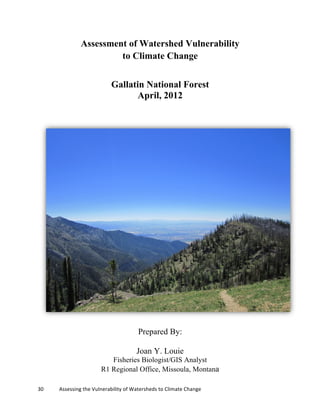
  • 31.
    27 | ASSESSINGTHE VULNERABILITY OF WATERSHEDS TO CLIMATE CHANGE Luo, L. F., and E. F. Wood. 2007. Monitoring and predicting the 2007 U.S. drought, Geophys. Res. Lett., 34, 6. Mote, P.W., A. F. Hamlet, M. P. Clark, and D. P. Lettenmaier. 2005. Declining mountain snowpack in western North America. Bull. Amer. Meteor. Soc., 86, 39–49. Ray, A.J., J.J. Barsugli, K.B. Averyt, K. Wolter, M. Hoerling, N. Doesken, B. Udall, R.S. Webb. 2008. Climate Change in Colorado: a Synthesis to Support Water Resources Management and Adaptation. Western Water Assessment. Boulder, CO. Rice, Janine; Tredennick, Andrew; Joyce, Linda A. 2012. Climate change on the Shoshone National Forest, Wyoming: a synthesis of past climate, climate projections, and ecosystem implications. Gen. Tech. Rep. RMRS-GTR-264. Fort Collins, CO: U.S. Department of Agriculture, Forest Service, Rocky Mountain Research Station. 60 p. Spears, M., L. Brekke, A. Harrison, and J Lyons. 2009. Literature Synthesis on Climate Change Implications for Reclamation’s Water Resources. Technical memorandum 86-68210-091. U.S. Department of the Interior, Bureau of Reclamation, Research and Development Office. Denver, CO. USFS. 1995. Ecosystem Analysis at the Watershed Scale. Federal Guide for Watershed Analysis. USFS Northwest Region. Regional Ecosystem Office. Portland, Oregon. 26p. U.S. Department of Agriculture (USDA) Forest Service. 2011a. Forest Service watershed condition classification technical guide. Washington, DC: U.S. Department of Agriculture, Forest Service, Watershed, Fish, Wildlife, Air, and Rare Plants Program. U.S. Department of Agriculture (USDA) Forest Service. 2011b. Forest Service watershed condition classification
  • 32.
    28                        Assessing  the  Vulnerability  of  Watersheds  to  Climate  Change Pilot National Forest Reports Contents   Gallatin National Forest ......................................................................... 30   Helena National Forest........................................................................... 46   Grand Mesa, Uncompahgre and Gunnison National Forests................ 64   White River National Forest ................................................................ 112   Coconino National Forest .................................................................... 130   Sawtooth National Forest..................................................................... 158   Shasta Trinity National Forest ............................................................. 185   Umatilla National Forest...................................................................... 210   Ouachita National Forest...................................................................... 226   Chequamegon-Nicolet National Forest................................................ 236   Chugach National Forest...................................................................... 266  
  • 33.
    29                        Assessing  the  Vulnerability  of  Watersheds  to  Climate  Change Example of Recommended Citation Format for Forest Reports Caty Clifton; Day, Kate; Johnson, Allison. 2012. Assessment of Watershed Vulnerability to Climate Change, Umalilla National Forest. In: Michael J. Furniss, Roby, Ken B., Cenderelli, Dan; Chatel, John; Clifton, Caty F.; Clingenpeel, Alan; Hays, Polly E.; Higgins, Dale; Hodges, Ken; Howe, Carol; Jungst, Laura; Louie, Joan; Mai, S Christine; Martinez, Ralph; Overton, Kerry; Staab, Brian P.; Steinke, Rory; Weinhold, Mark. 2012. Assessing  the   Vulnerability   of   Watersheds   to   Climate   Change:   Results   of   National   Forest   Watershed   Vulnerability   Pilot   Assessments. Climate Change Resource Center. U.S. Department of Agriculture, Forest Service 305p. www.fs.fed.us/ccrc/wva
  • 34.
    30                        Assessing  the  Vulnerability  of  Watersheds  to  Climate  Change Assessment of Watershed Vulnerability to Climate Change Gallatin National Forest April, 2012 Prepared By: Joan Y. Louie Fisheries Biologist/GIS Analyst R1 Regional Office, Missoula, Montana
  • 35.
    Gallatin  National  Forest  Watershed  Vulnerability  Assessment,  Northern  Region  (R1)     31                        Assessing  the  Vulnerability  of  Watersheds  to  Climate  Change BACKGROUND The Gallatin National Forest (GNF) is located in southwestern Montana within the Northern Region (R1) of the U.S. Forest Service (USFS) and is part of the Greater Yellowstone Ecosystem, the largest intact ecosystem in the continental United States (Figure 1). The 1.8 million acre Forest contains more than 1,900 miles of fish-bearing streams and 700 high mountain lakes, and supports important, high-profile recreational fisheries. Figure 1. The Gallatin National Forest is located in southwestern Montana, within the Greater Yellowstone Ecosystem.
  • 36.
    Gallatin  National  Forest  Watershed  Vulnerability  Assessment,  Northern  Region  (R1)       32                        Assessing  the  Vulnerability  of  Watersheds  to  Climate  Change   PARTNERS Data were provided by: • The Montana Natural Resource Information System (NRIS) • Montana Bureau of Mines and Geology (MBMG) • US Geology Survey (USGS) • University of Washington Climate Impacts Group (CIG) • Montana Fisheries Information System (MFISH) • US Forest Service (USFS) R1 Geospatial Group • Ecoshare Assistance with the analysis was provided by: • Kerry Overton et al., Rocky Mountain Research Station • Ralph Martinez, Plumas National Forest • Jim Morrison, R1 Regional Office ASSESSMENT OBJECTIVES The objective of this project was to develop a reliable method to prioritize all HUC-6 watersheds within the GNF in order to focus forest resource conservation and restoration efforts. A watershed characterization process was first developed to assess the relative sensitivity of the watersheds to disturbance, based on various environmental parameters. A vulnerability assessment further prioritized watersheds using the Watershed Condition Framework, resources of value, and exposure (climate projections). The proposed analysis has been developed in part to address the USFS initiative in considering climate change in land management decisions. Current studies show climate change is occurring, but climate model projections are uncertain and models at common management scales are nonexistent. Therefore, alternative methods of examining the potential impacts of climate change and other environmental stressors are needed. While this initial framework was originally designed from a watershed perspective, the results can also have implications for terrestrial management, such as fire, rangeland and wildlife management activities on the GNF. This process is intended to make it easy to update previous runs or examine other resources simply by rotating in the appropriate datasets. This project will also provide an example for other Forests in Region 1 to develop similar vulnerability assessments. SCALE OF ANALYSIS The scale of the analysis used in the GNF assessment was HUC-6 (12-digit) subwatersheds (Figure 2) and HUC-5 (10-digit) watersheds (Figure 3).
  • 37.
    Gallatin  National  Forest  Watershed  Vulnerability  Assessment,  Northern  Region  (R1)       33                        Assessing  the  Vulnerability  of  Watersheds  to  Climate  Change   Figure 2. Subwatersheds (HUC-6) on the Gallatin National Forest Figure 3. Watersheds (HUC-5) on the Gallatin National Forest
  • 38.
    Gallatin  National  Forest  Watershed  Vulnerability  Assessment,  Northern  Region  (R1)       34                        Assessing  the  Vulnerability  of  Watersheds  to  Climate  Change   CONNECTIONS TO OTHER PROJECTS AND ASSESSMENTS GNF Stream Temperature Modeling The objective of this project is to develop a broad-scale geographic information system (GIS) model to predict the effects of climate change on stream thermal regimes that in turn, provide the basis for estimating impacts on fisheries resources. A standardized approach was developed to collect and share temperature information among partner agencies and the public. The results will be used in conjunction with the GNF Watershed Vulnerability Assessment (WVA) to identify thermally-sensitive habitats and vulnerable native fish populations, and to prioritize future restoration activities to mitigate the effects of climate change on aquatic resources. GIS analysis identified locations for deployment of stream temperature loggers in HUC-6 watersheds intersecting the Gallatin and Custer National Forests. A matrix was developed comparing stream size (y- axis) and elevation (x-axis). Multiple temperature deployment locations were chosen from each cell of the matrix across broad spatial scales (see Figure 4 for the Lower East Boulder River HUC-6 watershed). Approximately 100 stream temperature loggers will be deployed, which include 40 long-term/multi-year deployments and 60 short-term/annual deployments. The data collected will be used to develop a model to predict changes in stream temperature with respect to elevation, contributing area (stream size), and air temperature. The methods employed were developed by the Rocky Mountain Research Station. For a complete description, refer to the following website. www.fs.fed.us/rm/boise/AWAE/projects/stream_temp/multregression/methods.shtml Figure 4. Temperature deployment locations within the Lower East Boulder River HUC-6 watershed East Boulder River W rightGulch Canyon Creek Dry Fork Creek Burnt Gulch Blakely Creek
  • 39.
    Gallatin  National  Forest  Watershed  Vulnerability  Assessment,  Northern  Region  (R1)       35                        Assessing  the  Vulnerability  of  Watersheds  to  Climate  Change   Watershed Condition Framework The Watershed Condition Framework (WCF) was included as one step in the process. The WCF established a nationally consistent method for classifying watershed condition and documenting improvements in watershed condition at the forest, regional, and national scales (US Forest Service. 2011). This process uses 12 indicators and 24 attributes to serve as surrogate variables representing fundamental ecological, hydrological, and geomorphic functions, and processes that affect watershed condition. The primary emphasis is on ecological processes and conditions that Forest Service management activities can influence. There are three watershed condition classes identified in this process: • Class 1 = Functioning Properly • Class 2 = Functioning at Risk • Class 3 = Functionally Impaired Watersheds considered to be Functioning Properly have ecosystem processes functioning within their range of natural variability. In general, the greater the departure from the natural pristine state, the more impaired the watershed condition is likely to be (USFS 2011). Climate Change Performance Scorecard The Climate Change Performance Scorecard is the Forest Service’s tracking tool to assess progress in integrating climate change considerations into programs, plans, and projects. It is composed of 10 performance elements, with a national goal of 100% of Forests/Grasslands to achieve a “Yes” rating on 7 of the 10 elements by FY 2015. One of these elements is a vulnerability assessment, which the WVA would fulfill. Forest Landscape and Rapid Assessments The WVA would not replace these assessments but can help validate priorities being identified in these assessments.
  • 40.
    Gallatin  National  Forest  Watershed  Vulnerability  Assessment,  Northern  Region  (R1)       36                        Assessing  the  Vulnerability  of  Watersheds  to  Climate  Change   WATERSHED VULNERABILITY ASSESSMENT PROCESS Figure 5. The Gallatin National Forest Watershed Vulnerability Assessment Model. The assessment consists of several different types of information (added and removed as necessary) to identify vulnerable watersheds. Geophysical/Sensitivity Characterization The first step of the WVA process, the geophysical/sensitivity characterization, was the most time- consuming. As interdisciplinary team (fish biologist, hydrologist, and soil scientist), identified the dominant physical processes and features of the watershed that affect ecosystem function and condition. Identifying which watersheds are the most geophysically reactive can indicate how much a watershed responds to disturbances such as floods, drought, intense precipitation, and fires. The datasets determined to be most important for the watershed characterization were soils, geology, hydrology, terrain, and groundwater. The initial run of this analysis utilized pre-existing datasets (often outdated and of lower resolution and accuracy). These datasets include the GNF Soil Survey (slope classes, surficial geology, and shallow groundwater) and datasets derived from the National Hydrography Dataset, National Elevation Dataset, and R1 VMap (water yield, high flows, and low flows). After this initial run, the team met again to evaluate the results and determine which watershed characteristics were most important. The second run of the analysis included newer datasets developed for the analysis. The state surficial geology layer from MBMG was reclassified into broad rock class categories to identify sensitive geologies. A compound index of slope and aspect from 10m digital elevation models (USGS) was derived to identify sensitive terrain areas. The original hydrology metrics were omitted in the second run due to their strong correlation with the terrain analysis (see Hydrology section below). Each variable was quantified by subwatershed and given a rating of 1, 2, or 3, based on specific threshold values identified by literature and professional judgment. All scores were added together by subwatershed. Higher scores indicate higher sensitivity to disturbance. Geology Sensitivity
  • 41.
    Gallatin  National  Forest  Watershed  Vulnerability  Assessment,  Northern  Region  (R1)       37                        Assessing  the  Vulnerability  of  Watersheds  to  Climate  Change   The surficial geology layer covering the GNF was reclassified, based on a relative assessment of soil erosion/sediment delivery and rapid runoff potential from different bedrock types. Three classes were created (low, moderate, and high) to identify geology sensitivity by each HUC-6 subwatershed. Terrain Sensitivity A mathematical equation was used to explain the empirical relationship between slope, aspect, and elevation. The results of this analysis have been extrapolated beyond Forest boundaries to allow characterization of entire subwatersheds, however characterizations are truly only valid within Forest boundaries. The equation is developed for montane areas and will need to be recalibrated for use on flatter areas (outside of GNF boundaries). Three classes were created (low, moderate, and high) to identify terrain sensitivity for each HUC-6 subwatershed. A future iteration of this analysis will expand this terrain analysis beyond Forest boundaries to increase the accuracy. Geophysical Characterization The geology sensitivity and terrain sensitivity datasets were combined and reclassified with more weight given to the terrain dataset (Figure 6). Hydrology Groundwater is expected to play an important role in buffering the impacts of changing flows and stream temperatures, however currently there is no accurate and comprehensive dataset for groundwater. This information will be included in the model as better and more reliable methods of identifying groundwater data are determined. The first run of the WVA analysis developed hydrology metrics for water yield, high discharge, and low flows. Each metric was categorized into high, moderate, and low categories. The water yield sensitivity map compares reasonably well with the newly developed terrain sensitivity dataset. The main hydrology variable, water yield, appears to be accurately characterized, and is heavily influenced by the elevation variable. The aspect and slope steepness terrain variable further refines the elevation variable, accounting for less water yield on 150- to 210-degree aspect slopes and faster runoff on steep (35%+ ) slopes. The hydrologic factors determined to be the most influential in watershed sensitivity to climate change are best represented by the terrain sensitivity analysis and, therefore, no hydrology metrics were included in the second run of the WVA.
  • 42.
    Gallatin  National  Forest  Watershed  Vulnerability  Assessment,  Northern  Region  (R1)       38                        Assessing  the  Vulnerability  of  Watersheds  to  Climate  Change   Figure 6. Geophysical characterization of Gallatin National Forest subwatersheds.
  • 43.
    Gallatin  National  Forest  Watershed  Vulnerability  Assessment,  Northern  Region  (R1)       39                        Assessing  the  Vulnerability  of  Watersheds  to  Climate  Change   Watershed Condition Framework The second step in the WVA assessment is the WCF dataset. This dataset identifies the level of human disturbance on the landscape. All of the GNF subwatersheds analyzed through this process were determined to be either Functioning Properly or Functioning at Risk (Figure 7). Because of this determination, some of the potentially more important watersheds may have been de-emphasized and future runs will need to confirm and/or modify this as needed. Figure 7. Watershed Condition Framework for the Gallatin National Forest
  • 44.
    Gallatin  National  Forest  Watershed  Vulnerability  Assessment,  Northern  Region  (R1)       40                        Assessing  the  Vulnerability  of  Watersheds  to  Climate  Change   Water Resources/Values The following water resources and values were chosen for the vulnerability analysis. 1. Infrastructure • Roads • Trails • Developed recreation sites 2. Water use and water developments • Point of use locations • Diversions 3. Cutthroat Trout • “Sensitive species” designation by Forest Service • “Species of special concern” designation by state of Montana • Management indicator species for the GNF The purpose of this dataset is to quantify selected water resource values in each HUC-6 subwatershed. Areas with the greatest density of values may indicate important sites where there may have been significant economic investment and/or would require the greatest investment to maintain/conserve the resource. Datasets for each value were used to place subwatersheds into three classes (low, medium, and high) based on natural breaks in the data. All of the datasets were then combined to create one Values dataset, identifying subwatersheds with the lowest to highest amount of values (Figure 8). Figure 8. Levels of watershed resource/values by subwatershed.
  • 45.
    Gallatin  National  Forest  Watershed  Vulnerability  Assessment,  Northern  Region  (R1)       41                        Assessing  the  Vulnerability  of  Watersheds  to  Climate  Change   Exposure To evaluate exposure, we used the regional downscaled climate and hydrological projections developed by Littell et al. (2011), which build on research and data from the Climate Impacts Group (CIG) at the University of Washington. We chose their Ensemble model to examine potential climate change impacts more closely. This model is composed of the 10 best-fitting global circulation models (GCMs) for the Upper Missouri River Basin region. The modeled time periods available are 1916-2006 (historic), 2030- 2049 (mid-21st century), and 2070-2099 (late 21st century). The climate projections are downscaled to 6 km2 resolution and are most appropriately summarized at the HUC-5 scale. The HUC-6 subwatersheds were overlaid to examine how they may be influenced by these climate projections. The metrics retrieved for the most current run of the WVA include variable infiltration capacity (VIC) derived (Liang et al. 1994; Liang et al. 1996) hydrological projections: combined annual flow, seasonality of flow, and snowpack vulnerability (hydrologic regime). For the Upper Missouri River Basin, some of the overall trends predicted for the mid- to late 21st century include increases in average annual air temperature, increases in seasonal air temperatures, increases in winter precipitation, and decreases in summer precipitation. Currently, we have used only the air temperature projections to examine predicted trends. In the future, these predicted air temperatures, combined with our stream temperature model (in development) and local air temperature data, may be used to model and predict stream temperatures across the forest. Potential Impacts to Water Resources 1. Increased instances of low flows and lower flows • Water uses/diversions would amplify the anticipated low flows • Culverts currently passable by fish may become barriers during low flows 2. Changes in flow regime • Increased winter flooding could increase summer low flows; increased/prolonged drought in the summer will further amplify the effects of changes in flow • Increased winter scouring of fall spawners (brook trout) − May favor native cutthroat trout 3. Increased stream temperatures • Previously unsuitable stream habitats (too cold) may become suitable for fish • At lower elevations, native cold-water fish will be negatively affected − More tolerant invasive fish species may outcompete natives − 4. Increased precipitation events • Roads would have increased sedimentation into streams • Culverts may need to be enlarged and/or maintained more frequently to accommodate higher flow • Some roads may need more frequent maintenance 5. Increased drought events • Water use/diversions would exacerbate drought events • Possible increases in wildfires  
  • 46.
    Gallatin  National  Forest  Watershed  Vulnerability  Assessment,  Northern  Region  (R1)       42                        Assessing  the  Vulnerability  of  Watersheds  to  Climate  Change   RESULTS   Datasets for the geophysical characterization, Watershed Condition Framework, and water resources/values were overlaid for a composite result (Figure 9). The red and yellow subwatersheds indicate where our areas of interest have the most overlap. Figure 9. Composite result of the geophysical characterization, WCF, and water resources/values datasets
  • 47.
    Gallatin  National  Forest  Watershed  Vulnerability  Assessment,  Northern  Region  (R1)       43                        Assessing  the  Vulnerability  of  Watersheds  to  Climate  Change   SUMMARY The physical characterization of watersheds was the most time-consuming step of the WVA. We felt it was most important to first develop a robust analysis to characterize the geophysical reactivity of each subwatershed. We hoped to utilize the most up-to-date and readily available datasets. After our initial run using existing datasets of lower quality, we developed a repeatable method for the physical characterization of watersheds. The results appear to be reasonably accurate, although additional validations are needed. The terrain and geology sensitivity datasets may be used to derive other datasets, such as soils, for use in future iterations of this assessment and other Forest analyses. We expect this to be an iterative process that is never truly “complete.” The WVA was designed to be easily updated with the latest datasets as they are developed. This design allows different resource areas to be assessed together or separately, by incorporating the relevant datasets. Even as climate change projections are refined in the future, the physical characterization of our subwatersheds should remain the same, enabling quick evaluation of the subwatersheds through the latest climate scenarios without additional analysis. APPLICATIONS Management These results may aid GNF managers in prioritizing subwatersheds for resource conservation and restoration efforts. The results can also be used to validate priorities identified by the rapid assessments and landscape assessments on the Forest. Monitoring The identification of the potentially most sensitive and most vulnerable subwatersheds can be used to prompt monitoring in those areas at risk. Collaboration, Education and Outreach This analysis, and others like it, will hopefully provide more reason and opportunity for the USFS to educate the general public on climate change and our adaptive management strategies to address it. In addition, these analyses will provide opportunities to collaborate with other state, federal, and tribal agencies and non-governmental organizations (NGOs) to address climate change. CRITIQUE What important questions were not considered? Currently, the WVA should not be considered valid beyond the Forest boundaries. The terrain sensitivity analysis will need to be further refined to characterize the subwatersheds beyond the Forest boundaries. What were the most useful data sources? 1. National datasets which do not end at the Forest boundaries (NHD, NED). − NED was very useful for deriving other datasets as well. 2. Ecoshare (website) is a well-organized source for climate projections data for Region 1. 3. Montana NRIS provided statewide datasets.
  • 48.
    Gallatin  National  Forest  Watershed  Vulnerability  Assessment,  Northern  Region  (R1)       44                        Assessing  the  Vulnerability  of  Watersheds  to  Climate  Change   4. Montana Bureau of Mines and Geology provided statewide surficial geology coverage. What were the most important data deficiencies? 1. Data beyond forest boundaries. − The mathematical equation used to develop the terrain sensitivity analysis will theoretically work on any landscape, but currently has only been calibrated to a montane landscape. More effort will be needed to modify the equation and more accurately characterize entire subwatersheds that go beyond Forest boundaries. − The R1 VMap dataset may have great potential in future runs of the WVA; unfortunately, this is limited to the Forest boundaries and will likely stay that way. 2. Groundwater data would be extremely helpful for this analysis, particularly to identify areas with buffering capacities to increased stream temperatures. Unfortunately, this data is currently lacking and it will be very time-consuming to develop an accurate dataset. 3. Stream temperature data is also lacking on the GNF. We have only just begun a comprehensive effort in collecting this data, which, along with local air temperature data, will be helpful in the modeling and prediction of future stream temperatures. 4. Field validations will be essential when there is available time and money. The physical characterization node of the WVA currently has only been “validated” by professional knowledge. What tools were most useful? 1. ArcGIS – Without this program, spatial analyses would have been severely limited, particularly because open-source GIS programs are significantly less well-developed in user-friendliness, tools, and options. 2. Google Earth is a useful tool to disseminate some of this spatial information for users who are not GIS-savvy. 3. Video/phone conference calls, website and webinar technology greatly facilitated the group’s information-sharing and coordination, especially with limited funds for agency travel. What tools were most problematic? 1. Citrix and T: drive on the Forest Service network. When fully functioning, these are excellent tools and make GIS more accessible for any Forest Service employee. Unfortunately, they have not yet reached their full potential and instead have created numerous issues for GIS users. 2. ArcGIS often contains bugs and is not always the most intuitive for non-GIS people. New versions also come out relatively often and are mostly incompatible with the previous versions. This a non-issue for Forest Service employees utilizing Citrix, but can cause more issues when working with external agencies that cannot keep up with the latest ArcGIS versions. PROJECT TEAM Joan Louie, GIS analyst/fisheries biologist (R1 Regional Office) Scott Barndt, Forest fisheries biologist (GNF) Mark Story, Forest hydrologist (GNF) Tom Keck, Soil scientist (GNF)
  • 49.
    Gallatin  National  Forest  Watershed  Vulnerability  Assessment,  Northern  Region  (R1)       45                        Assessing  the  Vulnerability  of  Watersheds  to  Climate  Change   PROJECT CONTACT Joan Louie, GIS Analyst, R1 Regional Office Gallatin National Forest Office: (406) 329-3209 Email: joanlouie@fs.fed.us REFERENCES Littell, J.S., M.M. Elsner, G. S. Mauger, E. Lutz, A.F. Hamlet, and E. Salathe. 2011. Regional Climate and Hydrologic Change in the Northern US Rockies and Pacific Northwest: Internally Consistent Projections of Future Climate for Resource Management. Available online at: http://cses.washington.edu/picea/USFS/pub/Littell_etal_2010/ Liang, X., D. P. Lettenmaier, E. F. Wood, and S. J. Burges. 1994. A simple hydrologically based model of land-surface water and energy fluxes for general-circulation models, J. Geophys. Res.- Atmospheres, 99, 14415-14428. Liang, X., E. F. Wood, and D. P. Lettenmaier. 1996. Surface soil moisture parameterization of the VIC�2L model: Evaluation and modification, Global Planet. Change, 13, 195–206. Rieman, B.E., Isaak, D.J. 2010. Climate Change, Aquatic Ecosystems, and Fishes in the Rocky Mountain West: Implications and Alternatives for Management. Gen. Tech. Rep. RMRS-GTR-250. Fort Collins, CO: U.S. Department of Agriculture, Forest Service, Rocky Mountain Research Station. 46 p. US Forest Service. 2011. Watershed Condition Framework – A Framework for Assessing and Tracking Changes to Watershed Condition. FS-977. May 2011. http://www.fs.fed.us/publications/watershed/ 10/3/11. Wenger, S.J., Isaak, D.J., Dunham, J.B., Fausch, K.D., Luce, C.H., Neville, H.M., Rieman, B.E., Young, M.K., Nagel, D.E., Horan, D.L., Chandler, G.L. 2011. Role of climate and invasive species in structuring trout distributions in the interior Columbia River Basin, USA. Can. J. Fish. Aquatic Sci. 68: 988-1008. Wenger, S.J., Isaak, D.J., Luce, C.H., Neville, H.M., Fausch, K.D., Dunham, J.B., Dauwalter, D.C., Young, M.K., Elsner, M.M., Rieman, B.E., Hamlet, A.F., Williams, J.E. 2011. Flow regime, temperature, and biotic interactions drive differential declines of trout species under climate change. Proceedings of the National Academy of Sciences. 108: 14175-14180.
  • 50.
    46                        Assessing  the  Vulnerability  of  Watersheds  to  Climate  Change   Assessment of Watershed Vulnerability to Climate Change Helena National Forest April, 2012 Prepared By: Laura Jungst Hydrologist Helena National Forest, Helena, Montana
  • 51.
    Helena  National  Forest  Watershed  Vulnerability  Assessment,  Northern  Region  (R1)     47                        Assessing  the  Vulnerability  of  Watersheds  to  Climate  Change   BACKGROUND AND FOREST CONTEXT The Helena National Forest is located in west-central Montana within the Northern Region (R1) of the USFS. The Forest consists of nearly 1 million acres of distinctive landscapes and lies on either side of the Continental Divide, resulting in a very diverse climate and landscape (Figure 1). The Forest’s watersheds make up the headwaters for both the Missouri and Columbia River basins. The western portion of the Forest straddles the Continental Divide starting at the southern tip of the Bob Marshall Wilderness and ending just east of Deer Lodge. The eastern side includes the lower, drier Big Belt Mountains. The Forest is composed of a mixture of grass and sagebrush covered lowlands with pockets of lodgepole pine and mountainous areas composed of Douglas fir, spruce and larch. Elevations do not exceed 10,000 feet (3,000 m). Figure 1. Helena National Forest (green) and nearby communities and rivers The Helena National Forest has a continental climate modified by the invasion of Pacific Ocean air masses. The Forest lies in the strong belt of westerly winds that move out of the Pacific Ocean and deposit much of their precipitation on the mountain ranges in western Montana. Summers are warm in most valleys and cooler in the mountains. Winter months are relatively cold. Most precipitation falls as snow, and a deep snowpack accumulates in the mountains. East of the Continental Divide, occasional down slope warming winds, Chinooks, can occur in the winter months, resulting in a rapid rise in air temperature. The average annual precipitation ranges from 11.21 inches at Townsend in an intermountain valley to 50.30 inches at Copper Creek on an alpine mountain ridge. Valleys generally receive two-thirds to three-fourths of their annual precipitation during the growing season with seasonal peaks in May and June and again in September. The mountainous areas receive a larger percentage of their precipitation as snow during the winter. Average annual snowfall varies from 30 inches at Holter Dam to 108 inches at Lincoln Ranger Station (Sirucek, 2001). ANALYSIS OVERVIEW The WVA was completed for all subwatersheds under the management of the Helena National Forest. Three steps were completed to determine the vulnerability of each subwatershed (Hydrologic Unit Code level 6 (HUC-6)) to predicted changes in climate. First, the sensitivity of each subwatershed was determined, based on existing data representing the current condition of the subwatershed for each individual resource value of concern. Next, an exposure analysis was conducted based on the selected
  • 52.
    Helena  National  Forest  Watershed  Vulnerability  Assessment,  Northern  Region  (R1)   48                        Assessing  the  Vulnerability  of  Watersheds  to  Climate  Change climate variables assigned to each resource value. Lastly the sensitivity analysis outcome was overlaid with the exposure analysis outcome to show final watershed vulnerability for each HUC-6. Several different analysis units were used as part of this assessment. Sensitivity analysis was summarized at the subwatershed level as delineated by the sixth level (12-digit) hydrologic unit (HUC-6) hierarchy in the US Geological Survey (USGS) National Hydrography Dataset (NHD). Because many of the forest management decisions and projects are conducted at the subwatershed scale or smaller, we chose to use this scale to make this analysis most useful on the ground. This analysis includes 151 subwatersheds within the assessment area. The exposure analysis was conducted at the watershed scale (HUC-5) (Figure 2). This scale was used because the climate data was downscaled to around a 6 km hydrologic output; this data fit our analysis best at the HUC-5 watershed level. To resolve these differences in scale, we used the sensitivity analysis at the subwatershed scale and overlaid climate predications at the watershed scale to show how underlying subwatersheds may be influenced by the climate predictions, while keeping the focus at a reasonable management scale. Figure 2. HUC-6 subwatersheds and HUC-5 watersheds within Helena National Forest WATER RESOURCE VALUES The following water resource values were chosen for the vulnerability analysis. Although there are many water resource values on the Helena National Forest, we analyzed the three values that we believe are of greatest concern to the Forest.
  • 53.
    Helena  National  Forest  Watershed  Vulnerability  Assessment,  Northern  Region  (R1)     49                        Assessing  the  Vulnerability  of  Watersheds  to  Climate  Change   Bull trout • Listed as a Threatened Species throughout their range under the Endangered Species Act since 1999. • Have important habitat on the Helena National Forest west of the continental divide in the headwaters of the Columbia River. • Require colder water temperatures than most salmonids. • Require the cleanest stream substrates for spawning and rearing. • Need complex habitats, including streams with riffles and deep pools, undercut banks, and lots of large logs. • Rely on river, lake, and ocean habitats that connect to headwater streams for annual spawning and feeding migrations. Cutthroat trout • One of two subspecies of native cutthroat found in Montana. • Montana’s state fish. • Historic range was west of the Continental Divide as well as the upper Missouri River drainage. • Range has been seriously reduced due to hybridization with rainbow and/or Yellowstone cutthroat and habitat loss and degradation. • Designated a Montana Fish of Special Concern in Montana. • Common in both headwaters lake and stream environments. Infrastructure • Roads, campgrounds near streams and rivers, water diversions, bridges, etc. • Can become a safety concern for all forest users recreating in areas where streams are subject to higher flows, flash floods, etc. • Important financial investment for the Forest Service. EXPOSURE Information on predicted climate changes anticipated on the Helena National Forest came from a variety of sources. Published reports from the Rocky Mountain Research station were used to describe the general projections for the region including the projected change in the climate variable, the anticipated watershed response, and the potential consequences to watershed services (Table 1) (Rieman and Isaak, 2010). Generally, predictions agree on a warmer and sometimes drier climate (Rieman and Isaak, 2010). This will include an increase in summer maximum temperatures of approximately 3 °C by the mid-21st century, and an increase in spring and summer precipitation accompanied by a decrease in fall and winter precipitation.
  • 54.
    Helena  National  Forest  Watershed  Vulnerability  Assessment,  Northern  Region  (R1)     50                        Assessing  the  Vulnerability  of  Watersheds  to  Climate  Change   Projected Climatic Changes Anticipated Watershed Response Potential Consequences to Watershed Services Warmer air temperatures • Warmer water temperature in streams • Decrease in coldwater aquatic habitats Changes in precipitation amounts and timing • Altered timing and volume of runoff • Altered erosion rates • Increases or decreases in availability of water supplies • Complex changes in water quality related to flow and sediment changes Less snowfall, earlier snowmelt, increased snowpack density • Higher winter flows • Lower summer flows • Earlier and smaller peak flows in spring • Changes in the amounts, quality and distribution of aquatic and riparian habitats and biota Intensified storms, greater extremes of precipitation and wind • Greater likelihood of flooding • Increased erosion rates and sediment yields • Changes in aquatic and riparian habitats • Increased damage to roads, campgrounds, and other facilities Table 1. Projected hydrologic changes relative to the HNF identified values. Adapted from Water, Climate Change, and Forests GTR (Rieman and Isaak, 2010) The models used to predict climate changes were developed by the Climate Impacts Group (CIG) at the University of Washington. The Climate Impacts Group selected the A1B climate scenario to provide projections most relevant for vulnerability assessment and scenario planning exercises. They then modeled change (from time period 1916-2006 representing historic) and for two future time periods representing the mid-21st century (2030-2049) and late 21st century (2070-2099), using the emissions scenario A1B with the composite climate model. The composite model is an ensemble of climate models that falls between those models that predict cooler and warmer climate scenarios. It includes 10 Global Circulation Models that perform similarly well in the PNW / Columbia Basin, the Northern Rockies / Upper Missouri Basin, and the Central Rockies / Upper Colorado Basin and this is what the Helena National Forest chose to use to represent climate change in this analysis. Data was summarized at the HUC-5 scale for the entire Forest (downloaded from ftp://ftp2.fs.fed.us/incoming/gis/PNF/WVA/ on 12/10/2010). Predicted changes in selected hydrologic attributes were derived from the Variable Infiltration Capacity (VIC) model. Parameters from VIC modeling were used to assess potential impacts to the selected forest water resource values. We compared the HUC-5 scale CIG’s VIC outputs for the historic trend and composite models for the following parameters (by resource value): 1. Bull trout – Average summer maximum air temperature 2. Cutthroat trout – Average summer maximum air temperature 3. Infrastructure – Snowpack vulnerability (defined as the ratio of April1 snow water equivalent and October-March precipitation)
  • 55.
    Helena  National  Forest  Watershed  Vulnerability  Assessment,  Northern  Region  (R1)     51                        Assessing  the  Vulnerability  of  Watersheds  to  Climate  Change   Projection  Period Mean Range Mean Range 1916-­‐2006 23.7 21.1-­‐26.0 2030-­‐2059 26.0  (+10%) 23.4-­‐28.2 2070-­‐2099 28.2  (+19%) 25.6-­‐30.5 Projection  Period Mean   Range Mean Range 1916-­‐2006 41.3 0.2-­‐342.7 2030-­‐2059 29.6  (-­‐28%) 0-­‐289.2 2070-­‐2099 18.6  (-­‐55%) 0-­‐216.9 Projection  Period Mean   Range Mean Range 1916-­‐2006 10.1 2.9-­‐87.6 2030-­‐2059 7.4  (-­‐27%) 2.5-­‐59.4 2070-­‐2099 5.6  (-­‐45%) 2.3-­‐33.0 Projection  Period Mean   Range Mean Range 1916-­‐2006 2.3 1.1-­‐5.2 2030-­‐2059 2.5  (9%) 1.1-­‐7.0 2070-­‐2099 1.2  (-­‐48%) 0.2-­‐3.2 Historic Composite Summer  Baserflow  (September  Runoff) Predicted  Average  Summer  Maximum  Temperature Historic Composite Predicted  Average  June  Runoff Predicted  Average  April  1  SWE Historic   Composite Historic Composite Table 2. Historic (1916-2006) and future (2030-2059 and 2070-2099) hydrologic output climate predictions averaged over all watersheds on the Helena National Forest. Based on Global models downscaled to 1/16th degree (~6 km) grid. VULNERABILITY ANALYSIS BY RESOURCE VALUE For this watershed vulnerability assessment, pilot forests were tasked with identifying the relative vulnerability of watersheds to potential risks posed by climate change by focusing on the potential effects of those changes to water resource values. Based on our current evaluation of water resource values on the Helena National Forest, values evaluated include fisheries habitat for bull trout and cutthroat trout, and infrastructure. Vulnerability analysis was conducted specific to each individual water resource value. Water Resource Value: Bull Trout Habitat Sensitivity Bull trout habitat condition was characterized using the regional bull trout watershed baseline analysis completed in 2007. This analysis was a consultation requirement for species listed under the Endangered Species Act since the late 1990’s. Baseline information was summarized according to important environmental parameters for each subwatershed within the Helena National Forest. This summary was
  • 56.
    Helena  National  Forest  Watershed  Vulnerability  Assessment,  Northern  Region  (R1)     52                        Assessing  the  Vulnerability  of  Watersheds  to  Climate  Change   divided into six overall pathways (Table 3). Each of the pathways is categorized in terms of functionality; either Functioning Appropriately (FA), Functioning at Risk (FAR), or Functioning at Unacceptable Risk (FUR). The final rating is based on a suite of metrics which are either (1) quantitative metrics of collected field data or GIS driven attributes (e.g. road density) or (2) qualitative descriptions based on field reviews, professional judgment, etc. The composite watershed sensitivity based on the baseline analysis is depicted in Figure 3. Based on these parameters, the Helena National Forest has three subwatersheds rated as FA, ten rated as FAR and five rated as FUR. These rating is applied to only those subwatersheds where there are known populations of bull trout. Evaluation of those watersheds that could have potential for bull trout habitat but do not currently have viable populations were not included in this analysis. Exposure Summer maximum air temperature predictions were used as a surrogate for stream temperature because stream temperature data was not widely available. At the time of our analysis this was our best available dataset, in the future, it might be better to use mean summer temperature as better correlations have been found between air-water temperatures using the mean vs. max, even though these were very strongly correlated (Wenger et al. 2011a). Summer maximum air temperatures were predicted to increase by approximately 2 °C uniformly across the forest for the 2030-2059 predictive period and approximately 5 °C uniformly for the 2070-2099 predictive period. Consequently, it is predicted that not any one watershed will be more impacted by this change in summer maximum air temperature than another. However, we can develop conservation strategies based on current conditions in order to buffer more highly valued watersheds. Summer baseflow was considered as an exposure element, but not carried forward because Wenger’s (2011a) work showed temperature to be the key climate change variable related to bull trout habitat. Bull trout are likely sensitive to increase in winter high flows (Wenger 2011b), but this data is available at the reach level and time at this point does not allow for this kind of analysis. Winter 95 represents the number of days during winter that are among the highest 5% (respectively) of flows for the year. Winter 95 was used as the variable for winter high flows which would affect bull trout and brook trout, but not the spring spawning Westslope cutthroat trout. Watershed Vulnerability By overlaying the climate exposure data to the bull trout fisheries baseline data we see which habitat currently supporting bull trout populations is most likely to be adversely impacted by changes such as increased temperatures. Research has found bull trout currently inhabit the coldest available headwater streams which leaves little potential to shift to higher elevation habitats to avoid temperature increases (Wenger 2011a). Because the predicted temperature changes on the Helena National Forest are very uniform across all bull trout habitat, we assumed that it all has similar potential to be impacted by changes in climate. However, forest managers have the capability to maintain or increase the resiliency of watersheds that support the most valued bull trout fisheries. These areas can be selected as high priority for management activities. Because exposure to increased air temperatures is essentially uniform across the Forest, composite watershed vulnerability for bull trout habitat is equal to the watershed sensitivity analysis (Figure 3) or the current condition of the fisheries habitat. Incorporation of other climate change indicators may or may not change the overall potential vulnerability of these watersheds.
  • 57.
    Helena  National  Forest  Watershed  Vulnerability  Assessment,  Northern  Region  (R1)     53                        Assessing  the  Vulnerability  of  Watersheds  to  Climate  Change   Category Metric Subpopulation Characteristics within Subpopulation Watersheds Subpopulation size Growth and survival Life history diversity and isolation Persistence and genetic integrity Habitat - Water Quality Temperature Sediment Chemical contamination/nutrients Habitat - Access Physical barriers Habitat - Elements Substrate embeddedness in rearing areas Large woody debris Pool frequency and quality Large pools Off-channel habitat Refugia Channel Condition and Dynamics Average wetted width/maximum depth Ratio in scour pools in a reach Streambank condition Floodplain connectivity Flow/Hydrology Change in peak/base flows Increase in drainage network Watershed Conditions Road density and location Disturbance history Riparian conservation areas Disturbance regime Table 3. Matrix of Pathways and Indicators
  • 58.
    Helena  National  Forest  Watershed  Vulnerability  Assessment,  Northern  Region  (R1)     54                        Assessing  the  Vulnerability  of  Watersheds  to  Climate  Change   Figure 3. Composite watershed sensitivity rating for bull trout
  • 59.
    Helena  National  Forest  Watershed  Vulnerability  Assessment,  Northern  Region  (R1)     55                        Assessing  the  Vulnerability  of  Watersheds  to  Climate  Change   Water Resource Value: Westslope Cutthroat Trout Habitat Sensitivity Cutthroat trout habitat was assessed using the “Matrix of Pathways and Indicators” for bull trout fisheries described above (Table 3) in combination with the cutthroat distribution information and professional knowledge of the specific subwatersheds. The ratings of FA, FAR and FUR were given to those watersheds with known populations of cutthroat trout. Of the 155 watersheds with some portion of their area under forest management, 76 have known populations of cutthroat trout. Five of these have a rating of FA, 19 are FAR, and 52 are FUR (Figure 4). Exposure Westslope cutthroat trout are closely associated with headwater habitats which are often more stable than downstream reaches. Therefore, they may be less influenced by changes in large scale environmental conditions (Copeland, 2011, Wenger 2011a). Cutthroat trouts have a strong negative response to brook trout presence at the subwatershed scale (Wenger, 2011b). Brook trout are highly sensitive to increasing temperature, so the cutthroat trout could have an indirect positive response to climate change (Wenger, 2011b). Most of the subwatersheds on the Helena National Forest have a population of invasive brook trout, brown trout or both. Only 17 of the subwatersheds do not have known populations of these invasive species (Figure 5). We analyzed the effects of average summer maximum temperature increase as a net positive interaction with cutthroat trout due to the parameter’s negative interaction with the invasive populations of brook trout (Wenger, 2011b). Figure 4. Composite watershed sensitivity rating for Westslope cutthroat trout
  • 60.
    Helena  National  Forest  Watershed  Vulnerability  Assessment,  Northern  Region  (R1)     56                        Assessing  the  Vulnerability  of  Watersheds  to  Climate  Change   Composite Watershed Vulnerability Cutthroat trout will experience the same changes in temperature that bull trout experience because they too inhabit headwater streams. Summer maximum air temperatures were predicted to increase by approximately 2 °C uniformly across the forest for the 2030-2059 predictive period and approximately 5 °C uniformly for the 2070-2099 predictive period. These temperature changes are assumed to have little impact on cutthroat populations; however there could be a net positive effect due to the predicted decrease in invasive populations (Figure 5). Figure 5. Composite watershed sensitivity rating for Westslope cutthroat trout with invasive fish species (bull trout and brown trout) habitat overlay Water Resource Value: Infrastructure Sensitivity Based on the indicators used to determine sensitivity (Table 5), a rank was developed to show those watersheds that are least resilient (most sensitive). The overall sensitivity score was determined by calculating the average of the ranked values given to each of the sensitivity factor. Density of high value near-stream developments (table 5) were used to characterize infrastructure value (Figure 6).
  • 61.
    Helena  National  Forest  Watershed  Vulnerability  Assessment,  Northern  Region  (R1)     57                        Assessing  the  Vulnerability  of  Watersheds  to  Climate  Change   Resource Value at Risk Description Water diversions Number of diversions per subwatershed. Based on Montana State water rights and diversion data. Municipal Watershed Current municipal water use. Recreation Developments Developed recreation sites within 200' of stream (i.e., campgrounds, picnic grounds, trailheads, etc.) Riparian roads Roads miles within 150' of a stream. Sensitivity Factor Description Number of Road/Stream Crossings Stream crossings were determined by intersecting perennial and intermittent streams with existing roads. Soils Percent severe and/or moderate erosion potential determined using the erosion potential designated by the Helena National Forest Soil Survey. Roads Road miles by subwatershed. Riparian roads Roads miles within 150' of a stream. Table 5. Resource values considered and indicators used to determine infrastructure sensitivity Figure 6. Sensitivity ratings for the infrastructure value on the Helena National Forest. Map highlights Tenmile watershed, a watershed with high sensitivity due to its function as a municipal watershed.
  • 62.
    Helena  National  Forest  Watershed  Vulnerability  Assessment,  Northern  Region  (R1)     58                        Assessing  the  Vulnerability  of  Watersheds  to  Climate  Change   Exposure Many parameters influence the timing and magnitude of runoff for a given watershed. Average winter precipitation and average maximum winter temperature were initially analyzed to determine watershed exposure to changes in climate variables. Precipitation average over the entire forest is projected to increase slightly. All elevations on the forest are above approximately 3,500 feet. The average elevation is approximately 6,200 feet and the maximum elevation approximately 9,500 feet. Precipitation is predicted to increase in the winter, spring and fall and decrease in the summer season. Projected maximum winter temperatures (Dec-Jan-Feb) for the Helena National Forest for the 2040s time period are expected to increase. The average temperature across all HUCs went from 0 °C historically to 1.3 °C projected for the 2040s time period. Temperatures are expected to remain relatively cold with the average maximum winter temperature not exceeding 3 °C for any individual watershed. Temperature is predicted to continue to increase into the 2080s time period where the average maximum winter temperature for all watersheds is predicted to be near 3 °C. Hamlet and Lettenamaier, 2007, found through a series of models of the northwestern United States, that cold river basins, where snow processes dominate the annual hydrologic cycle (< 6 °C average in midwinter), typically show reductions in flood risk due to overall reductions in spring snowpack. The Helena National Forest is well below 6 °C average midwinter and may see reductions in spring runoff flows for this reason. Since changes in summer and winter temperature are not expected to have a direct effect on infrastructure and development, change in watershed snowpack (the ratio of April 1st SWE to Oct-Mar precipitation) was the only climate factor used to assess exposure. This value has been calculated using downscaled climate and hydrologic projections for the entire Columbia, upper Missouri and upper Colorado basins. Figures 7 and 8 show predicted watershed snowpack vulnerability (Littell et al.) watershed for the 2030- 2059 and 2070-2099 time periods, respectively. Both the North Fork of the Blackfoot River and The Landers Fork watersheds are projected to see the most change in snowpack.
  • 63.
    Helena  National  Forest  Watershed  Vulnerability  Assessment,  Northern  Region  (R1)     59                        Assessing  the  Vulnerability  of  Watersheds  to  Climate  Change   Figure 7. Changes in rainfall/snowmelt dominance for HUC-5 watersheds on the Helena National Forest predicted for the 2030-2059 time period Figure 8. Changes in rainfall/snowmelt dominance for HUC-5 watershed on the Helena National Forest predicted for the 2070-2099 time period
  • 64.
    Helena  National  Forest  Watershed  Vulnerability  Assessment,  Northern  Region  (R1)     60                        Assessing  the  Vulnerability  of  Watersheds  to  Climate  Change   Composite Watershed Vulnerability Watershed vulnerability was determined by overlaying the sensitivity analysis with the exposure analysis. Watersheds with include high value infrastructure and high sensitivity that also had highest risk of snowpack loss where rated as most vulnerable. The most vulnerable watersheds (Figures 9 and 10) are found in the northernmost section of the forest where changes in winter snowpack possibly resulting in rain on snow events pose the highest risk to forest infrastructure. Figure 9. Watershed vulnerability with regards to forest infrastructure is based on watershed sensitivity and exposure results for the 2030-2059 time periods
  • 65.
    Helena  National  Forest  Watershed  Vulnerability  Assessment,  Northern  Region  (R1)     61                        Assessing  the  Vulnerability  of  Watersheds  to  Climate  Change   Figure 10. Watershed vulnerability with regards to forest infrastructure is based on watershed sensitivity and exposure results for the 2070-2099 time periods CONNECTIONS TO OTHER ASSESSMENTS AND POTENTIAL APPLICATIONS • The WVA will provide a basis for incorporating climate change considerations into project planning and implementation. Identified climate change considerations may also be designed into forest plan desired conditions, objectives, and standards and guidelines. • Information from the WVA, while not specifically part of the watershed condition framework, can be used to help identify priority watersheds for future restoration activities. • Completing the WVA will aide in the completion of the climate change scorecard. The WVA analysis helps fulfill element 6 (vulnerability assessment), element 7 (adaptation activities), and element 8 (monitoring). • The WVA utilized work done by the Fisheries Watershed Baseline for the bull trout and Cutthroat trout sensitivity analysis. CRITIQUE What important questions were not considered? 1. The watershed vulnerability assessment focused only on water resources and did not consider predicted changes to terrestrial resources. While this analysis was designed to focus on water resources, composite effects on terrestrial ecosystems can have significant influence on watershed hydrology. 2. Did not account for all resilience factors and did not use all climate exposure factors, including flow metrics.
  • 66.
    Helena  National  Forest  Watershed  Vulnerability  Assessment,  Northern  Region  (R1)     62                        Assessing  the  Vulnerability  of  Watersheds  to  Climate  Change   What were the most useful data sources? 1. The Forest Service GIS database as well as the state GIS database (NRIS) was useful in describing sensitivity on a watershed basis (http://nris.mt.gov/). 2. VIC data available from the Climate Impacts group was useful in describing projected climate change under several models. What were the most important data deficiencies? 1. The data analyzed was based on layers that were approximations of what is on the ground. For example, NHD Streams and the roads layers are approximations and resulting stream crossing point layer is not necessarily an accurate representation. Field inventories in general are not complete. This is a data gap that could be improved in the future. 2. Climate data was complex and time consuming to use. What tools were most useful? 1. Examples of how the analysis was approached on other units including what kind of data to include and how to organize and display the information. 2. Communication and support from all members of the WVA group willing to share their ideas and experiences throughout the process. Information sharing included monthly conference calls and Google share site. 3. ArcGIS was a necessary tool throughout the entire process including evaluation and display of all data. 4. Microsoft Excel was used as an interface between tabular data and spatial data. Often tables would be exported from ArcGIS to excel, manipulated and then imported and new values could then be displayed spatially. What tools were most problematic? 1. Downscaled climate data 2. Forest level GIS data 3. Accurately displaying climate change projections and resolving differences in scale between the forest level data and downscaled climate data. PROJECT TEAM Core Team: Laura Jungst, Hydrologist; Dave Callery, Hydrologist; Len Walch, Fisheries Biologist Support: Melanie Scott, GIS analyst; Kerry Overton, RMRS Data: Climate Impacts Group (Variable Infiltration Capacity (VIC) modeled data for several climate change scenarios at the HUC-5 scale and raster data at the 6 km grid scale) • RMRS – Boise, Kerry Overton • Jim Morrisson • Montana Natural Resource Information System Digital Atlas of Montana (http://maps2.nris.mt.gov/mapper/) • Helena National Forest GIS analyst Melanie Scott
  • 67.
    Helena  National  Forest  Watershed  Vulnerability  Assessment,  Northern  Region  (R1)     63                        Assessing  the  Vulnerability  of  Watersheds  to  Climate  Change   • Western US Stream Flow Metric Dataset (http://www.fs.fed.us/rm/boise/AWAE/projects/modeled_stream_flow_metrics.shtml) • Helena National Forest Fisheries Watershed Baseline PROJECT CONTACT Laura Jungst, Hydrologist Helena National Forest ljungst@fs.fed.us (406) 495-3723 REFERENCES Copeland, T., Meyer, K.A. 2011. Interspecies Synchrony in Salmonid Densities Associated with Large- Scale Bioclimatic Conditions in Central Idaho, Transactions of the American Fisheries Society, 140:4, 928-942 Hamlet, A.F., Lettenmaier, D.P. 2007. Effects of 20th century warming and climate variability on flood risk in the western U.S. Water Resources Research, 43, W06427. Sirucek, D., 2001. Soil Survey of the Helena National Forest Area, Montana. USDA Forest Service and natural Resources Conservation Service. Northern Region. Littell, J.S., M.M. Elsner, G. S. Mauger, E. Lutz, A.F. Hamlet, and E. Salathé. 2011. Regional Climate and Hydrologic Change in the Northern US Rockies and Pacific Northwest: Internally Consistent Projections of Future Climate for Resource Management. Draft report: January 7, 2011. Online at: http://cses.washington.edu/picea/USFS/pub/Littell_etal_2010/ Wenger, S.J., Isaak, D.J., Luce, C.H., Neville, H.M., Fausch, K.D., Dunham, J.B., Dauwalter, D.C., Young, M.K., Elsner, M.M., Rieman, B.E., Hamlet, A.F., Williams, J.E. 2011(a). Flow regime, temperature, and biotic interactions drive differential declines of trout species under climate change. Proceedings of the National Academy of Sciences. 108: 14175-14180. Wenger, S.J., Isaak, D.J., Dunham, J.B., Fausch, K.D., Luce, C.H., Neville, H.M., Rieman, B.E., Young, M.K., Nagel, D.E., Horan, D.L., Chandler, G.L. 2011(b). Role of climate and invasive species in structuring trout distributions in the interior Columbia River Basin, USA. Can. J. Fish. Aquatic Sci. 68: 988-1008. Rieman, B.E., Isaak, D.J. 2010. Climate Change, Aquatic Ecosystems, and Fishes in the Rocky Mountain West: Implications and Alternatives for Management. Gen. Tech. Rep. RMRS-GTR-250. Fort Collins, CO: U.S. Department of Agriculture, Forest Service, Rocky Mountain Research Station. 46 p.
  • 68.
    64                        Assessing  the  Vulnerability  of  Watersheds  to  Climate  Change Assessment of Watershed Vulnerability to Climate Change Grand Mesa, Uncompahgre and Gunnison National Forests March, 2012 Prepared by: Carol S. Howe Resource Information Specialist, Climate Change Coordinator and John Almy, Clay Speas, Warren Young and Ben Stratton, Grand Mesa, Uncompahgre and Gunnison National Forests, Delta, Colorado
  • 69.
    Grand  Mesa,  Uncompahgre  and  Gunnison    National  Forest  Watershed  Vulnerability  Assessment,  Rocky   Mountain  Region  (R2)   65                        Assessing  the  Vulnerability  of  Watersheds  to  Climate  Change LOCATION The Grand Mesa, Uncompahgre, and Gunnison National Forests (GMUG) are located in western Colorado (Figure 1), within the Rocky Mountain Region (R2) of the USFS. Figure 1. Grand Mesa, Uncompahgre, and Gunnison National Forest vicinity map The GMUG is also located within the headwaters of the Upper Colorado River Basin (Figure 2).
  • 70.
    Grand  Mesa,  Uncompahgre  and  Gunnison    National  Forest  Watershed  Vulnerability  Assessment,  Rocky   Mountain  Region  (R2)   66                        Assessing  the  Vulnerability  of  Watersheds  to  Climate  Change   Figure 2. Upper Colorado River Basin PARTNERS Data were obtained from the following groups: •• Rocky Mountain Research Station (facilitated training on use of climate tools, developed climate record for GMUG (pending), PRISM data, from Linda Joyce, Chuck Rhoades, David Coulson) •• Western Water Assessment (WWA) (climate data websites from Jeff Lucas) •• The Nature Conservancy (climate change scenarios for the Gunnison Basin, prepared by Joe Barsugli (WWA) and Linda Mearns (National Center for Atmospheric Research)) •• Climate Impacts Group (Variable Infiltration Capacity (VIC) modeled data for several climate change scenarios at the HUC-5 scale and raster data at the 6 km-grid scale)
  • 71.
    Grand  Mesa,  Uncompahgre  and  Gunnison    National  Forest  Watershed  Vulnerability  Assessment,  Rocky   Mountain  Region  (R2)   67                        Assessing  the  Vulnerability  of  Watersheds  to  Climate  Change   •• Colorado Department of Water Resources (surface and groundwater sources, water rights information) •• Colorado Department of Public Health and Environment (source water protection areas) SCALES OF ANALYSIS Area Assessed The WVA was completed for the entire Forest and surrounding areas, in general; and specifically for those portions of the GMUG within watersheds that were mostly on National Forest System lands. Analysis Units Several different analysis units were used as part of this WVA. Analyses were summarized primarily at the subwatershed level (-6), as delineated by the sixth level (12-digit) of the hydrologic unit hierarchy in the US Geological Survey (USGS) National Hydrography Dataset (NHD) and the US Department of Agriculture (USDA) Natural Resources Conservation Service (NRCS) Watershed Boundary Dataset (WBD). There are 205 subwatersheds within the assessment area for this WVA. Some subwatersheds were merged together for analysis purposes so that complete catchment basins were delineated (some HUC-6 subwatershed delineations from NHD/WBD separated upper portions of watersheds from lower portions). This resulted in 152 modified HUC-6 subwatersheds. These modified HUC-6 subwatershed analysis units were used to summarize information on aquatic resource values, and watershed risks described below as inherent sensitivities and anthropogenic stressors. Anticipated climate changes, or exposure (also described below) were evaluated using several different analysis units. Watersheds (HUC-5), delineated at the fifth level (10-digit) of the hydrologic unit hierarchy in NHD/WBD were used to summarize predicted climate changes output by the VIC model. There are 49 HUC-5 watersheds that overlap the assessment area for this WVA. In addition, exposure was also evaluated using geographic areas that have similar climatic regimes. These geographic areas also roughly correspond to areas used in Forest planning. Modified HUC-6 subwatersheds were aggregated into six geographic areas within the assessment area. Figure 3 shows the original NHD/WBD HUC-6 delineations, the modified HUC-6s used for this analysis, and the HUC-5 watersheds as they overlap the GMUG. Figure 4 shows the geographic overlap of the modified HUC-6 subwatersheds and the GMUG.
  • 72.
    Grand  Mesa,  Uncompahgre  and  Gunnison    National  Forest  Watershed  Vulnerability  Assessment,  Rocky   Mountain  Region  (R2)   68                        Assessing  the  Vulnerability  of  Watersheds  to  Climate  Change   Figure 3. Modified HUC-6 Subwatersheds and HUC-5 Watersheds used in Watershed Vulnerability Assessment Figure 4. Geographic Area and Modified HUC-6 Subwatersheds used in Watershed Vulnerability Assessment Grand Mesa Uncompahgre San Juans Cochetopa Upper Taylor West Elks
  • 73.
    Grand  Mesa,  Uncompahgre  and  Gunnison    National  Forest  Watershed  Vulnerability  Assessment,  Rocky   Mountain  Region  (R2)   69                        Assessing  the  Vulnerability  of  Watersheds  to  Climate  Change   CONNECTIONS TO OTHER ASSESSMENTS, PLANS AND EFFORTS The WVA used data and results from a previous watershed assessment completed as part of the 2005- 2007 Forest plan revision process, specifically: 1) a summary of past activities that have occurred in each subwatershed (used as the anthropogenic stressors in the WVA); 2) a summary of intrinsic characteristics of each subwatershed (i.e. geology, soil types, topography) that indicate how sensitive a given watershed is to erosion (used as the indicator for erosion and sediment production for the WVA); and 3) a summary of water uses by subwatershed (used as the water uses values for this WVA). Data and results from the Forest plan watershed assessment were limited to National Forest System lands. Off-Forest data were lacking or very limited and were not incorporated into the existing data for the WVA. The WVA will incorporate consideration of potential effects of predicted climate changes, which was not previously done. Results of the WVA will be used as part of a vulnerability assessment for the Upper Gunnison Basin, an ongoing collaborative effort with The Nature Conservancy (part of its Southwest Climate Change Initiative), the BLM, National Park Service, Gunnison County, Colorado Division of Wildlife, Colorado River Conservation Board and the USFS. The Upper Gunnison Basin vulnerability assessment will incorporate terrestrial resources that the WVA did not, as well as aquatic resources that occur off the National Forest. The WVA will also inform additional outcomes from the Upper Gunnison Basin collaborative effort, which include: 1) developing landscape-scale strategic guidance for climate adaptation and resilience- building for a set of conservation targets (e.g., Gunnison sage-grouse); 2) developing tools and information to make current conservation projects climate smart; and 3) developing a climate adaptation demonstration project. The WVA and the subsequent vulnerability assessment for the Gunnison Basin will provide a basis for incorporating climate change considerations into project planning and implementation. When Forest plan revision efforts resume on the GMUG, identified climate change considerations can also be designed into Forest plan desired conditions, objectives, standards, and guidelines. Data gaps and uncertainties in predicting climate changes and potential effects are needs that can be filled through a variety of monitoring efforts. In 2011, the GMUG NF completed a Watershed Condition Classification. Information from the WVA, while not specifically part of the watershed condition classification protocol, can be used to help identify priority watersheds for future restoration activities. WATER RESOURCES This WVA is intended to identify the relative vulnerability of watersheds to potential risks posed by climate change, by focusing on the potential effects of those changes to water resource values. For the pilot project, water resource values needed to include floodplain and in-channel infrastructure, water uses, and aquatic species. Following this direction, the GMUG team initially identified a list of resources in these three categories. As we worked through the process, lack of available data and time constraints reduced the list of values that were ultimately evaluated. We also adjusted how several resource values were grouped so that the final three categories combined values that would respond in similar ways to predicted climate changes. Modifications made during the process are discussed for each category, below.
  • 74.
    Grand  Mesa,  Uncompahgre  and  Gunnison    National  Forest  Watershed  Vulnerability  Assessment,  Rocky   Mountain  Region  (R2)   70                        Assessing  the  Vulnerability  of  Watersheds  to  Climate  Change   Infrastructure Values Infrastructure includes roads, trails, culverts, bridges, recreation developments, and other structures that have been constructed for some purpose. Infrastructure associated with stream channels, floodplains, and riparian areas was believed to be most vulnerable to changes in timing or magnitude of stream flow. The NHD flowline data were used to identify stream courses. Floodplains and riparian areas were identified using the Forest riparian habitat layer (created from aerial photo interpretation to identify wetlands, fens, waterbodies, and 100-foot buffer of perennial streams). The infrastructure values evaluated in this WVA are listed below, along with the metric used to rank these values by watershed. Note: Data for riparian areas, roads and trails, recreation developments, and recreation residences were limited to National Forest System lands and what is available in USFS databases. Stream network information extended off-Forest. The discrepancies in data extent means the confidence in results varies for subwatersheds that are completely or mostly within the GMUG as compared to those subwatersheds that extend beyond the GMUG boundary or that have developments on private inholdings. Road and Trail Stream Crossings - number of open road and trail crossings per miles of perennial and intermittent streams within a given subwatershed. Stream crossings were determined by intersecting perennial and intermittent streams with existing and open roads and trails. Figure 5 shows where these stream crossings occur. The crossing count for a given subwatershed was then divided by the miles of perennial and intermittent streams for that same subwatershed, to get a count of crossings per mile of perennial and intermittent streams within a given subwatershed. Counts of crossings per mile of perennial and intermittent streams by subwatershed ranged from 0 to 1.2. Note: The NHD Flowline and the roads and trails layers are approximations and the resulting intersection point layer is not necessarily an accurate representation of all actual crossings. This information also does not identify if the crossing is a culvert, a bridge, or a ford. Existing culvert and bridge inventories are not complete. These are data gaps that need to be addressed in the future.
  • 75.
    Grand  Mesa,  Uncompahgre  and  Gunnison    National  Forest  Watershed  Vulnerability  Assessment,  Rocky   Mountain  Region  (R2)   71                        Assessing  the  Vulnerability  of  Watersheds  to  Climate  Change   Figure 5. Road and Trail Stream Crossings Roads and Trails within Riparian Areas - miles of open roads and trails per square mile of riparian areas within a given subwatershed. This was determined by identifying those segments of open roads and trails that occur within riparian areas, for each subwatershed. This length was then divided by the square miles of riparian areas for each subwatershed. Figure 6 shows where roads and trails occur within riparian areas. Miles of open roads and trails per square mile of riparian areas within a given subwatershed ranged from 0 to 10.
  • 76.
    Grand  Mesa,  Uncompahgre  and  Gunnison    National  Forest  Watershed  Vulnerability  Assessment,  Rocky   Mountain  Region  (R2)   72                        Assessing  the  Vulnerability  of  Watersheds  to  Climate  Change   Figure 6. Roads and Trails in Riparian Areas Recreation Developments within Riparian Areas - density of recreation developments per square mile of riparian areas within a given subwatershed. This was determined by identifying where recreation developments (i.e., campgrounds, picnic grounds, trailheads, parking areas, toilets) occur in riparian areas and dividing the count of these occurrences by the square miles of riparian areas for each subwatershed. Note: Only developed recreation sites were included; dispersed sites without structures were not. Figure 7 shows where recreation developments occur within riparian areas. Recreation developments within riparian areas occur in 28 subwatersheds. Densities within riparian areas range from less than one to nine. Recreation Residences within Riparian Areas - density of recreation residences per square mile of riparian areas within a given subwatershed. This was determined by identifying where recreation residences occur within riparian areas. Note: Only those recreation residences that are permitted were included; residences that occur on private inholdings or areas outside the Forest boundary were not. Figure 7 also shows where recreation residences occur within riparian areas. Recreation residences within riparian areas occur in two subwatersheds. Densities ranged from less than one to three.
  • 77.
    Grand  Mesa,  Uncompahgre  and  Gunnison    National  Forest  Watershed  Vulnerability  Assessment,  Rocky   Mountain  Region  (R2)   73                        Assessing  the  Vulnerability  of  Watersheds  to  Climate  Change   Figure 7. Recreation Residences and Developed Sites in Riparian Areas Initially, water use diversions and storage structures were going to be included as part of the infrastructure value. These values were ultimately considered in the Water Use Values, below, where both the structures and the amount of the associated water use (in acre feet for storage or cubic feet per second for flow) were evaluated. It is not enough to know which subwatersheds have the most infrastructure values. Two different watersheds may have the same number of road and trail stream crossings, but there may be twice as many miles of streams in one watershed than the other, which could potentially have much larger stream flows and sediment/debris loads that could impact the crossings. Metrics used were designed to compare subwatersheds in a more relative way. For each individual infrastructure value, the results were standardized (results for each subwatershed were divided by the largest result of all the subwatersheds). The standardized results for each infrastructure value were then summed to get a cumulative infrastructure value (Stream Crossings + Roads and Trails in Riparian Areas + Recreation Developments in Riparian Areas + Recreation Residences in Riparian Areas = Infrastructure Value Ranking). The cumulative Infrastructure Value Rankings were classified into quartiles. The top 25% were classified 3 (high), middle 50% were classified 2 (moderate), lowest 25% were classified 1 (low). Figure 8 shows the resulting Infrastructure Values Ranking.
  • 78.
    Grand  Mesa,  Uncompahgre  and  Gunnison    National  Forest  Watershed  Vulnerability  Assessment,  Rocky   Mountain  Region  (R2)   74                        Assessing  the  Vulnerability  of  Watersheds  to  Climate  Change   Figure 8. Infrastructure Values Ranking The Upper Taylor geographic area has the largest area in a high ranking for infrastructure values. The Cochetopa geographic area has the second largest area in high infrastructure values ranking, due primarily to road and trail stream crossings and miles of routes within riparian areas. The San Juans geographic area has the third highest amount of area in a high ranking for infrastructure values, mostly due to the density of road and trail stream crossings, with a few subwatersheds having a higher density of developed sites within riparian areas. The Uncompahgre geographic area has the lowest ranking for infrastructure values. Water Uses Values An initial purpose of the National Forest system was and remains to “secure favorable conditions of water flows.” Many water use values depend upon the runoff generated from the GMUG. Those values are realized both on and off the Forest. Water use values are both consumptive and non-consumptive. For this WVA, both public and private water uses were evaluated, and are listed below. Water Rights Quantification - acre feet per acre of subwatershed for water storage rights, or cubic feet per second per acre of subwatershed for water flow rights. Water rights included were those held by the US Forest Service, municipalities and other public entities, as well as private individuals and water user groups. Water uses associated with these rights are primarily for irrigation and stockwater, with some domestic water use. Data used to identify water rights originated with the State of Colorado Division of Water Resources. The state’s Division 4 overlaps all but the northern half of the Grand Mesa on the GMUG, which is within the State’s Division 5. Data for Division 4 included water rights/uses both on and off National Forest system land; Division 5 data used in this analysis were only for National Forest system land on the GMUG. Only actual, developed water rights were included. Water rights exist for approximately 1,704,070 acre feet of storage (quantification of water rights in acre feet per acre of subwatershed ranged from 0 to 79) and 24,620 cubic feet per second flow (quantification of water rights
  • 79.
    Grand  Mesa,  Uncompahgre  and  Gunnison    National  Forest  Watershed  Vulnerability  Assessment,  Rocky   Mountain  Region  (R2)   75                        Assessing  the  Vulnerability  of  Watersheds  to  Climate  Change   in cubic feet per second per acre of subwatershed ranged from 0 to 0.3). Figure 9 shows approximate locations where water rights occur in the WVA analysis area. NOTE: Many water rights locations in the state’s data are based on approximate quarter quad descriptions and not actual coordinates. Water Rights Structures - count of structures associated with each quantified water right per acre of subwatershed. The state’s data identify the type of structures associated with each water right. This varies among ditch, well, reservoir, pipeline, spring box and pump. There are 9,775 structures associated with water rights, with counts per acre of subwatershed ranging from 0 to 0.01.The water rights locations in Figure 9 are the approximate locations of these structures. Figure 9. Water Rights Surface Source Water Protection Areas - percent of source water protection area on GMUG by watershed. A number of communities rely on surface and groundwater originating on the GMUG NFs for their public drinking water supplies. Analysis of surface community water supplies previously conducted for the Forest plan revision process was used for this WVA. This analysis was limited to lands within the GMUG. There are a total of 18 surface water providers (32 separate systems or source water areas) that include at least some GMUG-administered lands. These source areas include portions of one or more subwatersheds on the GMUG. The source areas range from 500 acres to over 2 million acres in size, with the proportion lying within GMUG NFs varying from approximately 4% to 100%. Generally, the greater the proportion of NF lands in a source water area, the greater the potential to be directly affected by Forest Service land use and management activities. GMUG lands are considered the principal source of water where 70% or more of the total supply area lies within the Forest boundary. Forest-wide that includes 21 separate systems (managed by 16 providers), totaling approximately 1,038,000 acres. Figure 10 shows subwatersheds where greater than 70% of a given source water protection area is on the Forest in pink. Portions of the GMUG that are included in source water areas where less than 70% is on the Forest are shown in green.
  • 80.
    Grand  Mesa,  Uncompahgre  and  Gunnison    National  Forest  Watershed  Vulnerability  Assessment,  Rocky   Mountain  Region  (R2)   76                        Assessing  the  Vulnerability  of  Watersheds  to  Climate  Change   Figure 10. Source Water Areas Instream Flow Water Rights - miles of instream flow water rights per square mile of subwatershed. The Colorado Water Conservation Board (CWCB) holds instream flow water rights on approximately 1,800 miles of stream in 107 subwatersheds across the Forest (Figure 11). The quantity and timing of those flows vary by individual stream, but the CWCB program objective is to “preserve and improve the natural environment to a reasonable degree.” This nonconsumptive water use is designed to retain a minimum amount of water within a given stream, to protect the natural environment (which can include coldwater fisheries and riparian habitats, among other environmental factors).
  • 81.
    Grand  Mesa,  Uncompahgre  and  Gunnison    National  Forest  Watershed  Vulnerability  Assessment,  Rocky   Mountain  Region  (R2)   77                        Assessing  the  Vulnerability  of  Watersheds  to  Climate  Change   Figure 11. Instream Flow Water Rights Other water uses, such as water dependent recreation (fishing, rafting, kayaking), were initially considered but eventually eliminated from the WVA because they were either limited in their distribution or were represented by other values (e.g., fishing would occur where cold water fisheries are present). As with the infrastructure values, above, water use value metrics were designed to compare subwatersheds in a more relative way. For each individual water use value, the results were standardized (results for each subwatershed were divided by the largest result of all the subwatersheds). The standardized results for each water use value were then summed to get a cumulative water use value (water rights quantification + water rights structure + Surface Source Water Protection Areas + instream flow water rights = Water Uses Value Ranking). The cumulative Water Uses Value Rankings were classified into quartiles. The top 25% were classified 3 (high), middle 50% were classified 2 (moderate), lowest 25% were classified 1 (low). Figure 12 shows the resulting Water Uses Values Ranking.
  • 82.
    Grand  Mesa,  Uncompahgre  and  Gunnison    National  Forest  Watershed  Vulnerability  Assessment,  Rocky   Mountain  Region  (R2)   78                        Assessing  the  Vulnerability  of  Watersheds  to  Climate  Change   Figure 12. Water Uses Values Ranking The Upper Taylor geographic area has the largest area ranked high for water uses. The San Juans geographic area has the second-highest area ranked high for water uses. Because the water rights information from the State of Colorado did not include off-Forest data for Division 5 (the northern half of the Grand Mesa), the rankings for these subwatersheds are lower than they should be. Once data are acquired, the rankings should be re-evaluated for these subwatersheds. The Grand Mesa geographic area has several subwatersheds with the highest rankings for water use values on the GMUG. The Uncompahgre geographic area has the least area ranked high for water uses. Aquatic Ecological Values Aquatic Ecological Values identified for this WVA include both habitats and species. The GMUG team focused on those aquatic habitats and species that were of most concern and that would be representative of other aquatic habitats/species not selected. As with the other values, a mixture of data extent and availability for different aquatic values affects the confidence in the resulting watershed rankings. The aquatic ecological values included in this WVA are listed below. Fens, wetlands and riparian areas - density of riparian habitats measured as acres of habitat per square mile of subwatershed. A combination of a recent fen/wetland inventory database and an existing riparian habitat layer were used to identify where these aquatic habitats occur on the GMUG. Densities ranged from 0 to 121 acres of riparian habitats per square mile of subwatershed. (Data were limited to lands within the GMUG boundary.) The existing riparian habitat layer also includes waterbodies, so waterbodies were not evaluated separately. Figure 13 displays fens, wetlands, and riparian areas. Waterbodies are also display in this figure.
  • 83.
    Grand  Mesa,  Uncompahgre  and  Gunnison    National  Forest  Watershed  Vulnerability  Assessment,  Rocky   Mountain  Region  (R2)   79                        Assessing  the  Vulnerability  of  Watersheds  to  Climate  Change   Figure 13. Fens, Wetlands, Riparian Areas, and Waterbodies Coldwater Fisheries - miles of third order or higher perennial streams compared to the miles of perennial and intermittent streams in a subwatershed. An inventory of existing coldwater fisheries does not exist for the GMUG. We assumed that third order or higher perennial streams (not including crenulations) were likely to support salmonid fishes (brook trout (Salvelinus fontinalis), brown trout (Salmo trutta), rainbow trout (Oncorhynchus mykiss), and cutthroat trout (O. clarkii)) and associated fisheries. There are approximately 2,300 miles of third order or higher perennial streams identified on the GMUG. Figure 14 displays these streams. (Note: not all perennial streams on the GMUG are considered to be third order or higher, so some fisheries habitat may have been overlooked in this evaluation. Lake and reservoir fisheries were not included because an inventory is lacking.) Cutthroat Trout Fisheries - miles of streams occupied by cutthroat trout per miles of coldwater fisheries streams by subwatershed. Native cutthroat trout populations on the GMUG include both the Colorado River and greenback lineages of Colorado River cutthroat trout (O. c. pleuriticus). Known occurrences of conservation populations of native cutthroat trout were included in this analysis. Conservation populations are those having less than 10 % non-native genes (Hirsch et al. 2006). These populations represent the highest conservation priority for fisheries resources on the GMUG. Figure 14 shows the extent of known cutthroat trout conservation populations.
  • 84.
    Grand  Mesa,  Uncompahgre  and  Gunnison    National  Forest  Watershed  Vulnerability  Assessment,  Rocky   Mountain  Region  (R2)   80                        Assessing  the  Vulnerability  of  Watersheds  to  Climate  Change   Figure 14. Coldwater Fisheries and Known Cutthroat Trout Occurrences Initially, the list of aquatic ecological values to be evaluated in this WVA was more extensive. Springs were identified as an important resource value likely to be affected by climate change; however, the spring inventory for the Forest is very limited. Boreal toad (Anaxyrus boreas boreas, a sensitive species) was not included because known occurrences are limited to very few sites on the Forest, and evaluation of effects to riparian habitats would address the effects to boreal toads and other amphibian species. Four warm water-sensitive fish species (bluehead sucker (Catostomus discobolus), flannelmouth sucker (C. latipinnis), mountain sucker (C. platyrhynchus), and roundtail chub (Gila robusta)) were also not included in the WVA because of limited data on occurrence and stream temperatures. Botanical species and communities were eliminated from consideration because general effects to their habitat would also be addressed through riparian habitats. Aquatic ecological value metrics were designed to compare subwatersheds in a more relative way. For each individual value, the results were standardized (results for each subwatershed were divided by the largest result of all the subwatersheds). The standardized results for each value were then summed to get a cumulative aquatic ecological value (Fen/wetland/riparian habitat + coldwater fisheries + cutthroat trout fisheries = Aquatic Ecological Value Ranking). The cumulative Aquatic Ecological Value Rankings were classified into quartiles. The top 25% were classified 3 (high), middle 50% were classified 2 (moderate), lowest 25% were classified 1 (low). Figure 15 shows the resulting Aquatic Ecological Values Ranking.
  • 85.
    Grand  Mesa,  Uncompahgre  and  Gunnison    National  Forest  Watershed  Vulnerability  Assessment,  Rocky   Mountain  Region  (R2)   81                        Assessing  the  Vulnerability  of  Watersheds  to  Climate  Change   Figure 15. Aquatic Ecological Value Rankings The Grand Mesa has the largest area with high rankings for aquatic ecological values, primarily due to the dense concentration of riparian and wetland areas and associated waterbodies. The Grand Mesa also has subwatersheds with cutthroat trout populations. The Upper Taylor geographic area has the second largest area with high rankings, also for a combination of aquatic habitats as well as cutthroat trout populations. The lower, drier Uncompahgre geographic area has the lowest rankings for aquatic ecological values. EXPOSURE Information on exposure, or the predicted climate changes anticipated to occur on the GMUG, came from a variety of sources. Published climate change reports for the State of Colorado were used as sources for predicted climate changes (Colorado Water Conservation Board Draft 2010; Ray et al. 2008; Spears et al. 2009). This information was downscaled from global circulation models to the State of Colorado and the Upper Colorado River Basin. Further downscaled information was obtained from a report describing several climate and hydrologic change scenarios for the Upper Gunnison River (Barsugli and Mearns Draft 2010). Regional implications of climate change to fisheries information came from Rieman and Isaak (2010). Data modeled using the Variable Infiltration Capacity (VIC) hydrologic model were also used to evaluate potential climate changes for the GMUG. These data are described below. Anticipated Climate Change State of Colorado
  • 86.
    Grand  Mesa,  Uncompahgre  and  Gunnison    National  Forest  Watershed  Vulnerability  Assessment,  Rocky   Mountain  Region  (R2)   82                        Assessing  the  Vulnerability  of  Watersheds  to  Climate  Change   Climate change projections for the State of Colorado are summarized in “Climate Change in Colorado: A Synthesis to Support Water Resources Management and Adaptation” (Ray et al. 2008) and include the following projections. 1. In Colorado, temperatures have increased about 2 ˚F in the past 30 years. Climate models project Colorado will continue to warm 2.5 ˚F [+1.5 to +3.5 ˚F] by 2025, relative to the 1950-99 baseline, and 4 ˚F [+2.5 to +5.5 ˚F] by 2050. The 2050 projections show summers warming by +5 ˚F [+3 to +7 ˚F], and winters by +3 ˚F [+2 to +5 ˚F]. 2. Winter projections show fewer extreme cold months, more extreme warm months, and more strings of consecutive warm winters. 3. In all seasons, the climate of the mountains is projected to migrate upward in elevation, and the climate of the desert southwest is projected to progress up into the valleys of the Western Slope. 4. Variability in annual precipitation is high and no long-term trend in annual precipitation has been detected for Colorado. Multi-model average projections show little change in future annual mean precipitation, although seasonal shift in precipitation does emerge. 5. Dramatic declines in lower-elevation (< 8,200 ft) snowpack are projected, due to more winter precipitation coming as rain than snow. Modest declines in snowpack are projected (10%-20%) for Colorado’s high-elevations (> 8,200 ft) by 2050. 6. Between 1978 and 2004, the onset of spring runoff from melting snow has shifted earlier by two weeks. By 2050, the timing of runoff is projected to shift earlier in the spring, and late-summer flows may be reduced. These changes are projected to occur regardless of changes in precipitation. 7. The Upper Colorado River Basin average runoff is projected to decrease as much as 20% by 2050, compared to the 20th century average. 8. Increased storm intensity and variability are projected to elevate risks for floods and droughts. 9. Increasing temperature and soil moisture changes may shift mountain habitats higher in elevation. Forest, rangeland, and riparian plant communities may change with more xeric, drought-tolerant species becoming more abundant. 10. More extensive wildfire activity, especially at lower elevation/fire dominated ecosystems is predicted. 11. Decreased snowpack and earlier spring melt could diminish recharge of subsurface aquifers that support late summer and winter baseflows. Downscaled Scenarios for Gunnison Basin for 2040-2060 Downscaled climate changes were also available for the GMUG. Barsugli and Mearns (Draft 2010) developed two climate change scenarios for a Climate Change Adaptation Workshop for Natural Resource Managers in the Gunnison Basin, facilitated by The Nature Conservancy. These scenarios were specifically designed to represent a “moderate” and a “more extreme” scenario for the 2040-2060 timeframe. These scenarios were designed using the A2 emissions scenario because the world is already on this scenario path. Two hydrologic change scenarios were developed in tandem with the climate change scenarios, which produced quantitative estimates of how soil moisture, snowpack, and runoff would change, consistent with the temperature and precipitation change scenarios. These hydrologic scenarios were developed using the Sacramento Soil Moisture Accounting hydrology model, coupled to the “Snow-17” snow model, developed by the NOAA.
  • 87.
    Grand  Mesa,  Uncompahgre  and  Gunnison    National  Forest  Watershed  Vulnerability  Assessment,  Rocky   Mountain  Region  (R2)   83                        Assessing  the  Vulnerability  of  Watersheds  to  Climate  Change   These two scenarios describe a range in climate change predictions that may occur on the GMUG. The predictions are consistent with the state-wide changes described above, and further refine the potential effects that may be seen on the GMUG. Table 1 displays the predicted annual and seasonal changes in precipitation and temperature for the “moderate” scenario. Season Precipitation (%) Temperature (˚C) Temperature (˚F) Annual ~0.0 +2.0 to +3.0 +3.6 to +5.4 Winter +15.0 +2.0 +3.6 Spring -12.0 +2.5 +4.5 Summer -15.0 +3.0 +5.4 Fall +4.0 +2.5 +4.5 Table 1. Temperature and Precipitation Changes for “Moderate” Climate Change Scenario developed by Barsugli and Mearns for the Gunnison Basin Predicted changes under the “moderate” scenario include: 1. Increase in annual temperatures of 2-3 ˚C (3.6-5.4 ˚F). 2. No substantial change in annual precipitation, but an increase in cool season precipitation and a decrease in warm season precipitation. 3. Decrease in annual natural stream flows of 5% to 10%, due to increased temperature, even if annual precipitation remains the same. 4. Warming temperatures lead to a later accumulation of snow in the fall and earlier snowmelt in the spring. However, because of the increased precipitation in winter and the generally cold, high- elevation nature of the upper Gunnison basin, the mid-winter snowpack may be similar to the present. 5. Snowmelt-driven stream flow will occur earlier in the spring by about a week on average. (Note: this shift is due to warming and does not include the effects of dust-on-snow, which can result in an even earlier shift in snowmelt.) 6. The earlier melt, along with decreased summertime precipitation and increased summertime temperatures, results in lower amounts of water stored in the soils during summer and fall. Table 2 displays the predicted annual and seasonal changes for the “more extreme” scenario. The “more extreme” scenario is warmer and drier than the “moderate” scenario.
  • 88.
    Grand  Mesa,  Uncompahgre  and  Gunnison    National  Forest  Watershed  Vulnerability  Assessment,  Rocky   Mountain  Region  (R2)   84                        Assessing  the  Vulnerability  of  Watersheds  to  Climate  Change   Season Precipitation (%) Temperature (˚C) Temperature (˚F) Annual -10.0 +3.0 +5.4 Winter ~0.0 +3.0 +5.4 Spring -15.0 +3.0 +5.4 Summer -20.0 +4.0 +7.0 Fall -10.0 +3.0 +5.4 Table 2. Temperature and Precipitation Changes for “More Extreme” Climate Change Scenario developed by Barsugli and Mearns for the Gunnison Basin Predicted changes under the “more extreme” scenario include: 1. Increase in annual temperatures of 3 ˚C (5.4 ˚F). 2. A 10% decrease in annual precipitation, with greater decreases in warm season precipitation. 3. Decrease in precipitation and increase in temperature, both act to reduce annual stream flow totals in the range of 20% to 25%. 4. Warming temperatures lead to a later accumulation of snow in the fall and earlier snowmelt in the spring. Because this likely represents a hot/dry scenario for much of the west, the potential exists for more frequent dust deposition events, which also may lead to an earlier melt and to reduced water yield from the snowpack. 5. Snowmelt-driven stream flow will peak about two or more weeks earlier in the spring, though this effect may be less if dust effects on snowmelt are strong. The combined effects of dust and temperature on snowmelt timing tend to be dominated by the dust effects. 6. The much earlier melt, along with decreased summer precipitation and increased summer temperatures, will result in extremely low amounts of water stored in the soils during summer and fall. VIC Model Climate Change Predictions The primary predictive model used to display climate changes was the VIC hydrologic model. Data derived using the VIC model were available from the Climate Impacts Group (CIG) at the University of Washington. Historic trends were developed from the climate record from 1916 to 2006. Future prediction results for temperature- and precipitation-related parameters were generated using: 1) a composite of the 10 climate models that best resembled the historic trend, 2) the MIROC_3.2 model (more extreme temperature increases), and 3) the PCM1 model (less extreme temperatures increases) for two time periods (2030-2059 and 2070-2099) using the A1B emissions scenario. Data were available at the ~6 km-grid scale for monthly averages for 21 parameters for each model, but not all parameters were reviewed by the GMUG team. (Data downloaded from ftp://ftp.hydro.washington.edu/pub/climate/USFS_monthly_summaries/CO/ on 11/5/2010). In addition, some of the data were summarized at the HUC-5 scale. (Data downloaded from ftp://ftp2.fs.fed.us/incoming/gis/PNF/WVA/ on 10/22/2010). Outputs obtained from the VIC Model data are described below.
  • 89.
    Grand  Mesa,  Uncompahgre  and  Gunnison    National  Forest  Watershed  Vulnerability  Assessment,  Rocky   Mountain  Region  (R2)   85                        Assessing  the  Vulnerability  of  Watersheds  to  Climate  Change   Initially, we reviewed the HUC-5 data for the composite, and MIROC_3.2 models, comparing projections of historic condition with two time periods (2030-2059 and 2070-2099) for the following parameters: • precipitation (monthly total, seasonal* total) • tmax (daily maximum temperature monthly average, seasonal* average) • tmin (daily minimum temperature monthly average, seasonal* average) • runoff (monthly total, seasonal* total) • baseflow (monthly total, seasonal* total) • hydrograph (runoff + baseflow as monthly total, seasonal* total) *Seasonal breakdown: winter = December, January, February; spring = March, April, May; summer = June, July, August; fall = September, October, November Charts for each HUC-5 were created to compare the composite and MIROC_3.2 model results to the historic trend for these parameters (this information is available as GMUG Appendix A at www.fs.fed.us/ccrc/wva/appendixes). (Note: We did not chart the PCM1model results that averaged between the composite and MIROC_3.2 results). For most HUC-5 watersheds, the data display future decreases in summer and fall precipitation and shifts in precipitation between winter and spring. Temperature increases of 2 to 3 ˚C are predicted for both maximum and minimum temperatures throughout the year. Runoff periods are predicted to shift one to two months earlier and total runoff is reduced. (Note: these predictions are in addition to the changes already seen since 1978, described earlier.) Because some HUC-5 watersheds include a wide range of elevations (ranges of 5,000 to 7,000 feet), we also reviewed the 6 km-grid scale VIC data. Predicted results for the composite and MIROC_3.2 models were compared to the historic trend for the same parameters listed above, as well as for evapotranspiration. We looked at the actual change between modeled and historic results, and the percent change on a monthly basis at the 6 km-grid scale. Maps showing monthly results at the grid scale display large differences between higher and lower elevation areas (see this information is available as GMUG Appendix B at www.fs.fed.us/ccrc/wva/appendixes). We used the six geographic areas (areas with similar climatic regimes and elevation ranges) to examine predicted climate changes (see Figure 4). Since most of the lower elevations within the HUC-5 scale watersheds are actually below the GMUG Forest boundary, reviewing exposure parameters at the geographic area scale is more representative for the GMUG. We chose to focus on a smaller subset of VIC parameters at the geographic area scale. We compared the predicted seasonal temperature changes (both maximum and minimum averages) from the MIROC_3.2 model to the historic model. Figure 16 displays the seasonal increase in maximum average temperature by geographic area. Figure 17 displays the seasonal increase in minimum average temperature by geographic area.
  • 90.
    Grand  Mesa,  Uncompahgre  and  Gunnison    National  Forest  Watershed  Vulnerability  Assessment,  Rocky   Mountain  Region  (R2)   86                        Assessing  the  Vulnerability  of  Watersheds  to  Climate  Change   Figure 16. Seasonal Increase in Maximum Average Temperature by Geographic Area Figure 17. Seasonal Increase in Minimum Average Temperature by Geographic Area Temperatures are predicted to increase across all seasons and across all geographic areas. Increases in minimum daily temperatures will be very similar to increases in maximum daily temperature. Spring temperatures are expected to increase the most for the Uncompahgre Plateau, San Juans, Grand Mesa, and West Elk geographic areas. For the Uncompahgre Plateau, this spring increase may mean the difference from being below freezing to above freezing, which will change the precipitation from snow to rain, and which could affect snowpack melt and stream flow response. Summer temperatures are expected to increase the most for the more easterly geographic areas (Upper Taylor and Cochetopa). Fall temperatures are expected to increase the least for all geographic areas. However, for the Uncompahgre Plateau and the Grand Mesa, this increase could extend the frost-free period, resulting in longer growing seasons and later 0 0.5 1 1.5 2 2.5 3 3.5 4 Spring Summer Fall Winter °C Seasonal  Increase  in  Maximum  Average  Temperature   by  Geographic   Area Uncompahgre San  Juans Cochetopa Upper  Taylor West  Elk Grand  Mesa 0 0.5 1 1.5 2 2.5 3 3.5 4 Spring Summer Fall Winter °C Seasonal  Increase  in  Minimum  Average  Temperature   by  Geographic   Area Uncompahgre San  Juans Cochetopa Upper  Taylor West  Elk Grand  Mesa
  • 91.
    Grand  Mesa,  Uncompahgre  and  Gunnison    National  Forest  Watershed  Vulnerability  Assessment,  Rocky   Mountain  Region  (R2)   87                        Assessing  the  Vulnerability  of  Watersheds  to  Climate  Change   onset of snowpack. The largest annual increase in temperatures is predicted for the Uncompahgre Plateau, followed in order by Grand Mesa, San Juans, West Elk, Upper Taylor, and Cochetopa. An aridity index was used to forecast where water availability may be most affected. By determining the ratio of precipitation to potential evapotranspiration, we identified, in a very simplistic way, those locations where water surpluses or deficits are most likely to occur. A reduction in precipitation with an increase in potential evapotranspiration will reduce soil moisture, fuel moisture, groundwater recharge, and availability of water to contribute to sustained stream flow. An aridity index of 1.0 means precipitation meets the demand of potential evapotranspiration. An aridity index of less than 1.0 means potential evapotranspiration exceeds precipitation and plants are under water stress. An aridity index greater than 1.0 means precipitation exceeds potential evapotranspiration and there is available water in the system. We compared the change in the seasonal aridity index for the MIROC_3.2 model to the historic trend (Figure 18). Figure 18. Seasonal Aridity Indices by Geographic Area The MIROC_3.2 model predictions indicate a significant change in aridity indices throughout the year, but once again, spring appears to be the season that may be most affected by climate change. Historically, only the Uncompahgre Plateau has had an aridity index below 1.0 in the spring. Predictions from the MIROC_3.2 model indicate the Cochetopa and West Elk geographic areas may also become water- stressed in the spring. All geographic areas have had and will continue to have aridity indices below 1.0 in the summer. Water availability has not generally been a limiting factor in the fall for any of the geographic areas, but the aridity index is expected to drop to less than 1.0 for the three driest geographic 0 10 20 30 40 50 60 70 Aridity  Index WinterHistoric MIROC  Prediction 0.0 0.5 1.0 1.5 2.0 2.5 3.0 3.5 Aridity  Index SummerHistoric MIROC  Prediction 0.0 0.5 1.0 1.5 2.0 2.5 3.0 3.5 Aridity  Index SpringHistoric MIROC  Prediction 0.0 0.5 1.0 1.5 2.0 2.5 3.0 3.5 Aridity  Index FallHistoric MIROC  Prediction
  • 92.
    Grand  Mesa,  Uncompahgre  and  Gunnison    National  Forest  Watershed  Vulnerability  Assessment,  Rocky   Mountain  Region  (R2)   88                        Assessing  the  Vulnerability  of  Watersheds  to  Climate  Change   areas (Cochetopa, Uncompahgre, and West Elk). The amount of available water is expected to become limiting in the Uncompahgre, Cochetopa, and West Elk geographic areas for three out of four seasons. Figure 19 displays the annual change in aridity indices for both the composite and MIROC_3.2 models, compared to the historic trend. All geographic areas are predicted to become drier. The largest changes will actually occur at the highest elevations (San Juans, Upper Taylor, and Grand Mesa) in those geographic areas with the highest precipitation. These areas also have the greatest capacity to buffer the effects of climate change because of the high levels of water produced from snowmelt and higher occurrence of aquatic habitats. These areas also support high levels of water development for human uses, so any increase in aridity could have a dramatic effect on water uses. This is potentially a very big concern in the Grand Mesa geographic area, where the annual aridity index is predicted to drop below 1. Figure 19. Annual Change in Aridity Index by Geographic Area Geographic areas were ranked for exposure, based on the predicted changes (from the MIROC_3.2 model outputs) for maximum and minimum temperatures and the annual percent change in aridity index (Table 3). A score of 1 indicates lower exposure; a score of 6 indicates higher exposure. Figure 20 displays this ranking. 1.29   1.07   0.88   0.87   0.75   -­‐11.18%   -­‐9.37%   -­‐11.87%   -­‐8.72%   -­‐9.53%   -­‐8.57%   -­‐23.35%   -­‐18.31%   -­‐22.00%   -­‐18.05%   -­‐18.79%   -­‐18.80%   -­‐100%   -­‐90%   -­‐80%   -­‐70%   -­‐60%   -­‐50%   -­‐40%   -­‐30%   -­‐20%   -­‐10%   0%   0.0   0.5   1.0   1.5   2.0   2.5   3.0   3.5   4.0   4.5   5.0   San  Juans   Upper  Taylor   Grand  Mesa   West  Elk   Cochetopa   Uncompahgre   Percent  Change  (%)   Airidity  Index  (mm/mm)     Historic   COMP   MIROC  
  • 93.
    Grand  Mesa,  Uncompahgre  and  Gunnison    National  Forest  Watershed  Vulnerability  Assessment,  Rocky   Mountain  Region  (R2)   89                        Assessing  the  Vulnerability  of  Watersheds  to  Climate  Change   Geographic Area Tmin Rank* TMax Rank* Aridity Index Rank* Exposure Rank** Exposure Rank (numeric) Uncompahgre 6 6 4 0.89 6 Grand Mesa 5 5 5 0.83 5 San Juans 4 4 6 0.78 4 West Elk 3 3 1 0.39 3 Upper Taylor 2 2 2 0.33 2 Cochetopa 1 1 3 0.28 1 Table 3. Geographic Area Exposure Ranking * Highest number has most change ** (Tmin Rank + Tmax Rank + Aridity Index Rank) / 18 Figure 20. Geographic Area Exposure Ranking Table 4 summarizes key potential climate changes described above and their potential effects to hydrologic process and identified aquatic resource values. This table was modified from Table 2 found in Furniss et al (2010).
  • 94.
    Grand  Mesa,  Uncompahgre  and  Gunnison    National  Forest  Watershed  Vulnerability  Assessment,  Rocky   Mountain  Region  (R2)   90                        Assessing  the  Vulnerability  of  Watersheds  to  Climate  Change   Projected Climate Change Anticipated Hydrologic Response Potential Consequences to Resource Values Warmer Winter/Spring Temperatures Average daily winter/spring temperature expected to increase > 3 ˚C by 2050. • Fewer extreme cold months, more frequent extreme warm months, more consecutive warm winters • Later accumulation of snowpack. • Earlier onset of snowpack runoff (1-3 weeks) • Higher winter stream flows • Increased water temperature • Winter precipitation more often rain than snow below 8200 feet • Snowline to move up in elevation. • Reduced duration of winter snow cover • Longer period of saturated roadbeds vs. frozen roadbeds • Increased demand for water storage • Earlier demand for irrigation water • Decreased summer stream flows • Potential change to aquatic species reproductive triggers or success • Increased risk to channel and floodplain infrastructure from higher runoff • Increased risk to riparian habitat/floodplains from higher flows • Changes to winter habitat, winter recreation and plant communities Warmer Summer Temperatures Average daily summer temperature expected to increase > 3 ˚C by 2050. • Increased evapotranspiration • Decreased soil moisture • Reduced summer stream flows • Increased water temperature • Increased demand for irrigation water • Shifts in cold water habitat to higher elevations • Increases in warm water habitat • Decreased dissolved oxygen in lower elevation streams during the summer • Aquatic biota mortality and even loss of populations • Loss of summer stream flow Changes in Precipitation At higher elevations, may be slightly greater precipitation during the winter, but likely less total precipitation, especially during warmer months. • May see higher peak flows associated with snowmelt, earlier in the year. • Lower summer and fall baseflows • Increased soil moisture during spring at lower elevations • Decreased water availability during irrigation season • Increased risk to channel and floodplain infrastructure • Reduced riparian vegetation health and vigor • Increased landslides and slumps on geologically unstable areas • Increased potential damage to saturated roadbeds • Reduced aquatic habitat in summer and fall
  • 95.
    Grand  Mesa,  Uncompahgre  and  Gunnison    National  Forest  Watershed  Vulnerability  Assessment,  Rocky   Mountain  Region  (R2)   91                        Assessing  the  Vulnerability  of  Watersheds  to  Climate  Change   Projected Climate Change Anticipated Hydrologic Response Potential Consequences to Resource Values More intense storms Warmer atmosphere has potential for increase in frequency and magnitude of big storms. • Localized flooding • Increased debris flows • Increased hillslope and channel erosion • Increased risk to channel and floodplain infrastructure from sediment and high flows • Increased concern for public safety • Increased selenium load in streams where Mancos Shale exposure is significant. More frequent and longer periods of drought • Less soil moisture • Reduced groundwater recharge • Lower summer and fall baseflow • Increased erosion associated with natural disturbances associated with drought (e.g., fire) • Increased plant stress and susceptibility to insect and disease mortality • Reduced groundwater contribution to baseflows • Reduced discharge from springs • Reduced wetland/riparian function Increase winter dust deposition on snowpack • Accentuate changes to snowpack melt • Similar to warmer winter consequences Table 4. Projected climate changes to the GMUG NF, anticipated hydrologic response and potential consequences to aquatic resource values WATERSHED RISK Inherent characteristics and past management of watersheds influence how a watershed is likely to be affected by climate change, and when combined, can be considered as contributors to watershed risk. Some characteristics and/or impacts from past activities may exacerbate the anticipated impacts of climate change (stressors), while others may reduce the impacts of climate change (buffers). Inherent characteristics of watersheds were evaluated as two types of sensitivities on the GMUG: 1) sensitivity to erosion or sediment production, and 2) sensitivity to runoff response. Existing condition was evaluated based on past management activities. (The GMUG has not yet completed the new watershed condition classification, as directed by the Washington Office.) Sensitivities are described below. Erosion or Sediment Production Sensitivity The erosion or sediment production sensitivity was initially developed as part of the watershed assessment completed for the Forest plan revision. Characteristics of geology, soils, landforms and topography that affect the erosion potential or amount of sediment production from a given subwatershed were evaluated. Due to data limitations of some information, this evaluation was limited to lands within the GMUG Forest boundary. Mass wasting potential was not available at the time of the Forest plan
  • 96.
    Grand  Mesa,  Uncompahgre  and  Gunnison    National  Forest  Watershed  Vulnerability  Assessment,  Rocky   Mountain  Region  (R2)   92                        Assessing  the  Vulnerability  of  Watersheds  to  Climate  Change   revision, but is currently available, and has been added to the suite of factors evaluated for this sensitivity. The list of factors evaluated for erosion or sediment production sensitivity include those listed below. 1. Erosion Risk Rating – percent of severe and very severe erosion risk classes by subwatershed. This was derived from Kw factor (from soil survey data) and prevailing slope. The Kw factor is an indication of susceptibility of a soil to sheet and rill erosion by water, based on soil composition, structure, and permeability. The erosion risk rating was considered to be a stressor. 2. Runoff potential – percent of subwatershed in Hydrologic Group D. Runoff potential is determined by soil infiltration capacity after prolonged wetting, permeability, depth to water table, and depth to restrictive or impervious layer. Soils with the highest potential for runoff are identified as Hydrologic Group D in soil survey data. Runoff potential was considered to be a stressor. 3. Rainfall Intensity Factor – weighted average for each subwatershed. The rainfall intensity factor was derived from the Revised Universal Soil Loss Equation (RUSLE) R factor from PRISM data (obtained from Oregon State University). When other factors remain constant, soil loss is directly proportional to a rainfall factor related to the total quantity and intensity of rainfall. The RUSLE R factor is the average annual product of kinetic energy and maximum 30-minute rainfall intensity. The rainfall factor was considered to be a stressor. Based on the prediction that storm intensity is likely to increase, this factor is expected to increase in the future. 4. Stream density – total miles of perennial and intermittent streams per square miles of subwatershed. This factor characterizes the degree of dissection and network transport capacity for both runoff and sediment. The higher the stream density, the larger the amount of sediment that may be moved through a subwatershed. Stream density was considered to be a stressor. 5. Hydrologic Response Channels – percent of total stream network that is a response channel, compared to the total perennial and intermittent stream network in a subwatershed. Response channels are streams of third order or higher, with a gradient less than or equal to 1.5%, containing alluvial channel material, and classified as a Rosgen stream type of C, D or E. Response channels could be considered either buffers or stressors, depending on the situation. Response channels would be buffers in the situation where sediment is deposited in these areas and prevented from moving downstream. Response channels could also be added stressors because of the sediment loads they may retain, which under intense storms with high runoff could be released to impact downstream locations. 6. Mass wasting potential – percent of a subwatershed with high mass wasting potential. Areas with mass wasting potential include areas with identified geological instability and areas with potential for mass wasting based on presence of vulnerable sedimentary geology and slopes greater than 50 percent. This factor was considered a stressor. Values for each of the individual factors listed above were calculated and then standardized for each factor (as described above for the values). The overall erosion or sediment potential sensitivity ranking was determined by adding the individual factor standardized ratings together for each subwatershed. The resulting Erosion Sensitivity Rankings were classified into quartiles. The top 25% were classified 3 (high), middle 50% were classified 2 (moderate), and lowest 25% were classified 1 (low). Figure 21 shows the resulting Erosion Sensitivity Ranking.
  • 97.
    Grand  Mesa,  Uncompahgre  and  Gunnison    National  Forest  Watershed  Vulnerability  Assessment,  Rocky   Mountain  Region  (R2)   93                        Assessing  the  Vulnerability  of  Watersheds  to  Climate  Change   Figure 21. Erosion Sensitivity Ranking Runoff Response Sensitivity The runoff response sensitivity was identified to show the relative ability of a subwatershed to produce rapid runoff following a storm event. This sensitivity is also based on inherent characteristics of the geology, soils, and basin characteristics (topography) of a watershed. Many of the factors included in this sensitivity are the same as those included in the erosion sensitivity described above, and the extent of this data was limited to lands within the GMUG boundary. Basin characteristics were calculated for entire subwatersheds both on and off the Forest. Factors that contribute to the flashiness of a given subwatershed include: 1. Time of Concentration, a function of basin length (defined as the greatest distance from the watershed pour point to a point on the watershed divide which roughly follows the main drainage) and basin relief (the difference in elevation between basin pour point and highest point on the watershed boundary). Time of Concentration was considered to be a stressor. 2. Stream Density – total miles of perennial and intermittent streams per square miles of subwatershed. This factor characterizes the degree of dissection and network transport capacity for both runoff and sediment. The higher the stream density, the larger the amount of runoff that may be moved through a subwatershed. Stream density was considered to be a stressor. 3. Basin Ruggedness, a function of drainage density, basin relief and basin area. 4. Rainfall Intensity Factor – weighted average for each subwatershed. The rainfall intensity factor was derived from the RUSLE R factor from PRISM data (obtained from Oregon State University). When other factors remain constant, soil loss is directly proportional to a rainfall
  • 98.
    Grand  Mesa,  Uncompahgre  and  Gunnison    National  Forest  Watershed  Vulnerability  Assessment,  Rocky   Mountain  Region  (R2)   94                        Assessing  the  Vulnerability  of  Watersheds  to  Climate  Change   factor related to the total quantity and intensity of rainfall. The RUSLE R factor is the average annual product of kinetic energy and maximum 30-minute rainfall intensity. The rainfall factor was considered to be a stressor. Based on the prediction that storm intensity is likely to increase, this factor is expected to increase in the future. 5. Runoff potential – percent of subwatershed in Hydrologic Group D. Runoff potential is determined by soil infiltration capacity after prolonged wetting, permeability, depth to water table, and depth to restrictive or impervious layer. Soils with the highest potential for runoff are identified as Hydrologic Group D in soil survey data. Runoff potential was considered to be a stressor. 6. Waterbodies, riparian and wetland areas – density of these aquatic features within a given subwatershed. Waterbodies and riparian and wetland areas were considered buffers to runoff response and the ratings for this factor were given negative values so they would buffer the combined runoff response ranking. 7. Average annual baseflow – weighted average annual baseflow for each subwatershed. This value was determined from VIC data (modeled data for historic baseflow at the 6 km-grid scale). Baseflow is considered a buffer to runoff response and the ratings for this factor were given negative values so they would buffer the combined runoff response ranking. Values for each of the individual factors listed above were calculated and standardized for each factor (as described above for values). The overall runoff response sensitivity ranking was determined by adding the individual factor standardized ratings together for each subwatershed. The resulting Runoff Sensitivity Rankings were classified into quartiles. The top 25% were classified 3 (high), middle 50% were classified 2 (moderate), and lowest 25% were classified 1 (low). Figure 22 shows the resulting Erosion Sensitivity Ranking.
  • 99.
    Grand  Mesa,  Uncompahgre  and  Gunnison    National  Forest  Watershed  Vulnerability  Assessment,  Rocky   Mountain  Region  (R2)   95                        Assessing  the  Vulnerability  of  Watersheds  to  Climate  Change   Figure 22. Runoff Sensitivity Ranking Past Management Activity Stressors Data used to evaluate past management or activity stressors were taken from the watershed assessment conducted for the Forest plan revision. (Additional discussion of the data uses, limitations of that data, and the effects of these anthropogenic stressors can be found in the Chapter 5, Section C of the watershed assessment completed for the Forest plan revision (2005).) A mix of long-term effects (e.g., dams and major roads) and short-term effects (e.g., timber harvests) have been included. Some stressors have direct effects on or near channels; others affect areas throughout a subwatershed. Several individual stressors were combined so that effects were not overweighed in the final subwatershed rankings. Data used for this evaluation were limited to areas within the GMUG boundary. For watersheds that have a large portion of off-Forest area, these rankings may need to be adjusted as off-Forest data become available. Individual activity stressors considered include those listed below. Flow Related Stressors 1. Stream miles below diversions, expressed as a percentage of perennial and intermittent stream network in a watershed. There are some significant caps in understanding of the specific effects of diversions on aquatic systems. Operation information is only available for the major diversion, concerning timing and quantity of water diverted from or into the natural stream network 2. Stream miles below reservoirs, expressed as a percentage of perennial and intermittent stream network in a watershed. Only reservoirs of 50 surface acres or larger were included. There are many smaller reservoirs and stockponds whose effects are not addressed; however, it was felt that these smaller reservoirs would have limited ability to influence flow regimes. Operation of larger reservoirs can regulate flows in ways that benefit fisheries and other aquatic values.
  • 100.
    Grand  Mesa,  Uncompahgre  and  Gunnison    National  Forest  Watershed  Vulnerability  Assessment,  Rocky   Mountain  Region  (R2)   96                        Assessing  the  Vulnerability  of  Watersheds  to  Climate  Change   3. Stream miles inundated by reservoirs, expressed as a percentage of perennial and intermittent stream network in a watershed inundated by reservoirs greater than 50 acres in size, because at that scale entire stream reaches or major wetland complexes would be impacted. Route Related 1. Motorized route (roads and trails) density, expressed as miles of route per sq mi. of watershed. (Note: Travel management decisions made since 2005 are not reflected in these results.) 2. Motorized route density within buffered riparian area, expressed as miles of routes within the area of riparian habitat and a 100-foot buffer around riparian habitat by watershed. 3. Motorized route crossing density, expressed as number of crossing (determined by intersecting roads and trails layers with stream layer) compared to the total stream network (perennial and intermittent streams). Past vegetative treatments, expressed as a percentage of the watershed treated by some vegetation management within the past 50 years. High frequency of streamside recreational use, expressed as a percentage of the total miles of stream network in a watershed that have high levels of recreational use (camping, fishing, roads and trails, developed sites). Private land inholdings, expressed as a percentage of the total watershed area, was used as a measure of urban influences based on the assumption that as the amount of inholdings increases there is a greater potential for developments activities to be located on those private lands as opposed to surrounding NFS lands. Abandoned mine land site density, expressed as number of adits and tailings piles by area of each watershed. Values for each of the individual factors listed above were calculated and standardized for each factor (as described above for the values). The overall activity stressors ranking was determined by adding the individual factor standardized ratings together for each subwatershed. The resulting Activity Stressors Rankings were classified into quartiles. The top 25% were classified 3 (high), middle 50% were classified 2 (moderate), and lowest 25% were classified 1 (low). Figure 23 shows the resulting Activity Stressors Ranking.
  • 101.
    Grand  Mesa,  Uncompahgre  and  Gunnison    National  Forest  Watershed  Vulnerability  Assessment,  Rocky   Mountain  Region  (R2)   97                        Assessing  the  Vulnerability  of  Watersheds  to  Climate  Change   Figure 23. Activity Stressors Ranking Method Used to Characterize Watershed Risk Due to Sensitivities and Stressors Watershed risk was evaluated in two ways, based on the two different sensitivities discussed above. Each sensitivity was combined with the activity stressors: 1) Erosion or Sediment Production Sensitivity combined with Activity Stressors, and 2) Runoff Response Sensitivity combined with Activity Stressors, with the resulting Watershed Risk rankings being determined using the following matrix.
  • 102.
    Grand  Mesa,  Uncompahgre  and  Gunnison    National  Forest  Watershed  Vulnerability  Assessment,  Rocky   Mountain  Region  (R2)   98                        Assessing  the  Vulnerability  of  Watersheds  to  Climate  Change   Sensitivity × Stressors Risk Ranking Matrix Sensitivity x Stressors Low Moderate High Sensitivity Low Low Low Low Moderate Low Low High High High High High The GMUG team working on the WVA felt that the inherent characteristics of a subwatershed would have greater influence on the overall watershed risk than the effects of past management activities. For this reason, if a subwatershed was ranked “High” for either one of the sensitivities, the watershed risk ranking was “High.” If the subwatershed ranking for either sensitivity was “Low,” the watershed risk ranking was “Low.” The following figures show the resulting watershed risk ranking for the erosion sensitivity combined with activity stressors (Figure 24) and the resulting watershed risk ranking for the runoff response sensitivity combined with activity stressors (Figure 25). In both figures, the subwatersheds with the highest risk are shown in red, and those with the lowest risk are shown in green. Figure 24. Erosion Sensitivity × Activity Stressors Ranking
  • 103.
    Grand  Mesa,  Uncompahgre  and  Gunnison    National  Forest  Watershed  Vulnerability  Assessment,  Rocky   Mountain  Region  (R2)   99                        Assessing  the  Vulnerability  of  Watersheds  to  Climate  Change   There are a total of 58 “High” risk subwatersheds for Erosion Sensitivity × Activity Stressors. The majority of these subwatersheds are found in the San Juans, Upper Taylor, and West Elk geographic areas. Twenty-three of these subwatersheds have a “High” Risk Rating just for Erosion Sensitivity × Activity Stressors alone, and 35 also have a “High” risk for Runoff Response Sensitivity × Activity Stressors (compare with Figure 25). Figure 25. Runoff Response Sensitivity × Activity Stressors Ranking There are 63 “High” risk subwatersheds for Runoff Response Sensitivity × Activity Stressors. The majority of these subwatersheds are found in the San Juans and Grand Mesa geographic areas. Of these, 28 subwatersheds have a “High” risk rating for Runoff Response Sensitivity × Activity Stressors, while the remaining 35 are also “High” risk for Erosion Sensitivity × Activity Stressors (compare with Figure 24). RESULTS (VULNERABILITY) To determine relative vulnerability of identified aquatic resources to predicted climate change, we need to combine all the pieces described above (resource values, risk [inherent sensitivity of the land and past management], and exposure) to see where they overlap. Resources of concern are most vulnerable where they occur in subwatersheds with highest sensitivity. The additional stress from climate change is most likely to have greatest impact in these areas. Method Used to Rank Resource Values Relative to Watershed Risk The different aquatic resource values of concern identified for this WVA can be affected by erosion/sedimentation and runoff in different ways. For this reason, the results of the two different risk
  • 104.
    Grand  Mesa,  Uncompahgre  and  Gunnison    National  Forest  Watershed  Vulnerability  Assessment,  Rocky   Mountain  Region  (R2)   100                        Assessing  the  Vulnerability  of  Watersheds  to  Climate  Change   rankings based on the different types of sensitivities were each related to the three aquatic resource values. The process used to compare the Resource Values Rankings to the Sensitivities x Stressors Risk Rankings is displayed in the following matrix. Values × Sensitivity Stressors Risk Ranking Matrix Sensitivity × Stressors Low High Values Low Low Low Moderate Low High High Low High Subwatersheds with a High Sensitivity × Stressor Risk Ranking and a High or Moderate Values ranking were rated as High. Subwatersheds with a High Sensitivity × Stressor Risk Ranking but a Low Values ranking were rated Low because of the reduced level of concern for the values. All Subwatersheds with a Low Sensitivity × Stressor Ranking were rated as Low when compared to Values because there is lower risk from the existing conditions within these subwatersheds. The results of the values related risk rankings are discussed below. Infrastructure Values Vulnerability Infrastructure in and near streams and rivers are vulnerable to flooding and/or sediment and debris flows that may result from climate change-related disturbances. These effects are most likely to occur in subwatersheds that have the highest risk due to inherent sensitivities for erosion or runoff response and a concentration of past management activities. Infrastructure values were related to Erosion Sensitivity × Activity Stressors with results displayed in Figure 26. Subwatersheds where infrastructure values are at the highest risk from erosion or sediment production are in the Upper Taylor, San Juans, and West Elk geographic areas. Infrastructure values were related to Runoff Response Sensitivity × Activity Stressors with results displayed in Figure 27. Subwatersheds with the highest risk from rapid runoff response are mostly in the San Juans, with some localized areas in the Grand Mesa, Upper Taylor, and Cochetopa geographic areas. Increased runoff could erode sections of roads and trails, and could wash out crossings and structures. High densities of roads and trails can collect overland flow and divert it into stream networks, adding to high flow conditions. Road networks with undersized pipes to accommodate existing flows will become more vulnerable. Increased sediment or debris loads could also plug culverts at crossings or bury sections of roads or structures. All results could threaten public safety and greatly increase maintenance costs.
  • 105.
    Grand  Mesa,  Uncompahgre  and  Gunnison    National  Forest  Watershed  Vulnerability  Assessment,  Rocky   Mountain  Region  (R2)   101                        Assessing  the  Vulnerability  of  Watersheds  to  Climate  Change   Figure 26. Risk Ranking for Infrastructure Values related to Erosion Sensitivities and Stressors Figure 27. Risk Ranking for Infrastructure Values related to Runoff Response Sensitivities and Stressors
  • 106.
    Grand  Mesa,  Uncompahgre  and  Gunnison    National  Forest  Watershed  Vulnerability  Assessment,  Rocky   Mountain  Region  (R2)   102                        Assessing  the  Vulnerability  of  Watersheds  to  Climate  Change   Warmer fall, winter, and spring temperatures can result in more precipitation falling as rain instead of snow, particularly at elevations less than 8,200 feet. Most of the GMUG NF is above 8,200 feet in elevation, so the chance of rain-on-snow related flood events is judged to be relatively minor. (Only the Uncompahgre geographic area has significant area at elevations below 8,200 feet.) Periods of freezing weather will likely be shortened, especially on the Uncompahgre and Grand Mesa geographic areas, and road and trail surfaces at lower elevations can remain saturated and subject to rutting for longer periods. Warmer winter and spring temperatures will also result in earlier and more rapid snowmelt runoff, which can result in flooding and increased sediment/debris flows. Dust-on-snow events have already been documented to result in earlier and more rapid snowmelt runoff, with or without temperature increases (Painter et al. 2010). The greater risk to infrastructure values has to do with an increased severity in summer thunderstorm events. Increased summer temperatures are likely to increase the potential energy associated with convective storm development. These types of storms can result in very high-intensity rainfall events, capable of localized flooding, and in certain geomorphic settings (i.e., those subwatersheds with high risk for erosion or sediment production), triggering debris flows that are capable of great damage and risk to life. While high intensity summer storms could potentially occur anywhere on the Forest, they historically occur most frequently in the San Juans geographic area. Considering all this information, infrastructure values are most vulnerable in the San Juans and Upper Taylor geographic areas. Water Use Values Vulnerability Water use values are vulnerable to predicted climate change impacts in several ways. Structures related to water use values (dams, reservoirs, ponds, ditches, diversions) are most vulnerable to flooding and/or sediment and debris flows, similar to infrastructure values. Water Use Values related to Erosion Sensitivity × Activity Stressors are shown in Figure 28. The areas where erosion or sediment potential has the highest risk of affecting water use values structures are highest in the Upper Taylor, San Juans, and West Elk geographic areas. Because off-Forest water use data were not available for the Grand Mesa geographic area, some additional subwatersheds on the Battlement and Sunnyside areas could actually have higher risk rankings related to erosion sensitivity. Water Use Values related to Runoff Response Sensitivity × Activity Stressors are shown in Figure 29. The areas where runoff potential has the highest risk of affecting water-use-value-related structures are mostly in the San Juans geographic area, with smaller groupings of subwatersheds in the remaining geographic areas. Increasing peak flow and duration of high-stage events could result in storage and/or diversion facilities being overtopped or washed away. Timing of runoff may also come at periods where storage structures are full or are normally releasing water in preparation for later seasonal inputs. Increased sediment loads that could result from flooding may fill in storage structures and diversions, reducing the amount of water these facilities could hold or transport; this could potentially increase maintenance costs to dredge, replace, or repair affected structures. Geographic areas where water use related structures are most vulnerable are the San Juans and Upper Taylor.
  • 107.
    Grand  Mesa,  Uncompahgre  and  Gunnison    National  Forest  Watershed  Vulnerability  Assessment,  Rocky   Mountain  Region  (R2)   103                        Assessing  the  Vulnerability  of  Watersheds  to  Climate  Change   Figure 28. Risk Ranking for Water Use Values related to Erosion Sensitivities and Stressors Figure 29. Risk Ranking for Water Use Values related to Runoff Response Sensitivities and Stressors
  • 108.
    Grand  Mesa,  Uncompahgre  and  Gunnison    National  Forest  Watershed  Vulnerability  Assessment,  Rocky   Mountain  Region  (R2)   104                        Assessing  the  Vulnerability  of  Watersheds  to  Climate  Change   Consumptive water use values (public and private water rights for irrigation, domestic and stock water use, and source water protection areas for communities) are vulnerable due to predicted changes in temperature and precipitation. Increased temperatures can alter the timing of runoff and lengthen the season of demand for water in the spring and fall. Aridity indices are expected to decrease even if precipitation does not change, because warmer temperatures will result in increased evapotranspiration. The result is potentially less available water for ecological processes and human use. Predicted reductions in annual precipitation, along with the potential for longer and more frequent droughts, further reduce water availability. Water will be most limited in those areas with aridity indices below 1.0 (Uncompahgre, West Elk, and Cochetopa). If these landscapes become more arid, existing water developments may no longer hold water, potentially reducing livestock management opportunities. Consumptive water uses on the Grand Mesa geographic area may be most vulnerable, because the aridity index is predicted to decrease to less than 1.0. It is not clear how the large concentration of existing waterbodies and associated riparian/wetland habitats found on the Grand Mesa may buffer predicted effects. Aquatic Ecological Values Vulnerability Similar to water use values discussed above, aquatic ecological values are vulnerable to predicted climate changes in several ways. Aquatic values, such as fisheries and riparian/wetland habitats associated with streams, are vulnerable to flooding and sediment/debris loading. Risk is exacerbated in subwatersheds that have inherent sensitivity and are impacted by past management activities. Aquatic Ecological Values related to Erosion Sensitivity × Activity Stressors are shown in Figure 30. The areas where erosion or sediment potential has the highest risk of affecting aquatic ecological values are highest in the Upper Taylor and San Juans geographic areas. Aquatic Ecological Values related to Runoff Response Sensitivity × Activity Stressors are shown in Figure 31. The areas where runoff potential has the highest risk of affecting aquatic ecological values are in the San Juans geographic area, with smaller groupings of subwatersheds in the remaining geographic areas. Flooding due to earlier and/or rapid runoff can result in scouring out of aquatic habitats, resulting in loss of vegetation and other habitat features, as well as flushing resident trout or eggs out of the most suitable habitats. Increased sediment loads could fill in aquatic habitats and riparian areas, as well as smother nesting gravels for stream-dwelling fish. Debris flows simplify channel habitats through removal of banks and large wood, especially in headwater streams with moderate to high gradient. Wetlands and off- channel habitats become filled with sediment, reducing the size and functionality of these habitats. Subwatersheds with aquatic ecological values in the Upper Taylor and San Juans geographic areas are most vulnerable to these combined effects.
  • 109.
    Grand  Mesa,  Uncompahgre  and  Gunnison    National  Forest  Watershed  Vulnerability  Assessment,  Rocky   Mountain  Region  (R2)   105                        Assessing  the  Vulnerability  of  Watersheds  to  Climate  Change   Figure 30. Risk Ranking for Aquatic Ecological Values related to Erosion Sensitivities and Stressors Figure 31. Risk Ranking for Aquatic Ecological Values related to Runoff Response Sensitivities and Stressors
  • 110.
    Grand  Mesa,  Uncompahgre  and  Gunnison    National  Forest  Watershed  Vulnerability  Assessment,  Rocky   Mountain  Region  (R2)   106                        Assessing  the  Vulnerability  of  Watersheds  to  Climate  Change   Fisheries and aquatic habitats can be directly affected by the predicted changes in temperature and precipitation. Temperature increase may have both negative and positive effects on cold-water fisheries in general and on cutthroat trout populations in particular. Occupied habitats at lower elevations may be eliminated as stream temperatures increase due to increases in air temperatures. The loss of cold-water fisheries may allow an expansion of occupied habitat for several sensitive species (e.g., bluehead sucker, roundtail chub) currently only found in streams and rivers at lower elevations. Increases in stream temperatures at higher elevations may actually benefit fish populations by making these streams more productive due to increasing growth rates of the fish that occupy them. Our current thinking is that low water temperatures in high-elevation streams limit fish growth and recruitment. Because current stream temperature data are lacking for most of the Forest, it is unknown if and specifically where low stream temperature could be having these effects. In 2011, the Forest began a multi-year project to collect and summarize baseline stream temperature data. The collection effort will focus on streams that support conservation populations of cutthroat trout; however, additional streams will be sampled in order to develop a robust dataset from which changes in stream temperature may be modeled. Botanical aquatic habitats (fens, wetlands, riparian areas) can also be directly impacted by predicted changes in temperature and precipitation, in much the same way water use values were affected. Predicted increases in temperature, associated increases in evapotranspiration, and decreases in aridity indices will all result in reducing water availability. Prolonged drought will further reduce groundwater recharge. Aquatic habitats in areas where these changes are more pronounced will be most vulnerable. Aquatic habitats are currently limited in the drier geographic areas (Uncompahgre, West Elk, Cochetopa) and are likely to become even more so. Aquatic habitats on the Grand Mesa may be most vulnerable because the aridity index is predicted to drop from above 1 to below 1. In reviewing the six previous figures, some areas have high risk much more often than others. Figure 32 displays a count of how often a given subwatershed has a high risk ranking for the combination of values, sensitivities, and stressors. The San Juans geographic area has the largest area (339,717 acres) and largest number of subwatersheds (9) that received “High” rankings for all combinations of values, sensitivities, and stressors. The Upper Taylor geographic area has the largest area (476,936 acres) of subwatersheds with three or more “High” risk rankings.
  • 111.
    Grand  Mesa,  Uncompahgre  and  Gunnison    National  Forest  Watershed  Vulnerability  Assessment,  Rocky   Mountain  Region  (R2)   107                        Assessing  the  Vulnerability  of  Watersheds  to  Climate  Change   Figure 32. Count of High Risk Rankings for Values, Sensitivities and Stressors combined Overall vulnerability for the GMUG results from relating the Value × Sensitivity × Stressor Risk rankings shown in Figure 32 with the exposure rankings shown in Figure 20. Table 5 combines these rankings. Geographic Area Exposure Ranking* Value Risk Ranking (weighted average)** Vulnerability Ranking** Adjusted Vulnerability Ranking*** Uncompahgre 6 1 7/12=0.58 3 Grand Mesa 5 2 7/12=0.58 4 San Juans 4 6 10/12=0.83 6 West Elk 3 3 6/12=0.50 2 Upper Taylor 2 5 7/12=0.58 5 Cochetopa 1 4 5/12=0.41 1 Table 5. Vulnerability Ranking by Geographic Area *Exposure Ranking as shown in Figure 20 and Table 4. A ranking of 6 is the highest ranking, and 1 is the lowest. Based on greatest change in annual average maximum temperature, annual average minimum temperature, and percent change in annual aridity index. **Value Risk Ranking as shown in Figure 32. A ranking of 6 is the highest risk to values based on weighted average of acres × count of high rankings for each subwatershed. ***Vulnerability Ranking based (Exposure Ranking + Value Risk Ranking)/12. ****Adjusted Vulnerability Ranking; Upper Taylor adjusted to be greater than Grand Mesa and Uncompahgre because of area in high risk, then Grand Mesa adjusted to be greater than Uncompahgre because of higher concentration of values.
  • 112.
    Grand  Mesa,  Uncompahgre  and  Gunnison    National  Forest  Watershed  Vulnerability  Assessment,  Rocky   Mountain  Region  (R2)   108                        Assessing  the  Vulnerability  of  Watersheds  to  Climate  Change   APPLICATION Data gaps identified in this WVA indicate future inventory needs. More exact locations of road and trail crossings can be inventoried. Culverts can be inventoried to determine if they are properly sized for potential flood events. Bridges or other crossing structures can be evaluated to determine if they will allow debris/sediment/water flow to pass. Crossing inventories should be prioritized in subwatersheds with infrastructure at the highest risk and vulnerability. Data gaps identified in this WVA indicate future monitoring needs. Stream temperature monitoring can be established in those streams of most concern for cutthroat trout, in subwatersheds with the highest risk and vulnerability. If strong correlations between increases in air temperature and increases in stream temperature can be made, this should identify streams/subwatersheds where cutthroat trout populations may be supported in the future The WVA can be used to identify where monitoring climate changes (temperature, precipitation, runoff, extreme storm events, etc.) can be continued at established weather stations, and expanded into areas where climate information is currently extrapolated, to see if predicted changes occur. Results from the WVA could be used to identify where predicted changes in runoff overlap with areas that have extensive water development, diversion, and allocation. There may be increased pressure to enlarge existing developments or construct new storage capacity to capture enough water to meet increasing demands downstream in these high use locations. The WVA results could be incorporated into future project design and evaluation in those subwatersheds that are most vulnerable. Examples include the following. • Infrastructure construction/reconstruction in subwatersheds with high risk (sensitivities × stressors) may need to be designed to handle higher flood levels or located in less-vulnerable areas. • Roads should be disconnected from drainage networks. Roads and other manmade features that constrain or disconnect channels and floodplains should be removed. • Riparian and wetland ecosystems currently in poor ecological health or degraded by loss of groundwater should be restored in those subwatersheds/geographic areas expected to become more arid. • Protect and restore critical or unique habitats that support species survival during critical periods (drought, late summer low flows, etc.). • The climate change information collected for this WVA can be used in further vulnerability assessments of terrestrial resources. The WVA can be counted as an accomplishment on the new Performance Scorecard for Implementing the Forest Service Climate Change Strategy. CRITIQUE What important questions were not considered?
  • 113.
    Grand  Mesa,  Uncompahgre  and  Gunnison    National  Forest  Watershed  Vulnerability  Assessment,  Rocky   Mountain  Region  (R2)   109                        Assessing  the  Vulnerability  of  Watersheds  to  Climate  Change   This watershed vulnerability assessment was focused on water-related resources and did not incorporate predicted changes to terrestrial resources, particularly vegetation, and the implications of warmer temperatures and potentially reduced precipitation to changes in disturbance regimes (fire, insect, and disease), shifts in species composition (increase of invasive species) and the resulting viability of existing vegetation communities. Compounding effects on terrestrial ecosystems can have significant influences over hydrologic regimes. Similarly, changes in vegetation due to inherent sensitivities (high fire risk) may have more influence over watershed conditions than climate changes. What were the most useful data sources? Climate change reports for the State of Colorado (Ray et al. 2008; Colorado Water Conservation Board Draft 2010) provided general statewide projections that also provided information relative to the GMUG. Downscaled information and development of two climate change scenarios (Barsugli and Mearns Draft 2010) served to further describe the range of climate changes that are likely to happen specifically in the Gunnison Basin; however, the area where the two scenarios may apply included the entire GMUG Forest area. VIC data available from the Climate Impacts Group further refined the potential climate changes that may occur under several different models. Raster data available at the 6 km-grid scale (approximately) were reviewed to see the elevation differences in parameter outputs. Data were also summarized at the HUC-5 watershed scale. We further summarized data at the geographic-area scale on the GMUG (see Figure 4) to see how predicted climate changes might occur on different areas of the Forest that had similar climatic regimes. What were the most important data deficiencies? Much of the data assembled concerning values, sensitivities, and stressors were limited to that available for NFS lands. Some of these data were not complete inventories for the entire GMUG, or the data did not portray exact locations (e.g., culvert/crossing locations, stream locations, water rights locations). As a result, the composite rankings are more accurate for those subwatersheds (HUC-6) that occur mostly on NFS lands, while subwatersheds with larger amounts of off-Forest areas may have erroneous results, causing the assessment to compound uncertainties. Collaborative efforts with other agencies and landowners/land managers of non-NFS lands within subwatersheds on the GMUG needs to occur so that these data gaps can be filled and management implications of climate change can be addressed at a complete subwatershed/watershed scale. In an effort to save time and build on previous analyses on the GMUG, we used data compiled in 2005 for unrelated analyses, and these data were collected at slightly different scales. In some cases, these data are no longer current. In others, conversion from the scale used in earlier analyses to the modified subwatershed scale used for the WVA was done mathematically, using weighted averages, rather than based on spatial data. This introduced further uncertainties into the WVA. Because of the inherent sensitivities for erosion/sediment production and runoff response of many subwatersheds on the GMUG, the potential effect of extreme storm events is considered to be a big vulnerability. There is limited information on extreme storm event frequency and location, and current climate change models do not provide projections of storm. Baseline stream temperature data is extremely limited, making it hard to interpret what the potential effects will be of increased air temperature on stream temperature and changes in cold-water fisheries habitat.
  • 114.
    Grand  Mesa,  Uncompahgre  and  Gunnison    National  Forest  Watershed  Vulnerability  Assessment,  Rocky   Mountain  Region  (R2)   110                        Assessing  the  Vulnerability  of  Watersheds  to  Climate  Change   What tools were most useful? Examples from other units of methods used to deal with different aspects of the analysis were helpful. Similarly, examples of vulnerability assessments in general were useful because they provided methods to rank different data. ArcGIS was the most useful tool to display and evaluate all the spatial data. Microsoft Excel was a useful tool to manipulate and summarize tabular data, as well as display modeled outputs. People with expertise in these programs are necessary in the team makeup. What tools were most problematic? On the GMUG, while we had a relative wealth of information related both to the spatial resource data and climate change predictions, we lacked the knowledge to identify and evaluate the implications of predicted climate changes to our resource values of concern beyond a very general level. Forests completing watershed vulnerability analyses should be teamed up with research station personnel who can provide expertise in interpreting the climate change implications portion of the vulnerability assessment. It was clear that previous work between the Sawtooth NF and Boise research station had created a high level of understanding about the implications of climate change predictions, and familiarity with tools available to evaluate where changes are likely to occur and what the impacts of those changes may be. PROJECT TEAM Carol Howe, Resource Information Specialist (GIS), Climate Change Coordinator John Almy, Forest Hydrologist Clay Speas, Wildlife, Fish and Rare Plants Program Lead Warren Young, Forest Soils Scientist Ben Stratton, Hydrologist Steven Jay, Hydrology Technician Sherry Hazelhurst, Deputy Forest Supervisor PROJECT CONTACT Carol Howe Grand Mesa, Uncompahgre and Gunnison National Forests 2250 Hwy 50 Delta CO, 81416 970-874-6647 chowe@fs.fed.us REFERENCES Barsugli, J.J. and L.O. Mearns. Draft 2010. Climate and Hydrologic Change Scenarios for the Upper Gunnison River, Colorado. Prepared for The Nature Conservancy in support of the southwest Climate Change Initiative’s Climate Change Adaptation Workshop for Natural Resource Managers in the Gunnison Basin.
  • 115.
    Grand  Mesa,  Uncompahgre  and  Gunnison    National  Forest  Watershed  Vulnerability  Assessment,  Rocky   Mountain  Region  (R2)   111                        Assessing  the  Vulnerability  of  Watersheds  to  Climate  Change   Christensen, N.S., and D.P. Lettenmaier. 2007. “A multimodel ensemble approach to assessment of climate change impacts on the hydrology and water resources of the Colorado River Basin.” Hydrol. Earth Syst. Sci., 11, 1417–1434 (www.hydrol-­‐earth-­‐syst-­‐sci.net/11/1417/2007/).” Colorado Water Conservation Board. Draft 2010. Colorado River Water Availability Study; Phase I Report. Furniss, M.J., B.P. Staab, S. Hazelhurst, C.F. Clifton, K.B. Roby, B.L. Ilhadrt, E.B. Larry, A.H. Todd, L.M. Reid, S.J. Hines, K.A. Bennett , C.H. Luce, P.J. Edwards. 2010. Water, climate change and forests: watershed stewardship for a changing climate. Gen. Tech. Rep. PNW_GTR-812. USDA Forest Service, Pacific Northwest Research Station. Portland OR. Hirsch, C.L., S. E. Albeke, and T. P. Nessler. 2006. Range-wide status of Colorado River cutthroat trout (Oncorhynchus clarkii pleuriticus): 2005. Colorado Division of Wildlife, Denver, CO. IPCC. 2008. Technical Paper of the Intergovernmental Panel on Climate Change on Climate Change and Water. [Bates, B.C., Z.W. Kundzewicz, S.Wu, and J.P. Palutikof, (eds.)] IPCC Secretariate, Geneva. (Available at: http://ipcc.ch/pdf/technical-­‐papers/climate-­‐change-­‐water-­‐en.pdf). Painter, T.H., J. Deems, J. Belnap, A. Hamlet, C.C. Landry, and B. Udall. 2010. Response of Colorado river runoff to dust radiative forcing in snow. Proceedings of the North Academy of Sciences. (accessed at www.pnas.org/content/early/2010/09/14/0913139107.full.pdf+html) Ray, A.J., J.J. Barsugli, K.B. Averyt, K. Wolter, M. Hoerling, N. Doesken, B. Udall, R.S. Webb. 2008. Climate Change in Colorado: a Synthesis to Support Water Resources Management and Adaptation. Western Water Assessment. Boulder, CO. Rieman, B.E. and D.J. Isaak. 2010. Climate Change, Aquatic Ecosystems, and Fishes in the Rocky Mountain West: implications and alternatives for management. Gen. Tech. Rep. RMRS-GTR-250. USDA Forest Service, Rocky Mountain Research Station. Fort Collins, CO. Spears, M., L. Brekke, A. Harrison, and J Lyons. 2009. Literature Synthesis on Climate Change Implications for Reclamation’s Water Resources. Technical memorandum 86-68210-091. U.S. Department of the Interior, Bureau of Reclamation, Research and Development Office. Denver, CO.
  • 116.
    112                        Assessing  the  Vulnerability  of  Watersheds  to  Climate  Change   Assessment of Watershed Vulnerability to Climate Change White River National Forest March, 2012 Prepared by: Mark Weinhold Forest Hydrologist White River National Forest Glenwood Springs, Colorado
  • 117.
    White  River  National  Forest  Watershed  Vulnerability  Assessment,  Rocky  Mountain  Region  (R2)     113                        Assessing  the  Vulnerability  of  Watersheds  to  Climate  Change   BACKGROUND The White River National Forest is located in west central Colorado, on the western slope of the Rocky Mountains in the Rocky Mountain Region (R2) of the USFS. Over the 2.3 million acre forest, elevations start from a low of about 5,500 feet and rise to include several peaks over 14,000 feet. Glaciation has shaped the higher elevations. Granitic rocks are prevalent on the eastern side of the forest; sedimentary formations dominate the western side. Most of the precipitation falls as snow in the winter, although summer thunderstorms are common. Snowmelt from the forest into the Colorado River provides water to 27 million people in 7 states and two countries (Painter et al. 2010). Peak flows are generally associated with snowmelt, except for the western edge of the forest. The White River is the most visited National Forest in the country, largely because of winter sports. Most of Colorado’s largest ski areas (Vail, Keystone, Breckenridge, Aspen, etc.) are permit holders on the Forest. Consequently, there is a keen interest in how a changing climate may affect air temperatures and precipitation. INTRODUCTION Aquatic biological systems, such as those supported by National Forests, have evolved under certain climatic conditions. As the climate changes, it is reasonable to anticipate that a watershed’s ecological or biological values could also change. The analysis described herein is an attempt to apply expected changes in climate to large portions of the landscape, and determine which areas (and their associated resource values) are least resilient and therefore most susceptible to adverse effects from a changing climate. The objective of this effort is to define a process that sorts blocks of the landscape (HUC-6 subwatersheds in this case) into categories that express their relative vulnerability to climate change. By way of analogy, we propose to take all the subwatersheds on the forest and (mentally) shake them through a series of sieves in order to identify those that have the least resiliency to the anticipated changes in temperature, precipitation, and runoff. Because this process is intended to cover large landscapes (2.3 million acres in this case), it is necessary to rely on existing data. The GIS queries that make up the basis for the assessment rely on common corporate layers from either the Forest Service or state agencies. A key step at the outset of this process was the identification of an appropriate scale of analysis. Since the analysis is aquatics-based, watershed boundaries were chosen. Because subwatersheds generally coincide with the management scale of most Forest activities, and are also small enough to allow local expression of factors such as aspect, elevation, vegetation type, etc., they were chosen as the unit of analysis. The schematic in Figure 1 shows the general thought process behind the analysis protocol. Resource values (for example, a sensitive species of trout), are supported by a complex interaction of ecological landscape-scale drivers. These drivers define the ecological context (environment) of the watershed and can include such attributes as geology, aspect, precipitation, and glaciation, etc. Changes to this environment occur constantly, but large changes from anthropogenic or climatic stressors may affect the resiliency of the resource value of concern. Determining how these ecological and anthropogenic characteristics interact with anticipated climatic stressors to affect the relative resiliency of each subwatershed is the objective of this analysis.
  • 118.
    White  River  National  Forest  Watershed  Vulnerability  Assessment,  Rocky  Mountain  Region  (R2)   114                        Assessing  the  Vulnerability  of  Watersheds  to  Climate  Change   Figure 1. Schematic of the climate change vulnerability assessment process ANALYSIS PROCESS Determination of the relative vulnerability of each subwatershed involves the following steps, which are discussed in detail below: 1) identify the aquatic resource values of concern; 2) quantify the anticipated exposure from a changing climate; 3) identify the relative influence of the ecological drivers and anthropogenic influences for each subwatershed; and 4) assess the relative vulnerability of the resource values based on the interaction of the ecological drivers, anthropogenic influences, and the anticipated climate change exposure. Step 1. Identify the Resource Values of Concern Initial brainstorming on prominent aquatic resources gave a laundry list of potential values. These included aquatic habitat, water uses, infrastructure (roads, trails, and campgrounds) in streams or floodplains, wetlands, and water dependent recreation. This list proved to be overly ambitious and was eventually pared down. The final list of aquatic resource values to be considered includes the following. 1. Aquatic Habitat - specifically for Colorado River cutthroat trout and boreal toads 2. Water Uses - irrigation and water supply 3. Infrastructure - culverts and bridges at road-stream crossings Anthropogenic Stressors Resource Value 1 Resource Value 2 Resource Value 3 SUBWATERSHED Inherent Ecological Factors Like Geology Aspect Precipitation Glaciation etc. Condition Supported Current Climatic Stressors by
  • 119.
    White  River  National  Forest  Watershed  Vulnerability  Assessment,  Rocky  Mountain  Region  (R2)   115                        Assessing  the  Vulnerability  of  Watersheds  to  Climate  Change   This abbreviated list was considered comprehensive enough to cover the most significant aquatic issues while not generating redundant information across a long list of resource values. It became apparent that narrowing the list of resource values was justified since there is only modest variability in the final relative vulnerability of the three selected resource values. Step 2. Quantify the Anticipated Exposure from Climate Change Exposure is the term used to describe the amount of anticipated change in climate over time. The types of exposure typically considered for the mountainous West include changes in air temperature, changes in precipitation, and changes in runoff. Exposure estimates are not only highly variable but are highly uncertain as well. Variability of exposure estimates arise primarily from differences in carbon emission scenarios and the time frame of concern. High (A2) and low (B1) emission scenarios give very different exposure results when modeled at mid- century (often shown as year 2040 or 2050) versus those modeled at the end of the century. Uncertainty is also a major factor in estimating exposure. Exposure estimates, whether for temperature, precipitation, or runoff, are generated from global circulation models that attempt to predict weather patterns around the globe simultaneously for any given emission scenario. These large-scale global estimates are then down-scaled to smaller areas of concern, such as a state or some smaller region. A single model is rarely used to estimate exposure in a given locale. Rather, many different models are run and the exposure value presented is often the median of the predictions, along with a potential range of values. Since water supply is such a significant issue in the arid west, many states have compiled summaries of climate change predictions in order to assess future water supplies. Colorado is one of those states. For this analysis, climate change exposure data were taken from the 2008 report for the Colorado Water Conservation Boards entitled Climate Change in Colorado: A Synthesis to Support Water Resources Management and Adaptation (Ray et al. 2008). Predicted changes to temperature, precipitation, snowpack, and runoff (Christensen and Lettenmaire, 2006) are shown below in Figures 2 through 5. Figure 2 shows that air temperatures are predicted to increase over time. For the high-emission scenario (A2), the median predictions suggest an increase of 2.5 to 4.5 degrees Fahrenheit for mid- and late-century timeframes, respectively. This is in addition to an estimated 2 degree increase that has occurred over the last 30 years. Summers are projected to warm more than winters; winter projections show fewer extreme cold months, more extreme warm months, and more strings of consecutive warm winters (Ray et al. 2008). These warmer temperatures are likely to influence precipitation type, stream temperatures, and stream flow rates.
  • 120.
    White  River  National  Forest  Watershed  Vulnerability  Assessment,  Rocky  Mountain  Region  (R2)   116                        Assessing  the  Vulnerability  of  Watersheds  to  Climate  Change   Figure 2. Possible air temperature changes predicted from down-scaled global circulation models for the Colorado River basin (Christensen and Lettenmaier 2006) Figure 3 shows predicted changes in precipitation relative to the long-term historical record. Given the variability of the predictions, no consistent trend in annual precipitation is evident. However, other research has shown that shifts in the type of precipitation (primarily snow to rain) and shifts in the seasonal distribution are likely (Ray et al. 2008).
  • 121.
    White  River  National  Forest  Watershed  Vulnerability  Assessment,  Rocky  Mountain  Region  (R2)   117                        Assessing  the  Vulnerability  of  Watersheds  to  Climate  Change   Figure 3. Possible changes in annual precipitation predicted from down-scaled global circulation models for the Colorado River basin (Christensen and Lettenmaier 2006) Regarding precipitation, of particular interest is the change in snowpack with elevation. Figure 4 shows results from Christensen and Lettenmaier (2006), which suggest that snowpacks are expected to decline at elevations below about 8,500 feet. In western Colorado, the current transition from a rain-snow dominated precipitation regime to a snow-dominated regime occurs at around 7,500 feet elevation. This transition elevation is expected to rise with time and emissions. For this analysis, we considered the elevation band from 7,500 to 8,500 feet elevation to include snowpack at risk. That is, we expect more of the precipitation to occur as rainfall, as opposed to snow, which would affect both the timing and magnitude of streamflow.
  • 122.
    White  River  National  Forest  Watershed  Vulnerability  Assessment,  Rocky  Mountain  Region  (R2)   118                        Assessing  the  Vulnerability  of  Watersheds  to  Climate  Change   Figure 4. Predicted changes in Colorado River basin snowpack (Christensen and Lettenmaier 2006) Lastly, Figure 5 shows the predicted decrease in annual runoff for the Colorado River Basin. Median estimates from the multi-model runs approach 10% by mid and late century. Multiple studies in the Colorado River basin show predicted decreases in runoff between 6% and 20% by 2050 (Ray et al. 2008). Lower runoff is also coupled with a shift in the peak flow hydrograph. The peak is anticipated to occur earlier by two to four weeks, perhaps more, depending on the influence of dust on the snow surface. Recent research in Colorado has suggested that peak flows occur up to 3 weeks earlier than they did historically. This is at least partially due to dust layers on the snow surface that reduce snow reflectivity and increase the amount of solar radiation absorbed in the snowpack (Painter et al. 2010). Thus, not only will there be less water in streams and available for water uses, but the peaks flows will likely be occurring before the irrigation season begins. This would surely lead to an increase in the number of proposals for water storage.
  • 123.
    White  River  National  Forest  Watershed  Vulnerability  Assessment,  Rocky  Mountain  Region  (R2)   119                        Assessing  the  Vulnerability  of  Watersheds  to  Climate  Change   Figure 5. Possible runoff changes predicted from down-scaled global circulation models for the Colorado River basin (Christensen and Lettenmaier 2006) In summary, there are three potential outcomes of the anticipated climate change exposure. Most importantly, runoff volumes are likely to decrease, potentially exacerbating low flow conditions. This would likely be accompanied by higher water demand for irrigation, associated with higher air temperatures. All signs suggest an inevitable conflict between the Aquatic Habitat and Water Uses resource values. Secondly, although the published exposure data make little reference to flood events, there appears to be a trend toward more extreme weather events. The possibility of higher and more frequent flood events would have a direct impact on the Infrastructure/roads resource value. Lastly, as noted previously, we have seen average air temperatures increase over the last 30 years, and the data suggest a continuation of that trend. This would logically translate to increases in stream temperatures. However, since Colorado River cutthroat are typically pushed to the upper limits of their range through competition with brook trout, their reproductive success can be limited by cold water temperatures. In this rare case, an increase in stream temperatures may actually work to their benefit. For
  • 124.
    White  River  National  Forest  Watershed  Vulnerability  Assessment,  Rocky  Mountain  Region  (R2)   120                        Assessing  the  Vulnerability  of  Watersheds  to  Climate  Change   this reason, projected increases in stream temperatures are not carried forward in this process as a potential impact. Step 3. Identify Landscape-Scale Ecological and Anthropogenic Drivers At this point in the analysis, we have a general idea about the magnitude and direction of effects to aquatic systems from climate change. From the exposure data, we can see that temperatures will increase, some elevations will experience more rain than snow, and runoff timing may shift earlier while overall volume may decrease. With these potential changes in mind, we looked at the landscape-level drivers, both inherent to the subwatershed and human-created, that could either exacerbate or buffer these effects. Inherent Attributes of the Project Area Subwatersheds The resiliency of a watershed to any change is largely a function of parent geology, typical climate, topography, and vegetation. For this analysis, these factors were subdivided into more specific attributes that could be queried in GIS by subwatershed. The attributes considered most important for the White River National Forest are as follows: Geochemistry of the parent geology. Aquatic systems are intimately linked with the chemistry of the parent geology. In particular, calcareous geologies contain calcium carbonate (CaCO3), which dissolves to form ions that influence primary productivity in a stream. The weathering of these rocks also raises the stream pH and produces carbon dioxide for photosynthesis (Staley 2008). Because of the buffering effects to aquatic ecosystems from increased productivity, the percentage of a subwatershed with calcareous parent geology was used as a measure of resiliency to climate change. Extent of glaciation. Glacial processes have made some landscapes more suitable for wetland and riparian area developments by flattening the gradient of high mountain valleys and slowing runoff. Lateral and terminal moraines have created topography that encourages the slow movement and retention of large volumes of snowmelt-recharged groundwater. Consequently, glaciated environments typically have the highest densities of high-quality wetlands on the forest. Since glaciation generally led to a significant local influence on water availability and distribution, the percent of a subwatershed that was glaciated is used as a measure of inherent resiliency to climate change. Aspect. In snow dominated systems, aspect is a key factor affecting the size and longevity of the snowpack. South aspects tend to lose snow to evaporation or sublimation, even in the middle of winter. Subwatersheds dominated by southern aspects are expected to carry less snow for shorter periods under a warming climate scenario. Therefore, the percent of a subwatershed with a south, southeast, or southwest aspect is used as a measure of inherent resiliency to climate change. Hydroclimatic regime. This refers to the typical precipitation regime for a subwatershed. In the central Colorado Rocky Mountains, landscapes below about 7,500 feet typically have much of their precipitation and storm peaks associated with rainfall. Landscapes above about 7,500 feet in elevation typically have most of their precipitation and storm peaks associated with snowfall and snowmelt. As the climate warms, we expect that the transition from a snow-dominated to rain-snow-dominated precipitation regime will migrate upslope. The elevation band from 7,500 to 8,500 feet is considered to be an at-risk zone for snowpack. For this analysis, the percent of a subwatershed within the at-risk snow elevation band is used as a measure of inherent resiliency. Weighted precipitation. This attribute refers to the amount of precipitation that falls on the landscape as either snow or rain. In the Rocky Mountains, precipitation amount varies significantly with elevation and orographic effects. The Parameter-elevation Regressions on Independent Slopes Model (PRISM) database
  • 125.
    White  River  National  Forest  Watershed  Vulnerability  Assessment,  Rocky  Mountain  Region  (R2)   121                        Assessing  the  Vulnerability  of  Watersheds  to  Climate  Change   available from Oregon State University was used to determine composite precipitation values for each subwatershed, weighted by elevation. Since the amount of precipitation a subwatershed receives has a direct effect on aquatic ecosystems, weighted precipitation is used as a measure on inherent resiliency. Extent of surface water features. Groundwater movement and storage plays a large role in maintaining streamflow and stream temperatures. We found that the parent geology was not necessarily a reasonable predictor of shallow groundwater that regularly interacts with surface water. Instead, the presence of surface water and springs from the National Hydrography Dataset (NHD) GIS layers was used to estimate the percentage of a subwatershed with surface water or springs. Because of the buffering effects shallow groundwater has on aquatic ecosystems, this attribute was also used as a measure of inherent resiliency. Extent of large-scale pine beetle mortality. In snow-dominated systems, vegetation locally affects hydrology through evapotranspiration, canopy interception, and extent of snow scour. As the pine beetle epidemic progresses across western Colorado, we expect to see less evapotranspiration, less canopy interception, and more redistribution of snow as forest openings increase. Because of these effects on the annual hydrograph, the percentage of a subwatershed affected by pine beetle mortality was used as a measure of resiliency to a changing climate. Anthropogenic Influences in the Project Area Subwatersheds Human influences can also affect the resiliency of a subwatershed, depending on the amount of management-related activity that occurs. For the White River National Forest, the following anthropogenic influences were considered to have potentially significant effects on aquatic resources: Water uses. The amount of water withdrawn from a steam has a direct effect on the health of the aquatic system. The more water that is withdrawn, the more stress a system is exposed to and the less resilient it is to additional changes in water supply. Additionally, changes in streamflow have been associated with a competitive advantage for invasive species (Merritt and Poff 2010). In order to capture the cumulative change to the natural hydrology, the number of diversions per square mile was used as a measure of resiliency to climate change. Development (primarily roads). Roads and road ditches can have significant effects on how water is routed across the landscape. Ditches collect surface water (or intercept shallow subsurface water) on hill slopes, and act as tributary extensions of the stream network. Routing water off the landscape more quickly would have the net effect of exacerbating anticipated effects of climate change on runoff. In order to capture the influence of roads on the stream network, the road density, calculated as miles per square mile, was used as a measure of resiliency to climate change. Extent of beetle salvage. Performing salvage logging operations to remove standing dead trees can have additional effects on watershed hydrology. First, removing standing dead trees further reduces the interception of snow and can increase snow scour as openings increase in size. Additionally, most logging operations typically involve some new roads, at least temporarily. These effects may be slightly buffered in the long term since removal of trees may allow for quicker reforestation and subsequent hydrologic recovery. The percentage of a watershed proposed for salvage logging was used as a measure of resiliency to climate change. Step 4. Assess the Relative Vulnerability of the Resource Values In order for the relative vulnerability among subwatersheds to be determined, each inherent and anthropogenic attribute needs to be broken into categories of high, medium or low. Then each attribute
  • 126.
    White  River  National  Forest  Watershed  Vulnerability  Assessment,  Rocky  Mountain  Region  (R2)   122                        Assessing  the  Vulnerability  of  Watersheds  to  Climate  Change   needs to be weighted in order to combine them into a meaningful aggregate score. The processes for assigning categories and relative weights are as follows. Determination of High, Moderate, and Low Categories for Subwatershed Attributes In order to apply a simple mathematical ranking system by subwatershed, each of the previously discussed attributes required binning into categories. The amount of influence that an attribute exerts within a given subwatershed was categorized as high, moderate, or low. Upon inspection, most of the attributes or influences have no physical threshold to suggest a breakpoint between categories. For example, we don’t have any data to suggest how many diversions per square mile a subwatershed can contain and still have a low influence on aquatic systems. Since the objective of this analysis was to determine relative vulnerability between subwatersheds, a simple and objective approach was used. For each attribute listed, the distribution of the 166 subwatersheds was plotted and the quartiles determined. By definition, the first quartile is the 25th percentile of the ranked data, the second quartile is the median, and the third quartile is the 75th percentile of the ranked data. Subwatersheds below the first quartile (lowest 25%) were ranked as low influence; subwatersheds between the first and third quartile (middle 50%) were ranked as moderate; subwatersheds above the third quartile (top 25%) were ranked as high. See the example plot for road density below in Figure 6. Figure 6. A sample histogram of diversions per square mile across all subwatersheds, and the use of quartiles to categorize the relative influence on resiliency as high, moderate, or low Determination of the Relative Weights of Inherent and Anthropogenic Attributes While each of the attributes listed has some effect on the ultimate resiliency of the subwatersheds, they do not have equal effects. For example, the amount of precipitation or the amount of water withdrawn from a subwatershed is likely more important than a primary productivity increase from calcareous geology. Consequently, a simple method of scaling the relative influence of the attributes was developed. Since physically removing water from the stream (water uses) has the most direct effect on aquatic systems, each attribute was weighted relative to that, with values ranging from 0.25 (1/4 the effect) to 1 (similar effect). The assigned weights are as follows: geochemistry of parent geology (0.25), extent of
  • 127.
    White  River  National  Forest  Watershed  Vulnerability  Assessment,  Rocky  Mountain  Region  (R2)   123                        Assessing  the  Vulnerability  of  Watersheds  to  Climate  Change   glaciation (0.75), south aspect (0.50), hydroclimatic regime (1.0), weighted precipitation (1.0), extent of surface water features (1.0), extent of pine beetle mortality (0.5), water uses (1.0), development/roads (0.5), and the extent of beetle salvage (0.5). Determination of a Summary Numeric Ranking for Each Subwatershed At this point, the seven natural and three anthropogenic attributes that could either add to or buffer the expected climate change effects have been identified. These factors have also been categorized as having a high, moderate, or low influence and they have been weighted based on the relative strength of their influence. See the summary in Table 1 below. In order to aggregate these factors into a single rating, a simple numeric scheme was used. Factors exerting a high influence were assigned a value of 5, medium a value of 3, and low a value of 1. The score for each attribute was multiplied by the weighting factor, and those products were averaged for all attributes within a subwatershed. Once the average score was calculated for all the subwatersheds, they could easily be partitioned into groups based on their numeric ‘vulnerability.’ Again, given that no actual physical/biological thresholds exist based on the numbering scheme used, quartiles served as a consistent and systematic way to categorize subwatersheds with high, moderate, and low risk of impacts from climate change. Of all the 166 subwatersheds evaluated, the 25% with the highest overall scores were ranked as high vulnerability. The 25% with the lowest overall scores were ranked as low vulnerability. The middle 50% were ranked as moderate vulnerability. Subwatershed Attribute Name Type of Attribute Relative Weight Net Effect Relative to Climate Change Geochemistry of parent geology Inherent to watershed 0.25 Buffer Extent of glaciation Inherent to watershed 0.75 Buffer Aspect Inherent to watershed 0.50 Additive Hydroclimatic regime Inherent to watershed 1.0 Additive Weighted precipitation Inherent to watershed 1.0 Buffer Extent of surface water features Inherent to watershed 1.0 Buffer Extent of large-scale pine beetle mortality Inherent to watershed 0.5 Buffer (short term) Water uses Anthropogenic 1.0 Additive Development (primarily roads) Anthropogenic 0.5 Additive Extent of beetle salvage Anthropogenic 0.5 Additive (short term) Table 1. Summary of attribute types affecting subwatershed resiliency to climate change Presentation of Results Recall that the subwatershed attributes were rated based on their effect on one of the resource values (Aquatic Habitat, Water Uses, or Infrastructure/roads). Consequently, the previously described steps had to be repeated for each resource value. The results are graphically shown in Figures 7 through 9. Note that the presence or absence of the resource value did not play a role in the numeric ranking and categorization. Rather, the subwatershed’s vulnerability was assessed based on the natural and anthropogenic attributes, then the known resource value occurrences were overlaid on top of those ratings. In this case, the mapped elements included Colorado River cutthroat trout and boreal toad populations for the Aquatic Habitat resource value, points of diversion for Water Uses resource value, and road-stream crossing locations for the Infrastructure/Roads resource value. Therefore, areas of initial concern for managers would be those subwatersheds with high vulnerability AND a high concentration of the resource value.
  • 128.
    White  River  National  Forest  Watershed  Vulnerability  Assessment,  Rocky  Mountain  Region  (R2)   124                        Assessing  the  Vulnerability  of  Watersheds  to  Climate  Change   Figure 7. Climate change vulnerability rating for the Aquatic Habitat resource value. Red shading depicts subwatersheds with the highest vulnerability. Cutthroat trout and boreal toad populations are shown as green lines and green dots, respectively.
  • 129.
    White  River  National  Forest  Watershed  Vulnerability  Assessment,  Rocky  Mountain  Region  (R2)   125                        Assessing  the  Vulnerability  of  Watersheds  to  Climate  Change   Figure 8. Climate change vulnerability rating for the Water Uses resource value. Red shading depicts subwatersheds with the highest vulnerability. Points of diversion for water uses are shown as black dots.
  • 130.
    White  River  National  Forest  Watershed  Vulnerability  Assessment,  Rocky  Mountain  Region  (R2)   126                        Assessing  the  Vulnerability  of  Watersheds  to  Climate  Change   Figure 9. Climate change vulnerability rating for the Infrastructure/Roads resource value. Red shading depicts subwatersheds with the highest vulnerability. Road-stream crossings are shown as blue dots. As expected, the lower elevation subwatersheds are those that display the highest vulnerability to a changing climate. These are the watersheds with lower precipitation, more area in the rain-snow transition zone, and an absence of glaciated terrain. Because of the low elevation, these subwatersheds also tend to have a large private-land component and the highest number of irrigation diversions. Note that even as the resource value changes, there is not a huge variability in the mapped outcome. The natural and anthropogenic factors do not radically change, which supports the notion of minimizing the number of resource values considered. In this case, two resource values areas could have sufficed: One that captures effects from decreasing low flows (droughts) and one that captures increasing high flows (floods). APPLICATION Focus on Anthropogenic Influences As a whole, management activities on National Forests don’t create a lot of greenhouse gasses. So instead of focusing on the causes of climate change, our concern might center on increasing the resiliency of our landscapes to minimize their negative response to climate change. Looking back at the analysis process used, our role in increasing resiliency is ultimately very narrow, because much of a subwatershed’s
  • 131.
    White  River  National  Forest  Watershed  Vulnerability  Assessment,  Rocky  Mountain  Region  (R2)   127                        Assessing  the  Vulnerability  of  Watersheds  to  Climate  Change   sensitivity is an artifact of its inherent characteristics, such as geology, elevation, precipitation, etc. In other words, we can’t affect most of the attributes that influence resiliency. Therefore, the focus narrows to the few things that management can actually affect – the anthropogenic influences such as water uses, roads, and vegetation management. In the subwatersheds with the highest sensitivities, any activity that maintains or increases water quantity or runoff timing would ultimately be beneficial. Specific actions could include contesting new water rights proposals, exploring ways to convert existing water rights into instream flows, and anticipating storage proposals (which are likely to increase in both size and frequency). This analysis could also help guide implementation of our travel management plan by directing where roads should be decommissioned or where reconstruction/maintenance should be scheduled to hydrologically disconnect roads from the stream network. Similarly, this analysis could also help prioritize aquatic organism passage projects at road-stream crossings to ensure that aquatic residents are able to migrate to suitable habitat as streamflow and temperatures change. Selecting the subset of high vulnerability watersheds in high pine beetle mortality areas would also help prioritize road-stream crossings for upgrades relative to floods and debris. Lastly, with a half million acres of pine beetle mortality on the Forest, the results of this analysis could help direct where active vegetation management could benefit the recovery process by enhancing natural reproduction, hydrologic recovery, stream shading, and future large woody debris recruitment. Integration with the Watershed Condition Framework Process The recently completed process for the watershed condition assessment ended with a condition rating for each subwatershed on the forest. There were 12 attributes that were rated, but the following subset of those could be directly affected by climate change: • 1.2 - Water Quality Problems • 2.1 - Water Quantity • 4 - Aquatic Biota (Exotics and Invasives) • 10.1 - Vegetation Condition • 12 - Forest Health (Insects and Disease) Changes in runoff from climate change would have direct effects on water quantity (attribute 2.1), and indirect effects on water quality (attribute 1.2) as dilution flows diminish. Less runoff may also mean more indirect effects on aquatic and riparian biota (attribute 4.0), because exotic species tend to compete well in environments with modified flows and temperatures. Changes in air temperature and the distribution of precipitation types would eventually affect the distribution of vegetation types and the overall vegetation condition (attribute 10.1). Local experience with the mountain pine beetle has shown that insects and diseases (attribute 12) can propagate in unexpected ways with small changes in air temperature. Since the Watershed Condition Framework assessment and this climate change vulnerability assessment were both conducted at the subwatershed scale, they are easily integrated. Identifying areas where diminished watershed condition attributes overlap with high climate change vulnerability can help target restoration priorities.
  • 132.
    White  River  National  Forest  Watershed  Vulnerability  Assessment,  Rocky  Mountain  Region  (R2)   128                        Assessing  the  Vulnerability  of  Watersheds  to  Climate  Change   LESSONS LEARNED The important thing to remember is that this analysis is an attempt to determine the relative vulnerability of subwatersheds to the anticipated effects of climate change and to give managers a general idea about geographic areas of concern. It is, by nature, a broad-brush approach, and the level of precision and detail of the input parameters need to be commensurate with the precision of the final product. To a significant degree, less is more. As an example, when the scope of the analysis is being determined, there is inevitably a lot of brainstorming about what resource values would be affected by certain aspects of a changing climate. The initial list of resource values can be long. We found that resource issues often had similar sensitivities and expected responses. For example, two resource values that both respond negatively to decreases in streamflow are likely to give very similar vulnerability results. In the mountainous region of the Rocky Mountain west, it may be reasonable to limit resource values to one affected by timing/magnitude of decreasing flows, one affected by timing/magnitude of increasing peak flows, and/or one affected by changes in stream temperatures. Similarly, the list of inherent subwatershed attributes and anthropogenic influences (e.g., geology, precipitation, roads) that affect the vulnerability of a resource value can also be quite long. Although many small factors can cumulatively affect resource value vulnerability, they may not exert much influence in a particular numeric rating scheme. We found that factors with a low influence (assigned weights) had very little influence on the final rating. It would be a simple matter to do a sensitivity analysis of the numeric results to see if some attributes could be dropped early in the process, to streamline the analyses. Finally, as time goes on, much more detailed data on climate change exposure becomes available. Models are constantly being tuned and down-scaled to smaller areas. These data have limits based on their uncertainty, and that uncertainty grows with down-scaling. We structured this analysis so that the actual values for temperature changes, runoff changes, etc. were not critical. Rather, we focused on the magnitude and direction of the predicted change. We were more concerned with the direction of change (increasing or decreasing) and whether that change was a big number or small number relative to the annual variability that we see now. Not getting lost in the myriad of details of the Variable Infiltration Capacity model results was easily justified by keeping the original goal of the process in mind. REFERENCES Christensen, N. and D.P. Lettenmaier. 2006. A multimodel ensemble approach to assessment of climate change impacts on the hydrology and water resources of the Colorado River basin. Hydrology and Earth System Sciences Discussion, 3:1-44. Merritt, D.M. and N.L. Poff. 2010. Shifting dominance of riparian Populus and Tamarix along gradients of flow alteration in western North American rivers. Ecological Applications, 20(1): 135-152. Painter, T.H., J.S. Deems, J. Belnap, A.F. Hamlet, C.C. Landry and B. Udall. 2010. Response of Colorado River runoff to dust radiative forcing in snow. Proceedings of the National Academy of Sciences of the United States of America. 6 pp. Full report available at http://www.pnas.org/content/early/2010/09/14/0913139107.full.pdf+html
  • 133.
    White  River  National  Forest  Watershed  Vulnerability  Assessment,  Rocky  Mountain  Region  (R2)   129                        Assessing  the  Vulnerability  of  Watersheds  to  Climate  Change   Ray, R.J, J.J Barsugli, and K.B. Averyt. 2008. Climate change in Colorado: a synthesis to support water resources management and adaptation. A report by the Western Water Assessment for the Colorado Water Conservation Board. 52 pp. Full report available at http://wwa.colorado.edu/CO_Climate_Report/index.html Staley, D.M., D.J. Cooper, and E. Wohl, 2008. White River National Forest – Aquatic and Riparian and Wetland Assessment. Draft Report, USDA Forest Service, Rocky Mountain Region. Denver, CO.
  • 134.
    130                        Assessing  the  Vulnerability  of  Watersheds  to  Climate  Change   Assessment of Watershed Vulnerability to Climate Change Coconino National Forest April 2012 Prepared by: Rory Steinke, CPSSc Watershed Program Manager Coconino National Forest Flagstaff, Arizona
  • 135.
    Coconino  National  Forest  Watershed  Vulnerability  Assessment,  Southwest  Region  (R3)       131                        Assessing  the  Vulnerability  of  Watersheds  to  Climate  Change   INTRODUCTION This report presents the results of a Watershed Vulnerability Assessment (WVA) conducted on the Coconino National Forest (CNF) during 2010 and 2011. The Forest is located in Arizona in the Southwest Region (R3) of the USFS. The CNF volunteered to participate in a collaborative project between USFS and FS Research to develop processes to assess watershed climate vulnerability. The objective of the assessment was to evaluate the relative vulnerabilities of watersheds to hydrologic changes that could result from a changing climate. The pilot assessment process employed a very simple model of vulnerability, based on the combination of values at risk, the sensitivity of those values to change, and the potential for exposure. The model is illustrated in Figure 1. Figure 1. Conceptual Model for Assessing Watershed Vulnerability The pilot team also established a step-wise approach to the vulnerability assessment. The process is patterned after Watershed Analysis (USDA, 1994). The organization of this report follows the WVA process steps, which are as follows. • Step 1 - Establish the Scope and Water Resource Values that Will Drive the Assessment • Step 2 - Assess Exposure • Step 3 - Assess Watershed Sensitivity and Watershed Condition • Step 4 - Evaluate and Categorize Vulnerability • Step 5 - Response and Recommendations for Making WVA Useful for Managers • Step 6 - Critique the Vulnerability Assessment STEP 1 - Establish the Scope and Water Resource Values that Will Drive the Assessment Five fifth-field watersheds on the Forest were selected for analysis. These watersheds were selected because they support most of the aquatic resource values on the Forest. The watersheds are listed in Table 1, and displayed in Figure 2.
  • 136.
    Coconino  National  Forest  Watershed  Vulnerability  Assessment,  Southwest  Region  (R3)   132                        Assessing  the  Vulnerability  of  Watersheds  to  Climate  Change   Watershed HUC Upper Clear Creek 1502000803 West Clear Creek 1506020301 Fossil Creek 1506020303 Beaver Creek 1506020206 Oak Creek 1506020205 Table 1. Watersheds on the Coconino NF included in the Watershed Vulnerability Assessment Figure 2. Watersheds included in the Coconino NF Watershed Vulnerability Assessment Water is an extremely important resource on the CNF. Parts of the Forest lie within the Central Highlands of Arizona. This area receives higher precipitation than most of the state, and therefore is an important source of runoff and groundwater, locally and regionally (Figure 3). Water from the watersheds selected for the assessment supports a variety of important aquatic resources that include both natural systems and human uses. Perennial water is relatively scarce, and demands for both instream uses and diverted water are high.
  • 137.
    Coconino  National  Forest  Watershed  Vulnerability  Assessment,  Southwest  Region  (R3)   133                        Assessing  the  Vulnerability  of  Watersheds  to  Climate  Change   Figure 3. Annual precipitation for Arizona. Coconino NF and selected assessment watersheds include areas of relatively high precipitation for the region (from NOAA, 1994). Habitat degradation and competition with invasive species have severely restricted the distribution of numerous aquatic species. The regional human population continues to grow, as does demand for water. Competing demands for water will continue, and these demands are likely to be exacerbated by climate change. The National WVA pilot proposed that aquatic species, water uses, and infrastructure be included in each assessment. The CNF assessment included those values as well as two other resource values riparian and spring habitats, stream habitat) in the assessment. Each resource is briefly described below.
  • 138.
    Coconino  National  Forest  Watershed  Vulnerability  Assessment,  Southwest  Region  (R3)   134                        Assessing  the  Vulnerability  of  Watersheds  to  Climate  Change   Figures 4 a-b. Historic and existing distribution of selected aquatic species on the Coconino NF Native Aquatic Species The CNF supports a wide variety of native aquatic species. The distribution of these species has been greatly reduced due to water development, degraded habitat, and invasive non-native species (see Figures 4 a-b). Species in the analysis include both native warm water fishes and herpetiles. The CNF is home to an extensive list of Threatened, Endangered and Sensitive (TES) fish species. The fisheries biologist selected four fish species for inclusion in the analysis, all of which are currently present in subwatersheds within the analysis area (rather than downstream). The species selected for inclusion are listed in Table 2. Several are listed under the Endangered Species Act, and on the CNF, some are currently found only in the analysis area. Four other listed, candidate or species of concern were included as resources in initial assessment efforts but not carried forward due to their very limited distribution and co-location with other species. These were Gila Trout (re-introductions of the species on CNF have been discussed), Red Rock Stone fly, and the Fossil Springs and Page Springs spring snails.
  • 139.
    Coconino  National  Forest  Watershed  Vulnerability  Assessment,  Southwest  Region  (R3)   135                        Assessing  the  Vulnerability  of  Watersheds  to  Climate  Change   Species Species Status Amphibian Species Chiricahua Leopard Frog Threatened Lowland Leopard Frog Sensitive Northern Leopard Frog Sensitive Arizona Toad Sensitive Reptiles Species Narrow-headed Garter Snake Sensitive Mexican Garter Snake Sensitive Warm Water Fish Species Little Colorado Spine Dace Threatened Gila Chub Endangered Loach Minnow Threatened Spikedace Threatened Table 2. Aquatic species (and their status) included in the analysis For the analysis, resource value was rated based on the number of herpetile species present in each watershed. Likewise, the number of the four warm-water fish species found in each subwatershed was used to rate the resource value. Results of these ratings are shown in Figures 5 a-b.
  • 140.
    Coconino  National  Forest  Watershed  Vulnerability  Assessment,  Southwest  Region  (R3)   136                        Assessing  the  Vulnerability  of  Watersheds  to  Climate  Change   Figures 5 a-b. Location of selected herpetile and warm water fish species
  • 141.
    Coconino  National  Forest  Watershed  Vulnerability  Assessment,  Southwest  Region  (R3)   137                        Assessing  the  Vulnerability  of  Watersheds  to  Climate  Change   Infrastructure The Forest has a relatively high density of roads, with associated stream crossings. Several campgrounds are located within or adjacent to floodplains and may be susceptible to flood damage. In addition, numerous forest service roads, county roads, and state highways are located adjacent to stream channels and may be vulnerable to flooding. Characterization of the value of each subwatershed (HUC-6) for the resource was based on the density of road crossings (data source: Forest road route and stream route layers). Frequency distribution of the sixth field densities was used to rate each watershed as high, moderate, or low. This rating was made after analysis of both channel crossings and miles of road within 150 ft of channels. Results showed a very high correlation (>0.90) between the frequency of road crossings and the miles of road within 150 feet of channels. It was assumed that including the miles of adjacent roads added little to the analysis, so the road crossing data were used for the infrastructure resource ratings. Figure 6. Density of road stream crossings and location of campgrounds (red triangles) within 300 ft of stream channels. Darker colors represent highest density; grey indicates lack of data. Campgrounds located within 300 ft of a channel were also considered (see Figure 6). Campgrounds were not included in the infrastructure rating, because it was felt that the site characteristics of each facility, including location of facilities, the size of the adjacent channel, etc., necessitated a site-specific risk assessment at each facility. The infrastructure subwatershed sensitivity ratings do provide a generalized,
  • 142.
    Coconino  National  Forest  Watershed  Vulnerability  Assessment,  Southwest  Region  (R3)   138                        Assessing  the  Vulnerability  of  Watersheds  to  Climate  Change   relative assessment of risk for recreation facilities. Results of the infrastructure rating (with the location of campgrounds within 300 ft of channels) are shown in Figure 6. Water Uses Water from the forest supports domestic, livestock, wildlife and fish, recreational, and agricultural uses downstream, and all watersheds within the analysis area are highly valued for this reason. Additionally, water for domestic use is captured by and delivered from the C.C. Cragen Reservoir. Substantial surface water is stored close to its source in stockponds or tanks, where it used for stock water and wildlife purposes. Numerous agricultural diversions exist on the lower reaches of Oak, Beaver, and West Clear Creeks and the Verde River. Ratings of relative subwatershed values for water uses were based on a combination of all these factors. The amount of water (acre ft) diverted in each watershed was determined, and subwatersheds with no diversions were given a low value, watersheds with less than 500 acre ft diverted (annually) were classed as moderate, and those with greater than 500 acre ft were rated as high. GIS was used to obtain a count of tanks per subwatershed. Subwatersheds were divided into three classes: those subwatersheds with 16 or fewer tanks were given the lowest value, those with 17 to 32 had moderate value, and those with more than 32 received the highest rating. Tanks and diversions were given equal weight, and were combined to produce a single water resource score. These values were then divided into thirds, with the highest third of subwatersheds given a rating of “high.” Finally, all subwatersheds that contribute flow to the C.C. Cragen reservoir were rated as high. The results of the water-uses rating are displayed in Figure 7. Riparian and Spring Habitats Relative to other areas of the country, the amount of aquatic and riparian habitat (including springs) on the CNF is limited. Riparian areas represent 0.7% of the area on the Forest. These spatially limited areas provide habitat for 80% of the Forest’s bird species, including neotropical species. Eighty percent of the Forest’s vertebrate species depend on riparian habitat for at least half of their life cycles. These habitats are vitally important as habitat for numerous reptiles and amphibians not listed above and other aquatic organisms, such as macroinvertebrates. Springs also provide habitat for aquatic and riparian species, including numerous endemic macroinvertebrate species. The relative value of subwatersheds for this resource was based on two data sources: miles of riparian habitat and the number of springs. GIS was used to determine the miles of riparian habitat in each subwatershed. As with other attributes, values for each watershed were ranked and then grouped into thirds, with subwatersheds with the most riparian habitat (>17 miles) given the highest scores. Forest GIS data for springs were used to determine the number of springs per watershed; these were then grouped into thirds. A riparian-spring rating was obtained by combining the subwatershed scores for the individual factors, with the riparian value given twice as much weight as the spring rating. To be clear, ratings of “high” were given a score of 3, and low ratings were given a score of 2. The combined scores were then ranked and divided into thirds, with the highest third rated as high value.
  • 143.
    Coconino  National  Forest  Watershed  Vulnerability  Assessment,  Southwest  Region  (R3)   139                        Assessing  the  Vulnerability  of  Watersheds  to  Climate  Change   Figures 7 and 8. Relative Ratings of Water Uses and Riparian and Spring Habitats
  • 144.
    Coconino  National  Forest  Watershed  Vulnerability  Assessment,  Southwest  Region  (R3)   140                        Assessing  the  Vulnerability  of  Watersheds  to  Climate  Change   It should be noted that the ID team questioned the accuracy of the stream spring layer because it only includes about 200 springs and there are at least 100-150 more known springs not digitized in the forest GIS. Additional spring data were obtained from Northern Arizona University (NAU). NAU and other studies have identified at least 100-150 more springs located in the fifth-field watersheds included in this assessment. Results of the riparian spring ratings are shown in Figure 8. Perennial Stream Habitat As mentioned earlier, perennial stream habitat on the CNF is relatively uncommon, and supports a wide variety of environmental and human uses. Initially, streams were combined with riparian and spring habitat, but further consideration by the ID team resulted in the decision to look at the perennial stream resource by itself. The team felt that the data for perennial streams were slightly better than that for either riparian habitat or springs, and that the existing and future demands on the perennial stream resource justified the switch. Miles of stream were calculated for each subwatershed. The results, displayed in Figure 9, reflect ratings based on ranking of the subwatersheds by miles of stream and then grouping them into thirds. The break for these groupings is less than 16 miles for low, and greater than 27 miles for a high rating. Figure 9. Relative values of subwatershed for perennial stream habitat
  • 145.
    Coconino  National  Forest  Watershed  Vulnerability  Assessment,  Southwest  Region  (R3)   141                        Assessing  the  Vulnerability  of  Watersheds  to  Climate  Change   STEP 2 - Assess Exposure Background During initial work on this assessment, exposure was included after a generic assessment of water sensitivity. In the final assessment procedure, exposure was evaluated prior to sensitivity. This allowed the team to focus on a narrower list of potential hydrologic changes, derived from consideration of how predicted exposure would affect hydrology, and which of those changes were important to the water resource values included in the assessment. Historic Changes The first step in assessment of exposure of the selected watersheds to potential climate change was to look at relevant historic climatic data. Review of some available long-term data from Flagstaff shows a general pattern of warming (Figure 10), with a less-clear pattern relative to precipitation and snowfall (Figure 11). Regional long term data from the Arizona Water Atlas (Figure 12) indicates a much more dramatic increase in air temperature since 1960, and a decline in precipitation starting about 1966, except for a few years of above-average precipitation in the late 1970’s to mid 1980’s. Figure 10. Average daily air temperatures from Flagstaff, 1950-2006 (Staudenmaier et al. 2007)
  • 146.
    Coconino  National  Forest  Watershed  Vulnerability  Assessment,  Southwest  Region  (R3)   142                        Assessing  the  Vulnerability  of  Watersheds  to  Climate  Change   Figure 11. Snowfall at Flagstaff (Staudenmaier et al. 2007) Figure 12. Air temperature and precipitation from the Central Highlands of Arizona 1930-2005 (ADWR 2011)
  • 147.
    Coconino  National  Forest  Watershed  Vulnerability  Assessment,  Southwest  Region  (R3)   143                        Assessing  the  Vulnerability  of  Watersheds  to  Climate  Change   Modeled Predictions Available to the team were predictions of climate change prepared by the Climate Impacts Group (CIG) of the University of Washington. CIG compared available predictions with historic data for the western United States, and combined models with the best correlations to develop composite models for the western United States (Littell et al. 2011). Downscaled data from these models were provided to National Forests participating in the WVA pilot, including the Coconino NF. This analysis used the CIG composite model, and predictions for 2030 and 2080. These were compared for the composite modeling of the historic condition. The models predict nearly-uniform air temperature increases across the Coconino NF, of about 4 degrees F in 2030, and 7 degrees F in 2080. Modeled comparisons, by season, are displayed in Table 3. Results for maximum July temperatures in 2030, as compared to the historic condition, are shown in Figure 13. Season Historic 2030 2080 2030 Change 2080 Change DJF 50.6 53.9 56.7 3.3 6.1 MAM 66.7 70.7 73.8 3.9 7.1 JJA 87.0 91.4 94.5 4.4 7.6 SON 70.6 75.0 78.3 4.4 7.8 Annual 68.7 72.7 75.9 4.0 7.1 Table 3. Results from CIG composite model for air temperature. Values are averages for the entire analysis area. Figure 13. Results from CIG composite model projection for air temperature daily maximum for July. Results are the difference between the 2030 and historic simulations.
  • 148.
    Coconino  National  Forest  Watershed  Vulnerability  Assessment,  Southwest  Region  (R3)   144                        Assessing  the  Vulnerability  of  Watersheds  to  Climate  Change   The CIG applied the Variable Infiltration Capacity (VIC) (Liang et al. 1994) model to their modeled changes in temperature and precipitation, to predict changes to different hydrologic characteristics. Of most interest to the ID team were changes to snow, and runoff (Figures 14-15). Predictions again show fairly uniform changes across the forest, but with more change at higher elevations. This is logical, as this is where the most snow currently falls. If temperatures increase, a decrease in snow could be expected, with resultant changes in runoff timing and amount. Figures 14 and 15. Left, Predicted changes in Snow Water Equivalent (mm) between modeled historic and modeled conditions in 2070, based on the CIG composite model. Right, Predicted changes in runoff (mm/acre) between modeled historic and modeled conditions in 2030, based on the CIG composite model. The CIG composite model predicts almost no change in the annual precipitation, but does predict changes in the timing, with less precipitation falling in the spring, and more delivered by monsoons in the fall. Results of this modeling are shown in Table 4, and are averages for all the watersheds in the analysis area. Month Historic 2030 2030 2080 2080 January 2.4 2.5 0.1 2.3 -0.2 February 2.4 2.5 0.1 2.5 0.2 March 2.4 2.0 -0.4 1.9 -0.5 April 1.4 1.1 -0.3 0.9 -0.5 May 0.6 0.4 -0.2 0.3 -0.2 June 0.4 0.4 0.0 0.4 0.0 July 2.3 2.3 0.1 2.8 0.6 August 3.1 3.3 0.2 3.9 0.8 September 1.9 2.5 0.6 2.6 0.8 October 1.6 2.0 0.4 2.1 0.5 November 1.6 1.5 -0.1 1.3 -0.3 December 2.4 2.2 -0.2 2.3 -0.1
  • 149.
    Coconino  National  Forest  Watershed  Vulnerability  Assessment,  Southwest  Region  (R3)   145                        Assessing  the  Vulnerability  of  Watersheds  to  Climate  Change   Annual 22.5 22.8 0.4 23.4 0.9 Table 4. Modeled precipitation (inches) and predicted changes from historic, by month for the Coconino NF analysis area The team also considered modeling conducted by Rajagupal (Rajagupal et al. 2010) in his assessment of hydrologic change in the Black and Verde Rivers. This analysis included the entire WVA area, with the exception of the Upper Clear Creek (East Clear Creek) watershed. The selection of these models was based on a “best fit” comparison of all available models with historic temperature and precipitation records that was completed by Dominguez et al. (2009). Some of their results are displayed in Figure 16, and show a fairly substantial decrease in spring runoff for all future projections, with a slight increase in fall flows. Figure 16. Simulated annual hydrograph for the Salt and Verde Rivers, based on VIC modeling. Periods1:2009- 2038; 2:2039-2068; and 3:2069-2098. Hydrologic Changes of Concern The Forest team considered the potential changes as indicated by the CIG and Rajagupal modeling, and considered how these potential changes might impact the selected aquatic resources. The following is a brief summary of those considerations for each water resource value. Herpetiles • Less spring precipitation and runoff could result in drying of springs wetland habitats such that habitats might not persist through the summer, resulting in reduced populations or loss of species. • Dispersal might be improved in fall (more water). Warm Water Species • Natives spawn in spring triggered by snowmelt hydrograph, spawning success may be reduced.
  • 150.
    Coconino  National  Forest  Watershed  Vulnerability  Assessment,  Southwest  Region  (R3)   146                        Assessing  the  Vulnerability  of  Watersheds  to  Climate  Change   • Springs and headwaters are now important to natives due to the presence of invasives downstream. These habitats may be further restricted, resulting in reduced populations or loss of species. • Decrease in perennial stream habitat is likely. • Increased water temperatures are likely; in habitat with poor cover, temperatures could approach tolerance limits. • Reduced connectivity due to reduction in perennial (and seasonal) habitat. • Increase in flows in the fall could trigger spawning and might result in less overwinter survival. • Higher water temperatures result in lower O2 and higher primary productivity. Water Uses • Runoff will come earlier and baseflow will decrease during critical, dryer periods. • Less flow during periods of current diversion. • Warmer temperatures result in higher evaporative loss from reservoirs. Riparian and Stream Habitats • Year-round utilization of riparian vegetation by ungulates in Upper Clear and Upper West Clear Creek. This has led to impacts to aspen and other tree species in other areas. • Lower water tables will shrink the riparian areas longitudinally and by width. • Conversion of interrupted perennial streams to intermittent is likely. • Conversion of intermittent riparian areas to ephemeral or non-riparian areas is likely. • Reduced water quality from loss of buffer. • Changes to energy input (allochthunous). • There may be some shift in ephemerals from spring to fall. • Likely that fall flows will be flashier, resulting in poorer water quality. • Perennials streams are likely to shrink. Infrastructure • Higher-intensity storms expected; peak flows will increase. • More peaks may occur later in spring. The key hydrologic process potentially affected by climate change on the CNF is the amount and timing of precipitation. Aquatic and riparian habitats on the CNF are not abundant, and in many cases are already stressed. If precipitation were reduced, or flow regimes adversely affected by timing or increased temperatures, loss of the habitats would be expected. Secondary effects are likely to further stress aquatic systems. Evapotranspiration will likely increase as a result of increased seasonal temperatures and longer growing seasons. Flow regimes are likely to be further impacted, as a result. STEP 3 - Consideration of Watershed Sensitivity and Watershed Condition The current condition of the watersheds is important because it will affect how each watershed responds to changes in hydrologic processes. In this step, the existing condition of watersheds within the assessment area was categorized in terms of current condition and natural sensitivity to potential change. The assumption driving this analysis is that watersheds in good condition are more resilient than watersheds in poor condition. It is also assumed that resilient watersheds will respond better (change less in terms of outputs and ability to support resources) than watersheds that lack resiliency.
  • 151.
    Coconino  National  Forest  Watershed  Vulnerability  Assessment,  Southwest  Region  (R3)   147                        Assessing  the  Vulnerability  of  Watersheds  to  Climate  Change   Sensitivity of each subwatershed to change, including hydrologic changes that might result from a changed climate, was determined for each resource value by considering natural and anthropogenic factors most important in affecting the condition of these watersheds. In this exercise, the team assigned weightings to each factor based on professional judgment. Both stressors (factors that negatively impact condition) and buffers (factors that improve condition) were included. Factors for each resource, with their respective weights, are listed in Table 5. Of note is the importance of instream water rights as a buffer to possible impacts of climate change. Water rights are highly weighted buffers for five of the six water resource issues. Forest efforts in acquiring these rights substantially increase the chance of maintaining critical water resource values. Condition Factor Water Resource Issues Data SourceHerpetiles WarmWaterFishes Streams Riparian/Springs WaterUses Infrastructure Riparian Vegetation 4 4 4 4 WCA Disease (chitrid) 4 Forest Data Invasive aquatic species 5 5 WCA Terrestrial Vegetation Condition 4 4 4 1 3 WCA Wells, Water Diversions, and Developments 5 4 5 5 5 Professional Judgment Invasive Riparian Species 2 3 3 WCA Wildfires (severe, within last 5 years) 3 3 3 3 5 Forest Data Road Proximity 3 4 4 2 Forest GIS Basin Size 4 Forest GIS Road Density 3 Forest GIS % Watershed Urbanized 4 WCA % Watershed >40% Slope 3 Forest GIS Regional/National Groundwater Policy (b) 3 2 3 Professional Judgment Instream Water Rights (b) 4 4 4 4 3 Forest Data Invasive Species Removal (b) 5 Professional Judgment Barriers (natural or constructed) (b) 4 Forest Data BAER Treatments (b) 3 Forest Data Table 5. Condition factors (with weightings) for each water resource. Factors that buffer condition are indicated by (b). A single score for each watershed was derived by multiplying each factor times its weight, and adding the sum of the stressors together. The sum of buffers, multiplied by their respective weights, was subtracted from the buffer sum. These values were then ranked and the highest third rated as having “high” sensitivity, the lowest third were placed in the “low” sensitivity class. Results of this classification are available at www.fs.fed.us/ccrc/wva/appendixes. An example (relative watershed sensitivity for stream habitat) is shown in Figure 17.
  • 152.
    Coconino  National  Forest  Watershed  Vulnerability  Assessment,  Southwest  Region  (R3)   148                        Assessing  the  Vulnerability  of  Watersheds  to  Climate  Change   Figure 17. Relative watershed sensitivities for Stream Habitat Data sources for each sensitivity factor are listed in Table 5. The Watershed Condition Assessment provided much of these data. Other data sources were the Forest records, GIS, and professional judgment. To assess how the location of highly-valued resources related to watershed sensitivities, maps were created that combined these two factors. An example (for stream habitat) is displayed as Figure 18.
  • 153.
    Coconino  National  Forest  Watershed  Vulnerability  Assessment,  Southwest  Region  (R3)   149                        Assessing  the  Vulnerability  of  Watersheds  to  Climate  Change   Figure 18. Stream Habitat, relative rating of value and sensitivity As seen in Figure 18, the ID team decided to focus on the subwatersheds where resource values were highest, and sensitivity was either high or moderate. The logic for this approach was that since the factors that contributed to the sensitivity ratings were strongly influenced by management, sensitivity ratings could likely be influenced by focused management. Therefore, those areas where management might improve sensitivity were deemed to be highest priority, and are highlighted. Results for each resource are available at www.fs.fed.us/ccrc/wva/appendixes. The results for the combination of all resources and combined sensitivities are shown in Figure 19.
  • 154.
    Coconino  National  Forest  Watershed  Vulnerability  Assessment,  Southwest  Region  (R3)   150                        Assessing  the  Vulnerability  of  Watersheds  to  Climate  Change   Figure 19. Combined Values and Sensitivities STEP 4 - Evaluate and Categorize Vulnerability The final analysis step was to overlay areas with the highest exposure to potential climate change with areas identified as having the highest resource value and sensitivity. As discussed in the section on exposure, predicted temperature and precipitation changes across the Forest appear to be fairly uniform, with the greatest hydrologic change likely to be the result of changes in snowmelt. Based on review of the projections for change to runoff and snow water equivalent, and knowledge of the Forest conditions and runoff processes, the ID team decided that those watersheds with elevations above 6400 ft would probably be most susceptible to change, and could be termed most vulnerable. Subwatersheds were evaluated and placed into three categories as displayed in Figure 20. These are low exposure, with no area above 6400 ft; moderate exposure, with 10% of area above 6400 ft; and high exposure, with 90% of area above 6400 ft.
  • 155.
    Coconino  National  Forest  Watershed  Vulnerability  Assessment,  Southwest  Region  (R3)   151                        Assessing  the  Vulnerability  of  Watersheds  to  Climate  Change   Figure 20. Relative exposure to potential climate change effects, based on % of subwatershed above 6400 ft Once exposure was categorized, this rating was combined with the assessment of sensitivity and value, to produce a relative assessment of vulnerability for each resource, and for the combined resources. The vulnerability ratings for stream habitat and for all resources combined are displayed in Figures 21 and 22. Results for all resources are available at www.fs.fed.us/ccrc/wva/appendixes. Both examples reflect highest exposure at elevations above 6400 ft. Subwatersheds in the East Clear Creek drainage are consistently rated highly vulnerable, due to the combination of elevation, relatively high sensitivities, and high combined resource values. High values are associated with water uses (C.C. Cragen Reservoir) the presence of warm water fish species, and relatively high amounts of stream habitat. Pumphouse Wash in the Oak Creek watershed is the other subwatershed that displays the highest vulnerability.
  • 156.
    Coconino  National  Forest  Watershed  Vulnerability  Assessment,  Southwest  Region  (R3)   152                        Assessing  the  Vulnerability  of  Watersheds  to  Climate  Change   Figure 21. Areas with highest exposure, resource value, and sensitivity for stream habitat resource values
  • 157.
    Coconino  National  Forest  Watershed  Vulnerability  Assessment,  Southwest  Region  (R3)   153                        Assessing  the  Vulnerability  of  Watersheds  to  Climate  Change   Figure 22. Areas with highest exposure, resource value, and sensitivity for all water resource values combined STEP 5 - Response and Recommendations for Making WVA Useful for Managers The CNF sees the WVA results as a useful tool to help assess climate vulnerability of watersheds at various scales from landscape and sixth-level HUC or finer. The WVA should help identify watershed vulnerability to climate change necessary to identify and prioritize project-level proposal selection and management. Two management approaches and guidelines are recommended, which could integrate the WVA with the Watershed Condition Framework (WCF) and projects outside the WCF. The first is the sixth HUC WCF priority based management and the second is for projects not included in identified WCF sixth HUC priority watersheds or restoration action plans (WRAPs).
  • 158.
    Coconino  National  Forest  Watershed  Vulnerability  Assessment,  Southwest  Region  (R3)   154                        Assessing  the  Vulnerability  of  Watersheds  to  Climate  Change   Management Approach #1 and Guidelines for Integration of WVA and the WCF Findings of the WVA can be used to help prioritize sixth field HUC watersheds in the WCF. Findings of the WVA can be used to help identify project areas with moderate or high value and moderate or high sensitivity that are most vulnerable to climate change. Up to now, climate vulnerability has not been included in the prioritization of sixth field HUC watersheds in the WCF process. Guidelines: 1. Focus on WCF priority watersheds first (top 5) and allow the WVA to inform prioritization and condition classification of the sixth HUCs. 2. Reprioritize (if needed) selected priority watersheds based on results of WVA, to include climate vulnerability. 3. Select only high-value or moderate-value watersheds from WVA. 4. Consider highly and moderately sensitive HUCs before low-sensitivity HUCs. 5. Filter to see if TES species are present in watershed and then consider prioritization. Start with species that are listed and have critical habitat (including spinedace, Gila chub, loach minnow spike dace, Chiricahua leopard frog) and/or critical and historical habitat. 6. Look closer at the most vulnerable sixth-field HUCs that have high exposure to change in baseflow (based on VIC projections). 7. Verify to see if stressor (high or moderate sensitivity) can be effectively managed to improve conditions, and if so, prioritize accordingly. 8. The WRAP will identify practices that will enhance restoration in the short and long term. Management Approach #2 and Guidelines for Integration of WVA and Projects Outside of WCF Findings of the WVA can be used to help identify and prioritize project areas with moderate or high value and moderate or high sensitivity that are most vulnerable to climate change. Up to now, climate vulnerability has not been included in assessments or project identification process. Guidelines: 1. Select only high value or moderate value watersheds from WVA. 2. Consider highly and moderately sensitive HUCs before low-sensitivity HUCs. 3. Filter to see if TES species are present in watershed and then consider prioritization. Start with ones that are listed and have critical habitat (including spinedace, Gila chub, loach minnow, and spike dace) and/or critical and historical habitat. Also consider the Chiricahua leopard frog. 4. Look closer at the most vulnerable sixth-field HUCs that have high exposure to change in baseflow (based on VIC projections). Verify to see if stressor (high or moderate sensitivity) can be effectively managed to improve conditions, and if so, prioritize accordingly. 5. Practices to enhance and improve resource conditions to be determined by IDT.
  • 159.
    Coconino  National  Forest  Watershed  Vulnerability  Assessment,  Southwest  Region  (R3)   155                        Assessing  the  Vulnerability  of  Watersheds  to  Climate  Change   Additional Management Considerations 1. How do the results from WVA influence/modify existing Forest Priorities, Project Planning, and NEPA? The WVA highlights those valuable and sensitive water resources potentially most affected by climate change and better informs the need for change. 2. How does the outcome from WVA affect Forest Planning? For the CNF, the WVA does not inform the current forest plan revision, because we are about to release our DEIS. For upcoming forests in revision, the WVA should inform the ecological need for change with respect to the most valuable and sensitive water resources as they may be affected by climate change. This may result in a change in short- and long-term planning direction. 3. Completing WVA will allow the Forest to complete portions of the climate change scorecard. 4. How do we integrate the climate change (WVA) into watershed condition classification? This is disclosed above through two potential management approaches and guidelines. 5. How do we use WVA to guide the identification of priority baseline watersheds using the watershed restoration framework? This is disclosed above through two potential management approaches and guidelines. 6. How does the outcome from WVA affect special-use authorizations (ski areas, additional snow- making needs; water diversions; new reservoirs; expansion of reservoirs; grazing allotments)? The WVA will inform potential deficiencies in water quantity and location in the long-term (greater than 20-70 years). This may result in a change in short- and long-term planning direction and issuance of association special uses. 7. How does the outcome from WVA road infrastructure affect water resources? For the CNF, the WVA highlighted road stream crossings as a stressor. A reduction of water quality may occur as riparian streamside management zones (buffers) decrease due to climate change. It also helps identify watersheds where decommissioning roads would improve water quality, because their location currently contributes to water quality degradation. 8. How does the outcome from WVA affect recreation areas (location)? Riparian areas are expected to shrink and may cause developed and dispersed sites to locate even closer to water, thus impacting riparian function and water quality. However, the recent TMR decision should remove some of the recreation sites posing risk to water resources. Fall flows would be flashier, putting some recreation sites and roads at risk of flooding and damage. Site-specific analysis of these facilities is necessary to assess these risks. 9. How does the outcome from WVA affect restoration priorities (e.g., remove barriers, reduce habitat fragmentation, restore and protect riparian areas)? The WVA provides additional information for assessment of the ecological need for change for the selected water resource values, and should assist in focused management in those watersheds. STEP 6 - Critique the Vulnerability Assessment 1. Values identified in the WVA were limited to water resources, aquatic habitat, and biota, and did not include terrestrial bio-physical resources such as soils and upland vegetation. Therefore, fifth
  • 160.
    Coconino  National  Forest  Watershed  Vulnerability  Assessment,  Southwest  Region  (R3)   156                        Assessing  the  Vulnerability  of  Watersheds  to  Climate  Change   and sixth HUC watersheds without many water resources have not been assessed for climate vulnerability and will not inform sixth HUC WCF prioritization or projects outside of the WCF. 2. Following the WVA process, watersheds without many water resources will have low value, even though climate change can significantly alter upland vegetation types. Thus, results are biased towards watersheds with many water resources. The process could be expanded to assess vulnerability of other resources to better assist management. 3. We need to effectively present the framework so that Forest staff understand the process and do not have to start from scratch. It seems that the 6-step process varied somewhat between pilot Forests. 4. Integration with the resource specialists was necessary to identify the resource values of concern, assess how potential hydrologic changes might affect the resources, and identify and weigh stressors and buffers. 5. Need to be able to effectively address the time, cost, and relevance of performing a WVA to the leadership team to make it useful to managers. PROJECT TEAM The following team members contributed to this assessment: Amina Sena, CNF, hydrologist Mike Childs, CNF, fisheries Janie Agyagus, CNF, wildlife Ralph Martinez, Plumas NF, GIS Ken Roby, Lassen NF (retired) REFERENCES Arizona Department of Water Resources. 2011. Arizona Water Atlas Volume 5: Central Highlands Planning Area. http://www.azwater.gov/AzDWR/StatewidePlanning/WaterAtlas/CentralHighlands/default.htm Dominguez, F. and J. Cañon and J. Valdes. 2009. IPCC-AR4 climate simulations for the Southwestern US: the importance of future ENSO projections. Climatic Change DOI: 10.1007/s10584-009-9672-5 Liang, X., D. P. Lettenmaier, E. F. Wood, and S. J. Burges. 1994. A Simple hydrologically Based Model of Land Surface Water and Energy Fluxes for GSMs, J. Geophys. Res., 99(D7), 14,415-14,428. Littell, J.S., M.M. Elsner, G.S. Mauger, E.R. Lutz, A.F. Hamlet, and E.P. Salathé. 2011. Hydrologic Change in the Northern U.S. Rockies and Pacific Northwest: Internally Consistent Projections of Future Climate for Resource Management. Regional Climate and Preliminary project report, USFS JVA 09-JV- 11015600-039. Prepared by the Climate Impacts Group, University of Washington, Seattle. National Oceanic and Atmospheric Administration. 1994. National Climatic Data Center. Mean Total Precipitation - Annual vector digital data. Available on line at: Server=geodata.library.arizona.edu; Service=5151; Database=atlas01; User=NCDC; Version=dbo.DEFAULT
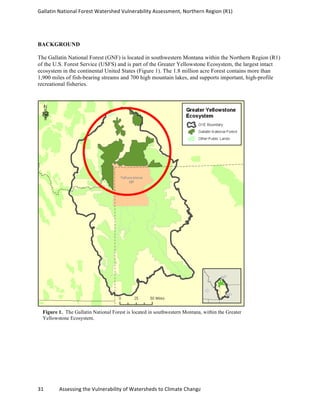
  • 161.
    Coconino  National  Forest  Watershed  Vulnerability  Assessment,  Southwest  Region  (R3)   157                        Assessing  the  Vulnerability  of  Watersheds  to  Climate  Change   Rajagopal S., Gupta H. V., Troch P. A., Dominguez F., Castro C. L. 2010. Climate change impacts on the water balance of a semi arid catchment in central Arizona using statistically downscaled climate data. (in preparation). Staudenmaier, Mike Jr., Preston, Reginald and Sorenson, Paul. 2007. Climate of Flagstaff, Arizona. NOAA Technical Memorandum NWS WR-273. 76 p. U.S. Department of Agriculture. 1994. A Federal Guide for Pilot Watershed Analysis, Version 1.2. Portland, OR. 202 pp
  • 162.
    Coconino  National  Forest  Watershed  Vulnerability  Assessment,  Southwest  Region  (R3)       158                        Assessing  the  Vulnerability  of  Watersheds  to  Climate  Change   Assessment of Watershed Vulnerability to Climate Change Sawtooth National Forest March, 2012 Prepared by: John Chatel Aquatics Program Manager Sawtooth National Forest Twin Falls Idaho
  • 163.
    Sawtooth  National  Forest  Watershed  Vulnerability  Assessment,  Intermountain  Region  (R4))   159                        Assessing  the  Vulnerability  of  Watersheds  to  Climate  Change   FOREST CONTEXT The unit and area assessed is the Sawtooth National Forest (SNF) and Sawtooth National Recreation Area within the Upper Salmon Subbasin (4th HUC) located in Idaho in the Intermountain Region (R4) of the USFS (Figure 1). PARTNERS Trout Unlimited and Rocky Mountain Research Station ASSESSMENT OBJECTIVE The assessment objective was to determine what influence climate change may have on infrastructure and key aquatic species (bull trout) within the Upper Salmon basin on the Sawtooth National Recreation Area. SCALE OF ANALYSIS The scale of the analysis used in the Sawtooth National Recreation Area; Upper Salmon Subbasin assessment was HUC-6 (12-digit) subwatersheds. Figure 1. Location of Upper Salmon Subbasin and Sawtooth National Recreation Area, where watershed vulnerability assessment was completed
  • 164.
    Sawtooth  National  Forest  Watershed  Vulnerability  Assessment,  Intermountain  Region  (R4)   160                        Assessing  the  Vulnerability  of  Watersheds  to  Climate  Change   WATER RESOURCE VALUES Columbia River Bull Trout • Threatened Species under Endangered Species Act since1998 • Sawtooth NF Management Indicator Species • More specific habitat requirements than other salmonids • Associated with the coldest streams; upper tolerance limits appear to be 12-15°C • Climate change could lead to smaller and more isolated habitat patches and the loss of local populations in the Upper Salmon. • Embryos and juveniles are vulnerable to channel scour associated with the rain-on-snow events and winter peak flows. Infrastructure • Roads, campgrounds, water diversions, bridges, etc., with poor drainage or in riparian areas will be at increased risk from rain-on-snow events and winter peak flows. Water Resource Value Indicators Projected Hydrologic Changes Analysis Tools Potential Impacts Infrastructure Recreation Sites (Campgrounds) Water Diversions System Roads and Trails Private Ownership Rain-on-Snow Events Increased Winter Peak Flows VIC – Winter 95 (# of days in the winter in which flows are among the highest 5% for year) Flood Damage Aquatics Bull Trout Rain-on-Snow Events Increased Winter Peak Flows Lower Summer Base Flows Increased Summer Water Temps VIC – Winter 95 VIC – MeanSummer (Mean flow during June 1 to September 30) Stream Temperature Model (Summer Maximum Weekly Temperature) Egg and Juvenile Scour Habitat Reduction Habitat Fragmentation Table 1. Water resource values, indicators, and analysis tools WATERSHED SENSITIVITY Watershed sensitivity includes natural risks from increased sediment, debris flows, and landslides to fish populations. The following factors were considered. Subwatershed Vulnerability - Percent of a subwatershed with sensitive land types (e.g., inherent surface soil erosion, sediment yield, and mass stability) (Figure 2). Landslide Prone Terrain – Included are areas with a tendency for rapid soil mass movements typified by shallow, non-cohesive soils on slopes with shallow translational planar landsliding phenomena are
  • 165.
    Sawtooth  National  Forest  Watershed  Vulnerability  Assessment,  Intermountain  Region  (R4)   161                        Assessing  the  Vulnerability  of  Watersheds  to  Climate  Change   controlled by shallow groundwater flow convergence. Also included are landforms with slow soil mass movements with deep earth-flows and rotational slumps, snow avalanche and rock fall areas (Figure 3). WATERSHED CONDITION Watershed condition was determined using the "Matrix of Pathways and Indicators" and Bayesian belief networks. The "Matrix of Pathways and Indicators" has been a consultation requirement for species listed under the Endangered Species Act since the late 1990’s. Baseline information was already organized and summarized by the matrix according to important environmental parameters for each subwatershed within the Upper Salmon subbasin within Sawtooth NRA. This matrix was divided into six overall pathways: -- Water Quality -- Channel Condition and Dynamics -- Habitat Access -- Flow/Hydrology -- Habitat Elements -- Watershed Conditions Each of the above pathways is further broken down into watershed condition indicators (WCIs). WCIs are described in terms of functionality (Appropriate {FA}, At Risk {FR}, and At Unacceptable Risk {FUR}). The Functioning Appropriately column represents the desired condition to strive toward for each particular WCI. The current condition of each WCI is represented as falling within its respective functionality class (Figure 5). The units of measure for WCIs are generally reported in one of two ways: (1) quantitative metrics that have associated numeric values (e.g., “large woody debris: > 20 pieces per mile”); or (2) qualitative descriptions based on field reviews, professional judgment, etc. (e.g., “physical barriers: man-made barriers present”). The suite of relevant WCIs, considered together, encompasses the environmental baseline or current condition for the subwatershed and associated aquatic resources. Bayesian belief networks (Lee and Rieman, 1997) were used to evaluate relative differences in predicted physical baseline outcomes. They are appealing because their basic structure (a box-and-arrow diagram Figure 2. Subwatershed vulnerability within the Upper Salmon subbasin on the Sawtooth NRA. Red areas have high risk, yellow have moderate risk and green have low risk of surface erosion. Figure 3. Landslide-prone terrain within the Upper Salmon sub-basin on the Sawtooth NRA. Red areas have high risk, yellow have moderate risk, and green have low risk of landslides
  • 166.
    Sawtooth  National  Forest  Watershed  Vulnerability  Assessment,  Intermountain  Region  (R4)   162                        Assessing  the  Vulnerability  of  Watersheds  to  Climate  Change   that depicts hypothesized causes, effects, and ecological interactions) can be readily modified to reflect new information or differences in perceptions about key relationships (Figure 4). Outcomes also are expressed as probabilities, so uncertainty is explicit. Bayesian belief networks (BBN) were constructed through a series of meetings with Boise and Sawtooth Forest biologists and the Rocky Mountain Research Station in 2004 to identify what baseline condition we believed possible when multiple indicators and pathways had certain functionality outcomes. Conceptual models (box- and-arrow diagrams) that depicted the hypothesized causal relationships were developed to show how each indicator resulted in pathway determinations and specific pathway outcomes resulted in an overall physical or biological baseline condition. Each BBN network variable or “node” was described as a set of discrete states that represented possible conditions or values, given the node’s definition. Arrows represent dependence or a cause-and-effect relationship between corresponding nodes. Conditional dependencies among nodes were represented by conditional probability tables (CPTs) that quantify the combined response of each node to its contributing nodes, along with the uncertainty in that response. The BBN was implemented in the modeling shell Netica software (Norsys Software Corp). Key model assumptions included: • All independent variables (Parent Nodes) in each model exert some influence on the dependent variables (Daughter Nodes). There are no “inert” variables in the Bayesian belief networks and influence diagrams. • Some variables may exert greater influence than others. For example, large pools and substrate embeddedness were “weighted” more heavily than four other WCIs in the belief network developed for evaluating the Aquatic Habitat pathway functional rating. In other words, the probabilities in the relation table reflect a belief that the functional ratings for large pools and substrate embeddedness exert greater influence on the overall Aquatic Habitat pathway than any of the other four WCIs. • Where all independent variables (parent node are functioning appropriately, there is zero probability that the overall pathway/threat (daughter node) will be functioning at risk. Conversely, where all independent variables (parent nodes) are functioning at risk, there is zero probability that the overall pathway/threat (daughter node) will be functioning appropriately. • The probability that the overall pathway (daughter node) is functioning appropriately decreases incrementally with departure from the FA condition in its parent nodes. Conversely, the probability that the overall pathway or risk (daughter node) is functioning at unacceptable risk (FUR) decreases incrementally with improvement from the FUR condition in its parent nodes. Figure 4. Bayesian belief network for determining overall physical condition from the six matrix pathways.
  • 167.
    Sawtooth  National  Forest  Watershed  Vulnerability  Assessment,  Intermountain  Region  (R4)   163                        Assessing  the  Vulnerability  of  Watersheds  to  Climate  Change   Figure 5. Overall physical baseline condition of subwatersheds within the Upper Salmon subbasin on the Sawtooth NRA. Red areas have conditions “functioning at unacceptable risk,” yellow areas have conditions “functioning at risk,” and green areas have conditions “functioning appropriately.”
  • 168.
    Sawtooth  National  Forest  Watershed  Vulnerability  Assessment,  Intermountain  Region  (R4)   164                        Assessing  the  Vulnerability  of  Watersheds  to  Climate  Change   Stressors that currently affect condition or may affect condition in the future Stressors or threats to aquatic resources were determined by 13 indicators of past and current management activities. These indicators included, among others, the amount of federal ownership within each subwatershed, number of abandoned mines, number of dispersed and developed recreation sites, route densities, water diversions, culvert barriers, and allotments. (Table 2). Criteria for each indicator were determined based on the Forest Plan (e.g., water quality and geomorphic integrity), literature (e.g., route densities), distribution through histograms (e.g., recreation) and professional judgment (e.g., culvert barriers) to determine the level of threat. Indicators Low Threat Moderate Threat High Threat Percent Federal Ownership 85-100% 50-84% <50% Abandoned Mines 0-9 sites/6th Field 10-31 sites/6th Field >32 sites/6th Field Dispersed Recreation Sites 0-8 sites/6th Field 9-31/6th Field >31/6th Field Developed Recreation Sites 0-1 sites/6th Field 2-7 sites/6th Field >7 sites/6th Field Route Density Miles of road/sq. miles of classified and unauthorized roads (w/in admin boundaries) < 0.7 mi/mi2 0.71-1.7 mi/mi2 >1.7 mi/mi2 RCA Route Density Miles of road/sq. miles of classified and unauthorized roads (w/in admin boundaries) within RCAs < 0.7 mi/mi2 0.71-1.7 mi/mi2 >1.7 mi/mi2 Landslide Prone Road Density <0.5 mi/mi2 0.5-0.7 mi/mi2 > 0.7 mi/mi2 Water Diversions No Diversions 1-2 diversions/6th Field >2 sites/6th Field Culvert Barriers No barriers present Culverts are partial barriers (passable to adults, but barrier to juveniles) or complete barriers, but less than 0.5 miles are blocked on minor tributary Barriers to all life stages (juveniles and adults) Water Quality Integrity Ratings are based on the cumulative effects of localized physical problems— such as poorly constructed roads, mineral activities, failed culverts, and landslides—or dispersed sources such as areas of extensive grazing, timber harvest, road construction or wildfire. The ratings determine the streams and riparian water quality relative to their potential. No damaged stream segments; fully supports beneficial uses <20% stream segments damaged; may not fully support beneficial uses (303d-listed) >20% stream segments damaged; does not fully support beneficial uses (TMDL developed)
  • 169.
    Sawtooth  National  Forest  Watershed  Vulnerability  Assessment,  Intermountain  Region  (R4)   165                        Assessing  the  Vulnerability  of  Watersheds  to  Climate  Change   Geomorphic Integrity Rating determinations are based on the ability of subwatershed soil-hydrologic conditions to function as a sponge-and- filter system to absorb and store inputs of water, and on geomorphic resilience of streams, and riparian and wetland areas. Both natural and anthropogenic disturbances were used to estimate existing geomorphic conditions of each subwatershed. Subwatershed is in good condition, near or at properly functioning condition, and has low risk from further disturbance. Subwatershed is in fair condition, functioning at risk, and has moderate risk from additional disturbance. Subwatershed is in poor condition, not properly functioning, and has high risk from additional disturbance. Allotments No allotments Sheep/Goat allotments and less than 25% of 6th Field in Cattle/Horse allotment Greater than 25% of 6th Field in Cattle/Horse allotment and Sheep/Goat allotments present Equivalent Clearcut Acres <15% 15-20% >20% Table 2. Indicators and criteria used to determine threats to aquatic resources After each indicator was rated (low, moderate, or high), outcomes were entered into a Bayesian belief network to determine a composite threat rating for each subwatershed within the Upper Salmon subbasin on the Sawtooth National Recreation Area (Figure 6). Threat ratings were used later in this analysis to determine bull trout persistence. A key assumption in this analysis is that subwatersheds with a higher composite risk rating would be more at risk to the influences of climate change. Figure 7. Composite threat rating for subwatersheds in the Upper Salmon subbasin on the Sawtooth NRA. Red areas have the most threats, yellow areas have moderate threat levels, and green areas have low threat levels. Figure 6. Bayesian belief network for determining overall threat level for each subwatershed on the Sawtooth NRA.
  • 170.
    Sawtooth  National  Forest  Watershed  Vulnerability  Assessment,  Intermountain  Region  (R4)   166                        Assessing  the  Vulnerability  of  Watersheds  to  Climate  Change   CLIMATE CHANGE EXPOSURE MODELS Water Temperature Potential effects of increased water temperatures due to climate change to bull trout were evaluated using a non-spatial multiple regression stream temperature model (Isaak et al. 2010). This model was created using an extensive, but non-random database of stream temperature measurements within the upper Salmon River, Upper S.F. Payette and Upper S.F. Boise subbasins on the SNF. More than 450 temperature measurements (Hobo and Tidbit models) were used from numerous resource agencies from 1994–2008. The majority of thermographs were placed in streams before mid-July, geo-referenced, and retrieved after mid-September. This sample period encompassed the warmest portion of the year when variation in temperatures among areas is most pronounced and influence on fish growth, behavior, and distribution is potentially greatest (Scarnecchia and Bergersen 1987, Royer and Minshall 1997). Predictor variables (i.e., geomorphic, climatic, and categorical) were used to describe spatial and temporal attributes associated with the stream network. Geomorphic predictors included watershed contributing area, elevation, and channel slope. Predictors in this category represented relatively static features of the river network, valley bottoms, and upstream watersheds that were hypothesized to affect stream temperatures. Interannual variation in climatically-influenced factors such as air temperature and stream flow have important consequences for stream temperatures. Air temperature affects stream temperature through sensible heat exchange near the surface of the stream and by influencing temperatures of near surface groundwater, which is an important component of summer flows. Stream flow determines the volume of water available for heating; larger flows have greater thermal capacities and are less responsive to heating (Hockey et al. 1982, Caissie 2006). Climate predictors included air temperature measurements derived from extrapolations of the observed 30 year trends at cooperative weather stations (Ketchum and Stanley) on the Sawtooth National Forest, and the 50 year trends at the USGS gauges (S.F. Boise River near Featherville, S.F. Payette River at Lowman, and Salmon River below Yankee Fork near Clayton) with the longest records on or near the SNF. The air temperature data between weather stations was strongly correlated (r2 = 0.74–0.91), so the individual time series were averaged and the same summary metrics that were applied to model stream temperatures were applied (i.e., MWMT). Flow data were obtained from two USGS stream gauges in the basin (Twin Springs and Featherville gauges). These two sets of data were also strongly correlated (r2 = 0.97) and were averaged to calculate annual mean flow (m3 /s) from 15 July to 15 September. Air temperature projections, used in the water temperature model, assume climate change will continue at the same rate that has occurred in the last 50 years on the forest. This likely underestimates the amount of change (as predicted by or some IPCC climate change scenarios). These scenarios generally predict the rate of air temperature change to accelerate due to increased carbon dioxide (Isaak/Wegner, pers. comm.). The advantage of using empirical estimates is that they're based on data from the Forest, are easy to understand. They provide estimates comparable to those from the IPCC scenarios for future values at mid-century. Categorical predictors included effects due to increased water temperature in lake outflows, water diversions, wildfires, and professional judgment. All upstream wildfires that occurred within the past 20 years were considered. Water diversion effects on water temperatures were coded from zero (when they diverted less than 5% of flow) to three (when they diverted more than 30% of flow). Diversion effects on stream temperature were assumed to extend as far as 7 km downstream of the diversion or to a confluence with a larger river or stream. Finally, lakes larger than 0.1 km2, or groups of lakes, were considered to
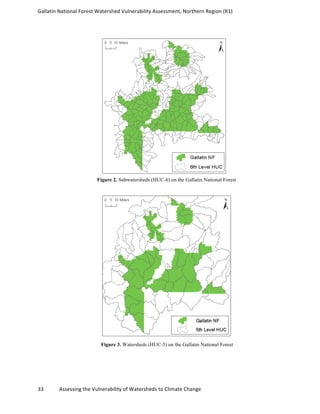
  • 171.
    Sawtooth  National  Forest  Watershed  Vulnerability  Assessment,  Intermountain  Region  (R4)   167                        Assessing  the  Vulnerability  of  Watersheds  to  Climate  Change   have an influence on water temperatures as far as 7 km downstream or to the confluence with another water body. All predictors were found to be significant (p<.05) in the model, with the exception of the wildfire effect. This was likely a result of limited fire-related temperature data and a minimal amount of wildfires on the Sawtooth NRA. As a result, the wildfire effect was not included in the final model. The model had an r2 of 0.47 and we established that it under predicted very warm temperatures and over predicted colder temperatures. A bias correction was applied to the predicted values to address these issues. Once temperature predictions were obtained for stream segments, potential effects on bull trout were analyzed by summarizing the available stream miles that were within or exceeded 15 o C for each bull trout patch. These calculations were made for current (2008), 2040, and 2080 time frames. Streams with cumulative drainages of less than 4 square kilometers were eliminated. Streams and their upstream neighbors were also eliminated if their gradient was greater than 15%. If available habitat was less than two miles within a patch, it was assumed that bull trout populations would not persist. This distance was based on not finding reproducing bull trout populations during the last eight years of sampling on the Sawtooth National Forest. Variable Infiltration Capacity (VIC) Winter high-flow frequency and summer baseflows were calculated for each subwatershed in the Upper Salmon subbasin using outputs from the VIC macro-scale hydrologic model (Liang et al. 1994, Liang et al. 1996) run for the Pacific Northwest by the Climate Impacts Group at the University of Washington (Matheussen et al. 2000, Elsner et al. 2009). The VIC model is a distributed, largely physically-based model that balances water and energy fluxes at the land surface and takes into account soil moisture, infiltration, runoff, and baseflow processes within vegetation classes. It has been widely used in the western US to study past and potential future changes to water flow regimes (Hamlet et al. 2009), snowpacks (Hamlet et al. 2005), and droughts (Luo and Wood 2007). A recently developed simplified routing method was obtained from Seth Wenger of Trout Unlimited (Wenger et al. 2010) that applied VIC outputs to stream segments in the National Hydrography Dataset Plus (NHD Plus; http://www.horizon-systems.com/nhdplus/) in USGS hydrologic region 17 (the Pacific Northwest). Two metrics (MeanSummer and Winter 95) were calculated for each subwatershed using the NHD stream segments. Mean summer flow represents the flow occurring between June 1 and September 30. This period may be most limiting to fish and is correlated with maximum water temperature (Isaak et al., 2010). Winter 95 represents the number of days during winter that are among the highest 5% (respectively) of flows for the year. These were assumed to be flows with velocity sufficient to displace and kill newly emerged fry (Fausch et al. 2001), but not necessarily destroy embryos in redds. Winter was defined as Dec. 1 – Feb. 28. Previous model validations (Wenger et al. 2010) had demonstrated that metrics representing frequency of winter high flows were accurately predicted and mean summer flow was predicted with moderate accuracy in most cases. Metrics were calculated for the 20-year period between October 1, 1977 and September 30, 1997 to represent baseline conditions. Wenger (2010) selected this time frame due to the availability of good flow records and numerous contemporaneous fish collection data to which flow metrics could later be matched. Metrics were also calculated for 2040 and 2080 using the A1B1 climate scenario to project potential changes in summer baseflow and winter high flows. Both metrics were determined by summarizing all of the NHD stream segments that fell within a subwatershed and then calculating an overall average. Change in MeanSummer flow was evaluated by looking at the percent change in flow from current to 2040 and 2080. Changes of less than 20% baseflow
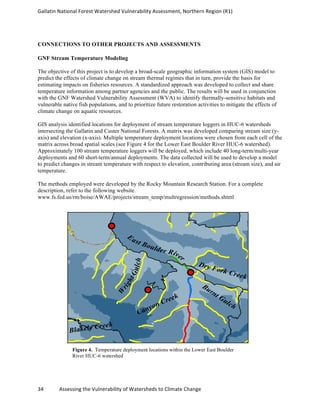
  • 172.
    Sawtooth  National  Forest  Watershed  Vulnerability  Assessment,  Intermountain  Region  (R4)   168                        Assessing  the  Vulnerability  of  Watersheds  to  Climate  Change   were considered low risk, 20 to 40% were considered moderate, and greater than 40% were considered high risk. Changes in Winter 95 were determined by seeing how many days with the highest 5% flows increased from current to 2040 and 2080. Subwatersheds with less than a 0.5 day increase were considered low risk, 0.5 to 2 day increases were considered moderate risk, and increases greater than 2 days were considered high risk. Risk ratings for Winter 95 and MeanSummer were provided by Seth Wenger, based on his recent work evaluating climate variables relative to geomorphic and land use in determining the distributions of bull trout and other species in the Interior Columbia River Basin (Wenger et al. (in press)). EXPOSURE RESULTS Winter Peak Flows (Winter 95) – The Upper Salmon subbasin has many high-elevation subwatersheds and is surrounded by 12,000-foot snow-capped peaks of the White Cloud and Sawtooth Mountains. Cold, dense air sinking from the mountains into the valley is the main reason for the chilly early-morning temperatures that are frequently the lowest in the lower 48 states. As a result, mid-winter rain-on-snow events are currently very rare. Rain-on-snow events that do occur typically happen in late April to May. The high elevation terrain and cold winter temperatures should help to buffer snow packs from winter flooding. However, as air temperatures increase, this natural buffering capacity will diminish, especially in those subwatersheds where temperatures hover around freezing. By 2100, air temperatures in Idaho could increase by 5°F (with a range of 2-9°F) in winter and summer (EPA 1998). The VIC model projects that the risk from mid-winter peak flows triggered by rain-on-snows events will increase by 2080. Specifically, the highest 5% winter- peak flows average 0.88 days under current conditions (1977-1997), but increase to 2.6 days in 2040 and to 4.44 days in 2080 on the Sawtooth NRA under the A1B emission scenario. Wenger et al. (in press) found some areas in the interior Columbia River basin within the 1977-1997 timeframe to have up to 8.4 days at the highest 5% winter peak flow. Thus, the current risk of mid-winter peak flows is relatively low in comparison to other areas. However, these risks will be increasing. By 2040, three (5.9%) of the 51 subwatersheds analyzed have less than a 0.5 day (low risk) increase in winter peak low from current; 34 (66.7%) have a 0.5 to 2 day (moderate risk) increase from current; and 14 (27.4%) have a greater-than-2-day (high risk) increase from current (Figure 8). Meadow, Stanley Lake, and Smiley Creek have the highest risk with each having over a 4 day increase in winter peak flows by 2040. Figure 8. Winter peak flow risk in 2040; highest (red); moderate (yellow); and lowest (green) Figure 9. Winter peak flow risk in 2080; highest (red); moderate (yellow); and lowest (green)
  • 173.
    Sawtooth  National  Forest  Watershed  Vulnerability  Assessment,  Intermountain  Region  (R4)   169                        Assessing  the  Vulnerability  of  Watersheds  to  Climate  Change   By 2080, only one (2.0%) subwatershed remains in a low risk category and three (5.9%) subwatersheds remain in a moderate risk category (Figure 9). The remaining 47 (92.1%) subwatersheds are in a high risk category, with Elk, Meadow, Pettit Lake, Smiley, Stanley Lake, and Upper Redfish Lake Creeks showing over a 5-day increase in winter peak flows. Summer Baseflows (Mean Summer) The VIC model projects that summer baseflows may decrease from current conditions (1977-1997) by 22% in 2040 and 29% in 2080, for the entire Sawtooth NRA under the A1B emission scenario. This is not unexpected, because air temperatures and evapotranspiration are expected to increase. Increasing winter air temperatures will reduce the amount of snow (e.g., more precipitation falling as rain than snow), as already observed in several parts of the western United States (Aguado et al. 1992; Dettinger and Cayan 1995). Higher spring temperatures will also initiate earlier runoff and peak streamflows in snowmelt-dominated basins (Aguado et al. 1992; Cayan et al. 2001). By 2040, 18 (35.3%) of the 51 subwatersheds analyzed are predicted to see moderate risks (20- 40%) from decreases in baseflow, and 33 subwatersheds will see low risk (< 20%) (Figure 10). By 2080, only 5 (9.8%) subwatersheds are predicted to remain in a low risk category and 42 (89.4%) subwatersheds in a moderate risk category (Figure 11). The remaining 4 (7.8%) subwatersheds (Beaver, Elk, Fishhook, and Park-Hanna) are predicted to be in a high risk category, with baseflow decreases of 37% or greater. These model predictions, however, should not be viewed as absolute changes, but instead as more reflective of a general trend of declining baseflows. This is because the VIC does not model groundwater, which causes it to underestimate summer flows where groundwater contributes. Conversely, the model also overestimates summer flows in drainages that lose stream flow. Still, the prediction of lower baseflows is consistent with other studies. Since 1950, stream discharge in both the Colorado and Columbia River basins has decreased (Walter et al. 2004). Regonda et al. (2005) Figure 10. Summer baseflow risk in 2040; moderate (yellow); and lowest (green) Figure 11. Summer baseflow risk in 2080; highest (red); moderate (yellow); and lowest (green)
  • 174.
    Sawtooth  National  Forest  Watershed  Vulnerability  Assessment,  Intermountain  Region  (R4)   170                        Assessing  the  Vulnerability  of  Watersheds  to  Climate  Change   and Stewart et al. (2005) found that stream runoff steadily advanced during the latter half of the twentieth century and now occurs 1 to 3 weeks earlier, due largely to concurrent decreases in snowpack and earlier spring melt (Mote et al. 2005). These changes diminished recharge of subsurface aquifers that support summer baseflows (Hamlet et al. 2005). Luce and Holden (2009) found that three-fourths of the 43 gauge records they examined from the Pacific Northwest exhibited statistically significant declines in summer low flows. Luce and Holden (2009) also found that the driest 25% of years are becoming drier across the majority of the Pacific Northwest sites, with most streams showing decreases exceeding 29% and some showing decreases approaching 50% between 1948 and 2006. Sites on or near the Sawtooth National Forest showed similar declines in mean annual flow (Table 3). Site Name Average Annual Flow (mm) 25th Percentile Change Median Change 75th Percentile Change Mean Change 13139510 Big Wood River at Hailey 257 -31% -13% -6% -7% 13186000 SF Boise River NF Featherville 411 -43% -30% 1% -21% 13302500 Salmon River at Salmon 182 -42% -29% -11% -26% Table 3. Mean annual flow from 1948-2006 In the upper Salmon River drainage, there are numerous irrigation diversions on federal and private land within the Sawtooth NRA. There are nine subwatersheds (Champion, Elk, Fisher, Huckleberry, Iron- Goat, Park-Hanna, Pole, Slate, and Smiley Creeks) at risk from declining baseflows and water diversion (Table 4). Future decreases in summer baseflows in these subwatersheds are likely to have severe consequences for aquatic ecosystems where there are already high water demands from diversions. HUC-6 Name % Decrease in MeanSummer Baseflows from Current Water Diversions 2040 2080 Overall Influence Miles of Stream Impacted Alturas Lake 24 39 None -- Beaver Creek 30 42 Low 1.21 Beaver-Peach 14 25 Low 3.88 Big Boulder Creek 109 15 Low 0.58 Big Casino Creek 10 14 Moderate 1.06 Big Lake Creek 11 20 None -- Bluett-Baker 10 22 Low 3.96 Boundary-Cleveland 15 28 Low 5.25 Cabin-Vat 22 34 Low 1.99 Champion Creek 17 33 Mod/High 3.13 East Basin-Kelly 24 30 None -- Elk Creek 25 53 Moderate 0.30 Fisher Creek 24 27 High 1.95 Fishhook Creek 25 37 None -- Fourth of July Creek 122 21 Low/Mod 4.52 French-Spring 13 24 Low 5.16 Germania Creek 13 27 None --
  • 175.
    Sawtooth  National  Forest  Watershed  Vulnerability  Assessment,  Intermountain  Region  (R4)   171                        Assessing  the  Vulnerability  of  Watersheds  to  Climate  Change   HUC-6 Name % Decrease in MeanSummer Baseflows from Current Water Diversions 2040 2080 Overall Influence Miles of Stream Impacted Gold-Williams 16 29 Low/Mod 10.77 Harden-Rough 15 28 None -- Hell Roaring-Mays 20 32 Low 2.63 Holman-Mill 14 24 Low 2.88 Huckleberry Creek 18 23 High 1.64 Iron-Goat 26 35 High 13.22 Joes-Little Casino 15 28 Low 5.58 Little Boulder Creek 8 22 Low 0.15 Lower Yankee Fork 17 23 None -- Meadow Creek 34 38 None -- Muley-Elk 15 26 None -- Nip and Tuck-Sunny 15 29 Low 7.27 Park-Hanna 32 42 High 8.46 Pettit Lake Creek 18 31 None -- Pole Creek 26 37 High 3.19 Prospect-Robinson Bar 12 27 None -- Redfish-Little Redfish 11 29 None -- Sawtooth City-Frenchman 29 35 Low 3.14 Slate Creek 15 27 Moderate 6.42 Smiley Creek 31 35 Moderate 0.92 Spud-Clayton 12 22 None -- Stanley Creek 25 34 None -- Stanley Lake Creek 25 33 Low 1.19 Sullivan-Clayton 12 22 None -- Swimm-Martin 9 29 None -- Thompson Creek 5 10 None -- Upper EF Salmon 23 32 None -- Upper Redfish Lake Creek 5 33 None -- Upper Salmon River 31 37 Low 4.04 Upper Warm Spring Creek 1 29 None -- Warm-Taylor 38 35 Low 9.00 West Pass Creek 8 12 Moderate 0.54 Wickiup-Sheep 11 23 Low 4.66 Yellow Belly Lake Creek 9 31 None -- Table 4. Comparison of summer baseflow changes and subwatersheds with water diversions * Green shaded (low risk) = < 20% decrease in baseflow; Yellow shaded (moderate risk) = 20 to 40% decrease; and Orange shaded (high risk) = > 40% decrease in baseflow. * Overall water diversion influence takes into account the number of diversions and miles of stream impacted by water withdrawals within each subwatershed.
  • 176.
    Sawtooth  National  Forest  Watershed  Vulnerability  Assessment,  Intermountain  Region  (R4)   172                        Assessing  the  Vulnerability  of  Watersheds  to  Climate  Change   Summer Water Temperatures (Maximum weekly maximum temperature) The temperature model predicts that summer maximum weekly maximum water temperatures will see a steady increase over the next 70 years (0.9 o C in 2033, 1.1 o C in 2040, 1.7 o C in 2058, and 2.5 o C in 2080) on the Sawtooth NRA. As a result, bull trout habitat within the 15 o C optimal temperature range will see a steady decrease. The stream temperature model currently projects that 102 miles of bull trout habitat within optimal temperatures exist across the Sawtooth NRA. Suitable habitat will see a slight decrease to 100 miles by 2040, but a substantial decrease (35%) to 66.7 miles by 2080 (Figures 12 and 13). Figure 12. Available thermal bull trout habitat in Valley Creek on the Sawtooth NRA in 2008. Streams with optimal temperatures are portrayed in purple and those outside optimal range in red. Figure 13. Available thermal bull trout habitat in Valley Creek on the Sawtooth NRA in 2080. Streams with optimal temperatures are portrayed in purple and those outside optimal range in red.
  • 177.
    Sawtooth  National  Forest  Watershed  Vulnerability  Assessment,  Intermountain  Region  (R4)   173                        Assessing  the  Vulnerability  of  Watersheds  to  Climate  Change   Water temperature increases are not surprising, as mean air temperatures have seen a 0.49 o C increase per decade (1979-2008) at local weather stations and projections show air temperatures increases of another 3.9 o C by 2080. At the same time, annual stream flows have decreased 5%/decade (1957-2008) at local USGS gauging stations and are projected to decrease an additional 54% by 2080. However, not every future year is expected to see warmer air temperatures and lower stream. The most pronounced changes will likely be associated with short-term cycles such as the Pacific Decadal Oscillation and the El Nino- Southern Oscillation. As climate change progresses, long-term warming trends will result in more frequent droughts and periods of unusually warm weather that were considered extreme in the twentieth century. When these events occur, the most affected watersheds will be those that have a high percentage of low-elevations terrain and channel conditions prone to heating (wide, shallow, lack of riparian vegetation) (Crozier and Zabel 2006). Projected decreases in thermally optimal bull trout habitat are similar to those by O’Neal (2002), who concluded that 2%-7% of current trout habitat in the Pacific Northwest would be unsuitable by 2030, 5%- 20% by 2060, and 8%-33% by 2090. Williams et al. (2009) also concluded that cold-water fish habitat in the Rocky Mountain region could lose up to 35% of its habitat by 2050 and 50% by 2100. Ecological Departure Bayesian belief networks were used to determine the overall influence of stream temperature, summer baseflow, and winter peak flow changes due to climate change on current and historic bull trout habitat (Figure 14). BBN’s were constructed through a series of meetings with Sawtooth National Forest and the Rocky Mountain Research Station in 2010 to determine how much collective change would need to occur before a certain level of ecological departure impacted aquatic habitat within each subwatershed that supported current or historic bull trout populations. Bayesian models predicted that habitat in 6 (16%) bull trout patches on the Sawtooth NRA would be at high risk from ecologically-departed flow and temperature conditions. It also predicted that habitat would be at moderate risk in 17 (46%) bull trout patches and at low risk in 14 (38%) bull trout patches. By 2080, risks to habitat from changed flows and water temperatures increase greatly. Only one (3%) bull trout patch (Big Casino Creek) would have low risk from ecologically-departed flow and temperature conditions, while habitat in 22 (59%) patches would be at moderate risk and 14 (38%) patches would be at high risk. Bull Trout Persistence Bayesian belief networks were used to determine bull trout persistence in the future on the Sawtooth NRA. Persistence of bull trout was based on a combination of factors. These included (Figure 15): the influence of increasing stream temperature, decreasing summer baseflow, and more frequent winter peak flow events due to climate change; the composite rating for risks and threats (i.e. landslide terrain, water diversions, route density, etc.); and current biological (i.e., local population size, life history diversity, etc.) and physical (i.e., overall watershed condition) baselines. The key assumption with this approach is that smaller, weaker, bull trout populations will be more susceptible to climate change in patches with poor baseline conditions and with Figure 14. Bayesian belief network for determining ecological departure from changes in mean summer baseflows, winter 95 rain on snow risks, and changes in optimal stream temperatures for bull trout
  • 178.
    Sawtooth  National  Forest  Watershed  Vulnerability  Assessment,  Intermountain  Region  (R4)   174                        Assessing  the  Vulnerability  of  Watersheds  to  Climate  Change   management activities that cumulatively impact habitat annually. This assumption is supported by studies that found that populations in complex habitats are more stable than populations in simple ones because they have greater capacity to buffer the effects of environmental change (Schlosser 1982; Saunders et al. 1990; Sedell et al. 1990; Schlosser 1991; Pearson et al. 1992). Neville et al. (2006) also showed that small, isolated populations were at increased risk of extinction because of demographic and genetic factors associated with their reduced population sizes and loss of interpopulation connectivity. There are, however, limitations with this approach, as follows 1. Bull trout may persist in streams that commonly exceed their perceived thermal limits (Zoellick 1999) because of increased availability of food, lack of competition with other species, or adaptations that better exploit thermal refugia or shift timing of life history transitions (Crozier and others 2008; Jonsson and Jonsson 2009). 2. Baselines and management threats were assumed to remain at present levels. In reality, some threats will diminish due to restoration or changed management approaches, some will persist due to a lack of political/social will to change, and new unexpected threats will emerge. As a result, baseline conditions will also not stay constant. 3. It was assumed that species and populations will continue to use and respond to the environment as they have in the recent past. In some instances, biological adaptation to changing environments could mitigate some of the challenges organisms face. 4. Finally, there are many complex interactions between physical changes brought on by climate change and species’ responses to these changes. While the model is a good start, it oversimplifies these interactions and may inaccurately project future persistence. Currently there are 14 patches in the Upper Salmon on the Sawtooth RNA that have reproducing bull trout populations. Bull trout in three of these patches are “functioning at unacceptable risk”, six patches are “functioning at risk,” and six are “functioning appropriately.” Populations in unacceptable or at-risk conditions are due to low population sizes, competition/hybridization risks with brook trout, poor habitat conditions, and/or moderate/high management risks. Bull trout populations in a better condition are characterized by relatively good habitat, larger populations, low to moderate management risks, and/or no brook trout present. Figure 15. Bayesian belief network for determining bull trout population persistence
  • 179.
    Sawtooth  National  Forest  Watershed  Vulnerability  Assessment,  Intermountain  Region  (R4)   175                        Assessing  the  Vulnerability  of  Watersheds  to  Climate  Change   Current Low Risk Populations - By 2040, three bull trout populations are still at low risk, nine populations are at moderate, and two are at high risk of extinction (Table 5 and Figure 16). Two populations at low extinction risk (Germania and Upper Warm Spring Creeks) have low risk from climate change (i.e., frequency of winter peak flows averaging 1.4 days, summer baseflows averaging a 7% decrease, and summer water temperatures changing very little). The other low extinction risk population (Swimm- Martin) is projected to have moderate climate-change risks (i.e., frequency of winter peak flows averaging 2.4 days, summer baseflows averaging a 9% decrease, and summer water temperatures changing very little), but has good watershed that should give the population enough resiliency to withstand the predicted changes. By 2080, all of these populations are predicted to be subjected to a greater frequency of winter peak flows (avg. 3.4), lower summer baseflows (avg. 28% decrease), and water temperatures outside optimal conditions for bull trout in lower portions of each patch. However, only the Germania population goes to a moderate risk of extinction from increasing effects of system roads in the headwaters and water diversions lower in the drainage, due to climate change. Current Moderate Risk Populations - Four populations (Big Boulder, Little Boulder, West Pass, and Fourth of July Creeks) are at moderate risk more from current and historic management impacts and moderate watershed conditions, than from climate change. This does not imply that there are no climate change impacts predicted by 2040 within these populations. There are still moderate increases in winter peak flows (avg. 0.9 days), and small changes to summer baseflows (avg. 8% decrease to 15% increase) and minor water temperature increases. However, these changes are not enough to increase extinction risks. The remaining five bull trout populations (Alturas Lake, Fishhook, Prospect-Robinson Bar, Upper EF Salmon, and Wickiup-Sheep) are projected to see a greater frequency of winter peak flow events (avg. 1.6 days), less baseflow (avg. 19% decrease) and slightly warmer water temperatures that may limit the use of habitat during portions of the summer. By 2080 extinction risks increase to most of the above bull trout populations as the frequency winter peak flows and summer water temperatures increase and summer baseflows continue to decrease (Figure 17). One additional local bull trout population (Wickiup-Sheep) is projected to be at high risk; nine are predicted to be at moderate risk, and two are predicted to be at low risk of extinction (Table 5). Figure 16. Predicted bull trout persistence in 2040. Red subwatersheds are at high extinction risk; yellow are at moderate risk, and green are at low risk. Figure 17. Predicted bull trout persistence in 2080. Red subwatersheds are at high extinction risk; yellow are at moderate risk, and green are at low risk.
  • 180.
    Sawtooth  National  Forest  Watershed  Vulnerability  Assessment,  Intermountain  Region  (R4)   176                        Assessing  the  Vulnerability  of  Watersheds  to  Climate  Change   Current High Risk Populations - By 2040, bull trout in Slate and Champion Creeks will be at a high risk of extinction, but for different reasons. Champion Creek is projected to see the loss of summer rearing habitat in the very lowest portion of the drainage from increased water temperatures above 15 o C and high risks from winter peak flows. The bull trout population is already “functioning at unacceptable risk” due to low densities (0.7 fish per 100m2 ), high densities of brook trout (17.1 fish/100m2 ), recent wildfire effects, and impacts to migration from irrigation diversions. Projected climate changes will likely increase winter peak flows enough to displace and kill newly emerged bull trout. Warmer water temperatures may also further decrease connectivity to migratory bull trout from the Salmon River. By 2080, risks from winter peak flows increase further (4.4 days), water temperatures are predicted to increase as far as the SF Champion confluence, leaving only 2.3 miles of habitat within optimal summer temperatures. Furthermore, baseflows are predicted to decrease by 33%, impacting rearing habitat and connectivity even further, especially if irrigation demands remain constant. By 2040, risks to summer baseflows in Slate Creek are expected to remain low, increases to winter peak flows increase moderately, and summer water temperatures remain high below Silver Rule Creek, due to irrigation diversions. These changes result in an overall low risk from climate change. However, the bull trout population was still projected to be at high risk of extinction due to very low population size and already-poor habitat conditions from grazing, historic mining, roads, irrigation diversions, and lingering impacts from the 1998 Labor Day flood. Thus, by 2040, climate change will add to cumulative effects but will not be the main driver of extinction risks. By 2080, risks from winter peak flows greatly increase (3.7 days), summer baseflows show a moderate decrease (27%), and summer water temperatures increase slightly, leaving 3.3 miles within the optimal temperature range. These risks will make it harder for an already-weak bull trout population to persist lower in this drainage. Subwatershed Name Management Threats Current Physical Condition Current Biological Condition 2040 2080 Ecological Departure Population Persistence Risk Ecological Departure Population Persistence Risk Alturas Lake Creek M FR FR M M M M Big Boulder Creek H FR FA L M M M Champion Creek M FR FUR M H M H Fishhook Creek M FA FR M M M M Fourth of July Creek M FR FR L M M M Germania Creek M FA FA L L M M Little Boulder Creek M FR FA L M H M Prospect-Robinson Bar M FA FA M M H M Slate Creek H FUR FUR L H M H Swimm-Martin L FA FA M L M L Upper EF Salmon M FR FR M M M M Upper Warm Spring Creek L FA FA L L M L West Pass Creek M FR FR L M M M Wickiup-Sheep H FR FR M M H H Table 5. Extinction risks and population persistence outcomes for bull trout-occupied subwatersheds
  • 181.
    Sawtooth  National  Forest  Watershed  Vulnerability  Assessment,  Intermountain  Region  (R4)   177                        Assessing  the  Vulnerability  of  Watersheds  to  Climate  Change   Overall, the predictions for bull trout do not seem promising for long-term persistence for many populations. The long-term climate patterns in tributary streams suggest both an expected decrease in the total amount of cold water stream habitat and fragmentation of some colder areas into disconnected “patches” of suitable habitat. Bull trout populations will likely increasingly retreat into these shrinking summer cold water refuges to avoid warming conditions. These restricted tributary populations may become more vulnerable to local extinction (Dunham et al. 1997; Dunham and Rieman 1999; Morita and Yamamoto 2002; Rich et al. 2003; Isaak et al. 2007). Many remaining patches will be subjected to more frequent winter peak flows, which will scour the streambed and destroy redds and/or kill newly emerged fry. Populations may also be subjected to larger, more severe wildfires (McKenzie et al. 2004; Westerling et al. 2006) that can remove riparian vegetation or catalyze severe channel disturbances such as debris flows (Luce, et al 2005). Conceivably, the combined effects of shrinking patch size and increasing frequency or magnitude of stream channel disturbance could chip away at what remaining resiliency these populations have, leaving them in a poorer condition to withstand the next series of disturbances, and accelerating the rate of local extinctions beyond that driven by temperature alone. Forest Infrastructure Developed recreation sites and trails within riparian conservation areas, water diversions, system roads, bridges, and ownership were categorized according to Forest Plan and literature criteria, histograms, and professional judgement, to determine the level of threat associated with each type of infrastructure (Table 6). Bayesian belief networks were then used to evaluate the overall amount of infrastructure and risk to facilities within each subwatershed from winter peak flows caused by rain-on-snow events on the Sawtooth NRA. Those subwatersheds that have moderate/high amounts of infrastructure and high risks from increased winter peak flows were considered to have a high risk of damage to road and trail drainage and facilities within riparian areas. Subwatersheds with less infrastructure were considered to have lower risks from winter peak flow events. Infrastructure Threat Low Moderate High Percent Federal Lands 85-100% 50-84% <50% Developed Recreation Sites within RCAs 0-1 sites/6th Field 2-7 sites/6th Field >8 sites/6th Field Water Diversions No Diversions 1-2 diversions/6th Field >2 sites/6th Field System Road Density - Miles of road/sq. miles (within admin boundaries) < 0.7 mi/mi2 0.71-1.7 mi/mi2 >1.7 mi/mi2 Road Stream Crossings - Number of road/stream crossings on perennial and intermittent streams based current road layer and NHD streams within total subwatershed regardless of ownership or administrative boundaries 0-11 crossings crossings >23 crossings Bridges No bridges present 1-2 Bridges >2 Bridges System Trails within RCAs < 0.7 mi/mi2 0.71-1.7 mi/mi2 >1.7 mi/mi2 Table 6. Forest infrastructure and levels of risk
  • 182.
    Sawtooth  National  Forest  Watershed  Vulnerability  Assessment,  Intermountain  Region  (R4)   178                        Assessing  the  Vulnerability  of  Watersheds  to  Climate  Change   Forty-six subwatersheds were evaluated for potential impacts to infrastructure on the Sawtooth NRA. Of these, 19 (41%) subwatersheds had low amounts, 22 (48%) had moderate amounts, and 5 (11%) had high amounts of infrastructure (Figure 18). Subwatersheds with the most infrastructure included Cabin-Vat, Fourth of July Creek, Nip and Tuck Sunny, Pole Creek, and Slate Creek. As discussed, VIC projects the risk from mid- winter peak flows triggered by rain-on-snow events increases substantially by 2080. Specifically, the highest 5% winter peak flows average 0.88 days under current conditions (1977-97), but increase to 2.6 days in 2040 and 4.44 days in 2080 in under the A1B emission scenario. Currently there are 18 (39%) subwatersheds at low risk, 24 (52%) at moderate risk, and 4 (9%) from winter peak flows (Table 7). These numbers change substantially as risk from winter peak flows increases into the future. By 2080, only one (2%) subwatershed (Yellowbelly Lake Creek) continues to have a low infrastructure risk, while 19 (41%) subwatersheds are at moderate risk and 26 (57%) are at high risk (Table 7). Although the Sawtooth NRA has been actively upgrading and removing facilities from riparian areas for many years, these efforts may not be enough to address projected increases in winter peak flows. There are also substantial implications to public safety, emergency access, and impacts to aquatic ecosystems. This new disturbance regime may be unlike anything we have faced before and will certainly challenge the limited resources the Forest has to repair and move facilities. If these projected changes occur, this analysis will provide a road map for further assessment of subwatershed infrastructure and incremental improvement. Figure 18. Amount of infrastructure within the Sawtooth NRA. Red shaded subwatersheds have high amounts of infrastructure; yellow moderate amounts, and green low amounts.
  • 183.
    Sawtooth  National  Forest  Watershed  Vulnerability  Assessment,  Intermountain  Region  (R4)   179                        Assessing  the  Vulnerability  of  Watersheds  to  Climate  Change   HUC Name Overall Infrastructure Amount Current 2040 2080 Winter 95 Risk Risk Winter 95 Risk Risk Winter 95 Risk Risk Alturas Lake L 0.21 L 1.77 M 4.55 M Beaver Creek M 0.70 M 3.43 H 5.55 H Beaver-Peach M 0.87 M 2.22 H 4.10 H Big Boulder Creek M 0.59 M 1.51 M 3.23 H Big Casino Creek L 4.14 M 3.69 M 5.24 M Big Lake Creek L 0.33 L 1.50 M 3.39 M Boundary-Cleveland M 0.98 M 1.32 M 1.98 M Cabin-Vat H 0.31 M 2.26 H 4.87 H Champion Creek M 0.42 L 2.72 H 4.79 H Elk Creek M 0.35 L 3.05 H 6.08 H Fisher Creek L 0.48 L 2.27 M 3.84 M Fishhook Creek L 1.79 M 4.18 M 6.60 M Fourth of July Creek H 0.38 M 1.67 H 3.53 H French-Spring L 0.40 L 1.63 M 3.28 M Germania Creek M 0.34 L 1.74 M 3.58 H Gold-Williams M 0.31 L 1.65 M 3.43 H Harden-Rough M 0.66 M 2.61 H 5.20 H Hell Roaring-Mays M 0.30 L 2.33 H 4.91 H Holman-Mill L 0.56 M 2.04 M 3.90 M Huckleberry Creek L 2.81 M 3.79 M 5.56 M Iron-Goat M 3.24 H 5.54 H 7.30 H Joes-Little Casino M 2.57 M 3.24 H 5.09 H Little Boulder Creek L 0.23 L 0.79 M 2.42 M Meadow Creek L 1.31 M 5.95 M 8.20 M Muley-Elk M 1.29 M 2.90 H 4.68 H Nip and Tuck-Sunny H 2.02 H 3.67 H 5.65 H Park-Hanna M 2.02 H 4.17 H 6.21 H Pettit Lake Creek M 0.22 L 2.53 H 5.45 H Pole Creek H 0.22 M 1.80 H 3.68 H Prospect-Robinson Bar L 0.77 M 2.60 M 4.28 M Redfish-Little Redfish L 0.90 M 4.44 M 7.29 M Sawtooth City-Frenchman M 0.41 L 2.79 H 5.05 H Slate Creek H 0.78 H 2.80 H 4.50 H Smiley Creek M 1.39 M 5.44 H 7.59 H Stanley Creek M 1.72 M 2.35 H 3.89 H Stanley Lake Creek M 0.89 M 5.07 H 8.04 H Sullivan-Clayton L 0.79 M 1.67 M 3.11 M Swimm-Martin L 0.93 M 3.30 M 4.96 M Upper EF Salmon M 0.57 M 1.72 M 3.37 H Upper Redfish Lake Creek L 0.28 L 2.49 M 5.32 M Upper Salmon River L 0.50 M 2.46 M 4.80 M Upper Warm Spring Creek L 0.27 L 1.56 M 3.25 M Warm-Taylor M 0.30 L 1.18 M 2.79 H West Pass Creek L 0.13 L 0.69 M 2.47 M Wickiup-Sheep M 0.32 L 1.19 M 2.21 H Yellow Belly Lake Creek L 0.01 L 0.12 M 0.38 L Table 7. Infrastructure risks by subwatershed from increased winter peak flows * Green shaded = low risk; Yellow shaded = moderate risk; and Orange shaded = high risk  
  • 184.
    Sawtooth  National  Forest  Watershed  Vulnerability  Assessment,  Intermountain  Region  (R4)   180                        Assessing  the  Vulnerability  of  Watersheds  to  Climate  Change   APPLICATION The results from this analysis can be applied to the following four main areas. Monitoring – Continue to expand our summer stream temperature monitoring and establish year-round monitoring sites in select subwatersheds that are projected to have temperature increases by 2040 and in higher elevation subwatersheds that are projected to have minimum temperature increase. Continue to monitor management activities that reduce stream shading and baseflows. Consider establishing stream channel/riparian monitoring sites in subwatersheds projected to see winter peak flow increases. Partner with other agencies and groups in these efforts. Watershed Aquatic Recovery Strategy (WARS) – Re-examine restoration priorities in the Forest’s WARS strategy to determine if designated high-priority subwatersheds should remain the focus of restoration. Within these and other priority subwatersheds, determine where infrastructure replacements or restoration can be most meaningful (i.e., improving riparian condition, streams flows, culvert barriers, etc.) to increase aquatic species and watershed resiliency. Education – Share results and develop educational tools to show how large-scale climate information can be used at smaller scales and what new challenges/opportunities exist. Improve Coordination - Forests are critical sources of water and habitat, but resource availability and conditions are changing, causing more uncertainty. Engage with communities and other agencies in adaptation strategies. CRITIQUE What important questions were not considered? – I would have liked to complete an evaluation on what climate will mean to fire severity and intensity in the Upper Salmon. Then see what cumulative impacts this would have had with other risks/threats. I would have also wanted to look at summer baseflow changes and water diversion closer. What were the most useful data sources? – By far the most important data sources for climate change predictions were local water temperature thermographs, weather stations, and USGS stream gauges used to construct the stream temperature model. The VIC model was essential for predicting changes in stream flow. Information on existing watershed and fish population condition and management threats was also critical to evaluate extinction risks to bull trout. What were the most important data deficiencies? – Many landscapes have some natural buffering capacity that will help minimize some climate change effects. We lacked information on groundwater, local air temperature data to determine which subwatersheds have the coldest summer temperatures, and water temperature data from high mountain lakes and streams that could have helped to evaluate this buffering capacity. What tools were most useful? – Bayesian belief networks were essential to evaluate the interaction of numerous variables and outcomes for baseline, risk/threats, ecological departure, and population extinction risks. Rocky Mountain Research Station stream temperature and VIC models were critical in looking at future climate change risks. What tools were most problematic? – The VIC model outputs were challenging to interpret. How much of an increase or decrease in flows was too much? How much change needed to occur before it would
  • 185.
    Sawtooth  National  Forest  Watershed  Vulnerability  Assessment,  Intermountain  Region  (R4)   181                        Assessing  the  Vulnerability  of  Watersheds  to  Climate  Change   impact populations or destabilize watershed conditions? Without assistance from researchers it would have been even a more subjective process in determining risk levels from certain climate changes. What could have been done differently in this process? – Each pilot Forest jumped into this very complex topic without a clear understanding of what basic climate change data was available in their area, what the best models are for future climate change predictions, and how to synthesize all this information to answer their key questions. There is a fine line between getting too much or too little direction. Too much direction can stifle creative approaches, and at times it was good to struggle through what was out there and how best to use it. However, it would have been helpful if the steering committee had made contacts with key climate change researchers before Forests proceeded too far in their analysis. For example, where is VIC data available nationally, what scale is the data, and how should it best be used to answer our key questions? If I had not had assistance from Trout Unlimited and Rocky Mountain Research Station, it would have been very difficult to complete and interpret the VIC and stream temperature models. PROJECT TEAM Core Team Assistance John Chatel (Sawtooth NF) Charlie Luce (RMRS) Kerry Overton (RMRS) Bruce Rieman (Emeritus Fisheries Scientist) Dan Isaak (RMRS) Emily Leavitt (RMRS) Seth Wenger (Trout Unlimited) Dona Horan (RMRS) Scott Vuono (Sawtooth NF) Jill Kuenzi (Sawtooth NF) PROJECT CONTACT John Chatel, Aquatics Program Managers, Sawtooth National Forest REFERENCES Aguado, E., D. R. Cayan, L. G. Riddle, and M. Roos, 1992. Climatic fluctuations and the timing of West Coast streamflow. J. Climate, 5, 1468–1483. Caissie, D. 2006. The thermal regime of rivers: a review. Freshwater Biology 51:1389–1406. Cayan DR, Kammerdiener S, Dettinger MD, Caprio JM, Peterson DH.2001. Changes in the onset of spring in the western United States. Bull Am Meteorol Soc 82(3):399–415. Crozier, L. G., and R. W. Zabel. 2006. Climate impacts at multiple scales: evidence for differential population responses in juvenile Chinook salmon. Journal of Animal Ecology 75:1100–1109. Dunham, J. B., and B. E. Rieman. 1999. Metapopulation structure of bull trout: influences of physical, biotic, and geometrical landscape characteristics. Ecological Applications 9:642–655. Dettinger, M. D. and D. R. Cayan, 1995. Large-scale atmospheric forcing of recent trends toward early snowmelt runoff in California. J. of Climate, 8, 606-623. Dunham, J. B., G. L. Vinyard, and B. E. Rieman. 1997. Habitat fragmentation and extinction risk of Lahontan cutthroat trout. North American Journal of Fisheries Management 17:1126–1133.
  • 186.
    Sawtooth  National  Forest  Watershed  Vulnerability  Assessment,  Intermountain  Region  (R4)   182                        Assessing  the  Vulnerability  of  Watersheds  to  Climate  Change   Elsner, M. M., L. Cuo, N. Voisin, J. S. Deems, A. F. Hamlet, J. A. Vano, K. E. B. Mickelson, S. Lee, and D. P. Lettenmaier. 2009. Implications of 21st Century Climate Change for the Hydrology of Washington State, in The Washington Climate Change Impacts Assessment: Evaluating Washington’s Future in a Changing Climate, edited by J. S. Littell, M. M. Elsner, L. C. W. Binder and A.K. Snover, pp. 69-106, University of Washington Climate Impacts Group, Seattle, WA. Fausch, K. D., Y. Taniguchi, S. Nakano, G. D. Grossman, and C. R. Townsend. 2001. Flood disturbance regimes influence rainbow trout invasion success among five holarctic regions, Ecol. Appl., 11, 1438-1455. Hamlet, A. F., S. Lee, K. E. B. Mickelson, and M. M. Elsner. 2009. Effects of projected climate change on energy supply and demand in the Pacific Northwest and Washington State, in the Washington Climate Change Impacts Assessment: Evaluating Washington’s Future in a Changing Climate, edited by J. S. Littell, M. M. Elsner, L. C. W. Binder and A.K. Snover, pp. 165-190, University of Washington Climate Impacts Group, Seattle, WA. Hamlet, A. F., P. W. Mote, M. P. Clark, and D. P. Lettenmaier. 2005. Effects of temperature and precipitation variability on snowpack trends in the western United States, J. Clim., 18, 4545 4561. Hockey, J. B., I. F. Owens, and N. J. Tapper. 1982. Empirical and theoretical models to isolate the effect of discharge on summer water temperatures in the Hurunui River. Journal of Hydrology (New Zealand) 21:1–12. Isaak, D.I, Luce, C.H, Rieman, B.E, Nagel, D.E., Peterson, E.E, Horan, D.L., Parkes, S., and Chandler, G.L. 2010. Effects of climate change and wildfire on stream temperatures and salmonid thermal habitat in a mountain river network. Ecological Applications, 20(5), 2010, pp. 1350–137. Isaak, D. J., Thurow, R. F., Rieman, B. E., Dunham, J. B. 2007. Relative roles of habitat size, connectivity, and quality on Chinook salmon use of spawning patches. Ecological Applications. 17: 352- 364. Jonsson B and N. Jonsson. 2009. A review of the likely effects of climate change on anadromous Atlantic salmon Salmo salar and brown trout Salmo trutta, with particular reference to water temperature and flow. Journal of Fish Biology 75: 2381-2447. Lee, D.C. and B.E. Rieman. 1997. Population viability assessment of salmonids by using probabilistic networks North American Journal of Fisheries Management 17:1144-1157. Legendre, P. 1993. Spatial autocorrelation: Trouble or new paradigm? Ecology 74:1659–1673. Liang, X., D. P. Lettenmaier, E. F. Wood, and S. J. Burges. 1994. A simple hydrologically based model of land-surface water and energy fluxes for general-circulation models, J. Geophys. Res.- Atmospheres, 99, 14415-14428. Liang, X., E. F. Wood, and D. P. Lettenmaier. 1996. Surface soil moisture parameterization of the VIC-­‐2L model: Evaluation and modification, Global Planet. Change, 13, 195–206. Luce, C. H., and Z. A. Holden. 2009. Declining annual streamflow distributions in the Pacific Northwest United States, 1948–2006, Geophys. Res. Lett., 36, L16401, doi:10.1029/2009GL039407.
  • 187.
    Sawtooth  National  Forest  Watershed  Vulnerability  Assessment,  Intermountain  Region  (R4)   183                        Assessing  the  Vulnerability  of  Watersheds  to  Climate  Change   Luce, Charles H., Tarboton, David G., Istanbulluoglu, Erkan, Pack, Robert T. 2005. Reply to comment by Jonathan J. Rhodes on ‘‘Modeling of the interactions between forest vegetation, disturbances, and sediment yields,’’ J. Geophys. Res., 110, F01013, doi:10.1029/2004JF000279. Luo, L. F., and E. F. Wood. 2007. Monitoring and predicting the 2007 U.S. drought, Geophys. Res. Lett., 34, 6. Matheussen, B., R. L. Kirschbaum, I. A. Goodman, G. M. O'Donnell, and D. P. Lettenmaier. 2000. Effects of land cover change on streamflow in the interior Columbia River Basin (USA and Canada), Hydrol. Processes, 14, 867-885. McKenzie, D., Gedalof, Z., Peterson, D. L., Mote, P. 2004. Climate change, wildfire, and conservation. Conservation Biology. 18: 890-902. Morita, K., and Yamamoto, S. 2002. Effect of habitat fragmentation by damming on the persistence of stream-dwelling charr populations. Conservation Biology. 16: 1318-1323. Mote, P. W., A. F. Hamlet, M. P. Clark, and D. P. Lettenmaier. 2005. Declining mountain snowpack in western North America, Bull. Am. Meteorol. Soc., 86, 39–49. Neville, H. M., J. B. Dunham, and M. M. Peacock. 2006. Landscape attributes and life history variability shape genetic structure of trout populations in a stream network. Landscape Ecology 21:901– 916. O’Neal, K. 2002. Effects of Global Warming on Trout and Salmon in U.S. Streams, Defenders of Wildlife and National Resources Defense Council, Washington, DC Pearsons, T. N., H. W. Li, and G. A. Lamberti. 1992. Influence of habitat complexity on resistance to flooding and resilience of stream fish assemblages. Transactions of the American Fisheries Society 121:427–436. Regonda, S. K., B. Rajagopalan, M. Clark, and J. Pitlick. 2005. Seasonal cycle shifts in hydroclimatology over the western United States, J. Clim., 18, 372–384. Rich, C. F., T. E. McMahon, B. E. Rieman, and W. L. Thompson. 2003. Local-habitat, watershed, and biotic features associated with bull trout occurrence in Montana streams. Transactions of the American Fisheries Society 132: 1053–1064. Royer, T. V. and G. W. Minshall. 1997. Temperature patterns in small streams following wildfire. Archiv fu r Hydrobiologie 140:237–242. Saunders, H.R., R.J. Hobbs, and C.R. Margules. 1990. Biological consequences of ecosystem fragmentation: a review. Conservation Biology 5:18-32. Scarnecchia, D. L., and E. P. Bergersen. 1987. Trout production and standing crop in Colorado’s small streams, as related to environmental features. North American Journal of Fisheries Management 7:315– 330. Schlosser, J.J. 1991. Stream fish ecology: a landscape perspective. Bioscience 41:704-712. Schlosser, J.J. 1982. Trophic structure reproductive success and growth rate of fishes in a natural and modified headwater streams. Canadian Journal of Fisheries and Aquatic Sciences 39:968-978.
  • 188.
    Sawtooth  National  Forest  Watershed  Vulnerability  Assessment,  Intermountain  Region  (R4)   184                        Assessing  the  Vulnerability  of  Watersheds  to  Climate  Change   Sedell, J.R., G.H. Reeves, F.R. Hauer, J.A. Stanford, and C.P. Hawkins. 1990. Role of refugia in recovery from disturbances: modern fragmented and disconnected river systems. Environmental Management 14:711-724. Stewart, I. T., D. R. Cayan, and M. D. Dettinger. 2005. Changes toward earlier streamflow timing across western North America, J. Clim., 18, 1136–1155. Walter, M.T., D.S. Wilks, J.Y. Parlange and B.L. Schneider. 2004. Increasing evapotranspiration from the conterminous United States. J. Hydrometeorol., 5, 405-408. Wenger, S. J., Luce, C. H., Hamlet, A. F., Isaak, D. J., and Neville, H. M. 2010. Macroscale hydrologic modeling of ecologically relevant flow metrics, Water Resour. Res., 46, W09513, doi: 10.1029/2009WR008839. Wenger, S. J., Dunham, J.B., Fausch, K.D., Rieman, B.E., Luce, C. H., Young, M.K., Isaak, D. J., Horan, D.L., Chandler, G.L., and Neville, H. M. (in press). Role of climate and invasive species in structuring trout distributions in the Interior Columbia Basin. Canadian Journal of Fisheries and Aquatic Sciences. Westerling, A. L., Hidalgo, H. G., Cayan, D. R., Swetnam, T. W. 2006. Warming and earlier spring increases western U.S. forest wildfire activity. Science. 313: 940-943. Williams, J.E., Haak, A.L., Neville, H.M., and Colyer, W.T. 2009. Potential Consequences of Climate Change to Persistence of Cutthroat Trout Populations. N. Am. J. Fish. Manag. 29(3): 533-548. United States Environmental Protection Agency. 1998. Climate change and Idaho. Office of Policy, EPA 236-F-98-007f. Zoellick, B. 1999. Stream Temperatures and Elevational Distribution of Redband Trout in Idaho. Great Basin Naturalist 59:136–
  • 189.
    185                        Assessing  the  Vulnerability  of  Watersheds  to  Climate  Change   Assessment of Watershed Vulnerability to Climate Change Shasta Trinity National Forest April, 2012 Prepared by: Christine Mai, Forest Hydrologist and Fred Levitan, Steve Bachman, and William Brock Shasta-Trinity National Forest Redding, California
  • 190.
    Shasta  Trinity  National  Forest  Watershed  Vulnerability  Assessment,  Pacific  Southwest  Region  (R5)   186                        Assessing  the  Vulnerability  of  Watersheds  to  Climate  Change   BACKGROUND Eleven National Forests across the country participated in a pilot study evaluating potential impacts of climate-induced hydrologic change on local water resources. Each forest identified its specific water resource values at risk, assessed the associated watershed sensitivities, and then considered expected effects from future climate change exposure to evaluate the relative vulnerabilities of forest watersheds to climatic change. This report summarizes the results from the Shasta Trinity National Forest, representing California and the Pacific South West Region. A primary objective of these assessments is to assist forests in developing strategies to guide forest management in response to climate change and promote sound resource investments. Determining areas that are most vulnerable to climate change impacts would help focus on the adaptation opportunities that may exist within these areas. Knowing what is at risk and how it may be affected presents the opportunity to incorporate watershed vulnerability into future management actions. Promoting resiliency in areas that are susceptible to hydrologic change is proposed as the appropriate management strategy. Water supplies, aquatic habitat, and the stability of forest infrastructure are all subject to significant changes as a result of climate change. More severe droughts, more frequent and larger floods, lower seasonal stream flows, higher peak flows, increasing water temperatures, increasing erosion and sedimentation are just a few of the changes that are likely to occur as a result of climate change, especially in the western United States. This vulnerability assessment evaluates the relative risk of impact from climate change to aquatic resources and infrastructure on the Shasta Trinity National Forest. Figure 1. Location of Shasta- Trinity NF, and river basin and climatic sections The Shasta Trinity National Forest manages 2.1 million acres of public land located in Northern California (Figure 1) with forest headquarters located in Redding California. The Forest is in the Pacific Southwest Region (R5) of the USFS. Mediterranean climate of northern California is characterized by hot dry summers and cool wet winters. All climate zones in the continental United States receive precipitation in the summer except California.
  • 191.
    Shasta  Trinity  National  Forest  Watershed  Vulnerability  Assessment,  Pacific  Southwest  Region  (R5)     187                        Assessing  the  Vulnerability  of  Watersheds  to  Climate  Change   Two primary ecological/climatological provinces cover the majority of the Forest; the Southern Cascade and the Klamath Mountain Range (Miles and Goudey 1997). There are also two river systems that drain the Forest (Figure 1): the Sacramento River Basin and the Trinity River, which drains into the Klamath Basin. The Southern Cascade lies on the east side of the Forest and contains the headwaters of the Sacramento River Basin. Elevations in the Southern Cascade range from 2,000 to 14,000 feet elevation, the range in precipitation is from 8 to 80 inches, with a growing season of 25 to 175 days. The Southern Cascade includes a number of active volcanoes, including Mount Lassen on the southern end and Mount Shasta to the north. The Klamath Mountain Province lies on the west side of the Forest and contains most of the Trinity River portion of the Klamath Basin as well as a the portion of the Sacramento River Basin that surrounds Shasta Lake. Elevations in the Klamath Province are a little lower than the Southern Cascade, ranging from 200 to 9,000 feet elevation. Climate variability is great with precipitation ranging from 18 to 120 inches and a growing season of 25 to 225 days. The spectacular Trinity Alps run east-west to east along the northern edge of the Forest within this province. The southernmost portion of the province is the headwaters of California’s agricultural heartland, the Central Valley. Figure 2. Shasta Trinity National Forest Hydrologic units included in Watershed Vulnerability Assessment. HUC-4 (left), HUC-5 (center) and HUC-6 (right) were the three scales used in the analysis. SCALES OF ANALYSIS This assessment included analysis at three scales: sub-basin (HUC-4), watersheds (HUC-5) and subwatersheds (HUC-6) (Figure 2). The Shasta-Trinity Watershed Vulnerability Assessment (WVA) was unique among the WVA pilot Forests in that multiple scales were utilized. A subbasin (HUC-4) was the largest assessment unit and represents the largest tributaries of the large rivers on the forest (Table 1). Subbasins range in size from roughly 300,000 acres to 1.6 million acres. Each subbasin is subdivided into watersheds (HUC-5) which range in size from roughly 40,000 acres to 200,000 acres. Watersheds are comprised of subwatersheds (HUC-6) which range from roughly 7000 acres to 57,000 acres.
  • 192.
    Shasta  Trinity  National  Forest  Watershed  Vulnerability  Assessment,  Pacific  Southwest  Region  (R5)     188                        Assessing  the  Vulnerability  of  Watersheds  to  Climate  Change   Winte Summe Klamath River Basin Subbasins Sacramento River Basin Subbasins Shasta River Lower Pitt River Trinity River (Main stem) McCloud River Sacramento Headwaters South Fork Trinity River Sacramento/Clear Cow Creek Cottonwood Creek Table 1. River Basins and nested Sub-basins on the Shasta Trinity National Forest The most relevant scale depends on assessment objectives and on the distribution of values and/or risks. Ultimately the finest scales of analysis provide the greatest level of information. If the data within the units are relatively equally distributed then smaller scales do not provide much additional information. Small scales are impractical when the scale of data available is larger than the units assessed. In this case, there are no differences between finer and larger scales. RECENT CLIMATE TRENDS IN CALIFORNIA Mean Summer and Winter Temperatures Cleland used Parameter-elevation Regressions on Independent Slopes Model (PRISM) data to analyze climate change across the United States. The 1961-1990 and 1991-2007 time periods were compared. The greatest difference in mean summer temperatures appears to be in the Southwestern United States. The mean summer temperatures are slightly warmer (0.6 º - 3.3ºF) throughout most of the California; however, in a small section in the north (home of Shasta Trinity Forest) and in a small strip along the Sierra Nevada, mean summer temperatures appear to be slightly cooler (0.2 º - 1.5 ºF). Figure 3. Winter (left) and summer (right) (from Cleland, 2010)
  • 193.
    Shasta  Trinity  National  Forest  Watershed  Vulnerability  Assessment,  Pacific  Southwest  Region  (R5)     189                        Assessing  the  Vulnerability  of  Watersheds  to  Climate  Change   Precipitation Differences in winter precipitation throughout California appear to have increased from 0.1 to 7.9 inches with the greatest increases in the north (Figures 3 and 4). California shows great variability in growing season precipitation, compared to the rest of the nation. Northern California received more precipitation (0.1 to 2.1 inches) while southern California has received less (0.1 to 1.3 inches). RECENT CLIMATE TRENDS ON FOREST (Summarized from Butz and Safford 2010) Mean Annual Temperatures Most of the Forest has had an increase of about 2 degrees Fahrenheit in mean annual temperature over the last 75 years, driven primarily by nighttime temperature increases (Figure 5). No changes in temperature have occurred at the Mt Shasta weather station (northern most portions of the forest in the Southern Cascade Ecoregion). PRISM data suggest mean annual temperature increases are slightly less at lower elevations (1ºC, 1.8º F). Figure 4. Winter and growing season changes in precipitation (PRISM Data: 1961-1990 vs.1991-2007)
  • 194.
    Shasta  Trinity  National  Forest  Watershed  Vulnerability  Assessment,  Pacific  Southwest  Region  (R5)     190                        Assessing  the  Vulnerability  of  Watersheds  to  Climate  Change   Figure 5. Shasta Trinity National Forest Mean Annual Temperature Trends Precipitation Variability Precipitation variability has significantly increased at all gauges in Sacramento River Basin (Southern Cascade Province) (McCloud and Mt Shasta Stations, Figure 6) on the east side of the Forest. This pattern in not evident in the west in the Trinity portion of Klamath Basin (Big Bar, Figure 6).
  • 195.
    Shasta  Trinity  National  Forest  Watershed  Vulnerability  Assessment,  Pacific  Southwest  Region  (R5)     191                        Assessing  the  Vulnerability  of  Watersheds  to  Climate  Change   Figure 6. Shasta Trinity National Forest Trends in Precipitation Variability Forest Snow Depth and Mount Shasta Glacier Trends Minimum and mean snow depths at all snow stations on the Forest have decreased (Figure 7). Maximum snow depth at all stations in the Trinity River basin has decreased over the period of record. This trend is not consistent across the Forest, as maximum snow depths in the Central Valley Region (the Southern Cascade Province, Figure 7) are increasing. Growth of glaciers on Mount Shasta is consistent with increase in maximum depths in the Southern Cascades (Figure 7). Shasta’s glaciers are among the few in the world that are still growing. Glacier changes are dictated by air temperature and precipitation. Warming can lead to increases in precipitation (and thus glacier ice accumulation) (Nesje et al. 2008).
  • 196.
    Shasta  Trinity  National  Forest  Watershed  Vulnerability  Assessment,  Pacific  Southwest  Region  (R5)     192                        Assessing  the  Vulnerability  of  Watersheds  to  Climate  Change   Figure 7. Trends in snow depths from snow courses on the Shasta-Trinity National Forest. Maximum, mean and minimum depths are shown in green, blue and red, respectively. Figure 8. Photographs of the Hotlum Glacier, Mount Shasta, taken September 18, 1935 (left) and August 24, 2008 (right). Photos courtesy of Mount Shasta Climbing Rangers. APPROACH TO ASSESSING VULNERABILITY The general model used in this assessment is shown in Figure 9. The approach starts with identifying important aquatic resource values on the Forest that might be affected by climate change. Next, the potential changes to climate and the resources were assessed. The third step was to examine factors that might modify the response. The three components are characterized (rated and ranked) at the watershed scales described above. Vulnerability was derived by overlaying the products of the first three steps. The objective of the assessment was to provide a means of describing relative vulnerability of aquatic resources on the Forest to potential climate change impacts. It is important to remember the results are not applicable to watersheds not on the Forest, and they are not based on ecological thresholds.
  • 197.
    Shasta  Trinity  National  Forest  Watershed  Vulnerability  Assessment,  Pacific  Southwest  Region  (R5)     193                        Assessing  the  Vulnerability  of  Watersheds  to  Climate  Change   Figure 9. Model used in the Shasta-Trinity NF Watershed Vulnerability Assessment. Note that stressors are limited to those relative to climate change exposure. WATER RESOURCE VALUES Three resource issues were selected for analysis, warming, drying, and extreme events. The aquatic values of focus are the aquatic habitats associated with lakes and streams (fish focus), ponds and springs (sensitive aquatic species), and infrastructure (stream crossings and near-stream recreation facilities). These resources are likely to be impacted by climate change in different ways. Fish populations are most likely to be affected by warming of rivers and streams. Sensitive aquatic species are most likely to be affected by the drying of ponds, small lakes, and springs. Infrastructure is at increased risk of damage from runoff from extreme precipitation events. Fisheries Fish species on the Forest include several USFS-sensitive species as well as species listed as threatened and endangered under the Endangered Species Act (ESA). ESA-listed species include Sacramento River winter run Chinook, Central Valley spring- and fall-run Chinook, North Coast winter coho, Northern California steelhead, and Great Basin Redband trout. The distribution of these species is shown in Figure 10. Impacts to these species are likely to occur as increased temperatures reduce the amount of suitable habitat. California lakes have been found, on average, to be warming at 0.2 degrees per year over the past several decades (Schneider et al. 2009). Warmer water temperatures and shifts in timing of hydrographs will likely disturb breeding and rearing lifecycles, and also impact food-source organisms upon which the species depend, resulting in additional stress. Increased stresses could result in loss of species already at risk.
  • 198.
    Shasta  Trinity  National  Forest  Watershed  Vulnerability  Assessment,  Pacific  Southwest  Region  (R5)     194                        Assessing  the  Vulnerability  of  Watersheds  to  Climate  Change   Figure 10. Distribution of salmonid and resident fishes on the Shasta-Trinity NF. Density of TES fish species are shown for HUC-4, HUC-5 and HUC-6. Sensitive Species There are 28 USFS sensitive species on the Forest; over 70% of these are aquatic species (Table 2). Most of these species are already at risk due to loss of habitat and habitat fragmentation. Additional stress to species is probable due to influences of warming on hydrologic processes. Periods of extended drought would also exacerbate the effects of drying on small aquatic habitats. Timing and volume of hydrographs are likely to shift. These increased stresses could result in loss of habitats and the species they support. The non-fish species are strongly associated with springs and other water bodies less than one acre in size (Figure 11). This analysis uses impacts to these habitats as the proxy for species effects.
  • 199.
    Shasta  Trinity  National  Forest  Watershed  Vulnerability  Assessment,  Pacific  Southwest  Region  (R5)     195                        Assessing  the  Vulnerability  of  Watersheds  to  Climate  Change   Fishes Amphibians & Reptiles Terrestrial & Aquatic Invertebrates Hardhead Southern torrent salamander Shasta sideband snail Shasta hesperian snail redband trout Foothill yellow legged frog Wintu sideband snail CA floater (freshwater mussel) Steelhead Cascade frog Shasta chaparral snail Nugget Pebble Snail Spring-run Chinook salmon Shasta salamander Tehama chaparral snail Scalloped Juga (snail) Fall-run Chinook salmon Northwestern pond turtle (reptile) Pressley hesperian snail Montane peaclam Table 2. Shasta Trinity National Forest Sensitive species (List since 2007) Figure 11. Distribution of springs and lentic habitats less than an acre in size on the Shasta-Trinity NF. Densities of habitats are shown for HUC-4, HUC-5 and HUC-6. Infrastructure Forest infrastructure located in or near water bodies includes road crossings (including bridges) and near- stream road segments, campgrounds, and water diversion facilities. As temperatures warm and more energy drives the hydrologic cycle, increases in the size of peak precipitation and flow events is anticipated. These increases will increase the risk of damage to near channel infrastructure from increased winter peak flows, including rain-on-snow events. Data used to characterize location and density of infrastructure included the distributions of stream crossings, water diversions, and areas that are susceptible to debris flows, mass wasting and flooding.
  • 200.
    Shasta  Trinity  National  Forest  Watershed  Vulnerability  Assessment,  Pacific  Southwest  Region  (R5)     196                        Assessing  the  Vulnerability  of  Watersheds  to  Climate  Change   CLIMATE CHANGE INFLUENCE ON HYDROLOGIC PROCESSES Implications of climate change on water resources are very complex. Based on climate trends already observed and discussion of potential effects of changing climate on hydrologic processes (Furniss et al, 2010), the team identified several changes. These were briefly addressed in the discussion of each resource value, and are displayed in Figure 12. Next, the team considered how these changes might influence key aquatic resource values. The assessment assumes the effects will be moderated in resilient watersheds. These inter-relationships are shown in Table 3. Figure 12. Summary of likely climate change effects on hydrologic processes, and on selected resource values Stressors (Exposure) Two elements were combined to rate exposure of watersheds to climate change. The first is temperature increases predicted by the A2 Climate Scenario from the World Climate Research Programme's (WCRP's) Coupled Model Intercomparison Project phase 3 (CMIP3) multi-model dataset. This is a downscaled global temperature modeling output available from the University of California, Santa Barbara. The second element of the exposure analysis was characterization of each stream and river segment’s relative solar exposure. The NetMap Modeling Product (citation) was used for this characterization. Projected Temperature Increases The CMIP3 multi-model dataset displayed below uses an A2 emission scenario represents a world that has a self-reliant focus on local or regional concerns as opposed to cooperative global concerns; it’s also driven by greater emphasis on economics than on environmental concerns. The result is temperatures at the high end of the range of projections. Projected temperatures are displayed in Figure 13. Note that in
  • 201.
    Shasta  Trinity  National  Forest  Watershed  Vulnerability  Assessment,  Pacific  Southwest  Region  (R5)     197                        Assessing  the  Vulnerability  of  Watersheds  to  Climate  Change   contrast to other characterizations, temperature increases are not displayed at all three scales, because the downscaled data do not allow discrimination at the HUC-6 level. Figure 13. Projected Climate Change (World Climate Research Program (WCRP), Coupled Model Intercomparison Project Multi Model Dataset Solar Exposure Products from the NetMap Model (Earth Systems Institute) were utilized to display areas that have the greatest percentage of each hydrologic unit that is susceptible to solar exposure using digital elevation modeling (Figure 14). Flat areas are considered to have the greatest level of exposure, and steeper ground is most variable, with aspects determining overall percentages that have a higher or lower degree of solar exposure.
  • 202.
    Shasta  Trinity  National  Forest  Watershed  Vulnerability  Assessment,  Pacific  Southwest  Region  (R5)     198                        Assessing  the  Vulnerability  of  Watersheds  to  Climate  Change   Figure 14. Thermal exposure of streams on the Shasta-Trinity NF Watershed Sensitivity and Resiliency Numerous factors were considered in the assessment of what might modify potential changes to hydrologic factors. Of these, two factors were thought to be most important. These are the percentage of each watershed where snow is the dominate runoff process, and the percentage of each watershed composed of geologies where groundwater is a primary influence. Groundwater Influence Though future changes in precipitation will affect all geologies, areas with groundwater influence are less likely to be rapidly altered by climatic influences and should supply more reliable water sources. Because infiltration rates are relatively high in such areas, they buffer changes to runoff timing, and increased water temperature. The percentage of a hydrologic unit that contains volcanic basalt or limestone was used to represent areas that are ground dominated systems with limited surface water flows and a tempered/ delayed hydrologic response.
  • 203.
    Shasta  Trinity  National  Forest  Watershed  Vulnerability  Assessment,  Pacific  Southwest  Region  (R5)     199                        Assessing  the  Vulnerability  of  Watersheds  to  Climate  Change   Figure 15. Percentage of hydrologic units in volcanic and limestone geologies; representing groundwater influence. While geologies that promote infiltration and groundwater may tend to buffer climate change effects, areas that are currently dominated by snowmelt processes are likely to be most susceptible to change. Snowmelt-Dominated Hydrology An evaluation of the climatic subsections (Ecomap 1997) was used to rate areas most susceptible to hydrologic transitions based on elevation and snow dominated runoff (Figure 16). Ecological subsections on the Forest were ranked based on the amount of snow dominated runoff. The percentages of each hydrologic unit containing the ranked climatic subsections determined the overall sensitivity of the hydrologic units.
  • 204.
    Shasta  Trinity  National  Forest  Watershed  Vulnerability  Assessment,  Pacific  Southwest  Region  (R5)     200                        Assessing  the  Vulnerability  of  Watersheds  to  Climate  Change   Figure 16. Ranking of watershed sensitivity based on snow dominated runoff processes. Higher numerical scores represent higher percentage of the watershed with snow. Combining Values, Exposure (Stressor) and Sensitivity A rating of each element (resource value, exposure, and sensitivity) was derived for each watershed, and these scores divided into fifths to obtain relative ratings of 1-5, based solely on values on the Shasta Trinity National Forest. They do not represent ecological thresholds. A “one” represents the lowest value (or stressor). A “five” corresponds to the highest value (or stressor). Each of the ratings is the combination of several elements. For example, the aquatic features resource combined information on both springs and lakes (see Table 3). The scores were then added together using the weighted average approach from the WVA (USDA 2011) to obtain a total “resource value” score, a total “exposure” score and a total sensitivity score. The process of combining two data sets into one combined ranking is displayed by using both Table 3 and Figure 17. For example, the final “value score” in Table 3 (6th column from the left) is multiplied by 10. Refer next to the matrix (Figure 17) to find the intersection of this “resource value” score (10 to 50) and the corresponding “exposure” score (1 to 5); this intersection (labeled from Low to High) represents the combined “value/exposure” ranking. Again, a “low” combined score is represented by the number 1, up
  • 205.
    Shasta  Trinity  National  Forest  Watershed  Vulnerability  Assessment,  Pacific  Southwest  Region  (R5)     201                        Assessing  the  Vulnerability  of  Watersheds  to  Climate  Change   to “high” as a 5. The process is repeated, merging this new combined data set with the sensitivity ranking. This is done to produce an overall score of vulnerability that includes values, stressors, and sensitivity. Aquatic Features Susceptible to Loss from Drying Values at Risk Exposure Combined Value & Exposure Subbasins Drying Lake Density Rank Spring Density Rank Sum of Values Weighted Value (Sum- Min/Max- Min)1 Value Score Matrix Value Score = Value x 10 NetMap Thermal Exposure Rank 2030 A2 Global Climate Model Rank Sum of Exposure Weighted Exposure (Sum-Min /Max-Min) Exposure Score Value Exposure Score2 Cottonwood 1 2 3 0.1 1 10 1 1 2 0.3 2 1 Cow 4 5 9 0.9 5 50 1 1 0.0 1 3 Lower Pit River 3 2 5 0.4 2 20 5 5 10 1.0 5 4 McCloud 1 4 5 0.4 2 20 4 5 9 0.9 5 4 Sacramento Headwaters 2 5 7 0.6 4 40 2 4 6 0.5 3 4 Sacramento/ Clear 4 1 5 0.4 2 20 1 5 6 0.5 3 2 Shasta 5 5 10 1.0 5 50 4 4 0.8 4 5 South Fork Trinity River 2 3 5 0.4 2 20 3 3 6 0.5 3 2 Trinity 3 3 6 0.5 3 30 2 4 6 0.5 3 3 Table 3. Combining multiple attributes into final scores (sample table) High Exposure Low Rank 5 4 3 2 1 Rank High 50 H H H MH M 50 High Values 40 H H MH M ML 40 Values 30 MH MH M ML ML 30 20 MH M ML L L 20 Low 10 M ML L L L 10 Low Rank 5 4 3 2 1 Rank High Exposure Low Figure 17. Example of matrix used to combine resource and sensitivity (stressor) ratings. Results shown in pink received overall rating of “5”; those in light blue received a rating of “1”. It is important to note that this very simplistic model has many limitations. Other factors and more refined datasets could be employed to improve this model. The results presented are a first cut at identifying and analyzing factors that can be considered in evaluating watershed vulnerability to climate change. 1  This  calculation  is  based  on  the  weighted  average  approach  used  in  the  Watershed  Vulnerability  Assessment.   Technical  Guide  USDA  2011.  (  5=  >0.8,    4=0.6  to  0.8,  3=  0.4  to  0.6,  2=0.2  to  0.4  and  1  =  <0.2)   2  This  column  is  derived  from  using  matrix  shown  in  Figure  21.  
  • 206.
    Shasta  Trinity  National  Forest  Watershed  Vulnerability  Assessment,  Pacific  Southwest  Region  (R5)     202                        Assessing  the  Vulnerability  of  Watersheds  to  Climate  Change   Watershed Vulnerability Results Fisheries This assessment considered increase in water temperature considered to be the primary risk to fisheries and fisheries habitat. Fish values were characterized by the density of fish presence with higher weighting for threatened, endangered and sensitive species than for resident species. The result of the analysis for fish is shown in Figure 18. Areas in green contain habitats that may provide greatest resilience, and watersheds in red support habitats that may be the most vulnerable to impacts associated with climate change. Watersheds shown in yellow are considered to have moderate resilience. Figure 18. Combined ratings of resources, stressors and exposure produce relative ratings of watershed vulnerability Investing in fish habitat or watershed improvement projects is expected to be most effective in watersheds with high resilience (green), or moderately resilient watersheds (yellow) adjacent to watersheds with high resilience, because these would provide a greater level of connectivity. Enhancement of connectivity is a vitally important form of restoration in response to climate change. Restoration has traditionally been driven by a combination of political and biological considerations. It is highly important that scarce restoration funds for species recovery be allotted based on a hierarchy that considers resource values and includes long-term sustainability in the face of climate change. Site selection should prioritize areas of high resource value, tempered by considerations of resiliency to climate change. Areas of high resource value would include both population strongholds and habitat that will act as refugia from the change.
  • 207.
    Shasta  Trinity  National  Forest  Watershed  Vulnerability  Assessment,  Pacific  Southwest  Region  (R5)     203                        Assessing  the  Vulnerability  of  Watersheds  to  Climate  Change   Highest priority actions are habitat protection and improving connectivity and access to existing habitat not currently occupied. Aquatic Species Sensitive aquatic species are represented in the analysis by springs and lentic habitats less than one acre in size. The primary risks to these habitats (and the species they support) are loss of suitability from warming and complete loss due to drying. Resource values were characterized by the density of the small waterbodies. Results of this analysis are displayed in Figure 19. Areas in green are watersheds supporting aquatic habitats that may provide greatest resilience to impacts associated with climate. Watersheds depicted in red are areas where habitats may be the most vulnerable to change. Investing in sensitive aquatic species habitat improvement projects may be most efficient in watersheds that are most resilient, and in watersheds with moderate resilience (yellow) that are adjacent to more resilient watersheds. Developing more reliable water sources and protesting acquisition of additional water rights in may improve resilience in all watersheds, and may help to retain water in small ponds and springs. Figure 19. Vulnerability of small aquatic features to drying
  • 208.
    Shasta  Trinity  National  Forest  Watershed  Vulnerability  Assessment,  Pacific  Southwest  Region  (R5)     204                        Assessing  the  Vulnerability  of  Watersheds  to  Climate  Change   Infrastructure Figure 20 displays results from the assessment of relative risk to infrastructure. Resource value was based on relative densities of roads and recreation sites in nearstream areas, road crossings and water diversions. Areas depicted in green are least likely to have infrastructure affected by extreme events. Watersheds shown in red are expected to have the greatest changes in peak flows and will be most vulnerable to impacts associated with extreme events. Investing in watershed improvements that buffer runoff response (disconnecting road crossings, etc.) may be most efficient in watersheds with greater resilience (green). This model needs more work to better synthesize resource values. Wilderness areas obviously should have greater resiliency and lower vulnerability; at this point, trail crossings are included in the model and result in higher vulnerability ratings. Figure 20. Watershed Vulnerability to Climate Change from Extreme Events RESPONDING TO CLIMATE CHANGE In ecology, resilience describes how much disturbance a system can "absorb" without substantially changing its condition and structure (Bakke 2009). In regard to recovery, habitat restoration, and conservation of at-risk aquatic species, resiliency also requires that certain key habitat characteristics or processes will change little, or not at all, in response to climate change (Bakke 2009).
  • 209.
    Shasta  Trinity  National  Forest  Watershed  Vulnerability  Assessment,  Pacific  Southwest  Region  (R5)     205                        Assessing  the  Vulnerability  of  Watersheds  to  Climate  Change   It is vitally important to understand that healthy hydrologic units are the most resilient to change and thus are a first step in considering where to apply future management. Proven management actions that maintain or improve resilience include the following. • Maintain or increase habitat accessibility • Prioritize aquatic habitat connectivity in refugia • Road improvements to reduce sediment delivery and disconnect channel crossings • Implementation of erosion prevention BMPs • Replace undersized and damaged culverts • Practice water conservation practices such as replacing leaky pipes, installing floats to force pump shutoff, and better controlling or eliminating overflow from developed water sources. • Riparian improvements- thinning, enhancing native communities • Meadow and stream improvements • Maintain or increase water developments supporting key species • Acquire water rights for critical resources • Promote stricter enforcement of illegal water drafting, contest new applications for use and storage • Explore creative solutions for FERC flows, relocating species above dams, removal of natural barriers, collaboration and communications • Apply actions strategically (where infrastructure replacements or restoration can be most meaningful to increase aquatic species and watershed resiliency) The list is not complete and should be expanded to consider things like strategic planting of aquatic species that favor adaptation to expected change to increase survival. It could also include fuel treatment to break up continuity of continuous dead fuels to make the watersheds more resilient to wildfire. Reducing road densities and other erosion and sedimentation sources also help promote watershed resiliency. Maintaining or improving riparian areas through distributions of diverse native species of all age classes is also key. Maintaining and increasing habitat accessibility, accomplished primarily by replacing and removing anthropogenic barriers that block access to historic or suitable is also important, especially to replace habitat loss to warming. These actions include upgrading road stream crossings and reducing or mitigating the barriers associated with dams and diversions. The other major area of critical focus is careful management of water supplies. There is a need to consider potential climate change effects in the review and implementation of FERC licenses. Consider developing additional water sources and acquiring water rights to provide supplies for threatened and endangered species. Consider objecting to water-use developments that might further limit water supplies. Maintain and improve water infrastructure to reduce water loss and waste. Increasing the enforcement of illegal water drafting will become even more prevalent and more significant to maintain water in streams. Illegal drafting is already completely dewatering portions of streams that would otherwise be perennial. While the Forest has the experience and capacity to implement these actions, it does not have the resources to implement them everywhere. Therefore planning is needed to identify priority areas for implementation. Results of the vulnerability assessment should be used to review, and modify as necessary, existing forest improvement and restoration plans. Finally, there is a need to share our experience and knowledge with partners and adjacent landowners with whom the Forest can collaborate to provide watershed-wide climate adaptation strategies that will
  • 210.
    Shasta  Trinity  National  Forest  Watershed  Vulnerability  Assessment,  Pacific  Southwest  Region  (R5)     206                        Assessing  the  Vulnerability  of  Watersheds  to  Climate  Change   better protect our precious water resources. The Forest needs to share results and develop educational tools to show how large scale climate information can be used at smaller scales and what new challenges and opportunities exist. LESSONS LEARNED • Scale Matters • Simplify Assessments − Focus on “processes” related to key values − Identify, locate and prioritize solutions based on these same key processes and potential effects. • Synthesis is key and most challenging − Seek assistance and involve critical thinkers! PROJECT TEAM • Tyler Putt, GIS Specialist, Shasta Trinity National Forest • Lois Shoemaker, Fire Ecologist, Shasta Trinity National Forest • Ralph Martinez, GIS Specialist, Plumas National Forest • Brenda Olson, Biologist Fish and Wildlife Service • Michael Wopat, Engineering Geologist, California Geological Survey • Sherry Mitchell Bruker, Hydrologist, Lassen National Forest The above individuals provided many reference resources and participated in initial brainstorming processes or development of data layers and critical reviews that helped to guide this project. Ken Roby, Lassen National Forest and USFS Stream Systems Technology Center (retired) provided advice during the analysis, and edited the draft report. Dr Lee Benda of Earth Systems Institute provided solar exposure to stream dataset products from the Net Map Model. We acknowledge the modeling groups, the Program for Climate Model Diagnosis and Intercomparison (PCMDI) and the WCRP's Working Group on Coupled Modelling (WGCM) for their roles in making available the WCRP CMIP3 multi-model dataset. Support of this dataset is provided by the Office of Science, U.S. Department of Energy. REFERENCES Aguado, E., D. R. Cayan, L. G. Riddle, and M. Roos. 1992. Climatic fluctuations and the timing of West Coast streamflow. J. Climate, 5, 1468–1483. Bailey. 1994. Hierarchy of Ecoregions at a Range of Scales. Bakke, Jostein; Lie, Øivind; Heegaard, Einar; Dokken, Trond Martin; Haug, Gerald; Birks, Hilary H; Dulski, Peter; Nilsen, Trygve. 2009. Rapid oceanic and atmospheric changes during the Younger Dryas cold period. Nature Geoscience 2, s. 202-205. (html)
  • 211.
    Shasta  Trinity  National  Forest  Watershed  Vulnerability  Assessment,  Pacific  Southwest  Region  (R5)     207                        Assessing  the  Vulnerability  of  Watersheds  to  Climate  Change   Benda, L., Miller, D. J., Andras, K., Bigelow, P., Reeves, G., and Michael, D. 2007. NetMap: A new tool in support of watershed science and resource management, Forest Sci., 52, 206–219, Caissie, D. 2006. The thermal regime of rivers: a review. Freshwater Biology 51:1389–1406. Cayan DR, Kammerdiener S, Dettinger MD, Caprio JM, Peterson DH. 2001. Changes in the onset of spring in the western United States. Bull Am Meteorol Soc 82(3):399–415 Crozier, L. G., and R. W. Zabel. 2006. Climate impacts at multiple scales: evidence for differential population responses in juvenile Chinook salmon. Journal of Animal Ecology 75:1100–1109. Daly, Christopher. 2010. PRISM (Parameter-elevation Regressions on Independent Slopes Model) climate mapping system, PRISM Climate Group director. http://prism.oregonstate.edu/ Dettinger, M. D. and D. R. Cayan. 1995. Large-scale atmospheric forcing of recent trends toward early snowmelt runoff in California. J. of Climate, 8, 606-623. Fausch, K. D., Y. Taniguchi, S. Nakano, G. D. Grossman, and C. R. Townsend. 2001. Flood disturbance regimes influence rainbow trout invasion success among five holarctic regions, Ecol. Appl., 11, 1438-1455. Hamlet, A. F., P. W. Mote, M. P. Clark, and D. P. Lettenmaier. 2005. Effects of temperature and precipitation variability on snowpack trends in the western United States, J. Clim., 18, 4545 4561. Isaak, D.I, Luce, C.H, Rieman, B.E, Nagel, D.E., Peterson, E.E, Horan, D.L., Parkes, S., and Chandler, G.L 2010. Effects of climate change and wildfire on stream temperatures and salmonid thermal habitat in a mountain river network. Ecological Applications, 20(5), 2010, pp. 1350–137. Isaak, D. J.; Thurow, R. F.; Rieman, B. E.; Dunham, J. B. 2007. Relative roles of habitat size, connectivity, and quality on Chinook salmon use of spawning patches. Ecological Applications. 17: 352- 364. Liang, X., D. P. Lettenmaier, E. F. Wood, and S. J. Burges. 1994. A simple hydrologically based model of land-surface water and energy fluxes for general-circulation models, J. Geophys. Res.- Atmospheres, 99, 14415-14428. Liang, X., E. F. Wood, and D. P. Lettenmaier. 1996. Surface soil moisture parameterization of the VIC-­‐2L model: Evaluation and modification, Global Planet. Change, 13, 195–206. Luce, C. H., and Z. A. Holden. 2009. Declining annual streamflow distributions in the Pacific Northwest United States, 1948–2006, Geophys. Res. Lett., 36, L16401, doi:10.1029/2009GL039407. Luo, L. F., and E. F. Wood. 2007. Monitoring and predicting the 2007 U.S. drought, Geophys. Res. Lett., 34, 6. Maurer, E. P., L. Brekke, T. Pruitt, and P. B. Duffy. 2007. 'Fine-resolution climate projections enhance regional climate change impact studies', Eos Trans. AGU, 88(47), 504. "bias-corrected and spatially downscaled climate projections derived from CMIP3 data and served at: http://gdo- dcp.ucllnl.org/downscaled_cmip3_projections/, described by Maurer et al (2007)."
  • 212.
    Shasta  Trinity  National  Forest  Watershed  Vulnerability  Assessment,  Pacific  Southwest  Region  (R5)     208                        Assessing  the  Vulnerability  of  Watersheds  to  Climate  Change   Matheussen, B., R. L. Kirschbaum, I. A. Goodman, G. M. O'Donnell, and D. P. Lettenmaier. 2000. Effects of land cover change on streamflow in the interior Columbia River Basin (USA and Canada), Hydrol. Processes, 14, 867-885. McKenzie, D., Gedalof, Z., Peterson, D. L., Mote, P. 2004. Climate change, wildfire, and conservation. Conservation Biology. 18: 890-902. Miles, Scott and Charles Goudey. 1997. Ecological Subregions of California, Section and Subsection Descriptions. USDA, Forest Service Pacific Southwest Region, San Francisco, CA Prepared in cooperation with: USDA, Natural Resources Conservation Service USDI, Bureau of Land Management. http://fsgeodata.fs.fed.us/other_resources/ecosubregions.html Mote, P. W., A. F. Hamlet, M. P. Clark, and D. P. Lettenmaier. 2005. Declining mountain snowpack in western North America, Bull. Am. Meteorol. Soc., 86, 39–49. Nesje, A. 2008. Norwegian mountain glaciers in the past, present and future. Global and Planetary Change 60 (2008) 10–27. Available online at www.sciencedirect.com or at http://www.uio.no/studier/emner/matnat/geofag/GEG2130/h09/Reading%20list/Norwegian%20mountain %20glaciers%20in%20the%20past,%20present%20and%20future.pdf Neville, H. M., J. B. Dunham, and M. M. Peacock. 2006. Landscape attributes and life history variability shape genetic structure of trout populations in a stream network. Landscape Ecology 21:901– 916. O’Neal, K. 2002. Effects of Global Warming on Trout and Salmon in U.S. Streams, Defenders of Wildlife and National Resources Defense Council, Washington, DC Pearsons, T. N., H. W. Li, and G. A. Lamberti. 1992. Influence of habitat complexity on resistance to flooding and resilience of stream fish assemblages. Transactions of the American Fisheries Society 121:427–436. Regonda, S. K., B. Rajagopalan, M. Clark, and J. Pitlick. 2005. Seasonal cycle shifts in hydroclimatology over the western United States, J. Clim., 18, 372–384. Royer, T. V. and G. W. Minshall. 1997. Temperature patterns in small streams following wildfire. Archiv fu r Hydrobiologie 140:237–242. Saunders, H.R., R.J. Hobbs, and C.R. Margules. 1990. Biological consequences of ecosystem fragmentation: a review. Conservation Biology 5:18-32. Schlosser, J.J. 1982. Trophic structure reproductive success and growth rate of fishes in a natural and modified headwater streams. Canadian Journal of Fisheries and Aquatic Sciences 39:968-978. Sedell, J.R., G.H. Reeves, F.R. Hauer, J.A. Stanford, and C.P. Hawkins. 1990. Role of refugia in recovery from disturbances: modern fragmented and disconnected river systems. Environmental Management 14:711-724. Stewart, I. T., D. R. Cayan, and M. D. Dettinger. 2005. Changes toward earlier streamflow timing across western North America, J. Clim., 18, 1136–1155.
  • 213.
    Shasta  Trinity  National  Forest  Watershed  Vulnerability  Assessment,  Pacific  Southwest  Region  (R5)     209                        Assessing  the  Vulnerability  of  Watersheds  to  Climate  Change   USDA Forest Service. 2011. Watershed Condition Classification Technical Guide. FS- 978. Primary Author John Potyndy. http://www.fs.fed.us/publications/watershed/watershed_classification_guide.pdf Waananen, A.O. and Crippen, J.R., 1977. Magnitude and frequency of floods in California: U.S. Geological Survey Water-Resources Investigations Report 77-21, 102p. Wenger, S. J., Luce, C. H., Hamlet, A. F., Isaak, D. J., and Neville, H. M. 2010. Macroscale hydrologic modeling of ecologically relevant flow metrics, Water Resources., 46, W09513, doi: 10.1029/2009WR008839. Wikipedia. 2011. Climate Zones of the United States (Image)
  • 214.
    210                        Assessing  the  Vulnerability  of  Watersheds  to  Climate  Change   Assessment of Watershed Vulnerability to Climate Change Umatilla National Forest March, 2012 Prepared by: Caty Clifton, Forest Hydrologist Kate Day, Hydrologist Allison Johnson, Fishery Biologist Umatilla National Forest Pendleton, Oregon and Ukiah, Oregon
  • 215.
    Umatilla  National  Forest  Watershed  Vulnerability  Assessment,  Pacific  Northwest  Region  (R6) 211                        Assessing  the  Vulnerability  of  Watersheds  to  Climate  Change   BACKGROUND AND FOREST CONTEXT National Forests across the country are evaluating the risk posed by climate change to important water resources on the forests and adjoining lands. These evaluations are focused on climate-induced hydrologic change, impacts on water diversions and aquatic species, and interactions with infrastructure. These Watershed Vulnerability Assessments (WVAs) provide real world examples of issue-based and landscape-specific approaches to assessing the vulnerability of national forest watersheds and resources to climatic changes, and planning and implementing effective adaptation. The general intent is to display, for managers, the relative vulnerability of watersheds to climate change, and identify watersheds containing water “values,” or systems that may be susceptible to changes in hydrologic conditions (Hurd et al. 1999; Furniss et al. 2010). On the Umatilla National Forest (UNF), vulnerability was considered at the following two landscape and issue scales. 1. Forestwide at the HU12 scale (162 subwatersheds have UNF ownership from <1% to 100%), using categorical data and risk ratings for a suite of water resource values. 2. Fine-scale analysis of three Evolutionarily Significant Units (ESUs) for bull trout (a temperature sensitive species) using a predictive model developed by the Rocky Mountain Research Station (RMRS). The 1.4 million acres of the UNF (located in SE Washington and NE Oregon – see figure to the right) are within the lower Snake River basin, the mid-Columbia basin, and the John Day River basin. The UNF is one of four National Forests in the Blue Mountains physiographic province, an area of diverse geologic terrains, climate, systems, and vegetation groups. The Forest is in the Pacific Northwest Region (R6) of the USFS. The figures below show the major river basins and subbasins and the complex mixed climate geology systems of the Forest. LEFT: Major River Basins and Subbasins, elevations range 2000 to 7000’. RIGHT: Complex mixed climate- geology systems with marine influence climate, Columbia River Basalt group, and mesic conifer forests north half; continental climate with mixed volcanics, dry forests, and more rangelands on the south half.
  • 216.
    Umatilla  National  Forest  Watershed  Vulnerability  Assessment,  Pacific  Northwest  Region  (R6) 212                        Assessing  the  Vulnerability  of  Watersheds  to  Climate  Change   OBJECTIVES AND SCALE OF ANALYSIS Forestwide “Coarse Grain” Analysis The objective is to produce a display for resource managers showing the relative vulnerability of Forest watersheds to risks posed by climate change, and identify watersheds containing water “values,” (systems) that may be susceptible to changes in hydrologic conditions (Hurd 1999; Furniss et al. 2010). The analysis framework was outlined by the WVA steering committee and 12 pilot Forests with the overall goal of producing case studies with examples and a framework for National Forest watershed vulnerability assessments. The analysis scale was Forestwide at the subwatershed unit (12-digit hydrologic unit, or HU12). A total of 162 HU12 watersheds contain UNF acres; of these, 101 have 25% or more UNF acres where data and results are most representative. This scale was intended to provide an overview of the Forest, to distinguish relative vulnerability from place to place based on water resource values and non-climate sensitivity (resilience, condition, threats). The climate data resolution was not detailed enough for HU12- level analysis, so data were summarized at the HU10 (watershed) scale and applied uniformly to subwatersheds contained within. Generalized Framework Steps Values Sensitivity Exposure Vulnerability Response Water Uses, Infrastructure, Aquatics Base Watershed Condition ratings, Resiliency factors, Threats Historic and Projected Climate (2030 and 2070) Winter Temperature, Summer Temperature, and April 1 Snow water equivalent (SWE) Relative rating based on values, sensitivity, and exposure. Composite and individual value ratings Evaluate restoration priorities, infrastructure risk, community engagement Focused Watersheds or “Fine Grain” Analysis for Bull Trout Our goal was to develop an understanding of climate change specific to water temperatures and suitable critical bull trout (Salvelinus confluentus) habitat on a HU10 forestwide scale. The analysis was focused within HU12 subwatersheds in the three bull trout ESU subareas on the Umatilla NF (John Day, Tucannon in the Snake River and Washington recovery unit, and the Umatilla - Walla Walla recovery unit). The aim was to delineate historic, current, and future suitable bull trout habitat using a multiple regression stream temperature model developed by the RMRS. CONNECTION TO OTHER ASSESSMENTS Climate change vulnerability assessments are now a component of USDA’s Strategic Plan. Region 6 has begun a broad-scale vulnerability assessment for multiple resources, including water uses and aquatics. Revision of the Blue Mountains National Forest management plans is well underway and water resource and aquatics issues are important aspects of planning. The Draft Forest plan identifies climate change as a management challenge both broadly and specifically to water resources. Two Regional aquatics strategies (Aquatic Restoration Strategy, 2005, and Aquatic and Riparian Conservation Strategy, 2008) do not explicitly address climate change implications, although results from vulnerability assessments could be
  • 217.
    Umatilla  National  Forest  Watershed  Vulnerability  Assessment,  Pacific  Northwest  Region  (R6) 213                        Assessing  the  Vulnerability  of  Watersheds  to  Climate  Change   used to inform aquatic restoration and conservation emphasis and may shift priorities (location, timing, and restoration actions). Forest and Basin restoration strategies could be updated to incorporate results from this initial assessment. Resource planning efforts such as the Umatilla’s Forest Integrated vegetation and fire risk planning, and regulatory programs (recovery planning for listed fish, and water quality Total Maximum Daily Loads (TMDLs)) may also consider watershed vulnerability in a changing climate. Step 2 of the National Watershed Condition Framework which prioritizes watersheds for restoration, could take into account the vulnerability of watersheds to risk posed by climate change. Other connections include community and regional risk assessments lead by various interest groups, including water managers, cities, and universities. COARSE SCALE ANALYSIS Water Resource Values Three categories of water resource values were evaluated, with local Forest indicators selected as most representative of these values: • Water uses – Municipal watershed, public supply watershed, Forest Service potable water systems, and state water rights • Infrastructure – Campgrounds, roads, and other developments in potentially vulnerable settings (within 300’ of rivers and streams mapped at 1:100K) • Aquatics (coarse-level) – Number of ESA listed species and Chinook salmon per subwatershed, and groundwater dependent ecosystem (GDE) indicators (springs, wetlands, and groundwater dependent streams). Fine-scale temperature analysis focused on bull trout within three ESUs. Resource values were classified, weighted, and summed for total composite value ratings per HU12, then binned into 5 value rating categories. Examples of water resource value attributes used in categorizing and ranking, LEFT: Water Uses, RIGHT: Aquatics and Infrastructure
  • 218.
    Umatilla  National  Forest  Watershed  Vulnerability  Assessment,  Pacific  Northwest  Region  (R6) 214                        Assessing  the  Vulnerability  of  Watersheds  to  Climate  Change   Sensitivity (Resiliency, Watershed Condition, and Non-climate Stressors) Watershed sensitivity was evaluated by combining factors representing watershed resiliency, base watershed condition, and non-climatic stressors. Resiliency Factors, or “Buffers” to climate change • Groundwater Dependent Ecosystems – number of springs and wetlands and overall presence of GDEs, including springs, wetlands, rivers, and lakes per HU12, rated (also Value indicator) • Watershed restoration investment – 3 categories: 0= limited or no active restoration; 1= sustained ongoing actions to improve conditions and habitat; and 2=Focus watersheds with Action Plans, more than 50% percent complete. Resiliency factors considered but not used in this iteration include: elevation, aspect, relief ratio, geology, stream density, stream type, stability (mapped landslides and stability class), and other groundwater indicators (meadows, permeability, faults, and alluvial deposits). Watershed Condition We used available data from the Blue Mountains Forest Plan revision watershed condition model (Gecy file “KWS_August2010”). Watershed condition scores (-1 to +1) from “Netweaver” decision support model analysis, incorporated the following factors: • road density, road gradient, miles in buffer as % stream mile • range condition (AUMs/acre, compared range use based on 2009 AUMs compared to forage production • forest vegetation as weighted departure of stand condition, and • aquatic habitat attributes from stream survey (LWD, pools, shade, and riparian type). The score is the average of upslope (roads, range, and forest vegetation) and habitat (range-riparian). Scores for Umatilla HUC-6 subwatersheds range from -0.5937 to +0.6473. Watershed Condition Rating (See figure to right) Watershed Condition Class FPR Model Rating # HUC-6 All # HUC-6 UNF >25% 1. Good >0.2 22 14 2. Fair -0.2 to 0.2 101 62 3. Poor <-0.2 39 25 Total -- 162 101 Model-derived ratings for 21 subwatersheds were adjusted based on professional judgment and local data. All 162 subwatersheds with UNF acres were scored in the original model. Values may not be representative of watersheds with <25% NF ownership.
  • 219.
    Umatilla  National  Forest  Watershed  Vulnerability  Assessment,  Pacific  Northwest  Region  (R6) 215                        Assessing  the  Vulnerability  of  Watersheds  to  Climate  Change   Stressors or factors that may exacerbate climate change • Mines: coded 1= mine(s) shows no evidence of impacting water quality; 2= mine(s) has the potential to impact water quality; 3= mine(s) is actively impacting water quality. • Ditches, reservoirs: present/absent • Fire: percent acres burned last 10 years coded 0=0% watershed burned; 1=<10%; 2=10-50%; 3= >50% burned in the last 10 years. • Developments and floodplain roads: Campgrounds and developments coded 0=none,; 1=1,; 2>1. Roads coded 0=0 miles; 1=1-10 miles; 2=>10-20 miles; 3=>20 miles (also under Values). Overall sensitivity scoring was the simple sum of weighted factors for watershed condition, resiliency, and stressors, binned into 5 classes per HU12: from 1=LOW Sensitivity (High resiliency) to 5=HIGH Sensitivity (Low resiliency) We used a categorical matrix approach to combining and categorizing water resource value and sensitivity into “Risk-Value” groups. Exposure A growing body of published research in the Pacific Northwest shows regional trends in historic temperatures (warming), precipitation, declining snowpack, and streamflow (Mote 2003; Knowles et al. 2006; Hamlet and Lettenmaier 2007). Exposure represents the pressure or change imposed by future climate systems outside the historic range of variability. We used University of Washington-based Climate Impacts Group (CIG) downscaled gridded data at the watershed scale for spatial Forest overlay and identification of locations of greatest projected future change. The subwatershed scale was considered too fine to apply macro-scale climate- hydrologic model outputs (grid cells about 6 km2 ). Changes in winter and summer temperatures range from about 3 to 5 °C increase but spatial differences are very small (<0.5 °C). In other words, warming is projected everywhere. Changes in Apr1 SWE show an order of magnitude decline and spatial variation is more apparent. Differences between historic and 2030 projected values were used for relative exposure coded as follows: Snow Water Equivalent – 4 classes, 1-4, Winter and Summer temperatures – 2 classes. 2030 (see above) was selected for the Forest-scale analysis as a reasonable projection within feasible planning horizons. Projections for 2070 show more extreme change in temperature and snow conditions, with a complete shift from transient snow to rain. Projected change in snow water equivalent was weighted higher than changes in summer and winter temperatures because greater spatial variability in magnitude of change in SWE is forecast across the Forest. Historic compared to 2030
  • 220.
    Umatilla  National  Forest  Watershed  Vulnerability  Assessment,  Pacific  Northwest  Region  (R6) 216                        Assessing  the  Vulnerability  of  Watersheds  to  Climate  Change   Three categorical exposure values were summed for total exposure risk (from 3, least exposure to 7, greatest exposure). The climate exposure risk rating for each HU6 subwatershed was then combined with the Risk-Value rating. Composite Watershed Vulnerability Each step in the analysis is displayed below for the 162 HU12 subwatersheds using 5 categories for value, sensitivity, and exposure, and combined into a simplified three-factor “composite watershed vulnerability” rating. Watershed values were ranked 10-50 in multiples of ten in an unequal distribution of arbitrary breaks based on the total number of values. Rankings were based on the sum of all values categorized as follows: 3-4 values=10 (Low); 5 values=20 (Moderate/Low); 6 values=30 (Moderate); 7-8 values=40 (Moderate/High); 9-13 values=50 (High). Watershed sensitivity was ranked 1-5 in an approximately equal distribution. Rankings were based on sum of all values categorized as follows: 5-7=1 (Low); 8=2 (Moderate/Low); 9=3 (Moderate); 10=4 (Moderate/High); 11-14=5 (High).
  • 221.
    Umatilla  National  Forest  Watershed  Vulnerability  Assessment,  Pacific  Northwest  Region  (R6) 217                        Assessing  the  Vulnerability  of  Watersheds  to  Climate  Change   Value-Risk Matrix Low Risk/Value High Rank L ML M MH H Rank High 7 M MH H H H 7 High Vulnerability 6 ML M MH H H 6 Vulnerability 5 ML ML M MH MH 5 4 L L ML M MH 4 Low 3 L L L ML M 3 Low Rank L ML M MH H Rank Low Risk/Value High Exposure was ranked from 3 to 7 and categorized as follows: 0-3=L; 4=ML; 5=M; 6=MH; 7=H. Data were categorized into 5 categories for values, sensitivity, and exposure, but were simplified into 3 categories for the composite relative watershed vulnerability using the matrix. The composite analysis included all resource values and sensitivity and climate factors, to produce a composite relative watershed vulnerability rating. Two individual coarse-scale analyses were also performed to assess relative vulnerability of individual values for aquatic species and infrastructure in a similar process; however, only individual values and stressors and climate variables that could affect those individual values were included in the analysis. Individual Value Ranking: Infrastructure Vulnerability Infrastructure vulnerability (see figure below) was assessed using high-value developments (campgrounds, guard stations, and other buildings) as the value metrics. Sensitivity and vulnerability factors included in the analysis were similar to those used in composite analysis, with the exclusion of roads and developments. Change in SWE was the only climate factor used to assess exposure; changes in summer and winter temperature are not expected to have a direct effect on infrastructure and development.
  • 222.
    Umatilla  National  Forest  Watershed  Vulnerability  Assessment,  Pacific  Northwest  Region  (R6) 218                        Assessing  the  Vulnerability  of  Watersheds  to  Climate  Change   Individual Value Ranking: Aquatic species vulnerability Aquatic species’ vulnerability was assessed using the number of focal aquatic species per subwatershed as the value metric. All sensitivity and threats variables, as used in the composite analysis, were used in this analysis. All climate factors, including winter and summer temperature and SWE, were also included in the analysis. Results were placed in three categories; high, medium, and low. Greatest vulnerability tends to be in subwatersheds with 3 focal aquatic species; however, not all subwatersheds with 3 focal aquatic species show high vulnerability.
  • 223.
    Umatilla  National  Forest  Watershed  Vulnerability  Assessment,  Pacific  Northwest  Region  (R6) 219                        Assessing  the  Vulnerability  of  Watersheds  to  Climate  Change   FINE SCALE ANALYSIS FOR BULL TROUT Bull trout (Salvelinus confluentus) was used as our aquatic focal species in the WVA because bull trout require cold (≤ 17 °C) and relatively low gradient, pristine waters to rear and spawn. They have a small thermal niche and are very responsive to changes in stream temperature. Analysis of suitable habitat on the UNF is necessary because bull trout are on the edge of their bioclimatic envelope (Beever et al. 2010, Dunham et al. 2003); the UNF is a fairly low elevation, dry forest landscape. Bull trout populations in the southern parts of the UNF can also be described as peripheral populations or species that are at the geographic edge of their range; they often have increased conservation value because they maximize within-species biodiversity, retain important evolutionary legacies, and may provide a “gene pool” for future adaptation (Haak et al. 2010). Previous research suggests future stream temperature increases on the forest, but influences on distribution and abundance of stream organisms is not well documented (Rieman et al. 2007). To begin the analysis, current bull trout distributions were identified in the Umatilla, Walla Walla, Tucannon, Lookingglass, and North Fork John Day (NFJD) drainages. Previous stream surveys conducted by USFS and ODFW/WDFW were used to verify current bull trout distribution. Multiple Regression Stream Temperature Model A multiple regression stream temperature model developed by the RMRS was used to model historic, current and future (years 2033, 2058, 2080) suitable bull trout habitat. Stream temperature model information and methods to the can be found at www.fs.fed.us/rm/boise/AWAE/projects/stream_temperature.shtml The regression model used observed mean weekly maximum temperature (MWMT) and physical parameters or predictor variables and geomorphic variables that have direct effects on stream temperatures. (The regression equation and coefficients can be found at www.fs.fed.us/ccrc/wva/appendixes.) Physical metrics: • Water diversion • Wildfire – Used data from the last 20 years; ~4km from the stream. • Groundwater Dependent Ecosystems (resiliency): number of springs and wetlands per HU12, rated Geomorphic variables or metrics (National hydrologic data set): • Cumulative drainage area (km2 ) • Slope (%) • Elevation (m) Observed Stream Temperature and Climate Data Observed summer MWMT were taken from 37 locations and provided a total of 333 stream observations. A separate regression model was developed to predict historic and future stream temperatures using the same physical and geomorphic predictor vales, however, air MWMT data (1979-2009) and flow (m3 /s) data (1957-2009) were considered. (Details about this regression model are available at www.fs.fed.us/ccrc/wva/appendixes.)
  • 224.
    Umatilla  National  Forest  Watershed  Vulnerability  Assessment,  Pacific  Northwest  Region  (R6) 220                        Assessing  the  Vulnerability  of  Watersheds  to  Climate  Change   Historic Record 2033 2058 2080 Air MWMT (°C) 35.7 36.7 37.7 38.7 Flow (m3 /s) 2.02 2.00 1.98 1.96 Air MWMT - 0.42 °C decadal increase, Flow (m3 /s) - 0.009 m3 /s decadal decrease Results: Suitable bull trout critical habitat (2033-2080) It was difficult to quantitatively measure suitable bull trout habitat loss between the years 2033-2080 for many reasons. The model predicted that only 8% of all suitable bull trout habitat forestwide would be lost by the year 2080 (~9,804 total miles with 769 miles lost). This underestimates loss because not all stream- miles included in this forestwide analysis have presence of bull trout, so the calculated habitat loss seems small. When more closely examining the NFJD subwatershed, where there is known presence of migratory and rearing bull trout habitat, the critical habitat that is lost is approximately 22% (~81 miles of suitable habitat and ~18 miles lost by 2080). This may also be an underestimate because not all habitats that were projected “suitable” were historically or currently occupied with viable bull trout populations. From our current understanding, only a small percentage of streams in the upper NFJD provide rearing habitat for juvenile bull trout. Therefore, when looking at known juvenile bull trout distribution, a 34% loss of suitable bull trout habitat may be a better estimate of habitat loss in the NFJD watershed. Major habitat losses: • Tucannon - 9.43 mi • Mill Cr. - 20.43 mi • Umatilla and NF Umatilla - 15.28 mi • Upper NFJD watershed - 15.12 mi (Most of the habitat lost was tributary habitat.) Watersheds more resilient to bull trout habitat loss, possibly due to groundwater influence and habitat complexity: • Lookingglass
  • 225.
    Umatilla  National  Forest  Watershed  Vulnerability  Assessment,  Pacific  Northwest  Region  (R6) 221                        Assessing  the  Vulnerability  of  Watersheds  to  Climate  Change   • Little Lookingglass • Upper Walla Walla Discussion/Management Objectives It is important to apply this knowledge to active restoration and to highlight the importance of stream connectivity and aquatic organism passage. Resilience of local bull trout populations to disturbance is linked to the condition, structure, and interaction of populations and habitats at larger scales (Dunham and Rieman 1999; Neville et al. 2009; Isaak et al. 2010). Thus, active riparian restoration and improvement to passage barriers are important in addressing any thermal or anthropogenic barriers that may alter bull trout movement. In addition, because bull trout on the UNF are on the edge of their “bioclimatic envelope,” they may provide a leading edge for range shifts with warming temperatures, and it is important to establish this baseline. These peripheral populations may be our best avenue for maximizing future adaptive potentials for high temperature tolerance. Implementing a monitoring protocol or making habitat improvements to bull trout habitat can be costly and prioritizing management response is important, especially because this analysis shows that some watersheds have more temperature resilience than others. Prioritize Key Watersheds: Upper NFJD The responses of most salmonid populations to habitat alteration due to temperature increases have been difficult to quantify, and most efforts with bull trout have focused on linkages between habitat condition and survival of life stages. For example, a slow-growing resident population may not persist even after modest habitat change, while migratory or fast-growing stock might be viable in similar or worse situations (Rieman and McIntyre 1993). The bull trout populations in the upper NFJD and Desolation Creek are examples of small, isolated, slow- growing populations and are especially vulnerable to anthropogenic disturbances such as road density and nonnative fish introductions. There have been many efforts in active stream restoration in the upper Granite Creek drainage to improve stream habitat complexity. Continued restoration efforts are essential for persistence of this bull trout population and are necessary because this population is one of the last strongholds on the NFJD. It is also important to mention that John Day bull trout populations have different allele frequencies from Walla Walla and Umatilla populations and are similar to only a few Grande Ronde populations (Spruell and Allendorf 1997). The Lookingglass drainage and the Upper Walla Walla rivers show a strong resilience to future critical habitat loss, possibly due to groundwater influence, few cumulative stresses (nonnative fish threats), and intact stream complexity. Because of these drainages, a thorough monitoring program is needed. Lookingglass Creek springs , Fall spawning survey, 2009
  • 226.
    Umatilla  National  Forest  Watershed  Vulnerability  Assessment,  Pacific  Northwest  Region  (R6) 222                        Assessing  the  Vulnerability  of  Watersheds  to  Climate  Change   SUMMARY OF FINDINGS AND MANAGEMENT ACTIONS Forest-scale rating of relative watershed vulnerability to climate change shows that a majority of the Forest has “moderate” to “high” vulnerability, using categorical indicators for Water Values, Sensitivity, and Exposure. Two “hot spots,” or cluster watersheds, show the highest rating: mid-Columbia marine influence zone (temperature vulnerability), and upper NFJD, higher elevation snow zone (water supply vulnerability). A total of 29 HU12 subwatersheds, or 18%, ranked highest vulnerability. (A summary of vulnerability factors and management options is available at www.fs.fed.us/ccrc/wva/appendixes.) Bull trout habitat modeling shows current habitat quality and projected losses and fragmentation in response to warming climate. Populations in Upper NFJD may be more susceptible to human impacts. Groundwater and habitat complexity may buffer climate impacts in some watersheds. More resilient areas in Upper Lookingglass and Walla Walla could be a focus for protection and restoration. Management Actions • Verification: Field verification of potential susceptibility to hydrologic regime changes of campground and other high value developments. GIS analysis of these values was limited by quality of spatial data; some developments may or may not be vulnerable. Field verification and more detailed hydrologic modeling is needed. • Increase resilience: Use existing programs for protecting watersheds; measures include “Best Management Practices”, Forest Flood Emergency Response Plan, and land allocations (wilderness and roadless areas as refugia). • Actively restore: Evaluate restoration priorities and activities, and address vulnerable infrastructure, passage barriers, and riparian conditions. • Improve coordination: Forests are critical sources of water and habitat, but resource availability and conditions are changing, with more uncertainty. Consider findings in Forest planning, Regional vulnerability assessments, and restoration strategies. Engage with communities in adaptation strategies. Assess current juvenile bull trout populations in the key watersheds to begin the process of establishing the “thermal” limit of juvenile bull trout. • Improve monitoring: Follow the bull trout monitoring protocol and example application in the Secesh River basin (published by RMRS) to design bull trout monitoring protocol for the UNF. • Expand inventory of culvert barriers and compile other cumulative effects that may alter bull trout distribution. • Refine modeling to address variation in stream temperature scale; for example, site versus systematic variation at stream, landscape, and regional scales is an issue with many temperature studies (Isaak et al. 2010). There is a need to collect further climatic data at finer scales and consult PRISM data (OSU application) to make improvements to temperature models.
  • 227.
    Umatilla  National  Forest  Watershed  Vulnerability  Assessment,  Pacific  Northwest  Region  (R6) 223                        Assessing  the  Vulnerability  of  Watersheds  to  Climate  Change   CRITIQUE Questions not considered: This first run-through for the Forest and initial fine-scale analysis for the bull trout did not address many questions, such as downstream resource values at risk. The analysis also does not fully represent resilience factors and did not use a full suite of climate exposure factors, including flow metrics. Most useful data sources: Forest Plan revision watershed condition data, CIG data, and Forest water temperature data. Most important data deficiencies: Physical framework, water uses data, and complexity of using gridded climate data. Useful tools: ArcGIS, RMRS temperature model, with caveats (need technical assistance) Problem tools: Water rights data and climate data sets. FUTURE WORK • Refine coarse-scale analysis: validate ratings, run individual values with specific climate exposure (Water Uses and SWE), and consider 2070 timeframe. • Improve fine-scale model analysis – incorporate finer-scale historic climate data into model, identify where habitat losses and disconnects are likely. In Forest Restoration strategy, consider individual actions to improve connectivity and maintain habitat. Identify “lost causes.” • Comparison of bull trout habitat modeling to coarse-scale aquatic species vulnerability analysis. • Use flow metrics in more detailed hydrologic analysis (Wenger et al, 2010). PROJECT TEAM Core Team: Caty Clifton, Forest hydrologist; Kate Day, hydrologist; Allison Johnson, fish biologist Support: Kristy Groves, Dave Crabtree, Tracii Hickman - fish biologists, aquatic analysis. Bob Gecy - watershed condition ratings from the Blue Mountains Forest plan revision, basis for sensitivity rating, and analysis of historic climate and gage data in the Blue Mountains RMRS: Dan Isaak and Dona Horan - temperature modeling and data processing assistance Ralph Martinez, - GIS analyst, Plumas NF - support preparing CIG climate data. Pilot Forests - for a community of practice; in particular, Christine Mai for risk matrix concept External: Ken Roby, USFS fish biologist emeritus - project support and coordination Rich Carmichael, ODFW - Mid Columbia Steelhead Recovery Plan vulnerability assessment example Climate Impacts Group: Jeremy Littell - climate data, expertise, and advice The Nature Conservancy, Oregon: Jenny Brown - groundwater assessment data PROJECT CONTACT Caty Clifton, Forest Hydrologist Umatilla National Forest cclifton@fs.fed.us (541) 278-3822
  • 228.
    Umatilla  National  Forest  Watershed  Vulnerability  Assessment,  Pacific  Northwest  Region  (R6) 224                        Assessing  the  Vulnerability  of  Watersheds  to  Climate  Change   REFERENCES Beever, A., C. Ray, P. Mote, and J.L. Wilkening. 2010. Testing alternative models of climate-mediated extirpations. Ecological Applications 20(1): 164-178. Dunham, J.B., and B.E. Rieman. 1999. Metapopulation structure of bull trout: influences of physical, biotic, and geometrical landscape characteristics. Ecological Applications 9(2): 642-655. Dunham, J.B., B.E. Rieman, and G. Chandler. 2003. Influences of temperature and environmental variables on the distribution of bull trout within streams at the southern margin of its range. North American Journal of Fisheries Management 23: 894-904. Furniss, M.J. et al. 2010. Water, climate change, and forests: watershed stewardship for a changing climate (PNW-GTR-812). Hamlet, A.F. and D.P. Lettenmaeir. 2007. Effects of 20th century warming and climate variability on flood risk in the western US (WRR v. 43). Hurd et al. 1999. Relative regional vulnerability of water resources to climate change (JAWRA, v35, No. 6). Haak A., J.E. Williams, H.M. Neville, D.C. Dauwalter, and W.T. Colyer. 2010. Conserving peripheral trout populations: the values and risks of life on the edge. Fisheries Management 35(11): 530-548. Isaak, D.J., C.H. Luce, B.E. Rieman, D.E. Nagel, E.E. Peterson, D.L. Horan, S. Parkes, and G.L. Chandler. 2010. Effects of climate change and wildfire on stream temperatures and salmonid thermal habitat in a mountain river network. Ecological Applications 20(5): 1350-1371. Isaak, D.J., B.E. Rieman, and D.L. Horan. 2008. A bull trout monitoring protocol and example application in the Secesh River Basin. Rocky Mountain Research Station publication. www.fs.fed.us/rm/boise/AWAE/projects/stream_temperature.shtml Knowles, N, Dettinger, M., and D. Cayan. 2006. Trends in snowfall versus rainfall in the western US (J. of Climate). Mote, P.W. 2003. Trends in temperature and precipitation in the PNW during the 20th century (NW Science v77, No4). Neville, H., J. Dunham, A. Rosenberger, J. Umek, B. Nelson. 2009. Influences of Wildfire, Habitat Size, and Connectivity on Trout in Headwater Streams Revealed by Patterns of Genetic Diversity. Transactions of the American Fisheries Society 138: 1314-1327. Rieman, B.E., D. Isaak, S. Adams, D. Horan, D. Nagel, and C. Luce. 2007. Anticipated Climate Warming Effects on Bull Trout Habitats and Populations Across the Interior Columbia River Basin. Trans. American Fisheries Society 136(6): Rieman, B.E., J.D. McIntyre. 1993. Demographic and Habitat Requirements for Conservation of bull trout. USDA Intermountain research General Technical Report INT-302.
  • 229.
    Umatilla  National  Forest  Watershed  Vulnerability  Assessment,  Pacific  Northwest  Region  (R6) 225                        Assessing  the  Vulnerability  of  Watersheds  to  Climate  Change   Rieman, B.E., D.J. Isaak, S. Adams, D. Horan, D. Nagel, C. Luce, D. Myers. 2007. Anticipated climate warming effects on bull trout habitats and populations across the Interior Columbia River Basin. Transactions of the American Fisheries Society 136: 1552-1565. Spruell, P., F.W. Allendorf. 1997. Nuclear DNA analysis of Oregon bull trout. Final report for ODFW Report 97/5. Wenger, S.J., Luce, C.H., Hamlet, A.F., Isaak, D.J., and H.M. Neville. 2010. Macroscale hydrologic modeling of ecologically relevant flow metrics. Water Resource Res., Vol. 46, WO19513. 10 p.
  • 230.
    226                        Assessing  the  Vulnerability  of  Watersheds  to  Climate  Change   Assessment of Watershed Vulnerability to Climate Change Ouachita National Forest March, 2012 Prepared by: J. Alan Clingenpeel Forest Hydrologist Ouachita National Forest Hot Springs, Arkansas
  • 231.
    Ouachita  National  Forest  Watershed  Vulnerability  Assessment,  Southern  Region  (R8)     227                        Assessing  the  Vulnerability  of  Watersheds  to  Climate  Change   FOREST CONTEXT The Ouachita National Forest covers over 1.7 million acres in western Arkansas and eastern Oklahoma, and is located within the Southern Region (R8) of the USFS. The forest is primarily composed of shortleaf pine and hardwoods and is largely within the Ouachita Mountain Ecoregion with some ownership in the Arkansas Valley and Mid Coastal Plains - Western Ecoregion. The Ouachita Mountains form the backbone of the forest with an east-west orientation. Weather patterns for the Ouachita Mountains in Arkansas and Oklahoma are characterized by a temperate climate due to its location in the center of the North American continent. Air masses that move across the national forest generally originate from the Eastern Pacific Ocean, Western United States, the Gulf of Mexico, and Canada. The sources of moisture for the region are the Pacific Ocean and the Gulf of Mexico. Because of the general circulation characteristics of the atmosphere, weather systems generally move from west to east across the Ouachita Mountains (USDA Forest Service, 1999). Mean annual precipitation ranges from 39.4 inches per year (Fort Smith, AR) in the northwestern area of the forest to 55.5 inches per year (Hot Springs, AR) in the southeastern areas of the forest. Corresponding surface runoff values range from 14 to 22 inches per year. PARTNERS The forest was fortunate in that a subwatershed analysis was recently completed with the Travel Management Project. In addition, the climate change study included consultations with Bill Elliot (Rocky Mountain Research Station), Dan Marion (Southern Research Station), and Steve McNulty (Southern Research Station). Data for climate scenarios was taken from the TNC Climate Wizard website (http://www.climatewizard.org/).
  • 232.
    Ouachita  National  Forest  Watershed  Vulnerability  Assessment,  Southern  Region  (R8)     228                        Assessing  the  Vulnerability  of  Watersheds  to  Climate  Change   ASSESSMENT OBJECTIVE The assessment objective, using the Aquatic Cumulative Effects (ACE) model, is to determine changes in risk level for aquatic biota for each subwatershed for two climate scenarios (B1 and A1B) for the near term (year 2050) and long term (year 2080). SCALES OF ANALYSIS There are 13 fourth-level cataloging units on the forest and 50 fifth-level watersheds. Within those fifth-level units, 190 sixth-level subwatersheds have some NFS ownership. The area assessed included all NFS ownerships under the management of the Ouachita National Forests. Subwatersheds are also referred to as sixth-level watersheds or 12 digit hydrologic units. They are typically 10,000 to 40,000 acres in size. CONNECTIONS TO OTHER ASSESSMENTS, PLANS AND EFFORTS This analysis has several connections within the Forest and across the Region. The Forest has participated in a number of assessments at various scales. The first and largest assessment was the Ozark Ouachita Highlands Assessment (OOHA) Aquatic Condition report (USDA Forest Service, 1999). This assessment addressed water quality and management concerns across a three state area at the fourth-level cataloging units (eight digit hydrologic units). From 1999 through 2001, the Region (including the Ouachita) completed a series of forest-level assessments using the East-wide Watershed Assessment Protocol (EWAP, 2000). This assessment occurred at the fifth-level watershed scale. It addressed a number of conditions and vulnerabilities for each watershed and applied a ranking system for condition, vulnerability, and overall watershed health among the fifth level watersheds on the forest. From that exercise, watershed condition was determined for many forest-level plan revisions across the region. The Ouachita was one of the forests that took the information from the assessments and developed a disturbance (based on sediment) model to address cumulative effects. The value of the model was that it provided a correlation of disturbance to fish guild communities. For the first time, this allows a numerical assessment of the effect of management actions on fish communities. Again this exercise was at the fifth- level watershed. To date, this process has been applied on 10 of 16 forests in the Southern Region. The Ouachita NF developed a project level analysis using the same protocols found in the forest plan. This model is referred to as the Aquatic Cumulative Effects (ACE) model. This forest level model was modified to address the short and long term risks of climate change for two different climate scenarios.
  • 233.
    Ouachita  National  Forest  Watershed  Vulnerability  Assessment,  Southern  Region  (R8)   229                        Assessing  the  Vulnerability  of  Watersheds  to  Climate  Change   WATER RESOURCES The ACE model is a disturbance model that uses changes in sediment to compare various management scenarios and determine the effect on aquatic biota. Model inputs include the following. • Watershed layer • Current land use (grid) • Ecoregion (section level) • Ownership (forest service or other) • Slope class (derived from dems) • Roads and trails (ownership, maintenance level and surface) • Recreation use (motorized recreation use) For terrestrial sediment yields; land use, ecoregion, slope class, and recreation use were summarized by 30 meter grids. An erosion coefficient (pounds/acre/year) was determined for each grid combination and the grids were accumulated for each subwatershed. Sediment was determined using Roehl (1962). Roads and trails were identified by ownership, maintenance level, ecoregion, and recreation use level. A sediment coefficient (tons/mile/year) was determined from Water Erosion Prediction Project (WEPP, 1999) surveys for each road or trail combination. The roads and trails were clipped by subwatershed and summarized by total miles of each combination. EXPOSURE (CLIMATIC CHANGES) Predictive Models Used The forest ACE model was used to establish current condition and potential current condition (assuming fully funded and implemented road and trail maintenance). The ACE model calculates general land uses and linear events (roads and trails) separately. From the TNC climate wizard, changes in precipitation and temperature were captured by month from the composite climate change models. The changes in climate were used to modify the climate generator in WEPP. Roads and trails coefficients were reanalyzed in WEPP Road to determine changes in sediment production from roads and road use levels. Because of the time consuming nature of recalculating individual climates, a proportional relationship for road and trail sediment increases was used. The Universal Soil Loss Equation (USLE) (Dissmeyer and Foster, 1984) was used for terrestrial coefficients. The R factor was modified using information from Phillips (1993). The new R value for the climate change scenarios was used in the USLE equation. Results were proportionally distributed for terrestrial coefficients. Storm intensity was determined for roads and trail by reducing the number of days of precipitation in the climate generator model. In theory, this should force the generator to predict more intense storms. The value used was half of the percent change in precipitation volumes (personal communication, Bill Elliot). Anticipated Climate Change
  • 234.
    Ouachita  National  Forest  Watershed  Vulnerability  Assessment,  Southern  Region  (R8)   230                        Assessing  the  Vulnerability  of  Watersheds  to  Climate  Change   The table below shows the monthly and annual changes predicted for the B1 and A1B climate scenarios. This is an average of all of the climate generated models (CGM). The Forest should experience a 2 to 4 degree F increase in the B1scenario in 2050 with an additional 1 to 2 degree F increase to 2080. The largest temperature increase will occur in the summer months and early fall. The 2050 A1B shows a 4 to 5 degree F increase throughout the year with an additional 2 degree F increase by 2080. Precipitation values are mixed with increases and decreases. Monthly declines are anticipated for all months except April, August, and December for the 2050 B1 scenario. Annually, a two percent reduction is anticipated for both near term (2050) and long term (2080). The 2050 A1B scenario is similar with a three to four percent reduction with the greatest reduction in precipitation occurring in summer and late fall. Storms are forecast to be more intense for both scenarios. However, that value was not quantified. Increases in Temperature (°F) Percent change in precipitation (inches) B1 2050 B1 2080 A1B 2050 A1B 2080 B1 2050 B1 2080 A1B 2050 A1B 2080 January 2.70 4.42 4.38 6.00 (0.69) 8.85 5.98 1.68 February 3.50 4.01 4.46 5.19 (0.97) (4.50) (2.54) (1.24) March 3.46 4.25 4.70 5.74 (0.75) (4.30) 0.63 (5.17) April 2.99 4.46 4.49 5.93 5.42 2.45 (1.19) 0.67 May 3.68 4.48 5.02 7.16 (8.46) (1.28) (6.26) (10.68) June 3.90 4.64 5.34 7.04 (5.87) (7.17) (8.76) (12.37) July 4.14 4.98 5.40 7.28 (8.34) (2.70) (7.39) (12.84) August 4.13 5.04 5.21 6.84 1.20 6.97 1.52 2.61 September 4.23 5.49 5.35 7.45 (0.49) 1.10 (3.47) 1.32 October 4.12 5.46 5.29 7.15 (13.81) (8.17) (9.75) (8.17) November 3.52 4.36 4.93 6.15 0.91 (5.08) (7.93) (8.75) December 3.18 4.40 4.11 5.97 5.20 (9.39) (1.69) (1.68) Annual 3.63 4.67 4.89 6.49 (2.22) (1.93) (3.40) (4.55) Changes to key hydrologic processes and their direct and secondary impacts to each water resource Using the new climates from TNC climate wizard and batch runs from WEPP, a 7 to 13 percent increase in sediment from linear disturbances (roads and trails) were identified for the various road types, climate scenarios, and time periods. From the modified R values, a 3 percent increase in average annual erosion for the B1 scenario (both year classes) and 15 percent increase in average annual erosion for the A1B (both year classes) was used. This data is somewhat suspect because of the scale used for the R values, the limited number of CGMs, and the improvements in climate predictions since the early 1990s. WATERSHED RISK Stressors that amplify the anticipated hydrologic changes Many of the stressors are natural or historic; geology, erodible soils, steepness, and vegetation types are all natural features of a watershed that may or may not amplify hydrologic changes. Past human activities may also have a bearing. Certainly stressors that have been chosen to describe climate change (increases in temperature and storm intensity as well as fluctuations in precipitation) are stressors. However human
  • 235.
    Ouachita  National  Forest  Watershed  Vulnerability  Assessment,  Southern  Region  (R8)   231                        Assessing  the  Vulnerability  of  Watersheds  to  Climate  Change   activities, such as past and current land use and roads and trails, are factors directly affecting hydrologic change within a watershed. Buffers that modify the anticipated hydrologic changes Land use and changes in land use is a useful tool to anticipate changes in sediment. This is the primary vehicle used in the ACE model to address cumulative effects. For the purposes of this exercise, the current land use condition was frozen for both scenarios and time frames. In addition, forest management was not addressed. No forest management activities (e.g. clearcuts or thinnings) were modeled. Roads and trails (including their current condition and level of use) is the other useful stressor to address changes in sediment yield. Currently, many forest roads on the Ouachita National Forest are seeing increased off highway vehicle (OHV) use and substantial reductions in maintenance. Bringing these forest roads/trails up to an acceptable level of construction standard and providing maintenance is the easiest way to buffer sediment losses. Reducing user created trails is another method to buffer sediment losses. For this exercise, the current road and trail condition and potential current condition (assuming roads and trails built to standard and maintained) were used in the climate change predictions. Other methods not addressed could include reducing road and trail miles (obliteration or maintenance level 1) or reducing the numbers of OHV users. County road maintenance and design could also be addressed and improved. Method used to characterize watershed risk Increases in sediment can directly affect stream habitats by reducing available substrate, and reducing pool volumes and pool depths. Indirectly changes in habitat can affect fish communities. The sensitivity of these changes was established by taking known fish population samples and determining the annual sediment contribution from the watershed above the sample location. Percent sediment increase (over a baseline condition) was compared to the relative abundance of various fish guilds. Ecoregions and slope (how steep the watershed is) were used to generate broad categories. When a wedge pattern was found, sensitivity thresholds were
  • 236.
    Ouachita  National  Forest  Watershed  Vulnerability  Assessment,  Southern  Region  (R8)   232                        Assessing  the  Vulnerability  of  Watersheds  to  Climate  Change   identified through quadrants. These quadrants were then used to evaluate watershed health and the potential risk to fisheries from increases in sediment (green is a low risk, yellow is a moderate risk, and red is a high risk. RESULTS The following map shows the surface ownership for the Ouachita National Forest and the sixth- level subwatersheds associated with that ownership. The map below identifies the subwatershed risk levels for the current condition and the potential risk to aquatic biota. This analysis was taken from the Travel Management Assessment that the forest completed in January of 2010. Green subwatersheds are low risk to aquatic biota, yellow are moderate, and red are high risk. This assessment found 88 subwatersheds with a high risk, 46 with a moderate risk and 56 with a low risk. Two factors exist for this analysis. The first is that the Forest has not implemented its Travel Analysis. This means that the forest floor is still open and that user created trails still exist. The second factor is that the maintenance level 1 and 2 roads and motorized trails are not being maintained and have fallen below an acceptable road construction standard. To demonstrate the ability of the model to respond to change, the model was recalibrated to assume that the roads and trail systems were brought up to the forest standard for construction and maintenance. The map to the right shows the difference between the
  • 237.
    Ouachita  National  Forest  Watershed  Vulnerability  Assessment,  Southern  Region  (R8)   233                        Assessing  the  Vulnerability  of  Watersheds  to  Climate  Change   current condition and a condition with road maintenance and the forest floor closed to OHV use. All subwatersheds show improvement. Some subwatersheds show enough improvement to move to a lower risk category. The dark green subwatershed would actually move from a high risk to a low risk and five other subwatersheds would move from a high risk to a moderate risk. Eleven subwatersheds would move from moderate to low risk (light green). Current Condition and B1 The B1 scenario for 2050 found that an additional four subwatersheds would move from a moderate risk to a high risk (shown in dark red) and that one subwatershed would move from a low risk to a moderate risk (shown in red). Comparing the current condition for 2080 B1 scenario provided the same results. There was no change for the B1 scenario between the near term and long term predictions. Current Condition and A1B The current condition and A1B predicts a poorer condition than B1. There are 16 subwatersheds that moved from a moderate risk to a high risk for aquatic biota. In addition, 15 subwatersheds moved from a low risk to a moderate risk. The long term climate change prediction (2080) is worse with an additional subwatershed moving from a low risk to a moderate risk. CONCLUSIONS The predicted climate changes from TNC climate wizard and their application to WEPP is a useful tool to predict different climate scenarios. The use of Phillips (1993) was not as useful because of the scale the data is represented at and improvements in climate predictions from the early 1990s. The current Forest watershed condition has 88 watersheds with a high risk and 46 with a moderate risk. The simple act of maintaining of roads, bringing them up to plan standards, and limiting recreation use can reduce the number of subwatersheds with high risk by six. The number of subwatershed with a moderate risk would decrease by 11. Seventeen subwatersheds (almost 10 percent of all subwatersheds) would move from a higher risk category to a lower risk category by complying with the forest plan (road and trail standards) and providing maintenance. Over time, all of the various scenarios suggest an increased risk to aquatic biota. There are many approaches to managing that risk, the least of which is to provide maintenance.
  • 238.
    Ouachita  National  Forest  Watershed  Vulnerability  Assessment,  Southern  Region  (R8)   234                        Assessing  the  Vulnerability  of  Watersheds  to  Climate  Change   Scenario 2010 Current 2010 Mngt resp* 2040 B1 2040 B1 Mngt resp 2080 B1 2080 B1 Mngt resp 2040 A1B 2040 A1B Mngt resp 2080 A1B 2080 A1B Mngt resp Risk High 88 82 93 85 93 85 105 96 105 96 Moderate 46 40 42 43 42 43 44 43 45 43 Low 56 68 55 62 55 62 41 51 40 51 *Mngt resp – responsible management that brings roads and trail up to FS standards APPLICATION This project is applicable at the sixth-level subwatershed scale. Conceivably, it is applicable at the fourth and fifth level scales as well. However, the risk levels would have to be reevaluated at the fourth-level basin scale. The information exists for application across the south – many forests have established aquatic thresholds by ecoregion. It is also applicable on the project level when used at the subwatershed scale. CRITIQUE What important questions were not considered? • This approach uses thresholds for fish. Other aquatic biota such as mussels are more sensitive to changes in sediment. • This particular exercise did not include water yield and regimen which could easily provide additional stress to aquatic biota. • The analysis is based on averages. Extreme events such as droughts or floods which would modify aquatic and riparian habitats were not taken into account. What were the most useful data sources? • TNC climate wizard − user friendly − multiple scenarios with multiple GCMs • WEPP climate generator − Individual sites are easily modified − A national application for the lower 48 states What were the most important data deficiencies? • The USLE R-factor. Given more time or knowledge, I would have recalculated those values. This was the weakest part of the analysis. What tools were most useful? • TNC climate wizard • WEPP climate generator • ArcView and ArcMap
  • 239.
    Ouachita  National  Forest  Watershed  Vulnerability  Assessment,  Southern  Region  (R8)   235                        Assessing  the  Vulnerability  of  Watersheds  to  Climate  Change   PROJECT CONTACT Alan Clingenpeel Ouachita National Forest (501) 321-5246 aclingenpeel@fs.fed.us REFERENCES Dissmeyer, G.E., and G.R. Foster. 1984. A guide for predicting sheet and rill erosion on forestland. USDA For. Serv. Gen. Tech. Publ. R8-TP 6. 40. EWAP. 2000. http://www.fs.usda.gov/Internet/FSE_DOCUMENTS/stelprdb5291793.pdf. Phillips, D.L., D. White, and C.B. Johnson. 1993. Implications of climate change scenarios for soil erosion potential in the United States. Land Degradation and Rehabilitation 4: 61-72. Roehl, J. W. 1962. Sediment source areas, delivery ratios, and influencing morphological factors. IASH Comm of Land Eros, Pub 59:202-213. USDA Forest Service. 1999. Ozark-Ouachita Highlands Assessment: aquatic conditions. Report 3 of 5. GTR SRS-33. Asheville, NC: USDA, Forest Service, Southern Research Station. 317 p. WEPP. 1999. http://forest.moscowfsl.wsu.edu/fswepp/docs/fsweppdoc.html
  • 240.
        236                        Assessing  the  Vulnerability  of  Watersheds  to  Climate  Change   Assessment of Watershed Vulnerability to Climate Change Chequamegon-Nicolet National Forest July, 2012 Prepared By: Dale Higgins Hydrologist Chequamegon-Nicolet National Forest Park Falls, WI
  • 241.
    Chequamegon-­‐Nicolet  National  Forest  Watershed  Vulnerability  Assessment,  Eastern  Region  (R9)     237                        Assessing  the  Vulnerability  of  Watersheds  to  Climate  Change   INTRODUCTION Maintaining and restoring watershed resilience is an appropriate strategy for responding to climate change because changes are anticipated to affect every component of the hydrologic cycle. But watersheds can differ greatly in their vulnerability to climate change. Understanding differences in watershed vulnerabilities is necessary to develop adaptive management strategies and implement targeted land management practices. Several National Forests, representing each region of the US Forest Service, are working to assess the potential impacts of climate-induced hydrologic change on important water resources. Each forest is identifying important water resources, assessing their exposure to climate change, evaluating risk, categorizing watershed vulnerability, and recommending potential management responses. The Chequamegon-Nicolet National Forest (CNNF) is one of the pilot Forests. This report summarizes an assessment of watershed vulnerability associated with four important water resources: wetlands, groundwater recharge, stream fishes and infrastructure (culverts at road stream crossings). More detailed individual reports are available for each of these resource assessments. These four resources were selected because of their importance to people and the local environment. Wetlands (with an emphasis on bogs) were selected because of their importance to the northern Wisconsin landscape and their apparent vulnerability to increased potential evapotranspiration. Groundwater recharge was selected because of the importance of groundwater to the ecology of many streams, lakes, and wetlands; the potential for changes associated with higher evapotranspiration; and to take advantage of a groundwater inventory currently underway on the Forest. The ultimate goal will be to model the projected effects of changes in groundwater recharge on aquifer levels, flow paths and flow rates and to evaluate those effects on surface water resources. Wetlands and groundwater recharge were also selected because they were unlikely to be addressed by the other National Forests in the pilot. Infrastructure was selected because there is a concern that precipitation frequency and intensity may increase in the future, threatening culverts that are not properly sized. This is one of the most urgent management considerations because culverts installed now need to last up to 100 years. Stream fish-water temperature was selected because of the potential for future stream temperature increases and the subsequent effects on cold and cool water fish. It was also selected because there was an opportunity to take advantage of a statewide analysis of the potential effects of climate change on stream fish in Wisconsin. METHODS Methods are summarized here; more detail is provided in the following sections. In all cases, the assessment included two basic steps: (1) some type of modeling to characterize the potential effect or risk of projected climate change on the water resource, and (2) extrapolation of that potential risk to characterize the vulnerability of that resource at the watershed scale. The five individual vulnerability ratings (wetlands, groundwater recharge, infrastructure, cold water fish, and cool water fish) were combined into one composite numerical watershed vulnerability ranking with the following thresholds: 1.0, very low; 1.2-2.4, low; 2.6-3.0, moderate; and 3.2-4.0, high. The composite rankings were based on averages of the individual resource ratings. Climate data required for modeling were obtained from the Wisconsin Initiative on Climate Change Impacts (WICCI) program (www.wicci.wisc.edu/). The WICCI Climate Working Group has developed a regional-scale, daily dataset of historical and future projections of total precipitation, and maximum and minimum temperature for the time period 1950-2099 at an 8-km spatial resolution across Wisconsin. This
  • 242.
    Chequamegon-­‐Nicolet  National  Forest  Watershed  Vulnerability  Assessment,  Eastern  Region  (R9)     238                        Assessing  the  Vulnerability  of  Watersheds  to  Climate  Change   data is available for 14 global circulation models (GCMs) and three future scenarios for greenhouse gas emissions (A2, A1B, B1). It was developed by downscaling the coarse-scale climate projections of the GCMs. The ideal approach for climate change analyses would be to model the effects for all 14 GCMs and all three scenarios to evaluate the full range of potential climate change impacts. Given limited time and resources, this assessment used just one GCM, the GFDL-CM2.0, and one scenario for one pixel of data located on the Park Falls unit of the CNNF. The A1B scenario was selected because it provides an intermediate level of greenhouse gas emissions relative to the other scenarios. Wetlands Potential changes in wetland hydrology were determined using the Peatland Hydrologic Impact Model (PHIM) (Guertin et al. 1987; Brooks et al. 1995). PHIM is a physically-based, continuous simulation model for predicting water yield and streamflow from peatland and upland watersheds typical of the northern Great Lakes region. The PHIM was run with 40 years of historic climate data (1961-2000) and 20 years of projected climate data (2046-2065). The potential effect of climate change on bog hydrology was evaluated by determining differences in average annual and seasonal runoff and evaporation from the upland-peatland complex, and average annual and seasonal water level in the bog. The results were extrapolated to all HUC-6 watersheds encompassing the National Forest based on the proportion of total wetland and acid wetland in each HUC-6 watershed. Groundwater Recharge The groundwater recharge portion of the analysis focused on the Park Falls unit of the Forest to take advantage of a recently initiated project characterizing groundwater resources on this portion of the Forest. This project is being conducted by the Wisconsin Geological and Natural History Survey (WGNHS) and United States Geological Survey (USGS). Potential changes in groundwater recharge were determined for the Park Falls unit using the Soil Water Balance Model (SWBM) (Westenbroek et al. 2010; Dripps and Bradbury 2007). The SWBM estimates recharge using gridded watershed data and tabular climatic data. The watershed data include soil water capacity, hydrologic soil group (HSG), flow direction, and land use. The results of the Park Falls modeling were extrapolated to all HUC-6s encompassing the National Forest based on the proportion of HSG in each HUC-6. Watersheds with no or reduced recharge were considered most vulnerable while those with increases in recharge were considered least vulnerable or most resilient. Infrastructure-Culverts The analysis included four primary steps: (1) evaluating climate change projections to determine the potential for increases in flood magnitudes, (2) reviewing culvert sizing criteria and hydraulic modeling results, (3) determining road-stream crossing density and runoff potential for HUC-6s within the CNNF, and (4) characterizing the vulnerability of HUC-6s to increased flood flows and failure of culvert infrastructure based on steps 1-3. WICCI summary data were evaluated for evidence that flood flows may increase in the future. Key data used for this evaluation were projections for the frequency of 1-, 2-, and 3-inch rainstorms and for annual and seasonal precipitation and air temperatures.
  • 243.
    Chequamegon-­‐Nicolet  National  Forest  Watershed  Vulnerability  Assessment,  Eastern  Region  (R9)     239                        Assessing  the  Vulnerability  of  Watersheds  to  Climate  Change   Culvert sizing criteria were obtained from the CNNF Forest Plan (USDA Forest Service 2004) and Stream Simulation (USDA Forest Service 2008) guidelines. The results of hydraulic modeling for a select number of recent culvert replacements on the CNNF were reviewed and compared to the culvert sizing criteria. These included several sites with low to moderate runoff potential and one with high runoff potential. The number of road-stream crossings and their density (#/sq mi) within the CNNF boundary were determined from an inventory conducted by the CNNF. The watersheds were placed into one of four classes based on road-stream crossing density. Runoff potential was estimated from hydrologic soil groups. Watersheds were placed into one of four classes based on their average HSG rating. The vulnerability of individual HUC-6s to increased flood flows and failure of culvert infrastructure was estimated by combining the road-stream crossing density and runoff potential classes. The ratings for these two parameters were combined to classify the vulnerability of each HUC-6 as either very low, low, moderate, or high. In this classification, HSG ratings were given twice the weight of crossing density ratings because HUC-6s with high runoff potential were expected to experience higher increases in flow, making infrastructure in those watersheds more vulnerable than watersheds with low runoff potential, regardless of the crossing density. Stream Fishes The analysis included two primary steps: (1) evaluating statewide modeling of the potential impacts of climate warming on stream fish distributions at the Forest level, and (2) summarizing those results to characterize the vulnerability of cold and cool-transitional stream fishes to climate change at the watershed scale. Lyons et al. (2010) analyzed the potential effects of climate change on water temperature and 50 stream fishes in Wisconsin. They utilized habitat models developed from the Wisconsin aquatic gap program to estimate existing and future distributions of each fish. These models were applied to 86,898 km of stream (at the 1:100,000 scale) in Wisconsin under four different climate scenarios, including current conditions, minor warming (summer air temperature increases 1 °C and water 0.8 o C), moderate warming (air 3 o C and water 2.4 o C) and major warming (air 5 o C and water 4.0 o C). The water temperature increase of 0.8o C for each 1.0 o C increase in air temperature used in their study was an oversimplification necessitated by the statewide study that did not take into account how groundwater input, land uses, or changes in flow might alter the response of streams to air temperature increases. For the CNNF analysis, the GIS layers of predicted fish distributions developed by Lyons et al. (2010) were obtained for 15 fish species from the Wisconsin Department of Natural Resources (WDNR) and USGS. The selected species included 2 cold water fishes (brook trout and mottled sculpin), 8 cool or transitional water fishes (blacknose dace, brook stickleback, creek chub, longnose dace, northern hogsucker, northern redbelly dace, walleye, white sucker) and 5 warm water fishes (black crappie, hornyhead chub, logperch, smallmouth bass, and stonecat). The distributions for each climate scenario and species were intersected with CNNF HUC-6 delineations. The amount of predicted habitat for the current climate and moderate warming was determined for each species by HUC-6 and for all HUC-6s combined. One additional cold water species, brown trout, was modeled but not carried through the analysis. The vulnerability of individual HUC-6s was estimated by determining the percentage change in habitat for each species in the watershed. That percentage was based on the total habitat for all HUC-6s for that species. Within each HUC-6, cold and cool water species were combined by calculating a simple arithmetic average. Each HUC-6 was then classified according to its vulnerability to climate change
  • 244.
    Chequamegon-­‐Nicolet  National  Forest  Watershed  Vulnerability  Assessment,  Eastern  Region  (R9)     240                        Assessing  the  Vulnerability  of  Watersheds  to  Climate  Change   impacts to cold and cool water species by developing and applying thresholds for average change in fish distribution. EXPOSURE Northern Wisconsin has a typical continental climate with cold winters and warm summers. Precipitation averages 32 inches per year, two-thirds of which falls during the growing season. Snowfall generally averages 50 to 60 inches per year but some localized areas receive 70 to 140 inches. There are normally 110 to 130 days with snow cover greater than 1 inch. Evapotranspiration and runoff average 20 inches and 12 inches per year, respectively. Average annual temperature is 40 o F (4.4 o C) with a January average of 10 o F (-12.2 o C) and July average of 66 o F (18.9 o C). The WICCI downscaled data from 14 GCMs for the A1B scenario projects that northern Wisconsin will likely experience an increase in average annual air temperature of 6.5 o F (3.6 o C) by the mid-21st century (Figure 1). Warming will be most pronounced in winter (increase of 8.5 o F, 4.7 o C) and least pronounced in summer (increase of 6.5 o F, 3.6 o C) (Figure 2). Average annual precipitation is expected to increase by 2.0 inches with most of the increase occurring in fall, winter, and spring (Figure 3). Figure 1. Projected increase in average annual air temperature for WI, A1B scenario
  • 245.
    Chequamegon-­‐Nicolet  National  Forest  Watershed  Vulnerability  Assessment,  Eastern  Region  (R9)     241                        Assessing  the  Vulnerability  of  Watersheds  to  Climate  Change   Figure 2. Projected increase in seasonal air temperatures for WI, A1B scenario Rainfall intensity is expected to increase. The number of days with precipitation greater than 2 inches is expected to increase from seven days per decade to about 9.5 or 10 days per decade (Figure 4). Much of this increase is projected to occur in spring and fall (Figure 5). The frequency of storms producing more than 3.0 inches of rainfall in 24 hours is also expected to increase, especially in spring and fall. There will also be a shorter snow season with less snowfall and snow depth. The GFDL-CM2.0 model produced average annual temperatures for the historic and future periods of 4.6 0 C (40.3 o F) and 8.1 o C (46.6 o F), respectively (Table 1). Average annual precipitation was predicted to increase by 0.8 inches or 2.6 percent from 31.1 to 31.9 inches (Table 1). Average monthly precipitation would increase by about 0.5-1.5 inches in January, March, April, and May and decrease a similar amount in June, July, and October (Figure 6).
  • 246.
    Chequamegon-­‐Nicolet  National  Forest  Watershed  Vulnerability  Assessment,  Eastern  Region  (R9)     242                        Assessing  the  Vulnerability  of  Watersheds  to  Climate  Change   Figure 3. Projected change in average annual precipitation for WI, A1B scenario Figure 4. Projected increase in days with 2” precipitation events in WI, A1B scenario
  • 247.
    Chequamegon-­‐Nicolet  National  Forest  Watershed  Vulnerability  Assessment,  Eastern  Region  (R9)     243                        Assessing  the  Vulnerability  of  Watersheds  to  Climate  Change   Figure 5. Projected increase in 2”-24” precipitation by month for WI Figure 6. Average monthly precipitation for PHIM runs for Park Falls unit -­‐15   -­‐10   -­‐5   0   5   10   15   20   25   Jan   Feb   Mar   Apr   May   Jun   Jul   Aug   Sep   Oct   Nov   Dec   Average  Air  Temperature  (oC)   Month   1960-­‐2000   2046-­‐2065   Peatland  Hydrologic  Impact  Model  (PHIM)   Calibrated  S2  Bog  WS  from  Marcel  Exp  Forest  in  MN   WICCI  Climate  Data  for  longitude  -­‐90.1,  ladtude  45.8   (located  on  Park  Falls  unit  of  Chequamegon-­‐Nicolet  NF)   GFDL_CM2.0  Model,  Scenario  A1B  
  • 248.
    Chequamegon-­‐Nicolet  National  Forest  Watershed  Vulnerability  Assessment,  Eastern  Region  (R9)     244                        Assessing  the  Vulnerability  of  Watersheds  to  Climate  Change   RESULTS Wetlands For the historic period, the PHIM produced an average monthly snowpack that peaks in March at 2.2 inches of water equivalent and normally melts by mid-April (Figure 7). With warmer winters in the future, PHIM projects that average monthly snow water equivalent would peak in February at 1.7 inches and melt by mid-March. This represents a decline in average snow water of nearly 25 percent with melt occurring about one month earlier. The modeling results indicate average annual evapotranspiration from the upland-peatland complex would increase by 3.2 inches (from 21.7 to 24.9 inches), a 15 percent increase (Table 1). Average annual runoff would decline by 1.3 inches (from 5.5 to 4.2 inches), which represents a 24 percent decline. From a seasonal standpoint, runoff would remain the same in winter, increase in spring by 0.4 inches, and substantially decline in summer and fall (Table 1). Average annual water levels would decline only slightly in the bog but changes for individual seasons and months would be much greater. Average annual water levels in the bog would decline from 9.5 to 8.1 inches, or about 15 percent (Table 1). Monthly water levels would be unchanged in Jan-Feb, increase 0.5- 1.25 inches in Mar-May, and decline 0.5-4.5 inches in Jun-Dec (Figure 8). No flow days were predicted to occur 4.4 percent of the time (16 days/yr) for the current climate but would increase to 23.4 percent of time (85 days/yr) under the climate change scenario. The 4.5-inch decline in water levels in August and September and large increase in no-flow days could have a substantial effect on plant communities and carbon processes in the bog. Figure 7. PHIM average monthly watershed snow water equivalent for 1961-2000 and 2046-2065 The results indicating earlier snowmelt and higher initial water levels in the spring are similar to the results obtained by McAdams et al. (1993) who used PHIM to model streamflow and water table changes in the S2 bog due to climate change. S2 is an experimental peatland watershed located on the Marcell Experimental Watershed in northern Minnesota. The researchers used temperature and precipitation 0.0   0.5   1.0   1.5   2.0   2.5   Jan   Feb   Mar   Apr   May   Jun   Jul   Aug   Sep   Oct   Nov   Dec   Ave  Snow  Water  Equivalnet  (inches)   Month   1960-­‐2000   2046-­‐2065   Peatland  Hydrologic  Impact  Model   Calibrated  S2  Bog  WS     from  Marcel  Exp  Forest  in  MN   WICCI  Climate  Data     longitude  -­‐90.1,  ladtude  45.8   (located  on  Park  Falls  unit     of  Chequamegon-­‐Nicolet  NF)   GFDL_CM2.0  Model,  Scenario  A1B  
  • 249.
    Chequamegon-­‐Nicolet  National  Forest  Watershed  Vulnerability  Assessment,  Eastern  Region  (R9)     245                        Assessing  the  Vulnerability  of  Watersheds  to  Climate  Change   increases projected for northern Minnesota by the GISS global climate model at the time of their study. These included monthly increases of 3 to 6 o C for temperature and 5 to 25 percent for precipitation. In their case, though, growing-season water levels in the bog were projected to decline by only 0.2-0.6 inches because higher evapotranspirational losses would be offset by higher summer precipitation. There was one modeling problem that remained unresolved. The spring runoff hydrograph for the historic period appears to peak at about 25 to 50 percent of expected runoff during the spring snowmelt season (Figure 9). It also appears to produce slightly higher runoff than expected in the fall. While this modeling problem causes some concern, the overall results seem to provide reasonable estimates of the potential impacts of climate change on bog hydrology in northern Wisconsin. These include future increases in average annual evapotranspiration of about 3.2 inches, decreases in runoff of 1.3 inches (about 25 percent) with an increase in spring and decreases in summer and fall, and lower water levels in the bog in summer and fall of 2-4.5 inches with an increase in no-flow days. Although the ecological implications of these potential changes in wetland hydrology need further evaluation, for the purposes of this analysis they were considered sufficient to conclude that climate change poses some risk to the Forest’s wetlands in general and to bogs in particular. These risks include loss of wetland area, changes in wetland plant communities, and alteration of wetland processes such as water chemistry, peat accumulation, and geochemical cycling. Season Time Period Air Temp. (o C) Ppt. (in) ET (in) RO (in) Water Level (in) Winter 1961-2000 -10.3 3.2 0.2 0.4 8.6 2046-2065 -7.0 3.9 0.4 0.4 8.2 Spring 1961-2000 4.3 7.5 4.7 1.6 9.5 2046-2065 7.6 9.7 6.0 2.0 10.3 Summer 1961-2000 17.9 11.7 12.5 1.3 9.3 2046-2065 22.3 10.3 14.8 0.8 6.7 Autumn 1961-2000 6.3 8.7 3.7 2.1 10.5 2046-2065 9.2 8.0 4.4 0.8 7.3 Annual 1961-2000 4.6 31.1 21.7 5.5 9.5 2046-2065 8.1 31.9 24.9 4.2 8.1 Table 1. Average seasonal and annual water balance components from modeling of potential climate change impacts to wetlands on the Chequamegon-Nicolet National Forest. WICC climate data for longitude 90.1, latitude 45.8 located on Park Falls Unit of Chequamegon-Nicolet NF, GFDL_CM2.0 Model, A1B scenario. Water level estimates from Peatland Hydrologic Model (PHIM).
  • 250.
    Chequamegon-­‐Nicolet  National  Forest  Watershed  Vulnerability  Assessment,  Eastern  Region  (R9)     246                        Assessing  the  Vulnerability  of  Watersheds  to  Climate  Change   Figure 8. PHIM monthly average bog levels for 1961-2000 and 2046-2065 Classification of watershed vulnerability to wetland impacts from climate change was based on the proportions of total wetland and acid wetland within the National Forest boundary of each HUC-6 (Figure 10). Three risk categories were established for both total and acid wetlands. The percentage of total wetland area ranged from 0 to 55.8 percent. Those with less than 10 percent were rated low, 10 to 30 percent were rated moderate, and greater than 30 percent were rated high. Acid wetland ranged from 0 to 42.8 percent of the area for all HUC-6s. Those with less than 5 percent were rated low, 5 to 15 percent were rated moderate, and greater than 15 percent were rated high. These two risk classes were combined to form one vulnerability classification for each watershed, as indicated in Table 2. Figure 9. PHIM average monthly bog runoff for 1961-­‐2000 and 2046-­‐2065 4.0   5.0   6.0   7.0   8.0   9.0   10.0   11.0   12.0   Jan   Feb   Mar   Apr   May   Jun   Jul   Aug   Sep   Oct   Nov   Dec   Water  Level  (inches)   Month   1960-­‐2000   2046-­‐2065   Peatland  Hydrologic  Impact  Model   Calibrated  S2  Bog  WS     from  Marcel  Exp  Forest  in  MN   WICCI  Climate  Data     longitude  -­‐90.1,  ladtude  45.8   (located  on  Park  Falls  unit     of  Chequamegon-­‐Nicolet  NF)   GFDL_CM2.0  Model,  Scenario  A1B   0.0   0.1   0.2   0.3   0.4   0.5   0.6   0.7   0.8   0.9   1.0   Jan   Feb   Mar   Apr   May   Jun   Jul   Aug   Sep   Oct   Nov   Dec   Runoff  (inches)   Month   1960-­‐2000   2046-­‐2065   Peatland  Hydrologic  Impact  Model  (PHIM)   Calibrated  S2  Bog  WS  from  Marcel  Exp  Forest  in  MN   WICCI  Climate  Data  for  longitude  -­‐90.1,  ladtude  45.8   (located  on  Park  Falls  unit  of  Chequamegon-­‐Nicolet  NF)   GFDL_CM2.0  Model,  Scenario  A1B  
  • 251.
    Chequamegon-­‐Nicolet  National  Forest  Watershed  Vulnerability  Assessment,  Eastern  Region  (R9)     247                        Assessing  the  Vulnerability  of  Watersheds  to  Climate  Change   The relative vulnerability of each HUC-6 to climate impacts on wetlands is presented in Figure 11. There were 38 watersheds with low vulnerability because of low percentages of both total and acid wetlands. There were 82 HUC-6s classified as having moderate vulnerability. There were 19 watersheds classified as having high vulnerability and also 19 watersheds classified as having very high vulnerability because of high percentages of both total and acid wetlands. They are located primarily in glacial till landforms with loam or silt soils. Groundwater Recharge Average potential recharge varied substantially across the area. For 1971-1990, it generally ranged from 0 to 15 inches per year and for 2046-2065 it tended to range from 0-20 inches per year. The average differences (future minus historic) for each pixel were mostly in the range of -1 to +2 inches (Figure 12). The average potential recharge increased 0.54 inches from 7.81 to 8.35 inches for the entire area covered by the Park Falls HUC-6s (Table 3). This represents a 6.9 percent increase in potential groundwater recharge. While not large, this could have a significant effect over time on some groundwater dependent resources. Figure 10. Percentage of total and acid wetlands for portions of HUC-6 watersheds within the Chequamegon-Nicolet National Forest derived from ecological land type inventory mapping
  • 252.
    Chequamegon-­‐Nicolet  National  Forest  Watershed  Vulnerability  Assessment,  Eastern  Region  (R9)     248                        Assessing  the  Vulnerability  of  Watersheds  to  Climate  Change   Wetland Vulnerability Rating All Acid Combined low (0-10%) low (0-<5%) low low (0-10%) moderate (5-10%) moderate moderate (>10-30%) low (0-<5%) moderate moderate (>10-30%) moderate (5-10%) moderate moderate (>10-30%) high (>10%) high high (>30%) low (0-<5%) high high (>30%) moderate (5-10%) high high (>30%) high (>10%) very high Table 2. Wetland vulnerability ranking criteria for HUC-6 watersheds on the Chequamegon-Nicolet National Forest Figure 11. Relative vulnerability of wetlands to climate change for HUC-6 watersheds on the Chequamegon-Nicolet National Forest The small increase in potential groundwater recharge can be explained by the timing of groundwater recharge and projected changes in the climate of northern Wisconsin. In northern Wisconsin and throughout much of the Lake States, most groundwater recharge occurs in spring when there is excess soil moisture at the end of the snowmelt season and prior to the onset of summer (Boelter and Verry 1977). While the GCM projections for precipitation are generally less consistent than for temperature, they tend
  • 253.
    Chequamegon-­‐Nicolet  National  Forest  Watershed  Vulnerability  Assessment,  Eastern  Region  (R9)     249                        Assessing  the  Vulnerability  of  Watersheds  to  Climate  Change   to show a small increase in precipitation during fall, winter, and spring for northern Wisconsin. This additional water, available at the time of year when evapotranspiration is low, will most likely go to satisfying soil moisture deficits and recharging groundwater. Both the absolute potential groundwater recharge and the difference for the two time periods varied by soil type. Highly permeable soils have greater potential recharge and showed a greater positive difference than heavy or peatland soils. Average potential recharge ranged from 13.5 inches for HSG A to 3.5 inches for HSG D (Table 3). HSGs A, B, C, and D had average increases of 1.3, 0.8, 0.7, and 0.0 inches, respectively (Table 3, Figure 13). HSGs are based on runoff potential when soils are thoroughly wet, considering texture, presence of impermeable layers, and depth to water table. HSG A soils have low runoff potential and consist primarily of sand and gravel. HSG B soils have moderately low runoff potential, consisting of mostly loamy sand and sandy loam textures. HSG C soils have moderately high runoff potential and finer textures such as loam, silt loam, sandy clay loam, clay loam and silty clay loam. Hydrologic Soil Group Area (acres) Avg. Annual Potential Recharge (inches) 2046- 2065 1971- 1990 Mean Difference A 62,351 14.88 13.54 1.34 B 96,384 11.51 10.75 0.76 C 37,134 7.16 6.51 0.65 D 116,218 3.47 3.51 -0.04 Water 14,144 1.19 1.17 0.02 Total 326,231 8.35 7.81 0.54 Table 3. Summary of average annual potential groundwater recharge (inches) by hydrologic soil group for HUC-6 watersheds on the Park Falls Unit of the Chequamegon-Nicolet NF HSG D soils have high runoff potential because of clayey textures, an impermeable layer within 20 inches, or water table within 24 inches. Based on the results of the groundwater recharge modeling, HSG As were considered least vulnerable or most resilient to climate change impacts while HSG Ds were considered most vulnerable or least resilient. Because the response of potential groundwater recharge to the projected climate change varied by HSG, this information was used to estimate potential groundwater recharge and vulnerability to climate change for each HUC-6 on the Forest. An HSG index was developed for each HUC-6, based on the area- weighted proportion in each HSG, with A=1, B=2, C=3, and D=4. This index was used, along with the presence of surface water features, to classify the watersheds into four classes: groundwater recharge (HSG index<1.82), groundwater (HSG index 1.83-2.42), mixed (HSG index 2.44-2.837) and surface (HSG index>2.837). Regression analysis was used to relate this index to the future and historic potential groundwater recharge for the HUC-6s on the Park Falls unit. These regression equations were then used to estimate and summarize potential historic and future recharge for all HUC-6s across the Forest.
  • 254.
    Chequamegon-­‐Nicolet  National  Forest  Watershed  Vulnerability  Assessment,  Eastern  Region  (R9)     250                        Assessing  the  Vulnerability  of  Watersheds  to  Climate  Change   Figure 12. Difference in potential groundwater recharge average 2046-2065 minus 1971-1990, Park Falls Unit, Chequamegon-Nicolet NF
  • 255.
    Chequamegon-­‐Nicolet  National  Forest  Watershed  Vulnerability  Assessment,  Eastern  Region  (R9)     251                        Assessing  the  Vulnerability  of  Watersheds  to  Climate  Change   Figure 13. Average annual difference in potential groundwater recharge by hydrologic soil group These estimates need to be viewed cautiously; but in spite of these shortcomings, the regressions are strong, they are consistent with the modeled results by HSG, and the climatic differences across the Forest are not large. Therefore, they should provide reasonable estimates for the entire Forest until more comprehensive modeling can be conducted. The number, location, and relative vulnerability of the four HUC-6 classes are presented in Figure 14. The groundwater recharge watersheds have few or no streams, very high permeability, and are entirely groundwater recharge zones that were considered to be resilient or to have very low vulnerability to impacts from the projected climate change. There were 12 watersheds in this class; nine were split HUC- 6s and three were complete HUC-6s. All were located on the Bayfield Peninsula. The estimated average annual future and historic potential groundwater recharge for these watersheds were 13.4 and 12.4 inches, respectively, resulting in an average increase of 1.0 inch (Table 4). These watersheds may provide the best opportunities on the Forest to implement adaptive management practices to respond to climate change for resources other than water. HUC-6 # of Est. Avg. Annual Potential Watershed HUC-6 Groundwater Recharge (inches) Class Watersheds 2046-2065 1971-1990 Difference Groundwater Recharge 12 13.4 12.4 1.0 Groundwater Runoff 50 10.1 9.4 0.7 Mixed Runoff 59 8.6 8.1 0.6 Surface Runoff 37 7.0 6.6 0.4 Table 4. Estimated Average Potential Groundwater Recharge for the historic (1971-1990) and future (2046-2065) time periods for HUC-6 watersheds on the Chequamegon-Nicolet NF -­‐0.25   0   0.25   0.5   0.75   1   1.25   1.5   A   B   C   D   Water   GW  Recharge  Difference  (inches/yr)   Hydrologic  Soil  Group  
  • 256.
    Chequamegon-­‐Nicolet  National  Forest  Watershed  Vulnerability  Assessment,  Eastern  Region  (R9)     252                        Assessing  the  Vulnerability  of  Watersheds  to  Climate  Change   Figure 14. Relative vulnerability of groundwater recharge to climate change for HUC-6 watersheds on Chequamegon-Nicolet NF Runoff from the groundwater watersheds is dominated by groundwater discharge and they were considered to have low vulnerability. There were 50 HUC-6s classified as groundwater runoff. They were located predominantly in outwash sands on Lakewood/Laona RD, northern Eagle River/Florence RD, and western Great Divide RD. The estimated average annual future and historic potential groundwater recharge for these watersheds was 10.1 and 9.4 inches, resulting in an average increase of 0.7 inches (Table 4). These watersheds are most likely to provide refugia for groundwater-dependent resources such as brook trout and other cold water stream fish. They may be an area to focus adaptive management for these resources. Runoff from mixed watersheds includes a combination of groundwater and surface water and these watersheds were considered to have moderate vulnerability. There were 59 mixed HUC-6s located on Park Falls units, eastern Great Divide RD, and Eagle River/Florence RD. The estimated average annual future and historic potential groundwater recharge for these watersheds was 8.6 and 8.1 inches, resulting in an average increase of 0.6 inches (Table 4). Some of these watersheds may have a few cold water streams in local areas where soil and topography provide adequate groundwater recharge and discharge and these streams may be vulnerable yet important potential refugia. Runoff from surface watersheds is dominated by surface runoff processes and these watersheds were considered to be most vulnerable. There were 37 watersheds classified as surface runoff; 30 were
  • 257.
    Chequamegon-­‐Nicolet  National  Forest  Watershed  Vulnerability  Assessment,  Eastern  Region  (R9)     253                        Assessing  the  Vulnerability  of  Watersheds  to  Climate  Change   complete HUC-6s and seven were split watersheds. These were located in the moraines on the Medford unit, the clay plain along Lake Superior, the southern half of Park Falls unit, southwest portion of Eagle River/Florence RD, and central portion of Great Divide RD. The estimated average annual future and historic potential groundwater recharge for these watersheds was 7.0 and 6.6 inches, resulting in an average increase of 0.4 inches (Table 4). With a few exceptions, these watersheds will contain very few surface waters that are substantially fed by groundwater and these will be the most susceptible to climate change impacts. The exceptions are the split watersheds on the Bayfield Peninsula, which have low groundwater recharge themselves but many of whose main streams are heavily fed by groundwater from upslope groundwater recharge watersheds and an occasional isolated coldwater stream. Infrastructure While it is not possible at this time to predict changes in flood frequency and magnitude due to climate change, the WICCI downscaled projections provide sufficient evidence that the frequency and intensity of large precipitation events will increase and are likely to increase floods. The WICCI Stormwater Working Group reported that more frequent and severe flooding in rural areas are likely from the projected increases in rainfall and shifting precipitation patterns that favor more rain during periods of low evapotranspiration and high soil moisture which result in lower infiltration rates (Potter et al. 2010). Maintaining the current infrastructure, minimizing natural resource impacts, and reducing life cycle maintenance costs will logically require road crossing designs that will last at least 75 and preferably 100 years. Structures installed in the near future must last until the late 21st century and survive future climate changes. The CNNF 2004 Forest Plan revision included a guideline that all road and trail stream crossings be designed to pass the 100-yr flood (USDA Forest Service 2004). Since 2004, the CNNF has attempted to design all crossings to pass the 100-year flood with the headwater-to-depth (HW/D) ratio of less than 1 (i.e., water level below the top of the culvert) to prevent pressurized flow or surcharging in the structure and to provide freeboard. In 2008, the US Forest Service published a guide for simulating stream channels at road and trail stream crossings to maintain or restore ecological connectivity (USDA Forest Service 2008). This design procedure also maximizes structure life and minimizes maintenance requirements. Using this guide, a structure width is selected that will allow the construction of a channel with bankfull width and stable banks, and a structure height is selected that will prevent pressurized flow and maintain sediment transport. In recent years, the CNNF has used two procedures to design road and trail stream crossings: no-slope with tailwater control, and stream simulation. Both procedures consider bankfull width and pass the 100- yr flood with HW/D<1. Experience on the CNNF indicates that in many cases, structures that exceed bankfull width will pass the 100-yr flood and in some case the 500-yr flood with the HW/D<1 (i.e., no pressurized flow). Riley Creek at Forest Road 2161 provides a good example. The site has a drainage area of 2.25 square miles and flood flow estimates of 56 and 70 cfs for the 100- and 500-yr floods, respectively, based on the Wisconsin regressions equations (Walker and Krug 2003). Riley Creek is a low-gradient stream with average and minimum bankfull widths of 9.2 and 7.0 feet, respectively. The hydraulic modeling for an 87” x 63” (7.25’ x 5.25’) pipe-arch culvert shows the structure will pass the 100- and 500-yr floods with the water surface more than one foot below the top of the culvert (Figure 15). An exception to this rule of thumb would be those watersheds with very high runoff potential. Road and trail stream crossing sites in such watersheds might be the most vulnerable to increases in flood flows caused by climate change. In these cases, hydraulic modeling should be conducted to ensure structures pass the 100-yr flood, and preferably the 500-yr flood, with the HW/D<1.
  • 258.
    Chequamegon-­‐Nicolet  National  Forest  Watershed  Vulnerability  Assessment,  Eastern  Region  (R9)     254                        Assessing  the  Vulnerability  of  Watersheds  to  Climate  Change   Figure 15. Modeled 100 and 500 year flood water surface elevations for an 87”x63” pipe-­‐arch culvert at Riley Creek and Forest Road 2161 with a minimum bankfull width of 7.0 feet Road and trail stream crossings inventoried on the CNNF were used to estimate crossing density for each HUC-6. Densities for each HUC-6 ranged from 0.0 to 1.83 crossings per square mile. Watersheds were rated for their vulnerability to infrastructure impacts based on the following crossing densities (mi/sq mi): very low, 0.0-0.15; low, 0.16-0.39; moderate, 0.40-0.83; and high, 0.84-1.83. Watersheds were rated for their vulnerability to increased floods based on the following HSG indices: very low, 1.049-1.816; low, 1.862-2.422; moderate, 2.446-2.837; and high, 2.838-5.894. Combining the HSG and crossing density indices while giving the HSG index double weight resulted in 26 HUC-6s rated very low, 50 low, 46 moderate, and 37 high (Figure 16). The most vulnerable HUC-6s have high runoff potential and high crossing density while the least vulnerable have the opposite characteristics. However, it is possible to adapt to potential increases in flood flows in all watersheds by sizing stream crossing structures to bankfull width or greater and conducting hydrologic and hydraulic analyses to ensure the 100-yr flood elevation is below the top of the culvert to provide freeboard for future increases in flood flows. Such sizing will also help to restore or maintain aquatic organism passage and channel morphology, reduce maintenance, and extend structure life.
  • 259.
    Chequamegon-­‐Nicolet  National  Forest  Watershed  Vulnerability  Assessment,  Eastern  Region  (R9)     255                        Assessing  the  Vulnerability  of  Watersheds  to  Climate  Change   Figure 16. HUC-6 watershed vulnerability to infrastructure (stream crossing) impacts from climate change on the Chequamegon-Nicolet National Forest Stream Fishes Both cold water species, brook trout and mottled sculpin, are very vulnerable to all levels of warming but especially to moderate and major warming. The projected existing and future brook trout distributions are provided in Figure 17. Brook trout and mottled sculpin were predicted to decline by 81 and 76 percent, respectively, under moderate warming, and 100 and 90 percent under moderate warming (Table 5). These two species are fairly common in small- to medium-sized streams across the CNNF and brook trout are a popular sport fish. Such declines could have a dramatic effect on recreational fishing opportunities and cold water stream ecology. As a group, cool water species appear to be very vulnerable to moderate and major warming. They were predicted to decline by 15 to 98 percent under moderate warming and only two of these species, brook stickleback and northern hogsucker, were predicted to decline by less than 47 percent (Table 5). These eight species are very common and occur in a wide range of stream habitats across the Forest. Such declines could have a dramatic effect on the abundance and distribution of stream fishes and on stream ecology.
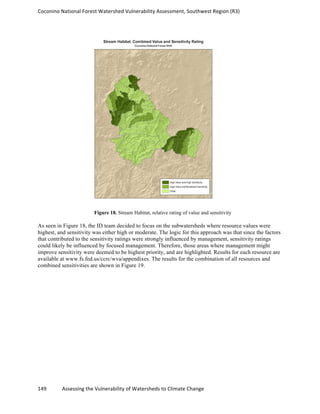
  • 260.
    Chequamegon-­‐Nicolet  National  Forest  Watershed  Vulnerability  Assessment,  Eastern  Region  (R9)     256                        Assessing  the  Vulnerability  of  Watersheds  to  Climate  Change   Figure 17. Predicted distribution of brook trout (Salvelinus fontinalis), a cold water species, for current climate and moderate warming (increase air 3 deg C, water 2.4 deg C), Chequamegon-Nicolet NF With the exception of hornyhead chub, warm water species considered in this analysis were predicted to remain the same or expand habitat. Black crappie and stonecat were predicted to expand substantially on a percentage basis but because their existing habitat is very limited (4 and 1%, respectively, of total stream length), the absolute increase in habitat would be less dramatic (10 and 21%, respectively, of total stream length) (Table 5). Since all fish habitat used in this analysis was predicted from modeling, including habitat for the present climate, this data is most useful when viewed as an index of the relative magnitude and general pattern of species distribution changes in response to future warming scenarios. This modeled habitat has been used here to classify the vulnerability of individual HUC-6s but the results for any individual HUC-6 should be viewed carefully and the use of more detailed and site specific data should be considered. For cold water fish, there were 35 HUC-6s (22%) classified as having high vulnerability, 35 (22%) as moderately vulnerable, 37 (24%) as low vulnerability, and 51 (32%) as having very low vulnerability (Figure 18). For cool water fish, there were 40 HUC-6s (25%) classified as having high vulnerability, 40 (25%) classified as moderately vulnerable, 39 (25%) classified as low vulnerability, and 39 (25%) classified as having very low vulnerability (Figure 19).
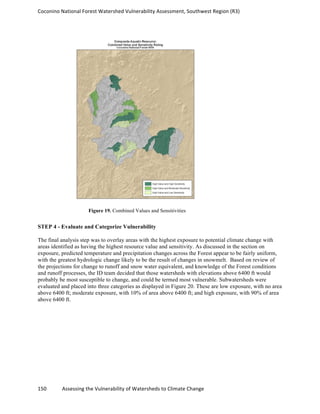
  • 261.
    Chequamegon-­‐Nicolet  National  Forest  Watershed  Vulnerability  Assessment,  Eastern  Region  (R9)     257                        Assessing  the  Vulnerability  of  Watersheds  to  Climate  Change   Climate Warming Scenarios Current Climate Limited Warming Moderate Warming Major Warming Fish Species Thermal Class Sensitivit y Class Size Class Length (km) % of Total Length Length (km) % Change % of Total Length Length (km) % Change % of Total Change Length (km) % Change % of Total Length brook trout (Salvelinus fontinalis) cold S H 3122 50 2743 -12 44 603 -81 10 0 -100 0 brown trout (Salmo trutta) cold S H 634 10 633 0 10 582 -8 9 289 -54 5 mottled sculpin (Cottus bairdii) cold S H 4700 76 2983 -37 48 1137 -76 18 448 -90 7 blacknose dace (Rhinichthys obtusus) cool T H 4927 79 4836 -2 78 1049 -79 17 613 -88 10 brook stickleback (Culaea inconstans) cool T H 2913 47 2906 0 47 2467 -15 40 1200 -59 19 creek chub (Semotilus atromaculatus) cool T H 5244 85 4501 -14 73 1878 -64 30 1003 -81 16 longnose dace (Rhinichthys cataractae) cool S M 2051 33 2045 0 33 728 -65 12 126 -94 2 northern hogsucker (Hypentelium nigricans) cool S R 1180 19 1143 -3 18 874 -26 14 183 -84 3 northern redbelly dace (Phoxinus eos) cool S H 4877 79 4594 -6 74 82 -98 1 0 -100 0 walleye (Sander vitreus) cool S R 289 5 283 -2 5 152 -47 2 0 -100 0 white sucker (Catostomus commersonii) cool T U 3164 51 2836 -10 46 711 -78 11 158 -95 3 black crappie (Pomoxis nigromaculatus) warm M R 222 4 534 141 9 1261 468 20 1261 468 20 hornyhead chub (Nocomis biguttatus) warm S M 3211 52 3192 -1 51 679 -79 11 760 -76 12 logperch (Percina caprodes) warm S R 1307 21 1159 -11 19 1086 -17 18 1407 8 23 smallmouth bass (Micropterus dolomieu) warm S R 613 10 613 0 10 613 0 10 613 0 10 stonecat (Noturus flavus) warm S M 55 1 334 507 5 590 973 10 633 1051 10 Table 5. Summary of predicted fish habitat under three warming scenarios for HUC6 watersheds encompassing the Chequamegon-Nicolet National Forest (for sensitivity: S=sensitive, M=moderate, T=tolerant; for size class: H=headwater, M=mainstem, R=riverine, U=ubiquitous; findings based on Lyons et al. 2010)
  • 262.
    Chequamegon-­‐Nicolet  National  Forest  Watershed  Vulnerability  Assessment,  Eastern  Region  (R9)     258                        Assessing  the  Vulnerability  of  Watersheds  to  Climate  Change   Figure 18. Predicted vulnerability of 2 species of coldwater fish by 6th level watershed for moderate warming (3 deg C increase), for Chequamegon-Nicolet NF
  • 263.
    Chequamegon-­‐Nicolet  National  Forest  Watershed  Vulnerability  Assessment,  Eastern  Region  (R9)     259                        Assessing  the  Vulnerability  of  Watersheds  to  Climate  Change   Figure 19. Predicted vulnerability of 8 species of coolwater fish by 6th level watershed for moderate warming 3 deg C increase), for Chequamegon-Nicolet NF Composite Watershed Vulnerability Based on the composite watershed vulnerability ratings, 11 HUC-6s were rated very low, 59 low, 64 moderate, and 24 high (Figure 20). The watersheds with very low vulnerability were exclusively or predominantly groundwater recharge zones. These were rated very low because they support low densities of the water resource values (wetlands, stream crossings, cold and cool water stream fisheries). They also contain highly permeable soils, in which adverse effects to groundwater recharge from climate changes are least likely. The vulnerability of other watersheds depended on the combined occurrence of wetlands, runoff potential, road-stream crossing density and the presence of cold and cool water fisheries. As the occurrence of these attributes increased, so did overall watershed vulnerability to climate changes.
  • 264.
    Chequamegon-­‐Nicolet  National  Forest  Watershed  Vulnerability  Assessment,  Eastern  Region  (R9)     260                        Assessing  the  Vulnerability  of  Watersheds  to  Climate  Change   Figure 20. HUC-6 vulnerability to climate change based on 5 attributes (groundwater, wetlands, cold and cool water stream fish, and infrastructure-culverts) for Chequamegon-Nicolet NF CONCLUSIONS Wetlands Hydrologic modeling of an upland-bog complex with PHIM for the Park Falls unit of the Chequamegon- Nicolet NF, using WICCI downscaled data for one location, just one GCM (GFDL-CM2.0) and one climate change scenario (A1B), indicates that bogs may be susceptible to climate change impacts. Average annual evapotranspiration would increase about 3.2 inches or 15 percent, runoff could decrease about 1.3 inches or roughly 25 percent with increases in spring and decreases in summer and fall, water levels in the bog would be 2-4.5 inches lower in summer and fall, and no-flow days would increase from about 4 to 23 percent of time. The PHIM modeling may have underestimated runoff, especially in spring, but the overall results seem to provide reasonable estimates of the potential impacts of climate change on bog hydrology. Based on the modeling, it was concluded that climate change poses some risk to Chequamegon-Nicolet National Forest wetlands, especially bogs. These risks include loss of wetland area, changes in wetland plant communities, and alteration of wetland processes such as water chemistry, peat accumulation, and
  • 265.
    Chequamegon-­‐Nicolet  National  Forest  Watershed  Vulnerability  Assessment,  Eastern  Region  (R9)     261                        Assessing  the  Vulnerability  of  Watersheds  to  Climate  Change   geochemical cycling. These results were extrapolated to all HUC-6s on the Forest based on their percentage of total and acid wetland, and each watershed was placed into one of four classes representing its vulnerability to climate change impacts on wetlands. Groundwater Recharge Results from soil water balance modeling for the Park Falls unit of the Chequamegon-Nicolet NF, using WICCI downscaled data for one location, just one GCM (GFDL-CM2.0), and one scenario (A1B), indicates potential groundwater recharge may increase about 7 percent in the future. While these are preliminary results, they indicate that groundwater recharge might be somewhat resilient to climate change impacts. Potential groundwater recharge and increases in recharge were related to hydrologic soil group with coarse textured soils having the highest potential average recharge (13.5 in/yr) and increase in recharge (1.4 in) and fine textured or peat soils having the least potential average recharge (3.5 in/yr) and increase in recharge (0.0 in). These results were extrapolated to all HUC-6s on the Forest and each watershed was placed into one of four classes representing its vulnerability or resilience to climate change impacts on potential groundwater recharge. Infrastructure-Culverts The WICCI downscaled climate projections provide sufficient scientific evidence that the frequency and intensity of large precipitation events will increase and will likely increase floods. Indices of road-stream crossing density and runoff potential based on HSG were developed and used to classify the vulnerability of HUC-6s to impacts on infrastructure. The most vulnerable watersheds have high runoff potential and high stream crossing densities. For watersheds with low to moderate runoff potential, sizing stream crossing structures to channel bankfull width is an adaptive strategy that will most likely accommodate future increases in flood flows. And while hydrologic and hydraulic modeling should be conducted for all stream crossing designs, it is especially important for watersheds with very high runoff potential. In those cases, hydraulic modeling should be conducted to ensure structures pass the 100-yr flood, and preferably the 500-yr flood, with the HW/D<1. Stream Fishes The statewide modeling used by Lyons et al. (2010) to predict stream fish distributions for the current climate and three warming scenarios was evaluated for all HUC-6s encompassing the CNNF. Fifteen of 50 fishes were evaluated including two cold, eight cool or transitional, and five warm water species. Cold water species were predicted to decline by about 80 percent under moderate warming (3.0 o C increase in air temperature, 2.4 o C increase in water temperature) and no brook trout were predicted to persist under major warming. These results were not surprising since these species are limited by warm water temperatures. Somewhat unexpectedly, all cool water species were predicted decline with moderate warming and six of the eight species were predicted to decline by 47-98 percent. Since cool water species are less sensitive to increases in maximum water temperature than cold water species, these results suggest these species may be more sensitive to other aspects of the thermal regime. Additional research into this topic would help to clarify the vulnerability of cool water species to warming and opportunities for their future management.
  • 266.
    Chequamegon-­‐Nicolet  National  Forest  Watershed  Vulnerability  Assessment,  Eastern  Region  (R9)     262                        Assessing  the  Vulnerability  of  Watersheds  to  Climate  Change   Changes to predicted available habitat for the five warm water fishes under a moderate warming scenario vary significantly. Two were predicted to increase by 468 to 973 percent two were predicted to remain about the same, and one was predicted to decline by 79 percent. These results indicate that cold and cool water fish on the CNNF are very vulnerable to moderate and major warming. Such warming could cause large declines in these fish, which could substantially impact stream ecology throughout the CNNF. The predicted fish distributions for the current climate and moderate warming were analyzed to determine the percent change in cold and cool water fish habitat in each HUC-6 on the CNNF. These results were used to place each watershed into one of four vulnerability classes. The most vulnerable HUC-6s are those predicted to contain a substantial amount of habitat under the current climate but which also had substantial declines in predicted habitat with moderate warming. The least vulnerable HUC-6s are primarily those with little or no predicted habitat given the existing climate. The increase of 0.8 o C for each 1.0 o C increase in air temperature used by Lyons et al. (2010) in their study was an oversimplification necessitated by the statewide study that did not take into account how groundwater input, land uses, or changes in flow might alter the response of streams to air temperature increases. Composite Watershed Vulnerability Watersheds with very low composite vulnerability were exclusively or predominantly groundwater recharge zones. These were rated very low because they support low densities of the water resource values (wetlands, stream crossings, cold and cool water stream fisheries). They also contain highly permeable soils, in which adverse effects to groundwater recharge from climate changes are least likely. The vulnerability of other watersheds depended on the combined occurrence of wetlands, runoff potential, road-stream crossing density, and the presence of cold and cool water fisheries. As the occurrence of these attributes increased, so did overall watershed vulnerability to climate changes. RECOMMENDATIONS Wetlands There is a need to conduct much more comprehensive wetland modeling with downscaled data from additional GCMs, scenarios, and locations to verify and refine the preliminary results described above. Modeling should also be conducted for a variety of bogs with different wetland and contributing watershed areas. Other wetland types, including vernal ponds, fens, and weak fens, should be modeled and evaluated for their vulnerability to climate change. Existing mapping that includes wetland units, such as Wisconsin Wetland Inventory, WISCLAND and Forest Service stand inventory, is inadequate to fully evaluate the potential impacts of climate change on wetlands because it does not adequately characterize water source and flow regimes. In addition, this mapping frequently does not include vernal ponds, does not incorporate watershed divides through wetlands, and may have inaccuracies due to limited field verification. National Forest ecological land type inventory mapping provides the most accurate information, but is limited to areas within the National Forest boundary. Wetland inventories and mapping should be upgraded as soon as to solve these shortcomings and to allow more accurate determination of wetland vulnerability to climate change.
  • 267.
    Chequamegon-­‐Nicolet  National  Forest  Watershed  Vulnerability  Assessment,  Eastern  Region  (R9)     263                        Assessing  the  Vulnerability  of  Watersheds  to  Climate  Change   If the above recommendations are completed, the results should be used to identify and develop more specific adaptations to minimize the impact of climate change on wetlands. Groundwater Recharge More comprehensive soil water balance modeling should be conducted with downscaled data from additional GCMs, scenarios, and locations to verify and refine the preliminary results described above. These results could then be incorporated into groundwater flow modeling to predict effects on aquifers, groundwater flow paths, and surface waters dependent on groundwater flow. Once such groundwater modeling is completed, the results need to be evaluated with regard to potential effects on important groundwater-dependent resources such as cold water streams, wetland fens, groundwater-fed lakes, and water supply wells. Use the results from the above activities to identify and develop more specific actions to adapt to the impacts of climate change on watersheds and water resources. Infrastructure-Culverts There is a need to conduct hydrologic modeling using the WICCI downscaled daily precipitation data and a variety of watershed conditions to more accurately determine potential increases in flood flows associated with the projected changes in future climate. The CNNF should support such work to the extent practicable. The CNNF should conduct additional analyses of culverts. The evaluation should determine where sizing to bankfull channel width will adequately adapt to climate change and also assess aquatic organism passage and channel morphology. The CNNF should continue to size stream crossing structures using stream simulation guidelines. Structures should be sized to at least match minimum bankfull width and pass the 100-year and preferably 500-yr flood with the HW/D<1. Give priority to completing the inventory and assessment of road-stream crossings in high and moderate vulnerability HUC-6s. Stream Fishes The predicted effect of warming on cold and cool water fish as a result of climate change would occur gradually over time and would be most pronounced in the mid and late 21st century. This provides some time in the near future during which additional modeling should be conducted to incorporate groundwater influence and potential changes in flow on stream temperatures and fish habitat. Some of this work is currently underway by the WDNR and USGS and should be supported by the CNNF and USFS. The CNNF should utilize trout class mapping, the CNNF stream segment classification, water temperature data and a groundwater inventory that is underway to identify existing cold water stream habitat on HUC-6s that encompass the CNNF, and to refine the vulnerability of each stream system, utilizing the existing water temperature data and results from the groundwater inventory. These results should be used to develop adaptive management recommendations, which would include restoration and management activities on specific streams most likely to maintain a cold water stream community.
  • 268.
    Chequamegon-­‐Nicolet  National  Forest  Watershed  Vulnerability  Assessment,  Eastern  Region  (R9)     264                        Assessing  the  Vulnerability  of  Watersheds  to  Climate  Change   Additional research should be conducted regarding the thermal requirements and tolerance of cool water fish, to better clarify their vulnerability to warming and potential management options. This work should be supported by the CNNF and US Forest Service. The CNNF stream segment classification system should be used to better identify existing cool water stream habitat. The CNNF should continue to (1) implement best management practices for water quality, (2) practice sound watershed management, and (3) restore streams (e.g. properly replace stream crossings that impound water or prevent fish passage, restore streams impacted by log drives, manage beaver in critical habitat) to improve their resilience to climate change impacts. The CNNF should also continue to monitor stream temperatures across a variety of stream types to (1), gather year round temperature data, (2) provide up-to-date data on current stream temperatures, (3) more accurately identify vulnerable streams, (4) establish trends in stream temperature, and (5) facilitate more accurate modeling of response to climate change. REFERENCES Boelter, D.H. and E.S. Verry. 1977. Peatland and Water in the northern Lake States. USDA Forest Service General Technical Report NC-31, North Central Forest Experiment Station, St. Paul, MN, 22 p. Brooks, K.N., S.Y. Lu and T.V.W. McAdams. 1995. User Manual for Peatland Hydrologic Impact Model (PHIM), Version 4. College of Natural Resources, University of Minnesota, St. Paul, MN, 55108, 150 p. Dripps, W.R. and K.R. Bradbury, K.R.. 2007. A simple daily soil-water balance model for estimating the spatial and temporal distribution of groundwater recharge in temperate humid areas. J. of Hydrogeology 15: 433-444. Eggers, S.D. and D.M. Reed. 1987. Wetland Plants and Plant Communities of Minnesota and Wisconsin. US Army Corps of Engineers, St. Paul District, St. Paul, MN, 201 p. Guertin, D.P., P.K. Barten and K.N. Brooks. 1987. The Peatland Hydrologic Impact Model: Development and Testing. Nordic Hydrology 18, p. 79-100. Hawkinson, C.F. and E.S. Verry. 1975. Specific Conductance Identifies Perched and Ground Water Lakes. USDA Forest Service Research Paper NC-120, North Central Forest Experiment Station, St. Paul, MN, 5 p. Lyons, J., J. S. Stewart and M. Mitro. 2010. Predicted effects of climate warming on the distribution of 50 stream fishes in Wisconsin, U.S.A. J. of Fish Biology 77:1867-1898. McAdams, T.V., K.N. Brooks and E.S. Verry. 1993. Modeling Water Table Response to Climate Change in a Northern Minnesota Peatland. In: Management of Irrigation and Drainage Systems Symposium, July 21-23, 1993, ASCE, Park City, Utah, p. 358-365. Urie, Dean. 1977. Groundwater differences on pine and hardwoods forests of the Udell Experimental Forest in Michigan. USDA Forest Service Research Paper NC-145, North Central Forest Experiment Station, St. Paul, MN, 12 p.
  • 269.
    Chequamegon-­‐Nicolet  National  Forest  Watershed  Vulnerability  Assessment,  Eastern  Region  (R9)     265                        Assessing  the  Vulnerability  of  Watersheds  to  Climate  Change   USDA Forest Service. 2008. Stream Simulation: An Ecological Approach to Providing Passage for Aquatic Organisms at Road-Stream Crossings. USDA Forest Service, National Technology and Development Program, 7700 Transportation Management, 0877 1801-SDTDC, 646 p. USDA Forest Service. 2004. Chequamegon-Nicolet National Forests, 2004 Land and Resource Management Plan. Chequamegon-Nicolet National Forest, R9-CN-FP, 500 Hanson Lake Road, Rhinelander, WI 54501. US Geological Survey and US Department of Agriculture, Natural Resources Conservation Service. 2009. Federal guidelines, requirements, and procedures for the national Watershed Boundary Dataset: U.S. Geological Survey Techniques and Methods 11–A3, 55 p. Walker, J.F. and W.R Krug. 2003. Flood-Frequency Characteristics of Wisconsin Streams. US Geological Survey, Water Resources Investigations Report 03-4250, 37 p. Westenbroek, Kelson, Dripps, Hunt and Bradbury. 2010. SWB-A modified Thornthwaite-Mather Soil Water Balance code for estimating groundwater recharge. US Geological Survey Techniques and Methods 6-A31, 60 p.
  • 270.
    266                        Assessing  the  Vulnerability  of  Watersheds  to  Climate  Change   Assessment of Watershed Vulnerability to Climate Change Chugach National Forest March, 2012 Prepared By: Ken Hodges Fisheries Biologist Cordova Ranger District, Chugach National Forest Cordova, Alaska
  • 271.
    267                        Assessing  the  Vulnerability  of  Watersheds  to  Climate  Change SUMMARY This study was conducted as part of the USDA Forest Service Watershed Vulnerability Assessment Pilot Project. The goal of this study is to determine methods for assessing the vulnerability of aquatic resources to the predicted effects of climate change in the Chugach National Forest of southcentral Alaska. Many of the findings would also be applicable to coastal areas of southeast Alaska as well. The Chugach National Forest is somewhat exceptional in the National Forest system. Most of the Forest is undisturbed, with only 272 miles of road on 5.5 million acres, mainly state highways. There are no grazing allotments, no current commercial timber production to speak of, and limited active mineral extraction. Most of the Forest is managed for recreation and the conservation of fish and wildlife habitat. Climate change data were obtained from the University of Alaska, Fairbanks Scenarios Network for Alaska Planning program. Data are available online and some custom services were provided by the University. A review of the literature was conducted to determine how these changes are predicted to affect fish and wildlife, glaciers, and vegetation. Given that most of the watersheds in the Chugach are relatively pristine, ranking the vulnerability of all of the watersheds did not seem necessary. The large differences between ecosystem types were also not conducive to meaningful comparisons. Instead, two representative watersheds were selected for analysis: the Eyak Lake watershed near Cordova was chosen as representative of the coastal temperate rain forest ecosystem, and the Resurrection Creek watershed near Hope as more typical of the drier boreal forest of the Kenai Peninsula. Both watersheds are among the most developed on the Forest, although the overall disturbance may be considered low. Mean annual temperatures, precipitation, and days below freezing were developed for the watersheds by a Forest GIS specialist. Monthly data for Cordova and Hope, and other data are available online. Air temperature are predicted to increase in both areas, with summer temperatures increasing about 1.5 °C, but winter temperatures increasing about 4 °C. Precipitation is predicted to increase for all months in both watersheds, with a mean annual increase of 2 inches in the Resurrection Creek watershed and of 6 inches in the Eyak Lake watershed. All of these changes are well within the historic extremes. No predictions for extreme events in the future are available. Streamflow and water temperature data are limited in much of Alaska, and for the remote parts of the Chugach in particular. There are some stream gauge data for Resurrection Creek and Power Creek, which flows into Eyak Lake; however, the number of years of data are limited. I am unaware of VIC or other models that can be used to predict future flows with the available climate change data. Modeling flows is also complicated by conflicting factors. Snowpacks at lower elevations may be reduced by warmer temperatures in the fall and early spring, but this may be offset by higher precipitation and more snow at higher elevations. In addition, increased glacial melting may augment flows in late summer, which may compensate for an earlier melting of the snowpack – at least until the glaciers are gone. Given this complexity and limitations on the availability of modeling expertise, future conditions were judged qualitatively for each watershed. The assessment focused on the resource values in the watersheds, and particularly on the actions that could be taken to mitigate the predicted effects. Increased precipitation and the greater risk of rain-on- snow events make flooding and its effect on salmon habitat one of the greatest threats in both watersheds. Maintaining floodplain connectivity in the Eyak Lake watershed and restoring connectivity in the Resurrection Creek watershed are seen as the two most important mitigation measures to reduce the risks of salmon redd scour and other habitat damage. Increased erosion caused by higher precipitation, snow
  • 272.
    Chugach  National  Forest  Watershed  Vulnerability  Assessment,  Alaska  Region  (R10)   268                        Assessing  the  Vulnerability  of  Watersheds  to  Climate  Change   avalanches, and exposure of glacial moraines could lead to higher bedload transport and channel shifts in depositional areas. This deposition, however, is seen as a natural response and does not pose risks to infrastructure or other values. Some forms of fish habitat enhancement that might be considered for mitigation, such as instream structures, may not be appropriate due to the potential channel instability. Managers also need to review existing restoration plans, road maintenance plans, and other work that already has been identified. Mitigation measures for the increased risk of fire in the Resurrection Creek watershed are already spelled out in the All Lands/All Hands program developed with other agencies and the Kenai Peninsula Borough. Fuel reduction goals, public education, and emergency preparedness measures are already lined out and are being implemented. Other entities, such as the Copper River Watershed Project in the Cordova area, have ongoing restoration programs, including the Million Dollar Eyak Lake project. Thus, Forest Service managers may have many opportunities for collaborative work. The greatest issue, however, may be the uncertainty as to how fish and wildlife species may respond to the effects of climate change. Salmon, in particular, are a key part of the ecosystem and the economy in Alaska. Unlike areas in the lower 48 states, coastal streams will have more, not less, water, and water temperatures will not rise enough for lethal effects to salmonids. Direct mortality is unlikely, but increased water temperatures could disrupt seasonal timing and life history cycles of both the fish and the food chains upon which they depend. If, for example, warmer water temperatures cause salmon eggs to mature more quickly, the fry could hatch too early in the season when no prey is available – unless the maturation of zooplankton and other organisms is temperature-dependent and increases as well. Without this basic knowledge, it is difficult to determine how the resources will be affected. There are a number of other biological questions, particularly whether species have the genetic/behavioral plasticity to adapt to changes. As an example, most salmon can have a wide range of spawning times, habitats, and life-history patterns. If eggs develop more quickly with warmer water, perhaps late- spawning stocks will preserve the species. Perhaps the best mitigation is for land managers to maintain or restore diverse habitats and the genetic stocks that use them (something managers should be doing anyway). This is not to say populations will not be stressed, and population managers may well need to reduce harvests or take other actions as species adjust. To answer some of the biological questions, researchers from the Pacific Northwest Research Station and a number of universities are conducting studies in the Cordova area. Two current studies involve looking at differences in salmon and aquatic invertebrate life histories and timing, based on different temperature conditions across the Copper River Delta, including some sites in the Eyak Lake watershed. In these cases, physical locations are being used as a surrogate for the temperature changes that are predicted from climate change. Additional baseline data is also being collected on surface and groundwater temperatures, another major data gap. In summary, extensive climate data resources are available through the University of Alaska, Fairbanks, but limited historic data and models may hinder quantitative assessments. However, determining climate change trends, identifying resource values, and analyzing how those resources might be affected may be a sufficient start for determining future actions. In Alaska, where most areas are relatively pristine, it made more sense to focus on more developed watersheds to identify specific issues and actions. Much of the mitigation efforts that need to be done are actions that may already be planned or should be the normal plan of work. Stream projects that restore natural flows and functions may be the best way to protect fish habitat and reduce the risks of floods. Most Forests have conducted watershed assessments, road condition surveys, and fire management plans. The standards may need to be reviewed in light of predicted changes, such as increasing cross drainage or culvert sizes for roads, but most of the problems may already be identified. Lastly, a number of other government entities, agencies, community groups,
  • 273.
    Chugach  National  Forest  Watershed  Vulnerability  Assessment,  Alaska  Region  (R10)   269                        Assessing  the  Vulnerability  of  Watersheds  to  Climate  Change   and NGO’s may have existing programs or grants. This is the case even in the small fishing town of Cordova, Alaska, and the rural Kenai Peninsula. INTRODUCTION The Chugach National Forest is somewhat exceptional in the National Forest system. Most of the Forest is undisturbed, with only 272 miles of road on 5.5 million acres, 175 of which are state or Forest highways. No roads for timber harvest remain open. There are no grazing allotments, no current commercial timber production to speak of, and limited active mineral extraction. From 1985 to 1997, timber harvest averaged 2 million board ft/year, but this was due mostly to the salvage of beetle-killed spruce in the early 1990’s. By 1997, commercial harvest was no longer economically viable. The aquatic resource issues are limited as well. There are no threatened, endangered, or sensitive aquatic species unless one includes the Forest Service Alaska Region-designated sensitive dusky Canada goose (Branta canadensis occidentalis) that nests in the wetlands of the Copper River Delta. With small human population centers in the surrounding areas, limited industry, high precipitation, and no local agriculture, the demand for water is relatively low. There are, however, two diversions for hydroelectric power generation. The main aquatic resource issue is maintaining the high salmon productivity in the streams for the sport, commercial, and subsistence fisheries. Of particular importance are sockeye (Oncorhynchus nerka), coho (O. kisutch), chinook (O. tshawytscha), and pink (O. gorbuscha) salmon. The 2002 Forest Plan and its updates anticipate little development on Forest land except for tourism- related projects such as the expansion of existing campgrounds, additional trails, and more recreation cabins. Water use and the amount of area affected by these activities would be relatively small. Adjacent landowners have not proposed major development projects. Most of the remaining FS management activities are related to fuel reduction or wildlife and fish habitat restoration and enhancement. Vegetation management for ungulate browse would affect the greatest amount of land with up to 10,000 acres treated with prescribed burns, cutting back mature shrubs, or other treatments. Fuel reduction would affect 4,000 acres over 10 years. Additional areas may be treated with prescribed fire for wildlife enhancement. Most of the necessary stream restoration work has been completed, with the exception of continued restoration of placer-mined areas along Resurrection Creek and Cooper Creek. The trend for fish habitat projects in the future will be elective enhancement projects on a small scale. A recent watershed condition classification study has been completed for the Chugach National Forest. Of the 275 sixth level watersheds, 268 were rated as Condition Class 1 (the best ranking), 7 as Class 2, and none as Class 3. Thus, most of the watersheds are intact and functioning properly. Large landscape disturbances from future development are not foreseen. With some exceptions, when managers examine the effects of climate change, they may find that there is little they can do to improve matters without altering natural conditions. ASSESSMENT OBJECTIVES This study was conducted as part of the USDA Forest Service Watershed Vulnerability Assessment Pilot Project. The purpose of this assessment is to provide land managers on the Chugach National Forest, and similar areas of Alaska, with a method of assessing the vulnerability of watersheds to the effects of predicted climate change. This entails the identification of the important aquatic resources or values, the type and degree of climate change, and the effects on the values. Most important, however, this
  • 274.
    Chugach  National  Forest  Watershed  Vulnerability  Assessment,  Alaska  Region  (R10)   270                        Assessing  the  Vulnerability  of  Watersheds  to  Climate  Change   assessment will stress the course of action that managers can take to mitigate the predicted negative effects. Realistically, there are a number of limitations on the analysis, particularly simple hydrologic data. Most of the Forest is accessible only by aircraft or boat, so data collection has generally been limited to project- specific sites on a short-term basis. Since many of the watersheds have little historic or proposed human disturbance, data collection has not been a priority. I also assume that given the predicted climate changes for the area, undisturbed watersheds are best left alone. Predictions for coastal Alaska include increased precipitation, higher temperatures, and more intense storm events. While there may well be changes in stream flows, flow timing, or other effects, trying to “correct” those effects without altering other natural processes may be difficult. In addition, where there are no direct effects to infrastructure or threats to population centers, land managers may have higher priorities. Thus, instead of looking at all of the watersheds on the Forest and trying to rank their vulnerability, this assessment focuses on two of the more highly developed watersheds where more data are available, where a wider variety of restoration activity might occur, and that are representative of their ecological areas. These are the Eyak Lake watershed in a coastal rainforest ecosystem near Cordova, and the Resurrection Creek watershed in a relatively drier boreal forest setting on the Kenai Peninsula. Figure 1. The Chugach National Forest, its location in Alaska, and the two watersheds that were examined for this study Another limitation is that many of the biological effects are intuitively predictable – such as warmer water temperatures causing salmon eggs to develop and hatch sooner – but how these individual effects interact with other components of the ecosystem are unknown or cannot be quantified. Thus, there is a vast need for biological research that can help land managers reach decisions for on-the-ground mitigation activities.
  • 275.
    Chugach  National  Forest  Watershed  Vulnerability  Assessment,  Alaska  Region  (R10)   271                        Assessing  the  Vulnerability  of  Watersheds  to  Climate  Change   This assessment was made based on the conditions of the Chugach National Forest along the southcentral coast of Alaska, but it could be applicable to other areas in coastal Alaska, including southeast Alaska. The intent of focusing on just two watersheds is to have them serve as examples for land managers who may have watersheds with similar issues. METHODS The directions that participants in this pilot project were given included a number of practical steps. These included: • Describing the assessment areas, existing conditions, and the major water resources, or the water- related values or benefits in these areas. • Determining the anticipated climate change and its degree, using various predictive climate models. • Describing the predicted changes to hydrologic processes. • Determining the effects on water resources or values. • Describing the conditions that might amplify the changes and effects (stressors) or reduce them (buffers). • Determining the degree of watershed risk. • Describing how the findings might be applied to management activities at various geographic levels. The initial steps required consultations with area managers, literature searches (particularly of the gray literature), collecting historic temperature and precipitation data, and determining the availability of site specific data such as stream flows or water temperatures. The University of Alaska, Fairbanks (UAF), in collaboration with government agencies and non- governmental organizations, conducts the Scenarios Network for Alaska Planning project (SNAP), which provides climate change data using a variety of Global Circulation Models (GCM) linked with historic Parameter-elevation Regressions on Independent Slope Models (PRISM) data. The resulting SNAP data can then make climate change predictions based on historic data that also take into account elevation, topographic facet, coastal proximity, slope, and distance from weather stations. This is particularly important in Alaska where there are large areas with few or no stations. There are ready-made maps with 2 km cells available online for temperature and precipitation, but the scale increments are somewhat coarse: 3 °C for temperatures close to freezing and 50 mm increments for precipitation. However, these maps are sufficient to determine overall trends and a rough estimate of the amount of change. Analysis requires downloading the data. For the initial efforts, UAF provided me with GIS layers of the Eyak Lake watershed where I could manipulate the scales to better detect freezing points and finer changes in precipitation. Since the elevations range from near sea level to 4,600 ft, the temperatures and precipitation vary significantly over short distances. The data were an average of the five GCM’s that best matched historical data. After the project was expanded to include Resurrection Creek, a GIS specialist for the Chugach National Forest downloaded and manipulated additional data available from SNAP for both watersheds. By using the raw data for each 2 km cell, the GIS specialist was able to average and obtain mean values for the watersheds as a whole. This was done for annual mean temperatures, annual mean precipitation, the freeze day, and the thaw day. The freeze and thaw days are extrapolated predictions of when the average
  • 276.
    Chugach  National  Forest  Watershed  Vulnerability  Assessment,  Alaska  Region  (R10)   272                        Assessing  the  Vulnerability  of  Watersheds  to  Climate  Change   daily temperatures are below or above freezing. Changes in the number of days between the freeze and thaw provide clues about changes in the annual hydrologic cycle, such as earlier snowmelt and runoff. Monthly temperature and precipitation data were obtained from the SNAP community charts that provide predictions for selected towns. These data are an average of the five best-fitting GCM’s. As described on the website, “SNAP then scaled down outputs to the local level using data from Alaskan weather stations and PRISM, a model that accounts for land features such as slope, elevation, and proximity to coastlines.” (University of Alaska, Fairbanks 2011). The data are predictions for the 2 km grid square closest to the town. The data provided are derived from an average of five models (out of a total of 15) that best fit the historic data. Variability among the models is generally in the range of 0-4 °F and 0-0.7 inches for precipitation (ibid). Figure 2. An example of a GIS product developed from SNAP data. The 2 km cells were clipped to the watershed boundaries and the mean precipitation for the watershed was calculated.
  • 277.
    Chugach  National  Forest  Watershed  Vulnerability  Assessment,  Alaska  Region  (R10)   273                        Assessing  the  Vulnerability  of  Watersheds  to  Climate  Change   Figure 3. An example of the community graphs provided by SNAP. The black bars show the amount of variation among the five models used for these projections. Graphs are also available for precipitation and with projections for low and high emissions scenarios as well. The predicted changes to hydrologic processes were only examined qualitatively. In part, this was due to the limited availability of personnel, hydrologic models for Alaska, and stream gauge data. Moreover, the available quantity of water does not appear to be a problem in Alaska as it is in other areas. The climate models call for increased precipitation in all months of the year and the relatively high average elevations of the watersheds would appear to buffer potential changes in snowmelt and runoff timing. To determine effects on water resources and values, I investigated the use of the NetWeaver™ knowledge-based decision support system. The appeal of this and similar systems is that they can incorporate empirical data as well as “expert opinion” in a logical transparent method. I thought this might be useful given the limited amount of available data for current and historic stream flows, water temperatures, and other parameters. It might also have been useful for comparing conditions across watersheds, since the system output is a numerical score measuring how “true” a certain proposition might be – for example, “Watershed X can sustain a viable coho salmon population.” The usefulness of this method, however, is limited by the complexity of the situation, how qualitative input is scaled (high, medium, low or numerically), and the confidence the experts have in making a rating or judgment. In short, this method did not prove to be practical and the analysis was not completed. My experience, however, provides a practical lesson for land managers that will be addressed in the assessment section. Further determination of the effects on aquatic resources and values, and the overall watershed risks, were made qualitatively, based on information in the literature, consideration of stressors and buffers, current investigations in the area, and personal communications. The issues are complex and there is a great deal of uncertainty, especially with the biological effects. These will be presented in the discussion.
  • 278.
    Chugach  National  Forest  Watershed  Vulnerability  Assessment,  Alaska  Region  (R10)   274                        Assessing  the  Vulnerability  of  Watersheds  to  Climate  Change   ASSESSMENT AREA DATA Assessment Areas • Eyak Lake watershed – coastal rainforest ecotype • Resurrection Creek watershed – drier boreal forest ecotype Of the 85 fifth level HUCs and 275 sixth level HUCs on the Forest, only a handful have significant development, infrastructure, or active land management. The two watersheds used for this assessment have the widest variety of development and aquatic resource values for their respective ecotypes and can serve as representative watersheds for many coastal Alaska areas. The Eyak Lake watershed contains part of Cordova, a small city of 2,440 people. The town of Hope (182 residents) is adjacent to the lower part of the Resurrection Creek watershed. Eyak Lake Resurrection Creek Area (acres) 27,748 103,215 HUC Level Two 6th levels 5th level w/ three 6th National Forest Land 25,554 (92.1%) 100,839 (97.3%) Mean Annual Air Temperature July January 5.3 °C 12.5 - 4.1 2.6 °C 14.1 - 7.2 Water Temperature Summer surface Eyak Lake 5.5 - 14.5 °C Power Creek mean 6.1°C annual 3.0 - 8.4 °C Resurrection Creek Mean 8.4 °C Range 5.5 -12.0 °C Mean Discharge (cfs) 10-yr Flood 387 (ungauged) 8,700 275 2,400 Mean Precipitation (inches) 130.25 22.15 Lake/Pond Area (acres) 2,400 (8.6%) 80.5 (0.07%) Road Density - mile/mile2 (total) 0.36 (25.1) 0.14 (35.1) Residential/Commercial Area (acres) 205.3 (0.7%) 53.1 (0.05%) Area Unvegetated Rock (acres) (%) 5,405 (19.7%) 11,391 (11.0%) Area Icefields/Glacier (acres) (%) 3,256 (11.7%) 245 (0.2%) Area > 70% Slope (acres) (%) 6,332 (23.1%) 7,660 (7.4%) Avalanche Area (58-173% slope) (acres) (%) 12,001 (43.7%) 20,952 (20.3%) Area > 500 ft Elevation (acres) (%) 20.553 (74.0%) 100,324 (97.2%) Fire, Including Prescribed Burns (acres) (%) 0 9,400 (9.1%) Mining Disturbance (acres) (%) 0 2,560 (2.5%) Trails (miles) 13.1 16.8 Recreation Sites (cabins, camps, day use) 5 14 Table 1. Current conditions for the Eyak Lake and Resurrection Creek watersheds. Assessment Area Climate Change Predictions The general predictions for both the Eyak Lake watershed and the Resurrection Creek watershed call for increased temperatures. Annual mean temperatures are predicted to increase 1.7 to 1.9 °C for the two watersheds under both the A1B and B1 scenarios (Table 2). However, winter temperatures are predicted to increase much more than summer temperatures. Monthly data for the entire watersheds were not readily available, but the January temperatures for the towns of Cordova and Hope are predicted to rise 3.4 to 3.7 °C, and the July temperatures 1.5 to 1.8 °C.
  • 279.
    Chugach  National  Forest  Watershed  Vulnerability  Assessment,  Alaska  Region  (R10)   275                        Assessing  the  Vulnerability  of  Watersheds  to  Climate  Change   Air Temperature °C Eyak Lake Resurrection Creek Annual Mean Annual Mean A1B Scenario B1 Scenario A1B Scenario B1 Scenario 2000-2009 4.3 3.5 1.4 0.5 2020-2029 5.1 4.4 2.1 2.1 2050-2059 6.1 5.3 3.1 2.4 Cordova January Hope January 2001-2010 -1.4 -3.3 -6.1 -8.2 2031-2040 -0.2 0.7 -5.2 -4.2 2061-2070 2.3 0.2 -2.3 -4.7 Cordova July Hope July 2001-2010 14.1 13.1 15.1 14.1 2031-2040 14.3 14.4 15.2 15.4 2061-2070 15.6 14.9 16.7 15.9 Table 2. Predicted changes for annual mean air temperatures for the Eyak Lake and Resurrection Creek watersheds as a whole, and selected monthly temperatures for the towns of Cordova and Hope. Annual mean precipitation is generally predicted to increase, although the total amounts are quite different for the two watersheds. As shown in Table 3, the increase in the Eyak Lake watershed as a whole is predicted to be as much as 6.7 inches under the A1B scenario, while the Resurrection Creek watershed may see an increase of 3.1 inches. The data for the driest and wettest months for Cordova and Hope were taken from the SNAP community charts (2011), and generally show small increases over time. Unlike the other trends, the prediction for June 2061-2070 shows a slight decrease, but given the variability among the models used for the prediction (University of Alaska, Fairbanks 2011), this is probably not significant. It should also be mentioned that the historic annual precipitation levels are highly variable for the Cordova area. The Cordova airport weather station, which is about 10 km from the Eyak Lake watershed, has an annual mean of 96.26 inches, but a historic range of 54.41 to 139.34 inches. Thus, while an average annual increase of six inches will lead to higher flows and presumably more extreme events, the watershed already experiences extreme changes. This makes it difficult to determine how, or how much, geophysical and biological conditions will be affected. From 1979 to 1995, a low-elevation station near Hope had a precipitation range of 15.19 to 31.30 inches, with a mean of 22.15 (Kalli and Blanchet 2001). The predicted amounts for the entire watershed are higher as shown below, but the predicted changes still appear well within the historic range. Precipitation Inches Eyak Lake Resurrection Creek Annual Mean Annual Mean A1B Scenario B1 Scenario A1B Scenario B1 Scenario 2000-2009 177.2 176.9 34.5 38.0 2020-2029 179.6 178.3 35.8 38.1 2050-2059 183.9 179.0 37.6 39.8 Cordova June Hope May 2001-2010 7.81 7.52 0.85 0.89 2031-2040 7.86 7.50 1.05 0.96 2061-2070 7.70 7.69 1.14 1.01 Cordova October Hope September 2001-2010 21.13 20.83 3.52 3.73 2031-2040 21.92 21.19 3.68 3.50 2061-2070 22.10 21.23 4.47 3.97
  • 280.
    Chugach  National  Forest  Watershed  Vulnerability  Assessment,  Alaska  Region  (R10)   276                        Assessing  the  Vulnerability  of  Watersheds  to  Climate  Change   Table 3. Predicted changes for annual mean precipitation in inches for the Eyak Lake and Resurrection Creek watersheds as a whole, and selected monthly totals for the towns of Cordova and Hope. Using data provided by SNAP, our GIS specialist determined the mean ordinal freeze and thaw dates, and from this we could derive the number of days where the average daily temperature was below freezing. The results do not appear to be consistent with other findings, since the B1 predictions suggest that conditions would be much warmer (later freeze and earlier thaw) than for the A1B scenario. Days Mean Temp < 0 °C Eyak Lake Resurrection Creek A1B Scenario B1 Scenario A1B Scenario B1 Scenario 2000-2009 91 76 165 166 2030-2039 62 27 152 99 2060-2069 21 34 118 74 Table 4. Predicted changes for the number of days below freezing for the Eyak Lake and Resurrection Creek watersheds as a whole General Area Climate Change Predictions Two other factors have the potential to exacerbate the effects of temperature and precipitation change: the predicted increase in extreme weather events and the accelerated melting of glaciers. Most sources agree about the trends, but it is difficult to predict the magnitude of these changes. It appears likely, though, that both will lead to increased stream flows, changes in sediment transport, and the potential for flooding. Extreme Weather Events Specific predictions for extreme weather events in the project area are not available. For high northern latitudes, however, Sillman and Roeckner (2008) state that there will be significant increases in the maximum and minimum temperatures and the amounts of precipitation for 5-day events and the 95th percentile of wet days. They conclude that northern areas that have wet climates under the current conditions will become substantially wetter by the end of the 21st century. Glacial Melting Site-specific conditions can greatly affect glacier formation or melting (Boggild et al. 1994, Dowdeswell et al. 1997, Arendt et al. 2010). Boggild et al. (1994) suggested that increased precipitation could add to glacial mass in Greenland, where there is an extensive higher-elevation land mass. Coastal Alaska has a number of high elevation glaciers as well. Topography, slope aspect, and local weather conditions, such as wind, can also affect accumulation of ice (Boggild et al. 1994). On the other hand, Crisitiello et al. (2010) found that the mass balance of two southeast Alaska glaciers has declined and has been correlated with temperature but not with precipitation. This suggests that increasing precipitation may not compensate for increased glacial melting. Closer to the project area, however, recent data indicate that most Alaskan glaciers are losing mass. Arendt et al. (2010) reported most of the 67 Alaskan glaciers surveyed during an early period from the 1950’s to the mid-1990’s, and 28 glaciers resurveyed from the mid 1990’s to 2001, had thinned. Less than 5% of the glaciers in the study had thickened, and most of these were tidewater glaciers where the melting of the toe of the glacier may have triggered other responses such as glacial surges (Arendt et al. 2010). They also found that during the latter period, when glaciers were resurveyed, the thinning rate was twice that of the earlier period.
  • 281.
    Chugach  National  Forest  Watershed  Vulnerability  Assessment,  Alaska  Region  (R10)   277                        Assessing  the  Vulnerability  of  Watersheds  to  Climate  Change   The glaciers that had thinned included the Scott Glacier that is adjacent to the Eyak Lake watershed and the Wolverine Glacier and Harding Icefield complex on the Kenai Peninsula, about 50 miles from the Resurrection Creek watershed. Thus, although we have no data for glacier or icefield melting within these watersheds, and cannot predict how increased precipitation might affect the mass balance, the recent trends suggest that there will be an eventual loss of glaciers. The predicted effects of glaciers melting are varied. Haufler et al. (2010) suggest that flows may initially increase with the additional meltwater, but that over time, the reduction in melting ice may cause streams to disappear. The higher meltwater flows may also erode unconsolidated glacial moraines, especially where glaciers have recently receded and the moraines are not vegetated. This could lead to increased sediment transport and eventual deposition in downstream areas. ASSESSMENT AREA RESULTS AND FINDINGS Eyak Lake Watershed Figure 4. Eyak Lake Watershed. The downstream delineation of the watershed is somewhat arbitrary as it is joined by the glacial Scott River to form an interwoven complex of channels before entering the Gulf of Alaska to the south. Area Description The primary reason for selecting the Eyak Lake watershed is that it is the most developed watershed of the eastern two-thirds of the Chugach National Forest. It also has the greatest range of aquatic resource values that might be affected by climate change. Predicted increases in air temperature, precipitation, and extreme weather events could result in damage to salmonid habitat, changes to salmonid life histories,
  • 282.
    Chugach  National  Forest  Watershed  Vulnerability  Assessment,  Alaska  Region  (R10)   278                        Assessing  the  Vulnerability  of  Watersheds  to  Climate  Change   damage to infrastructure, changes in hydroelectric production, and increased flooding of residential and commercial areas. Flooding is already a problem on a 5- to 10- year basis. The Eyak Lake watershed also has an active restoration program in place that can provide ideas and examples for land managers in other areas. The Copper River Watershed Project (CRWP), a local non- profit group, has led a watershed restoration planning team with representatives from the Alaska Department of Fish and Game (ADFG), the Native Village of Eyak, the City of Cordova, the USDA Forest Service, the Prince William Sound Science Center, and other agencies, organizations, and individuals. Some of the completed activities and proposed projects will be discussed in the section on recommendations. Watershed Values • Large sockeye and coho salmon runs, average annual index counts 19,000 and 10,000, respectively (Botz et al. 2009). Extensive rearing areas in a shallow lake. Spawning habitat along the shore and in tributaries. No current population concerns exist. • Salmon populations support commercial, sport, and subsistence fisheries. Other salmonids provide sport fishing. • Residential and light industrial areas around lake and on floodplain downstream from the lake. This floodplain currently experiences flooding every 5 to 10 years. • Hydroelectric power generation on Power Creek. • Floatplanes use lake, small wheeled planes land on airstrip along lake. • Backup water supply for city of 2,000 people, three salmon processors/canneries. • Wildlife viewing – bears, waterfowl, and fish. Ecological Triggers and Thresholds for these Values • Water temperatures: 12-15 °C is optimal. 25 °C is lethal for salmonids. • A minimum of 5 cfs is needed in the Power Creek area bypassed by the hydroelectric diversion. The plant can utilize up to 320 cfs. (Mean creek flow 50-500 cfs.) • Flooding occurs when lake rises approximately 5-6 ft. • Floods at an unknown velocity may mobilize spawning gravels, destroy eggs. Data Available, Data Needs • Power Creek (main tributary) gauge data 1948-1995. Currently, the required 5 cfs flow is maintained mechanically and is monitored by the electric company. The total flow above that level is not monitored. • The Prince William Sound Science Center and CRWP have done some monitoring of water quality in Eyak Lake for the past few years. Eventually they will have more consistent data for temperature, dissolved oxygen, and other parameters. There is only limited water quality data for Power Creek. • Historic precipitation and air temperature data are available from gauges at the Cordova airport and a station in town. These are not in the Eyak watershed but are geographically close. • Need to correlate precipitation, cfs in Power Creek, with flood events in lake and Eyak River. No lake height data available, but a gauge has been installed on a downstream bridge this past year. • Preliminary groundwater temperatures for one winter taken by Gordon Reeves and Steven Wondzell, USDA PNW Research Station. • SNAP program conducted by the UAF has predictions for temperatures, precipitation, and freeze/thaw dates at a 2km scale. This was calculated with PRISM and five climate models. On-
  • 283.
    Chugach  National  Forest  Watershed  Vulnerability  Assessment,  Alaska  Region  (R10)   279                        Assessing  the  Vulnerability  of  Watersheds  to  Climate  Change   line maps and bar graphs are available for Alaska communities. Raw data are available for use with GIS. • Total salmon spawning area not known. Sensitivity The sensitivity of the Eyak Lake watershed is due mainly to natural conditions –steep slopes, shallow lake, and high precipitation. Human activities, such as road building and other development, have been relatively minimal but there are stressors that might affect watershed’s ability to respond to the predicted increases in temperature and precipitation. • The mean high elevation of the watershed makes the watershed less sensitive to the effects of higher temperatures on the glaciers and snowpack. However, the current storm patterns from the relatively warm ocean already cause frequent rain-on-snow events. These are likely to increase and occur at higher elevations. • The relatively high percentage of area covered by glaciers and icefields makes the watershed more sensitive to the effects of melting glaciers: increased flows and erosion of glacial moraine. • Stream temperatures could rise with predicted changes in air temperatures but should be well within the suitable range for salmonids. Power Creek temperatures were no more than 10 °C at a downstream location (Sea-Run Fisheries 2006) and should rise no more than the predicted 2 to 3 °C air increase. All streams are relatively steep and short, so there is little opportunity for streams to warm. • Water temperatures for most of Eyak Lake are dominated by stream and groundwater flows. Summer surface temperatures are generally less than 13.5 °C and data at two sites suggest there is a thermocline at about 1 m (Crawford 2010). • Parts of Eyak Lake could be sensitive to higher water temperatures. The west arm of the lake has less circulation, is less than 3 m deep, and currently has recorded surface temperatures of 15 °C (the top end of the optimal range for salmonids). • Watershed is naturally flashy due to 19.7% being unvegetated, 23.1% having steep slopes (>70%), along with thin soils, high precipitation, and long duration of storm events. • Flooding already occurs in residential areas along Eyak River and Eyak Lake. Floods have occurred in 1983, 1985, 1986, 1995, 2004, and 2006. • Hydroelectric power generation is sensitive to flows in Power Creek, which are at a minimum in winter when precipitation is bound as ice and snow. Higher precipitation, warmer temperatures, and rising snowline could increase winter power generation. • Salmon spawning in the lake and smaller tributaries not sensitive to redd displacement by floods. Those fish spawning in the main channel of Power Creek may be susceptible to substrate mobilization. • The risk of avalanches could increase as warmer temperatures create more frequent wet, heavy snowpacks. There are a high percentage of avalanche-prone slopes of 58 -173%. There have been three fatal incidents in past 15 years. • Landslides. High precipitation, long steep slopes characteristic of glacial U-shaped valleys, thin soils, underlying bedrock, and glacial till increase propensity for landslides. Stressors Stressors from residential development include hydrocarbon input to the lake from the streets and snow dumping, nutrient input from fertilizer and leach fields, minor sediment input from unpaved roads, and runoff from two subdivisions. Low levels of hydrocarbons have been detected in water samples, but the overall effects of oil and the other stressors have not been quantified.
  • 284.
    Chugach  National  Forest  Watershed  Vulnerability  Assessment,  Alaska  Region  (R10)   280                        Assessing  the  Vulnerability  of  Watersheds  to  Climate  Change   Road density is low (0.12 km/km2 ) with a total of 25.1 km of road in the watershed. One publication (NOAA 1996) rates this as well within the level of a properly functioning watershed (< 1.2 km/km2 ). Residential development and roads along the lake have reduced lakeside vegetation. Invertebrates that fall from terrestrial vegetation make up a large part of the diet for juvenile coho salmon and this dietary input will be reduced. The effect on the water temperature of the lake as a whole is probably negligible, given the large areas far from shore and stream inputs. However, cooler, shallow shoreside areas, preferred by juvenile coho salmon for habit and rearing habitat, are reduced. Salmon spawning area in Eyak Lake has been reduced from 63,011 m2 (Professional Fishery Consultants 1985) to a currently unknown amount. This is a result of housing development, construction of a water treatment plant, and sedimentation from roads in one area. An unknown amount of salmon spawning area exists in the creeks. Culverts have reduced salmon spawning by several hundred meters, but the overall percentage of spawning area is minimal. There are perched culverts that do not prevent access to usable habitat, but do eliminate intergravel flows in alluvial fans in the lake that could be used for sockeye salmon spawning. Cutthroat trout spawning area has been reduced by 35% due to culverts, houses, and roads covering potential spawning areas (Hodges et al. 1995). Another possible stressor is the reduction in the number of returning salmon due to the commercial, sport, and subsistence harvests. This harvest not only reduces the number of spawning fish, but also the availability of salmon for predators and the amount of nutrients provided by the carcasses for organisms throughout the food chain. A greater abundance of nutrients might help populations stressed by climate change in the future. There are anecdotal reports that there used to be more sockeye salmon early in the season, with the first fish reaching the spawning areas in May. This could be an effect of the variability of run sizes. The ADFG generally has the first commercial fishing opener on May 15. There is a need to carefully manage the early part of run to maintain the full genetic diversity. Water use is not seen as a stressor. The only water diversions are for backup municipal water use and for hydroelectric power generation. However, the backup municipal water use is infrequent and the water used for power generation is returned to the channel upstream of fish habitat, so there is minimal effect. Trends The population of Cordova has declined from 2500 residents in 2000 to 2240 residents in 2009. The use of migrant non-resident labor at canneries, decreased government employment, and the lack of other resource jobs are likely to keep the population and development from growing. Almost all of the areas suitable for housing lots and roads in the watershed have already been utilized. Runoff from recently constructed roads and building lots should decrease as raw areas revegetate. The opening of 50 or more residential lots outside of the Eyak watershed will reduce development pressure. Overall, there have been no detectable trends for the salmon populations. The commercial salmon fishery is managed well, and minimum escapements in the watershed have been maintained. Population levels generally follow changes of weather patterns associated with the Pacific Decadal Oscillation and the El Nino and La Nina patterns (Chittenden et al. 2009). The sport fishery is not managed closely, but the
  • 285.
    Chugach  National  Forest  Watershed  Vulnerability  Assessment,  Alaska  Region  (R10)   281                        Assessing  the  Vulnerability  of  Watersheds  to  Climate  Change   harvest is still a small percentage of the commercial fishery (Lang 2010). Recreation and subsistence harvest are likely to grow, but data are lacking. Exposure/Risks Hydrologic/Geomorphic Assessing risk is difficult in the Eyak Lake watershed because the weather conditions are highly variable already. At the nearby Cordova airport, the mean annual precipitation from 1949 to 2004 is 96 inches, but the extremes have ranged from 54 to 139 inches (139 being 45% above normal). Thus, predictions that the mean precipitation in the rainier Eyak Lake watershed will increase 3% from 177 to 184 inches do not give a clear indication of how that will affect the hydrologic or geomorphic conditions. Such an increase is well within what might be considered normal. The significant changes are most likely to come from the extreme events, which are predicted to increase and intensify, but aren’t readily quantified. Mass wasting from snow avalanches is likely to increase but predicting such events is also not feasible. Thus, exposure and risk may be best discussed in general terms. The predicted increases in temperature and precipitation are likely to result in higher streamflows throughout the year, more frequent rain-on-snow events in the fall and spring, and changes in the timing of peak spring flows as the snowpack melts earlier. The predicted increase of extreme weather events, including increased storm duration and intensity, will also lead to greater streamflows. Glacial melting is expected to continue or accelerate, adding to flows in the summer, which could compensate for the reduction in flows from an earlier snowmelt. Geomorphically, these changes are likely to lead to increased snow avalanches, landslides, and other erosive processes. Temperatures changing between freezing and thawing at the lower elevations will be especially conducive to increasing snow avalanche danger. Many avalanche and landslide areas transport material directly to Power Creek or Eyak Lake itself, adding to the bedload. Exposed glacial moraines will be subject to erosion and transport by meltwaters. The increased bedload material will be deposited in the Power Creek delta at the head of Eyak Lake, and at Middle Arm and other smaller alluvial deposition areas around the lake. As with many deltas and glacial outwashes, stream channels will fill and shift. The Power Creek delta will most likely extend farther into the lake. The main consequence of the hydrologic and geomorphic changes will be the increased risk of flooding, especially in the subdivision just downstream from the outlet of Eyak Lake. Prolonged storm events in the fall have caused flooding in this area a few times every decade and this is only likely to increase with more precipitation and extreme events. Despite past flooding, development has continued on this floodplain due to the general scarcity of level land on which to build and its location beyond the city zoning areas. The other exacerbating factor is that flows from the glacial Scott River in the adjacent watershed can spill over into Eyak River, about 1/2 mile downstream from the development. As the Scott River deposits sediment into Eyak River, the Eyak channel’s ability to drain its watershed is reduced, resulting in increased flooding (Blanchet 1983, Hitch 1995). Similar increases in flows, bedload transport, and channel shifting in the Scott River are thus likely to affect Eyak River as well.
  • 286.
    Chugach  National  Forest  Watershed  Vulnerability  Assessment,  Alaska  Region  (R10)   282                        Assessing  the  Vulnerability  of  Watersheds  to  Climate  Change   Flooding will also affect Power Creek Road as it crosses the delta floodplain. Flooding already occurs every few years, but the flows are not sufficient to severely damage the dirt road, nor does the minimal amount of traffic seem to justify upgrading the road. Increased flows and a shift of the main channel, however, could cut off access to the hydroelectric plant until waters subside. One positive effect of the hydrologic changes may be the increased production of hydroelectric power at Power Creek. The plant is a run-of-the-river facility with no reservoir, so when winter precipitation falls as snow, and the river drops below 320 cfs, power generation is reduced. At the present time, maximum generation is reduced from late October to mid-May and severely limited from late November to April. The number of days with the mean temperature below freezing is predicted to decline dramatically, with precipitation falling as rain later into the fall and earlier in the spring. Thus, the period of higher power generation would be extended. Since the water use capacity of the turbines is well below the summer flows, and summer precipitation is predicted to increase, the smaller snowpack and summer runoff should still be sufficient to run the turbines at maximum capacity. Because there is no reservoir, additional bedload from increased erosion should not be a problem. There is a low dam with an inflatable bladder that can be deflated to allow accumulated sediment to be flushed from behind the wall and pass downstream. Biological Exposure/Risks In the western lower 48 states, the main concerns for aquatic organisms are high water temperatures and low flows that can have direct lethal effects. In coastal Alaska where precipitation will increase and water temperatures will be higher but still relatively low (Bryant 2009), the effects of climate change could be more subtle, but serious nonetheless. Water Temperature Water temperatures are expected to rise, but since existing stream temperatures in the Eyak watershed are cool, increases would not be lethal or even beyond the optimum levels for salmonids, the organisms of primary concern. Current lake temperatures are somewhat warmer, but Crawford (2010) shows that most of the lake temperatures are influenced by the streams, except for the shallow west end. Even there, surface temperatures in the summer have been moderate. If summer water temperatures increase about the same as the predicted air temperatures (1.5 to 1.8 °C), the temperatures would still be within or close to the optimal range. Thermal refugia would also be available near the mouths of some small creeks or in deeper waters. Increased water temperatures are more likely to have an effect on the egg and larval stages of fish and aquatic invertebrates. As is clear from fish hatchery experience (Piper et al. 1982), higher water temperatures accelerate the development of eggs and hatching. Based on a model by McCullough (1999), a 1 °C increase in water temperature could cause coho salmon fry to emerge about 10-20 days earlier in the Eyak area. If prey organisms do not follow the same pattern of earlier growth, the newly emerged fry may lack food resources (Bryant 2009). Such a scenario is described by Winder and Schindler (2004) where a species of zooplankton that emerged according to photoperiod length was at a disadvantage compared to a species that hatched by temperature. Unfortunately for sockeye salmon fry, their preferred prey species is the photoperiod dependent species, which may have significant effects in the future. Hypothetically, similar disruptions could occur with aquatic insect life cycles and the avian species dependent on them (McClure, et al, 2011). It is not known whether similar scenarios may occur in the Eyak Lake area because the specific
  • 287.
    Chugach  National  Forest  Watershed  Vulnerability  Assessment,  Alaska  Region  (R10)   283                        Assessing  the  Vulnerability  of  Watersheds  to  Climate  Change   species in the food chain and their life histories have not been studied. This lack of information makes it difficult to assess the full effects of climate change. Another concern is that increased metabolic rates for juvenile fish in warmer water may result in reduced growth as a greater share of energy is expended for body processes when there is no increase in food availability (Bryant 2009). Smaller size is linked to higher predation rates. If fish have lower fat reserves going into the winter, winter survival rates will be a concern because food is less available then. Another research need is to determine whether food is a limiting factor or whether greater primary production from warmer temperatures and a longer growing season may lead to greater resources at higher trophic levels. Water Quantity Water quantity is generally not a concern, as increased precipitation throughout the year (in addition to the high current levels) should help to maintain flows in small streams. There is, however, some uncertainty about the degree to which warmer winter temperatures will affect the snowpack. Winter temperatures at sea level are expected to remain close to freezing until the middle of the century, but the number of days below freezing will decrease, and more precipitation is expected to fall as rain at the lower elevations. The question is whether the increased winter precipitation at the high elevations could offset this loss of snow and maintain the snowpack and, in turn, summer flows. The opposite concern is that flows may be too great. With increased precipitation, more frequent rain-on- snow events, and more extreme storm events, high streamflows in the fall could mobilize gravels in salmon spawning areas, displacing and killing the eggs in the redds. Material from landslides, triggered by extreme precipitation, could scour spawning beds or be carried by high flows and deposited on redds (Bryant 2009). Fine sediment deposition can not only smother salmon eggs; the deposition can cause greater and deeper scouring (Montgomery et al. 1996), dislodging eggs that might have been buried at a safe depth under other conditions. These risks might also be increased because warmer temperatures could extend the flood-prone season later into the year. Currently, by late October, most precipitation at higher elevations is falling as snow, and streamflows drop. The somewhat late spawning run of coho salmon in the main channel of Power Creek, which lasts into December, could be a local adaptation to avoid the risk of redd scour (Montgomery et al. 1999). However, the benefits of late spawning are negated if heavy rain or rain-on- snow events occur later in the year. Overall, however, the risks to spawning are buffered by the variety of spawning habitats used by salmonids. Sockeye salmon spawning in the lake is not subjected to scouring, although a large sediment flux or landslide could bury some areas. Much of the spawning of coho salmon and sockeye salmon occurs in the smaller, side channels of the Power Creek delta or in other tributaries that are not subject to high flows. Cutthroat trout spawning areas are almost all in small tributary streams (Hodges et al. 1995). Montgomery et al. (1999) and Tonina and McKean (2010) also stress that the channel type where spawning occurs influences the risk of redd scour. Steeper-gradient confined channels are naturally more prone to scouring, whereas less-confined channels allow flows and energy to be dispersed. In the case of the Eyak Lake watershed, most of the salmon stream spawning occurs on poorly controlled alluvial fans and in the Power Creek delta complex. As Tonina and McKean (2010) state: Our analyses showed that such unconfined low-gradient streams have not a great danger of extensive bed mobility, even at high flows. Consequently, in this landscape, alterations in flood timing due to climate
  • 288.
    Chugach  National  Forest  Watershed  Vulnerability  Assessment,  Alaska  Region  (R10)   284                        Assessing  the  Vulnerability  of  Watersheds  to  Climate  Change   change are unlikely to decrease the success rate of salmonid egg incubation by the mechanism of increased channel bed scour. Thus, salmon spawning in the watershed may be less sensitive to scour even with the predicted increases in flows, but this depends on maintaining floodplain connectivity. While it may seem appealing to elevate the road bed of Power Creek Road so it is not subjected to flooding, this would constrict flows and possibly make downstream spawning areas more susceptible to scour. Aquatic Vegetation While increased atmospheric carbon dioxide levels and a longer growing season are generally expected to increase plant growth in Alaska (Haufler et al. 2010), site specific factors and individual species responses make it difficult to predict the overall effect in wetland communities (Poff et al. 2002). Eyak Lake already has large areas covered by aquatic plants, including various species of Potamogeton and the non-native Elodea canadensis. If these species respond positively to climate changes, there may be adverse effects to fish habitat. One potential effect is that increased amounts of vegetation could lead to greater biological oxygen demand under the winter ice when the plants die and decay. In areas where there are insufficient streamflows entering the lake, localized anoxic zones could develop. This risk could be reduced if warmer temperatures keep the lake surface ice-free for a greater part of the winter. Eyak Lake Watershed Management Recommendations The most important part of these climate change analyses should be determining what can and cannot be done, or at least what should or should not be done. Most of the current problems, stressors, and potential risks for the Eyak Lake watershed are outside of National Forest land or are issues not managed by the Forest Service. There are, however, some actions that can be taken either unilaterally by the Forest Service or in conjunction with cooperating agencies and organizations. For the values identified for the Eyak Lake watershed, protecting the salmon stocks and adopting measures to mitigate the predicted increase in flooding are the primary concerns. Forest Service Management The current Forest Plan manages most of the upper watershed as a “primitive” area, while other areas have restrictive covenants that were established when the land was purchased from a local Native Alaskan corporation. The area is not available for timber harvest, and while mineral development is conditional, there are no active claims and no known mineral resources. There are no Forest Service roads. No off- road vehicle use is permitted. Thus, management actions are limited, and with the relatively pristine state of the National Forest land, there may not be much that can be done to improve conditions in preparation for climate change. There have been suggestions that large woody debris (LWD) could be added to streams to moderate flows or provide refugia for juvenile fish, which could buffer the effects of predicted high flows or floods. This can be useful where natural sources of LWD have been removed or in highly disturbed areas (Bair et al. 2002). However, Bakke (2008) points out that areas affected by climate change are likely to be unstable and any structures or stream engineering will have to be carefully designed to accommodate change. Redundant structures are recommended in anticipation that many structures may fail or may not have the intended effect.
  • 289.
    Chugach  National  Forest  Watershed  Vulnerability  Assessment,  Alaska  Region  (R10)   285                        Assessing  the  Vulnerability  of  Watersheds  to  Climate  Change   Bakke (2008) advises, “Passive restoration techniques, such as establishment of wider riparian buffers, may be a more sustainable alternative in light of increased geomorphic instability caused by global warming.” This may well be the case in the Power Creek delta, where sediment from landslides and exposed glacial moraines will be deposited and where channels can be expected to fill and shift frequently. Thus, it may be best, and less costly, not to alter naturally functioning channels. Maintaining the current floodplain connectivity may do the most to protect fish habitat from floods and scouring of redds. Keeping the upland vegetation and slide-prone slopes undisturbed should be the key methods for minimizing runoff, landslides, and transport of material to the streams. If development projects are proposed, managers would obviously need to be aware of the increased potential for avalanches, landslides, and flooding in project areas. There will also be a need for more appropriate road construction standards, such as more frequent cross drainage, larger culvert size, and more consideration of slope stability. Cooperative Efforts Flooding The most likely adverse effect of climate change will be the increased frequency of floods, which will affect residences, small businesses, and other development along Eyak River, as well as areas around the lake. Flood mitigation measures will require cooperative efforts among government agencies, private landowners, and Native corporations. Assuming that the uplands will be managed properly, the question becomes what other actions can be taken to prevent flooding or to mitigate the effects. One project that has been proposed over the past 25 years is to build a dike separating Eyak River and the glacial Scott River. As mentioned above, the Scott River can deposit sediment in lower Eyak River, reducing the Eyak channel’s drainage capacity. The project has never been implemented, due to the high construction and maintenance costs. Project investigators for the U.S. Army Corps of Engineers stated in 2000 that the dike would cost $5 million to $8 million, and given their hydrologic data at the time, the value of the property and houses that might be flooded was only $2 million (Hodges 2000). Given the predictions of more frequent flooding, possible higher flood levels, and the increased development and property value in the area since that time, it would be reasonable to study the situation and cost/benefit analysis once again. One specific action that is needed is to develop a “water budget” for the watershed, as proposed by Rothwell and Bidlack (2011). At the present time, there is no way to correlate streamflows, precipitation, etc., with lake and river levels and, in turn, flood levels. Once a water budget is developed, predicted increases in precipitation and other climate change information can also be incorporated for determining flood risks in the future. One other flood issue is the potential water pollution from fuel and other substances stored in flood-prone areas. Almost all of the residences rely on fuel oil for heating, and the tanks are susceptible to damage or inundation. Through its Million Dollar Eyak Lake program, the Copper River Watershed Project is looking into ways to get homeowners to elevate fuel tanks above flood levels and to adequately secure tanks so they are not washed away. Public education and possible grant opportunities for implementation are being considered. Many landowners have already begun raising their tanks and houses, as well.
  • 290.
    Chugach  National  Forest  Watershed  Vulnerability  Assessment,  Alaska  Region  (R10)   286                        Assessing  the  Vulnerability  of  Watersheds  to  Climate  Change   Eyak Lake Area Meriting Special Attention (AMSA) Cooperative Management Plan The Copper River Watershed Project is working on an update of the Eyak Lake AMSA plan (Professional Fishery Consultants 1985) that assesses the condition of Eyak Lake, which was designated as an “area meriting special attention.” The ADFG, Prince William Sound Science Center, City of Cordova, Native Village of Eyak, Ecotrust, USDA Forest Service, and others have worked together identifying resource issues, community concerns, monitoring needs, and possible projects for restoration or to improve recreational uses. Some of the issues identified include non-point source pollutants, effects of the Power Creek Road and its culverts on the lake and spawning areas, pollution from the flooding of developed areas along Eyak River, and relocating a boat ramp. While these issues do not directly relate to climate change, maintaining the health of the watershed and its fish and wildlife species, is perhaps the best way to mitigate potential effects in a system that is generally functioning in a natural condition. Fisheries Management The Forest Service has no direct management authority over fish populations but sport and subsistence fishers are important users of National Forest lands in the Cordova area. The nutrients that spawning salmon bring to the watershed are also an important part of the ecosystem, not only for predators such as bears and eagles, but for future generations of salmon as well (Lang et al. 2006). Thus, it is important to have sufficient numbers of salmon returning to streams in National Forests and for the Forest Service to provide input and assistance where possible. Just recently, the CRWP and the Prince William Sound/Copper River Marketing Association (a commercial fishing group) recently started an outreach to see if there is interest in developing a sustainability plan for the Copper River and Prince William Sound fisheries. The announcement stated, “Our goal is to bring together information resources on fisheries, management and habitat; identify data gaps and information needs; and identify indicators for tracking sustainability of the fisheries over time.” (CRWP and PWSCRMA 2011.) This appears to be a good cooperative opportunity for agencies, organizations, commercial interests, Native groups, and others to provide input for the managers at the ADFG. One example would be the management of the coho salmon fishery. Currently, coho salmon in the Copper River Delta and adjacent systems are managed as a single stock based on aerial observations of index streams. There are no set escapement goals for individual streams; rather, the management biologists work to meet an overall total. In practice, the desired range of the combined counts has been met consistently (Botz et al. 2010). Hilborn et al. (2003) and Bryant (2009), however, suggest that genetic stocks may occur on a much smaller level, either among or within stream systems. Ruff et al. (2011) identified distinct genetic stocks associated with different spawning behaviors within a single system. Thus, to maintain the ability of a species to adapt to change, especially in their behaviors, diverse stocks need to be preserved. Bryant (2009) concludes that in view of the potential disruptive effects of climate change, future harvests should be conservative to ensure that all stocks have sufficient escapement. Given the satisfactory overall counts, the management strategy appears to be working well under the present conditions. However, in order to conserve all of the stocks, interested parties should collaborate on ways to monitor escapement in the numerous smaller systems. The Forest Service and other partners could take an active role and provide additional personnel to obtain this information and ensure that the current management is effective.
  • 291.
    Chugach  National  Forest  Watershed  Vulnerability  Assessment,  Alaska  Region  (R10)   287                        Assessing  the  Vulnerability  of  Watersheds  to  Climate  Change   Watershed Restoration Restoring damaged watersheds to improve their natural function is widely seen as the key to increasing resiliency to the effects of climate change (Furniss et al. 2010, Haufler et al. 2010). The Eyak Lake watershed has not been severely damaged, but there have been restoration opportunities, and some still exist. The CRWP has taken the lead in implementing restoration projects through their FishWatch and Million Dollar Eyak Lake programs. The Forest Service, ADF&G, Native Village of Eyak, and others have worked with CRWP to identify and prioritize projects. Some of the specific projects have included the following. • Replaced three undersized failing culverts with an arch culvert that restores passage to upstream fish habitat and downstream transport of spawning gravels to sockeye salmon spawning areas in the lake. • Installed a Stormceptor oil and grit separator to remove sediment and hydrocarbons from street runoff and an urban stream that flow into the lake. • Removed an artificial spit and abandoned floatplane dock that adversely affected sockeye salmon spawning habitat in the lake. • Revegetated disturbed shorelines where roads border the lake. Vegetation will reduce erosion, trap sediment runoff from the roads, and provide shade and cover to improve fish habitat. • Worked with the City of Cordova to address snowplowing and dumping practices to help keep sand, salt, and hydrocarbons from entering the lake. Thus, many of the existing problems have been addressed. There are still some culverts that prevent fish passage, but the loss of habitat is relatively small, and replacement costs would be high. The CRWP, in partnership with Ecotrust, ADFG, the US Fish and Wildlife Service, and the Alaska Department of Transportation, has also developed a culvert replacement prioritization protocol that has been used in the Eyak watershed and surrounding areas (CRWP 2011). The highest priority sites are outside of the watershed. Eyak Lake Watershed Summary The Eyak Lake watershed was chosen because it is typical of coastal Alaska and because its climate change issues would be similar for most rainforest watersheds in southcentral and southeast Alaska. Higher precipitation, melting glaciers, and more frequent rain-on-snow events increase the possibility of floods, erosion, increased sediment transport, and changes to channels in depositional areas. All of these increase the risks to infrastructure and fish habitat. As discussed by Rothwell and Bidlack (2011) there are many data gaps that hinder the development of a water budget for Eyak Lake, therefore, it is difficult to quantify flows and their effects. There are also no models that can predict and quantify snow avalanches and how they affect the landscape. However, a general look at the issues and values allows land managers to identify possible mitigation actions, or things to leave as is – in this case the existing flows and habitats that appear to be functioning well. Maintaining the habitat and the diverse genetic stocks may be all that mangers can do to buffer the effects of climate change. This brief study also shows the value of an active, concerned community. NGO’s like the CRWP have taken an extensive role in identifying and implementing restoration projects. The Prince William Sound Science Center, Ecotrust, and others are conducting studies that will provide baseline data for future
  • 292.
    Chugach  National  Forest  Watershed  Vulnerability  Assessment,  Alaska  Region  (R10)   288                        Assessing  the  Vulnerability  of  Watersheds  to  Climate  Change   assessments. Again, the watershed is generally functioning properly in a natural condition, as is evidenced by its abundant fisheries resources. However, the watershed needs to be managed well, maintained, and monitored to continue its productivity. The local community and user groups that derive the benefits of the resources are probably the best stewards. Resurrection Creek Watershed Figure 5. The Resurrection Creek watershed association. The town of Hope and the areas along the coast lie outside of the Resurrection Creek watershed. Area Description The Resurrection Creek watershed was added to this assessment to examine the issues and conditions on the western side of the Chugach National Forest. Although the watershed is coastal in the sense that it drains directly to saltwater, the mountains and prevailing storm patterns reduce the precipitation, giving the watershed a drier climate. Potkin (1997) describes the Kenai Peninsula as a transitional area between the coastal rainforest and the inland boreal forests. Climate change predictions, however, call for increasing temperatures, particularly in winter, and increases in precipitation. The Resurrection Creek watershed is a U-shaped valley with steep slopes, a low- to moderate-gradient valley floor, and a dendritic stream drainage pattern. The tributary streams are generally steep and form alluvial areas as they reach the floor. This watershed is a popular recreation area and has five species of Pacific salmon; it also has a history of hydraulic mining, forest insect infestation, and occasional wildfires. Mining has been the most disruptive. The natural tributary channels have been diverted to power hydraulic cannons (Kalli and Blanchet 2001), while the main creek has been diverted from one side of the valley to the other for easier access to the alluvial deposits. A one-mile section of the upper creek has had extensive restoration work but the lower creek still has substantial problems.
  • 293.
    Chugach  National  Forest  Watershed  Vulnerability  Assessment,  Alaska  Region  (R10)   289                        Assessing  the  Vulnerability  of  Watersheds  to  Climate  Change   The town of Hope (population 182) lies near the mouth of the creek; most of the residences and development are outside of the watershed. The town is supported mainly by tourism. The historic buildings and a modest pink salmon recreational fishery are the main attractions. Commercial miners have claims to old tailings piles and alluvial material in the lower floodplain but activity has been sporadic. There is no industrial, agricultural, or other large-scale use of water. The mining activities occur at a level that does not require large diversions of water. The water supply for the town comes from private wells. Watershed Values • Recreational fishing, primarily for pink salmon. • Five species of Pacific salmon (peak counts): chinook (600), chum (892), coho (900), pink (40,000), and sockeye (37). • Resurrection Pass Trail in the main valley: 19 miles of trail and three Forest Service recreation cabins. Popular for summer and winter recreation including hiking, mountain biking, snowmachining, skiing, and snowshoeing. • Recreational gold dredging and gold panning. • Limited commercial mining operations on floodplain. • Limited residential structures and tourist oriented businesses within the watershed, to which the town of Hope is immediately adjacent. Data Available, Data Needs • Air temperature and precipitation collected 1979-1995. Some data are missing. Permanent station at Moose Pass, 25 miles south. • United States Geologic Survey Stream Gauge 1967-1986. • SNAP program conducted by the UAF has predictions for temperatures, precipitation, and freeze/thaw dates at a 2km scale. This was calculated with PRISM and five climate models. On- line maps and bar graphs are available for Alaska communities. Raw data is available for use with GIS. • Global Land Data Assimilation System (NASA 2011) has soil moisture, evapotranspiration estimates using VIC for 1979 to present, but no future estimates yet. Different models show conflicting results for amounts and increases in evapotranspiration rates but two of three show increases for 1979-1991 compared to 1992-2010. • Limited data for the stream restoration work in upper Resurrection Creek are available. • Additional data are needed for total fish habitat and for miles of stream still disconnected from the floodplain by tailings piles and channelization. Resurrection Creek Sensitivity and Stressors As with many mountainous areas, there are steep, unvegetated slopes at the higher elevations, which are prone to snow avalanches and landslides. Avalanches occur in most of the tributary streams during winter and spring, providing a source of colluvial sediment along the streams (Kalli and Blanchet 2001). At lower elevations, the thick vegetation, relatively low precipitation, and low precipitation intensity and duration reduce flashy flows, stream bank erosion, and surface erosion (Kalli and Blanchet 2001). Human derived stressors are mostly confined to the valley floor where mining has severely altered channels and flow patterns. Mining has affected about 2,560 acres of the floodplain along the main stem, as well as patches along a one-half mile stretch at the mouth of Palmer Creek. The mining-caused problems that may be exacerbated by climate change include:
  • 294.
    Chugach  National  Forest  Watershed  Vulnerability  Assessment,  Alaska  Region  (R10)   290                        Assessing  the  Vulnerability  of  Watersheds  to  Climate  Change   • Tailings piles deposited along the creek have confined the channel and caused downcutting. Greater flow velocities, scouring, and erosion may occur with predicted increases in precipitation and extreme events. Salmon redds may be subject to scouring. • The creek channel has been moved and straightened, increasing the gradient and water velocity. Again, scouring and erosion are likely to increase with precipitation and extreme events. • Mining has removed the trees in the riparian areas. This has resulted in the loss of future LWD that would add roughness to the channel and moderate water velocities. The loss or pool-forming LWD reduces fish habitat. • Mining activity has reduced the fine-grained sediment and organic material from the floodplain, so re-establishment of the riparian vegetation has been minimal. Without healthy vegetation, the streambanks are more sensitive to erosion from high flows during extreme events. The topography and current climate conditions, however, may reduce the sensitivity of the watershed to climate change. Even with the predicted increases in temperature and precipitation, the watershed will still remain relatively cold and dry. In addition, some current and proposed restoration work could lessen the sensitivity. In brief: • Cold winter temperatures (even at sea level), high mean elevation, low precipitation, could all reduce sensitivity to snowline increase and rain-on-snow events. • Continued cold winter temperatures at high elevations should result in fewer freeze/thaw cycles and instances of wet heavy snow falling on dry snow layers. Avalanche danger and its sediment transport may not be sensitive to changes. • Short duration, high intensity storms are relatively rare, and the flow response from such events is limited by high initial infiltration. This reduces sensitivity to flooding and high flows. • A restoration project along one mile of stream reconnected floodplain, created meanders to reduce gradient, added LWD and secondary channels. Several miles of unrestored channel remain. • Current low stream temperatures, minimal lake area, make water temperatures less sensitive to warming. • Low acreage of glaciers/permanent ice field reduces sensitivity to the effects of increased glacial melting – higher flows, moraine transport. • Low road density and minor current mining operations do not contribute significant amounts of sediment to the streams. One non-aquatic stressor that may have already been worsened by climate change is increased timber mortality due to the spruce bark beetle. Warmer winters have been cited as one reason for increases in the beetle population and infestation of the stands. Continued warming trends could lead to further increases in the beetle population and greater tree mortality. With high numbers of dead trees, the watershed is expected to be more vulnerable to fire, although the extent of risk is in question. Fire and the resulting loss of vegetation could lead to greater erosion of the hillslopes. More in-depth analysis of the fire potential is needed, but the general outlook is that the risk of fire will increase as described here: • The spruce bark beetle infests about 11% of the watershed, resulting in high levels of dead trees and fuel loading. Predicted warmer summer temperatures with only small increases in precipitation may increase fuel drying and fire hazard. • Increased temperatures, growing season, and precipitation could increase grass and shrub growth, increasing fuel load (Haufler et al. 2010).
  • 295.
    Chugach  National  Forest  Watershed  Vulnerability  Assessment,  Alaska  Region  (R10)   291                        Assessing  the  Vulnerability  of  Watersheds  to  Climate  Change   • One source suggests the Resurrection Creek watershed is insensitive to wildfire. Historically, fires are infrequent and of low intensity given the moderate levels of precipitation compared to the western Kenai Peninsula. The general north-facing slope aspect reduces sensitivity (Kalli and Blanchet 2001). • Another source says that Hope and nearby communities are at greater risk. An interagency plan states the Hope/Sunrise area is at a high risk – on a scale of low, moderate, high, and extreme (Kenai Peninsula Borough 2004). Part of this rating may be due to the poor road access and availability of personnel and equipment. Trends The population in the Hope area increased from 137 in 2000 to 182 in 2010 but there is a large margin of error (U.S. Census Bureau 2011). There has also been an increase of 31 housing units, some of which may be cabins or other development targeted for tourism. Most of the development is in areas adjacent to the Resurrection Creek watershed, but this still increases exposure to wildfire along the wildland urban interface. The increased development suggests that there is more interest in the area and probably more use of the recreational opportunities within the watershed. No figures are available for future recreational use specifically for the Resurrection Creek area, but recreation use and tourism are projected to increase throughout the Kenai Peninsula (USDA Forest Service 2002). The situation with commercial gold mining is unclear at the present time. There have been discussions between the Chugach National Forest and the mining interests regarding stream restoration work the Forest Service would like to implement in the lower stretches of the creek. However, this and other information on future mining plans are not available. A watershed restoration project along a one-mile stretch of Resurrection Creek should provide significant benefits to the hydrology of the system. The biological benefits will arrive more slowly, but are expected nonetheless. Fish populations should increase with habitat improvements (Martin et al. 2010), particularly for coho salmon. Because only two brood years of coho salmon have returned since the completion of the project, not enough time has passed to detect any trends. The riparian vegetation that was planted at the project site should be established by now but it will still take several more years for the shrub species to reach maturity. Sitka alder (Alnus sitchensis) should also be regenerating naturally. Conifers will require many decades to reach a size large enough for meaningful input into the stream as large woody debris (Farr and Harris 1979). Exposure/Risks The predicted changes call for increases in precipitation and air temperatures, as well as a reduction in the number of days below freezing, summarized in Table 1. There are conflicting results for changes in evapotranspiration from 1979 to 2010 (NASA 2011), but it appears that rates in the Kenai Peninsula area have been increasing (Haufler et al. 2010). Fire Hazard Risk One of the main concerns on the Kenai Peninsula has been the risk of fire, because many of the smaller towns such as Hope are within or adjacent to forests. The towns’ isolation, relative lack of firefighting personnel, and lack of equipment make these communities especially vulnerable. In addition, fuel loads are high, due to the number of spruce killed by infestations of the spruce bark beetle.
  • 296.
    Chugach  National  Forest  Watershed  Vulnerability  Assessment,  Alaska  Region  (R10)   292                        Assessing  the  Vulnerability  of  Watersheds  to  Climate  Change   Historically, wildfires have been infrequent and of low intensity in the Resurrection Creek watershed, but predicted increased temperatures and higher evapotranspiration rates may dry fuels and increase the number of hazardous fire days on the peninsula as a whole (Haufler et al. 2010). Earlier snowmelt dates could also extend the period during which grasses and other dead vegetation can dry and provide flammable material, before the spring green-up, thus extending the fire season (Ecology and Environment Inc. 2006). Hydrologic/Geomorphic Risks The predicted annual increase in precipitation is relatively small at 2 to 3 inches, so unlike rainier areas of the Chugach National Forest, flooding may not be seen as a great concern. High initial infiltration rates also reduce the risk (Kalli and Blanchet 2001). An increased risk of floods from rain-on-snow events may not be likely. Hamlet and Lettenmaier (2007) state that cold systems where snow processes dominate the hydrologic cycle may be less prone to flooding. Even though winter temperatures are expected to increase by 4 °C, mean temperatures at sea level are still predicted to be below freezing. The usual rain-on-snow events in the fall and spring may occur, but not throughout the winter, as they would in a warmer area. The town of Hope and the infrastructure in the Resurrection Creek valley are unlikely to be affected by floods. Most of the town straddles a low ridge between two watersheds. The town’s buildings are set on higher areas away from where the creek enters the ocean. The buildings, roads, and the airstrip in the valley are also on relatively high ground. There are only 20 developed parcels within the 100-yr floodplain (Kenai Peninsula Borough 2011). Despite frequent extreme weather in recent years, which has caused flooding in other areas of the Kenai Peninsula, no flood damage was reported for the Hope area (Kenai Peninsula Borough 2011). A later freeze date and earlier spring melt would change flow timing, however. The current peak discharge is in mid-June and would be expected to occur earlier. Reduced flows from July to September could be partially offset by increases in precipitation ranging roughly from one-half to one inch of rain per month. Also, given the high mean elevation of the watershed and the predicted increase in winter precipitation, there could be an increased snowpack at the higher elevations that would last longer into the summer. In warmer, rainier areas, erosion and sediment transport are expected to increase because of higher precipitation, rain on snow events, increased freeze/thaw cycles, avalanches, and exposed glacial moraines. The Resurrection Creek watershed, however, should be less exposed to these factors because of the low predicted increases in precipitation, low winter temperatures even with warming, and limited area of glaciers and icefields. Thus, the risk of increased filling and shifting of channels is not expected to be much higher than existing levels. Biological Risks Although the Kenai Peninsula is a relatively dry area for Alaska, low flows are not expected to be a major concern for fish. As discussed earlier, the changes in the hydrograph may be offset by increases in summer precipitation and an increased snowpack at high elevations. The lowest flows are in the winter, and given the warmer temperatures, precipitation falling as rain in early winter could increase flows then. The risk is also lessened by the fact that most fish habitat is in the low gradient channels near the valley floor, rather than small headwater streams. These lower elevation streams drain larger areas and are less likely to dry up. Higher precipitation is not likely to increase the risk of salmon redds and juveniles being scoured by high flows, given the moderate increases. This risk is probably more dependent on other factors, such as the
  • 297.
    Chugach  National  Forest  Watershed  Vulnerability  Assessment,  Alaska  Region  (R10)   293                        Assessing  the  Vulnerability  of  Watersheds  to  Climate  Change   channelization of the stream from mining activity. The recent restoration work that lowered the stream gradient and restored floodplain connectivity should provide some help to reduce the risk of redd scour, however, there has been no monitoring of this yet. The use of lower-velocity side channels as spawning areas by coho, chum, and pink salmon also reduces the risk of redd scour. The issues related to warmer water temperatures that were discussed in the Eyak Lake watershed section also apply here. Resurrection Creek and its tributaries are currently cold enough that increased water temperatures will not be beyond optimal temperatures. However, unknown problems may be caused by faster egg development, increased metabolic rates, and the desynchronization of life-stage timing with other biological and physical conditions. The biggest risk for salmon is that their populations are small, except for pink salmon. A disastrous event or adverse conditions for several years could extirpate the less abundant species, particularly the sockeye salmon, which generally do not use systems without large lakes. A large fire could be such an event if it removes vegetation and leads to significant erosion, sedimentation, or channel changes. As discussed, the fish habitat in the system has been highly disrupted already. More restoration work is planned, but until the salmon species become more established, they will remain susceptible. Resurrection Creek Management Recommendations There has already been extensive planning for the Kenai Peninsula area, including the Resurrection Creek watershed. The Kenai Peninsula Borough, in cooperation with other partners, has developed the All- Hazard Mitigation Plan that includes strategies for addressing eight hazards, including wildfire, floods, weather, and avalanches. There are detailed action plans, mitigation measures, hazardous site evaluations, and ideas for future actions and cooperative efforts. Thus, there is little need for land managers to reinvent the wheel; there might simply be a need to continue the ongoing work while keeping the implications of climate change in mind. A primary concern for land managers is public safety, and there is an immediate risk of wildfire near the town of Hope. The wildfire section of the Mitigation Plan includes specific goals for fuel reduction, controlled burns, fire breaks, and public education. The Chugach National Forest has completed its first five-year action program under this plan and is now working on strategies for the next five years. Actions in the Resurrection Creek watershed have included controlled burns, seeding areas with birch (in place of spruce, which is susceptible to beetle kill), and working with private landowners to make structures less vulnerable to fires. The Mitigation Plan also addresses the danger of snow avalanches, which increases with variable temperatures creating layers of wet and dry snow. Although mean winter temperatures are expected to remain below freezing in the Resurrection Creek watershed, the high degree of winter recreational use makes it an issue to be dealt with. The Forest Service currently operates the Chugach National Forest Avalanche Information Center, which provides recreationists with current snow conditions. The Forest is also hiring a meteorological technician to help with this program. This is another example of how existing programs can address future risks. The other main action that can be taken in the watershed is to continue with the stream restoration program. Although there are some conflicts between existing claims and the areas to be restored, returning the channels to a more natural condition will provide the best long-term protection from floods and for fish habitat. The costs are significant. The previous restoration project cost about $700,000 per mile, and simply removing the tailings piles to establish floodplain connectivity might cost $300,000 per mile. However,
  • 298.
    Chugach  National  Forest  Watershed  Vulnerability  Assessment,  Alaska  Region  (R10)   294                        Assessing  the  Vulnerability  of  Watersheds  to  Climate  Change   reducing the risk of redd scour and creating additional high-quality fish habitat would help maintain and improve the small salmon populations that are becoming re-established, and would help maintain the recreational fisheries that draw people to Hope. Smaller scale work, such as adding more LWD to off- channel rearing areas and secondary channels could provide some benefit since the past mining operations removed the natural LWD and the riparian trees (Martin et al. 2010). Resurrection Creek Watershed Summary The Resurrection Creek watershed was chosen because it is more typical of the drier, colder Kenai Peninsula climate. Given these conditions, and the relative lack of infrastructure in the watershed, the predicted increases in temperature and the relatively small increase in precipitation are not expected to have as great an effect as in other areas. Management direction is also made simpler because of the existing plans for addressing wildfire, snow avalanches, and watershed restoration. The actions that are already outlined in these plans appear to be the same steps that should be taken to mitigate for climate change. Managers should review the plans in light of the predicted changes – accounting for higher flows when reconstructing stream channels, for example – but the basic direction and schedule of work appears to be what is needed. DISCUSSION AND GENERAL GUIDELINES FOR MANAGERS Given that most of the watersheds on the Chugach National Forest are essentially unaltered and are functioning naturally, this assessment was limited to two specific watersheds where there has been some development and where at least some hydrologic and climate data were available. The intent, then, became not to identify which watersheds in the Forest were the most vulnerable, but rather to look at these two watersheds and identify specific vulnerabilities and possible mitigation. This assessment was limited in some ways, not because of the lack of predicted climate change data, but because of the problems associated with drawing specific conclusions from the data. As mentioned earlier, without data on lake and river levels in the Eyak Lake watershed, it was not possible to determine the specific risk of floods, although existing conditions and climate predictions point to greater risks. The predictions of the increased frequency of extreme events also make it difficult to determine risk. Looking at the effects of climate change from a general viewpoint can be valuable, despite the uncertainties. By examining specific watersheds and issues, land managers can determine actual on-the- ground actions that can be taken to help mitigate the effects of climate change even if the specific degree of risk is not known. The following sections discuss this approach, which was used for this assessment, along with some shortcomings and lingering questions. Climate Change Data Acquisition and Analysis For Alaska, there is a considerable amount of predictive climate change data available online; the main question is how to analyze and apply it to specific areas. It is relatively easy for a competent GIS user to manipulate mean temperature and precipitation values, but determining how these changes might affect flows and salmon habitat requires many additional levels of information. It may be easy to get caught up in the GIS data, while losing sight of what it actually means on the ground. Thus, before delving too deeply into data analysis, managers need to determine what they need and how they can use these results in a practical manner. One other type of analysis that was attempted was NetWeaver, a knowledge-based decision support system using fuzzy logic. It can be used when data are not complete, and expert opinion or other means
  • 299.
    Chugach  National  Forest  Watershed  Vulnerability  Assessment,  Alaska  Region  (R10)   295                        Assessing  the  Vulnerability  of  Watersheds  to  Climate  Change   can be used for the gaps. The system tests whether a statement is true (e.g., coho salmon habitat is suitable), based on a number of dependent data inputs. The validity of this method is discussed by Reynolds (2001), and the method was used for the Aquatic and Riparian Effectiveness Monitoring Plan for the Northwest Forest Plan (Reeves et al. 2003). Some of the key benefits are that it forces managers to analyze issues in a clear, rational method, and that the links between factors and conditions, the causes and effects, can be clearly diagrammed. Using this tool may seem easy in concept, but can become exceedingly complex, even for simple biological questions. Summer coho salmon habitat, for example, will depend on water temperature, cover, food, water velocity, etc., all of which may depend on multiple subfactors. Temperature could depend on riparian vegetation, groundwater input, stream width, and so forth. At each step, one has to determine how much to weigh each factor in relation to other factors and how to evaluate each factor. The degree of uncertainty seems to accumulate with every estimation, opinion, or assumption. Thus, one can spend a lot of time working out the details of this analysis method and never reach a conclusion with which one feels comfortable. This was my experience. If one wants to use NetWeaver or some similar method, it would be best to have experienced users to point out the limitations, particularly as to the level of investigation. Deriving broadscale conclusions for the Northwest Forest Plan is probably more appropriate than trying to analyze conditions in a small watershed, where you would want more detailed answers. Also, since many inputs may require expert opinion, it would be best to have a number of qualified people to present their views for each topic (Reynolds 2001), not just a single person. Even though NetWeaver may reduce the need for some data, it still requires a good deal of intellectual input and effort to get a satisfactory product. So, as far as analysis is concerned, a general idea of the types and magnitudes of climate change – which could be readily available from the internet – may be enough to get started. The key first step might not be to obtain specific numbers, but to analyze how those changes might generally affect the resource values in a given area. After that, one can determine if there is anything that can be done about the problem, and how much more specific data is needed for project implementation. Again, local groups with existing plans, such as the Kenai Peninsula Borough’s All Hazard Mitigation Plan or the Copper River Watershed Project’s Million Dollar Eyak Lake program can provide direction or ready-made solutions. Direction for the Future Once managers have looked at the resource values and how they might be affected by climate change, there is the need to implement the mitigation proposals. Certainly, there is a laundry list of tasks that can be applied to almost all areas and that should be implemented as a normal course of work. Some examples include: • Replacing “red” culverts that are inadequate for fish passage or flows. Replacement culvert sizes will need to be adjusted for predicted flows under climate change scenarios and extreme events. Utilize existing culvert prioritization protocols. • Maintaining roads at least to current standards. In the long term, standards should be reviewed in light of predicted climate changes, such as requiring more frequent drainage structures for areas with increased precipitation. • Examining infrastructure in riparian or other areas that may be subject to floods or snow avalanches, in regard to public safety. • Restoring existing damaged riparian areas, particularly in regard to floodplain connectivity in areas susceptible to floods from rain-on-snow or extreme events.
  • 300.
    Chugach  National  Forest  Watershed  Vulnerability  Assessment,  Alaska  Region  (R10)   296                        Assessing  the  Vulnerability  of  Watersheds  to  Climate  Change   • Restoring riparian vegetation to maintain cooler water temperatures. There are many other tasks, but the underlying theme is that fixing existing problems can go a long way toward mitigating climate change effects. However, to be most effective, the current engineering or biological standards should also be reviewed and adjusted in view of the predicted changes. One other area where managers can be effective is through reviews of their Forest Plans. As an example, one of the biggest issues in the past, for the Chugach National Forest, has been winter recreational use. The Plan is up for review and managers might consider the possibility of reduced recreational opportunities from shorter winters and higher snowlines. There may be a need to open new winter recreation areas, rewrite management prescriptions for existing uses, or improve access to higher elevation areas. If managers wish to be proactive about climate change, a committee could look at each component of the Forest Plan to see how it might be affected by predicted changes. Some areas may need little or no adjustment, and monitoring baseline conditions might be sufficient. The Chugach plan has a Monitoring and Evaluation Strategy, which would be the best place to establish a climate-change monitoring design. In any case, the Forest Plan is one place where managers can establish policy and show commitment toward addressing climate change. Biological Issues The biggest lingering question is how species, particularly the highly valued salmon species, will respond to climate changes. Unlike areas in the lower 48 states, the freshwater changes in coastal Alaska are less likely to have direct lethal effects to salmonids, but life-cycle timing and changes to food source species could occur. Although Haufler et al. (2010) state that a risk assessment needs to be made for Alaska salmon, knowing how salmon will respond to the predicted changes and trying to assign risk appear to be difficult tasks at this point. As mentioned in the Eyak Lake watershed discussion, part of the salmon response will depend on the response of other organisms, especially whether the life cycles of prey species change in synchrony with newly emerged fry. This is not presently known. The other part of this situation is how well a species itself can adapt to changing conditions. If, for example, warmer temperatures cause fry to hatch too early in the spring, does the species have the innate capacity to adjust its spawning to a time later in the fall to compensate? It would appear that this capacity does exist for some salmon species that have a diverse life history. One example is a groundwater-fed spawning channel near Cordova used by coho salmon. The adults spawn over a wide period of time, from October well into December, with fry emerging from May to mid-July (unpublished Forest Service data). If warmer groundwater temperatures cause faster development, but the optimal hatching time continues to be in June, the progeny of late-December spawners could still sustain the run and adapt over time. Such diversity may make these species more resilient to change, assuming that food chains or other conditions are not totally disrupted by climate change. Another part of this question is how well species will survive climate changes, given the highly variable weather conditions that already exist in an area like Cordova. From 1949 to 2004, the mean annual temperature at the Cordova airport has been 39.1 °F, but the extreme annual temperatures have ranged from 34.3 to 41.4 °F. Annual precipitation has averaged 96 inches, but has ranged from 54 to 139 inches. There is no certainty that species will be able to cope with extended years of the predicted higher temperatures and precipitation, but the species of the area have survived conditions similar to what is
  • 301.
    Chugach  National  Forest  Watershed  Vulnerability  Assessment,  Alaska  Region  (R10)   297                        Assessing  the  Vulnerability  of  Watersheds  to  Climate  Change   predicted at least on an occasional basis. It is certainly speculative, but the various species may already have the genetic capacity to persist considering their past experience. Along these lines, Bryant (2009) points out that the future Alaska climate may become more like British Columbia, where the same salmonid species exist, or have existed, in abundance. In time, with the help of straying or through selection, these species could be expected to exist or even flourish in Alaska under the changed climate conditions. The only difference, Bryant notes, is that the evolution will need to occur over a period of decades rather than hundreds or thousands of years. Thus, the key to maintaining species of all sorts may simply be through the conservation of diverse habitats and genetic stocks (Hilborn et al. 2003, Bryant 2009). Although many habitats in southeast Alaska have been damaged by timber harvest or other management, Bryant (2009) states that there are still numerous unaltered watersheds that can buffer the effects of climate change. Timely restoration work in the altered areas can help to save stocks that are in danger. This is not to say that there will not be adverse effects while the populations are adjusting to the new conditions and stresses. In regard to salmon, Bryant (2009) stresses the potential need for cooperation among all users groups to manage conservatively and reduce harvests, even if population stresses are not readily apparent. Since we cannot determine the genetic composition of fish in every stream and habitat niche, the management strategy should be to ensure that all existing stocks, based on locations and run timing, have sufficient returns. Current Research, Monitoring As discussed in the previous section, much of the uncertainty about risk is due to a lack of understanding about the biological processes and how species will respond. In addition, some basic parameters, such as groundwater flows and temperatures, have not been studied. Researchers from the Pacific Northwest Research Station and various universities are attempting to fill these knowledge gaps with a number of studies on the Copper River Delta area, including some monitoring sites in the Eyak Lake watershed. One study examines the life-history diversity of populations of coho and sockeye salmon in streams with different seasonal thermal regimes. These differences may be related to location, groundwater input, glacial melt, and surface water input. Using scales and otoliths from adult fish returning to spawn at these sites, researchers will determine a number of life history parameters including size at emergence, number of years spent in freshwater, and size at ocean entry. If differences are correlated with varying temperature regimes, researchers may be able to predict what might occur from the changes associated with climate change. For example, warmer winter air temperatures may lead to increased amounts of surface water input in a system, as precipitation occurs as rain rather than snow. The temperature change may then affect the incubating eggs and their rate of maturation. Another ongoing research project is a study of aquatic invertebrates in ponds with different temperature regimes – some located in the relatively warmer west Copper River Delta and others in the colder east delta. Again, location is used as a surrogate for the temperature changes that are predicted over time. Differences in larval development, emergence timing, and possibly the annual number of generations of some species, could have a significant effect on predators. This could be especially true for avian species whose migratory patterns may be based on daily photoperiods rather than temperature. There are a number of other research questions that should be asked for Alaskan areas, especially in regard to the ability of species such as salmon to adapt to changed conditions. Also, in rural or remote
  • 302.
    Chugach  National  Forest  Watershed  Vulnerability  Assessment,  Alaska  Region  (R10)   298                        Assessing  the  Vulnerability  of  Watersheds  to  Climate  Change   areas, there is likely a need to collect simple baseline data, such as groundwater temperatures, that can be monitored over time to detect or verify predicted changes. Most of all, managers need to determine how the information is going to help make on-the-ground decisions. Certainly, we would like to know that if fry develop faster and emerge earlier, their food resources will also develop faster and will be available. But we need to be thinking about how we can mitigate the situation if necessary. And this isn’t necessarily building enhancement structures or replacing culverts. New information can be used to justify policies and management, such as a reduction in salmon harvests or other conservation measures. The main point is that the complexity of climate change is bringing up lots of questions, and managers would do well to establish specific needs and research priorities before getting started. CRITIQUE General Approach The initial steps that were suggested for this assessment follow a rational and logical progression – defining the assessment area, identifying the resource values, describing the sensitivity of these values, identifying stressors, and determining exposure. Identifying the resource values is especially important because it focuses the analysis on the relevant issues. The other Forests compared all of their watersheds to determine which were the most vulnerable but this was not a priority for the Chugach. As mentioned earlier, most of the watersheds have little or no development – 99% of the Forest is in roadless areas. Although climate change can affect resources in all of the watersheds, I felt that it was unlikely that managers would conduct mitigation measures in pristine areas. Not ranking the relative vulnerability of the watersheds may be one weakness of this assessment. The assessment does not show, for example, that the fisheries values of the Kenai River system (with headwaters on National Forest land) far outweigh the Resurrection Creek fisheries. However, Chugach managers don’t have more than a half dozen developed watersheds to look at, so they have the luxury of being able to look closely at each watershed. Given the low levels of development in the Kenai area and knowing that the climate change conditions will be similar, managers will still need to be working on a site-specific scale, watershed by watershed, to develop meaningful plans and establish project priorities. Data Availability There is a good deal of climate change information available from the UAF SNAP program, from raw GCM data to ready-made maps and graphs. Other websites have historic evapotranspiration estimates and other parameters that could be useful in more extensive analyses. Predicting change for streamflow and runoff timing in coastal Alaska is difficult due to several conflicting factors. Climate change models predict warmer temperatures and increased precipitation for coastal Alaska, but given the high elevations of the area, reductions in snowpack at lower elevations may be offset by higher precipitation and more snow at higher elevations. Earlier melting of the snowpack may be compensated for by increased glacial melting augmenting flows in late summer, – at least until the glaciers are gone. Most of the literature agreed that glaciers were melting more rapidly, but increased snowpacks in coastal Alaskan mountains was only mentioned as a possibility.
  • 303.
    Chugach  National  Forest  Watershed  Vulnerability  Assessment,  Alaska  Region  (R10)   299                        Assessing  the  Vulnerability  of  Watersheds  to  Climate  Change   As a result, the main data gap was an estimate of the future change in streamflows, snowpacks, runoff timing, and other parameters. My assumption is that this information is available from VIC and other models for the lower 48 states, but I am not aware that such data are available for Alaska yet. The limited numbers of stream-gauging stations, limited duration of station operation, and the limited number of weather data sites in remote areas may be part of the reason. In any case, the data did not appear to be readily available, so I turned my focus to qualitative assessments. Other data gaps included long-term water temperature data and stream height/flood level data. Having more specific data would have added more certainty to some statements and conclusions, but overall I think the general concepts are valid. The accuracy of the data provided by the models appeared to be a little questionable at times. For some areas near Cordova, the maps don’t always fit the topography, which may reflect the extrapolations between distant weather stations or distance from the ocean. The 2 km cells may also add some uncertainty if one is trying to analyze a relatively small area. However, if one is only looking for trends, small discrepancies may not be a concern. The variation among models also raises some questions. The SNAP website states that the variability among the models is generally in the range of 0-4 °F and 0-0.7 inches for precipitation. Four degrees is a large range when one is looking at winter temperatures that are near freezing. For Hope, where conditions are relatively dry, the range of variability for precipitation is often greater. There is also the question of whether an average of five models is any more accurate than any single model. Thus, if one were to do a quantitative analysis, there may be problems. However, the models all agree in the general trends, which should be sufficient for some types of analysis. Assessing Risk One of the suggested methods for assessing overall watershed vulnerability was to create a risk matrix, comparing various attributes such as road density or slope, values such as fish populations, predicted climate change parameters, and then assign risk levels on a low to high scale. The total scores would be used to determine the most vulnerable watersheds. This process did not appear to be applicable for the Chugach National Forest, where most of the watersheds are undisturbed, road densities are uniformly low or zero, and the risks to fish and other wildlife from the predicted climate changes are unclear. Assigning different levels of risk seemed to be subjective, given the wide differences between the ecosystems. While winter temperatures are expected to increase by about 3.7 °C for both Hope and Cordova, the effect in Cordova will be much greater since low-elevation winter temperatures are hovering around the freezing point. Similarly, larger precipitation increases in Cordova are probably less meaningful, given the currently high precipitation. Also, some watersheds may have greater fire hazards, while others may have more valuable fish, so the comparisons may not be equal. With the limited number of developed watersheds, it didn’t seem necessary to rank them to determine which are the most vulnerable. For the Chugach, it seems simpler to identify the specific issues for each watershed on its own, since there are only a few to analyze. The other problem is determining the magnitude of adverse effects from climate change over existing conditions. As discussed, the predicted increases in temperature and precipitation are well within the historical variability, although more extreme weather events are expected. While one can intuitively say that greater precipitation could lead to greater erosion and landslides, it may be difficult to argue that another 6 inches of rain will increase landslides in a watershed that already receives a mean of 177 inches.
  • 304.
    Chugach  National  Forest  Watershed  Vulnerability  Assessment,  Alaska  Region  (R10)   300                        Assessing  the  Vulnerability  of  Watersheds  to  Climate  Change   To really answer some of these questions, it will take a good deal of professional knowledge and modeling expertise to predict the effects with more certainty. The ability to assess risk is also difficult when the biological effects are unknown. Certainly there is the potential for major disruptions to the food chains, salmon life histories, and aquatic invertebrate life cycles due to increased water temperatures. The absolute temperature probably isn’t the biggest factor, but simply that water temperatures will change for species adapted to the former conditions. Thus, all watersheds may have similar disruptions. The question of risk then becomes whether the organisms can or cannot easily adapt to these new conditions, and that is unknown. Implementation Before conducting a vulnerability assessment, managers need to be able to commit a good deal of time and have knowledgeable personnel with the appropriate technical skills. For a team with no previous climate change experience, a large amount of time can be spent learning about the data that are available and reviewing the literature. Specialists from all fields will be needed to identify values and determine effects. A diverse, interdisciplinary group will also know more about existing plans, strategies, and what actions are really possible. Thus, a large commitment of time and personnel is required to do the assessment, and even more to turn the findings into a plan of action. It may be better for the Forest Service to establish an Enterprise Team that has expertise using climate change data and models. A large part of the learning curve can be eliminated in this fashion. Local specialists will still be needed to identify site-specific values and issues. The team could also develop a stock set of mitigation prescriptions for a variety of circumstances. REFERENCES Arendt, A.A, Echelmeyer, K.A., Harrison, W.D., Lingle, C.S., and V. B. Valentine. 2010. Rapid Wastage of Alaska Glaciers and Their Contribution to Rising Sea Level. Science 297:382-386. Bair, B. P. Powers, and A. Olegario. 2002. Resurrection Creek stream channel and riparian restoration analysis, river kilometer 8.0-9.3. Project Report for the USDA Forest Service by the Wind River Watershed Restoration Team. Bakke, P. 2008. Physical processes and climate change: A guide for biologists. Unpublished report. U.S. Fish and Wildlife Service. Available: http://www.stream.fs.fed.us/ publications/documentsNotStream.html. – states depositional areas most sensitive to change. Instream structures need to be more robust, redundant in areas where channel change more likely, or better, passive means such as wider riparian buffers. Blanchet, D. 1983. Evaluation of recent channel changes on the Scott River near Cordova, Alaska. USDA Forest Service, Chugach National Forest, Anchorage, AK. Boggild, Carl E., Niels Reeh, and Hans Oerter. 1994. Modeling ablation and mass-balance sensitivity to climate change of Stormstrmmen, Northeast Greenland. Global and Planetary Change 9:79-90. Botz, J., G. Hollowell, J. Bell, R. Brenner, and S. Moffitt. 2010. Fishery Management Report No. 10- 55. 2009 Prince William Sound area finfish management report. Alaska Department of Fish and Game, Division of Commercial Fisheries, Cordova.
  • 305.
    Chugach  National  Forest  Watershed  Vulnerability  Assessment,  Alaska  Region  (R10)   301                        Assessing  the  Vulnerability  of  Watersheds  to  Climate  Change   Bryant, M. D. 2009. Global climate change and potential effects on Pacific salmonids in freshwater ecosystems of southeast Alaska. Climatic Change 95:169-193. Chittenden, C. M., Beamish, R. J., and R. S. McKinley. 2009. A critical review of Pacific salmon marine research relating to climate. – ICES Journal of Marine Science, 66: 2195–2204. Copper River Watershed Project. 2011. Prioritizing Fish Passage Improvement Projects in the Copper River Watershed. Cordova, AK. Copper River Watershed Project and Prince William Sound/ Copper River Marketing Association. 2011. Personal communication. Kate Alexander (CRWP) sent an e-mail to numerous agencies, organizations, Native groups, fishing groups, and others, soliciting interest in a fisheries sustainability plan for the Prince William Sound and Copper River fishing areas. Crawford, R.E. 2010. Hydroacoustic visualization of Eyak Lake’s bathymetric features: Updating the AMSA bathymetric map of Eyak Lake. Prepared for the Copper River Watershed Project. Cordova, AK. Criscitiello, A., M. A. Kelly, and B. Tremblay. 2010. The response of Taku and Lemon Creek glaciers to climate. Arctic, Antarctic, and Alpine Research 42(1):34-44. Dowdeswell, J.A. et al. 1997. The Mass Balance of Circum-Arctic Glaciers and Recent Climate Change. Quaternary Research 48, 1–14. States that no uniform trend for Arctic, but high loss in mass balance in Alaska due to higher summer temperatures, increases for maritime Scandinavia and Iceland due to increased precipitation. Ecology and Environment Incorporated. 2006. Community Wildfire Protection Plan for At-Risk Communities Near Chugach National Forest, Alaska: Hope, Sunrise, Summit Lake. Prepared in cooperation with the USDA Forest Service, Chugach National Forest. http://www2.borough.kenai.ak.us/SBB/documents/CWPP/Hope-Sunrise- Summit%20CWPP%20Final%20Draft%2007-28-06.pdf Farr, W.A. and A.S. Harris. 1979. Site index of Sitka spruce along the Pacific coast related to latitude and temperatures. Forest Science 25:145-153. Furniss, M.J. and 12 others. 2010. Water, climate change, and forests: watershed stewardship for a changing climate. General Technical Report PNW-GTR-812. Portland, OR: U.S. Department of Agriculture, Forest Service, Pacific Northwest Research Station. Hamlet, A. F., and D. P. Lettenmaier. 2007. Effects of 20th century warming and climate variability on flood risk in the western U.S., Water Resources. Research, 43, W06427. Haufler, J.B., C.A. Mehl, and S. Yeats. 2010. Climate change: anticipated effects on ecosystem services and potential actions by the Alaska Region, U.S. Forest Service. Ecosystem Management Research Institute, Seeley Lake, Montana, USA. Hilborn, R., T.P. Quinn, D. Schindler, and D. Rogers. 2003. Biocomplexity and fisheries sustainability. Proceedings of the National Academy of Science 100:11:6564-6568. Hitch, Kenneth E. 1995. Letter from the U.S. Army Corps of Engineers to Scott Janke, City Manager, City of Cordova. Available at the Chugach National Forest, Cordova Ranger District.
  • 306.
    Chugach  National  Forest  Watershed  Vulnerability  Assessment,  Alaska  Region  (R10)   302                        Assessing  the  Vulnerability  of  Watersheds  to  Climate  Change   Hodges, K. 2000. Project status of proposed Scott River dike. Unpublished Forest Service report. Cordova Ranger District, Cordova, AK. Hodges, K., S. Greenwood, and K. Buckley. 1995. Changes in cutthroat trout spawning habitat in the Eyak Lake watershed, Cordova, Alaska. Unpublished Forest Service report available at the Chugach National Forest, Cordova Ranger District. ISAB. 2007. Independent Science Advisory Board for the Northwest Power and Conservation Council, Columbia River Basin Indian Tribes, and National Marine Fisheries Service. Climate Change Impacts on Columbia River Basin Fish and Wildlife. ISAB Climate Change Report 2007-2. Kalli, G. and D. Blanchet. 2001. Resurrection Creek Watershed Association Hydrologic Assessment. USDA Forest Service, Chugach National Forest, unpublished internal report. Kenai Peninsula Borough. 2004. Interagency all lands/all hands action plan for fire prevention and protection, hazardous fuel reduction, forest health and ecosystem restoration, community assistance in Alaska’s Kenai Peninsula Borough. Kenai Peninsula Borough. 2011. All-Hazard Mitigation Plan. Website http://www2.borough.kenai.ak.us/emergency/HazMit/plan.htm Lang, D. W. 2010. A survey of sport fish use on the Copper River Delta, Alaska. General Technical Report PNW-GTR-814. U.S. Department of Agriculture, Forest Service, Pacific Northwest Research Station. Lang, D.W., G.H. Reeves, J.D. Hall, and M.S. Wipfli. 2006. The influence of fall-spawning coho salmon (Oncorhynchus kisutch) on growth and production of juvenile coho salmon rearing in beaver ponds on the Copper River Delta, Alaska. Canadian Journal of Fisheries and Aquatic Sciences. 63:917- 930. Martin, A.E., M.S. Wipfli, and R.E. Spangler. 2010. Aquatic community responses to salmon carcass analog and wood bundle additions in restored floodplain habitats in an Alaskan stream. Transactions of the American Fisheries Society 139:1828-1845. McClure, C.J.W., B.W. Bolek, K. McDonald, and G.E. Hill. 2012. Climate change and the decline of a once common bird. Ecology and Evolution. 2(2):370-378. McCullough, D. 1999. A Review and Synthesis of Effects of Alterations to the Water Temperature Regime on Freshwater Life Stages of Salmonids, with Special Reference to Chinook Salmon. Columbia Intertribal Fisheries Commission, Portland, OR. Prepared for the U.S. Environmental Protection Agency Region 10. EPA 910-R-99-010. Montgomery, D., J. Buffington, N.P. Peterson, D. Schuett-Hames, and T.P. Quinn. 1996. Stream-bed scour, egg burial depths, and the influence of salmonid spawning on bed surface mobility and embryo survival. Canadian Journal of Fisheries and Aquatic Sciences 53:1061-1070. Montgomery, D., E. Beamer, G. Pess, and T.P. Quinn. 1999. Channel type and salmonid spawning distribution and abundance. Canadian Journal of Fisheries and Aquatic Sciences. 56: 377–387.
  • 307.
    Chugach  National  Forest  Watershed  Vulnerability  Assessment,  Alaska  Region  (R10)   303                        Assessing  the  Vulnerability  of  Watersheds  to  Climate  Change   National Aeronautics and Space Administration. Global Land Data Assimilation System http://gdata1.sci.gsfc.nasa.gov/daac-bin/G3/gui.cgi?instance_id=GLDAS10_M viewed 10/2011. National Oceanic and Atmospheric Administration, National Marine Fisheries Service. 1996. Coastal salmon restoration: working guidance for comprehensive salmon restoration initiatives on the Pacific coast. Piper, R. I. McElwain, L. Orme, J. McCraren, L. Fowler, and J. Leonard. 1982. Fish hatchery management, third printing. USDI Fish and Wildlife Service. Washington, D.C. Poff, L. N., M. Brinson, and J. Day. 2002. Aquatic ecosystems and global climate change. Potential impacts on inland freshwater and coastal wetland ecosystems in the United States. Report prepared for the Pew Center on Climate Change. Potkin, M. 1997. Fire history disturbance of the Kenai Peninsula mountainous portion of the Chugach National Forest. Unpublished USDA Forest Service report. Available online at http://depts.washington.edu/nwfire/publication/Potkin_1997.pdf Professional Fishery Consultants. 1985. Eyak Lake AMSA Cooperative Management Plan. Prepared for the Eyak Lake AMSA (area meriting special attention) Study Team. Funding from the Alaska Coastal Management Program, Office of Ocean and Coastal Resource Management; and US Department of Commerce, National Oceanic and Atmospheric Administration. Ramstad, K.M., C.J. Foote, J.B. Olsen, and D. Rogers. 2005. Genetic and phenotypic evidence of reproductive isolation between seasonal runs of sockeye salmon in Bear Lake, Alaska. Transactions of the American Fisheries Society 132: 997-1013. Reeves, G. et al. 2003. Aquatic and Riparian Effectiveness Monitoring Plan for the Northwest Forest Plan. Gen. Tech. Rep. PNW-GTR-577. Portland, OR: U.S. Department of Agriculture, Forest Service, Pacific Northwest Research Station. 70 p. Reynolds, K. M. 2001. Fuzzy logic knowledge bases in integrated landscape assessment: examples and possibilities. Gen. Tech. Rep. PNW- GTR-521. Portland, OR: U.S. Department of Agriculture, Forest Service, Pacific Northwest Research Station. 24 p. Rothwell, E. and A. Bidlack. 2011. Using hydrology equations to estimate a water budget and data gaps, Eyak Lake, AK. Poster presentation at the Copper River Delta Symposium, March 22-24, 2011, Cordova, AK. Ruff, C.P. et al. 2011. Temperature-associated population diversity in salmon confers benefits to mobile consumers. Ecology 92(11):2073-2084. Scenarios Network for Alaska Planning. 2011. Community charts. Available on the internet at: http://www.snap.uaf.edu/home. Sea-Run Fisheries. 2006. Fish, wildlife and water quality monitoring for 2005 per FERC license article 410 Power Creek Hydroelectric Project FERC project no. 11243 Cordova, Alaska. For Cordova Electric Cooperative, Cordova, AK. Seppälä, R., A. Buck, and P. Katila. (eds.). 2009. Adaptation of Forests and People to Climate Change. A Global Assessment Report. IUFRO World Series Volume 22. Helsinki. 224 p.
  • 308.
    Chugach  National  Forest  Watershed  Vulnerability  Assessment,  Alaska  Region  (R10)   304                        Assessing  the  Vulnerability  of  Watersheds  to  Climate  Change   Sillman, J. and E. Roeckner. 2008. Indices for extreme events in projections of anthropogenic climate change. Climatic Change 86:83–104. Tonina, D. and J. McKean. 2010. Climate change impact on salmonid spawning in low-gradient streams in central Idaho, USA. 9th International Conference on Hydroinformatics HIC 2010, Tianjin, China. Viewed online October 2011. http://www.fs.fed.us/rm/boise/AWAE/scientists/profiles/mckean/rmrs_2011_toninad002.pdf University of Alaska, Fairbanks. 2011. Scenarios Network for Alaska Planning. Community charts. Available on the internet at: http://www.snap.uaf.edu/charts.php. U.S. Census Bureau. http://factfinder.census.gov/servlet/ACSSAFFFacts USDA Forest Service, Alaska Region, Chugach National Forest. 2002. Revised land and resource management plan. Final environmental impact statement. R10-MB-480d. Winder, M. and D. Schindler. 2004. Climate change uncouples trophic interactions in an aquatic ecosystem. Ecology, 85(8):2100–2106.
  • 309.
        305                        Assessing  the  Vulnerability  of  Watersheds  to  Climate  Change   The Watershed Vulnerability Assessment Guild in Salt Lake City, September 2010. From left to right: Christine Mai (Shasta-Trinity NF), Dave Cleaves (Climate Change Advisor to the Chief), Dana Kuntzsch (Chugach NF), John Chatel (Sawtooth NF), Carol Howe (GMUG NF), Dan Cenderelli (Stream Systems Technology Center), Laura Jungst (Helena NF), Mark Weinhold (White River NF), Polly Hays (Rocky Mountain Region), Dale Higgins (Chequamegon-Nicolet NF), Joan Louie (Gallatin NF, currently Northern Region), Alan Clingenpeel (Ouachita NF – retired), Michael Furniss (Pacific Northwest Research Station), Ken Roby (Lassen NF – retired), Caty Clifton (Umatilla NF), Jamey Lowdermilk (Guest, Helena NF), Scott Vuono (Guest, Sawtooth NF), Karen Bennett (Pacific Northwest Region), Brian Staab (Pacific Northwest Region), Ann Carlson (Lassen NF), Kerry Overton (Rocky Mountain Research Station), Ken Hodges (Chugach NF). Not pictured: Ralph Martinez (Plumas National Forest) and Rory Steinke (Coconino National Forest).